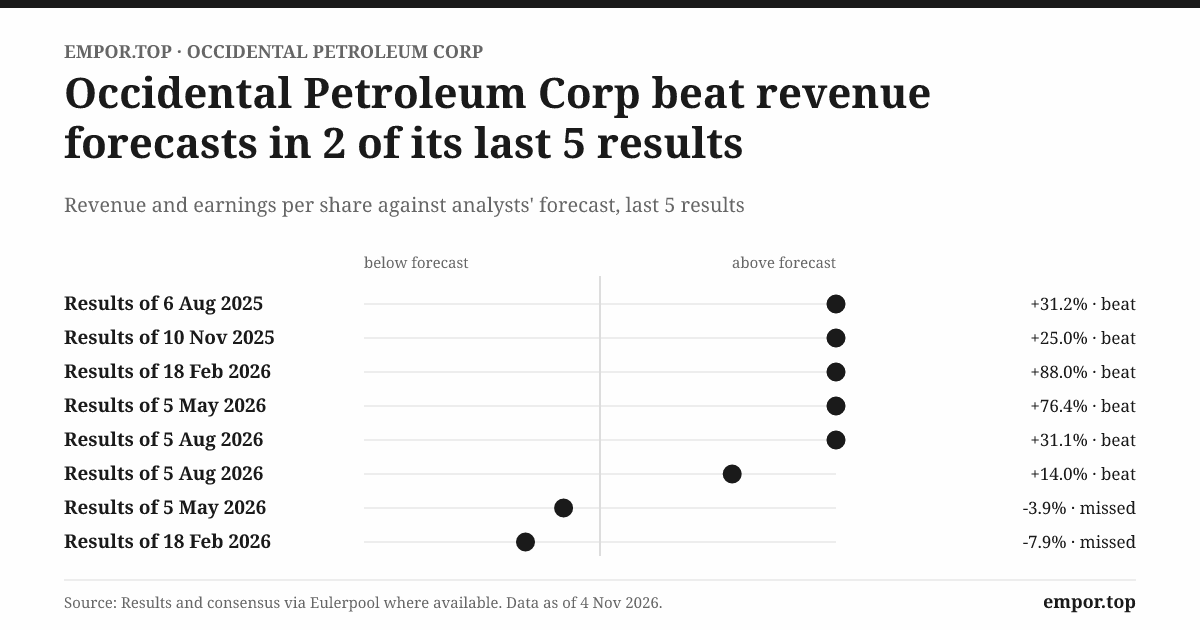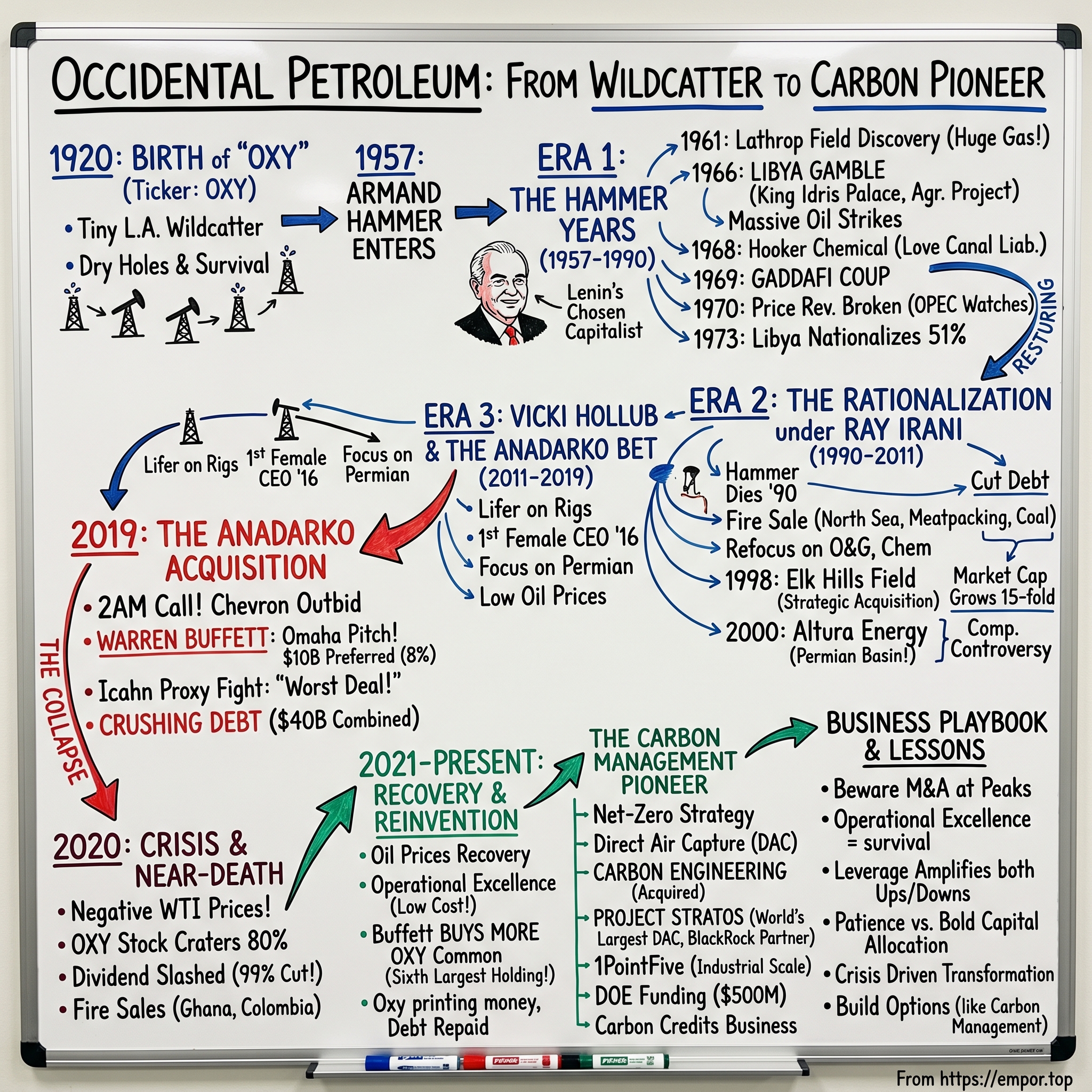
Occidental Petroleum: The Price of Getting Bigger
I. The $76 Bid That Changed Oxy
In the spring of 2019, the biggest oil deal of the year looked finished. On April 12, Chevron announced that it would buy Anadarko Petroleum for $65 a share, a signed agreement with a $1 billion break fee attached and the full weight of one of the world's largest oil companies behind it.1 Anadarko owned some of the most coveted acreage in the Delaware Basin of West Texas and New Mexico, along with a deepwater business in the Gulf of Mexico, a liquefied natural gas project in Mozambique and a controlling interest in a pipeline partnership. For Chevron it was a bolt-on. For a smaller company that had been courting Anadarko for months, it was the end of a plan.
Occidental Petroleum refused to accept that ending. A day before Chevron's announcement, Oxy had already offered $76 a share, and after Anadarko's board chose Chevron anyway, Vicki Hollub's team came back with a revised proposal on April 24: still $76, but now half in cash rather than 40%, a deal Oxy valued at $57 billion including Anadarko's net debt and minority interests.1 Then it went looking for the money to make the cash credible. Within a week it had a $10 billion commitment from Warren Buffett's Berkshire Hathaway, and within two weeks it had agreed to sell Anadarko's African assets to Total for $8.8 billion.2 On May 9, Chevron declined to raise its bid, and Anadarko signed with Occidental instead. The final terms were $59 in cash plus 0.2934 of an Oxy share for each Anadarko share.2
Measured by what Anadarko's owners actually received, the gap between the two offers was large. Anadarko's own merger proxy put the value of Oxy's consideration at roughly 24% more than the implied value of Chevron's offer, and about 64% above the price where Anadarko's shares had traded before the bidding war broke out.3 That is the scene this story keeps returning to: a mid-sized American producer outbidding a supermajor by almost a quarter, borrowing heavily to do it, and inviting the most famous investor alive to sit in the middle of its capital structure.
A word on the headline number, because it has hardened into shorthand. The deal was announced as a $57 billion transaction including the debt Oxy would assume, and by completion its value had drifted closer to $55 billion as Oxy's share price moved.24 It was never a $55 billion cash purchase. Most of the "transaction value" was Anadarko's existing debt and other obligations, which Oxy took onto its own balance sheet, plus new borrowing to fund the cash portion. That distinction matters, because the debt is what made the next six years of Occidental's history so hard.
The story that follows is really four questions wrapped around that bid. The first is what makes Oxy's oil and gas business competitive at all in an industry where nobody controls the price of the product. The second is whether Anadarko, and the CrownRock purchase that came four years later, earned what Oxy paid for them. The third is whether the long campaign of debt reduction has actually restored the company's financial flexibility. And the fourth is whether carbon capture, the bet that has made Oxy unusual among its peers, can become a business rather than a slogan.
The stakes are clearer in late 2026 than at any time since the deal closed. Occidental has sold its chemicals business, OxyChem, to the same Berkshire Hathaway that helped finance Anadarko.5 Principal debt stood at $11.8 billion at the end of June 2026, down from roughly $40 billion of borrowings at the end of 2019.54 And on June 1, 2026, Hollub handed the chief executive role to Richard Jackson, a 23-year Occidental veteran who now inherits both the assets she bought and the bill she ran up buying them.6
So the question worth asking is not whether Occidental won Anadarko. It plainly did. The question is whether winning turned out to be worth it, or whether the price of winning became the company's next crisis. To answer it, the story has to start much earlier, with a small Los Angeles oil company and an art collector who arrived to rescue it.
 Subscribe on LinkedIn
II. From a Small California Driller to Hammer's Oxy
Occidental Petroleum was founded in California in 1920, and for most of its first four decades it was the kind of company that the oil industry produces by the thousand: small, local, and permanently one dry hole away from irrelevance.7 It did not have the refineries of the Standard Oil successors or the international concessions of the majors. It had a handful of wells around Los Angeles and not much else.
The man who changed that did not come from the oil patch at all. Armand Hammer was a physician by training and a deal-maker by temperament, a figure who had already spent years trading with the Soviet Union and building fortunes in businesses from pencils to whiskey to art. In 1956, he and his wife Frances each put $50,000 into two Occidental wells in California.7 The wells came in, the investment grew into a stake, and by July 1957 Hammer was running the company as its president.7 He would lead it for more than three decades, until his death on December 10, 1990, at the age of 92.7
Hammer's first real breakthrough came from stubbornness underground. In 1961, Oxy drilled to about 6,900 feet in the Lathrop area near San Francisco, deeper than the roughly 5,600 feet where other operators had stopped, and found one of the largest natural gas fields in California's history.7 It is a small story with a theme that runs through the whole company: the advantage in this business often belongs to whoever is willing to push past where others quit, in depth, in geology or in price.
Libya made Occidental global. In 1966, competing against far larger companies for concessions, Oxy found a field described as holding a billion barrels of oil.7 Almost overnight, a California driller became a significant international producer. The same success exposed the company to a different kind of risk. After the 1969 coup brought Muammar Qaddafi to power, Libya pressed for higher payments, and in late 1970 Hammer agreed to an immediate increase of 30 cents a barrel, with a further ten cents phased in over five years.7 Oxy's concession sat at the mercy of a government that could change the terms whenever it chose, and Hammer's concession to Tripoli helped open the way for producing countries to rewrite their bargains with Western oil companies across the region. Oxy eventually left Libya in 1986 under U.S. sanctions, while producing about 45,000 barrels a day from three fields, and returned in 2005 on far less generous terms that handed up to 89% of what it found to Libya.7 Resource access brought growth. It also brought political exposure that no amount of engineering could manage away.
Hammer also gave the company a second leg. In 1968, Oxy bought Hooker Chemical, the business that would eventually become OxyChem.7 Chemicals diversified the earnings, because a company making chlorine, caustic soda and plastics does not live or die by the oil price alone. But Hooker also carried a past. It had disposed of more than 21,000 tons of chemicals at Love Canal in Niagara Falls, New York, in the 1940s and 1950s, and in 1988 Occidental was found liable for the cleanup.7 Environmental liabilities from the chemical business would follow Occidental for decades, and, as this story will show, they followed it even after the chemicals business itself was sold.
What survives from the Hammer era is less a set of assets than an appetite. Hammer built Occidental by doing deals other people thought were too risky, in places other people thought were too difficult. His successors inherited a company comfortable with scale and international complexity, and comfortable with acquisitions as a way to get there. Through the 2000s and 2010s, Oxy built a large position in the Permian Basin and in enhanced oil recovery, injecting carbon dioxide into old fields to squeeze out more crude, a skill that would matter enormously later. It also developed businesses in Oman, Qatar and the United Arab Emirates.
That history leaves a recurring question for the modern company. Would Occidental build its way to scale, well by well and acre by acre, or would it buy scale, paying a premium to someone else for the privilege? The answer in 2019 was unambiguous. To judge whether it was the right answer, though, it helps to understand exactly what Occidental sells, who pays for it, and what, if anything, the company controls.
III. The Business Is Paid in Commodity Prices
Picture a single well pad in the Permian Basin. A horizontal well runs two miles sideways through rock that was once the floor of an ancient sea. What comes up is a mixture: crude oil, natural gas, and natural gas liquids such as ethane and propane, which are separated and sold into different markets. Every barrel is sold at a price that someone else sets, in a market where a barrel from Oxy is chemically almost indistinguishable from a barrel from its neighbor. The well's value depends on three things only: the market price on the day the product is sold, how much the well produces over its life, and what it costs to drill it, run it and get its output to a buyer.
That is the whole revenue model in miniature. Occidental earns most of its money from producing and selling oil, natural gas liquids and gas, and the prices in its contracts are generally indexed to market benchmarks.8 Contracts can run from a month to a year or longer, but they are not subscriptions in any meaningful sense. Revenue rises and falls with commodity prices, with production, and with whether pipelines and processing plants have room to move the product.8 No single customer accounted for more than 10% of revenue, and the company reported no unusual customer credit terms or major customer losses.8 Buyers do not have leverage because they are concentrated. They have leverage because a barrel of oil can be bought from thousands of sellers.
The pricing dynamic can be brutal in ways that a stock chart hides. In the second quarter of 2026, Oxy realized nearly $97 a barrel for its oil, up 38% from the first quarter, yet its domestic natural gas sold at a negative price, minus $1.48 per thousand cubic feet.9 In parts of West Texas, gas is a byproduct of drilling for oil, and when pipeline capacity runs short, producers can end up paying to have it taken away. A company with a world-class position in the basin still could not escape that.
The Shape of the Machine
The proportions of the business explain almost everything about its economics. In 2025, the last year that still included chemicals, the oil and gas segment generated about $20.9 billion in sales and $4.6 billion in segment income.8 Midstream and marketing, the business of gathering, processing, transporting and selling oil and gas, reported about $1.3 billion in sales and only $252 million in segment income.8 OxyChem was still in the 2025 results but was sold at the start of 2026, so the company that exists today is essentially the oil and gas segment plus the plumbing that supports it.5
Where does Oxy sit in its industry? It is one of the largest oil producers in the United States, producing about 1.43 million barrels of oil equivalent a day in 2025.8 But it is not a supermajor. Exxon Mobil and Chevron have far larger integrated portfolios, with refineries and chemicals plants that can partly offset swings in crude prices. ConocoPhillips is the cleaner comparison for an independent producer with global operations, and Permian specialists such as Diamondback show what pure upstream economics look like in the same rock. Oxy's position is distinctive in one respect: it pairs a huge Permian footprint with decades of experience in enhanced oil recovery. None of that, however, gives it customer lock-in. Nobody buys Oxy's oil because it is Oxy's.
So what does Oxy control? Costs, recovery and capital. The cleanest evidence of operational improvement is lease operating expense, the cost of keeping wells running once they are drilled. It fell from about $10.48 per barrel of oil equivalent in 2023 to $8.94 in 2025, a decline of roughly 15% at a time when the oilfield was still digesting inflation.8 By the second quarter of 2026 domestic lease costs had dropped to $7.80 a barrel, about 6% better than the company's own guidance, though management guided the third quarter back up to $8.75 and kept a full-year figure of $8.10, citing higher carbon dioxide costs as oil prices rose.10 The company also reports reserve replacement above 100% every year since 2016, meaning it has added at least as many proved barrels as it has produced.11
Those are real accomplishments, but they need to be read carefully. Lower cost per barrel is a concrete improvement. Reserve replacement shows the company has not been shrinking its resource base. Neither proves that the replacement was economical: a company can replace every barrel it produces and still destroy value if it pays too much for the new ones, whether by drilling expensive wells or buying a rival at a premium. Oxy has improved as an operator, but these figures do not prove that its advantages produce returns above its peers across a full cycle.
Midstream and marketing deserves a sentence of its own because it can confuse anyone reading Oxy's quarterly numbers. The segment moves and sells Oxy's production and can capture margin from logistics, storage and timing differences between markets. It also swings wildly. In the second quarter of 2026 it earned about $1.3 billion before tax, after a pre-tax loss of $87 million just one quarter earlier.9 A segment that can swing by more than a billion dollars in three months is better understood as a trading and logistics adjunct than as a stable earnings stream. Its job is to make sure Oxy's barrels reach buyers; its profits are a bonus that cannot be relied on.
Profit and Cash Tell Different Stories
There is one more feature of this business that a newcomer needs to grasp before any of the deals make sense. Over the twelve years from 2014 to 2025, Occidental reported cumulative net profit of only about $7.8 billion. Over the same period, it generated about $103 billion in cash from operations.84 That is not an accounting trick. It reflects the physics of the industry. When an oil company drills a well, it spends the money up front and then writes that spending down over the well's life as depreciation, depletion and amortization. In 2025 alone, those noncash charges were about $7.5 billion.8 Add years of impairments, when falling prices forced write-downs of asset values, and reported profit can look meager even while cash pours in.
The catch is that most of that cash has to go straight back into the ground. Over the same twelve years, after capital spending, Oxy produced about $41.7 billion of free cash flow, and it paid out about $22.4 billion of that as dividends, more than half.84 Cash and short-term investments actually ended the period about $1.4 billion lower than where they began. The rest of the free cash, and a great deal of borrowed money, went into acquisitions and debt repayment. In other words, Occidental's cash engine is large but not loose. Continuing capital spending ran between roughly $5.7 billion and $6.4 billion a year from 2023 to 2025, around a quarter to nearly a third of sales.8 This is a business that must keep reinvesting just to stand still, because shale wells decline quickly after their first year.
It is also a business run by a relatively small workforce for its size. Occidental had about 10,412 employees in its continuing operations at the end of 2025, excluding OxyChem, which means each employee stands behind well over a hundred barrels of daily production.8 Exploration spending, the money spent hunting for new resources rather than developing known ones, fell from about $441 million in 2023 to about $249 million in 2025, a sign that the company now finds most of its growth in acreage it already owns or buys, rather than in wildcat discoveries of the kind Hammer once chased in Libya.8 Currency is barely a factor: the company treats the U.S. dollar as the functional currency for its international oil and gas operations, and exchange-rate gains and losses were not material.8 The only exposure that really matters is the one printed on every oil trader's screen.
Put those pieces together and Oxy's edge comes into focus. It is operational and geographic: large, connected acreage, deep subsurface experience and supporting infrastructure that can lower costs and lift recovery. Its weakness is structural: it sells a product priced by the world, so its returns move with a cycle it cannot influence. If scale and Permian access are the source of advantage, the obvious strategic move is to get more of them. The harder question is how much a company should pay to do it. In 2019, Occidental gave its answer.
IV. Anadarko: A Premium Bid, a Leveraged Company
The board meeting that mattered most in Occidental's modern history was about a deal someone else had already signed. The Chevron agreement left Oxy's directors to decide whether to concede or return with a bid big enough to make Anadarko's board pay the $1 billion break fee and switch partners.1
They chose to fight, and Vicki Hollub led the charge. She had become chief executive in 2016, after joining the board in 2015, and she was not a financier by instinct but an operator who thought in terms of rock, rigs and acreage maps.6 She believed Anadarko's Delaware Basin acreage sat next to Oxy's own and could be developed far more efficiently as one block. Larger contiguous acreage means longer horizontal wells, shared roads, water lines and processing, and fewer boundaries where two companies have to negotiate who drills what. That was the industrial logic. The financial logic was harder.
The first move was to reshape the offer. The revised April 24 proposal shifted more of the $76 offer to cash, and the final agreement in May tilted further still.12 Cash was more certain for Anadarko's shareholders, who would not have to trust Oxy's share price. For Oxy's own shareholders, it meant fewer new shares but far more debt. To make that cash believable, Oxy assembled an elaborate funding stack: committed bank financing, new bonds and term loans, the $8.8 billion sale of Anadarko's African assets to Total, and Berkshire Hathaway's $10 billion.12
The Berkshire money was the piece that drew the headlines. Buffett did not buy common stock. He bought $10 billion of cumulative perpetual preferred shares paying an 8% annual dividend, plus warrants to buy up to 80 million Oxy common shares at $62.50 each.4 Think of it as an expensive insurance policy for deal certainty. Eight percent a year on $10 billion was $800 million annually, every year, ahead of any dividend to common shareholders. The warrants meant that if Oxy's stock recovered, Berkshire would share in the upside too. Berkshire got a high fixed return and a free option on success. Common shareholders got the deal.
What did Oxy promise in return? Management forecast $3.5 billion a year of free-cash-flow improvement, made up of $2 billion in cost synergies and $1.5 billion in lower capital spending, all to be achieved by 2021.12 Combined production would exceed 1.4 million barrels of oil equivalent a day.1 Oxy also planned $10 billion to $15 billion of divestitures within 12 to 24 months, of which the Total sale accounted for $8.8 billion.2 Those numbers are claims, not facts, and the right way to test them is to see what happened to the cash flow and the debt afterwards.
The balance sheet tells that story in one line. Occidental's borrowings were about $10.3 billion at the end of 2018. A year later, after closing Anadarko in August 2019, they were about $40 billion, nearly four times as much.4 Total assets roughly two and a half times larger, from about $44 billion to $107 billion, show how much bigger the company became. But the debt grew faster than the company, and debt-to-equity rose from below 0.5 to about 1.2.4 Equity rose too, partly because of the stock issued to Anadarko holders, yet it would be wiped down sharply within a year.
How should anyone benchmark the premium? The honest comparison is the one Anadarko's board faced: Chevron's signed offer. Against that, Oxy paid about a quarter more.3 It is tempting to argue that the African asset sale or later divestitures "proved" the valuation, because Oxy recovered billions selling pieces it did not want. That argument does not hold. Selling assets at fair value returns money; it does not show that the original price for the whole was fair. Nor should the $57 billion "transaction value" be confused with what Oxy paid for Anadarko's equity. It bundled in debt that Oxy assumed and had to service.
There is a fair case for the deal as a strategic move. Anadarko's Delaware acreage and its Gulf of Mexico platforms produced barrels that Oxy has run efficiently ever since, and in 2026, the Permian remains the core of the company, producing more than 800,000 barrels of oil equivalent a day in the second quarter.10 The assets were useful. Usefulness, however, is not the same as earning the price, and the price came with a financing structure that left almost no margin for error. Hollub had bought scale at the top of a bidding contest, with borrowed money and an 8% preferred coupon. Then, a few months later, the oil market fell away.
V. The Pandemic Turns the Deal into a Survival Test
In March 2020, Occidental's problem stopped being integration and became survival. Oil demand collapsed as economies closed, and a company that had just loaded its balance sheet with tens of billions of dollars of Anadarko-related debt found its revenue shrinking at the same time as its fixed obligations stayed exactly where they were.
The external shock and the internal choice need to be separated, because they are often blurred. Nobody at Oxy caused a global pandemic, and every oil producer suffered in 2020. What Oxy controlled was how much leverage it carried into the storm, and that followed directly from Anadarko and how it was financed. Chevron, the loser of the bidding war, entered 2020 with a far stronger balance sheet and none of Oxy's new obligations.
The response was swift and painful. In March, Oxy cut its quarterly dividend from $0.79 to $0.11, and by July it was paying a penny, a reduction that the company said lowered annual dividend outlays by about $2.9 billion.12 It paid two quarters of the Berkshire preferred dividend in common stock rather than cash, conserving about $400 million of liquidity.12 It cut capital spending, sold assets and later distributed warrants to its own common shareholders, a way of compensating them partly with paper for the cash they were no longer getting.128
The financial result for the year was the worst in the company's modern history. Occidental lost about $14.8 billion in 2020, much of it from impairments as lower price assumptions forced it to write down the value of assets it had just bought.12 Borrowings still stood at about $37.3 billion at year-end, only modestly below their 2019 peak, and debt-to-equity peaked at about 2.0 as losses ate into equity.12 The dividend tells the human side of the story for shareholders. Oxy paid out about $2.6 billion in 2019 and only $839 million in 2021.48 Investors who had held Oxy for its income discovered that its dividend was the first thing a leveraged balance sheet sacrificed.
Then oil recovered, and the cash engine described earlier did what it is designed to do. Operating cash flow rose from about $4 billion in 2020 to $16.8 billion in 2022.8 Borrowings fell to about $30 billion in 2021 and roughly $21 billion in 2022.8 In 2022, with oil prices high after Russia's invasion of Ukraine, Oxy earned about $13.2 billion and generated about $12.3 billion of free cash flow, numbers that briefly made the Anadarko deal look like a stroke of genius.8
That interpretation deserves scrutiny. The 2022 recovery was primarily the product of oil prices, not of synergies. The assets performed and the cost reductions were real, but the swing from a $14.8 billion loss to a $13.2 billion profit in two years was mostly the commodity cycle swinging back. The more telling fact is that the balance sheet did not return to its pre-deal shape. Even after the 2022 windfall, borrowings were roughly double their 2018 level.8
The dividend record is a useful clue here, though not a verdict. Over the past decade, Oxy has paid out anywhere from about 9% of net profit, in the boom year of 2022, to about 359%, in 2014, when it paid far more than it earned.8 The 2025 payout was about 67%.8 A payout ratio that swings that much is not a sign of a carefully calibrated policy; it is a sign that profits in this business swing faster than any board wants to move its dividend. The 2020 episode taught Oxy's shareholders that a dividend set in good times is only as safe as the balance sheet beneath it.
The episode also qualifies any later claim of capital discipline. Oxy survived, and the speed of its repair was impressive. But the survival was bought with dividend cuts, dilution through stock-paid preferred dividends and warrants, asset sales and a lot of luck from the 2021-2022 price rebound. By 2023, the company had worked its debt down to a level that looked manageable again. And then, having spent four years repairing the damage from one Permian acquisition, it decided to buy more Permian acreage.
VI. CrownRock: Buying the Midland Basin Again
On December 11, 2023, Occidental announced that it would buy CrownRock, a private Midland Basin producer backed by CrownQuest Operating and Lime Rock Partners, for about $12 billion.13 It came barely two months after Exxon Mobil agreed to buy Pioneer Natural Resources and in the middle of a consolidation wave that was sweeping the Permian. The pitch was familiar to anyone who remembered 2019: more acreage, next to acreage Oxy already understood, at a price management said would pay for itself quickly.
Management's case had three parts. CrownRock brought about 1,700 undeveloped drilling locations, which Oxy said would increase its inventory of Permian wells that break even below $40 a barrel by about a third.13 It brought roughly 170,000 barrels of oil equivalent a day of production and about 94,000 net acres.1314 And Oxy said it would add about $1 billion of free cash flow in the first year, assuming $70 oil.13 Each of those claims has a weakness worth noting. Breakeven inventory is a company estimate that depends on its own cost assumptions. Free-cash-flow accretion at $70 oil is a statement about the oil price as much as about the asset. And locations are only valuable if they are drilled at costs that leave a return after paying for the acquisition.
What Oxy paid, and how, matters more than the headline. At closing, in August 2024, the total consideration was about $12.4 billion: about $9.4 billion in cash, 29.6 million new Oxy shares and $1.2 billion of CrownRock debt that Oxy assumed.14 To fund the cash, Oxy raised about $9.7 billion of new debt.14 The stock component was worth about $1.8 billion.8 So, once again, most of the purchase was funded by borrowing. Oxy's total borrowings climbed from about $20.9 billion at the end of 2023 to about $27.1 billion a year later, undoing much of the progress it had made since the pandemic.8 The company paired the deal with plans to sell assets to bring the debt back down, and the debt raised to buy CrownRock helps explain why so much of the later OxyChem sale proceeds were earmarked for repayment.15
There is a subtle point here about how the market judged the deal. Oxy chose not to fund CrownRock mainly with stock, even though its own shares were a natural currency. The company did not frame its choice this way, but the trade-off was plain: issuing many more shares, with warrants from 2019 and 2020 still outstanding, would have spread future cash flow across many more owners. Borrowing kept the share count lower but pushed risk back onto the balance sheet. It was the same trade-off Oxy had made in 2019, at a smaller scale and with a stronger starting position. Whether it was right depends on which outcome proves more expensive: lasting dilution, or debt that can be repaid if oil prices cooperate.
How does that price compare with its peers? Exxon's Pioneer deal, announced in October 2023, was an all-stock transaction valued at about $59.5 billion, or about $64.5 billion including net debt, and it would more than double Exxon's Permian production to about 1.3 million barrels of oil equivalent a day.16 On the crudest measure, price per flowing barrel, CrownRock cost Oxy roughly $73,000 for each daily barrel of production, in the same broad range as the large Permian deals of that period. That comparison is only a scale check. Basin mix, the depth of remaining inventory, synergies and, crucially, financing all differ. Exxon paid with its own highly valued shares and added no debt. Oxy paid mostly with borrowed money. Two acquisitions at similar multiples can have very different consequences when one buyer is already carrying a heavy debt load.
What happened after closing? The production contribution was real. Company output rose by about 8% in 2025, partly because CrownRock contributed a full year of volumes.8 Permian oil production climbed from about 337,000 barrels a day in 2023 to about 416,000 in 2025.8 On the operating side, the deal delivered barrels.
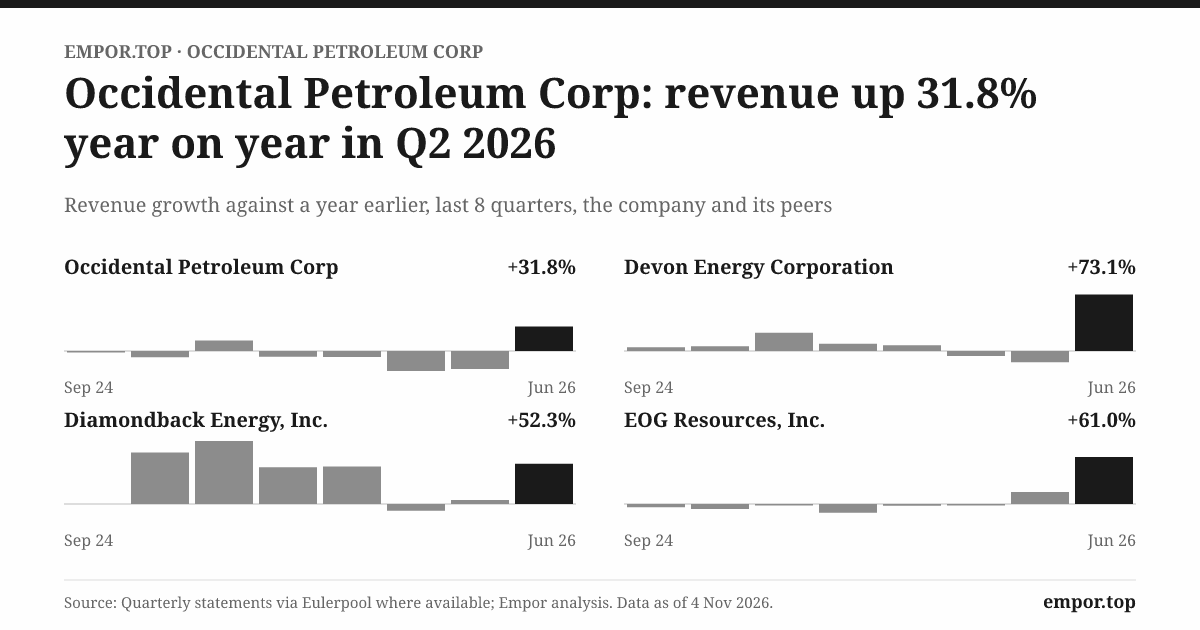
The financial picture is less clear. Occidental's revenue in 2025 was about $21.6 billion, down from about $36.3 billion in 2022, and its free cash flow was about $4.1 billion, against about $12.3 billion in 2022.8 That drop mostly reflects lower oil and gas prices, so it is not a verdict on CrownRock. But it means the company's larger asset base did not produce a larger cash stream in the years after the acquisition. More barrels at lower prices left Oxy in roughly the same place, with more debt to service.
The honest conclusion is provisional. CrownRock added contiguous Midland Basin acreage and production that fit Oxy's operating model. Whether it created value depends on returns from the acquired inventory over many years and on cash generation after financing costs, and Occidental does not disclose CrownRock's standalone results or realized returns. Claiming the deal was a success on today's evidence would be like declaring a wine vintage great before the bottles are opened. What can be said is that Oxy repeated the pattern: buy Permian scale with debt, then sell assets and repay. That pattern is now Richard Jackson's to manage, at a moment when the company's stated priority is debt, cash and returns rather than another acquisition.
VII. The Permian Edge: Scale Without Pricing Power
Imagine an Oxy development plan laid over a map of the Delaware Basin. Rather than drilling one well at a time, engineers plan a dozen or more wells from shared pads, stacked across several layers of rock, sharing roads, water pipelines, electrical lines and gathering systems. Each design choice, from how far apart to space the wells to which layers to target first, determines how much oil each dollar of capital will release. This is where Oxy's claim to competitive advantage lives: not in the oil, which anyone can sell, but in the plan.
Start with the structure of the industry, because it limits every claim of advantage. Benchmark oil prices are shaped by global supply and demand, including decisions by OPEC and its allies, and by the geopolitics of producing regions. U.S. shale producers are price-takers who respond through how fast they drill, how they manage the decline of existing wells and where they spend capital. That leaves Oxy a price-taker.
Within those limits, Oxy has scale. In 2025 it spent roughly $5.7 billion of capital on oil and gas.8 Richard Jackson told analysts in August 2026 that the company held about 16.5 billion barrels of oil equivalent of total resources, about 88% of it in the United States, and described "more than a 30-year low-cost development runway."10 He also cited drilling improvements, saying Oxy was "almost 50% better" in well delivery per rig, and highlighted carbon dioxide flood pilots showing more than 45% uplift in estimated ultimate recovery.10 These are management's figures, and the resource number is a broad internal estimate rather than proved reserves. They are worth recording, but they are claims to be tested.
The geography of that production says a lot about where the advantage sits. In the second quarter of 2026, the Permian supplied about 804,000 barrels of oil equivalent a day, more than half the company's total; the Gulf of Mexico, which the company now calls the Gulf of America, added about 144,000; the Rockies and other U.S. regions about 280,000; and Al Hosn, the sour-gas venture in Abu Dhabi, about 74,000.10 Oxy is, in effect, a Permian company with a deepwater business, a Rockies business inherited largely from Anadarko and a set of Middle East partnerships. The diversity helps at the margin. Management said in the same call that waterflooding in Oman had cut the field's decline rate from about 19% to around 7%, and that wells in the Powder River Basin of Wyoming were producing about 41% more oil in their first six months than the industry average.10 Those are the kinds of claims that, if sustained, distinguish a skilled operator from a merely large one.
The deeper economic lever is decline. A shale well can lose most of its initial output within a couple of years, which means a producer has to keep drilling just to hold volumes flat, like a person walking up a down escalator. Management said its base decline rate was about 25% and that it aimed to bring it down to about 20% by 2030, mostly through enhanced recovery and a larger share of slower-declining conventional assets.10 Every percentage point matters, because it shrinks the capital needed simply to stand still. The company put its 2027 starting capital budget at about $5.9 billion for roughly flat production, and said it wanted sustaining capital to fall to about $4.5 billion by 2030.10 If that happens, more of each year's cash flow becomes genuinely free. If it does not, the escalator keeps winning.
How does the operating position compare with competitors? Exxon Mobil and Chevron have larger and more diversified portfolios, and their downstream businesses partly cushion them from crude price swings, which makes simple margin comparisons misleading. Diamondback, a Permian pure play, offers a cleaner comparison for upstream efficiency, but its acreage mix and lack of international and chemicals exposure make the comparison imperfect. What can be said is that Oxy is among the largest Permian operators, with a distinctive capability in carbon dioxide enhanced oil recovery, supported by its own midstream network and a stake in Western Midstream, the pipeline partnership inherited with Anadarko.8
When the Cycle Turns, Where Does the Edge Go?
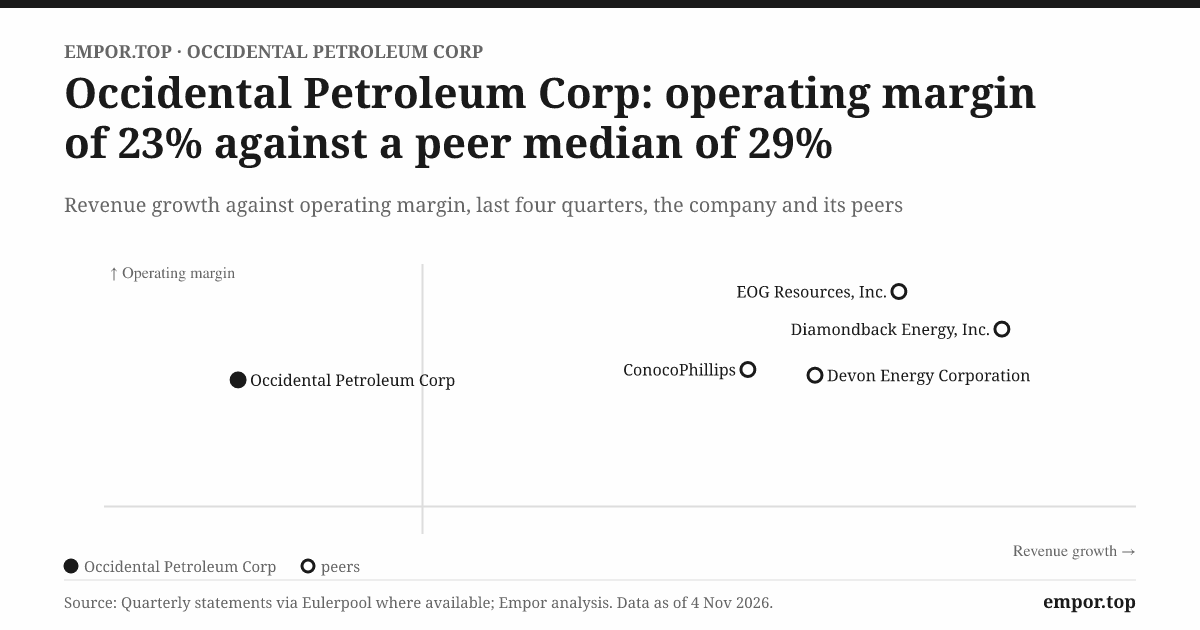
Now the test that matters. If Oxy's scale and operating skill were a durable advantage, returns on capital should hold up reasonably well when prices fall. They did not. Return on invested capital was about 25% in 2022 and about 4% in 2025.8 Some of that decline is the denominator: Oxy added billions of dollars of acquired assets with CrownRock, which raised the capital base. Most of it is the numerator: lower oil and gas prices cut operating profit. Either way, the record shows a company whose returns move largely with the commodity cycle. In 2025, operating margin was about 17%, compared with about 37% in 2022.8 Capital spending, meanwhile, stayed large.
So the evidence narrows the claim of a moat to something smaller and more defensible. Oxy has a cost and resource position: large, contiguous acreage, improving cost per barrel and a record of replacing reserves. It does not have an unassailable moat, because buyers can always find other barrels, production is capital intensive, and nothing in its disclosures shows customer lock-in or the ability to set prices. The advantage is real but cyclical, and it must be re-earned every year through execution.
Three measures will show whether the advantage is holding. The first is production and reserve replacement, which tests whether the resource base is being sustained without another large acquisition; production was about 1.433 million barrels of oil equivalent a day in the second quarter of 2026, above guidance.9 The second is cost per barrel, which tests whether operating improvements are real and lasting; the second-quarter figure was below guidance, though management guided higher for later quarters.10 The third is free cash flow from continuing operations after capital spending, which tests whether the barrels actually earn their capital; in the second quarter of 2026 it reached about $3.0 billion before working capital, the highest since the third quarter of 2022, at oil prices that were unusually high.9 Those measures are the scoreboard. The next chapter, though, is about a decision that changed what the scoreboard measures: the sale of OxyChem.
VIII. OxyChem Leaves: A Berkshire Deal and a More Concentrated Oxy
On January 2, 2026, Occidental completed the sale of OxyChem to Berkshire Hathaway.5 The buyer was Oxy's largest shareholder and the financier that had underwritten the Anadarko deal six years earlier. In one transaction, the company that Armand Hammer had diversified with Hooker Chemical in 1968 became, essentially, an oil and gas producer again.
The economics were straightforward. Berkshire paid $9.7 billion in cash.15 At the announcement in October 2025, Occidental earmarked about $6.5 billion of the proceeds for debt repayment.15 The company estimated an after-tax gain of about $3.2 billion on the sale, and OxyChem's results were reclassified as discontinued operations.8 That accounting break matters for anyone looking at the numbers. Occidental's 2025 results still include OxyChem, while 2026 continuing-operations results exclude it. Comparing the two as if the portfolio were unchanged is a mistake, and it is particularly misleading in the first quarter of 2026, when the sale gain inflated reported net profit to about $3.3 billion.8
Why does the sale matter beyond the cash? Because it changed the character of the company. OxyChem produced chlorine, caustic soda and polyvinyl chloride, businesses with their own cycles that do not move in lockstep with crude. In years when oil fell, chemicals sometimes helped. Selling it reduced Oxy's debt but also removed its only meaningful earnings stream that was not directly tied to oil and gas prices. Shareholders now own a more concentrated bet.
Berkshire's role deserves scrutiny, because it is unusual. According to the 2026 proxy statement, Warren Buffett and affiliated entities beneficially owned 264.9 million Oxy common shares plus warrants for another 83.9 million, or about 32% on the proxy's diluted basis.17 Berkshire's common stake alone was about 28% of the shares.8 Dodge & Cox and Vanguard each owned about 8%.17 Berkshire is a large minority owner, not a disclosed controlling shareholder. But it has been, in sequence, the preferred investor that made Anadarko possible, the largest common shareholder, and the purchaser of the chemicals business. A skeptic might ask whether a company so intertwined with one investor is negotiating with it at arm's length. The proxy says the governance committee assesses whether related-party terms are no less favorable than those available from unaffiliated parties.17 The $9.7 billion price was all cash, which removed financing uncertainty, but outsiders cannot independently confirm whether another buyer would have paid more.
The related-party flows in Oxy's 2025 accounts are easy to misread, and they are not primarily about Berkshire. Related-party sales were about $128 million, roughly 0.6% of net sales, while related-party service charges were about $1.5 billion, or about 7% of revenue.8 Those service charges were mostly gathering, processing and treating fees paid to Western Midstream, the pipeline partnership in which Oxy holds a large stake.8 They represent the cost of moving Oxy's own production through infrastructure it partly owns, not a large share of product revenue flowing to Berkshire.
There is also something Occidental kept. The company retained legacy OxyChem environmental remediation and indemnification obligations after the sale.8 At the end of 2025, Occidental carried about $1.87 billion of environmental remediation liabilities across 152 sites, and about $1.67 billion of that related to discontinued operations, which is to say mostly the chemicals legacy.8 Love Canal's shadow, in other words, did not leave with the business. Berkshire bought the plants; Oxy kept much of the history.
The strategic trade-off is clear. A pure oil and gas company is easier for investors to value, and the sale accelerated the debt repayment that Oxy had been pursuing since 2019. But a cleaner company is also more exposed to commodity prices, with less to fall back on in a downturn. That trade-off landed on the desk of a new chief executive within months.
IX. Richard Jackson Inherits the Debt and the Promises
On June 1, 2026, Richard Jackson became Occidental's president and chief executive.6 He was not an outsider brought in to shake things up. He had joined Oxy in 2003 in its Middle East operations and worked his way through roles that read like a tour of the company: vice president of drilling for the Americas, vice president of investor relations, general manager of the Permian Delaware Basin and enhanced oil recovery business, president of low-carbon integrated technologies, president of U.S. onshore oil and gas, and finally chief operating officer.6 Few CEOs arrive knowing the rocks, the investors and the carbon capture strategy from the inside. That is an advantage. It also means he was part of the leadership team that made the Anadarko and CrownRock decisions he now has to make good.
Vicki Hollub's era deserves a fair summary. She led Occidental through the Anadarko bidding war, the pandemic collapse and recovery, the CrownRock purchase and the OxyChem sale, and she remains on the board after retirement.6 Her reported compensation was about $18.1 million in 2025, though the proxy's measure of compensation actually paid, which reflects changes in the value of equity awards, was about $11.3 million.17 Say-on-pay support was about 94% in 2025, and nine of ten director nominees were independent.17 Shareholders did not revolt against her pay or governance. But her legacy is defined by the large, debt-financed acquisitions at its center, and the jury is still out on whether they earned their price.
What Jackson inherits can be stated simply. He has a larger Permian position, a debt load that has fallen sharply but remains material, a Berkshire preferred stock that the company plans to redeem in August 2029, and a business now concentrated in oil and gas plus supporting midstream operations.10 Principal debt was about $13.3 billion at the time of the first-quarter 2026 call, and about $11.8 billion by the end of June, which the chief financial officer described as the lowest level since the second quarter of 2019.1110 Only about $414 million of debt matures through the end of 2029.10 Credit agencies noticed. At the end of June 2026, Oxy was rated Baa3 by Moody's, BBB by Fitch and BB+ by S&P, after Fitch upgraded the company in February 2026, citing accelerated debt reduction.518
How aligned is Jackson with ordinary shareholders? He beneficially owned 351,246 shares and equivalents in the 2026 proxy, made up of 250,060 common shares plus exercisable options and warrants, well under 1% of the company.17 The proxy requires the CEO to build holdings worth six times base salary within five years, and he received a $6 million restricted-stock grant on his promotion.17 The 2025 annual cash incentive included metrics such as spend per barrel and free cash flow before working capital, which at least point management at the right things.17 His incentive is tied to the share price, but he is too new in the role for anyone to judge his CEO-level record.
Jackson's First Call
The company's own history provides the scorecard against which Jackson will be measured. Free cash flow was about $4.1 billion in 2025, down from about $12.3 billion in 2022.8 Debt-to-equity improved from about 2.0 in 2020 to about 0.66 in 2025.8 The second figure shows the repair has worked. The first shows that the larger company is not yet generating more free cash than the smaller one did at its peak.
The second-quarter 2026 earnings call, Jackson's first as CEO, showed his priorities. Chief financial officer Sunil Mathew said the company's "immediate cash flow priority remains to reduce principal debt to $10 billion," after which the focus would shift to net debt.10 Jackson said reaching that target would cut annual interest costs by roughly $740 million compared with the previous year.10 The company raised its quarterly dividend by 8% to $0.28 a share.9 When analyst Doug Leggate of Wolfe Research pressed on the sequencing of buybacks, Mathew confirmed that debt reduction and building cash for the preferred redemption came first, and that "any continuous share buyback program will be a lower priority until the redemption of the preferred."10 Jackson added that the allocation toward net debt "provides the clearest path to increased value."10
The arithmetic behind that priority is worth spelling out, because it explains why the company is so focused on a round number. Mathew said net principal debt was about $7.6 billion after netting roughly $4.2 billion of cash, and that leverage had been about 1.9 times EBITDA in 2025 at $65 oil; at $10 billion of principal debt, he said, that ratio would be roughly halved on a normalized basis.10 He also said the go-forward interest run-rate was about $760 million a year, around $630 million lower than the interest Oxy paid in 2025.10 In plain terms, every billion dollars of debt repaid hands shareholders back a slice of cash that used to go to lenders, and that slice compounds year after year. It is the least glamorous path to higher free cash flow in the oil business, and the most certain one.
The same call showed management leaning, cautiously, toward efficiency rather than growth. Asked by Mizuho's Nitin Kumar about growth, Jackson said Oxy was "a bit biased to free cash flow in the near term," while Mathew said a moderate case of about 2% annual production growth could beat the baseline free cash flow by 2030.10 Mathew also said the company had already achieved about 7% well-cost efficiency in 2026, with a target of 12% by 2030.10 Notably, Mathew declined to set a new debt milestone beyond $10 billion, citing oil price volatility.10 That restraint is healthy. A company burned by over-promising has reason to make fewer promises.
The answers were concrete, which is to the team's credit. They also reveal the limits of the moment. Buybacks are on hold for years, because the company is still paying down obligations created in 2019. Management also offered ambitious medium-term targets: lowering sustaining capital spending to about $4.5 billion by 2030 and improving annual cash flow by more than $4 billion by 2030.10 Those are promises, and Oxy's record includes a promised $3.5 billion of Anadarko-driven free-cash-flow improvement that arrived alongside a balance-sheet crisis. Investors should treat the 2030 targets as hypotheses to check each year, not as facts.
The credibility issue is worth stating fairly. The transition was orderly, and Jackson's operating background is deep. But Oxy's recent history includes an expensive acquisition followed by a severe leverage repair, and then another large debt-funded acquisition. What would count as proof that the cycle has broken? Not an oil rally, and not one strong quarter at $90 crude. Proof would be through-cycle cash generation and returns on the acquired portfolio that hold up when prices fall. The other part of Jackson's inheritance is a bet that his own career shaped: carbon removal.
X. STRATOS: From Carbon-Capture Construction to Paying Customers
In the flat ranchland of Ector County in West Texas, Oxy's 1PointFive subsidiary has built STRATOS, a direct air capture plant designed to pull up to 500,000 tonnes of carbon dioxide out of the atmosphere each year once fully operational.19 Picture enormous banks of fans pushing ordinary air across a liquid that binds carbon dioxide, which is then separated, compressed and injected deep underground for long-term storage. It is chemistry at industrial scale, and it is expensive.
Why would an oil company build a machine that removes carbon from the air? Oxy's answer rests on capabilities it already has, including decades of carbon dioxide enhanced oil recovery in the Permian. If companies are willing to pay for verified carbon removal, Oxy believes it can sell it, and potentially use captured carbon in lower-carbon oil production. Jackson personally led the company's low-carbon technologies business before becoming CEO.6
Technical progress is real. STRATOS has a Class VI permit for carbon dioxide sequestration wells from U.S. regulators and is moving through start-up activity.1920 On the August 2026 call, Jackson said the project was moving "from development to operations," that non-technology repair and commissioning work on two of its processing trains was progressing, and that full plant commissioning should begin around year-end, with operations in 2027.10 But a permit is not production, and capacity is not revenue.
The customer evidence puts the project in scale. In January 2026, Bain & Company agreed to buy 9,000 metric tonnes of carbon removal credits from STRATOS over three years, its first purchase of direct air capture credits.20 That is about 3,000 tonnes a year against a facility designed for up to 500,000, well under 1% of capacity. The price was not disclosed.20 Oxy has announced other offtake arrangements over the years, but the company does not disclose the total contracted volume, the price per tonne or the cost of capture at STRATOS. Without those, nobody outside the company can tell whether the plant can make money.
Management's own investment signals help. Jackson said about $400 million of low-carbon ventures capital would roll off beginning in 2027 as STRATOS moved into operations, and Mathew's 2027 cash-flow bridge counted about $200 million from STRATOS capital falling away.10 That is a relief for free cash flow, and it suggests the company is not planning an immediate second large plant. It also shows how heavily the project has drawn on capital that otherwise could have gone to debt reduction or wells.
What would upgrade this from optionality to business? Reliable operating volumes, a disclosed cost per tonne, contracted offtake at prices that can be repeated, and a measurable contribution to cash flow. The wider risks run through economics. Direct air capture depends on government support and on corporate willingness to pay premium prices for removal credits, both of which can change. Project delays and further capital needs would compete with debt reduction and oil investment. For now, STRATOS is an engineering achievement and a modest commercial start, and it deserves to be valued as an option, not as an earnings engine.
XI. Playbook: Business & Investing Lessons
Go back to the spring of 2019, when Oxy's board decided to outbid Chevron. Seven years later, the company that bought its way into a higher production tier has spent most of the time since selling assets and paying down the financing that got it there. That journey leaves lessons that belong to Occidental.
The first is that in a commodity business, a premium paid at the top of a cycle has to be earned in every cycle that follows. Oxy paid a premium for Anadarko, and the 2020 collapse exposed the cost. A buyer of a branded consumer company can raise prices to recover an expensive acquisition. An oil producer cannot. It has to recover the premium through lower costs and higher volumes, under whatever prices the market gives it, year after year.
The second is that synergies are a forecast, but debt is a bill. The promised Anadarko synergies did not protect the balance sheet from the pandemic. Synergies can be real and still arrive too late to protect the balance sheet. The debt was due on schedule regardless.
The third is that scale only helps when the barrels earn their capital. CrownRock added production and drilling inventory, but returns on capital fell by 2025. Bigger is not better unless each new barrel earns more than it cost to acquire and develop.
The fourth is that a dividend can be either a promise or a constraint. Oxy's dividend proved vulnerable to leverage in 2020. A dividend that cannot survive a bad year is not a policy; it is a hostage to the balance sheet.
The fifth is that a permit is permission to try, not proof of a business. STRATOS remains an option until it operates reliably at a known cost with repeat buyers. Oxy's own history suggests a simple rule: take the barrels, take the operating improvements, and take management's forecasts with a discount sized to the debt behind them.
There is a wider lesson underneath all five, and it is the one founders and investors in any capital-intensive business should carry away. Occidental's assets were never the problem. Anadarko's Delaware acreage was good rock, CrownRock's Midland inventory was good rock, and OxyChem was a good business that Berkshire was happy to own outright. What turned good assets into a hard decade was the order of operations: paying first, financing second, and counting on the cycle to cooperate third. Buffett's preferred stock captured that perfectly. The most disciplined investor in the room did not bet on the synergies. He secured seniority and upside, and was paid either way. When the smartest money at the table chooses the senior security, the common shareholder should ask what it knows.
XII. Analysis & Bear vs. Bull Case
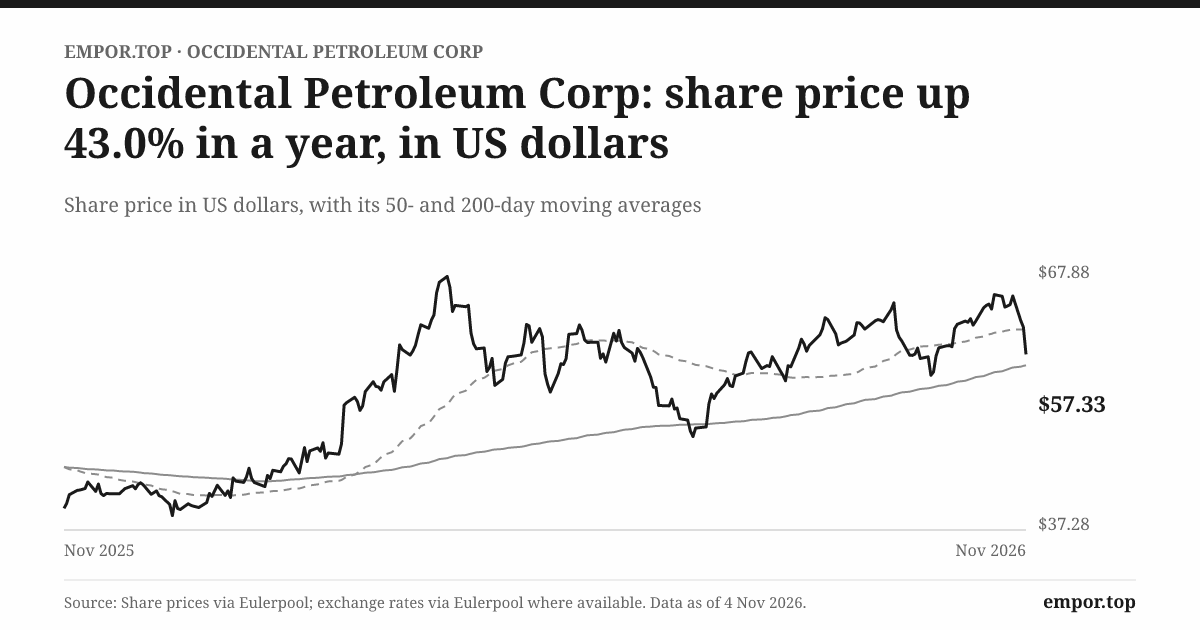
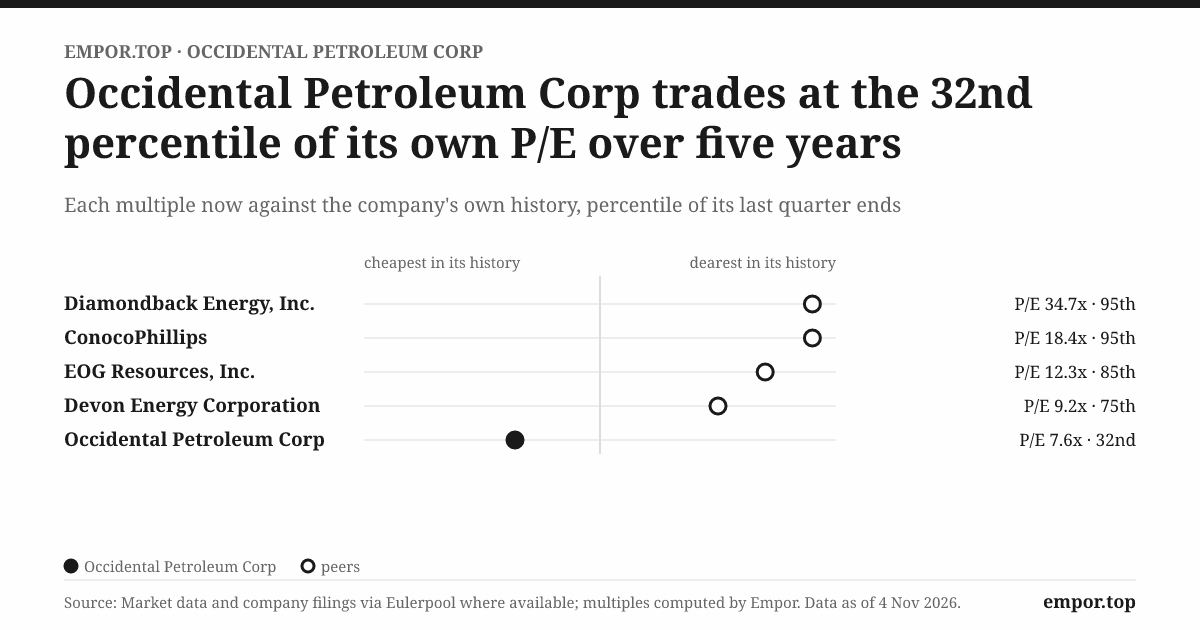
On October 30, 2026, Occidental's shares closed at about $62.86, giving the company a market value of about $60.8 billion and an enterprise value, including debt, of about $71.3 billion.21 The stock was about 5% below its 52-week high and well above its 52-week low near $39. On trailing earnings, it traded at about 8.4 times, compared with its own five-year median of about 11.3 times. Chevron, Exxon Mobil and ConocoPhillips each traded at more than twice that multiple on trailing earnings.
That gap looks dramatic, but it needs unpacking. Oxy's trailing earnings include the gain from the OxyChem sale in the first quarter of 2026 and a second quarter in which oil realized nearly $97 a barrel.9 Strip out the one-time gain, and the earnings base is considerably smaller; normalize oil prices, and it is smaller again. Revenue fell about 16% a year from 2022 to 2025, and return on invested capital fell from about 25% to about 4%.8 The low multiple may reflect a market that sees the trailing earnings as unrepresentative, or a market that sees Oxy as a more leveraged, more volatile producer than its larger peers. It does not, by itself, prove that the stock is cheap.
Good Rock in a Hard Industry
Start with Porter's five forces. Buyer power is substantial, not because customers are concentrated, since none exceeds 10% of revenue, but because oil and gas can be bought from thousands of producers at market-indexed prices.8 Supplier power is moderate: oilfield services costs move with the cycle and rose sharply in the inflation of 2022 and 2023. The threat of substitutes is long-term rather than immediate, through electrification and efficiency; it shapes long-term demand but does not change next year's price. Rivalry is intense, because every producer sells into the same market and competes for the same acreage, services and capital. New entrants face high capital barriers, but the Permian's many private operators show that entry is possible. The industry structure, in short, is unfavorable for pricing power and favorable only for low-cost producers with good rock.
Hamilton Helmer's seven powers sharpen the answer. Oxy has a form of economies of scale, through shared infrastructure, larger contiguous development units and procurement leverage, and lower lease operating costs per barrel show it in practice. It has a cornered resource, in a narrow sense: its acreage, and especially its carbon dioxide enhanced oil recovery positions, cannot be duplicated, although rivals have their own acreage that is often just as good. It has process power in its subsurface and carbon dioxide flood expertise, which is real but hard to measure from outside. It has no network effects, no switching costs, no brand power and no counter-positioning that would stop rivals from copying its strategy. Add it up and Oxy owns a cost and resource position, not a fortress.
The bull case builds on those powers. Oxy's Permian position, operating cost improvements and production scale can sustain competitive returns through the cycle. Principal debt has fallen to about $11.8 billion and is heading toward $10 billion, improving credit ratings and cutting interest costs.910 At normal oil prices, free cash flow could grow meaningfully as interest falls and STRATOS capital rolls off, and if management's 2030 targets are even partly achieved, the company could generate substantially more cash per share than today. The current free-cash-flow yield of about 8.7% offers a cushion if those improvements arrive.
The bear case starts with commodity prices, which dominate realization and are outside management's control. Return on invested capital and free cash flow remain well below 2022 levels, and the 2026 boost from high oil prices may not last; preliminary third-quarter figures showed oil realizations near $86, down from nearly $97 in the second quarter, and a third-party pipeline constraint and maintenance curtailed some Gulf of Mexico production in September.229 Debt and the preferred obligation still compete with dividends and reinvestment, and buybacks are explicitly a low priority until 2029.
Then there are the deals. Anadarko carried a large premium and left Oxy highly leveraged; CrownRock added contiguous assets, but its standalone returns are not disclosed. The right question is whether incremental free cash flow per share, not production alone, justifies the capital deployed. On that test, the evidence so far is incomplete. The portfolio change compounds the uncertainty. OxyChem's sale reduced debt but increased dependence on oil and gas, so investors should compare continuing-operations earnings with the prior consolidated base and exclude the disposal gain from any normalized figure. Carbon capture adds an option, but disclosed contracted volume is tiny relative to planned capacity and profitability is unproven.
The risk radar is specific to this company. Oil and gas prices, OPEC and non-OPEC supply decisions and geopolitical disruptions drive revenue; management said in August 2026 that domestic production had offset disruptions to its Middle East volumes.10 Pipeline availability affects realizations, as negative West Texas gas prices showed. Reserve estimates and impairment assumptions are judgment calls; the auditor's critical audit matter was the estimation of proved reserves used for depreciation.8 Permit timing, climate regulation and the retained OxyChem environmental liabilities add exposure. And there is a legal overhang worth naming: in a long-running tax dispute related to the Tronox litigation, the potential repayment of an $881 million tentative refund and roughly $500 million of related cash tax benefits, plus interest, totaled about $2.4 billion as of June 2026, with the tax court's opinion still pending.5
The right valuation discipline follows from all of this. The 8.4 times earnings multiple is below Oxy's history, but trailing earnings are distorted by commodity swings and the OxyChem gain. The cleaner tests are continuing-operations free cash flow, principal debt and return on invested capital. If those improve through a lower-price year, the discount may prove too steep. If they do not, the discount may be the market's way of pricing a business that remains more leveraged and more volatile than its peers.
The same three measures remain the clearest signal: continuing-operations free cash flow after capital spending,9 principal debt and preferred redemption funding,9 and production, cost per barrel and reserve replacement.910 Those three numbers will show whether Occidental is earning the returns its asset base promises.
XIII. Epilogue
Tonight, Richard Jackson faces the first full year of results after the OxyChem sale. The company will report its third-quarter numbers in the coming weeks, and its full-year 2026 results early next year, which will be the first clean look at what a pure oil and gas Occidental earns. STRATOS is heading toward full commissioning, and the $10 billion principal-debt milestone is within reach.
The preview Oxy published in mid-October offered a first glimpse of how quickly the backdrop can shift. Worldwide oil realizations in the third quarter were about $86 a barrel, roughly in line with West Texas Intermediate, and well below the second quarter's near-$97.22 Crude oil collar settlements, the hedges that protect the company against falling prices but cap its gains when prices rise, reduced operating cash flow before working capital by about $94 million.22 Gulf of Mexico sales volumes were estimated at about 110,000 barrels of oil equivalent a day, after a third-party gas pipeline constraint and maintenance forced curtailments in September, down from about 144,000 in the second quarter.2210 None of that is a crisis. It is a reminder that even a quarter in which total production stayed within guidance can carry a lower price, a hedging cost and an outage that nobody at Oxy controls. The full-year scoreboard will be built from quarters like that one.
The next proof points are easy to name. Full-year continuing-operations results, without the OxyChem gain, will show the real earnings base. The path to $10 billion of principal debt will show whether debt reduction continues when oil prices soften. And the funding plan for the August 2029 preferred redemption will show whether Oxy can finally clear the last obligation of the Anadarko financing without straining the balance sheet or delaying buybacks indefinitely.
Watch whether Jackson keeps those capital priorities through a weaker oil-price period. The test is not what management says when crude is near $90; it is what it does when crude is near $60. Watch, too, whether production and reserve replacement hold without another large acquisition. If Oxy can sustain its resource base through drilling and enhanced recovery rather than purchases, it will have broken the pattern that defined the Hollub era.
For carbon capture, the signals are operational and commercial. Start-up, utilization, cost per tonne and contracted demand beyond the first few customer agreements will determine whether STRATOS becomes a business. A 500,000-tonne plant selling credits a few thousand tonnes at a time is a beginning, not a market.
The central tension remains unresolved but testable. Occidental owns substantial producing assets in some of the best oil acreage in North America. Whether those assets can now earn attractive returns without another balance-sheet crisis is the question the next three years will answer.
XIV. Outro
Go back once more to May 2019, when Occidental beat Chevron with $76 a share. It won the auction, and then it spent the better part of seven years paying for the win: through a pandemic, through dividend cuts, through asset sales and the sale of the chemical business Hammer had bought half a century earlier. Principal debt, at about $11.8 billion in June 2026, is finally approaching a level that looks ordinary.
Picture a wellhead in the Permian, pumping oil into a market that does not care who owns it, and beside it, the debt ledger that followed the acquisition of that well. Occidental has to prove both things at once: that it can produce the barrels, and that it can afford the price it paid to own them. Its story is about the distance between owning more oil and earning more value from it.
References
-
Occidental's Revised Anadarko Proposal — SEC, 2019-04-24 ↩↩↩↩↩↩↩
-
2026 Form 10-Q for quarter ended June 30 — SEC, 2026-08-05 ↩↩↩↩↩↩
-
Occidental Announces CEO Succession — Occidental Petroleum Corporation, 2026-05-01 ↩↩↩↩↩↩
-
Occidental Petroleum Corporation company history — Reference for Business ↩↩↩↩↩↩↩↩↩↩
-
2025 Annual Report and Form 10-K — Occidental Petroleum Corporation, 2026-02-18 ↩↩↩↩↩↩↩↩↩↩↩↩↩↩↩↩↩↩↩↩↩↩↩↩↩↩↩↩↩↩↩↩↩↩↩↩↩↩↩↩↩↩↩
-
Occidental Announces 2nd Quarter 2026 Results — Occidental Petroleum Corporation, 2026-08-05 ↩↩↩↩↩↩↩↩↩↩↩
-
Q2 2026 Earnings Call Transcript — The Motley Fool, 2026-08-12 ↩↩↩↩↩↩↩↩↩↩↩↩↩↩↩↩↩↩↩↩↩↩↩↩↩↩↩↩
-
Q1 2026 Earnings Call Transcript — Occidental Petroleum Corporation, 2026-05-06 ↩↩
-
Occidental Acquires CrownRock — Occidental Petroleum Corporation, 2023-12-11 ↩↩↩↩
-
CrownRock Acquisition Completion and Pro Forma Statements — Occidental Petroleum Corporation, 2024-08-12 ↩↩↩
-
OxyChem Strategic Transaction Update — Occidental Petroleum Corporation, 2025-10-02 ↩↩↩
-
ExxonMobil and Pioneer Natural Resources merger announcement, Form 8-K exhibit — SEC, 2023-10-11 ↩
-
2026 Proxy Statement — Occidental Petroleum Corporation, 2026-03-19 ↩↩↩↩↩↩↩↩
-
Fitch Upgrades Occidental Petroleum Rating on Debt Reduction — Investing.com, 2026-02-26 ↩
-
1PointFive and Bain Announce Direct Air Capture Credit Purchase — 1PointFive, 2026-01-13 ↩↩↩
-
2026 Q3 Earnings Considerations, Form 8-K — SEC, 2026-10-13 ↩↩↩↩
 LinkedIn
 WhatsApp
 Reddit
 Hacker News
 Email
 Kindle
 RSS Feed
 Spotify
 Apple Podcasts
 Amazon Music
 Audible
 YouTube