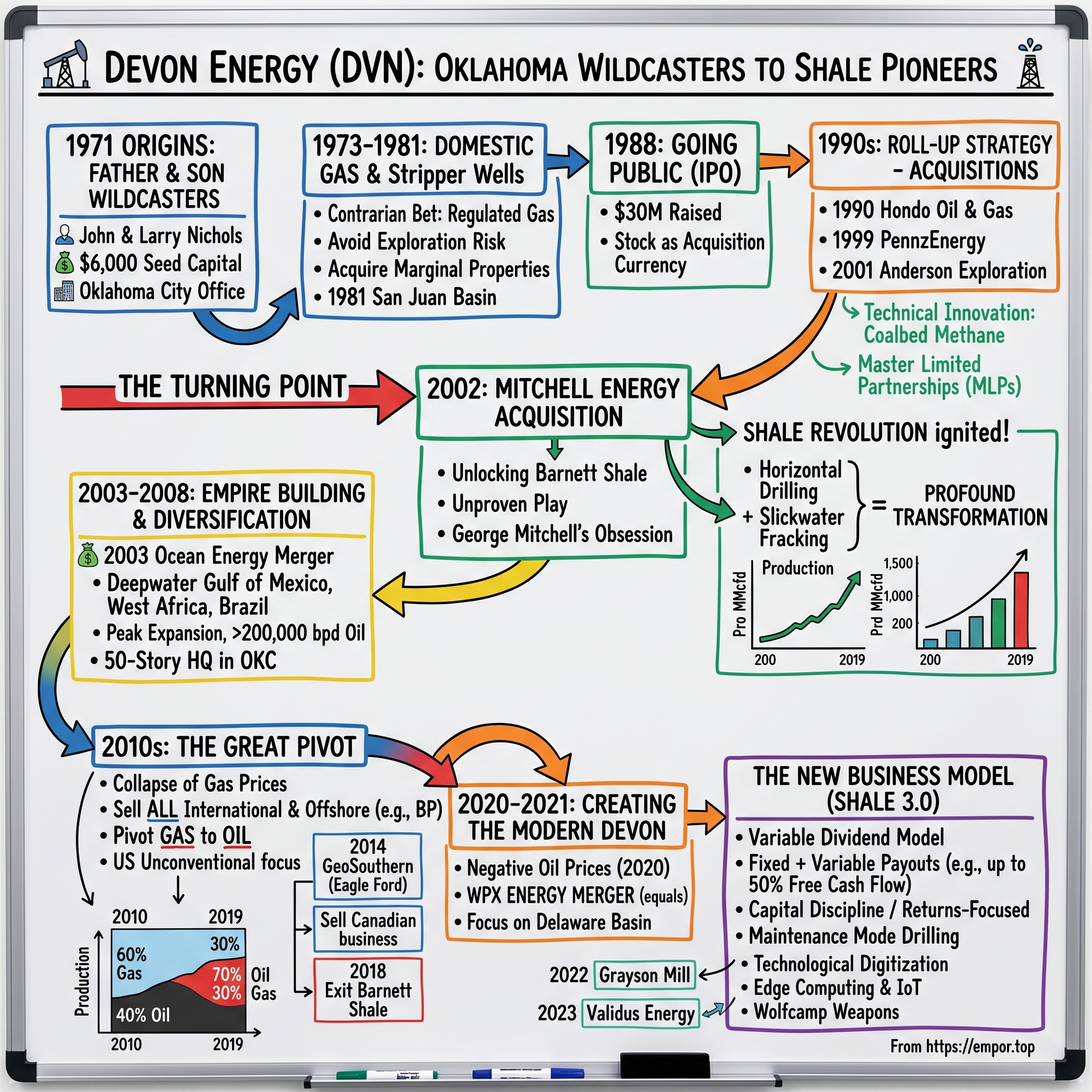
Devon Energy: The Shale Pioneer's Capital Allocation Crucible
I. Introduction & Cold Open
In the winter of 2001, inside an Oklahoma City conference room, a team of engineers and landmen debated a geological formation that most of the oil and gas industry considered worthless. The rock was the Barnett Shale, buried roughly a mile and a half beneath the suburbs of Fort Worth, Texas. It was the source rock—the geological kitchen where hydrocarbons formed over millions of years before migrating upward into porous sandstone and limestone traps. For a century, energy companies had targeted those upper traps, avoiding the dense, impermeable shale that held its natural gas tightly locked.
One independent operator, however, had spent nearly two decades pursuing the Barnett. George P. Mitchell, a Galveston-born son of a Greek herder turned Houston wildcatter, invested tens of millions of dollars attempting to unlock commercial gas flows from the formation. By the late 1990s, his team replaced expensive gel-based fracturing fluids with slickwater—a cheap mixture of water, sand, and friction reducers. The wells produced, yielding just enough volume to demonstrate the concept's viability.
In January 2002, Devon Energy—an Oklahoma-based independent known primarily as a disciplined acquirer of North American gas properties—agreed to buy Mitchell Energy & Development for approximately $3.5 billion including assumed debt.1 Devon contributed deep horizontal drilling expertise developed in coalbed methane basins. Pairing slickwater fracturing with horizontal wellbores exposed thousands of feet of shale to stimulation, creating a technological breakthrough that transformed global energy production.
The acquisition altered global commodity dynamics. It shifted the United States from a prospective importer of liquefied natural gas into the world's largest hydrocarbon producer, weakened OPEC's pricing authority, and reshaped European energy trade. Yet over the next decade and a half, the financial windfalls of the breakthrough tested the discipline of the company that brought it to scale.
That capital allocation paradox defines Devon's modern history. After unlocking massive domestic natural gas reserves, Devon spent fifteen years expanding into high-cost assets: deepwater Gulf of Mexico and international offshore leases, Canadian oil sands, peak-market Barnett acreage, and Eagle Ford positions acquired at $100-per-barrel oil. The company built a 50-story corporate headquarters in downtown Oklahoma City. By 2019, Devon sold its Barnett acreage—the asset that initiated the shale boom—for $770 million.2
Today, Devon Energy trades on the NYSE under the ticker DVN as a multi-basin Lower-48 producer generating more than 700,000 barrels of oil equivalent per day across the Delaware Basin in West Texas and southeast New Mexico, the Williston Basin in North Dakota, the Eagle Ford in South Texas, the Anadarko Basin in Oklahoma, and the Powder River Basin in Wyoming.3 Since March 2025, the company has been led by Chief Executive Officer Clay Gaspar, a petroleum engineer who joined Devon following its merger with WPX Energy.
Four central themes define Devon's corporate trajectory. First, the broader transition of the U.S. shale sector from debt-fueled volume expansion to a capital-disciplined manufacturing model focused on free cash flow per share. Second, the structural challenge of corporate M&A in cyclical commodity markets, where entry valuation dictates long-term returns. Third, the evolution of investor payout models, exemplified by the fixed-plus-variable dividend framework Devon pioneered and subsequently scaled back as market preferences shifted toward stable distributions. And fourth, the strategic imperative facing mature shale operators: sustaining inventory quality as premium drilling locations deplete.
 Subscribe on LinkedIn
II. Origins & The Roll-Up Era: John & Larry Nichols (1971–2001)
There is a version of the American oil origin story that involves a gusher, a mud-covered roughneck, and a fortune made overnight. Devon's origin story began with a lawyer.
In 1971, John Nichols—a petroleum engineer and accountant who had spent his career structuring oil and gas drilling partnerships—founded a small company in Oklahoma City with roughly $6,000 in capital.4 He named it Devon. His son, J. Larry Nichols, soon joined him. Larry's background was unusual for the Oklahoma oil patch: Harvard Law School, a clerkship for Chief Justice Earl Warren at the U.S. Supreme Court, and a position as an attorney at the Department of Justice. Although positioned for a legal career in Washington, he returned to Oklahoma, becoming Executive Vice President and General Counsel in 1973, President in 1976, and Chief Executive Officer in 1980—a post he held for three decades.4
That legal and financial orientation shaped Devon's strategy for the next fifty years. Devon was never primarily an exploration company in the wildcatting tradition; it operated as an acquisition vehicle. Its competitive advantage lay in structuring, financing, and integrating purchases of producing properties discovered by others.
That strategy ran counter to industry consensus at the time. Through the 1970s and 1980s, major integrated producers—including Exxon, Mobil, Texaco, and Chevron—redirected capital toward deepwater offshore developments and international mega-projects, viewing North American onshore fields as mature and depleted. The Nicholses took the opposing view. As major producers exited, Devon targeted their legacy assets, relying on low overhead and disciplined underwriting to generate attractive returns from fields the supermajors considered too small to justify corporate overhead.
Two early strategic decisions demonstrated that approach. In 1981, Devon expanded into the San Juan Basin of northwestern New Mexico, becoming an early commercial producer of coalbed methane—gas adsorbed onto coal seams rather than trapped in conventional reservoirs. While conventional gas resides in porous rock like water in a sponge, coalbed methane clings to coal surfaces like moisture on paper, requiring operators to depressurize the formation to release gas flows. Devon developed this unconventional resource before the category gained industry prominence, establishing an institutional focus on overlooked geological formations. Then in 1985, Devon introduced a Master Limited Partnership structure to fund North American gas consolidation, creating a tax-efficient vehicle to raise capital against long-lived producing assets.
Devon went public in 1988, initiating a decade of corporate consolidation. It acquired Hondo Oil & Gas in 1989 for roughly $122 million, followed by Canadian producer Northstar Energy in 1998 for about $750 million. In 1999, Devon bought PennzEnergy—the exploration and production arm spun out of Pennzoil—for approximately $2.6 billion. In 2001, Devon completed a $4.6 billion acquisition of Anderson Exploration, becoming one of Canada's largest independent gas producers.
Across that sequence, a clear pattern emerged: each deal grew larger, financed in part by the balance sheet capacity generated by prior acquisitions. Roll-up strategies depend on controlling acquisition costs and integration expenses while navigating commodity cycles. The Anderson acquisition occurred as North American natural gas prices retreated from cyclical highs, and Canadian conventional gas ultimately proved vulnerable to competition once domestic shale production expanded.
Nevertheless, thirty years of systematic aggregation established Devon's corporate scale. By late 2001, Devon possessed the balance sheet, borrowing capacity, and corporate structure required to execute multi-billion-dollar transactions. For long-term investors, the company's trajectory demonstrated that an acquisition-driven model is defined by entry valuation and market timing.
That capital capacity set the stage for the transaction that transformed the industry.
III. The Mitchell Energy Bet & The Birth of Shale (2002–2009)
Understanding why the Barnett Shale was long considered unviable requires understanding permeability. In a conventional reservoir, coarse, loosely packed rock allows hydrocarbons to flow freely to a vertical wellbore across a wide radius. Shale, by contrast, resembles tightly cemented rock with microscopic pores. Natural gas is trapped in vast quantities but cannot migrate naturally. A traditional vertical well drilled into shale drains only a few feet before production stalls.
George Mitchell spent nearly two decades attempting to break that geological barrier. Hydraulic fracturing—pumping fluid downhole under high pressure to crack the formation and propping the fractures open with sand—had been used since the late 1940s. Mitchell’s team discovered through years of trial and error that the industry’s standard thick gel fracturing fluids were expensive and clogged shale pores. By replacing gels with thin, water-based "slickwater" fluids mixed with sand and friction reducers, Mitchell created extensive crack networks at a fraction of the cost.
Even with slickwater, Mitchell Energy’s Barnett wells remained economically marginal by 2001, and Mitchell sought a buyer. Devon’s acquisition closed in early 2002 at approximately $3.5 billion including debt.1 Wall Street greeted the transaction with skepticism, questioning why Devon would pay a corporate premium for low-permeability natural gas acreage that had absorbed capital for twenty years without delivering strong financial returns.
What skeptics missed—and what Devon’s engineering team recognized—was that Mitchell had solved only half of the technical puzzle. While a vertical well exposed just forty feet of shale formation, a horizontal wellbore drilled along the seam could expose several thousand feet. Combining horizontal laterals with slickwater stimulation transformed well economics, unlocking commercial flow rates across vast acreage.
Devon acted quickly, permitting horizontal wells across the Barnett within months of closing the deal. Well productivity surged compared to vertical drilling, while multi-well surface pads reduced surface footprints by radiating horizontal laterals in multiple directions. Over the following decade, Devon drilled thousands of wells, scaling its Barnett production to well over one billion cubic feet per day. Beyond Devon's own balance sheet, the breakthrough proved to the entire industry that unconventional source rock was a commercially viable reservoir, sparking a continent-wide leasing boom across the Haynesville, Fayetteville, Marcellus, and subsequent oil-rich shale plays.
Capitalizing on its expanded valuation, Devon resumed its corporate consolidation strategy.
In 2003, Devon merged with Ocean Energy in a transaction valued at approximately $5.3 billion, becoming the largest U.S.-based independent producer and adding deepwater assets in the Gulf of Mexico, Brazil, and Azerbaijan. In 2006, the company spent roughly $2.2 billion in cash to acquire Chief Oil & Gas, expanding its Barnett position near the peak of the market. To house its growing corporate footprint, Devon commissioned the Devon Energy Center in 2009—a 50-story, $750 million skyscraper in downtown Oklahoma City completed in 2012.
Evaluating this period requires stress-testing a central thesis: Devon's early entry into shale created a durable first-mover advantage and a structural economic moat.
The historical record challenges that assertion. While Devon pioneered the commercial application of horizontal slickwater fracturing, being first yielded little long-term competitive protection. The core technologies were non-proprietary and relied heavily on third-party oilfield service providers—such as Halliburton, Schlumberger, and Baker Hughes—who rapidly deployed identical techniques to competitors across North America. Devon's operational advantage diffused throughout the sector within three years.
Furthermore, that rapid technology diffusion eroded the value of Devon's asset base. The company had concentrated capital in North American dry natural gas through the Mitchell, Anderson, and Chief acquisitions. As competitors deployed horizontal drilling nationwide, the resulting supply glut drove Henry Hub natural gas prices down from more than $12 per million British thermal units in 2008 to under $2 by 2012, severely depressing cash flows from Devon's core gas holdings.
The financial impact of that price decline culminated in December 2019, when Devon exited the Barnett Shale entirely, selling its position to Banpu Kalnin Ventures for $770 million.2 Compared to the roughly $5.7 billion in combined acquisition capital spent on Mitchell and Chief—excluding two decades of subsequent development spending—the pioneering asset ultimately resulted in substantial net capital destruction for shareholders.
The Ocean Energy acquisition proved similarly mismatched to the emerging shale era. Deepwater and international offshore developments required massive front-loaded capital, multi-year lead times, and exposure to geopolitical risks—contrasting sharply with the short-cycle, flexible capital allocation of onshore shale. The offshore assets yielded weak returns on capital employed, prompting Devon to exit its international and deepwater portfolio entirely within seven years.
Ultimately, Devon demonstrated technical leadership and timely execution, but neither generated a defensible moat because the underlying commodity was homogenous and the technology was readily available across the market. For energy investors, this experience highlights a structural reality of the shale sector: operational advantages offer temporary leads measured in quarters, rather than moats lasting decades. Sustainable returns depend instead on asset quality, structural cost control, and disciplined acquisition pricing.
Devon would spend the subsequent decade confronting that lesson.
IV. The Great Inflection: Portfolio High-Grading & The $6B Misstep (2010–2019)
By 2009, Devon's management faced a strategic challenge that operational refinements alone could not resolve. The company ranked among the largest natural gas producers in North America at the exact moment surging shale supply severely depressed domestic gas prices. Meanwhile, West Texas Intermediate crude oil, which had briefly touched $147 a barrel in 2008, recovered from the global financial crisis and climbed back toward triple digits. The strategic imperative was clear: shift capital from natural gas to crude oil, and reallocate investment from long-cycle offshore projects to short-cycle onshore shale.
Devon executed the first phase of that pivot early relative to peers. In March 2010, the company agreed to sell its deepwater and international assets in Brazil, Azerbaijan, and the Gulf of Mexico to BP for $7.0 billion.5 The transaction timing proved fortuitous: BP closed the acquisition just months before the Deepwater Horizon blowout fundamentally altered offshore operating risk and regulatory costs. Devon exited deepwater near the peak of the offshore expansion cycle, converting illiquid, capital-intensive international holdings into liquid cash reserves.
Nine years later, Devon completed the exit from another long-cycle legacy position. In 2019, the company sold its Canadian business—comprising heavy oil and thermal oil sands assets in Alberta—to Canadian Natural Resources for approximately US$2.8 billion.[^6] Set against the roughly $4.6 billion spent to acquire Anderson Exploration in 2001, alongside nearly two decades of sustaining and expansion capital deployed into thermal projects, Devon's Canadian entry ultimately absorbed far more capital than it generated.
Between those two exits sat the pivotal transaction of the decade—a test case for evaluating whether management's portfolio high-grading into premier tight-oil basins consistently created per-share value.
In November 2013, Devon agreed to acquire GeoSouthern Energy's Eagle Ford assets for $6.0 billion in cash, closing the transaction in February 2014.6 Strategic rationale aligned with management's stated goals: replace natural gas with oil, trade long-cycle commitments for flexible short-cycle development, and upgrade core acreage. The Eagle Ford rock was high quality. The primary flaw lay not in geology, but in commodity cycle timing: Devon paid all-cash near the top of the price cycle, when crude oil had traded above $90 per barrel for three years and industry consensus assumed an enduring price floor near $80.
Within eleven months of closing, OPEC decided against cutting production to support prices, triggering a collapse that drove crude oil down to the mid-$20s by early 2016. Because Devon utilized full-cost accounting—a method requiring quarterly ceiling tests that write down capitalized asset values when trailing commodity prices decline—the company recognized consecutive multi-billion-dollar non-cash asset impairments across 2015 and 2016. Devon also recorded a valuation allowance against its deferred tax assets, reflecting reduced expectations for near-term taxable income to absorb historical losses. These write-downs persisted into subsequent downturns, including additional impairment charges in the first quarter of 2020.
Two analytical considerations clarify the financial impact of these write-downs.
First, although ceiling-test write-downs are non-cash accounting entries, the initial cash outlay of $6.0 billion was real and immediate. The impairment simply recognized an economic loss that had already occurred. Dismissing ceiling-test write-downs as mere non-cash accounting adjustments obscures the permanent loss of capital spent on peak-cycle acquisitions.
Second, the impairment reflected cycle timing rather than geological misjudgment. Devon acquired quality acreage, but did so by paying peak-cycle cash prices for assets whose cash flows depended entirely on a volatile, mean-reverting commodity. This repeated a capital allocation pattern previously seen in the 2001 Anderson Exploration purchase and the 2006 Chief Oil & Gas deal, where acquisition timing coincided with high commodity valuations.
Consequently, while Devon's directional portfolio shifts—from gas to oil, and from long-cycle offshore to short-cycle onshore—were strategically logical, entry timing repeatedly compromised shareholder returns. The BP divestment demonstrated effective execution on asset exits, but high-cost acquisitions constrained overall value creation.
In 2015, Dave Hager assumed the CEO role. A geophysicist who previously led exploration and production at Kerr-McGee before joining Devon's board and executive team, Hager inherited a balance sheet burdened by acquisition debt, a portfolio containing legacy non-core assets, and a weakened equity valuation. His leadership focused on structural restructuring: divesting non-core acreage, reducing corporate debt, lowering operating costs, and acquiring acreage in the Delaware Basin.
While necessary to stabilize the company, those operational adjustments left Devon entering 2020 with limited scale in the Permian Basin and a challenging investment narrative for generalist shareholders—setting the stage for further consolidation during the energy market downturn of 2020.
V. The WPX Merger & The "Shale 3.0" Model (2020–2021)
On April 20, 2020, the front-month West Texas Intermediate crude oil futures contract settled at negative $37.63 per barrel. Holders of expiring contracts paid counterparties to take delivery of physical oil because global demand had collapsed and storage capacity at Cushing, Oklahoma, was nearly full.
The price collapse reshaped the operating philosophy of the U.S. exploration and production sector. For nearly a decade following the Barnett Shale breakthrough, independent producers had outspent operating cash flow, relying on high-yield debt and equity issuances to fund aggressive volume growth. That model generated substantial production gains but led to cumulative negative free cash flow across the industry. By 2020, capital markets closed to exploration and production companies, precipitating a wave of bankruptcies and forcing surviving operators to adopt a new financial model focused on free cash flow and capital discipline.
Devon and WPX Energy announced their combination in September 2020 and completed it on January 7, 2021, structured as an all-stock merger of equals in which Devon shareholders held approximately 57% and WPX shareholders approximately 43% of the combined company.[^8][^9] The all-stock structure allowed Devon to execute a multi-billion-dollar transaction without deploying cash or expanding debt during a period of severe market distress—a direct contrast to its cash-financed acquisition of GeoSouthern seven years earlier.
The industrial rationale centered on asset quality and scale. WPX brought a roughly 400,000-net-acre position in the Delaware Basin, characterized by stacked productive intervals—including the Wolfcamp A, Wolfcamp B, and Bone Spring formations—that allowed multiple reservoir layers to be accessed from shared surface pads and gathering systems. Devon contributed multi-basin scale, a deleveraged balance sheet, and positions in the Anadarko and Powder River basins. The combined company produced more than 700,000 barrels of oil equivalent per day, with management estimating corporate breakeven costs between $35 and $40 per barrel WTI.
By year-end 2021, Devon reported delivering approximately $575 million in annual cash-flow synergies, exceeding its original underwriting target and generating what management estimated as a net present value above $2 billion over five years. Unit operating costs and general and administrative expenses per barrel decreased as duplicate corporate overhead was eliminated and drilling programs were consolidated onto contiguous acreage. While corporate cost synergies can be challenging to isolate from broader operational shifts, the sustained reduction in unit expenses provided clear evidence of integration savings.
Alongside the transaction, Devon introduced a fixed-plus-variable dividend framework that quickly became an industry benchmark. Under this design, the company paid a modest fixed quarterly dividend calibrated to remain sustainable during commodity downturns. After funding capital expenditures and the fixed dividend, Devon distributed up to 50% of its remaining free cash flow as a variable dividend. Management capped capital spending at 70% of operating cash flow, ensuring that at least 30% of cash generation was structurally preserved for shareholder distributions or balance sheet allocation.
The framework constrained capital allocation by rule rather than discretionary management choice. By enforcing a reinvestment cap, the company sought to prevent the over-drilling that had characterized prior cycles. In 2022, as WTI crude prices surged past $100 per barrel following Russia's invasion of Ukraine, Devon's variable payouts propelled its total dividend yield to among the highest in the S&P 500, leading peers across the sector to adopt similar payout models.
However, explicit payout formulas also introduced direct exposure to commodity volatility. Variable dividends expanded during market rallies but contracted immediately when oil prices retreated, testing investor appetite for fluctuating income distributions.
VI. Current Management, Governance & Capital Allocation Framework
Clay Gaspar became President and Chief Executive Officer of Devon Energy on March 1, 2025, succeeding Rick Muncrief. The succession was unusually well-telegraphed: Gaspar had served as Devon's Executive Vice President and Chief Operating Officer, and prior to the merger had been Chief Operating Officer of WPX Energy, managing operations for both halves of the combined enterprise.
Gaspar is a petroleum engineer trained at Texas A&M University and the University of Texas at Austin, with a career focused on operational execution rather than deal-making or capital markets storytelling. Within the industry, he is associated with the technical mechanics of modern shale production: pad drilling design, completion optimization, and the steady compression of cycle times between spudding a well and first sales. That background provides context for evaluating Devon's strategic posture. For a company whose primary historical vulnerability has been acquisition timing, appointing an operationally focused chief executive represents either a necessary corrective or a strategic void in capital allocation leadership. Early results offer arguments for both interpretations.
Muncrief came to Devon as WPX's chief executive and led the combined company from January 2021 through his retirement in March 2025—a four-year tenure spanning the post-merger integration, a major commodity cycle, the introduction of the variable-dividend model, and its subsequent refinement. While capital discipline across the sector emerged under broad market pressure, Muncrief codified those principles into a published framework with explicit numerical reinvestment caps, making Devon's capital allocation more predictable than that of many peer exploration and production companies.
In August 2026, Devon restructured its senior operating leadership, appointing Tom Hellman and Trey Lowe III as Executive Vice Presidents of Exploration and Production, and naming Kevin Smith as Executive Vice President and Chief Technology Officer. Division of E&P leadership typically indicates basin specialization or executive development, while elevating technology to the executive vice president level underscores strategic focus on subsurface modeling and drilling automation. However, organizational structure reflects strategic intent rather than competitive capability. Because peer operators across the Permian Basin are pursuing similar machine-learning subsurface interpretation and automated rig controls, technology adoption alone does not confer a structural moat; any realized advantage must manifest in lower well costs per lateral foot and higher productivity relative to offset operators.
Devon's executive compensation architecture aligns annual cash bonuses and long-term equity grants with free cash flow per share, return on capital employed (ROCE), relative total shareholder return against an industry peer group, and greenhouse gas intensity reduction. Gaspar's base salary was set at $1.5 million for 2026, with the majority of target compensation structured as equity subject to multi-year performance vesting.7
That metric design marks a departure from historical industry practices. For much of the preceding decade and a half, exploration and production compensation plans favored volume growth and reserve replacement—metrics that could be expanded through capital expenditure regardless of underlying returns. Weighting compensation toward free cash flow per share discourages un-economic drilling and dilutive equity issuances. Incorporating ROCE penalizes low-return capital deployment, while relative total shareholder return ensures management is not compensated solely for broad commodity price rallies. Applied historically, such incentives would have disincentivized high-valuation acquisitions like the 2013 GeoSouthern transaction.
Evaluating management's execution reveals a clear distinction between field performance and payout strategy. Operationally, execution has been consistent: horizontal laterals routinely extend past 10,000 feet, spud-to-sales cycle times have compressed, and unit cash costs in the Delaware Basin remain competitive with leading Lower-48 producers. Concurrently, financial leverage has been maintained near or below the target ceiling of 1.0 times net debt to EBITDAX.
On capital allocation, however, operational realities required strategic adjustments. The variable dividend framework, widely praised during the 2022 commodity surge, created payout volatility when oil prices declined in 2023 and 2024. In response, management shifted its distribution focus toward steady fixed-dividend growth paired with opportunistic share repurchases. This pivot can be interpreted either as pragmatic adaptation to shifting equity market preferences or as a departure from the strict rule-based framework established after the WPX merger.
Ultimately, executive leadership oversees a consolidated multi-basin asset base with strong operational metrics, yet faces the central strategic mandate of sustaining inventory quality and economic longevity as core drilling locations mature.
VII. Core Business Deep-Dive & Multi-Basin Asset Portfolio
A modern well pad in Loving County, Texas, bears little resemblance to the traditional image of the oil patch. There is no solitary derrick standing against the horizon. Instead, a gravel pad the size of several football fields holds a row of wellheads spaced a few dozen feet apart. During completion, an industrial array of pressure-pumping equipment, sand silos, and water lines resembles a chemical processing plant more than a conventional drilling rig. Beneath the surface, a dozen horizontal wellbores fan out two miles in multiple directions through three or four separate productive intervals.
This physical layout reflects how the modern Delaware Basin operates as a manufacturing enterprise rather than a speculative exploration venture. The subsurface geology is thoroughly mapped; the primary operational focus is how efficiently and cost-effectively an operator can drill and complete repeatable well units.
Devon's Delaware Basin position covers roughly 400,000 net acres and contributes the largest share of production and a disproportionate share of corporate value.3 Its defining characteristic is stacked pay—multiple productive zones vertically superimposed, which multiplies drillable locations per surface acre and allows a single footprint of roads, pads, gathering lines, and water infrastructure to serve multiple reservoirs. That infrastructure leverage underpins the Delaware's cost structure, enabling breakeven costs in the $35 to $40 WTI range.
The Williston Basin position—spanning roughly 430,000 net acres in North Dakota and Montana—represents the company's newest major operating pillar, expanded through the Grayson Mill acquisition. Unlike the multi-layered formations of the Delaware, the Bakken relies on a single dominant productive interval. However, it offers a high oil cut and shallower base decline rates on mature wells. Although Bakken barrels carry higher extraction costs than Delaware barrels, their higher oil content generates stronger realized revenue per barrel of oil equivalent in a market where crude commands a premium over natural gas.
The Eagle Ford position, comprising roughly 215,000 net acres enhanced by the $1.8 billion Validus Energy acquisition in 2022, serves as a mature cash generator. Producing high-value condensate and natural gas liquids, its proximity to Gulf Coast refining and export infrastructure provides favorable pricing differentials relative to inland basins. Meanwhile, the Anadarko Basin in Oklahoma and the Powder River Basin in Wyoming provide long-term optionality: the Anadarko offers natural gas and liquids exposure that benefits from expanding LNG export capacity and power demand, while the Powder River remains an emerging oil play in the appraisal stage.
The Grayson Mill transaction serves as a key benchmark for evaluating Devon's recent capital allocation discipline.
In July 2024, Devon announced the acquisition of Grayson Mill Energy's Williston Basin business for $5.0 billion, structured as approximately $3.25 billion in cash and 37.3 million shares of Devon stock.[^11] The assets added roughly 307,000 net acres, about 100,000 barrels of oil equivalent per day of production weighted roughly 70% to oil, a substantial inventory of undrilled locations and refracturing candidates, and approximately 950 miles of midstream gathering infrastructure.[^11]
At roughly $50,000 per flowing barrel of daily production, the transaction benchmarked in line with contemporaneous Permian and Bakken comparables. The inclusion of 950 miles of midstream gathering infrastructure provided an additional strategic benefit: controlling gathering systems captures processing margins that would otherwise go to third-party operators while reducing takeaway bottlenecks.
Critically, market scrutiny centered on financing structure and cycle timing rather than asset quality. By funding the majority of the $5.0 billion purchase price in cash, Devon increased its net debt at a time when crude oil prices were softening. While reminiscent of previous cash-heavy acquisitions during market peaks, the transaction included key mitigating factors: a meaningful equity component, immediate cash flow from producing wells rather than unproven acreage, and a stronger initial balance sheet. Nevertheless, the deal highlights an ongoing strategic question: whether Devon acquired the assets because entry valuations were compelling or to replenish maturing inventory.
Competitive positioning reveals distinct structural trade-offs. Compared to Permian pure-play peers such as Diamondback Energy, Devon incurs corporate overhead across five operating basins. Relative to large-scale producers like EOG Resources and ConocoPhillips—or integrated majors such as ExxonMobil and Occidental Petroleum—Devon operates with less total scale and integration. While unit cash costs in the Delaware Basin remain competitive, managing five separate operating areas across different regulatory regimes, service markets, and midstream networks limits corporate-level cost efficiencies.
Ultimately, Devon maintains a high-quality asset base with functional scale. In a global commodity market where individual producers lack pricing power, combining adequate scale, low-cost core acreage, and disciplined shareholder returns offers a viable operational framework—one rooted in operational execution and cost control rather than a structural economic moat.
VIII. Strategic Moat Analysis: Helmer's 7 Powers & Porter's 5 Forces
Hamilton Helmer's framework asks a deceptively simple question: what allows an enterprise to earn persistent, differential returns that competitors cannot arbitrage away? Applied to an oil and gas producer, the answer is typically minimal, and Devon is no exception. However, mapping where competitive power exists—and where it fails—provides a clear analytical model for evaluating the business.
Scale Economies — Moderate to strong, but local rather than global. The relevant scale in shale is not total corporate footprint; it is density within a specific basin. When Devon operates contiguous acreage in the Delaware Basin, it can drill multi-well pads, maintain continuous fracturing schedules without demobilization fees, negotiate volume pricing for sand and casing, and recycle produced water through dedicated infrastructure rather than commercial trucking. Each factor creates a tangible cost advantage over smaller operators drilling isolated wells. However, this advantage is bounded: while significant relative to sub-scale regional producers, it is largely neutralized against peers like Diamondback Energy, EOG Resources, ConocoPhillips, or ExxonMobil, all of which command comparable or superior basin density.
Process Power — Moderate and continuously eroding. Devon's accumulated expertise in completion design, fluid formulations, zipper-fracturing sequences across adjacent wells, and data-driven subsurface modeling—strengthened under its executive technology leadership—yields measurable operational efficiency against smaller operators. Yet this power remains moderate for the same structural reason Devon's early Barnett Shale advantage dissolved: primary field execution relies on oilfield service contractors who rapidly transfer technical innovations across clients, while engineering talent moves freely throughout the industry. In unconventional shale, process innovation resembles a treadmill—operators must continuously innovate merely to maintain parity, with productivity gains largely diffusing to the broader industry.
Cornered Resource, Counter-Positioning, Branding, and Switching Costs — Effectively absent. A barrel of Devon's crude oil is chemically and commercially identical to any other barrel of the same specification. Buyers pay no premium for corporate branding, customers incur no switching costs, and the business model contains no structural barriers that competitors cannot replicate. The closest proxy to a cornered resource is high-quality, contiguous acreage. Yet acreage is a finite, depleting asset rather than a permanent moat. Premium locations function as finite inventory, and depleting inventory represents asset value rather than a structural moat.
Porter's Five Forces reinforce this analytical picture.
Buyer Power — Low, yet conferring zero pricing power. Devon sells into deep, liquid commodity markets, including West Texas Intermediate pricing at Midland and Cushing, Brent-linked export markets, and regional natural gas hubs like Henry Hub and Waha. No individual buyer possesses the leverage to dictate terms to Devon. However, the converse is equally true: Devon functions as a pure price taker. The absence of buyer concentration simply means prices are dictated by global market clearing rather than counterparty negotiation.
Supplier Power — Moderate to high, and highly cyclical. Oilfield service providers—including major contractors like Halliburton, SLB, and Patterson-UTI, as well as pressure-pumping fleet operators—wield substantial pricing power when rig and fracturing crew availability tightens. Service cost inflation posed a primary margin headwind during 2022 and 2023. When industry activity accelerates, service pricing rises rapidly, capturing a meaningful portion of raw commodity price expansion that would otherwise flow to E&P operators.
Threat of Substitutes — Real, but unfolding across decades. Electric vehicle adoption, grid decarbonization, and fuel efficiency gains represent genuine long-term demand risks for crude oil, primarily in light-duty transport. Conversely, growth in petrochemical feedstocks, heavy transport, aviation, and expanded natural gas demand driven by data centers and electrification provide long-term demand offsets. Substitution functions as a multi-decade terminal value variable rather than a near-term cash flow disruptor, requiring capital markets to discount long-term terminal value rather than assume immediate disruption.
Competitive Rivalry — High, manifesting primarily through capital and asset markets. Devon does not compete with peer producers for end customers; instead, it competes for capital, drilling rigs, specialized labor, pipeline takeaway capacity, and undeveloped acreage. The wave of corporate M&A from 2023 through 2025 reflected rivalry focused on asset consolidation, driving up valuations for high-quality inventory across every major North American basin.
Synthesizing these forces yields a clear conclusion: Devon possesses no structural moat in the classic strategic sense. Its valuation rests on relative cost positioning, asset quality, and capital allocation discipline. A low-cost operator in a commodity market can earn returns above its cost of capital through broader stretches of the cycle than higher-cost peers. However, those advantages are not permanently defensible against well-capitalized competitors, requiring management to re-establish its operational edge each year.
This structural reality shifts the central investment thesis to management execution: because market power cannot shield the enterprise, long-term shareholder outcomes depend entirely on disciplined capital allocation through commodity cycles.
IX. Historical Falsification & Capital Allocation Stress Test
If an energy enterprise possesses no structural economic moat, long-term valuation depends on evaluating management's core financial claims against its historical execution. Testing Devon's modern thesis requires evaluating three central strategic promises against the corporate record.
Claim one: The fixed-plus-variable dividend framework delivers superior long-term income returns.
The disconfirming evidence emerged not from a mechanical failure of the framework, but from it working precisely as designed. When West Texas Intermediate crude oil prices retreated from above $110 per barrel in 2022 to between $70 and $75 through 2023 and 2024, Devon's variable dividend payout declined by more than two-thirds. The formula functioned as intended: lower free cash flow yielded smaller variable distributions.
However, investor behavior diverged from management's structural assumptions. Income-oriented investors—including retail shareholders, dividend-focused funds, and automated screening strategies—typically evaluate yield based on distribution stability rather than a fixed percentage of variable cash flow. A contracting headline dividend prompted selling from the shareholder base attracted by the peak 2022 payouts, causing Devon's total shareholder return to lag peers that maintained flatter, more predictable dividend trajectories.
Management subsequently adjusted the framework, emphasizing baseline growth in the fixed dividend while redirecting variable capital returns toward share buybacks under a $5.0 billion authorization extended through 2026. Buybacks deliver capital return without creating an expectation of recurring income, providing per-share accretion when shares trade below intrinsic value—a condition most likely during commodity downturns when cash flow is constrained. Conversely, repurchase capacity expands when cash flows are highest and stock prices are elevated, illustrating the cyclical challenge inherent in oil and gas buybacks.
Verdict: The claim is invalidated in its original broad formulation but survives in a narrower operational capacity. The fixed-plus-variable model failed to deliver superior total returns because a shrinking headline dividend created negative market sentiment that outweighed cumulative cash distributions. The surviving value resides in the underlying capital discipline—specifically the reinvestment cap and the commitment to avoid funding growth through debt. The primary key performance indicator confirming this structural discipline is the reinvestment rate: if Devon maintains total capital spending below approximately 70% of operating cash flow across a complete commodity cycle, including price troughs, the framework represents a permanent operational shift rather than a temporary bear-market posture.
Claim two: A multi-basin portfolio provides superior diversification compared to Permian pure-plays.
Devon's internal segment economics have repeatedly challenged this thesis. Capital deployed outside the Delaware Basin—including Anadarko Basin natural gas, Powder River Basin appraisal acreage, and legacy Eagle Ford positions—has generally delivered lower returns on capital employed than core Delaware development. When an operator's primary asset yields superior economics, asset diversification effectively reallocates capital into secondary-return opportunities.
Institutional investors have periodically advocated for Devon to divest non-core assets and operate exclusively as a Permian pure-play, arguing that portfolio concentration would streamline operations, allocate capital to highest-return acreage, and command valuation multiples comparable to pure-play peers. Management counters that a multi-basin structure mitigates single-basin operational and regulatory risks, including Permian takeaway bottlenecks, Waha regional natural gas price discounts, New Mexico regulatory exposure, and localized oilfield service inflation.
Evaluating both perspectives indicates that multi-basin diversification functions as a risk-management mechanism rather than a return-enhancement strategy. Operating across multiple basins does not shield cash flows from broad commodity price volatility, which remains the primary revenue driver. Instead, it mitigates basin-specific infrastructure constraints and regulatory changes. Consequently, the claim that multi-basin diversification is inherently superior for total returns is unsupported, whereas the narrower assertion that it reduces operational tail risk at the expense of peak average returns aligns with historical performance.
Claim three: Capital discipline under Shale 3.0 has eliminated empire-building acquisitions.
Between 2022 and 2024, Devon committed approximately $6.8 billion to inorganic acquisitions, comprising the $1.8 billion purchase of Validus Energy and the $5.0 billion acquisition of Grayson Mill Energy. Committing nearly seven billion dollars to asset purchases during a period of moderating commodity prices presents an apparent contradiction for a strategy centered on capital restraint.
Management's rationale emphasizes that both transactions targeted producing assets with immediate cash flow rather than speculative acreage, generating per-share free cash flow accretion under corporate financial models. The Grayson Mill acquisition also included 950 miles of company-owned midstream infrastructure, reducing operating expenses and takeaway risk. Furthermore, maintaining production scale requires inventory replacement, as active drilling programs deplete core locations faster than organic leasing typically restores them.
However, this requirement underscores a fundamental reality of the E&P model: an operator without a permanent economic moat relies on an ongoing acquisition budget to replenish depleting reserves. Every shale producer confronts inventory depletion; the critical distinction rests on whether acquisitions generate returns above the corporate cost of capital across full commodity cycles. Devon's historical transactions—including Anderson Exploration and Chief Oil & Gas during natural gas price peaks, and GeoSouthern Energy near an oil price peak—demonstrated vulnerability to acquisition entry timing.
Verdict: The discipline claim remains unproven on current performance metrics but presents a testable framework. The Grayson Mill transaction was executed at defensible per-barrel valuation metrics with a partial equity component and producing asset foundation, representing more structured underwriting than the cash-heavy GeoSouthern purchase. Evaluating whether Grayson Mill delivers long-term capital discipline depends on whether its return on capital employed exceeds Devon's cost of capital across varying commodity price environments over the next three to four years. If the Williston Basin assets generate target returns during periods of lower crude prices, the historical pattern of value-destructive acquisition timing will be broken; if not, entry valuation will remain a persistent headwind to long-term returns.
X. Earnings Call Analysis & Skeptical Investor Stress Test
Quarterly earnings calls in the energy sector follow a familiar ritual. Prepared remarks highlight operational records, cost reductions, and capital return commitments. Then sell-side analysts—from firms including Goldman Sachs, Morgan Stanley, Tudor Pickering Holt, and Bernstein—take the floor, and within a few questions, institutional investors' primary concerns emerge.
Across Devon's earnings calls from 2024 through 2026, two specific inquiries recurred with enough persistence to highlight where market skepticism concentrated.
The first focuses on inventory quality—specifically the depth of tier-one locations in the acquired Williston acreage relative to the Delaware Basin. In shale disclosures, inventory counts are inherently soft estimates because the tally of drillable locations depends on assumed commodity prices, well spacing, and lateral lengths. An operator can expand its location count by narrowing well spacing—until downhole interference occurs and per-well recoveries decline in what the industry calls the "parent-child" problem. Analysts probing Bakken tier-one depth are fundamentally questioning whether Devon purchased a decade of high-return drilling or simply a decade of ongoing activity. Management has pointed to refracturing opportunities—re-stimulating legacy wells at a fraction of the cost of a new drill—to extend corporate inventory life. While refrac economics can be compelling when successful, historical industry results remain variable, making it analytically generous to treat a refrac location as equivalent to an undrilled tier-one location.
The second challenge addresses capital allocation directly: with Devon's stock trading at a free cash flow yield that at times exceeded 12%, why allocate $5.0 billion toward an asset acquisition rather than repurchasing its own equity? The economic trade-off is straightforward. Repurchasing company shares at a 12% free cash flow yield acquires a known asset with an established operating history at a transparent market price. Acquiring external assets introduces negotiated valuations alongside integration and execution risks. Consequently, the required return hurdle for an inorganic acquisition must sit well above the yield on existing equity, leaving it open to debate whether the Grayson Mill transaction surpassed that threshold.
Chief Executive Officer Clay Gaspar consistently maintained that Grayson Mill provided immediate free cash flow per share accretion—the primary metric for evaluating capital efficiency—while extending inventory longevity in a way share buybacks cannot. Management also emphasized that the $5.0 billion share repurchase authorization through 2026 remained active, allowing the company to pursue both strategies simultaneously. While logical, this rationale remains difficult to verify in the short term, reinforcing why long-term return on capital employed (ROCE) across a complete commodity cycle serves as the ultimate test of the transaction.
Beyond routine quarterly earnings calls, an activist or concentrated skeptical investor evaluating Devon would likely highlight four structural vulnerabilities:
The depletion treadmill. The primary operational question is whether Devon's core Delaware Basin acreage supports a decade of drilling at current activity levels while maintaining tier-one economics, or if corporate inventory figures blend premium locations with lower-quality acreage and acquired positions to sustain headline numbers. Because each bolt-on acquisition resets the inventory clock, tracking organic inventory health requires monitoring location counts and well productivity by vintage over time. Skeptics view the ongoing acquisition cadence itself as evidence of underlying core depletion.
Federal land exposure. A substantial portion of Devon's Delaware Basin acreage sits on federal land in New Mexico governed by the Bureau of Land Management. Federal acreage involves slower, politically sensitive permitting processes compared to state or private land, with leasing policies subject to shifting federal administrations. While Devon mitigates this risk by building an extensive permit backlog well ahead of drilling schedules, this approach creates a timing buffer rather than eliminating policy risk, leaving the company's highest-return assets vulnerable to federal regulatory shifts.
Portfolio complexity and the conglomerate discount. Operating across five distinct basins requires navigating five separate service markets, regulatory frameworks, and midstream networks, burdening the enterprise with multi-basin corporate overhead. An activist case would advocate divesting non-core positions in the Anadarko and Powder River basins to focus exclusively on the Delaware, Williston, and Eagle Ford, arguing that portfolio simplification could unlock a higher valuation multiple.
Water and produced-water handling. A growing operational challenge across the Permian Basin involves managing produced water, where water volumes have expanded faster than crude oil production. Disposal capacity constraints and induced-seismicity regulations in Texas and New Mexico have constrained salt-water injection options. For Devon and Permian peers, produced-water handling represents an escalating cost and permitting risk that directly impacts operating margins.
None of these factors is individually disqualifying. Instead, they explain why a low-cost, operationally sound commodity producer operating without a structural economic moat trades at its current valuation multiple.
XI. The Investment Spine: Bull vs. Bear Case & Key KPIs
Stripped of historical shifts and strategic frameworks, the core investment thesis for Devon Energy reduces to a clear proposition: a low-cost, well-operated asset base converting volatile commodity production into free cash flow, guided by a management framework designed to restrict value-destructive reinvestment.
Why it wins from here.
First, asset quality underpins current returns. Devon's Delaware Basin position represents a premier Lower-48 tight-oil resource, where stacked-pay geology and midstream infrastructure support corporate breakeven costs between $35 and $40 per barrel WTI. The Grayson Mill acquisition added scale in the Williston Basin, where high oil cuts and company-owned gathering infrastructure enhance realized pricing and takeaway control. With West Texas Intermediate crude trading in the mid-$70s per barrel, Devon generates a double-digit free cash flow yield—a financial profile capable of delivering strong returns without requiring higher commodity prices.
Second, the capital return framework enforces disciplined cash distribution. Combining a growing fixed dividend, a $5.0 billion share repurchase authorization through 2026, and an explicit reinvestment cap below 70% of operating cash flow ensures that cash generation is returned to shareholders rather than over-invested in volume growth. A steady annual reduction in share count compounds over time, providing a reliable driver of per-share value creation in a mature commodity enterprise.
Third, operational execution remains measurable and consistent. Under Chief Executive Officer Clay Gaspar, field metrics—including lateral lengths exceeding 10,000 feet, compressed spud-to-sales cycle times, and lower completed well costs per foot—demonstrate clear cost control. In a commodity sector lacking pricing power, structural cost efficiency serves as the primary operational differentiator.
What breaks the case.
First, commodity price sensitivity remains the overriding risk. Devon's earnings remain inherently linked to WTI crude and regional natural gas prices. If WTI declines below $60 per barrel for a sustained period, free cash flow contracts sharply, share repurchases slow, variable returns diminish, and debt incurred for the Grayson Mill acquisition poses balance-sheet pressure. Valuing the enterprise at $75 oil is fundamentally an implicit forecast on crude prices.
Second, historical acquisition timing presents a recurring vulnerability. Over three decades and multiple executive regimes, major transactions—including Anderson Exploration, Chief Oil & Gas, and GeoSouthern Energy—coincided with cyclical commodity peaks, leading to subsequent asset write-downs. The critical bear thesis is not that Devon acquires poor geology, but that inventory depletion periodically forces large-scale acquisitions regardless of cycle timing, creating a persistent structural headwind to long-term returns.
Third, regulatory exposure on federal lands in New Mexico creates localized operational risk. Because a significant portion of Devon's Delaware Basin inventory resides on Bureau of Land Management acreage, permitting delays or regulatory shifts directly impact the company's highest-margin assets.
Fourth, the absence of a structural economic moat limits long-term competitive protection. Devon produces a homogeneous commodity using non-proprietary service-company technology while continuously depleting its subsurface asset base. To sustain cash flow, management must repeatedly replace reserves and maintain operational efficiency. While highly profitable during favorable price environments, the business model does not generate compounding competitive advantages over time.
The three KPIs that actually matter.
Free cash flow per share, evaluated against corporate breakeven WTI. Free cash flow per share measures whether operational performance translates into per-share value creation and share count reduction, bypassing headline volume or unadjusted EBITDA. Evaluated alongside corporate breakeven costs, this metric indicates the margin of safety available during commodity price downturns.
The reinvestment rate. Defined as capital expenditures as a percentage of operating cash flow, this ratio serves as the definitive test of management's capital discipline. Tracking this metric across high-price environments reveals whether the company adheres to its published reinvestment cap or yields to cyclical pressures to expand production.
Tier-one inventory depth, evaluated alongside well productivity by vintage. Total location counts can be visually inflated by adjusting spacing assumptions. The critical performance test is whether newly completed wells match the per-lateral-foot productivity of earlier vintages. A decline in vintage productivity alongside stable inventory totals signals that an operator is moving down the geological quality curve.
XII. Epilogue & Playbook Lessons
A widely reproduced photograph from the history of the shale revolution shows George Mitchell in his later years—an entrepreneur who spent nearly two decades pursuing a geological formation most of the industry dismissed. Mitchell created enormous economic value by demonstrating that shale gas could be unlocked. Yet he sold Mitchell Energy to Devon for $3.5 billion, and Devon eventually sold those same Barnett Shale assets for $770 million.
That gap between value creation and value capture is the central lesson of Devon Energy's 55-year history—a principle that extends far beyond the energy sector.
Commodity businesses severely penalize empire-building. In a differentiated industry, overpaying for an acquisition costs an enterprise the transaction premium. In a commodity market, overpaying costs the premium and exposes the buyer to a price collapse that the added supply may reinforce. Devon's history—purchasing Anderson Exploration and Chief Oil & Gas ahead of natural gas downturns, and GeoSouthern Energy before an oil price collapse—reflects the risk of corporate momentum. It illustrates how an acquisition-driven enterprise can continue buying assets simply because consolidation is its established identity, extrapolating peak commodity prices into the future precisely when doing so poses the greatest danger.
Structural constraints outperform good intentions. The most impactful financial innovation Devon introduced over the past decade was not the variable dividend; it was the reinvestment cap—a published, numerical limit capping capital spending as a percentage of operating cash flow. While management teams routinely profess capital discipline, few pre-commit to explicit benchmarks that make overspending visible to the market. The governance value of such a constraint lies not in legal enforceability, but in public accountability.
Financial engineering must align with investor psychology. Analytically, the fixed-plus-variable dividend model offered clear mathematical advantages over a traditional payout: it distributed more cash during market tops, avoided debt-funded payouts during troughs, and reflected the underlying volatility of commodity cash flows. In practice, however, the model proved flawed because income-focused shareholders prioritize dividend stability over variable peaks, interpreting headline payout reductions as negative operational signals. Capital structure elegance offers little protection when investor behavior diverges from financial modeling.
The future of American tight oil is driven by consolidation. The independent operators that navigate the coming decade will be those maintaining low breakeven costs and long-dated inventory. In mature shale plays, inventory growth occurs primarily through mergers and acquisitions rather than wildcat exploration, as operators trade mapped reserves at negotiated valuations. Devon enters this consolidation phase as a viable survivor equipped with a multi-basin asset base, a competitive cost structure, an established capital return framework, and an executive team whose operational credentials outweigh its deal-making record.
Whether those advantages prove sufficient depends on a question Devon has confronted since 1971: not whether it can operate its field assets efficiently, but whether it can resist acquiring additional acreage at peak-cycle prices.
References
-
Devon Energy Exits Barnett Shale with $770 Million Sale to Banpu — Reuters, 2019-12-17 ↩↩
-
BP Buys $7 Billion in Assets from Devon Energy — Reuters, 2010-03-11 ↩
-
Devon Energy to Buy GeoSouthern Eagle Ford Assets for $6 Billion — The Wall Street Journal, 2013-11-20 ↩
-
Devon Energy Corp — Form DEF 14A Proxy Statement, SEC EDGAR ↩
 LinkedIn
 WhatsApp
 Reddit
 Hacker News
 Email
Email Kindle
 RSS Feed
 Spotify
 Apple Podcasts
 Amazon Music
 Audible
 YouTube