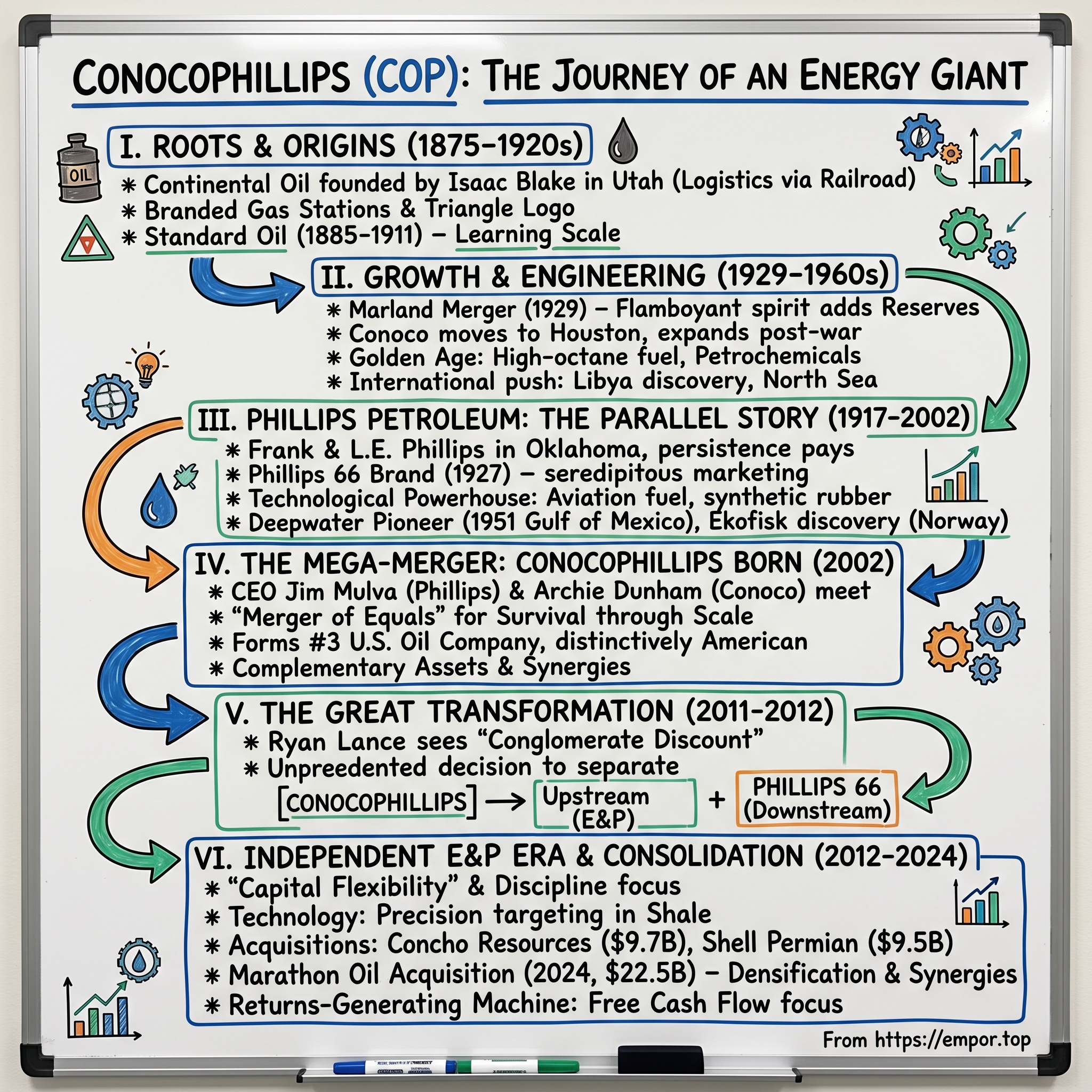
ConocoPhillips: The Story of America's Independent Energy Giant
I. Introduction & Episode Roadmap
On the morning of August 6, 2026, ConocoPhillips reported the highest quarterly profit in its modern history — adjusted earnings of $3.24 per share, production exceeding guidance, Permian Basin volume surpassing 900,000 barrels of oil equivalent per day for the first time, and $4.2 billion in free cash flow generated over ninety days.1 At the same time, the company announced that the chief executive who had led it for fourteen years was stepping down.
Ryan Lance opened the earnings call by addressing his departure before discussing the financial results. "I have spent more than 40 years at Conoco," he told analysts, "and I have had the honor of leading the company for the past 14 years."2 He announced that he would hand the CEO position to Chief Financial Officer Andy O'Brien effective September 1 — three days prior to this publication — while transitioning to executive chairman.3 Analysts on the call opened their single allotted questions with congratulations before moving to business issues.
Neil Mehta of Goldman Sachs called him "one of the most consequential leaders in the history of the energy industry."2
Yet those record earnings were driven less by operational improvements than by geopolitical conflict. ConocoPhillips realized $62.33 per barrel of oil equivalent in the second quarter of 2026, up 36% from a year earlier.1 That price surge followed a conflict among the United States, Israel, and Iran that spread into the Persian Gulf on February 28, 2026. By late August, Iranian forces and proxy groups had launched at least 172 attacks on non-military infrastructure across Gulf states, targeting energy facilities in nearly half of those strikes.4 The disruption largely closed the Strait of Hormuz, through which roughly one-fifth of global traded oil and gas flows.
Brent crude, which had traded near $72 per barrel, reached $96.11 on September 2, 2026 — roughly 38% higher than its level a year earlier.54
That dynamic illustrates the central tension of ConocoPhillips as an investment. By most metrics, it is the world's largest independent exploration and production company: producing roughly 2.3 million barrels of oil equivalent per day, holding 7.6 billion barrels of oil equivalent in proved reserves at year-end 2025, generating $58.9 billion in revenue across operations in fourteen countries, and carrying a market capitalization of approximately $164 billion in early September 2026.678 Over the past decade, management built a reputation for maintaining strict capital discipline among American oil producers.
Yet the company remains structurally dependent on a commodity price it does not control.
Its corporate history spans from an 1875 Utah kerosene reseller to an enterprise spending $12 billion annually on drilling across four continents. That trajectory includes one of the largest value-destroying acquisitions in oil industry history, a clean corporate split, a broken dividend commitment, and a series of counter-cyclical acquisitions that received broad market approval.
The core question facing investors is not whether management adopts "capital discipline" as a slogan, but how the team responds when commodity prices collapse — and whether pre-crisis commitments match post-crisis execution.
ConocoPhillips' record provides a nuanced answer to that question. It begins with two separate companies, founded four decades and a thousand miles apart.
 Subscribe on LinkedIn
II. Early Roots & The Pioneer Era: Continental Oil & Standard Oil (1875–1920s)
Isaac Blake was an oilfield worker from Pennsylvania and West Virginia who arrived in Utah Territory in the mid-1870s seeking new opportunities. He identified a clear market inefficiency: residents of Ogden were paying premium prices for kerosene—nineteenth-century America's primary lamp fuel—because wagon haulers brought it in from refineries in Colorado.
Blake's strategy was straightforward: buy kerosene in bulk in cheaper eastern markets, ship it west by rail, repackage it, and sell it to local retailers at prices no wagon-hauler could match.9
In 1875, he formed the Continental Oil and Transportation Company to execute this plan, purchasing two railroad tank cars—the first such cars used west of the Missouri River.9
That initial venture established a structural pattern for the company. Blake did not discover oil; he created a logistics advantage supported by dedicated infrastructure. Decades later, as ConocoPhillips moved low-value Permian Basin natural gas toward premium international liquefied natural gas markets, it applied a modern variation of that same infrastructure-led commercial model.
Continental expanded rapidly enough to attract Standard Oil. By 1884, Continental had agreed to become a Standard Oil affiliate; the following year, it merged with Standard's Rocky Mountain operations and reincorporated in Colorado as the Continental Oil Company, with Blake as president and headquarters in Denver.9 For the next quarter-century, Continental operated as a distribution and marketing arm for John D. Rockefeller's trust across the Mountain West rather than as an independent producer.
The U.S. Supreme Court's 1911 antitrust dissolution of Standard Oil broke apart the trust, establishing Continental as an independent enterprise—one of 34 corporate fragments created by the ruling.
The newly independent Continental remained primarily a distributor with minimal upstream production of its own. That structural imbalance was addressed in 1929 through a combination with an upstream operator facing the opposite challenge. Ernest Whitworth Marland, a former Pennsylvania oilman who had built a fortune in Oklahoma, founded Marland Oil Company in 1921. Marland grew into a prominent midcontinent wildcatter, building extensive reserves but lacking a sufficient retail network.
On April 30, 1929, Marland Oil acquired Continental Oil and Transportation.9 The merged company retained Continental's corporate name, relocated headquarters to Ponca City, Oklahoma, adopted Marland's red triangle logo, and gained a retail service-station network spanning 30 states. The market soon shortened "Continental Oil Company" to Conoco. The core transaction exchanged upstream reserves for downstream distribution: Marland secured a direct retail outlet for its production, while Continental secured a steady supply of crude for its network.
The 1929 deal established an operational identity that persisted across subsequent decades. Rather than relying primarily on organic exploration, the company operated as an industry consolidator, securing resources through acquisitions and corporate mergers. While asset consolidation can be an effective growth model, long-term returns depend heavily on acquisition timing and purchase prices relative to commodity cycles—a principle that would repeatedly test ConocoPhillips in later decades.
That asset-aggregation strategy contrasted sharply with the origins of another major component of the modern enterprise, established in Oklahoma around the same era.
III. Phillips Petroleum & The Integrated Major Era (1917–2000)
Frank Phillips worked as a barber before entering the oil business. In 1903, he moved from Iowa to Bartlesville, Oklahoma, to acquire Indian Territory leases with his brother, L.E. Phillips. After two initial unprofitable years, the brothers initiated a streak in 1905, drilling 81 consecutive producing wells without a single dry hole.9
In an era before seismic imaging, well logging, or modern subsurface science, this drilling campaign established the capital base for their expansion. In June 1917, as the United States entered World War I and crude prices rose, the brothers consolidated their Anchor Oil & Gas and Lewcinda Oil holdings into Phillips Petroleum Company. The new entity was capitalized at $3 million, with 27 employees and leases across Oklahoma and Kansas.9
Unlike Conoco's logistics-focused orientation, Phillips developed primarily around technological innovation. Its research facilities emerged as significant industrial laboratories, securing patents in catalytic cracking, natural gas liquids extraction, and later, polymer chemistry for high-density polyethylene. Beyond industrial patents, its research and marketing efforts produced a recognized retail brand.
In 1927, as the company prepared to launch a new gasoline without a finalized name, company officials testing the fuel reached 66 miles per hour on U.S. Highway 66 en route to Bartlesville; company lore holds that the coincidence supplied the brand name.9 The first Phillips 66 service station opened in Wichita, Kansas, later that year, launching a retail network across the central United States.
The company's subsequent expansion turned toward international exploration. By 1969, Phillips had conducted extensive drilling in the Norwegian North Sea without commercial success and was preparing to abandon its operations. On its thirty-eighth attempt in the Norwegian sector—drilling in Block 2/4—the crew encountered oil on October 25, 1969, at a depth of roughly 3,081 meters when downhole gas pressure spiked and drilling mud returned carrying crude.10 Publicly announced on June 2, 1970, the Ekofisk field discovery initiated Norway's transformation into a major petroleum-exporting economy.
The Ekofisk discovery remains relevant to ConocoPhillips' modern operations because the field continues to produce. Today, the Greater Ekofisk Area offshore Stavanger encompasses five producing fields, with crude piped to a stabilization and natural gas liquids processing facility at Teesside in the United Kingdom.7 Decades after its discovery, the complex remains an operational cash engine for the modern $164 billion enterprise.
In energy markets, assets like Ekofisk exemplify the "long-life, low-decline" profile that distinguishes diversified producers from pure-play shale operators, whose unconventional wells typically lose more than half their production volume within the first 18 months.
During the postwar period, Phillips also built international positions on Alaska's North Slope and in Qatar, securing equity stakes in liquefaction ventures that established its liquefied natural gas franchise. By the late 1990s, the predecessor companies possessed complementary profiles: Conoco brought midstream logistics, marketing, and North American onshore acreage, while Phillips contributed offshore engineering, gas processing technologies, and international concessions.
However, both enterprises faced scale limitations. The 1998 oil price collapse triggered an industry-wide consolidation wave, forming supermajors such as ExxonMobil, BP Amoco, and Chevron-Texaco. Against those larger balance sheets, neither Conoco nor Phillips possessed sufficient capital to independently fund the deepwater and LNG megaprojects that defined industry growth at the turn of the century. Combining the two companies was driven less by corporate ambition than by strategic necessity.
IV. The Mega-Merger & Empire Building: ConocoPhillips (2002–2011)
The Federal Trade Commission cleared it on the morning of August 30, 2002, and by the end of that day the merger of Conoco Inc. and Phillips Petroleum was done. The new ConocoPhillips began life with 8.7 billion barrels of oil equivalent in proved reserves, 1.7 million barrels a day of production, 2.6 million barrels a day of refining capacity and $75 billion of assets — the third-largest integrated energy company in the United States and sixth-largest publicly held energy company in the world by reserves and production.11 Jim Mulva of Phillips took the chief executive role; Archie Dunham of Conoco became chairman.
The shares began trading under COP on September 3, 2002.11
The strategic thesis was scale, and for a few years it appeared to work. Then came the decision that would define, and nearly destroy, the following decade.
The Burlington Resources acquisition: a claim tested and rejected. The claim ConocoPhillips was making in 2005 was explicit and testable: that large-scale acquisition of North American natural gas resource would create durable shareholder value, and that scale in gas was a strategic asset worth paying up for. On December 12, 2005, the company agreed to acquire Burlington Resources — the premier independent North American gas producer — for $35.6 billion.
Burlington holders received $46.50 in cash plus 0.7214 ConocoPhillips shares per share, roughly $92 per share against Burlington's pre-announcement price.1213 It brought 2,001 million barrels of oil equivalent in reserves and roughly 475,000 barrels a day of production, taking the combined company to 10.5 billion BOE of reserves and 2.3 million BOE per day.12 Mulva framed it as enhancing "production growth and North American gas supply position."12
The disconfirming evidence arrived within three years, and it arrived from a direction almost nobody at ConocoPhillips had modelled. The combination of horizontal drilling and multi-stage hydraulic fracturing — techniques that had been kicking around the Barnett Shale for years without anyone quite believing what they implied — turned North American natural gas from a scarce resource into an abundant one.
Prices that had spiked above $10 per million British thermal units collapsed. Burlington's conventional gas reserves, bought at the top of a scarcity narrative, were repriced against a supply curve that had shifted permanently outward.
The accounting caught up in the fourth quarter of 2008. ConocoPhillips wrote off $25,443 million — the entire recorded goodwill of its Exploration and Production segment, the bulk of it created by the Burlington transaction — alongside a $7,410 million impairment of its stake in the Russian producer LUKOIL. The quarter produced a net loss of $31,764 million and the full year a net loss of roughly $17.0 billion, against net income of $11.9 billion in 2007.14 That is not a markdown. That is the complete erasure of the premium paid for a $35.6 billion acquisition, three years after signing.
Analysts had flagged the risk at the time. Deutsche Bank's Paul Sankey called it a high-priced deal pitched at peak U.S. natural gas prices; Bernstein's Benjamin Dell said flatly that the company appeared to be buying at the peak of the market.12 The company's response was that high gas prices would let it retire the associated debt quickly.12 That is the shape of the error, and it is worth naming precisely: ConocoPhillips underwrote a very large, largely irreversible commitment against a price forecast. Not against a cost position, not against a structural advantage — against a view of where gas prices were going.
The forecast was wrong, and the loss was permanent.
Venezuela: a second claim, tested by politics. The parallel claim of the empire-building era was that international concessions provided resilient, geographically diversified resource growth. In the summer of 2007, Hugo Chávez's government moved to take control of foreign-operated heavy oil projects in the Orinoco Belt. ConocoPhillips held interests in Petrozuata, Hamaca and the offshore Corocoro development. It refused the terms offered and walked. The second-quarter after-tax impairment in the Exploration and Production segment came to $4,512 million.15
What followed was a nineteen-year legal campaign that is still running. In March 2019 an ICSID tribunal unanimously ordered Venezuela to pay approximately $8.7 billion for unlawful expropriation, later rectified downward by about $227 million.16 As of June 30, 2026, ConocoPhillips held confirmed ICSID and ICC awards totalling roughly $10.5 billion plus interest against Venezuelan entities, and had actually collected about $795 million.17 Collection actions continue.
There is a live path to more: a Delaware court approved a $5.9 billion bid from Elliott Investment Management's Amber Energy affiliate for Citgo's parent PDV Holding on November 25, 2025, with ConocoPhillips among the large creditors positioned to recover from the proceeds — though closing remained contingent on U.S. Treasury sanctions approval and appeals.18
Read those two episodes together and a conclusion emerges that is harsher than "oil is cyclical." Between 2006 and 2012, ConocoPhillips deployed roughly $40 billion into a gas-scarcity thesis and a political-stability thesis, and both were falsified by mechanisms external to the company.
An investor evaluating today's ConocoPhillips is evaluating an institution that has direct, expensive institutional memory of what happens when capital is committed against a forecast. The interesting question — taken up in Section VI — is whether the framework it built in response actually removes that failure mode or merely relabels it.
By 2011 the empire had become the problem. The stock traded at a persistent discount, the balance sheet carried the scars, and management concluded that the integrated model itself was the obstacle.
V. The Great Separation: Spinoff of Phillips 66 & The Pure-Play Pivot (2011–2012)
The financial rationale for an integrated oil company rests on a structural hedge. When crude oil prices are high, upstream exploration and production generates substantial earnings. When crude prices fall, downstream refining margins tend to expand as feedstock costs decline. Operating both segments theoretically smooths cash flows across commodity cycles—a thesis integrated majors like ExxonMobil and Chevron have maintained for over a century.
By 2011, ConocoPhillips concluded that equity markets were no longer rewarding that corporate structure. Wall Street analysts valued refining and upstream operations on different earnings multiples, leaving the combined enterprise trading at a persistent sum-of-the-parts discount. Furthermore, the two business units competed internally for capital on incompatible terms: refining projects offering modest returns over long payback periods competed directly against shale drilling programs characterized by high initial decline rates and rapid cash recovery, all evaluated under a single corporate cost of capital ill-suited to both.
On May 1, 2012, ConocoPhillips resolved the internal capital conflict by dismantling the integrated structure. Shareholders received one share of Phillips 66 for every two ConocoPhillips shares held as of the April 16 record date, spinning off the refining, chemicals, midstream, and marketing operations into an independent public company with no retained ConocoPhillips equity.19 The remaining standalone enterprise launched as the world's largest independent exploration and production company, backed by 2011 production of 1.62 million barrels of oil equivalent per day, 8.4 billion barrels of oil equivalent in proved reserves, operations across nearly thirty countries, and a workforce of more than 16,000 employees.19
The board selected Ryan Lance as chief executive. Rather than a background in corporate finance or marketing, Lance was a petroleum engineer whose operational career in the field and subsurface spanned forty-two years in the energy business by 2026.3 "ConocoPhillips will truly be unique as an independent E&P company," Lance stated at the separation. "Our unmatched size, scope and capability position us to compete successfully in this business."19
That assertion warranted skepticism because its emphasis on scale mirrored the operational priorities that had driven the high-priced Burlington Resources acquisition six years earlier. Management's initial post-spinoff strategy aimed to optimize the asset base by selling non-core international concessions and reallocating capital toward North American unconventional shale resources.
However, through 2012 and 2013, the corporate strategy remained anchored to a volume-growth framework: fixed production growth targets, escalating dividend commitments, and an implicit reliance on crude prices remaining near $90 to $100 per barrel.
Evaluated on its structural merits, the spinoff succeeded in creating strategic clarity. Upstream and downstream businesses carry distinct capital costs, investor bases, and payout expectations; separating them enabled ConocoPhillips to apply a uniform hurdle rate to capital allocation across its global E&P portfolio.
What did not hold up was the premise that a pure-play exploration and production company could maintain earnings stability across commodity downcycles. Divesting the downstream refining business permanently eliminated the enterprise's primary cash flow shock absorber.
Between 2012 and 2016, ConocoPhillips experienced the full impact of operating without that operational cushion.
The test began in the second half of 2014.
VI. The Crucible: The 2014–2016 Crude Collapse & The Cost-of-Supply Framework (2014–2020)
In June 2014, West Texas Intermediate traded above $105 a barrel. Twenty months later it touched $26. The proximate cause was OPEC's November 2014 decision — driven by Saudi Arabia — to defend market share rather than price, which was in substance a decision to find out how much pain American shale producers could absorb. The answer, for a while, was a great deal, because shale wells kept getting cheaper to drill even as the price fell. For companies with dividends to fund, the answer was less.
The dividend promise, and what happened to it. This is the single most instructive episode in ConocoPhillips' management-credibility record, and it deserves to be laid out with the dates attached, because the dates are the evidence.
On December 10, 2015 — with WTI already below $40 — ConocoPhillips announced a 2016 capital budget of $7.7 billion, down 25% from the $10.2 billion expected for 2015. On that occasion Lance was asked directly about the dividend and gave an answer of unusual clarity: "We view the dividend level as a long-term decision, and we've been in the current low price cycle for a relatively short period of time.
We're choosing to exercise flexibility during this downturn through CapEx and the balance sheet if necessary, not via the dividend."20 The company had actually raised the dividend earlier in 2015, describing it as a modest but important signal to owners.20
Fifty-six days later, on February 4, 2016, ConocoPhillips cut the quarterly dividend from $0.74 to $0.25 per share, effective March 1 — a 66% reduction.2122 Capital guidance was cut again, from $7.7 billion to $6.4 billion, and operating cost guidance from $7.7 billion to $7.0 billion, together improving 2016 net cash flow by $4.4 billion.21 The context was brutal: a fourth-quarter 2015 net loss of $3.5 billion, a full-year loss of $4.4 billion, and realized prices of $28.54 per barrel of oil equivalent against $52.88 a year earlier.21 Lance's explanation was that "while we don't know how far commodity prices will fall, or the duration of the downturn, we believe it's prudent to plan for lower prices for a longer period."21
How should an investor weigh this? Two readings are defensible and both should be held simultaneously. The charitable reading is that cutting was correct — the alternative was borrowing to fund distributions into a collapsing market, which is how balance sheets die — and that a management team willing to take a reputational beating to protect solvency is demonstrating exactly the judgment you want.
The uncharitable reading is that eight weeks is not long enough for the facts to change that much. WTI in mid-December 2015 was already in the $35 range. The information that justified the February cut was substantially available in December, when management chose instead to make a public commitment it could not keep.
The conclusion that survives both readings is the one that matters going forward: ConocoPhillips management's forward statements about distributions should be treated as intentions conditioned on price, not as commitments. The company's own subsequent framework, to its credit, was built to make that explicit rather than to pretend otherwise. When today's management says it will return 45% of cash from operations, the honest translation is "45% of a number we do not control."
The framework that came out of the wreckage. What ConocoPhillips built after 2016 is the reason the company gets talked about as a template rather than a survivor. Stripped of jargon, the idea is this: instead of forecasting the oil price and approving projects that work at the forecast, define a single number — the "cost of supply" — and refuse to fund anything above it.
The definition is precise and is disclosed in the annual report: cost of supply is the WTI-equivalent price that generates a 10% after-tax return on a point-forward, fully burdened basis, where "fully burdened" includes capital infrastructure, foreign exchange, an internal cost of carbon, price-related inflation and corporate overhead.7 Think of it as the break-even price of a barrel with every cost the company can attribute to it loaded on top — including a charge for carbon emissions that no regulator currently forces it to pay.
Projects that clear the threshold get capital. Projects that do not, do not, regardless of how much production they would add.
Two things about this deserve emphasis. First, it inverts the industry's historical incentive. For most of the twentieth century, oil executives were rewarded for growing volumes and replacing reserves; a barrel produced was a barrel of achievement.
The cost-of-supply framework makes volume irrelevant except as an output. Second — and this is the genuinely falsifiable part — it is only as good as the cost estimates that feed it. A framework that mechanically rejects bad projects still depends on engineers correctly forecasting what a project will cost.
As Willow would later demonstrate, that is not a solved problem.
Around the framework, management built a capital allocation hierarchy that has stayed remarkably stable since: sustain the base business, grow the ordinary dividend, fund only low cost-of-supply development, and return a defined share of operating cash flow to shareholders regardless of the point in the cycle. The formal commitment disclosed in the annual report is to return greater than 30% of net cash provided by operating activities.7 The company has consistently run well above it — 46% in 2025 — but the commitment is 30%, and in a genuine downturn that gap is where the flexibility lives.7
By 2020, with the pandemic having briefly driven WTI futures below zero, ConocoPhillips had a rebuilt balance sheet, a disciplined framework, and something most of its peers did not have: cash and equity currency at a moment when the American shale industry was on its knees. It went shopping.
VII. The Unconventional Consolidation Machine: Concho, Shell Permian & Marathon Oil (2020–2024)
To understand why the next four years mattered, you need to understand what "shale inventory" actually is, because the phrase gets used as though it were self-explanatory.
A shale well is not a conventional oil well. A conventional well taps a pressurized underground reservoir and produces for decades at a slowly declining rate. A shale well drills down and then turns sideways for two or three miles through rock that holds oil but will not release it, then fractures that rock with high-pressure water and sand to create pathways. It produces spectacularly for a year or two and then declines steeply.
The economics therefore depend not on the well but on the queue — the number of remaining locations where you can repeat the operation at an acceptable cost. Tier-one inventory means locations where the rock is thick and rich enough that the well pays back at low prices. Nobody is making any more of it.
Once a basin's core is drilled, the operator's choice is to accept declining well quality or to buy someone else's remaining queue.
ConocoPhillips made the second choice, three times.
Concho Resources (closed January 15, 2021). The all-stock acquisition of Concho, in which each Concho share converted into 1.46 ConocoPhillips shares, closed while the industry was still shell-shocked.23 It brought a large Permian position spanning the Delaware and Midland basins into a company that, at the time, had a respectable but not commanding presence there. Lance's framing at closing was ambitious: the combination of "two premier companies that can lead the structural change for our vital industry."23
The timing was the whole argument. ConocoPhillips issued equity when its own shares were depressed, which is normally a bad trade — but it issued them to buy assets that were equally depressed, and it did so when almost no competitor had the balance sheet to bid.
Whether that was skill or the accident of having survived 2016 with capacity intact is a judgment call. The defensible statement is narrower: ConocoPhillips was one of very few buyers able to transact in late 2020, and being able to transact when others cannot is itself a capital-structure achievement traceable to the discipline imposed after the dividend cut.
The Shell Permian assets (closed December 1, 2021). Eleven months later, ConocoPhillips paid cash — roughly $8.6 billion after closing adjustments against a $9.5 billion headline — for approximately 225,000 net acres in the Delaware Basin in Texas, expected to deliver about 200,000 barrels of oil equivalent per day in 2022, along with more than 600 miles of operated crude, gas and water pipelines.24 Lance's public justification was notably specific: the deal "meets our rigorous cost of supply framework," the company saw "a way to drive efficiencies from the assets," and it made the ten-year plan better.24
That last clause is the tell. By late 2021 ConocoPhillips had stopped talking about deals in terms of scale and started talking about them in terms of what they did to a specific, disclosed multi-year plan. The infrastructure that came with the acreage — the pipelines — mattered more than it sounds. Owning your own water disposal and gas takeaway in the Delaware Basin is the difference between drilling on your own schedule and drilling on a midstream company's schedule.
Marathon Oil (announced May 29, 2024; closed November 22, 2024). The largest of the three was announced with a full set of promises attached, which makes it the most useful for testing management's record. ConocoPhillips agreed to acquire Marathon Oil in an all-stock transaction at an enterprise value of $22.5 billion including $5.4 billion of Marathon net debt, at an exchange ratio of 0.2550 ConocoPhillips shares per Marathon share — a 14.7% premium to Marathon's closing price.2526 The strategic case was inventory density: more than two billion barrels of resource with estimated point-forward cost of supply below $30 per barrel WTI, concentrated in the Eagle Ford and Bakken where Marathon's acreage interleaved with ConocoPhillips', plus low-cost gas in Equatorial Guinea.25
Management attached three specific commitments to the deal, and it is worth checking each.
Synergies. The initial target was $500 million of run-rate cost and capital savings within the first full year.25 At closing that was raised to more than $1 billion.7 By the 2025 annual report, the company stated it had integrated Marathon "with >25% more resource and >$1 billion synergy capture."7 On the evidence disclosed, this promise was met and exceeded. It is the cleanest win in the set.
Buybacks. At announcement, ConocoPhillips said that assuming then-current commodity prices it planned to repurchase more than $7 billion of shares in the first full year post-close and more than $20 billion over three years.25 What actually happened: share repurchases totalled $5.0 billion in 2025 and $3.0 billion in the first half of 2026.717 That is a meaningful shortfall against the year-one figure.
The company's caveat — "assuming recent commodity prices" — was real and prices did fall in 2025. But this is the second instance in a decade of a headline distribution commitment being scaled back when prices moved, and the pattern is now a pattern rather than an incident.
Share count. The related claim, made frequently by bulls, is that buybacks are rapidly shrinking the share count. The arithmetic deserves care. Weighted average diluted shares were approximately 1,181 million in 2024 and approximately 1,253 million in 2025 — because the Marathon stock issuance more than offset repurchases.6 Shares outstanding fell from 1,257.5 million to 1,201.3 million over the first half of 2026.17 So the accurate statement is that the count is now falling from a post-deal peak, not that it is below where it stood before the deal.
An investor tracking per-share value creation should be measuring from the 2024 baseline, not from the 2025 top.
The uncomfortable coda. On September 3, 2025 — roughly nine months after closing a transaction sold on more than $1 billion of synergies — ConocoPhillips announced it would cut 20% to 25% of its workforce, employees and contractors, with most of the reductions occurring that year.27 The company framed it as ongoing efficiency work; a spokesman said "we are always looking at how we can be more efficient with the resources we have."27 The annual report is more specific: a restructuring initiated in late 2025 was expected, together with lease operating cost improvements and transportation and processing opportunities, to contribute roughly $0.8 billion of a targeted $1 billion-plus of incremental cost reductions and margin enhancements on a run-rate basis by the end of 2026.7
The honest reading is that the Marathon synergies were real and the additional cost program was a separate, larger response to a weaker price environment — but also that a company cutting a quarter of its workforce twelve months after an acquisition is a company that either found more overlap than it disclosed at signing, or found its cost base less competitive than it had believed. Both are worth knowing.
VIII. Current Business Model & Segment Breakdown
Picture a portfolio built along a single axis: how long does the barrel last, and how quickly does the capital come back? At one end sit shale wells — fast, cheap, steep-declining, and endlessly repeatable while the inventory holds. At the other sit Arctic and offshore megaprojects and liquefaction plants — enormous upfront cost, four to six years before first revenue, then thirty years of production that barely declines. ConocoPhillips runs both ends deliberately, and the interaction between them is the actual business model.
Lower 48. This is the engine. The segment produced 1,484 thousand barrels of oil equivalent per day in 2025 and contributed 67% of consolidated liquids production and 74% of consolidated natural gas production, generating segment earnings of $5,264 million.7 The land position is genuinely large: approximately 782,000 net acres in the Delaware Basin spanning west Texas and southeast New Mexico, 416,000 in the Midland Basin, 489,000 in the Eagle Ford and 799,000 in the Williston Basin of North Dakota and eastern Montana.7 The Delaware Basin alone held more than 15% of the company's total proved reserves at year-end 2025.7
What has been happening inside that acreage is a compounding efficiency story that is easy to under-appreciate. On the second-quarter 2026 call, Lower 48 head Nick Olds described average lateral lengths up 15% in 2026 versus 2025 with the number of three-mile-plus laterals doubling, drilling and completion efficiency gains of about 15%, and technology work including real-time fracture diagnostics that let crews adjust stage volumes by up to 30% and surfactant trials showing up to 20% higher oil productivity in treated wells.2 Translated: a longer lateral spreads the fixed cost of the vertical section and the surface facility across more producing rock, so cost per barrel falls even if nothing else improves.
This is the least glamorous and most reliable source of margin in shale, and ConocoPhillips has been compounding it for years.
Alaska. The legacy North Slope assets — Greater Prudhoe Bay, the largest conventional oil field in North America, and the Greater Kuparuk Area — contributed 12% of consolidated liquids production in 2025 with segment earnings of $730 million, down from $1,326 million in 2024 on lower prices.7 These are waterflood and enhanced-recovery operations decades into their lives, which is precisely their virtue: they decline slowly and require no exploration risk.
The future of the segment is Willow, in the Bear Tooth Unit of the western North Slope. Sanctioned in December 2023 after federal approval, it comprises three drill sites, an operations centre and camp, and a processing facility, with first oil anticipated in early 2029 and roughly 600 million barrels expected over thirty years.7[^28] In November 2025 the company raised the cost estimate to a range of $8.5 billion to $9.0 billion from the original $7.0 billion to $7.5 billion, citing roughly $700 million of general inflation and higher North Slope construction costs.28 The project was around 50% complete after the 2025–26 winter construction season, with the processing facility on schedule for transport to the North Slope in 2027 and about $1.7 billion of annual spending planned in 2026, 2027 and 2028.728
Canada. Surmont, an oil sands operation south of Fort McMurray in Alberta covering approximately 684,000 net acres in the Athabasca region, became wholly owned in October 2023 when ConocoPhillips bought TotalEnergies' remaining 50% working interest for $3.0 billion.7 Surmont uses steam-assisted gravity drainage — SAGD — which is worth explaining plainly: bitumen in place is too viscous to flow, so operators drill paired horizontal wells, inject steam through the upper one to heat the deposit until the bitumen liquefies, and collect it through the lower one.
It is capital- and energy-intensive to establish and then produces steadily for decades with minimal decline. The Montney play in northeastern British Columbia adds approximately 297,000 net unconventional acres of liquids-rich gas.7
Europe, Middle East and North Africa. Beyond Ekofisk, this segment carries the Qatari LNG interests — 25% stakes in the QatarEnergy LNG NFE(4) and NFS(3) joint ventures participating in the North Field East and North Field South expansions — plus a 20.4% interest in Libya's Waha concession.7
That Qatar position is where the 2026 war intersects the business model directly, and it deserves to sit here rather than in a distant risk section. Ras Laffan Industrial City, the world's largest LNG export hub, came under repeated attack in March 2026 and at one point halted production entirely; an explosion at Qatar's Barzan gas project in June killed at least thirteen people.4 ConocoPhillips excluded Qatar entirely from its second-quarter 2026 production guidance and took a 20,000 barrel-per-day annual adjustment to full-year guidance.29 On the second-quarter call, EVP of Global Operations Kirk Johnson characterized delays to the North Field East and South projects as "months, not a full year," with limited free cash flow impact.2 Independent assessments have been less sanguine: damage to Ras Laffan LNG trains has been estimated to require three to five years and around $3 billion to repair, with the North Field East expansion likely delayed by at least a year.4 Those two accounts cannot both be right, and the gap is a live disclosure question an investor should hold management to on subsequent calls.
Asia Pacific and global LNG. Australia Pacific LNG, the coal-seam-gas-to-LNG venture with Origin Energy and 中国石化 Sinopec on Curtis Island, converts coal bed methane into exportable LNG and returns cash through distributions.7 The newer and more consequential piece is commercial: ConocoPhillips holds a 30% direct equity interest in Port Arthur LNG Phase 1, scheduled to start up in 2027, and has been assembling third-party offtake — 10.2 million tonnes per annum of North American commercial offtake at year-end 2025, expanded to 12 MTPA in mid-2026 with new agreements in Indonesia and on the U.S. Gulf Coast — plus approximately 6.7 MTPA of European regasification capacity.71
The logic here is arbitrage, and CFO-turned-CEO Andy O'Brien has been unusually explicit about the economics: "for every $1 per MMBtu margin on 5 MTPA, that's about $200 million cash flow."2 The company buys or produces cheap North American gas, pays a toll to liquefy it, ships it, and sells it into European or Asian markets that price gas far higher.
It is Isaac Blake's kerosene arbitrage with cryogenic tankers instead of rail cars. It is also, on the evidence so far, a business of signed contracts rather than realized earnings — Port Arthur has not started up, and offtake agreements are commitments to buy, not proof of margin.
This is the part of the story that should be held to a conversion standard rather than an announcement standard.
The segments together produced 2,375 MBOED in 2025 and 2,248 MBOED in the second quarter of 2026, with 84% of proved reserves located in OECD countries — a genuine and underrated risk characteristic given what happened in Venezuela.71
IX. Current Management, Incentive Structure & Capital Allocation Framework
For fourteen years the answer to "who runs ConocoPhillips" was one name. As of September 1, 2026, it is not.
Ryan Lance built the modern company and has now stepped into a transitional executive chairman role after forty-two years with the enterprise.3 His public persona was consistent to the point of monotony: engineer's vocabulary, no rhetorical flourish, an insistence on repeating the same four capital-allocation priorities on every call for years.
On his final earnings call he offered his own summary of the record: "We have a high say-do ratio. We do not say things we do not intend to go do."2 That claim is the one an investor must weigh, and the honest verdict is mixed — strongly supported on operational and project commitments, and contradicted twice on distribution commitments, in December 2015 and again at the Marathon close.
Andy O'Brien joined Conoco in 1997 and has spent nearly thirty years in finance, planning and strategy roles across the company's geographies. He entered the executive leadership team in 2022 with an unusually broad remit — Alaska, the international businesses, commercial, LNG, finance, strategy, investor relations and M&A — before adding the CFO title.3 That breadth is the argument for him: he is the architect of both the Middle East re-entry and the LNG commercial build-out, and he is arguably the only executive who has held every piece of the current plan at once.
The counter-argument is that a finance-and-strategy CEO succeeding an engineer, at a company whose next three years hinge on delivering an Arctic megaproject and a liquefaction start-up, is a specific bet on continuity of the operating bench rather than on new operating leadership. That bench — Kirk Johnson in global operations, Nick Olds in Lower 48 — stayed in place.2
Konnie Haynes-Welsh became senior vice president and chief financial officer on the same date, promoted from vice president of finance and controller. She joined ConocoPhillips in 2012 and has served in corporate strategy, compliance, Lower 48 and as treasurer, with prior experience at PricewaterhouseCoopers and Mariner Energy.3 A controller stepping into the CFO seat is a signal about where the emphasis sits: cost discipline and reporting rigour rather than deal-making.
Incentives. The disclosed long-term incentive structure is more specific than the generic "returns-based" language companies typically use. The financial metric for recent Performance Share Program cycles is Relative Adjusted Return on Capital Employed — relative, meaning measured against a defined peer group rather than an absolute internal target.30 The annual Variable Cash Incentive Program includes a 20% weighting on strategic milestones, which from 2025 absorbed the previously separate energy transition milestones.30 The historical peer group for these comparisons has included the integrated majors and large independents rather than a pure-play E&P set.31
That last detail is not trivial, and it has been contested by the company's own shareholders. In 2017, ConocoPhillips' say-on-pay proposal failed to receive majority support — a genuinely rare event for a company of its size. The board's own account, in the following year's proxy, was blunt: "ConocoPhillips' Board and management team were disappointed with the results of the 2017 Say on Pay vote, which failed to receive majority support."32 The response was substantive rather than cosmetic.
The company sought meetings with holders of more than 50% of outstanding stock, met with holders of more than 42%, sent its lead director and compensation committee chair in person to holders of roughly 37%, and then increased target disclosure, published a payout matrix for relative financial metrics, reduced annual incentive complexity and revised peer selection and CEO benchmarking disclosure.32 Ryan Lance's 2016 total compensation, the year that triggered the vote, was $19.2 million including a $3.6 million change in pension value, or $15.6 million excluding it.31
The episode is nearly a decade old and was remediated, so it should not be over-weighted. But it establishes something useful about the governance culture: the board was capable of losing a shareholder vote and then engaging seriously rather than defensively. That is a better indicator than any single year's pay figure.
The capital allocation framework in its current form. The 2026 plan calls for capital expenditures of $12.0 billion to $12.5 billion and adjusted operating costs of $10.2 billion, against production guidance of 2.295 to 2.325 million BOE per day.3329 The ordinary dividend stands at $0.84 per share quarterly, having been raised 8% in 2025 in line with a stated goal of top-quartile dividend growth within the S&P 500.71 The stated distribution target for 2026 is 45% of cash from operations, against a formal framework commitment of greater than 30%.72 Through the first half of 2026 the company had averaged roughly 40%, and O'Brien told analysts he was "shooting for" 45% for the full year without guiding quarter to quarter.2
The balance sheet supports it. Total debt stood at $23.3 billion at June 30, 2026 against $6.6 billion of cash and equivalents and $1.1 billion of short-term investments, for net debt near $15.6 billion.17 Long-term ratings were Fitch A, S&P A- and Moody's A2, all with stable outlooks, and Fitch reaffirmed in November 2025.7 There are no ratings triggers that would cause automatic default on corporate debt.7
The single most important disclosed number in the entire framework is not a distribution percentage. It is the free cash flow break-even: O'Brien told analysts on the second-quarter call that it stands in the mid-$40s WTI today and is expected to move to the low $30s by 2029 as Willow and the LNG projects come online and capital spending falls.2 Every other claim in the current bull case — the $7 billion free cash flow inflection, sustained top-quartile dividend growth, buybacks through the cycle — depends on that trajectory being real.
X. Competitive Position: Strategic Powers & Industry Structure
Setting two questions side by side clarifies the enterprise's standing: Does ConocoPhillips possess a durable competitive advantage, or does it simply hold a favorable position inside a cyclical commodity business? Strategic frameworks help separate those two realities.
Hamilton Helmer's 7 Powers, applied honestly.
Scale economies — real but bounded. Producing roughly 2.3 million barrels of oil equivalent per day gives ConocoPhillips genuine purchasing leverage across the oilfield services complex—from rigs and hydraulic fracturing spreads to proppant sand, casing, and supply chain logistics. Corporate overhead is distributed across a production base far larger than any mid-cap operator can match. Yet scale in exploration and production reaches a ceiling that software business models do not. Larger integrated majors like ExxonMobil and Chevron command equal or greater scale, and beyond a certain operational threshold, incremental volume yields diminishing discounts on field supplies. This scale functions as a clear cost advantage over smaller independents, but offers only parity against the supermajors.
Cornered resource — the strongest claim, and the one to interrogate. Management asserts that the enterprise controls a deep queue of premium drilling locations breaking even below $35 per barrel West Texas Intermediate—a scarce asset base that competitors cannot easily duplicate. Concrete evidence supports this position: proved reserves of 7,637 million barrels of oil equivalent at year-end 2025, a commanding acreage footprint in the Delaware Basin, and Marathon Oil's sub-$30 cost-of-supply inventory.725 Counter-evidence, however, places clear boundaries on that claim.
In 2025, the company achieved an 80% total reserve replacement ratio, or 99% on an organic basis when excluding a net reduction of 165 million barrels of oil equivalent from asset dispositions—meaning organic drilling matched annual output while reported reserves contracted.7 Total proved reserves declined from 7,812 million barrels of oil equivalent at year-end 2024 to 7,637 million.7 Meanwhile, proved undeveloped reserves expanded from 35% to 37% of the total, indicating that a larger portion of reported reserves requires fresh capital upfront before it can yield cash flow.7 Divided by annual production of roughly 867 million barrels of oil equivalent, the proved reserve base provides about nine years of output.7
This inventory life is not a structural flaw; it is typical for a shale-focused producer, and official reserve figures understate total resource because Securities and Exchange Commission regulations limit what can be formally booked. However, the data narrows the corporate narrative. The rigorous verdict is that ConocoPhillips maintains a strong inventory position providing roughly a decade of proved reserve coverage—backed by unbooked resources of variable quality—and has relied primarily on corporate acquisitions rather than organic discovery to secure recent additions.
The critical test for investors to monitor is clear: consecutive years of organic reserve replacement below 100%, or further large-scale acquisitions justified by inventory depth, would signal that the top-tier drilling queue is shorter than management claims.
Counter-positioning — genuine, and the most distinctive power in the portfolio. ConocoPhillips does not operate oil refineries, build utility-scale renewable power projects, or manage chemical plants. Its integrated peers maintain all three. This pure-play design represents a structural choice competitors cannot swiftly replicate, given the time and capital required to dismantle integrated operations. For investors, it yields a direct financial product: unhedged exposure to upstream cash flows paired with an explicit capital return framework.
However, that strategic commitment eliminates the downstream earnings hedge that buffers integrated majors during commodity downturns—a tradeoff illustrated by the severe dividend reduction in 2016. Counter-positioning in this context is real, functioning as a powerful but double-edged strategic weapon.
Process power — moderate and improving. Continuous gains in horizontal lateral lengths and completion efficiency form the core of the operational model. Whether these operational practices constitute a proprietary advantage remains doubtful; peers such as EOG Resources, Diamondback Energy, and the shale divisions of the integrated majors execute comparable technical programs. Continuous efficiency gains in shale function less like an insurmountable moat and more like a competitive treadmill, where top-tier operators must run faster simply to preserve their margin advantage.
Branding, network economies, and switching costs — absent. Unprocessed crude oil and liquefied natural gas are standardized global commodities; buyers select shipments based on price and delivery specs rather than producer identity.
Porter's Five Forces, briefly.
New entrants encounter formidable barriers to entering top-tier shale plays, where premier acreage is already locked up, regulatory permitting is complex, and required capital infrastructure is substantial.
Buyer power appears low because crude oil and liquefied natural gas clear into global commodity markets, but that dynamic cuts both ways: ConocoPhillips possesses zero pricing power and functions strictly as a price-taker across its entire output.
Supplier power remains moderate and highly cyclical, expanding whenever industry utilization of drilling rigs, hydraulic fracturing fleets, and oilfield labor tightens.
Substitutes represent a long-term structural overhang. Electric vehicle adoption and energy-efficiency trends alter liquid fuel demand over decades rather than quarters, affecting the terminal value of thirty-year megaprojects like Willow far more than near-term operating cash flows.
Rivalry is intense and has fundamentally shifted context. Competition among ExxonMobil, Chevron, ConocoPhillips, EOG Resources, and Diamondback Energy focuses less on traditional exploration and more on acquiring prime inventory and optimizing shareholder returns. Consequently, the ultimate scarce resource contested in the sector is investor capital and patience rather than unassigned acreage.
The synthesis is straightforward: ConocoPhillips commands a structural cost advantage and a disciplined capital-allocation model within a cyclical commodity industry, rather than a durable, price-setting moat. These operational strengths are real and measurable, yet they remain vulnerable to erosion if execution wavers over a multi-year window. That structure represents a fundamental difference from businesses with pricing power, requiring investors to evaluate the enterprise on cost control and capital execution rather than commodity price expansion.
XI. Playbook: Business & Investing Lessons
Strip away the specifics, and four transferable lessons emerge from this history—three of which ConocoPhillips learned by first making the opposite mistake.
Structure follows capital cost, not sentiment. The Phillips 66 separation succeeded because upstream exploration and downstream refining genuinely require different hurdle rates, dividend policies, and investor bases. Forcing both through a single corporate cost of capital produced flawed capital-allocation decisions in both directions.
The generalizable test for corporate splits is not whether a spinoff will "unlock value"—a framing that invites motivated reasoning—but whether the underlying businesses require materially different hurdle rates. Where the answer is yes, separation provides strategic clarity. Where it is no, separation amounts to financial engineering with transaction fees attached. Crucially, the 2012 split did not make the standalone E&P business safer. Instead, it concentrated commodity risk, leaving the company without a refining buffer when oil prices crashed four years later.
A hard constraint beats a good forecast. ConocoPhillips underwrote its Burlington Resources acquisition against a high natural gas price forecast, only for horizontal drilling and hydraulic fracturing to dismantle that premise. The company's subsequent cost-of-supply framework replaced price forecasting with a strict threshold: a project either clears a fully burdened break-even rate of return or it receives no funding, explicitly excluding management's commodity price assumptions from the decision.
That design principle applies well beyond energy: build capital-allocation systems that fail safely when forecasts prove wrong, rather than systems that depend on forecasts being right. Yet the framework carries an essential caveat: a break-even threshold is only as reliable as the cost estimates fed into it. The cost inflation on the Willow project—rising from an initial $7.0 billion to $7.5 billion estimate up to $8.5 billion to $9.0 billion—serves as a clear reminder that hurdle rates bind on estimated inputs rather than realized outcomes.28
Buy when you can, not when you should. ConocoPhillips' counter-cyclical acquisitions between 2020 and 2024 proved strategically successful, but the mechanism behind that record requires precision. The company did not buy Concho Resources and Shell's Permian acreage simply because management was more perceptive about commodity cycles than its peers.
Rather, ConocoPhillips executed those deals because it had emerged from the 2016 downturn with an investment-grade balance sheet and valuable equity currency at a moment when most competitors had neither. The capacity to act counter-cyclically is manufactured through capital discipline during prosperous years, then deployed during downturns. The real lesson is less about deal-making intuition than about how an executive team manages capital when market conditions are favorable.
Distinguish the formula from the promise. ConocoPhillips' distribution architecture—a growing ordinary dividend sized for low-price environments, paired with variable buybacks that flex alongside cash flow—is structurally sound because it does not require management to guarantee fixed dollar payouts through a market collapse.
The primary stumbles in the corporate record occurred when management departed from that formula to make explicit commitments: first in December 2015 regarding dividend sustainability, and again in May 2024 regarding first-year post-merger share repurchases. In both instances, relying on the flexible formula would have provided a safer and more accurate representation to shareholders. For investors, the practical takeaway is to evaluate the underlying distribution framework rather than management's headline promises.
XII. Analysis & Bear vs. Bull Case ("Why Win / Why Not")
Why ConocoPhillips wins from here.
The affirmative case rests on a single mechanical claim with a date attached: that free cash flow roughly doubles into 2029 as capital spending falls and long-cycle projects start producing. Management has been specific. O'Brien told analysts that peak Willow capital spending is already behind the company, that capital expenditure "comes down" from here and comes down further once Willow starts up in early 2029, and that free cash flow break-even moves from the mid-$40s WTI to the low $30s over that period.2 Lance framed the target as "$7 billion free cash flow inflection by 2029," roughly doubling the prior year's total.2
The supporting evidence is better than rhetoric. The disposition programme delivered $5 billion ahead of schedule, including $1.7 billion of non-core Lower 48 sales completed in July 2026.1 The cost reduction programme was described as running ahead of plan.2 Willow was on schedule for early 2029 first oil after a successful winter construction season.7 The Middle East re-entries were structured to be nearly capital-free: O'Brien put acquisition capital for the 42% Kirkuk interest at $300 million to $500 million at closing, with the joint venture expected to fund its own redevelopment from its own cash flows at a cost of supply "around $30 a barrel."2 The 10-Q puts the structure at $0.4 billion upfront plus $0.2 billion deferred over three years.17 Whatever else these deals are, they are not the Burlington pattern of a large irreversible bet on a price view.
Why the case could break.
It is a levered bet on price, and the current numbers flatter it. The second quarter of 2026 was a record because realized prices rose 36% year over year on the back of a war.1 Production actually fell 143,000 BOE per day year over year on field decline and asset sales.1 Strip the price effect and the underlying business grew modestly in the Permian and shrank elsewhere. Any analysis that treats current cash flow as a run-rate is mispricing the cycle.
The distribution record has been revised twice. The pattern established in December 2015 and repeated at the Marathon close — a specific dollar commitment made in a strong market and scaled back when prices fell — is the single most important governance fact in the file. It does not make management dishonest; it makes their forward distribution statements price-contingent in ways the headline language obscures.
Willow is a live execution test, and the record on it is mixed. This is the claim that Alaska megaprojects deliver stable, decades-long free cash flow optionality, and it deserves its disconfirming evidence attached rather than deferred.
Willow was sanctioned in December 2023 as a three-drill-site project after years of regulatory litigation and federal scope restrictions.7[^28] Its cost estimate has risen by roughly $1.5 billion, or on the order of 20%, since sanction, with about $700 million attributed to general inflation.28 It will not produce revenue until early 2029, more than five years after final investment decision.7 Against that: the project has hit its disclosed milestones since sanction, reached roughly 50% completion, and has module fabrication on schedule for 2027 transport.7 The calibrated conclusion is that the optionality claim survives but in narrowed form — Willow is likely to deliver long-life barrels, at a cost meaningfully above the original underwriting, on a timeline that has already slipped once.
The KPI that would confirm or falsify it is simple and public: whether the $8.5–9.0 billion range and the early-2029 date hold through the 2027 and 2028 construction seasons.
The LNG growth vector has just been physically damaged. This is the sharpest live test of the international diversification claim. ConocoPhillips holds 25% interests in the North Field East and South ventures, and Qatari LNG infrastructure was struck repeatedly in March 2026.74 Management's characterization of "months, not a full year" of delay sits directly against outside estimates of multi-year repair timelines at Ras Laffan.24 An investor should treat the company's guidance here as an unresolved disclosure question rather than a settled fact, and should watch the next two quarterly calls specifically for whether the Qatar contribution is restored on the timeline described.
Inventory depth is asserted more confidently than the reserve disclosures support. The narrowed version of the cornered-resource claim, set out in the previous section, applies here: roughly nine years of proved reserve coverage, an 80% reported reserve replacement ratio in 2025, and a resource base extended substantially through acquisition rather than the drill bit.7
Activist stress test. What would a skeptical investor press on? Three things. First, the buyback cadence: Lance was asked directly on the second-quarter call whether ConocoPhillips buys its own stock pro-cyclically — heavily when prices and the share price are high, lightly when they are low — and answered "we do not believe that," arguing the share price should rise with the coming free cash flow doubling.2 The company doubled repurchases to $2 billion in a quarter when realized prices were up 36%; the pattern is at least consistent with the criticism, and the rebuttal is a forecast rather than a policy.
Second, the market's scepticism is measurable: Doug Leggate of Wolfe Research told management directly that "the market does not yet seem to have confidence" in the 2029 free cash flow inflection.2 Third, portfolio direction: having spent years divesting international assets to concentrate on North American shale, the company re-entered Iraq and Syria in 2026.2 That may be excellent capital-light optionality. It is also a strategy reversal that deserves to be named as one.
The KPIs that actually matter. Three, and only three, are worth tracking.
-
Free cash flow per share. Not free cash flow — per share. This is the metric that captures whether the 2029 inflection is real and whether buybacks are net accretive after the Marathon issuance. Everything in the bull case reduces to this number rising.
-
Free cash flow break-even in WTI terms. Management has publicly committed to a path from the mid-$40s to the low $30s by 2029.2 It is disclosed, it is falsifiable, and it is the cleanest single test of whether the cost-of-supply framework is producing what it claims.
-
Cash returned as a percentage of cash from operations. The formal floor is greater than 30%; the 2026 target is 45%; 2025 came in at 46%.72 Watching where this lands when prices fall — rather than when they are elevated by conflict — is how an investor tests whether the framework holds under stress or bends as it did in 2016.
XIII. Risk Radar & Stress Test
Commodity price reversal is the dominant risk, and it works faster than anything else. ConocoPhillips operates with no downstream refining hedge and zero commodity pricing power. Realized price per barrel of oil equivalent flows directly into operating cash flow, which dictates the size of the distribution pool. The historical stress case demonstrates how quickly this mechanism moves.
In the fourth quarter of 2015, the company realized $28.54 per barrel of oil equivalent and posted a $3.5 billion quarterly loss; in the second quarter of 2026, it realized $62.33 per barrel of oil equivalent and earned $3.24 per share.211 These two periods represent the same asset base under radically different price environments. Elevated crude prices in late 2026 reflect a geopolitical war premium and closed shipping lanes. A negotiated settlement that reopens the Strait of Hormuz and restores Persian Gulf crude supply would compress realized prices quickly, leaving share buybacks as the first line of capital allocation to be reduced.
Geopolitical exposure now cuts in two directions simultaneously. The conflict in the Middle East has inflated realized crude prices across global portfolio assets while physically damaging the Qatari liquefied natural gas expansion that management spent years assembling.4 ConocoPhillips has also expanded its regional footprint, pursuing the Kirkuk joint venture in northern Iraq and re-entering Syria while regional hostilities remain active.2 While these transactions are structured to be capital-light, the company's historical experience in Venezuela serves as a reminder of how quickly sovereign action can impair producing assets regardless of contractual protections.
Execution and cost inflation risks on long-cycle projects are partially within management's control, but have already begun to materialize. Cost increases at the Willow project in Alaska and the 2027 start-up timeline at Port Arthur LNG reflect broader supply-chain pressures, specialized labor scarcity, and equipment inflation.287 The underlying risk is not a single cost overrun, but rather the cumulative effect on project economics: every dollar of unbudgeted capital increases the break-even cost of supply for future barrels, directly eroding the margin thresholds central to the corporate framework.
Policy and regulatory exposure remains slow-moving, though current U.S. federal posture offers near-term support. Executive leadership highlighted this regulatory tailwind during recent investor communications. On the second-quarter earnings call, Executive Vice President Kirk Johnson credited federal officials with supporting domestic resource development through permitting reforms and regular lease sales across Alaska and the Lower 48, while outgoing CEO Ryan Lance noted that the policy environment was strengthening energy security.2
These administrative actions provide tangible short-term benefits by converting federal leases directly into drillable inventory. However, assets whose long-term returns depend heavily on federal permitting remain exposed to political shifts across election cycles, as demonstrated by Willow's extended history of litigation and federal scope reductions. The company's internal cost-of-carbon charge embedded within its cost-of-supply framework provides a partial analytical hedge against future regulatory tightening, representing a distinct disclosure practice among independent producers.7
Integration and restructuring risks have shifted from transaction synergies to operational capability. ConocoPhillips met and exceeded its initial synergy targets following the Marathon acquisition.7 The remaining operational question centers on corporate restructuring: whether reducing workforce headcount by 20% to 25% in 2025 lowers operating expense without impairing field execution, where asset reliability determines quarterly production performance.27 Strong second-quarter 2026 production figures suggest initial stability, but evaluating full-year operational consistency under the smaller organizational footprint remains necessary.
Accounting judgements and legal claims warrant specific investor tracking. Two specific balance-sheet items carry notable analytical weight. First, legal claims against Venezuelan entities total roughly $10.5 billion in confirmed ICSID and ICC arbitration awards plus accrued interest, compared against approximately $795 million collected to date, with proceeds from the court-ordered Citgo parent auction remaining subject to federal sanctions approval and judicial appeals.1718 Because these claims represent unrecognized contingent assets rather than recorded balance-sheet receivables, any future cash collections will record as discrete non-recurring gains rather than ongoing operational earnings.
Second, proved undeveloped reserves account for 37% of total proved reserves, representing an accounting determination on capital that has not yet been deployed into the ground; an extended period of depressed commodity prices that defers planned capital projects would force write-downs or reclassifications of those undeveloped bookings.7
XIV. Transcript & Primary Evidence Guide for the Downstream Writer
For investors seeking to test this narrative against the primary record rather than accept it secondhand, three document sets provide the essential evidence—and examining them chronologically reveals more than reading any single filing in isolation.
The second-quarter 2026 call, held August 6, 2026. This transcript stands as the richest primary source in the current record, capturing a chief executive succession announcement, record financial results, and direct analyst questioning within a single ninety-minute session.2 The prepared remarks detail management's capital framework, while the question-and-answer segment shows where those commitments face market scrutiny. Three exchanges are particularly instructive:
Doug Leggate of Wolfe Research pressed management on whether the projected 2029 free cash flow inflection depended on capital spending dropping as the Willow project ramps up, prompting Andy O'Brien to clarify that peak capital expenditure for Willow had already passed.
Scott Hanold of RBC questioned whether share buybacks would be ratable or opportunistic and whether the payout ratio would eventually be scaled down, drawing O'Brien's response that the company does "not plan to feather back distributions." Meanwhile, Betty Jiang of Barclays raised long-term liquefied natural gas supply balances, eliciting a general answer on global demand rather than a quantified market forecast.
The fourth-quarter and full-year 2025 release and the 2025 annual report. The earnings release, issued February 5, 2026, establishes the operational baseline for 2026: approximately $12 billion in capital expenditures, $10.2 billion in adjusted operating costs, daily production of 2.33 to 2.36 million barrels of oil equivalent, and a 45% cash distribution target.33 The annual report provides the formal definitions underpinning those headlines: the explicit cost-of-supply formula, the baseline commitment to return more than 30% of operating cash flow beneath the 45% target, the organic reserve replacement metrics, and the restructuring specifics supporting the enterprise cost program.7 Comparing the annual report's binding disclosures against the earnings release's headlines illustrates the distinction between contractual policy floors and management's aspirational goals.
The December 2015 and February 2016 sequence. This historical pairing remains the definitive stress test of management guidance. The capital budget announcement on December 10, 2015, included Ryan Lance's explicit assurance that financial flexibility would be managed through capital spending and the balance sheet, "not via the dividend."20 Just fifty-six days later, the February 4, 2016 earnings release announced a 66% reduction in the quarterly dividend.2122 Reviewing these two disclosures in sequence offers a clear case study in how corporate commitments adapt when commodity prices fall.
That precedent provides critical context when evaluating subsequent distribution goals, such as the initial share repurchase targets announced alongside the Marathon Oil acquisition in May 2024.25
Two additional primary sources provide essential governance and operational details. The 2018 proxy statement offers the board's account of its failed 2017 say-on-pay vote and subsequent investor outreach, providing insight into executive compensation adjustments and corporate governance under shareholder pressure.32 Meanwhile, quarterly 10-Q filings supply the granular financial data—including Venezuelan arbitration award collections, Middle Eastern transaction terms, and net share count changes—that underlie management's high-level summaries.17
XV. Epilogue & Future Outlook
The American shale industry that ConocoPhillips helped consolidate no longer exists in the form that made it famous. The wildcatter model — a small team, a geological thesis, leases assembled ahead of the crowd — has been replaced by something closer to manufacturing, run by a handful of very large operators with the balance sheets to drill through downturns.
ExxonMobil, Chevron, and ConocoPhillips now sit atop the industry's best acreage, and competition among them has moved from the land office to the capital markets. The scarce commodity is no longer tier-one rock. It is the willingness of institutional investors to fund a business whose terminal value depends on energy demand that most long-range forecasts show plateauing.
That is the real strategic problem of the next decade, and it explains behavior that would otherwise look contradictory. Why does a company with a decade of drilling inventory spend $8.5 billion to $9 billion on an Arctic project that will not produce until 2029? Because thirty-year barrels with low decline rates are the answer to a shale portfolio that requires continuous replenishment.
Why does an upstream exploration and production company assemble 12 million tonnes per annum of liquefied natural gas offtake and a 30% stake in a Gulf Coast liquefaction plant?17 Because natural gas demand curves and crude oil demand curves diverge, and because the price arbitrage between cheap North American gas and expensive Asian and European markets offers one of the few avenues for an independent producer to earn a margin not tied strictly to the crude benchmark.
On environmental strategy, ConocoPhillips chose an operationally focused path rather than the broad power-diversification strategy that BP and Shell pursued and later scaled back. The company achieved its annual Scope 1 and Scope 2 greenhouse gas intensity target in 2025 and embeds an internal cost of carbon into the fully burdened cost-of-supply calculation that gates every capital allocation decision.7 The strategic logic is coherent: reduce the emissions intensity of producing each barrel rather than trying to transform into an electric utility.
Whether that strategy proves sufficient depends on regulatory policies beyond management's control. It also requires precision about metrics: emissions intensity measures output per barrel, not absolute volume, meaning an enterprise can meet an intensity target even as its total emissions rise.
The immediate outlook is clear. Three execution milestones will determine whether the investment thesis holds: the Willow project must remain near its revised cost and early-2029 startup date; the commercial LNG portfolio must convert signed offtake into realized operating margin as Port Arthur starts up in 2027; and capital expenditures must decline as projected.
If all three milestones are met, the company's free cash flow break-even moves toward the low $30s per barrel, creating a structurally more resilient business than the one that cut its dividend in 2016. If any of the three slips, ConocoPhillips remains what it has long been — a well-capitalized, price-taking producer whose financial results are dictated in trading pits and war rooms rather than in Houston.
There is a historical symmetry to this final chapter. Isaac Blake's foundational insight in 1875 Utah was that a barrel of kerosene carried different values in different markets, and that controlling the transport captured that spread. One hundred and fifty-one years later, the enterprise's newest commercial business takes natural gas selling at minimal value at a Permian wellhead, liquefies it, ships it across oceans, and sells it into premium markets.
The operational scale is vast, but the underlying trade is identical. What has changed is that modern management now defines and discloses the exact price threshold below which it refuses to deploy capital — and the central question, as a new chief executive takes office three days into his tenure, is whether that capital discipline is an institutional fixture or merely a habit tied to the predecessor who just departed.
References
-
ConocoPhillips announces second-quarter 2026 results and quarterly dividend — ConocoPhillips, 2026-08-06 ↩↩↩↩↩↩↩↩↩↩
-
Earnings call transcript: ConocoPhillips beats Q2 2026 profit forecast — Investing.com, 2026-08-06 ↩↩↩↩↩↩↩↩↩↩↩↩↩↩↩↩↩↩↩↩↩↩↩
-
ConocoPhillips announces planned leadership succession: Andy O'Brien named president and CEO, Ryan Lance to assume transitional executive chair role, Konnie Haynes-Welsh appointed CFO — ConocoPhillips, 2026-08-06 ↩↩↩↩↩
-
Mapping the Iran war's strikes on Gulf energy – and what comes next for oil — Al Jazeera, 2026-08-30 ↩↩↩↩↩↩↩
-
Current price of oil as of September 2, 2026 — Fortune, 2026-09-02 ↩
-
ConocoPhillips Annual Report on Form 10-K filings index — SEC EDGAR ↩↩
-
ConocoPhillips 2025 Annual Report and Form 10-K — ConocoPhillips, 2026-02-17 ↩↩↩↩↩↩↩↩↩↩↩↩↩↩↩↩↩↩↩↩↩↩↩↩↩↩↩↩↩↩↩↩↩↩↩↩↩↩↩↩↩↩↩↩
-
ConocoPhillips Stock Quote & Financial Overview — NYSE / Bloomberg ↩
-
ConocoPhillips Petroleum Museums — American Oil & Gas Historical Society ↩↩↩↩↩↩↩
-
The discovery which changed Norway – Ekofisk — Norwegian Petroleum Museum / Ekofisk Industrial Heritage ↩
-
ConocoPhillips merger completion press release, Form 8-K12G3 — SEC EDGAR, 2002-08-30 ↩↩
-
ConocoPhillips acquires Burlington Resources for $35.6 billion; set to become leading natural gas producer in North America — Oil & Gas Journal ↩↩↩↩↩
-
Form 8-K: ConocoPhillips Enters Into Agreement to Acquire Burlington Resources — SEC EDGAR, 2005-12-12 ↩
-
ConocoPhillips Annual Report on Form 10-K for fiscal year 2008 — SEC EDGAR, 2009-02 ↩
-
ConocoPhillips reports fourth-quarter and full-year 2007 results, Form 8-K exhibit 99.1 — SEC EDGAR, 2008 ↩
-
International Arbitration Tribunal Orders Venezuela to Pay ConocoPhillips $8.7 Billion for Unlawful Expropriation of Company's Oil Investments — ConocoPhillips, 2019-03-08 ↩
-
ConocoPhillips Form 10-Q for the quarterly period ended June 30, 2026 — SEC EDGAR, 2026-08 ↩↩↩↩↩↩↩
-
U.S. Judge Approves $5.9 Billion Elliott Bid for Citgo Parent PDV Holding — Pipeline & Gas Journal, 2025-12 ↩↩
-
ConocoPhillips Becomes One of the World's Largest Independent E&P Companies, Spinoff of Phillips 66 Complete — ConocoPhillips, 2012-05-01 ↩↩↩
-
ConocoPhillips Cuts North American Spending by 30% — Oil & Gas 360, 2015-12-10 ↩↩↩
-
ConocoPhillips reports fourth-quarter and full-year 2015 results, Form 8-K exhibit 99.1 — SEC EDGAR, 2016-02-04 ↩↩↩↩↩↩
-
ConocoPhillips Slashes Capex and Cuts Dividend 66% as Low Prices Take Toll — Natural Gas Intelligence, 2016-02-04 ↩↩
-
ConocoPhillips Completes Acquisition of Concho Resources — ConocoPhillips, 2021-01-15 ↩↩
-
ConocoPhillips Announces Completion of All-Cash Permian Asset Acquisition — ConocoPhillips, 2021-12-01 ↩↩
-
ConocoPhillips to acquire Marathon Oil Corporation in all-stock transaction; provides shareholder distribution update — ConocoPhillips, 2024-05-29 ↩↩↩↩↩↩
-
ConocoPhillips to Buy Marathon Oil for $22.5 Billion — Reuters, 2024-05-29 ↩
-
ConocoPhillips to cut up to 25% of workforce in 2025 restructuring — World Oil, 2025-09-03 ↩↩↩
-
ConocoPhillips lifts Willow project cost to $9 billion, first oil set for early 2029 — World Oil, 2025-11-06 ↩↩↩↩↩
-
ConocoPhillips announces first-quarter 2026 results and quarterly dividend, Form 8-K exhibit 99.1 — SEC EDGAR, 2026-04-30 ↩↩
-
ConocoPhillips Definitive Proxy Statement, Form DEF 14A — SEC EDGAR, 2025 ↩↩
-
ConocoPhillips Notice of 2017 Annual Meeting of Stockholders, Form DEF 14A — SEC EDGAR, 2017 ↩↩
-
ConocoPhillips Definitive Proxy Statement, Form DEF 14A — SEC EDGAR, 2018 ↩↩↩
-
ConocoPhillips reports fourth-quarter and full-year 2025 results; announces 2026 guidance and quarterly dividend — ConocoPhillips, 2026-02-05 ↩↩
 LinkedIn
 WhatsApp
 Reddit
 Hacker News
 Email
Email Kindle
 RSS Feed
 Spotify
 Apple Podcasts
 Amazon Music
 Audible
 YouTube