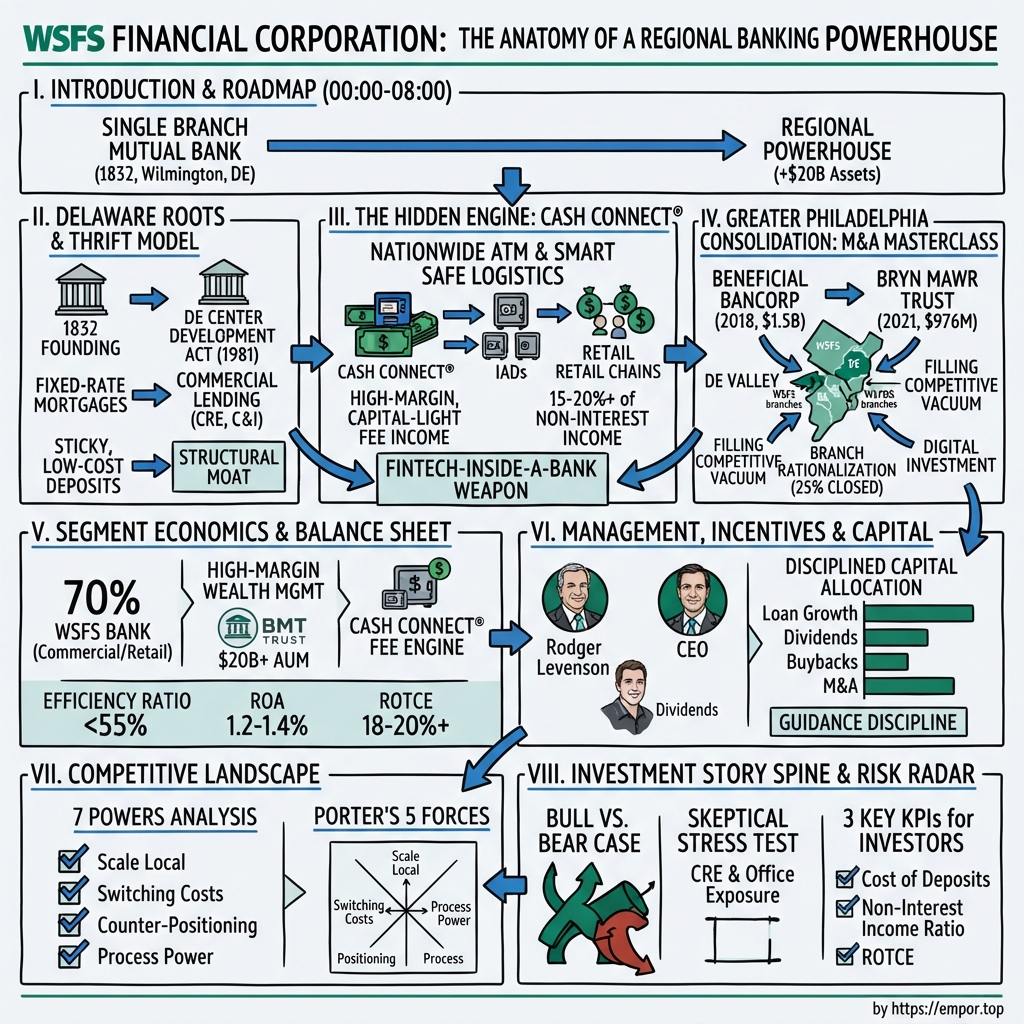
WSFS Financial Corporation: The Anatomy of a Regional Banking Powerhouse
I. Introduction & Episode Roadmap: The 194-Year-Old Startup
On the afternoon of July 23, 2026, a mid-cap bank headquartered on Delaware Avenue in Wilmington reported a quarter that would have seemed absurd to anyone who knew the institution thirty years earlier. Core earnings per share of $1.66. A core return on tangible common equity of 20.2%. Fiduciary assets — the money the bank holds, administers, or manages on behalf of other people — crossed $100 billion for the first time, finishing the quarter at $101.7 billion.1016
For context: the entire balance sheet of WSFS Financial Corporation was roughly $22.7 billion at that date.18 The bank now looks after more than four times its own size in other people's assets. That is not a normal shape for a community bank. It is not a normal shape for most banks.
Rewind. The institution began on February 18, 1832, as the Wilmington Savings Fund Society — a mutual savings institution created so that working people in a small Delaware port city would have somewhere safe to put their wages. There were no shareholders. There was no stock. There was one purpose: keep the money safe and pay a little interest. Today, WSFS Bank is one of the ten oldest bank and trust companies in the United States still operating under its original name, and it has been in business for more than 193 years.1
The distance between those two facts is the story.
The hook. How does a single-branch mutual thrift, founded when Andrew Jackson was president, become a $22.7 billion institution that is the largest locally headquartered bank and wealth management franchise in the Greater Philadelphia and Delaware region — a region where five of the six largest deposit-takers are headquartered somewhere else?112
The complication. The popular thesis about WSFS is that it hides a fintech inside a bank. That business is Cash Connect®, a nationwide operation that supplies physical currency to independent ATM operators and smart safes. It is genuinely unusual, genuinely national, and genuinely capital-light. It is also, on the evidence of the company's own segment disclosures, a much smaller profit contributor than the story implies. In 2025 Cash Connect produced $97.4 million of fee revenue — roughly 29% of the company's noninterest income — but only $9.8 million of pre-tax income, or about 2.6% of consolidated pre-tax profit.1 The hidden engine is real. It is just not the engine.
The actual engine, on the numbers, is somewhere else entirely: a fiduciary and trust business bolted on through acquisition and then compounded organically, which threw off $134.7 million of pre-tax income in 2025 — more than a third of the whole company — on a loan book of under half a billion dollars.1 That is the part of WSFS that behaves least like a bank and most like an asset-light franchise, and it is the part that has quietly done the heavy lifting.
The strategic bet underneath all of it is a wager on a competitive vacuum. Over two decades, the Philadelphia–Wilmington–Camden corridor was systematically stripped of locally owned banks by out-of-state acquirers. WSFS's thesis is that the survivors of that consolidation — Wells Fargo, TD, PNC, Bank of America, Citizens — run centralized credit machines that cannot serve a $30 million-revenue manufacturer the way a local lender can, and that being the last big bank headquartered in the region is itself a durable position. Management has spent nearly $2.5 billion of shareholder currency testing that thesis through two transformational mergers.
Here is the roadmap:
- Delaware roots and the thrift model — the origin, the near-death experience of the early 1990s that almost nobody remembers, and how survival shaped the risk culture that governs the bank today.
- Cash Connect — how vault cash bailment actually works, why it earns money, why the earnings collapsed and recovered, and what the disclosures really say about its materiality.
- The M&A playbook — Beneficial Bancorp at $1.5 billion and Bryn Mawr Bank Corporation at $976 million, benchmarked against what management promised at announcement.
- Segment economics — where the money is actually made, what the deposit franchise costs, and why the noninterest-bearing mix is the single most important number on the balance sheet.
- Management, incentives, and capital allocation — including a hard look at how the compensation targets were set and what the buyback is really doing to reported growth.
- Frameworks, stress test, and the bull/bear spine — including the market-share data that complicates the "dominance" narrative.
Start where the money started: a savings society in a river town.
 Subscribe on LinkedIn
II. Delaware Roots & The Thrift Business Model: Survival as a Strategy
Wilmington in 1832 was a milling and shipbuilding town on the Christina River, powered by water wheels and immigrant labor, sitting in the shadow of Philadelphia forty minutes upriver. A mill hand who wanted to save money had two options: a mattress, or a merchant who might or might not still be solvent next spring. The savings fund society was the era's civic answer — a mutual institution, owned by nobody, run by trustees, existing to hold small deposits and pay modest interest.
That founding logic still explains something important about WSFS. Because the institution was chartered as a state mutual savings bank and later became a federal savings bank, it operates today with a broader scope of permissible activities than most commercial banks of its size — a technical legacy of thrift regulation that turns out to matter enormously for the trust and fiduciary businesses it now runs.1 A 194-year-old charter quirk became a modern competitive asset. That is not a story anybody planned.
The state that rewrote American banking
For most of the twentieth century, Delaware banking was sleepy. That changed in 1981, when the state legislature passed the Financial Center Development Act — legislation drafted by a Wilmington law firm and pushed through the General Assembly for the explicit purpose of attracting out-of-state banks and credit-card operations to Delaware.4 The Act opened the door for national banks and credit-card companies to set up shop in the state, and it transformed Delaware's economy.4 Within a decade, Wilmington was the credit-card capital of America. The city's skyline filled with the back offices of institutions that had no historical connection to Delaware whatsoever.
This created a strange competitive environment for a local thrift. WSFS suddenly shared a zip code with some of the largest consumer lenders on earth — but those lenders were not competing for the deposits of a Wilmington dentist or the working capital line of a New Castle County contractor. They were booking national credit-card receivables under a favorable usury regime. The mega-institutions were physically adjacent and commercially irrelevant. WSFS's actual competition remained local.
That distinction — between banks that are in your market and banks that are of your market — became the intellectual core of everything WSFS would later argue about itself. It is worth flagging early that it is also the argument most vulnerable to being mistaken for a moat when it is really just a positioning statement.
The part of the story WSFS does not put on posters
The thrift converted to stock ownership, and its shares began trading on Nasdaq under the ticker WSFS. Then the savings-and-loan crisis arrived, and the newly public company nearly died.
The details are unflattering and instructive. Following the S&L crisis, WSFS had what American Banker later described as a near-death experience and went into survival mode before it could think about growth again.2 In 1990, the board recruited an outsider — Marvin "Skip" Schoenhals — to run it. He stayed seventeen years, until 2007.2 What Schoenhals did during those years is the reason WSFS exists in 2026: he rebuilt the credit culture, shrank the footprint, and installed the institutional habit of getting out of things early.
Two of those decisions deserve to be remembered, because they establish a behavioral track record that long predates the current management team. In 2003, WSFS sold its subprime mortgage subsidiary at a substantial profit, on the judgment that the market had become too frothy — four years before subprime detonated the global financial system.2 In 2005, the bank imposed internal concentration limits on construction and land development lending, a full year before federal regulators issued their own warnings on exactly that exposure.2
Consider what those two calls have in common. Both involved voluntarily giving up growth that was still working. Both were made against consensus. Both were made by a bank that had already been humiliated once and had internalized what it feels like to be wrong with leverage. Institutions rarely learn risk discipline from textbooks; they learn it from scar tissue. WSFS's scar tissue is from 1990.
Schoenhals also did the other thing that outlasts a CEO: he built a successor. Mark Turner joined as controller in 1996, became chief financial officer in 1998, chief operating officer in 2001, and chief executive in April 2007 at age 43.2 The pattern of long internal grooming followed by a scheduled handoff would repeat a decade later.
Rewiring the balance sheet
A thrift's classic problem is duration. It funds itself with deposits that can leave tomorrow and lends into thirty-year fixed-rate mortgages that will not repay for decades. Every rate cycle is an existential event. The strategic answer, pursued by essentially every surviving thrift in America, was to become a commercial bank in everything but charter — swapping long fixed-rate residential paper for commercial and industrial loans, owner-occupied commercial mortgages, and commercial real estate that reprices faster and yields more.
WSFS executed that shift with unusual thoroughness. By the end of 2018 — the last full year before the company's transformational merger — the commercial loan portfolio stood at $4.0 billion, built primarily by recruiting seasoned commercial lenders out of larger institutions in the market.3 By the end of 2025, that commercial loan and lease portfolio had reached $10.0 billion, and total assets had grown from $7.2 billion to $21.3 billion.13
The recruiting detail matters more than it sounds. A commercial loan book is not a product you launch; it is a set of relationships that live inside individual bankers' heads and phone contacts. Growing one organically means hiring people who already have books of business and can carry clients across a logo change. It is expensive, slow, and impossible to fake — which is precisely why it is more defensible than most things banks call strategy.
What the heritage is actually worth
WSFS argues that 194 years of continuous local presence produces a stickier, cheaper deposit base. That claim deserves scrutiny rather than applause, because "brand trust" is the single most over-invoked and least measurable asset in banking. There are, however, two pieces of hard evidence worth putting on the table. WSFS reported an overall Net Promoter Score of 76.0 in 2025, placing it in the top quartile of Medallia's global database of financial services companies for relationship surveys, and its associate engagement results placed it in the 84th percentile of Gallup's global company-level database.1 Those are self-selected disclosures from a company with an incentive to publish flattering ones. They are also externally benchmarked, which is more than most banks offer.
The harder test comes later, in the deposit-cost data. Hold the claim; the evidence arrives in Section V.
What the founding era really bequeathed was not a brand. It was a charter with unusual fiduciary latitude, a management lineage trained by near-failure, and a market position defined by being the last one standing locally. The first of those three built a business almost nobody outside Delaware noticed for twenty years.
III. The Hidden Engine: Cash Connect® & Payments Optionality
In 1998, a Delaware thrift with a few billion dollars in assets started a business that had nothing to do with banking Delaware. It began supplying cash to ATMs — not its own ATMs, but machines owned by other people, in gas stations and convenience stores and bars, eventually spread across all fifty states.2 The unit was called CashConnect. Nobody at the time would have described it as strategic.
Eleven years later it saved the company's income statement. American Banker's account of the era is blunt: the ATM servicing unit generated enough in annual fees that without it, WSFS would have lost money in 2009.2 A side hustle carried a bank through the worst credit cycle since the Depression.
How vault cash bailment actually works
Strip away the jargon and the business is almost embarrassingly simple, which is why it is worth explaining carefully.
An independent ATM deployer — the company that owns the machine in the corner store — needs the machine to be full of twenty-dollar bills. That cash is inventory. It sits in the machine doing nothing until a customer withdraws it, at which point the deployer is reimbursed through the card networks. Financing that inventory is expensive and operationally miserable: the deployer would need working capital, insurance, armored-car contracts, and a reconciliation system, all to keep idle currency sitting in a box in a laundromat.
So they rent it instead. WSFS supplies the physical cash and retains legal ownership of it the entire time. The arrangement is a bailment — the same legal structure as a coat check. The cash never leaves WSFS's balance sheet; the deployer simply has custody of it. In exchange, the deployer pays a fee, typically indexed to short-term interest rates, because what they are really buying is the use of somebody else's money.
That last point is the whole economic story of Cash Connect, and it explains everything that has happened to the segment's revenue since 2022. When short rates rise, the fee on rented cash rises — but so does WSFS's own cost of funding that cash. When rates fall, the reverse. The business is a spread business wearing a fee business costume.
Around the bailment core sits a set of genuinely operational services that are harder to replicate: armored carrier management, predictive cash ordering so machines do not run dry, daily reconcilement, online reporting, and loss protection.1 And then there is the growth vector: smart safes — safes installed at retailers and restaurants that automatically count, validate, and hold cash, so a store manager never has to make a bank run and the merchant gets provisional credit for the deposit before the armored truck arrives.
The revenue mix tells you where the value sits. In 2024, bailment accounted for about 60% of Cash Connect fee revenue, armored services 18%, other services 13%, and smart safes 9%.12 Six of every ten dollars came from renting money.
The scale, and the direction of travel
Cash Connect describes itself as the oldest and largest vault cash provider in the ATM industry, supporting more than seventy independent operators.1217 At the end of 2025 it managed approximately $1.3 billion in total cash, serviced roughly 24,000 non-bank ATMs and approximately 11,900 smart safes nationwide, and supported 488 owned or branded ATMs for WSFS Bank's own clients.1
Now watch the trend lines diverge, because this is the analytically interesting part. At the end of 2018, the unit managed over $1.0 billion in cash across 24,300 non-bank ATMs and about 2,300 smart safes.3 At the end of 2024, it serviced approximately 28,600 ATMs and about 10,000 smart safes.112
So over seven years: ATM count essentially flat and now declining from its peak, smart safes up more than fivefold. The ATM business is a mature-to-shrinking franchise. The smart safe business is compounding at a double-digit rate — it grew by 1,247 units, or 14%, in 2024 alone.12 Management has been explicit that smart safes generally carry higher margins and higher value-added product attachment, and that growing them is the strategy.[^11]
The financial reality check
Here is where the popular narrative and the segment footnotes part company.
Cash Connect's external fee revenue was $82.5 million in 2023, $114.5 million in 2024, and $97.4 million in 2025.1 Pre-tax income across those same three years was $4.2 million, $1.0 million, and $9.8 million.1 The segment's full-year profit margin was 0.99% in 2024 and 11.51% in 2025.1
Read those numbers slowly. In 2024, a business generating $114.5 million of revenue produced one million dollars of pre-tax profit. That is not a high-margin fee machine. That is a business whose funding costs and one-time charges — including $4.7 million associated with the termination of a longstanding client relationship — consumed essentially everything it earned.1
The recovery in 2025 was real and driven by deliberate management action rather than luck. On the fourth-quarter 2025 call, chief financial officer David Burg walked through the levers: pricing increases achieved by leveraging scale, optimization of in-transit cash, general expense discipline, and mix shift toward smart safes.[^11] The margin held at 15% in each of the first two quarters of 2026, which management flagged as the second consecutive quarter at that level.10[^11]
But the top line kept falling, and the reason is mechanical. Burg gave analysts a rule of thumb: roughly $2.5 million of annual revenue impact per 25 basis point rate cut.[^11] Cash Connect's revenue is a leveraged bet on the short end of the curve. In 2025 the segment's fee revenue fell $17.2 million, driven by lower interest rates and lower ATM bailment income.1 In the second quarter of 2026, fees declined again year over year for the same reasons.10
Myth versus reality. The consensus framing — that Wall Street misprices Cash Connect because analysts see WSFS only as a net interest margin story — does not survive contact with the disclosures. Analysts on the fourth-quarter 2025 call asked about Cash Connect first, before deposits, before credit, and they asked specifically about the revenue-versus-margin trade-off.[^11] The business is not ignored. It is priced roughly for what it is: a differentiated, defensible, rate-levered logistics operation that contributed about 2.6% of consolidated pre-tax income in its best year of the last three.1 Total segment assets were $363.7 million at the end of 2025 — genuinely capital-light, and genuinely small.1
Where the optionality argument has more merit is strategic rather than financial. Cash Connect gives WSFS operational infrastructure — insured cash logistics, reconciliation, network relationships — that no other bank of its size possesses, and it does so without taking unhedged credit risk. That is a real asset. Whether it ever becomes a platform for embedded finance is, as of today, entirely unproven and not something management has guided to.
The honest framing for an investor is this: Cash Connect is a call option with a modest current cash yield, not a hidden crown jewel. The falsifiable tests are simple — smart safe unit growth, and whether segment margin holds above the mid-teens through a rate-cutting cycle.
Which raises the obvious question. If the fintech-inside-a-bank is not the engine, what transformed this company from a $7 billion Delaware thrift into a $22 billion regional franchise? The answer is two cheques, written three years apart.
IV. The Greater Philadelphia Consolidation Strategy: The M&A Masterclass
There is a specific kind of corporate graveyard in Southeastern Pennsylvania. Sovereign Bank, gone to Santander. Commerce Bancorp, gone to TD. Susquehanna Bancshares and National Penn Bancshares, both absorbed by BB&T. Progress Financial, Willow Grove, Harleysville, Abington — a generation of Philadelphia-area institutions that were bought, rebranded, and had their credit decisions relocated to Charlotte, Toronto, Madrid, or Providence.
By the mid-2010s, the Delaware Valley — the seventh-largest metropolitan labor force in the country, with more than six million people, over one hundred colleges and universities, and industries anchored in healthcare, biotech, and logistics — had almost no significant locally headquartered commercial bank left.12
Rodger Levenson, then chief operating officer and CEO-designate, and Mark Turner, then chief executive, looked at that map and saw an opening. The thesis was not complicated: in a market where the top five deposit-takers were all headquartered somewhere else, a bank with a real balance sheet, local credit authority, and a full product suite could take share from institutions that had structurally deprioritized the middle market. The question was whether they were willing to bet the company on it.
Inflection Point #1: Beneficial Bancorp
They were. On August 7, 2018, WSFS announced a combination with Beneficial Bancorp — the oldest and largest bank headquartered in Philadelphia, tracing back to 1853 — in a stock and cash transaction valued at approximately $1.5 billion.5[^19]
The mechanics: each Beneficial share converted into 0.3013 WSFS shares plus $2.93 in cash, an implied value of $19.61 per share based on WSFS's closing price the prior day.5 That priced Beneficial at 172% of tangible book value — a full price by the standards of the era, and one that immediately invited the question of whether WSFS was paying up out of strategic necessity.5
What the price bought was scale that could not have been assembled organically in a decade. The combined institution had approximately $13 billion in assets and roughly 133 banking offices, and it vaulted WSFS to the sixth-largest deposit position in the region while making it far and away the largest locally headquartered player.5 The deal closed on March 1, 2019.6
The financial architecture of the transaction is worth walking through, because it reveals how this management team thinks about integration.
WSFS projected $68 million of annual synergies fully phased in by 2021, of which roughly $56 million — about 37% of Beneficial's annualized noninterest expense — came from non-branch operations and personnel.5 It budgeted approximately $146 million of pre-tax merger and restructuring costs.5 It planned to consolidate about 25% of the combined physical offices over twelve to twenty-four months.5 And critically, it committed to reinvest $32 million — roughly half the estimated cost savings — into technology and delivery systems over five years.5 The projected internal rate of return was approximately 19%, with the deal expected to be 8% accretive to earnings by 2021.5
That reinvestment commitment is the tell. Most bank acquirers treat cost synergies as the entire prize and flow them straight to the bottom line, which produces a good first year and a hollowed-out franchise by year four. WSFS explicitly earmarked half of the savings for rebuilding the digital and physical delivery platform. Whether that was wisdom or necessity — a $7 billion bank suddenly running a $13 billion balance sheet needs better systems regardless — the decision meant the reported synergy benefit would look worse than the gross number for several years.
The deal also pushed WSFS decisively past $10 billion in assets, the threshold at which a bank loses interchange-fee protection under the Durbin Amendment and inherits materially heavier regulatory expectations. Crossing that line is a one-way door. Institutions generally either stay well below it or leap far past it; sitting on the line is the worst outcome. WSFS leapt.
Inflection Point #2: Bryn Mawr Bank Corporation
Three years later, management went again — and this time the target was not primarily a bank.
On March 9, 2021, WSFS agreed to combine with Bryn Mawr Bank Corporation, parent of The Bryn Mawr Trust Company, in an all-stock transaction valued at approximately $976.4 million.7 Bryn Mawr shareholders received 0.90 WSFS shares each, an implied $48.55 per share.7[^18] The deal grew WSFS's assets by roughly 25% and its wealth management assets by more than 40%.7
Bryn Mawr, founded in 1889, sat in the affluent Main Line suburbs west of Philadelphia — Villanova, Haverford, Radnor, Wayne — a concentration of old and new money that is one of the densest high-net-worth corridors on the East Coast. The Pennsylvania, New Jersey, and Delaware region contains roughly one million households with over $1 million in investable assets.12 WSFS was not buying deposits. It was buying a client list, a fiduciary platform, and a brand that carried more weight with wealthy families than its own did.
The financial terms disclosed at announcement: approximately $73 million of annual cost savings by 2023, roughly $127 million of pre-tax merger and restructuring costs, and consolidation of about 30% of the combined banking offices given geographic overlap.7 Management guided to roughly 6% dilution to tangible book value with an earnback of a little over three years, and expected the deal to be about 6.7% accretive to earnings in 2022 and 13.4% in 2023.7[^18]
The combination closed on January 1, 2022.8 The brand and systems conversion completed on March 22, 2022 — a fast turn by industry standards, and the ninth acquisition WSFS had completed since 2010.9 Thirty-four offices were consolidated, twenty-two of them former Bryn Mawr Trust locations and twelve WSFS branches, leaving 94 retail banking offices and more than 600 ATMs across the region.9 Rather than retire the acquired brand, WSFS did the opposite: it kept Bryn Mawr Trust as its primary private wealth management identity.9
That branding decision looks trivial and is not. In wealth management, the relationship manager and the brand are the product. Forcing Main Line families to rebrand their trust relationships to a Delaware thrift's logo would have invited attrition. Keeping Bryn Mawr Trust — and running WSFS Bank as the commercial and retail brand alongside it — was an admission that the acquirer's name was worth less in that specific market than the target's. Few management teams have the discipline to admit that.
Grading the playbook
The right way to evaluate acquisitions is against what management said at the time, not against the current stock price.
On Beneficial, the strategic objective — becoming the dominant locally headquartered bank in the region — was achieved and has not been contested since. The cost architecture was executed. What is harder to verify from the outside is whether the $32 million technology reinvestment produced a durable delivery advantage, because WSFS does not disclose digital adoption metrics with the granularity that would let an investor judge.
On Bryn Mawr, the evidence is stronger and more measurable. At the time of the systems conversion, WSFS's wealth division administered roughly $58 billion in assets.9 By the end of the second quarter of 2026, assets under management and administration reached $101.7 billion.16 Some of that is market appreciation, but the segment's fee revenue grew from $132.5 million in 2023 to $148.1 million in 2024 to $171.4 million in 2025 — growth rates that market beta alone does not explain.1 The acquired platform did not merely survive integration; it became the fastest-growing profit pool in the company.
There is also an unflattering residue, and management has been candid about it. On the first-quarter 2026 call, Levenson noted that much of the maturing commercial real estate book consists of acquired loans, and that WSFS is applying its own asset-quality and return criteria before agreeing to extend or refinance them.[^11] Translation: some of what came over in the mergers does not meet the buyer's standards, and it is being run off. That is a normal and healthy post-merger process. It is also a reminder that acquired loan books carry underwriting DNA the acquirer did not write.
The most interesting fact about WSFS's M&A record in 2026 is what has not happened. There has been no bank acquisition since the Bryn Mawr close — more than four years. Asked repeatedly by analysts, Levenson has given a consistent answer: the bar for whole-bank M&A is very high, because deploying organizational bandwidth away from the organic opportunity in the existing footprint would have to clear a return hurdle that the organic opportunity already meets.10[^11] He has been more openly interested in bolt-ons and talent lift-outs in the fee businesses.[^11]
Consistency of that message across four years of calls is a genuine credibility marker. It is also, viewed skeptically, exactly what a management team would say if it could not find a deal at an acceptable price. Both readings can be true.
What the two mergers unambiguously produced is a company with three distinct economic engines that behave very differently. Understanding how differently is the next step.
V. Segment Economics & Balance Sheet Anatomy
Open the 2025 annual report to the segment footnote and a picture emerges that almost nobody would guess from the corporate description.
WSFS reports three segments. The WSFS Bank segment — commercial and consumer lending, deposits, treasury management — generated $236.1 million of pre-tax income in 2025. Wealth and Trust generated $134.7 million. Cash Connect generated $9.8 million.1
So the banking business, which holds essentially the entire $13.3 billion loan book and nearly all of the $21.3 billion balance sheet, produced about 62% of pre-tax profit. The wealth business, sitting on a loan portfolio of just $445.7 million, produced 35%.1 Per dollar of balance sheet deployed, the two businesses are not remotely comparable.
The bank: what is actually in the loan book
The commercial franchise is diversified by design and granular by policy. At the end of 2025, commercial mortgages were the largest single category at 30% of the $13.3 billion portfolio, followed by commercial and industrial at 20%, owner-occupied commercial at 15%, consumer at 14%, construction at 8%, residential at 8%, and small business leases at 5%.1
Management is explicit that commercial and industrial lending is the flagship product, and the reason is not yield — it is deposits. A C&I relationship brings operating accounts, and operating accounts are non-interest-bearing. Burg has described the C&I book as the product that drives the broader relationship and delivers deposit growth, and both he and Levenson have repeatedly told analysts that WSFS is not the low-price provider in the market and does not intend to be.10[^11] On the second-quarter 2026 call, Levenson pushed back on the framing that WSFS chases deposit-rich borrowers, arguing instead that the company underwrites total relationship return and can be aggressive on credit pricing when the full relationship justifies it.10
That is a coherent commercial model. It is also, notably, the same model every relationship-focused bank in America claims to run. The evidence that WSFS actually executes it is in the deposit mix.
The funding side: where the real edge shows up
Here is the number that matters most in the entire company.
At the end of 2025, noninterest-bearing deposits represented 32% of total client deposits. By the first quarter of 2026 that had risen to 34%, and by the second quarter to 37% — a level Burg described on the call as hard to sustain, with low-to-mid thirties a realistic long-term range.10[^11]
Why obsess over this? Because noninterest-bearing deposits are money the bank pays nothing for. In a world where a depositor can move funds to a money market fund yielding 4% with three taps on a phone, a bank that funds more than a third of its balance sheet at zero cost has a structural advantage that no amount of loan pricing skill can replicate. It is the closest thing to a genuine moat in commercial banking.
The composition is broad rather than concentrated: at the end of 2025, roughly 40% of noninterest-bearing balances sat in consumer, about 35% across trust and private banking, and about 25% in commercial.[^11] In the second quarter of 2026, roughly 80% of the growth came from institutional services and 20% from commercial.10
That last split deserves a caveat the company itself supplies. Institutional services deposits — from corporate trust securitization work and from bankruptcy and distressed-debt agency mandates — are transactional. They arrive with deals and leave with deals. Both Burg and Levenson have flagged elevated quarter-end activity and warned against extrapolating the growth rate.10[^11] A skeptical investor should treat a portion of the noninterest-bearing surge as cyclical rather than structural.
The rest of the funding picture: the interest-bearing deposit beta — the share of each Federal Reserve rate move that passes through to depositors — held at 46% through the first half of 2026, after exiting December 2025 at 43%.10[^11] Total client deposit costs fell to 1.33% in the first quarter of 2026.[^11] The loan-to-deposit ratio sits around 76%, well below peer levels, which is why the bank was able to let higher-cost certificates of deposit run off during 2025 rather than defend them on price.[^11]
But the competitive pressure is real and management has not hidden it. Burg told analysts in July 2026 that WSFS's largest CD product was a six-month certificate at 3% while twelve-month money was readily available above 4% elsewhere in the market — placing WSFS visibly on the low end of pricing.10 His conclusion was that the bank may need to raise rates to defend and grow share even though it does not need the liquidity.10 That is an honest admission that the funding advantage has a price ceiling.
Margin mechanics and the securities portfolio
Net interest margin was 3.83% for the fourth quarter of 2025 and expanded four basis points to 3.87% in the second quarter of 2026, driven by lower deposit costs and higher investment yields.10[^11] Holding margin roughly flat while absorbing 75 basis points of rate cuts through 2025 required active management rather than luck.
Three levers did the work. Deposit repricing was the main one. Second, a hedging program: by the fourth-quarter 2025 call, WSFS held about $1.3 billion of hedges in the money, rising to $1.5 billion with one more cut.[^11] Third, and most durable, the securities portfolio roll. The existing book yields roughly 2.35% to 2.40%, and maturing bonds are being reinvested at roughly 4.30% to 4.40% — an uplift of about 200 basis points on every dollar that rolls.[^11] The portfolio is 96% agency mortgage-backed securities and 4% bank-qualified municipal bonds, so this yield pickup comes with essentially no credit risk.1
That securities roll is a quiet, mechanical earnings tailwind that will persist for years regardless of what the Federal Reserve does. It is one of the more underappreciated features of the WSFS story.
The wealth and trust machine
The fastest-growing part of the company is also the least bank-like. Wealth and Trust ended 2025 with $97.4 billion of assets under management and administration, up 9% year over year.1 Within it sit several distinct businesses.
Bryn Mawr Trust serves affluent and high-net-worth families with advisory, investment management, and trustee services. The Bryn Mawr Trust Company of Delaware — a Delaware-chartered non-depository trust company — provides directed trusts, asset protection trusts, and dynasty trusts, marketed through estate planning attorneys, and held approximately $40.7 billion in assets under management and administration at year-end 2025.1 Bryn Mawr Trust Advisors, a registered investment adviser, held about $4.4 billion.1
And then there is WSFS Institutional Services, which is the genuinely unusual one. It provides trustee, agency, bankruptcy administration, custodial, and commercial domicile services to corporate clients and special purpose vehicles.1 In plain English: when a lender pools thousands of auto loans or mortgages into a securitization, somebody has to serve as trustee — holding the assets, administering payments, and standing between the issuer and the bondholders. When a company goes through Chapter 11, somebody has to administer distributions to creditors.
WSFS ended 2025 as the fourth most active trustee for U.S. asset-backed and mortgage-backed securities by deal count, with nearly 12% market share — up two spots from 2024.1 Through the first half of 2026 it ranked third, with share rising to 14%.10
Two things make this business attractive. First, it is a genuine share-gain story in a growing market: Burg told analysts the underlying securitization market has been growing roughly 20% to 30% annually, and WSFS has grown faster still.10[^11] Second, the two halves are counter-cyclical to each other. Corporate trust thrives when issuance markets are hot; the global capital markets business — bankruptcy, distressed debt, high-yield — thrives when they are not.
The competitive logic Burg articulated is credible and specific: WSFS has the balance sheet strength and three investment-grade credit ratings that these mandates require, but is more nimble and more responsive than the money-center trustees it competes against.10[^11] In a business where reputation compounds and mandates last years, that combination is defensible.
The caveat is straightforward. This is a cyclical business riding a cyclical boom, and management has said explicitly it does not expect the market's growth rate to persist.10
Efficiency, and the honest scorecard
WSFS reported a full-year 2025 efficiency ratio of 59%, improving to roughly 58% in the first two quarters of 2026, against a stated outlook of the high fifties.10[^11] Full-year 2025 return on assets was 1.36% on a reported basis with return on tangible common equity of 17.55%; on the company's core basis, ROA was 1.39% and core ROTCE 18%.[^11]11 Reported net income was $287.3 million on diluted earnings per share of $5.09.111
Two things stand out. First, WSFS is not, on efficiency, an elite operator. A high-fifties efficiency ratio is respectable for a bank with three business lines and a heavy fee mix, but it is not the sub-55% level the aspirational framing implies, and Burg has declined to commit to a specific target, saying only that the goal is to tick it down over time while continuing to invest.10 Second, the returns are genuinely strong — a 20.2% core return on tangible common equity in the second quarter of 2026 puts WSFS near the top of the regional bank cohort.10
But part of that return is manufactured, and understanding how requires looking at what management does with capital.
VI. Current Management, Incentives & Capital Allocation
Rodger Levenson spent seventeen years at CoreStates Financial before he ever set foot in a WSFS office.15 CoreStates — a Philadelphia institution that was itself swallowed by First Union in 1998, in one of the mergers that helped create the vacuum WSFS later exploited — was where he learned commercial lending. He holds a finance degree from Temple and an MBA from Drexel, both Philadelphia schools.15 He is, in background and instinct, a Philadelphia commercial banker who happens to run a Delaware company.
He joined WSFS in 2006 as chief commercial banking officer and stayed in that role for nine years.1415 Then something unusual happened: rather than being promoted upward in a straight line, he was moved sideways through the company's hardest jobs. Interim chief financial officer from 2015 to 2016. Chief corporate development officer — the M&A seat — from June 2016 to August 2017. Chief operating officer from August 2017.14
That is a deliberate apprenticeship, and it mirrors what Schoenhals had done with Turner a generation earlier. When WSFS announced on July 11, 2018 that Levenson would become president and chief executive effective January 1, 2019, with Turner moving to executive chairman, the board framed it as the culmination of a five-year succession plan.14 Turner's own explanation of why he was stepping down after eleven years was strikingly unsentimental: he said ten to fifteen years is an optimal period for most leaders to serve as a public-company chief executive.14
Levenson became chairman in 2020. As of the second quarter of 2026 he holds all three titles — chairman, president, and chief executive.15 That concentration is a governance point worth noting: combining the chair and CEO roles reduces independent board oversight, and the mitigant is a lead independent director rather than an independent chair.
The team, including a gap worth flagging
The current executive bench was substantially rebuilt in 2024. On May 21, 2024, WSFS announced that David Burg would join as chief financial officer effective August 15, 2024, arriving from nearly seventeen years at Citigroup where he had served as head of strategy and execution for Legacy Franchises, chief financial officer for Latin America from 2021 to 2023, and chief financial officer of Treasury and Trade Solutions from 2017 to 2021.1315 The same announcement elevated Arthur J. Bacci to chief operating officer, overseeing Commercial, Wealth, Consumer, and Cash Connect along with technology and operations, and named Jamie Hopkins chief wealth officer.13
Two details matter here that the corporate narrative does not emphasize. First, Bacci — who joined WSFS in April 2018 from Principal Financial Group, where he had spent sixteen years and run Principal Bank — is the chief operating officer, not the chief wealth officer; Hopkins, who arrived in 2023 from Carson Group, runs wealth.1315 Second, and more consequentially, Burg filled a chief financial officer seat that had been open since August 2023. A publicly traded, $20 billion bank operated for roughly a year without a permanent CFO during a period of acute industry stress following the 2023 regional banking failures. That is an execution fact, and a reasonable investor would want to know why the search took that long.
What can be said in the other direction is that Burg's background is unusually well matched to what WSFS actually is. Treasury and Trade Solutions is Citigroup's transaction banking and cash management franchise — precisely the discipline underlying Cash Connect's logistics economics and the institutional services deposit machine. His fingerprints are visible in the Cash Connect margin repair and in the granularity of the quarterly disclosure since he arrived.
How the incentives are actually built
The 2026 proxy statement is where management's stated priorities meet real money, and it contains some genuine surprises relative to the conventional description of WSFS's pay design.
The short-term cash incentive is scored on four equally weighted company-wide metrics: adjusted return on assets, adjusted return on tangible common equity, adjusted earnings per share, and a strategic performance measure covering associate engagement, community impact, and the rollout of the 2025–2027 strategic plan.11 For the chief executive, 100% of the short-term incentive is based on the company-wide score, with no individual component.11 Long-term incentives split 40% restricted stock units and 60% performance share units, with the performance units vesting on the company's three-year cumulative adjusted return on assets measured as a percentile against the KBW Nasdaq Regional Bank Index.11
Note what is absent. There is no relative total shareholder return metric anywhere in the design. There is no explicit asset-quality or credit metric in the company-wide scorecard — credit goals appear only among individual objectives for divisional executives.11 For a bank, that is a meaningful omission: return on assets can be juiced in the short run by loosening underwriting, and the payoff for doing so arrives before the losses do.
The counterweight is that the performance share units are measured against a peer index rather than an internal target, which is a genuinely rigorous relative standard. The 2023 awards, covering the three years ended December 31, 2025, vested at the 76th percentile of the KRX index — a real result against real competitors, with Levenson's 20,557 target units converting to 31,245 earned.11
Now the part that deserves an activist's attention. For 2025, the short-term incentive thresholds were set at 0.99% adjusted ROA, 12.40% adjusted ROTCE, and $3.62 adjusted EPS, with maximums at 1.36%, 17.05%, and $4.97 respectively.11 Actual results, after the compensation committee's "quality of earnings" adjustments, came in at 1.39% ROA, 17.96% ROTCE, and $5.21 EPS.11
All three financial metrics scored above maximum. Not near maximum — above it.
The quality-of-earnings review excluded $4.1 million of impairment on an equity investment, a $3.9 million net loss on a Visa Class B derivative liability, a $1.0 million gain on the sale of equity investments related to Spring EQ, $1.5 million of loss on early debt extinguishment, and $0.5 million of corporate development and restructuring expense — net adjustments that moved reported GAAP results upward for incentive purposes.11 Levenson received a short-term cash award of 154% of his $1,009,400 base salary, representing 140% of his target opportunity.11
None of this is improper, and the proxy discloses it clearly. The committee explicitly reserves downward discretion and states a bias toward holding management accountable for reported results.11 But a scorecard on which every financial metric exceeds its maximum is, by definition, a scorecard whose maximums were set below what the business was capable of delivering. That is a target-setting question, and it is the right question for a shareholder to ask at the annual meeting.
The governance hygiene around the edges is standard and reasonable: stock ownership guidelines, a clawback policy covering cash and equity incentives for fraud or misconduct, double-trigger change-of-control provisions, annual say-on-pay, and a prohibition on hedging, collars, short sales, and pledging of company stock by executives.11
Capital allocation: the buyback question
This is where WSFS has been most aggressive and where the analysis gets most interesting.
Since the start of 2025, management has run an explicit capital return framework: a multi-year glide path toward a 12% common equity tier 1 target, returning approximately 100% of net income to shareholders, with roughly 85% of that coming through buybacks rather than dividends.[^11]
The execution has been relentless. During 2025, WSFS repurchased $288 million of stock, more than 9% of shares outstanding, including $109 million or 3.7% of shares in the fourth quarter alone.[^11] In the first quarter of 2026 it returned $94 million including $85 million of buybacks — another 2.5% of shares — while raising the quarterly dividend 18% to $0.20 and adding a new authorization equal to 15% of shares outstanding, bringing total authorization to 19%.[^11] In the second quarter it returned $77 million including $66 million of repurchases, taking year-to-date buybacks past 4% of shares.10 Cumulatively, Burg told analysts in July 2026, WSFS had repurchased about 14% of its shares since the beginning of 2025.10
Here is what that means for the reported growth rate, and it is essential to understanding the headline numbers. In the second quarter of 2026, core net income grew 19% year over year while core earnings per share grew 31%.10 The twelve-point gap is the buyback. Roughly two-fifths of the reported per-share growth came from shrinking the denominator rather than growing the numerator.
This is not criticism — retiring shares is a legitimate and often optimal use of capital for a bank generating high returns with limited organic capital needs. But an investor extrapolating 31% earnings growth into future years is extrapolating a mechanism that has a hard limit. Once common equity tier 1 reaches 12%, the buyback slows to roughly the rate of earnings retention, and per-share growth converges toward net income growth.
Burg has been transparent about the timeline. Asked directly on the second-quarter call, he noted the ratio declined about 15 basis points in the quarter and that simple arithmetic implies a two-and-a-half to three-year trajectory to the target, while declining to commit to a specific date because the company also monitors tangible common equity, accumulated other comprehensive income volatility, and rate risk.10 He also flagged that pending regulatory capital changes could provide roughly a 4% to 5% benefit on a risk-weighted basis under preliminary modeling — potential additional capacity, not a committed plan.[^11]
The capital-allocation hierarchy management articulates is consistent across every call reviewed: invest in the business first, return excess second, and consider acquisitions only if they are accretive to the existing organic plan.10[^11] The behavior matches the words. That consistency is worth something.
The pruning is worth something too. Over 2025 and 2026, WSFS exited the Upstart consumer loan partnership, sold its credit card portfolio, exited Powder Mill and a joint venture with Commonwealth, and allowed the Spring EQ partnership portfolio to run off.10[^11] Levenson framed these as decisions made when WSFS looked very different — low-scale, low-profitability partnerships that no longer fit — and described an internal initiative called "relook" that systematically re-examines business lines for strategic fit.[^11]
Read charitably, that is disciplined portfolio management. Read skeptically, it is the cleanup of a prior era's diworsification, and the fact that a company needed a formal program to find these businesses suggests they accumulated with insufficient scrutiny in the first place. Both readings inform how one should weigh future strategic announcements.
VII. Competitive Landscape & Framework Analysis
Time to war-game this. Strip away the narrative and ask what actually protects WSFS's economics from competitors who would happily take them.
Hamilton Helmer's 7 Powers, tested against the data
Scale economies — weaker than advertised. The company's own investor materials contain a chart that complicates the dominance story considerably. In the Philadelphia–Wilmington–Camden metropolitan area, based on June 30, 2024 FDIC data, WSFS Bank ranked sixth in deposits with $14.9 billion and a 6.4% share. Ahead of it: Wells Fargo at 14.6%, TD at 14.2%, PNC at 12.0%, Bank of America at 10.9%, and Citizens at 10.8%. Immediately behind: M&T at 6.3%, Fulton at 3.6%, Santander at 3.1%, and Univest at 2.4%, with roughly seventy remaining institutions splitting 15.8%.12
Read that honestly. WSFS is not dominant in its market. It is the largest locally headquartered institution — a meaningfully different claim — in a market where the top five out-of-state banks control roughly 62% of deposits. Local scale economies are real relative to the seventy small banks below it, and largely absent relative to the five giants above it. The scale power exists in one direction only.
Delaware specifically is a stronger position than the metro-wide figure suggests, given the bank's 37 offices there and nearly two centuries of presence, but the company does not publish a state-level rank in its current filings, so this should be treated as directional rather than quantified.1
Switching costs — the strongest real power, and it lives in trust. A corporate trust mandate on a securitization is not a relationship a client revisits casually. The trustee holds the assets, administers the cash flows, and is written into deal documents that may run for a decade. Replacing it requires bondholder mechanics and legal cost. Personal trusts are stickier still — a dynasty trust or asset protection trust established under Delaware law involves estate attorneys, tax structuring, and multi-generational documentation. Bryn Mawr Trust of Delaware's business is built precisely on those relationships, marketed through centers of influence rather than direct advertising.1 Commercial treasury management sits a tier below but still carries meaningful operational friction. This is where WSFS's genuine moat lives, and it is not the moat the popular thesis emphasizes.
Counter-positioning — a real behavior, not a structural power. The argument is that local credit authority and fast turnaround beat centralized underwriting, and there is anecdotal evidence: between the third and fourth quarters of 2025, WSFS hired M&T's market president for the Greater Philadelphia and Delaware region, someone Levenson described as a proven, well-known individual who could have gone anywhere.[^11] Talent choosing WSFS over larger platforms is a data point. But counter-positioning in Helmer's sense requires that the incumbent cannot respond without damaging its existing business. A money-center bank can, in principle, delegate more credit authority locally. It usually does not, but nothing structural prevents it. Call this an operating advantage rather than a power.
Process power — narrow but genuine. Cash Connect's accumulated capability in vault cash logistics, insurance arrangements, predictive ordering, and daily reconciliation is close to three decades deep, and no comparably sized bank has replicated it.117 The constraint on its value is the addressable market, which is shrinking on the ATM side.
Branding — plausible, weakly evidenced. Nearly two centuries of continuous operation and top-quartile relationship survey scores support the claim; there is no disclosed pricing premium that would prove it.1
Cornered resource and network economies — absent. WSFS controls no scarce input and its products do not become more valuable as more clients use them.
Porter's Five Forces
Rivalry: high, and intensifying. WSFS competes simultaneously against national banks with lower funding costs, super-regionals like M&T and Citizens with comparable local scale, mid-cap peers like Fulton and Univest, and a long tail of community banks. Loan pricing competition in commercial and industrial has been described by management as very competitive and getting more so as others try to penetrate the space.10
Bargaining power of depositors: high and rising. This is the most acute force in 2026. The gap between WSFS's 3% flagship CD and the 4%-plus available elsewhere in the market illustrates it precisely — depositors can act on that gap in minutes.10 Management has warned across two consecutive quarters that competition has built over the prior six months and may require pricing action.10[^11] The mitigant is the noninterest-bearing base, which is behavioral rather than rate-driven.
Bargaining power of borrowers: medium. Quality middle-market borrowers have many lenders. WSFS's stated response — competing on service and total relationship rather than price — is a real differentiator with real limits.
Threat of substitutes: medium and structurally rising. Private credit funds now compete directly for middle-market loans that once went to regional banks. WSFS discloses that its own lending to non-depository financial institutions is about 3% of assets, granular, and currently showing no credit issues — which quantifies participation in that ecosystem but does not address the disintermediation risk.[^11] On the consumer side, the substitution has already happened: WSFS exited unsecured consumer lending partnerships and retreated to real-estate-secured products where it believes it has a differentiated origination capability.[^11]
Threat of new entrants: low. Charter requirements, capital rules, and compliance infrastructure make de novo entry rare. The relevant entry risk is not a new bank but an existing large bank deciding to compete harder locally, or a fintech unbundling a specific product.
The synthesis
The competitive position is stronger than a generic community bank and weaker than the "regional powerhouse" framing suggests. What genuinely differentiates WSFS is the combination of a fee mix approaching a third of revenue with a deposit base that is a third non-interest-bearing — a pairing few banks of its size can match.110 What does not differentiate it is scale, cost position, or local relationship rhetoric, all of which are contested.
The question that follows naturally: what would break it?
VIII. Investment Story Spine, Risk Radar & Stress Test
Imagine an activist investor building a short thesis, or a long-only manager doing final diligence. Here is what they would attack, and what the evidence actually shows.
Challenge one: the commercial real estate book
The obvious line of attack for any Northeast regional bank in this decade is office. Philadelphia's central business district has struggled with vacancy since 2020, and WSFS carries commercial real estate and construction equal to roughly 36.9% of gross loans, at 198% of tier one capital plus allowance.12 That is a real concentration.
The disclosure, however, is unusually granular and largely defuses the crudest version of the bear case. The office portfolio stood at $667 million with $686 million of exposure — about 5.1% of gross loans — with an average loan balance of $1.8 million, only thirteen loans above $10 million, and just two above $20 million with the largest around $27 million.12 Composition is 77% suburban and 23% urban, with only 7% of the office book located in a central business district.12 Average loan-to-value at origination was approximately 58%, and 83% of the portfolio carries recourse to sponsors.12 Delinquency was 0.2% and non-performing assets were zero, though 11% of the book was internally classified as problem loans.12 The multifamily portfolio of $1.4 billion showed a similar profile: 56% average origination loan-to-value and 87% recourse.12
The recourse figure is the one to focus on. A non-recourse commercial mortgage means the collateral is the lender's only claim; if the building is worth less than the loan, the sponsor can hand back the keys. Recourse means the lender can pursue the sponsor's other assets. Having four in five office loans carry recourse fundamentally changes the loss-given-default math, and management has cited it repeatedly as the differentiating feature of the portfolio.[^11]
Then there is the episode that tested the framework in public. In the fourth quarter of 2024, WSFS wrote off in full a loan to a fund invested in office real estate — an acquired credit, participated with another bank, where WSFS had no direct recourse to the collateral and assigned the position no value.[^11] In the first quarter of 2026, the sponsor obtained a full refinancing and WSFS recovered the entire $15.7 million.[^11] Burg's read was that the recovery demonstrated liquidity in the market for these assets.[^11]
Both interpretations are available. The bull reads it as evidence of conservative marking — WSFS took the loss immediately and was proven overly pessimistic. The bear reads it as evidence that the acquired loan book contained exposures WSFS would never have originated, and that a happy outcome on one credit does not generalize.
The broader credit trend has improved sharply. Through the second quarter of 2026, problem assets were down 31% year over year, delinquencies down nearly 40%, and non-performing assets down roughly 25%, with net charge-offs of $7.1 million or 21 basis points of average loans.10 Full-year 2025 net charge-offs were 0.45% of average loans, with commercial and industrial at 1.02% and small business leases at 1.83% — the leases being the loudest problem area, a portfolio of just $603 million.1 Management cut its 2026 net charge-off outlook twice, from 35–45 basis points at the start of the year to 25–35 in April to 15–25 in July.10[^11]
That said, the April revision was mechanically driven by the recovery, which management disclosed rather than obscured. The July revision reflected genuine underlying improvement. Both Burg and Levenson have consistently warned that commercial losses may remain uneven, and that office remains a challenging market where the bank is being selective.10[^11] Nothing in the disclosure suggests a systemic problem; everything in it suggests episodic single-credit risk.
Challenge two: is Cash Connect melting?
The bear case writes itself. Cash usage per capita declines. ATM counts fell from roughly 28,600 to 24,000 in a single year. Segment fee revenue fell from $114.5 million to $97.4 million.1 A business whose revenue is indexed to interest rates faces a structural headwind whenever the Federal Reserve eases.
The rebuttal is partial rather than complete. Smart safe units grew to approximately 11,900 while the ATM base shrank, and segment margin went from essentially zero in 2024 to 11.51% for 2025 and 15% in each of the first two quarters of 2026.110 Management's entire stated focus for the segment is margin rather than revenue.[^11]
The honest conclusion: this is a business being managed for cash generation and margin, not growth, with a genuine growth vector in smart safes that has not yet offset ATM decline at the revenue line. That is a reasonable thing for management to do. It is not the "high-return fee machine" of the popular framing, and an investor should size it accordingly — at 2.6% of consolidated pre-tax income in 2025, even a severe deterioration would be an annoyance rather than a thesis-breaker.1 The operational risk is the more relevant concern, and WSFS discloses it plainly: as a provider of vault cash, the business faces substantial operational risk including theft from ATMs, armored vehicles, or carrier terminals, and has experienced such occurrences historically; inadequate controls or uninsured losses could materially affect results.3
Challenge three: did they overpay for Bryn Mawr?
At announcement, management guided to roughly 6% tangible book dilution with a three-year-plus earnback.7[^18] The verifiable outcome four years later: wealth assets under management and administration roughly $58 billion at conversion, $101.7 billion by mid-2026, with segment fee revenue compounding at a double-digit rate and segment pre-tax income up $16.1 million in 2025 alone.1916
On the specific question asked, the evidence favors management. The more useful skeptical framing is different: how much of that growth would have happened anyway through market appreciation and the organic build-out of institutional services, which was a WSFS business before the deal? That counterfactual is unanswerable from public disclosure, and anyone claiming certainty in either direction is guessing.
Challenge four: the capital return itself
An activist might argue the opposite of the usual complaint — not that WSFS returns too little capital, but that buying back roughly 14% of shares in eighteen months at a premium to tangible book, while the balance sheet still carries an accumulated other comprehensive income deficit from the securities portfolio, converts book value into reported earnings per share growth at an unattractive exchange rate.10 Burg's response to a direct question about price sensitivity was that he would not name a level at which repurchases stop, because the decision depends on internal opportunities, rate volatility, and the securities portfolio.10 That is a defensible answer and also a non-answer.
The material risk radar
Credit concentration in a single regional economy. WSFS lends almost entirely in Delaware, Southeastern Pennsylvania, and Southern New Jersey. Geographic diversification is essentially absent. A regional downturn hits loans, deposits, and wealth fees simultaneously.
Deposit competition and the noninterest-bearing reversion. If the 37% noninterest-bearing mix normalizes toward the low thirties that management itself calls the sustainable level, funding costs rise even with no change in Federal Reserve policy.10 Burg has also noted a subtlety worth internalizing: noninterest-bearing deposits that sit in cash rather than funding loans are roughly neutral to margin, so the benefit depends on deploying them.10
Rate path risk in both directions. The 2026 outlook assumes no further Federal Reserve moves for the remainder of the year.10 Cuts would compress Cash Connect revenue and loan yields; the securities roll and hedge book partially offset. The company is modestly asset-sensitive.
Institutional services cyclicality. The securitization market growing 20–30% annually is not a permanent condition, and management says so.10
Operational and fraud exposure. Beyond the vault cash risk, Levenson specifically flagged on the second-quarter call that fraud spikes periodically from different events and that healthcare costs remain a live pressure — both cited as the main sources of expense variability.10
Governance overhang. Combined chair and chief executive roles, and incentive targets that were exceeded at maximum on every financial dimension in 2025.11
The three KPIs that matter
Not a scorecard — three numbers that, tracked over time, would tell an investor whether the thesis is intact.
One: the noninterest-bearing share of client deposits, alongside the interest-bearing deposit beta. This is the funding franchise in a single pair of figures. If the noninterest-bearing share holds in the mid-thirties while the beta stays near the mid-forties, the relationship model is working. If the share drifts toward the twenties or the beta climbs through the fifties, the deposit advantage is eroding and margin follows.
Two: Wealth and Trust fee revenue, with particular attention to WSFS Institutional Services' trustee ranking and market share. This is the compounding engine and the genuine switching-cost moat. Sustained double-digit fee growth and stable-to-rising share in asset-backed and mortgage-backed trusteeship would confirm the franchise is winning on capability rather than riding a market. A stall would remove the most valuable part of the story.
Three: core return on tangible common equity, read alongside net income growth rather than earnings per share growth. The gap between the two reveals how much of the reported result is operating performance and how much is share count. As the capital glide path completes, that gap should narrow — and what remains is the true earning power of the franchise.
Bull versus bear
The bull case. WSFS occupies a position no competitor can easily replicate: the only large locally headquartered bank in a top-ten metropolitan market whose incumbents are all run from other cities, paired with a fiduciary business that has been taking share in a growing national market and a deposit base a third of which costs nothing. Fee revenue near a third of the total makes earnings less rate-dependent than a typical spread lender.1 The securities portfolio roll provides a mechanical, credit-free earnings tailwind for years. Credit metrics have improved for five consecutive quarters against a portfolio with high recourse and low origination loan-to-values.[^11]12 Management has proven it can integrate large acquisitions, has pruned unprofitable businesses, and returns essentially all earnings to shareholders. If the region's economy holds and the trust franchise keeps compounding, the earnings base grows while the share count shrinks.
The bear case. The market-share data undercuts the dominance narrative — WSFS is sixth in its own metropolitan area with 6.4% of deposits.12 Its efficiency ratio in the high fifties is unremarkable. Roughly two-fifths of recent per-share growth came from buybacks that must eventually slow, and management has not committed to a date.10 The noninterest-bearing surge is partly transactional deposits from a securitization boom management itself will not extrapolate. Commercial real estate and construction near 37% of loans in a single regional economy is a real concentration, and small business leases have been charging off at nearly 2%.112 Cash Connect is shrinking on the top line. Compensation targets were set below achieved results across every financial metric, and the chair and chief executive roles are combined. If deposit competition forces WSFS to pay up — as its own chief financial officer has warned it may — the margin story compresses at exactly the moment the capital return decelerates.10
The spine, stated plainly: WSFS wins from here if the fiduciary franchise keeps compounding and the noninterest-bearing deposit base proves behavioral rather than cyclical. It breaks if either the securitization cycle turns or deposit competition converts a zero-cost funding advantage into a market-rate one — and the two are not independent, because the same institutional clients supply both the fee growth and the deposits.
IX. Epilogue & Key Takeaways for Investors
Four lessons come out of this 194-year corporate life, and none of them are about ATMs.
Scale locally, but be honest about what local scale is worth. WSFS's strategy of building density in one defined geography rather than spreading across six states is sound, and the evidence supports it: the company grew from $7.2 billion of assets and 76 offices in 2018 to $21.3 billion and 113 offices in 2025 without leaving its corridor in any meaningful way.13 But the accompanying rhetoric about dominance does not survive the company's own market-share disclosure. The correct version of the lesson is narrower and more useful: in a consolidated market, being the largest institution that still makes decisions locally is a durable differentiation, not a durable dominance. Those are different things and they command different multiples.
Build a fee engine — but check which one is actually working. The strategic instinct to reduce dependence on net interest income was correct, and fee revenue near a third of the total genuinely dampens rate sensitivity.1 The instructive detail is that the fee business WSFS is famous for is not the one carrying the load. Cash Connect generates headlines and roughly 2.6% of pre-tax income; Wealth and Trust generates roughly 35% on a fraction of the balance sheet.1 For investors, the lesson generalizes: read the segment footnote, not the corporate description. The two often tell different stories, and the footnote is audited.
M&A discipline is measurable, and the measurement is public. WSFS published specific cost-save targets, branch consolidation percentages, earnback periods, and reinvestment commitments at the announcement of both major deals, then executed against them on visible timelines — the Bryn Mawr systems conversion inside three months of closing being the clearest proof point.579 The reinvestment discipline matters most: earmarking half of Beneficial's cost savings for technology rather than flowing it to earnings was the harder choice and probably the right one. The corollary is equally instructive — after two large deals, management has spent four years buying back stock instead of buying banks, and has given the same explanation on every call. Whether that is patience or a lack of opportunity, the consistency of the message is itself information.
Scar tissue is an underrated asset. The decisions that most distinguish WSFS's credit culture were made by a management generation that no longer runs the company: selling a subprime lender in 2003 because the market felt frothy, imposing construction concentration limits in 2005 before regulators asked.2 Those instincts came from a near-death experience in 1990 that almost nobody now discusses. Institutional memory of failure is not on any balance sheet, and it decays with every retirement. Watching whether it survives the current leadership generation is a legitimate long-horizon question for anyone holding this stock.
The closing observation is this. WSFS in 2026 is not the story its own marketing tells, and it is better in one dimension than that story and weaker in another. It is not primarily a fintech hiding inside a bank; it is a trust and fiduciary franchise hiding inside a commercial bank, funded by an unusually cheap deposit base, run by a management team that has been candid about its risks and aggressive with its capital. Whether that combination compounds depends on two things largely outside management's control — the securitization cycle and the price of deposits — and on one thing entirely within it: whether a 194-year-old institution that has already reinvented itself twice can resist the temptation to declare victory.
References
-
WSFS Financial Corporation Form 10-K for fiscal year 2025 — U.S. Securities and Exchange Commission, 2026-02-27 ↩↩↩↩↩↩↩↩↩↩↩↩↩↩↩↩↩↩↩↩↩↩↩↩↩↩↩↩↩↩↩↩↩↩↩↩↩↩↩↩↩↩↩
-
A Community Banker's Guide to Surviving the Next 184 Years — American Banker ↩↩↩↩↩↩↩↩
-
WSFS Financial Corporation Form 10-K for fiscal year 2018 — U.S. Securities and Exchange Commission, 2019 ↩↩↩↩↩
-
Drafters of Delaware's Financial Center Development Act (1981) — Morris, Nichols, Arsht & Tunnell LLP ↩↩
-
WSFS Financial Corporation Announces Combination with Beneficial Bancorp, Inc. — WSFS Financial Corporation, 2018-08-08 ↩↩↩↩↩↩↩↩↩↩
-
WSFS Financial Corporation Completes Acquisition of Beneficial Bancorp — WSFS Financial Corporation, 2019-03-01 ↩
-
WSFS Financial Corporation to Combine with Bryn Mawr Bank Corporation — WSFS Financial Corporation, 2021-03-10 ↩↩↩↩↩↩↩
-
WSFS Financial Corporation Completes Combination with Bryn Mawr Bank Corporation — WSFS Financial Corporation, 2022-01-01 ↩
-
WSFS Completes Conversion of Bryn Mawr Trust into WSFS Bank; Launches Bryn Mawr Trust as the Prominent Wealth Management Brand — WSFS Financial Corporation, 2022-03-22 ↩↩↩↩↩↩
-
Earnings call transcript: WSFS second quarter 2026 results — Investing.com, 2026-07-24 ↩↩↩↩↩↩↩↩↩↩↩↩↩↩↩↩↩↩↩↩↩↩↩↩↩↩↩↩↩↩↩↩↩↩↩↩↩↩↩↩↩↩↩
-
WSFS Financial Corporation 2026 Proxy Statement (Form DEF 14A) — U.S. Securities and Exchange Commission, 2026-04-02 ↩↩↩↩↩↩↩↩↩↩↩↩↩↩
-
WSFS Financial Corporation Investor Presentation — WSFS Financial Corporation, 2025-05-06 ↩↩↩↩↩↩↩↩↩↩↩↩↩↩↩↩↩
-
WSFS Strengthens Executive Leadership Team to Support Next Phase of Growth — WSFS Financial Corporation, 2024-05-21 ↩↩↩
-
WSFS Announces Leadership Succession Plan: Mark A. Turner to be elevated to Executive Chairman; Rodger Levenson to be named President and CEO — WSFS Financial Corporation, 2018-07-11 ↩↩↩↩
-
Governance — Executive Leadership — WSFS Financial Corporation ↩↩↩↩↩↩
-
WSFS Financial Reports Strong Second-Quarter 2026 Results — The Globe and Mail, 2026-07-23 ↩↩↩
-
Cash Connect — ATM Vault Cash, Smart Safes and Cash Logistics ↩↩
-
WSFS Financial Corporation SEC filing index (CIK 0000828944) — U.S. Securities and Exchange Commission ↩
 LinkedIn
 WhatsApp
 Reddit
 Hacker News
 Email
Email Kindle
 RSS Feed
 Spotify
 Apple Podcasts
 Amazon Music
 Audible
 YouTube