Nurix Therapeutics: The $700 Million Bet on a Protein Degrader
I. The Quarter That Turned a Loss Maker Profitable
On October 12, 2026, a company that had never sold a single dose of medicine reported more than half a billion dollars of quarterly profit. For the three months that ended on August 31, Nurix Therapeutics booked net income of about $549 million.1[^2] A year earlier the same quarter had produced a loss of about $86 million, and every fiscal year since the company's earliest public accounts had closed in the red.12 To anyone scanning an earnings screen, it looked like a turnaround. A biotech that had spent its whole public life asking shareholders for money seemed suddenly to be printing it.
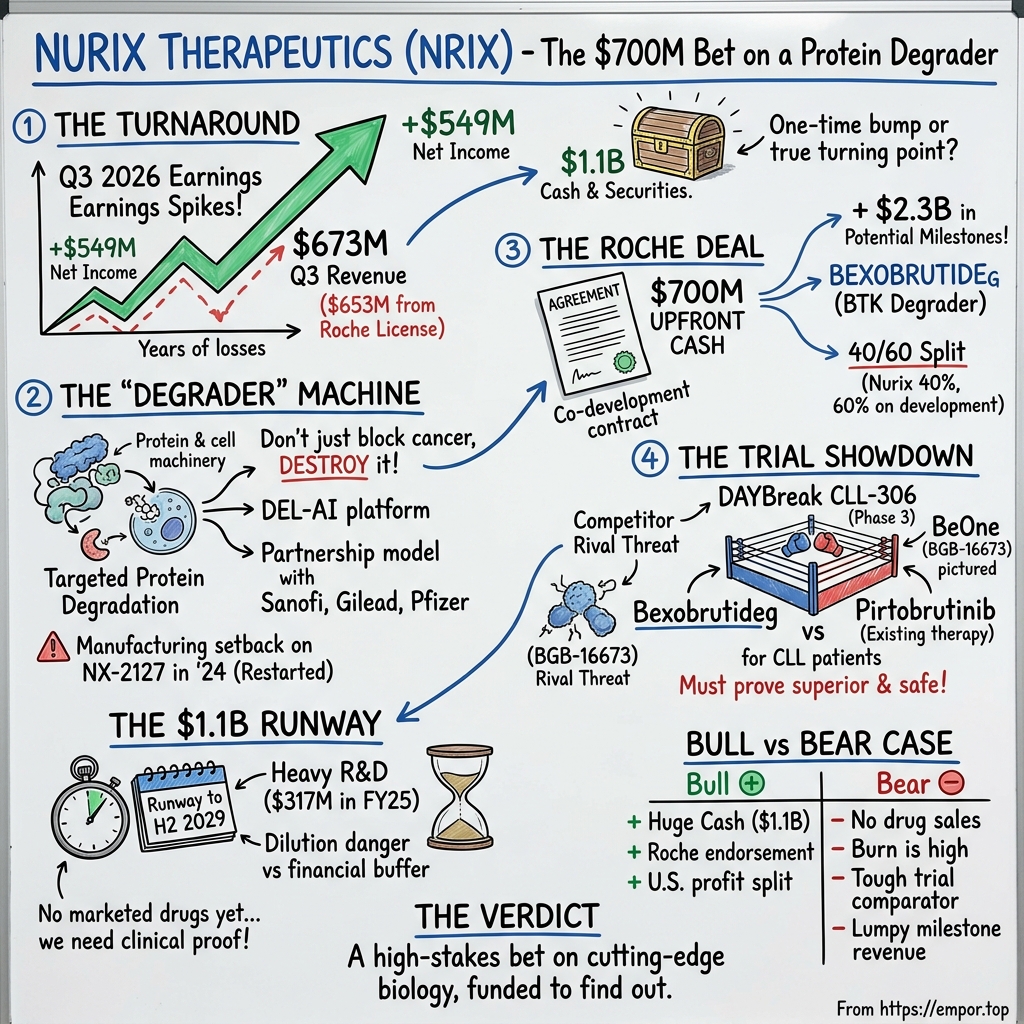
The screen was telling the truth about the accounts and not much about the business. Of roughly $673 million in revenue that quarter, about $653 million came from one line: license revenue from Roche.1[^2] Nurix had not launched a drug, signed up hospitals or found a new stream of recurring customers. It had sold a share of its most important experimental medicine, a protein degrader called bexobrutideg, to one of the largest drug companies in the world. Roche paid $700 million upfront for the privilege.[^4]3 The company also reported about $1.1 billion in cash, cash equivalents and marketable securities, more than it had held at any point in its history.1[^2]
So the real question this quarter poses is not whether Nurix became profitable. It plainly did not, in any sense a long-term investor would recognise. The question is whether Nurix reached a turning point, or whether one deal simply made the accounts look transformed. The honest answer is a bit of both. Roche changed Nurix's financing position overnight and attached a deep-pocketed partner to its lead drug. What Roche did not do was turn a milestone payment into a recurring sale, or prove that bexobrutideg will work well enough to sell.
The accounting deserves a plain-English pass, because it is the whole story of that quarter's headline. Roche wired $700 million once. Under the revenue rules drug developers follow, Nurix had to decide how much of that payment was for something it handed over on the day, the license to the drug, and how much was for work it still owes, such as research and development activities it will perform over the coming years. It concluded that about $653 million belonged to the license and recognised that amount immediately as revenue.1 The remainder sits on the balance sheet, to be recognised as Nurix performs. In other words, the cash arrived in a single wire, the revenue arrived almost entirely in a single quarter, and the obligations attached to both will unfold over many years of trials.
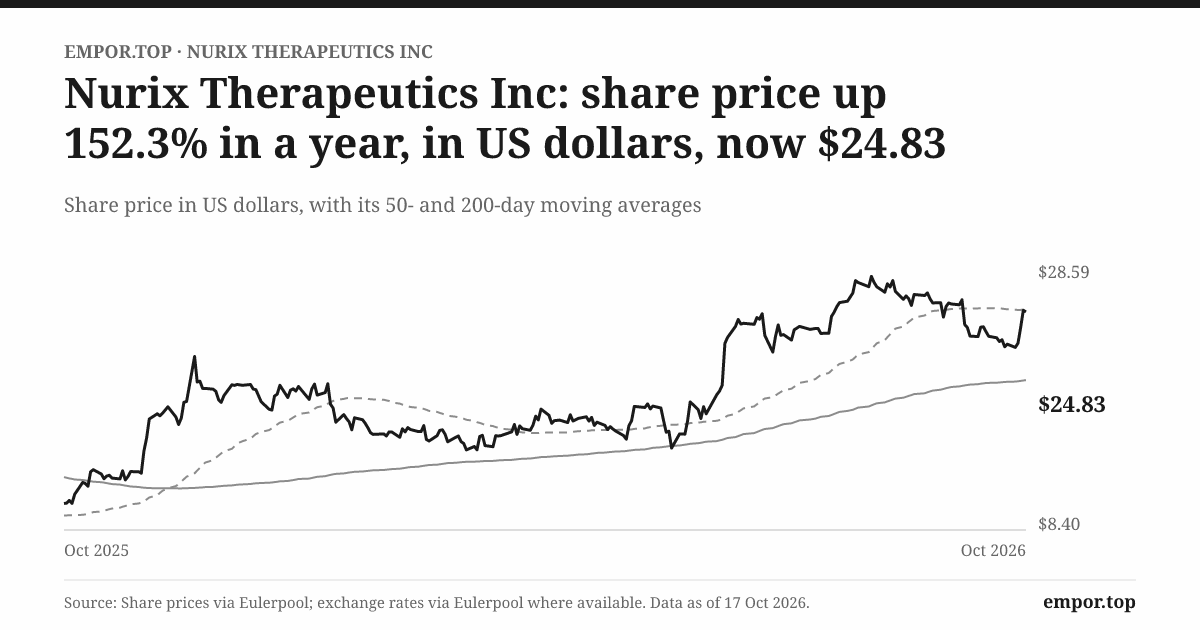
That one-time recognition then flows into every valuation shortcut. At a share price of $24.83 on October 17, 2026, Nurix carried a market value of about $2.6 billion and traded at roughly 8.7 times trailing earnings and 4.9 times trailing EBITDA.1 For a company with an experimental cancer drug and a platform pitched as a drug-discovery engine, those multiples look absurdly cheap. They are not cheap; they are distorted. Trailing twelve-month net income of about $295 million consists of one enormous profitable quarter stacked on top of three loss-making ones.12 Once the Roche quarter rolls out of the twelve-month window, the arithmetic will snap back to losses unless something else of similar size arrives. These multiples describe one transaction, not a durable earnings base.
What, then, did Roche actually buy, and what does Nurix still have to prove? Four questions run through this story. The first is clinical: can bexobrutideg beat the drugs that already treat chronic lymphocytic leukemia, the blood cancer where it is furthest along? The second is strategic: can a business model built on big-pharma partnerships turn Nurix's science into products, rather than a succession of upfront payments? The third is financial: does the Roche money fund that work without yet another dilutive share sale? And the fourth is about price: what is a company worth while the first three answers are still sitting inside clinical trials?
To answer any of them, the story has to rewind to a much quieter moment, when Nurix was a small San Francisco research shop trying to persuade the world that throwing proteins away could be better than blocking them.
 Subscribe on LinkedIn
II. From Drug Discovery to a Public Platform
Most drugs work like a hand over a light switch. A small molecule finds a disease-causing protein, slips into a pocket on its surface and holds it in the "off" position for as long as the drug stays in the body. That approach has produced most of modern pharmacology, but it has two stubborn limits. Many proteins have no convenient pocket to grab. And proteins mutate: a cancer cell under pressure can change the shape of the switch until the hand no longer fits, and the drug stops working.
Targeted protein degradation proposes a different trick. Every cell already has a garbage-disposal system, a network of enzymes that tag worn-out or unwanted proteins with a molecular label and send them to be shredded. The enzymes that apply the label are called E3 ligases. A degrader is a molecule designed to act as a matchmaker: one end grips the disease-causing protein, the other end grips an E3 ligase, and by bringing the two together it persuades the cell to tag and destroy a protein it would otherwise have kept. Instead of holding the switch off, the drug removes the switch from the wall. Because a single degrader molecule can, in principle, move on and repeat the process, the hope is that it can work at lower exposures and keep working even when the target has mutated in ways that defeat ordinary inhibitors.
Nurix was founded in 2009 to industrialise that idea.4 Its pitch was never a single drug. It was a machine for finding drugs: deep expertise in E3 ligases, the part of the system most companies understood least, combined with enormous DNA-encoded libraries, collections of billions of small molecules each tagged with a short strand of DNA that works like a barcode, so that researchers can test vast numbers of compounds against a protein at once and read out which ones stuck. The company later layered machine learning on top and branded the combination DEL-AI.2 The aspiration was repeatability, the claim that Nurix could point its engine at a target and reliably produce candidate degraders, again and again.
The person who turned that engine into a company was Arthur Sands, a physician-scientist who became chief executive in 2014.4 Sands had already built and run a public biotech before Nurix: he co-founded Lexicon Pharmaceuticals and led it for years, an experience that included both the excitement of large-scale genetics platforms and the hard lesson that platforms are judged in the end by the drugs they deliver.4 At Nurix he has been a persistent advocate of the degrader thesis and of the partnership model that pays for it, and he has stayed in the job for more than a decade, an unusually long tenure in an industry where development-stage CEOs often rotate with each financing cycle.7
The business model followed from the science. Nurix had no marketed products, and building the platform was expensive, so it rented the engine out. Pharmaceutical partners paid upfront fees for access to programs or discovery work, reimbursed research staff, promised milestone payments if candidates crossed scientific and regulatory hurdles, and agreed to royalties or profit-sharing if any product ever reached market.2 An early relationship with Celgene, which began in 2014, gave way to larger collaborations with Sanofi and Gilead signed in late 2019, and, in September 2023, a collaboration with Pfizer.2 Each deal did two things at once. It shared the cost of research, and it created a ladder of contingent payments that could turn scientific progress into cash before Nurix ever had a product to sell.
In July 2020, Nurix took that model to the public markets. Its Nasdaq listing sold shares at $19 each and raised about $218 million after fees.42 The point of the money was explicit: partnerships funded discovery, but Nurix wanted to keep its most promising degraders for itself and run its own clinical trials, which meant it needed capital no partner would supply. That decision defines everything that follows. A company that only licensed discovery work could have stayed small and cheap. A company that wanted to own clinical assets committed itself to years of escalating spending.
The public market became the funding source of choice. A follow-on offering in March 2021 priced at $31 a share, a high-water mark of enthusiasm for degraders; a raise in April 2024 priced at $15; and another in October 2025 priced at about $10.21 and brought in roughly $250 million gross.2 The direction of those prices tells its own story about how investors valued the platform across the cycle. The share count tells another. From roughly 33 million shares around the listing, Nurix's count grew to about 102 million by early 2026.2 That financing bought development time, and each round arguably bought it at the best price available then. It also meant that existing owners held a much thinner slice of whatever the pipeline would eventually be worth.
It is worth being clear about what Nurix did not do with its capital. Through fiscal 2025, its filings show no material corporate acquisition; the money went into research, clinical trials, laboratory buildouts and the cash pile itself.2 There is therefore no acquisition premium to judge against biotech deal comparables, and no goodwill write-down to point to. Capital allocation at Nurix has to be judged by different evidence: the scientific progress the spending produced, the terms of the partnerships it signed, the dilution it accepted and the pace of its cash burn.
The partnerships are the most visible evidence that sophisticated buyers took the platform seriously. Sanofi, Gilead and Pfizer each paid real money for access, and in some years their payments were the bulk of Nurix's revenue.2 But partner interest is not product success. A big-pharma collaboration is, among other things, a cheap option for the buyer: a modest upfront fee in exchange for the right to walk away later. The payments validate that the science was worth a look. They do not show that any candidate will become a medicine.
And Nurix's own record contains a sharper warning. Its first BTK degrader to reach patients, NX-2127, ran into a manufacturing-related problem, and in 2024 U.S. regulators placed a partial clinical hold on the program while the company addressed it; the fix required a redesigned drug product before dosing could restart.[^7] A hold is not a verdict on whether a mechanism works, and NX-2127's issue was specific to how that compound was made. It is, however, a reminder that turning clever chemistry into a consistent, manufacturable medicine is its own discipline, and that a platform company can stumble at the stage where science becomes product. That is the first clue that the "repeatable engine" claim has to be earned one molecule at a time.
Which raises a more mundane but crucial question: if Nurix sells access rather than drugs, what does its revenue actually look like from one quarter to the next?
III. The Revenue That Arrives in Bursts
Imagine running a business where your best quarter of the year happens because a customer's scientists hit a target in a laboratory you do not control, and your worst quarter happens because nothing in particular occurred at all. That is what a partnership-funded biotech's income statement looks like. A milestone is achieved and a payment is recognised. A partner extends a license and revenue jumps. A deal closes and the quarter balloons. None of it requires a single patient to buy a Nurix product.
Follow the money to its source and the units become clear. Partners pay upfront fees when they sign, which buy access to an asset or a stretch of discovery work. They pay research funding that reimburses Nurix scientists working on partnered targets. They pay development and regulatory milestones when a program clears a defined hurdle, such as a candidate nomination, a first patient dosed or a regulatory filing. They promise sales milestones and tiered royalties, typically in single-digit to low-double-digit percentages, on future product sales.2 Every one of those units is real money. None of them is recurring in the way a subscription or a repeat customer order is recurring. They arrive when contracts and science say they arrive.
The long-run record shows exactly that. Revenue was about $17 million in fiscal 2020 and about $83 million in fiscal 2025, which produces a five-year growth rate of roughly 37% a year.2 The number is arithmetically correct and economically misleading. Along the way, revenue fell by nearly half in one year, doubled in another and dropped by almost 30% in the year after that.2 Quarter by quarter before Roche, revenue moved between about $6 million and about $44 million, with no steady trend in either direction.12 A growth rate calculated between two arbitrary endpoints of a series like that tells an investor more about the endpoints than about demand.
Then came the Roche quarter, when revenue reached about $673 million, nearly a hundred times what it had been a year earlier.1 It is tempting to treat that as the new base. It is better understood as a step-change in funding and in the seriousness of Nurix's partner, attached to the same underlying model. Product revenue and royalties remain contingent on clinical and regulatory success that has not yet happened.
Concentration is the next clue. In the Roche quarter, Roche alone supplied about 97% of revenue, with Sanofi contributing a $10 million development milestone tied to its STAT6 program, roughly another 1.5%.1 Before Roche, the same pattern held with different names: Sanofi and Gilead accounted for virtually all collaboration revenue in fiscal 2024, and in fiscal 2025 Sanofi supplied more than half, helped by about $30 million from two license extensions.2 A handful of partners therefore decide not only when Nurix recognises revenue but also which programs move forward at all. That is an enormous amount of influence for a few counterparties to hold over a public company's results.
One quirk in the historical numbers looks alarming and is not. Measured as days of revenue, Nurix's receivables once peaked at about 244 days, in fiscal 2020.2 Read naively, that would suggest customers taking eight months to pay. The reality is that the company has few receivables at all, often close to zero at year-end, and when a milestone is billed just before a quarter closes against a small revenue base, the ratio explodes.2 The counterparties are some of the largest and best-capitalised companies in the world, and the company has recorded no credit-loss allowance on these balances.2 The 244-day figure is an artefact of timing, not a sign of late payers, and it is a poor gauge of credit risk going forward. The real risk in these relationships is not that a partner fails to pay a bill. It is that a partner stops sending new ones.
That risk is built into the contracts. A partner can end a program, decline an option it has the right to exercise or simply change its priorities after a merger, a reorganisation or a pipeline review. When it does, the milestones disappear, and if Nurix wants to keep the program alive, the costs come back onto its own books. Partnership revenue is therefore not just volatile; it is revocable in a way commercial sales are not.
The historical record is honest about this. The Celgene collaboration that began in 2014 ended without producing a Nurix commercial product.2 The more recent partnerships have produced extensions and milestones, which is a positive signal that partners keep paying to stay in, but no partnered program has yet become a marketed drug. So the evidence supports a narrower claim than "a platform that generates products": Nurix has demonstrated that it can repeatedly sell access to its science and collect contingent payments as that science advances. What it has not yet demonstrated is that the science becomes a durable marketed franchise.
Which is why the June 2026 deal matters so much. For the first time, a partner did not just rent the engine. It bought into the car.
IV. Roche Takes a Share of the Lead Drug
On June 8, 2026, Nurix and Roche announced that they would co-develop and co-commercialise bexobrutideg, the BTK degrader known in earlier filings as NX-5948.[^4]3 For a company that had spent a decade licensing out early discovery programs and pieces of its platform, this was different in kind. Roche was taking a share of Nurix's most advanced, most valuable, wholly owned asset, the drug the company had kept for itself precisely because it believed it could be the one that turned the platform into a business.
Why BTK? Bruton's tyrosine kinase is a signalling protein that B cells, a type of white blood cell, rely on to survive and multiply. In cancers such as chronic lymphocytic leukemia, malignant B cells lean on BTK signalling constantly, which is why BTK inhibitors became one of the great oncology franchises of the past decade. The first generation of these drugs bind permanently to a specific spot on the protein. Cancers adapt. Mutations at that binding spot, and later at other places in the protein, let tumours escape. A newer, non-covalent inhibitor works around the first escape route, but resistance can still emerge.
Nurix's claim is that degradation sidesteps the cat-and-mouse game. If bexobrutideg removes BTK entirely, including the mutated forms that resist existing inhibitors, then the cancer cannot simply change the shape of the switch to escape; the switch is gone.[^2][^4] There is a second argument too: BTK is not just an enzyme but also a scaffold that helps assemble other signalling proteins, and an inhibitor that silences the enzyme leaves that scaffolding role intact, while a degrader takes away both. That is the theory. Whether it translates into patients living longer without their disease progressing is the question the next decade of trials will answer.
The economics of the deal are more intricate than the headline. Roche paid $700 million upfront, and the announced deal value reached up to about $2.3 billion including potential milestone payments.[^4]3 Global development costs are split 60% Roche and 40% Nurix. In the United States, the two companies share commercial profits and losses equally, and Nurix keeps the right to participate in U.S. commercialisation. Outside the United States, Roche leads, and Nurix is eligible for tiered royalties on sales.1[^4] Roche takes on major responsibilities for regulatory strategy, manufacturing and commercialisation, with defined participation rights for Nurix in the U.S.1
The first thing to separate is cash from deal value. The $700 million is real money, already received.1 The rest of the $2.3 billion headline is a menu of contingent payments that arrive only if specific development, regulatory and sales events happen. Biotech headlines routinely add these together into one large number, and investors routinely treat that number as more certain than it is. Milestones are promises with conditions, and the conditions are the hard part.
The second thing to understand is what the U.S. profit split means. A royalty deal is like owning a small slice of revenue with no costs attached: if the drug sells, the money arrives; if it does not, nothing is lost but hope. A 50/50 profit-and-loss share is like owning half a business. If bexobrutideg becomes a large U.S. product, Nurix keeps half the profits, which is far more valuable than a royalty would have been. But it also owns half the losses during launch, when sales forces are being built and marketing spending runs ahead of revenue, and it must keep paying 40% of global development costs to get there. Nurix kept meaningful upside, and with it, meaningful obligations.
Why did Roche do it? The most generous reading is that Roche looked closely at the clinical data and the mechanism and concluded that bexobrutideg could be a better BTK drug, not just in blood cancers but potentially in immune diseases driven by B cells and mast cells. Roche's own announcement tied the deal to plans beyond oncology.3 A more measured reading is that Roche bought a well-priced option on a promising clinical asset in a class with known commercial value, paying a meaningful but manageable upfront fee, keeping control of most of the world, and sharing development risk with the inventor. Both readings can be true at once. Roche is a sophisticated buyer, and its willingness to commit capital is genuine evidence of strategic interest. It is not evidence of clinical superiority, because Roche does not yet know the answer to that question either.
Nurix's own history adds a layer of caution. The manufacturing-related hold on NX-2127 showed that getting a degrader into patients does not make the next step routine; formulation, consistency and supply are where many promising molecules falter.[^7] That episode was specific to a different compound, and bexobrutideg has its own manufacturing path, now with Roche's considerable manufacturing capabilities involved.1 It should be read as a program-specific warning about execution risk in a young modality, not as a verdict on the drug Roche bought.
So the proof standard needs to be stated plainly. A large partner, a broad development plan and a big headline establish that serious people find bexobrutideg worth backing. They do not establish that it works better than existing drugs, that it stays tolerable over years of continuous dosing, or that doctors and payers will prefer it. Those answers come from one place only: a trial against the standard of care.
V. The Trial That Has to Beat the Standard of Care
Somewhere in a clinic in 2026, a patient whose leukemia had come back after earlier treatment received the first dose in DAYBreak CLL-306, a Phase 3 trial that randomly assigns patients to bexobrutideg or to pirtobrutinib, the newest BTK inhibitor on the market.[^2] That moment is the hinge of the entire Nurix story. Everything before it was laboratory promise, early-stage data and deal-making. Everything after it depends on a comparison against a drug that is already very good.
Begin with the landscape a new BTK drug has to enter. Chronic lymphocytic leukemia is one of the most common adult leukemias in Western countries, and it is often a long disease, managed for years rather than cured. Covalent BTK inhibitors from large companies including AbbVie and AstraZeneca reshaped its treatment and became multibillion-dollar products. Eli Lilly's pirtobrutinib, a non-covalent inhibitor, was built to work in patients whose disease had escaped the first generation.[^2]5 Add combination regimens with other drug classes, and doctors already have a well-stocked toolbox. A newcomer does not win by being novel. It wins by giving patients a reason to switch: longer control of the disease, deeper responses, better tolerability, or a way to treat patients the existing drugs leave behind.
That is why the comparator matters so much. Testing bexobrutideg against pirtobrutinib in relapsed or refractory CLL and its close cousin, small lymphocytic lymphoma, is choosing a tough opponent.[^2] Pirtobrutinib is itself the drug many patients receive after covalent inhibitors fail, so beating it would make a powerful case that degradation adds something inhibition cannot. Losing to it, or merely matching it, would leave bexobrutideg as one more option in a crowded later-line market. The evidence that will settle the question has a familiar shape: progression-free survival, meaning how long patients live before their disease worsens; response rate and depth; how long responses last; and the safety profile over long-term dosing. Until those numbers exist, every argument about the drug's value is an argument about probabilities.
Nurix also has company on the degrader frontier. BeOne Medicines, the company formerly known as BeiGene, is developing its own BTK degrader, BGB-16673, in overlapping B-cell cancers, and has presented it as a priority in its pipeline.56 BeOne already sells zanubrutinib, a covalent BTK inhibitor, so it knows the market intimately and has every incentive to defend and extend its franchise with a degrader of its own.5 The field is still early. Being first to the clinic with a BTK degrader, or holding a regulatory designation, does not confer a cornered market; it confers a head start in a race whose finish line is comparative data.
Think of the competitive forces in plain terms. Physicians and payers have real alternatives, so the threat of substitution is high and any pricing power has to be earned with data. Partners hold real bargaining power because Nurix depends on their money and their global reach, which is why Roche ended up controlling most of the world outside the United States. Rival programs compete not just for future patients but for present ones: clinical trial sites, investigators and eligible patients are finite, and two degrader programs plus several inhibitor trials in the same disease pull on the same pool. Switching costs and pricing power, the classic sources of durable profit, can only be demonstrated after approval, through what doctors actually prescribe and what payers actually reimburse.
What about Nurix's moat? The evidence supports a credible scientific position: specialist expertise in E3 ligases and degrader discovery, patents on its compounds, a discovery platform that several large partners have paid to use, and the first BTK degrader to reach a head-to-head Phase 3.[^2]2 What the evidence does not show is an approved product, retention data from real prescribers, or a demonstrated cost advantage over competitors. The history narrows the moat claim rather than rejecting it: Nurix has a capability, not yet a franchise. The event that would confirm the larger version is a DAYBreak CLL-306 result that beats pirtobrutinib on progression-free survival with acceptable safety; the event that would falsify it is a result that does not.
The optionality deserves proportion. Roche has signalled plans to explore bexobrutideg beyond cancer, in chronic spontaneous urticaria, a persistent hive-forming skin condition driven partly by mast cells, and in multiple sclerosis, where B cells play a central role.3[^2] Those plans matter more than a typical biotech "expansion opportunity" slide, because Roche is committing development money to them and has a deep presence in immunology and neurology. But they remain future trials in diseases where safety expectations are stricter than in cancer and where degradation has yet to show its value. They are options, not separate businesses.
The live version of this story is told on earnings calls. Investors listening to management's October 2026 third-quarter call, the July 2026 second-quarter call and the presentations that followed the Roche announcement should compare prepared remarks with what management says when analysts push: does it give concrete enrollment targets and timelines for DAYBreak CLL-306 and the combination studies, and how candidly does it describe the bar pirtobrutinib sets?[^2][^8] Management naturally emphasises the mechanism. The useful signal is whether it also commits to specific, checkable milestones.
All of that costs money, and the next question is whether Nurix now has enough of it.
VI. The $1.1 Billion Runway Has a Date on It
After the Roche money landed, Nurix reported about $1.1 billion in cash, cash equivalents and marketable securities and said that this funded operations into the second half of 2029.[^2] For a company whose history is a sequence of share sales, that is a remarkable sentence. It is also a forecast with a date on it, and dates in biotech have a way of arriving faster than planned.
There is a tempting back-of-the-envelope calculation that produces a much longer horizon. Take $1.1 billion, assume a net burn of perhaps $175 million to $225 million a year once Roche pays its 60% share of development, and you arrive at five or six years of runway, stretching to 2031 or 2032. That arithmetic is too optimistic against what management itself now says. The company's own stated horizon, into the second half of 2029, implies roughly three years of funding from the end of the Roche quarter, which suggests management expects spending well above that simple estimate as Phase 3 trials, combination studies and other programs scale up.[^2] The sensible base case is the company's own number, tested each quarter against actual cash burn.
Where does the money go? Research and development spending climbed from about $189 million in fiscal 2023 to about $317 million in fiscal 2025, as bexobrutideg moved through its early studies and other programs advanced.2 That pace of growth, roughly two-thirds in two years, is the story of a company scaling from discovery into late-stage trials. Roche now covers 60% of bexobrutideg's global development costs, which takes real pressure off.1 But Nurix's 40% share of a global Phase 3 program is not small, and its internal pipeline, platform work and wholly owned degraders still draw entirely on Nurix's cash. Headcount rose to 317 at the end of fiscal 2025, more than 80% of them in research and development.2 The machine is getting bigger, not smaller.
There is a modest cushion from the cash pile itself. Interest on the treasury portfolio, held in money-market funds, Treasury bills and high-grade government and corporate debt, brought in about $22 million in fiscal 2025.2 With a bigger balance, that income rises, but it rises and falls with interest rates and with the balance itself, which shrinks as the company spends. Interest income softens the burn. It is not a product economic, and it will not fund a Phase 3 trial.
The long history of profit versus cash adds context. Over the eight fiscal years from 2018 through 2025, Nurix reported cumulative net losses of about $956 million but used about $776 million in operating cash.2 The gap, about $180 million, can look like a sign of efficiency. It is not. It reflects non-cash charges, mainly stock-based compensation paid to employees in equity rather than cash, and upfront partner payments that arrived as cash before they were recognised as revenue. In fiscal 2025 alone, non-cash charges added back to the loss came to about $63 million.2 The cash picture was better than the profit picture because employees were paid partly in shares, which shifts cost to shareholders through dilution, and because partners prepaid for work. Neither is positive operating economics.
Where the free cash went is equally clear. Across those eight years, free cash flow was negative by about $836 million, and Nurix paid no dividends.2 Every dollar of financing went into research, trials and facilities. That is exactly what a development-stage biotech is supposed to do; the question is only whether the research ends up worth more than it cost.
One line in the data deserves correction before it misleads. Financial databases show Nurix with "borrowings" of about $56 million at the end of fiscal 2025 and a debt-to-equity ratio of about 0.10.2 Those figures are almost entirely operating lease liabilities, the accounting value of future rent on laboratories and offices in the San Francisco Bay Area. Nurix has no bank loans, no bonds and no convertible notes.2 It carries no conventional funded debt and no covenants to trip. The leases are still obligations, and they rose as the company expanded its facilities, but they are rent, not leverage.
The financing record belongs in any judgement of management. The listing and the follow-on offerings, most recently the October 2025 raise priced at roughly $10, kept the pipeline funded at every stage, and each one expanded the share count.2 The October 2025 raise came only months before the Roche deal was announced, which means shareholders who bought then did well; those who were diluted by it may reasonably ask whether the timing was as good as it looks in hindsight. Characterising the company's financing as "disciplined" or saying the Roche money has "eliminated" the need to raise again goes further than the evidence. What can be said is that the Roche deal sharply reduces the near-term case for another raise. Only realised burn and clinical progress will show whether it has removed it.
A company that spends shareholders' money for years before it has a product has to pay people well to do it. Who, then, gets paid before the drug exists?
VII. Who Gets Paid Before the Drug Exists?
A biotech without revenue still has payroll. It must hire chemists who could work at any large pharmaceutical company, clinicians who run global trials and executives who can negotiate with Roche. It must pay all of them while asking public investors to finance the gap until a drug proves itself. That arrangement is fair only if the people running the company share the risk they ask shareholders to bear.
Start with related parties, because in many companies that is where value quietly leaks. At Nurix, the disclosed record is small and ordinary. The chief financial officer serves as a trustee of an industry association that administers employee healthcare benefits, and Nurix's annual premium payments to that plan have run at roughly $0.1 million to $0.3 million.2 There is no related-party revenue, no royalty stream owed to founders or insiders, no management fee to a sponsor and no loans to insiders; early venture investors such as Third Rock Ventures and The Column Group hold equity but have no commercial agreements with the company.2 On this evidence, related-party dealings are an ordinary-course matter rather than a governance concern.
Pay is the more interesting question. In fiscal 2024, Arthur Sands received total compensation of about $6.37 million, of which roughly $5.17 million was option awards, alongside a salary of about $675,000 and a cash bonus of $510,000.7 The same year, Nurix reported a net loss of about $193 million.2 The ratio of his pay to that of the median employee was 23 to 1, modest by large-company standards, partly because the median Nurix employee is a highly paid scientist earning about $274,000.7
The structure matters more than the total. Options are worth something only if the share price rises above the price at which they were granted, so a package weighted toward options does, in principle, tie the chief executive's reward to shareholders' experience. The tension is that option grants are themselves a form of dilution, and that a share price can rise on a deal headline, as Nurix's did in 2026, well before any drug is proven in the market. An option-heavy package rewards the stock going up; it does not necessarily reward the clinical outcomes that would justify the stock going up. That is a reason for scrutiny rather than alarm.
Ownership by insiders is meaningful but not controlling. The executive officers and directors as a group held roughly 4% to 5.5% of common stock in the most recent proxy-based estimates, and the largest named specialist holder was Baker Bros. Advisors at about 7.2%, with large index and active managers such as Vanguard, BlackRock and Fidelity also on the register.7 There is no controlling shareholder and no dual-class structure. Insiders own enough to care and not enough to override outside investors.
Judge leadership on behaviour over time, and the record cuts both ways. Sands has run Nurix since 2014, and under him the company built a stable of big-pharma partnerships, raised capital repeatedly to fund its own pipeline, absorbed the NX-2127 setback and pushed bexobrutideg into a head-to-head Phase 3 with Roche alongside.[^2][^7] The chief financial officer and chief scientific officer have also been stable for years.7 The counterweight is that the pipeline remains pre-commercial after more than a decade, and shareholders financed years of losses through a share count that roughly tripled after the listing.2 Long tenure is evidence of continuity. It is not, by itself, proof of capital-allocation skill.
Shareholders' own voice offers one more data point. At the annual meeting on May 15, 2026, the advisory vote on executive pay passed with about 91% support, while roughly 6.9 million votes were cast against.7 That is meaningful dissent, nearly one vote in eleven, even though the proposal passed comfortably. It is a reason to read the proxy's incentive design closely, not proof of a governance crisis.
The remaining trust checks are short. Nurix reported no material legal proceedings in its fiscal 2025 annual report or its third-quarter 2026 report, and its auditor, PricewaterhouseCoopers, issued an unqualified opinion on the fiscal 2025 accounts.21 Foreign-exchange effects from paying overseas trial sites were immaterial, and tax and contingent-liability disclosures are not central to the investment case.2 Most of the risk at Nurix is where it should be in a biotech: in the science and the spending, not in the paperwork.
Which brings the story to the market's own verdict, and to the stubborn gap between what the trailing numbers say and what the business actually is.
VIII. Analysis & Bear vs. Bull Case
On October 17, 2026, Nurix shares closed at $24.83, near the top of a 52-week range that ran from about $9.84 to about $27.51.1 In a year, the stock had more than doubled from its low. Investors looking at it see three things that are hard to hold in one thought: a market value of about $2.6 billion, roughly $1.1 billion of cash and securities, and a trailing price-to-earnings ratio below nine, all belonging to a company that still has no marketed medicine.1
Start with the bull case, stated without the sales pitch. Roche is now paying most of the cost of developing bexobrutideg and brings global regulatory, manufacturing and commercial reach that Nurix could never have built on its own.[^4]3 The U.S. profit split preserves meaningful upside: if the drug succeeds, Nurix owns half of the economics in the world's most lucrative drug market. The company holds a large treasury and no funded debt. And the older partnerships are still producing: Sanofi paid for two license extensions in fiscal 2025 and a further $10 million milestone in the Roche quarter, while Gilead and Pfizer programs continue.12 On that reading, Nurix is a funded, de-risked company with a major partner and several shots on goal.
The bear case deserves equal force. Nurix has no product revenue. It ran persistent operating losses before Roche, and absent another deal those losses will return as soon as the Roche quarter falls out of the trailing figures. Revenue is concentrated among a handful of partners who can walk away. Nurix still owes 40% of global development costs and half of any U.S. launch losses. Shareholders have absorbed heavy dilution. The clinical benefit of degradation over inhibition is unproven in a randomised trial, and the drug faces direct competition from BeOne's degrader and from well-entrenched inhibitors from AbbVie, AstraZeneca and Lilly.56 On that reading, the stock prices in a good deal of success that has not happened yet.
The valuation shortcuts mislead in both directions. Trailing net profit of about $295 million is almost entirely the Roche license recognition, so the price-to-earnings ratio, EV/EBITDA of about 4.9 times, EV/sales and a reported free-cash-flow yield above 14% are not normalised operating multiples.1 They describe a single wire transfer. Against peers, the comparisons are just as noisy: other degrader developers range from Kymera Therapeutics, valued at a far higher enterprise value on the strength of its immunology programs, to Arvinas and Monte Rosa, valued much lower, and none earns steady profits.2 Peer multiples are not a guide here either; the market prices each degrader company on its lead programs' perceived probabilities.
What does the price appear to assume? Treasury assets of about $1.1 billion are roughly 42% of the market value, or about $10.50 a share.1 Subtract that cash and investors are paying roughly $1.5 billion of enterprise value for Nurix's share of bexobrutideg, its other programs and its platform. That is a meaningful bet on clinical success, though far from a heroic one if the drug becomes a leading BTK therapy. The cash also is not a floor. It is a finite resource being spent on an expanding trial plan, and the company itself says it lasts into the second half of 2029.[^2]
Now the moat, argued in full once. In Michael Porter's terms, rivalry is intense and getting more so, with multiple BTK inhibitors on the market and at least one direct degrader competitor in the clinic. The threat of substitutes is high, because doctors have effective alternatives. Buyer power is high on two levels: payers and physicians control demand for any eventual drug, and big-pharma partners control Nurix's financing and reach, as Roche's control of territories outside the U.S. shows. Supplier power is moderate: clinical research and manufacturing contractors are specialised but replaceable, though the NX-2127 hold showed how much manufacturing can matter. The threat of new entrants into degraders is real, because large companies including BeOne are building their own programs.
Hamilton Helmer's seven powers make the gap clearer. Nurix has a plausible claim to cornered resource in its E3 ligase know-how and patents, but other degrader companies hold their own patents and expertise, so it is a partial claim at best. It has no scale economies, no network effects, no switching costs yet and no brand with prescribers, because it has no product. Process power, the idea that DEL-AI lets it discover degraders faster and better than rivals, is the heart of the platform pitch, and the evidence for it so far is partner willingness to pay rather than a record of approvals. Counter-positioning against inhibitor incumbents is the most interesting possibility: companies with large inhibitor franchises may hesitate to cannibalise them. But BeOne, an inhibitor incumbent, is developing a degrader anyway, which weakens that argument considerably.5 The honest conclusion is that Nurix has a credible scientific position and a powerful partner, not a proven commercial moat.
Three numbers will tell investors most about how this story evolves. The first is DAYBreak CLL-306 itself: enrollment pace now, and eventually its comparative progression-free survival against pirtobrutinib; the trial began dosing in 2026 and has no efficacy readout yet.[^2] The second is quarterly net cash burn against the company's stated runway into the second half of 2029: before Roche, quarterly operating losses had climbed to around $90 million.1 The third is partner conversion, whether Sanofi, Gilead and Pfizer programs move into and through the clinic and trigger milestones, as the $10 million Sanofi STAT6 milestone did in the Roche quarter.1
The material risks are best described by mechanism. A trial failure or a safety finding would cut directly into the value of the lead asset and, through the U.S. profit split, into Nurix's share of its future. A partner reprioritising would remove milestones and could shift costs back onto Nurix. Expanding trials, especially into immunology and neurology, would accelerate cash use. And a competing degrader or an improved standard therapy could erode bexobrutideg's clinical differentiation before it ever reaches market. Currency, credit and general macro risks matter little by comparison.
Why might Nurix win? It has a differentiated mechanism, clinical progress to a head-to-head Phase 3 and Roche's reach. Why might it not? Because each of those strengths is still a hypothesis until comparative data and commercial conversion arrive. The case is intact but unproven, and the verdict sits inside a single trial.
IX. Business & Investing Lessons
The same quarter that delivered a $653 million revenue line also delivered a funding horizon that ends in 2029.1[^2] Hold both facts together and Nurix becomes a short course in how to think about platform companies before the product exists.
The first lesson is that a milestone is a receipt, not a market. Roche's payment was the largest event in Nurix's financial history, and it bought the company years of time. But it was a payment for a chance, made by a company that does not yet know whether that chance will pay off. Investors who read a license fee as earnings are measuring the size of the bet rather than the quality of the business. The lesson travels well beyond biotech: whenever a single contract makes a company look profitable, ask what would have to happen for that profit to recur, and whether anything in the business makes it likely.
The second lesson is that a partner can validate the science and still leave the risk with you. Roche did not take bexobrutideg off Nurix's hands; it took a share of it. Nurix still pays 40% of global development and owns half of the U.S. profits or losses.[^4] That structure is the price of keeping upside, and it is a fair one. But it means partnership is not the same as de-risking. A founder who hands over half a business to a giant should remember that the giant can afford to be patient with failure in a way a smaller company cannot.
The third lesson is that runway is a forecast with a date. A $1.1 billion cash pile invites simple division, and simple division produced a five-to-six-year horizon. Management's own number is closer to three.[^2] The difference is the plan: more trials, more indications, more people. Cash buys a strategy, not a calendar, and the only way to know whether the strategy stays on budget is to watch the quarterly burn, not the balance.
The fourth lesson is that platforms earn their moat one successful drug at a time. Nurix has spent more than a decade building a discovery engine that several large companies have paid to use, and its first BTK degrader to reach patients hit a manufacturing hold.[^7] Neither fact is a verdict on the platform. Together they say that discovery expertise is a capability, and that capabilities become advantages only when they produce products that patients and payers choose. For investors in any "platform" story, the question is never how many partners have signed. It is how many products have shipped.
X. Epilogue
Tonight, Nurix stands at an unusual point in a biotech's life: funded, partnered and still unproven. The deal is signed, the cash is in the account and the Phase 3 trial is enrolling. Roche's development plan is reaching beyond blood cancer toward immunology and neurology, and the older partners are still writing modest cheques.[^2]3 The financing question that dominated the company's first decade has, for now, receded. The clinical question that will decide its second decade has moved to the front.
The first event to watch is DAYBreak CLL-306. Enrollment and trial execution will tell investors over the coming quarters whether the program is running to plan. The comparative results, when they eventually come, will be the moment of truth. A clear win over pirtobrutinib on progression-free survival, with tolerable long-term safety, would support the central claim that removing BTK can improve on blocking it, and would turn the U.S. profit split from an obligation into a prize. A tie or a loss would leave bexobrutideg as a salvage option in a crowded market, and much of the Roche headline would remain on paper.
The second is the burn. Each quarterly report will show whether spending tracks the company's own runway into the second half of 2029.[^2] Faster burn backed by visible trial progress would be an acceptable trade. Faster burn without corresponding progress would bring the old question back: when does Nurix return to the equity markets?
The third is partner conversion. Watch whether Roche actually opens trials in chronic spontaneous urticaria and multiple sclerosis, whether Sanofi advances the STAT6 degrader further into the clinic, and whether Gilead and Pfizer programs reach clinical stages and trigger payments.13 Each of those events would add evidence that the platform produces more than one drug. Each failure to materialise would narrow the story back to a single asset.
Did Roche buy a future franchise or an expensive clinical option? The financing path is clearer than it has ever been, and the clinical test is sharper. The decisive evidence, comparative efficacy, durable safety and, eventually, commercial uptake, has not yet arrived.
XI. Outro
Go back to that October morning: a company that had spent years reporting losses suddenly reports more than half a billion dollars of quarterly profit. It looks like a transformation. It is really a transaction, $653 million of one-time Roche license revenue sitting on top of a business that still has no approved product, now cushioned by $1.1 billion in the bank.1[^2]
What makes Nurix unlike an ordinary biotech earnings story is that the profit is the least important number on the page. Nurix has sold a partner the chance to help turn a new way of removing disease-driving proteins into medicine, and used the proceeds to fund the proof. The deal is done and the money is real. What happens next depends on the trial, and on what bexobrutideg does once it reaches patients.
References
-
Form 10-Q for the quarterly period ended August 31, 2026 — Nurix Therapeutics / SEC, 2026-10-13 ↩↩↩↩↩↩↩↩↩↩↩↩↩↩↩↩↩↩↩↩↩↩↩↩↩↩
-
Form 10-K for the fiscal year ended November 30, 2025 — Nurix Therapeutics / SEC, 2026-01-28 ↩↩↩↩↩↩↩↩↩↩↩↩↩↩↩↩↩↩↩↩↩↩↩↩↩↩↩↩↩↩↩↩↩↩↩↩↩
-
Roche Collaboration Announcement with Nurix Therapeutics — Roche, 2026-06-08 ↩↩↩↩↩↩↩↩
-
Nurix Therapeutics Form S-1 Registration Statement — SEC, 2020 ↩↩↩↩
-
BeOne Medicines Ltd. 2025 Annual Report — BeOne Medicines ↩↩↩↩↩
-
BGB-16673 BTK Degrader Fact Sheet — BeOne Medicines, 2025 ↩↩
-
Nurix Therapeutics SEC Filings: 2026 Proxy Statement, Form 8-K Annual Meeting Results (2026-05-15) and Schedule 13G Filings — SEC EDGAR ↩↩↩↩↩↩
 LinkedIn
 WhatsApp
 Reddit
 Hacker News
 Email
 Kindle
 RSS Feed
 Spotify
 Apple Podcasts
 Amazon Music
 Audible
 YouTube