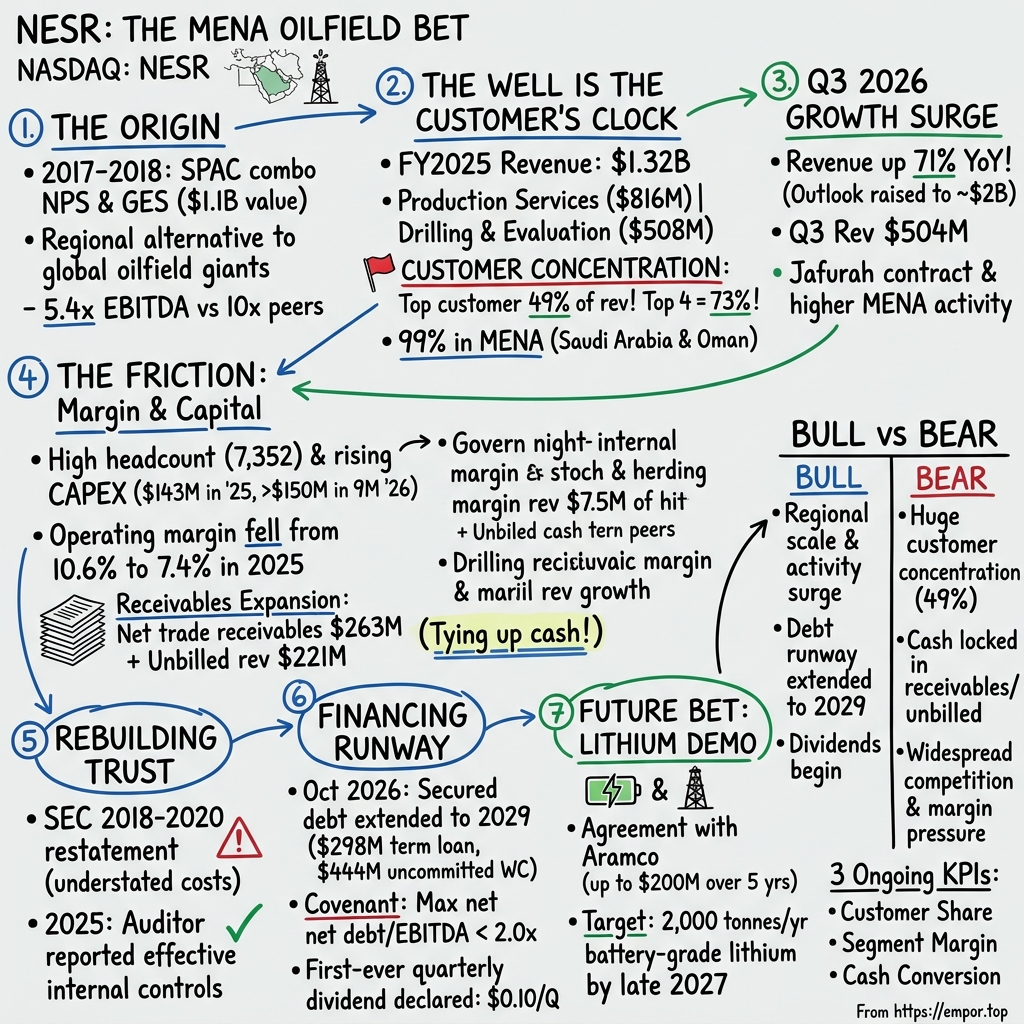
National Energy Services Reunited: The MENA Oilfield Bet
I. The Contract That Changed the Growth Rate
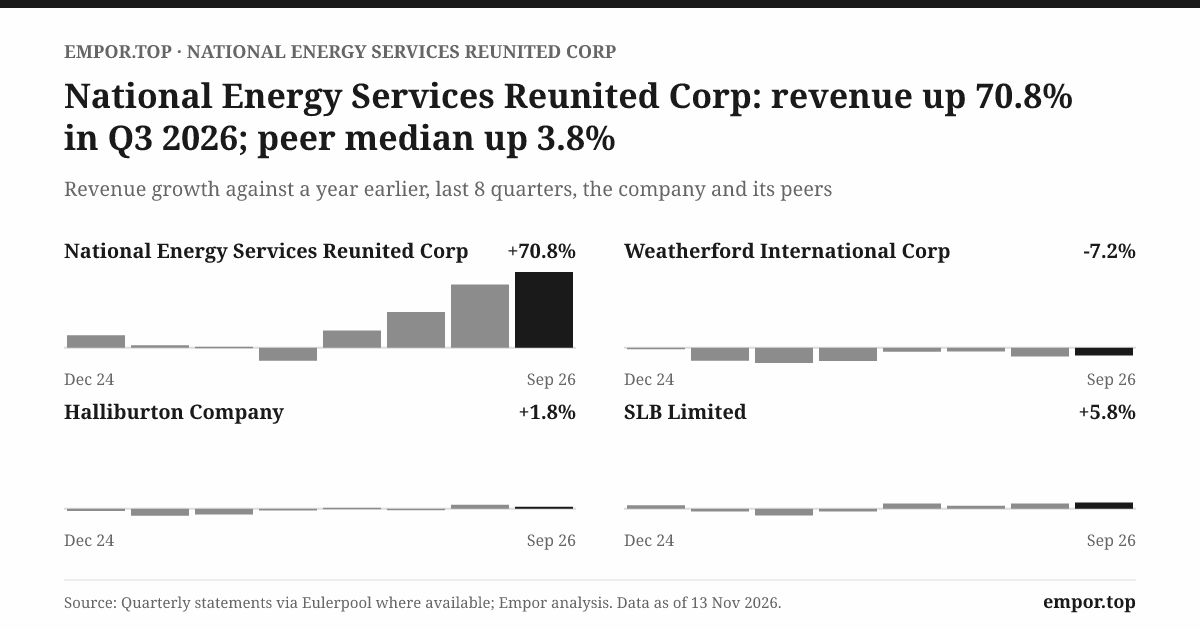
On November 9, 2026, National Energy Services Reunited published the kind of quarter that makes analysts check whether they have opened the right spreadsheet. Revenue for the three months to September was about $505 million, up roughly 71% from the same quarter a year earlier.1 For the first nine months of the year the company had booked about $1.43 billion, against roughly $926 million in the same stretch of 2025.1 On the call that followed, management pointed to about $2 billion of revenue for the full year, give or take, and an adjusted EBITDA margin of around 20%.2
To understand why that number landed with a jolt, it helps to know what normal used to look like. Over the five years to 2025, NESR's revenue had compounded at a little under 10% a year.3 That is a respectable pace for an oilfield-services company, an industry where revenue follows the drilling budgets of other people, but it is not the pace of a company that suddenly adds half a billion dollars of annual sales. In 2025 itself, revenue barely moved, edging up less than 2%.3 Then, within three quarters, growth went from flat to roughly seventy percent. Something in the business had changed gear.
The source of the jump is not mysterious. Chief executive Sherif Foda described four hydraulic-fracturing fleets running all quarter at Jafurah, Saudi Arabia's giant unconventional gas development, with a fifth crew already shipped into the Kingdom, and he talked about higher activity across several other markets in the Middle East and North Africa.2 He also described a quarter worked under the shadow of a regional conflict, with crews operating through "sirens, closed airspace, and supply routes that changed by the week."2 That conflict cost NESR roughly $5.5 million of extra freight and logistics in the third quarter alone, about one percentage point of margin, management said.2
So the story has a clear protagonist and a clear catalyst. The harder question is what kind of growth this is. A company can grow because it has become better at what it does and is winning work from rivals. It can also grow because one very large customer has decided to spend a lot more money, for its own reasons, in a place where the company happens to have trucks and crews. Both kinds of growth show up identically on the income statement. They behave very differently when the customer changes its mind.
NESR's own disclosures make the point uncomfortably clear. In 2025, a single customer supplied 49% of the company's revenue, and four customers together supplied 73%.3 The company does not name that largest customer, but it describes its business as almost entirely Middle Eastern and North African and overwhelmingly sold to government-owned oil and gas companies, with Saudi Arabia and Oman foremost among them.3 When half your revenue comes from one buyer, the growth rate is in part a measure of that buyer's appetite.
That sets up the three questions that run through this story. Can NESR's growth repeat without leaning ever harder on one customer? Can the revenue turn into cash after the company has paid for the equipment and the working capital that new contracts demand? And can the business earn returns high enough to justify the growth it is chasing, including a stated ambition to reach $3 billion of annual revenue?2
A word on what, exactly, investors own. NESR is incorporated in the British Virgin Islands and its shares trade on the Nasdaq Capital Market.3 It has an administrative presence in Houston, but its operating business, the people, the pumps and the wireline trucks, sits almost entirely in MENA.3 There is no parent group whose numbers need separating; the consolidated accounts are the business. That makes the analysis cleaner than for many emerging-market stories, but it also means there is no diversified group to cushion a bad year in Saudi Arabia.
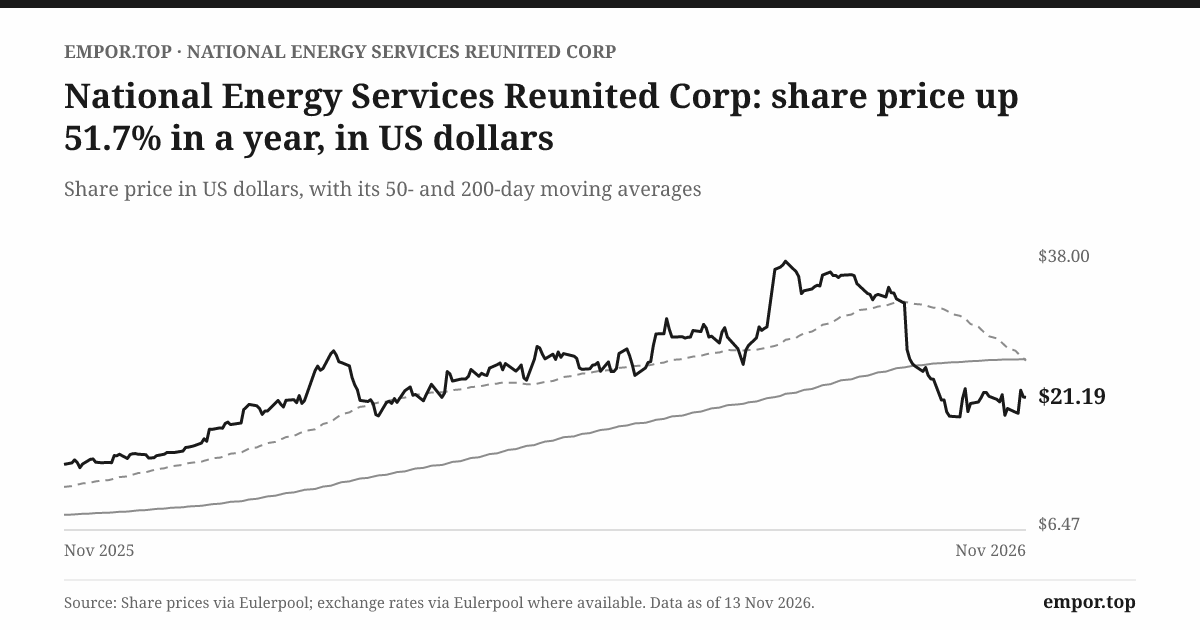
The market, for its part, has not treated the surge as a settled fact. In mid-November 2026, the shares trade at about $21, more than 40% below their 52-week high of roughly $36, even as reported revenue was accelerating. That gap between operating momentum and share price is itself a clue. Investors seem to be asking whether 2026 is a new floor or a peak.
Answering that requires going back to the beginning, because NESR is not an old company that grew into this position. It was assembled, quite deliberately, in a single transaction in 2018, at a price that embedded a set of assumptions about what a regional oilfield champion could become. The best way to judge the surge is to ask what that original price assumed and how much of it has come true.
 Subscribe on LinkedIn
II. A SPAC Buys Two Regional Oilfield Companies
In January 2017, a blank-check company was formed in the British Virgin Islands with no operations, no customers and no oilfield equipment.4 What it had was a name with an ambition built into it, National Energy Services Reunited, and a chairman who knew the region's oil business from the inside. In May 2017, it sold 21 million units at $10 each, and an over-allotment later that month took the total to about 22.9 million units and roughly $229 million of gross proceeds.4 It is worth being precise about this. The 2017 listing was the IPO of a cash shell. It was not an IPO of an oilfield-services company, and nobody buying those units was buying a business yet. They were buying a promise to find one.
The man making that promise was Sherif Foda. An Egyptian-trained engineer who studied electronics and automatic control at Ain Shams University in Cairo, Foda joined Schlumberger in 1993 and spent more than two decades there.5 His résumé reads like a tour of the world's largest oilfield-services company: managing director for the Arabian market, president of well intervention worldwide, president for Europe and Africa, president of the Production Group, and finally senior adviser to the chairman.5 That background matters for this story in two ways. It gave Foda credibility with national oil companies in the Gulf, which buy from people they know. And it gave him a precise view of the gap he wanted to exploit: the global majors offered technology and scale, but they were foreign companies in a region where governments increasingly wanted spending to stay at home.
On November 12, 2017, the shell announced what it had found.6 It would buy two businesses. The first was NPS, National Petroleum Services, a provider of well services, electric-line logging, well testing and integrated drilling and workover operations, which operated in 12 countries and employed more than 1,600 people of 40 nationalities.6 NPS was chaired by Hussain Al-Nowais, also chairman of the Abu Dhabi investment company Waha Capital, and run by Adnan Ghabris, its chief executive since 2008.6 The second was Gulf Energy, known as GES, an Omani drilling and completions services company founded in 2005 by Hilal Al-Busaidy and Yasser Al Barami, with about 1,200 staff and relationships with most of the operators in Oman.6
The price was about $1.1 billion, which the sponsors described as 5.4 times the targets' estimated 2018 EBITDA.6 Foda framed the deal not as a bolt-on but as a founding act. The combination, he said, would provide "an ideal platform to create a leader in oilfield services in the MENA region," a "truly national services company which has its roots in the region."6 Ghabris went further and called the result "the largest indigenous MENA-focused oilfield services player."6 The money behind it came from the SPAC's trust plus cash and equity from SCF Partners, a Houston energy private-equity firm, and other regional and international investors, while most existing NPS and GES owners were to take a large part of their consideration in NESR shares.6 A forward-purchase agreement in 2018 added a $70 million primary placement and up to $80 million more, subject to its terms.7
The logic was easy to sell. Combine two regional companies and you get a broader menu of services, more countries, more customers and a bigger balance sheet with which to bid for large integrated contracts. Local ownership and a regional workforce would fit the national oil companies' push to keep more spending inside their own economies. And a listed company could use its shares to buy more regional businesses later.
The multiple is the part that deserves scrutiny. Five-point-four times EBITDA sounds cheap for oilfield services, and it may well have been cheap relative to where large service companies traded. But the 5.4 figure rested on an estimate of 2018 EBITDA prepared before the deal closed, by people who wanted it to close. A low multiple of a forecast is only as good as the forecast. It also says nothing about the debt the combined company would carry, the shares it would issue, or the returns it would earn on the capital it put in afterwards. An entry multiple is where an investment begins, not how it ends.
The deal took longer than planned. The announcement had expected completion by the end of 2017; it actually closed on June 6, 2018.64 What came out the other side was a company that grew quickly at first. Revenue reached about $658 million in 2019 and $834 million in 2020, figures that reflect a full year of the acquired businesses rather than organic growth from a standing start.3 The company kept adding service lines and countries.
Then the platform stumbled. In 2021 and 2022, NESR reported losses, with an operating loss of about $43 million in 2021 and a roughly breakeven operating result in 2022.3 Return on invested capital, which had been in the mid-teens on the shell's tiny 2017 base, sank to around zero.3 Borrowings, which had stood at about $384 million at the end of 2019, rose to roughly $596 million by the end of 2021.3 And in March 2022, the company told investors that its 2018, 2019 and 2020 financial statements could no longer be relied upon.8 The early years of the listed company, the very years that were supposed to prove the platform, had to be rewritten.
That restatement deserves its own chapter later. For now, its significance is narrower. The original pitch claimed that scale and integration would produce a regional leader. Eight years later, NESR is unquestionably a sizable operator, with about $1.3 billion of revenue in 2025 and a workforce of more than 7,000.3 But size was the thing the deal bought on day one. The evidence that the combination created something more durable than size, such as better pricing, stickier customers or structurally higher returns, is much thinner. Return on invested capital peaked at about 9% in 2024 and slipped to about 7% in 2025.3 Those are respectable numbers for a cyclical services business. They are not the numbers of a company with an obvious moat.
So the acquisition verdict is a split one. The 2018 transaction built a real company at a price that looked attractive on the sellers' own estimates. It did not, by itself, prove the synergy story. To see whether that story holds, it is necessary to go to where the money is actually made: a well site somewhere in the desert, on a customer's schedule.
III. The Well Is the Customer's Clock
Picture a well in eastern Saudi Arabia or the interior of Oman. Before it produces anything, someone has to drill it, measure what is down there, line it with steel and cement, and then, especially in tight gas rock, crack the formation open with water, sand and chemicals under enormous pressure so that the gas can flow. After that, the well needs maintenance for years: cleaning, stimulation, coiled-tubing interventions, chemicals to keep the pipes from scaling or corroding. Each of these stages is a separate job, with separate equipment and crews, and each is bought by the oil company that owns the well.
NESR sells into almost all of those stages, organised into two reportable segments.3 Drilling and Evaluation Services covers the construction phase: drilling-related services, wireline logging that lowers instruments into the hole to read the rock, well testing and similar work. Production Services covers what happens once the well is built: hydraulic fracturing, cementing, coiled tubing, stimulation, nitrogen services, pipelines and specialty chemicals. In 2025, Production Services generated about $816 million of revenue and Drilling and Evaluation about $508 million.3 Roughly 99% of all revenue came from MENA, mostly from government customers.3
The economics of that business are shaped by time. Most of NESR's work is recognised as it is performed, typically over periods of 30 days or less, and invoices are usually due 30 to 60 days after billing.3 In plain terms, the company does a job, bills for it, gets paid a month or two later, and then needs the customer to order the next job. There is no subscription. NESR does not quantify how much of its revenue is recurring, does not publish a distribution of contract lengths and does not disclose minimum-volume commitments.3 Some national oil companies do award long-term fixed-price and integrated project-management contracts, which can lock in work for longer, but those carry their own risks: cost overruns, inflation, labour shortages, supplier failures and liquidated damages if the work slips.3 A third, more exotic model, in which NESR's pay is tied to the cash a customer's wells generate, made up less than 1% of revenue in 2025.3
That is why the well is the customer's clock. NESR's activity rises and falls with how many wells its customers decide to drill, complete and service in a given quarter. The MENA rig count, a rough proxy for that activity, fell from 591 at the end of 2024 to 565 at the end of 2025.3 When the customer slows down, NESR's crews sit idle; when the customer accelerates, NESR has to find equipment and people fast enough to keep up.
The 2025 segment results show the clock at work, and they show it running in opposite directions. Production Services revenue fell from about $878 million in 2024 to $816 million, which the company attributed mainly to fewer hydraulic-fracturing stages during a contract transition and lower coiled-tubing activity in Saudi Arabia, partly offset by higher specialty-chemical sales in Egypt.3 Drilling and Evaluation went the other way, growing from about $424 million to $508 million.3 NESR does not name the customer behind the frac transition, and it does not describe the episode as a lost contract. But the effect on profit was severe. Production Services' segment operating profit dropped from about $147 million to roughly $100 million, a fall of nearly a third on revenue that declined only 7%.3 Drilling and Evaluation's profit rose modestly, from about $63 million to about $69 million.3
Those numbers reveal the cost structure underneath the business. Production Services is the larger and historically more profitable segment, and its fracturing and coiled-tubing fleets are expensive to own whether or not they are pumping. When the stages stopped, revenue fell a little and profit fell a lot, because the equipment, crews and overhead did not shrink with the work. Drilling and Evaluation grew by about a fifth but earned only a slightly larger profit, which suggests that growth there came at thinner margins. After about $71 million of costs that NESR does not allocate to either segment, consolidated operating profit was about $98 million.3
Then, in 2026, the frac story reversed. By the third quarter, four fracturing fleets were working at Jafurah all quarter.2 The company has not connected the 2025 transition and the 2026 Jafurah work explicitly in its filings, but the pattern of a frac lull followed by a frac surge at the same type of work in the same country is exactly what a contract-driven business looks like from the outside. One decision by a customer took margin away in 2025; another decision gave a great deal of revenue back in 2026.
Who else competes for that work? NESR names the global operators, SLB, Halliburton, Baker Hughes and Weatherford, which bring much larger technology portfolios and global supply chains, alongside regional and national players that compete on local presence, equipment and service capability.3 The global majors have research budgets NESR cannot approach; the company itself says it has not incurred significant research-and-development expense.3 What NESR offers instead is proximity: a regional head office, a regional workforce, a broad service menu that can be bundled, and an ownership and identity designed to suit national oil companies that want local content. NESR does not quantify its market share, its bid-win rate or its customer retention.3 Without those figures, outsiders can see that NESR wins work but not how often, at what prices, or against whom.
That leaves the most important force in this market: the buyer. Customer concentration remained high.3 The largest customer's share had been 44% in 2023 and 54% in 2024.3 The decline in 2025 looks like diversification, but it happened in a year when that customer's frac work paused; in other words, the concentration fell partly because the biggest customer bought less. State-owned buyers of this size hold unusual leverage. They run formal tenders, can split awards among several vendors, can retender when contracts expire, and can press prices when oil revenues tighten. A short-cycle service order can be moved to a rival quickly. A long integrated contract binds the relationship more tightly, but it shifts execution risk onto NESR's shoulders.
The third-quarter 2026 call offered a live test of how management thinks about this. Asked by Phillip Jungwirth of BMO about recovery after the conflict, gaining share in service lines where NESR is not already a top-three player, and the pipeline of tenders, Foda pointed to large upcoming tenders in Kuwait and the UAE and said NESR was "going to win more than our fair share of all these tenders."2 He did not give tender values, win rates or named awards, and said some awards were not yet announced officially.2 That is a confident answer. It is not yet evidence. "Integrated" may describe a real advantage in winning bundled work, or it may describe an aspiration; until NESR discloses win rates or retention, investors can see the claim but not the proof.
The business, then, is a short-cycle, activity-driven service company with a regional footprint and a dominant customer. Its profits depend on keeping expensive equipment busy. And as the company prepared for the surge that arrived in 2026, it spent heavily on exactly that equipment, which raises the next question: what did the capacity buy?
IV. The Margin That Fell While the Fleet Grew
Walk into a NESR yard in 2025 and the evidence of ambition would have been hard to miss. The company ended the year with 7,352 employees and independent contractors, up from 6,554 a year earlier, an increase of about 800 people, or roughly 12%.3 It spent about $143 million on capital equipment during the year, most of it for operating equipment.3 Two years earlier, in 2023, capital spending had been about $68 million.3
Revenue, meanwhile, grew by less than 2% in 2025.3 That is the puzzle at the centre of this chapter. NESR was hiring and buying as though business were booming, and the business was flat.
Start with what the company actually sells, because it explains why this matters. An oilfield-services offer is a bundle of four ingredients: trained people, company-owned equipment such as pumps, coiled-tubing units and logging trucks, materials such as sand and chemicals, and the logistics to get all of it to a remote well on time. Most of those ingredients cost money whether or not the customer is buying. NESR's depreciation and amortisation was about $142 million a year from 2023 through 2025, larger than its entire 2025 operating profit.3 In this business, profitability turns on utilisation, as the 2025 margin decline showed.
The capital spending trail tells a story of rising conviction. Capex rose from about 6% of revenue in 2023 to about 11% in 2025.3 On top of that, NESR committed another $45.6 million of capital spending as of the end of 2025.3 Management was building capacity ahead of demand, betting that the work would come.
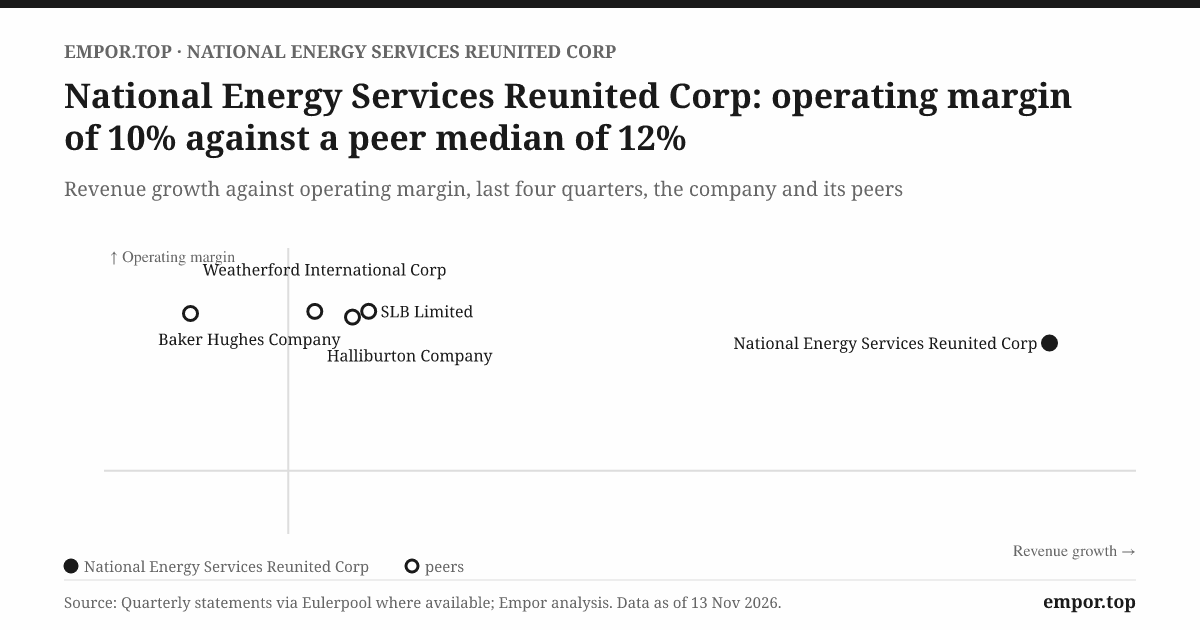
In 2025, the bet cost margin. Operating margin fell from about 10.6% in 2024 to about 7.4% in 2025.3 Cost of services rose faster than revenue, while the mix moved against the company: the higher-margin Production Services segment shrank during the frac contract transition, and the growth came from Drilling and Evaluation at thinner returns.3 Put the two facts together, more people and more equipment chasing roughly the same revenue, and the margin decline needs no further mystery. NESR carried the cost of a bigger operation before it had the revenue of one.
Revenue per head shows the squeeze in a single figure. In 2024, each employee or contractor corresponded to roughly $199,000 of revenue; in 2025, to about $180,000, a decline of nearly a tenth.3 That is not a sign of a broken business; it is the arithmetic of a company that has staffed up early. But it is a reminder that capacity is a cost long before it becomes a capability.
Then 2026 arrived, and with it the revenue that the buildout seemed to anticipate. NESR spent about $153 million on capital equipment in the first nine months of the year to support what it called its growing contract portfolio, and on the third-quarter call management pointed to full-year capex of roughly $220 million to $225 million.12 Quarterly operating margin climbed from under 7% in the third quarter of 2025 to about 12.5% in the second quarter of 2026 before settling around 10.4% in the third.1 Adjusted EBITDA in the third quarter was about $96 million, up about 50% from a year earlier, against revenue growth of about 71%.1
Those last two numbers are worth sitting with. EBITDA grew more slowly than revenue. Part of the gap was the conflict: management put the extra freight and logistics bill at about $5.5 million for the quarter, and said the adjusted EBITDA margin would have been about 20.1% without it instead of the 19.0% reported.2 Part of it may be the nature of the new work itself. Frac fleets running at scale are revenue-heavy and materials-heavy; they generate large invoices that include sand, chemicals and logistics that are passed through at modest margin. Without a segment breakdown of the new Jafurah work, outsiders cannot tell how much of the gap is temporary freight, how much is mix and how much is pricing.
The third-quarter call is where the prepared story met the questions. In his remarks, Foda talked about resilience, about maintaining operations through the conflict, and about the longer-range 3B3 strategy, whose headline target is $3 billion of annual revenue.2 The analysts went straight at the mechanics. Derek Podhaizer of Piper Sandler asked how the company bridges to $3 billion; Foda answered that fourth-quarter revenue multiplied by four was "almost there."2 That answer is revealing in two directions. It shows how much of the target is already within reach on the current run rate, which is a genuine change from a year ago. It also shows that the bridge depends heavily on the current run rate being sustained, which in turn depends on the Jafurah work and the customer behind it.
Saurabh Pant of Bank of America asked about 2027 margins. Management's answer, as reported, was that adjusted EBITDA margin could reach about 21.3% if the conflict ended, and stay "around today or a little bit more" if it did not.2 David Anderson of Barclays asked about the 2027 backdrop, and Foda said he expected regional activity to be "more or less flat," with NESR still growing.2 Here management was more careful than its long-range target. Flat regional activity means growth has to come from taking share, which brings back the question of whether NESR's integrated offer actually wins against SLB, Halliburton and the rest.
The company has also started to talk about artificial intelligence. On the call, management described an internal project using AI to cut nonproductive time, the hours when crews and equipment are on site but not working, with an efficiency target of about 20% and no quantified financial effect.2 Nonproductive time is a real drain in oilfield services, so the effort is sensible. But it is an internal efficiency programme, not a revenue line or a demonstrated competitive advantage, and it should be weighed accordingly until NESR shows its results in margins.
The verdict on this chapter is therefore conditional. The 2025 buildout preceded a sharp 2026 revenue acceleration, so it would be unfair to call it reckless. But the 2025 numbers prove that capacity does not automatically produce better economics; for a year, it produced worse ones. The test now is simple to state and hard to fake: segment operating margins and revenue per employee as the expanded equipment base goes to work. If margins rise with utilisation, the buildout was foresight. If revenue rises while margins stall, the company will have bought growth rather than earned it.
And there is another place where growth can hide its costs. Before a dollar of revenue counts as value, it has to arrive as cash.
V. The Cash Arrived—Then Receivables Expanded
At the end of September 2026, NESR's balance sheet carried a quiet but large change. Net trade receivables, money customers owed for invoiced work, stood at about $263 million, up from $178 million at the end of 2025.9 Unbilled revenue, work NESR had performed and recognised as revenue but had not yet invoiced, had risen from about $121 million to about $221 million.9 Together, those two balances grew by roughly $185 million in nine months. That is more than NESR's entire 2025 free cash flow.
To understand why that matters, it helps to start with a paradox that runs the other way. Across the nine years from 2017 to 2025, NESR reported cumulative net profit of about $152 million. Over the same period, it generated about $1.2 billion of cash from operations, almost eight times as much.3 On that measure, NESR's cash record looks not merely good but spectacular. A skeptic of reported earnings would usually worry about the opposite problem: profits that never turn into cash.
The explanation is mostly mechanical. NESR is a capital-heavy business, and depreciation and amortisation, the accounting charge for wearing out equipment, ran at about $142 million a year from 2023 to 2025.3 That charge reduces profit but costs no cash in the year it is booked; the cash went out earlier, when the equipment was bought. Add back depreciation, impairments and other noncash charges, and operating cash flow will naturally dwarf net income in a business like this. The flip side is that the cash is not free. It has to be reinvested to replace the equipment that is wearing out. Free cash flow, operating cash minus capital spending, totalled about $397 million over the same nine years, a much more modest figure.3
The second force is working capital, and it can swing cash sharply in either direction. In 2025, NESR generated about $264 million of operating cash flow and about $121 million of free cash flow.3 Management attributed the improvement to better working-capital management and payment timing.3 The cash-flow statement shows what that meant. Accounts payable and accrued expenses rose by about $116 million during the year, partly offset by about $49 million absorbed by receivables and about $9 million by unbilled revenue.3 In other words, a large part of 2025's operating cash came from paying suppliers later, not from earning more. The company's days payable, a measure of how long it takes to pay its own bills, rose from about 102 days in 2024 to about 130 days in 2025.3 Stretching suppliers is a legitimate tool, but it is a one-time source of cash. It cannot be repeated every year without straining the supply chain.
That context makes the 2026 receivables build more significant. As revenue surged, the money owed to NESR surged with it, and faster. In the third quarter, free cash flow was negative, at about minus $46 million, which the company attributed to higher working-capital needs and modestly higher capital spending.1 On the call, management said inventory had absorbed roughly $45 million to $50 million and that some collections had been slow, adding that "we collected a significant portion of these delayed receivables early in the fourth quarter."2 That statement is encouraging. It is also a statement, not a reconciliation; the proof will come in the year-end balance sheet.
Some of the receivables growth is simply what happens when a company grows fast. If NESR's customers pay in 30 to 60 days and the company's revenue rises by 70%, receivables will rise roughly in proportion. The unbilled balance is the more interesting figure. Unbilled revenue nearly doubled in nine months, faster than revenue itself.9 It typically reflects work completed but not yet invoiced, often because a customer must approve the job tickets or milestones before billing can begin. A growing unbilled balance can simply mean a busy quarter end; it can also mean that approval processes with a large state customer are lagging behind the pace of work.
NESR's disclosures offer some comfort and leave some gaps. The company says it has not suffered material credit losses due to customer creditworthiness in 2023 to 2025, and the allowance for credit losses rose only modestly, from about $13.8 million to about $16.2 million, during 2026's first nine months, with write-offs of about $0.5 million.39 Its customers are, in the main, government-owned oil companies, which rarely default. But NESR does not publish an ageing table for its receivables or identify customer-specific overdue balances.39 And it charges no interest on past-due accounts.3 So when a large customer pays late, NESR's lenders and shareholders, not the customer, carry the financing cost.
The ratio that captures this tension is debtor days, receivables expressed as days of revenue. It peaked at about 133 days in 2022, improved to about 89 days in 2024, and drifted back to about 107 days in 2025.3 On the September 2026 balance sheet, receivables and unbilled revenue together represent more than three months of current revenue. That is not an alarm in itself for a business with this customer base. It is, however, the line most likely to tell investors whether the 2026 surge is turning into cash or merely into claims.
The calibrated reading is this. NESR's long-run cash conversion is strong, but it is strong in part because of a capital-heavy accounting structure, and its best recent year owed much to supplier timing. The 2026 growth has tied up cash in receivables and unbilled work. The next proof point is specific: year-end collections, unbilled revenue and operating cash flow read together, after payables stop doing the heavy lifting. If cash catches up with earnings in the fourth quarter, the growth is real money. If it does not, the company will be financing its customers' timetable.
And the question of whether investors believe what NESR reports is not an abstract one. There was a time, not long ago, when the company's own early numbers had to be withdrawn.
VI. The Restatement That Rewrote the Early Years
In March 2022, NESR's management identified what the Securities and Exchange Commission later described as potentially significant accounting errors.8 The company then told investors that its annual financial statements for 2018, 2019 and 2020, the first three years of its life as an operating company, should no longer be relied upon.8 For a business that had been sold to the market as a professional, well-governed regional champion run by a veteran of the world's largest oilfield-services firm, it was a deep embarrassment.
The SEC's eventual order, announced on August 28, 2024, spelled out what had gone wrong.8 The regulator found "pervasive, systemic deficiencies" in NESR's accounting and controls, spanning its supply-chain, finance and accounting functions and dating back to June 2018, the month the business combination closed.8 The company had failed to properly record accounts payable, accrued liabilities, operating expenses and certain private warrants.8 The resulting multiyear restatement primarily increased accrued liabilities and the cost of services, which significantly reduced net income for the restated periods.8 Put simply, NESR had been reporting bills it owed as smaller than they were, and so had reported profits as larger than they were.
That is the most consequential kind of accounting error for a services company, because it goes to the heart of the margin. A company that understates its costs is not just making a bookkeeping slip; it is telling investors that its business is more profitable than it is. The restatement also landed in a period when the company was already reporting losses, which made the reckoning more painful: 2021 and 2022 were loss years before profitability returned in 2023 and 2024, and then margins compressed again in 2025.3
NESR settled without admitting or denying the findings, agreed to a cease-and-desist order and paid a $400,000 civil penalty.8 The order also required the company to fully remediate its material weaknesses in internal controls within one year, with an additional $1.2 million penalty if it failed.8 At the time of the order, the SEC said remediation had begun in March 2023 and had made significant progress, but was not complete.8
The penalty was small; the signal was not. The regulator's language, "pervasive" and "systemic," described problems of process and culture rather than an isolated error, and the deficiencies began in the very month the platform was assembled. The years that were meant to demonstrate the combination's quality were the years whose numbers could not be trusted.
What has happened since is genuine counterevidence. In its 2025 annual report, management said the remaining weaknesses had been remediated, including the one relating to "tone at the top," and the company's auditor reported that NESR maintained effective internal control over financial reporting as of December 31, 2025.3 The auditor's opinion on the 2025 financial statements was unqualified, with no material weakness identified.3 That is meaningful. But one clean year cannot establish a durable record, especially for a company whose controls were found deficient across its first several years. Trust in financial reporting is built the slow way, period after period.
Governance, meanwhile, rests heavily on one man. Sherif Foda has been chairman and chief executive since the company's inception, combining the two most powerful roles in the company.5 The board has placed a lead independent director, Antonio Campo Mejia, beside him and determined that every director except Foda is independent under Nasdaq rules.5 Foda owned about 3.2% of the shares in the 2026 proxy, a meaningful personal stake.5 His 2025 pay was about $2.27 million, made up of an $840,000 salary and about $1.43 million of non-equity incentive pay, with no stock award reported.5 His total had been the same in 2024, even though net profit fell by about a third in 2025.35
The chief financial officer's pay followed a different pattern. Stefan Angeli, who joined as CFO in February 2022, after roughly three decades at Schlumberger and a stint as finance chief of a private-equity-backed reservoir company, received about $4.49 million in 2024, including about $2.73 million of stock awards, and about $1.70 million in 2025.5 Angeli arrived a month before the accounting errors were identified, and his large 2024 equity award came in the year the restatement saga ended in a settlement. Compensation, in other words, does not track net profit in any simple way, which is a reason for shareholders to watch how incentive targets are set.
Shareholders, for their part, have shown little appetite for confrontation. At the May 2026 annual meeting, say-on-pay passed with about 98.2% support, and directors received between 94.5% and 99.8% of votes cast.10 The register is anchored by long-term holders: Olayan Financing Company held about 17.2% as of March 2026, with FMR, Encompass Capital Advisors, SCF's fund and Al Nowais Investments each holding between roughly 5% and 7.5%.5 No single shareholder controls the company.5 Strong votes show the owners' support, but they are not proof of operating credibility.
There is one more piece of the record that bears on credibility, and it concerns how NESR deploys capital outside its core. The company has held a stake in WDVGE, a strategic investment, and impaired it in each of 2023, 2024 and 2025 after customer and revenue growth came in slower than expected.3 NESR's strategic investments and partnerships across its environmental unit and drilling business totalled about $25 million at the end of 2025, so the sums are small against the company's size.3 In the third quarter of 2026, NESR took a further $2.9 million impairment on an equity investment.1 This is a bounded warning about how well the company underwrites new ventures, not evidence that the core service business has failed.
The credibility test therefore lies ahead. It will be passed through clean reporting through the next full audit cycle, and through specific, verifiable explanations of contract transitions, margins and working capital, of the kind investors will need as the surge is digested. And because NESR has just borrowed a large new sum, its lenders will be watching too.
VII. Refinancing Buys Time, With Conditions
On October 29, 2026, a new set of loan documents came into force, and NESR closed the book on the financing it had arranged in 2021.11 The old secured facilities were terminated. In their place came a syndicated package from regional and international banks: about $298 million of secured term loans, a $5 million revolving credit facility and about $444 million of uncommitted working-capital lines in U.S. dollars and Saudi riyals, along with an uncommitted option to add up to about $153 million more if lenders agree.11 All told, the headline was roughly $747 million of facilities.11 The term loans amortise over 36 months, with the balance due in October 2029.11
To see why this mattered, rewind one month. At September 30, 2026, NESR had about $210 million drawn under its old secured term loan and about $27 million used under trade-finance lines.9 Total debt stood at about $267 million, of which about $123 million was due within a year.1 The old term loan cost about 6.5% for dollar borrowings.9 The company was growing fast, its receivables were climbing, and its main debt was approaching maturity. On September 30, NESR also signed a separate $55 million facility with HSBC, which the company described as short-term liquidity while it pursued longer-term refinancing; that money was funded on October 5, after the quarter closed.9 The HSBC deal reads like a bridge across a short, uncomfortable gap.
The new package resolves the near-term maturity concentration and lowers the margin on term debt to between 2.35% and 2.60% above benchmark rates, depending on leverage, with sustainability-linked adjustments.11 That buys time and flexibility. It also comes with rules. NESR must keep total net debt below 2.0 times EBITDA, cash flow above 1.25 times debt service, and EBITDA at least 4.0 times net finance charges, all tested quarterly on a rolling twelve-month basis.11 And dividends and other distributions are restricted unless those covenants are met on a pro-forma basis and no default is continuing.11
The most important nuance is the difference between capacity and cash. The $444 million of working-capital lines is uncommitted, which means the banks are not obliged to lend under them.11 In good times, uncommitted lines behave much like committed ones. In bad times, when a borrower most needs them, lenders can decline. For a company with the recent receivables build, the comfort of those lines depends on the banks' mood as much as on the paper.
The balance sheet entering this new phase is considerably healthier than it was at the low point. Borrowings fell from about $596 million at the end of 2021 to about $350 million at the end of 2025, and debt-to-equity improved from about 0.73 to about 0.36.3 Net debt fell further in 2026, to about $161 million at the end of September from about $185 million at the end of 2025, which the company attributed mainly to debt repayments.1 On any conventional measure, NESR's leverage is moderate. The 2.0-times covenant gives meaningful room against current earnings. But covenant headroom is a function of EBITDA, and EBITDA in this business can move quickly when a large customer changes its plans, as the 2025 frac transition showed.
There are also obligations that sit outside the debt line. At the end of 2025, NESR had about $187 million of off-balance-sheet surety bonds and bank guarantees, plus about $15 million of cash-margin guarantees, the routine instruments that national oil companies require to back bids and performance.3 The company says none is likely to have a material effect.3 They are a reminder that in this industry the bank relationship is not just a source of money but a condition of bidding at all.
Then came the gesture that signalled confidence. On November 6, 2026, NESR's board declared a dividend of $0.10 per share, payable on December 10 to holders of record on December 3.1 The company had paid no dividend in any year from 2019 through 2025.3 The declaration is a change in posture, a statement that management believes the business can now fund growth, service debt and return cash at the same time. It also arrives one week after a loan agreement that makes distributions conditional on covenant compliance.
That pairing matters. Under the new facilities, debt service and the working capital that growth demands are prior claims on cash. The dividend is a residual. At roughly 100 million shares outstanding, a $0.10 quarterly dividend would cost about $40 million a year, manageable against 2025's free cash flow but large against the third quarter's negative free cash flow.13 If working capital normalises and earnings hold, the dividend looks sustainable. If receivables keep growing and the Jafurah run rate slows, the covenants, not the board's intentions, will decide how far the distribution can go.
The refinancing, then, did what it needed to do. It replaced a looming maturity with a three-year runway, cut the borrowing margin and gave NESR bank backing for the working capital its new contracts require. It did not remove execution risk, and the most flexible part of the package is the part the banks can withdraw. With the balance sheet settled for now, NESR has started talking about something entirely different: a mineral that powers electric cars.
VIII. The Lithium Demonstration Is a Contract, Not Yet a New Business
On October 8, 2026, in Dhahran, the home of Saudi Aramco, NESR announced a contract unlike anything in its history.12 Its environmental and decarbonisation unit, known as NEDA, had signed an agreement with Aramco to deliver what the companies called the region's first direct lithium extraction project: the Aramco 2027 Lithium Demonstration Project.12 The company says the plant is designed to produce 2,000 tonnes a year of battery-grade lithium carbonate, with commissioning and first production planned for late 2027.12 The contract is worth up to about $200 million over as many as five years.12
The idea behind it is more intuitive than it sounds. Oil and gas fields bring up enormous volumes of salty water along with the hydrocarbons, and in some reservoirs that brine carries dissolved lithium. Traditional lithium production either digs hard rock out of the ground or pumps brine into vast evaporation ponds and waits months for the sun to concentrate it. Direct lithium extraction works more like a filter: the brine is pre-treated, passed through a material that selectively grabs lithium, and the captured lithium is then converted into a saleable chemical, in this case lithium carbonate, the form battery makers buy. NESR's platform for this, branded LiThara, combines pre-treatment, direct extraction and carbonation in one system.12 Aramco brings its deep knowledge of its own subsurface; NESR brings the processing technology and its field experience operating in Saudi Arabia.12
Strategically, the logic is appealing. NESR already knows how to move fluids, chemicals and equipment around oilfields in the Kingdom, and the brine comes from the same type of subsurface its crews work in every day. If lithium extraction from oilfield brine becomes a real industry in the Gulf, a company that has already built and operated the region's first plant would have an obvious head start. On the third-quarter call, Foda listed the lithium contract among the company's growth drivers and said first output was due by the end of 2027.2
The economic weight needs perspective, though. A maximum contract value of about $200 million spread over up to five years works out to around $40 million a year at most, roughly 2% of the revenue run rate NESR now reports.112 Even if the contract delivers its full value, it is a modest line beside the oilfield business. And 2,000 tonnes a year is a demonstration scale; it is meant to prove that the process works on Aramco's brine, not to build a lithium company overnight.
The more important distinction is between capability and commercialisation. A signed contract and a branded technology platform are milestones. Sustained output at target, product that meets battery-grade quality, operating costs that compete with established producers, and recognised revenue are the proof. None of those exist yet, because the plant does not.
The company says it has not incurred significant research-and-development spending, so its technology bets come largely through partnerships and investments rather than in-house laboratories.3 The WDVGE write-downs offer a reason for caution.3 That does not doom the lithium project, which has a committed customer and a contract, something a speculative investment does not. But it does show that NESR's ability to turn technical promise into revenue outside its core has not yet been demonstrated.
What management must show next is straightforward: a plant commissioned on time in late 2027, production at the targeted rate and quality, and economics that justify putting more capital behind the idea. Until then, the lithium project is best understood as an option with a real counterparty and a real deadline: interesting, plausible and still unproven. It deserves a place in the story, but not the weight of the oilfield business that pays for it. That business, and how the market prices it, is where the investment case stands or falls.
IX. Analysis & Bear vs. Bull Case
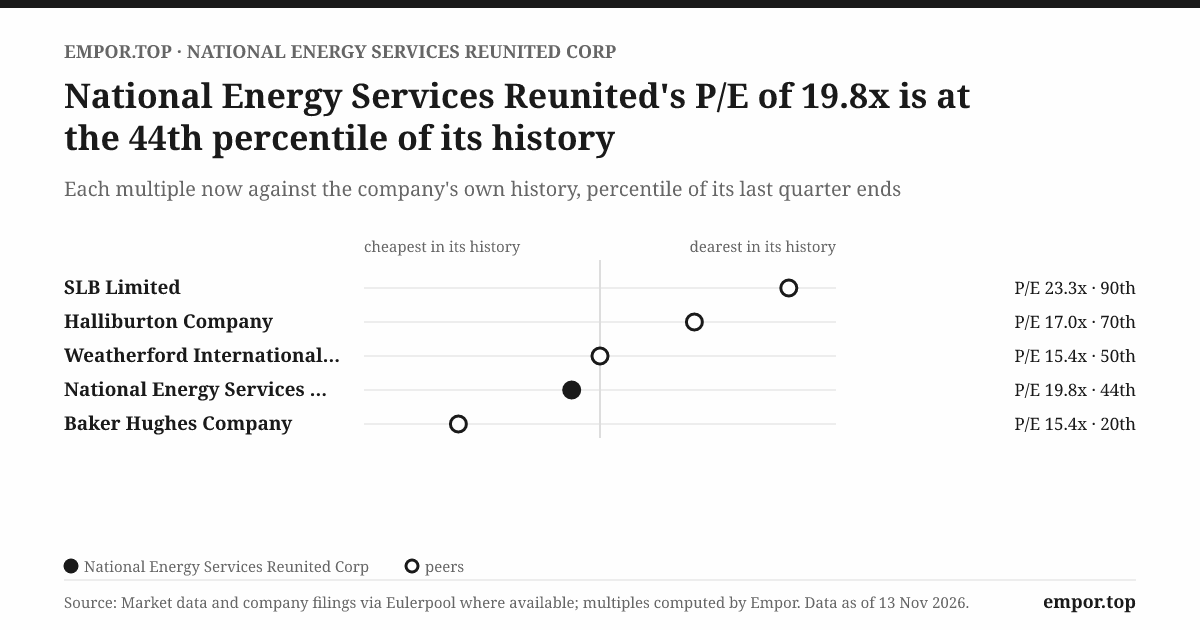
In mid-November 2026, NESR's shares traded at about $21, more than 40% below their 52-week high of about $36. The company's market value was about $2.1 billion and its enterprise value, including debt, about $2.3 billion. On trailing earnings, the stock traded at about 19.8 times, slightly below its own five-year median of about 21.7 times; on enterprise value to EBITDA, it was about 7.3 times, and its free-cash-flow yield was about 6.8%. The shares were volatile, with a one-year price volatility of about 60%. The market, in other words, is pricing NESR as neither a broken company nor a proven compounder. It is pricing a question.
The way to answer it is to ask what, if anything, protects NESR's profits from competition, and then to test that against the company's own record.
Who holds the leverage
Start with the five forces that shape any industry's profitability. The first and most important here is buyer power, and it is overwhelming. NESR's four largest customers supplied nearly three-quarters of 2025 revenue and the largest supplied nearly half.3 These buyers are state-owned oil companies that run formal tenders, award contracts to several vendors at once, retender when contracts expire and can set technical specifications that favour whomever they choose. When one buyer represents half your sales, that buyer sets the terms of the relationship.
Rivalry is the second force, and it comes from two directions. The global majors, SLB, Halliburton, Baker Hughes and Weatherford, have technology portfolios, research budgets and procurement scale far beyond NESR's.3 Regional and national service companies compete on the same local presence NESR claims as its edge.3 NESR sits in between, larger than most local players and smaller than any global one. Supplier power is moderate: NESR buys equipment, sand, chemicals and logistics in competitive markets, though the 2026 conflict showed how freight costs can bite. The threat of new entrants is limited by the capital needed for frac fleets and the bank guarantees required to bid, but well-funded national champions and global players can always enter a service line. Substitution is low in the short run, since wells still need to be drilled and completed, though over longer horizons oil and gas demand itself is the substitute risk.
Now apply Hamilton Helmer's framework of seven powers, which asks whether a business has a structural reason to earn returns above its cost of capital. Scale economies: NESR is large regionally, but the majors are far larger, so scale is not its advantage against them. Network effects: none in a well-services business. Counter-positioning: arguably a little, in that NESR's regional identity and local-content credentials are something a foreign major cannot easily copy without changing what it is. Switching costs: the 30-day service cycles and multi-vendor tenders suggest customers can switch quite easily, and NESR does not disclose retention or contract-renewal rates that would show otherwise.3 Branding: limited among procurement-driven state buyers. Cornered resource: none disclosed; NESR has no unique reservoir access, patent estate or exclusive licence evident in its filings. Process power: possible in integrated execution, but unproven without win-rate or margin evidence.
The honest conclusion is that NESR's competitive position rests on regional presence, a broad service menu and relationships, and that these may help it win work, but no disclosed retention, pricing, market-share or renewal data confirms switching costs or any other durable power. The moat is not rejected; it is unproven. The history narrows the claim to a smaller version: NESR is a credible regional bidder with the scale to win large contracts, not a company insulated from competition. The 2025 frac transition, in which the company's most profitable segment lost nearly a third of its profit in a year, is the clearest evidence of how much a single customer's decision can override any edge.3
Two ways the story can go
The bull case starts with momentum that is not only one contract. Drilling and Evaluation revenue grew in both 2024 and 2025, and growth in 2026 has been broad across several countries, with management pointing to tenders in Kuwait and the UAE and expecting North Africa to grow by 20% to 30% in 2027.23 The Jafurah work gives NESR a large, visible frac programme with a fifth crew mobilising.2 Operating margin has recovered from about 6.6% in the third quarter of 2025 to about 10.4% a year later, and management has guided toward adjusted EBITDA margins around 20% with room for more if the conflict eases.12 The refinancing has extended debt maturities to 2029 and cut borrowing margins.11 Leverage is moderate, and the board felt confident enough to declare a dividend. On valuation, the stock trades below its own five-year median earnings multiple despite revenue growing faster than at any time since the combination. If 2026's run rate holds and margins expand with utilisation, today's multiple will look modest in hindsight.
The bear case is equally specific. One customer supplied almost half of 2025 revenue, and the 2026 surge has almost certainly increased dependence on Saudi frac work rather than reduced it. Production Services revenue and profit fell sharply during a single contract transition in 2025, showing that the company's best segment is hostage to one buyer's calendar.3 Operating margin compressed by about three percentage points in 2025 while headcount and capex climbed, and EBITDA has grown more slowly than revenue in 2026.13 Receivables and unbilled revenue have risen by roughly $185 million in nine months, third-quarter free cash flow was negative, and the best recent cash year owed much to stretching suppliers.139 The company restated three years of results and only received a clean controls opinion for the first time in its most recent audit.38 And the new loan covenants mean that any stumble in earnings would quickly constrain dividends and flexibility.11
A skeptical long-short investor would press on three points. The first is disclosure: a company bidding for share against global majors should be able to tell investors its win rates, its retention and its contract backlog, and NESR does not. The second is capital allocation: the company built capacity ahead of revenue, began paying a dividend just as working capital ballooned, and has a record of impairing its strategic investments. The third is concentration: management's $3 billion target, which Foda said the fourth-quarter run rate times four was "almost there" on, depends heavily on one customer continuing to spend at today's pace.2 Asked about gaining share in businesses where NESR is not already top three, management offered confidence rather than mechanics.2
The valuation is lower than NESR's own history on earnings, but that history includes years of losses and restatement, so the comparison flatters less than it seems. Closest listed peers with a comparable MENA-focused service mix are scarce, and NESR's filings do not provide peer multiples, so no clean peer comparison is possible. What the price appears to assume is that some of 2026's surge will persist, but not all of it, and that margins will improve somewhat without reaching management's ambitions. It is a price that discounts concentration and cash risk rather than ignoring them.
Three measures will tell investors which case is winning. The first is the largest customer's share of revenue, last reported at 49% for 2025 and down from 54% in 2024.3 The second is segment operating margin, which fell to about 12% in Production Services and about 14% in Drilling and Evaluation in 2025, from about 17% and 15% the year before.3 The third is cash conversion after working capital, which was strong in 2025 thanks to payables but turned negative in the third quarter of 2026 as receivables grew.13 If concentration falls, margins rise and cash catches up with earnings, the bull case is being proved. If any one of them moves the wrong way for long, the bear case is.
The growth is visible. A durable competitive advantage and normalised cash economics still require proof. Which leaves the question of what this company, assembled in a single deal eight years ago, actually teaches.
X. Lessons
Go back to Houston on November 12, 2017. A cash shell announced that it would buy two Middle Eastern oilfield companies and turn them into the region's answer to the global service giants.6 Eight years later, NESR is on course for about $2 billion in revenue.23 Its 2025 operating margin was about 7.4%.3 Between those two moments lie five lessons, each of which belongs to NESR in particular.
The first is that a low entry multiple is a hypothesis about value, not proof of value. The 2018 price looked cheap against a forecast of earnings supplied by the people selling the business. Subsequent losses, a restatement and returns on capital that never climbed above about 9% showed how little the multiple alone could prove.38 Founders and investors in roll-ups should remember that the price paid is the easiest number in a deal to calculate and the least informative about how it ends.
The second is that in a contract business, the customer list is part of the balance sheet. NESR's largest customer supplied about half its revenue, and the swings in frac work showed how much that relationship shapes results.3 Neither swing was a measure of NESR's skill so much as of its exposure. A company whose biggest asset is a relationship with one buyer owns something valuable and fragile at once, and should be analysed as if that relationship were an asset that can be impaired.
The third is that cash conversion has a clock. NESR's long-run cash conversion looks extraordinary until one accounts for depreciation on equipment that must be replaced.3 Its best recent year owed much to paying suppliers later, and its fastest-growing year saw receivables and unbilled work swallow the gains.39 Cash is real only when it repeats: when the next year's collections arrive on time without the help of last year's timing trick.
The fourth is that a technology demonstration becomes an investment case only when it earns revenue. NESR wrote down its WDVGE investment three years running when customers came slowly, and its lithium project is still a plant that does not yet exist.312 A contract with Aramco is far better evidence than a press release about potential. It is still a contract, not a business.
The fifth is that trust is rebuilt in consecutive reporting periods. After the accounting failures, it took until the end of 2025 for an auditor to call NESR's controls effective.38 One clean opinion is a beginning. A management team that wants investors to fund a $3 billion ambition will need many more of them, along with the kind of candid explanations of setbacks that turn a credibility deficit into a credibility record. NESR's story is the story of a regional champion that has proven it can grow. Its next chapter will show whether it can be believed.
XI. Epilogue
Tonight, in mid-November 2026, NESR stands at its largest and most consequential moment since the 2018 combination. It is guiding to about $2 billion of revenue for the year and has a $3 billion ambition on the table. A new $747 million loan package is in force, the first dividend in seven years is about to be paid, and a lithium plant does not yet exist.121112 Each of those is a promise with a date attached, and the next twelve months will deliver verdicts on most of them.
The first verdict arrives with the annual report for 2026. It will show the largest customer's share of revenue for the year. If that share has fallen, NESR's growth beyond Jafurah, in Kuwait, the UAE and North Africa, will have proved substantial enough to dilute its biggest relationship. If it has risen back toward or above half, the company will have become more dependent on one buyer just as it asks investors to value it as a regional platform. Neither outcome is fatal. They describe very different companies.
The second verdict is in the cash. The fourth quarter will show whether management's statement that delayed receivables were largely collected early in the quarter translates into a year-end balance sheet where receivables and unbilled revenue fall back in line with revenue, and whether full-year operating cash flow comes close to earnings without a fresh boost from supplier timing.2 Management has pointed to free cash flow equal to about 30% to 35% of adjusted EBITDA for 2026, a target that leaves room for heavy capital spending but no room for a further working-capital build.2
The third verdict is about margins. With full-year capital spending of about $220 million to $225 million going into equipment, the question for 2027 is whether segment margins and revenue per employee rise as that equipment is used.2 Management has floated about 21% adjusted EBITDA margins for 2027 if the regional conflict ends.2 A reader should watch whether the company provides segment-level detail that lets outsiders check that claim, and whether freight and logistics costs ease as promised.
The fourth verdict is in the bank. The new facilities put covenant headroom in play, and the working-capital lines can be withdrawn.11 The first full year under that regime will show whether NESR can grow, pay its dividend and keep comfortable headroom at the same time, or whether one of the three has to give.
The last verdict is the slowest. In late 2027, the lithium plant is due to start producing.12 If it arrives on time and at quality, NESR will have a demonstrated second line of business with Aramco. If it slips, the market will remember the WDVGE write-downs.
The story remains open because none of those outcomes is yet in the filings. What is already clear is that NESR has stopped being a company whose question was survival and become one whose question is durability.
XII. Outro
Somewhere in eastern Saudi Arabia tonight, a frac crew is finishing a stage. The pumps go quiet, the sand trucks pull away, and the job ticket goes off for approval. In a month or two, if all goes well, the invoice will be paid.
That is NESR in a single scene. Growth and risk arrive together.13 Foda's regional oilfield-services bet has produced a company large enough to win the region's most consequential work. What remains to be proven, in the field, in the margin and in the cash account, is whether being large and local is enough to be lasting.
References
-
Q3 2026 Earnings Release — National Energy Services Reunited Corp. (SEC Form 8-K Exhibit 99.1), 2026-11-09 ↩↩↩↩↩↩↩↩↩↩↩↩↩↩↩↩↩↩
-
Earnings call transcript: NESR posts strong Q3 2026 growth — Investing.com, 2026-11-09 ↩↩↩↩↩↩↩↩↩↩↩↩↩↩↩↩↩↩↩↩↩↩↩↩↩↩↩↩
-
2025 Annual Report on Form 10-K — National Energy Services Reunited Corp., 2026-03-06 ↩↩↩↩↩↩↩↩↩↩↩↩↩↩↩↩↩↩↩↩↩↩↩↩↩↩↩↩↩↩↩↩↩↩↩↩↩↩↩↩↩↩↩↩↩↩↩↩↩↩↩↩↩↩↩↩↩↩↩↩↩↩↩↩↩↩↩↩↩↩↩↩↩↩↩↩↩↩↩↩↩↩↩↩↩↩
-
Business Combination and IPO History, Form 6-K — National Energy Services Reunited Corp., 2019-08-22 ↩↩↩
-
2026 Definitive Proxy Statement — National Energy Services Reunited Corp., 2026-03-24 ↩↩↩↩↩↩↩↩↩↩
-
NESR to Combine with NPS and Gulf Energy, Business Combination Announcement — SEC, 2017-11-12 ↩↩↩↩↩↩↩↩↩↩
-
Forward Purchase Agreement — National Energy Services Reunited Corp., 2018-04-27 ↩
-
SEC Charges National Energy Services Reunited Corp. with Financial Reporting, Accounting, and Controls Violations — U.S. Securities and Exchange Commission, 2024-08-28 ↩↩↩↩↩↩↩↩↩↩↩↩↩
-
Q3 2026 Quarterly Report on Form 10-Q — National Energy Services Reunited Corp., 2026-11-09 ↩↩↩↩↩↩↩↩↩↩
-
Annual Meeting Results, Form 8-K — National Energy Services Reunited Corp., 2026-05-07 ↩
-
New Secured Facilities, Form 8-K — National Energy Services Reunited Corp., 2026-11-04 ↩↩↩↩↩↩↩↩↩↩↩↩
-
NESR and Aramco Sign Agreement to Deliver the Region's First Direct Lithium Extraction Project — National Energy Services Reunited Corp., 2026-10-08 ↩↩↩↩↩↩↩↩↩↩
 LinkedIn
 WhatsApp
 Reddit
 Hacker News
 Email
 Kindle
 RSS Feed
 Spotify
 Apple Podcasts
 Amazon Music
 Audible
 YouTube