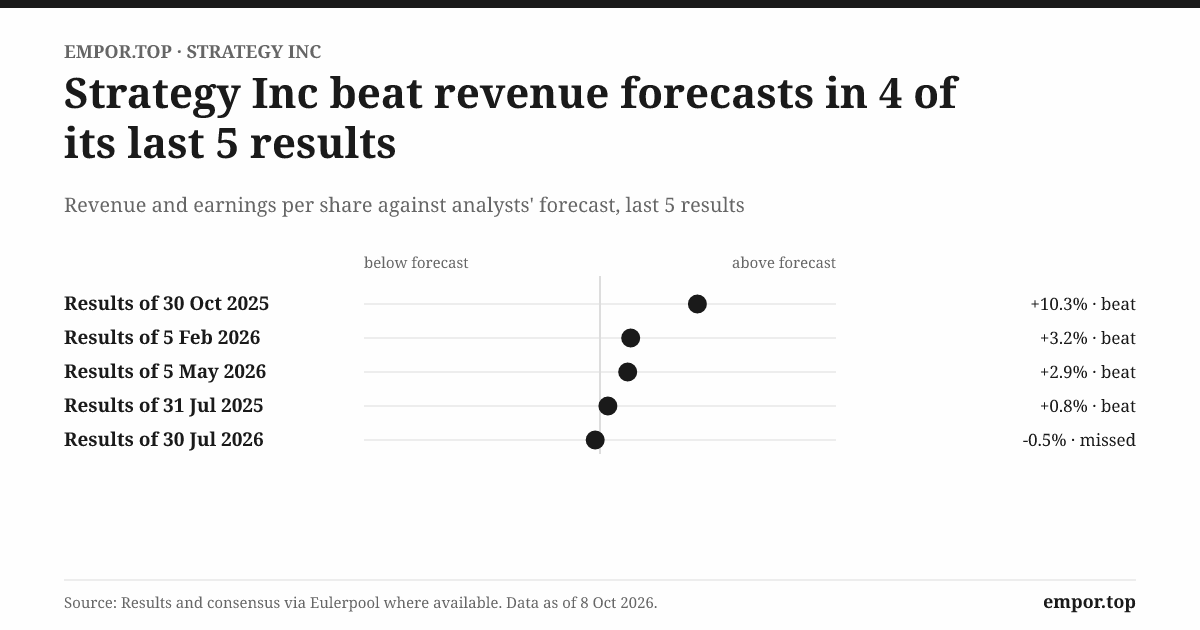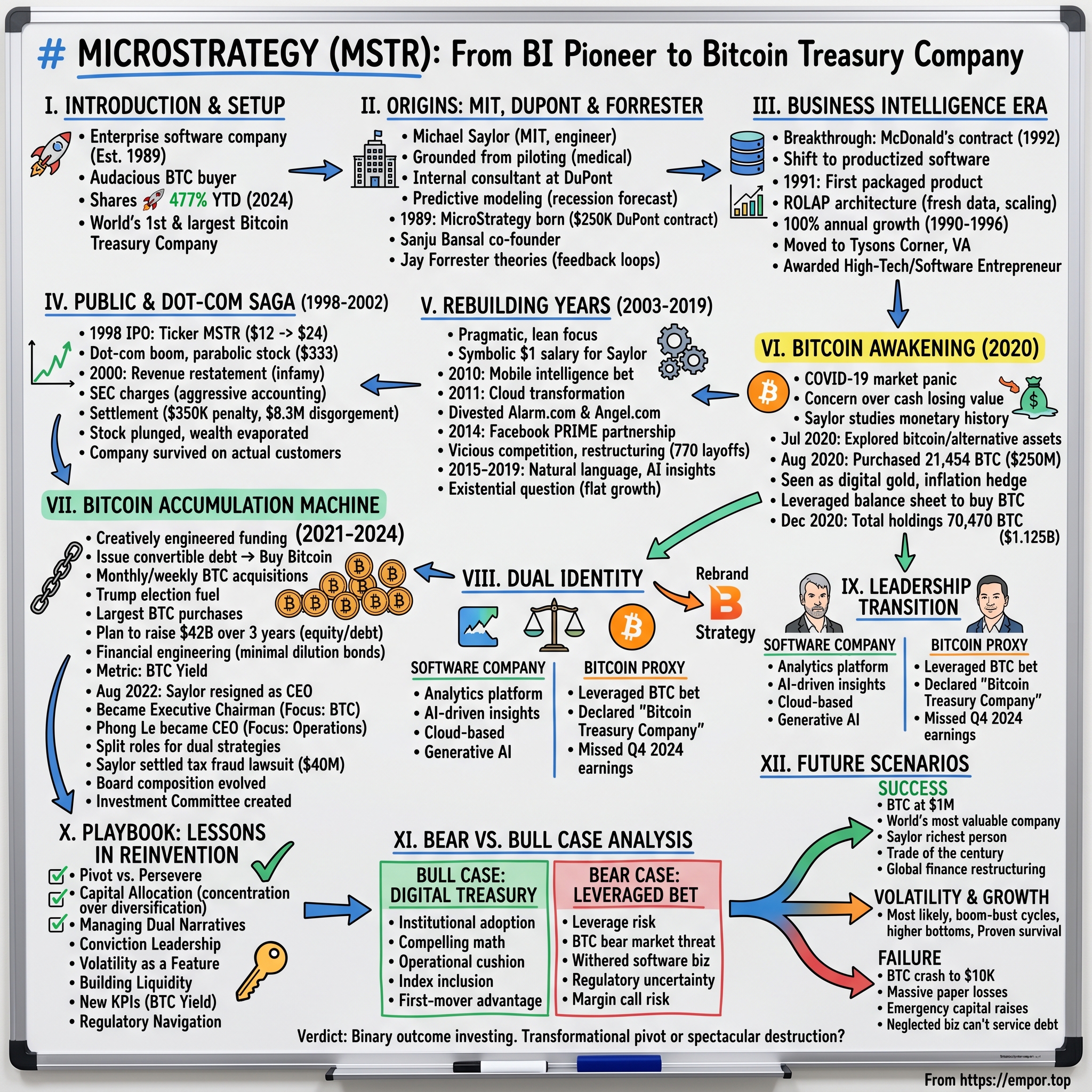
Strategy Inc. (MSTR): The Software Relic That Swallowed Wall Street's Bitcoin
I. The $50 Billion Leveraged Flywheel
Picture a low-slung office campus in Tysons Corner, Virginia, a few miles outside the Beltway. Inside, engineers maintain dashboards and reporting tools that Fortune 500 finance departments have used for decades. The business sells about half a billion dollars of software a year, roughly what it sold a decade ago.1 By ordinary standards it is an unremarkable mid-sized vendor, the kind a private-equity firm might buy for a few times sales and run for cash.
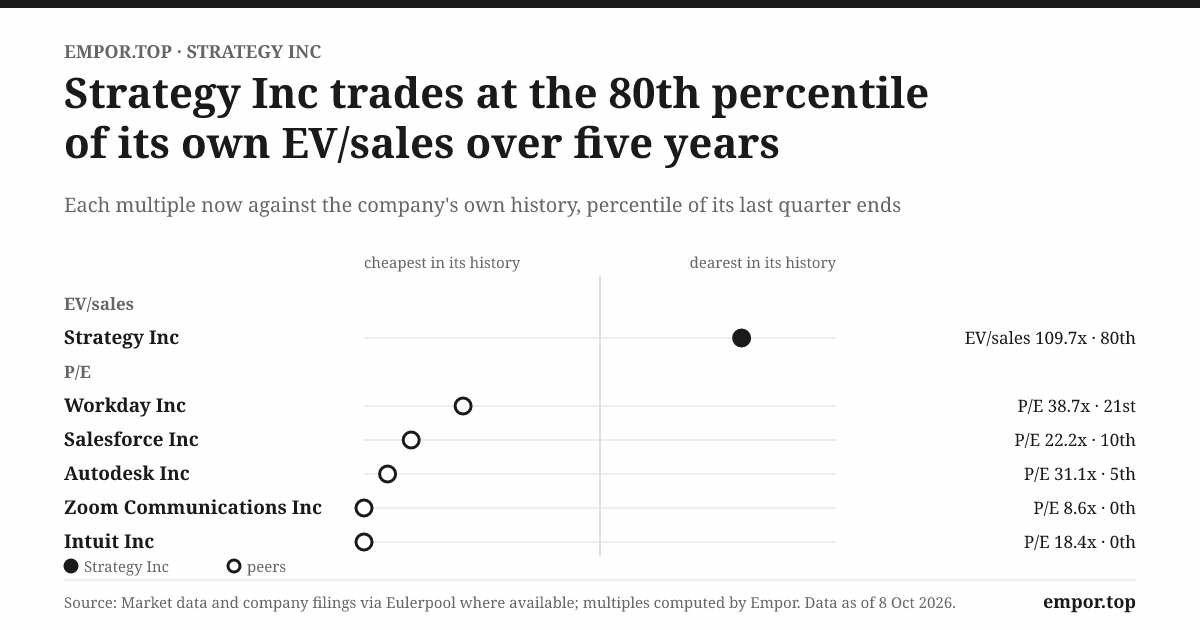
And yet on October 8, 2026, the stock market values this company at about $49 billion, with an enterprise value above $53 billion.2 That works out to more than one hundred times its annual sales. No software multiple explains that number, because the market is not paying for the software. It is paying for a vault. Since August 2020 the company once called MicroStrategy has turned itself into the largest corporate holder of bitcoin on earth, with more than half a million coins.23 In 2024 and 2025 alone it raised close to $47 billion from stock, convertible bonds and preferred shares, and spent almost all of it on bitcoin.23
That is the opening paradox. A 35-year-old business intelligence vendor beat the S&P 500 and most of the AI darlings over the first half of this decade, and it did so without selling a single extra dashboard. The software revenue line has shrunk by about 1% a year for ten years.12 The balance sheet grew from about $660 million of assets to $61.6 billion over the same stretch.2 Those two lines tell the whole story of the company, and the gap between them is the subject of this one.
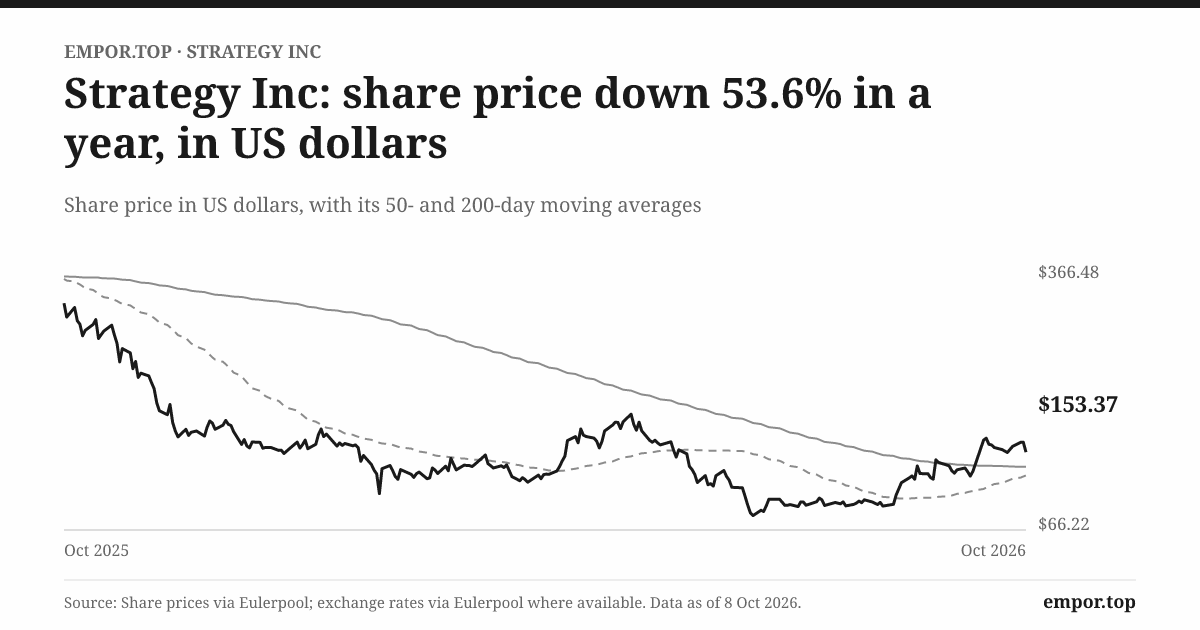
Investors have spent five years arguing about what Strategy really is. To its admirers it is a genuine institutional innovation: a public company that converts Wall Street's appetite for volatility into bitcoin per share for its owners. To its critics it is a leveraged closed-end fund dressed in a software company's clothes, one that works only as long as its shares trade above the value of the coins it holds. The best evidence today sits somewhere uncomfortable. At $153.37 a share, the stock is down more than half from its 52-week high of $330.80, and it trades at about 1.1 times book value, down from premiums that once exceeded two times the value of the bitcoin underneath.2
The verdict this story builds toward is simple to state and hard to escape. Strategy is, structurally, a levered digital-asset fund wrapped inside a legacy enterprise software shell. It survives on two things: access to U.S. capital markets, and a share price that stays above the value of its bitcoin, a ratio its own managers call mNAV. Everything else, including the software, is supporting cast.
Four questions run through the rest of the story. Can the machine that sells stock to buy bitcoin keep running when the premium disappears? What happens when roughly $8.3 billion of debt comes due in a long crypto winter?2 Does the old software business offer any real floor, or is it an operating drag? And will mark-to-market accounting and regulators break the corporate wrapper that makes all of this possible?
To answer them, the story has to start long before bitcoin existed, with a young MIT graduate building computer simulations for a chemical company in Delaware. The habits of mind he formed there, that economies behave like engineered systems and that the right model beats the crowd, explain almost every bold and dangerous decision that followed.
 Subscribe on LinkedIn
II. MIT Systems Dynamics and the DuPont Simulation (1989–1996)
Michael Saylor wanted to fly. He went to MIT on an Air Force ROTC scholarship, and a heart murmur kept him out of the cockpit. So he did the next most MIT thing and studied how complicated systems move. He graduated with a double major in aeronautics and astronautics and in the history of science, and he fell under the influence of the systems-dynamics school founded by Jay Forrester, which modelled companies, cities and economies as webs of feedback loops that could be simulated on a computer.4
Forrester's idea was that most business disasters are not surprises. They are the predictable output of feedback loops that managers fail to see: inventories that overshoot, capacity that arrives too late, prices that chase themselves. A good model can show the cycle before it arrives. That conviction, that the future is an engineering problem rather than a fog, is the thread connecting everything Saylor later did.
After a short stint as a consultant, Saylor took the idea to DuPont. His simulations of DuPont's markets pointed to a coming downturn in the chemical company's core businesses, and the forecast impressed the client enough that DuPont became the founding customer of his new firm, with seed money and space in Wilmington, Delaware.4 The figure most often told is $250,000. Saylor was joined by his MIT fraternity brother Sanju Bansal, a quieter, more operational partner who stayed alongside him for more than two decades.4
What they built was a way to let executives ask questions of very large databases without a programmer in the middle. The technique became known as relational online analytical processing, or ROLAP. Think of a giant spreadsheet that sits on top of a company's sales records and lets a manager slice them by store, week and product in seconds. In the early 1990s that was close to magic, and big retailers and consumer brands were drowning in point-of-sale data they could not read.
The breakthrough customer was McDonald's. A multi-million-dollar engagement analysing how promotions moved sales across thousands of franchise restaurants showed that MicroStrategy's tools were not a consulting trick but a product category.4 Business intelligence, as the industry came to call it, became a standalone software market, and MicroStrategy was one of its pioneers. The company moved to northern Virginia's tech corridor in the mid-1990s and grew roughly every year from 1990 to 1996 as client-server computing swept corporate America.4
It is worth pausing on what kind of company this was. MicroStrategy did not begin as a product built for a consumer craze. It began as a modelling shop that believed its models could see what markets could not. The software was the way to sell that belief at scale. That matters because, thirty years later, the same founder would look at the dollar, the Federal Reserve and a cryptographic asset and reach a conclusion just as confident as the one he reached about DuPont's markets. The question his career keeps posing is what happens when a model this confident meets a world that does not follow the model. The first answer came quickly, and it was brutal.
III. The Dot-Com Crucible and the SEC Settlement (1998–2002)
On March 20, 2000, MicroStrategy told the market it would restate its results for the previous two years. Revenue it had booked had been recognised too early. By the close of trading, its shares had fallen by about 62%, and Michael Saylor's personal paper fortune had shrunk by roughly $6 billion in a single session.5 Few founders have ever lost so much so fast.
The fall made sense only against the height of the climb. MicroStrategy went public on Nasdaq in June 1998 at $12 a share, and the stock doubled on its first day.[^6] Over the next eighteen months the company rebranded itself as a pioneer of the wireless and internet information age, launching ventures to push data to phones and pagers. As the dot-com mania built, the share price multiplied many times over, and by early 2000 Saylor's stake was valued at several billion dollars, making him one of the richest people in the Washington region. He threw lavish parties and promised a $100 million gift to create a free online university. He was, for a few months, the face of the new economy in the capital.
The problem lay in the arithmetic of software contracts. MicroStrategy was signing large, complex deals that bundled licences, services and future deliverables. Under the accounting rules, much of that revenue had to wait until the software was delivered or the service performed. The company recognised it sooner. When its auditor and outside critics pressed, the profits it had reported for 1998 and 1999 turned into losses.5
In December 2000 the Securities and Exchange Commission brought fraud charges against the company and three executives: Saylor, Bansal and the chief financial officer. All three settled without admitting or denying the allegations. They paid more than $10 million in disgorgement between them and $350,000 each in civil penalties, and the company agreed to appoint an independent director for compliance.5 There was no criminal case. The company survived. Its shares did not recover their peak for more than two decades.
The lesson Saylor took from this is central to the rest of the story, though it is also open to interpretation. One reading is that he learned humility about accounting. The record suggests the other reading is closer to the truth: that he came to see reported earnings as a fragile convention, something regulators and auditors could rewrite overnight, and to trust instead in hard assets and in control. A founder who watched accrual accounting erase his company's profits in one afternoon would later embrace an asset whose value is set second by second by a public market, and would build his reporting around a metric, bitcoin per share, that does not depend on revenue recognition at all.
It also cemented control as the priority. Through the crash and the settlement, Saylor kept his Class B shares, which carried ten votes each, and with them majority voting power.6 Outside shareholders could sell; they could not easily change course. That voting fortress would matter enormously twenty years later.
For investors, the dot-com episode is the first entry in a long ledger of how this management team handles promises. It is a regime under the same founder, and the specific failure, letting a story about the future run ahead of what the numbers could support, is precisely the risk critics name today. The difference is that today the numbers are marked to market every day. The question for the next chapter was more mundane: once the excitement drained away, could MicroStrategy become a great software company?
IV. The Thirty-Year Stagnation: The Core BI Business (2003–2019)
There is a version of this story in which MicroStrategy becomes Salesforce. It had the early lead, the Fortune 500 customer list and a founder who understood data before data was fashionable. It got none of that outcome. Instead, through the greatest bull market software has ever seen, the company stood still.
The financial record makes the stagnation plain. In 2014 the company booked about $579 million of revenue. Ten years later, in 2024, it booked about $463 million, and in 2025 about $477 million.12 Over the decade to 2025, sales shrank at roughly 1% a year.2 Operating profit, which had touched about a quarter of revenue in 2015, slid toward zero by 2018 and stayed there.2 Head count fell from more than 2,100 people in 2019 to 1,534 at the end of 2024.1 This was a company harvesting itself.
Why? The short answer is that the market moved from servers in the customer's building to software rented over the internet, and MicroStrategy moved slowly. Tableau won analysts with visual, self-service tools. Qlik won departments. Microsoft bundled Power BI into the Office relationship most enterprises already had, at a price that made standalone tools hard to defend. Google bought Looker. MicroStrategy's strength, a powerful, governed engine run by central IT teams, became a weakness when buying power shifted to business users with a credit card.
Management did try. It built mobile analytics early, and it worked on large-scale data projects with internet companies. It also had a knack for spinning out ideas that thrived elsewhere. Alarm.com, a home-security software business incubated inside MicroStrategy, was sold in 2009 for about $27.7 million and later became a public company worth several billion dollars. Angel.com, its cloud call-centre business, was sold to Genesys in 2013 for about $110 million. Those were sensible cash sales, but they also show the pattern: the company's best new growth repeatedly ended up outside it.
Under the surface, the core business kept useful qualities. Product support, the annual maintenance fee customers pay to keep receiving updates, was its biggest line, about $244 million in 2024, at high gross margins.1 No single customer accounted for even 10% of revenue in any recent year.1 Bad debts were trivial, with an allowance of about $2 million against $183 million of receivables at the end of 2024.1 Receivables did stretch, from about 50 days of sales in 2014 to 157 days in 2025, but that reflects large annual billings to blue-chip customers rather than customers failing to pay.12
So the verdict on this era is not that the software was bad. It was a stable, cash-producing utility that had hit a wall and lacked the will or the product to climb over it. By 2019 the company sat on roughly half a billion dollars of cash and investments earning a percent or two.2 It had no acquisition plan that had worked, no organic growth and a founder who still owned the votes. Saylor's frustration with that pile of cash would become the most consequential decision in the company's history.
V. The August 2020 Pivot: Burning the Cash Boat
On August 11, 2020, with offices closed by the pandemic and the Federal Reserve printing money at a pace never seen in peacetime, MicroStrategy published a press release that read like a treasury memo from another planet. The company had bought 21,454 bitcoins for $250 million and adopted bitcoin as its primary treasury reserve asset.3
The reasoning Saylor gave was about cash, not crypto. Interest rates were near zero. The money supply was expanding rapidly. A company holding half a billion dollars of cash was, in his phrase, holding a melting ice cube: its purchasing power would erode year after year while the business itself was not growing fast enough to use it.3 The company had considered buybacks and acquisitions. It chose an asset it believed would hold value better than the dollar.
For context, the company was worth only about a billion dollars on the stock market at the time. A $250 million bet was a quarter of its market value and about half its liquid reserves. A board of a widely held company might have balked. This board did not have to persuade a majority of outside holders, because Saylor's ten-vote Class B shares still gave him control.6 The governance structure that survived the dot-com crash is what made the pivot possible in a single summer.
Within weeks the company bought more, and by the end of 2020 it had spent more than a billion dollars on bitcoin.1 It also set up the plumbing: a subsidiary, MacroStrategy LLC, to hold the coins, and institutional custody arrangements with firms such as Coinbase Custody and later Fidelity Digital Assets.1 That concentration of custody is a quiet risk worth naming. The company has almost no customer concentration in software, but it relies heavily on a small number of custodians and prime brokers for its main asset.
The early reception was mixed to hostile. Software analysts did not know what to do with a vendor whose earnings would now be driven by a cryptocurrency. Enterprise customers asked whether their supplier was still serious about dashboards. Yet the market itself gave the clearest answer. The stock rose, and kept rising, faster than bitcoin. Investors who could not or would not buy bitcoin directly, and many institutions in 2020 could not, discovered they could buy a Nasdaq-listed equity that held it.
That was the real discovery of 2020. The treasury move began as a defence against inflation, and it turned into a business model. The market valued MicroStrategy far more as a bitcoin vehicle than as a software vendor, and a company whose shares are valued above the assets behind them can sell those shares and buy more assets. Once Saylor saw that, the question was no longer whether to hold bitcoin. It was how much capital Wall Street would hand him to buy it.
VI. The Financial Engineering Playbook: Convertibles, ATMs, and the 21/21 Plan
On October 30, 2024, alongside an otherwise unremarkable quarterly report, MicroStrategy announced what it called the 21/21 Plan: a target to raise $42 billion over three years, half from selling stock and half from fixed-income securities, to buy more bitcoin.7 For a company with a few hundred million dollars of software sales, it was a capital-raising ambition on the scale of a sovereign wealth fund.
It then raised money faster than even the plan implied. Cash from financing activities was about $22 billion in 2024 and about $25 billion in 2025, and nearly all of it went out the other door into bitcoin.12 By year-end 2025, borrowings had reached about $8.3 billion, up from about $2.3 billion two years earlier.2 To understand whether that is genius or hazard, the machine has to be taken apart. It has three main engines.
Selling volatility to the people who want it
The first engine is the convertible bond. A convertible is a loan that can turn into shares. The investor lends money at a low interest rate, and in return gets the right to swap the bond for stock if the share price rises past a set level. Strategy's convertibles carry coupons from zero to about 2.25%, far below what a company rated deep in junk territory would pay on ordinary debt.1
Why would anyone accept almost no interest? Because the buyers are mostly hedge funds running a strategy called convertible arbitrage. They buy the bond, short the stock against it and adjust the hedge as the price moves. When a stock swings wildly, every swing lets them buy low and sell high against their position, and that trading profit is their real return. Strategy's shares have had annual volatility near 80%.2 That volatility is the product. Strategy is effectively selling call options on its stock to people who value volatility, and taking payment in the form of cheap money.
The rating agencies see the other side. S&P Global assigned Strategy a B- rating in October 2025, firmly speculative grade, citing a narrow business, heavy concentration in a single volatile asset and dollar cash flow that is tiny relative to debt.8 It also credited the company's proven access to capital markets and low cash interest costs. The two points together describe the bargain exactly: the debt is cheap because buyers are paying for the option, not the credit.
The premium machine
The second engine is the at-the-market stock programme. Instead of large, discrete offerings, Strategy sells shares into the market day after day through brokers. If its stock is valued at, say, twice the bitcoin per share it holds, every dollar raised buys a dollar of bitcoin while giving up only fifty cents' worth of existing bitcoin backing. Existing shareholders end up with more bitcoin per share than before. The company calls the result BTC Yield, the percentage growth in bitcoin held per diluted share.[^10]
Here is the worked example in plain steps. Suppose a share is backed by one-hundredth of a bitcoin and trades at twice that value. Selling one new share brings in enough cash to buy two-hundredths of a bitcoin. The company now holds three-hundredths across two shares, or one and a half hundredths each. Every holder is 50% richer in bitcoin per share. Management presents this as yield. It is better described as a transfer from new buyers paying the premium to old holders who receive it.
Preferred stock and the reverse gear
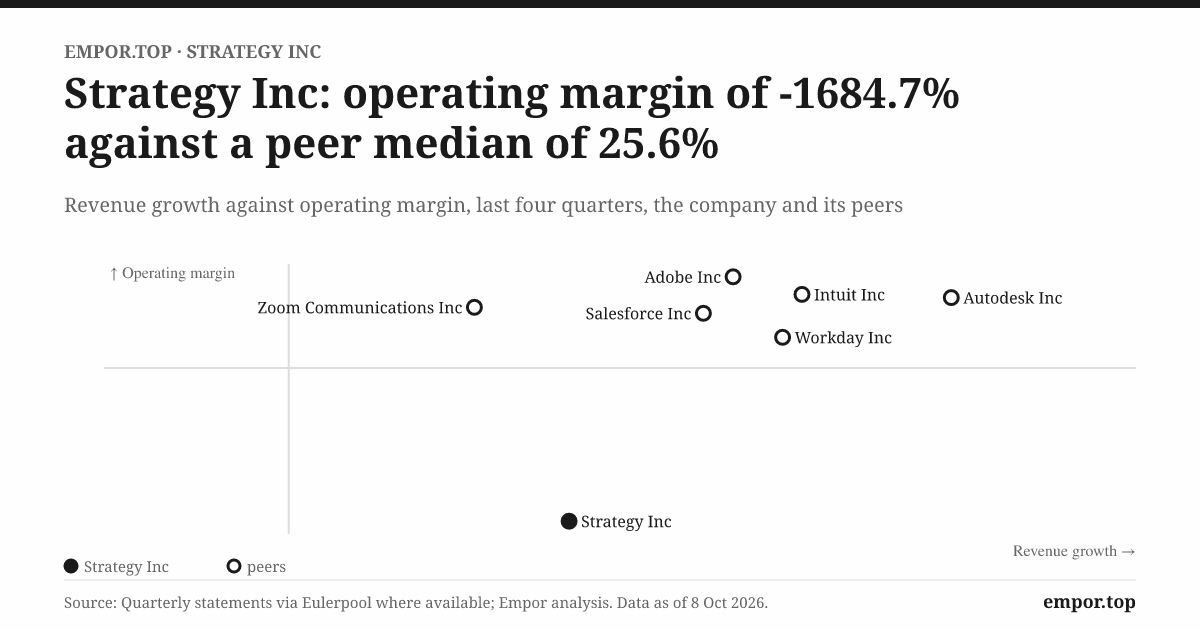
The third engine arrived in 2025: perpetual preferred shares sold under tickers STRK, STRF, STRD and STRC. They pay fixed or variable dividends, some of them in cash, carry no voting rights and never mature.3 They tapped retail and income investors who wanted yield with bitcoin flavour, and they let Strategy add leverage without adding maturity dates. They also add something the convertibles mostly avoided: recurring cash obligations. The company's operating cash flow was negative, about $53 million in 2024 and $67 million in 2025, so those dividends and the bond coupons are paid from new capital, not from the software.2
That leads to the disconfirming arithmetic. Run the worked example backwards. If the stock trades at 0.8 times its bitcoin backing, every share sold buys less bitcoin than it gives away, and BTC Yield turns negative. The machine has no reverse gear that creates value; below 1.0 times, the only accretive moves are buying back stock or selling bitcoin, and both shrink the vault. Today, at about 1.1 times book, the premium that powered 2024 is mostly gone.2 So the playbook has proven it works in a rising market with a fat premium. It has not yet proven it can survive without one, and that test is the one that now matters.
Running this machine requires a particular kind of leadership: one person to sell the dream and another to keep the lights on. In 2022, Strategy formalised exactly that split.
VII. The Identity Split: Phong Le's Software Engine vs. Saylor's Evangelism
In August 2022, with bitcoin deep in a bear market and the company booking large impairment losses, Michael Saylor gave up the chief executive title after more than three decades. He became Executive Chairman, focused on the bitcoin strategy. Phong Le, the company's president and former finance chief, became CEO.6
The two men could hardly be more different in public. Saylor became one of the most recognisable voices in crypto: on television, on podcasts, on social media, presenting bitcoin as digital property and Strategy as its premier vehicle. Le is a finance executive's executive, the person who runs the quarterly call, renews the software contracts and manages the mechanics of offerings. The split was sensible. It also confirmed what the market already knew: the person who mattered for the stock price was not the one running the software.
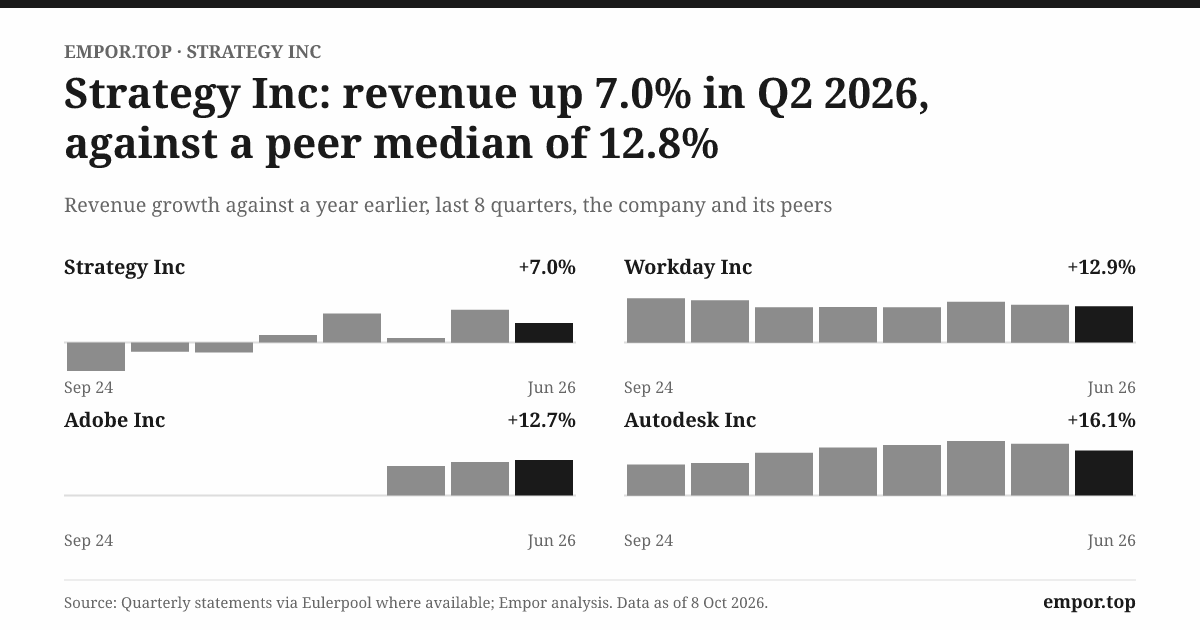
Le has worked to modernise that software. The company pushed customers toward its cloud platform, MicroStrategy ONE, and added generative-AI assistants to its analytics. The results show up in the revenue mix. In 2024, subscription services rose to about $107 million from $81 million, while licence sales fell to about $49 million and product support slipped to about $244 million.1 Total revenue still fell, because cloud subscriptions replace upfront licences with smaller annual payments. By the end of 2024, contracted but unrecognised revenue stood at about $455 million.1 Recent quarters have turned modestly positive, with revenue up about 7% year on year in the June 2026 quarter.2 That is a real improvement from years of decline, but it is a small business growing slowly, not a turnaround that changes the investment case.
In early 2025 the company rebranded as Strategy, with an orange stylised B as its logo.3 The rename settled the identity question in public. The software kept the MicroStrategy name as a product; the company became the bitcoin vehicle.
Two governance threads deserve attention. The first is the District of Columbia. In June 2024, the D.C. Attorney General announced a $40 million settlement with Saylor and the company over claims that Saylor had falsely claimed residence outside the District to avoid income tax, and that the company had helped by misreporting his address.9 Saylor did not admit wrongdoing. The amount was immaterial to the balance sheet, but the case belongs on the same ledger as the dot-com settlement: two regulatory actions, a quarter century apart, involving the same founder and how the company reported facts about him.
The second is control. Relentless share issuance has diluted the ten-vote Class B shares. Saylor's voting power fell below 50% and, by 2026, to roughly 36%, ending the company's status as a controlled company under Nasdaq rules.6 He remains by far the dominant shareholder. But the voting fortress that made the 2020 pivot possible is now a large minority stake, which means a future board could, in principle, be pressed by outside holders to change course. Related-party dealings are limited, mainly arrangements for business use of aircraft tied to Saylor's affiliates, reviewed by the audit committee.6
The deeper point is key-person risk. Saylor's credibility is not a soft asset here; it is one of the inputs that has held up the premium the whole machine runs on. That premium shows up most violently in the one place a company cannot spin: its accounting.
VIII. The Accounting Mirror: From Impairment Penalties to Mark-to-Market Chaos
At the end of 2022, MicroStrategy owned more than 130,000 bitcoins and reported negative shareholders' equity of about $383 million.2 On paper the company was insolvent. In reality its coins were worth billions. The gap was not fraud or error; it was an accounting rule that made no sense for this asset.
Under the old standard, bitcoin was treated as an intangible asset with an indefinite life, like a trademark. If its price fell below what the company paid, even briefly on a single day, the company had to write the value down. If the price later recovered, it could not write it back up. The result was a ratchet that only turned one way. By the end of 2024 the company had booked about $4.1 billion of cumulative impairment losses, and its coins sat on the balance sheet at about $24 billion against a market value of roughly $42 billion.1
In December 2023 the Financial Accounting Standards Board fixed this with a new standard, ASU 2023-08, requiring crypto assets to be carried at fair value with changes run through net income.10 Strategy adopted it on January 1, 2025.3 The balance sheet finally told the truth: total assets reached $61.6 billion at the end of 2025, and shareholders' equity about $51 billion.2
But fair value has a dark side, and it arrived immediately. Because every move in bitcoin now flows through earnings, Strategy's profit swings with the coin. In the June 2025 quarter it reported net income of about $10 billion, or about $34 a share. In the December 2025 quarter it reported a loss of about $12.4 billion, or about $42 a share.2 Over the twelve months to June 2026, the loss totalled about $30 billion.2 None of that describes how the software did. The quarterly earnings figure has become a delayed, noisy readout of the bitcoin price.
The cleaner test is cash. Over the twelve years from 2014 to 2025, Strategy reported cumulative net losses of about $6.3 billion, while its operations produced about $462 million of cash.2 The operating business made money in its old form; the losses were mostly accounting for bitcoin. But the trend in cash is the uncomfortable part. Operating cash flow, which was well above $100 million in good software years, turned negative in 2024 and 2025 as interest costs rose against a flat business.2 The software is no longer paying for the company's obligations.
Two risks sit on the horizon. The first is tax. The corporate alternative minimum tax, introduced in 2022, applies to large companies based on their book income. Under fair-value accounting, a strong year for bitcoin could produce enormous book profits with no cash, and potentially a cash tax bill on gains the company never realised. The treatment of unrealised crypto gains under that tax has been subject to Treasury guidance and lobbying, and it remains a live exposure for any year in which bitcoin rallies sharply. The second is classification. A company whose assets are overwhelmingly a single financial asset invites the question of whether it is really an investment company under the 1940 Act, which would bring rules on leverage and governance that would be incompatible with its model. Strategy argues it is an operating company with a real software business. That argument is one reason the shrinking software arm still matters.
The auditor, KPMG, gave clean opinions and flagged the valuation of digital assets as a critical audit matter.1 Fair-value accounting, then, solved the understatement problem and created a volatility problem. It made Strategy more transparent and less legible at the same time. That leaves the question every copycat has had to face: if anyone can buy bitcoin with borrowed money, what exactly is Strategy's edge?
IX. The Moat Analysis: 7 Powers and 5 Forces
By 2025 the Strategy playbook had become a genre. A medical-device company in California, Semler Scientific, started buying bitcoin. Metaplanet, a Tokyo-listed hotel company, rebranded itself as Japan's bitcoin treasury. Bitcoin miners such as MARA Holdings held their output instead of selling it. Dozens of smaller firms announced treasury policies and saw their shares jump. Most of them found the same thing: buying bitcoin is easy; buying it with cheap capital at scale is not.
Hamilton Helmer's 7 Powers framework asks what lets a business earn returns above its cost of capital for a long time. Applied honestly to Strategy, it finds one strong power, one weak one and several absences.
The strong power is a kind of scale economy in capital markets. Strategy's shares and options are among the most heavily traded in the market, and that liquidity is exactly what convertible arbitrage funds need to hedge. A fund can put a billion dollars into a Strategy convertible and hedge it efficiently; it cannot do that in a small imitator whose shares barely trade. That is why Strategy can borrow at zero coupons when copycats cannot. Index inclusion, which brought passive buyers, deepened this advantage. Call it cornered capital-market access: a first mover's head start that compounded into scale. But its durability is tested by evidence the company itself supplies. The advantage is worth the most when the premium is high, and the premium has fallen to about 1.1 times book.2 So the history narrows the claim: Strategy has a real cost-of-capital edge over other treasury companies, but not over the asset it holds.
The weak power is switching costs in the software. Large enterprises that built reporting on MicroStrategy do not rip it out lightly, which is why maintenance revenue has decayed slowly rather than collapsed and why about $455 million of contracted revenue sits in the backlog.1 Yet a decade of shrinking sales says those costs bind customers without giving pricing power. Strategy lacks network effects in software, has no process advantage against cloud giants and has no brand edge against Microsoft's bundled Power BI.
Porter's five forces make the vulnerabilities sharper. The threat of substitutes is extreme. Since January 2024, spot bitcoin exchange-traded funds such as BlackRock's IBIT and Fidelity's FBTC have offered institutions direct exposure at low fees with no leverage, no dilution and no key-person risk. In 2020, an equity was the main door to bitcoin for many institutions; that door has been joined by a wider, cheaper one, which is exactly the venue arbitrage closing. The threat of new entrants into treasury is high in principle, tempered by the liquidity gap. Buyer power in software is high, because customers can multi-source analytics tools and renegotiate at every cloud renewal.
Pulling it together, the moat that matters is not the coins, which anyone can buy, but the ability to finance them more cheaply than others. That ability depends on liquidity and on the premium, and the premium depends on belief. It is a moat made partly of sentiment. The lessons in this story come from watching it fill and drain.
X. Playbook: Business & Investing Lessons
The first lesson comes from that pile of cash in 2019. MicroStrategy had a business shrinking by a percent a year and half a billion dollars earning almost nothing. Most boards would have bought back stock slowly and called it prudence. Saylor treated idle cash on an ex-growth balance sheet as a slow liquidation. Whatever one thinks of what he bought, the insight is sharp: a company with no growth and a large cash pile is making a capital-allocation decision every day it does nothing. Doing nothing is a bet too, just a quiet one.
The second lesson is that volatility can be sold. Most companies spend their lives trying to look smooth to investors. Strategy turned its wildness into a funding source, selling the price swings of its stock to hedge funds in exchange for money that cost almost nothing. A company's most annoying trait to one investor can be its most valuable product to another. The hedge funds were never betting on Strategy; they were renting its chaos.
The third lesson is about venue arbitrage. Much of Strategy's early value came from standing between capital that wanted bitcoin and rules that kept that capital from buying it directly. That gap was real, and it was temporary. Once spot ETFs arrived, the gap narrowed and the premium followed. Any business built on a regulatory or market-structure gap should know the date it closes, and price its strategy for that day rather than for today.
The fourth lesson is the one written in the worked example: accretion runs in both directions. Selling shares above the value of what they hold makes every owner richer per share. Selling them below makes every owner poorer. BTC Yield is not a property of bitcoin or of Strategy; it is a property of the premium, and a metric that only works in one market regime is a description of that regime, not of the business.
The fifth lesson is that control decides speed. The 2020 pivot happened in a summer because one person held the votes. A widely held company would have argued for a year and bought a small allocation, if anything. Dual-class shares are usually debated as a governance flaw. Here they were the precondition of a transformation, for better and for worse. Control lets a founder be right faster. It also lets a founder be wrong faster, and nobody knows which in advance. With those lessons in hand, the bull and bear cases come into focus.
XI. Bear vs. Bull Case Analysis
On October 8, 2026, Strategy closed at $153.37, down about 54% from its high of the past year and well above its low of about $82.2 Price to book stood at about 1.1 times, and the last twelve months showed a GAAP loss of roughly $30 billion.2 Annual volatility was about 79%, and the deepest fall over five years had been 84%.2 That is the setting for the only question that matters now: can a leveraged treasury vehicle survive a long bitcoin drawdown, and what is it worth if it does?
The case for the machine
The bull case begins with scarcity. Bitcoin's supply is capped, and Strategy owns more than half a million coins, a hoard that would be hard to rebuild at any reasonable price.3 If bitcoin keeps gaining acceptance as a monetary asset held by institutions and possibly governments, the owner of the largest corporate stack holds something close to irreplaceable, and a premium could return as investors seek leveraged exposure through a regulated equity. The second leg is that demand for volatility is durable. As long as Strategy's shares swing, convertible desks will want its paper, which means maturing bonds can often be refinanced with new ones. The third leg is the software floor. Roughly half a billion dollars of mostly recurring revenue, a diversified Fortune 500 customer base and recent quarters of growth suggest the operating business is not disappearing.12 It also keeps the company an operating business, which matters for its regulatory classification.
Tested against the record, those legs are uneven. The scarcity claim is intact but not unique to Strategy, because ETF holders own the same scarce asset without leverage. The volatility claim has held for five years, including through the 2022 crash, when the company did not sell bitcoin to meet obligations. The software floor is the weakest: it is a revenue floor, not a cash floor, because operating cash flow is negative.2
The case against the leverage
The bear case begins with the premium. If Strategy trades at a sustained 10% to 20% discount to its bitcoin, issuing stock destroys value, the main engine stops and the company becomes a fund with debts and preferred dividends and no growth mechanism. The second leg is maturities. About $8.3 billion of debt comes due between 2027 and the early 2030s.2 Convertibles are only painless if the stock is above the conversion price at maturity; if it is not, bondholders want cash. Some issues also include investor put options that can bring repayment forward. With dollar reserves of about $2.3 billion at the end of 2025, part of it set aside for dividends, a cluster of maturities during a bear market could force bitcoin sales, which would themselves pressure the price.2 The third leg is the cash drain: the software now consumes cash rather than producing it, and preferred dividends add a growing fixed claim.2
The record tempers both sides. Strategy has never yet sold bitcoin to meet debt, and past convertibles were converted or refinanced as the stock rose. But every one of those successes happened with a premium and a rising coin. The bear case is not disproved by history; it is simply untested by it.
Three readings will tell investors which case is winning. The first is BTC Yield, reported each quarter, which must stay positive for issuance to add value. The second is the market's multiple of the bitcoin holdings, the mNAV, which at about 1.1 times book is close to the danger line of 1.0. The third is operating cash flow before bitcoin transactions, which was negative about $67 million in 2025 and shows whether the software helps or hurts.2 Those readings will settle the epilogue's questions in a matter of quarters, not years.
XII. Epilogue: The Horizon of Corporate Alchemy
Tonight Strategy is a $49 billion company holding a vault of bitcoin, a modest software franchise and a capital structure that would make a 1980s leveraged-buyout banker blink.2 It has institutional legitimacy it never had before: index membership, a credit rating, clean audits and a balance sheet that finally reflects the market value of what it owns.18 It also has the most fragile thing a financial vehicle can have, a business model that depends on how others feel about it.
The tests that will decide it are already on the calendar. The first is the debt. The first major convertible maturities and put dates arrive in 2027 and 2028, and they will reveal whether the company can roll its obligations in whatever market exists then.1 If bitcoin is well above the conversion prices, the bonds will turn into stock and the debt wall will dissolve, and the bull case will look prophetic. If bitcoin is below them, Strategy will need to raise new capital at a discount or sell coins for the first time, and the market will learn what this machine looks like in reverse.
The second test is regulatory. As digital assets make up more than nine-tenths of the company's assets, the argument that Strategy is an operating company rather than an investment company rests on a software business that is now a small fraction of its value. A challenge to that status, or a large tax bill on unrealised gains in a strong year, would change the economics of the wrapper itself.
The third test is imitation. If corporate treasurers around the world follow the blueprint, Strategy becomes the prototype of a new kind of company. If the copycats fade, as many already trade at discounts, Strategy will look like a singular anomaly, a product of one founder, one macro moment and one gap in market structure that has since narrowed.
Each outcome maps onto the central questions. The premium decides whether the flywheel turns. The maturities decide whether leverage is a tool or a trap. The software decides whether the wrapper holds. And all of it depends on a single price, set every second, on an asset that has fallen more than 70% several times in its short life. Strategy may yet prove to be modern corporate finance's boldest breakthrough. It may also prove to be its most leveraged house of cards. The uncomfortable truth is that the company itself cannot know which.
XIII. Outro
Go back to Wilmington, Delaware, at the end of the 1980s. A young man who could not fly is spreading simulation printouts across a conference table at DuPont, explaining that the model sees a downturn the managers do not. He is confident, a little impatient and entirely sure that the right model can beat the market's guesswork.
Thirty-six years later the simulation is still running. It no longer predicts chemical demand. It has turned a public software company into a machine that converts Wall Street's appetite for volatility into digital scarcity, one share sale and one convertible at a time. Strategy is a business software vendor that stopped waiting for customers and decided to manufacture its own destiny out of digital scarcity and Wall Street volatility. Whether the model was right this time will be decided not in Tysons Corner, but in the price of a coin.
References
-
Strategy Inc. 2024 Form 10-K — SEC EDGAR, 2025-02-18 ↩↩↩↩↩↩↩↩↩↩↩↩↩↩↩↩↩↩↩↩
-
MicroStrategy Incorporated 2025 Form 10-K — SEC EDGAR, 2026-02-17 ↩↩↩↩↩↩↩↩↩↩↩↩↩↩↩↩↩↩↩↩↩↩↩↩↩↩↩↩↩↩↩↩↩↩↩
-
Strategy Inc. Investor Relations and Financial Disclosures — Strategy Inc. ↩↩↩↩↩↩↩↩
-
Wall Street Journal: The Man Who Bet His Company on Bitcoin — The Wall Street Journal, 2024-12-05 ↩↩↩↩↩
-
SEC Litigation Release No. 16829: SEC Charges MicroStrategy and Top Executives with Financial Fraud — SEC, 2000-12-14 ↩↩↩
-
Strategy Inc. Definitive Proxy Statement Form DEF 14A — SEC EDGAR, 2025-04-18 ↩↩↩↩↩
-
MicroStrategy Announces 21/21 Plan to Raise $42 Billion of Capital — Business Wire, 2024-10-30 ↩
-
S&P Global Ratings Research Update: Strategy Inc. Assigned 'B-' Rating, Outlook Stable — S&P Global, 2025-10-24 ↩↩
-
Attorney General Schwalb Secures $40 Million Settlement from Michael Saylor and MicroStrategy for Tax Fraud — Office of the Attorney General for DC, 2024-06-03 ↩
-
FASB Accounting Standards Update (ASU) 2023-08: Accounting for and Disclosure of Crypto Assets — FASB, 2023-12-13 ↩
 LinkedIn
 WhatsApp
 Reddit
 Hacker News
 Email
 Kindle
 RSS Feed
 Spotify
 Apple Podcasts
 Amazon Music
 Audible
 YouTube