MiniMed Group: The 40-Year Race to Close the Loop
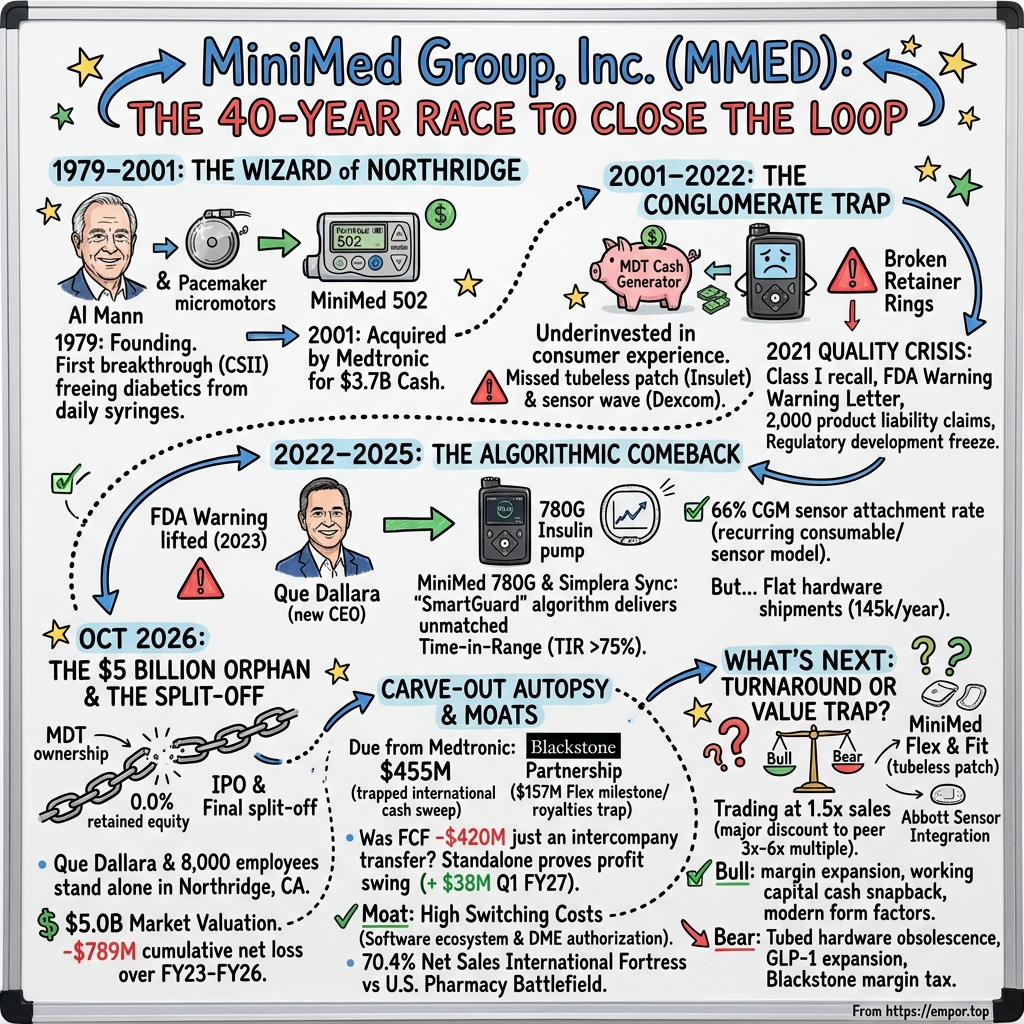
I. The $5 Billion Orphan of Northridge
On October 15, 2026, Medtronic completed its split-off exchange offer, and nobody rang a bell. There was no ceremony and no product launch, just an exchange of paper. Medtronic accepted 55,032,401 of its own ordinary shares from investors who chose to trade them in. In return it handed over all 252,813,348 shares of MiniMed Group it still held.1 A day later, Medtronic filed an amended ownership statement showing it held zero shares of the company it had bought a quarter-century earlier.2 Four Medtronic-affiliated directors resigned from the MiniMed board the same day, "without disagreement," the standard phrase for an exit with no drama.1
That left Que Dallara, the chief executive, and about 8,000 employees in Northridge, California, Juncos in Puerto Rico, Minneapolis, San Diego and Israel running a company that had never had to stand on its own.3 For twenty-five years the diabetes business had sat inside the world's largest medical device maker. Medtronic's treasury had collected its foreign cash, its IT department had run its systems, and its tax, legal and procurement teams had served it. Now each of those things was MiniMed's job, or became a contract with a vendor that had been family the week before.
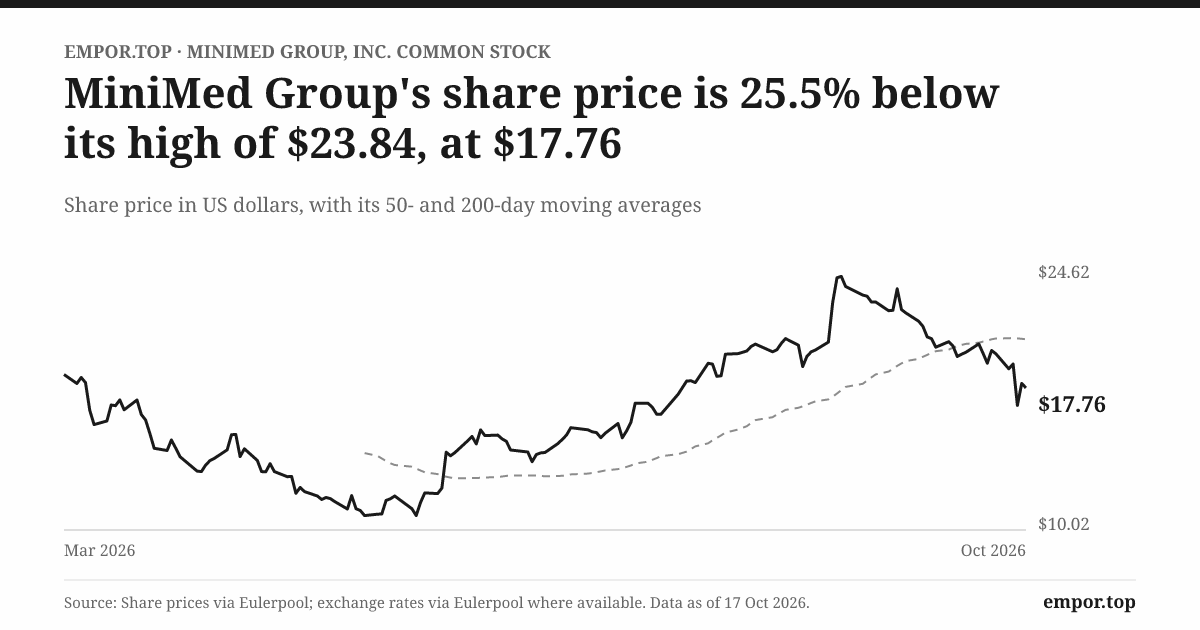
The company that walked out of that exchange offer is not small. It sold $3.10 billion of insulin pumps, glucose sensors and infusion supplies in the fiscal year ended April 2026, and $3.24 billion over the twelve months to July.35 At $17.76 a share on October 17, the market valued it at about $5.0 billion. That is roughly 1.5 times sales, for a company that has grown revenue at about 11% a year over the past three years. A medical device company with that growth rate usually commands a richer multiple. The market is therefore expressing doubt, and the doubt has a clear source. Over the four fiscal years from 2023 through 2026, MiniMed lost a combined $789 million.34
The case for MiniMed comes down to one argument: those losses were an accident of ownership, not a verdict on the business. Inside Medtronic, MiniMed carried roughly $300 million a year of allocated corporate overhead. It paid milestone charges on R&D a private equity firm had funded. It also watched its foreign customers' cash flow into its parent's bank accounts rather than its own. Strip those out and you might find a profitable franchise with a sticky recurring revenue base that was simply starved of attention. The skeptic's version is harsher. Medtronic kept MiniMed while it was a growth engine and sold it once it became a hardware incumbent losing ground to patch pumps and stand-alone sensors.
Medtronic's sequence of moves is a clue, though not proof, of how it saw the asset. In March 2026 it sold 28 million new MiniMed shares to the public at $20 each, keeping 90% for itself.4 Then, rather than holding a controlling stake for years, it exited the rest within seven months. It did so through a split-off: Medtronic's own shareholders chose whether to swap their Medtronic stock for MiniMed stock. The approach lets a parent shrink its own share count without paying cash and, typically, without incurring a tax bill. It also hands the new company a shareholder base made up partly of people who were happy with Medtronic and may not want a stand-alone diabetes stock. The 52-week range, from $10.80 to $23.84, shows how volatile that handover has been.46
Three questions will decide what MiniMed becomes. The first is whether the company can turn more than $3 billion of sales into a positive GAAP operating margin once Medtronic's allocations are gone and its own corporate costs take their place. The second is cash. At the end of fiscal 2026, $455 million sat on the balance sheet as money owed by Medtronic, mostly foreign customer collections held by Medtronic affiliates.3 If that money comes home, the cash flow statement looks very different. If it does not, or if capital spending and royalties absorb it, the cash burn may be structural. The third is the product. MiniMed's flagship is a tubed pump, a device that clips to a belt and connects to the body through a thin catheter. Insulet's tubeless patch pumps, and a generation of weight-loss and diabetes drugs that may delay insulin dependence for some people with type 2 diabetes, both threaten that franchise.
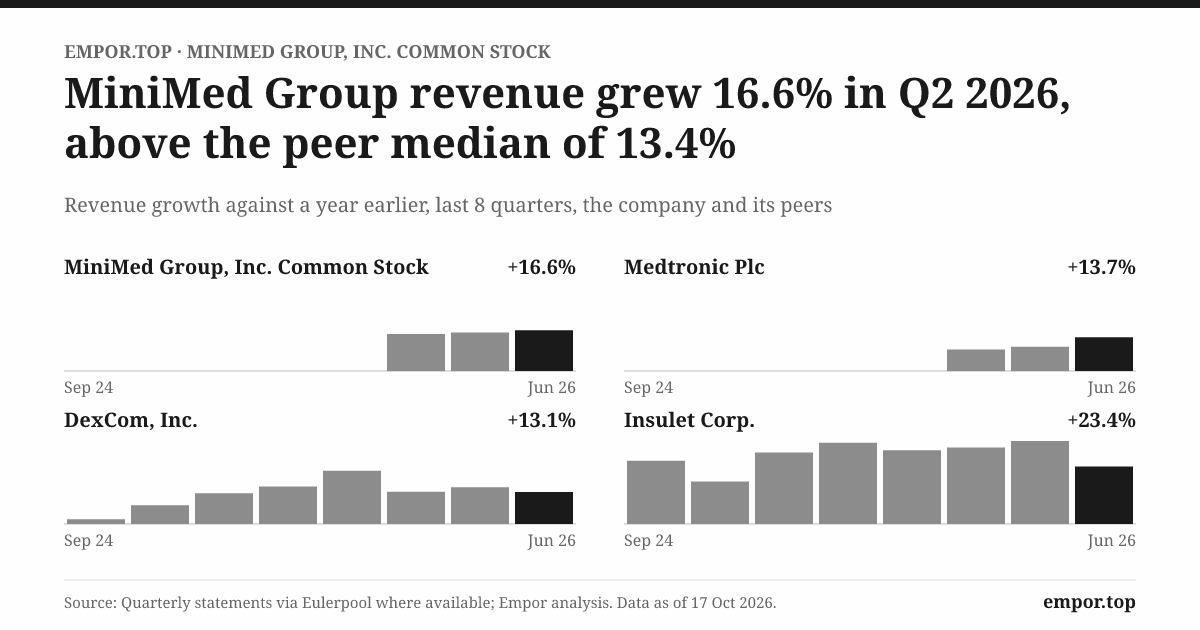
The market's current price leans toward the skeptic's view. MiniMed trades at roughly half the revenue multiple of Insulet and a quarter of Dexcom's.3 The rest of this story is an attempt to work out whether that discount reflects a structural laggard or a company that was only ever badly framed. It starts with a man who built pacemaker parts and decided insulin needed a motor.
 Subscribe on LinkedIn
II. The Wizard of Northridge and the First Artificial Pancreas (1979–2001)
Alfred E. Mann had a habit of spotting the same piece of engineering in two places at once. By the late 1970s he had already built a career in the aerospace and medical electronics businesses of the San Fernando Valley. His team at Pacesetter Systems had worked on rechargeable cardiac pacemakers, devices that had to run for years inside the human body on tiny amounts of power and with no margin for error. The micromotors and control electronics behind that work could do something else: they could push a precisely metered drop of liquid, again and again, for as long as the battery lasted.
Insulin was the obvious liquid. A person with type 1 diabetes produces none of the hormone, so before pumps the only option was syringes, several times a day, each dose a calculation based on food, exercise and guesswork. A healthy pancreas does not work that way. It drips insulin continuously in the background and adds bursts when a meal arrives. Mann's idea, the one that grew into MiniMed in Northridge, was to imitate the pancreas mechanically. A small motor would turn a drive screw, the screw would push a plunger, and the plunger would deliver insulin through a fine catheter under the skin. The industry came to call this continuous subcutaneous insulin infusion. Patients just called it the pump.
The engineering choices made in those early years still shape MiniMed's business today. The pump was a durable device: expensive, built to last years, and serviced by the company. The disposables were what it consumed: insulin reservoirs and infusion sets, replaced every few days. That split defined the economics, and in the United States it defined how the product was paid for. Insurers and Medicare came to treat the pump as durable medical equipment, the same category as wheelchairs and home oxygen machines, typically covering a replacement about every four years.3 Securing that reimbursement category was as important an invention as the motor, because it made a device costing several thousand dollars affordable to ordinary patients. It came with baggage, though. Durable equipment is ordered through specialized distributors, needs prior authorization and paperwork, and is billed slowly. Those features built a moat around the category in the 1990s and became friction once competitors found a different route to patients.
Mann also understood that a pump on its own was only half the answer. It delivered insulin on instructions from the patient, who still had to prick a finger to know their blood sugar. The real prize was a closed loop: a sensor that measures glucose continuously, linked to a pump that adjusts delivery automatically, so the machine does what the pancreas used to do. In the industry this has long been called an artificial pancreas. MiniMed pursued glucose sensing from the 1990s, and that ambition explains why the company today sells sensors as well as pumps. The two halves were always meant to be one product.
By the end of the decade MiniMed was the dominant name in insulin pumps, and dominant franchises attract buyers. In May 2001, Medtronic agreed to buy MiniMed, along with Medical Research Group, a Mann-affiliated developer of implantable pump technology, in a deal valued at about $3.7 billion.7 For Medtronic, a company built on pacemakers and defibrillators, it was a move into chronic disease management with a recurring-revenue business attached. For MiniMed, it was the end of independence and the beginning of a long period as one division among many in a much larger company.
Even this origin story offers an early sign of what went wrong later. MiniMed's founding advantage was the precision of a durable motorized device and the reimbursement system built around it. Both depended on a pump that stayed on the patient for years and connected through tubing. When the market later moved toward cheap, single-use wearables that stick directly to the skin, the company's greatest strength became its architectural inheritance. Whether a conglomerate parent would help MiniMed adapt or hold it back was the question of the next two decades.
III. The Conglomerate Trap and the Retainer Ring Crisis (2001–2022)
The part that failed was small: a clear plastic retainer ring, roughly the size of a fingernail, on the MiniMed 600 series pumps. Its job was simple. It locked the insulin reservoir into the pump so that the drive screw pushed insulin only when the software told it to. When the ring was cracked or missing, the reservoir could sit loose. A loose reservoir could let insulin flow uncontrolled, and an uncontrolled insulin dose can push blood sugar dangerously low within hours.
The FDA classified the problem as a Class I recall, its most serious category, reserved for situations where a product could cause serious injury or death.8 On December 9, 2021, the agency followed with a warning letter to Medtronic's diabetes headquarters in Northridge.9 The letter cited failures in the quality system responsible for catching, investigating and correcting defects like this one. In practice, a warning letter of this kind slows everything. Until the issues are resolved, the FDA is reluctant to approve new devices from the same site, which meant the company's next-generation products had to wait. MiniMed's growth paused from roughly fiscal 2020 to 2022, as its record shows.3
The legal consequences arrived later. By June 2026, 17 lawsuits representing 60 people were pending in U.S. courts over the ring. A bellwether trial in Los Angeles County produced zero damages for three plaintiffs and a verdict of about $253,000 for a fourth.3 Those numbers are small. The overhang is not: plaintiff firms have asserted tolling agreements, which pause the clock on filing a claim, on behalf of roughly 2,000 further claimants.3 MiniMed had accrued $18 million for litigation at the end of fiscal 2026, and the separation agreement assigns certain legacy exposures between it and Medtronic, though the full scope of that indemnity is a matter for the contracts.3
The retainer ring was a symptom, not the disease. The deeper story is how the undisputed leader in insulin delivery lost its lead in both halves of its own vision during the Medtronic years. The first loss was in sensors. Dexcom built a stand-alone continuous glucose monitor and treated it as a consumer product. Abbott's FreeStyle Libre made sensing cheap and easy to obtain. Both competed on accuracy, measured as MARD, the average gap between a sensor's reading and a lab reading, and on convenience: factory calibration, fewer finger pricks, longer wear. MiniMed's Guardian sensors were designed mainly to feed MiniMed's own pumps, and patients and doctors widely judged them less pleasant to use. In practice, MiniMed's sensor business served its installed base, while its rivals' sensor businesses won customers outright.
The second loss was in form factor. Insulet's Omnipod asked a simple question: why should a pump have a tube? Its pod sticks to the skin, holds the insulin, delivers it and is thrown away after a few days. There is nothing to clip to a belt, nothing to snag on a door handle, and nothing to explain at the beach. For children, teenagers and active adults, that difference matters enormously. Insulet's later Omnipod 5 added automated insulin delivery, and the company built a pharmacy distribution channel so patients could pick up pods much as they pick up a prescription.13 In short, a rival rebuilt MiniMed's founding product around the patient's daily life rather than the device's engineering.
The common explanation for MiniMed's slide is conglomerate neglect, and it fits the facts but needs care. Medtronic did not cut R&D to nothing. Even in fiscal 2023, the diabetes business spent $429 million on research, about 19% of sales, a high ratio for a device company.3 Money was not the problem. The record points instead to a mismatch of instincts. A company built on surgeons and hospital buyers ran a business that increasingly competed for consumers' wrists and phones, and its quality systems failed at exactly the moment its rivals were moving fastest. Medtronic's ownership almost certainly made the crisis survivable, since the financial backing absorbed the recall years. It did not keep MiniMed competitive.
The lesson for anyone weighing the moat comes directly from this period. The FDA's approval regime and decades of physician relationships are often described as barriers that protect incumbents. Between 2019 and 2022 they did the opposite. The same regulator whose approval process keeps start-ups out also froze MiniMed's product pipeline while competitors kept launching. Regulation is a moat only for a company that reliably clears it. MiniMed would need a new leader to show it could.
IV. The Smart Algorithm Comeback: The 780G and Simplera Sync (2022–2025)
In 2022 Medtronic hired a diabetes chief from outside medical devices. Que Dallara came from Honeywell, where she had been chief executive of Honeywell Connected Enterprise, the unit that sold software and connected-device services to industrial customers.4 Hiring a software and IoT executive to run an insulin pump business was itself a statement. Medtronic was saying that the next phase of diabetes care would be won in algorithms, apps and data, not just in drive screws, and that the division's old engineering culture needed reshaping.
Dallara's first task was unglamorous: clear the warning letter. That meant rebuilding quality procedures at Northridge and in the supply chain, a slow process of documentation, inspection and remediation. On April 21, 2023, the FDA approved the MiniMed 780G system for the U.S. market.10 The approval meant the pipeline freeze was effectively over in the country that matters most for medical device pricing.
The 780G is worth explaining, because it is the best evidence that MiniMed still has a real technological edge. Earlier "hybrid closed-loop" pumps adjusted background insulin automatically but still relied on the patient to announce meals and calculate doses. Forget to bolus for a sandwich and blood sugar climbs. The 780G's SmartGuard algorithm does two things more. It adjusts basal insulin every few minutes based on sensor readings, and it delivers automatic correction doses when glucose rises, which in effect covers some of the meals a patient forgets or underestimates. The measure clinicians care about is time in range, the share of the day a patient's glucose stays between roughly 70 and 180 milligrams per deciliter. Medtronic has promoted real-world data showing 780G users routinely above 70% time in range, a level that clinical guidelines treat as good control.10 Those figures are management's presentation of its own data and come from self-selected users. Still, the algorithm is widely regarded as a strong performer, and it gave MiniMed something it had lacked for years: a clinical reason to choose its system.
The financial results confirm that the algorithm made a difference, and they also show where its effect stopped. Revenue grew from about $2.24 billion in fiscal 2023 to $3.10 billion in fiscal 2026, an annual growth rate of about 11%, accelerating to 14% in the latest year.3 To see why, look at what MiniMed actually sells. In fiscal 2026, pumps generated $546 million, under a fifth of revenue. The rest was recurring: about $1.55 billion from glucose sensors and nearly $1 billion from infusion sets and reservoirs, together roughly 81% of sales.3 It is a razor-and-blade business. The pump is the razor, sold once every four years, and the sensors and infusion sets are the blades, bought every week or two for as long as the patient stays.
The growth engine has been more blades per razor. The share of MiniMed pump users who also use a MiniMed-integrated glucose sensor, which the company calls its CGM attachment rate, rose from about 52% in fiscal 2024 to 66% in fiscal 2026.3 Each point of that increase turns a patient who buys only infusion sets into one who also buys sensors, and sensors are now MiniMed's largest product line. The newer Simplera Sync sensor, smaller and easier to apply than the Guardian line, and the integration with Abbott's sensors announced in 2024, are both designed to lift that rate further.12 The attachment rate is the first of the few numbers that matter most for this company. It measures whether MiniMed is extracting more value from the patients it already has, and it is still rising.
Then there is the number that tempers the story. New pump sales were 143,000 units in fiscal 2024, 145,000 in fiscal 2025 and 145,000 again in fiscal 2026.3 This is a company with a celebrated new algorithm, revenue growing double digits and a sales force of more than 2,800 people, and its hardware unit sales have not moved in three years.3 Part of that is timing. Patients often delay buying a pump when they know a new one is coming, and MiniMed was openly preparing the Flex. But a flat line across the 780G's best years points to a deeper limit. The algorithm keeps current users happy and lifts sensor sales among them. It has not yet persuaded enough new patients to choose a tubed pump over a tubeless one.
The comeback, then, is real but narrower than the revenue chart suggests. MiniMed fixed its clinical performance and became much better at monetizing its installed base. It has not shown that it can grow that base. New pump shipments are the second key indicator for the stand-alone company, currently flat at 145,000 a year. To fix the hardware problem, Medtronic made an unusual financing decision, and its bill landed on MiniMed's books just days after the IPO.
V. The Blackstone Deal and the Cost of Buying an R&D Pipeline
On March 18, 2026, the FDA approved the MiniMed Flex pump. MiniMed had been a public company for nine days.3 Ordinarily an approval is good news, and in product terms this one was: the Flex is the next-generation pump that management expects to restart hardware growth. But the approval also triggered something less welcome. Under an agreement signed years earlier, regulatory approval of the Flex obliged MiniMed to make a $157 million milestone payment to Blackstone Life Sciences.3 MiniMed recorded the full amount as an expense in its first public fiscal year, and it is a large part of why that year's headline operating figure was a loss.
The arrangement dates back to 2020, when Blackstone Life Sciences and Medtronic announced a collaboration of up to $337 million to fund development of diabetes devices.11 The structure is common in pharmaceuticals and increasingly used in medtech. An outside investor pays part of the cost of developing specific products. If the products succeed, the investor is repaid through milestone payments on approval and then royalties on sales. For Medtronic the appeal was obvious: it could advance several diabetes programs without raising its own R&D budget, which mattered to a company managing margins across dozens of businesses. Over the life of the agreements, MiniMed received about $324 million of funding.3
The accounting of that funding is the first problem. MiniMed booked Blackstone money as income inside "other operating expense (income)": $60 million in fiscal 2024 and $46 million in fiscal 2025.3 That meant reported operating results in those years were flattered by more than $100 million of partner cash that was effectively a loan to be repaid later from success. The funding stopped in fiscal 2026, just as the first repayment arrived. Read in sequence, that pattern overstated operating performance in the earlier years and understated it in fiscal 2026. Neither picture shows the underlying business.
The relationship was not smooth. MiniMed's books at the end of fiscal 2025 included a $165 million accrual for a settlement of a contract dispute with Blackstone, resolved that year.3 The company does not describe the dispute in detail in its filings, and the cost of resolving it was itself a sign of how much was at stake for both parties.
The bigger issue lies ahead. The Flex milestone was the first of two large ones. The second is tied to the MiniMed Fit, the company's tubeless patch pump, which could trigger a payment of up to $162 million when it reaches its regulatory milestone.3 Beyond the milestones, Blackstone is entitled to royalties in the mid-to-high single digits as a percentage of sales of the funded products.3 A royalty of that size on a growing share of revenue acts as a permanent levy on gross margin. MiniMed's gross margin was about 54% in fiscal 2026, compared with more than 65% for Insulet and Dexcom.3 If funded products eventually make up a large share of pump and patch sales, a reasonable estimate is that royalties alone could cost a couple of percentage points of gross margin. That is not the entire gap, which also reflects manufacturing complexity and depreciation, but it is a part that efficiency improvements cannot remove.
There is an irony in how this works out. The two products most likely to solve MiniMed's hardware problem, the Flex and the Fit, are the ones that carry the heaviest financial burden. Each success increases the bill. A skeptical investor would ask whether Medtronic, when it signed the deal in 2020, priced it as a parent that already planned to separate the business. The filings do not answer that. They do make clear that the stand-alone company inherited the obligations without having made the decision.
The verdict is mixed. Blackstone's money likely helped keep the Flex and Fit programs funded during the warning letter years, when Medtronic was reluctant to spend more on a troubled division. But it was never free equity. It was a claim on future gross profit, and it moved some of the cost of today's pipeline into the income statements of a company that has to prove its profitability under scrutiny. That is one item in a broader accounting tangle that MiniMed's finance team had to sort out in its first months as a listed company.
VI. The Carve-Out Autopsy: Untangling the Books from Medtronic
Imagine MiniMed's finance team in spring 2026, assembling the company's first stand-alone annual report. Chad Spooner, who joined as chief financial officer in July 2025 from Société BIC, the French maker of pens and lighters, faced a set of statements that described a company that had never existed in the form shown.43 Every figure had been carved out of Medtronic's books using allocation formulas, and the auditor, PricewaterhouseCoopers, flagged those allocations as a critical audit matter, its way of saying the numbers depended on management's judgment.3 The bottom line showed an operating loss of about $190 million and free cash flow of minus $420 million.3 One balance sheet line overshadowed all the others: $455 million "due from Medtronic."3
Start with the losses. In fiscal 2026, Medtronic allocated $298 million of corporate costs to MiniMed, after $344 million the year before.3 Most of it, $228 million, landed in selling, general and administrative expenses, covering shared finance, IT, legal, HR and executive functions.3 Those charges were real costs in the sense that MiniMed used those services. But they were calculated by formula rather than negotiated, and a stand-alone company may be able to provide the same functions for less, or may find it costs more. Since the IPO, the relationship has been governed by transition services agreements, under which MiniMed paid Medtronic $67 million in fees in fiscal 2026 for services it has not yet replaced.3 The race now is to set up its own systems, especially enterprise resource planning software, before those agreements expire. Separating an ERP system from a parent is one of the riskiest operational tasks in any spin-off, because a botched cutover can delay billing, shipping and collections all at once.
Here is a worked reconciliation of the loss. Take the roughly $190 million fiscal 2026 operating loss.3 Add back the $157 million Blackstone milestone, a one-time charge, and you are close to break-even. Add back impairments of $84 million, also non-recurring, and the result is a profit of about $50 million, roughly consistent with the profit figure some data providers report on a different basis.3 None of that yet removes any of the $298 million in allocated costs, only some of which will disappear. So the underlying business was probably profitable at an operating level in fiscal 2026, but thinly so, and the size of the profit depends on how much of the allocated cost was genuinely excess.
The cash flow story is clearer and more dramatic. Operating cash flow went from $140 million positive in fiscal 2025 to $197 million negative in fiscal 2026.3 Customers did not stop paying. Days sales outstanding, the average time to collect a bill, held at 77 days in both years.3 The swing came from where foreign customers' payments ended up. Outside the United States, MiniMed's customers paid into accounts at Medtronic affiliates, which held the cash on MiniMed's behalf. On the books, the cash became a $455 million receivable from Medtronic, and the increase counted as a cash outflow from operations.3 At the same time, MiniMed owed Medtronic $137 million for expenses Medtronic had paid on its behalf, which partly offset the drain.3
That receivable did not shrink after the fiscal year ended. It grew. By July 31, 2026, it had reached $602 million.5 Some growth is expected while the international payment systems are still being transferred. But it underlines the most important near-term question in the company: when does that money come home? If it is settled in cash after the split-off, operating cash flow will rebound by several hundred million dollars, and fiscal 2026 will look like an accounting distortion. If the settlement is delayed, netted against other obligations or reduced by disputes, the distortion is less flattering. The intent is clear; the settlement terms and timing are what the next filings must show.
There is also an encouraging early result. In the first quarter of fiscal 2027, ending July 2026, revenue reached $843 million, up about 17% from a year earlier, and operating profit was $38 million, a margin of about 4.5%.5 That was the first full quarter MiniMed reported as a public company, and the profit came without Blackstone income to flatter it. It is a single quarter, and the margin is thin for a medtech business. But it is the first evidence from the company's own figures that the business can earn an operating profit with its current costs.
So were the losses real? Partly. The allocations were not imaginary costs, the Blackstone milestone was a genuine liability, and the impairments represent real write-downs. But the cash burn was largely a matter of where the money was held, and the underlying business appears to be modestly profitable and growing. The verdict for investors is that MiniMed's history understates the business but does not prove a high-margin franchise is hiding underneath. To know what the franchise is worth, you have to look at where its customers actually are, and most of them are not in America.
VII. The International Fortress vs. The U.S. Pharmacy Battlefield
In most of Europe, nobody walks into a pharmacy and chooses an insulin pump. Health systems in Germany, France, the United Kingdom and elsewhere buy diabetes technology through national or regional procurement: tenders, framework contracts and reimbursement lists set by government bodies and insurers. A vendor that wins a place on those lists, trains a generation of endocrinologists and diabetes nurses, and builds a service network can hold that position for years. MiniMed has done this across Europe and beyond for decades, and it is the least understood source of the company's resilience.
The numbers make the point. In fiscal 2026, international sales were $2.19 billion, about 70% of the company's total, up from about two-thirds a few years earlier.3 That is unusual among its peers. Dexcom, Insulet and Tandem all built their businesses primarily in the United States and have historically earned most of their profits there.1314[^15] MiniMed is in effect the opposite: a global business with a smaller American arm. In some ways that is protective. European tenders are slow and price-focused, but once won they lock in volumes of pumps, sensors and supplies for years, and changing vendors means retraining clinicians and patients across an entire system. Insulet's pharmacy-channel advantage does not translate directly into a tender process.
The same geography brings two costs. The first is currency. MiniMed manufactures mainly in Northridge and in Juncos, Puerto Rico, so most of its costs are in dollars.3 Most of its revenue is in euros, pounds and other currencies. When the dollar strengthens, foreign revenue shrinks in dollar terms while costs stay the same, so margins are squeezed. The company estimates that a 10% move in the dollar would change annual sales by about $218 million.3 For a business that earned only a thin operating profit in its best recent quarter, that sensitivity is large enough to move its annual result from profit to loss or back again.
The second cost is government bargaining power. Single-payer systems can change the rules after the sale. Italy's medical device payback law, which requires suppliers to refund part of their revenue when regional health budgets are exceeded, cost MiniMed a $20 million revenue reduction in fiscal 2025 after the country's Constitutional Court upheld it.3 The amount is small relative to the company. The principle is not: a buyer that can retroactively claw back revenue is a buyer with power, and MiniMed's largest customers are buyers of that type.
The American business works differently, and in some ways less well. About 72% of MiniMed's U.S. products ship directly to patients through the durable medical equipment channel, with the rest going through distributors and retail pharmacies.3 Around 69% of those direct patients are on commercial insurance plans.3 The DME route requires prior authorization, documentation, and billing processes that take time, which is part of why the company's average collection period is about 77 days.3 Insulet built its U.S. business through the pharmacy benefit, which typically means faster access for patients and simpler paperwork for doctors. MiniMed's newer sensors and supplies are moving into pharmacies too, but its core pump business still runs through the slower, older channel that Al Mann's generation built.
The verdict is that MiniMed's international business is a genuine strength, but the protection it offers is from competitors, not from customers. Tenders and long relationships make it hard for Insulet or Tandem to displace MiniMed quickly in Europe. They do not stop governments from squeezing prices, and they leave MiniMed exposed to the dollar in a way U.S.-focused peers are not. Whether all of this adds up to a durable moat is the question to address directly, using the frameworks investors use for exactly this purpose.
VIII. Moat Analysis: 7 Powers and Porter's 5 Forces
Picture a newly diagnosed teenager in an endocrinology clinic, with a parent beside them and two options on the table. One is Insulet's Omnipod 5: a small pod that sticks to the arm, no tubing, refills picked up at the pharmacy. The other is MiniMed's 780G: a pump the size of a small phone clipped to a waistband, connected by tubing to an infusion site, ordered through a DME supplier after the insurer approves it, with a training session on how to change the tubing. The 780G may offer the better algorithm. For a teenager, the first option is the one they can forget they are wearing. That consultation room is where MiniMed's moat is tested every day, so it is worth examining it carefully once.
Hamilton Helmer's 7 Powers framework asks which durable advantages let a company earn returns above its cost of capital. MiniMed's strongest power is switching costs. Once a patient is trained on a MiniMed system, their doctor has set insulin rates, and their insurer has authorized the pump for four years, moving to a competitor means new training, new prescriptions and new paperwork. That is why roughly 81% of the company's revenue is recurring consumables and sensors.3 The evidence that the switching costs work is in rising attachment and the steady consumables line. The evidence that they are limited is that new pump sales have stayed flat: switching costs hold existing patients but do nothing to win new ones, and every four years each patient faces a natural moment to reconsider.
The second-strongest power is something like a cornered resource or process power: the SmartGuard algorithm and the years of glucose and dosing data behind it. That produces clinical results that physicians respect. It is moderate rather than strong, because algorithms can be matched. Insulet and Tandem have their own automated systems, and the clinical differences between leading systems, while real, are not so large that they override form-factor preferences.
Scale economies are moderate. Two main plants at Northridge and Juncos produce pumps, sensors and supplies at large volume.3 Yet MiniMed's gross margin of about 54% trails peers by more than ten points.3 Scale exists, but it is not producing a cost advantage, partly because durable pumps are more complex to build than disposable pods, and partly because of the Blackstone royalties.
Counter-positioning works against MiniMed. Helmer's idea is that a newcomer adopts a model an incumbent cannot copy without damaging its existing business. Insulet's disposable patch is exactly that. MiniMed's revenue is built around a durable pump replaced every four years, a tubed infusion set, and a reimbursement channel tailored to durable equipment. Promoting a tubeless patch aggressively would cannibalize that base. The MiniMed Fit is the company's attempt to escape this trap, but until it is on the market, MiniMed is the incumbent being counter-positioned.
Network effects and branding are negligible. One patient's use of a MiniMed pump does not make it more valuable for another, and while the MiniMed name carries weight with older endocrinologists, brand does not visibly allow premium pricing in tender markets.
Porter's Five Forces complements this picture. The threat of substitutes is high: tubeless patches, smart insulin pens that track doses, and GLP-1 drugs such as semaglutide and tirzepatide, which help some people with type 2 diabetes delay or reduce insulin use. The GLP-1 effect is mainly a long-term question for type 2 pump adoption; type 1 patients, MiniMed's core, still need insulin regardless. Buyer power is moderate to high. No single customer accounts for more than 10% of sales, but MiniMed manages more than 25 U.S. distributors and sells to European health systems that bargain hard and sometimes claw back revenue.3 Supplier power is moderate: MiniMed makes most of its own components and sensors, but it now relies on Abbott as a partner for a sensor integration that matters to its newest systems.312 That partnership expands MiniMed's reach to patients who prefer Abbott's sensors, and it also means part of the patient experience is controlled by a company that sells a competing product.
Competitive rivalry is intense. Insulet, Tandem with its t:slim X2 and Mobi, Dexcom with its G7 sensors, and Abbott with FreeStyle Libre 3 all compete for the same patients.1314[^15] The barrier to new entrants, by contrast, is high. FDA approval, clinical trials, reimbursement credentials and manufacturing quality systems take years and hundreds of millions of dollars, which is why few new pump companies have emerged at scale.
The balance sheet is the last element of resilience, and it is genuinely clean. MiniMed has no bank debt or bonds. The $145 million shown as borrowings at the end of fiscal 2026 consists of lease and development obligations rather than loans.3 It had about $298 million in cash and an undrawn $500 million revolving credit facility, arranged by Citibank and running to March 2031.3 There is no public credit rating, so lenders' covenants and terms are the only market test so far.3
Putting it together, MiniMed has a real moat, but it is defensive. Switching costs and clinical credibility keep existing patients and their recurring purchases. Nothing in the moat, however, helps MiniMed win the teenager in the clinic. That combination explains the valuation, and it is where bulls and bears part company.
IX. Bull vs. Bear Case: The $5 Billion Valuation Arbitrage
In late October 2026, with Medtronic's shares gone and the shareholder base reshuffled, analysts will be initiating or refreshing coverage of MiniMed as a fully independent company. The question they face is simple to state. The company trades at about 1.5 times sales and an enterprise value of about $4.8 billion.3 Insulet trades at roughly 3.2 times sales and Dexcom at about 6 times.3 Tandem, the other durable pump maker, trades at roughly 1.2 to 1.5 times sales with negative EBITDA.3[^15] By that comparison, the market is pricing MiniMed as a better-run Tandem, not a cheaper Insulet.
There is another way to read the valuation. On fiscal 2026 EBITDA of $205 million, the company trades at about 29 times EV/EBITDA, or about 24 times on the company's adjusted figure.3 That is not cheap. It is in line with or above Insulet's multiple on the same measure. On earnings, MiniMed is expensive; it only looks cheap on revenue. The market is betting, implicitly, on margin expansion. A buyer at today's price is paying a medtech earnings multiple for earnings that do not yet exist, which is the bull case, and accepting a revenue multiple appropriate to a business that may never produce them, which is the bear case.
The bull case begins with the carve-out. If MiniMed can replace Medtronic's $298 million in allocated costs for materially less, and if revenue keeps growing toward $3.5 billion, operating margins could expand from low single digits toward 10% or more. The first quarter of fiscal 2027 provides a small proof point. The second leg is cash. If the $602 million owed by Medtronic at the end of July is settled, the company's cash position would roughly triple, transforming its free cash flow profile and funding product launches without debt.5 The third is product. The Flex is approved, and the Fit, a tubeless patch, would give MiniMed a direct answer to Omnipod. The fourth is distribution: the Abbott sensor integration opens the MiniMed ecosystem to patients who will not use MiniMed sensors.12 And finally, if even part of the valuation gap with Insulet closes, the share price would move substantially. That is arithmetic, not a forecast: a move halfway from 1.5 times sales toward Insulet's 3.2 times would mean a large increase in market value.
The bear case begins where the bull case ends: with the pump. New pump sales have been stuck at about 145,000 a year for three years.3 If the Flex arrives into a market where new patients have already chosen tubeless systems, it may simply replace MiniMed's existing pumps rather than win new users, and the Fit, whose development has had delays, may arrive too late. The second leg is the Blackstone tax. The Flex milestone has already been booked, and the Fit could add a further $162 million, followed by royalties that keep gross margin below the peer level.3 The third is litigation. The bellwether outcome was favorable, but roughly 2,000 tolled claims could still result in an expensive settlement.3 The fourth is the long-term effect of GLP-1 drugs on type 2 insulin users, a group pump makers once saw as their biggest growth opportunity. The fifth is technical. Former Medtronic shareholders who accepted the exchange offer may not want to hold a stand-alone diabetes company, and income-focused investors in particular have no dividend to keep them.3 Their selling could weigh on the stock regardless of fundamentals.
An activist investor reading these filings would focus on three points. The first is the $602 million owed by Medtronic: what are the exact terms and timetable for settlement, and is any of it subject to offset? The second is overhead: what is the real stand-alone cost of corporate functions once the transition agreements expire, and how does it compare with the $298 million in allocations? The third is pay. Dallara's fiscal 2025 compensation of about $8.5 million was set under Medtronic's metrics.4 The new board, which now includes independent director Amy Bricker, a Walgreens pharmacy executive, will need to tie incentives to stand-alone cash generation and pump growth rather than revenue alone.1 Bricker's pharmacy background is relevant here, given MiniMed's need to move more of its U.S. business into pharmacy channels.
Weighed against the evidence, the current discount looks justified. Gross margins are lower than peers', hardware volumes are flat, and the legal and royalty obligations are real. A higher valuation will require proof: sustained positive GAAP operating margins, the Medtronic receivable converted to cash, and hardware sales that grow once the new pumps arrive. None of those are impossible, and each will be visible in the company's filings within the next year. That is why it is worth drawing the lessons of this story before watching how it ends.
X. Playbook: Business & Investing Lessons
The first lesson comes from the retainer ring years. Medtronic's ownership made MiniMed's worst crisis survivable. A stand-alone pump maker facing a Class I recall, a warning letter and a frozen pipeline might well have run out of money or been sold cheaply. Medtronic absorbed the costs and kept funding research. But the same years were when Dexcom turned sensors into consumer products and Insulet removed the tube, and nothing about conglomerate ownership helped MiniMed match them. Big parents are good at financing regulatory defense and poor at building products patients enjoy using. A conglomerate can finance your regulatory defense, but it cannot write your consumer software.
The second lesson comes from the 780G and the flat line beside it. The algorithm is MiniMed's clearest technical success in a decade. It raised sensor attachment, improved clinical results, and turned an installed base into a growing revenue stream. It did not move new pump sales from 145,000 a year. For founders building connected devices, this is a sobering pattern: software excellence protects the customers you already have, while the shape and feel of the device decides who joins. In wearable medical devices, an algorithm saves your current patients, but form factor wins the new ones.
The third lesson comes from the week after the IPO, when an approval that should have been a celebration also produced a $157 million bill. The Blackstone agreements were a reasonable way to fund development during a difficult period, and they also moved the cost of today's pipeline onto tomorrow's income statement in a way that made earlier years look better and the first public year look worse. Investors in any company with development partner funding should read the royalty terms as carefully as the debt covenants. Never mistake development partner funding for free equity; royalties are a mortgage on your future gross margin.
The fourth lesson comes from the $455 million line that became $602 million. MiniMed's negative cash flow in fiscal 2026 said almost nothing about whether customers paid or whether the business generated cash. It said where the cash was sitting. The statements of any carve-out reflect its parent's treasury design as much as its own business, and that remains true until the parent's bank accounts are fully separated. Never value a carve-out on its trailing cash flow statement until the umbilical cord to the parent treasury is fully severed.
XI. Epilogue
Sometime in 2027, MiniMed will hold its first annual meeting as an independent company. Que Dallara will be on the stage, and Amy Bricker, among other independent directors, will be in the boardroom.1 No Medtronic representative will be present for the first time since 2001. The shareholders in the audience will be a mix of IPO buyers, index funds and former Medtronic investors who chose MiniMed shares, and none will have the parent's patience. The company has no dividend, no parent and nobody else to blame. Its future will be settled in three filings.
The first comes in the 10-Q for the quarter ending October 2026, the first to cover the period after the split-off.5 The line to watch is the amount owed by Medtronic. If it falls sharply toward zero and operating cash flow turns positive, the cash question that has dominated MiniMed's financial statements is effectively answered. If it stays high or grows again, investors will want a detailed explanation of what is holding up the transfer and whether any of it is in dispute.
The second comes in June 2027, with the audited results for fiscal 2027. That will be the first full year without Blackstone income, with only partial allocated costs and with a full year of stand-alone corporate expenses. A GAAP operating margin above about 8%, sustained across the year and without adjustments, would show the business is structurally profitable. A margin close to the first quarter's 4.5% would suggest the carve-out benefit was smaller than bulls hope. This operating margin is the third and most important of the key indicators.
The third settling event is more gradual: the commercial results of the Flex and, eventually, the Fit. MiniMed's pump unit sales have been flat at about 145,000 a year.3 A move above about 160,000 after the Flex launch would be the first evidence in years that the company can win new patients rather than just keep existing ones. If unit sales stay flat despite a new pump, it will be hard to argue the tubed franchise can grow again, and the Fit will carry the company's hardware future, with a nine-figure Blackstone payment attached.
In the background, the stock's shareholder base will continue to shift as investors who received shares in the exchange decide whether to stay. That will affect the share price in the short term without changing the business. The underlying tension is clear. MiniMed has a growing, recurring revenue base and a clean balance sheet, but it also has a hardware problem that its best software has not solved and a cost structure that has not yet been proven on its own. The next three quarters will show which of those facts matters more.
XII. Outro
In 1979, Alfred Mann looked at a pacemaker motor and saw a pancreas. His idea was a machine that would run quietly in the background, adjusting a hormone a drop at a time, so that people with diabetes could think about something other than their blood sugar. Nearly half a century later, the 780G comes closer to that vision than anything MiniMed has built before. The irony is that the company that came closest to closing the loop is still working out how to make the device disappear from patients' lives.
The company Mann created invented an industry, was absorbed by the largest device maker in the world, and has now returned to the market as a mid-sized company fighting rivals it once dwarfed. Somewhere in the Northridge cleanroom, an engineer is still checking the tiny drive screw at the heart of a pump, a reminder that in medical devices, longevity is not granted by a parent's scale but earned one microliter at a time. MiniMed spent twenty-five years inside Medtronic learning how to be big; now, at five billion dollars and with no parent support, it has to remember how to be fast.
References
-
Medtronic plc Form 8-K Announcement of Split-Off Exchange Offer Completion — SEC EDGAR, 2026-10-16 ↩↩↩↩
-
Medtronic plc Schedule 13G/A Reporting 0.0% Beneficial Ownership in MiniMed Group — SEC EDGAR, 2026-10-16 ↩
-
MiniMed Group, Inc. Form 10-K Annual Report for Fiscal Year Ended April 24, 2026 — SEC EDGAR, 2026-06-29 ↩↩↩↩↩↩↩↩↩↩↩↩↩↩↩↩↩↩↩↩↩↩↩↩↩↩↩↩↩↩↩↩↩↩↩↩↩↩↩↩↩↩↩↩↩↩↩↩↩↩↩↩↩↩↩↩↩↩↩↩↩
-
MiniMed Group, Inc. Form 424B4 IPO Prospectus — SEC EDGAR, 2026-03-06 ↩↩↩↩↩↩
-
MiniMed Group, Inc. Form 10-Q Quarterly Report for Period Ended July 31, 2026 — SEC EDGAR, 2026-09-08 ↩↩↩↩↩
-
Medtronic plc Form 8-K Final Results of Exchange Offer for MiniMed Common Stock — SEC EDGAR, 2026-10-13 ↩
-
Medtronic Agrees to Acquire MiniMed Inc. for $3.7 Billion in Stock and Cash — The New York Times, 2001-05-31 ↩
-
FDA Medical Device Safety Notification on Class I Recall of Medtronic MiniMed 600 Series Pumps — U.S. Food and Drug Administration ↩
-
FDA Warning Letter to Medtronic Diabetes Northridge Facility Regarding Quality System Regulations — U.S. Food and Drug Administration, 2021-12-09 ↩
-
Medtronic Announces FDA Clearance of MiniMed 780G System with Guardian 4 Sensor — Medtronic Newsroom, 2023-04-21 ↩↩
-
Blackstone Life Sciences and Medtronic Announce $337 Million Strategic Collaboration in Diabetes — Blackstone Press Releases, 2020-06-11 ↩
-
Medtronic and Abbott Announce Global Collaboration to Connect Continuous Glucose Monitoring System with Automated Insulin Delivery Systems — Abbott MediaRoom, 2024-08-07 ↩↩↩
-
Insulet Corporation Investor Relations Overview and SEC Filings — Insulet Corporation ↩↩↩
-
Dexcom, Inc. Investor Relations and Financial Reports — Dexcom, Inc. ↩↩
 LinkedIn
 WhatsApp
 Reddit
 Hacker News
 Email
 Kindle
 RSS Feed
 Spotify
 Apple Podcasts
 Amazon Music
 Audible
 YouTube