Tandem Diabetes Care: The Pump That Could Change Its Own Future
I. The Handoff at the Start of a New Pump Cycle
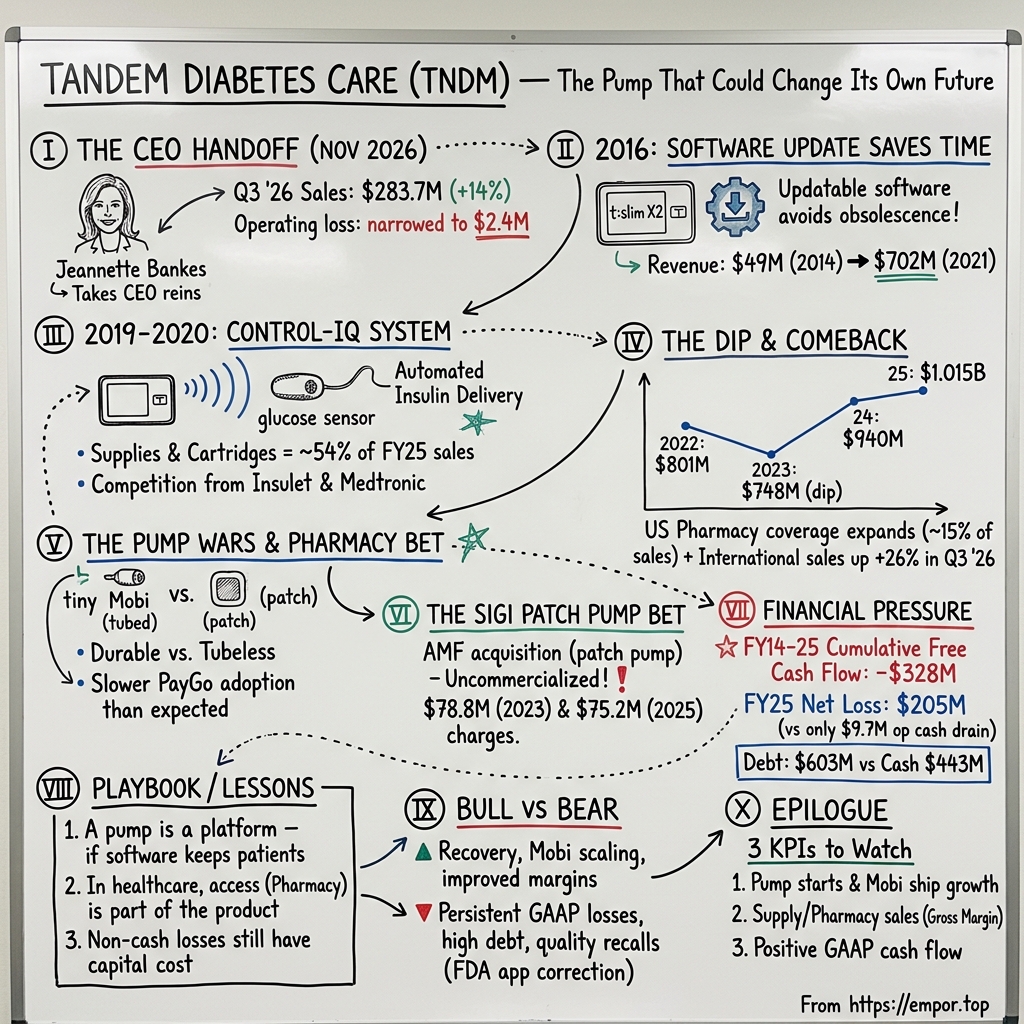
On Monday, November 16, 2026, a new chief executive walked into Tandem Diabetes Care's headquarters in San Diego. Jeannette Bankes did not come from the diabetes business. She came from GE HealthCare, where she had run the patient care solutions division, a business of about $3.1 billion that sells monitoring, diagnostic cardiology and anesthesia equipment to hospitals, and before that she had been president of global franchises at the eye-care company Alcon.1 Tandem's board set her base salary at $900,000 a year.1 The man she replaced, John Sheridan, was 70. He explained his decision with unusual plainness on the company's third-quarter call: he had to make a decision at some point.12 He would remain an employee to the end of the year and then advise the company as a consultant.1
The timing matters because Bankes did not inherit a quiet business. She inherited one in the middle of changing how it gets paid. Tandem makes insulin pumps, the small devices that people with diabetes wear to deliver insulin under the skin around the clock. For a person with type 1 diabetes, the device is not a gadget. It stands in for a pancreas that no longer works, and an error in either direction can mean a hospital visit. Tandem sells that responsibility to roughly 330,000 customers worldwide.2 In 2026 it was moving part of its American business from the old way pumps were paid for, as durable medical equipment bought upfront every four years, to a pharmacy model in which the patient picks up the pump and its supplies the way they would pick up a prescription. At the same time it was taking over sales in several European countries from the distributors who had handled them.2
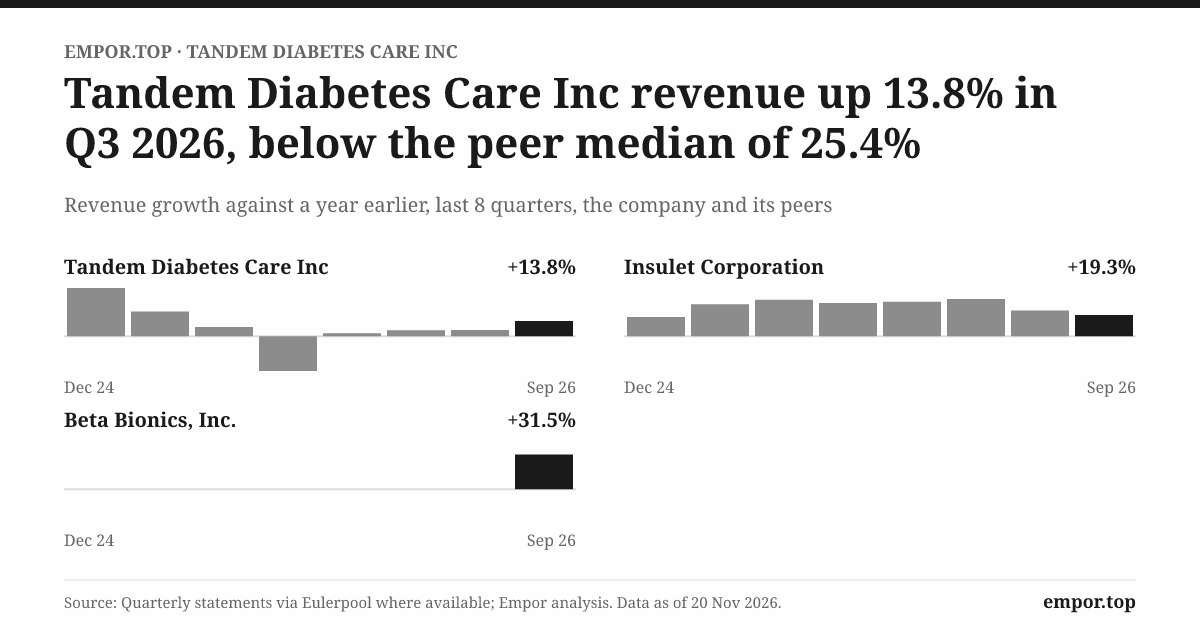
The newest numbers looked like a company finding its stride. In the third quarter of 2026, sales reached $283.7 million, up 14% on a year earlier and a record for any quarter.[^3]2 Gross margin, the share of each sales dollar left after paying to make the product, rose to 57%, up nearly three points.2 Operating loss, the bottom line before interest and tax, shrank to $2.4 million.4 For a company that had lost tens of millions of dollars a quarter for most of its history, that was close to break-even.
The direction through 2026 was the more interesting signal. Tandem lost about $17 million at the operating line in the first quarter, about $14 million in the second and about $2 million in the third, on sales that grew a little faster each quarter.4 Each extra dollar of revenue was falling through to the bottom line rather than being absorbed by new costs. That is the pattern a business shows when the fixed investment is already in place and the product is starting to pay for it.
Close is not the same as there. The quarter was still a loss, and it came after an important admission. The pharmacy model, which management had sold as the next engine of access and profit, was arriving more slowly than the company had expected. Chief financial officer Leigh Vosseller told analysts that the pace of the transition was more gradual than Tandem had initially anticipated, and that the share of American pumps sold through the new pay-as-you-go pharmacy route this year now looked more like 10% to 12%.2 So the new chief executive took over at the moment when the company's newest strategy had produced its first real test result, and it was a mixed one.
That is the tension at the centre of this story. Tandem sells life-sustaining technology to customers who must think hard before switching, and it has built that technology into a business that crossed $1 billion of sales in 2025.3 Yet over its life as a public company it has spent far more cash than it has generated. Three questions decide whether that changes. Can pump demand and the new sales channels keep growth going at a healthy rate? Is Tandem's technology and its base of users a defensible advantage against larger rivals, or just a good product in a crowded field? And can the company fund its ambitions, including an expensive bet on a patch pump, without leaning on dilution or debt?
The answers sit inside one consolidated company. Tandem has no controlling parent, and its accounts combine its own subsidiaries with intercompany dealings eliminated, so its pumps, supplies, sales channels and borrowings are the whole story.3 That makes the record unusually easy to judge. Every win and every mistake shows up in the same set of books.
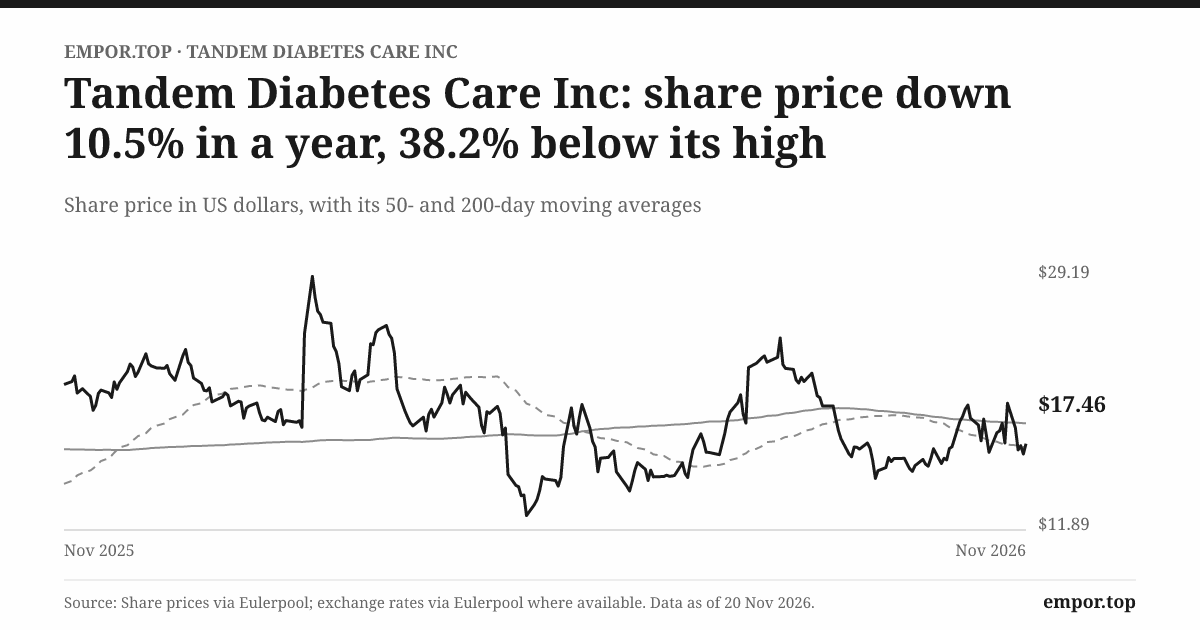
The market has judged it harshly. On November 20, 2026, Tandem's shares closed at $17.46, more than a third below their high of the past year, and the stock had at one point fallen about 90% from its peak over the past five years. The whole company was valued at about $1.3 billion, roughly 1.2 times its annual sales. That is the price of a business investors are not yet sure about.
The latest quarter is encouraging. But to understand why the market still hesitates, and why the company is worth hesitating over, the story has to go back to a much smaller Tandem, one that survived long enough to build the platform behind these numbers.
 Subscribe on LinkedIn
II. The Software Update That Bought Tandem Time
Tandem began life in January 2006, incorporated in Colorado before moving its legal home to Delaware two years later.5 Its chief executive for most of the early years was Kim Blickenstaff, who had already built and sold one San Diego medical company. He had been chairman and chief executive of Biosite, a diagnostics maker, from 1988 until its sale in 2007, and he had sat on the board of DexCom, the glucose-sensor company whose fortunes would later become intertwined with Tandem's.5 He took charge of Tandem in September 2007.5 Blickenstaff's bet was that the insulin pump business had been designed by engineers for clinicians, and that a pump designed around the patient would win.
The first product, the t:slim, went on sale in August 2012.5 It looked less like a medical device than a smartphone, with a color touchscreen and a slim case. Under that screen was a different way of pushing insulin. Instead of a mechanical syringe driven by a screw, the pump drew insulin from a flexible bag inside its cartridge, which let Tandem make it smaller than traditional pumps.5 That was the pitch: a pump people would not be embarrassed to wear.
The problem was that the people Tandem needed to persuade had already made a choice. An insulin pump is a routine as much as a device. A patient learns how to fill it, how to change the infusion set, what the alarms mean. Clinicians learn how to program it and teach it. Insurers in America typically paid for a pump once every four years, so a patient who bought a rival model was locked out of a Tandem purchase until the next cycle came around.5 A small company had to win converts one four-year window at a time, against bigger rivals who were already there.
The early financial record shows what that cost. In 2014 Tandem sold about $49 million of products and lost about $76 million at the operating line, meaning it spent roughly $2.50 for every dollar of revenue it brought in.35 By the end of 2018 it had piled up an accumulated deficit of $600.1 million, and it said plainly that it had financed itself mostly through share sales and borrowing, including cash raised through those sales.5 By the end of 2017 shareholders' equity had turned negative, and cash and short-term investments had fallen to about $14 million, a thin cushion for a company burning more than $60 million a year from operations.5
Then came the product that bought the company time. In October 2016 Tandem began selling the t:slim X2.5 In the same year it won FDA clearance for the Tandem Device Updater, a tool that let a patient plug the pump into a home computer and download new software, much as a phone downloads an update.5 No rival pump offered remote updates at the time, and Tandem said as much.5
The idea sounds obvious now. It was not obvious in an industry where the software in a pump was effectively frozen on the day it left the factory. The updater attacked the four-year problem directly. If a patient bought an X2 and Tandem later released a better feature, the patient did not have to wait four years for a new pump. The feature could come to them. Tandem proved the point in September 2017, when it offered every in-warranty X2 user integration with DexCom's G5 sensor through a software update, and again in August 2018, when it pushed out Basal-IQ, its first automated feature, which used readings from DexCom's G6 sensor to pause insulin when blood sugar was predicted to fall too low.5 It also said the updates had so far been free, though it reserved the right to charge for some in future.5
The transition was not clean. Moving customers to the X2 left Tandem holding older pumps that fewer people wanted, and the company took charges for excess and obsolete inventory as customers moved away from previous models.[^7] It was a small version of a pattern that would return later: every time Tandem changes its product line, it pays a toll in the period of change.
What the X2 changed was the shape of the business. Tandem stopped being a company that sold pumps and became one that sold a connected system: a pump, the software inside it, a link to a glucose sensor made by someone else, and the cartridges and infusion sets a patient uses up every few days.5 A pump is a one-time sale every four years. Supplies are bought for every one of those four years. Each pump placed in a patient's hands therefore turned into a stream of supply orders, and each software update gave that patient a reason to stay.
The cash to build all this came from investors, again and again. In 2018 alone Tandem raised about $173 million net in two share offerings, in February and August, collected about $30 million more when investors exercised warrants that had come with an October 2017 offering, and used part of the money to repay an $87.7 million term loan.5 Those offerings diluted earlier shareholders heavily, and they were not a side note to the growth story. They were the fuel for it. A company that loses money while building a platform has to buy its runway, and Tandem bought it from the equity market.
The money bought engineers and salespeople, and it bought one hire who would shape the next decade. In April 2013 Tandem appointed John Sheridan as executive vice president and chief operating officer.10 He was not a diabetes specialist. He had been chief operating officer of Rapiscan Systems, which makes airport security scanners, and before that ran research, development and operations at Volcano, a maker of imaging catheters for the heart, and operations at the heart-monitoring company CardioNet and the imaging company Digirad.10 He held a chemistry degree from the University of West Florida and an MBA from Boston University.10 His career had been spent making complicated devices reliably and at scale, which is exactly the skill a startup with one touchscreen pump and rising demand needed. In March 2019, as Tandem prepared for its first fully automated insulin system, he became president and chief executive, and Blickenstaff stepped back.105
The handoff was a quiet statement about what kind of company Tandem had become. The founding era needed someone to convince investors to fund a long shot. The next era needed someone to build pumps on time, scale manufacturing and keep quality high. Sheridan's tenure, from that 2019 appointment to his retirement at the end of 2026, will cover both the best years in Tandem's history and the worst.
The runway was used well, at least in the sense that sales took off. Revenue rose from about $49 million in 2014 to about $702 million in 2021, a fourteen-fold increase in seven years.3 By 2018 Tandem had shipped about 84,000 pumps over four years, most of them in the United States.5 But the platform had only proved that Tandem could deliver software to pumps already in the field. The next test was whether the software could do something patients could not do for themselves: decide how much insulin to give.
III. Control-IQ Turned a Pump Into a System
On December 13, 2019, the FDA granted Tandem's request to authorize Control-IQ, software that would run on the t:slim X2 and adjust insulin delivery automatically based on readings from a glucose sensor.6 Four weeks later, on January 15, 2020, Tandem began shipping pumps with Control-IQ to new American customers, and it told existing in-warranty X2 users that they could add the feature for free through the updater, once their doctor wrote a prescription and they completed online training.7 Hundreds of thousands of patients with old hardware could suddenly own something close to a new product.
To understand why that mattered, picture what managing type 1 diabetes involves without it. A patient checks glucose, estimates the carbohydrates in a meal, calculates a dose, and corrects through the day as exercise, stress, illness and sleep move blood sugar up and down. Night is the hardest part, because the patient is asleep and cannot react. Control-IQ worked like a careful co-pilot. Every few minutes it read the sensor, predicted where glucose was heading, and raised or lowered the background insulin rate, adding small corrections when glucose climbed too high.6 The patient still announced meals. The software handled much of the rest.
The feature arrived just as the business was scaling, and the combination showed up in the revenue line. Sales rose about 38% in 2020 and another 41% in 2021, reaching roughly $702 million, and then climbed to about $801 million in 2022.3 In 2021 Tandem even reported a small operating profit, about $23 million, the only full year in its history so far with a profit at that line.3 Operating cash flow that year was about $111 million.3 For a brief moment the story looked complete: an updatable platform, a clinically tested algorithm and a growing base of users buying supplies.
In 2025, supplies and other items made up about $551 million of sales, or about 54% of the total, against about $464 million from pumps.3 More than half of Tandem's revenue that year came from patients who already used its products.
That figure is the strongest evidence for the bull case, and it should be read precisely. Tandem does not report a recurring-revenue percentage, a standard customer contract, a minimum commitment, a retention rate or a churn rate.3 Supply revenue repeats because patients keep using the pump, not because any patient is contractually bound to. The company does not publish how many customers renew with Tandem at the end of their four-year cycle, or how many leave for a rival.
The case for an advantage rests on three things. First, clinical proof. Control-IQ came to market on the back of a pivotal trial, and the FDA authorization set out the data behind it.6 Second, the installed base gives the company a large pool of patients who already know its interface and a large pool of clinicians who know how to train them.2 Third, choice. Tandem's pumps work with sensors made by other companies, which means a patient does not have to accept a single company's sensor to use a Tandem pump.
Each of those advantages has a limit. Clinical proof can be matched: automated insulin delivery is no longer unique to Tandem, and the company names five main competitors in its annual report: Beta Bionics, Insulet, Medtronic, mylife (formerly Ypsomed) and Sequel.3 Insulet, maker of the tubeless Omnipod, sold about $2.7 billion of products in 2025, roughly two and a half times Tandem's sales, and grew about 31% that year, nearly four times Tandem's rate.8 A rival that much larger and growing that much faster is not losing the race for new patients. The installed base is real, but without retention data it is a stock of customers, not a proven moat. And sensor choice cuts both ways. Because Tandem does not make the sensor, the part of the system that generates the data belongs to someone else, and those sensor makers can work with other pumps too.
Switching costs are plausible. Changing a pump means a new training session, new habits, new alarms and, often, a new approval from an insurer. A patient whose blood sugar is well controlled has every reason not to experiment. But plausible is the right word. Tandem does not publish win-loss rates or churn, so the size of that switching cost has not been demonstrated in its own numbers. The best one can say is that the evidence supports a real product and a loyal-looking customer base, and leaves the durability of that loyalty unproven.
The years that followed Control-IQ also showed that a great product does not protect a company from its own channel. The software made the pump better. It did not decide who could get one, how often, or who would pay. Those questions sat with insurers, distributors and pharmacy benefit managers, and in 2023 they hit Tandem's revenue as hard as any competitor ever had. That is why the company's next strategic bet was not an algorithm but a payment model.
IV. When the Growth Story Broke—and Came Back
The four-year cycle that had once worked against Tandem came back to bite. In 2023 sales fell about 7%, from roughly $801 million to about $748 million, the first annual decline in the company's history as a public company.3 The operating loss widened to about $233 million, the worst in Tandem's history.3 The share price, which had been one of the best performers in medical technology during the Control-IQ boom, collapsed.
The popular explanation at the time was that Tandem had lost its edge to Insulet's tubeless pump. The record shows something more complicated, and partly self-inflicted. Starting in September 2022, Tandem offered a program called Tandem Choice to eligible t:slim X2 customers in the United States. Buy an X2 now, and you could later switch to Tandem Mobi, the company's next and much smaller pump, for a fee once it became available.3 The program was designed to stop patients from delaying a purchase while they waited for Mobi. But the accounting rules required Tandem to defer part of the revenue on those pumps until it knew whether customers would take the upgrade.3 Revenue that would otherwise have landed in 2022 and 2023 sat on the balance sheet.
When the program ended, the deferred revenue came back. Customers could exercise their option through December 31, 2024, and Tandem recognized the remaining deferrals at that date, adding about $30 million of net pump sales to 2024.3 That flattered 2024's 26% growth, to about $940 million, just as the deferral had depressed earlier years.3 So part of the dip and part of the rebound were the same money moving across the calendar. Some of the 2023 fall also reflected the timing of pump replacements, because many patients who had bought pumps during the Control-IQ surge were not yet due for new ones.13
Strip those effects out and the business underneath was growing, but not like before. In 2025 revenue reached about $1.015 billion, up about 8%.3 Pump shipments rose to more than 86,000, from nearly 81,000 the year before.3 Over the three years from 2022 to 2025, sales grew about 8% a year; over the decade from 2015, they grew about 30% a year.3 The rebound was real, but the comparison that matters is not 2025 against 2023. It is the new growth rate against the old one, and the new one is far lower.
That is the consensus narrative corrected. The 2023 drop was not proof that the business was broken, because much of it came from timing and accounting. But the recovery is not proof that the old growth engine is back either. Tandem has become a larger, slower company, and the question is whether it can speed up again.
Management's answer was to change how Tandem gets paid in America. Historically, insurers treated insulin pumps as durable medical equipment. The patient's medical benefit paid for the pump upfront, typically every four years, and supplies were billed separately.3 In 2025 Tandem began a multi-channel strategy that allowed reimbursement through the pharmacy benefit as an alternative.3 In the pharmacy model, there is no large upfront pump payment. The patient pays as they go, and Tandem collects more on each month of supplies, allocating part of that supply revenue to the pump it has already handed over.3
The appeal is simple. A pharmacy benefit can be easier to access for some patients than a medical-equipment claim, and paying monthly removes the shock of a large upfront purchase. It is also how Insulet has long sold Omnipod. The cost is equally simple. Tandem warned that it might initially see lower sales and gross profit when pumps ship, which it expected to make up through higher supply sales over time.3 It is trading a big check today for a longer stream of smaller checks, and the trade only pays off if patients keep using the product.
By the third quarter of 2026, the early results were in. Pharmacy accounted for 15% of American sales.2 Formulary coverage, the share of insured Americans whose pharmacy plans listed Tandem's products, had reached about 50%, which Vosseller said was well ahead of the company's expectations.2 Net supply prices in the pharmacy channel exceeded $350 a month, and she added that they were averaging closer to $400.2 Coverage and price were better than planned.
Adoption was not. Only 12% of pump shipments that quarter went through pharmacy, and only 7% of the installed base ordering supplies used it.2 That is why the full-year estimate for pay-as-you-go pumps fell to 10% to 12%.2 Access had widened faster than patients and clinicians were changing their habits. For a channel strategy, that is an important distinction. Coverage is a door. Patients still have to walk through it, and many seem content with the route they already know.
A second growth vector came from outside America. International sales rose 26% in the third quarter, to about $93 million.2 Tandem launched direct operations in the United Kingdom, Switzerland and Austria, and began in France the same week as the call.2 Direct sales were 18% of international revenue that quarter, and management expected about 30% of the international installed base to be served directly by the end of 2026 and about half by the end of 2027.2 Selling direct means keeping the margin a distributor would have taken, but it also means hiring staff, holding inventory and absorbing a transition cost Tandem put at about $15 million for the year.2 Most international sales still went through distributors in 2025, and the company described distributor sales as the vast majority of its international business.3
The direct model also brings currency into the operating story. When a distributor buys in dollars, the exchange risk sits with the distributor. When Tandem sells to a British clinic in pounds or a Swiss patient in francs, the risk is Tandem's own. The company began hedging part of its forecast international revenue and costs with currency forwards in 2025, and by September 2026 the hedges covered about $135 million of notional value, up from about $68 million at the end of 2025.34 It does not hedge every exposure, and it says the cost of hedging can sometimes make it uneconomic.3 As the direct footprint grows—from 18% of international revenue in the third quarter toward serving about half of the international installed base by the end of 2027—swings in the euro and the franc will matter more to reported growth than they did when distributors absorbed them.
The split between the two halves of the business shows why both vectors matter. In 2025 American sales were about $707 million and international sales about $308 million.3 Inside the United States, pumps and supplies were almost exactly equal, each about $353 million to $354 million.3 Outside it, supplies were nearly twice pump sales, about $198 million against $110 million, which is what a more mature installed base looks like: years of customers who keep reordering.3 Tandem's gross margin rose in 2025, and the company attributed the improvement mainly to better average selling prices and lower non-manufacturing costs, not simply to volume.3 That is an early sign that the company can extract more value from each patient, though one year of improved pricing does not yet establish pricing power.
So the channel changes do expand the pool of people who can buy a Tandem pump. What they cannot do on their own is show that access turns into durable economics. That proof lives in three places: pump starts, supply revenue and margins. And it lives in a market where the competitors are not standing still.
V. The Pharmacy Bet Meets the Pump War
Picture the path a newly diagnosed teenager takes to an insulin pump. An endocrinologist recommends automated insulin delivery. A diabetes educator walks the family through the options. An insurer decides whether the pump is covered, under which benefit and at what cost to the family. If it is covered through the pharmacy, a pharmacy benefit manager decides which brands are on its list and on what terms. If it is covered as medical equipment, a distributor may handle the paperwork and the shipping. Only at the end of that chain does the teenager choose a device, and the choice is often narrowed long before they see one.
That chain is the real battlefield. A pump company does not only compete on the screen of its device. It competes for the educator's recommendation, for a place on the formulary, for a distributor's attention, and for the payment terms that make the purchase easy. Tandem's pharmacy bet is an attempt to move its products up that chain, and it puts the company into direct contact with the most powerful buyers in American healthcare.
Start with the competitors. Insulet's Omnipod is a tubeless patch pump: a small pod stuck directly on the skin, controlled by a separate device, with no tube connecting a pump on the belt to an infusion site. It is disposable every few days and sold largely through pharmacy.8 Medtronic is a diversified medical giant with its own insulin pumps and sensors. Beta Bionics sells a pump built around a different automated-dosing approach. Ypsomed's mylife and Sequel round out the list Tandem names in its filings.3 Tandem does not publish its share of new pump starts against these rivals, and no figure in its filings shows whether it is winning or losing share.
Tandem's answer has been to fill the gaps in its own line. Tandem Mobi, its smallest pump, can be worn on the body or clipped to clothing and controlled from a phone. By the third quarter of 2026, Tandem was selling Mobi in 12 countries outside the United States.2 It was also seeking FDA clearance for Mobi Tubeless, which uses an extended-wear infusion site that turns Mobi into a patch device stuck to the skin.32 Sheridan said he expected approval in the fourth quarter of 2026 and full commercial availability in the first half of 2027.2 Under questioning from a Wells Fargo analyst, he acknowledged that the first filing covered only abdominal wear, with other wear locations and insulin types to come after clearance.2
Mobi Tubeless is Tandem's most direct response to Omnipod, and it should be judged as one. A clearance would be a regulatory milestone, not a commercial result. What matters is how many patients start on it, whether they stick with it, how many supplies each patient buys, and whether those patients are new to Tandem or simply moving from an X2. A Deutsche Bank analyst asked what formulary coverage Mobi Tubeless would have at launch. Vosseller described the existing coverage as the starting point.2 That is a sensible answer, but it means the product will enter the market needing the same payer work the rest of the pharmacy business still needs.
The volume picture is solid but not spectacular. Tandem shipped about 33,000 pumps worldwide in the third quarter, up 12%, with nearly 23,000 of them in the United States.2 About seven in ten new American customers came from multiple daily injections rather than from another pump, which suggests Tandem is winning patients who are new to pumping rather than mostly trading customers with rivals.2 That is a meaningful clue, because a company that grows by converting injection users is expanding the market, not just fighting over it.
Now the forces behind the moat, weighed one at a time. Clinical outcomes and an established installed base support trust, and in a life-critical product trust is a real asset. Sensor interoperability and remote updates give patients flexibility and extend the useful life of each pump. Those are genuine product strengths. Against them stand buyers with real power. Insurers decide coverage. Pharmacy benefit managers decide formulary placement. Distributors control much of the international channel and a large slice of American receivables: one distributor accounted for 10.7% of 2025 sales and another for 13.4%, and they held about a quarter of year-end receivables between them.3 Each of these gatekeepers limits how much Tandem can charge.
Price realization is where the pharmacy model gives the first concrete evidence. Supply prices around $400 a month in the pharmacy channel suggest Tandem is not giving away its products to win formulary placement.2 That is a better result than many skeptics expected. But it comes with a trade-off. In the pharmacy model Tandem collects over time, which affects how quickly cash arrives, and the company's receivables were already stretching. Customers took about 60 days to pay in 2025, against 44 days in 2024.3 Some of that reflects the shift in channels and payers. Tandem discloses its allowance for bad debts but not how long its receivables have been outstanding, so outsiders cannot tell how much of the lengthening comes from slower payers rather than from new billing mechanics.34
This is also where the leadership change matters. Sheridan's plan was clear: tubeless Mobi, a fully closed-loop system, and pharmacy coverage.1 He said the pivotal study for fully closed loop, a system that would no longer need the patient to announce meals, would begin in the fourth quarter of 2026 with more than 300 and perhaps 400 participants, with an FDA submission by the end of 2027 and a product in 2028.2 Those are the commitments Bankes has inherited. Her career at GE HealthCare and Alcon gives her experience running large healthcare businesses, but none of that is evidence of how she will execute at Tandem.1 Her first calls will be the first test: whether she keeps the channel assumptions, tightens them, or resets them, and how clearly she explains any change from Sheridan's plan.
Tandem's edge, then, is credible but narrower than its best supporters claim. It has a differentiated product, real software capability and a growing base of patients buying supplies. What it has not shown, in any figure it publishes, is that patients stay with it at a higher rate than they would with a rival, or that it can win new patients at the pace of the market leader. And to close the gap with Omnipod in tubeless pumps, it had already spent heavily on a Swiss startup whose product, at the end of 2025, was still not on sale.
VI. The Patch Pump That Cost More Than a Press Release
On January 19, 2023, Tandem completed the purchase of AMF Medical, a Swiss company developing the Sigi patch pump.9 The deal reflected a hole in Tandem's line. Every Tandem pump to that point used tubing between the pump and the infusion site. Insulet had built a large business on removing that tube. If patients increasingly wanted a device stuck to the skin with nothing hanging from it, Tandem needed one.
The price came in pieces. Tandem had already invested CHF 8 million in AMF in 2022, paid CHF 62.4 million in cash when the deal closed, and agreed to pay up to CHF 129.6 million more in earnouts if AMF hit certain milestones.93 Because nearly all the value sat in a single unfinished asset, Tandem accounted for the deal as an asset purchase and immediately expensed $78.8 million as acquired in-process research and development, meaning research it had bought but could not yet use.3 That charge was one reason 2023's operating loss was so large.
Then the terms changed. In January 2025, Tandem signed an amended agreement that replaced the earnouts with a fixed payment of CHF 68 million: CHF 40 million paid in January 2025 and CHF 28 million in October 2025.3 All other payment obligations were removed. Tandem recorded the whole CHF 68 million, about $75.2 million, as another in-process research and development charge in the first quarter of 2025, which explains why that quarter's operating loss ballooned to about $121 million.34 The currency moves on the final payment added a further realized foreign-exchange loss of about $3.4 million.3
Add it up in francs and Tandem committed about CHF 138 million to AMF, against a maximum of about CHF 200 million under the original deal. Seen one way, the revision was a reasonable trade: Tandem paid less than the worst case and removed uncertainty. Seen another, Tandem paid the bulk of the value before the product reached the market, rather than paying only when milestones were met. The earnout structure existed to protect the buyer, and the revision gave that protection up in exchange for certainty. Both charges belong in the record of one bet.
The status of that bet at the end of 2025 was blunt. Tandem said the Sigi patch pump continued to be under development and was not yet commercially available.3 The company now describes it as the technology behind a next-generation Mobi patch pump designed for further miniaturization, a step beyond the Mobi Tubeless awaiting clearance.3 In other words, the tubeless product Tandem expects to sell first is not Sigi. It is a modified Mobi with a new infusion site. Sigi's technology is two steps away from revenue.
There is no sufficiently comparable deal to say whether Tandem overpaid. Small patch-pump startups rarely sell, and their prices depend on how close they are to clearance. What can be said is that the history weakens any claim that Tandem has proven disciplined capital allocation. The company bought a development-stage asset, wrote it off twice through acquired research charges, and still has no revenue from it. That does not mean the purchase was a mistake. It means its value is still an expectation.
Set the bet against the core business and the scale becomes clearer. Tandem spent about $193 million on research and development in 2025, about 19% of sales.3 That is a large commitment for a company that is not yet profitable, and it shows that the bulk of Tandem's product spending happens inside the company, not through deals. Capital spending on property and equipment was only about $20 million, about 2% of sales.3 Making pumps does not require heavy factories. Designing and testing them does require a lot of engineers, which is why Tandem's operating expenses rose to about $733 million in 2025 from about $589 million a year earlier, a jump that included the AMF charge, a $20 million settlement of a multi-year patent dispute with Roche, restructuring and a facility impairment.3
AMF was not Tandem's only acquisition. In 2022 it also bought Capillary Biomedical, a developer of extended-wear infusion sets, assuming a $4.7 million note that comes due only when the first product is sold or licensed.3 That deal was much smaller and aimed at a specific capability: an infusion set that a patient can wear longer, cutting the number of changes. Its terms tie the payment to commercialization, which is the structure AMF's original earnouts had and its revision dropped.
The investor test is not whether Sigi works in a lab. Many patch pumps have worked in labs. The test is whether Tandem can bring a differentiated patch pump to market at a cost and price that earns a return on the roughly $150 million it has already expensed for AMF. Until then, the deal is a reminder of a broader truth about Tandem's economics: the company can report large losses that do not use much cash in the year they are recorded, and still need outside money over time.
VII. The Loss That Was Mostly Noncash Still Needed Cash
Look at Tandem's 2025 income statement and the result looks alarming: a net loss of about $205 million.3 Look at its cash-flow statement and the picture changes. Operating cash outflow for the year was only about $9.7 million.3 The gap between those two numbers, nearly $200 million, is the clearest way into how Tandem's finances actually work.
The difference comes from charges that reduce profit without using cash in that year. The biggest in 2025 was the $75.2 million AMF charge. Cash had gone out for it, but because Tandem treats asset purchases as investing rather than operating outflows, the charge was added back when computing operating cash flow.3 Stock compensation, paid in shares rather than cash, and depreciation, which spreads the cost of past equipment purchases, also reduced profit without reducing current operating cash. Altogether, noncash adjustments added about $218 million back, while changes in working capital, mostly inventory and receivables, used about $23 million.3
Over the long run the gap is even larger. From 2014 to 2025 Tandem reported cumulative net losses of about $1.1 billion, while cumulative operating cash outflow was only about $45 million.3 A reader seeing that comparison might conclude the losses were an accounting fiction. They were not. Over the same twelve years cumulative free cash flow, operating cash minus spending on equipment, was negative $328 million.3 And that figure does not include the cash spent on acquisitions like AMF, which runs through investing activities. Stock compensation is also not free. It does not use cash, but it hands shareholders' ownership to employees, which is the same thing in a different currency.
The balance sheet shows where the money came from and how it moved. Cash and short-term investments peaked at about $624 million at the end of 2021, after the Control-IQ boom and its financing.3 By the end of 2025 they had fallen to about $293 million.3 Then Tandem went back to the market. In February 2026 it sold $300 million of convertible notes due in 2032 that carry no interest at all, receiving about $291 million after fees.34 By September 30, 2026, cash and short-term investments were back up to about $443 million.4
The debt deserves to be separated from the company's other obligations. At the end of September 2026, Tandem owed convertible notes with a book value of about $603 million: the zero-coupon 2032 notes and $316 million of 1.5% notes due in 2029.43 It also had operating lease obligations of about $134 million at the end of 2025 for its offices and facilities, which are a real fixed cost but not borrowings.3 Against $443 million of cash, the notes left Tandem with net debt of about $160 million.4
A zero-coupon convertible note is a clever instrument. Tandem pays no interest. In exchange, holders get the right to convert their notes into shares if the stock rises enough. If the share price stays low, Tandem repays the principal in 2032. If it rises a lot, holders convert, and existing shareholders are diluted. To soften that, Tandem paid $15.3 million for capped calls, a hedge that offsets dilution up to a set share price.34 The 2029 notes carry a similar hedge with a cap initially set at $42.01 a share.3 The arrangement is cheap in the short run. In the long run its cost depends on the share price: the better Tandem does, the more of the upside goes to noteholders above the cap.
Tandem has used this tool before. In March 2024 it issued the 2029 notes, using about $246 million of the proceeds to buy back older notes due in 2025 and $30 million to repurchase shares from the note buyers.3 Each refinancing has kept the lights on at a low interest cost, but each has also pushed the repayment question further out rather than eliminating it. The company has never paid a dividend.3
Below the operating line, the cash pile has done less work than it used to. When interest rates were higher and the balance was bigger, Tandem earned about $22 million of interest income in 2024.3 In 2025 interest income fell to about $14 million as cash shrank, and it was more than offset by about $8 million of interest expense, a $5 million currency loss and a $14 million loss on an equity-method investment, a stake in another company whose losses Tandem must share in its accounts.3 The net result was about $13 million of other expense.3 The cash is invested in high-grade securities chosen for safety and liquidity, which is the right posture for a company that may need the money.3 But it means the treasury is a cushion, not a profit center. It cannot offset an operating loss.
There is also a commitment that does not appear among the borrowings. At the end of 2025, Tandem had about $365 million of purchase obligations to suppliers, about $268 million of them due within a year.3 Those are the components and materials it has promised to buy to keep production running. In a growing business they are routine. In a business whose channel transition is running slower than planned, they are a reminder that forecasting demand wrongly ties up cash in inventory, as the X2 transition did a decade earlier.
The receivables deserve one more look, because they are where the new channels show up in cash. Net receivables rose to about $180 million by September 2026 from about $166 million at the end of 2025.43 Tandem's provisions for doubtful accounts, about $9.5 million in 2025, were close to the amounts it actually wrote off, which suggests that bad debts are a steady cost of doing business with many payers rather than a sudden problem.3 But the rise in days to collect from 44 to 60 between 2024 and 2025 means more of Tandem's money is tied up waiting for insurers and distributors to pay.3 The company publishes no ageing schedule, so outsiders cannot see how much of that is overdue.
The latest quarter shows real progress on profit. Operating loss narrowed to $2.4 million, and Tandem's own adjusted measure of profit before interest, taxes, depreciation and certain other charges was positive for a fifth straight quarter, at about 6% of sales.42 Operating expenses rose only 4% while sales rose 14%, which is exactly the kind of leverage a company needs to turn growth into profit.2 But adjusted profit excludes the stock compensation and other charges that cost shareholders real money, and one good quarter is not a trend. The test is not a single near-break-even quarter. It is several consecutive quarters of positive GAAP operating profit and cash generation while research spending and new launches continue.
VIII. Playbook: Business & Investing Lessons
Go back to the X2 and its updater in 2016. The promise was that the pump a patient bought would keep getting better through software. A decade later, revenue has grown from about $49 million to more than $1 billion, and the company has still consumed $328 million of free cash flow over that span.3 Tandem's history is a lesson in how a great product can build real scale without yet building durable returns.
The first lesson is about platforms. A pump can be a platform, but only if each upgrade keeps the patient and pays the company. The updater was one of the smartest ideas in the industry. It let Tandem give Control-IQ to existing patients for free and turned the four-year insurance cycle from a trap into an opportunity. But free updates are a gift to the installed base, not a revenue line. The value of the platform is captured only in supplies and in the next pump purchase. If a patient takes the free upgrade and then leaves at the end of the cycle, the platform has made a great product without making a durable business. Founders who build updatable hardware should remember that software improvements must eventually show up in retention or price, or they are only a cost.
The second lesson is that in healthcare, access is part of the product. Tandem spent years building a better pump, then discovered in 2023 that program design, reimbursement timing and replacement cycles could move its revenue more than any rival could. The pharmacy model is a product decision as much as a finance one. It changes who can buy, when they pay and how often. And the 2026 result shows the limits of access on its own: Tandem won formulary coverage for about half of insured Americans and good prices, but patients and clinicians adopted the new route more slowly than planned.2 A door opened by an insurer still needs a doctor to recommend it and a patient to walk through. In regulated markets, distribution is not something that happens after the product. It is the product.
The third lesson is that a technical milestone is a beginning, not a business. Tandem bought AMF to get a patch pump, paid roughly CHF 138 million, booked about $154 million of charges across two years and, at the end of 2025, still had no product on sale.3 Its first tubeless product is a modified Mobi, not Sigi. Investors should translate every clearance, trial result and acquisition announcement into the same sequence of questions: when does it launch, how is it reimbursed, how many patients start on it, and how many stay? Tandem's own record shows that each step can take years and cost more than the first press release implied.
The fourth lesson is that noncash losses still have a capital cost. Tandem's income statement makes the losses look larger than its cash burn in most years, and that gap is real. But the company has still needed repeated equity offerings, a series of convertible notes and the ownership it hands employees in stock awards to stay in the race. Each of those choices shifts value away from existing shareholders, through dilution, through future conversions, or through the repayment obligations that come due. A company can be cash-light in a given year and capital-hungry over a decade, and Tandem has been both at once.
IX. Analysis & Bear vs. Bull Case
The third-quarter call on November 5, 2026, captured both sides of Tandem in a single hour. In the prepared remarks, management reported a record quarter, higher margins, a narrowing loss and reaffirmed guidance.2 In the questions, Piper Sandler's Matthew O'Brien pressed on the pharmacy arithmetic, and Vosseller conceded that the guidance assumptions now looked more like 10% to 12% of pumps through pay-as-you-go.2 TD Cowen's analyst asked why Sheridan was stepping down now.2 That is the story in miniature: operating progress, a strategy behind its own timetable, and a leadership transition in the middle of it.
The bull case starts with momentum. Third-quarter revenue grew about 14%, gross margin reached 57%, and operating margin improved to about negative 1%, from about negative 8% a year earlier.24 Pump shipments grew 12%, most new American customers came from injections rather than rival pumps, and supplies already account for more than half of sales.23 Management said pharmacy coverage and pricing came in ahead of plan, and international direct sales let Tandem keep margin it used to share.2 The product pipeline has near-term catalysts in Mobi Tubeless and a closed-loop trial.2 On this view, Tandem is a company that has done the hard work of building its platform and is now beginning to reap operating leverage.
The bear case starts with the long view. Growth over the past three years averaged about 8% a year, well below the company's history and far below its largest competitor.38 GAAP losses continue, cash generation has not been proven, and the company spent about 19% of sales on research and development in 2025 just to stay competitive.3 Insulet is more than twice Tandem's size and still growing faster, Medtronic has a much larger balance sheet, and smaller rivals keep entering the field.83 Tandem has convertible notes worth more than its cash, and its growth depends on a channel shift patients are adopting more slowly than planned.
Run Tandem through Michael Porter's five forces and the structure becomes clear. Rivalry is intense: Tandem and five named competitors fight over the same patients, and the largest is growing faster.3 Buyer power is high, because insurers, pharmacy benefit managers and distributors decide which pumps are covered and at what price, and two distributors each account for more than a tenth of sales.3 Supplier power is moderate but real, because the sensors that make automated delivery work are made by other companies. The threat of new entrants is limited by regulation and clinical evidence, since a new pump needs FDA clearance and trials, but it is not zero, as Beta Bionics and Sequel show. The threat of substitutes is the most interesting force: a closed-loop system that works well enough, or a future therapy that reduces the need for insulin, could change the market's shape over time.
Hamilton Helmer's seven powers sharpen the moat question. Tandem's strongest candidate is switching costs: retraining, new routines and insurance approval make patients reluctant to change pumps. But Tandem does not publish retention or churn, so the power is plausible rather than proven. Its second candidate is a form of process power in software: the ability to update pumps in the field and the experience of running a clinically validated algorithm. Rivals have caught up on automated delivery, which narrows that edge. Tandem lacks scale economies against Insulet, which is far larger, and it lacks a cornered resource, since its sensors come from partners and its algorithm is not unique. Network effects are weak in insulin pumps. Brand matters, especially with clinicians, but brand alone does not stop a patient choosing a tubeless rival. The verdict is that Tandem has real product strengths and a plausible switching-cost advantage, but no power that has been demonstrated in its published numbers.
Trust is part of that moat, and the FDA record shows how fragile it can be in a device that runs on software. In March 2024 Tandem began correcting version 2.7 of its iPhone app, which could crash and relaunch repeatedly, draining the pump's battery through constant Bluetooth communication. A dead battery stops insulin delivery.11 The FDA classed it as the most serious type of recall, covering 85,863 devices in the United States, with 224 reported injuries as of April 2024 and no deaths.11 A follow-up notice in August 2024 said some users were still experiencing battery drain after the first fix, and a further version followed.11 In July 2025 Tandem issued a correction for certain t:slim X2 pumps after finding a speaker wiring problem that could trigger an error stopping insulin delivery; 59 injuries had been reported and no deaths, and the FDA again assigned its most serious classification.12 The same software capability that lets Tandem improve its pumps remotely also lets a faulty update reach thousands of patients at once. The investor's job is to track whether corrections recur and how fast they are fixed, not only how many products launch.
Management incentives deserve attention too. Sheridan's reported compensation for 2025 was about $6.9 million, of which about $5.4 million was stock awards, down from about $8.5 million in 2024.10 Shareholders approved the 2025 pay plan with about 97% support.10 He even asked that about $300,000 of his targeted equity awards go to other executives to reduce stock dilution.10 Sheridan owned less than 1% of the company, and all current directors and executive officers together owned about 2.1%.10 The company also discloses that Sheridan and Vosseller share a primary residence, with the CFO reporting to the CEO, a relationship that puts weight on the board's oversight.10 The largest holders are institutions such as BlackRock, Vanguard and Sessa Capital, with no controlling shareholder.10 Management has a stake, but a small one relative to the size of the company.
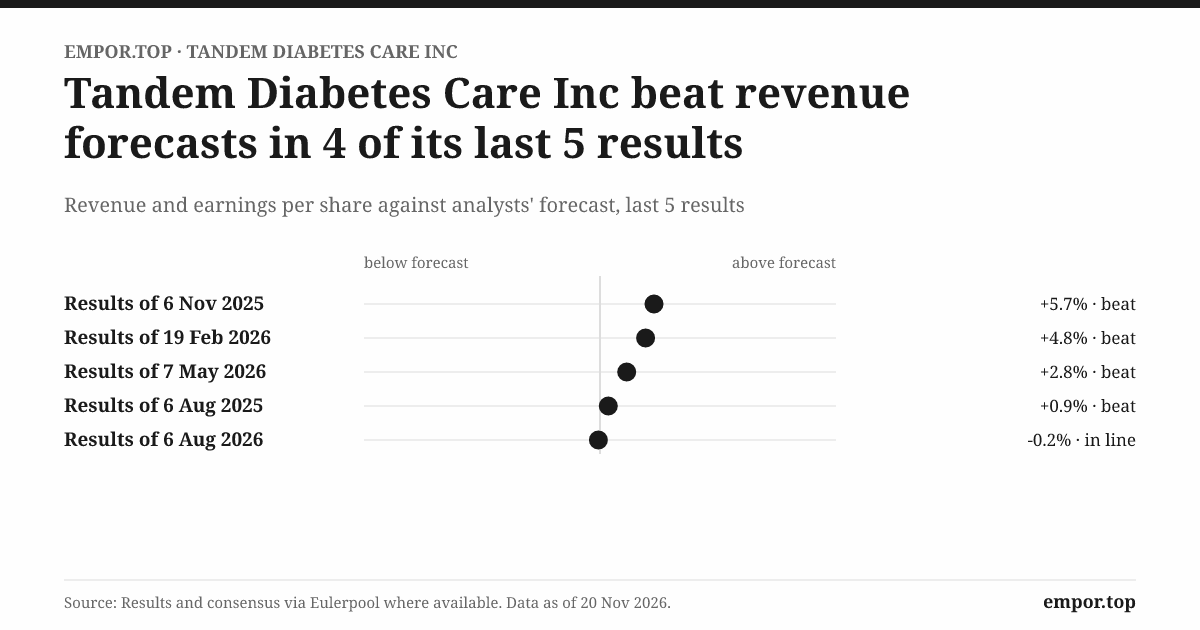
The credibility test is visible across Tandem's own calls. Management reaffirmed 2026 guidance while acknowledging that pharmacy adoption had fallen short of its initial assumptions.2 That is better than a surprise miss, and the explanation came with numbers: shipments, installed-base share, coverage and price. What investors will watch is whether the next update revises the adoption curve with operating evidence or simply moves the date.
Imagine a skeptical activist taking a large stake and writing to the board. The letter would not attack the product. It would attack the spending. Tandem spends about a fifth of its sales on research, has written off two large charges on a patch pump that has not reached the market, and runs a closed-loop program, a tubeless Mobi, a next-generation Mobi, extended-wear infusion sets and sensor integration at once.3 The activist would ask whether a company of Tandem's size, competing against a rival more than twice as large, can afford to pursue every front, or whether it should concentrate its money where it has the clearest edge. The letter would also point to the pattern of financing: each convertible issue has bought time at a low coupon, but the company has not yet shown it can run for several years without new capital.
The same letter would ask about disclosure. A company that rests its investment case on an installed base and recurring supplies does not publish retention, churn, new-patient starts by source or receivable ageing. Those are the numbers an outside owner would need to judge whether the platform really keeps patients. Management has given more channel detail in 2026 than ever before, including pharmacy shares of shipments and installed base, and that transparency deserves credit.2 But the most important number for a platform business, how many patients stay at the end of their cycle, remains private.
A fair board reply would note that much of the research spending is the cost of staying in a life-critical market where rivals launch new systems every year, that the AMF revision capped a liability that could otherwise have been larger, and that the convertible notes have no near-term maturity or disclosed covenant pressure.34 Both sides of that exchange are partly right. The question is which one the next two years of numbers will support.
Valuation keeps all of this in proportion. With trailing losses, a price-to-earnings ratio is not meaningful. The shares traded at about 1.2 times sales and an enterprise value, including net debt, of about 1.5 times sales on November 20, 2026. For a medical device company with a 57% gross margin, those are low multiples, which suggests the market is pricing in a meaningful chance that Tandem never earns a durable profit. Those figures are context, not a verdict.
Three numbers will settle the story. The first is pump shipments and starts, which reached about 33,000 in the third quarter, up 12%.2 The second is supplies and pharmacy sales alongside gross margin: supplies were 54% of 2025 sales, pharmacy reached 15% of American sales, and gross margin reached 57%.32 The third is GAAP operating cash flow and free cash flow, which were both negative in 2025.3 If all three improve together, the bull case is gaining proof. If growth depends on accounting timing or one-time launches while cash stays negative, the bear case is winning.
X. Epilogue
Tonight, Jeannette Bankes is less than a week into her new job. Her first full year begins in January, and the business she inherits has a plan, a pipeline and a calendar of tests. Management's 2026 guidance calls for $1.065 billion to $1.085 billion of sales and an adjusted profit margin of 5% to 6%.2 Gross margin is guided to 56% to 57%.2 Those figures describe the company Bankes must deliver this year. The harder test, GAAP operating profit, sits beneath them.
The first moment to watch is the fourth-quarter report, which will show whether pharmacy adoption accelerates. Management guided to 15% to 20% of pump shipments through pharmacy in the fourth quarter.2 If that happens, the slower start in 2026 will look like a delay. If adoption stays near the third-quarter level, the company will have to explain why coverage for half of insured Americans is not translating into patient choice, and whether its assumptions about the channel were too optimistic from the beginning.
The second moment is Mobi Tubeless, whose expected approval and launch timing Sheridan set out on the third-quarter call.2 An approval would be good news, but it would be the start of the test, not the end. The real signal will come months later, in how many patients start on it, whether they are new to Tandem, and whether they keep buying supplies. A product that mostly moves existing X2 users to a new device would not change the competitive story with Omnipod.
The third moment is the closed-loop trial, whose timetable Sheridan also set out on the third-quarter call.2 It will show whether the company can still lead on software, the area that once defined it, and it will test whether she keeps Sheridan's priorities or reshapes them.
The fourth is Sigi, the AMF technology bet still awaiting commercial proof.3 Its regulatory and commercial milestones should be measured against the roughly CHF 138 million already committed. Approval and revenue are different events, and the distance between them has been long in Tandem's past.
Bankes herself is the fifth. Her first full year will show how she handles guidance, how she explains misses, where she puts research money, and whether she can keep costs in check while launching new products. A new chief executive often resets expectations early. If she does, investors will want the reset explained with operating data, not just with a new story.
Put the moments together and two very different 2027s become visible. In the first, pharmacy reaches a fifth of pump shipments, Mobi Tubeless wins new patients from injections and from tubeless rivals, international direct sales lift margins, and Tandem posts its first run of GAAP operating profits while the closed-loop trial proceeds. In that world, the low sales multiple of late 2026 would look like the market's last discount for a company in transition. In the second, pharmacy adoption stays stuck near its 2026 level, the tubeless launch mostly moves existing users onto a new device, research and launch costs keep the company in the red, and Tandem turns again to the convertible market. In that world, the 2026 quarter that came within a few million dollars of breaking even would look like a peak rather than a turning point.
Most likely, reality will land between those poles, and the details will matter more than the headlines. A quarter of fast revenue growth that comes from a product transition or a channel accounting shift is not the same as a quarter in which pump starts, supply revenue and margins all move up together. The record shows Tandem has had both kinds.
None of this will be settled by a single quarter. Tandem has to show that its platform can keep customers, fund innovation and generate cash at the same time, something it has never done for more than a brief stretch. Its central questions remain open: whether the growth engine can run faster than 8% a year again, whether its edge over larger rivals is durable, and whether it can finance its ambitions without more dilution. The answers will arrive in the numbers over the next two years, and the new chief executive will be judged by them.
XI. Outro
Go back to October 2016, to the t:slim X2 and the little updater that came with it. That updateable pump helped a small, money-losing company stay alive in a market dominated by bigger rivals.
Tandem built a business on the promise that a medical device could keep changing. The next chapter turns on whether that promise can change the company's economics, too. Software can extend the life of a pump. Only patients who stay, insurers who pay and cash that comes back can turn that into a company that lasts.
References
-
Tandem Diabetes Care Names Its Next CEO — MedTech Dive, 2026-11-06 ↩↩↩↩↩↩
-
Q3 2026 Earnings Call Transcript — Stock Analysis, 2026-11-05 ↩↩↩↩↩↩↩↩↩↩↩↩↩↩↩↩↩↩↩↩↩↩↩↩↩↩↩↩↩↩↩↩↩↩↩↩↩↩↩↩↩↩↩↩
-
2025 Form 10-K — Tandem Diabetes Care, SEC, 2026 ↩↩↩↩↩↩↩↩↩↩↩↩↩↩↩↩↩↩↩↩↩↩↩↩↩↩↩↩↩↩↩↩↩↩↩↩↩↩↩↩↩↩↩↩↩↩↩↩↩↩↩↩↩↩↩↩↩↩↩↩↩↩↩↩↩↩↩↩↩↩↩↩↩↩↩↩↩↩↩↩↩↩
-
Form 10-Q for the Quarter Ended September 30, 2026 — Tandem Diabetes Care, SEC, 2026-11-05 ↩↩↩↩↩↩↩↩↩↩↩↩↩↩
-
2018 Form 10-K — Tandem Diabetes Care, SEC, 2019 ↩↩↩↩↩↩↩↩↩↩↩↩↩↩↩↩↩↩
-
Control-IQ De Novo Authorization DEN190034 — U.S. Food and Drug Administration, 2019-12-13 ↩↩↩
-
Tandem Diabetes Care Announces Commercial Launch of the t:slim X2 Insulin Pump with Control-IQ Technology in the United States — Business Wire, 2020-01-15 ↩
-
Insulet Reports Fourth Quarter and Full Year 2025 Results — Insulet, 2026-02-18 ↩↩↩↩
-
Form 8-K: Completion of AMF Medical Acquisition — Tandem Diabetes Care, SEC, 2023-01-23 ↩↩
-
2026 Proxy Statement — Tandem Diabetes Care, SEC, 2026-04-07 ↩↩↩↩↩↩↩↩↩↩
-
Tandem Diabetes Care Recalls Version 2.7 of the Apple iOS t:connect Mobile App — U.S. Food and Drug Administration, 2024 ↩↩↩
-
Insulin Pump Correction: Tandem Diabetes Care Issues Correction for Certain t:slim X2 Insulin Pumps — U.S. Food and Drug Administration, 2025 ↩
-
Tandem Diabetes Care Announces 2024 Financial Results — Tandem Diabetes Care, 2025-02 ↩
 LinkedIn
 WhatsApp
 Reddit
 Hacker News
 Email
 Kindle
 RSS Feed
 Spotify
 Apple Podcasts
 Amazon Music
 Audible
 YouTube