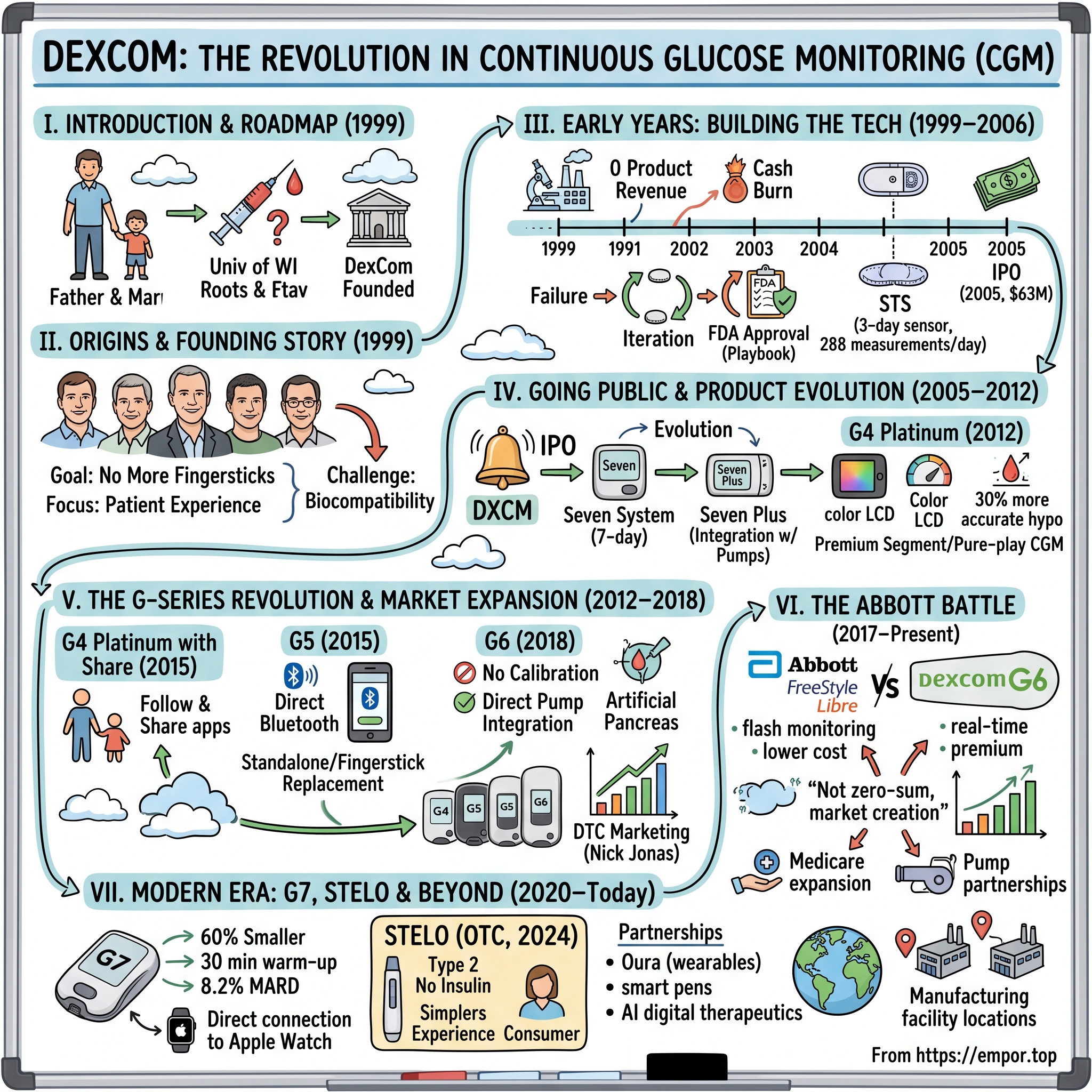
DexCom: The Revolution in Continuous Glucose Monitoring
I. Introduction & Episode Roadmap
There is a particular sound that defines the modern experience of Type 1 diabetes, and it is not the click of a lancet against a fingertip. It is a chime — a rising three-note alert from a phone on a nightstand at 3:14 a.m., telling a parent two rooms away that their eleven-year-old's blood sugar is falling through 70 mg/dL and heading lower. Before that chime existed, the only way to know was to walk into the room, wake the child, prick a finger, and squeeze out a drop of blood. Most parents did not. Most parents slept, and hoped.
DexCom, Inc. built the chime. Along the way it built a business that, by the close of 2025, generated $4.66 billion in annual revenue at roughly 61% non-GAAP gross margins and carried an equity value north of $31 billion.[^1] That is a substantial outcome for a company that spent its first seven years of existence with zero commercial products, burning venture capital on a scientific premise that turned out to be wrong.
The central question of this story is how that happened. How did a small San Diego startup — one whose founding mission failed outright — survive long enough to reach a market where it now splits a global duopoly with Abbott Laboratories, one of the largest diagnostic companies in the world? And having reached that position, is its standing defensible, or is it a temporary artifact of being early to a category that is now undergoing commoditization in full view of the market?
The narrative proceeds in roughly chronological order. First, the academic prehistory and the founding thesis that collapsed: the dream of a glucose sensor implanted once and left for years, and the straightforward biological reason the human body refused to cooperate. Then the wilderness — a 2005 initial public offering with no product revenue, a three-day sensor that needed constant fingerstick calibration, and a reimbursement system that treated a wearable continuous monitor like durable medical equipment. Then the G-series, where engineering finally caught up with ambition, and where DexCom did something subtler and more valuable than build a good sensor: it helped establish the regulatory classification every future competitor would have to clear.
Then the competitive struggle. Abbott's FreeStyle Libre arrived in the United States in 2017 at roughly half DexCom's daily price, launching an ongoing contest over pricing, pharmacy formulary placement, and per-unit manufacturing cost. Then the sharp correction: on July 25, 2024, DexCom cut its full-year revenue guidance, triggering a roughly 40% single-day stock collapse following what management described as a self-inflicted execution failure.12 That episode offers the clearest window into how the company operates, capturing a moment when operational execution broke down and leadership had to explain on a public earnings call precisely which mechanisms had failed.
And finally, the current state: the G7 platform, the over-the-counter Stelo product aimed at consumers without Type 1 diabetes, the GLP-1 medications that failed to diminish market demand as once predicted, and the January 2026 leadership transition from Kevin Sayer to Jake Leach.
The broader significance extends beyond the balance sheet to a fundamental shift in metabolic care. A person managing diabetes with fingersticks receives four to six data points a day — disconnected snapshots that remain silent about everything in between. A continuous glucose monitor produces a reading every five minutes, yielding 288 daily measurements that turn those static points into a trend line with direction and velocity. The clinical difference is substantial: knowing blood sugar is at 90 mg/dL is informative, but knowing it is at 90 mg/dL and dropping rapidly is actionable. Converting static snapshots into continuous visibility remains the core of the business.
 Subscribe on LinkedIn
II. Origins & University Roots: The 30-Year Journey to STS
The story starts in a laboratory in Madison, Wisconsin, decades before anyone thought of continuous glucose monitoring as a business. In 1967, Stuart Updike and George Hicks at the University of Wisconsin published work demonstrating that an enzyme—glucose oxidase—could be immobilized behind a membrane over an electrode to generate an electrical signal proportional to the fluid's glucose concentration. The chemical mechanism was straightforward: the enzyme consumes glucose, producing hydrogen peroxide that releases electrons at the electrode. The resulting micro-current provides the measurement: higher glucose yields higher current. Everything DexCom sells today remains a descendant of that foundational chemistry.
Translating that laboratory insight into a commercial product took thirty-two years. Enzymes denature. Membranes foul. Electrodes drift. Most challenging of all, the targeted fluid sits inside a living body engineered to isolate foreign objects.
In 1999, a founding team in San Diego—Scott Glenn, Dr. John Burd, Lauren Otsuki, Ellen Preston, and Bret Megargel—set out to bridge that gap. They established DexCom with an ambitious core mission: build a fully implantable, long-term glucose sensor. Rather than a patch or a skin-penetrating wire, they envisioned a device surgically placed beneath the skin to report glucose levels to an external receiver for a year or more without daily patient intervention.
The strategic appeal of that thesis was clear. If successful, it promised a formidable moat. A once-a-year surgical implant is not easily undercut on price at a retail pharmacy counter; it involves a clinical procedure, a physician relationship, hospital billing codes, and switching costs measured in operating-room time. It also addressed patient compliance in a single step, eliminating daily maintenance and components that could detach in daily use.
Funding that vision required patient capital. Across eight private financing rounds, DexCom raised approximately $52.7 million from investors including Warburg Pincus, Canaan Partners, and Black Diamond Ventures. By modern medtech standards, that figure is modest, but it financed years of fundamental laboratory work without revenue, an approved product, or guaranteed biological compatibility. Early-stage medtech venture capital operates under fundamentally different dynamics than software development: regulatory gates and physical biology precede any market launch.
The thesis that the human body rejected
DexCom's original moat thesis faced a decisive test, and the company's ultimate survival required recognizing that the approach had failed.
The core premise—that a long-term, fully implantable subcutaneous sensor was both technically achievable and commercially optimal—encountered insurmountable biological resistance. When a foreign object enters subcutaneous tissue, the body mounts a foreign-body response: initial inflammation triggers macrophages, followed by fibroblasts laying down a collagen capsule around the device. Within weeks, the sensor becomes encased in poorly vascularized scar tissue. Because glucose diffuses into this capsule slowly and unevenly while proteins foul the membrane, the sensor signal does not merely become noisy—it drifts unpredictably. For a monitor intended to guide precise insulin dosing, such instability is disqualifying.
DexCom spent roughly five years and millions of dollars attempting to engineer around this response using specialized membrane chemistries, anti-inflammatory coatings, and novel geometries. The biological barrier persisted. Management ultimately concluded that a fully implantable long-term sensor was not clinically or commercially viable within any financeable timeline.
The company pivoted to a pragmatic alternative: a short-wear transcutaneous sensor. This design used a hair-thin wire inserted through the skin via a spring-loaded applicator, operating in the interstitial fluid for several days before disposal and replacement. While less elegant and requiring ongoing patient effort, it transformed the commercial model. A short-wear disposable consumable created a high-margin recurring revenue stream with a manufacturing learning curve, whereas a once-a-year surgical implant faced a far more complex clinical sales cycle.
DexCom's turn was less a market insight than a tactical retreat to a defensible position, which proved more lucrative than the original goal. The move left the long-term implantable segment open to later entrants such as Senseonics, which established a specialized but modest market footprint. Two decades later, that niche remains small, validating the economic and biological rationale behind DexCom's pivot.
Having settled on the transcutaneous architecture, DexCom faced the task of securing FDA clearance, building market adoption, and establishing reimbursement—a capital-intensive path the company chose to fund via the public markets before generating its first dollar of product revenue.
III. Going Public & The Wilderness Years: Calibration, Regulators, & Survival
In April 2005, DexCom listed on the NASDAQ under the ticker DXCM at \$12.00 per share, raising roughly \$56 million. The company had no product on the market and no product revenue. What it possessed was a scientific premise, a pending regulatory submission, and a class of public investors willing to underwrite pure clinical optionality.
That public offering represented an unusual financing event. A 2005 buyer of DXCM stock was not underwriting an operational business; they were underwriting an FDA regulatory decision. There were no unit economics to model, no cohort retention metrics to extrapolate, and no sales productivity figures to analyze. The entire valuation rested on a binary regulatory approval followed by a far more complex commercial question: whether patients and physicians would adopt the device once cleared.
The regulatory question resolved favorably in 2006 when the FDA cleared the DexCom STS (Short-Term Sensor). The commercial question, however, yielded disappointing results for years.
What the early product was actually like
To understand why commercial adoption stalled, one must consider the daily demands a 2006-vintage continuous glucose monitor placed on a patient. The STS was approved for three days of continuous wear. It required users to perform fingerstick blood glucose tests and manually input those values to calibrate the sensor twice daily, in addition to a startup calibration. Consequently, the initial device failed to fulfill the promise of eliminating fingersticks; patients still had to prick their fingers while carrying and wearing an additional device.
The receiver was a separate handheld device roughly the size of a pager that patients had to carry at all times. The insertion needle was substantial, making application uncomfortable for many users. Sensor accuracy was modest and performed poorest precisely where accuracy was most vital: in the hypoglycemic range below 70 mg/dL, where an inaccurate reading could prove dangerous. Furthermore, sensor failures occurred frequently enough that patients and clinicians routinely budgeted for replacements.
DexCom introduced the Seven in 2007 and the Seven Plus in 2009, extending sensor wear to seven days and refining the measurement algorithm. Although these updates improved performance, the core clinical and user challenges persisted.
The clinical establishment remained skeptical. Endocrinologists had spent decades building treatment protocols around trusted fingerstick meters. A device that was less accurate, more expensive, more burdensome, and still dependent on fingerstick calibrations represented a difficult sales proposition. Physicians resisted adoption not out of conservatism, but because early clinical evidence did not justify replacing established tools. Meanwhile, incumbent blood glucose meter manufacturers—including Johnson & Johnson's LifeScan, Roche, Bayer, and Abbott—maintained large installed bases and established pharmacy distribution channels, with little incentive to cannibalize their profitable test-strip businesses.
The reimbursement swamp
Compounding these product limitations was the challenge of reimbursement. Continuous glucose monitors were classified as Durable Medical Equipment (DME)—the insurance category designed for wheelchairs, hospital beds, and oxygen concentrators. The DME channel was administratively cumbersome: every patient required extensive documentation, frequent prior authorizations, and often paper claims, resulting in a revenue cycle from prescription to cash that could span several months. Third-party distributors handled fulfillment, meaning sales representatives spent significant effort shepherding administrative files rather than simply securing physician prescriptions.
This administrative reality established a structural dynamic that shaped the company's trajectory for years, culminating in its 2024 operational challenges. DexCom's early business relied on a channel characterized by high administrative friction, elevated average selling prices, and slow customer acquisition. Moving away from DME and into retail pharmacy would eventually become the single largest commercial transformation in the company's history.
Buying the software layer
Amid these commercial headwinds, DexCom made a modest acquisition in 2012 that proved far more strategic in hindsight than it appeared at the time. The company purchased SweetSpot Diabetes Care for \$4.5 million upfront, with total consideration reaching approximately \$8.5 million including earnout provisions.
SweetSpot developed a cloud platform for aggregating diabetes device data. DexCom rebranded and expanded the technology into DexCom Clarity, creating a reporting platform that compiles, standardizes, and visualizes patient glucose data into standard clinical metrics—such as time-in-range, ambulatory glucose profiles, overnight trends, and post-meal glucose spikes—that endocrinologists review during routine patient visits.
From a strategic perspective, while the hardware sensor functioned as a consumable, the diagnostic report established a clinical habit. A clinic that standardized its workflow around DexCom Clarity—where staff knew how to generate reports and physicians grew accustomed to interpreting its specific visual layout—faced switching costs when considering alternative platforms. Combined with years of accumulated patient historical data residing within the platform, Clarity created a meaningful degree of customer retention, acquired for less than the cost of a single major clinical trial.
This advantage requires realistic assessment. Clarity is not a multi-sided network effect; its stickiness stems from clinical workflow habits and data gravity rather than scale-driven economic moats. While it increases switching friction, it does not preclude clinicians from switching, and Abbott's rival platform, LibreView, provides comparable functionality. Nevertheless, at an effective cost of \$8.5 million, the acquisition represented one of the most efficient capital deployments in DexCom's history—a notable result given the company's otherwise sparse record of corporate acquisitions.
By 2012, DexCom possessed a public listing, a seven-day sensor, a foundational software platform, and a presence in an administratively burdensome distribution channel—yet its core hardware had not yet achieved mass-market appeal. The catalyst for its next phase of growth would be a fundamental advancement in sensor hardware.
IV. The G-Series Breakthrough: Mobile Integration & The iCGM Moat
Every hardware company encounters a generation where its growth trajectory bends. For DexCom, it was a sequence of four.
The G4 Platinum launched in 2012 and achieved what prior generations had not: clinical accuracy. Mean absolute relative difference (MARD)—the industry yardstick measuring how far a sensor reading strays from a laboratory blood reference—dropped below 13 percent. In practice, a MARD in the high teens meant a sensor reading of 100 milligrams per deciliter could represent an actual level of 82 or 118, the difference between stability and a medical emergency. Pushing accuracy below 13 percent moved continuous glucose monitoring from an experimental option to a clinically trustworthy tool. In 2014, the FDA extended approval to pediatric patients, opening access to the market that became DexCom's commercial and emotional core: parents of children with Type 1 diabetes.
The G5 Mobile, launched in 2015, fundamentally altered user experience and distribution. It was the first continuous glucose monitor to transmit readings directly via Bluetooth to a smartphone, eliminating the need to carry a dedicated receiver. By moving glucose data onto a mobile phone, readings could be shared in real time with spouses, school nurses, or parents at work. The DexCom Share feature transformed a solitary diagnostic tool into a connected monitoring network, allowing low-glucose alerts to reach a parent's smartphone across town rather than sounding only on a bedside receiver.
In 2016, DexCom reached a pivotal regulatory milestone when the FDA approved the G5 for non-adjunctive use. Patients could finally make insulin dosing decisions directly from sensor readings without confirming results with a fingerstick. Until that decision, every continuous glucose monitor in the United States served strictly as a supplementary tool—informative, but not legally authoritative. Non-adjunctive status made the sensor the primary instrument of care, establishing its clinical indispensability while elevating sensor accuracy to a matter of formal regulatory compliance.
The G6 and the category DexCom helped write
The DexCom G6, launched in 2018, defined the modern continuous monitoring category. It offered ten-day wear and came factory-calibrated, delivering on the zero-fingerstick promise twelve years after the STS debuted. Its membrane was engineered to block acetaminophen interference, eliminating falsely elevated glucose readings in patients taking Tylenol—a previously dangerous flaw. A slimmer profile and a one-button applicator also rendered sensor insertion simple and routine.
The most lasting development of 2018, however, occurred on the regulatory front. In March 2018, the FDA authorized the G6 as the first integrated continuous glucose monitoring system — iCGM — and in doing so created an entirely new regulatory classification with a defined set of special controls, including stringent accuracy thresholds that a device must meet across the full glycemic range.[^4]
This decision functioned as a strategic maneuver rather than a routine administrative process. DexCom collaborated with the agency to establish the exact regulatory standard its own device had just met. The immediate benefit was procedural: iCGM devices were down-classified to Class II and eligible for the faster 510(k) clearance pathway, streamlining future product iterations. The enduring strategic benefit was that subsequent competitors—including Abbott—had to satisfy numerical accuracy thresholds that DexCom had helped write, particularly in the difficult-to-measure hypoglycemic range.
This regulatory classification represents a clear example of a structural competitive moat: the incumbent participated in writing the benchmark that rivals must meet. Yet its limitations remain important. The iCGM standard did not block well-funded competitors; Abbott's FreeStyle Libre 2 subsequently secured iCGM clearance, and Abbott eventually achieved global unit-volume leadership. A regulatory bar cleared by an established rival acts as a barrier against new startups rather than peer competitors.
Wiring into the pumps
DexCom's second structural move during this era was integrating its sensors with automated insulin pumps. The underlying logic was straightforward: if a sensor reads glucose levels every five minutes and a pump can deliver insulin at the same interval, software connecting the two can automatically adjust delivery to mimic pancreatic function. This architecture—automated insulin delivery, or AID—represents the closest commercial approximation of an artificial pancreas.
DexCom chose to position its device as the trusted sensor inside partner systems rather than build its own hardware pump, integrating with Tandem Diabetes Care's Control-IQ and later Insulet's Omnipod 5. In 2018, DexCom acquired TypeZero Technologies—a University of Virginia spinout whose closed-loop control algorithms powered Control-IQ—for undisclosed terms. The acquisition shifted DexCom from a component supplier to an owner of core intellectual property within the automated control layer.
Integrating into automated insulin delivery systems established the highest customer switching costs in the diabetes market. A patient using Omnipod 5 or Control-IQ is not merely wearing a sensor; they are operating an automated therapeutic system in which the continuous monitor is a certified, algorithmically tuned component. Switching sensor brands requires changing the entire delivery system—a level of friction far greater than switching test-strip brands. This integration explains why DexCom maintained a dominant position among high-acuity, high-value patients even as rival devices gained broader market share in overall unit volume.
Testing the optionality: approvals are not revenue
This strategic advantage required time to materialize, as technology timelines often invite overestimation.
The initial expectation in 2018 was that early technical and regulatory clearance for pump integration would rapidly lock in the Type 1 market. Commercial reality proved slower. Regulatory approvals for integrated systems lagged underlying sensor hardware by two to three years. Joint clinical development between DexCom, Tandem, and Insulet required aligning separate product pipelines, quality systems, and regulatory submissions. As a result, Control-IQ did not reach patients until 2020, and Omnipod 5 launched in the United States in 2022. Meaningful revenue from pump integration materialized in 2020 and 2021 rather than 2018.
That delay illustrates a recurring pattern in DexCom's corporate history: technical milestones are genuine, but commercial revenue typically trails initial announcements by two to three years. This lag is not a flaw in the engineering, but an operational calibration factor that applies to evaluating future product announcements.
While DexCom was building closed-loop integrations for high-acuity patients, a competitor was building something simpler, much cheaper, and aimed at a market ten times larger.
V. The Abbott Wars: Duopoly Structure, Price Cuts, & Channel Shift
Abbott's FreeStyle Libre arrived in the United States in 2017 with a fundamentally different commercial strategy.
The Libre was, in its initial iteration, not a real-time continuous monitor in the DexCom mold. Instead, it operated as a "flash" glucose monitor: while its sensor recorded data continuously, it did not stream readings automatically. Viewing a measurement required scanning a dedicated receiver or smartphone over the sensor patch. It lacked automated alarms and low-glucose alerts—no nocturnal chime warning of a rapid drop. Yet what patients relinquished in real-time safety, they gained in lower costs and simplicity: Libre launched at roughly $4 per day, nearly half the $7 to $8 daily cost of a DexCom G6.
That pricing gap established a logical partition in the market. For patients managing Type 1 diabetes or Type 2 requiring intensive insulin therapy, real-time alerts were the essential feature preventing severe hypoglycemic episodes—a capability patients and insurers were willing to fund. Conversely, patients managing Type 2 diabetes with oral medications or basal insulin faced minimal risk of sudden nocturnal drops. For that population, tracking overall trends and post-meal spikes took priority, making double the price for unneeded alarms economically unappealing.
Consequently, DexCom captured the high-acuity, high-value segment—pediatric care, Type 1 diabetes, and automated insulin pump integration—while Abbott secured the high-volume broader market. Abbott also leveraged structural advantages DexCom lacked: extensive international commercial infrastructure and long-established pharmacy relationships, allowing Libre to enter retail shelves and overseas formularies far faster than DexCom could initially match.
The pharmacy pivot and the cost curve
DexCom responded with a two-pronged, capital-intensive strategy.
First, the company shifted its primary distribution model away from durable medical equipment (DME) channels and into retail pharmacy chains like CVS and Walgreens, alongside the pharmacy benefit managers (PBMs) governing their formularies. The economics of this transition involved a direct structural trade-off. Retail pharmacy provided vast expansion in patient volume, frictionless access, and accelerated prescription fulfillment by bypassing DME distributor paperwork and prior authorization hurdles. However, securing preferred placement from major PBMs—such as Express Scripts, CVS Caremark, and OptumRx—required substantial rebates deducted directly from net revenue. DexCom effectively sacrificed average selling price per sensor in exchange for volume and patient acquisition speed.
Second, DexCom accelerated investments in manufacturing industrialization. As net realized prices per sensor dropped, lowering unit production costs became imperative. The company directed capital toward automated assembly facilities in Mesa, Arizona; Batu Kawan, Malaysia; and Athenry, Ireland, reducing unit manufacturing costs by more than 40 percent during its scaling phase. In its mature form, continuous glucose monitoring functions as a high-volume disposable goods business, where margins depend on industrial automation. This scale created a formidable capital barrier for new entrants, requiring hundreds of millions of dollars in automated assembly infrastructure just to match baseline unit economics—a moat far more effective against early-stage startups than intellectual property alone.
However, this manufacturing advantage offered little defense against Abbott, which deployed comparable capital reserves and extensive manufacturing depth to achieve similar scale.
The Medicare unlock
In 2023, regulatory reimbursement expansion fundamentally reshaped the market's addressable boundary. The Centers for Medicare & Medicaid Services (CMS) expanded coverage for continuous glucose monitors to include Medicare beneficiaries managing Type 2 diabetes on any insulin regimen—including basal-only therapy—as well as non-insulin patients with documented histories of problematic hypoglycemia.
Previous CMS criteria had restricted coverage primarily to patients requiring intensive insulin therapy with multiple daily injections. Broadening eligibility to any insulin user added roughly three million covered lives in the United States virtually overnight. In an industry where commercial penetration is constrained more by insurance coverage than end-user demand, this expansion marked a structural shift as impactful as a major technological iteration.
This evolution produced an asymmetrical duopoly. By unit volume, Abbott led the global market with roughly 46 to 48 percent market share, compared to DexCom's 42 to 44 percent, while Medtronic's Guardian platform and niche entrants like Senseonics divided the remaining single-digit share. However, the composition of those market shares differed significantly. Abbott's volume skewed toward lower-priced, international, and non-intensive Type 2 populations. DexCom maintained a heavier concentration in high-acuity Type 1 and pump-integrated users, characterized by higher revenue per patient and stronger subscription retention.
Relative long-term position depends on where future market expansion occurs. While DexCom dominates the high-margin, high-acuity tier, broader adoption trends—including CMS coverage expansion, over-the-counter access, and wider Type 2 penetration—point toward rapid growth in the lower-acuity segment long led by Abbott. This structural tension established the backdrop against which DexCom's subsequent operational execution faced severe scrutiny.
VI. Anatomy of an Execution Miss: The Q2 2024 Debacle & Course Correction
On the afternoon of July 25, 2024, DexCom reported second-quarter results and reduced its full-year revenue guidance from a range of $4.20 billion to $4.35 billion down to a range of $4.00 billion to $4.05 billion. The stock fell roughly 40%.1
A 40% single-session decline in a profitable, growing, large-cap medical device company is an extraordinary market event. It represents investors repricing not merely a single quarter's performance, but the predictability of the company's operating model. Roughly $10 billion in market value evaporated following a guidance reduction of approximately $300 million. The market was not discounting only the lost revenue; it was discounting the possibility that management lacked visibility into its own demand engine.
What makes this episode analytically instructive is that the breakdown was neither macroeconomic nor competitive in the traditional sense. It was internal, and management explicitly acknowledged it.
Three gears, all stripped at once
The primary cause was a reorganization of the United States sales force. Management had restructured the commercial team to broaden coverage among primary care physicians rather than concentrating heavily on endocrinologists. Strategic logic supported the shift: market growth was increasingly driven by Type 2 patients, who are managed primarily by primary care doctors rather than specialists. Execution, however, faltered. Rather than expanding total sales reach, the company redrew existing territories. Sales representatives who had spent years building relationships with specific prescribers were reassigned, causing accounts to change hands. Prescription momentum—which in medical devices depends heavily on individual physician habit and trust—promptly stalled. The quantified impact was approximately 70,000 fewer new patient additions than internal models had forecast.3
The second cause was market share loss within the durable medical equipment (DME) channel. As DexCom shifted patient fulfillment toward retail pharmacies, it reduced attention to traditional DME distributors, who still served a substantial installed base. Under-serviced distributors responded by promoting available alternatives, increasingly filling orders with Abbott's products. Consequently, DexCom ceded share in a channel it had partially stopped defending.
The third cause was lower-than-expected price realization. Under the G7 rollout, patients qualified for pharmacy rebate structures faster than internal financial models had assumed, an effect compounded by the accelerating channel shift toward retail pharmacy. Net revenue per user compressed more rapidly than expected. While less dramatic than the sales territory disruption, this realization was structurally instructive: it revealed that internal models for net realized pricing under the new channel architecture were unreliable.
Three simultaneous operational breakdowns—in demand generation, channel coverage, and price realization—within a single quarter reflected a classic execution risk: changing multiple strategic variables at once without adequate tracking to monitor their interaction.
Testing the "superior execution" claim
For years, the optimistic thesis on DexCom relied on management's reputed commercial execution and pricing discipline—the premise that leadership could navigate a complex channel transition without operational disruption. The second quarter of 2024 provided clear disconfirming evidence against that thesis under the same management team, business model, and channel strategy.
Chief Executive Officer Kevin Sayer offered a direct assessment on the earnings call. Management characterized the shortfall as self-inflicted rather than the result of macroeconomic headwinds or competitive pressure, describing the outcome as a "100% self-inflicted" execution failure.3[^6]
Evaluating this admission requires a calibrated perspective. The evidence dismantles the claim that DexCom's commercial organization possessed a durable, flawless execution advantage, demonstrating instead that even an industry leader remains vulnerable to large unforced errors during commercial transitions. At the same time, the data does not support a bear case of structural impairment. Underlying market demand did not collapse; new patient additions remained positive despite missing targets, and overall revenue continued to grow.
Two operational responses warrant credit. First, management avoided attributing the miss to external factors, identifying specific operational mechanisms and quantifying their financial impact. Second, remediation was immediate: territory realignments were paused, existing physician relationships were reconstituted, and DME distributor coverage was re-established. In corporate communications, detailed operational accountability serves as a stronger indicator of recovery than generalized reassurances.
To address capital allocation, the company initiated a $750 million share repurchase program, which was subsequently expanded to a $1.0 billion authorization in May 2026.[^1][^7] A neutral financial reading suggests that buying back stock after a steep price decline is logical and signals confidence in ongoing cash flow generation. A critical reading suggests that launching a buyback immediately after an operational failure serves partly to stabilize market sentiment, diverting capital that could otherwise fund international expansion where DexCom trails Abbott. Both perspectives contain valid elements.
Going forward, the critical metric is not the clarity of management's explanation, but whether new patient additions reaccelerate and sustain momentum over multiple quarters under new leadership, providing empirical proof of operational recovery.
VII. Modern Era: G7, Stelo, & The Leach Leadership Era
Placing the G6 and the G7 side by side highlights a decade of physical miniaturization. The G7 is roughly 60 percent smaller and warms up in 30 minutes compared to the two hours required by the G6—a crucial difference in practice, as sensor changeover windows leave patients unmonitored. The device also integrated the sensor and transmitter into a single disposable unit, eliminating the separate reusable transmitter that patients previously had to track, charge, and replace every 90 days. Furthermore, direct connection to a smartwatch without routing through a phone eliminates a common failure point in the previous system architecture.
The G7 represents DexCom's most advanced transcutaneous sensor engineering to date. Yet its rollout also introduced the rebate mechanics that contributed to the company's Q2 2024 guidance reduction, underscoring that technical performance does not guarantee smooth commercial execution.
Stelo and the leap off the medical cliff
In March 2024, the FDA cleared Stelo as the first over-the-counter continuous glucose monitor in the United States, and DexCom launched it commercially that August.45 The device is indicated for adults 18 and older who do not use insulin—encompassing individuals managing Type 2 diabetes through oral medications or diet, as well as health-conscious consumers tracking postprandial glucose responses.
This shift marked a structural category expansion. Prior monitors required a prescription, tying the addressable market to clinical diagnosis and physician visits. In contrast, Stelo is sold directly to consumers on a subscription basis for approximately $89 per month, bypassing prior authorizations, PBM rebate structures, formulary negotiations, and durable medical equipment paperwork. A direct-to-consumer cash model alters the unit economics: gross margins are unencumbered by pharmacy rebates, while customer acquisition relies on direct marketing rather than physician prescribing habits.
However, Stelo is best understood as strategic optionality rather than a central revenue pillar. The core intensive-diabetes sensor franchise generates the overwhelming majority of the $4.66 billion in 2025 revenue — more than 90% — and Stelo's contribution to date has been immaterial to the consolidated result.[^1] Total addressable market projections cite roughly 25 million non-insulin Type 2 patients in the United States and more than 100 million individuals with prediabetes. Yet total market potential does not equal sustained demand. Consumer health wearables frequently experience high initial trial followed by rapid churn once early novelty wears off. The central commercial test for Stelo is cohort retention beyond three months, a metric DexCom has not publicly disclosed.
Applying the historical lag between regulatory clearance and material financial impact, DexCom's technical firsts have typically required two to three years to generate substantial revenue. A 2024 over-the-counter clearance suggests meaningful revenue contribution would materialize in 2026 or 2027 at the earliest, contingent on subscriber retention. The November 2024 partnership with Oura, integrating glucose telemetry with sleep, activity, and recovery data, is a sensible attempt to make the data stickier by embedding it in a broader behavioral context.[^10] Whether this integration converts curiosity into a lasting habit remains unproven.
Meanwhile, Abbott launched competing over-the-counter products into the same market opening, demonstrating that first-mover advantage in the consumer segment is measured in months rather than years.
The GLP-1 scare that inverted
For nearly two years, a prominent bear thesis weighed on DexCom's valuation: GLP-1 receptor agonists like semaglutide and tirzepatide would drive significant weight loss and glycemic control, potentially shrinking the population of patients requiring long-term glucose monitoring. The core assumption was straightforward: as therapeutic efficacy improved, diagnostic demand would decline.
The empirical record, however, indicated the opposite trend. Patients initiating GLP-1 therapies showed an elevated propensity to adopt continuous glucose monitors rather than a reduced one. Several operational drivers explain this outcome: patients undergoing metabolic changes seek real-time visibility into their glucose levels, physicians titrating medication dosages require continuous data, and patients combining GLP-1s with insulin or sulfonylureas face real hypoglycemia risks during titration. Furthermore, visual glucose trends provide immediate behavioral reinforcement for dietary modifications.
This dynamic does not establish GLP-1 adoption as a permanent growth tailwind, but it refutes the initial market substitution thesis based on real-world adoption patterns. A longer-term structural consideration remains: if broad GLP-1 utilization reduces the multi-decade incidence of insulin-dependent Type 2 diabetes, expansion in the highest-value sensor segment could decelerate. However, that risk represents a potential long-term trend for the next decade rather than an immediate commercial headwind in 2026.
The handoff
On January 1, 2026, Kevin Sayer stepped down as chief executive and became Executive Chair; Jake Leach became CEO. The succession was announced in November 2025.6
Sayer led DexCom starting in 2015, overseeing the launches of the G5, G6, and G7 platforms, the commercial transition to retail pharmacy, competitive battles with Abbott, and the 2024 operational misstep. During his tenure as CEO, annual revenue grew from approximately $300 million to $4.66 billion—a decade of substantial top-line compounding bookended by an execution failure he publicly acknowledged. Both facts belong in the assessment.
Leach represents a long-standing insider, having spent over twenty years at the company as lead architect of the G-series hardware before serving as Chief Technology Officer and subsequently Chief Operating Officer. The promotion signals the board's strategic priorities: retaining leadership that built the core technology platform while managing operational execution internally rather than recruiting external commercial leadership. The success of that leadership transition will ultimately be judged by new-patient acquisition and international expansion metrics in 2026 and 2027.
Sayer's transition to Executive Chair carries specific corporate governance implications. While it preserves institutional memory during a period of market expansion, the presence of a long-serving former CEO as board chair can also limit a successor's flexibility to alter established operational strategies. It remains a governance structure worth monitoring should strategy need to change materially.
VIII. Business Model, Unit Economics, & Financial Anatomy
Strip away the medical technology and DexCom operates a classic razor-and-blade business, though the razor itself has progressively disappeared.
Under the G5 and G6 architectures, the commercial model was explicit: a durable transmitter—the handle—was replaced every 90 days, while disposable sensors—the blades—were replaced every 7 to 10 days. With the G7 and Stelo, DexCom collapsed the transmitter into the sensor patch. The entire device became fully disposable, replaced every 10 to 15 days depending on the product line. That design shift eliminated hardware management for patients and converted revenue into a continuous consumable subscription. It also removed a component whose cost was previously amortized across multiple sensor cycles, placing greater pressure on manufacturing efficiency to maintain gross margins.
Revenue reached $4.03 billion in 2024, representing growth of roughly 11%—a deceleration caused by the mid-year commercial disruption.[^12] In 2025, revenue rose to $4.66 billion, a reacceleration of approximately 15.6%.[^1] This rebound provides evidence that the 2024 slowdown resulted from an internal execution misstep rather than structural competitive erosion. While a single-year recovery off a depressed baseline does not guarantee long-term compounding, it demonstrates that underlying customer demand remained intact.
Non-GAAP gross margins have held in the 61% to 62% range. That stability reflects two powerful, opposing operational forces: manufacturing automation driving unit production costs down, offset by retail pharmacy rebates and expanding international distribution lowering net realized prices. A flat gross margin in this environment does not indicate pricing power. Instead, it demonstrates a business passing manufacturing savings to payers and pharmacy benefit managers in exchange for market volume and formulary access.
Non-GAAP operating margins have tracked between 18% and 20%, with management targeting 21% or higher as automated facilities in Malaysia and Ireland reach full production scale. That target warrants cautious evaluation; capacity ramps in regulated medical manufacturing frequently encounter timeline friction, and DexCom's historical lag between technical milestones and financial realization applies to infrastructure as much as to products.
The geographic mix sits at roughly 72% domestic and 28% international, with overseas markets growing faster but yielding lower net average selling prices due to single-payer price negotiations. Channel distribution stands at approximately 80% retail pharmacy and 20% durable medical equipment. Both shifts dilute average revenue per patient, creating a structural constraint at the core of the business: every expanding growth vector—international expansion, Type 2 diabetes, over-the-counter sales, and pharmacy channels—carries a lower price per user than the high-acuity core it replaces. To sustain revenue growth over time, unit volume must outpace price dilution continuously.
Capital allocation reflects a strong commitment to internal research and development, which absorbs 12% to 14% of annual revenue—over $550 million—focused on sensor miniaturization, advanced chemistry, and continuous ketone and lactate sensing. This sustained reinvestment indicates that leadership treats the underlying sensor platform, rather than any individual product generation, as the primary corporate asset.
By contrast, capital returns to shareholders remain relatively recent. The company executed $750 million in share repurchases in 2024 and expanded the program to a $1.0 billion authorization in May 2026.[^7] Two years of buybacks after two decades without capital returns represent a tactical response to valuation pressure following the 2024 stock decline, rather than an established policy of long-term capital return. Executive compensation aligns primarily with organic revenue growth and non-GAAP operating margin. While logical, weighting compensation toward revenue growth during an explicit strategy of trading price for volume requires oversight, as it rewards volume expansion more directly than pricing discipline. Executive equity alignment remains modest; former CEO Kevin Sayer's holding of roughly 302,000 shares represents substantial personal wealth but a small fraction of total outstanding equity.
The financial anatomy resolves into a clear thesis: DexCom operates a cash-generative, high-margin consumables business whose net realized price per user is in controlled decline, leaving overall corporate performance dependent on sustained volume expansion.
IX. Strategic Frameworks: Helmer's 7 Powers & Porter's 5 Forces Analysis
Evaluating DexCom's market position through established strategic frameworks reveals a business with substantial operational advantages but limited structural pricing power.
Under Hamilton Helmer's 7 Powers framework, scale economies represent DexCom's most concrete operational advantage. Automated sensor manufacturing across facilities in Arizona, Malaysia, and Ireland produces a per-unit cost structure that early-stage entrants cannot match without hundreds of millions of dollars in upfront capital. The limitation, however, is that this scale fails to differentiate DexCom from Abbott, which operates with comparable manufacturing depth. Switching costs also rate high, but primarily within a specific patient segment. For individuals utilizing integrated automated insulin delivery systems like Tandem's Control-IQ or Insulet's Omnipod 5, replacing a sensor means altering an entire certified therapeutic system. Conversely, for users on standalone G7 or Stelo devices, switching to a rival monitor requires little more than selecting a different package at the pharmacy counter, with accumulated Clarity history offering only minor retention friction. Consequently, DexCom's strongest switching costs are concentrated in the patient cohort experiencing the slowest relative expansion.
Cornered resource rates medium-high, though it warrants critical evaluation. While DexCom holds key institutional assets—including its role in establishing iCGM special controls, closed-loop algorithm patents from TypeZero, and trade-secret membrane formulations—a true cornered resource prevents competitor replication. Abbott subsequently secured iCGM clearance, Medtronic developed proprietary control algorithms, and chemical leads inevitably narrow over time. In practice, these assets afford DexCom a durable head start rather than an absolute barrier. Process power rates medium, sustained by two decades of accumulated operational expertise in enzyme deposition, polymer thickness control, and yield optimization. Network effects rate low; features like DexCom Share enhance family retention, but one patient's usage does not increase product utility for another. Counter-positioning also rates low, with DexCom on the receiving end: while legacy meter manufacturers failed to counter-position against continuous monitoring, Abbott's lower-priced, pharmacy-first model successfully counter-positioned against DexCom's higher average selling price strategy. Finally, brand rates medium, commanding deep trust among endocrinologists and Type 1 patient communities, but demonstrating far less leverage among non-intensive Type 2 and over-the-counter consumer buyers.
An analysis using Porter's Five Forces reinforces these structural dynamics. Threat of new entrants is low, as stringent iCGM accuracy thresholds, substantial manufacturing capital requirements, and multi-year regulatory cycles deter de novo competitors, maintaining the duopoly structure. Supplier power is low, given that microelectronics, polymers, and enzymes represent multi-sourced commodities and DexCom maintains vertical integration over core assembly. Conversely, buyer power is high and represents the defining force in the industry. Pharmacy benefit managers and commercial insurers sit between DexCom and end users, leveraging formulary access to extract steep rebates. When two clinically comparable products compete for preferred coverage, payers dictate pricing terms—a mechanism that caps gross margins and prevents the duopoly from extracting premium pricing despite expanding market demand.
Threat of substitutes is medium. Non-invasive optical glucose sensing remains a distant technological prospect, while GLP-1 medications have proved complementary rather than disruptive to monitor adoption. The primary substitution risk is clinical and administrative: payers could determine that traditional fingersticks remain sufficient for lower-acuity Type 2 patients and restrict continuous monitoring coverage accordingly. Ultimately, competitive rivalry is extremely high and serves as the dominant operational pressure. Two well-capitalized industry leaders with similar clinical performance, overlapping distribution channels, and strong incentives to capture market share create textbook conditions for persistent price competition—a structural reality unlikely to abate.
X. Playbook: Lessons for MedTech Founders & Public Market Investors
Five transferable lessons emerge from this history.
The seven-year horizon is real, and it dictates capital structure. DexCom operated for seven years before launching its first commercial product and roughly another decade before its technology proved reliable enough to displace traditional fingerstick meters as the standard of care. Founders building regulated hardware cannot finance development with capital expecting a two-year proof point. For investors, the corollary is that early-stage medtech equity functions as an option on a regulatory approval rather than a claim on an operating business, and position sizing should reflect that binary risk.
Category creation forms a stronger moat than category leadership. DexCom's most impactful regulatory milestone was not securing G6 approval alone, but helping establish the iCGM regulatory classification and its associated special controls. Founders in regulated sectors must recognize that regulatory specifications act as competitive artifacts, making participation in drafting them a vital strategic investment. However, the limits of this advantage are clear: a standard that a well-funded rival can also satisfy protects an incumbent against early-stage startups, not against peer competitors.
Channel transitions introduce acute operational risk. Shifting distribution from durable medical equipment channels to retail pharmacy expanded DexCom's patient reach enormously, but executing the transition nearly disrupted the commercial organization. The failure mode offers a clear cautionary case: rebate liabilities were mismodeled, the legacy DME channel was under-serviced while it still held a substantial installed base, and sales territories were reorganized simultaneously. The management lesson is straightforward: alter distribution channels or restructure sales territories, but avoid executing both in the same period.
Hardware becomes a platform only when software and ecosystem partners are attached. A standalone sensor is a disposable consumable competing primarily on price. A sensor linked to analytical software like Clarity and integrated into automated insulin delivery systems—such as Tandem's Control-IQ and Insulet's Omnipod 5—functions as an essential component of a broader therapeutic system. Long-term defensibility resides in these ecosystem attachments, justifying capital expenditure on software platforms and pump integrations that generate little direct revenue on their own.
When a therapeutic drug appears to threaten a diagnostic device, evaluate whether it acts as instrumentation. The GLP-1 episode provides a clear example of a perceived market threat turning into an adoption tailwind. Rather than rendering monitoring obsolete, GLP-1 medications created new behavioral needs—specifically dose titration monitoring and real-time dietary feedback—that continuous glucose monitors were uniquely equipped to provide. The overarching strategic principle is to assess whether a novel medical therapy eliminates the need for ongoing measurement or intensifies it.
XI. Bull vs. Bear Case & Skeptical Investor Stress Test
Why this wins from here
The bull case rests on penetration rather than technological invention. Fewer than 30 percent of intensive Type 2 patients and under 5 percent of non-intensive Type 2 patients in the United States use continuous glucose monitors today, compared to roughly 75 percent penetration among Type 1 patients. While the Type 1 market approaches saturation, the Type 2 market remains largely unpenetrated. With Medicare having expanded coverage to non-intensive insulin users and commercial insurers following suit, the structural adoption barrier for those populations has relaxed.
Stelo extends that commercial logic beyond insurance reimbursement entirely, converting a payer-negotiated product into a direct cash subscription at roughly $89 per month without pharmacy rebate leakage. Overseas manufacturing scale in Malaysia and Ireland supports the case for gross margins expanding toward the mid-60 percent range. Furthermore, the underlying sensor platform holds long-term optionality beyond glucose tracking—specifically continuous ketone monitoring to prevent diabetic ketoacidosis, a severe clinical complication, and continuous lactate monitoring for athletic performance.
What would break it
Price realization is the primary risk, and it is structural rather than cyclical. Pharmacy benefit managers continue to demand steep rebates for preferred formulary placement, ensuring that each new patient cohort yields lower net revenue per user than the core Type 1 population. Flat gross margins alongside substantial unit volume growth and 40-percent manufacturing cost reductions provide empirical proof: manufacturing efficiencies are being passed to payers rather than retained as profit. A duopolistic market operating under a powerful intermediary structure does not automatically guarantee pricing power.
Abbott's aggressive pricing compounds that margin pressure. Lower cash and contracted prices for the FreeStyle Libre limit DexCom's pricing flexibility, particularly in international markets where single-payer tenders favor lower bidders and DexCom's automated pump-integration advantage carries less weight.
Execution risk remains an active concern under new leadership. Securities class-action litigation regarding historical disclosures of sensor performance and alarm functionality remains an unresolved overhang, with financial exposure undisclosed. More materially, a commercial organization that suffered a 70,000-patient forecasting failure in 2024 has yet to demonstrate multi-year execution stability under CEO Jake Leach.
A skeptical investor would emphasize three additional concerns. First, capital allocation: repurchasing stock following an operational misstep—and expanding authorization to $1.0 billion in 2026—raises questions about whether capital would compound more effectively if directed into international sales infrastructure, where DexCom trails Abbott most significantly. Second, transparency: DexCom does not disclose Stelo revenue or subscriber retention rates, concealing the metrics required to evaluate the over-the-counter business segment. Third, executive compensation: incentive structures weighted toward organic revenue growth during a strategy centered on trading price for volume reward volume expansion without enforcing pricing discipline.
Testing the non-invasive disruption thesis
The most persistent bear narrative suggests that tech companies or optical startups will introduce non-invasive, wrist-based glucose sensors that render skin-penetrating devices obsolete.
Two decades of clinical history provide compelling counter-evidence. Extensive optical and spectroscopic attempts—including near-infrared, Raman, and photoacoustic methods—have failed to produce a single clinically cleared device for insulin dosing. The obstacles are fundamental to human biology rather than software engineering: glucose exists in skin tissue at minute concentrations alongside interfering signals from water, hemoglobin, collagen, and lipids. Moreover, variations in skin tone, hydration, body temperature, and sensor contact pressure distort measurement accuracy, while interstitial fluid naturally lags blood glucose levels regardless of sensing technology. To date, no non-invasive developer has published pivotal trial data satisfying iCGM accuracy standards.
The evidence leads to a clear conclusion: the non-invasive substitution thesis remains unproven after twenty years of failed attempts, and transcutaneous sensing will likely remain the standard of care for insulin-dosing decisions through the coming decade. A narrower possibility survives: a non-invasive device cleared strictly for wellness-grade tracking, rather than clinical dosing, could eventually compete at the lower-acuity consumer end of the market where Stelo operates. That risk threatens consumer optionality rather than the core medical franchise. The definitive benchmark to monitor remains any non-invasive developer publishing pivotal trial results that meet formal iCGM controls; absent such data, the non-invasive thesis should be treated as speculative.
The metrics that actually matter
Three core key performance indicators govern the operational trajectory of the business.
The first is new patient additions, particularly within the United States market. This metric serves as the primary leading indicator for recurring consumable revenue two to three years forward and provides the clearest measurement of commercial execution under Leach following the 2024 territory disruption.
The second is non-GAAP gross margin. Given that overall volume growth is supported by expanding clinical eligibility, the key operational question is whether DexCom retains manufacturing cost savings or surrenders them to pharmacy benefit managers. Sustained expansion above the 61% to 62% range would offer concrete evidence of pricing power, whereas margin compression below that threshold would indicate that price competition is eroding unit economics.
The third is international revenue growth relative to Abbott's continuous monitoring segment. Overseas markets represent the largest unpenetrated patient volume but also DexCom's weakest relative market share. Trailing Abbott's international growth over multiple consecutive quarters would signal that DexCom's pump-integration moat offers limited leverage in single-payer international markets.
XII. Epilogue & The 10-Year Horizon
The strategic question Jake Leach inherited upon taking over as chief executive is whether DexCom is fundamentally a diabetes company that manufactures sensors or a sensing technology platform that originated in diabetes.
The underlying hardware supports the platform view. The core architecture — an immobilized enzyme behind a selective membrane on a micro-electrode, continuously sampling interstitial fluid — is not inherently restricted to glucose measurement. Modifying the enzyme and membrane chemistry enables the same platform to monitor ketones, allowing a patient with Type 1 diabetes to detect the metabolic progression toward ketoacidosis hours before clinical symptoms appear. Altering the chemistry again allows the sensor to track lactate, the metabolic indicator marking the threshold between sustainable and unsustainable physical exertion. Because the manufacturing facilities, regulatory frameworks, applicator designs, Bluetooth communication protocols, and software infrastructure remain shared, this flexibility provides genuine operational platform leverage rather than speculative narrative expansion.
The second growth vector centers on predictive analytics. A contemporary continuous monitor reports real-time glucose levels and directional trend lines. The next analytical evolution involves predictive modeling — algorithms designed to forecast glycemic excursions hours in advance by evaluating meal composition, sleep metrics, physical activity, and historical individual response patterns, allowing clinical intervention before an excursion occurs. The 2024 partnership with Oura represents an early step toward gathering the necessary multi-modal data. However, predictive health models face significant validation challenges: real-world physiological variability frequently degrades algorithmic performance, and a false warning of impending hypoglycemia carries severe clinical risks that far exceed an inaccurate step-count metric.
Looking toward 2035, the expanded bull case envisions a market where continuous multi-analyte sensing becomes routine — millions of individuals without diabetes wearing single-patch monitors that report real-time levels of glucose, ketones, lactate, and potentially cortisol. In that scenario, metabolic health transitions from a snapshot derived from an annual blood panel to a continuous live dashboard, expanding DexCom's addressable user base beyond the 38 million Americans diagnosed with diabetes to a far broader general adult population.
The necessary caveat is that DexCom's history counsels against accepting long-term technology roadmaps at face value. The company's original implantable thesis collapsed under the body's foreign-body response, its closed-loop pump integrations required several additional years to deliver material revenue, and its 2024 operational setback resulted from sales territory disruption rather than engineering failure. While the multi-analyte sensing platform offers genuine technical promise, converting engineering capabilities into profitable, long-term subscriber retention has historically proved far more demanding — and remains the critical variable governing the company's next decade.
XIII. Recent News & Triggers
Four developments define the current state of play as of September 2026.
The most critical is the full-year 2025 financial performance. Revenue reached $4.66 billion, representing growth of roughly 15.6% with non-GAAP gross margin holding near 61%, establishing that top-line expansion rebounded to the mid-teens after the 2024 commercial disruption reduced growth to around 11%.[^1][^12] The analytical significance of that reacceleration lies in how it separates competing explanations for the 2024 misstep. Had the shortfall reflected structural market share loss to Abbott on price or product parity, growth likely would have remained depressed, as competitive erosion rarely self-corrects. The recovery aligns with management's account of an operational, self-inflicted disruption. The remaining question is durability, which a single rebound year cannot conclusively resolve.
Second, the executive succession proceeded as scheduled. Jake Leach assumed the role of chief executive officer on January 1, 2026, with Kevin Sayer transitioning to Executive Chair, following the late 2025 announcement.6 An orderly, internally sourced leadership transition provided management continuity for a company working to rebuild investor confidence. Leach's initial year serves as the primary evaluation window, where performance will be judged on operational execution—specifically whether the sales organization maintains momentum amid ongoing distribution channel shifts.
Third, capital allocation strategy continues to evolve. In May 2026, the board expanded the share repurchase authorization to $1.0 billion, following the $750 million buyback executed in 2024.[^1][^7] A positive interpretation notes that strong free cash flow generation now enables meaningful capital returns, marking an operational milestone for a business that spent two decades consuming capital. A more critical reading suggests that consecutive buyback authorizations following share price weakness reflect tactical market stabilization rather than a permanent capital allocation policy, leaving the strategic question of funding broader international expansion unresolved.
Fourth, Stelo expanded its retail availability alongside integration partnerships with health tracking platforms like Oura.[^10] However, DexCom has not disclosed dedicated Stelo revenue or subscriber retention rates. Until detailed cohort performance is published, the over-the-counter segment remains a promising option rather than a quantified core driver of the business model, making the lack of disclosure an essential metric to monitor.
References
-
DexCom Shares Plunge 40% After Revenue Forecast Cut — Reuters, 2024-07-25 ↩↩
-
Dexcom Plunges After Slashing Revenue Forecast on Sales Force Reorganization — Bloomberg, 2024-07-25 ↩
-
Inside DexCom's Q2 Execution Miss: Sales Restructuring and DME Share Loss — MedTech Dive, 2024-07-26 ↩↩
-
FDA Clears First Over-the-Counter Continuous Glucose Monitor (Stelo) — U.S. Food and Drug Administration, 2024-03-05 ↩
-
DexCom Stelo OTC CGM Receives Historic FDA Clearance — Fierce Biotech, 2024-03-05 ↩
-
DexCom Names Jake Leach as CEO, Succeeding Kevin Sayer — MedTech Dive, 2025-11-06 ↩↩
 LinkedIn
 WhatsApp
 Reddit
 Hacker News
 Email
Email Kindle
 RSS Feed
 Spotify
 Apple Podcasts
 Amazon Music
 Audible
 YouTube