Merchants Bancorp: The Bank That Moves the Mortgage
I. The Quarter That Looked Too Good
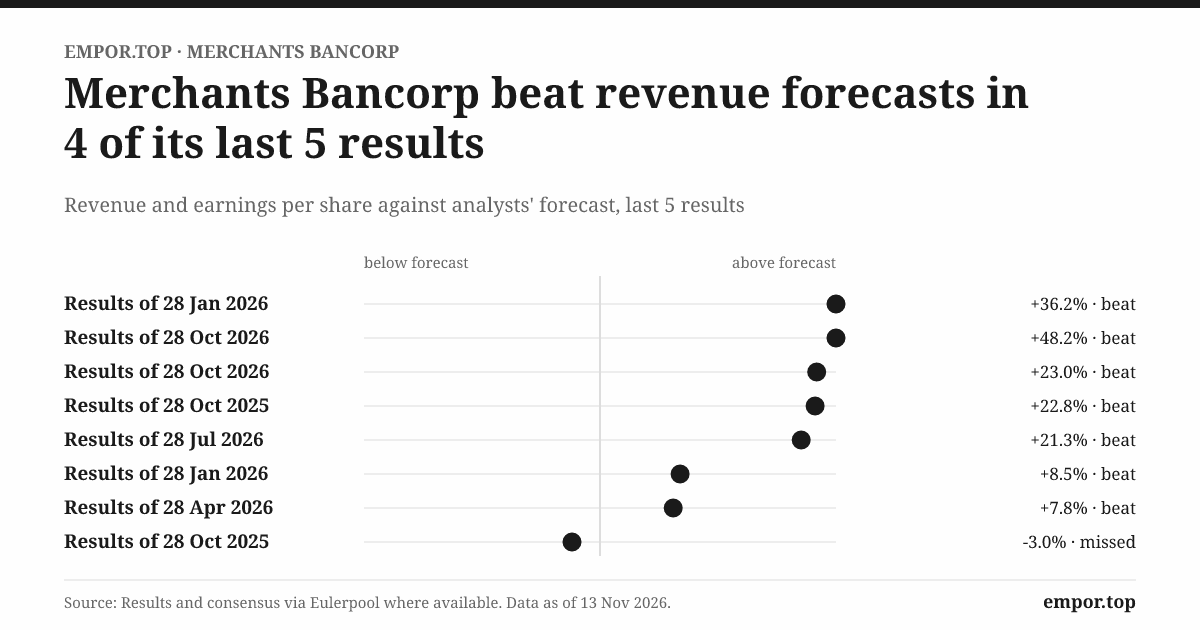
On October 28, 2026, a bank headquartered in Carmel, Indiana, a quiet suburb north of Indianapolis, published a quarter that seemed to settle an argument. Merchants Bancorp earned $105.2 million in the three months to September, almost double the $54.7 million it had earned a year earlier.1 Problem loans were shrinking. Charge-offs, the losses a bank finally admits it will never collect, had fallen to a trickle. Core deposits were climbing and expensive borrowed money was being paid down. For a company whose worst stretch of its public life had come in 2025, the release read like a recovery announced in a single page.
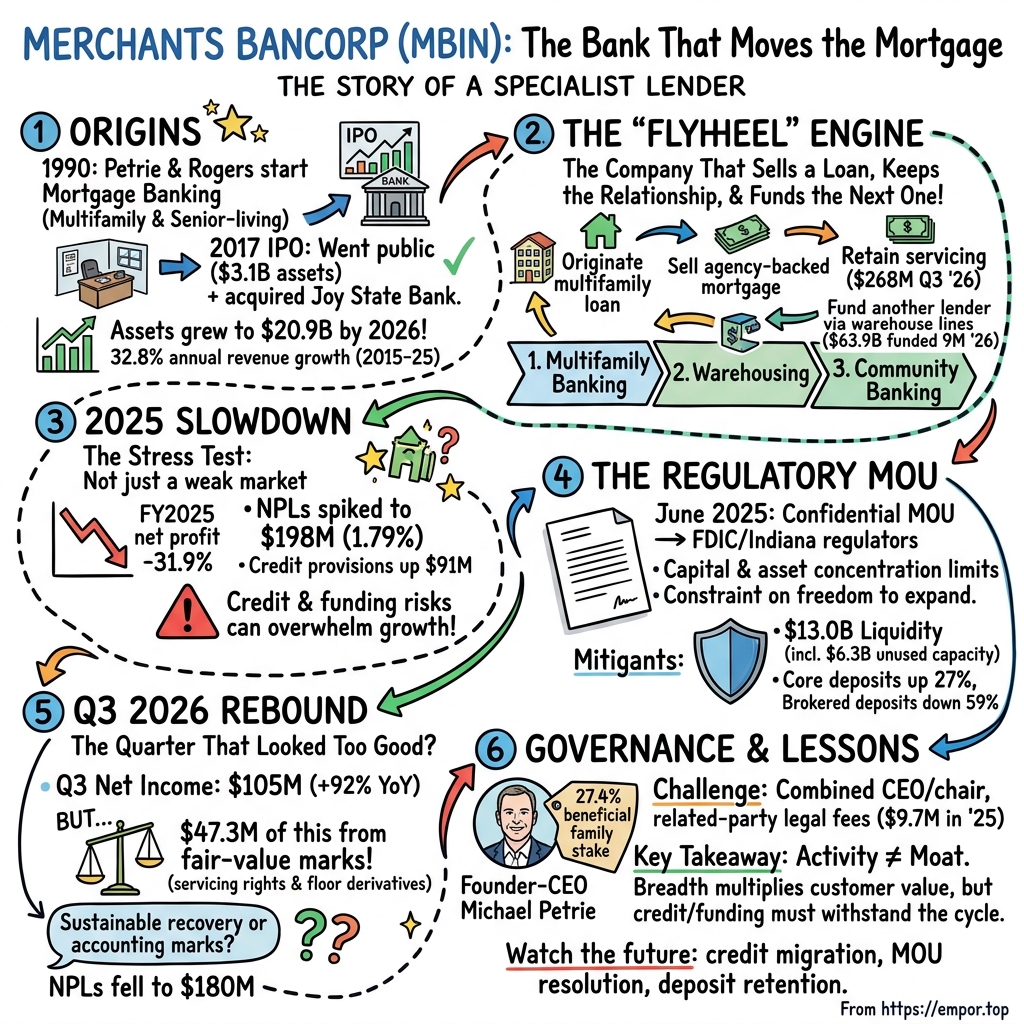
The scale behind that number surprises people who have never heard the name. At the end of September 2026, Merchants held $20.9 billion of assets, $15.0 billion of deposits and $12.3 billion of loans it intended to keep rather than sell.2 That is a larger balance sheet than many regional banks with familiar brands and hundreds of branches, and yet Merchants has neither. It is something stranger: a specialist that makes its living on the movement of mortgages, financing apartment buildings for affordable-housing developers, lending overnight-style money to the mortgage companies that write home loans, and then collecting fees for years on loans it has already sold.
The question every serious reader of that October release had to ask is the one in this section's title. The quarter looked very good, perhaps too good. Buried inside the $105 million was $47.3 million of positive fair-value adjustments: $28.2 million from a rise in the estimated value of the company's mortgage servicing rights and $19.1 million from an interest-rate floor derivative.1 Neither is cash collected from a borrower. Both are accounting estimates of what an asset is worth today, and both can move the other way next quarter. Those two marks together equalled roughly a third of the quarter's pretax profit of $133 million.1
That does not make the quarter fake. Nonperforming loans had fallen to $180.3 million, or 1.47% of loans, from $197.8 million at the end of 2025.1 Charge-offs were $3.9 million against $29.5 million a year earlier.1 The provision for credit losses, the amount set aside for future losses, dropped from $29.2 million to $12.0 million.1 Those are not marks; they are the bank's lending judgment showing up as lower expense. So the honest answer to the opening question is split down the middle. The rebound has real support from better credit and stronger interest income, and it was flattered by valuation gains that may not recur.
There is a second, quieter wrinkle in the headline. Merchants reported diluted earnings per common share of $2.06 for the quarter.1 Divide the $105 million of net income by the roughly 46 million common shares outstanding and you get something closer to $2.28.1 The difference is not an error. It is preferred stock. Merchants has funded part of its growth by selling preferred shares, and their holders collect about $10.3 million in dividends each quarter before common shareholders see anything.1 For a common shareholder, that gap is a standing reminder that the capital structure has layers, and that the bank's growth has been paid for partly with a more senior, fixed-cost form of equity. The longer-run trend tables used throughout this story count net income before that deduction, so per-share figures quoted from them run a little higher than the company's filed EPS.
Behind the numbers sits an investigation with three threads. The first is growth: can a lender built around housing finance keep expanding through property and interest-rate cycles that it does not control? The second is credit: the bank holds concentrated books of apartment and healthcare loans, and 2025 showed what happens when those books sour. The third is stewardship. Merchants is still run by Michael Petrie, the man who co-founded it in 1990, who also chairs its board and whose family is the largest owner.34 Founder control can be a superpower in banking, where patience matters. It can also blunt the independent oversight that keeps a fast-growing lender honest.
The tension, then, is this. The core machinery of Merchants may genuinely be improving just as its reported earnings are getting a lift from marks. A shareholder who annualises the October quarter is buying the marks. A shareholder who ignores the improvement is missing the credit turn. To decide which reading is right, it helps to understand how a mortgage shop in central Indiana became a $21 billion bank in the first place.
 Subscribe on LinkedIn
II. From a Mortgage Shop to a Public Bank
Michael Petrie and Randall Rogers started Merchants as a mortgage banking company.3 It was not a bank in the sense most people mean. It did not gather deposits from savers on Main Street and lend them out to local businesses. It originated mortgages on apartment complexes and senior-living facilities, packaged them for federal housing programs and investors, and earned its money on the transaction and on servicing what it had sold. Multifamily and senior-housing finance was a niche that rewarded knowing the government programs better than anyone else in the room, and the founders built the business around that expertise.
Pure mortgage banking has a structural weakness, though, and Merchants felt it. A firm that originates loans to sell needs money to fund them in the weeks or months before the sale settles, and that money usually comes from a bank. When credit tightens, the bank pulls back first and the mortgage company is left stranded. The founders' answer was to own the bank. Over time Merchants joined its national mortgage platform to a small Indiana community bank, Merchants Bank of Indiana, which gave it something a standalone originator never has: its own deposit funding and a regulated balance sheet on which to hold loans.3 Rogers became vice chairman, and Petrie took the chair of both the holding company and the bank.3
That hybrid is the whole story in miniature. The mortgage business found the borrowers and knew the agency programs. The bank turned deposits into the funding that let the mortgage business move faster, and it could keep the loans that were too short-term or too unusual to sell. Neither half on its own would have been remarkable. Together they formed a company that could touch a loan at more points than most of its competitors.
In October 2017 Merchants took the model public on Nasdaq, joining a small wave of Indiana listings that local business press described as a rare double for the state that season.5 At the time of the offering the company had about $3.1 billion of assets.6 The prospectus explained what the new money was for: growth capital for the bank, and about $5.8 million directed toward the acquisition of Joy State Bank, a small Kansas lender.6 It is worth being precise about that deal, because acquisitive banks are often judged by their appetite. Joy State was tiny relative to Merchants, and the filing offers no sign it was a large valuation bet. It looks like what it was presented as: a modest, strategic purchase that added a little geography and a few customers. Merchants' growth since has come overwhelmingly from building its own platforms, not from rolling up other banks.
And the growth was extraordinary. From roughly $3 billion at listing, assets climbed to $20.9 billion by September 2026, a near-sevenfold expansion in nine years.26 Reported revenue grew about 33% a year from 2015 to 2025.3 Shareholders' equity rose from under $150 million in 2015 to about $2.3 billion at the end of 2025.3 Some of that equity was retained profit; some was raised. The company issued preferred stock repeatedly, in 2019, 2021, 2022 and again in November 2024, when its Series E raised $230 million gross.3 That pattern matters for the investment case and resurfaces when the story turns to capital, but for now the point is simpler. Merchants needed a lot of capital to support a balance sheet that grew this fast, and it went to the market for it more than once.
The plain version of this history is a growth story: a scrappy Indiana mortgage shop that became one of the larger specialist lenders in the country. The record says that version is incomplete. Fast revenue growth did not translate into equally fast recent profit growth. Over ten years, net profit grew about 23% a year, which is excellent. Over the last five, it grew about 4% a year. Over the last three, it was essentially flat.3 Net profit peaked at about $320 million in 2024, then fell to about $218 million in 2025.3 Revenue kept rising for most of that period. Profit did not keep up.
That gap is the first clue in the investigation. A bank's revenue can grow simply because it is bigger and interest rates are higher, which is exactly what happened in 2022 and 2023, when revenue nearly doubled in a single year as rates surged.3 Profit grows only if the bank keeps more of that revenue after paying depositors, staff and, above all, credit losses. The early Merchants converted growth into profit with remarkable efficiency; operating margins were around 60% in 2020 and 2021 by the measure in the company's reported figures.3 By 2025, that margin had fallen to about 19%.3 Some of the compression came from the higher cost of deposits, which is an industry-wide fact of life when rates rise. Some came from credit, which is specific to Merchants and to the books it chose to grow.
So the bank charter and public capital did what the founders hoped. They turned a specialist originator into a diversified funding and lending platform with a balance sheet big enough to matter. Whether that platform earns its keep through a full cycle is a separate question, and it starts with understanding how the machine actually makes money.
III. The Company That Sells a Loan, Keeps the Relationship, and Funds the Next One
Picture a developer in the Midwest who wants to refinance a 200-unit affordable-housing complex. She calls Merchants Capital, the company's multifamily lending arm. Merchants can originate a loan that Fannie Mae or Freddie Mac will buy or guarantee, sell that loan into the agency market, and keep the right to service it, collecting her monthly payments, managing her escrow account and earning a small fee for years. If the property needs a shorter loan first, perhaps because it is still being renovated or leased up, Merchants can make a bridge loan and hold it on its own balance sheet until the building qualifies for permanent agency financing. If the deal involves low-income housing tax credits, a Merchants affiliate can help syndicate those credits to investors. And on the other side of the same company, a mortgage warehouse team is lending to independent home-loan companies so they can fund the single-family mortgages their customers are closing that week.
That is the business in one scene: a company that can be paid at several points in a loan's life, and in some cases on several different loans tied to the same property or the same mortgage market. The revenue comes from interest on loans and securities, from gains when loans are sold, from servicing fees, from warehouse interest and fees, and from syndication and asset-management fees.3 Most of that, the company notes, is not revenue from customer contracts in the usual accounting sense; it is lending income recognised as interest accrues or as loans are sold.3
Merchants reports its results in three segments, and each has a different personality. Multi-family Mortgage Banking is the original business: it originates and services multifamily and healthcare loans, most of which are sold. Mortgage Warehousing lends against mortgages that other lenders have closed and are waiting to sell. Banking is the balance sheet: it holds loans, gathers deposits, and includes residential mortgage and community banking.2
The warehouse business needs the most explanation, because it is the least familiar and arguably the most important. An independent mortgage company that closes a $400,000 home loan on Friday has to hand the seller $400,000 on Friday. It will not get that money back until it sells the loan to Fannie Mae, Freddie Mac or a private investor, typically within a few weeks. A warehouse line bridges that gap. Think of it as a revolving credit card for mortgage companies, secured by the mortgages themselves and paid down every time a loan is sold. Because each advance lasts only weeks, the dollar volume flowing through the warehouse dwarfs the balance outstanding at any moment. Merchants funded $66.3 billion of warehouse loans in 2025, and $63.9 billion in just the first nine months of 2026.32 Set that against a total balance sheet of $20.9 billion and the image is of money turning over again and again, a conveyor belt rather than a vault.
The mix of risk across the company follows the same logic. Agency-eligible fixed-rate multifamily loans are usually sold quickly; loans in the process of securitization typically settle against firm investor commitments within about 30 days.3 Adjustable-rate and bridge loans are different. Those can sit on the balance sheet for one to three years until they are refinanced into permanent financing or paid off.3 That is where Merchants takes genuine credit risk, because a bridge loan bets that a property will stabilise enough to qualify for a permanent loan. When property values fall or rents disappoint, the bridge can become the destination.
Servicing deserves its own explanation, because it is both a real economic asset and the source of the October marks. When Merchants sells a loan but keeps the servicing, it owns a stream of future fees. Accounting requires the company to estimate what that stream is worth today and carry it as an asset, the mortgage servicing rights, which stood at about $268 million at the end of September 2026.1 The value depends on assumptions about how long borrowers will keep their loans before refinancing and, importantly for Merchants, on what the company earns from the escrow and custodial balances that servicing brings in. When rates rise, borrowers refinance less and those balances earn more, so the estimated value goes up; when rates fall, it goes down. In the third quarter of 2026 the company said higher earnings on escrow and custodial balances drove most of the increase.1
There is an elegant connection hidden here. Servicing a large book of loans means holding the borrowers' escrow money for taxes and insurance, and that money can sit at the bank as deposits. So the servicing operation is not just a fee stream. It is also a source of funding for the bank, which in turn funds the warehouse lines and the bridge loans. This is the mechanism that makes the integrated model more than a collection of businesses under one roof.
What does not recur is just as important. Merchants does not disclose a consolidated recurring-revenue share or any minimum commitments from customers.3 A mortgage company can move its warehouse line to another bank; a developer can take its next deal to a competitor. Earnings depend on loan volumes, spreads, prepayment speeds, servicing values, fee activity and credit demand, all of which follow housing and interest-rate cycles.3 Servicing fees are recurring in the sense that they arrive monthly, but their accounting value moves with every shift in rates. Tax-credit syndication fees arrive deal by deal.
Which segment actually earns the money today? In the first nine months of 2026, Banking produced about $129 million of segment net income, Mortgage Warehousing about $104 million and Multi-family Mortgage Banking about $52 million.2 Measured against the assets each segment uses, the picture is striking. Banking held about 56% of segment assets, Warehousing about 39% and Multi-family Mortgage Banking a mere 3%.2 The original mortgage-banking business, in other words, earns roughly a fifth of segment profits on a sliver of the balance sheet. That is the capital-light jewel in the structure, but it is also the most volatile part, because its income depends on deal flow and on servicing marks rather than on a stable book of loans.
So the model earns from spreads, gains on sale, servicing, warehouse interest and fees, and syndication. The strongest advantage it reveals is an integrated set of capabilities and funding relationships. What the company's disclosures do not establish is exclusivity or switching costs: nothing in the filings shows that a borrower who uses one Merchants service is locked into the next. An integrated platform may well win more business per borrower. But agency rules let many lenders sell the same product, giant banks offer every one of these services, and specialist lenders compete on each piece. Whether breadth amounts to a moat depends on the market Merchants competes in, and that market is enormous and crowded.
IV. A Big Market With No Private Tollbooth
In 2025, after two years in which higher rates had frozen apartment financing, U.S. multifamily lending came back. Total multifamily originations rose about 32% to roughly $381.8 billion, and 2,530 different lenders made at least one multifamily loan during the year.7 Fannie Mae and Freddie Mac, the two government-sponsored enterprises that buy or guarantee most agency apartment loans, accounted for about 40% of the market.7 The rest came from banks, life insurers, commercial mortgage-backed securities, debt funds and others.7
Those three numbers frame the competitive question better than any adjective. A market of almost $400 billion is large enough for a specialist to grow for decades without running out of room. A market with more than 2,500 participants is one where no single lender controls the gate. And a market in which the two agencies hold 40% means that much of the product is, by design, standardised: a Fannie Mae loan is a Fannie Mae loan whichever licensed lender writes it.
At the top of the league tables sit names that dwarf Merchants. The Mortgage Bankers Association's 2025 rankings of commercial and multifamily originators were led by firms such as JPMorgan Chase, Wells Fargo, Walker & Dunlop, Berkadia and CBRE.8 These are lenders with national sales forces, massive balance sheets or deep ties to property brokerage. Merchants is not trying to beat them across the board. Its claim is narrower, and there is real evidence for it. In Fannie Mae's 2025 rankings of its Delegated Underwriting and Servicing lenders, Merchants Capital appeared among the top five producers of affordable-housing loans.9 Fannie's DUS program delegates underwriting authority to a limited group of approved lenders that share in the credit risk, so being a DUS lender at all requires capital, a servicing operation and a track record; ranking near the top in affordable lending shows a genuine franchise in that slice of the market.9
The warehouse business offers a second piece of evidence. Merchants reported that its warehouse funding grew 46% in 2025, while industry single-family mortgage volumes grew about 22%.3 In the first nine months of 2026 the pattern repeated: warehouse funding rose 40% against industry growth of about 16%.2 Gaining volume at two to three times the pace of the market, two years running, is hard to explain by luck.
It is also easy to overread. These are company-reported warehouse fundings compared with industry estimates of total mortgage originations, not a market-share series, and the two can diverge for reasons that have nothing to do with competitive strength: a change in the mix of customers, longer dwell times on the line, or simply lending to faster-growing mortgage companies. The comparison is a clue that Merchants is winning business. It is not proof of durable share gains, and it says nothing about whether the business was won on price.
Run the industry through the five forces that Michael Porter used to describe competitive pressure, and the picture is mixed. Buyer power is high. Developers and mortgage companies can choose among thousands of lenders and many types of capital, and they shop aggressively on rate, speed and execution. Supplier power is moderate: Merchants' key inputs are capital, deposits and agency approvals, and the agencies themselves set the rules, the pricing grids and the risk-sharing terms, which means a powerful partner sits on the supply side of every agency loan. The threat of substitutes is real, because life insurers, debt funds and securitisation markets all compete for the same borrowers when their own capital is abundant. The threat of new entrants is tempered by licensing and capital requirements in agency lending, but warehouse lending has fewer barriers, and large banks can re-enter whenever they choose. Rivalry is intense in every segment. The agency programs give Merchants a regulated distribution channel, but no exclusive resource, and short transaction cycles limit any conventional claim to switching costs.
What, then, could make Merchants hard to copy? The best case rests on combinations rather than any single asset. Agency approvals take years to earn. A servicing operation that handles thousands of loans and their escrow accounts is costly to build. Warehouse lending at scale requires both funding and the risk systems to monitor hundreds of mortgage companies. And the referral links among these pieces, a warehouse client that also sells loans the bank can service, a multifamily borrower that also needs a bridge loan, may produce economics that no single-product competitor can match. That is a plausible description of a process advantage.
The trouble is that the evidence for it is thin in public. Merchants does not publish retention rates for warehouse clients, win rates on multifamily deals, the share of borrowers who use more than one service, or how its pricing compares with rivals. Without those, the claim that the integrated platform creates customer captivity remains a hypothesis that fits the facts rather than a fact itself.
There is a fair way to test it over the next few years, and it does not involve counting gross dollars funded. Follow multifamily originations and warehouse fundings against the market volumes the MBA and the agencies publish; watch whether the servicing portfolio grows faster than originations, which would suggest the company is retaining relationships after the sale; watch credit performance on the loans the bank keeps; and above all watch returns. A lender that wins share by underpricing risk will show it eventually in its losses. Merchants did, for a while, and that is where the story turns next.
V. The 2025 Slowdown Exposed the Cost of Growth
For most of its public life, Merchants seemed to have found a way to grow without paying for it. Then came 2025, when net profit fell about 32%.3 Operating margin, by the measure in the company's reported figures, dropped to about 19% from 29%.3 Return on equity fell to 9.6%, from above 14% a year earlier and above 22% in 2020.3 In the second quarter of 2025, net income fell to $37 million, about half its level a year earlier.3
The popular explanation for a mortgage lender's bad year is a bad mortgage market, and there was some truth to that. Gain-on-sale income is sensitive to volumes and spreads, and housing finance in 2025 remained subdued by historical standards. But the record shows the decline was concentrated elsewhere. The Banking segment, the part of the company that holds loans on its own balance sheet, saw earnings fall about 42%.3 Its provision for credit losses rose by about $91 million.3 Net interest income fell and expenses rose.3 This was not primarily a story about fewer loans being sold. It was a story about loans the bank had kept going bad.
The chain of cause and effect runs through the property market. Many of the bank's multifamily loans were bridge loans and adjustable-rate loans written in the low-rate years, when apartment values were high and buyers assumed rents would keep rising and refinancing would be easy. When interest rates rose sharply in 2022 and 2023, both assumptions broke. Higher rates raised the cost of the floating-rate debt on those properties, lowered the price buyers would pay for them, and made permanent agency refinancing harder to qualify for. A bridge loan works only if the property crosses the bridge. When it cannot, the loan becomes a problem asset, then a nonperforming loan, and sometimes a building the bank must foreclose on and own.
That is exactly what the numbers show. Nonperforming loans, those where payments have stopped or full repayment is in doubt, were $73.8 million, or 0.80% of loans, at the end of 2023.3 A year later they had risen to $279.7 million, or 2.68%.3 By the end of 2025 they had come down to $197.8 million, or 1.79%, but that was still well over twice the level of two years earlier.3 Nonperforming assets, which also include property the bank has taken back, reached $258.0 million, including $60.1 million of real estate owned, largely after one multifamily property moved to foreclosure.3 Moody's, in its 2025 assessment, credited the company with improved capital and lower commercial real-estate concentration but flagged rising problem loans.[^10]
There were other signs of strain. Among the company's securities was a $438.4 million non-agency mortgage-backed security whose underlying loans showed 35% delinquency; the bond had senior loss protection, meaning other investors absorb losses first, but the company classified it as Special Mention, the first rung on the ladder of concern.3 And the bank had bought protection on part of its loan book: by September 2026, about $2.1 billion of loans were covered by credit default swaps, insurance-like contracts that pay out if specified loans default.1 That protection is prudent, but it is also a sign that management saw enough risk in the book to pay for a hedge.
By the third quarter of 2026, the direction had improved. Nonperforming loans had fallen to $180.3 million, or 1.47%.1 Criticized loans, the wider category of loans showing weakness that includes both Special Mention and Substandard, stood at $460.1 million, down 9% from the end of 2025.1 That improvement deserves credit. It deserves context too. Criticized loans actually rose 3% between June and September 2026, and within them the Substandard category, the more serious one, grew by $48.8 million in that quarter alone.1 Delinquent loans rose 4% in the quarter.1 Petrie said in the release that management remained focused on "the migration within criticized loan classifications," which is banker's language for watching whether weak loans are getting weaker.1 The problem is shrinking, not solved.
A word on a figure that looks alarming but means little for a bank. Merchants' reported operating cash flow was negative in most recent years, including about minus $341 million in 2025, even as the company earned more than $200 million.3 For an industrial company, that would be a red flag. For Merchants, it is noise. In 2025 the company collected about $43.2 billion from selling loans and collecting principal on loans held for sale, while originating or buying about $43.4 billion of loans for sale.3 Those loan flows run through operating cash flow, so a small timing difference between originations and sales swamps everything else. The right way to judge whether Merchants generates real earnings is not its cash-flow statement. It is credit costs, liquidity, retained earnings and regulatory capital.
The verdict on 2025 is uncomfortable for the bull case. The profit fall was not simply the mortgage market's fault. Higher credit provisions, lower net interest income and higher expenses in the Banking segment drove it. The subsequent improvement in credit is encouraging, but 2025 stands as a material counterexample to any claim that an integrated mortgage platform insulates a lender from property cycles. The bank kept risks that it could not sell, and the risks arrived.
The most useful tests from here are concrete. Investors will want to see migration by loan type and vintage, so they can tell whether the 2021 and 2022 bridge loans are still the source of trouble; charge-offs and recoveries, which show whether the bank's reserves were adequate; and the resolution value of the multifamily property the bank now owns, which will reveal whether its carrying value was realistic. Credit stress of this kind rarely stays inside the loan book. In June 2025 it reached the bank's regulators.
VI. The Confidential Agreement Behind the Capital Plan
In June 2025, Merchants Bank entered into a memorandum of understanding with the Federal Deposit Insurance Corporation and the Indiana Department of Financial Institutions.3 An MOU is the mildest formal tool in a bank regulator's kit. It is not a public enforcement order, not a cease-and-desist, and not a finding that the bank is unsafe. It is a private agreement in which a bank commits to specific improvements, and its full terms are confidential. Merchants disclosed its existence and outline: the MOU requires the bank to maintain capital above agreed thresholds, to manage asset concentrations, and to adopt certain operational plans.3
On the second-quarter 2025 call, management told investors that capital remained above the MOU's requirements and acknowledged that the agreement may limit or delay expansion plans.10 By the end of 2025 the company said capital exceeded the agreed thresholds and the bank remained within its agreed concentration limits.3 Those are the facts. Everything else about the MOU, including what specific concentrations the regulators want reduced and what would end the agreement, is not disclosed.
That uncertainty has real consequences. Merchants Bancorp, the holding company, depends on dividends from Merchants Bank to pay its own preferred and common dividends and to fund buybacks. If the bank's capital falls below the agreed minimums, those upstream dividends may require regulatory approval.3 The MOU is therefore a constraint on the company's freedom to expand, to concentrate, and potentially to return capital. Moody's had already noted in 2025 that holding-company double leverage, the degree to which the parent's investments in the bank exceed the parent's own equity, stood at about 133% at March 2025.[^10] Double leverage that high means the parent leans heavily on the bank's dividends. In June 2026, Moody's affirmed the bank's Ba1 issuer rating, one notch below investment grade.[^12]
The more immediate question is funding. A bank's funding is its oxygen, and Merchants' has changed shape quickly. At the end of September 2026, 95% of deposits were classified as core, up from 91% just three months earlier.1 Brokered deposits, money gathered through intermediaries that tends to leave when better rates appear elsewhere, fell 44% in the third quarter and about 59% for the year to date, while core deposits grew about 27%.12 Total borrowings, mainly advances from the Federal Home Loan Bank, fell from about $3.8 billion at the end of 2025 and $4.3 billion at the end of June to $3.0 billion at the end of September.13
Every one of those moves points in the right direction. But headline liquidity and funding quality are not the same thing, and the details are where the risk lives. About 31% of deposits, roughly $4.7 billion, were uninsured at the end of September.2 Uninsured deposits are those above the FDIC's $250,000 limit, and in 2023 they were the deposits that left Silicon Valley Bank in a single day. Some of Merchants' deposits are custodial and escrow balances tied to its servicing and other businesses, which can be stickier than a corporate treasurer's cash but are concentrated in a handful of relationships. And the remaining brokered certificates had a weighted-average remaining maturity of just 41 days, which means that money has to be renewed, at whatever rate the market demands, almost every few weeks.1
Merchants reported total available liquidity of $13.0 billion, or 62% of assets, including $6.3 billion of unused borrowing capacity.1 That is a big number, and it is easy to hear it as $13 billion sitting in a vault. It is not. It includes loans held for sale that could be sold, warehouse lines that could be run down, and the capacity to borrow from the Federal Home Loan Bank and the Federal Reserve against collateral. In a crisis, those sources should hold up, but they depend on the collateral keeping its value and the lenders keeping their doors open. They are a strong mitigant, not a substitute for stable deposits.
Capital ratios sit within that same frame. At the end of September 2026 the company estimated its common equity tier 1 ratio at 9.9% and its total capital ratio at 13.3%, both up from June.1 Tangible book value per common share reached $41.64, which the company described as its 31st consecutive quarterly record.1 Note the structure, though. A good part of Merchants' total capital is preferred stock. The Series E preferred raised $230 million in November 2024; in January 2025 the company redeemed $125 million of its older Series B.3 Preferred stock counts toward regulatory capital and does not dilute common holders, but it carries a fixed dividend that must be paid first.
Then, in January 2026, with the MOU still in force, the board authorised a $100 million common-stock repurchase program running through the end of 2027, and a trading plan under Rule 10b5-1 began in March.2 Buybacks at a bank under a regulatory agreement deserve a hard look. Repurchasing stock reduces common equity at the very moment regulators are asking the bank to hold capital above agreed thresholds. If shares trade near tangible book value, buybacks can be accretive; if the bank needs every dollar of common equity to absorb future losses or support loan growth, they can be a distraction. The right test is not whether the buyback is legal, which it plainly is, but whether it competes with regulatory headroom and the growth the bank wants to finance.
The MOU, in short, is a meaningful constraint, not a public finding of distress. Strong reported liquidity and rising capital are real mitigants. But deposits and secured borrowing capacity have to hold up under stress, and the bank has to satisfy regulators before it can grow freely again. With that frame in place, the October quarter's earnings can be taken apart properly.
VII. The Rebound Has Three Engines—and a Valuation Problem
Read the October 2026 release closely and the rebound turns out to have three engines, each running for a different reason. Merchants' net income rose across all three segments compared with a year earlier, which matters: this was not one lucky business carrying two weak ones. But each engine was fuelled by a different mixture of real improvement and accounting marks, and the proportions are what decide how repeatable the quarter is.
The first engine is Banking, and its fuel was mostly credit. The provision for credit losses fell to $12.0 million from $29.2 million a year earlier, and net charge-offs fell from $29.5 million to $3.9 million.1 When a bank stops losing money on its loans, the savings drop straight to the bottom line. That is the most durable kind of improvement, provided credit stays benign. Banking also received $5.0 million of the servicing-rights mark.1
The second engine is Mortgage Warehousing. Its loan balances grew as volumes rose, which lifted interest income, but the segment also booked the $19.1 million gain on the interest-rate floor derivative.1 A floor is a contract that pays off if rates fall below a set level; Merchants uses it as a hedge, because falling rates would squeeze the yield on its floating-rate warehouse loans. Its value moves with expectations for future rates. In the same quarter a year earlier, the floor had produced a small loss of about $770,000.1 So part of the warehouse segment's improvement was the hedge swinging from a small loss to a large gain.
The third engine is Multi-family Mortgage Banking, which received $23.2 million of the servicing-rights mark, along with lower compensation expense.1 Here the mark is the dominant fact. Gains on loan sales, the core income of a mortgage originator, actually fell about 23% from a year earlier, to $19.0 million.1 In other words, the underlying origination business was weaker, and the valuation gains filled the hole. Michael Dunlap, the company's president and chief operating officer, made the logic explicit, describing the servicing and derivative valuations as providing "an earnings hedge to pressure on gain on sale revenue."1
That phrase is the key to the whole quarter, and it cuts both ways. A hedge is supposed to offset losses in one part of the business with gains in another. When rates are high, origination profits suffer, but servicing rights are worth more and escrow balances earn more. When rates fall, origination recovers, but servicing values and the floor derivative behave differently. That is a sensible risk design. It also means that the marks that helped in the third quarter of 2026 are, by design, likely to reverse when the conditions that produced them reverse. They are not a new, repeatable source of profit. They are one side of a seesaw.
The marks also flattered the efficiency ratio, the share of revenue consumed by operating costs, which banks use as a headline measure of productivity. Merchants' efficiency ratio fell to 35.35% in the quarter, from 45.16% a year earlier, and the company itself attributed the improvement to the positive valuation adjustments in noninterest income.1 An efficiency ratio in the mid-30s is exceptional for a bank. One that depends on fair-value gains is not a stable benchmark.
The nine-month view softens the quarter's peaks. Net income for the first nine months of 2026 was about $251 million.2 Segment contributions were led by Banking and Warehousing, with Multi-family smaller, partly offset by holding-company costs and other items.2 That is a solid year, ahead of 2025's pace, but not one in which every quarter looks like October. The second quarter of 2026 earned about $78 million, the first about $67 million.1
There is also a small, lumpy item on the horizon. On the third-quarter call, management pointed to as much as $31.7 million of potential acquisition fees from low-income housing tax-credit transactions, recognition of which remained constrained pending contractual calculations.11 That could add to future results, but it is precisely the kind of transaction-driven income that makes any single quarter a poor guide to the next.
The calls themselves offer a useful test of consistency. On the second-quarter 2025 call, as the MOU was first disclosed, management talked about capital thresholds and acknowledged constraints on expansion.10 By the second and third quarters of 2026, the emphasis had shifted toward deposit growth, falling brokered funding and improving credit, alongside the servicing and derivative marks.1211 The shift is consistent with the numbers; the bank has genuinely improved. What investors should keep asking for is a clean, recurring view of earnings with fair-value changes separated out. The company's own release already reports the valuation adjustments by segment, which makes that exercise possible.1
It would be wrong to simply subtract the $47.3 million of pretax marks from net income and call the result "core" earnings. Some servicing value is genuine and will be realised as fees over time; some hedge gains offset real losses elsewhere; taxes complicate the arithmetic. The honest approach is to compare later quarters and watch whether earnings excluding these changes keep rising, stall or fall.
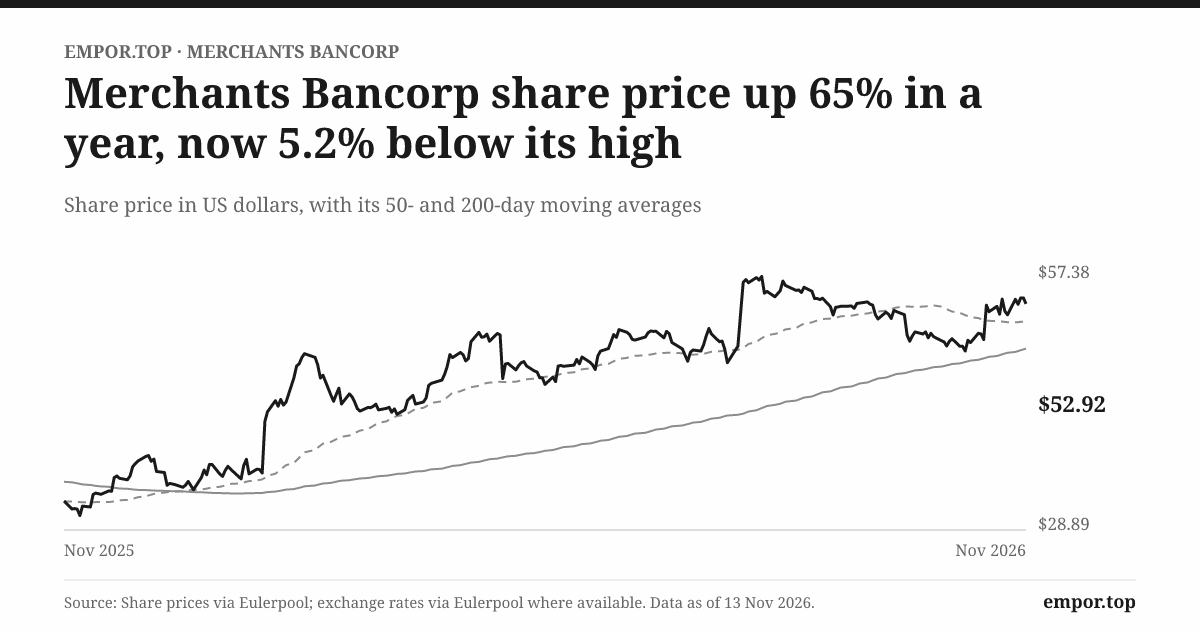
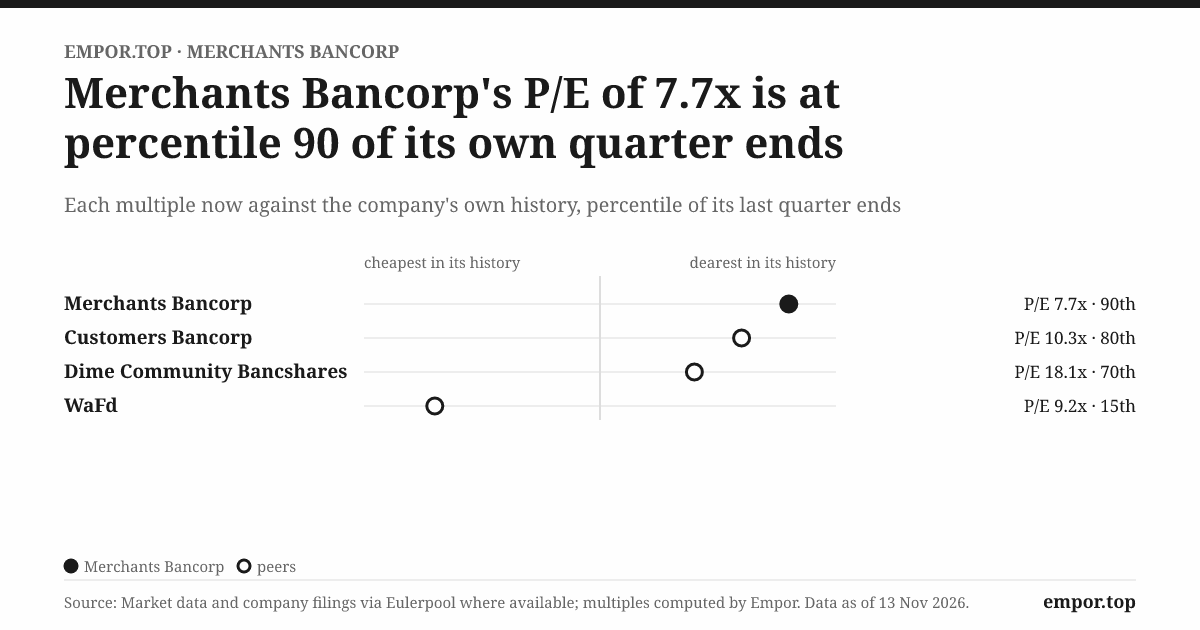
The stock market has made its own judgment. At $52.92 on November 13, 2026, Merchants traded about 5% below its 52-week high of $55.85 and well above its low of $30.42. Its price-to-earnings ratio of about 7.7 times trailing earnings sat above its own five-year median of about 5.9 times, and its price-to-book ratio was about 1.0. That last figure flatters a little, because book value includes preferred equity. Against tangible book value per common share of $41.64, the shares traded at roughly 1.3 times.1 The market, in other words, is no longer pricing Merchants as a troubled lender. It is pricing a recovery. Whether that recovery is worth more than its history says depends on the people running it.
VIII. Founder Ownership, Incentives, and the Price of Trust
The Petrie family's beneficial ownership was reported at 27.4% in April 2026.134 The Rogers family, heirs to the other founding partnership, holds meaningful stakes too: the proxy lists Mary Rogers and Carey Rogers Kulongoski at about 6.0% each, alongside family trusts.4 Michael Dunlap, the president and chief operating officer, has been chief executive of Merchants Bank since 2014.4 Sean Sievers, the chief financial officer, joined in September 2024.4 This is a company run by people who have lived inside it for a long time.
That continuity is the bull's argument for founder control. A founder with a quarter of the company has every reason to think in decades, to avoid the kind of short-term moves that impress analysts and wreck balance sheets, and to treat the bank's reputation as personal. In banking, where a single bad underwriting vintage can cost years of earnings, that kind of patience can be a competitive asset.
There is a caveat in the ownership arithmetic itself. The beneficial-ownership tables include family and trust overlaps, so the rows should not be added together as though they were independent blocks.4 The total influence of founding families is large, but its exact size is harder to state cleanly than the headline suggests.
The stronger test of stewardship is how the company behaves when things go wrong, and pay is the clearest window. Petrie's total compensation was about $2.53 million in 2025, down from $2.94 million in 2024 and $2.84 million in 2023.4 That direction is appropriate in a year when net income fell by about a third. The detail is less reassuring. For 2025, the compensation committee set three performance measures: revenue, earnings per share and return on average equity. Actual results reached 79%, 63% and 69% of target respectively, and two of those three fell below the threshold at which the plan would normally pay anything.4 The committee nonetheless awarded Petrie, Dunlap and Sievers 75% of their target cash and equity incentives.4 Martin Schroeter, who runs warehouse lending, received a $900,000 discretionary cash bonus.4
There are reasonable arguments for discretion. The warehouse business had a strong year, and committees sometimes judge that formulaic plans fail to capture what executives accomplished in a difficult market. But paying three-quarters of target when two of three metrics missed their thresholds is a choice, and it tells shareholders that the formula is a guide rather than a contract. In a year shaped by credit losses and a regulatory agreement, that is a choice worth noting.
Shareholders mostly accepted it. The advisory say-on-pay vote at the May 2026 annual meeting passed with about 38.7 million votes for and 2.0 million against.14 Yet the director elections told a more pointed story. Petrie received about 332,000 withheld votes, while several independent directors received roughly 6.1 to 6.7 million withheld votes each.14 That pattern is unusual. It suggests that some institutional holders were less concerned about the founder than about the independent directors who are supposed to oversee him, and it hints at dissatisfaction with committee decisions, board composition or oversight during the 2025 setback. With Petrie holding both the chief executive and chair roles, the independence of the rest of the 12-member board carries more weight than usual.4
Related-party dealings deserve proportional attention, which means taking the large item seriously and keeping the small ones small. In 2025 the company paid about $9.7 million in legal fees to a law firm in which one of its directors was a partner.3 That is material enough to track, even though the company describes it as ordinary-course legal work on normal terms. The company also paid about $25,000 for charter flights from a company owned by Petrie, and sold land for about $2.2 million to an entity Petrie owns, at approximately carrying value, paid in cash, with nothing owed at year-end.3 Loans to directors, executives and their affiliates were no more than 5% of shareholders' equity, on terms management says were substantially comparable to those offered to other customers.3 None of this suggests misconduct. All of it is the kind of web that founder-led companies accumulate, and it raises the bar for the board's independence.
Capital allocation is the other measure of stewardship. The company's most recent acquisition, The Loan Exchange, a single-family mortgage platform, closed on September 14, 2026, for about $13.9 million in total consideration, including about $11.1 million of goodwill.1 That is tiny against a $20.9 billion balance sheet, and there is no useful set of comparable transactions to say whether the price was high or low. More telling is management's own warning: the company said the acquired operations would raise operating expenses and may be dilutive to earnings as production increases and integration progresses.1 Buying a business that is expected to dilute earnings while operating under an MOU is not reckless at this scale, but it is an option on future jumbo and single-family production, not a proven earnings engine.
So founder ownership does align a large block of shares with the company's long-term future. But the combined chief executive and chair role, the family ownership overlap, the decision to pay incentives despite below-threshold results and the unusual protest votes against independent directors all warrant scrutiny. The filings show ordinary-course terms for related-party dealings; they do not remove the need to judge governance by its outcomes. And outcomes, in the end, are what the bull and bear cases are about.
IX. Analysis & Bear vs. Bull Case
The market has partly priced in a recovery, but whether Merchants is a specialist platform with durable advantages or a cyclical lender whose recent profit base is too uncertain to trust remains unsettled.
Start with the moat, argued once and in full. Hamilton Helmer's framework of seven powers asks which durable advantages let a company earn returns above its cost of capital. Run Merchants through them and only a few survive. Network economies, where each new customer makes the product more valuable to the others, do not apply. Switching costs are weak: a mortgage company can move its warehouse line and a developer can take the next deal elsewhere, and Merchants publishes no retention data to suggest otherwise. Brand matters in affordable-housing finance, where developers value lenders who understand complex programs, but brand alone rarely justifies a pricing premium in agency lending, where the product is standardised. A cornered resource would require exclusive access to something valuable; agency approvals are valuable but not exclusive, since other DUS lenders hold the same licences.
Scale economies are modest. Merchants is large enough to spread compliance and technology costs, but small compared with JPMorgan Chase, Wells Fargo and the other giants in the MBA rankings.8 Counter-positioning is more interesting: as a bank with its own deposit base and agency capabilities, Merchants can fund and keep loans that nonbank lenders must sell, and can lend to mortgage companies that large banks sometimes shun. That is a real positioning advantage, though it depends on the regulators who are currently asking the bank to manage concentrations. The most plausible power is process power, the hard-to-copy organisational know-how that comes from running origination, servicing, warehouse lending and banking as one connected system. The evidence for it is the platform's breadth, its agency participation, $63.9 billion of warehouse funding in nine months, and a top-five position in Fannie Mae's affordable-housing rankings.29 The counterevidence is intense competition, the absence of any disclosed retention or win-rate series, and the 2025 earnings decline, which showed the platform could not protect returns when credit turned. The verdict: the moat is plausible in the affordable-agency and integrated-platform niches, but not demonstrated as pricing power or durable market dominance.
The bull case has identifiable operating evidence. Core deposits have grown to 95% of total deposits and brokered funding has shrunk sharply, which should lower funding costs and improve stability.1 Nonperforming loans and charge-offs are falling.1 Warehouse volumes have grown faster than market benchmarks for two years running.32 And the servicing and origination platform can earn at several stages of a loan's life, with a built-in hedge between origination income and servicing values. If credit continues to normalise and the MOU is lifted, a bull would argue, Merchants could return to the mid-teens returns on equity it earned for most of its public life, which at around 1.3 times tangible book would not look expensive.
The bear case is just as concrete. At the end of 2025, multifamily and healthcare loans together made up roughly 61% of the loan book, about $5.3 billion and $1.4 billion respectively.3 That is concentration in exactly the asset classes that soured in 2025. About 31% of deposits are uninsured.2 The MOU can restrain expansion and dividends, and its terms are not public.3 Reported earnings remain exposed to credit costs and to servicing and derivative marks, which supplied a third of the latest quarter's pretax profit.1 And the five-year record of net profit growth, about 4% a year, says the company's rapid balance-sheet growth has not translated into proportionate earnings.3 A bear would argue that the current multiple capitalises a recovery that has not yet been proved through a full quarter without help from marks.
A skeptical activist would push on capital allocation. Should management be buying back stock under a regulatory agreement, or should it prioritise common equity and regulatory headroom until the MOU is lifted and normalised returns improve? Should a founder-chaired board award incentives above formula in a down year? Should the company add a dilutive acquisition while its regulators are watching concentrations? None of these questions has an obviously wrong answer. All of them deserve a clear one from management, and the 2026 proxy gave only part of it.4
Three indicators will carry most of the signal. The first is credit migration: criticized loans stood at $460.1 million at the end of September 2026, down 9% from year-end but up 3% in the latest quarter, with Substandard loans rising.1 The second is funding quality: core deposits at 95% of total and rising, with uninsured balances at 31%.12 The third is earnings excluding fair-value adjustments, the line that tells whether the October quarter was a step change or a spike.1
It helps to translate the price into what it assumes. A trailing multiple of about 7.7 times earnings equates to a roughly 13% earnings yield if the last twelve months of profit simply persist. Those twelve months, however, include the October quarter and its marks. Against tangible common equity, the market is paying about 1.3 times book for a bank whose return on equity fell below 10% in 2025 and recovered to the low teens over the twelve months to September 2026, by the measure used in the company's reported figures.31 A bank earning mid-teens returns on tangible equity through a cycle typically commands more than 1.3 times; one earning high single digits typically commands less. The market has placed Merchants in between, which is another way of saying it has not yet decided whether 2025 or the third quarter of 2026 is the better guide to normal.
There is no clean peer table that answers the question for Merchants, because no listed company combines the same three businesses in the same proportions. Walker & Dunlop and similar agency lenders earn most of their money from origination and servicing fees without a deposit-funded balance sheet, so they carry less credit risk but also lack Merchants' funding engine. Warehouse lenders inside larger regional banks enjoy cheaper, more diversified deposits but lack the multifamily servicing book. The company's own compensation peer group, 22 banks chosen partly for revenue scale and multifamily exposure, is a reasonable starting list, but it is a pay benchmark, not a valuation table.4 The point of the comparison is not that Merchants deserves a particular multiple. It is that its hybrid design is genuinely different, which makes both its advantages and its risks harder for the market to price.
What would change the conclusion? Several quarters of lower credit costs and stable fee income without large valuation gains, together with a disclosed end to the regulatory agreement, would substantially strengthen the recovery case. A reversal in criticized-loan migration, a loss on the foreclosed property, or a run-off of uninsured deposits would weaken it. Until then, the honest verdict is that Merchants has real operating strengths and real unresolved risks, and the stock's current price assumes the strengths will prevail.
X. Playbook: Business & Investing Lessons
Return to the developer refinancing her 200-unit building: Merchants could follow her loan through several stages. That is the story's central image and the source of its lessons.
The first lesson is that a loan is a relationship only if the economics follow it. Merchants built its business on keeping a relationship after a loan is sold. That can turn a one-time transaction into a long tail of income. But the company's disclosures show how much of that tail is estimated: the quarter's servicing mark reflected changed assumptions about rates and escrow earnings.1 For founders, the lesson is that the right to future fees is only as valuable as the borrower's decision to stay. For investors, it is that the test of a relationship is the cash it produces after the loan has gone, not how high the asset is marked on the day the quarter closes.
The second lesson is that volume is a useful clue, not a profit. Merchants' warehouse volumes suggest a franchise mortgage companies trust with their daily funding.2 But the segment's quarterly earnings also included a derivative gain.1 Dollars funded measure traffic. Dollars earned, after the cost of deposits and the price of hedges, measure tolls. A lender celebrated for its traffic can still run a thin toll road.
The third lesson is that a diversified income statement can still share one weather system. On paper, Merchants has three businesses that look nothing alike: an agency lender, a warehouse financier and a bank. In practice, all three depend on the same housing market, interest-rate path and appetite for real estate. The company has built sensible hedges between the pieces, and the October quarter showed them working. But hedges soften the swings; they do not change the climate. Diversification across products that share a single underlying risk is not the same as diversification across risks.
The fourth lesson is that growth earns its keep only after the losses. Merchants grew rapidly, but 2025 exposed the cost of that growth: net profit fell by about a third, and the bank entered a regulatory agreement on capital and concentrations.3 The losses on bridge loans arrived years after the lending, when rates changed. A lender's growth is a promise that its underwriting was right, and the bill for that promise arrives years later.
The fifth lesson is that founder ownership is alignment; governance decides whether it stays that way. Petrie's family's stake gives him a reason to protect the franchise for decades.13 But the incentive decision and withheld votes against independent directors raised questions about oversight.414 The pattern suggested that some investors trusted the founder more than the people meant to check him. In a founder-led bank, the founder's stake guarantees attention. An independent board is needed for accountability.
XI. Epilogue
Tonight, in mid-November 2026, Merchants stands in a better place than it did a year ago, and in a more ambiguous one than its October headline implied. The balance sheet and credit picture have improved.1 The confidential agreement with regulators remains in force.3 The market has moved from fear to cautious hope. The next few reporting days will decide which of those moods was right.
The first moment arrives with the fourth-quarter results early in 2027, and the line to read first is not net income but the credit table. Criticized loans remain the waiting room from which future nonperforming loans and charge-offs will emerge.1 If that balance resumes its decline, and especially if the Substandard category starts to shrink, the 2025 losses will look increasingly like a contained episode tied to one vintage of bridge lending. If Substandard balances keep climbing, the bank will need fresh provisions, and the rebound will have been a pause rather than a turn. The fate of the foreclosed apartment property belongs in the same story. A sale near its carrying value would vindicate the bank's marks; a large loss would raise questions about every other loan carried on similar assumptions.
The second moment will not arrive on a calendar. It will come whenever the next liquidity scare hits the banking system, whether from a regional-bank failure, a sharp move in rates or a shock in the mortgage market. That is when Merchants' new deposit mix will face its first real test. Its uninsured and custodial deposits, and the short maturities on its remaining brokered certificates, will face that test too.21 If depositors stay, and the bank holds its funding costs, the shift from borrowed money to core deposits will prove to be the most important improvement of 2026. If they run, the bank's unused borrowing capacity will be called on to do what it is there for, and the earnings consequences will be immediate.1
The third moment repeats every quarter. The test is earnings without servicing and derivative marks, using the segment-level valuation adjustments the company discloses.1 If those earnings keep rising, because origination recovers, warehouse volumes hold and credit costs stay low, the October quarter will look like the first step of a new base. If they fall back toward 2025's level once the marks fade or reverse, it will have been a spike. The potential tax-credit fees management flagged are a reminder that transaction-driven income can lift one quarter and vanish from the next.11
The fourth moment belongs to the regulators. A disclosed modification or termination of the MOU would do more for the investment case than any single quarter's earnings, because it would clarify the bank's room to grow and return capital.3 Until then, every growth plan, every repurchase and every new platform carries an asterisk.
And somewhere at the edge of the picture sits The Loan Exchange, the single-family mortgage platform bought in September for about $14 million.1 Management has already warned it may dilute earnings as production ramps. It could become a meaningful source of jumbo and single-family loans that feed the rest of the machine, or it could remain a small experiment. At this size it is an option, not a bet, and it deserves to be treated that way until it reports real production and real profit.
Each of these moments maps onto one of the story's central questions. Credit migration answers whether the concentrated books are healing. Deposit behaviour answers whether the funding transformation is durable. Earnings without marks answer whether the rebound is repeatable. The regulators' decision answers whether founder-led growth has earned back the freedom to grow. None of the answers is in yet.
XII. Outro
Return to the mortgage moving across the platform. One hand at Merchants originates it. Another funds the mortgage company that closed the loan down the street. Another keeps servicing it long after it has left the balance sheet, collecting a small fee each month and holding the borrower's escrow money in the bank, where that money helps fund the next loan. Somewhere in Carmel, the same company that wrote the first loan is quietly earning on the third and fourth steps of its journey. Few lenders of Merchants' size touch so many parts of the same mortgage.
That is what makes Merchants Bancorp unusual among banks of its size, and it is what made a mortgage shop founded in 1990 into a $21 billion institution. It is also what makes the company so hard to judge. Breadth can multiply the value of every relationship, or multiply the exposure to the same housing cycle; the October quarter showed both at once, with credit healing underneath and valuation marks shining on top. The design is integrated on a whiteboard. The test of it is whether Merchants can keep the relationship's earnings while controlling the risks it chooses to keep, through a full turn of the cycle, without the help of a good quarter's marks.
References
-
Q3 2026 Results Release, Exhibit 99.1 — Merchants Bancorp via SEC, 2026-10-28 ↩↩↩↩↩↩↩↩↩↩↩↩↩↩↩↩↩↩↩↩↩↩↩↩↩↩↩↩↩↩↩↩↩↩↩↩↩↩↩↩↩↩↩↩↩↩↩↩↩↩↩↩
-
Quarterly Report on Form 10-Q for the period ended September 30, 2026 — Merchants Bancorp via SEC, 2026-11-06 ↩↩↩↩↩↩↩↩↩↩↩↩↩↩↩↩↩↩
-
2025 Annual Report on Form 10-K — Merchants Bancorp via SEC, 2026-02-27 ↩↩↩↩↩↩↩↩↩↩↩↩↩↩↩↩↩↩↩↩↩↩↩↩↩↩↩↩↩↩↩↩↩↩↩↩↩↩↩↩↩↩↩↩↩↩↩↩↩↩↩
-
2026 Definitive Proxy Statement — Merchants Bancorp, 2026-04-10 ↩↩↩↩↩↩↩↩↩↩↩↩↩↩
-
Two Hoosier Companies Pull Off IPOs — Indianapolis Business Journal, 2018-01-29 ↩
-
2017 IPO Prospectus, Form 424B4 — Merchants Bancorp, 2017 ↩↩↩
-
Multifamily Lending Increased 32 Percent to $382 Billion in 2025 — Mortgage Bankers Association, 2026-08-13 ↩↩↩
-
MBA Releases 2025 Rankings of Commercial/Multifamily Mortgage Firms' Origination Volumes — Mortgage Bankers Association, 2026-03-31 ↩↩
-
Fannie Mae Expands Rental Supply With Nearly $74 Billion in Volume in 2025 — Fannie Mae, 2026 ↩↩↩
-
Merchants Bancorp Q2 2025 Earnings Call Summary — Quartr, 2025-08-11 ↩↩
-
Merchants Bancorp Q3 2026 Earnings Call Summary — Quartr, 2026-11-06 ↩↩↩
-
Merchants Bancorp Q2 2026 Earnings Call Summary — Quartr, 2026-08-14 ↩
-
2026 Annual Meeting Voting Results, Form 8-K — Merchants Bancorp via SEC, 2026-05-21 ↩↩↩
 LinkedIn
 WhatsApp
 Reddit
 Hacker News
 Email
 Kindle
 RSS Feed
 Spotify
 Apple Podcasts
 Amazon Music
 Audible
 YouTube