Customers Bancorp: The Branchless Bank That Chased Every Boom
I. The Ghost of Signature Bank in Reading, Pennsylvania
In the second week of March 2023, American banking had its worst few days since 2008. Silicon Valley Bank failed on a Friday. Signature Bank in Manhattan was shut down that Sunday. By the following week, depositors were pulling money out of First Republic in San Francisco faster than its executives could find collateral to borrow against. Venture capitalists, private equity fund managers and crypto trading desks that had kept their operating cash at those banks suddenly had no bank at all, and nobody knew which lender would be next.
About a hundred miles west of Wall Street, in a converted corner of Berks County, Pennsylvania, a bank most of those fund managers had never heard of was taking their calls. Customers Bank had its headquarters in West Reading, a borough next to an old textile-mill city whose best years ended long before the internet. It had a handful of retail branches. And within three months it had become one of the main places where the remains of Signature Bank's franchise ended up. In June 2023 it bought a portfolio of venture banking loans from Signature's receivership at a discount, and it took on teams of bankers who had served Signature's private-equity and venture clients.7 Those were the people who knew the capital-call lines, the fund administrators and the treasury habits of America's private-capital industry.
That is the odd thing at the centre of this story. Customers Bancorp, which trades on the New York Stock Exchange as CUBI, is a commercial bank with about $25 billion of assets, run through only five traditional retail branches in Pennsylvania.1 Most banks its size have hundreds of branches. Customers instead lends nationally to private-equity funds, venture-backed companies, healthcare operators, equipment lessees and mortgage warehouse borrowers, and it pulled in billions of dollars of interest-free deposits by giving institutional clients instant, round-the-clock payments. Last year it earned about $818 million of net revenue, roughly nine-tenths of it from the spread between what its loans earn and what its deposits cost, at a net interest margin of 3.32%.1 A typical community bank feels good about a margin near 3%. Customers gets more than that while paying for almost no real estate.
The speed that built that machine has also kept getting the bank into trouble, and the trouble is half of this story. The digital-asset payments network that brought in cheap deposits ended with a public Written Agreement with the Federal Reserve in August 2024.3 The finance chief was fired "for cause" in April 2024, and two weeks later she left with a $2.5 million settlement.89 The founder's son became chief executive this year after a pay package that nearly a third of voting shareholders rejected.56 Every big win for Customers has come with a bill attached.
So three questions run through the story. The first is whether Customers can hold on to its cheap-deposit advantage, with interest-free demand deposits making up about 32% of its funding, without walking back into money-laundering sanctions.2 The second is whether bringing in about 30 teams of bankers from the wreck of Signature Bank built a lasting commercial franchise, or just loaded a mid-sized balance sheet with flighty tech deposits and venture credit risk. The third is whether the Sidhu family, father and son, who have run the bank like a dynasty, are aligned with the institutions that own most of the stock. Those institutions are led by BlackRock and Wellington and hold more than 70% of the shares.5
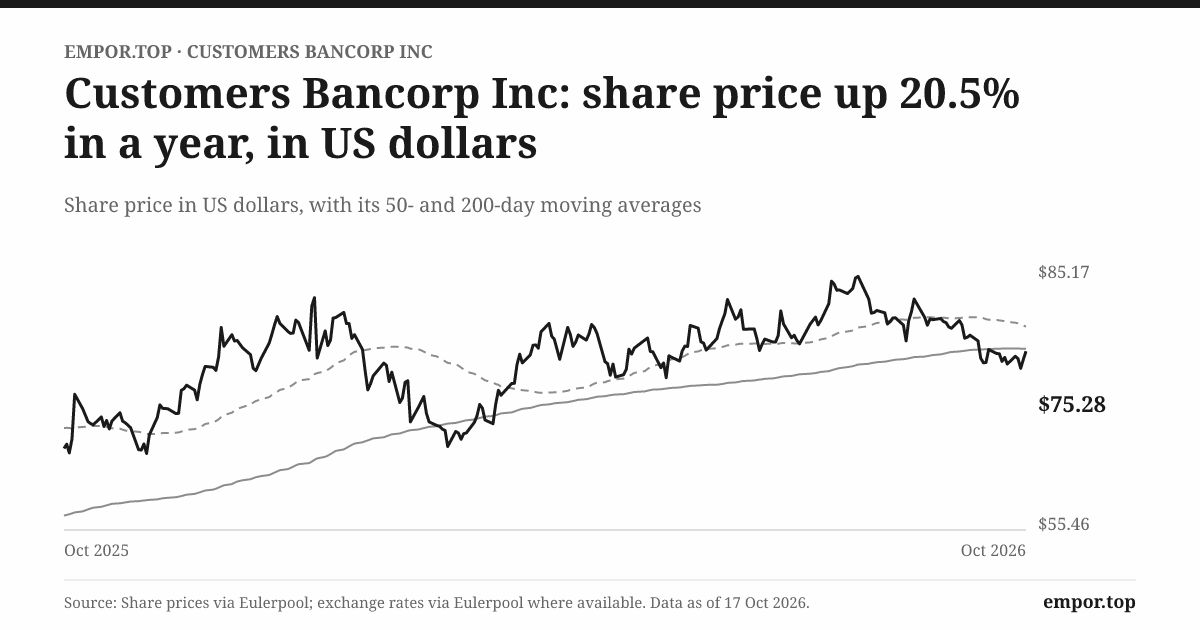
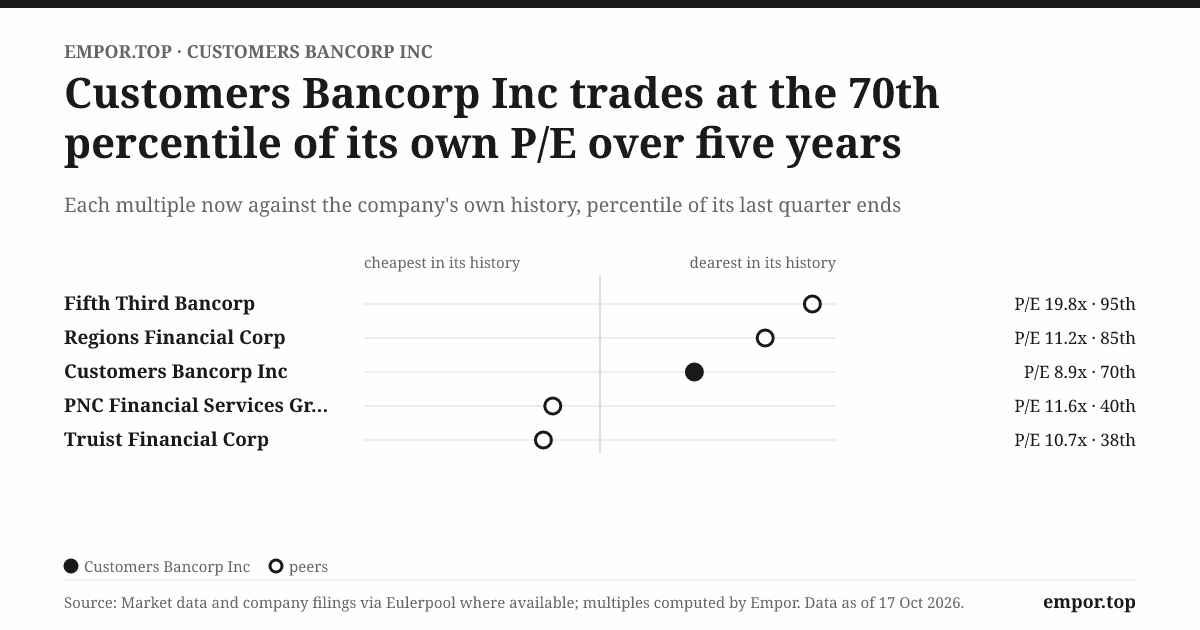
The market's view is easy to state. At $75.28 a share on October 17, 2026, the stock trades at about 8.9 times trailing earnings of $8.29 per share and about 1.1 times its book value of $64.51 per share.2 That is higher than its own five-year median of 7.3 times, which reflects a cleaner capital structure after the expensive preferred shares were retired in 2025.1 It is still cheaper than the specialist commercial banks investors usually compare it with. The gap is the price of the Fed agreement, which is still in force, and of a governance record that investors have not forgiven. To see why, the story has to go back to a Pennsylvania boardroom in 2006, where a banker lost the empire he had spent three decades building.
 Subscribe on LinkedIn
II. The Second Empire of Jay Sidhu: From Sovereign's Ouster to a Branch-Light Bank (2009–2019)
Jay Sidhu's first empire had branches everywhere. He was an immigrant from India who joined Sovereign Bancorp, a small savings institution in Wyomissing, Pennsylvania, in the 1980s. He rose to chief executive and turned it, through one acquisition after another, into one of the largest banks in the Northeast, with hundreds of branches from New Jersey to New England. Branches were the logic of that era. Deposits came from neighbourhoods, neighbourhoods were won with buildings, and buildings were bought by acquiring other banks.
The strategy ended badly. By 2006 Sovereign's shareholders were unhappy with what they saw as expensive deal-making and weak returns. The activist fund Relational Investors waged a loud campaign against the board, and Sovereign brought in Banco Santander as an investor. Before the year was out, Sidhu had left the company he built. Santander later bought Sovereign outright, and it became the American retail arm of the Spanish group. Sidhu's own account of what he learned is less important than what he did next. When he started again, he built the opposite of Sovereign.
In 2009, during the financial crisis, he found the vehicle: New Century Bank in Phoenixville, Pennsylvania, a small and struggling community lender. Sidhu led a recapitalisation with outside investors, took control and renamed it Customers Bank. That kind of deal was common in 2009 and 2010, when private money was buying weak community banks at the bottom of the cycle, and most of those projects disappeared into mergers. Sidhu's became a holding company called Customers Bancorp and later listed on the New York Stock Exchange.1
The idea was simple to describe and hard to copy. Most of a traditional bank's cost goes into branches: leases, tellers, security and heating for buildings that see fewer visitors every year. Sidhu decided Customers would keep only a token branch network and spend its money on commercial bankers instead. The bank called it a "single point of contact" model. Each business client dealt with one banker who could handle the whole relationship, supported by digital delivery rather than a counter. Customers capped its traditional branches at a handful in Pennsylvania, five today, while its lending teams spread to New York, Philadelphia, Boston, Chicago and later the West Coast.1
The numbers show it worked as a growth engine. Revenue went from about $213 million in 2014 to about $496 million in 2019, more than doubling in five years, and net profit grew from $43 million to $79 million.1 The return on assets was less impressive. Through the late 2010s it sat around 0.7%, a middling figure for a bank, and return on equity drifted down from about 10% to 7.5%.1 That is the hidden weakness of a branch-light bank. Without branches it had no natural supply of sleepy, cheap consumer checking accounts, so it had to pay for funding through higher-rate deposits and borrowings. In 2014 its borrowings were about four times its equity.1 Customers saved money on buildings and spent much of it on funding.
Sidhu's answer was to try to invent a digital deposit franchise. In 2015 Customers launched BankMobile, a branchless consumer bank led by his daughter, Luvleen Sidhu, built around the student refund disbursements that colleges sent to millions of students. In theory it was clever: a steady stream of young account holders with balances that cost nothing. In practice, consumer fintech was expensive to run, distracting for management, and never fit easily inside a commercial bank. In January 2021 Customers spun BankMobile off by merging it into a blank-cheque company, Megalith Financial Acquisition Corp, which renamed it BM Technologies.1
The spin-off did not end the relationship, and its cost shows how a bad idea can keep charging fees. Customers kept the BankMobile deposits on its own balance sheet and paid BM Technologies to service them. In 2024 alone, those servicing fees came to $19.6 million, including $7.1 million for earlier periods.1 The serviced deposits were about $308 million at the end of 2023. By the end of 2025 every one of them had moved to another sponsor bank, and the fee fell to $2.5 million that year before ending.1 The related-party ties were tangled too. Philip Watkins, who later served as interim finance chief at Customers, had been the chief financial officer of the Megalith vehicle.1 The clearest test of Sidhu's idea that a branchless bank could also gather cheap consumer deposits is a decade-long experiment that ended in a spin-off and a wind-down. The record does not support that idea. What survived was narrower: Customers could be a very efficient commercial lender, and it would have to keep looking for cheap funding wherever the next opportunity appeared.
By the end of the decade the bank had moved its headquarters to West Reading and focused on commercial niches: equipment finance, mortgage warehouse lending to non-bank home lenders, commercial real estate, and the beginnings of a fund-finance business. It was a capable lender without an obvious right to win. Then, in the spring of 2020, Washington offered something no community bank had seen before, and Customers turned out to be unusually ready for it.
III. The $10 Billion Algorithm: How a Community Bank Won the PPP Gold Rush (2020–2021)
Picture a small business owner in April 2020. The restaurant is shut, staff have been sent home, and Congress has just passed the CARES Act, which promised forgivable Paycheck Protection Program loans to cover payroll. The owner calls the bank where they have kept an account for fifteen years and is told the big bank is serving existing borrowers first. The online portal crashes. In those first weeks, the country's largest lenders handled PPP like a paper process that happened to be on the internet.
Customers handled it like software. Sam Sidhu, Jay's son, then a senior executive at the bank, pushed the bank to partner with fintech platforms so the application, document collection and approval steps could run automatically, day and night, for borrowers anywhere in the country. Most regional peers limited applications to existing clients. Customers did the reverse and took in hundreds of thousands of small borrowers it had never met. By the time the program closed, the bank was among the largest PPP lenders in the United States, competing in volume with institutions many times its size, a story the business press found hard to believe.16
The economics were remarkable because the government carried almost all the credit risk. PPP loans were guaranteed by the Small Business Administration, and lenders earned origination fees that were recognised as loans were forgiven or repaid. Revenue went from about $600 million in 2020 to about $844 million in 2021.1 Net profit rose 138% to $314 million, and diluted earnings per share reached $9.17.1 Return on equity jumped to 23%, roughly three times the bank's late-2010s level.1 For a moment, a mid-sized Pennsylvania lender had the returns of an elite franchise.
The lasting effect was on capital. Retained PPP profit took shareholders' equity from about $1.1 billion at the end of 2020 to about $1.4 billion a year later.1 Leverage fell sharply at the same time, with debt dropping to well under one times equity by 2021 from more than four times seven years earlier.1 That gave Customers a cushion it would rely on through every later crisis in this story. It is the strongest argument that PPP changed the bank for good: not because the fees continued, but because the equity they built did.
The tempting conclusion was that Customers had found a new level of earnings, and the next year disproved it. In 2022 net profit fell 27% to $228 million, and earnings per share dropped to $6.89.1 The stimulus stopped and so did the windfall. A shareholder who valued the bank on 2021 earnings would have paid for a peak that the bank has not matched since, even counting today's recovery. The record narrows the PPP story to this: it was a one-time capital gift earned through real operating agility, not proof that the bank could earn $300 million a year without help from Washington. Trailing earnings of $8.29 a share today are still below the 2021 peak of $9.17.2
PPP also showed something about the people. When an opportunity appeared, Customers moved faster than anyone, and it built for the volume before building the controls. That habit would matter. By late 2021 the board had more capital than at any time in its history and a margin that was about to fall as PPP fees disappeared. It needed another source of cheap funding, and the hottest one in American banking in 2021 belonged to crypto.
IV. Real-Time Rails and Hot Money: The Rise and Retraction of CBIT (2021–2024)
In 2021 two banks were the envy of the industry. Silvergate in La Jolla and Signature in Manhattan had each built a private payments network, Silvergate's SEN and Signature's Signet, that let crypto exchanges, trading firms and market makers move dollars to one another instantly at any hour. The volume of money moving through those networks was not the point. The point was where the money sat. Trading firms had to keep large operating balances at the bank to settle trades, and those balances paid no interest. Silvergate and Signature were collecting tens of billions of dollars of free funding.
Customers built its own version and called it CBIT, the Customers Bank Instant Token. It ran on technology from the fintech TassatPay. The idea is easiest to explain with an analogy. Ordinary bank payments in America run on systems like ACH and Fedwire, which work roughly like a post office with business hours: transfers go out in batches and nothing moves on weekends. CBIT worked more like a shared internal ledger. Two clients of Customers could send each other a dollar-backed token that settled immediately, every day of the year. Customers never held crypto itself. It held dollars and moved them faster than the national systems could.1
The business case was a textbook case of counter-positioning. Large banks could not easily serve crypto trading desks without frightening their own regulators and boards, and the old payment systems could not match round-the-clock settlement. Customers could offer both. The interest-free balances grew. Deposits linked to the digital-payments platform reached about $2.8 billion at the end of 2023 and about $3.6 billion at the end of 2024, close to two-thirds of all the bank's non-interest-bearing demand deposits.110
The timing made those deposits extremely valuable. Between 2022 and 2023 the Federal Reserve raised short-term rates by more than five percentage points, and most banks had to pay much more to keep their depositors. Customers, holding billions it paid nothing for, protected its margin better than peers whose funding was repricing quickly. In 2025 its total cost of deposits and borrowings fell to 2.88% from 3.46% the year before, and net interest margin rose to 3.32%.1
Then, in March 2023, Silvergate shut down voluntarily and Signature was seized. The two banks that defined the business were gone within a week. Customers did not pull back. Reporters described it as one of the few banks still connecting traditional banking with digital-asset firms, and crypto liquidity looking for a home found it.15 Taking that money was commercially sensible and, as it turned out, the decision regulators would look at most closely. The Fed's later independent review of the bank's transactions covered exactly March 1 to August 31, 2023, the months of the inflow.41
The test of the payments moat came from regulation, not from competitors. CBIT did not fail technically, and clients did not leave in large numbers. What failed was the bank's ability to watch what was moving through it. Fast, high-volume flows from institutional clients, many with international counterparties, put more strain on anti-money-laundering monitoring than the bank's systems and staff could handle. Before the end of 2024, under pressure from its regulators, Customers shut down the blockchain-based CBIT and TassatPay system and moved the remaining clients to cubiX, an in-house, non-blockchain, closed-loop ledger.1 The deposits largely stayed. The network did not survive. What Customers has now is useful payments plumbing for its own clients, not a growing network that becomes more valuable as each new firm joins.
Management did one thing right throughout, and it is worth recognising. A bank holding billions in flighty institutional deposits has to be able to replace them overnight. At the end of 2025 Customers had about $10.7 billion of immediately available borrowing capacity from the Federal Home Loan Bank and the Federal Reserve discount window, about 161% of its uninsured deposits once collateralised and affiliate deposits are excluded.1 That is the lesson SVB failed to learn. Customers may have lost control of who was sending money through its system, but it kept a careful hold on its liquidity. While the crypto money arrived in the spring of 2023, the bank was also preparing the most important deal in its history.
V. The Summer 2023 Heist: Buying Signature's Venture Book for 85 Cents
When the FDIC takes over a bank, it has to sell what it seized quickly, before borrowers drift away and bankers take their clients elsewhere. In the spring of 2023 the agency was selling three large failed banks at once. Most of Signature's deposits and branches went to Flagstar, part of New York Community Bancorp. The rest was split into portfolios and offered to whoever wanted them.
On June 16, 2023, Customers announced its piece. It agreed to buy a portfolio of Signature's venture banking and fund-finance loans with about $631 million of principal for roughly $536 million in cash, about 85 cents on the dollar.7 It also hired the bankers behind those relationships, about 30 teams of former Signature private-client and venture bankers based in New York, California and North Carolina.714
The choice of what not to buy matters as much as the price. Signature's biggest problems were in commercial real estate, especially New York's rent-regulated apartment loans, which a few years later damaged Flagstar's own balance sheet. Customers took none of that. It bought loans to venture-backed companies and to funds, the kind of credit where the borrower is often a private-equity or venture fund drawing on the committed capital of pension funds and endowments. A capital-call line is a little like lending against a promissory note signed by a university endowment. The fund borrows for a few weeks or months and repays when its investors send the cash they have already agreed to provide. Defaults are historically rare because the collateral is a legal promise from some of the most creditworthy investors in the world.
The discount gave Customers a built-in cushion. A 15% markdown on $631 million meant the bank paid about $95 million less than face value.7 Some of that discount is pricing for interest-rate and credit risk, and some is accreted into income as the loans pay down, so it is not entirely a gift. But it meant early losses would first come out of the discount rather than out of equity. The talent came without goodwill. No bank was bought and no premium over book value was paid for a franchise. Customers hired the people and bought the loans.
The franchise that resulted shows up clearly in the numbers. Specialized lending, which includes fund finance, venture banking, healthcare and equipment finance, grew about 21% in 2025 to roughly $7.1 billion.1 Those loans averaged a yield of about 7.4%, pulling the total loan book's yield to 6.68% and helping lift net interest income to about $750 million, up from $654 million the year before.1 The new teams also brought operating deposits. That is the real prize in fund finance: the funds and their portfolio companies keep their working cash with the bank that provides their credit line.
The skeptics expected venture debt to fail in the 2023 to 2024 tech downturn, as valuations fell and start-ups ran out of money. That has not happened so far. Non-accrual loans across the whole bank were only 0.27% of loans at the end of 2025, about $44 million, and the allowance for credit losses covered them more than three times.1 By June 2026 non-accruals had risen to 0.34%, still low but higher.2 The credit losses that did hit Customers came mainly from a different book: legacy consumer instalment loans, which drove most of $126 million of gross charge-offs in 2025.1 On current evidence, then, the venture portfolio has held up. The honest caveat is that a portfolio like this is tested in a deep and prolonged private-markets recession, and the book has not been through a full one.
The cost of the people is also real. Salaries and benefits went from about $133 million in 2023 to about $189 million in 2025, and headcount grew to 869 by the end of last year.111 Senior bankers in New York and Silicon Valley are expensive, and a team hired as a group can leave as a group. The Signature deal therefore turned one concentration, crypto operating balances, partly into another, private-capital funds and venture companies. It was a smart trade at a good price. Whether it becomes a lasting edge or just a well-timed cyclical bet depends on whether those teams are still at Customers ten years from now.
Customers came out of 2023 looking like the clear winner of the regional banking panic. Within twelve months, events inside the bank would show how thin its internal controls were.
VI. The "For Cause" Firing That Cost $2.5 Million and the Fed's August Hammer (2024)
On April 12, 2024, Customers filed a short and unusual 8-K. It said that on April 10 the board had terminated Carla Leibold, the executive vice president and chief financial officer, "for cause," for violating company policy.8 Leibold had been at the bank for years and was one of the most visible executives on earnings calls. The filing gave no detail about which policy she had broken. In banking, the CFO is the person who signs off on the numbers, and when a CFO is fired for cause, investors assume the worst.
They did. The shares fell sharply in the following weeks as investors weighed the obvious fears: a restatement, a hidden loan problem, or something the regulators had found. Leibold rejected the board's account and hired counsel. On April 25, fifteen days after the firing, Customers filed again. It had signed an Agreement and Mutual General Release with Leibold. She would receive $2.5 million in severance over two years and $500 an hour for any cooperation the bank needed.9 Companies do not usually pay seven figures to someone they have just fired for breaking policy. Whatever happened, the board's first public account did not hold up, and the reversal made it look worse.
There is no evidence of an accounting problem. Deloitte & Touche, the bank's auditor since 2019, gave unqualified opinions on both the financial statements and internal controls for 2025, with the allowance for credit losses as the only critical audit matter.1 The bigger issue was arriving from another direction.
On August 5, 2024, the Federal Reserve Bank of Philadelphia signed a public Written Agreement with Customers Bancorp and Customers Bank, and the Pennsylvania Department of Banking and Securities issued a parallel consent order. The Fed announced the action three days later.34 It found significant deficiencies in board oversight, risk management, and compliance with the Bank Secrecy Act, anti-money-laundering rules and sanctions requirements in the bank's digital-asset business.4 The press drew a direct line between the order and the bank's crypto ties.17
The details of the agreement are as important as the headline. The Fed did not accuse Customers of laundering money and imposed no fine. To date the bank has paid no civil money penalty.13 Instead it imposed obligations that limit a fast-moving bank. Customers had to strengthen board oversight, overhaul customer due diligence, hire an independent party to review transactions from March to August 2023, and give the Fed advance notice before launching new digital-asset or instant-payment products.41 For a bank whose story is built on getting to the next opportunity first, the notice requirement may hurt more than a fine would have.
The financial cost came through the expense line. Professional and legal fees were about $35 million in 2024 and rose 44% to about $50 million in 2025 as consultants, lawyers and reviewers worked through the remediation.1 Earnings fell in 2024, with net profit down 28% to $181 million.1 The decline had several causes. The BM Technologies servicing fees, a weaker fourth quarter and the compliance build-out all contributed, and the worst quarter, the first of 2025, earned only $12 million after a large securities impairment.1 The governance episode and the enforcement order still landed in the same year, and investors treated them as one story about a bank that grew faster than its controls.
Was there a link between the CFO firing and the regulatory problem? The company has never said so, and an analysis should not assume one. A shareholder class action filed on December 2, 2024, alleging misleading statements about both events, was voluntarily dismissed on October 28, 2025.1 A separate shareholder demand letter in June 2025 asked the board to pursue claims against directors and officers over the anti-money-laundering disclosures, and the board formed an independent Special Litigation Committee on July 23, 2025. That committee is still at work.1
The board's response was to rebuild credibility in finance. In 2025 Customers hired Mark McCollom, a veteran bank finance executive, as chief financial officer.1 It was a sensible choice that indirectly acknowledged the problem: the market needed to see an outsider in charge of the numbers. The question for 2025 was whether management could fix the balance sheet while the compliance work continued, and its answer was its best piece of corporate finance yet.
VII. Cleansing the Balance Sheet: The Preferred Purge and the 32% Shareholder Revolt (2025–2026)
Preferred stock is a quiet cost on a bank's earnings. It counts as regulatory capital but is not common equity, and the dividends are paid before common shareholders get anything. Customers had two series outstanding, Series E and Series F, both paying floating rates. When short-term rates were near zero, they were cheap. After the Fed's tightening cycle they became expensive, costing about $15 million in dividends in 2024, all of it coming out of profit that would otherwise have belonged to common shareholders.1
In 2025 management cleared them out in two steps. It redeemed the Series E preferred in June 2025. Then, on September 5, it sold about 2.5 million common shares out of treasury at $68.50 a share, raising about $163.5 million net, and in December it redeemed the Series F.113 The two redemptions cost about $142.5 million in total, with a small $4.7 million accounting loss.1 The trade was straightforward: issue common stock near book value, retire floating-rate capital that cost more than the equity investors were being diluted by. The common equity Tier 1 ratio, the measure regulators care about most, reached 12.99% at year-end and was 12.86% in June 2026, well above the bank's internal floor of 11.5%.12
There was a cost: issuing new shares diluted existing holders. But at $68.50, the equity raise was priced near book value, and once the preferred dividends ended, earnings per common share moved higher. Trailing earnings per share went from $6.33 for 2025 to $8.29 for the twelve months to June 2026.12 Most of that improvement came from operations, but the preferred retirement helped directly. The rating agency approved. In December 2025 Kroll Bond Rating Agency affirmed the holding company's senior debt at BBB and the bank's deposits at BBB+, and changed the outlook on all long-term ratings to positive. It cited the capital accretion, liquidity and better deposit granularity, while noting the remaining compliance remediation as a constraint.121
Then the family handed over the business. On January 1, 2026, Jay Sidhu became executive chairman, and his salary was cut 24% to $650,000. Sam Sidhu became chief executive, with a 34% raise to $975,000 in base salary.5 Sam came to the bank from investment banking. He was the one who pushed the PPP machine in 2020 and the Signature lift-out in 2023, and his style is more like a dealmaker's than a lender's: fast, opportunistic and focused on capital markets. The handover was planned rather than forced. It also confirmed that Customers is a family-run public company.
The pay is where the handover went wrong. Sam Sidhu's reported compensation for 2025 was $12.9 million, almost all of it a single stock grant of about $12.1 million, in a year when the bank was still paying consultants to fix problems the Fed had identified.5 In 2024 it had been $2.3 million.5 The board's argument is that the grant was for the new chief executive role and paid in stock, so it is tied to future share performance. The shareholders' answer came at the annual meeting on May 26, 2026. Of the votes cast on say-on-pay, about 32% were against, roughly 9.1 million shares, and a little over 30% opposed adding shares to the 2019 stock incentive plan.6 Advisory votes do not bind boards, but institutional investors usually treat opposition above 20% as a warning that requires a response. The dissent was not new. In 2024, almost 39% voted against an earlier amendment to the stock plan.18 So the history does not support the claim that management is aligned with shareholders on pay. Investors objected in two meetings two years apart, and the board's answer was a larger grant.
The issue that gets the least attention may matter most. Jay Sidhu has pledged about 694,000 of his shares as collateral for personal loans and Sam Sidhu about 214,000, roughly 908,000 shares in total, about a third of the family's holdings.5 At today's price that is about $68 million of stock tied to someone else's loan terms. Pledging is common at founder-led banks and is not illegal. The risk is mechanical: if the stock falls far enough, a lender can demand more collateral or sell the shares, and that selling happens exactly when the stock is already falling. CUBI's largest decline in the past five years was close to 79%.1 The family has asked for institutional trust while keeping a forced-selling risk in place.
The capital work in 2025 was excellent, and the governance record has kept that work from being valued fully. That raises a practical question for anyone looking at this stock: which of these two management teams should an investor expect to see from here?
VIII. Playbook: Business & Investing Lessons
The first lesson goes back to 2009 in Phoenixville. Jay Sidhu had just lost a bank built on hundreds of branches, and he decided the branch was the wrong thing to own. Customers then showed that a bank with five branches can afford the best commercial bankers in New York and California and still run efficiently. The lesson for founders is to cut the buildings, not the bankers. If your costs are concentrated in an asset your customers are quietly giving up, a competitor that never bought that asset can outspend you on the thing customers still value. Incumbent regional banks see this clearly and still cannot respond, because closing branches would risk the deposits that sit inside them.
The second lesson comes from the Philadelphia Fed in August 2024. Customers built a payments network faster than Silvergate's successors and filled it with free deposits during the most expensive funding market in fifteen years, and then had to shut it down because it could not see clearly who was sending money through it. Money it could not explain was worth less than money it could. For a bank, compliance is the licence that allows every other activity, not an overhead cost to minimise. Moving fast works in software. In banking it brings in examiners, and the cost of having them in the building every day, about $50 million in professional fees in a single year, is a reminder that the speed has to be paid for later.1
The third lesson is from June 2023, when the FDIC was selling a failed bank in pieces and Customers bought only the piece it understood. It did not buy Signature's New York apartment loans or its rent-regulated buildings. It bought loans backed by pension funds' capital commitments, at 85 cents on the dollar, and hired the people who knew those clients.7 Buy the part of the wreck you can underwrite, and buy the people with it. Bank failures are among the few times a mid-sized lender can buy franchise value below book. Most buyers lose money by taking the whole institution, problems included, because it seems simpler.
The fourth lesson is the preferred stock retirement in September 2025. A floating-rate instrument that had looked cheap in 2021 cost $15 million a year by 2024, and management swapped it for common equity priced near book value.1 The result was a cleaner balance sheet, a stronger capital ratio and a positive rating outlook, without making a single new loan. Fixing the right side of the balance sheet can add as much per share as growing the left side, with less risk, and it is less glamorous to talk about.
The fifth lesson is the vote count from May 2026. Nearly a third of the votes went against the pay plan, against a family that has delivered strong returns at many points over seventeen years. The point is not that the family is bad at banking. It is that founders who treat a public bank as a family business pay a valuation penalty, and the market charges it every day the stock trades at a discount to peers. The $12.9 million grant, the $2.5 million settlement and the pledged shares are each defensible on their own. Together they look like a pattern, and markets price patterns.59
IX. Analysis, Moat & Bull vs. Bear Case
Picture an investment committee meeting in October 2026. On the screen are three commercial banks known for specialist lending: Customers at $75.28, Western Alliance in Phoenix and East West in Pasadena. One analyst points out that Customers earns a respectable return and trades at only a little more than book. Another replies that the low price reflects real problems. Both are right, and the job is to work out how much of each.
Start with what Customers actually has, using Hamilton Helmer's seven sources of lasting advantage. The strongest is counter-positioning. Five traditional branches, where peers of similar size have dozens or hundreds, means Customers can spend its operating budget on bankers.1 Incumbents cannot copy that without closing branches and risking the deposits inside them. The advantage is real but it has limits. It lowers operating costs, not funding costs, and the branchless model has historically had to pay more for deposits. Today it partly offsets that with interest-free demand deposits of about $6.9 billion, roughly 32% of the total.2 That share depends on a small number of operationally active client groups, which is quite different from a base of millions of small checking accounts.
Switching costs are moderate and growing. A private-equity firm that runs its capital-call line, fund accounts and portfolio companies' operating accounts through Customers' teams faces real friction in moving: new documents, new administrator connections, new credit approvals. That friction supports the roughly $7.1 billion specialized loan book.1 But the friction belongs to the bankers as much as the bank. Signature's clients followed these same teams to Customers in 2023, which shows they would follow them again. A competitor willing to pay more could hire them away.
Network effects are essentially absent now. CBIT could have become one, a payments network that grows more valuable as more trading firms join, but it was shut down, and cubiX works as an efficient internal ledger, not an expanding two-sided network.1 There is no scale advantage. At $25 billion of assets, Customers is small next to JPMorgan or PNC, which spend more on technology each year than Customers' entire market value. There is no cornered resource either. Its technology is licensed or built in-house and can be copied, and its best people are hireable. Brand is weak outside its niches, and process power, the operating speed shown in PPP, is real but counts in both directions, because the same speed is what created the compliance failures.
Porter's five forces point to the same conclusion. Funding providers have considerable power: uninsured deposits were about $8.6 billion at the end of 2025, about 41% of the total, and corporate treasurers move money when yields fall behind.1 Borrowers in fund finance have alternatives, because large banks and private credit funds compete hard for capital-call lines, which keeps spreads in check. The threat from substitutes is growing as private credit takes over lending that used to sit with banks. Barriers to entry are high, because bank charters are hard to get, and the Fed's advance-notice requirement for new digital products is a barrier Customers itself now faces. Competition is intense. Overall this is an ordinary banking business with one durable structural advantage, its cost base, and one attractive franchise that depends heavily on a group of people.
A skeptical investor would push on three weak points. The first is rates. Management's own model says a 100 basis point cut in rates lowers net interest income by only about 0.6%, and a 200 basis point cut by about 2%.2 That is mild, and it relies on the bank being able to cut deposit rates as quickly as loan yields fall. Customers did that well on the way up, but the record on the way down is shorter. Net interest margin had already eased to 3.25% in the second quarter of 2026 from 3.32% for 2025.2 The second is the regulatory order. Each year the Written Agreement stays in place, professional fees probably stay high and new digital products need advance notice to the Fed. Professional fees in the first half of 2026 were about $22 million, below the 2025 pace but well above the levels before 2024.12 The third is the pledged shares. In a severe market drawdown, roughly 908,000 pledged family shares could be sold into an already falling stock.5
The bull case relies on things that have already started. Earnings per share of $8.29 no longer carry preferred dividends.2 If the remediation work finishes and professional fees return to their pre-2024 levels, that would add around $15 million of pre-tax income a year, a rough estimate based on the gap between 2025 fees and earlier levels.1 The Signature teams are reaching full productivity, and the June 2026 deposit figures, with interest-free deposits higher than at year-end, suggest the fund clients are keeping their operating cash at the bank.2 KBRA has said a successful regulatory resolution could lead to an upgrade, and lifting the order would remove the main reason Customers trades at a discount to peers.12 Trading at 8.9 times earnings, against roughly 9.5 times for Western Alliance and about 10.5 times for East West on comparable measures, the market is pricing in continued trouble rather than a cleaner future.2
The bear case is the history repeating. Uninsured deposits make up about 41% of funding, and two concentrated client groups, digital-asset firms and venture companies, are exactly the ones that leave together when a sector panics, as they did in March 2023.1 If that happened while rates were falling, margin could drop below 3%. Credit is the second risk. Provisions rose to about $98 million in 2025, gross charge-offs reached $126 million, and non-accruals moved up in the first half of 2026.12 Most of the losses were in consumer instalment loans, but a turn in the private-markets cycle would test the venture book for the first time. The third risk is governance. The Special Litigation Committee's findings, more executive turnover or another enforcement action would confirm what the dissenting shareholders already think.
Three measures tell most of the story from here. Net interest margin was 3.25% in the second quarter of 2026, down from 3.32% for 2025, and it shows whether cheap funding survives falling rates.2 Non-accruals were 0.34% of loans in June 2026, up from 0.27% at year-end, with reserves covering them about three times, and that shows whether rapid specialized lending growth is holding up.21 Liquidity coverage of adjusted uninsured deposits was 161% at year-end 2025, and it shows whether the bank can survive the next run.1 The debate comes down to one point: is the bank cheap because the market misreads it, or because the market has seen this pattern before? The answer depends on a decision being made in Philadelphia.
X. Epilogue
The Federal Reserve Bank of Philadelphia sits on Independence Mall, a short walk from the Liberty Bell. Somewhere in that building, examiners are reviewing what Customers has submitted under the August 2024 agreement: the independent transaction review, the rebuilt customer due-diligence process, and the reports on board oversight. The agreement has no fixed end date. It ends when the regulators decide it should.
Tonight Customers is in better shape than at any point in this story. It has about $2.26 billion of common equity Tier 1 capital, almost 6 percentage points above its regulatory requirement.2 It has paid no regulatory fines.1 The preferred stock is gone, the BM Technologies relationship is over, the class action has been dismissed, and earnings over the last four quarters were about $289 million, more than in any year since PPP.12 Customers has reduced its legal, financial and operational risks wherever it could. What remains are the risks it cannot fix alone.
The first decision belongs to the regulators. If the Fed and Pennsylvania lift the Written Agreement without a monetary penalty, the advance-notice requirement goes away, professional fees can fall, and the main reason for the valuation discount weakens. If the agreement continues into 2027, or the transaction review turns up something new, the bank will keep paying for remediation while peers spend on growth. That decision answers the first question of this story, whether Customers can keep its cheap deposits without returning to sanctions, more directly than anything management says.
The second decision belongs to the Special Litigation Committee. Its findings on the June 2025 shareholder demand will show whether the board is willing to hold its own executives accountable for the anti-money-laundering failures and the disclosures around the CFO's departure, or whether it closes the matter quietly. Either result will tell investors how this board behaves.
The third decision belongs to the family. With the stock near $75, Jay and Sam Sidhu could reduce or release their pledged shares and end the forced-selling risk. Doing so would cost them little and would show a lot. Not doing so would tell institutional holders how the family weighs its own convenience against their concerns.
The fourth decision is about capital. Customers paid no common dividend in 2025 and used up its buyback authorisation.1 With capital near 13% and no preferred stock left, the board has to decide during 2027 whether to keep accumulating, return capital, or do what it has always done when the money builds up: wait for the next crisis and buy part of it. The last option is the most profitable thing Customers knows how to do, and also the one that has repeatedly led to its next regulatory problem.
XI. Outro
Go back to Phoenixville in 2009. A banker in his late fifties, recently pushed out of the institution he spent decades building, took over a small, troubled lender in a town known mainly for its old steelworks, and decided that the bank he was about to build would barely have branches. Seventeen years later, that decision led to a $25 billion institution that outpaced the money-centre banks in PPP lending, ran an always-on payments network before most banks had heard of one, and bought the most valuable remaining part of Signature Bank at a discount while larger banks were still assessing the damage.
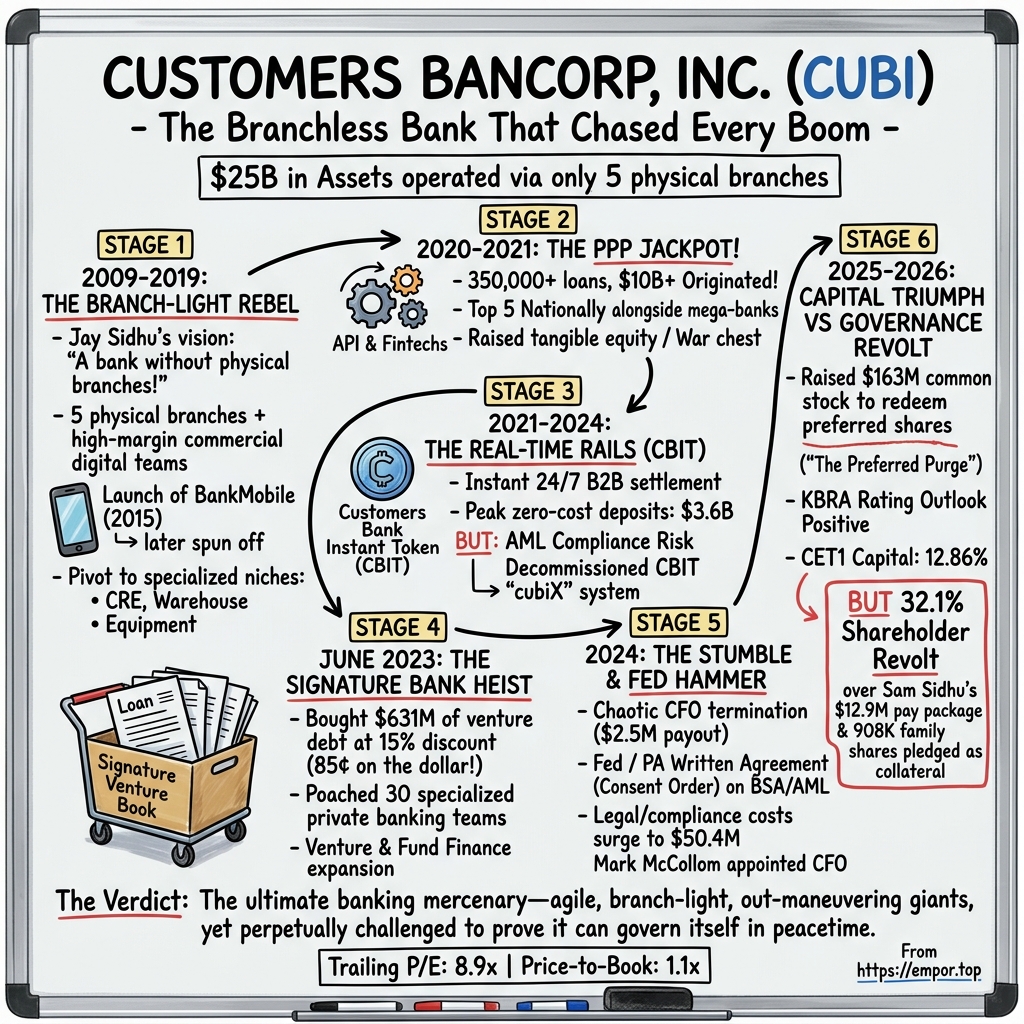
It also led to a Fed Written Agreement, a fired CFO who was paid to leave, and a family pay package rejected by a third of the voting shares. In this bank, the same speed produced both the wins and the problems. Customers Bancorp acts like a mercenary in banking: it can out-lend almost anyone during a crisis, and it still has to prove it can run itself well when there is no crisis.
References
-
Customers Bancorp, Inc. Form 10-K for the Fiscal Year Ended December 31, 2025 — U.S. Securities and Exchange Commission, 2026-02-27 ↩↩↩↩↩↩↩↩↩↩↩↩↩↩↩↩↩↩↩↩↩↩↩↩↩↩↩↩↩↩↩↩↩↩↩↩↩↩↩↩↩↩↩↩↩↩↩↩↩↩↩↩↩↩↩↩↩↩↩↩
-
Customers Bancorp, Inc. Form 10-Q for the Quarterly Period Ended June 30, 2026 — U.S. Securities and Exchange Commission, 2026-08-07 ↩↩↩↩↩↩↩↩↩↩↩↩↩↩↩↩↩↩
-
Federal Reserve Board Issues Enforcement Action with Customers Bancorp, Inc. and Customers Bank — Board of Governors of the Federal Reserve System, 2024-08-08 ↩↩↩
-
Federal Reserve Written Agreement with Customers Bancorp, Inc. Docket No. 24-019-WA/RB-HC — Federal Reserve Bank of Philadelphia, 2024-08-05 ↩↩↩↩
-
Customers Bancorp, Inc. Form DEF 14A Proxy Statement for 2026 Annual Meeting — U.S. Securities and Exchange Commission, 2026-04-14 ↩↩↩↩↩↩↩↩
-
Customers Bancorp, Inc. Form 8-K Report of Voting Results of 2026 Annual Meeting — U.S. Securities and Exchange Commission, 2026-05-28 ↩↩
-
Customers Bancorp, Inc. Form 8-K Acquisition of Signature Bank Loan Portfolio — U.S. Securities and Exchange Commission, 2023-06-16 ↩↩↩↩↩
-
Customers Bancorp, Inc. Form 8-K Departure of Chief Financial Officer Carla Leibold — U.S. Securities and Exchange Commission, 2024-04-12 ↩↩
-
Customers Bancorp, Inc. Form 8-K Agreement and Mutual General Release with Former CFO — U.S. Securities and Exchange Commission, 2024-04-25 ↩↩↩
-
Customers Bancorp, Inc. Form 10-K for the Fiscal Year Ended December 31, 2024 — U.S. Securities and Exchange Commission, 2025-02-28 ↩
-
Customers Bancorp, Inc. Form 10-K for the Fiscal Year Ended December 31, 2023 — U.S. Securities and Exchange Commission, 2024-02-29 ↩
-
KBRA Affirms Ratings for Customers Bancorp and Customers Bank; Outlook Revised to Positive — Kroll Bond Rating Agency, 2025-12-18 ↩↩
-
Customers Bancorp, Inc. Form 8-K Public Offering of Common Stock and Treasury Share Reissuance — U.S. Securities and Exchange Commission, 2025-09-05 ↩
-
Customers Bancorp Hires Former Signature Bank Venture Teams — Bloomberg News, 2023-06-20 ↩
-
Customers Bank Steps Into Crypto Void Left by Silvergate and Signature — Reuters, 2023-04-11 ↩
-
Small Pennsylvania Bank Became a Giant in PPP Loans — The Wall Street Journal, 2021-05-18 ↩
-
Federal Reserve Cracks Down on Customers Bank Over Crypto Ties — Financial Times, 2024-08-09 ↩
-
Customers Bancorp, Inc. Form 8-K Report of Voting Results of 2024 Annual Meeting — U.S. Securities and Exchange Commission, 2024-05-29 ↩
 LinkedIn
 WhatsApp
 Reddit
 Hacker News
 Email
 Kindle
 RSS Feed
 Spotify
 Apple Podcasts
 Amazon Music
 Audible
 YouTube