WaFd, Inc.: The Bank That Changed Its Bet
I. The Bank That Would Keep Its Name and Give Up Control
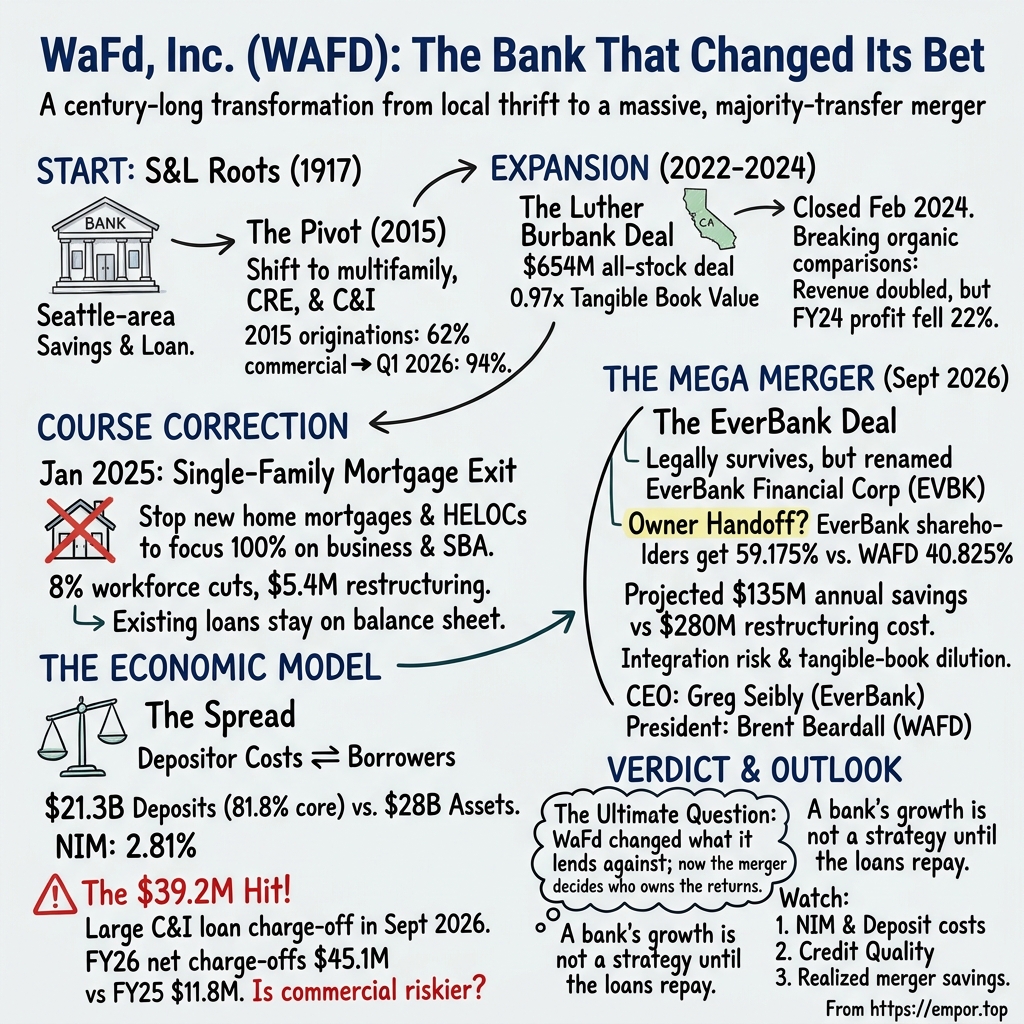
In September 2026, a century-old Seattle bank announced a merger that read, at first glance, like a familiar piece of regional-bank consolidation. WaFd, Inc. would be the company that survived. Its holding-company charter would carry on, its shares would not be cancelled, and its shareholders would not be cashed out. Then came the rest of the sentence. The combined company would be renamed EverBank Financial Corp., it would trade under a new ticker, EVBK, and for accounting purposes it would be EverBank, not WaFd, that was treated as the buyer.1 Former EverBank shareholders were set to own 59.175% of the enlarged company. WaFd's own holders, together with its equity awards, would keep about 40.825%.1
That split is the whole story in miniature. In law, WaFd acquires EverBank. In economics, EverBank's owners acquire control of WaFd. The bank that would keep its legal name on the corporate shell is preparing to hand the majority of its future earnings, and the direction of its strategy, to a new set of owners.2
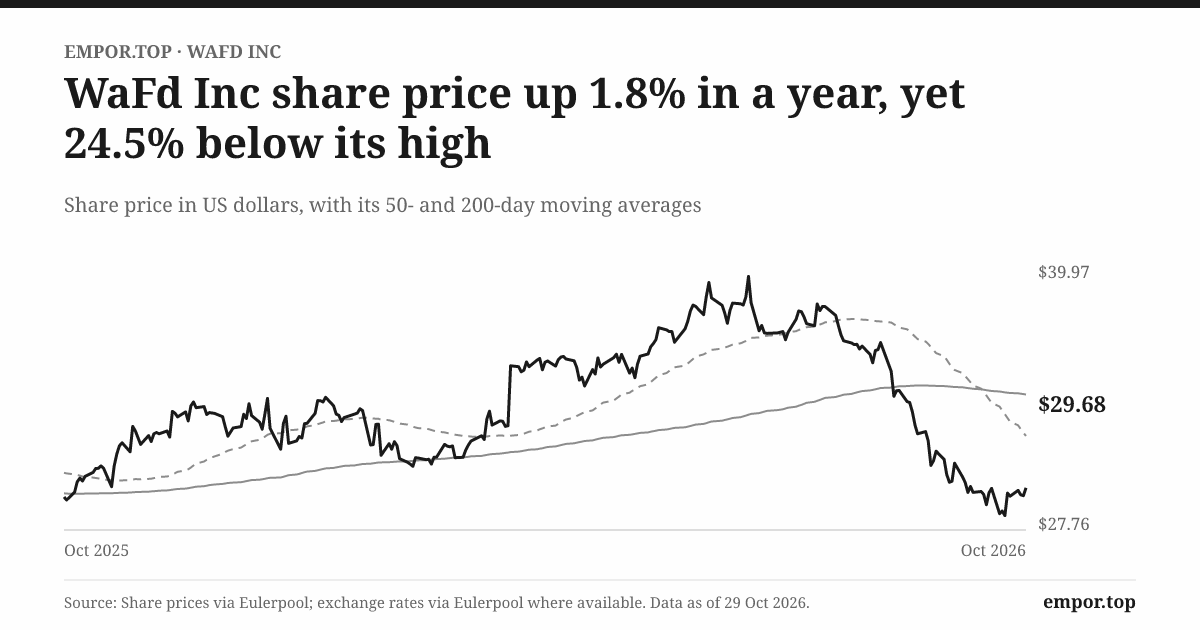
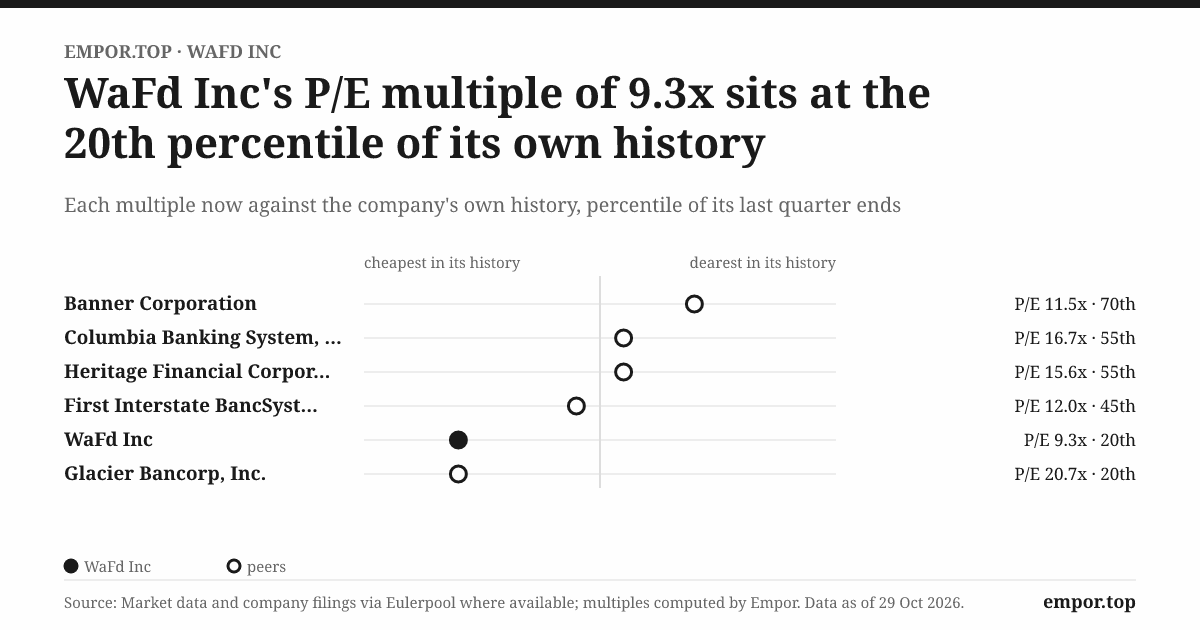
To see why that matters, it helps to look at what WaFd was on its own the moment before. At the end of its fiscal year in September 2026, WaFd held about $27.2 billion of assets, earned $255.9 million for the year and had spent more than a decade reshaping itself from a home-loan thrift into a commercial lender.3 On October 29, 2026, its shares closed at $29.68, roughly a quarter below their 52-week high, valuing the company at about 9.3 times trailing earnings and well under its reported book value.4 That is the price of a bank the market neither loves nor fears. It is also the price at which WaFd's shareholders were being asked to exchange majority control for a share of something larger.
Management's case for that exchange rested on arithmetic and reach. The two banks projected roughly $135 million a year of pretax cost savings once the combination was fully absorbed, against an estimated $280 million of one-time restructuring charges to get there.1 EverBank brought national specialty commercial lending and a digital deposit platform; WaFd brought a branch franchise across the western United States and the relationship deposits that come with it.5 Put together, the pitch went, the new bank would be bigger, more diversified and more profitable per share than WaFd could be alone.
The skeptic's reading is just as simple. A bank whose profit had barely grown in three years had agreed to dilute its owners into a minority, adopt another bank's name and accounting history, and accept a capital cushion that, by the merger proxy's own analysis, could be thinner at closing than it is today.1 The independent rating agency KBRA, which had affirmed WaFd's ratings with a stable outlook only weeks earlier, revised that outlook to "developing" after the announcement, citing the convergence of WaFd's risk profile toward EverBank's and the uncertainty of integration, funding and capital.5
So the merger is not a footnote to the WaFd story. It is the event that forces every older chapter to be reread, because each of them answers a question the deal now asks. The first is how much of WaFd's growth came from its own engine rather than from acquired balance sheets. The second is whether a decade-long shift toward commercial lending can be carried on without surrendering the credit record that gave the bank its reputation. The third is whether this management team's dealmaking has created value for shareholders, judged by results rather than presentations. And the fourth, the hardest, is whether the merger changes the answer to why WaFd wins at all, or quietly replaces it with a different company's answer.
One discipline runs through what follows. WaFd's reported history belongs to WaFd. The projected savings, accretion and capital ratios of the combined bank are forecasts, and as of late October 2026 the deal still needed approval from WaFd's shareholders and from bank regulators.1 The story of the merger therefore has to be told twice: once as the culmination of everything WaFd did before, and once as a promise whose evidence has not yet arrived.
To understand how a cautious Seattle thrift arrived at the point of trading control for scale, the story has to go back to the moment it decided to stop being only a thrift.
 Subscribe on LinkedIn
II. A Local Thrift Learns to Lend to Businesses
For most of its life, WaFd's business could be described in one sentence. It took in savings from people in the Pacific Northwest and lent the money back to them to buy homes. The bank traces its roots to 1917, when it began as a savings-and-loan association in the Seattle area, and over the following century it grew, branch by branch and acquisition by acquisition, into a lender spread across a string of western states.6 For decades the name on the door was Washington Federal, and its specialty was the thirty-year fixed-rate mortgage, a product that is beautifully simple to underwrite and quietly dangerous to fund.
The danger is worth explaining, because it shapes everything that came later. A thirty-year fixed mortgage locks in the rate the bank earns for a very long time. The deposits that pay for it can be repriced every time a saver walks in and asks for more. When interest rates rise, the bank's income stays stuck while its costs climb. Thrifts across America learned that lesson brutally in the 1980s, and a thrift that lived through it never quite forgets.
By the middle of the 2010s, WaFd's management had decided to change the mix. In its 2015 annual report, the bank described a deliberate shift in what it was originating, away from the traditional single-family loan and toward multifamily apartment lending, commercial real estate and commercial-and-industrial loans to businesses.7 That year, commercial lending already accounted for about 62% of the bank's new loan production.7 The reasoning management offered was not simply that commercial loans were a bigger market. It was that they were more often adjustable-rate or shorter in maturity, which meant the bank's earnings would reprice more closely in step with its funding.7 In other words, the commercial pivot began as a cure for the thrift's oldest disease.
That distinction matters for how investors should read what happened afterward. The bank was not just making more of the same loans; it was changing what kind of lender it was. Commercial borrowers bring larger individual loans, more varied collateral, deposit relationships, treasury-management needs and, crucially, a different kind of credit risk. A homeowner who loses a job tends to default slowly and in a crowd. A business borrower can fail suddenly, alone and in size.
The direction never reversed. By the first quarter of fiscal 2026, commercial loans made up about 94% of WaFd's originations.8 Over the full fiscal year that ended in September 2026, originations in what management calls its active commercial segments reached about $5.5 billion, up from roughly $4.0 billion a year earlier.3 Management's stated priorities had become almost a mirror image of the old thrift's: variable-rate commercial loans on the asset side, lower-cost deposits on the funding side, and a growing pool of liquid securities in between.3
So the consensus framing of WaFd as an old mortgage bank suddenly reinventing itself is not quite right. The reinvention was a decade old before the mortgage exit and the merger made it impossible to miss. That is a point in management's favour, because a strategy pursued consistently for ten years is more than a slogan. It is also a limit. A long-standing intention to become a commercial bank is not evidence that the commercial bank earns attractive returns. The record has to answer that separately.
And the record is harder to read than it looks, because the most dramatic change in WaFd's financial history over the past three years was not organic at all. In March 2024, the results of Luther Burbank Corporation, a California lender WaFd had agreed to buy in an all-stock deal, entered WaFd's accounts.9 WaFd's reported revenue for fiscal 2024 nearly doubled, from about $742 million to about $1.4 billion, while net income fell from about $257 million to about $200 million.910 Anyone glancing at the three-year growth rate of revenue, which compounds at roughly 24% a year from fiscal 2023 to fiscal 2026, would conclude that WaFd was a fast-growing bank.93 It was not. It was a bank that bought another bank in a period of high interest rates, when gross interest income was swelling across the industry.
Profit tells the truer story. Over the same three years, net profit was essentially flat, shrinking by about a tenth of a percent a year in compound terms, even after a 13% rise in fiscal 2026.39 Over ten years, profit grew about 4.5% a year, respectable for a cautious lender but hardly the trajectory the revenue line implies.93 The honest summary is that WaFd changed its business more than it grew it.
If the business changed, the next question is what economics now govern it. That means looking past the income statement and into the machine that actually produces a bank's profit: the spread between what a borrower pays and what a depositor earns.
III. The Spread Between a Borrower and a Depositor
Picture two customers walking into the same WaFd branch on the same afternoon. One is the owner of an apartment building or a mid-sized distributor who needs a loan and is quietly comparing WaFd's quote with offers from two other banks and a private lender. The other is a retiree with a few hundred thousand dollars to park, holding a printout of a certificate-of-deposit rate from an online bank. The banker cannot negotiate with one without thinking about the other, because they are two sides of the same balance sheet. Every dollar the retiree is paid comes out of what the business owner pays, and what is left over, after losses and the cost of running the bank, is WaFd's profit.
That leftover has a name: net interest income. It is the interest WaFd earns on its loans and securities minus the interest it pays on deposits and borrowings, and it is the overwhelming majority of what the bank makes. Fees from deposit accounts, card interchange and similar services exist, but they are a smaller stream. In fiscal 2025, the revenue streams that fall under the accounting standard for customer contracts, known as ASC 606, made up only about 3.6% of WaFd's total revenue, and most of those contracts were short-term and could be cancelled at will.9
That small number carries a big lesson. WaFd's revenue is recurring in the sense that a loan keeps paying interest while it is outstanding and a deposit keeps costing interest while it stays. It is not recurring in the way a software subscription is. There is no contract that obliges the depositor to stay, and no price list the borrower must accept at renewal. The bank's income depends on the size of its balances, the rates on both sides, how quickly each side reprices, and how many borrowers fail to pay. It is a business of spreads and cycles, not of contracts.
Start with the funding side, since that is where bank stories usually end badly. At the end of September 2026, WaFd held about $21.3 billion of customer deposits.3 It also had about $2.5 billion of borrowings, mainly from the Federal Home Loan Bank system, at a weighted average rate of about 3.0%, up from $1.8 billion a year earlier.3 Deposits and borrowings are different animals. Borrowings are wholesale money with a contractual price and maturity; deposits are relationships with customers, some sticky and some not.
WaFd measures the stickier part with a category it calls core deposits, and that share rose from about 77.9% of deposits in September 2025 to 81.8% a year later.3 That is a meaningful improvement in funding mix, and it fits management's stated goal of leaning on cheaper, relationship-based money. But "core" is a definition, not a guarantee. It describes the type of account, not the depositor's loyalty. About a quarter of deposits, 25.7%, were uninsured or uncollateralized, which is to say large enough that a nervous depositor has a reason to move.3 After the spring of 2023, when uninsured depositors drained several regional banks in days, no one should treat a bank's deposit base as permanent simply because it is labelled core.
Then there is price. Over the 2025 and 2026 fiscal years, management argued that WaFd's assets were repricing faster than its liabilities in the near term: maturing low-rate loans and securities were being replaced with higher-yielding ones, while deposit costs were easing more slowly.311 That is why the bank guided toward a modestly higher net interest margin. The margin itself, which measures net interest income against earning assets, was 2.81% in the second quarter of fiscal 2026.8 For a lender trying to become a commercial bank, that is thin. The merger proxy's selected peer group had a median margin of about 3.54%, which means WaFd earned noticeably less on each dollar of assets than the banks it was being compared with.1
Why so thin? KBRA's August 2026 review named two reasons that point straight back to the thrift's history. The first was funding cost: WaFd relies on higher-cost money, including a large book of certificates of deposit. The second was the asset side: a big residential mortgage portfolio originated when rates were far lower, still sitting on the balance sheet and still yielding less than new commercial loans.12 Both are legacies of the old business. Both take years to roll off. The margin, in short, is a slow-moving average of decisions made long ago, and that is the context for nearly every strategic move that followed.
None of this shows up cleanly in the headline financial ratios that work for industrial companies, and here the record needs translating. The reported operating margin for fiscal 2026 was about 23%, against about 44% in fiscal 2023.93 Taken at face value, that looks like a business in decline. It is mostly an artifact of how a bank's revenue is defined. Data providers count gross interest income as revenue and interest paid as a cost. When rates rose sharply, both lines ballooned, so the same dollar of profit became a smaller percentage of a much bigger revenue number. Add the Luther Burbank balance sheet, with its expensive funding, and the margin compresses further. The decline is real in one sense, because profit did not grow as fast as the balance sheet, but the percentage itself says little about the quality of WaFd's lending.
The same caution applies to cash flow. Across fiscal 2023 to 2025, WaFd reported cash from operations of about $890 million against net income of about $684 million.9 For a manufacturer, that would read as excellent cash conversion. For a bank it means very little, because the money that actually moves through the business, loans made and repaid, deposits gathered and withdrawn, sits in the investing and financing sections of the cash-flow statement. Measures like free-cash-flow yield and working-capital days, which can look striking for a lender, describe accounting classifications rather than economics. The useful measures are the ones a banker watches: the margin, the cost of deposits, the losses on loans and the capital left to absorb surprises.
Fiscal 2026 net income of $255.9 million came from that machine running a little better than the year before, with margin support from repricing and with cost discipline after the mortgage exit.3 That is genuine progress. It is also progress from a low base, achieved by a bank with a below-peer margin and funding that is more expensive than its rivals'. That raises the question every bank investor eventually has to ask: in a market crowded with much larger lenders, what exactly lets WaFd win the borrower and keep the depositor?
IV. A Regional Franchise Against Banks Several Times Its Size
Take the borrower and the depositor from that branch and send them shopping. The business owner in Boise or Phoenix can call WaFd, but also Columbia Banking System, Zions, East West Bancorp, Western Alliance, a national giant with a branch on the next corner, a private credit fund or a life insurer's lending desk. The retiree can move money to a money-market fund or an online bank in an afternoon, without leaving the kitchen table. WaFd is a meaningful bank in its markets, but it is not a large one by the standards of its rivals.
Scale makes the point. WaFd ended fiscal 2026 with about $27 billion of assets.3 Columbia Banking System, its most direct Pacific Northwest rival after its own mergers, reported about $65 billion in its third-quarter 2026 presentation.13 Zions, East West and Western Alliance are each larger still, and the national banks dwarf all of them. Those comparisons are about scale, not precise market share, since footprints, business mixes and reporting dates differ. But they establish the field: WaFd is a mid-sized western bank competing against franchises that can spread technology, compliance and marketing costs over balance sheets several times its size.
Thinking about the industry through Michael Porter's five forces, using a bank's actual economics, clarifies where pressure comes from. The bargaining power of depositors, who are really WaFd's suppliers of raw material, is high and rose sharply once rates moved off zero. Money is a perfectly fungible product, and digital banking has made switching nearly frictionless for anyone willing to chase yield. The bargaining power of borrowers, WaFd's customers, is meaningful in commercial lending, where a creditworthy business can shop its loan among several banks and nonbank lenders, and the best credits have the most options. The threat of substitutes is real on both sides: money-market funds and Treasury bills compete for deposits, while private credit and insurance balance sheets compete for commercial loans. Barriers to entry for a new chartered bank remain high because of regulation and capital, but digital deposit platforms have lowered them for the funding side of the business. And rivalry among existing banks is intense, because the same few products are sold by many players at visible prices.
Against those pressures, what can WaFd point to? Some advantages are evidenced. It has a long-established branch network across the western states, a high share of what it defines as core deposits, geographic diversity that spreads its exposure across several regional economies, and a credit record that KBRA singled out as historically favourable.123 KBRA's August 2026 rating affirmation, BBB+ for senior unsecured debt with a stable outlook, cited exactly those features: long-term credit performance, geographic diversity, solid asset quality and a common-equity tier-one capital ratio of 11.4% in the June 2026 quarter.12
Those are real strengths, and in a business where most failures come from credit losses or deposit flight, a reputation for not losing money is worth something. But a strength is not the same thing as a moat. A moat would show up in the numbers as persistent pricing advantages, market-share gains, unusually loyal customers or returns well above peers. WaFd does not publish customer retention data, borrower concentration or market-share figures, and nothing in its reported results shows sustained pricing power. Its margin sits below the peer median, and its return on equity, about 8.5% in fiscal 2026, is modest.19 A relationship banking model is a plausible advantage. On the available evidence, it is not a demonstrated one.
The funding caveat sits right beside the moat claim, and it is the most telling single fact in the competitive picture. In its August 2026 review, KBRA noted that about 39% of WaFd's deposits were certificates of deposit, and it identified higher-cost funding as a constraint on the rating.12 A CD is the most price-sensitive product a bank sells: the customer chose it because of the rate and will reconsider at maturity. A franchise with genuine deposit power typically funds itself with cheap checking and operating accounts that customers hold for convenience. KBRA did add an important nuance, noting that WaFd's long-tenured relationship jumbo deposits are not equivalent to volatile brokered money.12 Some of those CD holders have banked with WaFd for decades. But loyalty that has to be paid for at market rates is a weaker form of advantage.
The merger was pitched partly as an answer to this. EverBank brings national reach, digital deposit gathering and specialty commercial lending, and the combined company would be large enough to compete for funding and talent on a different footing.5 But KBRA's merger review complicates the logic, because it expected the combined bank to carry a deposit cost of about 2.73%, a level it described as higher than peers', with a loan-to-core-deposit ratio that would remain elevated.5 Scale may help with technology and expenses. It does not automatically fix the price of money, and the platform WaFd is joining appears to pay more for its deposits, not less.
The war-game verdict, then, is a narrower claim than either side usually makes. WaFd is not a commodity lender: it has a recognisable western franchise and a credit culture with a long record. It is also not a fortress: its funding is relatively expensive, its margin trails peers and it competes against much larger banks with more resources. That leaves one place where management could most clearly prove its judgment, which is how it has spent shareholders' capital when it chose to buy growth rather than build it. The first test of that came in California.
V. Luther Burbank: Expansion at Tangible Book Value
On November 14, 2022, WaFd announced that it would buy Luther Burbank Corporation, a Santa Rosa, California, lender with a long history in multifamily apartment loans, in an all-stock deal valued at about $654 million.1415 Interest rates had been rising at the fastest pace in four decades, bank valuations were falling, and the industry was still a few months away from the deposit panic of March 2023. WaFd framed the deal as a strategic step it had wanted to take for years: entry into California, the largest banking market in its natural western footprint, and a deeper bench in the multifamily lending it had been building since its 2015 pivot.14
The case management made to investors had three parts. First, geography: Luther Burbank gave WaFd a branch presence and a customer base in California. Second, funding: the target brought roughly $5.6 billion of deposits.14 Third, fit: Luther Burbank was, like WaFd, a thrift-style lender with a conservative credit culture and a concentration in apartment loans, so integration would be between two banks that spoke the same language.14 The pitch was not glamour. It was a bank that knew how to lend against apartment buildings buying another that did the same, in a bigger market.
The price looked disciplined on the measure that bank buyers use first. WaFd agreed to pay about 0.97 times Luther Burbank's tangible book value, meaning slightly less than the value of its equity after stripping out intangible assets.14 In bank M&A, where buyers routinely pay well above tangible book for franchises they covet, that is a price that does not, on its face, signal overpayment. On earnings, the picture was less obviously cheap: the price was about 14.8 times Luther Burbank's estimated fiscal 2023 earnings and about 15.4 times estimated fiscal 2024 earnings.14 Those multiples were not outrageous, but they were richer than WaFd's own shares typically commanded, and they implied that Luther Burbank's earnings power was modest relative to its book. A bank that trades below book is often telling you something about its returns.
That combination, cheap on book and full on earnings, is the classic profile of a low-return franchise. Luther Burbank had a large book of lower-yielding multifamily and residential loans funded with relatively expensive deposits and borrowings. In a world of rising rates, such a balance sheet earns less each quarter until its old loans reprice. Buying it at book value was not buying a bargain so much as buying a balance sheet at what it was worth on paper, with the bet being that WaFd could make it earn more.
Then the deal took a long time to close. Regulatory approval stretched for more than a year, through a period when regional-bank mergers faced heavier scrutiny after the 2023 failures. The transaction closed in February 2024, and Luther Burbank's results entered WaFd's books from March 2024, partway through WaFd's fiscal 2024.109 Because the consideration was paid in WaFd shares, its final value moved with WaFd's own stock price, and the 10-K records $465.5 million of stock issued in the merger, well below the headline value at announcement.9 That gap is consistent with the fall in WaFd's own share price over the long wait, a reminder that in an all-stock deal the buyer's currency matters as much as the seller's price.
What followed is where the strategic story and the accounting story diverge. The acquisition reshaped WaFd's fiscal 2024 results.109 Some of that decline was one-time: merger costs, provisions for the acquired loans and the accounting marks that come with any bank acquisition. Some of it was the economics of the purchased balance sheet itself. Afterward, WaFd sold loans and reshaped the combined portfolio, paying down expensive borrowings and managing its concentration in commercial real estate.9 That was sensible portfolio management, but it also means that changes in WaFd's balance sheet since 2024 cannot be read as organic growth. Acquired assets are not the same thing as a successful expansion.
The cleanest way to judge the deal from the outside is per share, because that is what an all-stock acquirer's owners actually experience. WaFd earned $4.00 per diluted share in fiscal 2023, the last full year before Luther Burbank.9 In fiscal 2026, more than two years after closing and with the integration complete, per-share earnings were still meaningfully below that level.3 Shareholders' equity grew from about $2.4 billion to about $3.0 billion across the period, while net profit was essentially flat, which is why return on equity slipped from about 10.6% in fiscal 2023 to about 8.5% in fiscal 2026.93 Some of that is the rate cycle, which hurt every bank with a large fixed-rate book. But the deal enlarged the capital base faster than it enlarged the earnings.
So the verdict on Luther Burbank is narrower than either the bulls or the bears would like. The record rejects the claim that WaFd overpaid wildly by the usual book-value yardstick. It does not support the claim that the deal was a proven bargain or that it delivered the growth the strategic case implied. The best reading is that WaFd bought a California platform at roughly what its balance sheet was worth, and that the platform has so far earned about what such balance sheets earn. California entry remains an option whose value has not yet shown up in returns.
Which makes the next decision all the more striking. Less than a year after closing a deal built partly on deepening its residential and multifamily lending, WaFd announced that it would stop making home loans altogether.
VI. The Mortgage Exit That Made the Pivot Hard to Reverse
In January 2025, Washington Federal's descendant did something that would have been unthinkable to the savings-and-loan men who built it. After more than a century of making home loans, WaFd announced that it would stop originating new single-family mortgages and home-equity lines of credit.16 The announcement came with a reduction of about 8% of its workforce and a restructuring charge of about $5.4 million.16 For a bank whose identity had been the thirty-year mortgage, this was not an adjustment at the margin. It was closing the family business.
The mechanics were precise. WaFd stopped making new fixed-rate home loans and HELOCs but kept the existing ones on its balance sheet, letting them pay down over time rather than selling the portfolio in one stroke.169 The people, capital and attention that had gone into mortgage production were redirected toward business banking: commercial real estate, commercial-and-industrial lending, small-business lending including government-guaranteed SBA loans, and the deposit and treasury relationships that come with business customers.16
Why stop? The strategic logic follows directly from the margin story. A fixed-rate mortgage originated at market rates does not earn enough, after funding costs, to justify the capital and the interest-rate risk for a bank of WaFd's size, especially one already carrying a large book of older, lower-yielding home loans. National mortgage originators and the big banks have scale, technology and secondary-market efficiency that a regional bank finds hard to match. And every new thirty-year loan deepens exactly the mismatch that the 2015 pivot was designed to escape.
The decision also extended a direction that had been running for a decade. Commercial lending had become the dominant source of originations, and the old business was gone from new production.78 That is why the exit matters more than any strategy slide. A pivot is easy to announce and easy to reverse while the old business is still running. Closing the mortgage operation, letting staff go and dismantling the production machinery made the change very hard to undo.
There is a less flattering reading, and fairness requires saying it. A bank that exits a product it has made for a century may be reallocating capital wisely, or it may be conceding that it could no longer compete profitably. Both can be true at once. The fact that the decision came after WaFd had just completed an acquisition heavy in residential and multifamily balances, and that the combined bank was earning below-peer margins, suggests at least some of the exit was a response to economics that were not working rather than a purely offensive move.
The cost of the change was modest in accounting terms. A $5.4 million restructuring charge is small against a bank earning a quarter of a billion dollars a year, and the workforce reduction was a one-time step rather than an ongoing drag.163 It would be tempting to credit the exit for the rise in fiscal 2026 net income, but that would claim too much. Profit also benefited from asset repricing, lower borrowing costs and the full absorption of Luther Burbank, and WaFd does not separate out how much of the improvement came from shutting the mortgage operation.
What matters is the bet the exit locked in. From January 2025 onward, WaFd's future growth had to come almost entirely from commercial and business lending. The legacy mortgage book would shrink, freeing capital and liquidity, but each dollar that ran off would need to be redeployed at better returns into loans that carry a different kind of risk. The thesis was clear: business loans would replace the earnings of home loans, at higher yields and with acceptable losses.
Within eighteen months, the commercial book delivered its first serious test of that thesis. Originations were growing fast. And then a single business relationship went bad.
VII. The $39 Million Loan That Tested the Credit Story
The September 2026 quarter should have been a victory lap. Commercial originations were rising, the margin was stabilising and the bank's quarter-end credit statistics looked better than they had in a year. Nonperforming assets, the loans that have stopped paying and the property taken back from borrowers, fell from 0.49% of total assets in June to 0.32% in September.3 Delinquencies dropped from 0.75% of loans to 0.50%.3 By the usual snapshot measures, the loan book was cleaner at the end of the quarter than at the start.
And yet in that same quarter, WaFd recorded $39.2 million of net charge-offs, the losses it actually wrote off after recoveries, against just $1.6 million in the previous quarter.3 On the October earnings call, management explained that the loss came mostly from one large commercial-and-industrial relationship, that the problem had been resolved, and that the size of the loss was outside the bank's historical norm.11
How can credit look better and worse at the same time? The answer is in how the ratios work. Nonperforming and delinquent loans are a snapshot of what is in trouble on the last day of the quarter. When a bank resolves a problem loan, by taking the loss, selling it or restructuring it, the loan leaves those ratios. A big charge-off can therefore make the snapshot look cleaner precisely because the bad loan was written off and removed. The improvement in the quarter-end figures was partly the mirror image of the loss. Neither number on its own tells the whole story; together, they say a single sizeable problem moved from "troubled" to "realized."
The longer comparison is the one that deserves weight. For fiscal 2026 as a whole, net charge-offs were $45.1 million, almost four times the $11.8 million WaFd wrote off in fiscal 2025.3 Against a loan book of roughly $20 billion, that is still a low loss rate by the standards of many commercial banks, well under a quarter of a percent. But for a bank whose reputation was built on almost not losing money, a near-fourfold jump in annual losses in the same year that commercial lending became nearly all of new production is not a coincidence an investor can ignore.
Management's claim that the loss was outside its historical norm is plausible, and it may well prove right. One relationship is a small sample, and commercial lending always produces occasional large losses on individual names. But it is an assertion, not proof. The question it leaves open is whether the bank's credit base rate, the losses it should expect in an ordinary year, has shifted upward because the loan book now looks more like a commercial bank's. A thrift lending against owner-occupied homes and apartment buildings lives with very small, very predictable losses. A commercial lender making loans to operating businesses lives with lumpier ones. If WaFd is becoming the second kind of bank, its historical loss record, built when it was the first kind, will overstate how safe its future book is.
The two calls that bracket the quarter are worth reading side by side. In July, when the June-quarter ratios were still elevated, the conversation was about a credit picture that had worsened but had not yet produced a large realised loss.17 By October, management presented the loss as resolved and outside its norm, and it kept the emphasis on growing commercial production.11 What investors most need from those exchanges is a clear answer to two questions: how much of the problem relationship, and of the bank's remaining nonaccrual loans, could still produce losses, and whether management changed its appetite for large business loans as a result. The posture management took in October was that the growth plan was intact, which is a statement of intent rather than evidence about the next problem loan.
That confidence has to be held against WaFd's below-peer net interest margin.81 The entire logic of the commercial pivot is that business loans earn higher, more variable yields, which should eventually lift that margin. But a higher margin earned by taking more credit risk is only worth having if the extra yield exceeds the extra losses. A bank that lifts its yield by half a percentage point and then sees losses rise by a similar amount has changed its risk without changing its returns.
KBRA's August 2026 review put the issue in its own terms. It named the shift toward more commercial lending as a rating constraint, alongside the funding costs and the legacy mortgage book, even as it praised the bank's long-run credit performance.12 That is precisely the right frame. The credit agency was not saying WaFd's underwriting had failed. It was saying that the bank's risk profile was changing and that the old record could not simply be projected forward.
Weighed together, the evidence narrows the claim rather than rejecting it. The history supports WaFd as a careful underwriter of the loans it used to make. It does not yet prove that the bank underwrites operating businesses as well as it underwrote homes and apartment buildings. The fiscal 2026 loss could be a one-off, or it could be the first data point in a higher, lumpier loss pattern. Three measures over the next several years will decide which: annual net charge-offs as a share of loans, the trend in delinquencies and nonperforming assets as the commercial book seasons, and the net interest margin that all that new lending is supposed to lift. If charge-offs drift back toward the fiscal 2025 level while the margin rises, the pivot will have worked. If losses stay closer to the fiscal 2026 level and the margin does not move much, the bank will have changed its risk for little reward.
There is, however, a second engine on the balance sheet that has nothing to do with borrowers at all, and in fiscal 2026 management was steering it hard.
VIII. A Balance Sheet That Is Also a Rate Bet
Not every dollar a bank holds is lent to a customer. A large share sits in securities: government bonds, agency mortgage-backed securities and similar instruments that pay interest, can be sold or pledged for cash, and give the bank a buffer it can draw on if deposits leave. To a casual observer, that portfolio looks like idle cash. To a banker, it is one of the most consequential decisions on the balance sheet, because it is a direct bet on interest rates.
In fiscal 2026, WaFd made that bet visibly. It bought about $1.4 billion of securities over the year, mostly thirty-year agency mortgage-backed securities purchased at a discount to face value, which management said were expected to yield about 5%.3 By September 2026, WaFd held about $4.05 billion of available-for-sale securities and about $887 million of held-to-maturity securities, alongside roughly $750 million of cash and equivalents.3
There is an irony in the purchase, and it is worth savouring. A bank that had just stopped originating thirty-year mortgages, partly because of the interest-rate risk they carry, was buying thirty-year mortgage bonds. The difference is real but subtle. A securities portfolio of agency MBS carries little credit risk, because the payments are guaranteed, and it can be sold or pledged quickly for liquidity. Buying bonds at a discount also means that when homeowners refinance or move, the bank is repaid at full face value, which lifts its return. But the core exposure is the same as with the old mortgage book: if rates rise, those bonds lose value, and if rates stay high, homeowners do not prepay, so the bank holds a long-duration asset for longer than it hoped.
The accounting treatment matters too. Available-for-sale securities are marked to market, with unrealised gains and losses flowing through a part of equity called accumulated other comprehensive income. That means a rise in rates can reduce WaFd's tangible book value even if it never sells a bond. Held-to-maturity securities avoid that mark, but cannot be sold without consequences. In 2023, the unrealised losses buried in securities portfolios were at the heart of the regional-bank failures. WaFd's portfolio is not of that scale relative to its balance sheet, but the mechanism is the reason a careful investor reads the securities footnote, not just the loan book.
The securities strategy connects directly to the legacy mortgage book. As older, low-yielding residential loans pay down, they free cash that can be redeployed into higher-yielding securities and commercial loans. KBRA pointed to another possibility: that WaFd could sell some of its residential loans to improve liquidity or redeploy capital.12 That option exists, but WaFd has not announced a decision to sell the portfolio wholesale, and doing so at today's rates would likely mean realising a loss on loans made when rates were much lower.
What about other market risks? WaFd reported no material foreign-currency exposure and had no separate foreign-exchange line. What they do show are interest-rate hedges: the bank uses swaps to fix the cost of some of its Federal Home Loan Bank borrowings, and runs a client-swap program for commercial borrowers.9 In fiscal 2025, the borrowing hedges produced an $18.0 million pretax loss in accumulated other comprehensive income as rates moved, a reminder that hedges cut both ways.9 The central market risk at WaFd is not currency or commodities. It is the speed at which assets and liabilities reprice, and the duration of the assets it chooses to hold.
So the treasury portfolio is best understood as a second rate bet sitting beside the loan book. If rates fall from here, the discount-priced MBS should gain value and prepay faster, lifting yields and book value. If rates stay high or rise, the purchases will look less clever. Either way, the portfolio is part of the earnings engine, and part of what EverBank's owners were about to inherit in the merger. Which brings the story back to that announcement, and to the numbers behind it.
IX. The Merger's Arithmetic: Savings, Dilution and a New Owner
When the preliminary merger proxy arrived on October 22, 2026, it turned the September headlines into figures that could be tested.1 Estimated savings of about $135 million a year before tax. Restructuring charges of about $280 million. Roughly 107.3 million new WaFd shares to be issued to EverBank's owners.1 Those three numbers define the bargain WaFd's shareholders are being asked to accept, and they are worth understanding one at a time.
Start with the structure, because it is unusual and easy to misread. WaFd, Inc. is the legal survivor: the holding company that remains standing after EverBank's parent merges into it. At the bank level, the arrangement runs the other way: EverBank's bank is set to survive the merger of the two operating banks.12 The combined holding company is to be renamed EverBank Financial Corp. and to trade as EVBK.1 Under merger accounting, the "accounting acquirer" is the company whose shareholders end up in control, and here that is EverBank. That means EverBank's historical financial statements become the combined company's history, and WaFd's assets and liabilities are marked to fair value as if they had been bought.1
That is why the ownership split sits at the heart of the investment question. WaFd's shareholders and equity awards are set to own about 40.825% of the combined company; former EverBank holders about 59.175%.1 In plain terms, WaFd's owners are giving up about three-fifths of their claim on the WaFd franchise in exchange for about two-fifths of EverBank's. Whether that is a good exchange depends entirely on whether the combined bank earns enough more, per share, to make up for the dilution.
The savings are the main lever. Of the $135 million annual pretax target, management expected about 40% to be realised by the end of fiscal 2027, about 80% by the second quarter of 2028, and the full amount thereafter.1 That phasing matters. Cost savings in bank mergers come from closing overlapping branches and back offices, consolidating technology systems and reducing duplicate staff, and they almost never arrive on day one. Meanwhile the restructuring charges, estimated at $280 million before tax, come early.1 Put simply, the combined company pays about two years' worth of full savings up front to earn them every year afterward. If the savings arrive on schedule, the payback is reasonable. If they arrive late, or partly, the cost has already been paid.
The proxy's projections show the deal as accretive to WaFd's estimated earnings per share in 2027 and 2028, and management pointed to a return on tangible common equity of about 15% once the savings are fully realised.1 That would be a striking improvement on WaFd's standalone return on equity of about 8.5%.3 But two qualifications belong right beside those numbers. First, the forecasts for EverBank's earnings that underpin the analysis were supplied by EverBank's management and approved by WaFd's management for use in the financial advisor's work.1 They are management forecasts, not independent estimates. Second, the proxy's own analysis also showed possible dilution to tangible book value per share and lower capital ratios at closing.1 Earnings accretion paired with book-value dilution is a common merger pattern, and it creates a trade-off investors must judge: more earnings per share sooner, in exchange for less capital per share now and a thinner cushion against surprises.
KBRA's September review gave the clearest independent view of that trade-off. It noted the projected savings but also flagged modest projected capital cushions for the combined company, and a pro forma deposit cost of about 2.73%, higher than peers'.5 It expected a combined deposit base of about $59 billion and a loan-to-core-deposit ratio that remained elevated relative to peers.5 That is why the outlook moved to developing. A rating agency is not paid to like or dislike a deal; it is paid to ask whether the bondholders are safer afterward. KBRA's answer was that it was too early to say.
The strategic fit has genuine logic. EverBank brings national specialty commercial lending, including business lines WaFd does not have, and a digital deposit platform that can raise money outside any branch footprint.5 WaFd brings its western branches, its relationship deposits and its long credit record. On paper, that diversifies both sides of the balance sheet: more kinds of loans, more channels for deposits. The merger also is expected to reduce the combined bank's concentration in commercial real estate, a point regulators watch closely.1 And because WaFd is being marked to fair value, the proxy includes a credit mark of about $313 million on WaFd's loan portfolio, an upfront estimate of future losses that, if accurate, protects the combined company's earnings from WaFd's existing book.1
Those protections are meaningful. They are not guarantees. A credit mark is an estimate, and the fiscal 2026 charge-off shows how quickly a single relationship can move the numbers. A lower CRE concentration helps with regulators but does not eliminate CRE risk. And the funding question is not solved by combining two banks that each lean on relatively expensive money. Digital deposits, in particular, tend to be rate-sensitive: they arrive quickly when a bank pays well and can leave just as quickly.
By the October fourth-quarter call, the merger had become the frame for nearly everything management said: the standalone results were presented as the base WaFd would bring to the combination, with savings, scale and the complementary fit as the story that would follow.11 The questions that matter most are the ones that map onto numbers reported after closing: how fast the savings arrive, what the combined bank pays for deposits, whether the credit marks prove adequate, how leadership will divide responsibility, and what any portfolio sales around the combination do to capital and earnings.
An activist reading the proxy would challenge the deal from three directions. Why should WaFd's owners accept a minority stake when their bank, at 0.7 times reported book, could instead buy back its own discounted shares? Why does an acquirer whose shareholders end up with 59% need WaFd's board and management to describe it as an acquisition by WaFd? And why should forecasts prepared by the counterparty's management carry the weight of the fairness case? Management's answers, broadly, are that scale and diversification are worth more than a standalone buyback program, and that the combined bank can earn returns WaFd could not alone. Those answers are coherent. They are also untested.
The evidence that settles the argument arrives only after the deal closes: actual cost savings against the staged targets, the combined deposit cost, capital ratios, loan losses against the credit mark, merger costs against the $280 million estimate and, above all, tangible book value per share. Until then, the arithmetic is a plan. And plans are only as good as the people who carry them out.
X. The Team That Must Deliver the Deal
Brent Beardall is a long-time WaFd insider. He rose through the finance function and became chief executive in 2017, inheriting a profitable, conservative bank in the middle of its commercial pivot.18 His tenure is the record that matters for the merger, because nearly every consequential decision in this story happened on his watch: the push into business banking, the Luther Burbank acquisition, the exit from mortgage lending, the share repurchases and now the combination with EverBank. If the deal closes, his role will change. EverBank chief executive Greg Seibly is set to become CEO of the combined company, with Beardall as president.1
That arrangement is itself a piece of evidence. In bank mergers, the chief executive's chair usually goes to the side with more economic control, and here it follows the ownership split. For WaFd shareholders, it means the person who designed their bank's strategy for nearly a decade will be the number two in a company led by someone else, and the strategy will be set by a board and management shaped by EverBank's majority.
What does the record say about Beardall's team? It shows a sustained strategy and real willingness to change course when the economics stopped working. The commercial pivot has been consistent. The mortgage exit was decisive and expensive in human terms. But the record also shows one completed acquisition that, judged per share, has not yet paid off, and a much larger second transaction whose results lie in the future. That supports testing execution, not a blanket verdict on credibility either way.
Compensation tells a story of its own, though it needs reading carefully. Beardall's reported total compensation was about $6.31 million in fiscal 2023, $4.03 million in fiscal 2024 and $3.82 million in fiscal 2025.18 On its face, pay fell as earnings fell after Luther Burbank, which is what pay-for-performance is supposed to do. But the fiscal 2023 figure included a large initial contribution to a supplemental executive retirement plan, a one-time item that exaggerates the decline.18 The board says about 64% of the CEO's potential fiscal 2025 compensation was at risk, meaning tied to performance or the share price.18
Shareholders appear broadly satisfied. At the February 2026 annual meeting, the advisory say-on-pay vote drew about 56.3 million votes in favour and 2.3 million against, roughly 96% of the votes cast either way, up from about 93% support the year before.1918 Director Randall Talbot had about 9.1 million votes withheld, the largest withheld total among the four directors up for election, which is a mild signal of dissent rather than a revolt.19 There is no evidence in those votes of an organised shareholder challenge to the board.
Who are those shareholders? WaFd has no founding family or controlling holder. In November 2025, BlackRock held about 14.7% of the shares, Vanguard about 11.8%, Dimensional about 6.5% and State Street about 5.4%.18 These are largely index and quantitative managers, which means a significant share of the register belongs to investors who rarely campaign against management. That may help explain why the merger can proceed without strong shareholder pushback, and why individual investors should not assume that a large institutional holder's presence equals an endorsement of the deal.
Two governance details deserve a clear description, even though neither is large. The 2026 proxy lists ten loans outstanding to or guaranteed by directors, all made on market terms, a normal practice at community and regional banks but one that always merits disclosure.18 It also describes a March 2025 transaction with a company associated with director Steve Singh: WaFd paid about $475,000 for fixed assets and prepaid items, kept a stake of about 4.3% in the renamed company, and Singh served as its chairman.18 The amount is small relative to a bank with $27 billion of assets. The relationship, a director-linked business in which the bank retains equity, is the kind of arrangement investors should keep an eye on rather than dismiss.
Capital allocation completes the picture. WaFd repurchased about 4.7 million shares under its program through fiscal 2026, with about 8 million still authorised in September 2026.3 At a price below book value, buying back shares raises book value per share for those who remain, which is one reason per-share earnings grew faster than net income in fiscal 2026. Set beside the merger, the buybacks sharpen the activist's question about issuing about 107 million new shares to buy EverBank at a similar valuation.1 Management's implicit answer is that the strategic value of scale outweighs the arithmetic of buying back a cheap stock. Investors are entitled to ask for that answer to be proved.
The settling evidence for this team is not its own forecasts, but its record against them once the combination is running. For now, the market has given its own provisional verdict, in the price it is willing to pay for WaFd's shares.
XI. The Discounted Bank: A Bargain or a Lower Return Story?
At the October 29 close, investors had been digesting three pieces of news at once: a solid earnings recovery for fiscal 2026, the announcement that WaFd's owners would become minority holders in an EverBank-controlled bank, and a near-fourfold jump in annual loan losses. The share price was the market's summary of all three.4
At that price, WaFd's trailing earnings multiple was below its own five-year median of about 10.8 times. It traded at about 0.7 times its reported book value, with a dividend yield of about 3.6%.43 For anyone who screens for cheap banks, those numbers stand out. The question is whether the discount reflects temporary pressure that will pass, or a structurally lower return profile that the market has correctly priced.
The bull case begins with momentum. Fiscal 2026 net income rose about 13%, and per-share earnings rose faster as the share count fell.3 Commercial originations grew by more than a third, quarter-end credit ratios improved, and the shares traded below their own historical earnings multiple.3 Management guided to a gradually higher margin as old assets reprice, and the merger, if it works, promises meaningful cost savings and a projected return on tangible equity far above WaFd's current level.1 A bull would argue that the market is pricing WaFd as if none of those improvements will materialise.
The bear case starts with the record. Net profit was flat over three years despite an acquisition that enlarged the balance sheet, and return on equity of about 8.5% in fiscal 2026 is below what most investors would consider the cost of equity for a regional bank.39 A bank earning less than its cost of capital should trade below book value, and WaFd does. Fiscal 2026 loan losses rose sharply as the commercial mix grew. The merger, which will dilute WaFd's owners into a minority, may also dilute tangible book value and capital ratios at closing.1 A bear would argue that the market is pricing WaFd correctly: as a low-return bank whose fixes depend on forecasts.
The comparison with peers is muddier than either side admits. In the merger proxy's analysis using September 4 prices, WaFd traded at about 10.8 times estimated 2026 earnings and about 1.18 times tangible book value, against medians of about 11.1 times and 1.59 times for a selected group of banks.1 Those figures use a different date and a different definition of book value from the headline 0.7 times. Tangible book strips out goodwill and intangible assets, many of them from past acquisitions, so on a tangible basis WaFd's shares trade much closer to book than the reported figure suggests. On either measure, the discount to peers is larger on book than on earnings. That pattern is what one would expect for a bank whose earnings are fine but whose returns on capital are below average: investors pay a roughly normal multiple for its profits but a discount for its capital, because that capital earns less.
That is where the moat question has to be answered in full. Hamilton Helmer's seven powers offer a useful checklist of where durable advantage can come from, and running WaFd through it shows how narrow its edge is. Scale economies are working against WaFd rather than for it: larger rivals spread technology, compliance and marketing costs across far bigger balance sheets, which is the strongest argument for the EverBank merger. Network economies barely exist in regional banking. Counter-positioning, a business model incumbents cannot copy without damaging themselves, does not apply: WaFd's commercial pivot moved it toward what its rivals already do, not away from it. Switching costs are modest but real for business clients, whose operating accounts, treasury services and loan relationships are harder to move than a retiree's CD, and that is why the push for business deposits makes sense. Brand, in banking, means trust earned over a century and a clean credit record, which WaFd has, though it does not translate into premium pricing on the evidence. There is no cornered resource. Process power, the hardest power to see from outside, could live in WaFd's underwriting culture, and that is exactly what the fiscal 2026 charge-off now puts to the test.
The conclusion of that stress test is that WaFd's strongest claimed advantages are its relationship franchise and its historical credit discipline. Its weakest are pricing, funding cost and returns, where the evidence points the other way. The merger is, in effect, an admission that WaFd's standalone scale was not enough, and a bet that EverBank's platform supplies what the western franchise lacked.
Out of all the measures this story has touched, three are most worth watching from here. The first is the net interest margin together with the cost of deposits: the margin was last reported at 2.81% in the second quarter of fiscal 2026, and management guided it to edge higher. That tells whether the commercial pivot and the funding mix are actually lifting the bank's core earnings.8 The second is net charge-offs and delinquencies: $45.1 million of losses in fiscal 2026, against delinquencies of 0.50% at year end, after a sharp rise in losses from the year before.3 The third, after closing, is tangible book value per share and the realised cost savings, the only honest test of whether the merger's arithmetic works.
On valuation, the right posture is neutral. A bank at 9.3 times earnings can be cheap, or it can be fairly priced for low returns and an uncertain integration. Which description proves right depends on whether returns rise, not on the multiple. That turns the analysis from numbers back to the story, and to what it teaches.
XII. Lessons From a Bank That Kept Changing Its Balance Sheet
Set three documents side by side. The 2015 annual report, in which a thrift explained why it was turning toward business lending. The January 2025 announcement that it would stop making home loans altogether. The 2026 merger agreement that would place it inside a bank controlled by someone else. Read together, they describe a management team that was never afraid to change its balance sheet. Whether that habit created value is a different question, and the answer contains four lessons that belong to WaFd and no one else.
The first lesson is that a bank's growth is not a strategy until the loans repay. Commercial lending rose from about 62% of WaFd's originations to about 94% over a decade, and fiscal 2026 brought the strongest commercial production in its history.783 It also brought a single business relationship that cost $39.2 million in a quarter.3 Origination growth is an input. Losses are the output that tells whether the input was any good. For founders and investors in any lending business, the lesson is to measure the strategy by what comes back, not by what goes out.
The second lesson is that buying near book can be disciplined, but buying near book does not prove the deal worked. Luther Burbank cost about 0.97 times its tangible book value, a price no one could call reckless.14 Yet the combined bank's revenue doubled while profit fell, and per-share earnings stayed below where they had been before the deal.93 A fair price for a low-return balance sheet still buys a low-return balance sheet. The only proof of a good acquisition is what it does to the buyer's returns per share, years later.
The third lesson is that a pivot becomes real when the old business closes. WaFd spoke about commercial banking for years, but it was the January 2025 decision to stop making home loans, with the job cuts that came with it, that turned an intention into an irreversible commitment.16 That is the clearest test of any corporate transformation: whether management is willing to shut what used to define the company. WaFd passed that test. Whether small-business and commercial lending replace the earnings of the old business is the test it has not yet passed.
The fourth lesson is that a merger forecast is a promise until the savings show up. The $135 million of annual savings and the $280 million of restructuring costs exist today only in a proxy statement.1 Every bank merger arrives with a savings target; far fewer report, years later, whether they hit it. The investor's job is to write down the promise now and check it against the reported results later. For WaFd's shareholders, that checking will happen inside a company that no longer carries their bank's name.
XIII. Epilogue
Tonight, WaFd is still WaFd. Its shares still trade under its own ticker, its branches still carry its name, and its fiscal 2026 earnings, its $45.1 million of loan losses and its decade-long commercial pivot still belong to it alone.3 Between this moment and the first results of a combined bank stands a series of decisions, each of which could change the story.
The first is the shareholder vote. The October 22 preliminary proxy put the issuance of about 107.3 million new WaFd shares to EverBank's owners in front of WaFd's shareholders, and without their approval there is no deal.1 A vote against would leave WaFd standing alone, a cheap bank with a low return and a strategy to improve it. A vote in favour would hand control to EverBank's owners. Then come the regulators, whose approval is required for any bank merger of this scale, and whose timing for Luther Burbank stretched well beyond a year. After that come the closing, the leadership transition to Greg Seibly as CEO with Brent Beardall as president, and finally the first set of reported numbers for EverBank Financial Corp.1
When those numbers arrive, a handful of figures will tell the story. Investors will be able to compare realised savings with the staged targets and restructuring charges.1 They will be able to judge deposit costs, capital ratios and credit losses against the merger's projections.51 And they will be able to track tangible book value per share, which is the single figure that captures whether the merger diluted WaFd's owners or rewarded them.
There is also an older question, one the merger could easily bury. Will WaFd's commercial lending, now just one piece of a much bigger national bank, grow profitably on its own after the fiscal 2026 charge-off? Organic growth in loans and deposits, reported separately from acquired balances, would show whether the western franchise has its own engine. If it does, the merger adds a platform to a working strategy. If it does not, the merger replaces a strategy that was struggling with one borrowed from someone else.
Each outcome answers the story's central questions differently. If the savings arrive, losses stay contained and tangible book recovers, WaFd's owners will have traded control for a better bank. If savings lag, funding costs stay high and the credit mark proves too small, they will have traded control for a bigger version of the same low-return problem. Until closing, every projection is a promise; after it, every quarter becomes a verdict.
XIV. Outro
The image that captures WaFd is still the one from the September announcement. A corporation that survives, legally, and a set of shareholders who will not control it. About 40.825% for WaFd's holders, about 59.175% for EverBank's.1 The shell endures; the owners change.
For a decade, WaFd's management did something most banks never manage: it changed what it lent against. It turned away from the thirty-year mortgage that defined it, toward the business loans its founders would hardly have recognised. Now its next transformation may put that hard-won strategy inside a company controlled by the bank it is acquiring. In the end, what will matter is not how many assets the new bank owns, but whether its loans earn more than the cost of the money and capital behind them. WaFd changed what it lends against; now the merger will decide who owns the returns.
References
-
Preliminary Merger Proxy Statement — WaFd, Inc. via SEC, 2026-10-22 ↩↩↩↩↩↩↩↩↩↩↩↩↩↩↩↩↩↩↩↩↩↩↩↩↩↩↩↩↩↩↩↩
-
FY2026 Annual and Fourth-Quarter Results — WaFd, Inc. via SEC, 2026-10-15 ↩↩↩↩↩↩↩↩↩↩↩↩↩↩↩↩↩↩↩↩↩↩↩↩↩↩↩↩↩↩↩↩↩↩↩
-
KBRA Affirms Ratings for EverBank Financial Corp. and WaFd, Inc. Following Merger Announcement; Outlooks Revised to Developing — KBRA, 2026-09-10 ↩↩↩↩↩↩↩↩
-
2015 Form 10-K — Washington Federal, Inc. via SEC, 2015-11 ↩↩↩↩↩
-
FY2026 Second-Quarter Earnings Release — WaFd, Inc., 2026-04-16 ↩↩↩↩↩↩
-
WaFd, Inc. Form 10-K for Fiscal 2025 — SEC, 2025-11-18 ↩↩↩↩↩↩↩↩↩↩↩↩↩↩↩↩↩↩↩↩
-
FY2026 Fourth-Quarter Earnings Call Transcript — Equibles, 2026-10-16 ↩↩↩↩
-
KBRA Affirms Ratings for WaFd, Inc. — KBRA, 2026-08-21 ↩↩↩↩↩↩↩
-
Columbia Banking System Q3 2026 Earnings Presentation — SEC, 2026-10 ↩
-
Luther Burbank Merger Investor Presentation — WaFd via SEC, 2022-11-14 ↩↩↩↩↩↩↩
-
WaFd to Buy Luther Burbank in $654M Deal to Enter California — Banking Dive, 2022-11-14 ↩
-
WaFd Sheds 8% of Staff With Mortgage Exit — Banking Dive, 2025-01-17 ↩↩↩↩↩↩
-
FY2026 Third-Quarter Earnings Call Transcript — Stock Analysis, 2026-07 ↩
-
Annual Meeting Voting Results — WaFd, Inc. via SEC, 2026-02-04 ↩↩
 LinkedIn
 WhatsApp
 Reddit
 Hacker News
 Email
 Kindle
 RSS Feed
 Spotify
 Apple Podcasts
 Amazon Music
 Audible
 YouTube