Lakeland Financial Corporation: The Local Bank That Has to Earn Its Deposits
I. The Warsaw Bank Facing a Bigger Question
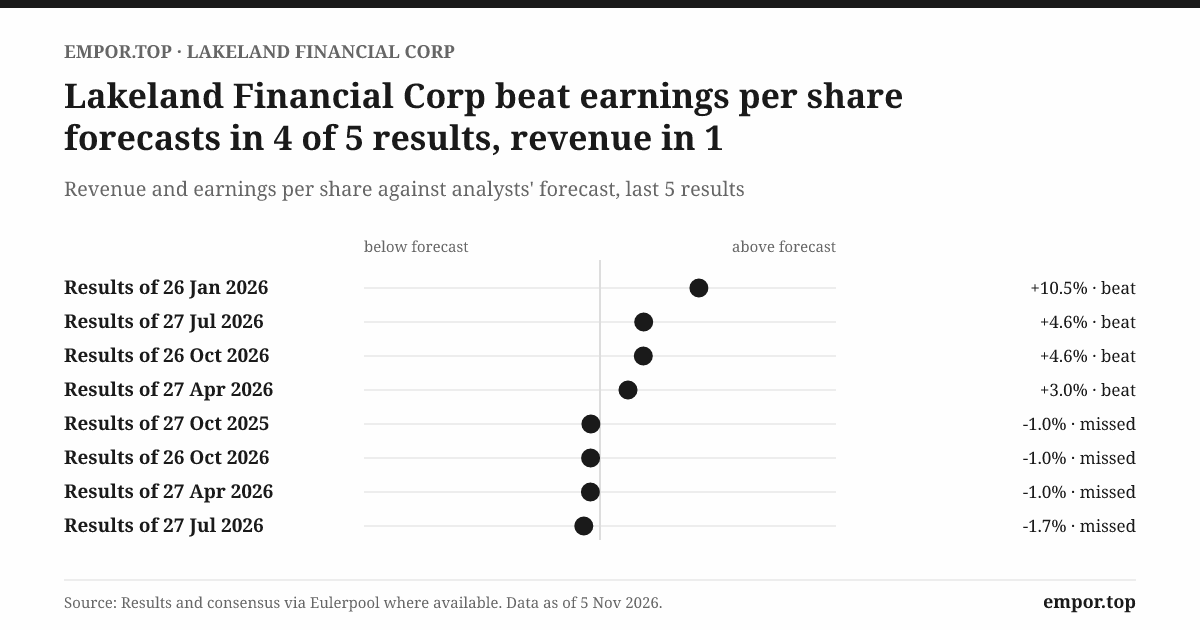
On October 26, 2026, a press release went out from Warsaw, Indiana, a town of lakes and orthopedic-device factories two hours north of Indianapolis, and its headline used the word every bank executive likes to write: record. Lakeland Financial Corporation had earned $28.9 million in the third quarter, about 9% more than a year earlier, and diluted earnings per share of $1.14 were the best third quarter in its history.1 Loans were up 8% from a year before. The net interest margin, the thin band of profit between what the bank earns on its loans and what it pays for its money, had widened for the quarter.1 Chairman and CEO David Findlay called the result a reflection of "the quality of our earnings performance."1
Two days later the company filed its quarterly report with the Securities and Exchange Commission, and in the notes, where a bank grades its own borrowers, a different picture sat beside the record. Loans the bank rated substandard, meaning the borrower's ability to repay had become a real concern, had grown from about $50 million at the end of 2025 to almost $70 million by the end of September. Loans rated doubtful, a grade only one step from writing the money off, had gone from roughly a hundred thousand dollars to $3 million.2 A third category, special mention, the early-warning list, had actually shrunk. The credit signals were pulling in different directions at the very moment the earnings were peaking.
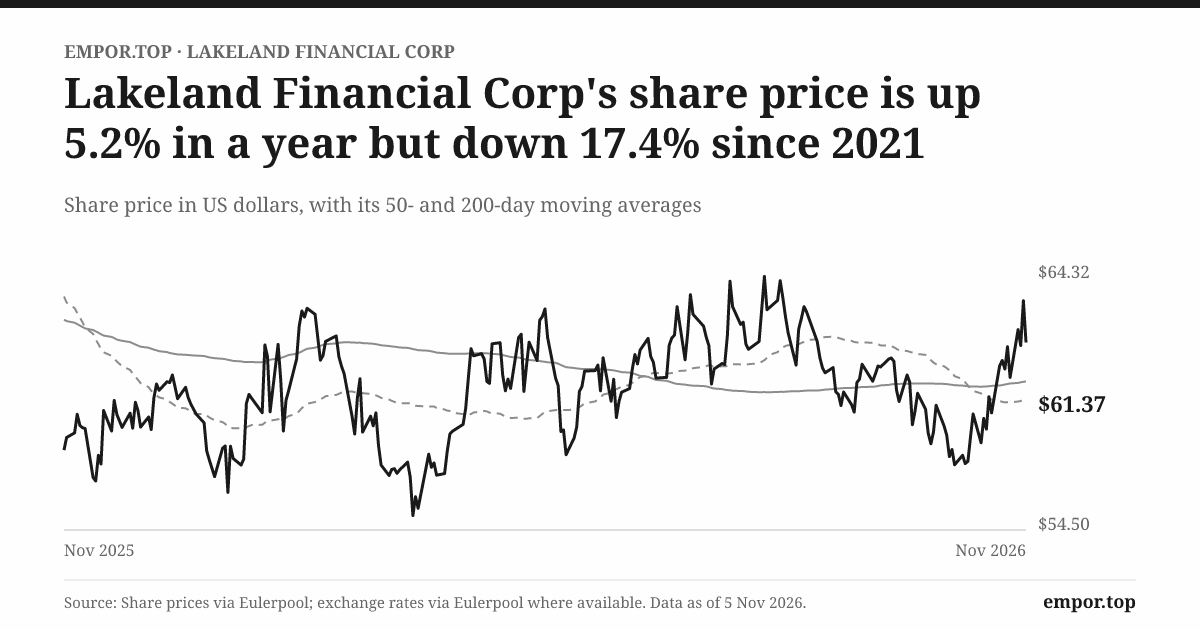
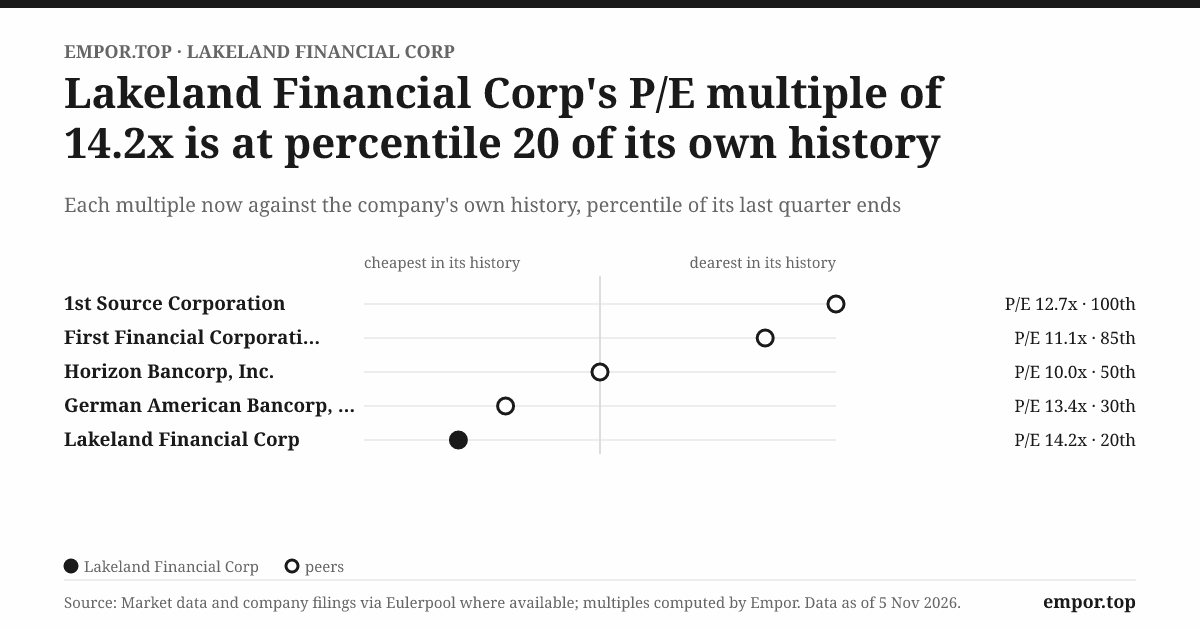
That collision is the right place to begin, because it captures what is both reassuring and unsettled about this bank. The stock market seemed to share the mixed feeling. In early November the shares traded at about $61, within 4% of their 52-week high, and at roughly 14 times trailing earnings, noticeably below the 17 times the market had paid on average over the previous five years.[^3]3 Investors were paying for the recovery, but not with full conviction.
Before going further, it helps to be precise about what is being bought. Lakeland Financial is the company listed on Nasdaq under the ticker LKFN. It is a holding company, and on its own it does very little. The banking—every deposit taken and every loan made—happens inside its subsidiary, Lake City Bank, and the parent's main source of income is the dividend the bank sends up to it, a dividend regulators can limit.3 When this story talks about winning customers or losing money on a loan, it is talking about Lake City Bank. When it talks about buybacks, governance and the share price, it is talking about Lakeland Financial. The two are inseparable in practice, but the distinction matters when the regulators, not the shareholders, decide how much capital can move between them.
The scale is modest by American banking standards and substantial by Indiana ones. Lake City Bank describes itself today as a $7.2 billion institution, with 55 offices concentrated across northern and central Indiana.41 It is large enough to lend to manufacturers, farm operations and commercial real-estate developers, and to hold the deposits of counties, school districts and towns. It is small enough that a single bad commercial credit can move a year's earnings, as it learned in 2025.
Four questions run through the rest of this story. The first is what makes a local bank win at all, in an industry where the product, money, is identical everywhere and the largest competitors spend more on technology in a year than Lakeland earns in a decade. The second is whether the recovery in earnings since the rate shock of 2022 and 2023 is durable, or whether it simply reflects a pause in the competition for deposits. The third is whether the loan growth now under way rests on deposits that will stay, because a bank that grows its loans faster than its loyal customers grow their balances eventually has to rent money from someone less loyal. The fourth is whether management's choice to buy back stock and pay a rising dividend fits a moment when credit costs and branch investment are both competing for the same capital.
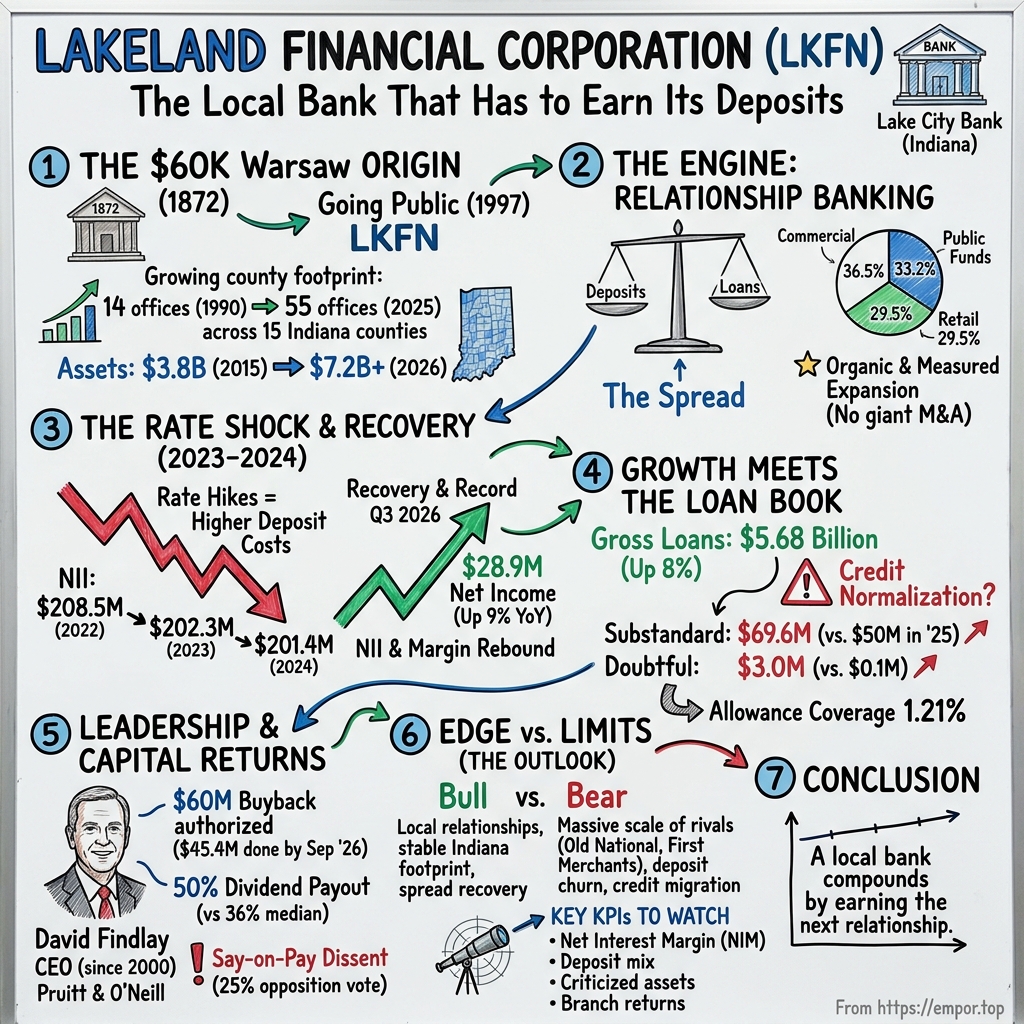
The verdict at the outset is simple enough to state. The recovery is real so far. Net interest income, the core engine, is growing again, and the bank remains well capitalized. But a record quarter does not settle whether margins, funding and credit can hold together at the same time, and that is the question the next several years will answer. To understand why this bank thinks it can, the story has to go back to a much smaller balance sheet in the same small town.
 Subscribe on LinkedIn
II. From a $60,000 Bank to a Public Company
Lake City Bank opened its doors in Warsaw on May 14, 1872, as a small private bank with $60,000 in assets.4 Ulysses S. Grant was in the White House, and the town's merchants needed somewhere to keep their money and someone to lend it to their neighbors. Three years later, a board led by a local man named James McMurray chose 26 charter stockholders and turned the bank into a private corporation.4 It reorganized again in 1895 and in 1919, the kind of quiet legal housekeeping that small-town banks did as the country's banking laws changed around them.
The episode that matters most from those early decades is not a deal or a product. It is survival. Warsaw had five banks when the Depression arrived, and when the panics of the early 1930s had finished their work, Lake City Bank was the only one still standing.4 That is worth pausing on, because it explains a temperament that runs through the institution's later history. A bank that watches four local competitors fail learns early that the deposits of a community are not a permanent asset. They are a trust that can be withdrawn in an afternoon, and the bank that keeps them is the one whose depositors believe it will still be there tomorrow. The bank joined the Federal Reserve System in December 1940, putting itself under a national supervisor and gaining access to the central bank's liquidity.4
For the next two decades it stayed a single-office Warsaw bank. A new headquarters building went up at Indiana and Center streets, and operations moved there in June 1961.4 Then, in December 1965, it opened its first branch, at nearby Winona Lake, a building that cost $75,000, more than the bank's entire balance sheet at its founding.4 Five months later, in May 1966, it merged with Commercial State Bank in Silver Lake through an eleven-to-one stock exchange, and suddenly had three locations.4 That small merger is the earliest example of a pattern worth noting. Lake City Bank has grown overwhelmingly by opening its own offices, but it has not been allergic to combining with a neighbor when the opportunity fit.
The decisive structural moves came later. In 1983, the bank's leaders formed Lakeland Financial Corporation as a holding company to own Lake City Bank.5 The reason banks did this in that era was practical. A holding company could raise capital, own other financial businesses and, as interstate and branching rules loosened through the 1980s and 1990s, provide a platform for expansion that a lone state-chartered bank could not. By 1990, the bank had 14 locations in five counties.4 It was no longer a Warsaw bank. It was a north-central Indiana bank.
On August 15, 1997, Lakeland Financial offered its common stock to the general public.4 It is tempting to treat a public listing as the moment a company becomes something new, and for many businesses it is. For Lakeland, the more accurate reading is that the listing gave an existing strategy a deeper pool of capital. The bank did not use its new currency to transform itself into a regional acquirer or a national lender. It kept doing what it had been doing, opening offices, hiring commercial bankers and pushing into the next county, only now with a stock that could be priced every day and a shareholder base far beyond the families of Kosciusko County. Two years later, in June 1999, it opened its 43rd office, in its 12th county, by moving into Fort Wayne, the second-largest city in the state.4
Jump forward to 2015 and the company had grown to $3.8 billion in assets. In its annual report it described itself as the fourth-largest independent bank holding company headquartered in Indiana.5 By the end of 2025 total assets had reached $7.0 billion, almost double, while the bank still had 55 offices.34 Over that decade net profit grew about 8% a year and revenue about 11% a year, compounding that would satisfy most industrial companies, let alone a community bank.35
What changed through that growth was scale and geography. What did not change, at least on paper, was the business model. The 2025 annual report, like the 2015 one, describes a single banking business: Lake City Bank takes deposits and makes loans, with wealth advisory, brokerage and mortgage services sold alongside.35 There is no second engine, no credit-card portfolio bought from someone else, no national lending niche bolted on for growth.
One clarification is necessary for anyone researching the company. Lakeland Financial of Warsaw, Indiana, has nothing to do with Lakeland Bancorp, an unrelated bank holding company from New Jersey. The names are similar and the tickers close enough to cause confusion in screeners and news feeds. Every figure and transaction in this story belongs to the Indiana company.
So the long history reduces to a short claim. Lakeland preserved its identity as a community bank while growing roughly a hundredfold in real terms over the past century. The public listing was a funding tool, not a reinvention. The harder question, and the one the next chapter has to answer, is whether a bank can keep growing that way, one office and one county at a time, without eventually needing to buy its growth.
III. A Relationship Bank Builds Outward
On June 13, 1984, Lake City Bank became the first bank in its area to install automated teller machines.4 It is a small detail in a long corporate history, and it would be easy to skip. But it says something about how the bank approached expansion. The ATM was a way to be present in more places, and at more hours, without building a full office. It was a bet that customers in small Indiana towns wanted the same conveniences as city customers, and that a local bank could provide them before the big banks bothered.
That bet set the pattern for the next four decades. Through the 1980s and 1990s, as mergers consolidated American banking and many large banks closed or sold branches in small communities that did not justify their cost, Lake City Bank moved in the opposite direction. It added offices in county seats and market towns across northern Indiana, and it shifted its lending mix toward commercial customers, the manufacturers, distributors and farm businesses that formed the economic base of the region. Commercial lending broadened the franchise beyond the retail depositor, and it brought something just as valuable as loan interest: the operating accounts of businesses, which tend to hold larger balances and to stay longer once a company's payroll and payments run through them.
The technology kept arriving in the same spirit. Internet banking launched in 1999, the same year as the Fort Wayne expansion.4 In 2006 the bank opened a loan production office in Indianapolis, a modest outpost of commercial bankers testing whether a Warsaw institution could win business in the state capital, and in 2011 it opened its first full-service Indianapolis branch.4 A mobile banking app followed in 2013, a digital banking platform in 2021, and that same year a branch inside Elkhart High School, a small symbol of how the bank thinks about recruiting the next generation of depositors.4 When the bank celebrated its 150th anniversary on May 14, 2022, its new Elkhart River District office was its 52nd.4 By 2025 it had nine branches in the Indianapolis region and 55 overall, spread across 15 Indiana counties.43
Two things stand out about that expansion. The first is how measured it was. The bank went from 14 offices in 1990 to 55 in 2025, an average of a little more than one new office a year over 35 years.4 That is not the trajectory of a bank in a hurry. The second is that it was overwhelmingly organic. Outside the small 1966 merger, the company's own account of its history is a story of offices opened rather than banks bought, and its recent annual reports describe growth through its own branch network and commercial teams rather than through acquisitions.43 The company has not, in the past decade, built its balance sheet by paying a premium for another bank's deposits.
That matters for an investor because acquisitions in banking often hide their costs for years. The buyer records goodwill, the acquired loan book carries surprises, and the promised cost savings arrive more slowly than the dilution. A bank that grows organically avoids those traps, though it also forgoes the speed. Lakeland has accepted the slower path. Because it has not published the prices it might have paid for alternatives, there is no clean way to say whether that choice created more value than a more aggressive strategy would have. What can be said is that the company's equity has not been diluted by deal-related share issuance in this period; employee equity plans are the disclosed source of new shares.3
The current version of the strategy is visible in the numbers the bank does publish. Capital expenditure rose to $11.1 million in 2025, from $8.6 million in 2024 and $6.0 million in 2023, nearly doubling in two years.3 For a bank with roughly $420 million of annual revenue that is still a modest figure, around 2.6% of revenue, but the direction is clear. In the third-quarter 2026 release, Findlay said the bank had three branches under development in the Indianapolis and Fort Wayne markets and had opened an Innovation and Technology Center at its Warsaw headquarters.1 Management also told investors it was preparing to roll out a new customer-relationship-management system.6 The Indianapolis deposit strategy, the release noted, had brought in $106.1 million of deposits.1
Indianapolis is where the patience of this strategy is most visible. The bank sent commercial lenders into the capital in 2006, waited five years before opening a full branch, and had built only nine branches in the region by 2025, nearly two decades after the first loan office.4 That is the opposite of how a larger bank enters a new city, usually by buying a local franchise and rebranding its offices overnight. The slow route costs less up front and avoids paying a premium for someone else's customers, but it means the bank is competing for each relationship against incumbents who already hold it. Roughly $100 million of deposits gathered through a targeted city strategy is a meaningful start for a bank of this size, and it is also a small fraction of a $6.3 billion deposit base.1 The capital market is the bank's growth frontier precisely because it is not yet its home market.
The bank is spending to build capacity, then, but the evidence on whether that capacity pays is thin. Lake City Bank reports itself as a single operating segment.3 Its wealth advisory, brokerage and mortgage businesses are supplements to the core, not separately reported businesses with their own disclosed profits. It does not publish branch-level deposit growth, customer counts, account retention or the return on a new office. A new branch in a growing Indianapolis suburb might reach profitability in three years or in eight, and an investor reading the filings cannot tell which.
The same gap applies to people. In 2025 the bank made 132 external hires and 176 internal promotions, figures the company offers as evidence of a culture that develops its own talent.3 It does not disclose its total headcount in the annual report, so those figures cannot be turned into a measure of productivity or a staffing trend.3 A bank where promotions outnumber outside hires may be building loyalty and institutional knowledge. It may also be thinning its bench. Without the denominator, the honest conclusion is that the figures describe activity, not results.
So the expansion story narrows to a bounded claim. Lakeland has extended its community-bank franchise across Indiana over 35 years. It has not demonstrated, in anything it publishes, that its network itself is a durable competitive advantage, because it does not report the retention rates, pricing or branch returns that would prove it. The evidence the network works is the bank's overall profitability. The question of why that profitability exists leads straight into the mechanics of what a bank actually sells.
IV. The Spread Between a Loan and a Deposit
Picture a commercial banker from Lake City Bank sitting across a conference table from the owner of a mid-sized manufacturer in Elkhart or Fort Wayne. The owner wants a line of credit to buy equipment. The banker wants the loan, but wants something else more: the company's operating account, the place where its receivables land and its payroll goes out. If the banker wins that account, the company's cash sits at Lake City Bank every night, and the bank can lend that money to someone else. The loan is the visible product. The deposit relationship is the business.
That exchange is the whole of banking reduced to a single meeting. A bank borrows money from its depositors, by paying them interest or by providing services in place of interest, and lends that money to borrowers or invests it in securities at a higher rate. The difference between the two rates, multiplied across billions of dollars, is net interest income, and for Lakeland it is by far the largest profit pool. In 2025, net interest income rose by $24.3 million, and the company attributed the increase partly to lower deposit costs.3 Fees from service charges, wealth advisory and brokerage, and mortgage banking add diversification, but they are the supplement, not the engine.3 In the third quarter of 2026, for example, the bank earned about $61 million of net interest income against roughly $12 million of noninterest income, about five dollars of spread for every dollar of fees.1
The fee side of the business has its own moving parts, and they show why it cannot carry the bank on its own. In that same quarter, noninterest income fell about 5% from a year earlier even as wealth advisory fees grew about 10%.1 Mortgage banking, the most cyclical fee line, has been held back by high long-term rates, thin housing inventory and homeowners unwilling to give up the low-rate mortgages they locked in years ago; management has said secondary-market originations could pick up if long-term rates fall.6 Wealth advisory is the more promising line, because a family that trusts the bank with its investments is a family unlikely to move its checking account. But at its current scale, fee income cushions the swings in the spread without changing the basic fact that this is a lending business funded by deposits. When the spread is squeezed, there is no fee engine large enough to make up the difference.
This is also why bank financial statements read strangely to someone used to industrial companies. A manufacturer's revenue measures what customers paid for its products, and its cash flow tells you whether those sales turned into money. For a bank, revenue is mostly interest income, which rises when rates rise even if the bank's spread is shrinking. And cash flow is almost meaningless as a quality check, because the bank's raw material is cash itself. When Lake City Bank grows its loans, cash leaves; when depositors bring in money, cash arrives. In 2025 the bank's investing activities used about $325 million, chiefly to fund $286 million of net loan growth along with securities, while financing activities, deposits and borrowings, supplied about $184 million.3 Those flows describe the bank's balance sheet growing, not its earnings turning into cash. The right questions are whether the loans are good and whether the deposits will stay.
Interest-rate timing makes the picture more complicated still. A bank's assets and liabilities reprice on different schedules. A variable-rate commercial loan might reset the month the Federal Reserve moves. A fixed-rate mortgage-backed security might not reprice for years. A checking account might never pay more interest unless the customer demands it, while a certificate of deposit reprices every time it matures. The bank's profit in any given year depends on which side of the balance sheet catches up faster, which is the subject of the next chapter.
What makes Lakeland's funding unusual is its mix. At the end of 2025, public funds, the deposits of counties, municipalities, school districts and other government bodies, made up 33.2% of the bank's deposits. Commercial deposits were 36.5% and retail deposits, the accounts of individuals, were 29.5%.3 For most community banks, the retail depositor is the bedrock. For Lake City Bank, government money is nearly as large a share as either businesses or households. That is both a strength and a peculiarity. Public-fund relationships are often long-lived, because a county treasurer who has banked with the same institution for 20 years does not switch on a whim, and the bank's longstanding footprint in so many county seats gives it a natural claim on that business. But public funds are also seasonal, rising when property taxes are collected and falling as they are spent, and they are frequently bid out or rate-sensitive, because treasurers are fiduciaries required to seek a fair return on taxpayers' money.
The 2025 deposit story shows why the mix matters. Total deposits grew only about 1.2% in the year, and public funds drove that growth; commercial and retail balances both declined.3 The bank's management could point out, correctly, that the public-fund growth came from new customers inside its existing footprint.3 The skeptic could point out, also correctly, that the two categories that best measure the bank's ordinary relationships with businesses and households both shrank in a year when the bank was growing its loans.
By the third quarter of 2026, that picture had shifted in a more encouraging direction, though not uniformly. Retail deposits were up about 5% from a year earlier. Commercial deposits were still down about 3% from a year earlier but had risen about 5% from the second quarter. Public funds were up about 10% year over year, though they had fallen 6% from the second quarter on normal seasonal outflows.1 And brokered deposits, money gathered through intermediaries from investors with no relationship to the bank, stood at $241.8 million, 38% more than a year earlier though down from a higher level in June.1 Brokered deposits are not dangerous in themselves; they are a legitimate funding tool that many banks use to match loan growth. But they are the opposite of a relationship. They are rented money, priced at market rates, and they leave as soon as a better rate appears elsewhere.
The competitive field explains why every one of those deposit dollars must be earned. Lake City Bank competes in Indiana against institutions many times its size. Old National, headquartered in Evansville, has grown through a series of large mergers into one of the largest banks in the Midwest. First Merchants, based in Muncie, had roughly $18 billion in assets at the end of 2025, more than twice Lakeland's size.7 1st Source in South Bend, an hour west of Warsaw, competes directly in the bank's northern Indiana home markets.7 Beyond the Indiana-headquartered banks, national giants such as JPMorgan Chase and regional lenders from neighboring states operate across the state, and online banks offer savings rates without branches at all. Industry tallies of Indiana deposits show how fragmented and contested the market is, but the bank does not publish a market share of its own, and no state-level total should be mistaken for one.
So what is Lake City Bank's edge in that field? The bank's case is that its local decision-making, its commercial bankers' knowledge of their markets and its long history in its communities let it win and keep relationships that larger banks treat as interchangeable. That is a plausible case, and the public-fund franchise, built over decades of county-seat banking, is its strongest piece of evidence. It is also, at the level of disclosure the company provides, an unproven one. Lakeland does not report customer churn, the rates it pays on deposits relative to competitors, the share of commercial bids it wins or loses, or its cost to serve a customer compared with peers. The single most telling measure, how much the bank had to raise deposit rates when competitors raised theirs, can only be inferred from what happened to its earnings when rates rose. That test came in 2023, and the result was not entirely flattering.
V. When Higher Rates Stopped Looking Like a Tailwind
In March 2022, the Federal Reserve began the fastest series of interest-rate increases in four decades. For a bank like Lakeland, the first effect looked like a gift. Its variable-rate commercial loans repriced upward almost immediately, while the rates it paid on checking and savings accounts barely moved. For a few quarters, the spread widened, and 2022 was a very good year. Net interest income reached $208.5 million and net income $103.8 million, a record at the time.8
Then the depositors noticed. By 2023, savers could earn 5% on a money-market fund or a Treasury bill with a few clicks, and businesses with idle cash were moving it to wherever it earned the most. In March 2023 the collapse of Silicon Valley Bank turned the question of where money was kept from a matter of yield into a matter of safety, and banks of every size scrambled to hold onto their deposits by paying more for them. Lake City Bank was no exception. Its funding costs rose faster than its asset yields, and the gift reversed. Net interest income fell from its 2022 peak to $201.4 million in 2024.38 Income from the securities portfolio fell as well in 2023.8 Net income dropped to $93.8 million in 2023 and stayed at $93.5 million in 2024.3
The decline in percentage terms was not dramatic, about 10% from peak. But it falsified a comfortable assumption that had been easy to hold through the long era of near-zero rates: that a well-run community bank's earnings simply compound. Over the three years from 2022 to 2025, Lakeland's net profit, measured on a comparable basis, was essentially flat.3 A decade of steady growth was interrupted by a two-year reset, caused not by bad loans or poor management but by the price of money. The lesson is uncomfortable for anyone who believes that relationship deposits are insulated from market rates. They are less sensitive than brokered money, certainly, but they are not immune.
There were other moving parts in those years, which complicate the picture without changing it. In 2023 the bank's other income included $6.3 million of insurance and loss recoveries related to a wire-fraud loss, along with a $9.0 million gain on Visa shares, both one-time items that flattered that year's results.3 Neither recurred in 2024. In 2025, other income fell further as limited-partnership income declined and there was no comparable recovery.3 Stripping out those items makes the core spread pressure in 2023 look somewhat worse and the recovery afterward somewhat cleaner.
The recovery itself arrived in 2025, as deposit costs eased.3 Net income climbed to $103.4 million, finally surpassing the 2022 peak.3 The mechanism was the mirror image of 2023: funding costs that had risen fast came down faster than the yields on the bank's loans and securities.
The third quarter of 2026 extended that pattern. Net interest income was about $61 million, up 8% from a year earlier, and the net interest margin was 3.58%, eight basis points wider than a year before.1 Underneath, the bank's cost of funds had fallen to 2.13% from 2.37%, while the yield on its earning assets had fallen less, to 5.71% from 5.87%.1 Put plainly, the bank's borrowing costs came down by about a quarter of a percentage point while its lending yields came down by a sixth. That gap is the recovery. Costs stayed controlled as well. Noninterest expense rose only about 3% year over year, and the efficiency ratio, the share of revenue consumed by operating costs, was 49.5%, meaning the bank spent about 50 cents to earn each dollar of revenue.1 For a community bank, that is a lean operation.
Management's own description of its interest-rate exposure changed over these years in a way worth noticing. In the period leading into 2022, the bank described its balance sheet as asset-sensitive, meaning it expected to benefit when rates rose because its assets would reprice faster than its liabilities. That expectation was correct for about a year. In the 2024 and 2025 annual reports, the bank described its position as more nearly neutral, with deposit mix and repricing behavior the decisive variables.3 A cynic might say the bank discovered that its deposits were more rate-sensitive than its models assumed and adjusted its language after the fact. A more generous reading is that the bank adjusted its balance sheet to reduce a vulnerability it had learned about. Both readings lead to the same practical conclusion. The bank's earnings are now less a bet on the direction of rates than a bet on whether it can keep its funding costs in line with competitors.
There is one more shadow from the rate shock that has not fully lifted. When rates rose, the market value of the bonds the bank had bought at lower yields fell. At the end of September 2026, unrealized losses on its available-for-sale securities portfolio were $213.9 million, and the company attributed a rise in those losses to an 85-basis-point increase in the 10-year Treasury yield.1 Those losses do not reduce regulatory capital for a bank of Lakeland's size, and they will gradually unwind as the bonds mature, but they reduce the tangible common equity ratio, a common measure of the cushion shareholders would have in a stress scenario, to 10.11% from 10.79% a year earlier.1 They also mean that the bank's securities portfolio is a slowly dripping source of cash rather than a reserve it could sell without crystallizing a loss. Management expected about $24.1 million of securities cash flows over the rest of 2026, money that could be redeployed into loans at higher yields.6
So was the 2023-24 pressure a temporary repricing problem or evidence of fragility? The weight of the evidence points to the first, with an important qualification. The spread recovered as soon as deposit costs eased, which is what a temporary problem looks like. But it took two years, it coincided with flat earnings, and the recovery depends on deposit competition staying calm. A bank can be well capitalized, efficient and profitable and still see its earnings power reset by the cost of its customers' money. The test from here is whether core net interest income keeps growing alongside loan growth without another squeeze on deposits. And that loan growth raises its own question, because the faster the bank lends, the more it depends on the quality of the borrowers it is lending to.
VI. Growth Meets the Loan Book
At September 30, 2026, Lake City Bank's loan book stood at about $5.68 billion, up $431 million, or 8%, from a year earlier.1 Commercial and industrial lending, the loans to operating businesses that sit closest to the bank's relationship model, led the growth with a 12% increase, and commercial real estate and multifamily loans grew about 4%.1 Management told investors that commercial loan originations had exceeded paydowns for the fourth consecutive quarter.6 By the standards of a mid-sized Midwestern bank in a period of high rates and cautious borrowers, that is strong demand.
But growth is only half the story of a loan book. The other half is whether the borrowers pay, and that is where the third-quarter report pulled in two directions. To understand why, it helps to know how a bank grades its loans. Most loans are rated "pass," meaning they are performing as expected. Loans showing early signs of weakness are moved to "special mention," a watch list. If the weakness becomes a genuine concern about repayment, the loan is downgraded to "substandard," and if full collection appears unlikely, to "doubtful." The final step is a charge-off, when the bank writes the loss against its reserves.
Think of it as a hospital's triage system. Special mention is the waiting room, substandard the ward and doubtful intensive care. At the end of September 2026, the waiting room had grown slightly emptier. Special-mention loans were $129.3 million, down from $134.0 million at year-end 2025.2 But the ward had more patients. Substandard loans had risen from $50.0 million to $69.6 million, and doubtful loans from $0.1 million to $3.0 million.2 Taken together, the bank's watch-list and individually analyzed loans were 3.56% of total loans, up from 3.00% a year earlier.1
Those numbers are not alarming in absolute terms. Nonperforming loans, the ones that have actually stopped paying, were only $17.9 million, or 0.32% of the loan book, and nonperforming assets were a quarter of one percent of total assets.1 Many banks would be content with those figures. The concern is the direction. Loans are moving from the early-warning category into the more serious ones, and the next question is whether they will recover or proceed to the final step.
The allowance for credit losses is the bank's reserve against that outcome, and it tells its own story. At September 30, the allowance was $68.8 million, or 1.21% of loans, nearly unchanged in dollars from the end of 2025.2 Over the first nine months of 2026, the bank had set aside $4.9 million in provisions and written off $5.1 million in net charge-offs, so the reserve was roughly static while the loan book grew.2 As a share of loans, the allowance had declined from 1.30% a year earlier.1 In the third quarter itself, net charge-offs were about $3.0 million, an annualized 0.21% of loans, mostly from a $2.8 million partial write-down on a nonperforming commercial credit that had already been fully reserved.1 That detail matters, because it means the loss had been anticipated and provisioned for in an earlier period.
The figure that keeps the allowance ratio from being a comfort blanket is 2025's. Net charge-offs that year were $28.8 million, a large number for a bank of this size, and the allowance declined during the year as a result.3 That figure is about a quarter of the bank's 2025 net income, and it was enough to show that a single problem borrower or a small cluster of them can move results materially. The allowance at 1.21% of loans looks adequate against the losses of 2026 so far. Against a repeat of 2025, it would be tested.
Credit risk and funding risk meet in the same place on a bank's balance sheet. At the end of 2025, the bank's annual report counted 99.2% of its deposits as core deposits.3 By the third quarter of 2026, measured against total deposits including brokered funds, the core share stood at about 96%, and CFO Lisa O'Neill described core deposits as "stable."1 Both figures are high by industry standards. But the composition matters more than the headline. The decline in commercial and retail deposits during 2025, and the presence of brokered deposits in the funding mix, mean that some of the loan growth was funded by money that is less committed to the bank than its traditional depositors.31 The fall in brokered deposits from the second quarter to the third, and the rebound in commercial balances over the same period, are encouraging. One quarter does not make a trend.
The bank's borrowing position adds context. At the end of 2025, total borrowings were $184.2 million, mostly short-term advances from the Federal Home Loan Bank, and the bank had $1.19 billion of untapped borrowing capacity at the Federal Reserve.3 There is no sign of liquidity stress. The bank remains well capitalized, with a common equity tier 1 ratio of 14.46% at the end of September, well above regulatory minimums, though down from 15.05% a year earlier as loan growth and buybacks absorbed capital.1
What the filings do not disclose limits how confidently any of this can be read. Lakeland reports its loans in broad categories, commercial and industrial, commercial real estate, agricultural, consumer, and its deposits by type, but not its largest borrowers, its concentration in particular industries beyond those categories, or the specific loans behind the rise in substandard balances.23 One related-party detail is worth a brief note: loans to officers, directors and their affiliates totalled $105.3 million at the end of 2025, down from $131.7 million a year earlier.3 Insider lending is normal in community banking and the balances fell, but such loans deserve the same scrutiny as any other credit exposure.
There is one internal source of funding that eases the pressure on deposits, and it comes from the same bond portfolio that produced the unrealized losses. At the end of September 2026, the bank held about $1.09 billion of investment securities, mostly agency, municipal and mortgage-backed holdings.2 As those bonds pay down and mature, the cash can be lent out at today's higher loan yields, which both funds loan growth without new deposits and lifts the bank's average asset yield. It is a slow tailwind rather than a gusher, measured in tens of millions of dollars a quarter, and it shrinks the liquidity buffer the bank would otherwise hold in securities. But it is part of why the margin can keep widening even if deposit costs stop falling, and part of why the funding question is less acute than the brokered-deposit figure alone suggests.
The credit picture, then, is genuinely unresolved. Coverage is stable, nonperforming loans are low, and the most recent charge-off had been reserved in advance. But substandard and doubtful balances are rising, the 2025 losses showed what a bad year can look like, and loan growth is outpacing the growth of the reserve. The signal to watch is migration: whether substandard loans return to pass or move to charge-off. The people who decide how aggressively to grow through that uncertainty, and how much capital to return while doing it, are the subject of the next chapter.
VII. David Findlay's Long Run—and the Shareholders' Bill
David Findlay has run Lakeland Financial since 2000, a tenure that now spans more than a quarter century, two financial crises, a pandemic and the recent rate shock.9 He also serves as chairman of the board.9 His leadership team includes President Kristin Pruitt, who also sits on the board, and Chief Financial Officer Lisa O'Neill.9 Findlay and Pruitt are the only directors who are not independent; everyone else on the board meets that standard.9
A 26-year tenure is rare in American banking, and it has obvious virtues. Strategy has been consistent, the organic-growth approach has not been abandoned for a splashy merger, and the culture the company emphasizes, promotions from within and long-tenured commercial bankers, has had time to take root. On his watch the bank pushed beyond its northern Indiana base into Fort Wayne and Indianapolis, and in the last decade alone it nearly doubled its assets. That record is the strongest argument for trusting management's judgment.
It is also the hardest record to evaluate, because a single leader's choices over a long period become inseparable from the market conditions around them. The flat earnings of 2023 and 2024, and the $28.8 million of net charge-offs in 2025, happened on the same watch. The test of a long-tenured CEO is not the length of the run but how each decision has worked out.
The compensation record gives one window. Findlay's total pay was about $2.05 million in both 2023 and 2024, years when net income declined, and rose to $2.47 million in 2025, when net income recovered.9 That pattern looks broadly aligned with results. More revealing is the performance-share award for 2023 through 2025, which paid out at only 42% of target, a sign that the plan's metrics were demanding and that the bank fell short of them over that period.9 A compensation plan that pays less than half its target after a difficult stretch is doing what it was designed to do.
Shareholders were not entirely persuaded. At the April 2026 annual meeting, the advisory vote on executive pay passed with about 14.7 million shares for and 4.9 million against, roughly 75% support among votes cast.10 For a say-on-pay vote, where support above 90% is common and proxy advisers often flag anything below 70%, that is material dissent. It is not a verdict on management as a whole. But a quarter of voting shareholders signalled discomfort with how executives are paid, and that is a governance signal to track at the next meeting.
The ownership structure explains why such votes matter. There is no controlling shareholder. At the February 2026 record date, BlackRock held about 14% of the shares, Vanguard about 7% and Neuberger Berman about 6%, while directors and executive officers as a group held 3.6%.9 That is a typical shape for a listed regional bank: large index and institutional holders, modest insider ownership. It means management answers to a diffuse group of professional investors rather than to a founding family or a parent company.
The most consequential decisions management has made recently are about capital. The board authorized up to $60 million of share repurchases through April 30, 2027, and by the end of September 2026 the bank had spent $45.4 million to buy back 787,166 shares at a weighted average of $57.62.2 That left $14.6 million of authorization.2 In the third quarter, the pace slowed noticeably, to about 41,550 shares, or $2.4 million.1 At the same time, the bank raised its quarterly dividend 4% to $0.52 a share.1
The dividend history shows how the balance has shifted. Over the twelve years from 2014 through 2025, the bank paid out between about 30% and 53% of its earnings in dividends, with a median of 36%.3 The payout was at the low end of that range through most of the 2010s, rose as earnings flattened in 2023 and 2024 while the dividend kept growing, and stood at about 50% in 2025.3 For the first nine months of 2026, it was about 47%.1 Combined with buybacks, the bank is returning a much larger share of its earnings to shareholders than it did a decade ago.
Is that the right use of capital? The case for it is straightforward. The bank is well capitalized, with a common equity ratio far above requirements, and it is generating more capital than its loan growth can absorb. Returning the surplus to shareholders avoids the temptation to spend it on an overpriced acquisition. The case against it is equally straightforward. Credit is weakening, and unrealized bond losses have thinned the tangible equity cushion. Capital spent on buybacks is capital not available to absorb a credit problem or to fund loan growth without brokered deposits. And it is not enough to note that the average repurchase price of $57.62 is below the share price in November 2026. Whether a buyback creates value depends on whether the shares were cheap relative to the business's future earnings, not relative to a later market price.
What would settle the question is the next several quarters: whether the bank slows buybacks as credit metrics evolve, whether it explains the slowdown in the third quarter, and whether the dividend keeps growing faster than earnings. In the third-quarter release, management's message emphasized loan growth, margin expansion and the resilience of the Indiana economy, which Findlay described as "resilient, diverse and expanding."1 The release discussed the rise in watch-list loans in its tables but did not give it the same prominence. That is not unusual for a press release, but it is precisely the kind of gap that analysts on the call are paid to probe, and the questions investors should want answered are clear: what is behind the migration into substandard and doubtful grades, how the bank is pricing deposits against competitors, why brokered funding rose year over year, and when the new branches are expected to earn their cost.
The management record supports confidence in continuity, cost discipline and an aversion to expensive acquisitions. It does not, by itself, settle whether the current capital-return pace is wise at a point when credit is moving in the wrong direction. That judgment depends on how strong the bank's competitive position really is, which is the question the next chapter takes up.
VIII. The Indiana Bank's Edge—and Its Limits
Return to the conference room in Elkhart, but change the setup. The manufacturer's owner now has two offers on the table. One comes from Lake City Bank, whose commercial banker has known the company for years and whose loan committee sits an hour away in Warsaw. The other comes from a bank many times larger, with more branches across the Midwest, a treasury-management platform built by a technology budget in the hundreds of millions, and a willingness to price the loan aggressively to win the relationship. Which does the owner choose?
The answer to that question is the entire bull and bear case for Lakeland. Start with the scale. At the end of 2025, Lakeland had about $7.0 billion in assets.3 First Merchants, the closest Indiana-headquartered peer in business model, had roughly $18 billion, and Old National, after a series of large mergers, was several times larger still.7 1st Source, the South Bend bank that competes directly in Lakeland's home region, is of broadly comparable scale.7 Lakeland is not the smallest bank in its markets, but it is far from the largest, and it competes against national banks, digital lenders and credit unions as well.
The case for Lakeland is that size is not the only thing that matters in commercial banking. A mid-sized bank with local decision-making can move faster, know its borrowers better, and offer the kind of attention a large bank reserves for its biggest clients. Its public-fund franchise, a third of its deposits built through decades of county-seat relationships, is a funding base that large banks find hard to replicate. And its efficiency ratio of about 50% shows that it can run a branch network without the cost bloat that sometimes accompanies a relationship model.1
Michael Porter's five forces framework helps organize the competitive pressures. The power of buyers is real on both sides of the balance sheet. Depositors can move funds in response to rates, as 2023 showed, and businesses can compare lenders, especially for larger loans. The threat of substitutes is real as well: money-market funds, Treasury bills and online savings accounts compete for deposits, while private credit funds and non-bank lenders compete for commercial loans. Rivalry among existing banks is intense, particularly from larger institutions that can use scale and digital investment to undercut pricing. The threat of new entrants is moderated by regulation and the trust that banking requires, though digital banks have lowered the barrier for deposit-gathering. And supplier power, in a bank's case the technology vendors and core-processing providers it depends on, is a real operational dependence that the company itself identifies as a risk.3 Local relationships may soften rivalry, but they do not eliminate it.
Technology deserves its own word in that analysis, because it is where scale advantages are growing fastest. The largest American banks spend billions of dollars a year on software, fraud detection and digital channels, and a bank of Lakeland's size cannot match that budget. Like most community banks, it relies on outside vendors for core processing and much of its digital platform, and the company itself names its dependence on third-party technology and service providers as an operational risk.3 The bank has already had a concrete reminder of what that risk looks like: in 2023 it recovered $6.3 million through insurance and loss recoveries tied to a wire-fraud loss.3 The new Innovation and Technology Center and the coming customer-relationship-management rollout are the bank's response, a bet that it can buy good-enough technology and win on service.16 Whether good enough remains good enough as customers' expectations are set by the largest platforms is one of the quieter long-run questions in the case.
Hamilton Helmer's seven powers framework asks a harder question: does the business have a durable advantage that lets it earn returns above its cost of capital? Scale economies favor larger rivals, not Lakeland. Network effects do not meaningfully apply to banking. Switching costs exist, since moving a business's operating accounts, payroll and treasury management is a genuine hassle, but the bank does not disclose retention rates that would show how strong they are. Counter-positioning is possible: a large bank may be unwilling to match the local attention Lakeland provides because it would disrupt its own standardized model. Brand matters in a trust business, and 150 years of survival, including surviving the Depression when its Warsaw rivals did not, is a form of brand. Cornered resources are limited, though the public-fund relationships come closest. And process power, the accumulated know-how of underwriting and relationship management, is plausible but unmeasured.
The honest conclusion is that Lakeland's moat is plausible but unproven. The pieces are there: switching costs, a longstanding brand, a public-fund franchise and a lean cost structure. But the company does not disclose the metrics that would prove them, such as customer retention, deposit pricing versus competitors, the cost of acquiring a new customer or the share of commercial bids won. The best evidence of an advantage is the bank's return on equity, which was about 13.5% in 2025 and 15.3% over the twelve months to September 2026.32 Those are good returns for a community bank. They are also returns that fell during the rate shock and recovered afterward, which suggests that the moat softens the impact of rate competition rather than preventing it.
The bull case follows from that assessment. If loan growth continues at a high single-digit pace, deposit costs keep easing, credit stabilizes, and relationship deposits prove durable, the 2025 and 2026 recovery extends into a longer run of earnings growth. In that scenario, the new branches in Indianapolis and Fort Wayne add deposits in growing markets, the technology investment improves the bank's ability to compete for commercial customers, and the market eventually pays closer to its historical multiple.
The bear case is just as coherent. If deposit competition returns, perhaps because rates rise again or because digital banks push harder for deposits, the bank's funding costs rise and the spread compresses, as in 2023. If substandard loans migrate into losses, credit costs eat into earnings, as in 2025. And if technology and branch investment rise faster than revenue, the bank's cost advantage erodes. In that scenario, the absence of disclosed proof of pricing or cost superiority becomes a real weakness, because there is nothing to show the bank can outcompete larger rivals through a downturn.
Three measures will settle which case is closer to the truth. The first is core net interest income and the net interest margin, which most directly measure the health of the spread; the margin stood at 3.58% in the third quarter of 2026, up eight basis points from a year earlier.1 The second is loan growth measured alongside the deposit mix and brokered funding, which shows whether growth rests on relationships or on rented money; loans grew 8% while brokered deposits rose 38% year over year but fell in the latest quarter.1 The third is criticized assets and net charge-offs, which show whether the loan book is healthy; substandard and doubtful loans were rising at the end of September.2
A skeptical investor, or an activist, would push hardest on capital allocation. Why should the bank spend tens of millions on buybacks when it is also funding loan growth with brokered deposits, investing in new branches and watching criticized loans rise? A bank that is confident in its credit and its funding can afford buybacks. A bank that is uncertain about either should probably preserve capital. Management's answer, implicitly, is that it is confident. The slowdown in third-quarter buybacks may suggest it is becoming more cautious, but the company has not said so.
The valuation reflects that uncertainty. At about 14 times trailing earnings, the shares trade below their five-year median of about 17 times, at about 2.1 times book value, with a dividend yield of about 3.4%.[^3]3 The discount to the bank's own history suggests the market is not yet willing to pay full price for the recovery, perhaps because of the credit questions, perhaps because the market applies lower multiples to regional banks after 2023. Without a consistent comparison to peers on the same date and basis, the discount cannot be called undervaluation. It is a measure of how much skepticism is already priced in.
The bank's edge is real enough to explain its long run of profitability, but not proven enough to remove doubt about its future. That leaves the question of what this long history teaches, for this bank and for investors in banks like it.
IX. Lessons from a Bank That Grew One County at a Time
Put two images side by side. Lake City Bank’s technology has changed beyond recognition since it installed an ATM in northern Indiana, and the bank is still investing in branches and technology.416 The underlying task did not. The bank still has to earn the customer's deposit, and it still has to lend that money wisely.
The first lesson is about what compounding means in community banking. Lake City Bank has grown its footprint and assets over decades.453 It is tempting to see that as a story about branches, as if the number of offices were the measure of success. But a branch is a cost, not an asset. Each one has to attract enough deposits and loans to justify its rent, its staff and its technology. The bank's growth came not from counting offices but from filling them with relationships, one commercial client and one county treasurer at a time. A local bank compounds by earning the next relationship, not by counting the next branch.
The second lesson is about the nature of deposits. Through the low-rate decade of the 2010s, it was easy for any bank to believe that its depositors were loyal, because they had no better alternative. The rate shock of 2022 and 2023 showed that loyalty has a price: as market rates rose, pressure on deposits squeezed the bank's net interest income.38 The recovery in 2025 came when that pressure eased, not because the bank found a way to escape it. Deposits are customers' money before they are a bank's funding.
The third lesson is about what a single quarter can and cannot prove. The third quarter of 2026 was a record,1 even as credit indicators weakened.21 Both are true at once. Credit problems in banking typically emerge with a lag, after the loans that cause them have been made and booked as growth. A record quarter is a beginning, not a credit conclusion.
The fourth lesson is about the value and limits of a long management record. David Findlay's long run leading the company, its growth, and its lean costs earn credibility. But credibility in banking is not a permanent asset. It has to be renewed with each decision: the buybacks made while criticized loans rose, the pay structure that a quarter of shareholders voted against, the credit decisions behind the 2025 charge-offs.9103 A long-tenured CEO earns credibility one decision at a time.
For founders and investors beyond Indiana, the broader lesson is that a community bank's strength is real but local, and it has to be tested rather than assumed. Lake City Bank's history shows that a local institution can prosper against much larger competitors, but its advantages soften the blows of the banking cycle rather than preventing them. The investor's task is to watch whether those advantages keep showing up in the numbers, quarter after quarter, rather than to take them on faith.
X. Epilogue
Lakeland has recovered from the rate shock, and its shares remain near their 52-week high but below their historical valuation.[^3] The question is no longer whether the bank survived the rate shock. It did. The question is whether the next phase of growth can come with durable funding and stable credit at the same time.
The next quarterly report, for the fourth quarter of 2026, will arrive in January, and three lines in it will matter more than the earnings headline. The first is the net interest margin and the trend in core net interest income. If the margin holds near or above 3.58% and net interest income keeps growing alongside loans, the recovery is extending on its own merits. If the margin narrows because deposit competition picks up again, the 2023 pattern may be repeating.1
The second is the deposit mix. The third-quarter deposit trends were encouraging.1 If they continue, with commercial and retail balances growing, public funds holding steady through the seasonal cycle and brokered deposits declining, then the loan growth rests on relationships. If brokered deposits climb again to fund loans, the bank is renting the growth.
The third is credit. Credit migration remains the key unresolved signal.2 If those loans cure, moving back toward pass ratings, the 2026 uptick will look like a normal fluctuation. If they migrate into charge-offs, the allowance will need to rise, provisions will weigh on earnings and the buyback pace will look less prudent in hindsight. Either way, the allowance ratio will need to track the outcome rather than fall as the loan book grows.
Two other threads will run alongside those three. The new branches in Indianapolis and Fort Wayne will open over the coming quarters, and the bank's disclosure about them will show whether management is willing to report operating evidence, deposits gathered, loans booked, time to profitability, rather than only announcing openings.1 And the buyback pace, which slowed sharply in the third quarter, will show how management weighs capital returns against credit and growth.1 With $14.6 million left on the authorization and the program running to April 2027, the board will soon have to decide whether to renew it.2
Further out, the April 2027 annual meeting will offer shareholders another say-on-pay vote, and it will show whether the dissent of 2026 was a one-year protest or the start of a pattern.10 If support recovers, the board will have addressed whatever concerns drove the vote. If opposition holds near a quarter of the shares cast or rises, the compensation committee will face pressure to change the plan, and investors will have a clearer reading of how the institutional holders who own most of the company judge the board's oversight.
On each call, the difference between the prepared remarks and the answers to analysts will be part of the evidence. A management team that explains deteriorating credit metrics clearly, with a plan, earns more trust than one that mentions them only when asked. The questions about credit, deposit pricing, brokered funding and branch returns remain straightforward.
The next chapter of Lakeland's story will not be decided by another record earnings per share figure. It will be decided by whether those earnings come with durable funding and improving credit, which together determine whether the bank's long record of steady growth can extend through the next turn of the cycle.
XI. Outro
In May 1872, a small bank opened in Warsaw, Indiana, with $60,000 in assets and a town full of farmers and merchants who needed a place to keep their money.4 Sixty years later it was the only one of the town's five banks to survive the Depression. Today it is a $7.2 billion institution with 55 offices across Indiana.4
The balance sheet has scaled beyond anything its founders could have imagined, but the essential bargain has not changed. The bank still has to persuade a depositor to trust it with money, and it still has to lend that money to a borrower who will pay it back. Lakeland's story is the long work of staying local while getting larger, and the open question is whether those relationships can keep earning their place on a much bigger balance sheet.
References
-
Lakeland Financial Reports Record Third Quarter Performance with Loan Growth of 8%; Diluted Earnings per Share Increases by 11% — Lakeland Financial Corporation via GlobeNewswire, 2026-10-26 ↩↩↩↩↩↩↩↩↩↩↩↩↩↩↩↩↩↩↩↩↩↩↩↩↩↩↩↩↩↩↩↩↩↩↩↩↩↩↩↩
-
Quarterly Report on Form 10-Q for the period ended September 30, 2026 — Lakeland Financial Corporation, 2026-10-28 ↩↩↩↩↩↩↩↩↩↩↩↩↩↩
-
2025 Annual Report on Form 10-K — Lakeland Financial Corporation, 2026-02-25 ↩↩↩↩↩↩↩↩↩↩↩↩↩↩↩↩↩↩↩↩↩↩↩↩↩↩↩↩↩↩↩↩↩↩↩↩↩↩↩↩↩↩↩
-
2015 Annual Report on Form 10-K — Lakeland Financial Corporation, 2016-02-26 ↩↩↩↩↩
-
Q3 2026 Earnings Call and Event Summary — Lakeland Financial Corporation via Quartr, 2026-10-26 ↩↩↩↩↩↩
-
Indiana Banks and Thrifts Peer Data — Indiana Bankers Association, 2025-12-31 ↩↩↩↩
-
2026 Annual Meeting Proxy Statement — Lakeland Financial Corporation, 2026-03-05 ↩↩↩↩↩↩↩↩
-
2026 Annual Meeting Voting Results, Form 8-K — Lakeland Financial Corporation, 2026-04-15 ↩↩↩
 LinkedIn
 WhatsApp
 Reddit
 Hacker News
 Email
 Kindle
 RSS Feed
 Spotify
 Apple Podcasts
 Amazon Music
 Audible
 YouTube