1st Source: The Indiana Bank Financing the Machines America Runs On
I. The Local Bank Behind a National Fleet
Picture two things that happened at once in 2025. In South Bend, Indiana, a customer walked into a branch of a bank that had been taking deposits in that town since the Civil War. Somewhere else, perhaps at an airport in Texas or a rental-car lot in Florida or a highway project in Ohio, an operator was making a monthly payment on a turboprop, a fleet of sedans, a crane or a row of dump trucks. The two people would never meet. Yet the same institution sat between them, taking the first person's savings and lending them against the second person's machines.
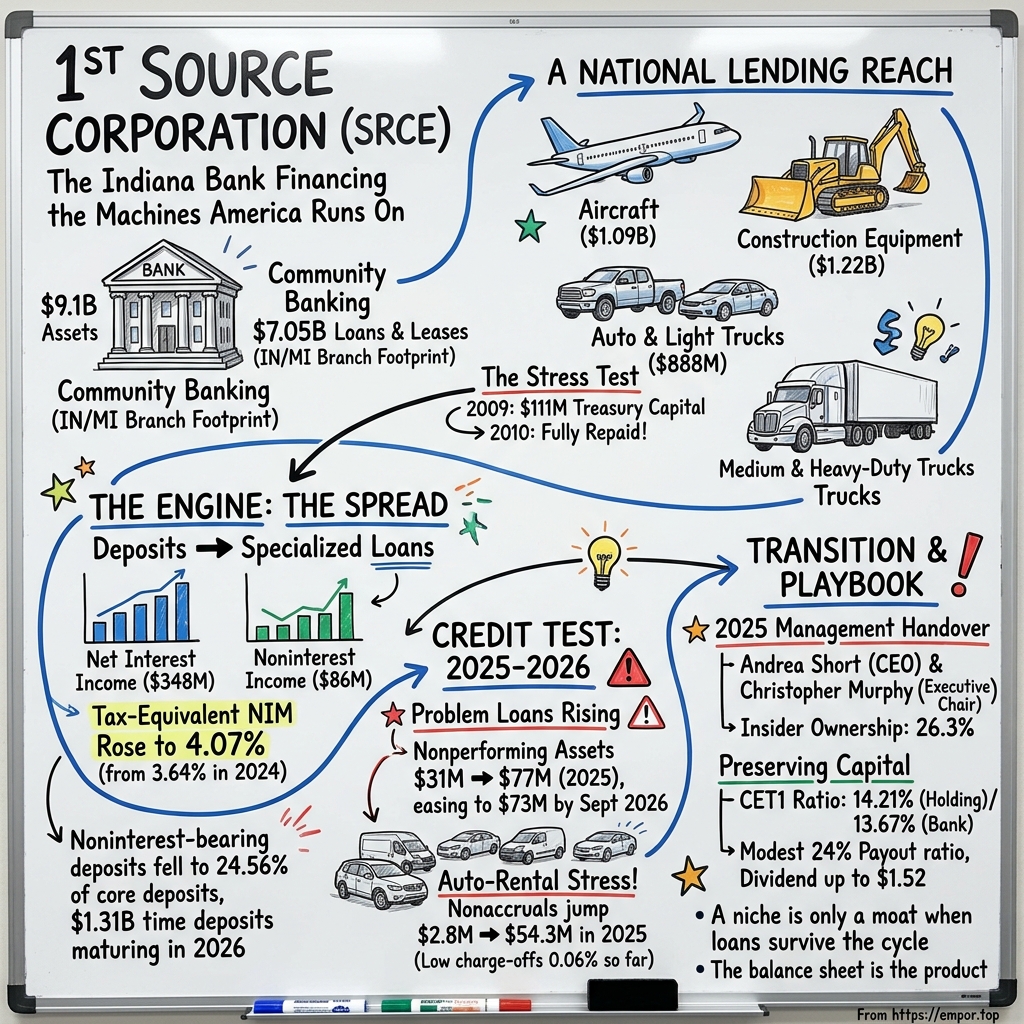
That institution is 1st Source Corporation, and 2025 was the best year in its history by the measure most banks care about most. It earned about $158 million, up almost a fifth on the year before.1 It ended the year with about $9.1 billion in assets and just over $7 billion in loans and leases.2 By the standards of American banking, that makes it a mid-sized regional lender, the kind of bank that usually lives and dies with the economy of a few counties.
But 2025 carried a second headline, and it pointed the other way. Nonperforming assets, the loans a bank has stopped expecting to be repaid on schedule plus anything it has repossessed, jumped from about $31 million to about $77 million.2 Almost all of that increase came from one corner of the loan book: loans to car-rental operators.2 In the same year that the bank printed record profits, its pile of problem loans grew to roughly two and a half times its previous size.
That tension is the story. A record year coincided with a warning light, and a listener could reasonably wonder which of the two is the signal and which is the noise. Four questions follow from it. Can the wider lending spread that powered 2025 last, now that depositors have more choices about where to park their money? Is the auto-rental trouble a contained episode, or the first crack in a specialist portfolio that has to survive cycles in trucking, aviation and construction? Does specialist lending actually give this bank a durable edge over competitors with far larger balance sheets, or does it merely give it a different set of risks? And can a new chief executive, who took the job in the autumn of 2025 after one of the longest tenures in American banking, keep the discipline that built the franchise?
It helps to be precise about what is being analyzed. The company listed on NASDAQ under the ticker SRCE is 1st Source Corporation, a bank holding company incorporated in Indiana. Its main operating business is 1st Source Bank, a wholly owned subsidiary that holds the deposits, makes the loans and carries most of the regulatory capital.2 When this story talks about margins, loans and credit, it is mostly talking about the bank; when it talks about dividends, buybacks and the share price, it is talking about the holding company that owns it. There is no controlling parent above the holding company and no group whose economics need to be separated from the listed entity.2
The hook here is not simply that 1st Source is a small bank. Plenty of small banks exist, and most of them look alike: branches, local businesses, mortgages, commercial real estate. 1st Source looks like that in northern Indiana and southwestern Michigan, where its branches are. Then, about half of its loan book walks out the door and across the country. In 2024, roughly 52% of loans and leases sat in its specialty finance portfolio, the national business that lends against aircraft, vehicle fleets, trucks and construction machinery.3 Its foreign aircraft loans reach borrowers in Brazil and Mexico.2 A deposit gathered at a branch near Notre Dame may end up financing a helicopter in São Paulo.
That blend is the company's identity. Community banking supplies relatively cheap, sticky funding and local relationships. Specialist lending gives the bank a much wider reach, often better yields, and a risk profile that bears little resemblance to the neighbouring community bank down the street. The question running through everything that follows is whether that blend produces repeatable returns, or whether 2025 was simply a favourable moment in the interest-rate cycle that flattered a business whose real test is still ahead. To answer it, the story starts with how a bank from South Bend came to finance machines across a continent.
 Subscribe on LinkedIn
II. A Regional Bank Adds a National Lending Reach
The bank's roots are almost absurdly old for a business story about rental fleets and business jets. 1st Source traces its history to 1863, when it was chartered as the First National Bank of South Bend.4 For a century it was what that name suggests: a local bank in an Indiana manufacturing town. The turning point that matters for today's franchise came much later, and it came through a family and a deal.
In 1972, Christopher Murphy III was in his mid-twenties, a lawyer at Citibank with family connections to South Bend. He joined his father-in-law and a group of investors to buy the banking company from Associates First Capital, the finance company that then owned it, and took a seat on the board.3 By 1979 he was chief executive, and by 1998 he was also chairman.3 The families that have shaped the bank, which the company names as the Morris, Carmichael, Raclin and Murphy families, have been in its leadership since 1931.5 When Murphy handed over the chief executive job in 2025, the company described his tenure as fifty years of successive leadership as president, chairman or chief executive.5 Very few American banks have had a single person at the centre of decisions for that long.
What Murphy and his colleagues did with the old Associates connection is the origin of the modern business. The new owners hired some experienced hands from Associates, which knew how to lend against equipment, and got into financing trucks.3 The specialty finance group dates its founding to 1976, and it began by funding vehicle fleets.6 A few years later it started working with auto-rental companies. Aircraft followed in 1986, and construction equipment in 1990.63 The logic Murphy later described was diversification inside specialization: if the bank was going to be in these businesses, it needed several verticals, "so that we're not too dependent on any one of them."3
Today the group still lends against the same families of machines it built over those decades. It finances aircraft, mostly turbine-powered planes and helicopters; auto and light trucks, including fleets for leasing and rental agencies; construction equipment and cranes; and medium and heavy-duty trucks, trailers and vocational vehicles such as waste-disposal trucks.62 Deals range from tens of thousands of dollars to about $45 million, with typical terms of two to six years.6 It lends across the United States and, for aircraft, into Brazil, Mexico and Canada.6
Those deal sizes say something about the strategy. A $50,000 loan on a single vocational truck and a $45 million loan on a long-range business jet require completely different skills, yet both sit inside the same group.6 At the small end, the work is volume and process: approving deals quickly and servicing them cheaply. At the large end, it is asset knowledge and structuring, the ability to judge what a particular aircraft will fetch in a particular market years from now. Running both under one roof is part of what makes the franchise hard to copy, and part of what makes it hard to analyse from outside.
The crisis loan and the exit
Every lending model looks clever in an expansion. The real test is a crisis, and the most recent severe one arrived in 2008 and 2009. Equipment finance was squarely in the blast radius. Trucking volumes fell, construction stalled, and business aviation, the kind of flying that depends on corporate profits, contracted sharply. A bank lending against all three at once was exposed in exactly the places the recession hit.
In January 2009, 1st Source took $111 million from the U.S. Treasury through the Capital Purchase Program, the part of the Troubled Asset Relief Program that injected capital into banks by buying their preferred stock.7 It is worth being clear about what that meant. Preferred stock is a layer of capital that sits between debt and common equity: it absorbs losses ahead of bondholders, pays a fixed dividend, and does not carry the voting rights or the open-ended upside of common shares. It strengthened the bank's capital cushion without issuing a wave of new common stock to the market at depressed prices. It was support, though, and nobody should pretend otherwise. In late 2008 and early 2009, many healthy banks took the money partly because the government encouraged it and partly because nobody knew how bad the losses would become.
Less than two years later, the bank gave it back. In December 2010, Treasury announced that 1st Source had repaid its investment, and the company redeemed the preferred shares for about $111.68 million, including accrued dividends.89 The exit came on a defined timetable, at a time when a number of banks were still unable to repay their crisis capital at all.
The episode is a useful stress test, though it proves less than a proud shareholder might like. It shows that the bank's capital base and earnings power were strong enough to retire government support quickly once markets reopened. It does not prove that underwriting alone carried the bank through. Some of the resilience came from access to capital when markets seized up, which is the very thing a bank cannot provide for itself in a panic. The honest reading is that 1st Source survived the worst equipment downturn in decades with help, and then demonstrated capital discipline by not keeping that help longer than it needed.
What about acquisitions? Many regional banks grow by buying other banks, and their history is a list of mergers, integration charges and goodwill. 1st Source's recent record is different. The company's recent filings describe growth through lending, deposits, dividends and buybacks; they identify no current rights issue, warrant issue or other equity raise.2 The shelf registration it filed in 2015 covered possible future offerings and sales by existing holders, not a completed raise.10 Its capital story in the past decade is one of organic lending, steady dividends, modest repurchases and selective growth in its specialist niches, not one of transformative acquisitions. That makes the business easier to read, because the numbers reflect what the bank built rather than what it bought. It also places more weight on the quality of the loans, since there is no merger story to blame or credit.
So the crisis left that franchise intact. To understand whether it is a good business, the next step is to follow a single dollar from one side of the bank to the other.
III. The Spread Between Indiana Deposits and a Financed Airplane
Start with a depositor. Call her a retired schoolteacher in Elkhart, though she could be a dentist in Mishawaka or a small manufacturer in Kalamazoo. She keeps a checking account at the local 1st Source branch, perhaps a savings account, perhaps a certificate of deposit that matures next spring. She is not thinking about aircraft. She is thinking about convenience, safety and whether the rate on her CD is good enough to stop her moving the money to an online bank.
Now follow the money. The bank pools her balance with thousands of others and lends it out. Some goes to local businesses and households. A large share goes to the specialty finance group, which might use it to fund a loan on a mid-size business jet owned by a company in Monterrey, or a fleet of compact SUVs for a regional rental operator. The aircraft owner pays interest at a rate that reflects the asset, the borrower's credit and the term. The schoolteacher earns a lower rate, or none at all if the money sits in checking. The difference between the two, after credit losses and running costs, is the bank's living.
That difference has a name: net interest income. It is the interest a bank earns on loans, leases and securities, minus what it pays on deposits and borrowings. In 2025, 1st Source earned about $348 million of it.2 Its other line of business, fees, brought in about $86 million.2 Fees come from wealth advisory services, deposit-account charges, debit cards, mortgage banking, insurance and equipment rental.2 They are useful, because they do not depend on the spread and they add breadth to the relationship. But they are only about a fifth of total revenue, which means the bank's fortunes rise and fall with the spread business. When a banker says "the margin," this is what they mean.
The headline measure is the net interest margin: net interest income divided by the assets that earn interest. On a tax-equivalent basis, which adjusts for tax-exempt municipal bonds so that yields are comparable, 1st Source's margin rose from 3.64% in 2024 to 4.07% in 2025.2 For a bank, that is a big move. Forty-three basis points across roughly $8 billion of earning assets is tens of millions of dollars of extra income, much of which fell straight to the bottom line because the bank's running costs did not jump with it.
Why did it happen? Three forces combined, and the order matters. The first was the securities portfolio. Like most banks, 1st Source holds a book of bonds, mostly Treasury and agency securities, municipal bonds and mortgage-backed securities, as a liquidity reserve.2 Many of those bonds were bought when rates were near zero. As they matured or were sold and replaced at higher yields, the portfolio started earning more. The second force was that loan and lease yields stayed relatively stable, which meant the bank was not losing ground on the asset side. The third, and most important for what comes next, was the funding side: the cost of deposits and short-term borrowings fell during 2025 as the Federal Reserve eased rates and the bank repriced what it paid depositors.2
Put simply, the bank earned a little more on its bonds, roughly the same on its loans, and paid a little less for its money. That is a powerful combination. It is also a combination that depends on conditions the bank only partly controls.
The depositor's choice
Which brings the story back to the schoolteacher in Elkhart, because deposits matter as much as loans. A bank's cheapest funding is the money customers keep in accounts that pay no interest at all: business operating accounts, household checking. Every dollar that sits there costs the bank only the expense of servicing the account. Every dollar that moves into an interest-bearing account, or out to a money-market fund, raises the bank's cost of funds.
At 1st Source, that cheapest funding has been shrinking as a share of the total. Noninterest-bearing deposits fell from about 28% of core deposits in 2023 to about 25% in 2025.2 That drift is common across the industry after the rate shock of 2022 and 2023, when customers who had ignored their idle balances for a decade suddenly realised they could earn 4% or 5% elsewhere. It is still a drift in the wrong direction. And it was paired with a large repricing event: about $1.31 billion of time deposits, the certificates of deposit customers lock in for a fixed term, were scheduled to mature during 2026.2
Picture each of those maturities as a decision point. The customer can roll the CD at whatever rate the bank offers, move it to a savings account, or take the money elsewhere. If rates are falling, the bank can reprice those deposits lower and widen its margin further. If competition for deposits is fierce, or the customer has better options, the bank has to pay up or watch the money leave. Multiply that decision by thousands of customers and it becomes one of the main forces deciding whether 2025's margin was a level or a peak.
So far in 2026 the funding story has held up better than a pessimist might have feared. By the third quarter, the bank was paying 2.38% on interest-bearing deposits, down from 2.70% a year earlier, while non-interest-bearing balances averaged about $1.64 billion, slightly higher than a year before.11 Total average deposits were essentially flat, around $7.44 billion, which the chief executive attributed partly to seasonal outflows of public-fund deposits.11 Flat deposits and falling deposit costs are good for the margin. They also mean the bank's loan growth is being funded without much new deposit growth, which can only continue for so long before it needs to raise funding at higher cost.
One more point of translation is essential. A listener used to analysing manufacturers or software companies might reach for familiar tools: cash conversion, receivables, net debt. They do not work here. For a bank, loans are the inventory and deposits are the raw material, so the movements in the cash-flow statement mostly reflect lending and deposit flows rather than the quality of earnings.2 The right instruments are credit quality, funding mix, liquidity and regulatory capital. A bank that "converts profit into cash" by shrinking its loan book is not getting healthier; it may simply be lending less.
The engine, then, is simple: local deposits fund national loans, and the spread pays for everything. What makes 1st Source interesting is the national-loan half, because that is where it claims to know something its rivals do not. Whether that claim holds is a question about competition, and the competition is formidable.
IV. The Niche Lender Against the Captive Finance Giants
Imagine a road builder in the Midwest who needs three new excavators and a crane before the paving season. The obvious first call is to the dealer, and through the dealer to the manufacturer's own finance arm. Caterpillar Financial and John Deere Financial exist precisely for this moment. They know the equipment because they built it, they can bundle financing into the sale, and they sometimes offer subsidized rates because the parent company wants to move iron. The second call might be to a giant national bank such as Wells Fargo, PNC or Huntington, which can lend at scale and offer treasury services, credit cards and payroll at the same time. The third might be to a specialist equipment lender such as GreatAmerica, or the equipment-finance arm of a regional rival like Wintrust.
So why would that road builder, or an aircraft owner, or a rental operator, ever call a $9 billion bank in South Bend?
The company's answer is expertise and relationships. Its own description is that its "long term relationship approach, expertise and commitment to timely quality service, makes a positive difference" for clients.6 Murphy put it more bluntly: "Financing equipment is in our DNA. Our strength is that we know how to work through the downsides in these businesses."3 He described that strength as something learned the hard way: "You get hurt, you get burned. And then you learn from those experiences and codify that learning."3
There is a real economic idea behind that claim. Lending against equipment is not the same as lending against a company's general creditworthiness. The lender needs to know what the asset is worth today, what it will be worth in three years, how fast it can be repossessed, who will buy it, and what it costs to store and sell. A lender that has financed turbine aircraft since 1986 has seen several aviation cycles, knows the resale market and has relationships with brokers and maintenance shops.6 It can say yes to a deal that a generalist bank would decline, and it can price the deal for the actual risk rather than a generic credit score. A manufacturer's captive can do this for its own brand, but it is less useful to a customer who runs a mixed fleet or buys used equipment.
The scale context matters. At year-end 2025, 1st Source had about $1.22 billion of construction-equipment loans and leases, about $1.09 billion of aircraft loans, and about $888 million of auto and light-truck loans.2 Those are large books for a bank of its size, each more than a tenth of its total loans in round terms, though the company says no single portfolio concentration reached 10% of total loans under its own definition, so the figures should be read as product categories rather than single-borrower concentrations.2 Beside the multi-trillion-dollar balance sheets of the national banks or the global finance platforms of the equipment makers, they are small. The company does not publish market shares for its niches, so there is no way to say whether it is a leader, a meaningful player or a rounding error in any of them.
What the record says about the edge
The strongest evidence for the edge is persistence. A specialty group that has operated continuously for five decades, in the same asset categories, through the 1980s farm crisis, the early-1990s recession, the 2001 aviation shock after September 11, the 2008 crisis and the pandemic, has at least shown that it can survive. Survival in specialty lending is not trivial, because a single badly timed concentration can sink a lender. And in 2025 there was a piece of affirmative evidence: construction financing grew by about 1.4%, driven by new and existing client relationships, according to the company.2
The counterevidence sits in the same year. Aircraft balances fell by about 3.3%, as clients paid off loans.2 Auto and light-truck balances fell by about 6.4% as rental customers downsized their fleets.2 By the end of September 2026, the auto and light-truck book had shrunk further, to about $818 million from about $925 million a year earlier.11 Some of that decline was the bank's own choice, a more selective credit posture after the problems in rental lending surfaced.2 But a lender with genuine pricing power and deep relationships would not usually see two of its three largest specialty books shrink in a year when the overall economy was growing.
The bank's own leadership has never claimed the niches were painless. During the pandemic, as travel collapsed, some loans on tourist buses in New York City soured; on another occasion, a client's helicopter purchase turned into a workout for the bank.3 Those episodes were small, but they illustrate the mechanism precisely: a specialist lender is exposed to shocks that hit one kind of machine and one kind of customer all at once, and its skill shows up in the recovery rather than in avoiding the trouble altogether.
A Bank Director profile in 2025 went further than the company does, arguing that the knowledge requirements "form a barrier to entry that keeps competitors largely at bay and provides pricing power," and quoting a bank analyst at KBW saying "the specialty finance group is what differentiates them."3 That is a reasonable hypothesis, and differentiation is clearly real. Pricing power is a stronger claim, and it is the one the company's own disclosures cannot prove. 1st Source does not publish loan-level pricing by category, win rates on competitive bids, client retention, or the share of loans that renew rather than leave for a competitor. Without those figures, the public record cannot distinguish between a bank that wins on expertise and a bank that wins sometimes on expertise and sometimes by accepting slightly lower spreads or slightly higher risk.
What can be said with more confidence is where the competitive pressure comes from. Borrowers can shop. A rental operator with a strong balance sheet can get quotes from the captive finance arms of car makers, from national banks, and from specialist lessors, and a sophisticated aircraft owner can do the same. Manufacturer financing is a constant substitute, especially for new equipment. And on the other side of the balance sheet, every bank, money-market fund and online savings account in America is competing for the schoolteacher's deposit, which caps how cheaply 1st Source can fund those loans. Those forces do not destroy the niche model, but they limit how much a niche lender can charge before customers walk.
The sharpest way to frame the moat is this. Specialist knowledge plausibly gives 1st Source an underwriting and servicing advantage: it can evaluate collateral, structure deals and manage problem loans better than a generalist. Whether that advantage translates into superior risk-adjusted returns across a full cycle is a separate question, and the answer depends on what happens when a niche goes wrong. In 2025, one of them did.
V. Record Earnings, with the Rate Cycle in the Room
In early 2026, Andrea Short sat down to write her first annual letter to shareholders as chief executive. The material was the kind every new chief executive hopes for. Net income was a record, up about 20%; earnings per share were up by a similar amount; the margin had expanded sharply.121 Revenue, by the broad measure that combines interest and fee income, grew by about 5%.1 A first letter that reports a record year is a pleasant way to begin.
The more interesting question is what produced the record, because that determines whether the next letter will be equally pleasant.
Look first at the long view. Over the decade from 2015 to 2025, revenue compounded at about 8.4% a year, and net profit at about 10.7%.2 Earnings per share rose from $2.21 to $6.49, almost tripling.2 For a regional bank that did not grow through large acquisitions, that is a respectable record. It reflects a loan book that grew, a deposit base that grew with it, operating costs that grew more slowly than income, and a lower corporate tax rate from 2018 onwards, which lifted after-tax profit for every American bank.
Then look closer. Revenue growth was explosive in 2023, about 32%, as interest rates rose and loan yields reset upward faster than deposit costs.2 It slowed to about 12% in 2024 and about 5% in 2025.2 Profit growth followed a different path: it was modest in 2023 and 2024, as the cost of deposits caught up with loan yields, and then accelerated in 2025 as deposit costs began to fall.2 Over three years, net profit grew about 9.6% a year, a little slower than the ten-year rate.2 The record in 2025, in other words, was not the product of a business suddenly growing faster. It was the product of a business whose margin widened after a period in which it had been squeezed.
That distinction matters because it tells investors where the growth came from. A bank can increase profits in three main ways: lend more, earn a wider spread on what it lends, or lose less to bad loans and costs. In 2025, the second lever did most of the work. The margin widened as funding costs fell.2 Loan growth was modest, and credit costs moved the wrong way.
What 2026 has shown so far
If 2025's record depended on a favourable spread, the obvious test is whether 2026 could keep it going. Through the first nine months, the answer was yes, and by more than a sceptic might have expected. Third-quarter net income was about $49.5 million, up about 17% from a year earlier, and diluted earnings per share were $2.03.11 Across the first nine months, net income came to roughly $137 million, also about 17% ahead of the same period in 2025.1311 The tax-equivalent margin reached 4.28% in the third quarter, up from about 4.09% a year earlier.11 The efficiency ratio, which measures how much the bank spends to earn each dollar of revenue, improved to about 46%, meaning the bank spent roughly 46 cents of operating expense for every dollar of revenue.11
The cost side deserves a moment, because a widening margin only becomes record profit if expenses do not swallow it. 1st Source ran the business with roughly 1,190 full-time-equivalent employees at the end of 2025, compared with about 1,170 two years earlier, even as revenue grew over the same period.2 Spending on data processing rose from about $25 million in 2023 to about $30 million in 2025.2 The pattern is a largely stable workforce with steadily rising technology spending, which is what a bank trying to raise productivity should look like. In the third quarter of 2026, the bank launched a Payments Hub that it said "modernizes and simplifies payment operations" by routing each payment through the choice that best balances speed and cost.11 The company does not isolate the return on its technology spending, and it does not quantify what artificial intelligence or automation might do to its cost base. The spread model itself is unlikely to be disrupted by software; the operating cost of running it may well be reshaped by it.
The reasons management gave for the third-quarter margin gain were higher average loan and lease balances, improved yields on investments, and stable interest-bearing deposit costs.11 Average loans were up about 3.4% from a year earlier, so the first lever, lending more, was finally contributing alongside the spread.11
The third quarter also included a deliberate trade. The bank sold about $68 million of available-for-sale securities that had been yielding about 1.83% and replaced them with securities yielding about 5.10%, booking a pretax loss of about $3.82 million on the sale.11 The logic of such a trade is straightforward. Bonds bought when rates were low are worth less than their face value today, because new bonds pay more. Holding them to maturity avoids the accounting loss but locks in a low yield for years. Selling them crystallises the loss now in exchange for more income later.
The arithmetic gives a sense of the payback. A yield pickup of about 3.3 percentage points on $68 million is worth roughly $2.2 million of additional interest income a year, before tax. On that basis, the $3.8 million loss earns back in a little under two years, assuming the replacement bonds hold their yield. The company's release described the move only as a repositioning and did not lay out its own expected payback, and the chief executive's comments did not mention it.11 The bank had done similar repositioning trades in 2025, which the second-quarter 2026 release credited with improving investment yields.13 That is a coherent strategy: use a period of strong earnings to absorb small realised losses, and buy a wider margin for the future. It is also a reminder that part of the margin expansion is a one-time portfolio refresh rather than a permanent improvement in the franchise.
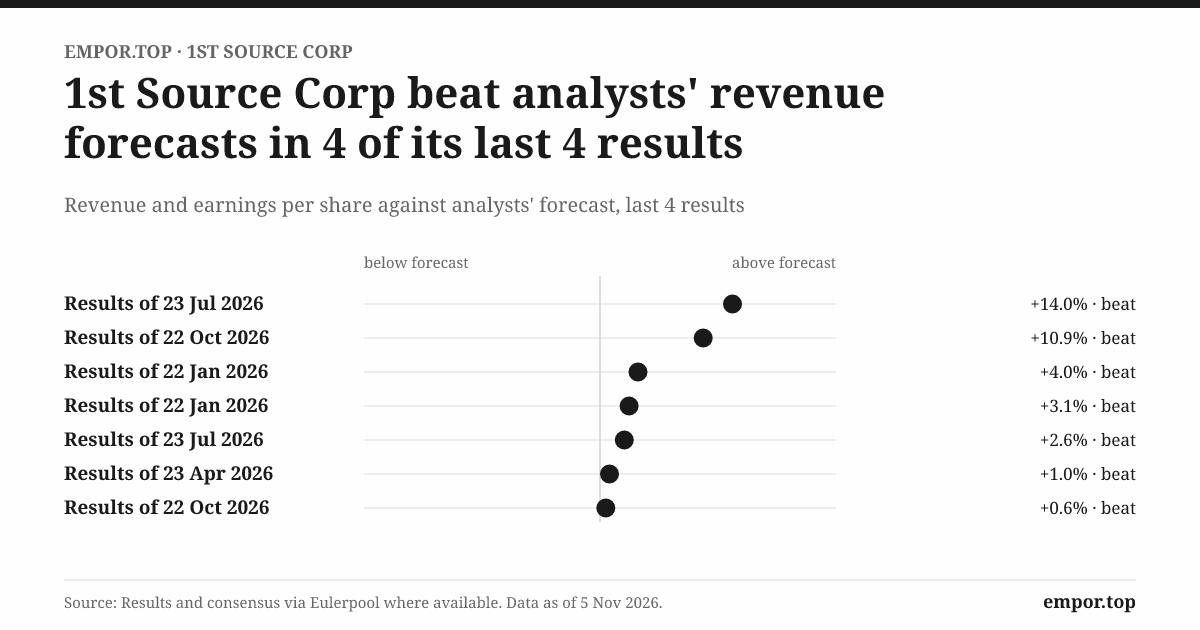
How did management describe all this in public? The language has been consistent and upbeat. In the second quarter, Short said 1st Source had "a record second quarter" and that the bank was "able to preserve our net interest margin and further improve our efficiency ratio."13 In the third quarter, she pointed to "record quarterly net income" along with "net interest margin expansion and an improved efficiency ratio."11 The tone is consistent with the numbers. What the releases do not offer is a forward view on margins or deposit pricing, which leaves investors to infer the outlook from the trend.
The settling evidence will be whether earnings remain resilient as deposit costs reset and as credit provisions absorb more of the lending cycle. The first half of that question has gone well. The second half is where the story turns uncomfortable, because the year of record earnings was also the year a rental-car problem appeared on the balance sheet.
VI. The Rental Fleet That Turned Into a Credit Test
The scene is a rental-car lot, and the problem is a mismatch between what a fleet cost and what it earns. Rental operators buy or finance cars in bulk, rent them out for a year or two, and then sell them into the used market. The business works when rental rates are healthy and used-car prices hold up. It strains when either side moves against the operator: when travel demand softens, when operators have overbought, or when the cars they bought at pandemic-era prices are worth less at disposal than they planned.
In 2025, several of 1st Source's rental customers started shrinking their fleets and shifting toward vehicles with lower capital costs.2 That is a rational response to tougher economics: run fewer cars, buy cheaper ones, pay down debt. For the lender, it means two things. Loan balances shrink, because customers are buying fewer cars. And some borrowers who cannot shrink fast enough, or whose cars are worth less than expected, slip into trouble.
The trouble showed up as nonaccrual loans. A loan goes on nonaccrual status when the bank stops recording interest income on it, usually because it doubts it will be repaid in full on schedule. It is the banking equivalent of a doctor's early warning: not yet a loss, but a reason to watch closely. At 1st Source, auto-rental nonaccrual loans jumped from about $2.8 million at the end of 2024 to about $54.3 million at the end of 2025, a nearly twentyfold increase in a single year.2 That jump accounted for most of the increase in total nonperforming assets.2
It is important to be precise about which loans these are. The bank's "auto and light truck" category includes rental lending, but it is not all rental lending; it also includes leasing companies and other fleet operators.26 The problem was concentrated in the rental slice, and not every borrower in the category is a rental company.
Early warning versus realised loss
Here is the puzzle. If nonaccruals surged so dramatically, why did the bank's actual losses stay so low? In 2025, net charge-offs, the loans the bank actually wrote off as uncollectible net of recoveries, were only about 0.06% of average loans.2 That is a remarkably small number. For context, the bank's charge-offs were 0.09% in 2024, and across American banking a level well under half a percent is generally considered benign.3
The answer lies in the difference between the two measures. Nonaccruals are a judgment about the future: the bank thinks some borrowers will not pay as agreed. Charge-offs are a record of the past: the bank has concluded that money is gone. In equipment lending, the gap between the two can be long, because the collateral has real value. A rental operator in trouble still owns cars that can be sold. If used-car values hold up, the bank can work out the loan, repossess and sell the vehicles, or help the borrower shrink the fleet, and recover most of what it lent. Murphy pointed to exactly this in 2025: "The good news is that car values have held up," he said, adding that if the bank could convince a customer to sell some of its fleet, "you can manage the risks."3
That is a credible explanation, and it reflects what an experienced equipment lender should do. It is also a statement about collateral values that the bank does not control. If used-car prices had fallen sharply, the same loans would have produced real losses.
The bank's cushion against those losses is the allowance for credit losses, a reserve set aside from earnings to cover expected future losses. At the end of 2025, the allowance covered nonperforming loans about 2.1 times, down from about five times a year earlier.2 The reserve did not shrink; the problem loans grew faster than the reserve. A coverage ratio of two times is still substantial, but the direction showed how quickly a specialist portfolio can change the picture.
The auto-rental problem also needs to be set beside the rest of the specialty book, because it is the comparison that tells investors whether the trouble was spreading. It was not, at least in 2025. Construction-equipment nonaccruals actually fell, from about $18 million to about $11 million.2 That matters, because construction is the bank's largest specialty book and one of the most cyclical. A single troubled niche, surrounded by stable or improving neighbours, is a very different situation from a broad deterioration.
The 2026 recovery
So what happened next? The early-2026 numbers showed the problem working through, but not without cost. In the first quarter, net charge-offs rose to about $4 million, or about 0.23% of average loans on an annualised basis, and the bank set aside about $7.3 million in provisions.13 That was the period in which some realised losses appeared. By the end of June, nonaccrual loans had eased to about $70 million from about $77 million at the start of the year, and the bank credited a reduction in loans needing special attention for its lower provision.13
The third quarter brought the clearest improvement. By the end of September 2026, nonaccrual loans and leases had fallen to about $57 million, and total nonperforming assets to about $59 million, or about 0.8% of loans.11 That compared with about $73 million at the end of both March and June, so the third quarter was the first in which the pile shrank meaningfully.1311 Net charge-offs in the quarter were tiny, about $0.3 million.11 Short summed it up: "Strong credit quality continued during the quarter with low net charge-offs, a lower provision for credit losses, and a reduction in nonperforming assets."11 The allowance stood at about 2.3% of loans.11
The decline is encouraging, and it suggests the bank has worked out a meaningful portion of its problem loans without heavy losses. It is also incomplete evidence of containment, for two reasons. First, the releases do not break out auto-rental nonaccruals specifically by quarter, so investors cannot see whether the improvement came from the rental book or from elsewhere. Second, the drop in nonaccruals could reflect cures, repayments, restructurings, repossessions or charge-offs, and those outcomes have very different implications. A borrower who cures and resumes paying is a success. A loan moved into repossession has simply changed form; repossessed assets rose to about $2.3 million by midyear.13
There is one more layer of judgment worth naming. The auditor's critical audit matter for 2025 was the allowance for loan and lease losses, specifically the qualitative adjustments management makes when estimating expected losses.2 That is not a qualification of the financial statements, which received a clean opinion, and it is common at banks. But it is a reminder that the reserve rests on management's judgments about future conditions, and that those judgments carry particular weight in a portfolio where a single niche can move from benign to troubled within a year.
The auto-rental episode is a test of the very claim Murphy made about the bank's DNA: that it knows how to work through the downsides. So far the record supports that claim in a narrow form. The bank identified the problem, set aside reserves, shrank its exposure and, through September 2026, avoided large losses. Whether the episode closes cleanly will be visible in the coming quarters' charge-offs and nonaccruals. It also unfolded on the watch of a new chief executive, who inherited both the franchise and its first serious credit test.
VII. Andrea Short Inherits the Franchise—and the Credit Cycle
On July 24, 2025, 1st Source announced the most consequential management change in half a century. Christopher Murphy III would step down as chief executive and become executive chairman, and Andrea Short would become chief executive and president of the holding company, effective October 1.5 Murphy's framing was warm and emphatic. He said he could not be "more pleased nor more excited to turn the CEO role over to a Servant Leader," and called the transition "a dream come true, ensuring long-term view to building value for our shareholders."5
There is a small puzzle in the record that is worth resolving. Some data providers list Short as chief executive since 2013, which would make the 2025 succession a formality. The company's own announcement says otherwise: before the change, Short was president of 1st Source Corporation and chief executive of 1st Source Bank, and the 2025 promotion made her chief executive of the holding company for the first time.5 She had been running the bank's day-to-day operations, but the top job at the listed company changed hands in the autumn of 2025.
Short is not an outsider. She joined 1st Source in 1998 to run its tax division, and Murphy noted that he had worked with her since she arrived.5 She is a certified public accountant, an accounting graduate of Alma College, with further training at the University of Chicago, Northwestern and Harvard Business School's Advanced Management Program.5 That background matters for the questions this story is asking. A chief executive who came up through tax, accounting and finance is likely to think first about capital, reserves and the economics of each loan, which is the right instinct for a bank whose margin and credit picture both turned in her first year.
The same announcement put Kevin Murphy, the bank's chief digital officer and the fourth generation of the founding family's leadership, into the role of president of 1st Source Bank, reporting to Short.5 Brett Bauer, the chief financial officer, remained in place, giving the finance function continuity across the handover.14 Christopher Murphy kept a substantial role as executive chairman, responsible for board direction, longer-term strategy, organisational development and senior-management succession.5
That arrangement has a strength and a risk. The strength is continuity: the person who built the specialty franchise remains in the building, and the new chief executive has decades of institutional knowledge. The risk is that accountability becomes blurred. When the founder-era leader remains executive chairman with responsibility for strategy and succession, investors may reasonably ask who owns the decisions when something goes wrong. The auto-rental problem began during the transition year, and it would be hard to say from outside whether it reflected underwriting decisions made under Murphy, the handling of the workout under Short, or both.
Incentives and ownership
Compensation tells part of the story. For 2025, Short's total compensation was about $2.19 million and Murphy's about $3.05 million, up from about $2.04 million a year earlier, reflecting his transition to executive chairman.14 Those are modest sums by the standards of larger banks, and they are not the main source of alignment. More important is how the long-term awards are designed: they vest over five years and depend partly on the bank's return on assets relative to peers.14 That design rewards sustained relative performance rather than a single good year, which is the right structure for a business whose risks show up over cycles. It also has a limit. Relative return on assets can look good when the whole industry is struggling, and it does not directly penalise credit risk that has not yet produced losses.
Ownership is the stronger alignment signal. Insiders held about 26.3% of the shares according to the company's ownership exhibit for the third quarter of 2026, institutions about 56.7%, retail and other holders about 14.3%, and the bank's employee stock ownership plan about 2.7%.15 That insider figure should not be read as Short's personal stake; it includes directors, officers and the founding families, and Murphy alone held about 17.2% according to a 2025 profile.3 It means the people closest to the business have a large amount of their own wealth tied to its long-term value. It also means a large block of votes sits with insiders, which can insulate management from outside pressure.
The board has a lead independent director, Mark Schwabero, and a structure of independent committees.14 Whether shareholders have expressed any meaningful dissent on pay or director elections is the kind of thing the annual-meeting results would show, and a sceptical investor would want to read them alongside the proxy rather than assume either support or opposition.
What would a demanding outside investor push on? Three things, most likely. First, the concentration of authority in a family-led institution where the former chief executive remains executive chairman and a family member runs the bank. Second, the explanation for the auto-rental deterioration: whether the bank saw it coming, what it changed in underwriting, and what it would do differently. Third, capital allocation in a business that is accumulating capital faster than it is deploying it, which is the subject of the next section.
The fairest verdict on Short's leadership is that it is too early to tell, and that the early evidence is favourable but short. In her first year, earnings set records, the margin widened, the efficiency ratio improved and problem loans began to fall. But she inherited a favourable rate cycle, and the credit problem began on the transition's watch. Credibility in banking is earned over a full cycle, not a single year, and the credit discipline that built the franchise will be tested most when the next downturn arrives. One of the clearest places to see that discipline is in how the bank handles its capital.
VIII. The Dividend Is Small; the Balance Sheet Is the Product
Every quarter, 1st Source's board meets and decides how much of the bank's earnings to hand back to shareholders. In October 2026, it declared a dividend of 45 cents a share, payable on November 13 to shareholders of record on November 3.11 It was a routine decision, and the routineness is the point. For a bank, the dividend is not the main event. The main event is everything the bank keeps.
Over the past twelve years, 1st Source has paid out between about a quarter and about a third of its earnings as dividends; in 2025, the share was about 24%, the lowest in that span, as profits rose faster than the dividend.1 The dividend itself rose to $1.52 a share for 2025.2 Paying out only about a quarter of earnings means the bank retains roughly three-quarters of each year's profit. That retained capital supports loan growth, builds the loss-absorbing cushion regulators require, and protects the bank in a downturn.
The second return channel is buybacks. The board has authorised the repurchase of up to one million shares.2 The company has used it sparingly: shares outstanding fell from about 24.52 million at the end of 2023 to about 24.33 million by February 2026, a reduction of less than 1%.2 In the first half of 2026 the bank repurchased about 338,000 shares for about $23 million, and then bought none in the second or third quarters.1311 That is a measured pace. It also means buybacks are not doing much to boost per-share earnings.
Why so restrained? The answer is the balance sheet. For a bank, the balance sheet is the product. Its capital ratios determine how much it can lend, how it is perceived by depositors and regulators, and whether it survives a bad year. At the end of 2025, the holding company's common equity tier 1 ratio, the core measure of a bank's highest-quality capital against its risk-weighted assets, was about 14.2%, and the bank's was about 13.7%.2 By September 2026, the holding company's ratio had risen to about 16%.11 Regulators generally expect well-capitalised banks to keep this ratio comfortably above 7%; 1st Source holds roughly twice that.
That level of capital is both a strength and a question. It is a strength because it gives the bank a large buffer against losses, the kind that lets it lend through a downturn when weaker competitors pull back. It is a question because excess capital that sits idle drags on returns on equity. A bank earning about 13% to 15% on equity while holding well above the regulatory minimum is making a choice to prioritise safety over leverage.
What "debt" means for a bank
A data screen might show 1st Source with about $341 million of borrowings and conclude that it has modest leverage, or compute an enterprise value that subtracts cash and adds debt.2 For a bank, that calculation is misleading. The bank's principal source of funding is not borrowings but customer deposits, roughly $7.4 billion of them, which are liabilities in every accounting sense.11 The borrowings, including short-term borrowings, subordinated notes and long-term debt, are a small supplement, and no covenant breach or refinancing pressure has been reported.2 Treating deposits as operating funding and ignoring them in a leverage ratio is like valuing an airline without counting its aircraft leases.
The securities portfolio is part of the liquidity story. At the end of 2025, the bank held about $1.52 billion of available-for-sale securities, with net unrealised losses of about $53.8 million.2 Those losses are the scar of the 2022-2023 rate shock: bonds bought at low yields fell in value when rates rose. The company said it did not expect to realise them through forced sales.2 That assurance matters because forced sales were exactly what brought down Silicon Valley Bank in 2023, when a run on deposits made it sell underwater bonds. For 1st Source, the unrealised losses are modest relative to its capital, and the bank has chosen to realise some of them deliberately through the repositioning trades rather than wait for maturity.
There is one more contingent exposure worth noting. The bank invests in affordable-housing, community-development and renewable-energy projects that generate tax credits. If those projects fail to meet their requirements, the credits could be recaptured. The maximum exposure was about $84.4 million at the end of 2025, including unfunded commitments.2 That is a ceiling, not an expected loss, and it is the kind of off-balance-sheet risk that rarely matters until it suddenly does.
The capital-allocation record, taken together, is consistent rather than spectacular. The bank pays a modest dividend, buys back stock at a measured pace and keeps a large capital buffer. There is no recent acquisition record against which to judge overpaying. A future acquisition would have to be judged against the alternative of organic lending: whether buying another bank's deposits and loans would earn more, after the price paid, than lending the bank's own capital into its specialty niches. Without a recent record of large deals, there is no evidence either way. What is clear is that capital, deposits and asset quality are the bank's binding constraints, and that returns to shareholders cannot be separated from the capacity to absorb credit losses. That leaves the question every investor ultimately has to answer: what is all this worth?
IX. Analysis & Bear vs. Bull Case
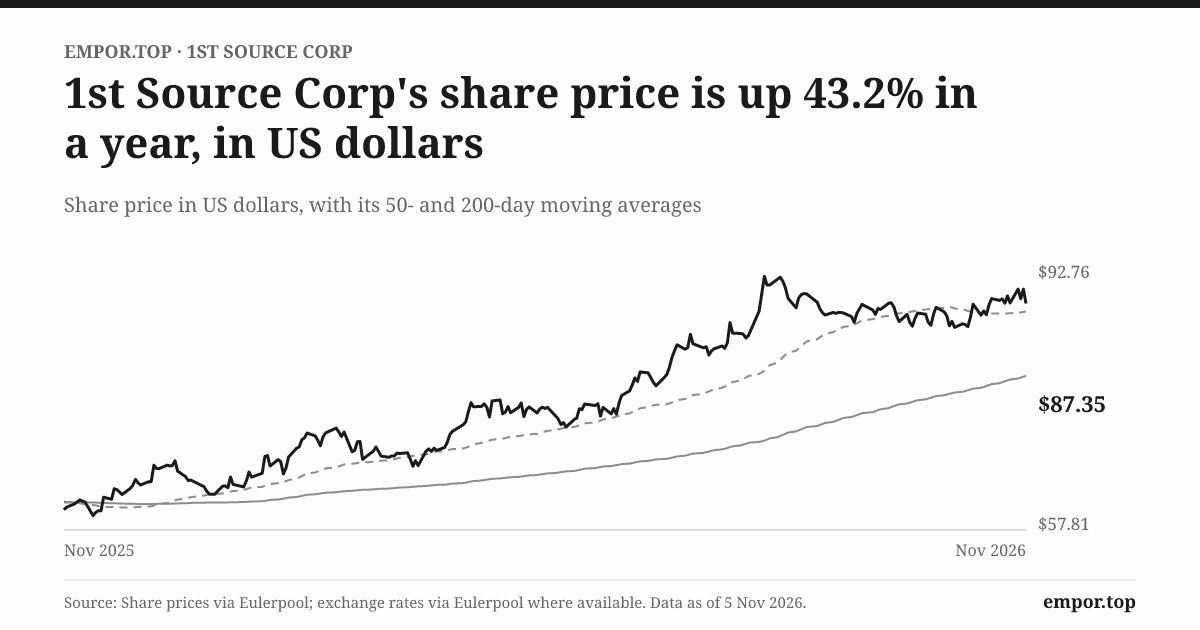
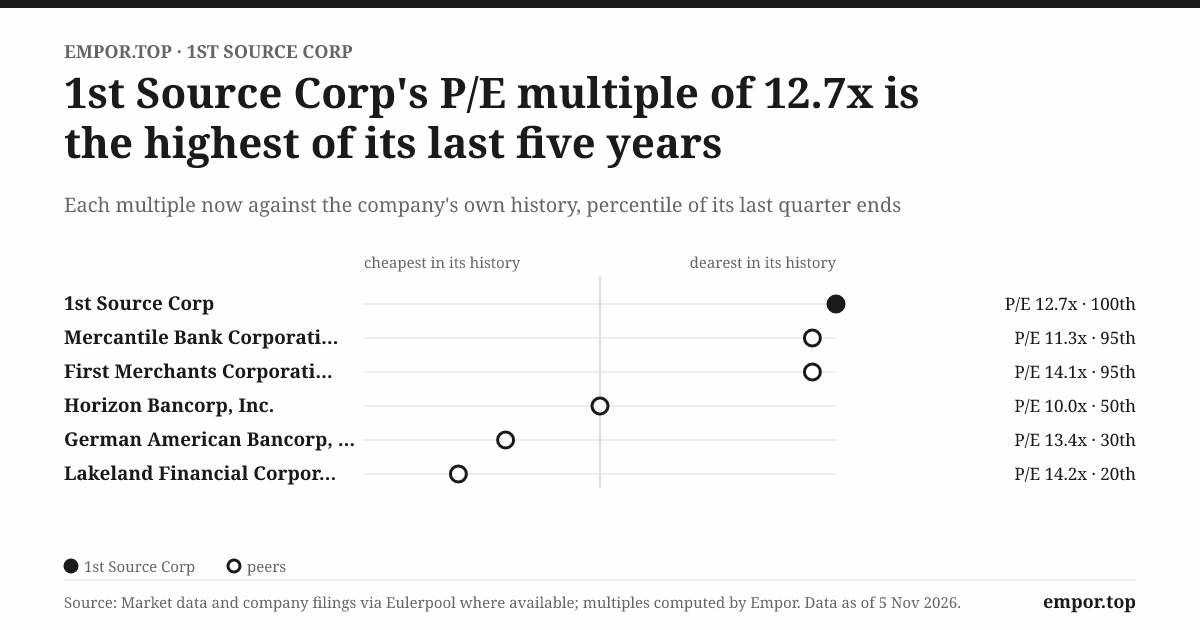
In early November 2026, 1st Source's shares traded around $87, within a few percent of their 52-week high of about $91 and well above the low of about $60 set during the past year. At that price, the company was valued at about $2.1 billion. Set against trailing earnings of about $7.34 a share, built from the last four quarterly reports, the stock traded at about 12.7 times earnings, compared with a five-year median of about 10.6 times, and at about 1.6 times book value.112 The dividend yield was about 2%, and the trailing return on equity about 13.4%.11 The market, in other words, was paying more for each dollar of 1st Source's earnings than it had on average over the past five years.
Is that premium justified, or does it price in a favourable spread cycle? Answering that requires weighing both cases in full.
The bull case begins with the specialty franchise. A bank that has lent against trucks, rental fleets, aircraft and construction equipment for five decades has accumulated knowledge of collateral values, workout processes and borrower behaviour that a generalist cannot easily copy. In 2025, construction financing grew through new client relationships, which suggests the franchise is still winning business in its largest niche.2 The bank's capital is strong by its own reported ratios, its dividend consumes only about a quarter of earnings, and its 2026 results showed loan growth and margin expansion continuing.11 The auto-rental problem appears to be working through without large losses so far. And the business is unusually transparent for a bank: there is no recent merger to digest, no hidden goodwill and no group structure to untangle.
The bear case begins with the margin. Much of 2025's earnings growth came from a wider spread, which depended on falling deposit costs and a repricing securities book. Those tailwinds are not permanent. The share of noninterest-bearing deposits has been declining, and large blocks of time deposits reprice each year. If rates fall further, loan yields will follow, and the bank may not be able to cut deposit rates as fast. If rates rise again, deposit costs will rise. Either way, the 2025 and 2026 margins look closer to a high-water mark than a floor.
The bear case continues with credit. Auto-rental nonaccruals surged, and the aircraft and auto and light-truck books shrank. Low realised charge-offs so far do not guarantee low losses later, especially if used-equipment values fall. The bank's specialty concentration means a downturn in trucking, aviation or construction would hit it harder than a diversified community bank.
Testing the moat
To test the moat, consider the competitive forces one at a time. Buyer power is significant: equipment borrowers are often sophisticated businesses that can compare offers from captive finance arms, national banks and specialist lessors. Substitutes are everywhere: manufacturer financing for new equipment, leasing companies for operating fleets, private credit funds for larger deals. Supplier power is also real, in the form of depositors, who can move their money to higher-yielding alternatives at any time. New entrants face some barriers in specialist lending, because collateral expertise takes years to build, but private credit has shown how quickly capital can enter attractive niches. Rivalry among existing lenders is intense in every category 1st Source serves.
Against that backdrop, which of Hamilton Helmer's seven powers could 1st Source plausibly claim? Scale economies are not available to a $9 billion bank competing with trillion-dollar institutions. Network effects do not apply. The strongest candidates are switching costs and process power. Switching costs exist because a borrower with an established relationship, known collateral and a lender who understands its business may find it easier to renew with 1st Source than to start over elsewhere. Process power exists if the bank's underwriting and workout know-how genuinely produce better outcomes than competitors can replicate. Counter-positioning might apply in a narrow sense: a large bank may find small, specialised equipment deals unattractive, leaving room for a focused lender.
The difficulty is that none of these powers is proven by the public record. The bank does not publish market share by niche, client retention, renewal rates, win rates or price realisation. The 2025 data show one niche growing and two shrinking, and a credit problem in one of them. The history shows survival through several cycles, but also a need for government capital in the worst one. The moat claim survives in a narrower form: 1st Source has a credible underwriting and servicing edge in specialised collateral, but the evidence does not show that this edge protects pricing or produces superior risk-adjusted returns across a full cycle. Specialisation can improve underwriting and service; it also concentrates expertise and credit exposure in cyclical equipment markets. Both are true at once.
A sceptical activist would aim at a different target: the capital itself. A bank holding core capital at roughly twice the level regulators expect, paying out a quarter of its earnings and buying back stock only occasionally, is choosing safety over returns. In the third quarter of 2026 the bank earned an annualised return on equity of about 14.8% and a return on assets of about 2.1%, strong figures for a regional lender.11 An activist might argue that returning more of the surplus would lift that return further without endangering the bank. The counterargument is the one the auto-rental episode made vivid: a specialist lender's capital is not idle when it is the reason the bank can work patiently through a troubled niche instead of dumping collateral at the bottom of the market. The insider ownership described earlier means that argument would be settled inside the boardroom, not by an outside campaign.
The valuation question has to be answered against the company's own history, because there is no well-established peer set of comparable specialist banks with comparable multiples. The current premium to the five-year median suggests the market is pricing in some durability for the higher margin and confidence that credit problems are contained. If those assumptions prove right, the premium is earned. If the margin compresses or credit costs rise, the premium leaves little room for disappointment.
Three measures will settle the story more than any others. The first is the tax-equivalent net interest margin, read together with deposit mix and cost; it stood at 4.28% in the third quarter of 2026 and has been rising.11 The second is nonperforming assets and net charge-offs, ideally broken out by category; nonperforming assets were about $59 million at the end of September 2026, down from about $77 million at the end of 2025.11 The third is loan growth alongside capital ratios: average loans grew about 3.4% year over year, while the core capital ratio rose to about 16%.11
The third-quarter securities sale is a small but useful test of management credibility in this framework. It was a deliberate trade that took a loss today in exchange for higher income tomorrow. If the margin keeps improving in coming quarters and the replacement bonds hold their yield, the trade will have done what it was designed to do. If the margin stalls, investors will ask whether the bank was harvesting future income to flatter the present. Either way, it is the kind of decision whose outcome can be checked, which is exactly what investors should want.
X. Playbook: Business & Investing Lessons
The year that delivered the best earnings in 1st Source's history also delivered a near-twentyfold jump in its auto-rental problem loans. That single year contains most of what the company has to teach.
The first lesson is that a niche is only a moat when the loans survive the cycle. 1st Source spent fifty years building expertise in rental fleets, trucks, aircraft and construction machinery. In 2025, one of those niches turned, and the bank's knowledge of car values and fleet economics was tested; realised losses remained low. That is the moat's promise. But the moat is not the knowledge itself; it is the realised loss rate after the knowledge has been tested. Founders building specialist businesses, and investors underwriting them, should judge a niche not by how well it performs in good years but by what it costs when the niche goes wrong.
The second lesson is that in a bank, the price of deposits is part of the product. The schoolteacher in Elkhart never sees the aircraft her savings help to finance, but her decision about whether to roll her CD is as important to the bank's earnings as any loan officer's decision about a jet. The 2025 margin jump came largely from paying less for money, and the 2026 margin continued to benefit from the same force. When a bank's earnings rise, the first question should be whether it is lending better or simply paying less, and the second should be how long it can keep paying less.
The third lesson is that specialisation can travel farther than branches, and risk travels with it. A bank whose branches stop at the Michigan line lends against helicopters in Brazil and business jets in Mexico. That reach is a source of growth that most community banks will never have. It is also a source of exposure that most community banks will never face: foreign borrowers, cross-border repossession, and asset markets that move on global rather than local conditions. The bank denominates its foreign aircraft loans in dollars, which removes currency risk but not credit risk.2 Distance multiplies both the opportunity and the cost of a mistake.
The fourth lesson is that capital discipline is visible in what a company does not chase. 1st Source has kept a substantial capital buffer and deployed capital cautiously. That restraint costs it some return on equity. It also means that when a niche turns, the bank has room to absorb losses without diluting shareholders or begging for capital. The best test of any future deal will be whether it beats the return the bank could earn by lending its own capital into the niches it already knows.
XI. Epilogue
Tonight, 1st Source stands in an enviable but unresolved position. Its margin is the widest in years, its earnings are setting records, its capital is strong and its problem loans have started to fall. The next quarterly filing, due in early 2027 with the full-year 2026 results, will show whether that position holds.
The first thing to watch is the funding trade-off. If the margin holds near its third-quarter level while the share of noninterest-bearing deposits stays stable and interest-bearing deposit costs keep easing, the bank will have shown that 2025's margin was not a one-time windfall. If deposit costs rise or the cheapest funding shrinks further, the margin will compress, and earnings growth will slow back to the pace of loan growth. The margin and the deposit mix need to be read together; one without the other can hide the trade-off.
The second thing to watch is the rental book. The most encouraging outcome would be further declines in auto-rental nonaccruals, driven by cures and repayments rather than charge-offs or repossessions. That would show the bank's workout skill turning a credit scare into a contained episode. The discouraging outcome would be a renewed rise in nonaccruals, or a jump in charge-offs as collateral values weaken. Total nonperforming assets alone will not settle the question; the composition matters as much as the headline.
The third thing to watch is growth against capital. Average loans have started growing again, and the bank has plenty of capital to support more. The question is whether that growth earns an adequate return for the risk. If construction, aircraft and truck lending grow with stable credit quality, the specialist model will look like a durable engine. If growth comes with rising problem loans, the bank's large capital buffer will start doing the work it was built for.
And then there is the leadership question, which will take longer to settle. Andrea Short's first year produced records, but a single year in a favourable rate cycle cannot show how she will manage capital, credit and competition through a downturn. Two or three more years, including at least one in which the cycle turns against the bank, will tell investors whether the discipline that built 1st Source survived the transition.
All of these questions are measurable. Stable margins and falling auto-rental problem loans would support the view that the bank absorbed a contained shock and emerged with its franchise intact. Renewed deterioration or margin compression would challenge that view. The bank's next chapter will be written in those numbers.
XII. Outro
Go back to the schoolteacher in Elkhart and the aircraft in Monterrey. That pairing, local funding relationships with specialist lending in machines that work across a continent, is what sets 1st Source apart from the typical regional bank.
Whether that pairing is a lasting advantage depends on what happens when the cycle turns. The bank's next test is not whether the aircraft takes off. It is whether the borrower can keep making payments when the fleet shrinks, the market softens or the cost of money changes, and whether the bank that understood the machine also understood the risk.
References
-
2025 Earnings Release — 1st Source Corporation, 2026-01-22 ↩↩↩↩
-
2025 Form 10-K — 1st Source Corporation, 2026-02-18 ↩↩↩↩↩↩↩↩↩↩↩↩↩↩↩↩↩↩↩↩↩↩↩↩↩↩↩↩↩↩↩↩↩↩↩↩↩↩↩↩↩↩↩↩↩↩↩↩↩↩↩↩
-
Specializing in Profits — Bank Director, 2025-08-25 ↩↩↩↩↩↩↩↩↩↩↩↩↩
-
1st Source Corporation Announces Executive Succession Plan — 1st Source, 2025-07-24 ↩↩↩↩↩↩↩↩↩
-
2025 Funding Source: 1st Source Bank's Specialty Finance Group — MonitorDaily, 2025-04-09 ↩↩↩↩↩↩↩↩↩
-
Treasury Announces Repayment by Six Financial Institutions — U.S. Treasury, 2010-12-29 ↩
-
Form S-3 Shelf Registration — 1st Source Corporation, 2015 ↩
-
Third Quarter 2026 Earnings Release, Form 8-K Exhibit 99.1 — 1st Source Corporation, 2026-10-22 ↩↩↩↩↩↩↩↩↩↩↩↩↩↩↩↩↩↩↩↩↩↩↩↩↩↩↩↩↩
-
Second Quarter 2026 Earnings Release, Form 8-K Exhibit 99.1 — 1st Source Corporation, 2026-07-23 ↩↩↩↩↩↩↩↩
-
2026 Definitive Proxy Statement — 1st Source Corporation, 2026-03-11 ↩↩↩↩
-
Q3 2026 Earnings Release and Ownership Exhibit — 1st Source Corporation, 2026-10-22 ↩
 LinkedIn
 WhatsApp
 Reddit
 Hacker News
 Email
 Kindle
 RSS Feed
 Spotify
 Apple Podcasts
 Amazon Music
 Audible
 YouTube