ICF International: The Federal Reset
I. The Work That Disappeared
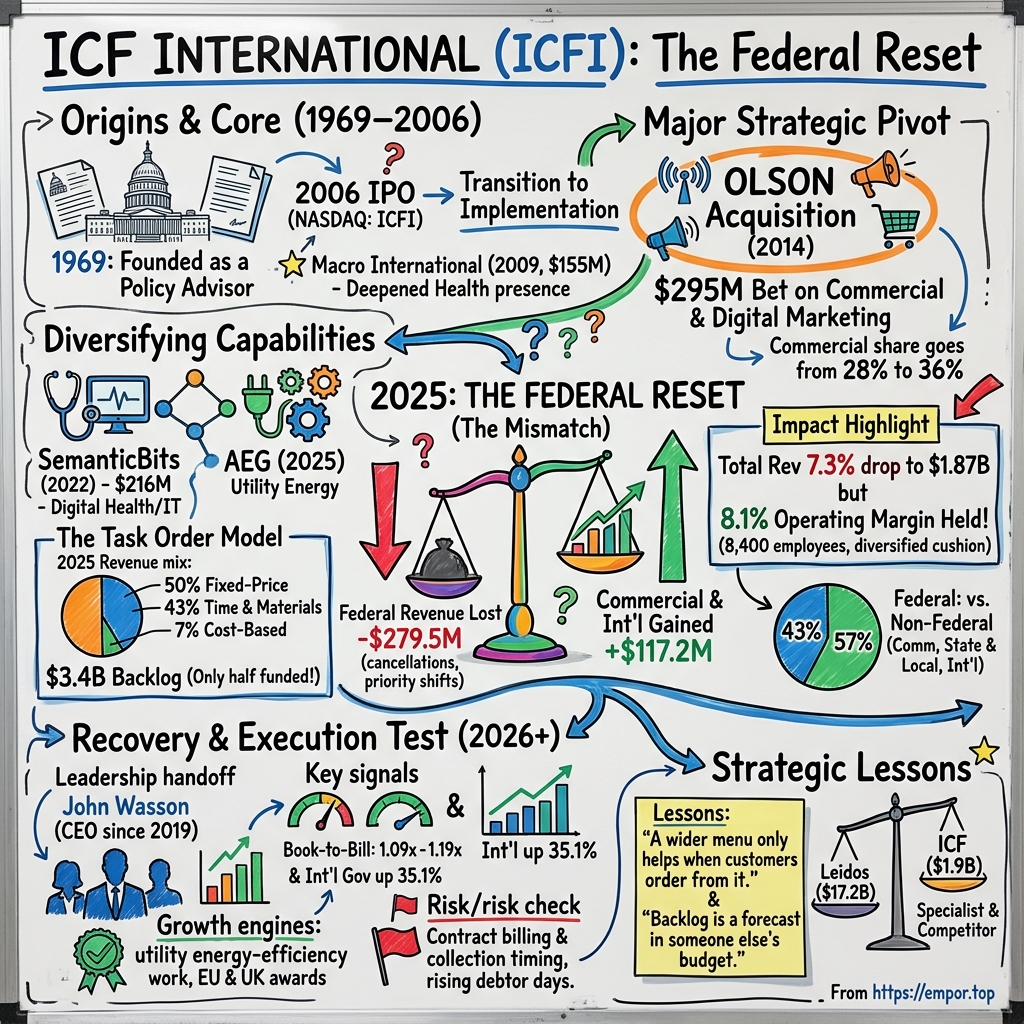
Picture two ICF teams working through the same week in 2025. One is helping a utility run an energy-efficiency program: inspectors visiting homes, rebates moving to customers, engineers measuring how many kilowatt-hours each upgrade saved. The other works on a federal health program and has just been told to stop. The program was not a failure, and nobody has complained about the work. It was ended because priorities in Washington had changed. Across ICF that year the two kinds of week added up, and the totals tell the story. Revenue from U.S. federal agencies fell by $279.5 million. Revenue from commercial clients, mostly utilities and other energy customers, rose by $117.2 million.1
The first number is more than twice the second, and that gap is the subject of this story. ICF finished 2025 with revenue of about $1.87 billion, down 7.3% from the year before.[^2] It was the company's first revenue decline in more than a decade, and a steep one for a business that had grown almost every year since the global financial crisis. The cause was not hidden. ICF's own explanation was terminated contracts, shifting administration priorities and procurement disruption across the federal market.1 Federal agencies had long been its largest group of customers. By the end of the year they provided about 43% of revenue. Commercial clients, state and local governments and international governments together provided the other 57%.[^2]
ICF is easy to underestimate because it is hard to picture. It has no product on a shelf and no app on anyone's phone. It is a $1.9 billion professional-services company with one reported segment and about 8,400 employees.1 Its work runs from public-health communications to disaster-recovery grant management, from modernizing federal IT systems to designing utility rebate programs. That breadth was supposed to protect it, and in one sense it did: no single contract provided more than 2% of revenue in 2025.1 No single mistake or lost bid could sink the company. A change of policy that ran through most of the federal government was a different kind of risk, and diversification by contract did nothing to stop it.
There is a common way to tell this story, and it is too simple. In that version, ICF was a federal contractor caught in a political storm, a victim of the push to cut government spending, and the storm will pass. The record supports part of it. The federal decline was driven by policy, not by ICF losing competitions to rivals. But it also shows that the company had spent more than a decade trying to reduce exactly this exposure, and that after all the acquisitions and all the commercial growth, the federal government was still the single largest force in its results. The shock was external. The vulnerability was built in.
So the questions are simple to ask and hard to answer. Can commercial and international work replace federal demand, or has diversification only made the decline less visible? Does ICF's backlog of awarded work predict a recovery, or is it a list of options that customers may never exercise? Can the company protect its margins while revenue is weak? Have its acquisitions earned what was paid for them? And when the market prices the stock at a lower earnings multiple than usual, is it seeing a temporary reset or a slower company?
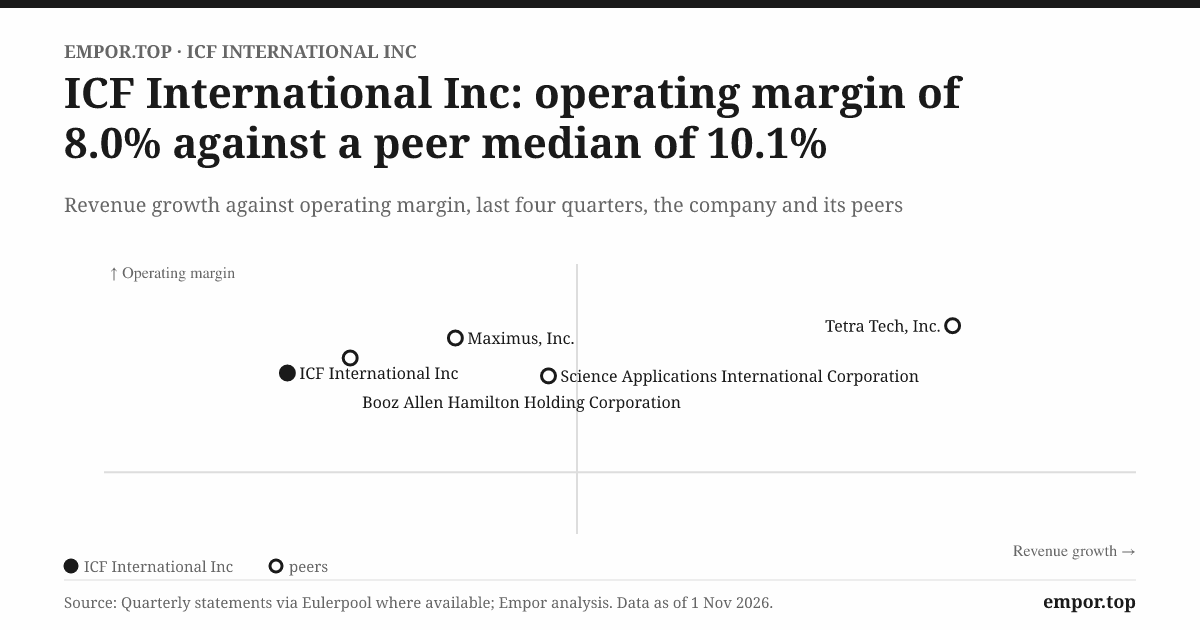
One number from 2025 makes these questions worth asking. Revenue fell by more than $140 million, yet ICF's operating margin was 8.1%, almost exactly the 8.2% it earned in its record year of 2024.[^2] Most companies that lose that much revenue see margins fall, because the costs of the people and offices that did the old work remain. ICF did not. What kind of business can lose that much work and keep its margin? To answer that, the story has to go back to a small Washington policy shop and the long, deliberate process by which it learned to deliver as well as advise.
 Subscribe on LinkedIn
II. A Policy Consultancy Learns to Deliver
ICF began in 1969 as a firm that thought about problems for the government. Its early customers wanted analysis: how an environmental rule would affect industry, how an energy policy might change prices, how a social program could be designed.2 It was the kind of business in which the deliverable is a report and the asset is the people who can write it. For three decades that was mostly what ICF remained, a respected adviser in a crowded field of Washington consultancies, passing through different owners along the way.
The turning point in ownership came in 1999. A management team led by Sudhakar Kesavan bought the consulting business, with backing from the private-equity firm CM Equity Partners, from the engineering group that then owned it.2 Kesavan, an engineer by training who had spent his career at ICF, ran it as chief executive for the next twenty years. His insight was not original but it was well timed. Federal agencies were increasingly buying more than advice. They wanted someone to carry a policy from the page into operation: run the program, build the system, staff the call center, measure the results and explain the program to the public. Implementation was a larger market than advice, and a steadier one, because programs run for years while studies end when they are delivered.
The 2006 initial public offering on Nasdaq gave that ambition a currency.3 It is tempting to read the listing as a change of identity, but it was not. The company's ultimate payers were still mostly government agencies. What changed was that ICF now had public stock and access to debt to buy the capabilities it lacked, and Kesavan used them.
The pattern of acquisitions over the next decade explains the company that exists today. Each purchase brought a skill the company could then sell to its existing clients. Before the IPO, ICF had acquired public-sector and environmental consulting teams that had been part of Arthur D. Little, the storied Cambridge consultancy, along with Caliber Associates, a specialist in social and human-services programs.2 After the IPO came firms in health, technology, energy and international consulting. Every deal answered the same question: what else could ICF do for a client that already trusted it?
The most important of those early deals came in 2009. ICF agreed to buy Macro International, a research and program-evaluation firm with deep roots in federal health work, for $155 million in cash.[^5] Macro brought roughly $150 million of annual revenue and about $452 million of backlog.[^5] At roughly one times revenue, the price was not aggressive. What ICF got was scale with the Department of Health and Human Services and its agencies: surveys, evaluations, communications campaigns and technical assistance for programs that touched millions of Americans. Macro helped make HHS ICF's largest customer, a position it still held in 2025.1
It is worth pausing on why a buyer of capabilities, rather than a builder of them, made sense in this market. A federal agency choosing a contractor wants proof that the firm has done the same work before, for a similar agency, at a similar scale. That requirement makes it slow and expensive for a consultancy to grow into a new field organically, because it cannot win the first contract without past performance and cannot earn past performance without the first contract. Buying a firm that already has the record shortcuts the problem. The acquired firm brings its contracts, its people and its references, and ICF can then offer those capabilities to clients in other parts of its business. That is the cross-selling logic Kesavan's ICF repeated for more than a decade, and it explains why acquisitions were not an occasional event in this company's history but part of its operating model.
The model has a cost that rarely appears in announcements. Every acquisition adds goodwill and intangible assets to the balance sheet, which means the company's returns must be judged on a larger base of invested capital. It also adds integration work: systems to merge, cultures to blend and key people to retain, in a business where the key people are the assets. And it creates a habit. A company that has grown by buying capabilities will be tempted to keep buying when organic growth slows, which is exactly the moment when the discipline to say no matters most.
By 2014 the transformation showed up in the size of the business. Revenue reached about $1.1 billion that year.[^6] ICF was no longer a boutique. It was a mid-sized contractor whose people advised, implemented, measured and communicated, often all within the same program.
Every capability that brought ICF closer to delivery also brought it closer to the budget line. An adviser's study can be postponed with little cost to the adviser. A company running a multi-year program has hired the staff, signed the subcontractors and built the systems, so a canceled program hurts it far more. Each new capability gave ICF more to sell to the same clients. It also tied more of the company's revenue to contract awards, option years and appropriations decided by people outside the company. By the early 2010s the federal share of revenue was large enough that a flat federal market meant a flat ICF, and management began to look for a market where growth did not depend on Congress. It found one in a digital marketing agency in Minneapolis.
III. Olson: The Bet on Commercial Growth
In October 2014 ICF announced a deal that looked odd for a government contractor. It would pay $295 million in cash for Olson, a Minneapolis marketing agency best known for loyalty programs, brand campaigns and customer-engagement technology for consumer companies.[^7] Olson's clients sold things to the public. Its people were creative directors, data analysts and software engineers, not policy experts. On paper it was hard to see what the two firms had in common.
The strategy behind the deal was clear enough. Federal spending growth had slowed after the budget fights of the early 2010s, and ICF wanted a growth engine that did not depend on the appropriations calendar. It had already been moving into digital and communications work through smaller purchases, including the technology consultancy Ironworks, the digital agency CityTech and the communications firm Mostra.[^7] Olson was a much larger step. It turned a collection of digital capabilities into a commercial marketing business of real scale.
The price deserves a careful look, because it is the first of several deals in this story whose logic depends on which multiple is used. Olson had about $126 million of revenue in 2013 and, by ICF's account, an adjusted EBITDA margin of 22.5%.[^7] At $295 million, ICF paid about 2.3 times sales, a high price for a services business when ICF itself traded nearer one times sales. On earnings, the deal looked less expensive: about 10.4 times Olson's announced adjusted EBITDA.[^7] Olson's margin was roughly three times ICF's own operating margin of the time, so the higher sales multiple bought a more profitable stream of revenue. ICF also said Olson was growing at a double-digit rate and forecast that the deal would lift its own margin by more than 70 basis points beginning in 2015.[^7]
So Olson was a substantial, forward-priced bet rather than an obvious bargain. Its value depended on Olson keeping both its growth and its unusual margin inside a much larger government contractor, a combination that many acquisitions of creative firms have failed to sustain.
The deal changed the mix of the business immediately. On a pro forma basis, commercial work would have been about 36% of ICF's revenue in the first half of 2014, compared with 28% as reported.[^7] In a single transaction ICF became noticeably less dependent on Washington, at least on paper.
The early evidence supported the thesis. ICF's 2014 results showed commercial revenue growth and management said Olson's contribution, along with other commercial work, helped operating income grow faster than revenue.[^6] Over the following decade the company's operating margin rose from about 6.6% in 2014 to 8.2% in 2024.[^2][^6] That is consistent with what Olson was meant to do. It is not proof that Olson did it, because over those ten years ICF also changed its contract mix, made other acquisitions, cut overhead and expanded its commercial energy business, which became by far the larger part of its commercial work. ICF does not report Olson's revenue or profit separately, so the deal's long-run return cannot be isolated from the public record.
There is also a quieter piece of disconfirming evidence in ICF's own record. If Olson had transformed the company's economics on its own, the margin uplift would have shown up quickly and stayed. Instead, ICF's operating margin barely moved in the years right after the deal, sitting around 6.6% to 7.0% from 2014 through 2019, and dipped to about 5.9% in 2020 before climbing to its 2024 peak.[^2][^6] The forecast lift of 70 basis points or more did not appear as a clean, lasting step in the consolidated numbers. That does not mean Olson failed. Amortization of acquired intangibles, investments elsewhere in the business and the pandemic year all weigh on the comparison. But it does narrow the claim. Olson was one contributor to a slow margin improvement that took a decade, not the cause of a sudden one.
That limitation matters for the rest of this story. ICF has made many acquisitions, and each was announced with a strategic rationale and a margin argument. An announcement is a forecast. The real question for each deal is whether the bought capability became durable revenue and profit. For Olson, the answer is a qualified yes on diversification: commercial revenue became a much larger part of ICF and gave it a second leg to stand on. On whether the $295 million earned more than its cost of capital, the record cannot answer.
What Olson did not solve became clear in 2025. ICF had broadened its customer base, but the federal business it had grown up with was still the largest single part of the company. A commercial engine can soften a federal downturn only if it is big enough to absorb one. In 2025 it was not, and to see why, it helps to look at what ICF actually sells and how it wins the work.
IV. The Task Order Is the Product
Imagine the moment a federal program award is announced. A multi-year contract, possibly worth hundreds of millions of dollars, appears in the trade press. The winning contractor celebrates and the backlog number rises. Then the reality of government contracting begins. The award usually sets a ceiling, not a commitment. The work arrives in task orders, each of which the agency must define, fund and issue. Option years must be exercised, one at a time. Appropriations must pass. At any point the agency can decline the next option, issue a stop-work order or terminate the contract for convenience. A multi-year program looks secure on paper, but each next step still depends on the customer.
That is the product ICF sells: not a single deliverable but a continuing relationship, renewed in pieces. A typical engagement takes in most of what the company can do. ICF advises on how a program should work, builds or adapts the systems that run it, operates the program with its own staff and subcontractors, measures whether it achieves its goals and communicates with the people it affects. Contract terms typically run from one month to five years including options, and government options are exercised at the client's discretion.1
The economics of that relationship are simple to describe and hard to scale. ICF earns money by selling the time and judgment of skilled people for more than it costs to employ them, and by running programs more efficiently than the client could itself. Revenue rises when it wins more work or bills more hours; margin rises when it keeps its people busy, prices its fixed-price bids well and spreads its overhead across a larger base. There is no factory to fill, but there is a bench: consultants between assignments cost money while earning nothing. That is why the timing of task orders matters so much. A delayed award does not just postpone revenue; it leaves people waiting, and a company that keeps them waiting too long either absorbs the cost or loses the people. In 2025 the federal pause tested that balance across hundreds of programs at once, and the margin's survival suggests ICF moved its people and its costs quickly.
The way ICF is paid determines who bears the risk. In 2025, about half of revenue came from fixed-price contracts, 43% from time-and-materials contracts and 7% from cost-based contracts.1 The difference matters. Under time-and-materials work, the client pays for the hours worked at agreed rates, so if a task takes longer than expected, the client pays for the extra hours. Under fixed-price work, ICF agrees to deliver a defined result for a set price. If it delivers efficiently, it keeps the savings; if it underestimates the effort, it absorbs the overrun. It is the difference between paying a contractor by the hour and agreeing a price for a kitchen. Half of ICF's revenue sits in the kitchen-quote category, which helps explain how margins can hold when revenue falls, since efficient delivery on fixed-price work can protect profit. It is also the main execution risk in the business, as the auditors later make clear.
The people behind those contracts are the real production line. ICF employed about 8,400 people at the end of 2025, 83% of them full-time.1 The company spends relatively little on physical capital: purchases of property, equipment and capitalized software ran at only about 1% of revenue a year from 2023 to 2025.1 That is the profile of a business whose main investment is in people and in the bids that keep them busy. It also explains how the margin survived 2025. When a contract ends, the labor cost tied to that contract can be reassigned or released, so costs fall alongside revenue more quickly than in a business with factories or long leases. The price of that flexibility is human. Staff on canceled federal programs bore the adjustment, and ICF does not publish a comparable year-by-year headcount series that would show how large it was.
The customer base looks diversified until the federal government is counted as one buyer. HHS alone supplied 22% of 2025 revenue, down from 26% in 2023, and no other single client exceeded 5%.1 The ten largest contracts together contributed only about 14% of revenue.1 By contract, ICF is highly diversified. By customer type and policy exposure, it is concentrated: federal agencies as a group still provided 43% of revenue, and the same political decisions can reach many of those agencies at once.[^2] HHS's share fell in 2025 not because ICF chose to diversify away from it but because federal health work was cut. In dollars, ICF's revenue from HHS fell from about $510 million in 2023 to about $416 million in 2025, a loss of nearly a fifth from its largest client in two years.1 Diversification by ratio can be achieved in two ways, by growing everything else or by losing the biggest customer. In 2025 ICF experienced mostly the second.
Backlog is where investors usually look for comfort, and it deserves careful reading. At the end of 2025 ICF reported backlog of about $3.4 billion, down from $3.8 billion a year earlier.1 Only about half, roughly $1.7 billion, was funded, meaning Congress had appropriated the money and the agency had obligated it to the contract.1 The rest is work ICF expects to perform if the client exercises options and funds them. The backlog provides visibility, not a promise. A subscription software company with $3.4 billion of contracted revenue can count on most of it. ICF's unfunded backlog is closer to a list of things the customer may choose to buy.
Where the moat ends
Michael Porter's five forces are a useful test of how much of ICF's position is protected. Buyer power is the dominant force, and it is high. Federal agencies write the requirements, run the competition, award and renew contracts, frequently spread work across several vendors under multi-award vehicles and can terminate or decline options. In 2025 they showed how fully they could use that power. Rivalry is intense and varied. ICF names Abt Associates, Accenture, Booz Allen Hamilton, CACI, Deloitte, Guidehouse, Leidos, Maximus, SAIC and Tetra Tech among its competitors, along with many smaller specialists.1 Several are far larger than ICF and have more resources to invest in bids, technology and acquisitions. Others are focused specialists who can compete hard in a single niche. The threat of substitutes comes from agencies bringing work in-house, from software that automates tasks once done by analysts, and increasingly from AI. Supplier power is moderate: the main supply is skilled labor, which is mobile, and subcontractors, who are plentiful. Barriers to entry exist in the form of past-performance requirements, security clearances and the cost of bidding, but they protect the incumbent group as a whole more than any single firm.
ICF's own description of its advantages lists reputation, past performance, technical expertise, client relationships and breadth of services.1 All of them are real. In federal procurement, past performance is a formal evaluation factor, and a firm that has run a program well has an advantage in the recompete. Breadth allows ICF to bid on work that requires research, technology and communications together, which a single specialist cannot do. But these are qualifications to compete, not a cornered resource. ICF does not disclose its win rate, recompete retention, pricing trends or market share, so the durability of these advantages cannot be measured from outside. The most that can be said is that ICF is a credible, experienced competitor in a fragmented market. It does not own its category, and it has no pricing power against a customer that sets the price.
ICF's scale relative to its rivals also limits what it can absorb. Leidos and Booz Allen each report revenue many times larger than ICF's roughly $1.9 billion, and Maximus, the closest competitor in government program operations, is also considerably larger.1 Size alone does not win contracts in this market, but it pays for the bid teams, technology investments and acquisitions that do.
AI belongs in this picture, both as a tool and as a threat. ICF describes AI as part of its analytics and digital offerings and as a way to make its own staff more productive.1 If AI lets ICF deliver fixed-price work with fewer hours, it helps margins. If it lets clients do with software what they once paid ICF's analysts to do, it shrinks the market. ICF does not disclose any revenue from AI, nor the net effect of AI on its labor needs. Until it does, AI is strategically relevant but not yet a separately proven growth engine.
This is the business John Wasson inherited when he became chief executive, one built on renewable relationships rather than locked-in contracts, and one where execution matters more than any structural protection.
V. A Long-Expected Leadership Handoff
In August 2019 ICF's board announced a succession plan that surprised no one who knew the company. John Wasson would become chief executive in October, and Sudhakar Kesavan, who had run ICF since the 1999 buyout, would move to executive chairman.4 It was a planned handoff in a company that values continuity, and the man who received it embodied that value.
Wasson joined ICF in 1987, before the buyout, before the IPO and before almost every acquisition in this story.4 He spent three decades inside the firm's consulting and delivery work, and later served as chief operating officer and president, running the client-facing operations that delivered the work.4 He is not a turnaround specialist or an outside hire with a new playbook. He is a long-serving operator who knows how a proposal becomes a program, and the strategy he inherited, to broaden capabilities, grow commercial energy work and keep a disciplined federal franchise, was one he had helped build. Two months after taking over, he presented the company's long-term plan to investors at an investor day built around that same continuity.[^9]
The handoff mattered because Kesavan's two decades had defined the company. He had taken a consulting business out of a struggling parent, listed it, and used acquisitions to turn it into a contractor approaching $1.5 billion of annual revenue. Successors to founders and long-tenured builders often face a choice between changing the strategy to make their mark and keeping it to preserve what works. Wasson chose continuity, and with Kesavan still in the chairman's seat, the board signaled that it wanted the same company with a new operator, not a new company.
For five years the continuity worked. Revenue grew from about $1.5 billion in 2019 to about $2.0 billion in 2024, and operating margin rose from 6.9% to 8.2%.[^2]5 The SemanticBits acquisition in 2022 deepened ICF's position in federal health technology, and utility energy programs kept growing. By the end of 2024, ICF was larger, more profitable and more technology-heavy than the company Wasson took over.
Then came 2025, and a different kind of test. On the fourth-quarter 2024 call in February 2025, management guided to 2025 revenue and earnings flat to down 10% from 2024, a range wide enough to absorb a serious federal disruption.5 Within weeks, ICF was publicly walking through which parts of its federal business were exposed to the new administration's push for cuts and which might benefit from priorities such as IT modernization.6 As terminations accumulated, the federal decline proved real. Revenue ultimately fell 7.3%, inside the range management had set.[^2] When the federal government shut down in the fall of 2025, management said it could keep its original guidance framework even if the shutdown lasted through year-end.[^12]
That is worth crediting. Management set a range that anticipated a serious decline, explained the drivers as they emerged and landed within it. But the result also shows the limit of management's control. The 2025 revenue drop was not a margin-management problem or an execution miss. Federal customers bought less. Good management could protect margins and choose where to invest; it could not make HHS renew programs that the administration had decided to end.
What the calls revealed
The three earnings calls that followed show how the story evolved and where it remained vague. On the fourth-quarter 2025 call, management presented 2026 as a year of stabilization and recovery: federal revenue would bottom, while commercial energy and international work kept growing.[^12] The plan was clear, and its milestones could be checked against the next few quarters.
The first quarter of 2026 was harder to read. Revenue fell 10.3% from a year earlier to about $437.5 million, and management attributed part of the shortfall to timing shifts in commercial energy and international projects that it expected to recognize later in the year.[^13] The federal news was better. Federal revenue rose 8.6% from the fourth quarter, and Wasson said the federal business had stabilized and was "on the upswing."[^13] Management also said that commercial, state and local and international work were on track to exceed 60% of full-year 2026 revenue, and argued that earnings could grow faster than revenue through mix and efficiencies.[^13] Analysts pressed on timing: how much of the commercial and international shortfall was truly deferred, and how much of the federal improvement was new work rather than a lower base.
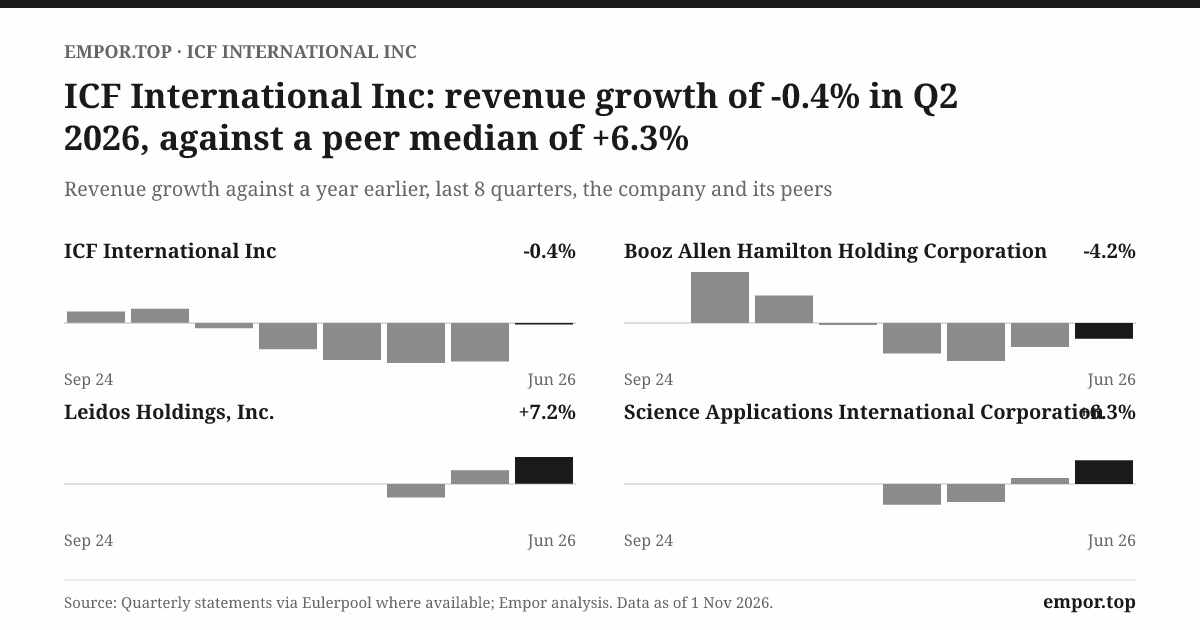
The second quarter offered a partial answer. Revenue recovered to $474.5 million, almost level with the year before and 8.5% higher than the first quarter.[^14] That supports the claim that some of the first-quarter weakness was timing. But federal revenue was still 9.5% lower than a year earlier, and the operating margin of 8.4% was unchanged from the prior-year quarter, not improved.[^14] On the call, Wasson pointed to a return to positive year-over-year comparisons beginning in the third quarter and said ICF had won more than $200 million of contracts since the quarter ended.[^15] Analysts' questions focused on the pace of federal awards, the conversion of pipeline into funded work and the role of receivables sales in cash flow. The answers were most concrete when they cited signed awards and backlog coverage, and least concrete when they spoke of AI efficiencies, which management described in general terms without quantifying savings.
The evidence so far is that management's guidance has been realistic and its explanations consistent. What has not yet been shown is the recovery itself. The third-quarter comparison Wasson pointed to is the first test where the company has named its own milestone.
Leadership continuity will also be tested below the top. Anne Choate, a long-time ICF executive, became president on January 1, 2026.7 James Morgan became chief operating and financial officer on March 1, 2026, the day Barry Broadus retired as CFO.7 Neither move suggests a break in strategy. Both put new people in the roles that turn awards into profitable, collected work, which is precisely what the next year requires.
Pay tells a similar, mixed story. Wasson's total compensation was $6.86 million in 2025, slightly lower than the $7.17 million of 2024, and was made up of salary, stock awards and non-equity incentives.7 After reviewing 2025 results, the compensation committee cut each named executive's earned short-term incentive by 5%, and executives took a temporary 20% salary cut during the shutdown.7 About 98% of votes cast supported the 2025 say-on-pay proposal.7 Directors and executive officers as a group owned about 1.71% of the shares in April 2026.7 The pay cuts are evidence of a response to a bad year and of shared pain. They are not proof of long-term alignment, which depends on whether equity-based pay is tied to the recovery shareholders are waiting for. That recovery is the real test of Wasson's tenure, and it begins with the numbers behind the federal reset.
VI. The Federal Reset Meets Its First Recovery Test
ICF entered 2026 in an odd position. Its federal pipeline had been reshaped by a year of cancellations. Programs that had run for years were gone, and new federal procurement moved slowly as agencies reorganized. At the same time, utilities were spending more on energy-efficiency and electrification programs, and European governments were awarding ICF new work. The company was being squeezed from one direction and pulled from another. The question for 2026 was which force would prevail.
Start with the scale of the shock. Federal revenue fell $279.5 million in 2025, which ICF attributed mainly to terminated contracts, shifting administration priorities and procurement disruption.1 Commercial revenue rose $117.2 million, international government revenue $8.5 million and state and local revenue $6.9 million.1 Add up the offsets and they cover about half the federal loss. Diversification cushioned the blow, but it did not absorb it.
Where the federal decline hit tells as much as its size. Health and social programs, ICF's largest market and the one built partly on the Macro acquisition, fell by $144.4 million, or 18.9%.1 That is about half of the entire federal decline. HHS remained ICF's largest client even after the cuts.1 So the federal exposure is concentrated twice: by customer type, because federal agencies are a single policy environment, and by mission area, because health and social programs were the most heavily targeted. A company whose largest client is HHS and whose largest market is health was always going to be among the most exposed contractors when federal health spending was cut.
The recovery has to be read quarter by quarter, because the annual numbers mix the decline and the rebound. In the first quarter of 2026, federal revenue was about $182 million, up 8.6% from the fourth quarter of 2025 but still 23.7% below a year earlier.[^13] Federal work made up 41.7% of revenue, down from 49% a year earlier.[^13] In the second quarter, federal revenue rose again to about $185 million, but was still 9.5% below the second quarter of 2025.[^14] The direction is encouraging: the year-over-year decline is narrowing quickly, because the comparison is now against quarters that had already been hit. But a narrowing decline is not growth. It suggests the federal business has found a floor, not that it has begun to rebuild.
The replacement engines are real, and it helps to be precise about their size. In the second quarter, commercial revenue grew 5.9% from a year earlier, led by utility energy programs.[^14] International government revenue grew 35.1%, helped by awards from the European Union and the United Kingdom.[^14] Commercial, state and local and international clients together produced about 61% of revenue in the quarter, up from 57% in 2025.[^14] That is a meaningful shift in mix. But international government work was only 8.3% of second-quarter revenue.[^14] Growth of 35% on a base of 8% adds about two to three percentage points to company growth. It cannot by itself replace a federal business that is still five times larger. The heavy lifting has to come from commercial energy, which grew far more slowly than international work in the quarter.
Commercial energy is the more interesting engine. Utilities run energy-efficiency programs, often required and funded through rates approved by state regulators, and they hire firms like ICF to design and administer them. Demand has been driven by state efficiency mandates, electrification and the strain that data centers and new load are placing on grids, which makes reducing or shifting demand valuable. That demand has drivers different from the federal budget, which is exactly the diversification ICF wants. It also has its own risks. Utility programs depend on state regulators and rate cases, they come with restricted cash ICF holds on clients' behalf, and the first quarter of 2026 showed that commercial energy revenue can slip between quarters as program timing changes.[^13]
The backlog and awards data are the leading indicators, and they deserve to be read skeptically. Over the twelve months to June 2026, ICF won about $2.0 billion of contract awards, a book-to-bill of 1.09, meaning it booked more new work than it recognized as revenue.[^14] That is encouraging. But the second-quarter book-to-bill on its own was 0.85, and total backlog was about $3.3 billion, with funded backlog of just over $1.6 billion.[^14] So backlog was still slightly lower than at the end of 2025, and about half of it remained unfunded. The pipeline of opportunities ICF was pursuing rose to about $9.3 billion.[^14] A pipeline is a list of bids, not a result. The figures that would settle the recovery question, how much of new awards is federal and how quickly awards convert into funded work, are not reported by customer type.
Management guidance offers a check against the company's own expectations. ICF reaffirmed 2026 revenue guidance of $1.89 billion to $1.96 billion in August, saying that more than 90% of the revenue needed to reach it was already in backlog.[^14][^15] At the midpoint, that implies growth of about 3% over 2025. Given that the first half of 2026 was below the first half of 2025, the guidance requires a clearly stronger second half, which is consistent with Wasson's promise of positive comparisons from the third quarter. It is a specific, testable claim, and that counts in management's favor.
The arithmetic of replacement is worth working through once, because it shows how demanding the task is. Suppose federal revenue stays roughly flat at its current run rate of about $185 million a quarter, or about $740 million a year. The non-federal businesses, at about 61% of revenue, then produce somewhere near $1.15 billion a year. For ICF to grow 5% a year in total, the pace it averaged over the decade before 2025, the non-federal side alone would need to grow by roughly 8% a year. Commercial revenue grew about 6% in the second quarter, and international government work, though growing far faster, is too small to close the gap alone. So the company's return to its historical growth rate requires one of two things: a sustained acceleration in commercial energy, or a federal business that grows again rather than merely stabilizing. Neither is impossible, but neither is yet visible in the reported numbers.
International growth also brings a new exposure. About 8% of ICF's 2025 revenue came from international operations, and the company estimated that a 10% move in the dollar against all currencies would change revenue by about $15.9 million.1 ICF tries to match costs and revenue in the same currency, so the effect on profit is smaller, and net foreign-exchange losses were only about $2.5 million in 2025.1 As European work becomes a larger part of the growth story, though, currency will matter more to the reported growth rate, flattering it when the dollar weakens and denting it when the dollar strengthens.
So the recovery is uneven. Commercial energy and international government work are meaningful offsets, and the federal decline is narrowing. But the latest quarter does not yet show that the newer engines can replace the lost federal work. Book-to-bill above one over twelve months is encouraging. The stronger test is funded backlog conversion, and that test is still ahead. Only sustained organic growth by customer type will distinguish a temporary federal reset from something more lasting: a smaller federal business inside a slower-growing company. Whether ICF can buy its way to faster growth is the next question, and its acquisition record offers some evidence.
VII. A $220 Million Bet on Digital Health
In June 2022 ICF announced it would acquire SemanticBits, a Virginia company that helped federal health agencies modernize their technology.[^17] SemanticBits was not a household name, but within the world of federal health IT it was well known. It built and ran the kind of systems that let the Centers for Medicare and Medicaid Services handle quality reporting and data exchange, the unglamorous digital plumbing of modern health programs. For ICF, it was a way to move up from advising health agencies and running their programs to building the software those programs run on.
The price was about $220 million in cash, funded by ICF's credit facility.[^17] SemanticBits expected about $135 million of revenue in 2022, so the price was about 1.6 times expected sales.[^17] ICF said the business was growing at a double-digit rate and earned high-teens EBITDA margins, which put the price at roughly nine times expected EBITDA.[^17] Compared with Olson's roughly 10.4 times announced EBITDA eight years earlier, it was a similar valuation for a similar kind of asset: a business with higher margins and faster growth than ICF's core, bought at a price that only made sense if both continued.
What happened after the deal closed is harder to trace. The deal closed in mid-2022, and SemanticBits contributed $64.3 million of revenue to ICF that year, about half a year's worth.8 Beyond its gross profit contribution, ICF said it was impracticable to report a standalone earnings measure for SemanticBits because its operations and systems had been integrated into ICF's.8 That is a common and reasonable accounting position, but it means investors cannot check whether the high-teens margin survived integration.
There is a darker irony in the timing. SemanticBits was bought to deepen ICF's federal health technology business. Three years later, federal health was the market that suffered most from the 2025 cuts. ICF has argued that technology modernization was among the more resilient parts of federal demand, and some evidence supports that: management credited federal IT modernization work for the first-quarter 2026 sequential improvement.[^13] But a capability bought to grow with federal health spending is still exposed to federal health spending. It diversified ICF's services, not its customers.
The test of a deal like this is commercialization, not the capability itself. A federal technology contract or a successful award proves that ICF can win the work. It does not prove the work is recurring, high-margin revenue. ICF has not published evidence of SemanticBits' growth or margins since integration, so the deal remains a reasonable bet that has not been shown to pay off.
The second recent deal was smaller and pointed in the other direction. In January 2025 ICF bought Applied Energy Group, a utility and state energy consulting and technology firm, to extend its commercial energy business.9 It paid $60.7 million in cash for a business with about $30 million of 2024 revenue, roughly two times sales.19 AEG adds load forecasting, program design and analytics to the utility programs ICF already runs. It is a plausible extension of the commercial energy engine, small relative to ICF, and not a second company hidden inside it.
Taken together, ICF's acquisitions have extended its capabilities into areas that turned out to matter: digital marketing, federal health IT and utility energy. The 2023 to 2025 annual reports record no material goodwill impairment, so ICF has not had to admit that any recent purchase was worth much less than it paid.1 That is a bounded record. The absence of a write-off is not proof of returns. ICF's return on invested capital over the last decade has mostly run between about 5% and 8.6%, close to or below a reasonable cost of capital for a services company.1 That does not mean the acquisitions destroyed value, but it makes it hard to argue that they created a lot of it.
The balance sheet shows what the SemanticBits purchase cost beyond its price. Because ICF paid with borrowed money, total debt climbed to about $776 million at the end of 2022, and debt reached about 0.9 times shareholders' equity, the highest level since at least 2014.8 Management then spent three years paying it down. By the end of 2025, borrowings were about $571 million and debt was about 0.56 times equity.1 That deleveraging is evidence of discipline after the deal. It also means that ICF entered the federal downturn with a balance sheet still recovering from its last big acquisition, which is one reason the company did not respond to cheaper valuations across the industry in 2025 by buying more capability at depressed prices.
Capital allocation more broadly has been measured. In 2025, ICF generated about $120 million of free cash flow, repurchased $55.3 million of stock and paid $10.4 million of dividends.1[^2] It had about $94 million of repurchase authorization left at year-end, and the share count fell from about 18.25 million at the end of 2025 to about 17.93 million by June 2026.110 The rest of the cash went to paying down debt. Buying back stock in a year of falling revenue suggests management believed the shares were undervalued, a belief whose wisdom will depend on the recovery.
The forward test for both deals is the same: whether the acquired digital-health and energy capabilities win follow-on work and earn margins that justify their prices, while debt stays manageable. That leads directly to the question the stock market is pricing every day.
VIII. Analysis & Bear vs. Bull Case
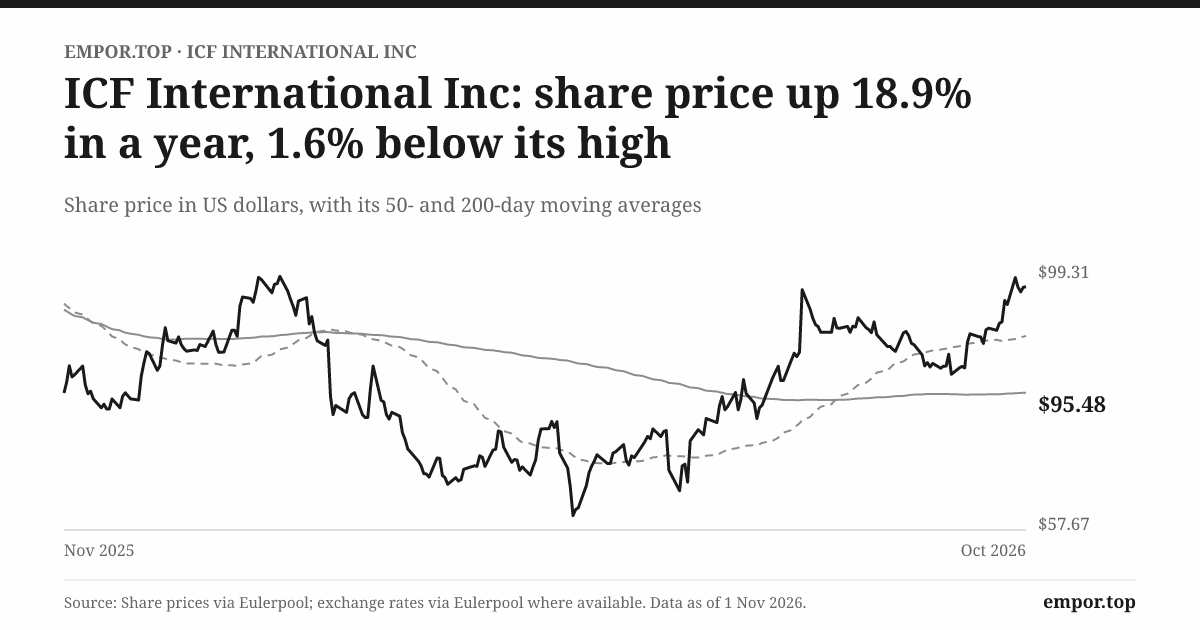
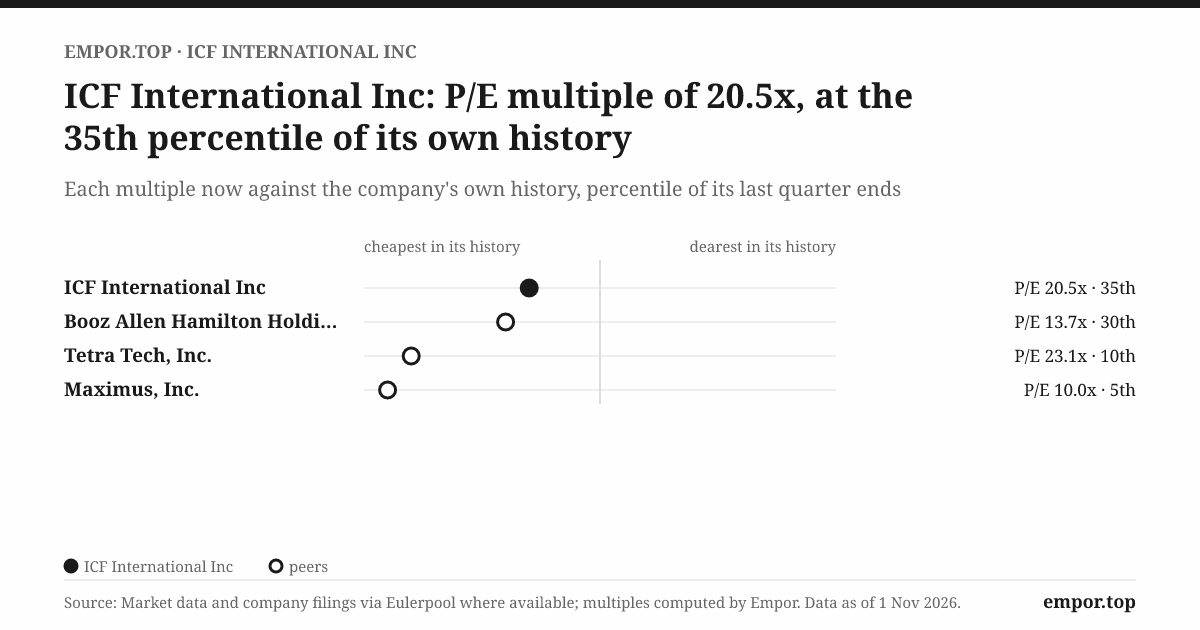
On November 1, 2026, ICF's shares traded at about $95, within 2% of their 52-week high and well above the 52-week low of about $60.[^2] The rebound from the lows of the federal panic was dramatic. Yet even after that rise, the stock traded at about 20.5 times trailing earnings, against a five-year median of 26.6 times.[^2] The market had forgiven some of 2025 but not all of it. Is that discount a reasonable price for a business exposed to contract cycles, or does it understate the recovery?
Start with what the multiples imply. With a market value of about $1.8 billion and enterprise value of about $2.3 billion including debt and leases, ICF traded at about 12.3 times EBITDA and about one times sales.[^2] Its peers offered no single benchmark. CRA International, a smaller economic-consulting firm, traded at about 26 times trailing earnings; Maximus, which runs government programs and depends even more on federal and state contracts, at about 9.5 times; and Booz Allen Hamilton, with its larger federal technology and defense business, at about 12.9 times.111213 ICF sits between them, priced above the pure federal operators but below the consulting firms with less policy exposure. That is roughly where its mix of businesses would put it. The price implies the market believes ICF is less exposed to Washington than Maximus or Booz Allen, but not free of it, and that growth will resume, but not at the pace of the years before 2025.
Seven powers, weighed honestly
Hamilton Helmer's seven powers framework asks whether a company has a durable reason to earn returns above its cost of capital. ICF's case is modest. It has no network effects; one client's use of ICF does not make it more valuable to another. Scale economies are limited, because consulting and program work grows roughly in line with headcount, and ICF is smaller than several rivals. Counter-positioning does not apply; ICF's model can be copied by any rival willing to invest. Switching costs exist in the middle of a program, because replacing a contractor that runs a live system or program is disruptive, but they fall away at recompete time, and 2025 showed that a customer that wants to end a program can simply end it. Brand matters in the form of reputation and past performance, and it does help ICF win bids, but it does not command a premium price from government buyers. ICF has no cornered resource, and the closest it comes to process power is its accumulated knowledge of how to run complex programs, which is real but hard to measure. The honest verdict is that ICF's advantages are mostly those of a competent, experienced, diversified operator. That explains a return on invested capital that has hovered around 7% to 8% rather than well above it.[^2]
The bull case rests on evidence, not hope. ICF held its operating margin at 8.1% in a year when revenue fell more than 7%, which shows a cost structure that can flex: labor-based delivery costs fall when work ends, and fixed-price contracts let ICF capture efficiencies.[^2] Commercial energy and international government work are growing, and they are driven by forces different from the federal budget. Full-year 2025 book-to-bill was 1.19 and the trailing twelve-month figure in June 2026 was 1.09, so ICF has been winning more work than it is burning off.[^2][^14] If federal demand stabilizes, as it appears to be doing, the growing non-federal half of the company could return ICF to mid-single-digit growth with stable or rising margins, and a stock priced at 20 times earnings might look inexpensive in hindsight.
The bear case is also grounded in the record. Federal revenue was still declining year over year in the second quarter of 2026.[^14] Total backlog has fallen from its 2024 level, and half of it is unfunded, subject to options, appropriations and cancellations that make it far less certain than a subscription book.1[^14] The non-federal engines, though growing, are not yet large enough to offset the federal decline. And ICF's revenue growth over the three years to 2025 was only about 1.7% a year, well below its ten-year rate of about 5.2%.[^2] If the federal business has reset permanently lower, the 20.5 times multiple may not be a discount at all, but a fair price for a company whose earnings power has shrunk.
Where earnings meet cash
The quality of earnings is best tested through cash, and here the record is good in the long run and more complicated recently. From 2014 to 2025, ICF's operating cash flow was about 181% of its net profit, mostly because of non-cash charges for amortization of acquired intangibles and stock compensation.[^2] That is a business whose reported profits turn into cash. But operating cash flow fell to about $142 million in 2025 from about $171 million in 2024, which management attributed mainly to contract profitability, the ability to invoice and collect, and vendor-payment timing.1 Two features of ICF's cash flow require particular attention.
The first is restricted cash. ICF holds cash on behalf of utility clients to pay rebates and incentives in energy programs. That cash appears in the company's accounts but is not freely available. In the second quarter of 2026, $43 million of operating cash flow was restricted cash tied to energy-efficiency programs.[^14] Management now guides to operating cash flow excluding restricted cash, about $135 million to $150 million for 2026, which is the right measure to follow.[^15] Headline figures, including the fact sheet's free cash flow yield of about 11%, can be flattered by restricted cash and should be read with that in mind.
The second is receivables. ICF's net receivables were about $238 million at the end of 2025, and contract assets, work performed but not yet billed, were another $187 million.1 Debtor days rose from 76 in 2023 to 86 in 2025, which means ICF is waiting longer to be paid.[^2] Part of that is the federal disruption: agencies under reorganization pay more slowly. In the first half of 2026 ICF sold $243 million of billed receivables to a bank, a common financing tool that turns invoices into cash sooner.10 The program produced a small net operating-cash outflow of about $4.4 million over those six months, so it was not flattering cash flow in that period.10 But a skeptical investor should watch how much cash flow depends on receivables sales, and should compare operating cash flow excluding both restricted cash and receivables-sale timing.
Fixed-price work creates a second, quieter risk. Because half of ICF's revenue is fixed-price, the company must estimate the cost to complete each contract and recognize revenue as the work progresses. If those estimates prove too optimistic, ICF must take charges. The auditor identified the estimation of costs to complete certain contracts as a critical audit matter, the issue requiring the most complex judgment in the audit.1 The auditor gave an unqualified opinion and reported no material weakness.1 But the critical audit matter is a reminder that ICF's margins depend in part on estimates, and that execution on fixed-price work is a direct earnings risk, not just an accounting footnote.
The balance sheet is not a distress story, but it runs lean. Unrestricted cash was only about $5.3 million at the end of 2025.1 Borrowings under the bank facility were about $408 million at June 2026, at a weighted-average interest rate of about 5%.10 The facility's maximum leverage covenant of 4.5 times is far above ICF's actual leverage, and the company reported compliance.1 ICF amended the facility in 2026, replacing the May 2027 maturity it had described at the end of 2025.10 Lean liquidity is normal for a company that can borrow under a revolver, but it leaves little room if collections slow further.
It is also worth noting what is not in the profit numbers. Other income and expense is small and unreliable: a net expense of about $2.6 million in 2025, mostly foreign-exchange losses, after small gains in 2023 and 2024 that included proceeds from divestitures.1 ICF's earnings come from its contracts, not from a treasury portfolio or one-off gains. Ordinary-course legal claims exist, as at any contractor, but management does not expect them to have a material effect, and letters of credit and bank guarantees outstanding at year-end were under $9 million combined.1 There is no hidden overhang of litigation or related-party dealings; ICF has no controlling shareholder, and its largest holders are institutions such as Capital Research, BlackRock, Wasatch Advisors and Dimensional Fund Advisors, each owning between about 5% and 9%.7
Interest rates are a more tangible sensitivity. ICF estimated that a one-percentage-point rise in rates would add about $5.2 million a year to interest expense, partly hedged by $175 million of swaps that convert floating rates to fixed.1 That is manageable against operating profit of about $150 million, but it is one more way that a business with modest margins can see small changes add up.
An activist or skeptical long-short investor would push on three points. They would ask why ICF does not report organic growth by customer type and backlog by customer type, so that investors can tell whether federal awards are actually recovering. They would ask whether the acquisition program has earned its cost of capital, given a return on invested capital that has rarely exceeded 8.5%. And they would ask how much of 2026 cash flow depends on restricted cash and receivables sales. None of these is evidence of wrongdoing. All are reasonable demands for disclosure that would let the market price the recovery more confidently.
Three measures matter more than any other. The first is federal revenue growth year over year, which was minus 9.5% in the second quarter and narrowing. The second is funded backlog and book-to-bill, with funded backlog just over $1.6 billion and trailing book-to-bill at 1.09 in June.[^14] The third is operating cash flow excluding restricted cash, which management guides at $135 million to $150 million for 2026 after $142 million in 2025.[^15] If management cannot show funded awards converting into revenue and cash while non-federal growth offsets federal weakness, the lower multiple may reflect a reset in earning power rather than a temporary discount. The multiple is below history, but that alone does not establish undervaluation.
IX. Business & Investing Lessons
Return to the two numbers that opened this story: $279.5 million of federal revenue lost and $117.2 million of commercial revenue gained in a single year.1 They contain most of what ICF has to teach.
The first lesson is that a wider menu helps only when customers order from it. Olson was supposed to make ICF less dependent on Washington, and in the narrow sense it did: commercial work grew from little more than a quarter of the company to a much larger share. But when federal spending fell, the commercial business could replace only about half the lost revenue. Diversification is measured not by the number of markets a company serves but by whether its other businesses can grow fast enough to absorb a shock in the largest one. For founders, the lesson is that a second business must be sized to the risk it is meant to hedge. For investors, the lesson is to measure diversification in dollars, not in pie-chart slices.
The second lesson is that backlog is a forecast written in someone else's budget. ICF's $3.4 billion backlog at the end of 2025 looked like years of secured revenue.1 Half of it was unfunded, and every part of it depended on a client's continued willingness to exercise options and spend appropriations. In a subscription business, backlog is a contract. In government contracting, it is a probability. Investors who treat the two the same will be surprised whenever the government changes its mind, as it did in 2025.
The third lesson is to buy capabilities, then prove the return. Olson, SemanticBits and AEG each came with a sound strategic rationale, an attractive margin and a growth story. Each disappeared into ICF's single reporting segment, and none can now be evaluated on its own. That is not unique to ICF; it is how most acquisitive services companies report. But it means the burden of proof sits with the acquirer. A company that wants credit for its acquisitions should show their revenue, margins and cash after integration, not only the rationale at announcement.
The fourth lesson is that in contract work, the estimate is part of the product. Half of ICF's revenue is fixed-price, and the auditor singled out the estimate of costs to complete those contracts as the hardest judgment in the audit.1 A firm that prices well and delivers efficiently earns more than its hourly rival. A firm that underestimates the work gives away its margin quietly, one revised estimate at a time. ICF's margin held in 2025, which suggests its estimates held too. That is a strength to keep watching, not one to assume.
The fifth lesson is that a steady margin can hide a moving business. ICF's operating margin barely changed between 2024 and 2025, and a reader of the margin line alone would have concluded that little happened. Underneath, the company lost a fifth of its health and social programs revenue, grew its commercial business by more than $100 million, absorbed an acquisition and cut executive pay during a shutdown. Stability in a ratio is not stability in a business. For investors, the lesson is to read the mix before the margin, because the mix tells you what next year's margin will be made of.
Each lesson points to the same test for management. It must explain changes plainly, distinguish timing from lost work and show investors the conversion of awards into funded backlog, revenue and cash. That test is now under way, and the next few reports will grade it.
X. Epilogue
On the first of November 2026, ICF stands at the midpoint of its recovery test. The federal decline has narrowed. The non-federal half of the business has grown to about 61% of revenue.[^14] The stock has recovered most of its lost ground. And management has made a promise that can be checked: positive year-over-year comparisons starting in the third quarter, and full-year 2026 revenue of $1.89 billion to $1.96 billion.[^15] The third-quarter report, the first to measure that promise, is due within days.
That report and the annual results that follow it in early 2027 will settle much of the story. The first thing to watch is the revenue table by customer type. If commercial energy, state and local and international work have grown enough to offset federal weakness for the full year, ICF's diversification will have proved itself, belatedly but convincingly. If federal revenue begins to grow again on top of that, the bull case will look stronger than the market has priced. If the non-federal engines stall, or federal revenue resumes its decline, the reset will begin to look permanent.
The second thing to watch is funded backlog and book-to-bill. Total backlog alone cannot answer the recovery question, because much of it depends on decisions that have not been made. What matters is whether new awards are converting into funded work at a pace that supports growth. A federal book-to-bill above one, if ICF chooses to disclose it, would be the clearest sign that the federal business has turned.
The third is margin and cash. ICF has shown it can hold its margin in a downturn. The question now is whether it can hold margins as the mix shifts toward commercial energy and international work, which carry different pricing and delivery risks. And it must show operating cash flow excluding restricted cash and receivables-sale effects at or above its guidance, because profit that does not become cash cannot fund buybacks, debt reduction or the next acquisition.
It helps to picture the outcomes plainly. In the best case, the third and fourth quarters of 2026 show year-over-year growth, federal awards begin to convert into funded work, commercial energy keeps compounding and the 2027 guidance calls for growth from all customer types. In that world, the company that emerges from the reset is more diversified than the one that entered it, and the drop in the earnings multiple would look like an overreaction. In the middle case, ICF meets its 2026 guidance but only because non-federal growth offsets a federal business that stays flat, so the company grows in the low single digits with stable margins. That is a respectable business, but not the one the five-year median multiple once paid for. In the worse case, a new round of federal cuts, a slip in utility program spending or a costly fixed-price contract pushes the recovery into 2027 or beyond. The evidence available today does not point clearly to any one of these. It points to a business that has stopped falling and has not yet proved that it is rising.
The final test is management's credibility in its next guidance cycle. In February 2027, ICF will set expectations for a year in which the federal comparison is no longer depressed. Investors should compare its assumptions with realized awards, terminations, revenue and cash rather than treating a pipeline as a result. The evidence that matters is not simply a return to positive quarterly growth. It is repeatable non-federal growth alongside stabilizing federal revenue, funded awards and cash conversion. Until all four appear together, the question of whether ICF is recovering or resetting to a lower growth path remains open.
XI. Outro
Go back to those two teams. One is still at work on a utility energy-efficiency program, measuring kilowatt-hours saved in homes across a state that will renew the program if the numbers hold. The other team's federal task order is gone, and some of its members have moved on to different work, or left. Both teams belong to the same company, and both deliver work that a customer can choose to renew.
That is ICF in one image. It is a company built to turn policy into programs, systems and services, and it has learned over fifty-seven years to do more kinds of that work for more kinds of clients. What it has not yet shown is that the work can grow beyond the budgets that built it. Its next chapter depends on whether customers outside Washington can take up enough of the work.
References
-
ICF International, Inc. Form 10-K for fiscal year 2025 — SEC, 2026-02-27 ↩↩↩↩↩↩↩↩↩↩↩↩↩↩↩↩↩↩↩↩↩↩↩↩↩↩↩↩↩↩↩↩↩↩↩↩↩↩↩↩↩↩↩
-
ICF International, Inc. Form 10-K for fiscal year 2006 — SEC, 2007 ↩
-
ICF Approves Plan to Name John Wasson as CEO — ICF, 2019-08-01 ↩↩↩
-
ICF Reports Fourth Quarter and Full Year 2024 Results — ICF, 2025-02-27 ↩↩
-
ICF lays out the risks, opportunities from Trump's push for cuts — Washington Technology, 2025 ↩
-
ICF International, Inc. 2026 Proxy Statement — SEC, 2026-04-22 ↩↩↩↩↩↩↩
-
ICF International, Inc. Form 10-K for fiscal year 2022 — SEC, 2023 ↩↩↩
-
ICF Expands Energy Technology Services with Applied Energy Group Acquisition — ICF, 2025-01 ↩↩
-
ICF International, Inc. Form 10-Q for the quarter ended June 30, 2026 — SEC ↩↩↩↩↩
-
CRA International market data — Stock Analysis, accessed 2026-11-01 ↩
-
Booz Allen Hamilton P/E history — TGMCharts, accessed 2026-11-01 ↩
 LinkedIn
 WhatsApp
 Reddit
 Hacker News
 Email
 Kindle
 RSS Feed
 Spotify
 Apple Podcasts
 Amazon Music
 Audible
 YouTube