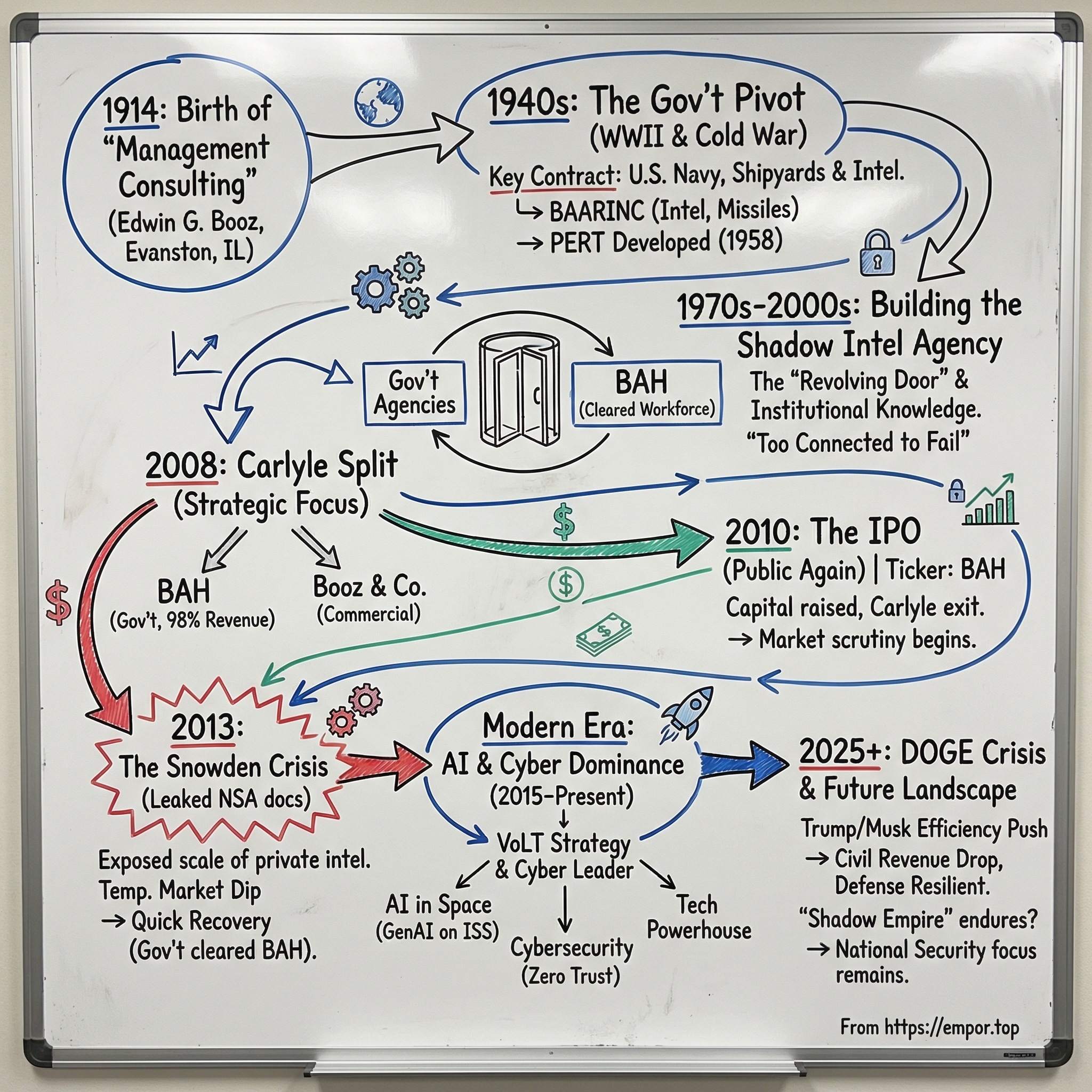
Booz Allen Hamilton: The Shadow Intelligence Empire
I. Introduction & Episode Roadmap
Picture the dimly lit corridors of power in Washington, D.C., where critical national security decisions unfold daily. Somewhere between the Pentagon's war rooms and the NSA's surveillance operations, there exists an organization that has operated in these shadows for over a century—yet few Americans can articulate exactly what it does. The company's McLean, Virginia headquarters sits just miles from Langley, and that proximity is no coincidence.
Booz Allen Hamilton makes about 98% of its revenue from government-related work. Bloomberg once dubbed it "the world's most profitable spy organization"—a provocative label that captures both the firm's mystique and its uncomfortable proximity to the nation's most sensitive operations. How did a management consultancy founded in 1914, in the quiet college town of Evanston, Illinois, evolve into the indispensable backbone of American intelligence and defense?
The firm employs approximately 35,800 people globally as of March 31, 2025, and had revenue of $12.0 billion for the 12 months ended March 31, 2025. These numbers alone make Booz Allen a formidable enterprise. But what makes this story truly extraordinary is the nature of its workforce: thousands hold top-secret security clearances, and the firm sits at the center of nearly every major cyber and intelligence mission the U.S. government conducts.
This is not a story of flashy consumer products or Silicon Valley disruption. It's something far more consequential—the tale of how one firm invented management consulting, pivoted entirely to government work during America's greatest existential threats, survived a whistleblower crisis that would have destroyed lesser organizations, and emerged as perhaps the most critical private partner to U.S. national security. Along the way, Booz Allen has shaped military strategy, pioneered project management techniques still used today, and built what amounts to a parallel intelligence apparatus within the private sector.
The thesis of this deep dive: Booz Allen Hamilton represents a unique corporate organism—part management consultant, part defense contractor, part intelligence agency—that has built durable competitive advantages through security clearances, institutional knowledge, and a revolving door of talent that makes it virtually irreplaceable to the U.S. government. Instead of providing security, the company's heritage since 1940 may actually represent exactly the kind of entrenched bureaucratic bloat that critics aim to eliminate. Yet this same entrenchment has created what analysts call a "too connected to fail" dynamic.
Today's article will trace this remarkable journey across eight inflection points: the birth of an industry, the transformative government pivot during World War II, the construction of a revolving-door talent pipeline, the Carlyle Group split, the IPO, the Snowden crisis, and the firm's modern reinvention as an AI and cyber powerhouse—all while examining the existential threats now posed by the Department of Government Efficiency (DOGE) under the Trump administration.
 Subscribe on LinkedIn
II. The Birth of Management Consulting (1914–1940)
The Founder: Edwin G. Booz
In the early 20th century, the very concept of hiring an outside expert to advise on business matters was revolutionary—almost heretical. American industrialists built their empires through gut instinct and paternalistic control. The idea that a company might benefit from "impartial advice" from someone outside the organization was foreign, even threatening.
Enter Edwin George Booz, a young man whose early life prepared him for unconventional thinking. Born in 1889 as the fifth of seven sons, Booz faced tragedy early when his mother died when he was only four years old. Despite this loss and growing up without wealth, Booz demonstrated academic brilliance. He earned acceptance to Northwestern University in 1908, where he completed degrees in both economics (1912) and psychology (1914)—an unusual dual focus that would prove prescient.
That combination of disciplines—one focused on markets and efficiency, the other on human behavior and organizational dynamics—gave Booz a unique lens for understanding business problems. In 1914, the same year Europe plunged into World War I, the 25-year-old Booz launched what he called the Business Research Service from Evanston, Illinois.
The founding premise was elegantly simple yet radical: companies would be more successful if they could call on someone outside their own organizations for expert, impartial advice. Today this sounds obvious—consultants are everywhere. But in 1914, the notion that a steel magnate or railroad baron might pay an outsider for strategic counsel was genuinely novel. Booz was effectively inventing an industry.
Pioneering a New Industry
The early years were a bootstrapped operation, with Booz personally conducting studies for any client willing to take a chance on this new-fangled "business research." Crucially, the young firm attracted major industrial clients surprisingly quickly. Goodyear Tire & Rubber Co., Montgomery Ward, and the Chicago Tribune all became early believers.
In 1925, recognizing he couldn't scale alone, Booz hired George Fry—another Northwestern alumnus—as his first full-time assistant. That same year, U.S. Gypsum Company became a significant client, cementing the firm's reputation in manufacturing circles. Fry brought operational rigor that complemented Booz's strategic vision.
Then came a linguistic breakthrough that helped define the nascent industry. James Allen, who joined the firm in 1929 as a fresh Northwestern graduate, coined a phrase that would stick: "management consulting." Before Allen, practitioners like Booz awkwardly called themselves "business researchers" or "industrial advisors." The term "management consulting" elevated the work—positioning practitioners as professionals with specialized expertise in the science of managing enterprises, not mere researchers poking around factory floors.
The Partnership Forms
The 1930s transformed the small consultancy into a genuine partnership. In 1929, James L. Allen joined full-time, bringing boundless energy and a gift for client development. But the most consequential hire came in 1935, when Carl Hamilton entered the picture. Hamilton was no fresh graduate—he was a 47-year-old marketing executive from Weyerhauser, the timber giant, with deep experience in corporate strategy.
Hamilton's arrival changed the firm's character. He brought gravitas, industry connections, and a commercial sensibility that complemented Booz's academic orientation and Allen's sales prowess. The partnership reconfigured itself several times to reflect evolving contributions. Initially known as Booz, Fry, Allen & Hamilton after their 1936 partnership agreement, the firm's name shortened to Booz Allen Hamilton before George Fry's departure in 1942—a name that has persisted for over eight decades.
The Code of Ethics
Perhaps Carl Hamilton's most enduring contribution was writing Booz Allen's original code of ethics—among the first of any U.S. company. Its ten principles emphasized independence, integrity, and client confidentiality. These weren't mere marketing—they addressed a genuine market anxiety. Why should a company share sensitive information with outside advisors? What prevented consultants from taking secrets to competitors?
Hamilton's code provided reassurance. By the late 1930s, the firm's marketing brochure explicitly promised "independence that enables us to say plainly from the outside what cannot always be said safely from within." This framing was brilliant—it repositioned potential vulnerability (being an outsider) as a competitive advantage (freedom to speak truth to power).
The early history reveals patterns that persist today: academic rigor combined with commercial pragmatism, a talent for attracting influential clients, and an institutional commitment to positioned confidentiality. These traits would prove essential when war arrived and the firm's most significant client appeared at the door—not a manufacturing company, but the United States government.
III. The Pivot to Government: World War II & the Cold War (1940–1960s)
The Defining Contract
In 1940, with Europe engulfed in flames and American entry into World War II looking increasingly inevitable, the telephone rang at Booz Allen's Chicago headquarters. The caller was Frank Knox, Secretary of the Navy under President Roosevelt and former publisher of the Chicago Daily News. Knox faced an urgent problem: the U.S. Navy needed to double in size—fast—while simultaneously streamlining operations for wartime efficiency.
Knox hired Booz Allen to assess the Navy's preparedness for a major war and to evaluate the Navy's shipyards, telephone systems, and intelligence operations. It was the most consequential contract in the firm's history, and Ed Booz and partner Jim Allen led the engagement personally.
The work was nothing less than helping transform America's naval force from a peacetime establishment into a war-fighting machine. The consultants examined everything from supply chains to communications protocols, bringing their private-sector expertise to military bureaucracy. The results impressed even skeptical admirals.
In 1944, Fortune magazine quoted Secretary Knox saying he had never spent the government's money more effectively—a remarkable endorsement that would be recycled in Booz Allen marketing materials for decades. The Navy engagement established a template: Booz Allen could tackle massive organizational challenges with life-or-death stakes, maintain strict confidentiality, and deliver measurable results.
Internal Tension Over Government Work
Not everyone within the firm celebrated this government pivot. By 1942, a growing percentage of the firm's billings came from government and military assignments—a shift that troubled George Fry, one of the original partners. Fry believed the firm should remain focused on private-sector clients, where margins were better and the work less bureaucratically constrained.
The tension between Fry and Booz over the firm's direction grew irreconcilable. Fry denounced government work as the wrong market for a consulting service. In December 1942, he resigned from the partnership to start his own consultancy, Fry Consultants. The split was amicable but philosophically profound—Fry was betting that private industry would remain consulting's premier market, while Booz saw the government as an equally legitimate (and potentially larger) client.
History would vindicate Booz's vision spectacularly. The firm Fry founded never achieved remotely comparable scale, while Booz Allen evolved into perhaps the most government-dependent large consultancy in existence.
Post-War Expansion and Leadership Transition
By war's end, Booz Allen had grown dramatically—nearly 400 clients served through offices in Chicago, New York, and a new Los Angeles location. The war years had provided not just revenue, but credibility and institutional knowledge about how government agencies functioned (and malfunctioned).
The late 1940s brought leadership transitions. Carl Hamilton died in 1946, and Edwin Booz retired the following year, leaving James Allen as chairperson of the governing board. Edwin Booz himself passed away in 1951, but his legacy was secure: he had created an industry, trained a generation of consultants, and positioned his firm at the intersection of American business and government.
The Intelligence Deep State Forms
The Cold War created unprecedented demand for strategic consulting with national security dimensions. In 1955, a group of key Booz Allen partners formed Booz Allen Applied Research, Inc. (BAARINC) as a separate corporate entity. BAARINC was designed to launch the firm's diversification into the intelligence arena, utilizing studies on missile production as a foundation.
The move proved prescient. BAARINC was soon hired by the federal government to help determine where the Soviet Union was manufacturing missiles—precisely the kind of sensitive, high-stakes intelligence work that required specialized expertise and ironclad security protocols. This engagement marked Booz Allen's entry into the shadowy world of intelligence analysis that would eventually make it "the world's most profitable spy organization."
Intellectual Contributions: PERT and Beyond
Beyond client work, Booz Allen consultants made foundational contributions to management science itself. In 1958, Gordon Pehrson, deputy director of U.S. Navy Special Projects Office, and Bill Pocock of Booz Allen Hamilton developed the Program Evaluation and Review Technique (PERT). This methodology revolutionized how complex projects—especially military programs—were planned and tracked.
PERT introduced probabilistic approaches to project scheduling, enabling managers to identify critical paths and optimize resource allocation. The technique spread far beyond the Navy, becoming standard practice across industries. Every modern project management software package owes a debt to that 1958 Booz Allen innovation.
Much later, in 1982, Booz Allen consultant Keith Oliver coined another term that would reshape global business: "supply chain management." Before Oliver, companies thought in terms of logistics, procurement, and distribution as separate functions. Oliver's framing unified these elements into a single strategic discipline—a conceptual shift that enabled the globalized manufacturing we take for granted today.
One particularly colorful engagement demonstrates the firm's reach into unexpected corners of American life. In 1966, NFL Commissioner Pete Rozelle sought an impartial outsider to help broker the complex merger between the American Football League and the National Football League. Booz Allen provided counsel on antitrust hurdles, mediated disputes, and brought an objective perspective. This work was instrumental in paving the way for the modern NFL and the Super Bowl—proof that the firm's influence extended far beyond traditional consulting.
The postwar decades established Booz Allen as an institution embedded in the American government's most sensitive functions. But this closeness came with consequences: the firm's fate became increasingly tied to federal spending, political cycles, and the volatile world of defense and intelligence procurement. The partnership that emerged from World War II had transformed from a nimble consultancy into something more complex—a hybrid organization that straddled the public and private sectors in ways no other firm could replicate.
IV. The Revolving Door: Building the Shadow Intelligence Agency (1970s–2000s)
Going Public—and Private Again
The 1960s and 1970s brought structural changes that reflected Booz Allen's maturation into a major institution. In 1962, the partnership was dissolved and the company was registered as a private corporation—a legal transformation that enabled more sophisticated capital structures and ownership arrangements.
Then, in January 1970, the firm went public, following the lead of Arthur D. Little, Inc., which had initiated public ownership of large consulting firms a year earlier. The IPO provided liquidity for founding partners and capital for expansion. But public markets imposed new disciplines: quarterly earnings pressure, analyst scrutiny, and shareholder expectations that sometimes conflicted with the long-term relationship-building essential to consulting.
The Revolving Door Phenomenon
What truly distinguished Booz Allen from other consulting firms was its systematic cultivation of relationships with the intelligence and defense communities. This wasn't merely about winning contracts—it was about embedding the firm's DNA into the government itself.
According to Information Week reporting from 2002, Booz Allen had "more than one thousand former intelligence officers on its staff." This staggering concentration of cleared personnel created a self-reinforcing cycle: intelligence veterans joined Booz Allen, bringing institutional knowledge and relationships; they then staffed contracts that required precisely that expertise; and government agencies naturally gravitated toward a firm that already understood their missions and spoke their language.
The most visible manifestations of this revolving door were high-profile executive hires. James Woolsey, who led the CIA from 1993 to 1995, became a Booz Allen senior vice president for global strategic security from 2002 to 2008. Mike McConnell, who served as Director of National Intelligence under President George W. Bush, was a former Booz Allen senior vice president. According to government watchdog OpenSecrets, "4 out of 6 Booz Allen Hamilton lobbyists in 2015-2016 have previously held government jobs."
This pattern drew critics who questioned whether the firm's influence was healthy for democratic governance. Defenders countered that complex national security challenges required experienced personnel, and that former government officials naturally gravitated toward private-sector opportunities where their expertise commanded premium compensation.
"Too Connected to Fail"
The revolving door created something more profound than individual career opportunities—it established institutional dependencies. Booz Allen became so intertwined with critical government functions that extracting the firm became nearly impossible without disrupting operations.
According to CNBC analysis, these contributions resulted in a steady stream of government contracts that put Booz Allen in a privileged position. Due to the company's important government services, "the government is unlikely to let the company go out of business. It's too connected to fail."
This "too connected to fail" dynamic paralleled the "too big to fail" status of major banks—but with arguably more profound implications. Banks handle money; Booz Allen handles secrets. The firm's institutional knowledge of classified programs, its cleared workforce, and its embedded presence across intelligence and defense agencies created switching costs that approached infinity for certain missions.
By the early 2000s, Booz Allen had evolved far beyond traditional consulting. The firm had become a parallel bureaucracy—a private-sector extension of the national security state that operated with the stability of a government agency but the flexibility of a corporation. This unique position would be tested—and ultimately validated—by the most significant crisis in the firm's modern history.
V. Inflection Point #1: The Carlyle Split (2008)
The Strategic Decision
By the mid-2000s, Booz Allen faced an identity crisis. The firm operated two fundamentally different businesses under one roof: a traditional management consulting practice serving global commercial clients, and a government consulting operation focused increasingly on defense, intelligence, and national security technology.
These businesses had divergent characteristics. Commercial consulting prized brand reputation, thought leadership, and the ability to deploy generalist consultants across industries. Government consulting required security clearances, domain expertise, and long-term contract relationships where continuity mattered more than intellectual pyrotechnics.
The conflict constraints were real. Potential commercial clients worried about confidentiality when engaging a firm that also worked for government regulators. Government clients questioned whether consultants' attention was divided between their classified work and more lucrative private-sector engagements.
In 2008, Booz Allen announced a radical solution: the firm would split in two. The U.S. government and global commercial businesses would separate entirely, with the government consulting business retaining the Booz Allen Hamilton name and being sold to The Carlyle Group. The Carlyle Group invested $910 million of equity to acquire Booz Allen Hamilton in a transaction valued at approximately $2.6 billion as part of which the company spun off its commercial consulting business (renamed Booz & Co.).
Dr. Ralph W. Shrader, then leading the firm, framed the split as opportunity rather than retreat: "This separation of our core businesses marks a dynamic new chapter in our history. For 94 years, Booz Allen has adapted and evolved as market realities have changed and our areas of expertise have grown."
The Strategic Rationale
The rationale for the split was to allow each business to focus on its core market without the conflicts and constraints of the other. It was a bet that specialization would create more value than diversification—that a pure-play government contractor could better serve national security clients than a firm distracted by commercial consulting.
For Carlyle, the acquisition represented a classic private equity thesis: acquire a steady cash-flow business with predictable government revenue, improve operational efficiency, and exit through IPO or sale. Government contractors offered something rare in private equity—revenue streams backed by the full faith and credit of the U.S. Treasury.
The Transformation
The post-2008 transformation was profound. Booz Allen Hamilton became squarely focused on government, defense, and national security projects—a strategic shift that shaped its next decade of growth. The firm largely exited the commercial management consulting arena, ceding that market to Booz & Company.
This meant Booz Allen's revenue mix became almost entirely federal—approximately 97-98% U.S. government, a concentration that would later prove both a strength and a vulnerability. In essence, the 2008 separation allowed Booz Allen Hamilton to become more like a government technology contractor (akin to SAIC or Leidos) combined with consulting, rather than a generalist management consultancy.
The Booz & Company Legacy
The commercial arm took the name Booz & Company and continued as a standalone strategy consultancy. In 2013, Booz & Company was acquired by PwC and renamed Strategy&—a rather awkward brand that attempted to signal strategic focus within the Big Four accounting firm.
The acquisition effectively ended Booz Allen's direct connection to commercial management consulting, though many Strategy& partners still traced their intellectual heritage to the original firm. For investors and observers, the split created clarity: Booz Allen Hamilton was now a pure government contractor, its fortunes tied entirely to federal spending and national security priorities.
The Carlyle split represented a bet on government dependence. That bet would be tested almost immediately by economic crisis, tested again by scandal, and ultimately validated by the relentless growth of defense and intelligence spending in the post-9/11 era.
VI. Inflection Point #2: The IPO (2010)
Going Public Again
Just two years after the Carlyle acquisition, Booz Allen prepared to return to public markets. In November 2010, Booz Allen Hamilton Holding Corporation announced that it had priced its initial public offering of 14,000,000 shares of Class A common stock at $17 per share. The shares began trading on the New York Stock Exchange under the ticker symbol "BAH"—a fitting symbol that echoed the firm's name while suggesting the bleating of a sheep to some wags who questioned whether investors understood what they were buying.
Since November 18, 2010, BAH's market cap has increased from $2.69B to $11.28B, an increase of 319.15%. That is a compound annual growth rate of 10.07%.
The IPO raised $238 million for the company, providing capital for growth initiatives and partial liquidity for Carlyle. After the initial public offering, the Carlyle Group still owned 71 percent of Booz Allen—this was a partial exit, not a full monetization.
Market Reception
The market reception was enthusiastic. Government consulting giant Booz Allen Hamilton made a promising debut on the New York Stock Exchange as its shares closed 13.2 percent above their initial-public-offering price. The McLean firm's newly issued stock traded at least 10 percent above its initial per-share price of $17 and closed at $19.25.
Industry observers were bullish. One analyst noted: "Booz has a phenomenal reputation in the market for having very talented people, and anytime you have outstanding talent, there's going to be great demand for your capabilities."
Carlyle's Exit
Carlyle gradually reduced its stake over subsequent years, capturing significant returns as Booz Allen's stock appreciated. At the time of Carlyle's final exit in December 2016, the company's enterprise value was approximately $7.0 billion—a nearly threefold increase from the 2008 acquisition price.
The IPO established Booz Allen as a publicly traded government contractor with transparent financials and analyst coverage. This visibility would prove both blessing and curse: investors could now track the firm's performance with precision, but so could critics who questioned the scale of government spending on consultants.
VII. Inflection Point #3: The Snowden Crisis (2013)
The Bombshell
On June 5, 2013, The Guardian and The Washington Post published explosive stories based on classified documents leaked by a 29-year-old systems administrator named Edward Snowden. The revelations exposed the scope of NSA surveillance programs, including PRISM, which enabled the agency to collect data from major technology companies. The alleged leaks rank among the most significant breaches in the history of the NSA.
The bombshell that followed the initial reporting was almost as significant for corporate America: Snowden had been employed by Booz Allen Hamilton, contracted to projects of the National Security Agency. Suddenly, the obscure government contractor became front-page news worldwide.
Adding to the embarrassment, Snowden later acknowledged that he had worked for two months at Booz Allen Hamilton with the explicit purpose of gathering more NSA documents. Snowden said he took a pay cut to work at consulting firm Booz Allen Hamilton, where he sought employment in order to gather data and then release details of the NSA's worldwide surveillance activity. The firm hadn't been merely victimized by a rogue employee—it had been targeted and infiltrated.
Booz Allen's Response
The company moved quickly to distance itself from Snowden. Booz Allen condemned Snowden's leak as "shocking" and "a grave violation of the code of conduct and core values of our firm." The company fired Snowden in absentia shortly after the revelations and emphasized that he had been an employee for less than three months.
Booz Allen Hamilton terminated Snowden's employment on June 10, 2013, citing violations of the firm's code of ethics. The company issued a public statement expressing shock at the events and confirmed Snowden's brief tenure and his annual salary rate of $122,000—a detail meant to underscore that he was a relatively junior contractor, not a senior executive with broad access.
The Scale of the Security State
The Snowden affair inadvertently shone a light on the scale of private-sector involvement in intelligence operations. When Edward Snowden blew the whistle on the extent of U.S. global electronic surveillance, he unexpectedly illuminated the world of contractors that consume some 70 percent of the $52 billion U.S. intelligence budget.
Booz Allen's own disclosures revealed stunning statistics about its cleared workforce. The 2012 annual report noted the company had approximately 25,000 employees, 76 percent of whom had U.S. government security clearance and 49 percent of whom had clearances at the level of "top secret or higher." That meant approximately 12,250 employees at Booz Allen alone with "top secret" clearance—a remarkable concentration of cleared personnel in private hands.
Today, the company has over 8,000 cyber professionals delivering on nearly 300 active cyber projects. According to its website, the firm employs more than 10,000 personnel who have cleared TS/SCI background checks.
Market Impact & Recovery
The initial market reaction was sharp but temporary. Booz Allen's stock dropped as investors worried about contract terminations and reputational damage. Market analysts considered the incident "embarrassing" but unlikely to cause enduring commercial damage.
Their assessment proved correct. On July 10, 2013, the United States Air Force stated that it cleared Booz Allen of wrongdoing regarding the Snowden case. The investigation concluded that Booz Allen's security procedures had been adequate—Snowden had exploited system administrator privileges that any organization would have granted to someone in his role.
The Snowden crisis tested whether Booz Allen was truly "too connected to fail." The answer was unambiguous: government agencies couldn't replace Booz Allen's institutional knowledge and cleared workforce even if they wanted to. The firm's stock recovered, contracts continued, and within a few years, the episode was largely forgotten by investors if not by privacy advocates.
For long-term investors, the Snowden episode provided a perverse validation of Booz Allen's competitive position. If a global scandal involving the most sensitive national security programs couldn't dislodge the firm from its privileged position, what could?
VIII. The Modern Era: AI & Cyber Dominance (2015–Present)
Transformation into a Tech Powerhouse
Horacio Rozanski became CEO on January 1, 2015, inheriting a firm that had survived the Snowden crisis and benefited from the relentless growth of post-9/11 security spending. Born in Argentina in 1968, Rozanski had joined Booz Allen as an intern in 1991 and risen through roles including chief personnel officer, chief strategy and talent officer, and president. His entire career had been spent at the firm—a continuity that provided institutional memory but also raised questions about whether an outsider's perspective might be valuable.
Beginning in 2012, he led "Vision 2020," an effort that defined the company's growth strategy for the next decade. Vision 2020 brought technology to the forefront of Booz Allen's operations and expanded its footprint into five main areas: engineering, systems delivery, strategic innovation, commercial and international business, and cyber.
The post-split era became one of significant growth—the company roughly tripled its revenue since 2010—driven by public sector demand for technology and consulting services. For the full fiscal year 2025, revenue grew by 12.4% to $12.0 billion, with adjusted net income rising by 13.4% to $815 million and adjusted EBITDA increasing by 11.9% to $1,315 million.
Cybersecurity Leadership
In Deltek's comprehensive Federal Cybersecurity Market, 2024-2028 report, Booz Allen led in cyber-related prime contract obligations from the federal government in fiscal years 2021 to 2023. This recognition positioned Booz Allen as the leading provider of cybersecurity to the federal government.
The company has over 8,000 cyber professionals delivering on nearly 300 active cyber projects. In fiscal year 2025, Booz Allen expects its total cyber revenue to reach between $2.5 and $2.8 billion, representing nearly a quarter of the company's total projected FY25 revenue.
The cybersecurity opportunity reflects the firm's positioning at the intersection of multiple trends: escalating nation-state cyber threats, aging government IT infrastructure requiring modernization, and the federal government's push toward zero-trust security architectures. Booz Allen is well positioned for growth given the company's leadership in implementing zero trust at scale for the U.S. government and as the number one provider of AI solutions to the federal government.
AI Dominance
The company's AI positioning represents perhaps its most significant strategic bet. Booz Allen is recognized as the largest artificial intelligence supplier to the U.S. government—a remarkable distinction given the explosion of AI interest across federal agencies.
BAH reported some $600 million in AI-related revenue in 2024 (about 6% of total company revenue), with expectations for an increase to $1 billion in the next couple of years. CEO Rozanski has predicted that AI revenue will reach $1 billion within two years as "almost every agency is looking to harness the power of AI."
The firm's AI capabilities span the full spectrum from research to deployment. In August 2024, Booz Allen announced the successful deployment and operation of a generative AI large language model (LLM) in space using Hewlett Packard Enterprise's Spaceborne Computer-2 onboard the International Space Station (ISS) National Lab. This LLM is believed to be the first one deployed in space and one day aims to help enable astronauts to use generative AI without depending on Earth-bound internet.
Booz Allen has sent generative AI (GenAI) into space—again. In partnership with Meta, they put Space Llama, a custom-tailored AI language model that works without internet access, on the International Space Station National Laboratory. Space Llama is believed to be the first instance of multimodal AI in space. These space deployments serve dual purposes: demonstrating technical capabilities while developing AI systems that can function in "disconnected environments" relevant to military operations.
The VoLT Strategy
Aligned with its VoLT strategy (Velocity, Leadership, Technology), Booz Allen's cyber business is positioned at the nexus of technology innovation and missions of national importance. The company pursues a "One Battlespace" approach, reflecting the nature of today's growing cyber threat where adversaries see the cyber domain as a single, expanding attack surface across defense, intelligence, civilian, and commercial infrastructures.
The VoLT framework has driven substantial growth while positioning the firm to capitalize on Pentagon priorities like AI modernization.
Recent Acquisitions and Contracts
Booz Allen Hamilton's most recent acquisition is PAR Government, a Rome-based provider of cloud-based software solutions for government and organizations, founded in 2000, and was completed in June 2024. The acquisition will combine PGSC's edge technologies with Booz Allen's deep mission expertise and digital battlespace solutions to accelerate and transform warfighter technology on the front lines.
Recent contract wins demonstrate the firm's positioning across critical national security domains. Booz Allen was awarded a five-year, single-award task order with a $1.58 billion ceiling to provide intelligence analysis related to countering weapons of mass destruction (CWMD). Under the WAEDS task order, awarded in September 2024, Booz Allen will apply advanced technology and tradecraft to transform CWMD missions globally.
In September 2025, Booz Allen Hamilton was awarded a five-year, $1.2 billion ceiling value contract to support the Shadow Raptor program. The firm also secured a five-year, $531 million Ground Systems Engineering and Integration Support task order supporting Space Systems Command.
In July 2025, Booz Allen announced it is tripling its venture capital commitment from $100 million to $300 million, signaling confidence in its ability to identify and nurture emerging technologies relevant to government missions.
IX. The DOGE Crisis and Current Landscape
The Trump Administration's Efficiency Push
The ascension of Elon Musk to lead the Department of Government Efficiency (DOGE) in early 2025 sent tremors through Washington's contractor ecosystem. Armed with his Twitter-tested corporate chainsaw and Trump's mandate to slash $65 billion in consulting contracts, Musk focused on the cozy relationship between federal agencies and their longtime advisors.
Booz Allen Hamilton, which extracts an astounding 98% of its $11 billion in annual revenue from taxpayer coffers, found itself squarely in Musk's crosshairs. The company that turned government dependence into an art form watched its stock drop more than 30% since election day.
Perhaps no other consultancy stands to lose as much as tech and digital transformation firm Booz Allen Hamilton. The firm relies on the US government for 98% of its contracts, which range from national park web services to defense industry cybersecurity tools.
Impact on Operations
While the effects of the Trump administration's contract-cutting measures have not yet been reflected in the company's bottom line, Booz Allen announced in May that it would be reducing its workforce by approximately 7%, or 2,500 jobs.
That reduction in headcount will be centered on Booz Allen divisions working with civil federal agencies—an area that accounts for about 35 percent of the company's annual revenues. During an earnings call, CEO Horacio Rozanski acknowledged the layoffs were an adjustment to business lost or endangered by DOGE slashing: "We are seeing agency reorganizations, reductions in government personnel and spending levels, as well as contract reviews."
BAH's executives indicated that several of its largest civilian IT engagements have been reviewed by DOGE, and the company does not anticipate any cancellations, drawdowns or disruptions to project delivery. However, BAH also noted that five ongoing, large-scale IT programs in the civilian sector have been scaled back due to DOGE's actions.
Strategic Response
Rozanski has attempted to reframe the DOGE challenge as an opportunity. Rozanski is trying to turn the environment of government cost-cutting into an advantage for the company. He thinks Booz Allen can teach the government a thing or two about how to trim budgets efficiently and how to operate with fewer people.
CEO Horacio Rozanski said in a recent interview that the firm functions more as a tech company than a consultancy, perhaps in an effort to distance the firm from the "management consultant" label that DOGE has targeted.
Many consultancies like Booz Allen are pivoting from providing services to civil federal agencies whose budgets and staffs are being slashed, and seeking more work for defense and intelligence agencies, which are likely to get more funding under the Trump administration's plans.
Financial Resilience
Despite the headlines, Booz Allen's financial performance has shown surprising resilience. Booz Allen Hamilton reported less than a 1% decrease in revenue this quarter compared to the same period last year. The Virginia-based consulting firm reported $2.92 billion in revenue for the quarter ending June 30, marking only a slight dip from $2.94 billion in the same quarter of 2024. The company's revenues appear to be essentially unaffected, at least for the time being.
The company's backlog reached $38 billion, an 11% year-over-year increase and a Q1 record, providing substantial visibility for future revenue.
However, the guidance for fiscal 2026 reflects caution. Booz Allen Hamilton enacted a sweeping revision to its fiscal year 2026 outlook, signaling that the ongoing U.S. government funding slowdown is more severe and structural than management previously communicated. The company cut its full-year revenue guidance midpoint by approximately $850 million, shifting expectations from potential growth to a projected decline of 4% to 6% year-over-year.
X. Competitive Positioning and Investment Considerations
The Competitive Landscape
Booz Allen Hamilton's top 3 competitors are SAIC, CACI, and Leidos. SAIC is the most similar to Booz Allen Hamilton.
Leidos reported revenues of approximately $16 billion in 2024, demonstrating its significant presence in the market. SAIC's 2024 revenue was around $7.7 billion, reflecting its strong position in government IT services. CACI's 2024 revenue was approximately $7.2 billion, indicating its focus on technology-driven solutions.
Booz Allen occupies a distinctive position within this competitive set. Booz Allen Hamilton is a significant competitor in government consulting and technology services, especially in digital modernization, cybersecurity, and data analytics.
Porter's Five Forces Analysis
Threat of New Entrants: LOW The security clearance requirements, established relationships, and institutional knowledge create formidable barriers to entry. New competitors cannot simply hire cleared personnel—the clearance process takes years and requires existing contracts to justify the expense. Booz Allen's century-long history and embedded position in classified programs would take decades to replicate.
Bargaining Power of Suppliers: LOW Booz Allen's primary input is human capital—cleared professionals with specialized expertise. While competition for this talent is intense, the firm's scale, reputation, and compensation packages provide advantages in recruiting. The firm employs 35,800 people, creating substantial talent development infrastructure.
Bargaining Power of Buyers: MODERATE TO HIGH The U.S. government is essentially a monopsony buyer with substantial negotiating leverage and the ability to change procurement rules unilaterally (as DOGE demonstrates). However, switching costs for the government are high given institutional knowledge and clearance requirements, which partially offsets buyer power.
Threat of Substitutes: LOW TO MODERATE For highly classified work, there are limited substitutes—the government cannot easily bring this expertise in-house given civil service constraints. However, for more routine IT work, internal government capacity and smaller contractors represent potential substitutes.
Competitive Rivalry: MODERATE TO HIGH Booz Allen Hamilton's 18.01% revenue growth in Q3 2024 highlights its performance in a competitive environment. Competitors like Leidos and SAIC have substantial revenues, demonstrating their market strength. Competition for major contracts is intense, often involving protests and rebids.
Hamilton Helmer's 7 Powers Framework
Scale Economies: Booz Allen benefits from scale in recruiting, clearance processing, and knowledge management systems. Its size enables investment in infrastructure that smaller competitors cannot match.
Network Effects: Limited direct network effects, though the firm's alumni network and government relationships create indirect benefits.
Counter-Positioning: The DOGE crisis reveals a potential counter-positioning challenge—traditional consulting models may be vulnerable to outcome-based procurement that favors different approaches.
Switching Costs: Very high for classified programs where institutional knowledge is critical. Lower for routine IT services.
Branding: The Booz Allen name carries weight in government circles, signaling quality and reliability. However, this brand is tarnished among some observers who associate the firm with surveillance excesses.
Cornered Resource: Cleared personnel represent a partially cornered resource—the supply is constrained and alternatives are limited. However, competitors also employ cleared personnel, limiting this advantage.
Process Power: Booz Allen's methodology and institutional knowledge represent accumulated process power, particularly in complex defense and intelligence programs.
Bull Case
Defense Spending Tailwinds: Even as DOGE cuts civilian agency spending, defense and intelligence budgets remain priorities for the Trump administration. Booz Allen's 75% national security exposure positions it well for this reallocation.
AI Leadership: Booz Allen is well positioned for growth given the company's leadership in implementing zero trust at scale for the U.S. government and as the number one provider of AI solutions to the federal government. AI adoption across government represents a multi-year growth driver.
Cleared Workforce Moat: The concentration of cleared personnel creates durable competitive advantages that cannot be replicated quickly.
Outcome-Based Contracting: If government procurement shifts toward outcome-based models, Booz Allen's technology capabilities and delivery track record could enable premium pricing.
Bear Case
DOGE Risk: With 34,000 employees dependent on government contracts, Booz Allen faces unprecedented risk to its core business model. Continued scrutiny could accelerate contract cancellations.
Civil Business Collapse: The Civil business segment saw revenue plummet 25% year-over-year in the second quarter. If this weakness persists, diversification strategy fails and defense concentration increases volatility.
Political Risk: Wall Street's most government-dependent darling is about to learn a harsh lesson about political risk. The firm's fate is tied to political decisions beyond management's control.
Legacy Legal Issues: In July 2023, Booz Allen settled one of the "largest procurement fraud settlements in history"—a $377,453,150 settlement for a decade of improper billing practices. Then last month, Booz Allen agreed to pay over $15 million to resolve additional allegations. These settlements raise questions about compliance culture.
Key Metrics to Watch
1. Book-to-Bill Ratio: This measures the ratio of contract awards to revenue recognized. A ratio above 1.0x indicates growing backlog and future revenue visibility. Booz Allen ended Q4 FY25 with a record backlog of $37 billion and a trailing 12-month book-to-bill ratio of 1.39x. Any sustained decline below 1.0x would signal deteriorating demand.
2. Defense vs. Civil Revenue Mix: Revenue from the Defense sector remained resilient, growing 2.1% year-over-year, while Civil collapsed 25%. Tracking this mix reveals whether the firm is successfully navigating the DOGE-driven reallocation toward national security spending.
XI. Myth vs. Reality
| Myth | Reality |
|---|---|
| Booz Allen is a "management consultancy" | The firm derived ~98% of revenue from government work and increasingly describes itself as an "advanced technology company" |
| The Snowden affair damaged the company permanently | Stock recovered within months; contracts continued; regulatory vindication followed |
| DOGE will devastate the company | Defense/intelligence spending remains strong; civil decline is painful but contained to ~35% of revenue |
| Security clearances are commoditized | The supply of TS/SCI cleared personnel remains constrained; Booz Allen employs 10,000+ with these clearances |
| Government contracting is low-margin commodity work | Booz Allen maintains ~11% EBITDA margins through premium positioning in high-complexity missions |
XII. Conclusion: The Shadow Empire's Future
Booz Allen Hamilton has defied expectations for over a century. A company founded to help manufacturers operate more efficiently evolved into the indispensable private-sector partner for America's most sensitive intelligence and defense missions. Along the way, it pioneered management consulting, developed project management techniques used worldwide, and built a talent pipeline that blurs the line between public and private service.
The current moment represents the most significant challenge since the Snowden crisis. BAH must now leverage the strong fiscal and operational foundation created by VoLT to successfully navigate a fast-changing federal IT landscape, mitigate the impacts of DOGE's program cancellations on its business, and position itself to capture the longer-term opportunities that will eventually arise due to the Trump administration's pledge to lean heavily on digital technologies.
Yet history suggests skepticism about transformational change. The firm has survived war, scandal, leadership transitions, and political upheaval. Its institutional knowledge, cleared workforce, and embedded relationships create switching costs that make extraction nearly impossible for most critical missions. About three quarters of Booz Allen's work is national security work—Department of Defense, intelligence, border security, law enforcement, counter-terrorism, cybersecurity. They built the most successful data platform the Department of Defense has ever had, called Advana.
For long-term investors, Booz Allen represents a concentrated bet on American national security spending—with all the policy uncertainty that implies. The firm's competitive position within that spending pool appears secure, but the pool itself is subject to political winds that no management team can control.
"I tried to make good decisions and I listened to and learned from my mentors," Rozanski has said, "but I also put in the effort. I didn't take the easy path; I did the work." Whether that work proves sufficient to navigate the DOGE tempest will determine whether Booz Allen's next century matches the remarkable trajectory of its first.
 LinkedIn
 WhatsApp
 Reddit
 Hacker News
 Email
Email Kindle
 RSS Feed
 Spotify
 Apple Podcasts
 Amazon Music
 Audible
 YouTube