Global Net Lease: The Rent Checks, the Sell-Off and the Modiv Bet
I. The $1.8 Billion Exit
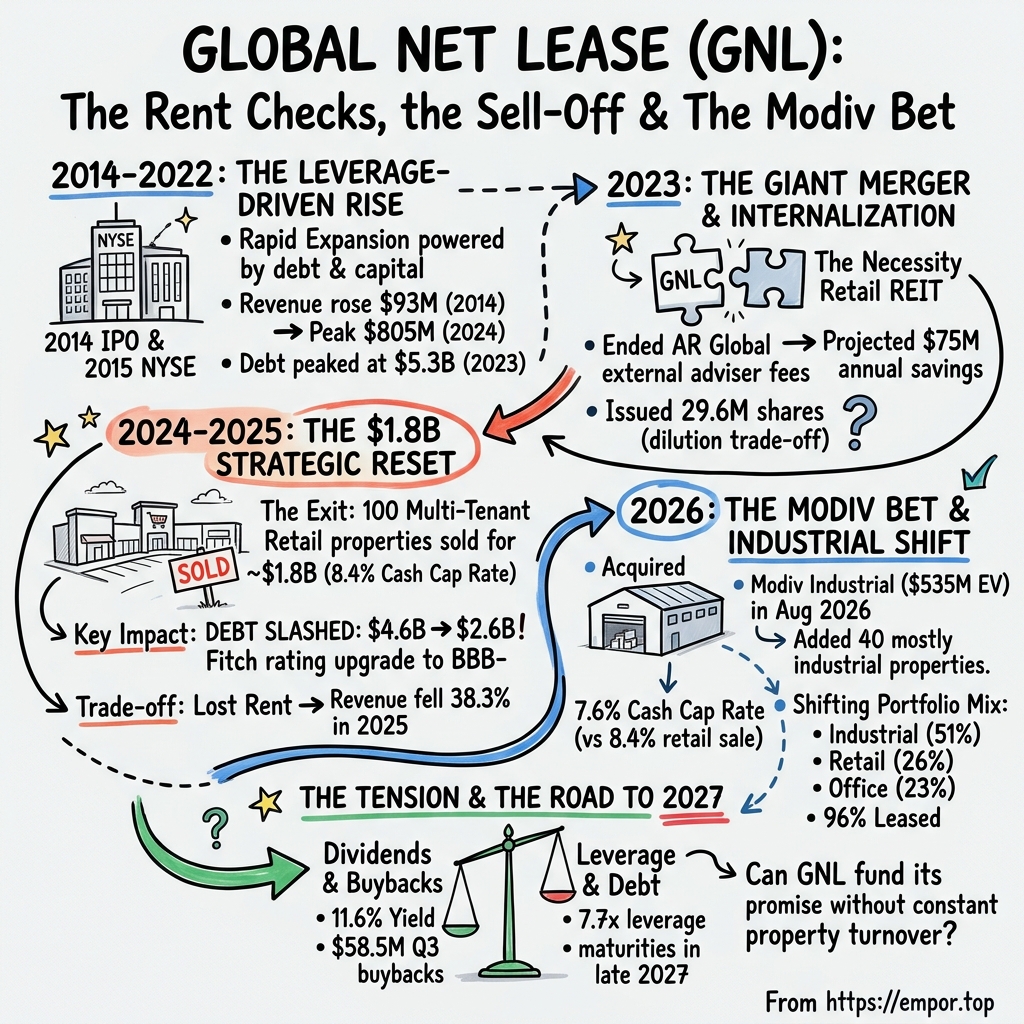
Picture the deal as a map rather than a press release. Across the United States, pins mark roughly a hundred shopping centers, the kind with a grocery anchor at one end, a fitness club at the other, and a nail salon, a mattress store and a sandwich shop in between. Each pin carries dozens of small leases, dozens of tenants, and a steady drip of calls about parking lots, roof leaks and common-area maintenance bills. In February 2025, Global Net Lease agreed to sell almost all of those pins at once.1 By the middle of that year the closings had come through, and the company had taken in roughly $1.8 billion for the portfolio, priced at an 8.4% cash capitalization rate.12
That cap rate is the first number worth holding onto. A cap rate is simply the property's yearly cash rent divided by the price paid for it, a little like the interest rate on a bond. At 8.4%, the buyer was paying about $12 for every $1 of annual cash rent it would collect. For GNL, the sale was not a one-off. It was the centerpiece of about $3 billion of dispositions across 2024 and 2025, a deliberate shrinking of the company in order to cut its debt.3 Few listed landlords sell that much of themselves in so short a time without being forced to, and the question this story keeps returning to is whether GNL was choosing or being chosen for.
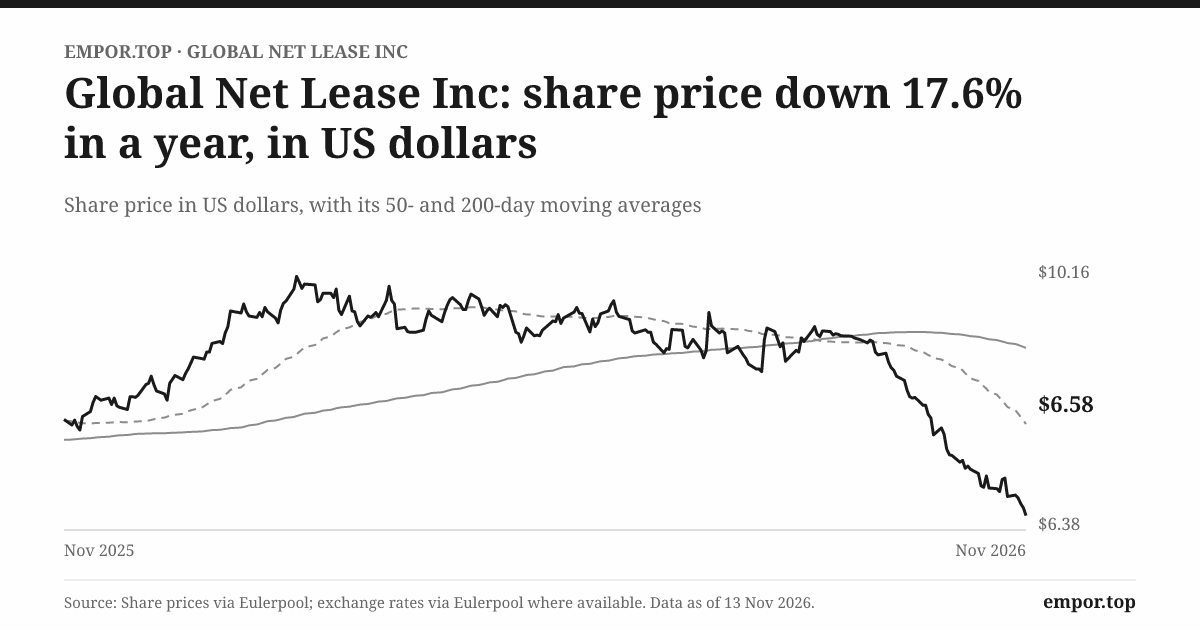
Fast forward to the close of trading on November 13, 2026. GNL's shares finished the day at $6.58, which was also the lowest price of the past year and about a third below the 52-week high of $9.96. At that price the stock offered a dividend yield of about 11.6%. In the stock market, a yield that high is rarely a gift. It is usually a question, and investors were asking it loudly.
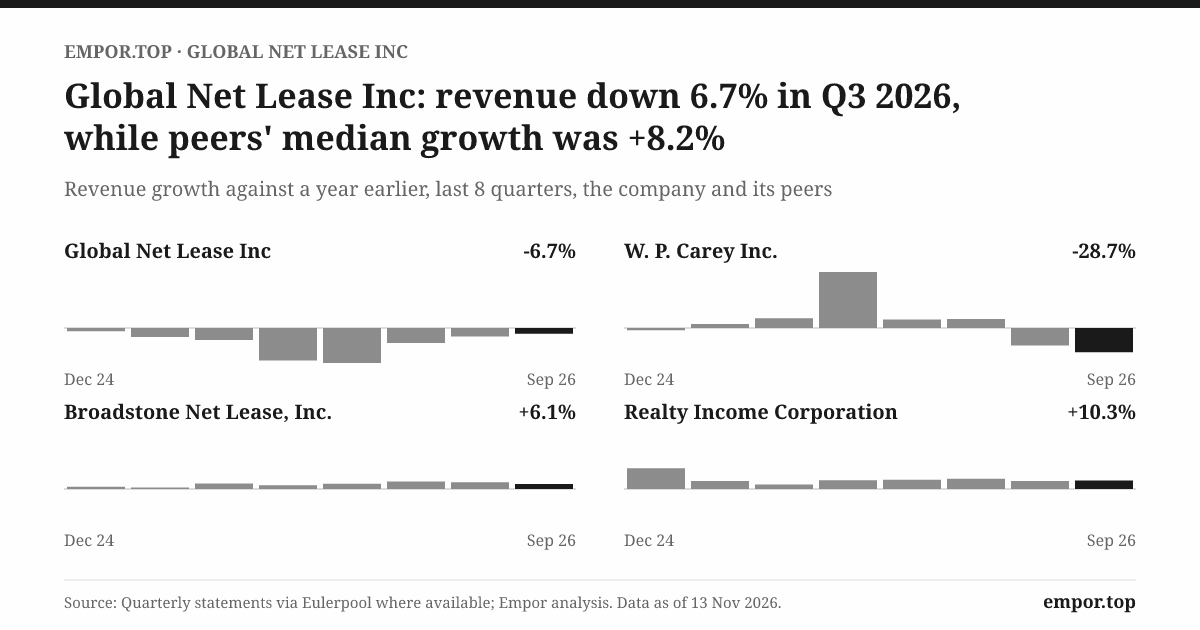
The company that remained after the great sell-off is still large. At the end of September 2026, GNL owned 835 properties with about 43.5 million rentable square feet, the buildings were 96% leased, and the average lease had about 6.3 years left to run.45 Those are the vital signs of a calm landlord: nearly everything rented, with tenants locked in for years. Yet the income statement tells a more restless story. Quarterly revenue was about $113 million in the three months to September, down roughly 7% from a year earlier, and the company reported a $67.1 million net loss attributable to common stockholders for the quarter.6 Full-year revenue had already fallen 38% in 2025, from about $805 million to about $497 million, because the properties that produced that rent were gone.2
So there is a contradiction at the heart of GNL. The portfolio looks occupied and long-leased. The reported revenue is shrinking, losses for common shareholders keep appearing, and the market prices the payout as if it were fragile. The market value of the shares is about $1.5 billion; add the debt and preferred capital and the enterprise value is about $4.2 billion. In other words, lenders and preferred holders have far more money at stake in this business than common shareholders do, and that ratio shapes almost every decision management makes.
Three questions organize the rest of this story. First, is GNL's growth, when it shows up, coming from the properties it keeps, or from buying and selling properties? Second, can the rent cover the dividend and the interest bill without another round of sales? Third, does the August 2026 acquisition of Modiv Industrial improve the portfolio enough to justify the shares and debt GNL used to pay for it?
The verdict on the $1.8 billion exit is easy to state and hard to finish. The sale was a real reset. It cut debt, it simplified a portfolio that had been stitched together from two different REITs, and it helped win GNL an investment-grade rating.3 What it did not do was prove that the remaining business can pay its dividend and service its debt from recurring rent alone. Selling a building converts many years of future rent into cash today. The rent stops arriving the day the sale closes, and the debt it repaid stops costing interest the same day. Whether that trade was a good one depends on what happened next.
To see why a landlord would sell a third of itself, it helps to go back to how it got so big in the first place.
 Subscribe on LinkedIn
II. A Landlord Built on New Capital
Global Net Lease was born as a fundraising machine before it became a listed company. It began life as a REIT sponsored by affiliates of AR Global, the real-estate investment sponsor then associated with the American Realty Capital family of vehicles, and it raised money from investors through an offering registered on Form S-11, a registration form designed for real-estate companies.78 Its initial public offering closed on June 30, 2014, and on June 2, 2015 the shares began trading on the New York Stock Exchange under the ticker GNL.8 The idea was simple to explain at a cocktail party: buy office buildings, warehouses and stores across the United States and Europe, lease each one to a single tenant on a long contract, and pass most of the rent through to shareholders as dividends.
The structure that makes this possible is called a net lease. In an ordinary lease, the landlord pays the property taxes, the insurance and the cost of fixing the roof. In a net lease, the tenant pays most or all of those costs on top of the rent. The landlord becomes something closer to a lender with a building as collateral: it puts up the capital, collects a predictable stream of payments, and leaves the day-to-day running of the property to the occupant. If you have ever owned a bond, you already understand most of the appeal. You also understand the risk, because a bond is only as good as the borrower who has to pay it.
The growth loop for a business like this is mechanical. The company raises equity and borrows money, buys leased buildings that yield more than the cost of that capital, and collects the spread. When a property no longer fits, it sells it and recycles the proceeds. Nothing about this loop requires a sales force or a product launch. It requires access to capital and the discipline to buy only when the yield on a building clearly beats what the money costs.
GNL ran the loop hard. Revenue rose from about $93 million in 2014, its first partial year as a sizable company, to about $805 million in 2024.82 That looks like a decade of spectacular compounding, roughly 16% a year over the eleven years to 2025 even after the post-sale collapse. But the long-run figure describes a different company each year. The portfolio kept growing through purchases, then jumped with the 2023 merger, then shrank with the disposals. Revenue fell back to about $497 million in 2025.2 None of that tells you whether the rent on any given building rose. It tells you how many buildings GNL owned.
The financing story moved even faster. Borrowings stood at about $942 million at the end of 2014. By the end of 2023, after the merger, they had reached about $5.3 billion.2 Shareholders' equity grew too, but more slowly, so debt for every dollar of equity climbed from about 0.66 to about 2.0 over that stretch. Debt was part of the engine that made GNL bigger. It was also the fuel that later made the company sell assets to stay comfortable with its lenders. After the disposals, borrowings fell to about $2.6 billion at the end of 2025.2
What did all that growth earn? Not much, measured by the returns the capital produced. Return on invested capital, which compares operating profit after tax with the debt and equity tied up in the business, hovered between about 1% and 3% for most of the decade and was about 1.2% over the twelve months to September 2026.62 Those are thin returns for any business. For a landlord paying 4% or more on its debt, they are a warning that size and value are not the same thing.
There is an accounting trap here, and it is worth flagging early because it runs through the rest of this story. Real-estate companies have to depreciate their buildings, recording a slice of the purchase price as an expense every year, even when the building is not losing value and may be gaining it. Depreciation is not a cash cost. That is why a REIT can report a GAAP net loss while rent arrives on schedule and operating cash flows remain healthy. GNL is an extreme example. Across 2014 to 2025 its cumulative net loss was about $463 million, while it generated roughly $1.8 billion of cash from operations.2 The industry's preferred measure, adjusted funds from operations or AFFO, adds back depreciation and other non-cash items and subtracts recurring maintenance spending. AFFO is a management-defined number, and each company calculates it its own way. So this story uses three lenses: net income for what the accountants say, AFFO for what management says, and cash after investment for what actually arrives and leaves.
The early decade, then, built a large landlord with modest returns and a growing pile of debt, run by an outside adviser. That last detail was about to become the problem everyone wanted to fix.
III. The 2023 Merger That Changed the Landlord
On May 23, 2023, two REITs that had shared the same sponsor for years announced that they would become one. Global Net Lease would acquire The Necessity Retail REIT, known by its ticker RTL, in an all-stock merger, and at the same time it would internalize its management, ending the arrangement under which affiliates of AR Global ran both companies in exchange for fees.9 The combined company was pitched as a giant of its niche: more than 1,350 properties and roughly $9.6 billion of real-estate assets.9 Management projected about $75 million a year of cost savings from combining the companies and bringing management in-house.9
To understand why this mattered, it helps to understand external management. Many non-traded REITs of GNL's generation were not run by their own employees. They were run by an outside adviser that collected fees for managing the assets, raising capital and sometimes for buying and selling properties. GNL's advisory agreement included a variable fee linked to cumulative equity proceeds, which meant the adviser earned more as the company raised more equity.2 Critics of the model have long argued that such arrangements reward asset growth more than per-share returns, because the adviser's fees rise with the size of the company whether or not shareholders get richer. Whatever the intent, the structure put a related party between shareholders and their own business, and the market often punished it with lower valuations.
Internalization cut that tie, but not for free. To end the advisory agreements, GNL issued 29.6 million of its own shares to the adviser's parent as consideration.102 In plain terms, shareholders paid the outgoing manager in stock to stop managing them. That is a common way to buy out an external adviser, and it can be a good trade if the fees saved over the following years exceed the value of the shares handed over. It is also dilution, because those 29.6 million shares claim a slice of every future rent check.
The fee burden being removed was real. In 2023, the last year under the old structure, GNL recorded about $28.3 million of related-party operating fees, equal to about 6% of its reported revenue that year.2 In 2024 and 2025, the company reported none.2 That is the cleanest piece of evidence that the internalization changed GNL's cost base: a recurring fee line simply disappeared.
The connection to the old sponsor did not vanish entirely. After internalization, GNL's own employees worked from office space in a property owned by affiliates of the former adviser. GNL paid about $1.6 million in rent for that office in 2025, up slightly from $1.4 million in 2023.2 Relative to revenue in the hundreds of millions, the amount is small. It is worth noting precisely because it is small: the related-party relationship shrank from a meaningful slice of revenue to a rounding error, and the remaining tie is a lease rather than a management contract.
The merger itself was about scale and simplicity. RTL owned a large portfolio of necessity-based retail, much of it multi-tenant shopping centers. GNL brought office and industrial properties in the US and Europe. Together, the companies could spread overhead across a bigger base and offer lenders a larger, more diversified borrower. The merged GNL, however, was also a more complicated landlord. Single-tenant net leases demand very little day-to-day management. Multi-tenant shopping centers demand a lot: leasing dozens of small spaces, managing common areas, recovering costs from tenants. The combined company had to run both kinds of business at once.
The transaction also put Edward Weil into GNL's leadership. Weil had led RTL, and after the merger he joined the combined company's senior team; in 2024 he became GNL's chief executive.11 He had been a GNL director since 2017, and he knew the sponsor's world from the inside. That history matters to how investors read him, a theme for later in this story.
It is worth pausing on what a skeptic would have calculated at the time. The fee line was a recurring cost that would have grown with the company; the 29.6 million shares were a one-time payment that would share in every future dividend. Paying a recurring cost with permanent equity makes sense only if the fees avoided over many years are worth more than the dividends and appreciation those shares will claim. With a dividend that is yielding more than 11% on the share price, the new shares carried a heavy running cost of their own. The trade still looks favorable to shareholders over a long horizon, because the fees would have kept rising and the misaligned incentives carried costs no income statement records. But it was not the free lunch that the phrase "ending external management" sometimes implies.
How should we judge the deal? The $75 million savings figure was a management projection at announcement, not a measured outcome, and the company's subsequent restructuring makes it hard to isolate cleanly. The disappearance of the fee line is solid evidence that at least part of the savings was real. The per-share record is less flattering. Net income attributable to shareholders swung from small profits before 2023 to losses of about $211 million in 2023, $131 million in 2024 and $225 million in 2025, losses driven by depreciation, impairments, interest and transaction costs as much as by operations.2 AFFO per share, management's preferred yardstick, fell by about a quarter in 2025.11 A larger share count, shrinking assets and higher interest costs all pushed in the same direction.
So the honest verdict is that internalization removed a related-party fee burden and created an internally managed platform that could make decisions in shareholders' names rather than an adviser's. It did not by itself create value per share. The test for the new regime was what it would do with its freedom. And within eighteen months, the most consequential thing it did was to sell the very shopping centers the merger had brought in.
IV. Selling the Shopping Centers to Save the Balance Sheet
The February 25, 2025 announcement had the quality of a tactical retreat that its authors wanted to describe as a strategic advance. GNL agreed to sell its multi-tenant retail portfolio, about 100 properties, for roughly $1.8 billion.1 The buyer was a private real-estate investor, and the price implied an 8.4% cash cap rate on the portfolio's rent.1 Management framed the sale as the move that would turn GNL into a pure single-tenant net-lease company and sharply lower its leverage.1 Less than two years after merging to gain those shopping centers, GNL was handing them on.
There are two ways to tell this story. In the generous version, the merger was always partly about acquiring a portfolio that could be sold in one block to private capital at a decent price, and the internalized team simply executed the plan once markets allowed. In the less generous version, the combined company found itself with too much debt and too complex a portfolio at a time of rising interest rates, and the shopping centers were the most saleable thing it owned. The evidence supports elements of both. The company had borrowings of about $5.3 billion at the end of 2023, more than twice its shareholders' equity.2 Rates had risen sharply since the deals that built the portfolio were financed. And the multi-tenant centers needed active management that did not fit a lean net-lease operation of a few dozen employees. GNL had 56 employees at the end of 2025.2
Follow the money from there. In 2025, GNL's investing activities brought in about $1.8 billion of cash, mostly from disposals, while its financing activities used about $2.1 billion, mostly to repay debt.2 By the end of the year, total borrowings had fallen from about $4.6 billion to about $2.6 billion.2 That is one of the larger single-year debt reductions in the listed net-lease sector, and it was achieved by selling assets rather than by issuing new equity at a depressed price.
The rating agencies noticed. S&P raised GNL's corporate rating to BB+ from BB in June 2025 and lifted its unsecured notes to BBB-, the bottom rung of investment grade.12 On October 17, 2025, Fitch upgraded GNL's corporate rating to BBB-, investment grade, from BB+.3 GNL's announcement attributed the upgrade to the roughly $3 billion of dispositions across 2024 and 2025, lower leverage, streamlined operations and improved liquidity.3 Investment grade matters for a landlord because it lowers the cost of unsecured borrowing and widens the pool of lenders. It also removed some covenants in GNL's credit agreements, including limits tied to secured debt and minimum net worth.4 The rating was the trophy of the sell-off.
Now the cost. Revenue fell by about 38% in 2025, largely because the sold properties stopped paying rent to GNL.2 The company's annual report traced specific chunks of lost revenue to disposals: about $27 million associated with six retail tenants, about $9.4 million from two groups of industrial properties, and about $8.9 million from eight office properties.2 These were sale effects, not tenant failures. The decline in reported revenue therefore says little, by itself, about whether rent on the buildings GNL kept was healthy. What it does say is that the company's earning base was smaller, and so its capacity to carry debt and pay dividends had to be measured against that smaller base.
That is where the cash-flow statement becomes useful. In 2025, cash from operations was about $223 million, and GNL paid about $192 million in common dividends.2 Operating cash covered dividends, but with less room than it appears, because operating cash flow is measured after interest but before the money a landlord spends to keep its buildings rentable. Recurring property capital spending was about $33 million that year, and GNL also had preferred dividends to pay.2 Subtract those and the cushion over the common dividend gets thin. The company itself said operating cash covered about 94% of dividends over a recent nine-month period, a sign that coverage was not comfortably above 100%.13
Did GNL sell at the right time? The honest answer is that nobody can know without the counterfactual. The 8.4% cap rate was not a fire-sale number for multi-tenant retail, a sector that private buyers had been willing to bid for, and it allowed a debt reduction that probably could not have been achieved any other way without heavy dilution. On the other hand, selling at 8.4% means giving up a stream of rent worth 8.4% a year on the sale price. GNL's weighted-average interest rate was about 4.1% by the third quarter of 2026.13 If the proceeds repaid debt costing less than the yield on the assets sold, the company traded higher-yielding assets for lower-cost liabilities, and its earnings per share fell even as its balance sheet improved. That is what the AFFO decline in 2025 is consistent with: GNL paid for safety with income.
The 8.4% figure also becomes a yardstick for what came next. Every subsequent purchase at a lower cap rate would be buying rent more expensively than GNL had sold it. Cap rates are not perfectly comparable across asset types, because a warehouse leased for fifteen years to an investment-grade tenant deserves a lower yield than a shopping center full of small tenants on short leases. But the yardstick is useful as long as one remembers its limits. The retreat from shopping centers bought GNL time and a better credit rating. It also left a smaller company that had to decide what kind of landlord it wanted to be.
V. A New Portfolio, Then a New Kind of Sale
Walk through GNL's portfolio as it stood at the end of September 2026 and the change is visible in the buildings themselves. The largest group is no longer stores. It is warehouses, distribution centers and manufacturing facilities: industrial and distribution properties produced about 51% of the portfolio's straight-line rent.5 Retail, now mostly single-tenant stores rather than shopping centers, was about 26%. Office was about 23%.5 The portfolio was nearly full and long-leased.45 About 63% of annualized straight-line rent came from tenants with investment-grade credit ratings.5
Straight-line rent needs a short translation. Many leases have rent that rises over time, say by 2% a year. Accounting rules require the landlord to average the total rent over the life of the lease and report that average as revenue each year. In the early years, the reported figure is higher than the cash actually received; in later years, it is lower. Straight-line rent is a reasonable way to compare leases, but it is not the same thing as cash in the bank this quarter.
The rent engine runs like this. A tenant signs a lease, often for ten or fifteen years at the start, and agrees to pay rent that typically rises on a set schedule. GNL's leases were not especially generous in that respect: at the end of 2025, 86% of leases had escalations, and they averaged about 1.4% a year.2 That is below most measures of inflation over recent years. So the built-in growth from GNL's existing contracts is modest. Faster growth has to come from filling vacant space, signing renewals at higher rents, and buying new properties. The company reported positive renewal spreads, meaning tenants who renewed agreed to pay more than before, with a straight-line spread of about 4.9% on renewals cited in 2026.13 That is encouraging, but renewals are a small share of a portfolio in any given year.
Notice what that implies about the company's revenue figures. When GNL reports total revenue falling, it is not usually because tenants are paying less. It is because the company owns fewer buildings. When total revenue rises, it is usually because GNL bought more. Segment rent mix, total revenue, AFFO and debt each answer a different question, and the company's mix shift toward industrial tells us what it owns, not how much more it earns per building.
How does a net-lease landlord actually win? It does not win on brand; tenants rarely choose a warehouse because of who owns it. It wins on underwriting. The landlord has to judge whether the tenant can pay for the next fifteen years, whether the building would be useful to someone else if that tenant left, what lease terms to demand, and whether the price clears its own cost of capital. The tenant's legal obligation to pay does not guarantee that the tenant can pay, as every landlord of a bankrupt retailer has learned.
Here the moat question deserves a direct test. A long lease is a form of switching cost: a tenant who has signed for twelve years cannot easily leave. But leases are finite. When they expire, the tenant can move, renegotiate or close, and the landlord's position resets to whatever the local market will pay. GNL's 6.3-year average remaining term is respectable but shorter than its best-known rivals. W. P. Carey reported a weighted-average lease term of about 12 years across roughly 1,682 properties at the end of 2025.14 Realty Income, the sector's giant, owned 15,511 properties at the same date.15 GNL competes against those companies, against other listed REITs and against private funds for the same buildings, and it has no evident cost-of-capital advantage over the largest of them. The scale gap matters because cheaper capital lets a buyer pay more for the same property and still earn its required return.
What GNL does have is diversification and reasonably strong tenant credit. No single tenant accounted for more than 10% of annualized rental income at the end of 2025.2 With 63% of rent coming from investment-grade tenants, the portfolio leans toward borrowers with access to bond markets.5 Those are real positives. GNL does not disclose its top-five tenant concentration in its annual report, so investors cannot easily see how much rent depends on a handful of names.2
There is one clue in the numbers that deserves attention. Debtor days, which measure receivables as days of revenue, rose to about 74 at the end of 2025 from about 45 a year earlier.2 Part of that rise is mechanical: revenue fell sharply with the disposals, and receivables that include straight-line rent built up over many years do not shrink at the same pace. Straight-line rent receivables actually declined, from about $89.8 million to about $72.9 million, between 2024 and 2025.2 The amounts written off as uncollectible were modest, about $2.6 million in 2025, down from about $3.4 million in 2024.2 GNL's accounting policy is conservative on paper: when it is no longer probable that a tenant will pay virtually all its rent, the company switches that lease to cash-basis accounting and writes off the accrued straight-line receivable.2 So the debtor-days jump looks more like a denominator effect than a collection crisis. GNL does not publish a detailed aging of its receivables, which is the disclosure that would settle the question.2
The gap between six years and twelve years of remaining lease term is worth translating into everyday terms. Imagine two landlords, each with a hundred buildings. If leases roll off evenly, the landlord with a twelve-year average faces roughly one in twelve of its rent stream coming up for renegotiation each year. The landlord with a six-year average faces about one in six. Every renewal is a moment when the tenant can leave, demand a rent cut or ask the landlord to pay for improvements. A shorter lease book is not necessarily a worse one; it gives the owner more chances to raise rents in a strong market. But it does mean that GNL's rent is less locked in than the industry leaders', and that the company's results depend more heavily on the leasing team's ability to win renewals year after year. The modest 1.4% escalators make that dependence sharper, because the contracts themselves do little to lift income between renewals.
There is also an international layer that most American net-lease investors underestimate. GNL owns properties in Europe and Canada as well as the United States, and at the end of 2025 about 15% of its debt was denominated in euros.2 The company says it tries to match rent and debt in the same currency, so that a weaker euro reduces both the income and the interest bill, and uses forwards, options and swaps to hedge what is left.2 Hedging narrows the exposure; it does not erase it. For a tenant in Germany or the Netherlands, the lease is in local currency, and when the euro or pound weakens against the dollar, GNL's reported rent shrinks even if the tenant pays every cent on time.
The verdict on the model, then, is that the leases provide visibility and shift many property costs to tenants, but GNL has no demonstrated pricing moat. Its advantages are a diversified, mostly investment-grade tenant base and a portfolio now weighted toward industrial assets. Its exposures are tenant credit, lease rollover, office vacancies and the cost of financing. And having just sold one portfolio, GNL had just bought another, one that pushed that industrial weighting further.
VI. Modiv: Buying Industrial Growth After Selling Retail
On August 12, 2026, GNL closed its acquisition of Modiv Industrial, a smaller listed REIT focused on industrial manufacturing properties.16 The deal added 40 properties, most of them industrial, to GNL's portfolio.16 It was valued at about $535 million in enterprise value, meaning the price for Modiv's equity plus the debt and preferred stock GNL took on or repaid.1716 Eighteen months after selling a shopping-center empire to cut debt, GNL was buying again.
The deal had been unveiled in early May 2026, when GNL presented the transaction to investors alongside its first-quarter results, and it took a little over three months to close.1718 The timing matters. GNL's own shares were then trading well above where they stood by mid-November, so stock-funded acquisitions looked cheaper to management than they would have looked in November. When a company pays in its own shares, the effective price of an acquisition depends as much on what the market thinks of the buyer as on the buildings bought.
The strategic case is easy to sketch. Industrial properties, especially manufacturing and distribution buildings leased for long terms, have been the most favored corner of net-lease real estate for a decade, propelled by e-commerce, supply-chain reshoring and the scarcity of modern warehouse space. Modiv's buildings tilted GNL further in that direction. After the acquisition, industrial and distribution properties accounted for roughly half of GNL's straight-line rent, and the weighted-average remaining lease term rose to about 6.3 years from about 6.1 years at the end of 2025.52
Then there is the price. GNL said it acquired Modiv at about a 7.6% cash cap rate and an 8.7% GAAP cap rate.17 The GAAP cap rate is higher because it uses straight-line rent, which front-loads future rent increases; the cash cap rate is what the buildings pay today. Management projected that the deal would add about 4% to AFFO per share.17
Now hold the yardstick against it. GNL sold its retail portfolio at an 8.4% cash cap rate and bought Modiv at 7.6%. In plain language, it sold rent for about $12 of price per $1 of cash rent and bought rent for about $13. That comparison is tempting and incomplete. Industrial buildings on long leases to manufacturing tenants are not interchangeable with multi-tenant shopping centers, and a lower yield can be justified by lower risk, longer leases and stronger growth. Neither GNL nor anyone else has published a matched set of comparable transactions that would show whether 7.6% was cheap or expensive for these particular buildings. The spread proves neither a bargain nor a mistake. What it does show is that GNL paid a higher price for each dollar of current rent than it had received for its retail portfolio, and that the case for the deal rests on the quality and growth of what it bought.
The financing is where the story gets more complicated. GNL paid for Modiv with a mixture of stock and cash. It issued about 20.4 million new common shares and 4.9 million operating-partnership units, which are economically similar to common shares, to Modiv's holders.164 It also repaid Modiv's $250 million term loan and $23.7 million of mortgage notes, and redeemed Modiv's preferred stock, using cash and borrowings on its revolving credit facility.416 So the acquisition simultaneously enlarged the share count and drew down the revolver.
Management described the deal as leverage neutral, meaning the debt added would be matched by the earnings acquired, keeping the ratio of debt to earnings steady over a full year.17 At the end of September 2026, however, net debt was 7.7 times annualized adjusted EBITDA, a measure of operating earnings before interest, tax, depreciation and amortization.13 On the third-quarter call, management explained that the figure was temporarily elevated because the quarter's balance sheet carried all of the acquisition debt while the income statement included only about seven weeks of Modiv's earnings.13 That explanation is arithmetically sound. It is also a promise, and the full-year guidance of 6.5 to 6.9 times leverage is the test of whether it holds.13
The 4% accretion claim needs a similar test. Accretion is an accounting result: if the earnings acquired per new share issued are higher than GNL's existing earnings per share, AFFO per share rises. That can happen even when the purchase earns less than GNL's true cost of capital, because the calculation compares one yield with another rather than with what shareholders could have earned elsewhere. GNL's own shares, after all, were trading at a high AFFO yield in 2026. Issuing them to buy a portfolio at a 7.6% cash yield is accretive only because some of the deal was funded with cheaper debt. The relevant question is whether the combined returns beat the full cost of the equity and debt used. That will only be visible after a full year of ownership.
There is a further wrinkle that reframes the deal. Soon after closing, GNL identified $75 million to $100 million of Modiv properties as candidates for sale.135 That is a significant share of a $535 million acquisition. It means GNL did not buy Modiv purely to hold every building; it bought a portfolio intending to keep the best of it and sell the rest. That approach can work well if the retained assets are the high-quality core and the sold assets fetch decent prices. It also confirms that GNL's business, for now, is as much portfolio selection as rent collection.
The quarterly numbers did not settle the question. Revenue in the third quarter of 2026 was about $113 million, down about 7% from a year earlier, though the decline was much smaller than the drops of nearly 40% that followed the retail sale.6 Diluted earnings per share for the quarter were a loss of about 31 cents, weighed down by transaction costs and other charges.6 With Modiv in the numbers for only part of the quarter, that is a portrait of transition, not of the finished company.
So the verdict on Modiv is provisional. It moves GNL toward the asset class with the strongest tenant demand and longer leases. Its accretion and leverage-neutrality are management claims that a full year of results will confirm or refute. And it raises a second question: while it was issuing shares to buy Modiv, GNL was also buying its own shares back.
VII. The Buyback Beside the Dividend
In the third quarter of 2026, GNL's finance team did two things that look, at first glance, like they belong in different companies. It bought back about $58.5 million of its own shares.13 And it reported a net loss attributable to common stockholders of about $67.1 million for the same three months.6 A company losing money and spending cash to buy back stock sounds like a contradiction. For a REIT, it may not be, and untangling why is the key to understanding GNL's dividend.
Start with the loss. As the accounting trap in GNL's early years showed, depreciation can push a landlord's net income below zero while rent keeps arriving. Over 2014 to 2025, GNL's cumulative net loss of about $463 million sat beside about $1.8 billion of operating cash flow, largely because depreciation and similar charges were non-cash.2 In 2025 alone, a net loss of about $225 million was offset by about $517 million of non-cash items, chiefly depreciation and amortization.2 GAAP losses are therefore not the right standalone measure of whether GNL can afford its dividend. They are also not meaningless. Some of the losses reflect impairments, which are admissions that properties were worth less than GNL paid for them, and losses on debt extinguishment and derivatives, which are real economic costs.2 In 2025, interest expense alone was about $195 million, an $11 million loss on retiring debt, an $11 million derivative loss and about $13 million of currency-related losses.2 Those lines tell you where the money goes: to lenders first.
Now the cash. GNL's preferred measure of cash available to shareholders is AFFO. Management said the third-quarter buybacks were made at an approximate 10% AFFO yield, meaning that for every $100 spent on shares, GNL retired a claim on about $10 of annual AFFO.13 That is a high return compared with buying a warehouse at a 7.6% cash cap rate, and it is the core of the bullish case for buybacks: if the market prices your rent stream more cheaply than the private market prices similar buildings, buying your own stock is the cheapest acquisition available.
There is a catch, and the stock price on November 13 illustrates it. At $6.58, the shares closed at their 52-week low, below the prices GNL paid during the quarter. A 10% AFFO yield on the buyback price implies purchases at roughly $8 to $8.50 a share, using the company's own AFFO guidance. Those buybacks were not losers if the AFFO is real and durable; they retired shares at a yield above GNL's cost of debt. But they were not a market-timing triumph either, and the market's subsequent verdict suggests investors do not yet trust the AFFO number that makes the arithmetic work.
The deeper question is whether buybacks are the best use of the money. GNL could instead repay revolver borrowings, which carry floating interest, or buy more properties. A buyback at a 10% AFFO yield beats debt repayment at a 4% to 6% interest cost in a simple spreadsheet. But it also leaves leverage higher, at a moment when net debt was 7.7 times EBITDA and the company's credit rating sits on the lowest rung of investment grade.133 Rating agencies watch leverage more closely than they watch AFFO per share. If buybacks delayed the return to management's target leverage, the cheapest acquisition could become an expensive one.
The fact-sheet free cash flow line adds confusion if read carelessly. It subtracts capital expenditure, including property purchases in some years, from operating cash flow. Measured that way, GNL's cumulative free cash flow from 2014 to 2025 was about negative $2.3 billion, while it paid about $2.0 billion in dividends.2 That does not mean the dividend was paid from thin air. It means the company spent heavily to buy properties and funded both the purchases and the dividends with a mixture of rent, borrowing, equity issues and later asset sales. The honest reading is that GNL's dividend has never been funded purely from internally generated surplus over a full decade; it has been part of a broader cycle of raising and recycling capital.
Recent years look better, because purchases slowed and sales accelerated. In 2025, operating cash flow of about $223 million exceeded common dividends of about $192 million.2 Subtract recurring capital expenditure of about $33 million and the remaining cushion is close to zero before preferred dividends.2 Management's own figure, that operating cash covered about 94% of dividends over the first nine months of the most recent reporting period, confirms how narrow the margin is.13 A dividend covered 94% by operating cash is not in crisis, but it is not safe either. It depends on either rising rent, falling interest costs, or continued help from asset sales.
It also helps to see who stands in line ahead of the common shareholder. Every quarter, rent comes in from tenants. The first claim on it belongs to the mortgage lenders, the noteholders and the banks behind the revolver, whose interest costs came to roughly two-fifths of 2025 revenue. Next come the holders of GNL's preferred stock, who are paid fixed dividends before common shareholders see anything. Then come the roofs, parking lots and tenant improvements that keep buildings leasable. Only after all of that does the common dividend get paid. When a company carries as much debt and preferred capital as GNL does relative to its common equity, small changes at the top of that waterfall become large changes at the bottom. A one-point rise in the interest rate on a billion dollars of refinanced debt costs about $10 million a year, a meaningful slice of the cushion between operating cash and the common payout.
The dividend yield of 11.6% should be read accordingly. It is market arithmetic: the annual dividend divided by the share price. It is not proof that the dividend is safe, and it is not an estimate of total return. A yield that high says the market assigns real probability to a cut, or to a long period without growth. Implied by that yield, the annual dividend is about 76 cents a share, against management's 2026 AFFO guidance of 83 to 85 cents.13 On that basis GNL pays out roughly nine-tenths of its own adjusted earnings, a ratio that leaves little room for error when leverage is high and lease escalators average about 1.4%.2
So the verdict is that buybacks below book value may be attractive if the AFFO and asset values hold, and the company had both the liquidity and the authorization to make them. The high dividend, however, remains a cash-coverage question rather than an earnings question. The right test is cash after interest, recurring capex and preferred dividends, measured over a full year with Modiv included. Whether that test is passed depends heavily on the people making the capital-allocation calls, and on whether their incentives point the same way as shareholders'.
VIII. Weil's Turn: Credibility in the Numbers
On November 5, 2026, Edward Weil opened GNL's third-quarter earnings call with the tone of a chief executive who has finished one job and started another.19 He raised the low end of full-year AFFO guidance, so that the company expected 83 to 85 cents a share for the full year.1913 He also acknowledged the headwind no landlord can control: higher long-term interest rates were pressuring real-estate valuations and the cost of capital.13 Both statements were true. The question for investors was which one would matter more.
Weil arrived at the top job through the sponsor's world.11 Alongside him, Christopher Masterson, the chief financial officer, is the other principal voice on earnings calls, the one who walks through debt maturities, hedges and the revolver.13 This is a management team that knows the portfolio intimately, because many of the assets were bought under the same sponsor before internalization. That is both a strength and a reason for scrutiny. Insiders know the buildings best. They also have the least distance from past decisions.
Measured by actions, the post-merger team has done what it said it would do on the balance sheet. It promised to simplify and deleverage, and it did both, winning an investment-grade rating.32 Within a year of the rating upgrade, the company was issuing shares to buy Modiv, drawing on its revolver and buying back stock, while leverage climbed back to 7.7 times.1316 Each step has a defensible rationale. Together they show a team moving from defense back toward offense faster than the leverage trajectory alone might suggest, and that leaves the per-share results, not the narrative, as the scorecard.
Consistency of language is a useful test here. Through 2025, management's message centered on discipline: sell, deleverage, simplify, earn the rating. By the second quarter of 2026, the language had expanded to include growth through Modiv, and by the third quarter it included buybacks as well.2013 None of these messages contradicts the others outright. Yet the speed of the pivot is notable for a company whose rating sits one notch above high yield. Discipline that lasts four quarters is a tactic; discipline that lasts a cycle is a culture, and GNL has not yet been tested over a cycle.
Compensation is where the scrutiny sharpens. Weil's reported total compensation was about $8.9 million in 2025, up from about $5.2 million in 2024.11 The 2025 package included about $5.6 million in stock awards and about $2.0 million in incentive pay.11 The proxy's own pay-versus-performance table is unusually stark: compensation actually paid to Weil, a measure that includes changes in the value of his equity awards, rose by about 267% from 2024 to 2025, while net loss increased by about 54% and AFFO per share fell by about a quarter.11 In a year when shareholders' per-share earnings measure fell sharply, the chief executive's realized pay rose sharply.
There is a fair defense. Much of Weil's pay is equity, so it rises and falls with the share price. The board can argue that 2025 was the year of the transformational sale, the debt reduction and the rating upgrade, and that the falling AFFO per share was the planned cost of de-risking. That argument has merit, but it is also exactly the kind of argument that should be tested against vesting terms. The question is whether the incentive metrics reward AFFO per share, leverage and total shareholder return over several years, or reward transaction completion. A management team paid for doing deals will tend to do deals.
Shareholders did not revolt, but they were not unanimous. At the May 2026 annual meeting, the say-on-pay resolution passed with about 145.9 million votes in favor and about 6.4 million against.21 Withheld votes were highest for director Leslie Michelson, at about 17.6 million, and for chairman Robert Kauffman, at about 9.7 million.21 Those are not crisis numbers. They are a measurable minority signaling unease. The board itself changed after the meeting: two directors retired, leaving eight directors of whom seven are independent.1121
Ownership adds a footnote worth reading carefully. Bellevue Capital Partners, an investment firm tied to the old sponsor's founders, held about 9.9% of GNL's shares in the proxy as of March 2026, making it the largest identified active holder behind the index giants BlackRock and Vanguard, each with about 15%.11 By its September 2026 filing, Bellevue's stake had fallen to about 7.3%, reflecting both share-count changes from the Modiv issuance and disposals.22 The proxy notes that Weil holds a passive interest in Bellevue that gives him no voting or investment power over its GNL shares.11 There is no controlling shareholder, but the legacy sponsor's circle remains a meaningful holder, and its gradual selling is a data point investors may weigh.
The third-quarter question-and-answer session revealed the pressure points. Analysts pressed on Modiv accretion, the 7.7 times leverage, the dividend, pending office sales and the late-2027 debt maturities.13 Management's answers were most concrete on leverage, reiterating a full-year range of 6.5 to 6.9 times, and on liquidity, pointing to about $863 million available and no maturities until the fourth quarter of 2027.13 They were less precise on the long-run payout path, which management tied to future results rather than quantifying. That is not evasion; it is caution. But it means the dividend question will be answered by results rather than by commitments.
The verdict on management is that it has completed substantial disposals, reduced debt and integrated Modiv, but it has not yet established durable per-share value creation. The pay-versus-performance gap and the return of leverage make delivery against guidance the credibility test. And that test now runs into a calendar with a clear deadline.
IX. The Case That Has to Clear 2027
Picture GNL's balance sheet at the end of September 2026 as a runway. On one side, about $863 million of liquidity, with its revolving credit facility running to August 2029.134 On the other side, about $1 billion of mortgage notes, about $830 million drawn on the revolver and about $1 billion of senior notes.4 No debt matures until the fourth quarter of 2027.13 The weighted-average remaining term on the debt is only about 2.6 years, and about 86% of it is fixed rate, at a weighted-average interest rate of about 4.1%.13 The plane has enough runway to take off. It does not have enough to idle.
The bull case is built on contracts. GNL owns an increasingly industrial portfolio with long leases and mostly investment-grade tenants.5 Renewal spreads have been positive.13 The company holds an investment-grade corporate rating from Fitch, which lowers its unsecured borrowing costs and widens access to the bond market.3 Office exposure, the weakest part of the portfolio, is falling: management expects it to decline toward about 18% of rent after pending sales.5 If the company completes those sales at reasonable prices, lets Modiv's full-year earnings bring leverage down, and refinances its 2027 maturities near current rates, AFFO per share could stabilize and the payout ratio could improve.
The bear case is built on arithmetic. Leverage remains high after Modiv.13 Common dividends were not fully covered by operating cash after recurring capex in 2025.2 Lease escalators remain modest, so real rent per building erodes unless renewals or acquisitions fill the gap.2 Reported revenue remains far below its pre-disposition level. And the debt that matures from late 2027 onward was largely borrowed when rates were lower; replacing it at today's long-term rates would raise interest costs. The bear case is not that GNL fails. It is that leverage, low escalators and refinancing costs absorb the gains from the portfolio's improvement, leaving shareholders running in place.
The industry's structure explains why neither case is easy to dismiss. Consider the five forces. Tenants have meaningful bargaining power at lease renewal, when they can move or renegotiate; during the lease term, their power is limited by contract. Sellers of property, GNL's suppliers, sell to whoever pays most, and competition for good industrial assets is fierce. The threat of new entrants is high, because private equity funds and pension investors can and do buy single-tenant net-lease properties without any special license or capability. Substitutes exist in tenants owning their own buildings or using sale-leasebacks with other landlords. And rivalry is intense among Realty Income, W. P. Carey, smaller listed REITs and private capital, all bidding for similar assets.1514 In that structure, the winner is usually the buyer with the cheapest capital and the best underwriting, not the one with the most distinctive strategy.
Now apply Hamilton Helmer's seven powers, the conditions under which a business earns persistent above-average returns. Scale economies favor the giants: Realty Income, with more than 15,000 properties, can spread overhead and borrow more cheaply than GNL.15 Network effects do not apply to landlords. Counter-positioning is absent; GNL's model is the industry standard. Switching costs exist only for the length of a lease. Brand barely matters to tenants choosing a warehouse. GNL holds no cornered resource, such as unique land or exclusive tenant relationships, that rivals cannot buy. Process power, an organizational ability to underwrite better than peers, is the only plausible power, and GNL's low returns over the past decade do not yet demonstrate it. The evidence narrows the moat claim to a smaller version: GNL has a diversified, rentable portfolio, not a structural advantage.
A skeptical activist reading this record would not attack the buildings. The attack would be on capital allocation and governance. That investor would point out that GNL, within roughly eighteen months, sold assets at an 8.4% cash yield, bought assets at 7.6%, repurchased stock at an approximate 10% AFFO yield and issued new stock to pay for an acquisition, a sequence that moved money in several directions at once and paid transaction costs each time.11713 The activist would ask why the company issued roughly 20 million shares in August and then spent tens of millions repurchasing shares in the same quarter.1613 The activist would note that executive pay rose sharply in a year when AFFO per share fell.11 And the activist would ask for a simple disclosure the company does not provide: a multi-year, same-store measure of cash rent growth on the retained portfolio, so that investors could separate the rent engine from the deal engine. Management has reasonable answers to some of these questions, chiefly that the Modiv shares were issued at a higher price and that buybacks exploited a later decline. But those answers rest on timing, and timing is the hardest skill to repeat.
The risks that matter run through specific mechanisms. Tenant distress would lower collections and force write-offs of straight-line receivables. Office vacancies would add costs, because empty buildings still need taxes, insurance and maintenance that tenants no longer pay. Higher long-term rates raise both refinancing costs and the hurdle for acquisitions, while lowering the prices buyers will pay for the office assets GNL wants to sell. Currency movements matter too: despite hedging, currency and derivative effects cost the company more than $20 million in 2025.2
Which numbers will revise the thesis? Three matter most. First, AFFO per share against 2026 guidance, after a sharp fall in 2025; it is the measure that tells whether the reshaped company earns more per share than the old one.1311 Second, net debt to adjusted EBITDA against full-year guidance; it tells whether Modiv was really leverage neutral.13 Third, occupancy and same-store rent on the retained portfolio; they tell whether the rent engine itself is growing.5 Office sale prices and the cash coverage of the dividend round out the watch list.
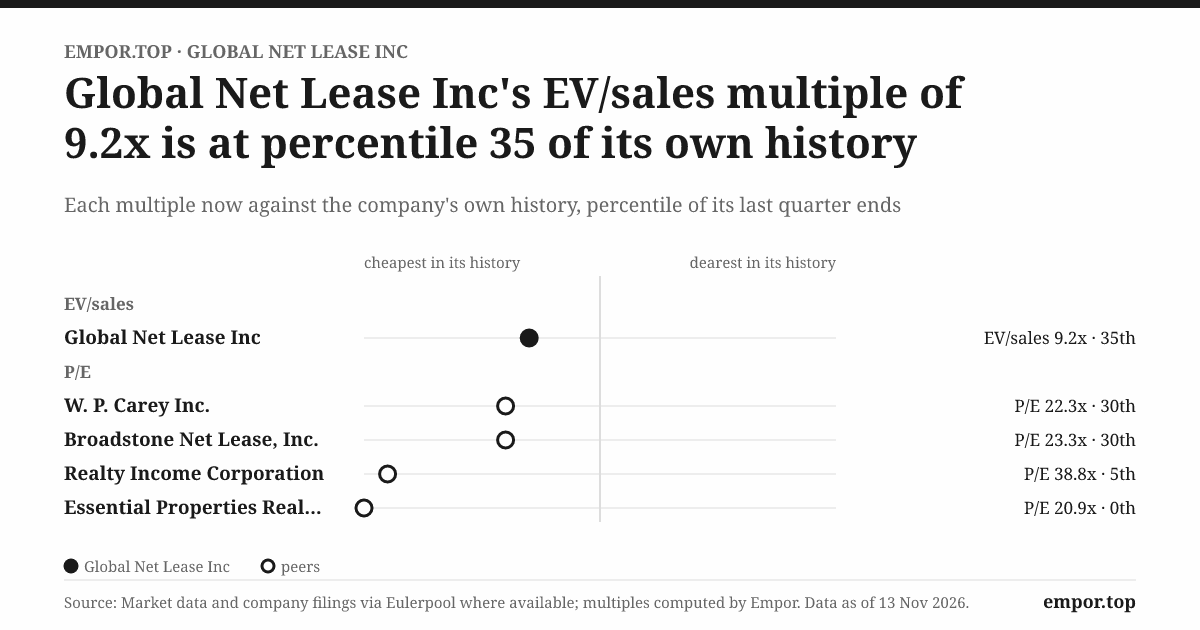
Valuation, read as data, frames the market's assumptions. At $6.58, GNL traded at about 0.9 times book value and about 12.4 times enterprise value to EBITDA.2 Price to earnings is not meaningful while trailing earnings per share are negative. On management's AFFO guidance, the shares were priced at about eight times AFFO. That is a level that implies investors doubt either the durability of the AFFO or the ability to refinance without dilution. A discount to book value is not automatically a bargain, because book value reflects historical purchase prices less depreciation, not what the buildings would sell for today. The market is pricing GNL as a leveraged landlord in transition, not as a stable rent compounder. And the lessons of that transition reach beyond this one company.
X. Business & Investing Lessons
Put two moments side by side. In 2025, GNL sold its shopping centers to cut debt.1 In 2026, it bought Modiv's mostly industrial properties to change its mix.1617 One move was a retreat, the other an advance. Together they show that GNL's defining skill is not collecting rent. Almost any landlord can collect contracted rent from tenants who are able to pay. GNL's defining skill, the one that will decide its value, is choosing what to own and how to pay for it.
The first lesson comes from the retail sale. Selling a portfolio is often celebrated as a success the day it closes, with a headline number and a press release. But the sale's real value depends on what the money does next. GNL used the proceeds to repay debt, then used its renewed borrowing capacity to buy Modiv and repurchase shares. Whether the whole sequence created value will be measured in AFFO per share and leverage over several years, not on closing day. A sale is only a success when the next use of the capital earns its keep.
The second lesson comes from the portfolio's vital signs. High occupancy and long leases look like stability, and for a while they are.5 But a lease is a promise with an expiry date, and its value depends on the tenant's ability to keep paying. GNL's escalators are modest, so even perfectly reliable tenants deliver rent that grows slowly.2 Long leases buy time, not immunity.
The third lesson comes from the dividend. GNL's history shows why the safety of the payout depends on cash after interest, maintenance spending and preferred dividends, not on accounting earnings or a headline yield.213 A dividend is a promise funded by cash.
The fourth lesson comes from the 2023 internalization. GNL bought out its external adviser in stock.10 The fee burden disappeared, but the per-share results that followed were weaker, and executive pay rose while AFFO per share fell.211 Structures can be bought in a single transaction; credibility accumulates only through outcomes. Scale can be bought; trust has to be earned.
For founders and investors, the wider point is that capital-intensive businesses rarely fail because their product stops working. A warehouse does not become obsolete overnight. They fail, or stall, because the capital stack around the product becomes too heavy, too expensive or too short-dated. GNL's story is a case study in how a decade of financed growth can turn into a decade of financial repair, and how the decisions that matter most are taken in the treasury, not on the property.
XI. Epilogue
Tonight, GNL is a smaller, simpler and more industrial landlord than it was two years ago, with an investment-grade rating, a stock at its 52-week low, and a calendar full of tests. The next full-year report will be the first to include Modiv for a meaningful stretch, and the 2027 results will be the first to include it for a full year. Those reports will turn management's projections into measurements.
The first test is accretion. Management promised that Modiv would add about 4% to AFFO per share.17 If full-year AFFO per share lands at or above the 83-to-85-cent range and grows from there with Modiv fully included, the claim will look sound.13 If AFFO per share stalls, investors will conclude that the deal mainly enlarged the company, as so many earlier acquisitions did.
The second test is leverage. Management expects net debt to adjusted EBITDA to settle at 6.5 to 6.9 times once the partial-quarter distortion fades.13 If leverage moves into that range by the end of 2026 and keeps falling, the "leverage neutral" framing will hold. If it stays near 7.7 times, the rating agencies will notice before shareholders do, and the investment-grade rating that the retail sale won could come under pressure. Behind that sits the refinancing of maturities that start in the fourth quarter of 2027.13 Every percentage point of higher interest on refinanced debt comes directly out of the cash available for dividends.
The third test is dividend coverage. Watch operating cash after interest, recurring property spending and preferred distributions, set against common dividends, and ask how much any improvement depends on gains from selling assets. A company that covers its payout from rent is a rent compounder. A company that covers it from sales is a liquidator, however slowly.
The fourth test is office. Management expects office exposure to fall toward about 18% of rent after pending sales.5 The mix change alone is not the point. What matters is the price: selling offices at high cap rates reduces risk but also reduces income, and if the proceeds earn less than the rent given up, AFFO per share will shrink again.
Each of these outcomes points to the question that has run under this whole story. Is GNL now a durable rent compounder, a business whose contracted rent grows, whose leverage falls and whose dividend is covered from recurring cash? Or is it a portfolio that must keep changing, selling one set of buildings to fund the promises attached to another? The evidence so far allows both readings. The next four quarters will make one of them much harder to hold.
XII. Outro
Think again of that map of pins from February 2025, the hundred shopping centers that GNL sold for about $1.8 billion.1 The rent from those properties now flows to someone else. In its place, GNL holds a lighter balance sheet, an investment-grade rating, a new set of industrial buildings from Modiv, and a share count that has both grown and shrunk in the same year.
A landlord's ledger has two columns. One records rent collected, month after month, by contract. The other records properties bought and sold to keep the balance sheet moving. At GNL, the second column has told the story.
At Global Net Lease, the lease is long; the real story is what the landlord does before it ends.
References
-
Sale of Multi-Tenant Retail Portfolio — Global Net Lease, Inc., 2025-02-25 ↩↩↩↩↩↩↩↩
-
2025 Form 10-K — Global Net Lease, Inc., 2026-02-25 ↩↩↩↩↩↩↩↩↩↩↩↩↩↩↩↩↩↩↩↩↩↩↩↩↩↩↩↩↩↩↩↩↩↩↩↩↩↩↩↩↩↩↩↩↩↩↩↩↩
-
Fitch Upgrade Announcement — Global Net Lease, Inc., 2025-10-17 ↩↩↩↩↩↩↩
-
Q3 2026 Form 10-Q — Global Net Lease, Inc., 2026-11-04 ↩↩↩↩↩↩↩
-
Q3 2026 Investor Presentation — Global Net Lease, Inc., 2026-11-04 ↩↩↩↩↩↩↩↩↩↩↩↩↩
-
Q3 2026 Earnings Release — Global Net Lease, Inc., 2026-11-04 ↩↩↩↩↩
-
2015 Registration Statement Amendment — Global Net Lease, Inc., 2015-05-07 ↩
-
Merger and Internalization Announcement — Global Net Lease and The Necessity Retail REIT, 2023-05-23 ↩↩↩
-
Merger and Internalization, Form 8-K — Global Net Lease, Inc., 2023 ↩↩
-
2026 Proxy Statement — Global Net Lease, Inc., 2026-04-07 ↩↩↩↩↩↩↩↩↩↩↩↩
-
S&P Rating Upgrade Announcement — Global Net Lease, Inc., 2025-06-30 ↩
-
Q3 2026 Earnings Call Transcript and Q&A — The Motley Fool, 2026-11-05 ↩↩↩↩↩↩↩↩↩↩↩↩↩↩↩↩↩↩↩↩↩↩↩↩↩↩↩↩↩↩↩↩
-
Modiv Acquisition Completion Announcement — Global Net Lease, Inc., 2026-08-13 ↩↩↩↩↩↩↩↩
-
Modiv Transaction Investor Presentation — Global Net Lease, Inc., 2026-05-04 ↩↩↩↩↩↩↩↩
-
Q3 2026 Earnings Call Script — Global Net Lease, Inc., 2026-11-05 ↩↩
-
2026 Annual Meeting Voting Results — Global Net Lease, Inc., 2026-05-26 ↩↩↩
-
Schedule 13D Amendment — Bellevue Capital Partners, LLC, 2026 ↩
 LinkedIn
 WhatsApp
 Reddit
 Hacker News
 Email
 Kindle
 RSS Feed
 Spotify
 Apple Podcasts
 Amazon Music
 Audible
 YouTube