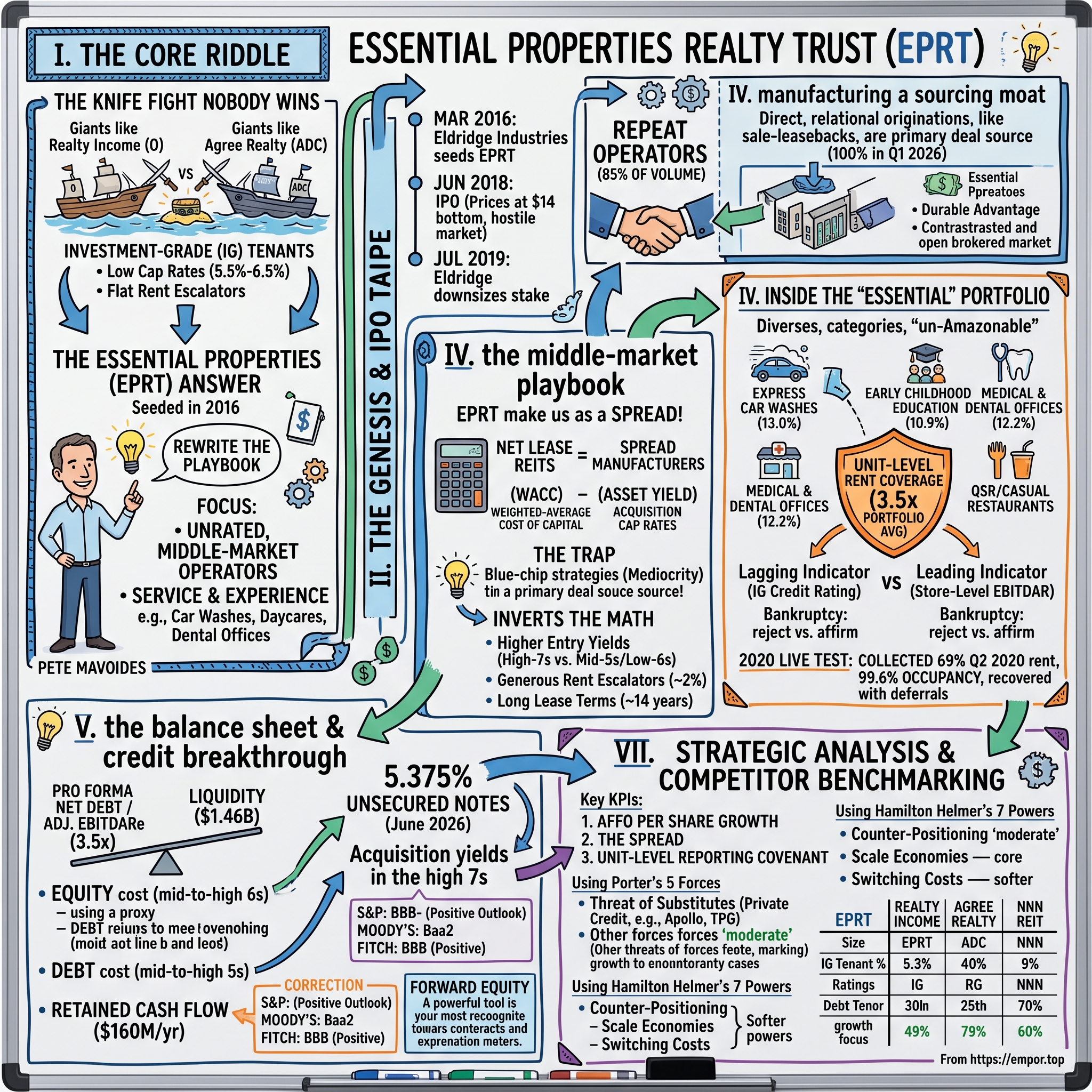
The Spread Machine: How Essential Properties Realty Trust Rewrote the Net Lease Playbook
I. Introduction & The Core Riddle
Picture the least glamorous corner of American commerce.
A three-bay express car wash off a suburban arterial road, its neon "OPEN" sign buzzing at dawn. A daycare at the edge of a parking lot where minivans idle in a ragged queue at 7:45 a.m. A regional pizza chain's drive-thru. A pediatric dentist's office wedged between a nail salon and a vape shop, its waiting room stocked with a fish tank and a decade-old copy of Highlights.
This is not the real estate that gets written up in glossy investor decks. There are no Walmart Supercenters here, no Walgreens on the corner, no Home Depot anchoring a power center. Nobody builds a brand campaign around it. And yet this unremarkable, almost invisible strip of the built environment is exactly where one of the most efficient capital-deployment machines on Wall Street was quietly assembled.
That machine is Essential Properties Realty Trust, listed on the New York Stock Exchange under the ticker EPRT and run out of Princeton, New Jersey.[^1] To understand why it is interesting, you have to understand the riddle sitting at the center of it.
The Knife Fight Nobody Wins
The world of single-tenant net lease real estate — landlords who buy a building, sign one tenant to a very long lease, and collect a clean rent check for a decade or more — is enormous, running into the hundreds of billions of dollars. It is also, at the top end, a knife fight.
The giants of the sector spend their days competing to lend money to the most creditworthy tenants in America. Realty Income (ticker O, the self-styled "Monthly Dividend Company") and Agree Realty (ADC) chase investment-grade retailers with corporate bond ratings — household names whose leases feel nearly as safe as government paper. The strategy is sound. The problem is that it is obviously sound, and therefore everyone pursues it.
When every well-capitalized buyer in the market wants the same asset, the price rises and the yield falls. Blue-chip net lease deals get bid down to capitalization rates — the annual rent divided by the purchase price, the rough "yield" a landlord earns on day one — in the neighborhood of 5.5% to 6.5%. The safety is real. So is the mediocrity of the return.
Essential Properties looked at that battlefield and walked in the opposite direction.
Seeded in 2016 by a vehicle controlled by billionaire Todd Boehly's Eldridge Industries and run by former Spirit Realty operating chief Pete Mavoides, EPRT went hunting for the tenants nobody else wanted to underwrite: unrated, middle-market operators of "service and experience" businesses. Car washes. Early childhood education centers. Quick-service restaurants. Medical and dental offices. Regionally-owned operators of everyday commerce with no corporate bond rating whatsoever — often no public financials at all.
The Objection, and the Answer
The skeptics had an obvious objection, and it was a good one.
Lending billions of dollars of long-duration capital to regional operators with no public credit rating sounds like a fast track to a wave of defaults the moment the economy turns. Blue-chip landlords sleep well precisely because Walgreens is not going to skip a rent check. What, exactly, helps you sleep when your tenant is a family partnership that owns fourteen car washes across three states?
Through mid-2026, the feared reckoning had not arrived. EPRT had scaled its portfolio to 2,417 properties leased to more than 400 tenants across 48 states, spanning 27.3 million square feet, with the portfolio 99.7% leased and only a handful of vacant buildings.12 Adjusted funds from operations — AFFO, the REIT world's preferred measure of recurring, distributable cash earnings — grew roughly 11% per share year over year in the first quarter of 2026, near the top of the sector.2 It achieved all of this while carrying materially less debt than almost any peer.
The instrument that lets management sleep at night is worth introducing up front, because the entire story turns on it.
Roughly 99% of EPRT's leases, weighted by rent, contractually oblige the tenant to hand over unit-level financial statements — the profit and loss of the specific store sitting on EPRT's land.2 That single clause converts what looks like opaque, high-risk credit into something closer to a live dashboard of tenant health. It is the difference between lending to a stranger on the strength of a handshake and lending to someone who has contractually agreed to show you their books every quarter, forever.
What This Story Will and Will Not Argue
This is the story of how that model was built: from Boehly's seed capital through the June 2018 IPO priced into a hostile market, the underwriting craft of "essential" commerce, the brutal live-fire test of the 2020 pandemic, the capital-markets spread machine that funds it all, and the still-open question of whether a portfolio of unrated middle-market operators holds up when a genuine consumer recession arrives.
One framing note, offered up front. A great deal of what follows is management's theory of why EPRT wins — and management is articulate, consistent, and has a good track record. But a good track record in a favorable environment is not the same as a proven model. The useful question throughout is not whether the strategy sounds clever. It is: what evidence actually supports it, and what would falsify it?
Both answers turn out to be more interesting than the pitch.
 Subscribe on LinkedIn
II. The Genesis: Todd Boehly, Pete Mavoides, and the Seeding of EPRT
Every good origin story starts with someone who noticed a flaw that everyone else had learned to live with. For Essential Properties, that person was Pete Mavoides, and the flaw was hiding inside the business he had spent years helping to build.
The Insider Who Saw the Trap
Mavoides was not a real estate outsider dreaming up a contrarian thesis from the cheap seats. He was a net lease insider who had run one of the sector's larger platforms from the inside.
As President and Chief Operating Officer of Spirit Realty Capital from 2011 to 2015, he helped take the company public and watched its asset base swell from a few billion dollars to roughly eight billion. That is a formative vantage point. You see the deal flow, the underwriting committee arguments, the quarterly grind of finding enough acquisitions to hit a growth number. And from that seat, Mavoides saw something that bothered him.
The big net lease REITs, in chasing the safety and scale of corporate-rated tenants, had quietly surrendered all of their bargaining power.
Think about the dynamic from the tenant's side. If you are an investment-grade national chain with a treasury department, opening thirty stores a year, you have a dozen landlords competing for your signature. You are not a supplicant. You dictate terms. You accept no rent escalator worth the name, you demand a low cap rate — which is to say a high price for your real estate — and you certainly do not open your store-level books to a landlord. Why would you?
The landlord, in this arrangement, is a price-taker. They accept the low yield, the flat or near-flat rent bumps, and the total absence of any window into how the individual store is actually performing. They are lending against a logo, not against a business. And they are telling themselves that the logo is enough.
The fix, as Mavoides came to see it, was to go where the bargaining power flipped. Find operators too small to tap the public bond market, too regional to command a dozen suitors, and yet large enough to be genuine institutional counterparties. Become their primary source of expansion capital. In that world, the landlord sets the terms — not out of predation, but because they are supplying something genuinely scarce.
Finding a Balance Sheet
A thesis is worthless without capital behind it. In late 2015, Mavoides went looking for a balance sheet, and he found an unusual one.
He partnered with Todd Boehly, co-founder and chief executive of Eldridge Industries — a sprawling holding company with interests across insurance, credit, and media, and a principal whose name would later become familiar to a much wider audience as an owner of Chelsea Football Club and part-owner of the Los Angeles Dodgers. Boehly's investment instincts ran toward resilient, cash-generating, hard-to-disrupt businesses with predictable economics. A portfolio of everyday service real estate — the stuff people use whether or not the stock market is up — fit the template neatly.
In March 2016, Eldridge seeded Essential Properties as a private vehicle.
That backing was the whole game in the early innings, and the sequencing deserves more credit than it usually gets. It gave Mavoides the capital to build a curated portfolio of single-tenant middle-market properties — more than a billion dollars' worth — over roughly two years, before ever facing the scrutiny of the public markets.
Building privately first mattered enormously. A REIT that goes public on a promise then has to buy in a hurry, under a quarterly spotlight, with analysts scoring its deployment pace. That pressure is precisely how underwriting standards erode. By assembling a diversified, seasoned book first and then listing, EPRT arrived on the NYSE with a portfolio it could point to rather than a plan it had to execute under duress. Whatever else one concludes about the model, this was a genuinely disciplined bit of sequencing.
Pricing Into a Hostile Tape
The public debut came in June 2018, and the market was not welcoming.
Net lease REITs are, in effect, leveraged bets on the spread between what they earn on real estate and what they pay for capital, which makes them acutely sensitive to interest rates. In 2018, rates were rising, the Federal Reserve was tightening, and sentiment toward the entire sector was sour. Investors were not in the mood to fund a new, unproven landlord whose tenants nobody had heard of.
EPRT priced its IPO at $14.00 per share — the very bottom of the marketed $14-to-$17 range — selling 32.5 million shares for gross proceeds of approximately $455 million, listing on the NYSE with a syndicate led by Goldman Sachs and Citigroup.3 Concurrently, Eldridge stepped up to purchase $125 million of stock in a private placement, a vote of confidence that also underscored just how central the sponsor still was to the story.3
Pricing at the bottom of the range is the kind of detail that reads as a disappointment in the moment and as a bargain in hindsight. It is worth noting what EPRT actually sold investors, because it was not a hot growth narrative. It was a structural pitch: high current yield, low tenant concentration, and — the differentiator — unit-level visibility into the underlying businesses. Dry, technical, and unglamorous. It was enough to get the deal done in a genuinely hostile window, which is more than many 2018 REIT offerings managed.
The Sponsor Who Knew When to Leave
Then came the part that quietly says a great deal about the company's governance.
A sponsor that seeds a company and then clings to control becomes an overhang: public investors discount the stock for the block that might come to market, and worry about whose interests the board is really serving. A sponsor that overstays can distort capital allocation entirely.
Eldridge did neither. In July 2019, roughly a year after the listing, Eldridge-affiliated holders sold about 22.9 million shares in a secondary offering priced at $19.75 — a 41% premium to the IPO price — with EPRT itself receiving none of the proceeds.4 Over successive offerings, Eldridge wound its stake down and let EPRT stand as an independent, institutionally-owned public trust.
The seed had grown into something that no longer needed the gardener. For public shareholders, that transition removed a governance question that hangs over many sponsor-backed listings, and it happened without drama or discount.
What this founding chapter establishes, though, is a claim to test rather than a fact to accept: that one insider's read on where net lease bargaining power actually sits could be converted into a durable business. Origin stories are seductive precisely because they are told backward, from a known outcome. The next chapter is where the thesis meets the underwriting desk — and where we can examine whether the mechanics genuinely support the story.
III. The Middle-Market Playbook: Manufacturing a Sourcing Moat
To see why EPRT's strategy amounts to more than a marketing slogan, you first have to sit with the deceptively simple economics of the net lease itself. It is worth doing slowly, because almost everything downstream is a consequence of these mechanics.
The Landlord's Dream of Passivity
A triple-net lease — "NNN" in the trade — is about as close as real estate gets to owning a bond.
The tenant pays the rent and also covers the three big ongoing costs of occupancy: property taxes, insurance, and maintenance. Hence "triple net." The landlord's job is to own the dirt and the building and cash the check. There is no leaky roof to fix, no property tax assessment to appeal, no HVAC unit to replace at 2 a.m. in August. Compare that to an apartment building or an office tower, where a landlord runs an operating business dressed up as an investment, and the appeal becomes clear.
But the passivity cuts both ways. Because you are not adding operational value, your returns come from only two places.
The first is the contractual rent escalator: a clause baked into the lease that raises the check a fixed percentage each year. This is organic, or internal, growth. It requires no capital and no effort. It simply happens, and it compounds.
The second is acquisitions funded by newly raised capital: buy an asset yielding more than the cost of the money used to buy it, and pocket the difference. This is external growth, and the difference has a name — the spread.
A net lease REIT is, stripped to its essence, a spread-manufacturing operation. Everything else is detail.
The Trap Hiding Inside the Safe Strategy
Here is where the sector's dominant strategy quietly ensnares itself. Chasing investment-grade tenants is a low-margin game that carries three separate, compounding penalties.
The cap rates are compressed, because the entire market is bidding on the same handful of credits. You buy at a high price and earn a thin initial yield.
The rent escalators are weak — frequently flat for the full term, or a token 1% per year — because a powerful tenant simply refuses to sign up for more, and has the alternatives to make that refusal stick. Over a fifteen-year lease, the difference between a 1% and a 2% annual bump is enormous: the latter grows the rent roughly 35% over the term versus about 16% for the former. That gap is pure, capital-free earnings growth, forfeited at signing.
The disclosure is nonexistent. A national chain will never let a landlord see how a single store is performing. So the landlord manages risk by reading the tenant's corporate credit rating — a slow-moving, backward-looking summary judgment produced by a third party.
You get safety, and you pay for it three separate ways. That is the trap: it is not that the blue-chip strategy is wrong, it is that its costs are invisible on the day of purchase and only show up as a decade of sluggish per-share growth.
Inverting the Math
EPRT's arbitrage is to find the operators for whom every one of those penalties inverts.
These are companies with roughly 10 to 100 locations — too large to be a corner store, too small and too unrated to sell bonds to Wall Street or tap the commercial paper market. They are the great forgotten middle of American business: profitable, growing, and structurally starved of capital.
To a growing regional operator, the real estate underneath the stores is dead capital — cash frozen in bricks, earning nothing, sitting on a balance sheet where it does no strategic work. A sale-leaseback unlocks it. The operator sells EPRT the building and simultaneously signs a long lease to keep running the exact same business in the exact same place. Nothing changes for the customer. Everything changes for the operator's balance sheet: a hard asset converts into cash that can fund the next eight locations.
For a chain with no bond market access and expensive bank lines, this is often the cheapest expansion capital available anywhere. And when you are the cheapest and most reliable capital a counterparty can find, you write the terms.
The Terms EPRT Writes
The terms are, almost point for point, the mirror image of the investment-grade penalty box.
Entry yields run materially higher. Cash cap rates in the high-7% range, against the mid-5s to low-6s that blue-chip deals command.15 On a billion dollars of annual deployment, a 150-basis-point yield advantage is $15 million of incremental annual rent — recurring, contractual, and compounding.
Rent escalators are generous by sector standards. New leases in recent quarters carried roughly 2% annual bumps, roughly double the sector norm.5 Management has been candid that this figure faces downward pressure back toward its historical average nearer 1.6%, which is the sort of unprompted disclosure of a mild negative that tends to build credibility over time.5
The leases are long. The standing portfolio's weighted-average remaining lease term sat at 14.6 years in early 2026 — and, tellingly, had held near fourteen years for nineteen consecutive quarters, meaning new originations were being written long enough to offset the natural runoff of the existing book.25
The Real Moat Is Sourcing
The engine producing all of this is sourcing, and this is where the durable advantage most plausibly lives.
EPRT does not primarily shop the open brokered market, where portfolios are auctioned to the highest bidder and yields get competed away by definition — an auction is a machine for transferring surplus from buyer to seller. Instead, it originates the overwhelming majority of deals directly, through relationships. In the first quarter of 2026, 100% of new investments were sale-leasebacks negotiated directly with operators.21
More telling still: on the fourth-quarter 2025 call, management noted that roughly 85% of quarterly volume came from operators EPRT had already done business with.5 That is a repeat-customer flywheel, and it is the hardest thing in this entire story for a competitor to replicate. A newcomer can raise a fund tomorrow. It cannot manufacture eight years of relationships with several hundred regional operators who have already been through a closing with you and know you will perform.
The average investment per property sat around $4.6 million.5 That number is doing quiet strategic work, and we will return to it — it is the specific reason the giants cannot follow.
A Tell in the Language
There is a subtle but revealing consistency in how management discusses all this.
On both the Q4 2025 and Q1 2026 calls, CFO Robert Salisbury described investment spread as "an output, not an input" — meaning EPRT does not set a volume target and then accept whatever spread the market hands it, but underwrites deals on their merits and lets volume land where discipline allows.25 Mavoides put it more bluntly on the Q4 call: "the opportunity set is not what is driving our investment volume."5
That is the right thing to say. It is also, conveniently, easy to say when deal flow is abundant and spreads are wide. The genuine test of the claim comes when growth gets hard — when cap rates compress and the choice is between missing a volume number and relaxing a standard. A skeptic should file the quote away and check it against behavior in a tighter market, because narrative consistency under favorable conditions proves considerably less than management commentary implies.
For now, the sourcing model demonstrably produces the yield premium, and the yield premium is what makes everything downstream work. Which raises the question the next chapter must answer: why haven't all those unrated tenants started defaulting?
IV. Inside the "Essential" Portfolio: Daycares, Car Washes, and Unit-Level Shields
Walk the EPRT portfolio and the first thing you notice is what is missing.
There are almost no apparel stores. No bookshops, no consumer-electronics showrooms, no furniture galleries to speak of — none of the retail categories that two decades of e-commerce have systematically hollowed out. By design, roughly 91% of the company's rent comes from service-oriented and experience-based businesses.2
The logic is almost childishly simple, which is part of why it works. You cannot download a car wash. You cannot stream a filling for your child's cavity. You cannot have a haircut delivered by drone. These businesses require a customer to physically show up, which means the physical location retains its economic function no matter what happens to online retail. That "un-Amazonable" quality is the portfolio's first line of defense, and it was a deliberate choice rather than a happy accident.
The Three Pillars
Zoom into the segments and the personality of the book emerges.
Express car washes are the largest single category at 13.0% of annualized base rent across roughly 220 properties as of early 2026.6 These are a peculiar and instructive business. They are capital-intensive to build — the conveyor tunnel, the equipment, the land — but extraordinarily high-margin once running, because the marginal cost of washing one more car is a few cents of water, soap, and electricity. Volume flows almost straight to the bottom line. Many operators layer on monthly subscription plans, converting one-off transactions into recurring revenue, which further stabilizes store-level cash flow.
That profitability is exactly what drew a flood of private-equity money into the category over the past several years. And that flood is also the sector's principal overhang, because overbuilding in a single suburb can crush any one operator's throughput regardless of how well-run it is. Management is visibly alert to the concentration: EPRT holds a self-imposed "soft ceiling" of 15% of rent for any single industry, and it has been an opportunistic seller of car wash assets when tax-motivated buyers appeared willing to pay rich prices — trimming exposure from 13.7% rather than letting it drift toward the cap.52 Selling into strength in your largest and most crowded category is the behavior of a disciplined allocator, not a growth-at-any-cost one.
Early childhood education — daycares and preschools operated under and alongside brands like KinderCare and The Learning Experience — accounts for roughly 10.9% of rent across some 256 properties.6 The bull case is demographic and behavioral. For a two-income household, childcare is not discretionary; it is the precondition for both parents earning at all. A family under budget pressure cancels the vacation, cuts the restaurant meals, and delays the car purchase long before pulling a toddler out of the daycare that makes their working life possible. That produces unusually resilient demand.
The cost side, as we will see, is an entirely different conversation.
Medical and dental offices make up about 12.2% of rent across 281 properties.6 Their defensive quality rests on the sheer cost and disruption of relocating a practice with an established local patient base — the equipment is fixed, the fit-out is expensive, and patients choose a dentist substantially on the basis of a five-minute drive. Rounding out the core are quick-service and casual restaurants, where the drive-thru lane and the neighborhood location do the defending.
The Shield: Reading the Store, Not the Rating
Industry mix alone does not explain how a book of unrated tenants stays 99.7% leased. The real answer is the mechanism introduced at the very start of this story, and it deserves a careful walk-through because it is the intellectual core of the whole enterprise.
A corporate credit rating — the instrument EPRT's blue-chip competitors rely upon — is a lagging indicator. It is a considered opinion, issued by a committee, revised slowly, and typically downgraded well after the market has figured out there is a problem. By the time an agency acts, the trouble is old news.
EPRT chose to underwrite a leading indicator instead: the profitability of the individual store.
Because roughly 99% of its leases by rent contractually require tenants to submit unit-level financial statements, EPRT can watch the EBITDAR — earnings before interest, taxes, depreciation, amortization, and rent — of each specific location it owns.2 From that it computes the unit-level rent coverage ratio: how many times over the store's own cash flow covers the rent it owes.
Across the portfolio, that ratio averaged about 3.5x in early 2026.26 Think of it as an altitude reading. A store generating three and a half dollars of cash for every dollar of rent has an enormous cushion; it can absorb a severe revenue decline and still pay the landlord in full.
Why the Ratio Matters Most in Bankruptcy
The number sounds abstract until you translate it into the scenario that actually decides outcomes: Chapter 11.
Suppose a regional restaurant operator files for bankruptcy. Under U.S. bankruptcy law, the debtor gets to choose which leases to keep — to "affirm" — and which to walk away from, or "reject." This choice is made on cold economics. A location generating 3.5x more cash than its rent is a profit center the reorganized company cannot afford to lose, so it gets affirmed and EPRT keeps collecting, often with the lease fully intact. The leases that get rejected are the money-losers, the marginal stores the operator wanted to close anyway.
This is the elegant part of the design. By underwriting to high store-level coverage at origination, EPRT stacks the deck so that when trouble arrives, its specific locations are the ones worth saving. It is not betting that its tenants never fail. It is betting that when they do, EPRT's boxes survive the triage.
The theory got a live test in early 2026. A restaurant franchisee filed for bankruptcy, affecting seven EPRT properties — about 30 basis points of rent. Five were quickly backfilled with new operators already paying rent, two went under contract for sale, and management expected recovery of roughly 80% of the rent, consistent with historical patterns.2
The honest reading: one data point is not proof of a system, and an 80% recovery is a real loss, not a clean escape. But the episode is at least consistent with the design working as intended — an operator-specific failure absorbed at the store level rather than metastasizing across the book.
The One Real Stress Test: 2020
There is, however, a far more revealing test in the record, and it is the single most useful thing an investor can study about this company. In the spring of 2020, a global pandemic shut down exactly the kind of physical, show-up-in-person commerce that constitutes EPRT's entire portfolio.
The results were sobering, and they cut against the tidiest version of the bull case.
EPRT collected only 69% of contractual rent in the second quarter of 2020 — 68% in April, 67% in May, 72% in June.7 It granted deferrals totaling $18.1 million across 85 tenants and 299 properties, with an average deferral period just under five months and repayment stretched over roughly fourteen months.7 Fifteen tenants were moved to non-accrual, cash-basis accounting, reducing GAAP revenue by $4.8 million in the quarter.7 Movie theaters, fitness centers, casual dining, and — notably — early childhood education were the hardest hit, the last of these hobbled by mandatory capacity constraints and by parents who were suddenly home anyway.7
Then came the detail that every serious analyst of this company should commit to memory. Unit-level coverage at the end of that quarter still read 3.0x — and Mavoides himself cautioned that the metric lagged pandemic impacts by roughly one quarter.7
Sit with that. The company's flagship risk instrument, the leading indicator meant to see trouble before a credit rating could, was reporting healthy readings while cash collections had already collapsed by nearly a third. Coverage is computed from financial statements that arrive with a delay; in a fast-moving shock, the dashboard updates after the crash.
This does not invalidate the tool. Coverage remains genuinely more informative than a corporate rating for a slow-developing deterioration, which is the more common case. And the recovery was fast and near-complete: 93% of the portfolio was operating by late July, collections rebounded to 87% that month, occupancy never broke from 99.6%, and the deferrals were structured as repayable rather than forgiven.7 Management's handling — Mavoides called the accommodations "entirely reasonable and appropriate given the impact of the pandemic" — preserved tenant relationships without permanently surrendering rent.7 That is a defensible outcome and a point in the model's favor.
But it does establish a crucial boundary condition: unit-level coverage is a superb instrument for detecting gradual erosion and a poor one for detecting sudden shocks. Anyone treating a 3.5x portfolio-average coverage ratio as real-time protection against an abrupt consumer downturn is misreading what the number can do.
That tension — genuine visibility on one hand, unavoidable cyclical exposure on the other — is what makes the balance sheet the decisive variable. If the assets can wobble, the liabilities had better not.
V. The Balance Sheet, Cost of Capital, and the 2026 Credit Breakthrough
If sourcing is EPRT's front end, the balance sheet is its engine block, and the physics are unforgiving in their simplicity.
The Only Equation That Matters
A net lease REIT grows AFFO per share by buying assets at a yield above its weighted-average cost of capital — the blended cost of the debt and equity it raises to fund those purchases. Widen the gap, or push more capital across it, and per-share earnings rise. Let the cost of capital drift above the acquisition yield and the entire growth model does not merely stall; it inverts, destroying value with every deal closed.
The whole business is a sustained bet on staying on the right side of that gap. Which means the cost of capital is not a finance-department detail. It is the product.
Why REITs Are Capital-Raising Machines
The structure of a REIT makes this dependency unusually acute, and it is worth explaining plainly because it drives so much behavior.
To qualify for their tax advantages, REITs must distribute the large majority of taxable income to shareholders as dividends. They therefore cannot fund growth mostly out of retained earnings the way an ordinary company can. An industrial company that wants to build a factory reinvests its profits. A REIT that wants to buy a billion dollars of buildings must go to the capital markets and ask — repeatedly, publicly, and on the market's terms rather than its own.
EPRT manages this dependency with two tools. The first is an at-the-market ("ATM") equity program, which lets it dribble shares into the market steadily rather than raising in large, price-disruptive chunks. The second, increasingly central, is forward equity sales.
Forward equity deserves a plain-English explanation because it is unfamiliar outside the sector. In a forward sale, EPRT agrees to issue shares at today's price but does not actually deliver them or receive the cash until later — often up to a year out. The effect is to lock in a favorable share price when the stock is strong, then draw the money down precisely when an acquisition needs funding. It decouples "when the market is willing to pay a good price" from "when I need the cash," which are otherwise rarely the same moment.
In the first quarter of 2026 alone, the company arranged roughly $419 million of equity almost entirely on a forward basis — $402 million through an overnight offering and $17 million via the ATM — ending the quarter with $541 million of unsettled forward equity held in reserve at a weighted-average price around $30.55.2 Management conservatively assumes a penny or two of annual dilution from the arrangement.2
That is a war chest of pre-priced equity sitting ready. It is the closest a REIT can get to having retained earnings without being allowed to retain them.
Conservative to a Fault
The leverage is where EPRT most clearly separates itself from the sector.
Pro forma net debt to annualized adjusted EBITDAre stood at just 3.5x at the end of the first quarter of 2026 — comfortably below management's own long-term target in the mid-4x range, and conservative by any net lease standard.2 Liquidity ran to roughly $1.46 billion.6 For a company whose tenants are unrated, running the balance sheet this far below its own stated ceiling is the logical complement to the asset-side risk: if the portfolio carries more cyclical exposure than a blue-chip book, the capital structure should carry less.
Salisbury has laid out the cost stack with unusual specificity: unsecured debt in the "mid to high 5s," an equity cost of roughly the mid-to-high 6s using AFFO yield as a proxy, and approximately $160 million a year of free cash flow retained after the dividend, which functions as effectively zero-cost growth capital.2 Blend those and the weighted-average cost of capital lands in the mid-5% range — against deployment yields in the high 7s.
That is the "healthy spread of 200 basis points plus" Salisbury described as "very supportive of our long-term growth algorithm."2 It is also worth noting what the retained cash flow does structurally: at a payout ratio around 63% of AFFO, EPRT keeps more of its own earnings than most peers, which modestly reduces its dependence on the equity market at exactly the moments that dependence is most dangerous.5
A Capital-Markets Operator in the CFO Chair
Behind the numbers sat a leadership change with a legible signal in it.
Mark Patten, the long-serving CFO, departed at the end of 2025, and Robert W. Salisbury — a chartered financial analyst who had joined EPRT in 2023 to run capital markets and investor relations — was promoted to CFO effective January 1, 2026.89 Salisbury's background is markets rather than accounting: director of research at Almanac Realty Investors, and before that co-managing a real estate securities portfolio at Citadel Investment Group.8
The choice tells you where the board believes the value is won and lost. At a company whose fortunes hinge on the cost and cadence of raising money, installing a markets specialist rather than a controller is a statement of priorities. It is also, a skeptic might note, a mild risk: a CFO whose instincts are calibrated to capital markets execution may be less naturally suited to the defensive, accounting-heavy work that a credit downturn demands. Salisbury's first real test on that dimension has not yet come.
Setting the Credit Record Straight
Now for a piece of the story that requires correcting the popular version — and this is precisely where independent scrutiny earns its keep.
It is sometimes asserted that S&P upgraded EPRT to a flat "BBB" in early 2026, decisively validating its conservative leverage. The verifiable record does not support that specific claim.
As of mid-2026, S&P Global Ratings held EPRT at "BBB-" with a positive outlook — one notch above the investment-grade floor, with an upgrade flagged as plausible but not delivered.10 The public record shows S&P revising the outlook to positive from stable in February 2025 while affirming BBB-, not an upgrade to BBB a year later.10
Where the credit story genuinely and materially strengthened was at the other two agencies. Moody's upgraded EPRT to "Baa2" from Baa3 — a solid mid-tier investment-grade mark — explicitly citing the larger asset base, growing cash flows, and leverage sustained below 5x.11 Fitch rated the company "BBB" and revised its outlook to positive, on the expectation that leverage would stay in the high-4x to low-5x range as the portfolio expanded.12
So the accurate statement is not that a single agency blessed a specific upgrade on a specific February date. It is that EPRT's investment-grade standing broadened and deepened across the rating universe through 2025 and into 2026, with two of three agencies at a solid BBB-equivalent tier and the third holding one notch lower with an upgrade in prospect. That is a real and hard-won achievement. It is simply not the tidy single-event narrative sometimes told, and the difference matters, because the remaining S&P notch is a live piece of potential cost-of-capital improvement rather than a box already ticked.
Two further details from the calls are worth noting for balance. Management did not claim an upgrade on either the Q4 2025 or Q1 2026 call — no rating action was cited in the prepared remarks or Q&A.2 And EPRT's debt maturity ladder, while free of material 2026 obligations, carries roughly $430 million coming due in 2027, which is the first genuine refinancing test of the higher-rate era.13
The Spread, Made Visible
The payoff of that credit standing showed up plainly in the debt markets in June 2026.
EPRT's operating partnership priced $400 million of 5.375% senior unsecured notes due July 2036, sold at 98.119% of par, with proceeds earmarked to repay revolver borrowings and fund future investment activity.1415 The deal closed on June 15.14
Set that 5.375% coupon against acquisition cap rates in the high 7s and the arithmetic of the entire enterprise is laid bare in one transaction. The company borrowed ten-year money at a shade over five and a third percent and put it to work at close to eight — a gap of well over two full percentage points flowing straight toward per-share growth. Extend the notes' 2036 maturity against a 14.6-year weighted-average lease term and the asset-liability match looks conservative too: the leases outlive the debt.
That is the accretion engine, made concrete. And it exists only because the balance sheet earned the right to borrow cheaply. How this engine stacks up against giants who enjoy far cheaper debt but nothing like EPRT's yield is where the competitive picture gets genuinely interesting.
VI. Competitor Benchmarking: How EPRT Compares to the Giants
Imagine the net lease sector as a fleet of ships of wildly different sizes, navigating the same waters but constrained by very different drafts. Some can enter shallow harbors. Some cannot, no matter how skilled the captain.
The Flagship and Its Denominator
The flagship is Realty Income, a behemoth with an enterprise value north of $40 billion and an S&P rating of "A-" — among the strongest in the entire REIT universe, which buys it some of the cheapest debt available to any landlord anywhere.16
But scale is a double-edged sword, and Realty Income's constraint has acquired a nickname among investors: the denominator problem.
To move the needle on a $40-billion-plus asset base, the company must deploy capital in enormous blocks — billion-dollar sale-leasebacks, portfolio acquisitions, European expansion, and increasingly adjacent asset classes like data centers and gaming properties. Consider the arithmetic. If Realty Income wants to grow its portfolio by 5%, it must source and close roughly $2 billion of acquisitions. At EPRT's average deal size of $4.6 million, that would require closing over four hundred separate transactions — each with its own underwriting, legal work, diligence, and closing. It is not a question of willingness. There are not enough hours in its underwriters' days, and the cost of the organization required would consume the margin.
So the giant is pushed toward larger, lower-yielding, more commoditized transactions, which compresses its growth rate even as its safety remains genuinely unmatched. Size is simultaneously Realty Income's moat and its ceiling.
The Specialist and the Veteran
Agree Realty occupies a different position: the premium investment-grade retail specialist, with a fortress balance sheet and a portfolio anchored by the strongest national credits.16 Agree's tenants are about as safe as net lease gets. That safety is purchased at the familiar three-part price — acquisition cap rates around 6%, thin contractual rent growth, and no window into store-level performance. It is a strategy optimized for durability rather than compounding, which is a legitimate choice, simply a different one.
NNN REIT, the sector's stable veteran, rated "BBB+" by S&P with a stable outlook, plays the slow-and-steady game: a notably long and well-laddered debt maturity profile — a real structural advantage when rates move against you — and decades of consistent, unspectacular retail net lease compounding.17
Where EPRT Actually Sits
Against this fleet, EPRT is the fast frigate.
It carries the highest portfolio-wide cash cap rates of any investment-grade net lease peer, among the fastest unit-count growth, and — crucially and least appreciated — the strongest organic growth engine. Its roughly 2% contractual escalators do meaningfully more internal lifting each year than the sub-1% bumps typical of blue-chip books.516 Where a blue-chip lease raises the rent a token amount annually, an EPRT lease compounds materially faster before a single new acquisition is made. Over a decade, that difference alone accounts for a large share of the growth gap between EPRT and its larger peers, and it requires no capital, no deals, and no market access to deliver.
But honest benchmarking names the trade-offs rather than only the advantages.
EPRT sits a notch or two below its largest peers on the rating scale — S&P "BBB-" against Realty Income's "A-" and NNN's "BBB+" — which means its cost of debt, while low by its own history, is structurally higher than the giants'.101617 Its tenants are unrated where theirs are investment-grade. Its assets are more specialized and, as the next section argues, potentially harder to re-lease when they go dark. Its debt maturity ladder is shorter than NNN's, concentrating more refinancing risk into fewer years.13
EPRT is not a safer version of Realty Income. It is a higher-yielding, higher-organic-growth, higher-execution-risk alternative to it. The whole investment question is whether the incremental yield and growth adequately compensate for the incremental risk — and whether the unit-level machinery genuinely neutralizes that risk or merely renders it invisible while conditions are good. The 2020 evidence suggests the answer is "somewhat, with a lag."
The Point That Matters Most
The deepest structural observation is this: EPRT is not really competing head-to-head with these companies at all.
By deliberately fishing in the $2-million-to-$5-million-per-deal pond of unrated regional operators, it operates in waters the mega-REITs cannot profitably enter — not because they lack capital or intelligence, but because their own scale forbids it. That deliberate non-overlap is not an accident of being small. It is the strategy, and it should get smaller as EPRT grows, which is itself a long-term question worth holding onto.
It is best understood through the lens of competitive theory, which is exactly where we turn.
VII. Strategic Analysis: Porter's 5 Forces & Hamilton Helmer's 7 Powers
Strip away the narrative and pose the cold structural question: is EPRT's advantage the kind that endures, or the kind that gets competed away by the next well-funded imitator? Two classic frameworks help war-game it.
Porter's Five Forces
Threat of new entrants — low, but for a specific and non-obvious reason. Replicating EPRT requires assembling two things simultaneously: an investment-grade balance sheet, which takes years of institutional scale-building to earn cheap bond-market access, and the specialized credit infrastructure to underwrite and continuously monitor thousands of unrated regional P&Ls. Either alone is achievable. Both together is hard. A private aggregator can raise a fund tomorrow, but it cannot borrow at EPRT's rates, and without cheap capital the spread model collapses regardless of how good the underwriting is. Conversely, a well-capitalized institution can borrow cheaply but lacks the origination relationships and credit apparatus. The barrier is the combination.
Bargaining power of tenants — low, and this is the entire origin of the yield premium. Middle-market operators shut out of public capital markets have genuinely limited alternatives, which is why EPRT can insist on long terms, strong escalators, and the all-important unit-level reporting covenant. One caveat a skeptic should register: this power is a function of capital scarcity in the middle market. It weakens if private credit floods in.
Bargaining power of sellers — low. The sellers are frequently the same fragmented regional operators executing a sale-leaseback on their own real estate. They value speed and certainty of execution — a buyer who will actually close, on time, without retrading — over extracting the last dollar of price. Reliability is a currency in this market, and reputation compounds.
Threat of substitutes — moderate, and the most underrated risk in the story. Private credit funds can offer operators debt financing as an alternative to selling the building. Management explicitly named Apollo, TPG, and Angelo Gordon platforms as competitors on the Q4 2025 call — a notably specific and candid acknowledgment.5 That financing is typically shorter in tenor, more expensive, and lacks the permanent-capital elegance of a sale-leaseback. But in a world awash in private credit, it is a genuine competing option, and it is the force most likely to compress EPRT's returns over time. Every dollar of private credit that reaches a middle-market operator is a dollar of bargaining power transferred away from EPRT.
Competitive rivalry — low, precisely because of the small-ticket niche. The mega-REITs are simply not bidding on a $3-million single-site car wash.
Helmer's 7 Powers: One Strong Power, Two Soft Ones
Hamilton Helmer's framework is the sharper instrument here, and applying it honestly produces a more nuanced verdict than the pitch deck would.
Counter-Positioning is the core power, and it is genuinely strong. Counter-positioning describes a superior business model that incumbents cannot copy without damaging their existing business — the copying is not merely difficult, it is irrational for them.
That is precisely EPRT's situation. Realty Income and Agree cannot pivot into the middle market at scale, not for want of intelligence but because their size forbids it. To move a $40-billion needle you must deploy in nine-figure blocks. You cannot staff an organization to chase thousands of sub-$5-million deals, nor justify constructing the credit-monitoring apparatus to track thousands of unrated operators, without wrecking the very efficiency that made you large. The scale that grants the giants cheap capital is the same scale that bars them from EPRT's pond. Textbook counter-positioning, and the most durable asset in this story.
Scale Economies are real but relative. EPRT's own growth and improving ratings have lowered its marginal cost of debt, letting it underbid smaller, unrated private syndicates while preserving wide spreads. But EPRT remains far smaller than its blue-chip peers, so this is an advantage over private aggregators, not over Realty Income. It is a mid-sized company's power, useful in its lane.
Switching Costs operate at the tenant's store level, not EPRT's. A neighborhood dentist or daycare that relocates risks losing the hyper-local customer base that constitutes the entire value of the location, which is why these leases renew at high rates. That stickiness is genuine and economically significant. But note carefully: it is a property of the real estate, not a proprietary asset EPRT alone possesses. A competitor buying similar assets inherits identical switching costs. This is a good feature of the asset class, not a moat around the company.
The War-Game Verdict
The conclusion is nuanced rather than triumphant, which is usually the sign of an honest analysis.
EPRT possesses one strong, structural moat — counter-positioning — that credibly explains why the giants leave its niche alone, buttressed by softening cost-of-capital advantages and store-level stickiness that belongs to the asset class rather than to EPRT specifically. The repeat-operator relationships, at 85% of volume, are arguably the most underappreciated defensive asset, functioning as a soft network effect that a newcomer cannot buy.5
What EPRT does not have is protection against a well-funded peer of similar size and credit rating deciding to copy the middle-market playbook directly. Nothing structural prevents another BBB-rated net lease REIT from building the same unit-level underwriting machine and competing for the same deals — it would take years and considerable investment, but it is neither impossible nor irrational for them. The moat keeps out the elephants. It is considerably less obviously proof against a determined equal.
And there is a slow-burning tension embedded in the model's own success: as EPRT grows, its average deal size must eventually rise or its transaction count must explode. The denominator problem that constrains Realty Income today is the problem EPRT inherits tomorrow if it compounds long enough. Management has not yet had to confront it. It will.
That vulnerability, together with the model's macro sensitivities, is what a serious skeptic would press hardest. So let us give the skeptic the floor.
VIII. Current Risk Radar & Skeptical Stress Test
A story this clean deserves an adversary. Here is the case a thoughtful short-seller or activist would build.
Attack One: The Credit Mirage
The sharpest attack targets the crown jewel directly and calls it a mirage.
The argument runs as follows. Store-level rent coverage of 3.5x looks bulletproof — but it is measured during a period of strong consumer spending. Coverage is a ratio of store cash flow to fixed rent, and store cash flow is violently cyclical for precisely the categories EPRT favors. An express car wash is a discretionary, impulse purchase; in a sharp recession, volumes and subscription cancellations can move fast, and a location covering rent 3.0x in a good year can plausibly compress toward break-even within a few quarters. Restaurants behave similarly.
And here is the sting: unlike a blue-chip lease, no investment-grade corporate parent stands behind the obligation. If the regional operator fails and the specific store is underwater, EPRT does not have a national chain's balance sheet to fall back on. It has an empty building and immediate vacancy risk.
The 2020 experience gives this critique real teeth. It is not a hypothetical. When the shock arrived, collections fell to 69% within weeks while the coverage dashboard was still reading 3.0x — because coverage is computed from financials that arrive a quarter late.7 The shield, in other words, may be strongest exactly when it is least needed and weakest exactly when it is needed most.
The counter-argument is fair and should be stated: 2020 was an administratively-imposed shutdown, not an ordinary demand recession, and it is arguably the most extreme stress test the asset class could face. EPRT survived it with occupancy intact, deferrals repaid rather than forgiven, and no permanent impairment to the model.7 A normal recession would likely be gentler and slower — which is the environment where unit-level coverage genuinely does outperform a credit rating.
But the boundary condition stands, and it is the single most important thing to understand about this company: the instrument detects erosion well and shocks poorly.
Attack Two: The Residual Value Problem
The second structural critique concerns what happens to the building after the tenant is gone.
A generic warehouse or big-box store can be re-leased to many kinds of tenant. But a purpose-built express car wash tunnel, with its conveyor and drainage and canopy, or a heavily fitted-out daycare with its bathrooms sized for four-year-olds and its fenced play area, is a specialized structure. If the tenant fails and the box goes dark, re-tenanting it for a different use is capital-intensive — often requiring expensive conversion or, in the harder cases, demolition down to the land.
High coverage protects the going concern. It does nothing whatsoever to make an empty building fungible. The very specialization that defends against e-commerce disruption cuts the other way on the downside. EPRT's demonstrated ability to backfill five of seven properties from the 2026 franchisee bankruptcy is genuine evidence against the strongest form of this worry — but backfilling a handful of restaurants in a healthy economy is a far easier task than re-tenanting fifty car washes in a weak one.2
Attack Three: The Dilution Treadmill
Then there is the risk baked into the REIT structure itself, and it is the central financial vulnerability of the entire model.
Because REITs must distribute the bulk of taxable income and cannot retain much of it, EPRT's external growth depends on a steady stream of newly issued equity. When the stock trades well — as it largely has — issuing shares to fund high-yield deals is accretive, and the flywheel spins beautifully.
But run the machine backward. If the share price falls meaningfully, the cost of equity rises, and raising the same dollars requires issuing more shares. The spread narrows from the funding side even if cap rates never move. Push far enough and the spread closes entirely, halting external growth at precisely the moment the market is already punishing the stock. The equity market, in other words, has a veto over the growth model, and it exercises that veto exactly when confidence is lowest.
This is not a quirk; it is the defining structural fragility of every externally-growing net lease REIT, and EPRT's heavier reliance on continuous issuance makes it more exposed than a lower-growth peer, not less. Management's forward-equity approach genuinely mitigates the timing risk — having $541 million of pre-priced equity in reserve is meaningful insulation.2 The 63% payout ratio and $160 million of retained cash flow help too.25 But none of it repeals the underlying dependence. It buys quarters, not immunity.
The Sector-Specific Squeezes
Layer on two operating pressures that require no recession at all.
Overbuilding in express car washes — the direct consequence of the private-equity capital that flooded the category — could saturate suburban submarkets and grind down operator throughput and margins, and therefore unit-level coverage, in an otherwise healthy economy. High interest rates have slowed new construction, which helps at the margin, but the standing supply in some markets is already dense. That EPRT has been actively trimming this exposure rather than adding to it suggests management shares the concern.5
Wage inflation is a persistent squeeze on exactly the labor-intensive tenants EPRT favors. Early childhood education runs on the wages of childcare workers; restaurants on the wages of line staff. Both categories have faced sustained upward wage pressure and both have limited ability to raise prices without losing volume. Rising labor costs compress store-level cash flow directly — and store-level cash flow is the numerator of the coverage ratio the entire model depends upon. This is the quiet risk: not a dramatic default event, but a slow, grinding compression of the cushion.
What a Fair Verdict Looks Like
A balanced reading does not conclude that EPRT is fragile. Its low leverage, long lease terms, near-perfect occupancy, demonstrated ability to backfill failed sites, diversification across 400-plus tenants with the top ten at only about 15.8% of rent, and a watch list of troubled tenants sitting near 1.3% of rent all constitute real, verifiable defenses.26 The company has not merely asserted resilience; it has produced evidence of it, including through the worst operating environment in modern memory.
But the model's greatest strength and greatest risk are the same thing: a portfolio of high-yielding, unrated, cyclically-sensitive operators whose health is visible in near-real time but guaranteed by nobody larger. The bull owns the visibility. The bear owns the cyclicality and the reporting lag. Which one is right will not be settled by argument — only by the next genuine consumer downturn.
Which is precisely why the handful of metrics that would reveal the answer early deserve close attention.
IX. Playbook: Key Lessons & KPIs
Strip away the narrative and the entire EPRT thesis can be monitored through a very short list of numbers. Three matter above all others, and none requires a spreadsheet full of assumptions.
The First: AFFO Per Share Growth
This is the scoreboard, full stop.
It is entirely possible for a REIT to grow its asset base impressively while creating no value at all for its existing owners. If it funds that growth by issuing shares faster than earnings rise, the per-share number stagnates or falls, and the "growth" is an illusion financed by dilution. Total portfolio size, property count, and total revenue can all march upward while the actual owner of a share gets nothing. This failure mode is common enough in REIT-land to be considered the default risk of the structure.
AFFO per share cuts through all of it: it tells you whether the machine compounds value for each share you actually hold. EPRT's guidance implied roughly 7% to 8% growth for 2026, near the top of the sector.15 The question to carry forward is whether that pace holds as deals get harder to source and capital gets more expensive — because sustaining it in a hostile environment is a far stronger signal than posting it in a friendly one.
The Second: The Spread
The gap between the weighted-average cash cap rate on new investments and the marginal cost of capital is the tachometer of the external growth engine.
So long as EPRT buys assets yielding meaningfully more than its blended cost of new debt and equity, every dollar deployed adds to per-share earnings. When that gap narrows — whether because cap rates compress under competitive pressure, or because the cost of capital rises with rates or a falling share price — the engine loses power regardless of how much volume gets pushed through it. Volume without spread is motion without progress.
The high-7s-against-mid-5s configuration of early 2026 is healthy.2 But note that cap rates had already drifted down from 8.0% to 7.7% in a single quarter, which management attributed to capital markets competition and deal mix.2 The trajectory of the gap, not its level in any one quarter, is the leading indicator of trouble.
The Third: Unit-Level Reporting Coverage
The percentage of leases contractually providing unit-level financial reporting — near 99% in early 2026 — is the structural signature of EPRT's entire underwriting edge.2
This one is subtle, which is why it is valuable. If that figure ever erodes, it would signal that competitive pressure was forcing EPRT to win deals by relaxing its single most important covenant. An operator with other options will resist opening its books; a landlord desperate for volume will eventually stop asking. Holding the line near 99% is evidence that the bargaining power described throughout this story remains intact. A sustained slide would be an early, quiet warning that the moat was being competed away — visible in the disclosures long before it showed up in defaults.
Three numbers. One measures the outcome, one measures the engine, one measures the moat.
Two Lessons That Generalize
Beyond this single company, two broader principles emerge.
Information asymmetry can function as a moat. By contractually obtaining private, store-level financials, EPRT underwrites non-rated credits with something approaching institutional-grade insight, extracting high-yield spreads at a risk profile that looks — at least in benign and moderately adverse conditions — considerably better than the raw credit quality of its tenants would suggest. The lesson generalizes: the willingness to do granular, unglamorous diligence that larger competitors cannot economically replicate is a legitimate and defensible source of edge.
Counter-positioning beats confrontation. By deliberately staying small-ticket and relationship-driven, EPRT built a business in the one place its multi-billion-dollar competitors are structurally unable to follow. It did not out-compete the giants. It declined to compete with them at all, choosing a pond their own size prevents them from entering.
Both lessons carry the same asterisk that has run through this entire story: they are strategies that have worked well in a largely favorable environment, tested once by an extreme but short-lived shock, and not yet proven across a full economic cycle.
X. Epilogue
Step back from the details and the arc of Essential Properties is a study in disciplined contrarianism.
Pete Mavoides looked at the net lease sector's consensus — that safety lived in the highest-rated tenants — and concluded that the consensus had confused low risk with low reward, and had surrendered its pricing power in the bargain. Beginning with Todd Boehly's seed capital in 2016, he built the inverse: a portfolio of unrated, everyday-commerce operators, underwritten not on credit ratings but on the demonstrated profitability of each individual store, funded by one of the most conservative balance sheets in the business.
By mid-2026 that machine was compounding AFFO per share near the top of its peer group, borrowing ten-year money at a shade over five and a third percent to deploy at close to eight, and doing it while carrying leverage below almost anyone in the sector. Along the way it survived a pandemic that shut down its tenants' businesses by government decree, emerged with occupancy intact and deferrals repaid, and earned upgrades from two of the three major rating agencies with the third on positive watch.
That is a real record, built over a decade, and it deserves to be taken seriously rather than dismissed as a bull-market artifact.
What Remains Unresolved
And yet the central question cannot be settled on paper.
The unit-level coverage that looks like a fortress in good times demonstrably lags a fast-moving shock — that is not a bear's speculation but the company's own 2020 experience. The specialized real estate is harder to re-lease than the generic boxes the giants own. The growth engine depends on a steadily supportive equity market that has a habit of withdrawing support at the worst possible moment. And the counter-positioning moat that keeps Realty Income out of EPRT's pond does nothing to keep out a similarly-sized peer who decides to build the same machine.
None of these is a flaw in execution. They are the inherent, structural terms of the bet EPRT has chosen to make. A model that earns two extra points of yield does not do so because the market is stupid; it does so because it is taking a risk the market prices. The interesting question has always been whether EPRT's machinery genuinely reduces that risk or merely observes it more precisely. The evidence so far suggests: meaningfully the former, but not entirely, and with a lag.
What to Watch
For anyone following the story from here, the things to watch are concrete rather than philosophical.
Watch whether Robert Salisbury can hold the cost of capital down and the spread wide as the remaining S&P notch is contested and the rate cycle turns — and watch how the roughly $430 million of 2027 maturities gets refinanced, since that is the first real test of the shorter debt ladder.13 Watch the quarterly commentary on tenant health: the watch list, the coverage ratio, the pace and success of backfilling failed sites, and above all whether management explains any deterioration with specifics or with adjectives. Watch whether the disciplined language about spread being "an output, not an input" survives contact with a quarter where volume disappoints. And watch whether those famously wide investment spreads can be sustained, or whether the private-credit funds and eventual copycat REITs slowly grind them toward the sector mean.
Essential Properties has built something genuinely distinctive in a crowded and largely undifferentiated sector. Whether it has built something durable is a question only the next downturn will answer — and that, rather than any quarterly result, is the story still being written.
References
-
Essential Properties Realty Lifts 2026 AFFO Guidance on Strong Q1 — The Globe and Mail, 2026-04-22 ↩↩↩↩
-
EPRT Q1 2026 Earnings Transcript — The Motley Fool, 2026-04-23 ↩↩↩↩↩↩↩↩↩↩↩↩↩↩↩↩↩↩↩↩↩↩↩↩
-
Essential Properties Realty Trust prices $455 million IPO at $14, low end of range — Nasdaq / Renaissance Capital, 2018-06-20 ↩↩
-
Essential Properties Realty Trust, Inc. Announces Pricing of Secondary Offering of Common Stock — Nasdaq, 2019-07 ↩
-
Essential Properties (EPRT) Q4 2025 Earnings Transcript — The Motley Fool, 2026-02-12 ↩↩↩↩↩↩↩↩↩↩↩↩↩↩↩↩
-
Essential Properties (NYSE: EPRT) grows Q1 2026 AFFO with 99.7% leased portfolio and low leverage — StockTitan, 2026-04-22 ↩↩↩↩↩↩
-
Essential Properties Realty (EPRT) Q2 2020 Earnings Call Transcript — The Motley Fool, 2020-08-06 ↩↩↩↩↩↩↩↩↩
-
Essential Properties appoints Robert W. Salisbury as new CFO — Seeking Alpha, 2025-08-20 ↩↩
-
Essential Properties Realty Trust, Inc. — Form 8-K, CFO transition exhibit, SEC EDGAR, 2025-12 ↩
-
S&P Global Ratings revised outlook on Essential Properties Realty Trust to positive and affirmed at "BBB-" — Cbonds, 2025-02-27 ↩↩↩
-
Essential Properties, L.P. — Credit Rating (Baa2), Moody's Ratings ↩
-
Fitch Revises Essential Properties Realty Trust's Outlook to Positive; Affirms at 'BBB' — MarketScreener, 2025-08 ↩
-
Essential Properties' Dividend Buffer Intact, But 2027 Maturity Wall Is Worth Watching — Benzinga, 2026-04 ↩↩↩
-
Essential Properties Realty Trust, Inc. Announces Pricing of $400 Million of 5.375% Senior Notes due 2036 — Business Wire, 2026-06-04 ↩↩
-
Essential Properties, L.P. — Form 424B5, June 2026 notes offering, SEC EDGAR, 2026-06 ↩
-
Realty Income (NYSE: O) — Investment Grade REIT Analysis, InvestmentGrade.com ↩↩↩↩
-
S&P Global Ratings affirms NNN REIT at "BBB+" (Local Currency LT credit rating); outlook stable — Cbonds, 2025-06-26 ↩↩
 LinkedIn
 WhatsApp
 Reddit
 Hacker News
 Email
Email Kindle
 RSS Feed
 Spotify
 Apple Podcasts
 Amazon Music
 Audible
 YouTube