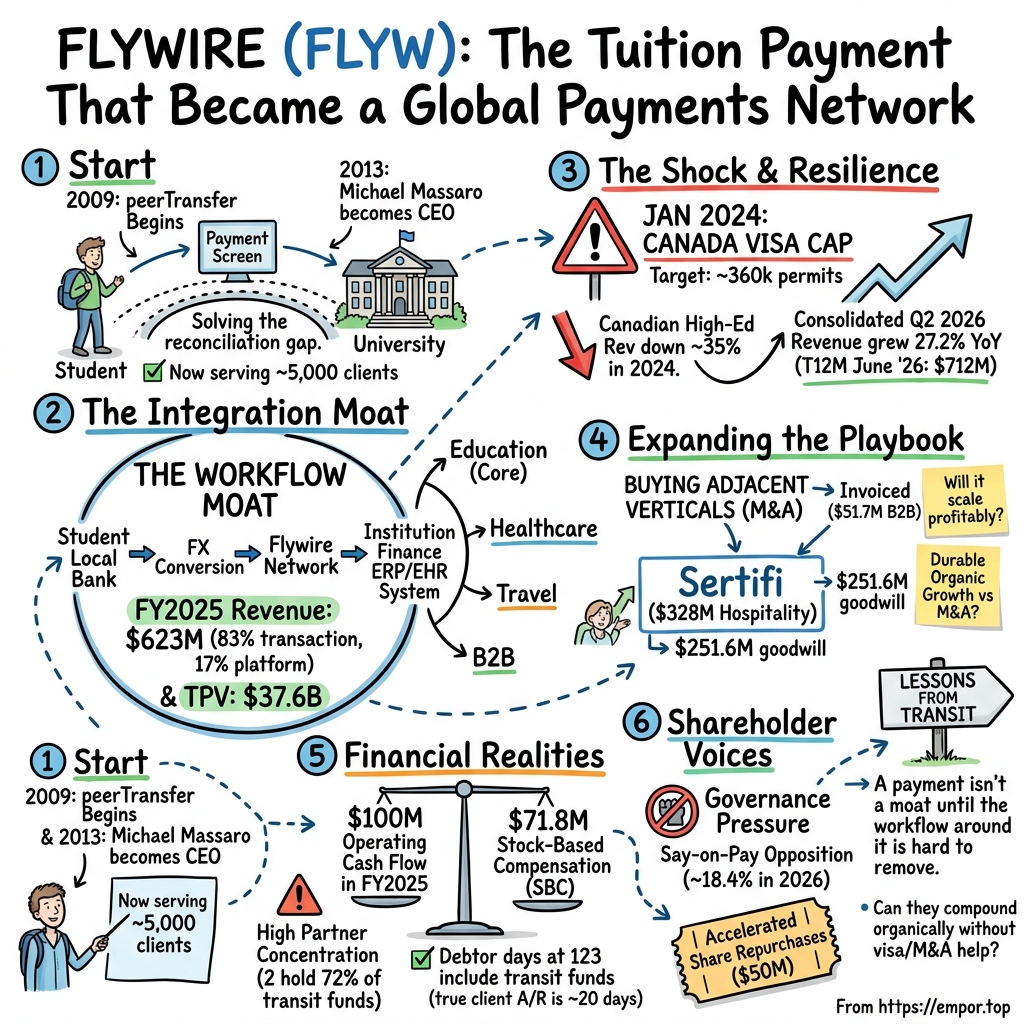
Flywire: The Tuition Payment That Became a Global Payments Network
I. The Visa Cap Hits the Payment Screen
Picture two screens on opposite sides of the world. On one, a student in Lagos, Delhi or Ho Chi Minh City is looking at a tuition bill priced in Canadian dollars, trying to work out how to get thousands of dollars of family savings out of a local bank account and into a college account in Ontario. On the other, a bursar's office clerk in that college is waiting for the money to land and, more importantly, waiting to know whose money it is. Between the two screens sits Flywire, the company that turns a family's local-currency payment into a reconciled credit on the right student's account. For most of its life, Flywire's growth question was about how many of those screens it could connect. In January 2024, the question changed. It became whether the student would be allowed to come at all.
On January 22, 2024, Canada's immigration department announced a two-year cap on new international study permits, setting the 2024 intake at roughly 360,000 approved permits, a decrease of about 35% from the year before.1 Ottawa's reasons were housing, health care and what it called a lack of integrity in parts of the international student system. Flywire's reason to care was simpler. Canadian colleges and universities had become one of the fastest-growing corners of its education business, and a decision taken in a cabinet room about housing pressure was about to flow, almost mechanically, onto Flywire's payment screens.
It did. Flywire later told investors that its revenue from Canadian higher education fell by about 35% in 2024, a decline that tracked the government's cut almost one-for-one.5 That is the uncomfortable symmetry at the heart of this story. Flywire built a business that is very good at moving a payment once a student has decided to enrol, and it has almost no say over whether that student is allowed to enrol. Its customers' customers are, in a sense, regulated by somebody else.
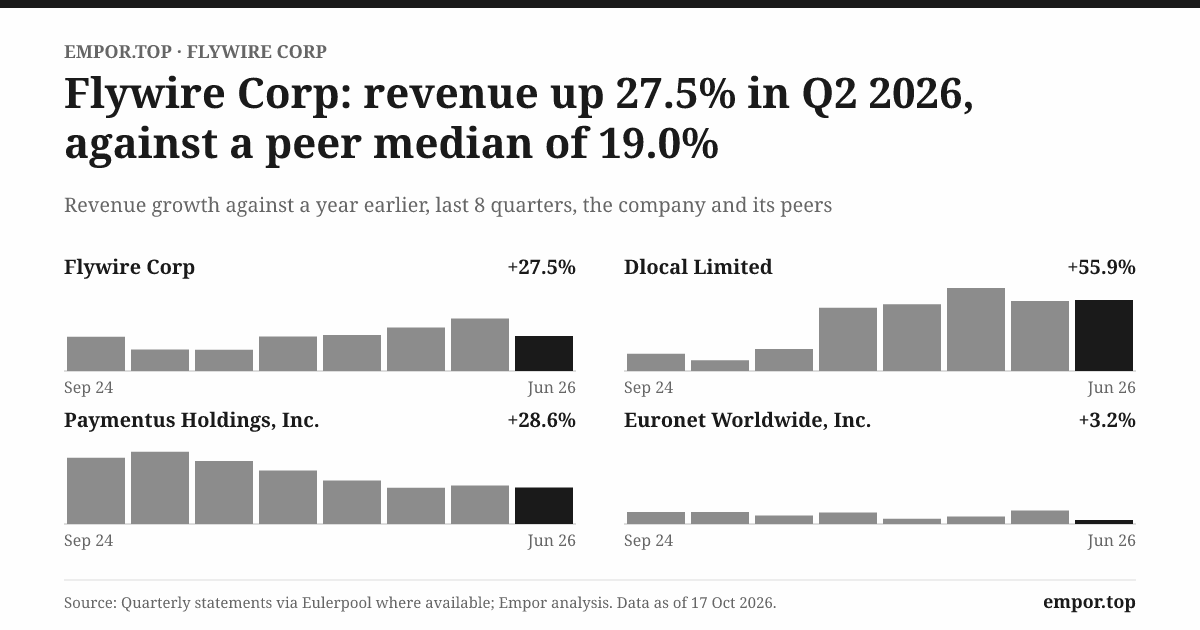
And yet the company is far from broken. Flywire's revenue reached $623 million in 2025 and about $712 million in the twelve months to June 2026.23 In the second quarter of 2026, revenue grew about 27% from a year earlier, which looks like a full recovery from the visa-cap slowdown.3 In 2025 it earned its first meaningful operating profit as a public company, about $20 million, and net income of $13.5 million.2 Read the headline, and the Canadian episode looks like a speed bump.
Read the footnotes, and it looks more complicated. Between the slowdown and the rebound, Flywire bought two businesses: the accounts-receivable software company Invoiced in August 2024 and the hotel-payments platform Sertifi in February 2025, the latter for about $328 million net of cash.2 Revenue that arrived through those doors counts in the consolidated growth rate, but it is not the same thing as more students paying more tuition through Flywire. So the recovery is real at the level of the income statement, and harder to read at the level that matters most, which is whether the original engine has started compounding again on its own.
That is the first of four questions this story will chase. The second is whether Flywire's mix of software and payments is genuinely hard for a university, hospital or hotel to replace, or merely convenient. The third is whether its strong cash generation belongs to shareholders once the cost of paying employees in stock is counted. The fourth is what its large acquisitions actually bought.
Running through all four is a distinction that matters more at Flywire than at most companies. Payment volume, the value of money that passes through the network, can surge while revenue per dollar moved, the mix of businesses and the profit per payment all move in different directions. In 2025, Flywire moved about $37.6 billion of payments.2 Whether that river of money becomes durable profit depends on how much of it the company is allowed to keep, and on what it costs to make each dollar flow.
To understand why that is such a hard question, it helps to go back to the problem Flywire was invented to solve, and to the fact that, at the beginning, it was not really a payments company at all.
 Subscribe on LinkedIn
II. A Tuition Payment Becomes a Company
In the late 2000s, paying tuition across a border was a small ordeal dressed up as a bank transfer. A family abroad would walk into a branch, fill in a wire form with a long string of account numbers, pay a fee they could not quite see, accept an exchange rate they could not quite check, and hope. On the other end, a university would receive a wire that had been shaved by intermediary banks, arrived short of the invoice, and carried a reference field that might say a parent's name, a misspelt student name, or nothing useful at all. Someone in the bursar's office then played detective.
peerTransfer was founded in 2009 to remove that detective work.4 The company was incorporated in Delaware that July, and its founding idea came from the student side: its founder, Iker Marcaide, a Spaniard who had paid his own way into an American business school, had experienced the friction of sending tuition across borders first-hand.4 The insight that turned an annoyance into a company was that the problem was not only the transfer. Banks could already move money. What nobody did well was combine three jobs at once: let the payer pay in a familiar local way, deliver the full amount in the institution's currency, and tell the institution exactly which student account the money belonged to.
That combination is the seed of everything Flywire later became. A bank sells money movement. An accounting system sells reconciliation. peerTransfer sold the two welded together, priced into the payment itself, and placed inside the institution's own workflow. The payer saw a portal with local options; the school saw a clean, matched payment. The company's revenue came from the payment flow, which meant it was paid when money moved, not merely when software was licensed.
In December 2013, Michael Massaro became chief executive, and the era he started has not ended.4 Massaro came from the finance and operations side of the company rather than from banking royalty, and his defining decision was to treat the tuition business as a template rather than a destination. If the hard part of an international tuition payment was the reconciliation and integration around it, then other industries with complicated, high-value, often cross-border receivables might want the same thing. Hospitals had patients with confusing bills. Travel operators had customers paying large deposits from abroad. Businesses chasing invoices had their own reconciliation mess.
In December 2016 the company renamed itself Flywire, a name that signalled the ambition was broader than students.4 It entered healthcare, notably by acquiring Simplee, a patient-billing software company, and it pushed deeper into education with businesses such as StudyLink in Australia, which added software around international student applications.42 By the time of its May 2021 initial public offering, Flywire described itself as a payments enablement and vertical software company serving education, healthcare, travel and business-to-business clients.4 The IPO priced at $24 a share and raised about $269 million in net proceeds.4
At its 2022 Analyst Day, management laid out the strategy in the shape it still uses: a common global payments network underneath, and vertical software on top, tailored to each industry's way of billing and collecting.[^6] The pitch was elegant. Every new vertical could ride on the same licences, bank relationships, currency corridors and compliance machinery, so each added industry should cost less to enter than the last.
The record since then supports the operating regime more than it proves the theory. Flywire grew from about $95 million of revenue in 2019 to $623 million in 2025, a compound rate of roughly 37% a year, all under Massaro.42 It ended 2025 with about 5,000 clients, compared with about 2,250 at the time of the IPO.24 That is a substantial record of execution. What it does not yet show is that the newer verticals can stand beside education at similar scale. Education remained the engine; healthcare, travel and business-to-business were, in the company's own framing, opportunities being built rather than replacements already built.
Which is why Massaro is the principal witness in this story. In May 2024, a few months after the Canadian cap, he spoke to investors with confidence about Flywire's ability to navigate visa policy changes.7 By November of that year, management was preparing investors for Canadian revenue to be roughly flat in 2025 after a hard 2024.[^10] Weighing those two moments against each other, and against the recovery that followed, is a test of judgement and candour. But first it is worth understanding exactly what Flywire sells, because the strength of its defence depends on it.
III. The University's Back Office Becomes the Product
Follow one payment. A family in Seoul owes a British university £20,000 in tuition. Through the university's Flywire-powered portal, the parent chooses to pay in Korean won through a domestic bank transfer, a method they use every week. Flywire quotes a locked exchange rate. The parent sends won to a Flywire account held at a local partner bank, which means the money never has to make an expensive, uncertain journey as an international wire from the family's side. Flywire then converts the won into pounds, either through its own currency positions or through a banking partner, and pays the university in sterling, in full, with a reference that identifies the student. The university's finance system, whether built on software from a vendor such as Ellucian, Workday or Oracle, receives a record it can post without anybody playing detective.2
That walk-through explains why the company prefers to describe itself as something more than a processor. The physical movement of money is the commodity part of the job. The valuable parts are the local collection network in many countries, the currency conversion at a visible rate, and above all the matching of money to an account inside the client's own system. Flywire holds money transmitter licences or equivalent authorisations across dozens of jurisdictions and supports payments in well over a hundred currencies, and those capabilities are expensive and slow to replicate.2
The pricing unit follows the work. Flywire earns most of its money as transaction revenue: fees tied to the payment flow, typically a percentage of the payment, which varies with currency corridor, payment method and whether the payment is domestic or cross-border. The rest comes from what the company calls platform and other revenue, which includes software subscriptions, application processing in education, fees from payment plans and related services.2 In 2025, transaction revenue made up about 83% of revenue less ancillary services, and platform and other revenue about 17%.2 In plain terms, Flywire is still mostly paid a slice of the money it moves. Software makes the slice defensible; it does not yet replace it.
The total for 2025 was $623 million of revenue on the $37.6 billion of payment volume, which works out to Flywire keeping roughly 1.7 cents of every dollar it moves.2 That ratio is the single most important number for understanding the business, because it is the one most exposed to mix. A large cross-border tuition payment from a country with a less developed currency market can carry a rich fee. A domestic payment, say an American patient paying an American hospital or a US student paying a US university through a payment plan, carries far less. Flywire's domestic volume grew faster than its cross-border volume in 2025, which means a dollar of growth there is worth less in revenue than a dollar of growth in the old tuition corridors.2
The calendar adds a second rhythm. Universities collect the bulk of fees ahead of the autumn term, so Flywire's third quarter is its harvest. In the third quarter of 2025, revenue was about $200 million and the operating margin about 16%.2 Two quarters later the picture inverts: in the second quarter of 2026, revenue was about $168 million and the company posted a small operating loss.3 Costs, mostly people and technology, arrive evenly through the year; revenue arrives in a wave. Any quarter taken alone tells you more about the academic calendar than about the business.
Who else could carry the payment
The defence of that 1.7-cent slice is where the story turns into a war game. In education, Flywire competes with Convera, the former Western Union business payments arm, with Nelnet and its campus commerce businesses, with TouchNet and Transact, which are deeply embedded in American campus payment systems, and with specialists such as PayMyTuition.2 In healthcare it meets patient-billing players such as Waystar and Cedar. In business-to-business receivables, Billtrust and HighRadius sell accounts-receivable automation to the same finance departments that Invoiced targets. And in hotels and travel, broad processors such as Stripe and Airwallex can offer cross-border acceptance as one feature among many.2 Each competitor attacks a different layer: some own the campus software, some own the currency conversion, some own the merchant relationship.
Run the five forces through that map and the shape of the business becomes clear. Buyers have real power: a university can split its business, keep the old bank wire as a free fallback, or invite rival bids at renewal. Payers, the families and patients, are price-sensitive and can compare the exchange rate against an app on their phone. Suppliers matter more than they first appear, because Flywire relies on banks and processing partners for settlement and collection in many markets. Against that, the barriers to entry are meaningful: licences, compliance programmes, currency operations and integrations with campus and hospital systems take years to build. The substitution threat is less a new technology than an old one, the bank wire, plus the bundling ambitions of large processors who could push down fees in exchange for volume.
In Hamilton Helmer's language, Flywire's best claim is to switching costs. Once a payment portal is wired into a school's student information system and its finance team's daily routine, ripping it out means retraining staff, rebuilding reconciliation and risking a messy term. There is a weaker claim to a cornered resource in the licence and corridor network, which is costly to copy but can be copied by anyone with enough patience and money, as Convera and the large processors show. Scale economies exist in compliance and in currency netting, but Flywire is small next to a Stripe or an Adyen. There is little evidence of network effects in the classic sense, because one university choosing Flywire does not make Flywire more valuable to another university. Counter-positioning, brand and process power are, on the record, modest.
The evidence for switching costs is decent but not decisive. Flywire has reported net revenue retention above 100%, meaning that existing clients, as a group, spend more each year than the year before, and it added thousands of clients in the years after the IPO.2[^6] No single client accounted for 10% or more of revenue in any of the last three years, so no one buyer can hold the company to ransom.2 What the company does not publish is the evidence that would turn stickiness into pricing power: how often it loses competitive bids, how much it discounts at renewal, how its take rate moves within the same client over time, or what each vertical earns. Retention above 100% can coexist with gradual fee pressure, particularly when payment volume per student rises with tuition inflation.
The partner at the other end
The weakest point in the moat sits not with the clients but with the pipes. At the end of 2025, Flywire was owed $155.5 million by its payment partners, money collected from payers but not yet passed on to Flywire. Two unnamed partners accounted for 72% of that balance, and the largest had grown from 19% to 47% of it within a single year.2 A company that boasts of owning its rails also, it turns out, depends on a concentrated handful of banks and processors to make those rails work. If one of them repriced, tightened terms or exited a corridor, Flywire would feel it in both cost and convenience.
So the honest description of the moat is narrower than the marketing. Licences in dozens of jurisdictions, proprietary routing and deep integrations with enterprise resource planning and electronic health record systems are real operational capabilities. They are not, on their own, proof of a cornered market. They make Flywire hard to dislodge from a client that is already happy, and they make it a credible bidder for a client that is not. Whether they protect price, rather than just position, remains unproven in public data.
Education also remains the centre of gravity. Travel grew with Sertifi, healthcare and business-to-business broaden the market, but the company does not disclose margins by vertical, and none of the newer businesses has been shown to rival education's scale or profitability.23 That is why a decision in Ottawa could hurt so much, and why the way management handled it deserves a closer look.
IV. Canada Turns a Growth Story into a Test of Management
By the spring of 2024, Canadian colleges were already receiving the provincial allocations that would tell them how many permit applications they could sponsor. Some institutions slashed intake plans; some programs designed largely for international students began to shrink. On Flywire's first-quarter call in May 2024, management struck a reassuring note: allocations had come in better than some had feared, the company had navigated visa changes before, and its diversified footprint across countries gave it room to absorb the shock.7
Six months later the tone had shifted. On the third-quarter call in November 2024, management told investors that Canada would remain difficult and that it expected its Canadian revenue to be roughly flat in 2025, after the steep fall in 2024.[^10] In between, Canada had tightened further. Ottawa reduced its targets for 2025 and later ended the Student Direct Stream, the fast-track visa route that many students from India and other large source countries had used, which altered not only how many students came but when they paid.15 Australia and the United Kingdom also tightened their own student-visa rules, so the problem was no longer one country's policy but a direction of travel across several of Flywire's most important destinations.5
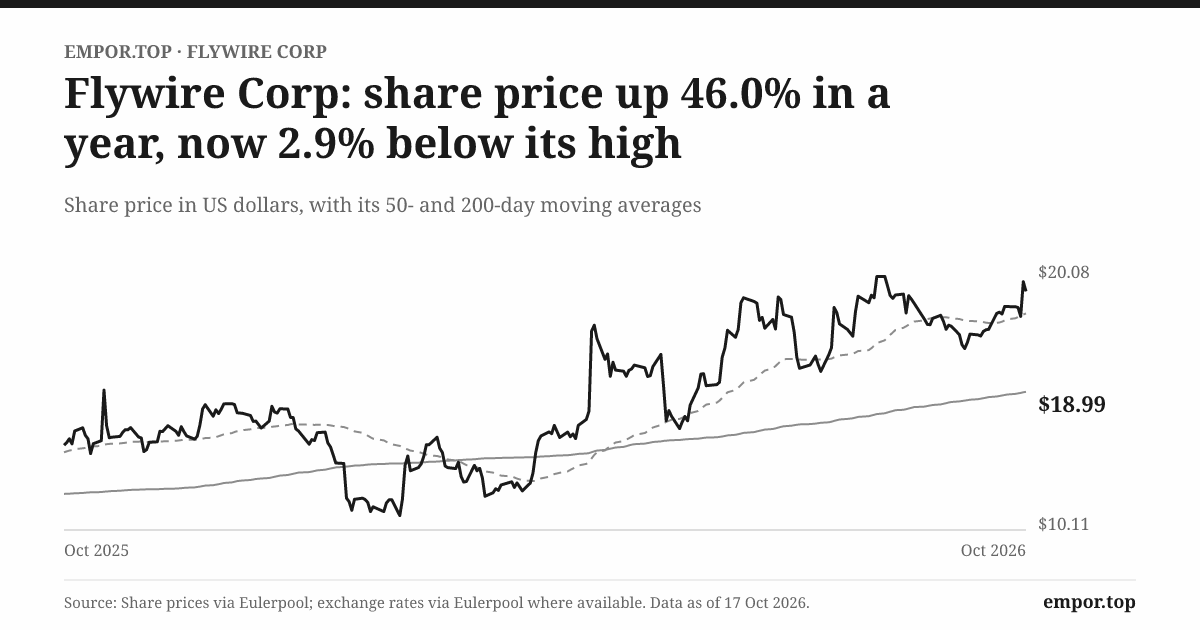
The numbers tell the story of the slowdown without much help. Revenue growth fell from about 39% in 2023 to about 22% in 2024.65 In the fourth quarter of 2024 and the first quarter of 2025, growth dropped to about 17%, the slowest pace in the company's public life.52 For a stock priced on the assumption of rapid compounding, that was the difference between a growth story and a question mark, and the share price behaved accordingly, falling by as much as 72% from its post-IPO high at its worst.
Was the early reassurance reasonable? The external shock was not Flywire's fault, and no payments company controls immigration policy. But management's May 2024 framing leaned on the idea that Flywire's breadth made such shocks manageable, and the following quarters showed that the Canadian exposure was large enough, and the policy direction persistent enough, to bend the consolidated growth rate. The most charitable reading is that management underestimated how far governments would go. The less charitable reading is the one plaintiffs have chosen.
In July 2025, Flywire and some of its executives were named in a putative securities class action in the Eastern District of New York, Hickman v. Flywire Corporation. The complaint, amended in January and again in May 2026, alleges that the company overstated the sustainability of its growth and understated the effect of visa policy changes on its business.23 Flywire contests the claims, and the case is unresolved. An allegation is not a finding, and the matter should be weighed as a legal overhang rather than as a verdict on management's honesty.
What the recovery is made of
Then growth came back. Revenue rose about 27% in 2025, and quarterly growth accelerated through the year, reaching around 41% in the first quarter of 2026 before settling at about 27% in the second quarter.23 Management attributed the rebound to new-client wins, strength in the United Kingdom and other destinations, momentum in travel and business-to-business, and the steady deepening of its software offering.[^11][^4] Some of that is surely true. The United Kingdom, for example, kept attracting international students even as Canada shrank.
But the recovery contains at least four different ingredients, and investors only get a clear view of some of them. The first is underlying volume from existing and new clients. The second is take rate, which tends to fall as domestic and lower-priced volume grows faster. The third is currency, because a weaker dollar flatters revenue earned in pounds, euros and Australian dollars when translated back. The fourth is acquisitions. Sertifi was consolidated from early 2025 and Invoiced from August 2024, so for most of 2025 every dollar they contributed showed up as growth that a like-for-like comparison would exclude.2
Management has offered adjusted measures that strip out some currency effects and the acquired businesses for particular periods, but it does not publish a clean, consistent organic revenue series by vertical that would let an outsider rebuild the story quarter by quarter.[^4][^11] That leaves one narrow question genuinely open. How much of the latest acceleration would remain without the businesses Flywire bought? It matters because the investment case is built on organic compounding, and the policy shock showed that the education engine can stall. If the answer is "most of it," the Canadian episode was a detour. If the answer is "less than it looks," growth has partly been purchased, which shifts the spotlight squarely onto the price paid for it.
V. Sertifi Costs More Than a Year of Growth
In February 2025, Flywire announced it would buy Sertifi, a Chicago-area software company that handles the awkward money moments in hospitality: authorising a credit card for a large group booking, collecting a deposit for a wedding block, securing payment for an event contract signed with a hotel's sales team.8 Sertifi's software sat inside the workflow of hotel sales and events teams at thousands of properties, and Flywire's pitch was familiar. Bring the global payments network to a vertical where the software was already embedded, and monetise more of the money flowing through it.8
The cheque was large. Flywire paid about $328 million net of cash acquired, and to help fund the deal it drew $125 million on its revolving credit facility.2 At that moment the company had about $611 million of cash and short-term investments on its year-end 2024 balance sheet, and the purchase price was more than half of its entire 2024 revenue of $492 million.5 For a company whose 2024 operating result was a loss, this was not a tuck-in. It was the largest capital-allocation decision of the Massaro era.
Sertifi was the second step in a sequence. Six months earlier, in August 2024, Flywire had bought Invoiced, an accounts-receivable automation platform aimed at small and mid-sized businesses, for about $51.7 million net of cash.2 Management described Invoiced as fast-growing and as the foundation of a more software-led business-to-business offering.5 Together, the two deals extended the strategy laid out at the 2022 Analyst Day: buy vertical software that already owns a workflow, then lay Flywire's payments underneath it.[^6]
What the accountants recorded
Purchase accounting offers a rare window into what a buyer thinks it is paying for. Of Sertifi's net consideration, $251.6 million was recorded as goodwill, roughly three-quarters of the price, alongside $86.7 million of identifiable intangible assets such as customer relationships and developed technology.2 Goodwill is the residue: the part of the price that cannot be pinned to an identifiable asset. Flywire attributed it to Sertifi's assembled workforce and to the revenue and cost synergies it expected from combining the businesses.2 PwC, Flywire's auditor, flagged the valuation of Sertifi's customer relationships and developed technology as a critical audit matter, a reminder that these numbers depend heavily on management's forecasts.2
None of this proves overpayment. Software acquisitions routinely carry large goodwill balances, because the value of a growing software business lies in future customers and cross-selling rather than in assets on the balance sheet. But a goodwill-heavy price does raise the bar for proof. If the synergies arrive, the goodwill will look like a fair estimate of future cash. If they do not, it becomes a candidate for impairment, and an impairment would be an admission in the accounts that the company paid for something that did not materialise.
What makes an independent verdict difficult is what Flywire does not disclose. It has not published Sertifi's or Invoiced's standalone revenue, profit or cash flow at acquisition, so there is no honest way to compute a purchase multiple, or to compare it with the prices paid for similar hospitality or receivables software. Any precise multiple floating around without those inputs is guesswork. The right standard is to track what the company does say over time: acquired revenue contribution, gross profit, cross-selling wins and integration milestones, and whether goodwill survives the annual impairment test.
The money trail
The funding story, at least, ended tidily. Flywire repaid the $125 million revolver draw before the end of 2025 from cash and operating cash flow, paying about $3.5 million in interest along the way.2 But the balance sheet looked very different afterward. Cash and investments fell from about $611 million at the end of 2024 to about $355 million at the end of 2025.52 The company remained debt-free in any meaningful sense, with its $300 million revolving facility undrawn, but the fortress was smaller.23
Put the acquisitions beside the other uses of shareholder capital, and a fuller picture appears. In August 2023, Flywire sold new shares in a follow-on offering that raised about $261 million net, explicitly to fund acquisitions and general corporate purposes.6 It then spent about $45 million in net cash on acquisitions in 2024 and about $325 million in 2025, while also buying back roughly $118 million of its own stock across those two years.52 In other words, the company raised equity at one price and then spent cash both buying businesses and buying back its own shares, all within about two years.
That pattern is not inherently wrong. Raising money when the stock is valued highly and repurchasing it when the stock is cheap can be good capital allocation. But it sets up a test that cannot be passed on narrative alone. The acquisitions need to earn more than the shares that funded them, and the buybacks need to shrink the share count rather than merely absorb new grants to employees. Which leads to the most important number Flywire's cash-flow statement does not put in bold.
VI. A Cash-Rich Business with a Stock-Compensation Bill
Open Flywire's 2025 cash-flow statement and the top line looks like a different company from the income statement. Net income was $13.5 million.2 Cash from operations was about $100 million.2 Free cash flow, after a tiny capital expenditure bill, was about $99 million.2 For a company that had reported cumulative net losses of about $91 million between 2019 and 2025, it generated about $283 million of operating cash over the same seven years.24 How does a business lose money on paper and fill its bank account at the same time?
There are three main reasons, and each says something different about the quality of the cash. The first is stock-based compensation. Flywire pays a large part of its workforce in shares and options, and accounting rules charge that as an expense in the income statement without any cash leaving the company. In 2025 the figure was $71.8 million, up from about $44 million in 2023.26 That non-cash charge is added back in the cash-flow statement, which is why it inflates operating cash flow relative to profit.
The second is amortisation, the gradual write-down of intangible assets bought in acquisitions. It is also non-cash, and it grew with Sertifi. The third is the float that comes from being in the middle of payments. When a family pays tuition, Flywire may hold the money for a few days before it is delivered to the university. When a partner bank collects money for Flywire, it may hold that cash for a few days before passing it on. The balance between what Flywire owes clients and what partners owe Flywire moves with the season and with growth, and those movements pass through operating cash flow.2
That third mechanism deserves care. Funds payable to clients are not Flywire's money; they are tuition, hospital bills and hotel deposits on their way to someone else. When volumes grow, the balance can grow too, flattering the cash-flow statement in a way that would reverse if volumes shrank. Over 2023 to 2025, changes in funds payable to clients added about $181 million of operating cash, partly offset by about $94 million of cash tied up in funds receivable from payment partners.2 A careful owner separates the money Flywire earns from the money that is merely passing through its hands.
The capital-light character, by contrast, is genuine. Flywire spent only about $1.4 million on property and equipment in 2025, a rounding error against revenue.2 Its real reinvestment happens through engineers' salaries, capitalised software of about $8.5 million, and acquisitions.2 There are no factories to rebuild. That is the source of the business's appeal: once the network exists, the incremental capital needed to process more payments is modest.
Charging the bill
Now apply the test that matters for owners. If stock compensation is treated as what it is economically, a way of paying employees with a slice of the company instead of with cash, then it belongs in the cost of running the business. Subtract the $71.8 million from 2025 free cash flow of about $99 million and what remains is roughly $27 million.2 At a market value of about $2.3 billion, that is a yield of a little over 1%, rather than the headline 6.6% that appears when the stock bill is ignored. The difference is not a trick of accounting. It is a statement about who receives the cash the business generates: a large part of it is effectively paid to employees, through the dilution their shares create.
The repurchase programme is the company's answer. The board authorised $150 million of buybacks in August 2024, and Flywire repurchased about 2.4 million shares for $43.7 million in 2024 and about 5.6 million shares for $74.3 million in 2025.2 That is real money returned. But shares outstanding still drifted upward, from about 120.1 million at the end of 2025 to about 121.6 million by June 2026, as non-voting shares converted and employee awards vested.23 The buybacks have, so far, mostly kept pace with the equity paid to staff rather than shrinking the company's share count meaningfully.
In May 2026, Flywire went further and announced an accelerated share repurchase of up to $50 million, its largest single capital-return action as a public company.[^15] An accelerated repurchase lets the company retire a block of shares immediately through a bank, which settles the final price over the following months. It is a signal of confidence and, given the shareholder mood, also a response to pressure. Whether it changes the arithmetic depends on one simple measurement: diluted shares outstanding a year from now, compared with today.
Management's preferred profit lens, adjusted EBITDA, excludes stock compensation, acquisition costs, restructuring and amortisation. It makes the company look substantially more profitable than GAAP results do, and it is useful for understanding operating leverage.[^4] It is less useful for understanding what an owner receives. The gap between the two figures is the stock bill plus the cost of past deals, both of which recur in some form. For investors, the cleanest single scorecard is free cash flow per diluted share after stock compensation, and on that measure Flywire is profitable but small. Another headline ratio, however, makes the company look much worse than it is.
VII. The 123-Day Debtor Is Mostly Not a Slow-Paying Customer
Glance at a standard screen of Flywire's ratios and one figure leaps out. Receivables, measured against revenue, stood at about 123 days at the end of 2025.2 For a typical company, that would mean customers were taking four months to pay, the kind of number that makes an analyst wonder about aggressive sales terms or doubtful collections. For a company whose consumers usually pay upfront by card or transfer, it seems bizarre.
The explanation lies in what the balance sheet puts in the same neighbourhood. At year-end 2025, ordinary accounts receivable, money clients owed Flywire for services such as software subscriptions, was only about $35 million gross.2 Next to it sat $155.5 million of funds receivable from payment partners: tuition and other payments that had been collected by banks and processors in local markets and were in transit to Flywire.2 A mechanical ratio that blends the two produces the alarming figure. Strip the partner balances out, and true client receivables represent roughly 20 days of revenue, a perfectly ordinary number for a software and payments business.2
Think of it as the difference between a customer owing a shop money and a courier carrying the shop's takings to the bank. The first is a credit risk with the customer. The second is a timing issue with the courier. The courier is usually reliable, but if one courier carries most of the money, the shop's real risk is the courier, not the customer.
The filings support the benign reading of the customer side. The allowance for credit losses at the end of 2025 was about $0.8 million, small against gross receivables, and Flywire reported no material credit losses across 2023 to 2025.2 No client accounted for 10% or more of revenue or of accounts receivable.2 By June 2026, accounts receivable had risen to about $39 million, consistent with growth rather than deterioration.3
The courier side is where the concentration lives. At the end of 2025, Partner A represented 47% of funds receivable from payment partners and Partner C 25%, compared with Partner A at 19% a year earlier.25 The company does not name the partners, and it does not explain the jump. It could reflect Sertifi's processing arrangements, the timing of year-end settlements, or a deliberate consolidation of volume with a partner that offers better terms. Whatever the cause, the practical effect is that a meaningful share of Flywire's money in transit, at any moment, sits with one counterparty.
That is not a solvency threat; the balances are a fraction of the company's liquidity. It is a reminder of that dependency. Flywire's relationships with institutions may be sticky, but its ability to collect locally and settle globally depends partly on a concentrated group of banks and processors, each with its own commercial interests. The red-flag ratio turns out to be mostly harmless, and the real risk it hides is a strategic one. The next distortion in Flywire's numbers is smaller, but it sits right at the bottom line.
VIII. When Interest and Currency Move the Bottom Line
In 2024, Flywire's operations lost money. The operating loss for the year was about $7.3 million.5 Yet the company reported a small profit before tax. The difference came from below the operating line: about $21.4 million of interest income on the large cash pile that the 2023 equity raise had built, partly offset by an $11.8 million loss from remeasuring foreign-currency balances.5 For a year in which growth was slowing and investors were nervous, the treasury did a lot of the work of keeping the bottom line positive.
In 2025 the roles reversed. Operating profit improved to about $20 million, driven by revenue growth, the high-margin autumn quarter and cost discipline, including a restructuring in the first half of the year that cost about $8.7 million in severance and accelerated stock compensation.2 Interest income fell to about $5.6 million because the cash pile shrank after Sertifi.2 But currency swung the other way, delivering a $7.9 million remeasurement gain, while the revolver cost about $3.5 million in interest.2 Net other income came to about $10.1 million, close to half of pretax profit of about $21 million.2
The lesson is not that the profit is fake. It is that on a small base, items outside the operating business can be as large as the operating result itself. Interest income depends on rates and cash balances. Currency remeasurement depends on where the dollar sits against the pound, the euro and the Australian dollar on the last day of a quarter. Neither is a durable source of earnings, and neither says much about whether universities, hospitals and hotels are getting more value from Flywire.
The currency mechanics are worth unpacking, because they are easy to misread. When Flywire locks an exchange rate for a family, it is exposed for the few days between that quote and settlement. It covers that exposure with short-dated forward contracts; at the end of 2025 it had about 18,000 open client-related forwards with a notional value of about $66.5 million.2 It also entered longer forwards, with about $84 million of notional, to manage currency risk on intercompany loans in pounds and Australian dollars.2 Because Flywire does not apply hedge accounting to these contracts, their fair-value changes and the remeasurement of foreign-currency balances run directly through the income statement.2
So the swing from an $11.8 million loss in 2024 to a $7.9 million gain in 2025 does not prove the hedging failed one year and worked the next. The client-transaction hedges protect the economics of each payment over a short window. The remaining volatility comes largely from balance-sheet exposures and accounting presentation. It is a reporting noise problem more than a risk-management problem, but noise matters when the signal is only $20 million a year.
Taxes add a further layer. Flywire's effective tax rate has swung widely from quarter to quarter, partly because tax benefits from stock compensation vesting and the mix of profitable foreign subsidiaries against loss-making domestic operations can move a small pretax figure around.23 The company has not disclosed a material tax dispute; the swings are better treated as volatility than as a signal. With about $355 million of cash and investments at the end of 2025 and $294 million by June 2026, Flywire is well funded, but a smaller pile means less interest income to soften future operating misses.23 When profit is this thin, how it is shared out becomes a sharper question, and shareholders have started asking it.
IX. The Shareholders Start Asking for a Different Return
The 2026 annual meeting of Flywire's shareholders took place in June, and the result read like a polite letter of complaint. About 18% of votes cast opposed the advisory resolution on executive pay.10 Two directors on the governance committee, Alex Finkelstein and Matthew Harris, saw roughly 30% and 27% of votes withheld.10 Neither result was a defeat; both directors were elected and the pay resolution passed. But in American corporate governance, where routine resolutions often pass with 95% support, opposition of that size is a signal to a board that a meaningful slice of its owners is unhappy.
The pay in question was not extravagant by technology-company standards, but it was large relative to the profits. Massaro's reported compensation for 2025 was about $8.8 million, of which about $7.7 million was stock awards, about 88%.9 The company's net income for the same year was $13.5 million.2 In 2024, when net income was under $3 million, his reported pay was about $10 million.9 Equity-heavy pay aligns an executive with the share price in principle. In practice, when the share price fell sharply after the IPO, the awards granted each year were in larger numbers of shares, adding to dilution.
The voting trend matters as much as the level. Say-on-pay opposition was about 7% in 2024, jumped to about 21% in 2025, and stayed elevated at about 18% in 2026.121110 That pattern suggests the 2025 jump was not a one-off. Some investors, and possibly proxy advisers, had concluded that pay, performance and capital allocation were out of step during a period when growth slowed, the stock fell and the company spent heavily on acquisitions.
There is a cleaner side to the governance record. Flywire's commercial related-party revenue and costs were zero across 2023 to 2025; there are no insider business dealings, royalties or management fees siphoning value.9 The governance issue is not self-dealing. It is the economics of pay and the choices about how to spend capital.
The ownership register explains why those choices are contested. Voss Capital, a hedge fund with a history of pushing companies on strategy and capital return, disclosed a stake of about 10.1% of voting stock in a January 2026 filing, making it the largest shareholder.9 Cadian Capital held about 6.5%, BlackRock about 6.4%, and an affiliate of Singapore's Temasek about 5.1%.9 Massaro owned about 2.2%, and all executives and directors together about 5%.9 So the people running the company own a modest slice, while a single fund with an activist reputation owns twice as much.
It is tempting to turn those facts into a takeover thesis: an activist, a cash-rich balance sheet, unhappy voters. The public record does not support that leap. Voss reported its stake on Schedule 13G, the form used by investors who are not seeking to influence control, and there is no public demand for a sale or for board seats.9 The May 2026 accelerated buyback may be read as management listening; it does not establish that a campaign is underway. Flywire also has a classified board, with directors elected in staggered classes over three years, which slows any attempt to replace a majority quickly.9 That is friction against rapid change, not proof that change cannot come.
The credibility ledger
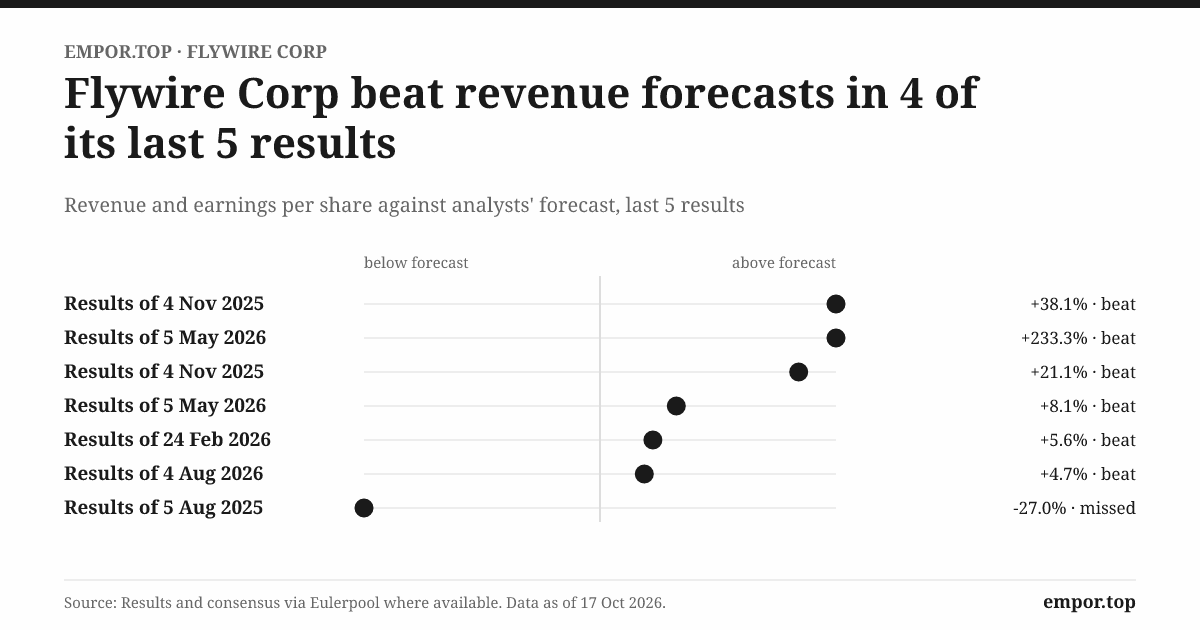
The more useful way to judge management is not through personality but through the record. On guidance, Flywire has generally met or beaten its own revenue outlooks, but the early 2024 framing of visa resilience proved too optimistic about the policy cycle.7[^10] On acquisitions, the claims around Sertifi and Invoiced are plausible and unproven, because the company does not disclose their standalone economics. On capital return, the buybacks were real but have not yet shrunk the share count. And on explanation, management has been willing to discuss the Canadian headwind openly once it was clear, which counts for something.
A skeptical activist would therefore ask four plain questions. Publish organic growth by vertical so owners can see what they are buying. Show Sertifi's contribution to revenue and gross profit. Tie executive equity to per-share cash flow after stock compensation, not just revenue or adjusted EBITDA. And commit to reducing the diluted share count, not merely offsetting grants. Each question is about evidence, and each is answerable by the company. The market's price for the stock is, in effect, its current guess at the answers.
X. What the Market Is Paying to Find Out
On October 17, 2026, Flywire's shares closed at about $19, within 3% of their 52-week high and almost double their 52-week low of about $11. The company was valued at about $2.3 billion, and about $2.0 billion after subtracting its net cash. That is roughly 2.8 times the last twelve months' revenue and about 51 times operating profit. Earnings per share over the last year were about 27 cents, so the price is about 70 times earnings.3 The stock is still far below the levels above $50 it reached after the 2021 IPO, but it has recovered a long way from the visa-cap lows.
Those multiples encode a specific bet. At 2.8 times revenue, the market is not pricing Flywire like a premium software company, and it is not pricing it like a low-growth payments utility. At 51 times operating profit, it is paying for profit that does not yet exist. The implied assumption is that revenue keeps growing in the twenties and that operating margins, now in the low single digits for a full year, widen materially as the cost base scales.
The case for Flywire winning
The bull case rests on evidence, not just hope. Flywire has about 5,000 clients, none of which accounts for 10% of revenue.2 It moved $37.6 billion of payments in 2025, up from about $24 billion two years earlier.26 Its licences, currency corridors and integrations into campus, hospital and enterprise systems make it a credible incumbent in a niche where generic processors struggle to match the reconciliation work. Its balance sheet carries no funded debt and an undrawn $300 million facility.3 Operating leverage is visible: technology and development spending fell from about 17% of revenue in 2022 to about 11% in 2025.2 And the business needs very little physical capital to grow.
The newer verticals give the story more than one engine. Sertifi brought Flywire into hotel group sales, Invoiced into small-business receivables, and healthcare into patient billing. If even one of them reaches education-like scale, the dependence on student flows falls and the multiple could look reasonable in hindsight.
Why it might not
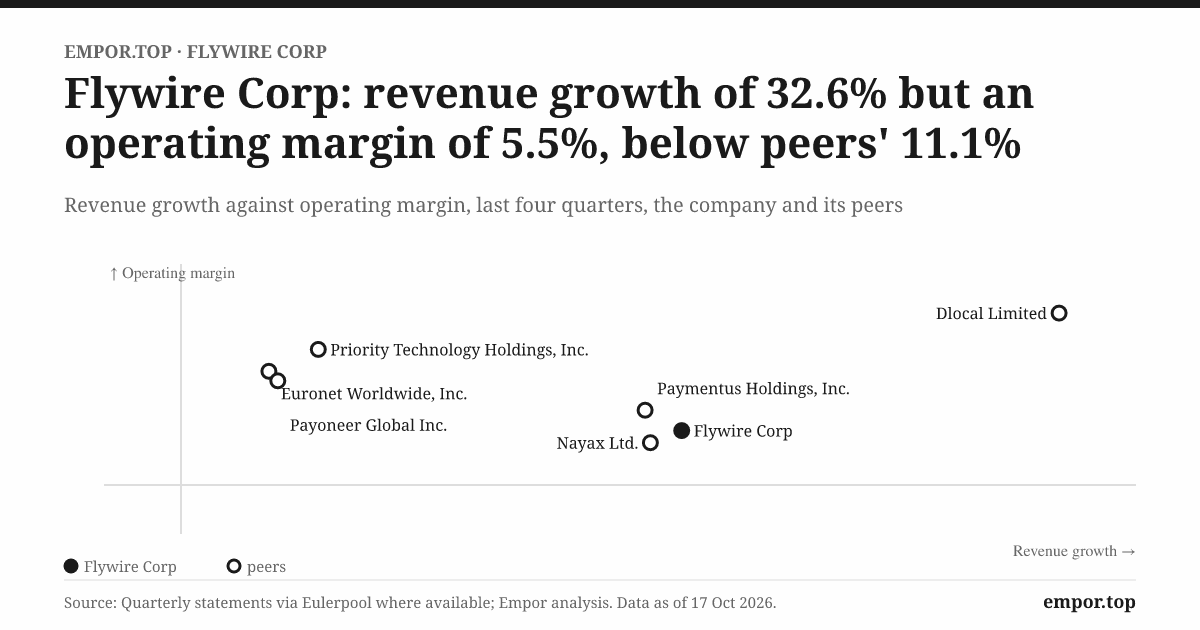
The bear case is equally concrete. Universities and other clients can multi-source and keep the bank wire as a costless fallback. Specialised rivals such as Convera, Nelnet, TouchNet and Transact compete in education, and larger processors can bundle cross-border acceptance and bargain hard on price.2 Student-visa policy in Canada, Australia and the United Kingdom has moved against international students, shrinking the most lucrative payment flow.5 Payment processing costs grew faster than revenue in 2025 as card and domestic mix shifted, a sign that each dollar of growth is costing more to deliver.2 Two partners hold most of the money in transit. And the company's margins, about 3% operating and 2% net for 2025, are thin beside mature payment platforms such as Adyen or Wise, which earn far higher margins on their volumes.2
Comparisons with those peers need care. EV-to-sales ratios across payment companies mean little unless revenue is measured the same way: some report gross revenue including pass-through costs, some report net revenue after them, and take rates differ by an order of magnitude between a card acquirer and a cross-border tuition specialist. The meaningful comparison is of economics, not labels: take rate, gross profit after processing costs, GAAP margins after stock compensation, and dilution. On those measures Flywire's distinctive feature is a high take rate on a niche flow, offset by heavy spending and dilution that keep owner earnings small.
There are also legal and compliance overhangs to keep in proportion. The securities class action remains an allegation. Separately, Flywire has disclosed that an internal review identified apparent violations of U.S. sanctions rules involving payments connected to sanctioned jurisdictions or persons, that it made voluntary disclosures to the Treasury's Office of Foreign Assets Control, and that it is engaging with the agency.23 Voluntary disclosures typically earn more lenient treatment, and the company has not disclosed a penalty estimate. The relevant watch items are any resolution, any penalty, and any changes to controls that might slow volumes in higher-risk corridors.
Three numbers will decide which case wins. The first is constant-currency organic revenue growth by vertical, which tells investors whether the engine is compounding without help; the company publishes only partial versions today. The second is gross profit and operating margin after payment-processing costs, which tells investors whether growth is getting cheaper or dearer to deliver; the full-year operating margin turned positive in 2025, at about 3%.2 The third is diluted free cash flow per share after stock compensation, which tells owners how much of the cash is theirs; it was positive but small in 2025.
Two balance-sheet items sit alongside them: the concentration of money held by payment partners and whether the $50 million accelerated buyback actually reduces the share count. The valuation tension can be stated in a sentence. The headline free cash flow yield of 6.6% looks generous, but once stock compensation is charged as the cost it is, the yield to owners falls to roughly a sixth of that. The market is paying to find out whether the gap will close.
XI. Lessons from the Payment in Transit
Go back to the moment in the middle of the payment. The family's won has left the bank in Seoul. The university's pounds have not yet arrived. For a few days, the money is in transit, sitting with a partner bank, recorded on Flywire's balance sheet as something owed by somebody to somebody else. That moment is the service Flywire sells, and it is also the source of almost every complication in its accounts: the inflated debtor days, the flattered cash flow, the partner concentration, the currency noise. Four lessons come out of that moment.
The first lesson is that a payment is not a moat until the workflow around it is hard to remove. Flywire's insight in 2009 was that universities would value the reconciliation more than the transfer, and its retention and client growth suggest it was right. But the company has never been able to show, in public, that this stickiness lets it hold price against bank wires, campus vendors and large processors. Founders building in payments should notice the distinction. Embedding in the workflow buys loyalty; only evidence of stable or rising take rates buys pricing power.
The second lesson is that growth can cross borders faster than policy can. Flywire built a superb machine for moving tuition from families in one country to institutions in another, and then a government in Ottawa, worried about housing, cut the number of students entering Canada by about a third in a single announcement. No amount of software prevented the hit. Any business whose volume depends on people being allowed to move needs to treat immigration policy as a direct input to its forecast, not as background weather.
The third lesson is that cash is not owner earnings when the share count is the bill. Flywire's cash-flow statement shows nearly $100 million of free cash flow in 2025, and the company's employees received about $72 million of stock in the same year. A buyback that soaks up the shares given to staff is a payroll expense paid in two steps. For investors, the cleanest discipline is to subtract the stock bill first and then ask what is left.
The fourth lesson is that an acquisition thesis is a promise until the acquired economics show up. Sertifi's price was mostly goodwill, an accounting entry that means "we believe this will be worth more together than apart." That belief may prove right. But a company that asks shareholders to accept a goodwill-heavy purchase owes them the evidence afterwards: revenue, margin and cross-selling, disclosed clearly. Until then, the deal is a bet with an unverified outcome, recorded on the balance sheet as if it were an asset.
XII. Epilogue: The Next Fall Intake
Tonight, Flywire is in a better position than it was two years ago. Growth has returned to the high twenties, full-year operating profit has turned positive, the revolver is repaid, and the stock sits near its 52-week high. The autumn of 2026 is already underway, and the company's third quarter, which ended on September 30, has closed. Its results, the most important set of the year, will tell investors how much tuition flowed through the network during the peak season.
Several things will settle the story's central questions over the next few quarters. The first is whether management reports organic, currency-neutral growth clearly enough to separate student volume from acquired revenue. With Sertifi now fully in the year-earlier comparison base, reported growth will need to stand without the acquisition boost, which makes the coming quarters a natural test. If growth holds in the twenties, the organic engine has recovered. If it falls sharply, the 2025 acceleration was partly bought.
The second is education itself. Canada's caps remain in place, and other destination countries have tightened their rules. Watch whether new-client additions and retention keep offsetting fewer students per client, and whether the United Kingdom and other markets keep growing. A stabilising Canada would remove a drag; a further tightening elsewhere would add a new one.
The third is whether Sertifi and Invoiced start producing evidence, not just consolidated revenue: cross-selling wins, gross profit, and a clean annual impairment test for their goodwill. The fourth is the plumbing: the share of money held by the largest payment partner, the trend in processing costs, and any update on the OFAC disclosures. And the fifth is the share count. After the accelerated buyback settles, diluted shares should be lower than they are today, and free cash flow per share after stock compensation should be rising.
If all five move the right way, Flywire will have shown that a niche payments network can compound through a policy shock and become a profitable multi-vertical platform. If organic growth fades, partner costs climb and the share count keeps creeping up, the market will have paid a growth multiple for a business that grows mainly by buying. Between those outcomes sits the tension that has defined Flywire since its IPO: a company that is clearly good at its job, still waiting to prove the job is a great business.
XIII. Outro
Return to the bursar's office. The money has crossed a border, been converted, and arrived in full. Somewhere, a clerk does not have to play detective, because the payment says exactly whose tuition account to credit. Nobody in that office thinks about the partner bank that held the funds for three days, the forward contract that locked the rate, or the licence that let the money cross the border legally. That invisibility is the product.
Flywire's whole story is an attempt to make the knowing more valuable than the moving: to make the reconciliation, the integration and the trust around a payment worth more than the transfer itself. Fifteen years on, with about 5,000 institutions relying on it, that idea has clearly found customers. Whether it can command durable economics, in a world of bank wires, bundling processors, concentrated partners and governments that can close the door on students, is the part of the story still in transit.
References
-
Canada to stabilize growth and decrease number of new international student permits issued to approximately 360,000 for 2024 — Immigration, Refugees and Citizenship Canada, 2024-01-22 ↩↩
-
Flywire Form 10-K for FY2025 — SEC, 2026-02-24 ↩↩↩↩↩↩↩↩↩↩↩↩↩↩↩↩↩↩↩↩↩↩↩↩↩↩↩↩↩↩↩↩↩↩↩↩↩↩↩↩↩↩↩↩↩↩↩↩↩↩↩↩↩↩↩↩↩↩↩↩↩↩↩↩↩↩↩↩↩↩
-
Flywire Form 10-Q for Q2 2026 — SEC, 2026-08-05 ↩↩↩↩↩↩↩↩↩↩↩↩↩↩
-
Flywire Form 424B4 IPO Prospectus — SEC, 2021-05-26 ↩↩↩↩↩↩↩↩↩↩
-
Flywire Form 10-K for FY2024 — SEC, 2025-02-26 ↩↩↩↩↩↩↩↩↩↩↩↩↩
-
Flywire Acquires Sertifi to Accelerate Travel Business — Flywire, 2025-02-25 ↩↩
-
Flywire 2026 Definitive Proxy Statement — SEC, 2026-04-23 ↩↩↩↩↩↩↩↩
-
Flywire 2026 Annual Meeting Voting Results, Form 8-K — SEC, 2026-06-05 ↩↩↩
-
Flywire 2025 Annual Meeting Voting Results, Form 8-K — SEC, 2025-06-06 ↩
-
Flywire 2024 Annual Meeting Voting Results, Form 8-K — SEC, 2024-06-07 ↩
 LinkedIn
 WhatsApp
 Reddit
 Hacker News
 Email
 Kindle
 RSS Feed
 Spotify
 Apple Podcasts
 Amazon Music
 Audible
 YouTube