dLocal: The Toll Road Across the Emerging-Market Payments Frontier
I. Introduction & Episode Roadmap
Somewhere in Lagos tonight, a driver finishes a shift and gets paid into a mobile wallet. In São Paulo, a shopper splits a purchase into twelve installments on a credit card issued by a bank most Americans have never heard of. In Cairo, someone buys a streaming subscription with a card scheme called ميزة Meeza that no Silicon Valley product manager has ever integrated. In Hanoi, a remittance lands in dong at an exchange rate set by a spread nobody outside the transaction can see.
Four transactions, four currencies, four regulatory regimes, four completely different sets of local plumbing. And in a meaningful number of cases, a single Uruguayan company sits in the middle of all of them, collecting a fraction of a percent for making the complexity go away.
That company is DLocal Limited, which trades on the Nasdaq under the ticker DLO and runs its business out of Montevideo, Uruguay — a city better known for beaches and beef than for global financial infrastructure.1 Its pitch to customers is almost aggressively boring: one API, one platform, one contract, and you can get paid and make payments across the emerging world without setting up a single local entity yourself.1 Its customer list is not boring at all. As of the second quarter of 2026, management said more than 760 enterprise merchants use the platform, including four of the largest ride-hailing companies operating in emerging markets, five of the ten largest e-commerce platforms, the top five video streaming platforms, and seven of the ten largest remittance companies.2
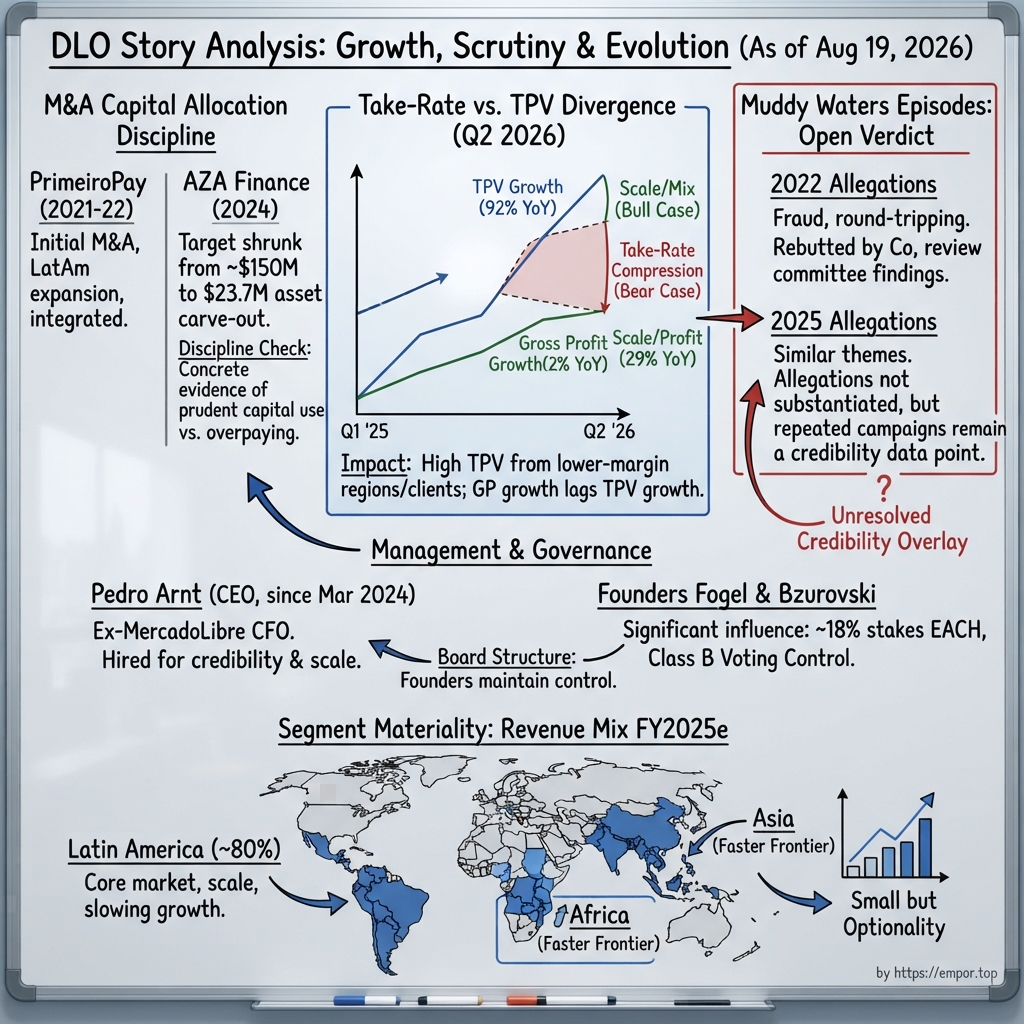
Here is the hook. In the quarter ended June 30, 2026, dLocal processed $17.7 billion of payment volume, up 92% year over year — the fastest growth rate the company had posted since early 2022.3 And in that same quarter, gross profit grew 29%.3
Sit with that gap for a moment, because it is the entire investment debate in one line. Volume nearly doubled. The profit dollars that volume produced grew less than a third. Expressed as a take rate — gross profit divided by volume processed — dLocal earned 0.72 cents on every dollar it moved, down from 1.07 cents a year earlier.3 Management calls this a deliberate trade: give the world's largest platforms better pricing, win a bigger share of their business, and compound absolute gross profit even as the percentage shrinks. Skeptics call it something simpler and less flattering: a company discovering that its customers have more bargaining power than it does.
The tension is sharpened by history. Twice in three years, prominent short sellers have argued that dLocal's economics are not merely optimistic but partly fictional. On November 16, 2022, Muddy Waters Research published a report concluding that "our research leads us to believe that DLO is likely a fraud," and the stock fell roughly 51% in a single session, from $21.22 to $10.46.45 In February 2025, dLocal publicly refuted a second short-seller report and reconfirmed that its Audit Committee had previously run an independent review with outside counsel and a forensic accounting firm.6 As of this writing, no SEC enforcement action or material restatement has been disclosed arising from either episode, and the first securities class action against the company was dismissed at the trial level in March 2025.1 That is meaningfully exculpatory. It is not the same as vindication.
So this is a story about a genuinely unusual business — capital-light, cash-generative, growing volume at rates most fintechs stopped posting years ago — that has spent its entire public life arguing about whether its own numbers mean what they say.
The route from here: the Uruguayan origins and why the "last mile" of emerging-market payments had to be built by insiders; the land-grab years and the 2021 IPO that arrived at the exact top of the fintech bubble; the short-seller crisis and what survived it; the handoff from founder-CEO Sebastián Kanovich to former MercadoLibre CFO Pedro Arnt; the segment-by-segment anatomy of the business and the take-rate divergence at its center; the competitive war game against EBANX, Adyen, and Stripe; capital allocation and a small African acquisition that says more than its size suggests; and finally the bull and bear cases, tested rather than asserted.
Start where the company started: with two entrepreneurs who had already learned, painfully, that the global card rails do not work for most of the world's people.
 Subscribe on LinkedIn
II. Origins: Why Payments Infrastructure Had to Be Built From Emerging Markets, Not Silicon Valley
The founding insight behind dLocal is not a technology insight. It is a geography insight, and it was earned rather than imagined.
Sergio Fogel and Andres Bzurovski were not first-time founders when they teamed up in 2016. They had already built AstroPay, a card payment solution aimed at online consumers and companies across Asia, Africa, and Latin America.1 Bzurovski's background reads like the profile of someone who has spent a career solving problems that look trivial from a distance and turn out to be brutal up close: a technology degree from the University of Northampton, a marketing degree from ORT University in Uruguay, and a long run as a serial entrepreneur and angel investor in Latin American online businesses.1 Fogel came out of the same Uruguayan orbit. Neither of them was building for a market they had read about. They were building for the one they lived in.
Working on AstroPay taught them the thing that outsiders consistently underestimate: in most of the world, the Visa and Mastercard rails that Americans treat as the default payment substrate are not the default at all. They are one option among many, often not the best-performing one, and sometimes not available to the consumer in question at all. A merchant that shows up in Brazil, Nigeria, or Vietnam with a card-only checkout is not offering a slightly worse experience. It is invisible to a large share of the people it wants to sell to.
dLocal was formally carved out of the AstroPay business on August 1, 2018, under a separation agreement splitting it from AstroPay and its then-affiliate Directa24.1 That history matters more than it looks: dLocal did not begin as a blank-page startup but as the enterprise-facing piece of an operating payments business that already understood local rails. It is also a lingering complication — the 20-F still carries a risk factor acknowledging reputational exposure from misattribution to AstroPay, which processes payments in verticals including online gambling, forex, and adult entertainment.1 By 2025 dLocal had stopped serving AstroPay entirely; in 2024 that revenue was already a rounding error at 0.03% of total.1
The problem, stated plainly
Picture a global platform — a ride-hailing company, say — deciding to launch in eight emerging markets at once. In each one, it faces a stack of problems that have nothing to do with its actual product.
It needs a way for riders to pay that they actually use. In Brazil, that increasingly means Pix, the central bank's instant-payment network, and installment plans on local cards. In Mexico, it means cash vouchers at convenience stores and local debit. In Peru, a wallet called Yape. In South Africa, a buy-now-pay-later product called Payflex. In Nigeria, a domestic card scheme called Verve. Management said in May 2026 that Verve represents roughly 60% of Nigeria's digital payment market, that مدى mada accounts for around 90% of cards issued in Saudi Arabia, and that Meeza is held by about half of Egypt's eligible adults.7 If a merchant does not support those, it does not lose a little conversion. In some markets it simply cannot compete.
It also needs to pay people out — drivers, sellers, freelancers — in local currency, in-country, on a schedule, which means holding local balances and moving money under local FX rules. It needs licenses, bank relationships that will actually settle, handling for withholding and indirect taxes that vary by state and by product, and someone accountable when a settlement fails at 2 a.m. in a market where the merchant has no staff. The build-it-yourself version is not one project. It is eight, repeated annually as regulations change.
The One dLocal model
dLocal's answer was to absorb all of that and expose a single interface — what the company calls the One dLocal model: one API, one technology platform, one contract, covering pay-ins (getting the merchant paid) and pay-outs (the merchant paying someone else).1
The useful analogy is not a payment processor. It is a customs broker. A global exporter could, in principle, learn the tariff schedules, documentation requirements, and inspection regimes of forty countries. In practice it hires one intermediary who has already done that, holds the necessary permits, and takes a cut. The intermediary's product is not technology. It is accumulated regulatory and relationship inventory. That inventory is what dLocal has been stockpiling for a decade: as of the first quarter of 2026, management said the company held 38 licenses and authorizations across 26 markets, with 16 more applications in process.7
The important analytical point — and it recurs throughout this story — is that this kind of moat is real but it is not free and it is not permanent. Licenses can be obtained by anyone willing to spend the years and the money. What compounds is the combination: licenses plus local bank relationships plus payment-method integrations plus the operational muscle memory of running settlement in a country where the currency can move 20% in a month. Each individually is copyable. The bundle is expensive to copy at speed.
Early capital, and a shareholder who still matters
General Atlantic backed the company before it had scale, and that relationship persisted through the IPO and beyond. As of the FY2025 annual report, General Atlantic DO B.V. held 46,656,695 Class A shares — about 28.1% of the Class A float and 15.8% of total shares — making it by a wide margin the largest non-founder holder.1 That position has been actively managed rather than passively held: on September 3, 2025, General Atlantic conducted an underwritten registered secondary offering, ultimately selling 17,250,000 Class A shares after the underwriters exercised their option in full.1 dLocal was not a seller and received no proceeds.1
A large, sophisticated, decade-long holder trimming a position is not a scandal — it is what growth funds do. But it is a data point worth holding onto when the story later turns to who actually controls this company and who is selling into whose buybacks.
By 2016, then, the pieces were in place: founders who understood the problem from the inside, a structural insight about fragmentation, and patient capital. What came next was the least glamorous and most valuable phase of the whole story — the grind of adding one country, one license, one payment method at a time.
III. Scaling the Network: 2016–2021, From Brazil-Only to a Global Rail
Pedro Arnt opened the first-quarter 2026 earnings call by reaching for a number that puts the entire scaling story in one frame. In 2016, dLocal processed $100 million in total payment volume, in a single country.7 On a trailing-twelve-month basis a decade later, it had crossed $47 billion across the Global South.7 "We now process more in a single day than we did in our entire first year of operations," he said — an almost 90% compound annual growth rate sustained over ten years.7
Compounding at that rate is easy to say and nearly impossible to do, and the mechanics of how dLocal did it are more prosaic than the headline suggests.
The land grab, one integration at a time
The expansion was sequential and unglamorous: add a country, obtain or partner into the licensing you need, connect the local acquirers and the alternative payment methods that actually matter there, hire people who can answer a phone in the local time zone, and then go tell your existing merchants they can now turn that market on with a configuration change rather than a project plan.
That last part is the whole trick, and it is where the closest thing dLocal has to a flywheel lives. Every additional country makes the platform more valuable to the merchants already on it, because their marginal cost of entering that country collapses. Every additional merchant makes it more economically rational to invest in the next payment method, because the fixed cost of the integration gets spread across more volume.
Management put concrete numbers on this dynamic in 2026 by walking through individual merchant histories. One ride-hailing client onboarded in 2016 for a single use case, later added on-demand delivery, and by early 2026 was served end-to-end across 18 countries.7 A software-as-a-service merchant onboarded in 2021 expanded from 19 countries to 40 over three years.7 An e-commerce merchant onboarded in 2023 started in two countries and by 2026 operated in 21.7
Those anecdotes matter because they are checkable in aggregate: if the land-and-expand story is true, it should show up in retention. It does. For full-year 2025, dLocal reported TPV retention of 158% and net revenue retention of 145% — the same merchant cohort sending materially more business the following year.8 That is the metric that most directly tests the "merchants get stuck to us" claim, because it measures behavior rather than assertion.
One caveat a careful reader should keep: retention above 100% in a business whose merchants are themselves growing rapidly partly measures the customers' growth, not the vendor's stickiness. A payments provider to a hypergrowth ride-hailing company will post spectacular retention even as a commodity supplier. Retention is necessary evidence for the moat argument, not sufficient.
Two-sided, but not a marketplace
It is worth being precise about the network effect here, because the phrase gets thrown around loosely. dLocal has a modest two-sided dynamic: merchants attract investment in payment methods, and payment-method coverage attracts merchants. But this is infrastructure, not a marketplace. There is no direct benefit to Merchant A from Merchant B joining, other than the indirect one of funding shared investment. Consumers are not dLocal's customers at all — the company does not engage with or provide services directly to its merchants' end users.1 That structural fact caps how powerful the network effect can get and is one reason the eventual moat discussion has to lean much harder on switching costs than on network dynamics.
June 3, 2021: the top of the market
By 2021, the growth numbers were spectacular enough to take public, and the market was in the mood to pay for spectacular growth.
dLocal incorporated as a Cayman Islands exempted company on February 10, 2021, specifically to facilitate the offering, and listed on the Nasdaq Global Select Market on June 3, 2021.1 The shares priced at $21, above the marketed range of $16 to $18 — the classic signal of an oversubscribed book.9 The offering totaled 29,411,765 Class A shares, of which only 4,411,765 came from the company itself and 25,000,000 from selling shareholders, raising $617.7 million in gross proceeds at a roughly $6.1 billion valuation.10
Then the market did what the market did in 2021. The stock opened at $31 and closed the first day at $32.39, up 54%, valuing the company near $9 billion.11
Pause on the structure of that offering. Roughly 85% of the shares sold were secondary — existing holders cashing out — and the company raised comparatively little for itself. dLocal never went public to fund its operations; it went public to give early investors and employees liquidity and to acquire the credibility of a US listing. The upside is a business that has never depended on capital markets to operate. The downside is that it entered the public arena at a valuation set by the most enthusiastic marginal buyer in the most enthusiastic month of a bubble, setting up years of multiple compression that had nothing to do with operations.
The pitch, and the target it painted
The post-IPO narrative was straightforward and, to be fair, largely delivered on: triple-digit growth, expansion beyond Latin America into Africa and Asia, and a "picks and shovels for the globalization of the internet" framing that growth investors found irresistible in 2021.
But look at the same business through a short seller's eyes. Here was a company reporting outlier growth and outlier margins, headquartered in a small country with no meaningful analyst community on the ground, earning a large and unspecified share of its economics from foreign-exchange spreads in currencies that trade in opaque and sometimes multi-tiered markets, holding client funds across dozens of jurisdictions, and — per its own risk disclosures — relying on manual reconciliations and manual journal entries across systems that were not fully integrated, which the company itself acknowledged raises the probability of control deficiencies and material weaknesses.1
Every one of those characteristics is defensible individually. Stacked together, in a market that had just stopped forgiving growth stories, they read like a target.
In November 2022, someone took the shot.
IV. The Muddy Waters Crisis: "Likely a Fraud" and What Actually Held Up
Timing in short selling is a craft, and Carson Block's firm practices it well. Days before the report landed, dLocal had reported a quarter showing payment volume up 51% and revenue up 63% — exactly the kind of print that gets a growth stock marked up and creates the maximum distance to fall.5
Then, on November 16, 2022, Muddy Waters Research published its thesis. The document's central sentence did not hedge: "our research leads us to believe that DLO is likely a fraud."4
By the close, holders had lost more than half their money.5
What the report actually alleged
It is worth separating the allegations, because they were not all of the same kind and they have not all aged the same way.
The first was an accounting-consistency claim: that dLocal had made disclosures about total payment volume and accounts receivable that "flatly contradict one another," and that there was a discrepancy between two key subsidiaries' payables and receivables.4 This is the classic short-seller move — not proving fraud directly, but showing that two numbers the company published cannot both be true.
The second, and analytically the most important, was about the composition of profit. Muddy Waters argued that dLocal's foreign-exchange gains were "roughly double — if not close to triple — what they should be," and estimated that approximately half of reported revenue derived from FX sources.4
Understand why that claim was so effective. When dLocal converts a merchant's local-currency collections into dollars, it earns a spread. That spread is a real fee for a real service — sourcing dollars in markets where dollars are scarce is genuinely hard work. But unlike a processing fee, which is a contractual percentage anyone can check, an FX spread is a margin against a reference rate. And in countries with parallel exchange rates, capital controls, or thin official markets, there is no single unambiguous reference rate to check against. A skeptic looking at a company earning large, growing, hard-to-benchmark FX margins in currencies like the Argentine peso and the Nigerian naira does not need to prove fabrication. The unverifiability is the argument.
The third allegation was about governance and honesty rather than accounting: that the company had engaged in misrepresentations to disguise the timing of an insider option exercise and the source of funding for it.4 The fourth concerned the flow of funds around the PrimeiroPay acquisition, a Brazilian payments asset dLocal had bought in the first half of 2021.41 The fifth concerned disclosures about, and controls of, client funds.4
The defense, and its awkward timing
dLocal's immediate response was flat denial — the report contained "numerous inaccurate statements, groundless claims and speculation," and shareholders were cautioned against acting on it.5
The substantive response came in December. The board convened an Audit Committee review conducted with independent counsel and an independent global expert services and forensic accounting advisory firm, and concluded the key allegations were without merit.56 Alongside that, on December 19, 2022, the board approved a share repurchase program of up to $100 million and the company announced proposed share purchases by key shareholders.112
That combination — internal investigation clears company, company buys its own stock, founders buy alongside — is the standard defensive playbook, and it is worth being honest that it is a genuinely ambiguous signal. Insiders buying their own stock after a fraud allegation is either a costly, credible signal of confidence or a cheap way to manufacture the appearance of one. Which it is depends entirely on whether the allegations were true, which is exactly the question at issue.
Then, in the same reporting cycle, came a coincidence so unhelpful that a novelist would cut it as implausible. When FTX Trading filed for Chapter 11 on November 11, 2022, dLocal had $5.6 million of deposits sitting there whose withdrawals had not been processed, and it recorded a provision for the expected loss in the fourth quarter of 2022.13
Consider the optics. A short seller had just alleged that the company's disclosures and controls around client funds could not be trusted. Weeks later, the company disclosed that millions of dollars of its money were stuck inside a collapsed crypto exchange. The loss was real, disclosed, and modest relative to the company's earnings. It was also, narratively, the worst possible headline at the worst possible moment. The postscript is genuinely exculpatory in a small way: dLocal later sold the FTX claim and recognized $3.4 million of recovery in 2023.13 Money that gets recovered was money that existed.
The second wave, and the legal aftermath
The story did not end there. In February 2025, dLocal issued a public statement refuting a fresh short-seller report — the company deemed the allegations inaccurate and misleading, made by interested parties who profit from the stock falling, and reconfirmed that the Audit Committee's independent review had in fact been carried out.6 The company did not name the short seller in its release, and the identity of the February 2025 author was not disclosed by dLocal.6 Its message to investors was blunt: rely on the audited financial statements filed with the SEC, not on reports from parties with a financial incentive to create volatility.6
That is a defensible position. It is also, as a matter of logic, precisely what a company in the wrong would say. So the honest approach is to look at what the legal and regulatory record actually shows.
Two tracks of securities litigation followed. The first, in New York state court — captioned Zappia and Hunt — alleged material misstatements or omissions in the IPO registration statement; the first was filed on February 23, 2023.1 On March 20, 2025, the court granted the motion to dismiss the complaint as to all moving defendants, including dLocal.1 Plaintiffs noticed an appeal on April 18, 2025, with oral argument scheduled for March 25, 2026.1 The second, Laurenzi v. dLocal Ltd. in the Eastern District of New York, was initiated on October 6, 2023 and alleges misstatements in the IPO registration statement and in filings and press releases from June 2, 2021 through June 5, 2023.1 That case has moved slowly: the court held the dismissal motion in abeyance in July 2025 pending international service on certain individual defendants, who were served in approximately early March 2026.1 dLocal's management and legal advisors stated they are unable to evaluate the likelihood of an adverse outcome, and no provision for contingencies has been recorded.1
Separately, and unrelated to the short sellers, certain administrative and judicial inquiries were initiated in 2023 concerning the Argentine subsidiary, dLocal Argentina S.A., in connection with that country's extensive foreign exchange regulations. The company disclosed that those inquiries do not seek penalties at this stage and that no new developments emerged in 2025.1
The honest scorecard
Where does that leave a serious investor?
On the exculpatory side of the ledger: no SEC enforcement action has been disclosed. No restatement has been disclosed. The financial statements continue to be audited by Price Waterhouse & Co. S.R.L., a member firm of the PricewaterhouseCoopers global network, whose report on the FY2025 statements was dated March 18, 2026.1 The company has grown revenue every year through the period, remained GAAP-profitable, and kept its Nasdaq listing. The first securities case was dismissed at the trial level. And several specific allegations — most notably the client-funds concern — have had four years to produce a smoking gun and have not.
On the other side: the company's own filings acknowledge dependence on manual reconciliations and manual journal entries with elevated risk of control deficiencies. The FX-spread mechanics that Muddy Waters attacked remain genuinely difficult for an outside investor to independently verify, because verification would require knowing the reference rate and the sourcing cost in each market, quarter by quarter. And two short-seller campaigns in roughly three years is, itself, a fact about how legible this company is to outsiders — regardless of who was right.
The correct posture is an open verdict rather than a resolved one. The specific fraud claims have not been substantiated in any forum with subpoena power. The underlying opacity that made them plausible has not gone away either.
What did change, and quickly, was who was running the company.
V. From Founder-CEO to Professional Operator: The Kanovich-to-Arnt Transition
"The leadership that's needed to go from zero to one is not the same as it is to go from one to 100."14
Sebastián Kanovich said that in March 2024, explaining why he was handing over the CEO job he had held since 2016. It is the kind of line founders say when they are being pushed out and the kind of line founders say when they have genuinely thought it through, and the surrounding facts suggest this was closer to the latter — though the timing is impossible to divorce from the credibility crisis that preceded it.
Kanovich's chapter deserves acknowledgment without dwelling: he took the company from a Brazil-focused startup to a global processor operating across dozens of geographies with clients including Google, Meta, and Spotify.14 Whatever one concludes about the take-rate debate or the short-seller episodes, building that network from Montevideo in eight years was not a small thing.
The hire that was really a signal
The transition happened in two deliberate stages, and the staging is the interesting part.
On August 15, 2023, dLocal announced that Pedro Arnt would join as Co-Chief Executive Officer alongside Kanovich.15 Arnt was not a payments executive. He was, for twelve years, the Chief Financial Officer of MercadoLibre — the Argentine-founded e-commerce and fintech platform that is the most successful technology company Latin America has produced, and one that built its own payments arm, Mercado Pago, into a regional financial institution.14
Read that hire as a message rather than an org chart. A company accused of financial opacity by a prominent short seller nine months earlier went out and hired the person who had spent over a decade explaining Latin American emerging-market financials to skeptical North American investors — through currency crises, capital controls, and hyperinflation accounting. MercadoLibre's reputation with the buy side was built substantially on disclosure discipline and consistent execution in exactly the countries where dLocal earns most of its money. Hiring its long-time CFO was, whatever else it was, an attempt to import credibility.
Seven months later, on March 18, 2024, the co-CEO structure ended and Arnt became sole CEO.14 Kanovich moved to the board as a director, taking on responsibility for commercial and M&A matters.14 Mark Ortiz joined as Chief Financial Officer.14
Arnt's framing at the time was notably unsentimental about what he had inherited: the business had "tremendous growth opportunity ahead of it, and that necessitates that we keep what needs to be kept."14 Not "transform." Keep. That is the language of someone who thinks the underlying machine works and the packaging and discipline around it need improving — which is, precisely, a CFO's diagnosis.
What Arnt actually changed
Three shifts are visible in the public record since.
The first is a change in what the company asks to be judged on. Beginning in 2026, dLocal moved its guidance framework to operating profit, explicitly stating that management believes it is a more useful measure for comparing operating results to industry peers and for assessing performance independently of capital structure, tax position, and non-cash depreciation and amortization.8 On the first-quarter 2026 call, when an analyst asked whether a one-off tax item should be adjusted out of guidance, Arnt refused: the company had "moved away from adjusted metrics," he said, because operating income and true EPS are what management manages to.7 Declining to hand analysts a cleaner number when a messier one is available is a small thing. In a company with a credibility problem, small things of that type compound.
The second is a change in strategic emphasis. Under Arnt, the stated priority became depth with the very largest global merchants — accepting worse unit pricing in exchange for a larger share of their business — plus a broadening product portfolio: buy-now-pay-later, stablecoin infrastructure, virtual accounts, a merchant-of-record product, and a card-present offering in development.82 Whether that is strategy or rationalization is the central question of the next several sections.
The third is governance. On December 23, 2025, dLocal completed a transition to a nine-person, majority-independent board with five independent members, adding Francisco "Paco" Fernandez de Ybarra del Rey — a 36-year Citigroup veteran who ran its Institutional Clients Group — and Nelson Mattos, formerly a vice president at Google for Europe and Emerging Markets and a distinguished engineer at IBM.116 Alberto Eduardo Azar, Martín Escobari, Jacobo Singer, Martin Toulan, and co-founder Sergio Fogel stepped down from the board in connection with the transition.116 Bzurovski became Chairman.1 Three new committees were established: Nominating & Corporate Governance, Compensation, and Product & Technology.1
Note what happened to Fogel specifically. He had been President and Chief Strategy Officer; he transitioned to a non-executive role as Co-Founder and Strategic Advisor, supporting the company on regulatory, technology, and corporate development matters.16 A founder moving from executive leadership to advisory status, alongside the arrival of a Citi risk veteran and the creation of a standalone compensation committee, is the shape of a company deliberately professionalizing its governance after a period in which governance was the attack surface.
Control did not move
Here is the qualifier that matters most, and it is structural rather than personal.
dLocal has two share classes. Class A carries one vote per share; Class B carries five, so long as Class B represents at least 10% of total shares outstanding.1 The entirety of the Class B shares is beneficially owned by Bzurovski, IZBA SA, Aqua Crystal Investments, Kanovich, and Jacobo Singer.1 As of the FY2025 annual report, Fogel held 48,718,177 Class B shares plus 2,175,422 Class A, or 17.2% of total shares; Bzurovski held 48,718,583 Class B and 1,088,363 Class A, or 17.0%; Azar held 6.2%; Kanovich, 4.3%.1 Acting together, that group can elect a majority of the directors and determine the outcome of most matters submitted to a shareholder vote.1
So the honest reading of the leadership transition is two-sided. Day-to-day operating authority and capital-markets communication genuinely shifted to a professional operator with a strong external reputation, and the board around him was rebuilt to be majority independent. But ultimate control never left the founding group. An outside shareholder who dislikes a future decision has, structurally, no path to force a different one.
That structure matters most when you start examining where the money actually comes from — and how much of it, per dollar processed, the company is still able to keep.
VI. What the Business Actually Does, Segment by Segment
Strip away the geography and the product names and dLocal is one machine with one dial.
Money flows through the platform. The company keeps a slice. Everything else — the countries, the verticals, the payment methods, the licenses — is in service of increasing the flow or defending the slice. dLocal reports itself as a single operating segment, payment processing, and that is not an accounting dodge; it is an accurate description.1
The slice has two components. There is a processing fee, negotiated with the merchant, typically tiered so that price per unit falls as volume rises. And there is an FX margin, earned when money crosses a currency boundary. Both show up inside a single reported number: revenue, and below it, gross profit. Divide gross profit by volume and you get the metric that now governs this entire story — the net take rate.
The two flavors of flow
One distinction does real work in understanding the numbers, so it is worth explaining carefully.
A cross-border transaction is one where the money changes currency: a consumer in Brazil pays in reais, and the merchant — headquartered in California or Amsterdam — ultimately receives dollars. dLocal handles the collection, the conversion, and the repatriation. Because there is a currency conversion, there is an FX margin. Higher take rate.
A local-to-local transaction is one where the money stays inside the country: a rider in Mexico pays in pesos, and a driver in Mexico gets paid in pesos. No conversion, no FX margin, just a processing fee. Lower take rate.
For full-year 2025, the split was almost exactly even — $20.3 billion cross-border, $20.5 billion local-to-local.8 By the second quarter of 2026, local-to-local had risen to 61% of volume, up six percentage points in a single quarter.3
That single fact explains a large part of the take-rate story, and it explains it in a way that is neither bullish nor bearish on its own. Ride-hailing and on-demand delivery are inherently local-to-local businesses — as CFO Guillermo López Pérez put it, those merchants need cash in market to settle to the driver.2 So when ride-hailing volume doubles quarter over quarter, as it did in the second quarter of 2026, the blended take rate mechanically falls even if not a single price was renegotiated.2 The mix shifted toward the lower-margin product. That is arithmetic, not pricing power erosion.
The unresolved question is how much of the compression is mix and how much is price. We will come back to it.
Where the money actually is: Latin America, overwhelmingly
For all the excitement about frontier markets, dLocal in 2026 is a Latin American company with meaningful and growing operations elsewhere.
Of $1.09 billion in full-year 2025 revenue, Latin America produced $874.1 million — 80% of the total.8 Brazil contributed $207.2 million, Mexico $183.0 million, and Argentina $161.1 million, with the rest of the region adding $322.8 million.8 Africa and Asia together delivered $219.4 million, or 20%, of which Egypt was $59.7 million.8
Gross profit tells a slightly different and more interesting story. Latin America generated $301.0 million of the $402.8 million total, or 75% — a smaller share than its 80% of revenue.8 Africa and Asia produced $101.7 million, 25% of gross profit on 20% of revenue.8 Egypt alone, on $59.7 million of revenue, contributed $46.8 million of gross profit.8
That gap is the frontier-market thesis in numbers. Smaller, more volatile, less competitive markets carry structurally higher spreads. Egypt's economics in 2025 were extraordinary because Egypt's currency situation was extraordinary. The same dynamic has rotated through Argentina, Nigeria, Bolivia, Vietnam, and Mozambique at various points, and Arnt has been candid that this is a feature of the model rather than an anomaly: there are pockets of the emerging world that at times show very large FX spreads because of macroeconomic volatility, and "which pocket of the emerging world is high spread changes, but there always seems to be somewhere a period."2
An investor should hold two thoughts about that simultaneously. It is a genuine diversification benefit — a portfolio of forty-plus volatile markets is more stable than any one of them. It is also, unavoidably, a business whose margin partly depends on other people's currency crises, which is not a revenue stream one can model with confidence or defend on ESG grounds without some discomfort.
Verticals: breadth as insurance
dLocal is not a specialist. Arnt has said so explicitly — the company is not a leader in any single payment vertical but has strength across several, which he frames as setting up sustained growth.7
The portfolio spans e-commerce (the largest), streaming, ride-hailing and on-demand delivery, financial services and remittances, advertising, SaaS, travel, gaming, and newer crypto on- and off-ramps.72 Management stated every vertical grew between the first quarter of 2024 and the first quarter of 2026, and that ride-hailing led sequential growth in the second quarter of 2026, with travel, remittances, e-commerce, SaaS, and advertising also contributing.72
Breadth here is insurance rather than an offensive weapon. A processor concentrated in one vertical is exposed to that vertical's cycle; one spread across nine is not. But breadth also means dLocal is rarely the deepest specialist in any category, which shows up in competitive situations.
The uncomfortable part: ten customers, most of the revenue
Now the structural feature that shapes everything else.
In 2025, dLocal's top ten merchants represented 61% of total revenue.1 That was 62% in 2024 and 60% in 2023 — remarkably stable, which tells you it is a characteristic of the model rather than a temporary artifact.1 More pointedly, in 2025 two individual merchants each accounted for more than 10% of total revenue, versus one in 2024 and none in 2023.1
That progression deserves emphasis because it runs against the usual diversification narrative. Concentration at the very top increased. As dLocal has grown, its dependence on a small number of enormous relationships has deepened, not lessened.
Think through what this does to bargaining dynamics. When a customer represents a tenth of your revenue, negotiations are not really negotiations. That merchant knows exactly how much your stock price depends on keeping them. It has an internal payments team fully capable of modeling what dLocal earns. And in its largest markets, it has a credible alternative: build direct local integrations, or split volume with a competitor. The enterprise-B2B model that gives dLocal blue-chip logos and multi-year relationships also hands those blue chips substantial leverage.
The centerpiece: 92% versus 29%
Which brings us to the number at the heart of the current debate.
In the second quarter of 2026, dLocal processed $17.7 billion — up 92% year over year, the highest growth rate in more than four years, and more volume in three months than the company processed in all of 2023.2 Revenue reached $400 million, up 56%.3 Gross profit reached $127 million, up 29%.3 Net income was $55 million, up 28%, with diluted EPS of $0.18.2 Net revenue retention was 153%, the fifth straight quarter above 140%; volume retention hit 188%.2
And the take rate was 0.72%, down from 1.07% a year earlier and from 0.84% in the preceding quarter.3
The trajectory across recent disclosures is worth laying out because it is the single most important series in this story: 1.09% in the fourth quarter of 2024, 1.07% in the second quarter of 2025, 0.99% in the third quarter of 2025, 0.88% in the fourth quarter of 2025, 0.84% in the first quarter of 2026, and 0.72% in the second quarter of 2026.38 That is not a plateau. That is a consistent, accelerating decline.
Goldman Sachs analyst Tito Labarta put the question directly on the second-quarter call: what is the floor on the take rate?2
Arnt's answer was the most important thing management said all year. When merchants have significant spikes in volume, he explained, they rapidly hit new pricing tiers — still incremental gross profit, but a lower headline rate. Then the specific claim: if you back out one very large ride-hailing merchant's mix gains at a lower take rate, the take rate would have been relatively flat sequentially.2 He added a careful hedge — "that doesn't necessarily signal a bottom" — but suggested the shape may be "increasingly asymptotic," and restated the core philosophy: "incremental TPV at incremental gross profit is really the financial model here and not managing to any specific take rate."2
Later, pressed by HSBC's Neha Agarwala on whether the compression might reverse, he was more precise and less comforting: what is implied in the revised guidance "is not a reversal of take rate. It is a deceleration in the rate at which take rate declines."2
What the evidence actually supports
Here is the analytical bottom line, stated plainly.
The bull reading is that this is disciplined scale-buying. Every deal is accretive to gross profit dollars. Retention above 150% says merchants are deepening, not leaving. Volume-based tiering is standard in payments and is how the largest processors have always priced. And there is genuine second-order benefit: as Arnt noted, growing volume in a market lowers dLocal's own cost of processing, which improves net take rate across the rest of the book even when prices are flat.2
The bear reading is that "we chose this" and "we had no choice" produce identical financial statements, and no outside investor can distinguish them in real time. That is the unfalsifiability problem, and it is not a rhetorical trick — it is a genuine limitation of the disclosure.
But there are tests. One appeared in the second quarter of 2026, and it did not go dLocal's way. In Mexico, revenue grew 64% year over year while gross profit declined sequentially. Arnt's explanation was unusually candid: the decline in pricing power there was "not that marked" — that is what the strong revenue growth shows — and the real problem was cost. dLocal's Mexican cost structure as a percentage of volume was actually up, meaning the company was failing to push down what it pays processing partners.2
That is a materially different problem from mix shift or strategic discounting. It is an operating-leverage failure in the company's second-largest revenue market, and management named it as such rather than hiding it inside a mix explanation. Both facts count: the miss is real, and the candor about it is a point in management's favor.
A second test came from Truist's Matthew Coad, who noted roughly five basis points of take-rate impact from lower FX spreads in Vietnam and general volatility.2 Arnt confirmed that Vietnamese spreads had compressed significantly quarter over quarter, and attributed a chunk of the volatility to Mozambique.2 This is the frontier-market coin landing tails: the same volatility that produced Egypt's outsized 2025 profitability produced Vietnam's 2026 compression.
The most useful summary of dLocal's current state is therefore not "the moat is intact" or "pricing power is gone." It is narrower: the company is demonstrably winning volume, demonstrably converting that volume into growing absolute gross profit, and demonstrably unable — so far — to stop the per-dollar economics from eroding. Whether the third fact is the price of the first two, or their eventual undoing, depends on where the curve flattens.
To judge that, you have to look at who else is competing for the same dollars.
VII. Industry Structure, Competition, and How dLocal Actually Wins or Loses
Imagine you run payments for a global streaming platform, and you have been told to launch in fourteen new emerging markets over the next eighteen months. You have three real options.
You can build it yourself: hire in each country, obtain licenses, negotiate with local acquirers, and staff a treasury operation that can move money under fourteen different FX regimes. Cost: enormous. Time: years. Ongoing burden: permanent.
You can go to a global platform — Adyen, Stripe, Checkout.com — and get a beautiful developer experience, unified reporting, and coverage that is excellent in developed markets and progressively thinner as you move toward the frontier.
Or you can go to a specialist that has already done the unglamorous work in exactly those fourteen countries, and accept that its API is not as elegant and its brand is not as famous.
The entire competitive question for dLocal is how long option three stays clearly better than options one and two — and for whom.
Porter, applied honestly
Supplier power is real and underappreciated. dLocal does not own the rails. It sits on top of local acquirers, banks, card networks, and alternative payment method operators, each of whom takes a cut and each of whom can renegotiate. The Mexico problem described earlier is precisely supplier power expressing itself: dLocal could not push its processing costs down fast enough, and gross profit suffered even as revenue grew.2 Arnt's stated remedy — scale plus further negotiation with processing partners — is the right remedy, but it is a promise about future negotiating leverage, not a demonstrated capability in that market.2
Buyer power is high and rising. This follows mechanically from concentration at the top of the merchant base, and it is visible in the pricing tiers that management describes as the mechanical cause of take-rate decline.
Threat of new entrants is moderate. Licenses, local banking relationships, and compliance infrastructure are real barriers — 38 authorizations across 26 markets took a decade and considerable capital to assemble.7 But they are barriers of time and money, not physics or patent. A well-funded competitor that decides emerging markets are strategic can walk the same path.
Substitutes are limited for the mid-tier and real for the top tier. A merchant needing one integration across forty markets has few good alternatives. A merchant doing enormous volume in Brazil has an obvious one: build a direct local integration there and use dLocal for the long tail. That is exactly where dLocal's pricing power is weakest — and exactly where most of its gross profit dollars are.
Rivalry is intensifying from both directions, which is the subject of the next part.
The war game: three kinds of competitor
EBANX is the closest direct analogue: Brazilian-founded, focused on the same problem, serving overlapping logos. It is also, on the available evidence, executing well. EBANX reported a 48% increase in total payment volume in 2025, said it works with over 1,600 global merchants including Spotify, Uber, SHEIN, and Shopee, and disclosed that 36% of its volume was processed for Asia-Pacific, with 65% of gross profit coming from outside Brazil.17 In December 2025 it announced a headquarters in Singapore and forecast 30% growth for its APAC merchants in 2026.17
Two observations. EBANX grew volume more slowly than dLocal did in 2025 — 48% against 60% — which is a point for dLocal on relative momentum.178 But EBANX is pushing hard into Asia at the same moment dLocal has named Asia-Pacific a strategic priority.2 The frontier dLocal describes as its highest-take-rate optionality is one its closest competitor is racing toward with equal conviction.
And here is the single most important competitive fact in this section: large enterprises routinely use both. Multi-sourcing is standard practice among sophisticated payment organizations, because it preserves negotiating leverage and provides redundancy. That is not a hypothetical constraint on dLocal's pricing. It is the mechanism through which take-rate compression happens.
Adyen, Stripe, and Checkout.com attack from the opposite direction. Their advantage is not local depth but standardization: one platform for a merchant's entire global footprint, developed-market and emerging-market alike, with best-in-class developer tooling and reporting. Their strategy is to extend local-method coverage outward from the developed world until the incremental value of a specialist collapses. They do not need to match dLocal in Mozambique. They need to match it in Brazil and Mexico — where most of the money is — while remaining the merchant's single global platform everywhere else.
Arnt implicitly acknowledged the frame when describing dLocal's new merchant-of-record product: asked for a comparison, he reached for Stripe Atlas as the proxy, saying the dLocal version "does some of the things Stripe Atlas does and then more."2 Benchmarking your new product against a competitor's is an honest answer. It also tells you whose shadow the company is operating in.
Local incumbents — StoneCo, PagBank, Cielo, Getnet in Brazil — dominate domestic card acquiring but offer no multi-country reach. Mercado Pago is the dominant regional wallet and checkout brand merchants also route through in some markets, and belongs to the company whose former CFO now runs dLocal. Rapyd competes as another cross-border aggregator.
Seven Powers, applied without flattery
Hamilton Helmer's framework asks which specific, durable power a business actually holds. The honest answer for dLocal is that it holds one clearly, one weakly, and none of the rest.
Switching costs are the real power, and they are genuine. Re-integrating payment rails is not a software migration; it is a migration of live revenue, where a failed cutover means declined transactions and lost customers in real time. Merchants stay integrated. But note the ceiling: switching costs protect the relationship, not the price. A merchant that never leaves can still demand better terms every year, which is precisely what appears to be happening.
Scale economies are partially present and improving. Arnt's point that growing volume lowers processing costs is a real scale economy, and management reports meaningful operating leverage: the company said AI-driven automation delivered the productivity equivalent of roughly 7% of total headcount in 2025, and that over 60% of code is now AI-generated, with engineering deployments nearly doubling year over year.82 In the second quarter of 2026, operating profit reached 50% of gross profit, up six percentage points sequentially, with headcount broadly flat.2 That is genuine leverage. But the Mexico case shows scale economies are not automatic; they have to be negotiated market by market.
Network economies are mild, as established earlier — real but structurally capped.
Counter-positioning, branding, cornered resource, and process power are not credibly present. No incumbent is structurally prevented from copying the model; the brand carries no pricing premium; the licenses are valuable but obtainable; and the operational know-how, while real, has not demonstrably produced a cost position competitors cannot reach.
The accurate description is a moderate, erodible moat built on switching costs and accumulating scale — not a fortress. Anyone placing dLocal's position in the same category as Visa's network is describing a different company.
The "why win" evidence, and what would falsify it
The affirmative case rests on checkable things: presence in 60-plus countries as of 2026, 38 licenses across 26 markets, over 1,000 payment methods, more than 760 enterprise merchants, and retention metrics that have stayed above 140% for five consecutive quarters.72 Management estimates its share of a $2.1 trillion emerging-market digital payments opportunity at less than 2%, expecting the market to double by 2030 — a figure sourced from third-party market research and, like all TAM estimates, more useful as an order of magnitude than a forecast.8
The most interesting proof point is behavioral. When a single very large global merchant ramped up dramatically in the second quarter of 2026, Arnt's explanation was specific: the merchant realized a rapid ramp would reach lower price tiers, and dLocal had "reached a level of operational excellence that they can trust us with this level of share of wallet."2 A sophisticated buyer concentrating more of its critical payment flow with one vendor is a meaningful vote.
What would falsify the case? Three things, and they are specific. If take-rate decline continues at the recent pace for several more quarters without the flattening management has hinted at, the "deliberate strategy" framing becomes untenable. If the Mexico-style cost problem — revenue growing, gross profit not — appears in Brazil or Argentina, the scale-economies argument breaks. And if EBANX or a global platform begins visibly displacing dLocal at a named top-ten merchant, the switching-cost thesis loses its most important support.
Those are the tests. None has been failed conclusively. None has been passed conclusively either.
Competitive position determines what a business can earn. What management does with what it earns is a separate question, and one with a clearer public record.
VIII. Capital Allocation, M&A, and Whether Management Is Overpaying
There is a feature of dLocal's financial profile that most investors skip past and probably shouldn't: the company collects money before it has to pay it out.
Payment volume flows in from consumers and settles out to merchants on a lag, which means dLocal permanently holds a large pool of funds in transit. That float is not free money — it belongs to the merchants and carries real custody obligations — but it means the business finances its own growth rather than consuming cash to fund it. The evidence is in the conversion: full-year 2025 adjusted free cash flow reached $191 million, up 110% year over year, converting at 97% of net income.8 A business converting nearly all of its accounting profit into distributable cash while growing volume 60% is doing something structurally unusual.
Management's own characterization in the fourth-quarter 2025 shareholder letter was that dLocal is "growing rapidly, highly profitable on a cash basis, with low leverage and high return on equity."8 That is a promotional framing, but the underlying arithmetic is checkable and holds: at year-end 2025, dLocal held $719.9 million in cash and cash equivalents, of which $424.5 million was corporate cash — the company's own money rather than merchant funds — up $106.7 million over the year.8 There is no meaningful debt to service.
The honest caveat is that high returns on capital in a business like this are partly an artifact of a small denominator. An asset-light platform with negative working capital does not need much invested capital, which flatters the ratio without necessarily proving an unassailable competitive position. Returns this high are a description of the business model, not by themselves evidence of a moat.
Which raises the question every cash-generative business eventually faces: what now?
The buyback arc, read as a narrative
dLocal's answer has evolved in three distinct phases, and the evolution is more revealing than any single program.
Phase one was defensive. The $100 million authorization approved on December 19, 2022 arrived as part of the response to the Muddy Waters report, alongside proposed purchases by key shareholders.112 It was completed in full by June 30, 2023.1 Its purpose was signaling as much as value: the company was announcing it thought its own stock was mispriced by people making a false claim.
Phase two was opportunistic. On May 13, 2024, the board authorized up to $200 million.13 By December 31, 2024, dLocal had repurchased 11,583,705 shares at an average price of $8.72, for total consideration of approximately $101.1 million.13 Then it stopped — no repurchases at all were made under that program during 2025.1
That pause is worth thinking about carefully, because it cuts both ways. The charitable reading is discipline: management bought aggressively when the stock was near $8.72 and declined to keep buying as it recovered, which is what a price-sensitive buyer does. The skeptical reading is that a company sitting on growing corporate cash, insisting its shares are undervalued, chose not to act on that conviction for a full year. There is no public statement resolving which it was.
Phase three was systematic. On March 13, 2026, the board authorized a new $300 million program expiring at the earliest of March 19, 2027 or exhaustion.1 Simultaneously, dLocal formalized a dividend policy of 30% of the prior year's free cash flow, declaring an aggregate cash dividend of $57.2 million — approximately $0.1939 per share — to holders of record on May 27, 2026, paid on June 10, 2026.8 Management said that since 2022, the company has returned 64% of adjusted free cash flow to shareholders.18
Execution has been prompt: through the end of the second quarter of 2026, dLocal had repurchased approximately 6.9 million Class A shares for $86 million under the new program, and all of those shares were canceled rather than held in treasury.2 Cancellation is a small but meaningful detail — it permanently reduces the share count rather than parking shares for future reissuance.
The verdict on the whole arc: the shift from defensive one-off to a stated dividend policy plus an ongoing repurchase program is what maturation looks like. The unavoidable caveat is that buybacks are only value-accretive if the shares were undervalued, and the entire premise of the bear case is that they were not. Shares repurchased at an average of $8.72 look well-timed against where the stock has traded since, and would look very different if take-rate compression eventually resets the earnings base.
M&A: thin, and honestly so
dLocal has not been an acquirer of consequence. The record consists of essentially two transactions in a decade.
PrimeiroPay was acquired in the first half of 2021 — a Brazilian payments asset folded into core operations.1 Terms were not separately broken out in the FY2025 annual report. Its most durable legacy is arguably human: Gabriela Vieira, dLocal's General Counsel, was previously Global Director of Legal and Compliance at PrimeiroPay and joined through the acquisition.1 Its other legacy is that Muddy Waters made the flow of funds around the deal one of its allegations.4
AZA Finance is the more instructive case, and it is worth walking through in sequence because the sequence is the story.
In June 2025, dLocal announced its intention to acquire AZA Finance, a Kenya-based fintech specializing in cross-border payments and FX solutions in Africa, subject to regulatory approvals.119 Bloomberg reported that AZA had been valued at approximately $150 million in a 2024 funding round, though neither company disclosed transaction terms.20
Then it went sideways. In July 2025, a third party initiated a legal proceeding against AZA Finance.1 dLocal responded by restructuring the transaction to focus on acquiring only the assets and entities most strategically relevant, conditional on satisfactory resolution of that proceeding and receipt of regulatory approvals.1 The proceeding was resolved and formally withdrawn in November 2025.1
The financing structure is where this gets genuinely interesting. dLocal had already extended short-term credit facilities to AZA — one in December 2024 and one in June 2025, at annual interest rates of 7% and 15% respectively — as working capital support pending completion.1 Those facilities carried a call option granting dLocal the right to acquire the assets. At December 31, 2025, principal outstanding was $22.5 million with $1.6 million of accrued interest, carried at a fair value of $24.1 million.1
On February 27, 2026, dLocal exercised the call option, acquiring certain assets and 100% of the share capital of Mint Code Solution S.A., a Cameroonian entity holding a payment license.1 The completed transaction was valued at $23.7 million per the first-quarter 2026 report, and comprised the Cameroonian licensed entity, intellectual property tied to the AZA Finance brand, and African customer relationships — acquired substantially by canceling the debt dLocal had already extended.20
A company that announced its intention to buy a business last privately valued near $150 million ultimately paid roughly $24 million, for a carve-out of the pieces it wanted, using money it had already lent.
What the AZA deal actually proves
Arnt's own framing on the first-quarter 2026 call was refreshingly unpromotional. He opened by insisting on precision about "what the asset transaction is and also what it's not," said flatly that it was "not material or meaningful" to the reported results, acknowledged that legal and regulatory hurdles caused the structure to mutate substantially, and conceded that because the process took so long, AZA's own top line "was definitely negatively affected by the time that it took."7 He explicitly told investors not to expect any near-term revenue impact.7
That is a CEO declining to spin an acquisition. It is a small credibility deposit, and those accumulate.
On the substance, the read should be measured. The deal cuts modestly in favor of capital-allocation discipline: management walked away from a full acquisition when complications emerged rather than pushing a marquee transaction through at the original price, and structured its exposure as secured, interest-bearing debt with a call option rather than an upfront equity purchase. That is a thoughtful structure, and the outcome — paying roughly a sixth of the earlier private valuation for the strategically relevant assets — is a real result.
But sizing matters. Twenty-four million dollars against $424.5 million of corporate cash and $191 million of annual adjusted free cash flow is not a needle-moving transaction.8 It demonstrates that management will not overpay. It does not demonstrate an M&A engine capable of accelerating strategy. And the fact that a comparatively small African deal took eight months and a lawsuit to close is itself a data point about how hard inorganic expansion is in exactly the frontier markets that constitute dLocal's optionality story.
The activist question worth asking: with growing corporate cash, a formalized dividend, an active buyback, and essentially no leverage, is dLocal under-deploying capital into a market management says is doubling by 2030? A skeptic could argue that returning 64% of free cash flow while claiming a sub-2% share of a $2.1 trillion opportunity is either admirable discipline or an admission that management cannot find enough attractive places to invest. Both readings are available on the current evidence.
Capital allocation is one lens on management. Its behavior under pressure is another.
IX. Management Credibility: Incentives, Consistency, and How They Handle Hard Questions
There is a moment on the second-quarter 2026 call that tells you more about this management team than any prepared remark.
Susquehanna's Jamie Friedman kept circling the same point: why, given a strong first half, was operating profit guidance unchanged when volume and gross profit guidance had both been raised? He asked it three ways. Eventually Arnt stopped him and walked him through it: the company was not adjusting anything out. A $4.4 million prior-year tax item recorded in operating expenses was staying in the numbers. Currencies had turned into a modest headwind since the original forecast. Absent the tax item, "it's likely we would have raised the operating income guidance as well."2 Then the line that mattered: "we'd rather not adjust and just give you guys this kind of clarity."2
For a company whose central vulnerability is the suspicion that its reported numbers are massaged, choosing the worse-looking presentation over the flattering one is a deliberate choice. It costs something — Friedman's confusion was itself evidence of the cost — and management made it anyway.
The consistency test
The most rigorous available test of management credibility is not what they say in any single quarter. It is whether the explanation for the same phenomenon holds up across quarters when the results change.
Take the take-rate explanation across four consecutive calls.
In the fourth-quarter 2025 release, the company attributed the decline to strong volume momentum and "the natural margin pressure dynamic of scaling volume with established merchants and into new payment methods, products and countries," and told investors in advance that 2026 guidance embedded "some structural volume-based discounting expected, which is a sign of scale and of our long-term merchant relationships."8 In the first quarter of 2026, the sequential story was mix and seasonality — Argentina recovering, Brazil normalizing after a strong holiday quarter, a modest shift toward lower-take-rate merchants — with management explicitly stating the movements were "driven by mix and seasonality, not by an underlying softness in demand."7 In the second quarter of 2026, the explanation was the local-to-local mix shift from ride-hailing, one very large merchant hitting lower pricing tiers, and FX-spread compression in Vietnam and Mozambique.2
Across all three, the underlying frame never moved: manage to incremental gross profit dollars, not to a take-rate percentage; expect volume-based tiering as a consequence of scale. The specific drivers changed quarter to quarter, which is what you would expect in a genuinely mix-driven business, but the framework was stated in advance and applied consistently afterward — including in the fourth quarter of 2025, when Argentina's election-related FX and rate volatility hurt results and management said so directly rather than burying it.8
That is meaningfully different from a company inventing a fresh excuse each quarter. It is not proof the strategy is right. It is evidence that the story is not being retrofitted.
The counter-evidence is also real and should not be glossed. On the first-quarter 2026 call, CFO Guillermo López Pérez acknowledged that operating expenses came in above plan, and his explanation was notably unspecific: "there wasn't a single factor. It was a handful of smaller items from some discretionary categories and third-party spend to slightly higher average salaries."7 A vague answer about a cost overrun is a vague answer. To management's credit, it was paired with concrete corrective actions — no new net hiring for the balance of the year, accelerated automation — and by the second quarter, headcount had indeed stayed broadly flat and operating expenses declined 4% sequentially.72 Stated remedy, followed by observable follow-through, within one quarter.
Guidance discipline
The 2026 guidance sequence is a useful record. Initial full-year guidance issued in March 2026 called for volume growth of 50–60%, gross profit growth of 22.5–27.5%, and operating profit growth of 27.5–32.5%.8 Management stated it intended to update guidance only twice yearly absent material changes, and duly left it unchanged in May despite a strong first quarter.7 In August, after a first half that was clearly running ahead, it raised volume guidance to 60–70% and gross profit to 25–30%, while holding operating profit unchanged for the reasons described.2
There is one more detail that reflects well on the CFO. López Pérez volunteered, unprompted, that some combinations of the guidance ranges would imply a larger operating-expense cut than the company actually has planned — and that rather than let analysts model an aggressive cost reduction, he preferred to hold operating profit guidance and let the gross profit upside play out.2 Preemptively closing off a favorable interpretation of your own guidance is not standard behavior.
Incentives, and the uncomfortable structure
Alignment is genuinely strong at the founder level. The combined economic stakes of Fogel and Bzurovski — roughly 17% each — mean the two people with structural control also carry the largest exposure to the outcome.1 That is real skin in the game.
But the same structure creates the governance concern. Because the founders' economic interest is concentrated in high-vote Class B shares, their voting power substantially exceeds their economic ownership, and the Class B group collectively can determine most shareholder votes.1 The classic risk is a control block whose incentives diverge from ordinary shareholders. Nothing in the public record suggests that has happened here. But an outside investor is buying a security with no meaningful governance rights, and should price that accordingly rather than assume the December 2025 board refresh changed the underlying arithmetic. It did not — it changed the composition of the board that the control group elects.
Aggregate compensation for executive officers and directors was $22.5 million in 2025, up from $19.8 million in 2024 and $9.0 million in 2023.1 As a foreign private issuer, dLocal does not file a US proxy statement, so individual pay packages are not disclosed at the granularity a domestic filer would provide — legal and common, but for a company with a credibility overhang, one more place where investors are asked to extend trust rather than verify.1
The short-seller question, revisited as a management test
How management handled the two campaigns is itself evidence. The pattern was consistent both times: immediate public denial, independent Audit Committee review with outside counsel and forensic accountants, and a public statement directing investors to audited financials.6 In February 2025, the company specifically pushed back on the suggestion that it had failed to properly investigate similar allegations previously.6
The most that can be concluded is this. Management has behaved the way an innocent company would behave, and it has produced the artifacts an innocent company would produce — investigations, an unqualified audit relationship maintained with a Big Four network firm, no restatement, no disclosed enforcement action.1 What it has not done, and arguably cannot do, is make the FX-spread economics transparent enough that an outside investor could verify them independently. Until that changes, a portion of the market will continue to apply a discount, and management's credibility will keep being relitigated with every quarter that contains an accounting judgment.
Some of those judgments sit inside risks that are structural rather than reputational.
X. Current Risk Radar
Every business has a risk section. Most of them are boilerplate. dLocal's genuinely is not, because the mechanisms through which this company loses money are specific, identifiable, and in several cases already visible in reported results.
Currency: the double-edged core
Start with the risk that is inseparable from the business model.
A meaningful portion of dLocal's economics comes from FX spread. Spread widens when a currency is volatile, scarce, or subject to controls — which is why Egypt generated $46.8 million of gross profit on $59.7 million of revenue in 2025.8 So the company is, uncomfortably, a partial beneficiary of monetary dysfunction in the countries it serves.
The other edge cuts in three ways.
Spreads compress without warning when a market normalizes or competition arrives — Vietnam in the second quarter of 2026 being the working example.2 Because these episodes rotate between countries, the resulting gross profit stream is lumpy and cannot be extrapolated. Management's implicit hedge is portfolio breadth: some pocket of the emerging world is usually dislocated.2 That is probably right on average and offers no protection in any particular quarter.
Second, currency chaos creates operational risk during the exact periods that generate the profit. Moving money out of a country in the middle of a devaluation involves counterparty risk, settlement risk, and custody risk on funds that belong to merchants. dLocal's own experience illustrates this: the third quarter of 2025 was negatively affected by $13.1 million related to the structuring used to expatriate flows from Argentina after regulatory changes, and the first quarter of 2026 saw working capital consumed by the architecture used to fund short-term Argentine advances through a special-purpose vehicle — which Arnt said should reverse over subsequent quarters.87 Neither was a loss in the accounting sense. Both show how much financial engineering sits behind a line item that looks like a simple fee.
Third, currency moves also hit the cost base. In the second quarter of 2026, management noted that its people are concentrated in countries whose currencies appreciated against the dollar — Brazil and Uruguay specifically — which pushed operating expenses up.2 The company earns in weak currencies and pays salaries in ones that had been strengthening.
Given that Argentina, Brazil, Mexico, and Egypt together comprised the large majority of 2025 revenue, this is not a peripheral exposure. It is the exposure.
Regulatory and political
Each of dLocal's markets has its own central bank, FX-control regime, tax authority, and payments licensing framework. A single adverse change in a large market — new capital controls, a licensing revocation, data-localization requirements, or a tax reinterpretation — flows straight to segment economics.
This is not theoretical. The Argentine inquiries into dLocal's local subsidiary remain formally open even though no penalties have been sought.1 The first-quarter 2026 one-off tax adjustment of $9.7 million arose from an internal review that changed the tax treatment of an installment payment product in certain markets for prior periods; management characterized it as immaterial to any previously reported annual or interim period and said comparable items were not expected to recur, while noting it was working with merchants to pass the ongoing costs through commercially.7 And management flagged in its 2026 guidance commentary that the evolving Brazilian tax environment, Argentine FX, tariff sensitivity in Mexico, and electoral uncertainty across the region were live considerations.8 Looking further out, the CFO said the company expects upward pressure on its effective tax rate from jurisdictions implementing the OECD's Pillar Two framework, expected to affect dLocal beginning in 2027, though it is too early to quantify.2
That last item deserves a note. dLocal's reported effective tax rate has been low — roughly 14% for the fourth quarter of 2025 and a normalized 15–16% in the first half of 2026.82 A structurally higher tax rate would compress net income and free cash flow independent of any operating development, and by extension the dividend, which is formulaically tied to prior-year free cash flow.
Concentration, competition, and credibility
Three risks already covered in mechanism need only brief restatement as ongoing exposures. Renegotiation by one or two of the largest merchants moves the blended take rate materially, and this is not a hypothetical — it is the visible cause of recent compression. Competitive pressure from a specialist peer expanding into Asia and from global platforms extending local coverage caps pricing precisely in the corridors that generate the most gross profit. And the persistent credibility discount from two short-seller campaigns is a valuation risk that operates independently of business performance: any future accounting ambiguity, however innocent, will be read through that lens first.
Cybersecurity and custody
A processor moving billions of dollars and holding client funds across dozens of jurisdictions carries breach and custody risk that is existential rather than merely expensive. Trust is the product. A material security failure would damage the merchant relationships that constitute essentially all of the company's value, and would arrive pre-loaded with a narrative — "controls of client funds" — that short sellers already wrote four years ago.1
Execution and technology
Two slower-moving items are worth naming. The company's own disclosures acknowledge reliance on manual reconciliations pending full system integration — an operational risk that scales with volume, and one the automation agenda is presumably designed to retire. And dLocal's value comes from abstracting complexity, while stablecoin rails, agentic payment protocols, and cross-border instant-payment interoperability all theoretically reduce complexity over time. Arnt's assessment in May 2026 was that stablecoins and agentic commerce were "way smaller" than the core business of digital wallets, real-time networks, local card schemes, and localized card processing.7 That is almost certainly accurate today; it is not a permanent answer, and the company has responded by building in both areas rather than dismissing them.
Weigh all of it, and the risk profile resolves into a single sentence: dLocal's greatest strength and its greatest vulnerability are the same thing — it makes its money in places where things break.
Which is exactly where the bull and bear cases collide.
XI. Bull Case vs. Bear Case
Two investors can look at dLocal's second-quarter 2026 results and reach opposite conclusions without either of them misreading a single number. That is unusual, and it is the most honest way to frame what follows.
The bull case, stated at its strongest
The affirmative argument does not depend on believing management. It depends on three observable facts.
The first is that volume growth has been extraordinary and, crucially, sustained. Growth has stayed above 50% year over year for seven consecutive quarters, with the most recent three above 70%, and it accelerated over five quarters rather than fading.2 Payments is a business where volume compounds into structural advantage — better negotiating leverage with downstream providers, deeper FX liquidity, more data to improve authorization rates — and Arnt has been explicit that this reinforcing loop is why the company manages to volume rather than to a take-rate percentage.2
The second is that the customer evidence is behavioral, not rhetorical. The world's most sophisticated payment organizations are choosing to route more of their emerging-market flow through dLocal, and retention metrics confirm the same cohorts keep expanding.
The third is that the model converts growth into cash rather than consuming it. In the second quarter of 2026, adjusted free cash flow grew 41% to $69 million, converting at 125% of net income.2 Layer on the operating leverage now becoming visible — operating profit at half of gross profit, headcount flat, automation deployments accelerating — and the bull synthesis is that even at a permanently lower take rate, absolute gross profit and operating profit compound while the company controls its own cost curve.2
The bear case, stated at its strongest
The bear case does not require fraud. It requires only that management's framing be wrong about one thing.
The core argument is that "deliberate strategy" and "losing pricing power" are observationally identical, and dLocal's own numbers do not distinguish them. Arnt's most reassuring data point — that excluding one very large ride-hailing merchant, take rate would have been roughly flat sequentially — is an ex-one-thing number.2 It is plausible and probably true. It is also the kind of adjustment that, if the same one thing recurs with a different merchant next quarter, becomes a permanently rolling exclusion. Management has not claimed a floor, and told investors directly that the revised guidance implies deceleration of decline rather than reversal.2
The second argument is structural: the customers are bigger than the vendor. dLocal's market capitalization is a fraction of that of the platforms whose volume it processes. In a negotiation between a $4 billion payment specialist and a global platform worth many multiples of that, with two individual merchants each already above 10% of revenue, the direction of pressure is not ambiguous.1
The third is that the moat's most reliable component protects the relationship rather than the price, and the frontier optionality that is supposed to offset compression — Africa and Asia at structurally higher take rates — is exactly where competition is arriving fastest and where a comparatively small acquisition took eight months and a lawsuit to complete.
The fourth is the durable valuation overhang. The market has now twice been told by credible short sellers that this company's economics may not be what they appear, and while the specific claims have not been substantiated, the underlying verification problem is unchanged. A business whose margin depends on FX spreads in currencies without transparent reference rates is one an outside investor cannot fully audit. That is a permanent reason for some portion of capital to demand a lower multiple, irrespective of results.
The competitive synthesis
The frameworks applied earlier resolve into a single judgment: dLocal has one genuine power and it is being tested in real time. Switching costs are keeping merchants in place — retention proves it. They are not keeping prices in place — the take-rate series proves that too. Everything else in the moat argument is either mild (network effects), partially demonstrated (scale economies, undercut by the Mexico cost failure), or absent.
Against EBANX, dLocal has broader geographic reach and, in 2025, faster volume growth; against the global platforms, it has depth that they must spend years to replicate but only in markets that may matter less to a merchant than a single unified global contract does.178 Neither comparison produces a decisive verdict, which is itself the verdict: this is a competitive market with a capable incumbent, not a protected one.
Myth versus reality
Three consensus narratives are worth checking against the record.
Myth: the short-seller allegations were resolved and are behind the company. Reality: the first securities class action was dismissed at the trial level and is on appeal; a second remains pending in federal court and has barely progressed on the merits.1 No enforcement action or restatement has been disclosed, which is genuinely favorable. "Not substantiated" is not the same as "adjudicated false."
Myth: falling take rate means the business is deteriorating. Reality: gross profit dollars have grown every quarter, and mix shift toward local-to-local and larger merchants mechanically lowers the percentage regardless of pricing. The rate is a poor standalone health metric. But it is an excellent early-warning metric, and it is warning.
Myth: this is a fragmentation moat that gets stronger as the world gets more complex. Reality: management makes exactly this argument — that payment fragmentation is dLocal's moat and that complexity increases the platform's value.21 The logic holds only if fragmentation persists and if dLocal's coverage advantage persists. Both are contested: real-time payment networks and cross-border interoperability standards are slowly reducing fragmentation, and every competitor is adding local methods. The moat is a race, not a wall.
The honest synthesis
dLocal's "why it wins" case rests on verifiable proof points: licenses accumulated, merchants retained and expanding, multi-year revenue growth, and real cash generation. Its "why it might not" case is not a tail risk stored up for some future recession. It is playing out in the reported numbers right now, quarter by quarter, in the take-rate line.
Both cases can be true simultaneously for years. A business can grow absolute profit while its unit economics erode, and the question of which force wins is genuinely unresolved on the current evidence. What can be said with confidence is that the credibility overhang from the short-seller era means this stock will likely continue to trade at a lower multiple than its growth rate alone would imply until several more years of clean, consistent execution accumulate — and that the market is being asked to underwrite a strategy whose success cannot be verified in real time.
That leaves an investor needing to know exactly what to watch.
XII. Durable Lessons & What to Watch Going Forward
There is a version of the dLocal story that gets told badly: a scrappy Uruguayan startup built an unassailable moat across the emerging world and the short sellers were simply wrong. There is an equally bad opposite version. Neither survives contact with the evidence. The accurate version is more useful and less satisfying.
The business lesson
Infrastructure moats in fragmented markets are real, but they are licensing-and-integration moats, not network-effect fortresses. They are built by spending years and money on things competitors could also spend years and money on. They protect against casual entrants and they do not protect against determined ones. And critically, they erode from the top down: the largest customers — the ones who justified building the infrastructure in the first place — are precisely the ones with the volume, the internal capability, and the leverage to demand better terms or build around you.
dLocal's take-rate compression is not a scandal. It is what happens to every intermediary that succeeds enough to matter to its customers. The strategic question is whether it can add enough new value — new countries, products, and flows — to grow profit dollars faster than its unit economics decay. Merchant-of-record, buy-now-pay-later, card-present, and stablecoin infrastructure are all attempts to answer yes, and management has conceded the new products are "slightly behind where we'd like them to be right now."2
The investing lesson
A company can be a legitimate, profitable, growing business and a recurring short-seller target. These are not mutually exclusive states, and treating them as if they were is how investors make expensive errors in both directions.
The discipline is sorting what is verifiable from what is not. Volume, retention, gross profit dollars, cash generation, litigation outcomes, auditor relationships, and buyback execution are all checkable. Moat durability, the sincerity of "deliberate strategy," and the true economics of FX spreads in a dozen managed-currency regimes are not. An investor honest about which bucket each claim falls into ends up knowing far less — and understanding far better what they are being paid to bear.
The three things to track
Everything above collapses into three metrics that matter more than the rest combined.
One: blended take rate, quarter over quarter. Gross profit as a percentage of volume, watched not for its level but for its second derivative. Management has said to expect deceleration in the rate of decline rather than reversal. The test is whether that happens. Two or three consecutive quarters of genuine stabilization would substantially validate the "deliberate strategy" framing. Continued acceleration downward would substantially falsify it.
Two: the geographic mix of gross profit between Latin America and the Africa/Asia frontier. Africa and Asia carried 25% of gross profit on 20% of revenue in 2025, and that gap is the entire case that frontier expansion can offset core-market compression.8 If the frontier share of gross profit rises, the offset is working. If it stalls or reverses — as it did sequentially in the second quarter of 2026 when Mozambique and Vietnam spreads compressed — the optionality is thinner than advertised.2
Three: top-ten merchant revenue concentration. It has sat in a narrow band around 60% for three years, and the number of individual merchants above 10% of revenue rose from zero in 2023 to two in 2025.1 Rising concentration means rising buyer power, which means continued pressure on price. Falling concentration would be the clearest possible evidence that the new-merchant and new-vertical engine is actually diversifying the revenue base rather than just adding to the largest relationships.
What would change the story
Three developments would materially alter the debate, and none of them requires a forecast to recognize.
A stabilization — not merely a deceleration — of take-rate compression sustained across several quarters would convert the strongest bear argument into a historical footnote about a mix transition.
A clean multi-year stretch without a new short-seller campaign, a governance surprise, or a material accounting adjustment would gradually retire the credibility discount. The December 2025 board transition and the 2026 compensation committee are steps in that direction; time is the only thing that finishes the job.
And evidence that the disciplined, structured approach visible in the AZA transaction can actually accelerate frontier-market share — rather than merely avoid overpaying — would give the growth story a second engine it does not currently have.
Until then, dLocal remains what it has been since the day it listed: a real business with real customers and real cash flows, running a strategy that is either the smartest thing in emerging-market payments or the polite name for losing pricing power, with the evidence to settle the question arriving four quarters a year.
References
-
DLocal Limited — Form 20-F, Annual Report for fiscal year 2025 — SEC, 2026-03-18 ↩↩↩↩↩↩↩↩↩↩↩↩↩↩↩↩↩↩↩↩↩↩↩↩↩↩↩↩↩↩↩↩↩↩↩↩↩↩↩↩↩↩↩↩↩↩↩↩↩↩↩↩↩↩↩↩↩↩↩↩
-
dLocal Limited (DLO) Q2 2026 Earnings Call Transcript — Seeking Alpha, 2026-08-13 ↩↩↩↩↩↩↩↩↩↩↩↩↩↩↩↩↩↩↩↩↩↩↩↩↩↩↩↩↩↩↩↩↩↩↩↩↩↩↩↩↩↩↩↩↩↩
-
dLocal Reports Second Quarter 2026 Financial Results — GlobeNewswire, 2026-08-13 ↩↩↩↩↩↩↩↩
-
MW is Short DLO — Muddy Waters Research, 2022-11-16 ↩↩↩↩↩↩↩↩
-
LatAm's dLocal Shares Drop 50% After Muddy Waters Questions Disclosures — PYMNTS.com, 2022-11-16 ↩↩↩↩↩
-
dLocal Refutes Short-Seller Allegations and Reconfirms Independent Investigations were Carried Out — GlobeNewswire, 2025-02-21 ↩↩↩↩↩↩↩
-
DLocal (DLO) Q1 2026 Earnings Transcript — The Motley Fool, 2026-05-15 ↩↩↩↩↩↩↩↩↩↩↩↩↩↩↩↩↩↩↩↩↩↩↩
-
DLocal Limited — 4Q25 Earnings Release, Form 6-K Exhibit 99.2 — SEC, 2026-03-18 ↩↩↩↩↩↩↩↩↩↩↩↩↩↩↩↩↩↩↩↩↩↩↩↩↩↩↩↩
-
DLocal Limited (DLO) Prices IPO at $21, Above Expected Range — StreetInsider, 2021-06-02 ↩
-
dLocal Raises USD617.7m in the NASDAQ at a USD6.1b Valuation — LAVCA, 2021 ↩
-
Uruguay's DLocal valued at nearly $9 bln in Nasdaq debut — Reuters via Yahoo Finance, 2021-06-03 ↩
-
dLocal Refutes Short-Seller Report and Announces Share Buyback Program and Proposed Share Purchases by Key Shareholders — DLocal Limited Investor Relations, 2022-12-20 ↩↩
-
DLocal Limited — Form 20-F, Annual Report for fiscal year 2024 — SEC, 2025 ↩↩↩↩
-
Exclusive: DLocal Appoints Pedro Arnt As CEO As Sebastián Kanovich Steps Back — Forbes, 2024-03-18 ↩↩↩↩↩↩↩
-
dLocal Appoints Pedro Arnt as Co-Chief Executive Officer alongside Sebastián Kanovich — DLocal Limited Investor Relations, 2023-08-15 ↩
-
dLocal completes transition to a majority independent Board with appointments of Paco Ybarra and Nelson Mattos — GlobeNewswire, 2025-12-23 ↩↩↩
-
EBANX announces HQ in Singapore and forecasts a 30% growth for APAC merchants in 2026 — PR Newswire, 2025-12 ↩↩↩↩
-
DLocal Q4 2025 Earnings Call Transcript — The Motley Fool, 2026-03-19 ↩
-
dLocal Announces Intention to Acquire AZA Finance — FF News, 2025-06 ↩
-
How dLocal's Planned AZA Finance Acquisition Became a $23.7M Asset Deal — TechCabal, 2026-05-26 ↩↩
-
dLocal CEO Says Payment Fragmentation Is Its Moat as Growth Momentum Builds — MarketBeat, 2026-05-19 ↩
 LinkedIn
 WhatsApp
 Reddit
 Hacker News
 Email
Email Kindle
 RSS Feed
 Spotify
 Apple Podcasts
 Amazon Music
 Audible
 YouTube