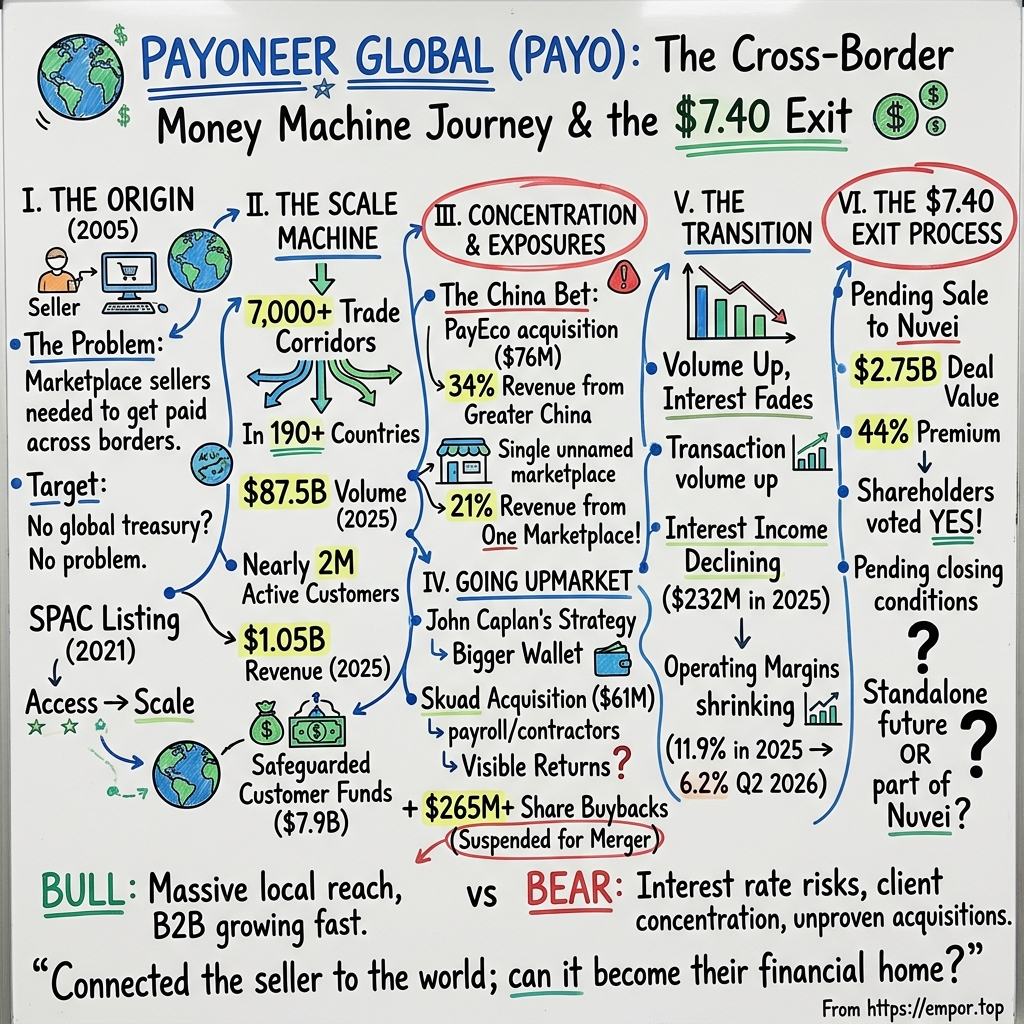
Payoneer Global: The Cross-Border Money Machine and the $7.40 Exit
I. The Price Is $7.40. What Is the Business Worth?
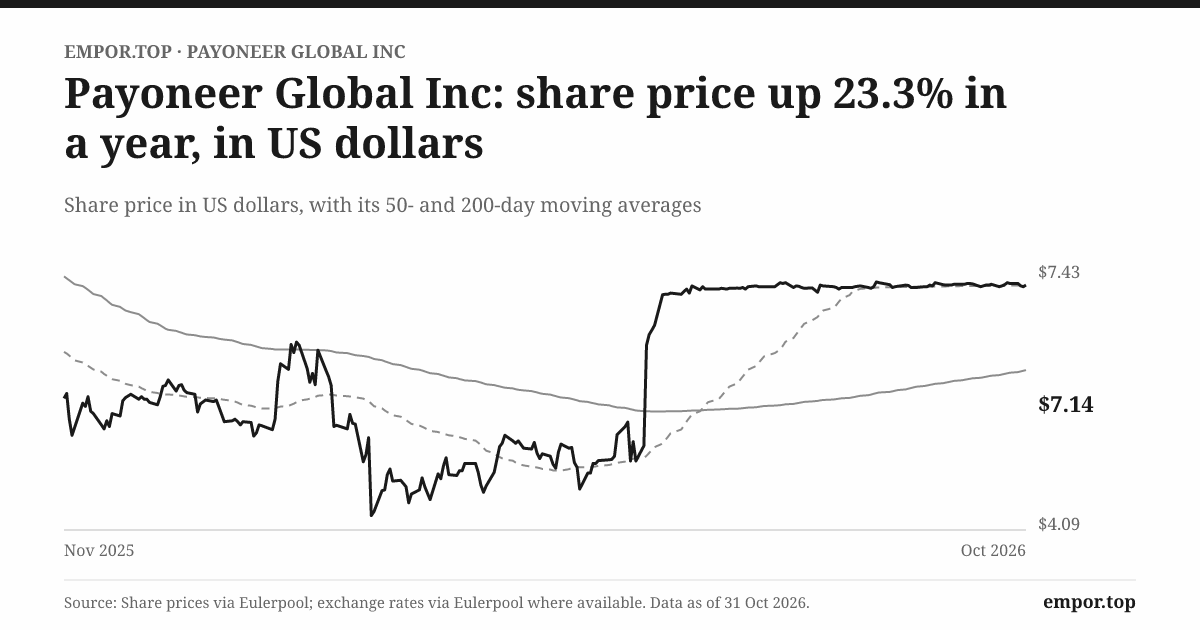
On the last trading day of October 2026, a share of Payoneer Global changed hands at $7.14.[^1] Twenty-six cents above that, at $7.40, sits a number the company did not choose by itself: the cash price that Nuvei, the Canadian payments processor, agreed to pay for every Payoneer share in June.12 The gap between the two figures is about 3.6%. That is not much of a gap. It is the kind of spread the market leaves when it believes a deal will close but wants to be paid for the wait, for the regulators who still have a say, and for the small chance that the whole thing unravels.
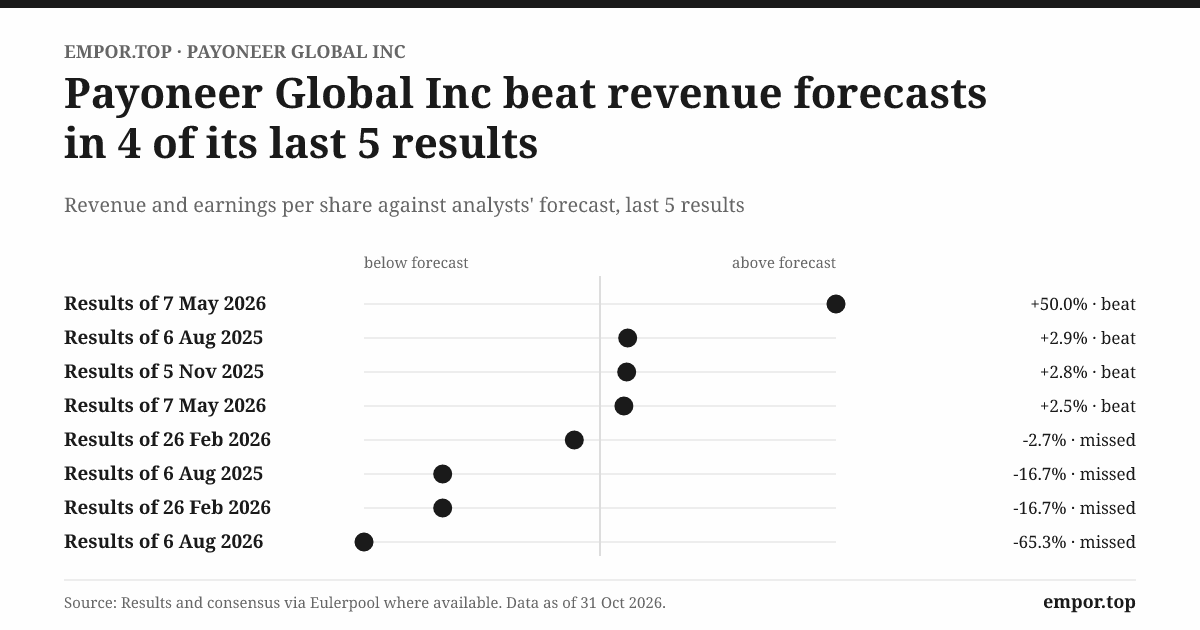
That narrow spread is strange, because almost everything else about Payoneer right now is hard to pin down. The company that agreed to sell itself is a cross-border payments platform used by close to two million small businesses, from sellers on global marketplaces to freelancers and exporters, in more than 190 countries and territories.3 It moved $87.5 billion of payment volume in 2025 and turned that into a little over $1 billion of revenue.3 Yet its most recent reported quarter showed revenue growing just 5%, operating profit falling by nearly half, and a small net loss.[^5] Months before that, management had raised its 2026 outlook. By August it had withdrawn that outlook altogether and stopped holding earnings calls.[^5]4
So the stock trades on Nuvei's promise rather than on Payoneer's own. The offer was struck at a 44% premium to the price of June 8, the last close before rumors of a deal began to move the shares.1 That premium is the story's first clue. Before anyone outside the boardroom knew a buyer existed, the market valued Payoneer at roughly $5.14 a share. The 52-week low was $4.27.[^1] Whatever Payoneer's management had been saying about its prospects, public investors had been unwilling to pay much more than five dollars for them. Then a buyer arrived and offered nearly half as much again.
Stockholders said yes. At a special meeting on September 14, 2026, they voted to approve the merger.5 Three weeks later, on October 8, the company filed a short report disclosing that one of its directors, Barak Eilam, had resigned from the board, and that its chief legal and governance officer would receive a transaction-related retention award.[^8] Those are the routine noises of a company that expects to change hands. But a stockholder vote is not a closing. Regulatory approvals and other conditions in the merger agreement remain outstanding as of today, October 31.15
That leaves an investor with two very different questions folded into one ticker. The first is simple and short-dated: does the deal close, and when? The second is the one this story is really about, because it also decides what happens if the deal fails: what is the business underneath worth on its own?
To answer it, four tensions have to be pulled apart. The first is that about a fifth of Payoneer's 2025 revenue came not from moving money but from the interest it earned on customers' money while it sat in Payoneer accounts.3 That income rose with interest rates and will fall with them, so the question is whether the fee-earning business underneath can grow fast enough to replace it. The second is whether Payoneer has a durable edge in a crowded market that includes Wise, PayPal, Airwallex, Remitly, banks, processors and the marketplaces themselves. The third is whether the money management has spent in recent years, on acquisitions such as the global payroll company Skuad and a licensed Chinese payments provider, on engineers and software, and on hundreds of millions of dollars of buybacks, strengthened that edge or merely made the company bigger. The fourth is what happens on the day after a failed merger, when standalone guidance has to come back and the market has to decide what Payoneer is without a buyer's floor beneath it.
The reporting frame matters here. The latest results available are for the second quarter of 2026, the three months to June.6 Payoneer has not held an earnings call since announcing the transaction, and it withdrew both its 2026 guidance and its longer-term targets.[^5] Third-quarter numbers, if published before the deal closes, will arrive without the usual commentary. In other words, the best public evidence on the standalone business is a little stale, and the company has stopped narrating it.
Which makes it worth going back to the beginning, because Payoneer started with a promise that was concrete in a way that "financial platform" never is. It was going to make it easier for a business far from New York, London or Hong Kong to sell to the world and actually get paid. The rest of this story tests how far that promise travelled, and whether it ever became something a customer could not easily leave.
 Subscribe on LinkedIn
II. The Marketplace Seller Who Needed a Way to Get Paid
Picture a small business in Shenzhen, Manila, Lagos or Kyiv in the mid-2000s. It can now reach customers across the world through a marketplace, an affiliate network or a freelance platform. The sale happens in seconds. Getting paid is another matter. The platform pays in dollars, through a U.S. bank system the seller has no access to. The seller's local bank charges heavily to receive a foreign wire, if it accepts one at all, and the currency conversion takes another bite. The technology of global commerce had leapt ahead. The plumbing of global money had not.
That gap was the opening Yuval Tal saw when he founded Payoneer in 2005.7 Tal was a repeat entrepreneur who had already built a company around cross-border online shopping, E4X, later known as BorderFree, which Pitney Bowes bought in 2015 for $395 million.7 He ran Payoneer as chief executive for its first five years before moving into the president's role, and he stepped away from the company in 2020 after fifteen years, shortly before it went public.7 The insight behind Payoneer was a simple one: a platform that wants to pay thousands of sellers in dozens of countries does not want to manage thousands of bank relationships, and a seller in a smaller market does not want to open a bank account in every country where it has a customer. Someone in the middle could do both jobs.
The early product was built for exactly that middle position. A seller could receive marketplace earnings into a Payoneer account, hold the money in several currencies, and then spend it with a card or withdraw it locally into a home bank account.[^11][^12] The customer, in a phrase that captures the whole business, was a company that could sell globally before it had a global treasury department. Payoneer became that treasury department for hire.
Over the next fifteen years the product widened. The card and payout tools grew into multi-currency receiving accounts, transfers between Payoneer customers, payments to suppliers, merchant services that let businesses accept card payments from their own customers, and working-capital advances made against sellers' future marketplace receivables.3[^12] Each addition followed the same logic. If the money already arrived at Payoneer, the company could try to keep it there a little longer, help the customer spend it, and charge for each step.
The decisive capital-markets moment came in 2021. Payoneer agreed to combine with FTAC Olympus Acquisition Corp., a special purpose acquisition company, and filed its registration statement in February of that year.[^11] The combination closed in late June, and Payoneer began trading on Nasdaq as PAYO.89 The investor presentation that sold the deal pitched Payoneer as far more than a payout tool: it described a global commerce platform for small and medium businesses, with a growing list of products layered on top of its payment network.[^12]
A SPAC listing was a fast route to public money in 2021, and it gave Payoneer a capital base and a currency for acquisitions. It also did something less comfortable. Once the growth story was public, every promise could be measured against a quarterly report. The record since then is mixed in a revealing way. Revenue grew quickly, from about $473 million in 2021 to more than $1 billion in 2025, and the company swung from operating losses to operating profits in 2023.310 But the stock's largest fall over the past five years reached about 63%, and for much of the public era the shares traded well below the levels that greeted the listing.[^1] The market believed in the network but was never fully convinced by the profit model.
By 2025, the scale was real. Payoneer said it supported nearly two million active customers in more than 190 countries and territories.3 It is worth stating plainly what that does and does not prove. It proves that Payoneer solved an access problem for a very large number of businesses. It does not prove that those businesses would stay if a cheaper or better option appeared, and it does not tell an investor how much pricing power Payoneer has over them. A wide funnel is one thing; a sticky relationship is another.
The old history is useful mainly as a contrast with the newer strategy. Under current management, Payoneer has tried to move from being the pipe through which marketplace money flows to being the place where an international small business actually runs its finances: collecting from customers, paying suppliers and contractors, converting currencies, holding balances, borrowing working capital. The ambition is a familiar one in financial technology. The harder question is whether customers want one provider for all of that, or simply the cheapest route for each job.
That leaves the operating question at the heart of the business. Is Payoneer merely routing money between other people's platforms, collecting a toll on each crossing, or is it becoming an indispensable financial home for international small businesses? The answer lives in the mechanics of how it makes money, and in a few numbers that show who really holds the bargaining power.
III. Seven Thousand Corridors, One Customer Wallet
Follow a single small exporter through a working month. Let us say it sells home goods made in Guangdong to shoppers in Germany and the United States through a large online marketplace. The marketplace pays out in euros and dollars. The exporter owes a fabric supplier in Vietnam, a freight forwarder in Singapore and a designer who freelances from Poland. It wants to convert some money into yuan to pay staff, keep some in dollars as a cushion, and perhaps borrow against next month's sales to buy inventory ahead of a holiday rush. Without a provider in the middle, each of those flows requires a bank relationship, a compliance check, a currency trade and a fee. With Payoneer, the exporter can, in principle, do all of it from one account.
That is what Payoneer means when it describes its network. The company says it works with close to 100 banking and payment service providers, supports more than 7,000 trade corridors, and can settle on the same day or in real time in more than 150 countries.3 A trade corridor is simply a route between two places and currencies: dollars from the United States to Chinese yuan, euros to Philippine pesos, and so on. Each one requires partners at both ends, licenses or arrangements that allow money to be received and paid out, and compliance systems that can tell a legitimate seller from a fraudster or a sanctioned party. Seven thousand corridors is not a marketing flourish. It is the accumulated result of years of licensing work, banking negotiations and risk engineering.
Where the money comes from
In 2025, Payoneer processed $87.5 billion of payment volume and reported $1.053 billion of revenue.3 The difference between those two numbers is the first thing to understand. Payoneer does not keep the money it moves. It keeps a slice, and that slice works out to roughly 1.2% of volume across the whole business. Most of it comes from fees on activity: platform and card usage fees, fees to withdraw money to a local bank, fees to receive or load funds, fees for transfers, and currency-related fees embedded in conversions.3 Those fees vary with the size of the transaction, the currency and the destination, and some bank-transfer fees are flat per transaction while others scale with volume.3
In 2025 those customer contracts generated about $813 million of revenue. Interest earned on customer balances added roughly $232 million, and income from capital advances contributed only about $8 million.3 That split is the single most important fact about Payoneer's economics. Roughly 77 cents of every revenue dollar came from moving and converting money. About 22 cents came from what happened while the money sat still.
That second stream deserves a careful explanation, because it is easy to misread. When a seller's marketplace earnings land in a Payoneer account, they do not become Payoneer's money. They are customer funds, held in dedicated accounts or invested in safe instruments such as debt securities and term deposits, and safeguarded under the rules of the regulators that license Payoneer around the world.3 At the end of 2025, those customer funds amounted to about $7.9 billion.3 Payoneer earns interest on that pool, and it books that interest as revenue. When short-term rates were near zero, the pool produced very little. When rates climbed in 2022 and 2023, the same pool became a meaningful profit engine without a single extra customer.
The analogy is a coat check at a busy theater. The business charges for checking coats, which is the fee revenue. But for a few years, the coat check also found that it could earn a return on the coats while they hung on the rack. It did not need to check more coats to earn that return; it needed interest rates to be high. Now that rates have begun to fall, the coat check has to earn more from the counter.
There is a trap here worth closing immediately. A balance sheet with $9 billion of total assets and an $87.5 billion payment flow can look like a fortress. It is not one in the ordinary sense. The $7.9 billion of customer funds cannot be used for acquisitions or buybacks; it belongs to sellers who can ask for it at any time.3 Payoneer's own corporate cash was a much smaller $415.5 million at the end of 2025.3 That distinction will matter again when the story reaches valuation, because it distorts the usual ways of measuring what a company is worth.
Currency adds a quieter twist to the same economics. Payoneer earns most of its revenue in U.S. dollars, but a large share of its costs are paid in Israeli shekels, because that is where most of its engineers sit.3 When the shekel strengthens against the dollar, the same team costs more in the currency Payoneer reports in, even if not a single new person is hired. The company began hedging that exposure with currency forwards and options in January 2024, and in 2025 those hedges reduced operating expenses by about $9.6 million.3 At the same time, the constant conversion of customer money across dozens of currencies produced about $13.2 million of foreign-currency transaction losses that year.3 Neither figure is large beside a billion dollars of revenue. Together they show that a company in the business of absorbing other people's currency risk carries a version of that risk inside its own cost base, which means reported profit can move even when payment volume does not.
Who holds the bargaining power
The cleanest way to see Payoneer's competitive position is to ask who can squeeze it. The first answer is its largest customers. One marketplace, which Payoneer does not name, accounted for 21% of its 2025 revenue.3 A partner of that size can bargain hard over pricing, can choose to offer its sellers rival payout options, and could, in the extreme, build or buy its own payout capability. That is not hypothetical: large marketplaces generally prefer to keep their sellers' financial relationships close, and every dollar of payout volume Payoneer handles is a dollar a marketplace might someday want to handle itself.
The second answer is its suppliers. Payoneer relies on third-party banks, processors and card networks, including a third-party bank that issues its U.S. cards.3 Those partners are not optional. A cross-border payments company without bank partners is a website. The company does not quantify how concentrated those supplier relationships are, which is itself worth noting, but the dependency is structural: the corridors exist because banks agree to sit at both ends of them.
Regulation cuts both ways. Payoneer operates as a licensed, non-bank financial institution in many jurisdictions, which means safeguarding rules, anti-money-laundering obligations, capital requirements and regular regulatory inquiries.3 That raises the cost of running the business, but it also raises the cost of copying it. A startup cannot wake up one morning with licenses in dozens of countries and relationships with a hundred banks. This is the most credible part of Payoneer's advantage: not a technology secret but a slowly accumulated permission to operate.
Network effects are the claim that needs the most careful testing. The bull version goes like this: each new corridor, local payment method and marketplace integration makes Payoneer more useful to every existing customer, so customers stay, and their counterparties join. Some of that is real. A seller who can collect from multiple marketplaces and pay suppliers who also use Payoneer does gain something from the network's breadth. But Payoneer does not publish retention cohorts, a customer churn rate or a measure of how many customers also use a rival provider.3 Without those, it is impossible to show that customers stay because of accumulated network value rather than because switching is mildly inconvenient. The network-effects thesis is plausible. It is not proven.
Payoneer's competitors are not one market but several, which is why market-share comparisons need care. Wise, the London-listed money transfer company, handled about $185 billion of cross-border volume in its fiscal year 2025, more than twice Payoneer's calendar 2025 volume.11 Wise built its franchise first on consumers sending money abroad and then on small businesses, and it has invested heavily in direct connections to local payment systems. Remitly reported $74.9 billion of send volume in 2025, of a similar order to Payoneer's, but its customers are mostly immigrants sending money home to their families, a different job with different economics.12 PayPal, Airwallex, the banks and the marketplaces' own payout services crowd the same space.
The useful comparison is not who is biggest but what each company is optimizing for. Wise competes on transparent pricing and low cost per transfer. Remitly competes for the trust of individual senders. Payoneer's distinctive position is its embeddedness in marketplace payouts and its focus on businesses whose financial lives are cross-border by default, especially in emerging markets. That is a narrower moat than the phrase "global financial platform" implies, but it is a real one where it applies.
Which brings the exporter back into view. Payoneer's reach across thousands of corridors does not change the arithmetic of its customer base: one marketplace still provides a fifth of revenue, and roughly a third of revenue comes from customers based in a single region.3 Broad reach and narrow dependence can coexist. The place where they collide most sharply is China.
IV. The China Bet: Local License, Concentrated Exposure
In April 2025, Payoneer completed a deal that rarely makes headlines but goes to the core of its business. It bought PayEco, a China-based payments provider that held a local payments license.3 The purchase was not about buying a growth story or a famous brand. It was about owning a piece of infrastructure in the country where Payoneer already had its largest concentration of customers.
To see why that mattered, look at who Payoneer serves. Customers based in Greater China generated 34% of Payoneer's revenue in 2025.3 These are, in large part, the factories, trading companies and brands that sell to the world through global marketplaces, and the Chinese cross-border e-commerce industry is one of the great commercial stories of the past two decades. Its sellers need to collect in dollars, euros and pounds and bring money home in yuan. For a payments company, that is a gusher of volume. It is also a dense web of rules: China's foreign-exchange controls, its licensing regime for payment institutions, and the shifting politics of trade between China and its largest customers.
A local license changes what Payoneer can do inside that system. Rather than depending entirely on partners to handle the domestic leg of a transaction, Payoneer could operate part of that leg itself. That can mean better control over the customer experience, potentially lower costs, and a more defensible regulatory footing. The strategic logic is clear.
The price was modest. Payoneer paid total consideration of about $76 million, and after accounting for the cash and customer funds that came with PayEco, the net cash outflow was about $33 million.3 The accounting is revealing. Payoneer treated the deal as an asset acquisition rather than the purchase of a business, and it valued the license intangible it acquired at about $97 million.3 In plain English, what Payoneer bought was essentially the license. The operating business that came with it was not, in the accounting's judgment, the point.
That is an honest way to describe the deal, and it should shape how an investor judges it. PayEco is infrastructure. It is not evidence of new revenue, and Payoneer has not disclosed PayEco's own revenue or profits before or after the purchase. There is no way, from the public record, to calculate a return on the money spent or to compare the price with similar license deals in China. What can be said is that the cost was small relative to a company with more than $1 billion of revenue, and that it addressed a genuine operating need.
The other concentration
Then there is the marketplace. One unnamed marketplace generated 21% of Payoneer's revenue in 2025.3 The trend has been in the right direction: the share was 25% in 2023 and 23% in 2024.310 Greater China's share has edged down too, from 35% in both 2023 and 2024 to 34% in 2025.3 Payoneer's growth outside its largest relationship has been somewhat faster than growth within it, which is the very definition of diversification.
But diversification measured in single percentage points per year is slow. A fifth of revenue still depends on one marketplace, and roughly a third is tied to customers in one region. These two exposures overlap, too: many of the sellers who collect through large global marketplaces are themselves based in Greater China. A shock to one can easily become a shock to the other.
It is worth being concrete about how such a shock would travel, because concentration risk is often described vaguely. There are four main routes. The marketplace could renegotiate pricing, add or favor a competing payout provider, or build its own financial services for sellers; any of those would hit Payoneer's revenue directly, and quickly. Trade policy could shift: higher tariffs, restrictions on small-parcel imports or changes in how Western markets treat Chinese sellers would reduce the flow of money that Payoneer helps collect. Chinese regulators could tighten licensing or foreign-exchange rules, changing the cost or feasibility of the domestic leg. And Chinese sellers' own business could weaken as competition, platforms' fee changes or demand shifts eat into their sales.
PayEco helps with only one of those routes. A local license offers some protection against regulatory friction on the domestic side. It does nothing to reduce dependence on the marketplace, and it arguably deepens Payoneer's commitment to Greater China rather than diversifying away from it. That is not a criticism of the deal. It is a description of what kind of bet it was: a decision to double down on the region where Payoneer's customers already are.
The bounded, unanswered point is this. Payoneer does not name the marketplace, and it does not disclose the status, length or renewal terms of that relationship.3 Investors therefore cannot judge how replaceable that 21% of revenue is. If the relationship rests on a long contract with exclusivity provisions, the risk is lower in the near term. If it rests on a year-to-year arrangement where sellers can easily choose another payout provider, the risk is higher. The company has chosen not to say.
The China bet, in short, is coherent. Payoneer is building infrastructure where its customers are, rather than pretending they are somewhere else. But coherence is not diversification, and the license does not resolve the question of who really controls the flow of money Payoneer depends on. That question, in turn, sits at the heart of the strategy the current chief executive has pursued: to make Payoneer matter more to each customer, so that no single partner or region could easily push it aside.
V. John Caplan's Bigger Wallet
John Caplan did not come to Payoneer from banking. His career ran through media, e-commerce and the business of helping small sellers reach big markets. He had been chief executive of Ford Models and chief marketing officer of About.com, then co-founded OpenSky, a platform for small merchants, which 阿里巴巴 Alibaba.com acquired, after which he served as president of Alibaba.com's North America and Europe business.[^18] He joined Payoneer in 2022 as co-chief executive alongside Scott Galit, the long-serving CEO, and took over as sole chief executive in 2023.[^18]13
The background shapes the strategy. Caplan's career was about the small business on the other side of a platform: the seller who needs tools, traffic and trust. At Payoneer he has framed the opportunity around a particular kind of customer: not the smallest sellers who pass through once, but higher-value small and medium businesses with complex, recurring cross-border needs.1415 Those customers pay more, use more products and, in theory, are harder to dislodge. The plan was to sell them a more integrated financial stack, so that Payoneer became the place where they managed money rather than a single stop on its journey.
In August 2024 that plan acquired its most visible move. Payoneer agreed to buy Skuad, a global payroll and employer-of-record company, for $61 million in cash, with up to $20 million of additional contingent payments in cash and equity.141617 Skuad helps businesses hire and pay employees and contractors in other countries without setting up local legal entities, handling payroll, compliance and benefits.17
The strategic logic is easy to state. An international small business does not just collect money from abroad; increasingly, it employs people abroad, too. If a Payoneer customer can pay a developer in Vietnam or a designer in Poland through the same account where its marketplace proceeds arrive, Payoneer gains a new, frequent use case, and a reason for that customer to keep more of its financial life inside the platform. Payroll is sticky by nature. Few businesses like to change who pays their staff.
How should an investor judge the price? The honest answer is that no one outside the company can. Skuad's price was small beside a company with more than $1 billion of annual revenue, and the deal did not strain the balance sheet. But Payoneer has not disclosed Skuad's standalone revenue, profit or growth, before or after the deal, and it does not report results by acquisition.3 Without those numbers, there is no basis for calling the price cheap or expensive, and no way to calculate a return. It is possible to say only that the cash went out and that a strategy was attached to it.
PayEco, the license purchase in China, is the second acquisition of this era, but it is a different animal. Skuad was a product bet, a software-and-services company bought to add a new use case. PayEco was an infrastructure bet, a regulatory permission bought to deepen an existing one. Putting them side by side shows a management team spending relatively small sums on capabilities that fit a coherent picture. It does not show that either capability has yet paid for itself.
The cost of building the stack
The larger investment was internal. Research and development spending rose from about $119 million in 2023 to about $155 million in 2025, holding at roughly 14% to 15% of revenue.3 Capital spending on property, equipment and capitalized software climbed faster, from about $48 million in 2023 to about $88 million in 2025, or from under 6% of revenue to more than 8%.3 Headcount grew from about 2,170 to 2,540 over the same period, with roughly four-fifths of R&D resources based in Israel.3
This is the bill for the bigger wallet. Building products for higher-value customers, connecting payroll to payments, and scaling compliance across more corridors all require engineers and systems. The question an investor should ask is whether the spending is producing operating leverage, meaning profits growing faster than revenue. So far, the answer has been no. Operating margin fell from 15.3% in 2024 to 11.9% in 2025, even as revenue grew.3[^1] Part of that decline reflected the fading boost from interest income, which the next chapter examines. But part reflected a cost base that was growing faster than fee revenue.
The buyback chapter
Management's other big deployment decision was to buy back its own shares. In 2025, Payoneer repurchased about 27.2 million shares for about $175 million.3 In the first half of 2026 it bought another 17.6 million shares for about $90.4 million.6 Together, that is more than $265 million of corporate cash, a large sum against a business whose own corporate cash stood at $415.5 million at the end of 2025.3 The share count reported in the company's proxy statements fell from about 363 million to about 344 million between early 2025 and early 2026.[^18]13
There is a hard edge to this record. Payoneer bought back roughly 17.6 million shares in the first half of 2026 at an average of a little over $5 a share, and then agreed to sell the entire company at $7.40.16 Seen from the remaining stockholders' point of view, those repurchases look well timed: the company bought stock well below the price a buyer was later willing to pay. Seen from the point of view of a skeptic, the same facts raise a question. If management believed the shares were worth substantially more than $5, why sell the company at $7.40? The likely answer is that a buyer's cash at a 44% premium was more certain than management's standalone plan. That is a reasonable judgment, but it is also an implicit admission about how confident the board was in its own forecast. Under the merger agreement, repurchases were suspended.6
So the capital-allocation question can be asked plainly. Did the acquisitions and the internal investment expand an integrated customer proposition that will show up in revenue per customer and retention? Or did they add capabilities whose contribution cannot yet be measured? The public record shows the cash spent and the strategy promised. It does not show acquisition-level returns, and it does not show the retention data that would prove customers are staying for the bigger wallet. The investment may be working; the company simply has not provided the evidence to prove it.
What the record does show, quarter by quarter, is how the bigger wallet changed the shape of Payoneer's income statement as the interest-rate tide went out.
VI. Volume Grows; The Interest Tailwind Fades
On August 6, 2026, Payoneer released its second-quarter results, and two different companies seemed to appear in the same document.[^5]
The first company was growing. Payment volume rose 15% from a year earlier.[^5] Revenue excluding interest income, the measure that captures what Payoneer earns from moving and converting money, rose 10% to about $222 million.[^5] Business-to-business volume, the payments that small businesses make to and receive from other businesses, rose 48%.[^5] Payoneer attributed its small-business growth to adoption of higher-value services, monetization initiatives and stronger performance in several regions.[^5] That is a respectable growth engine for a payments platform of this size.
The second company was shrinking. Interest income on customer funds fell 11% to about $52 million.[^5] Total revenue, which blends the two, grew only 5%, to about $274 million.[^5][^1] Operating profit fell from about $30.1 million a year earlier to about $16.9 million, and operating margin dropped from 11.6% to 6.2%.[^5][^1] Net income swung to a loss of about $2.4 million.[^5]
Reconciling these two pictures is the most important analytical job in the story, because it is the clearest available test of Payoneer's central question: can transaction growth replace the earnings that interest on customer funds used to provide?
The size of the hole
Start with the scale of the interest contribution. In 2025, interest on customer balances was about $232 million, roughly a fifth of total revenue.3 It had been about $231 million in 2023 and about $257 million in 2024.310 This is not incidental treasury income. It is one of Payoneer's largest single revenue lines, and because it costs almost nothing to produce once the customer funds are already there, it carries far more profit per dollar than ordinary fee revenue. When it falls, the damage to operating profit is close to dollar for dollar.
Payoneer has worked to slow the decline. By the end of 2025, it had moved about $1.8 billion of customer funds into longer-dated securities and term deposits, locking in yields for longer, and it had bought interest-rate floors covering about $2.2 billion, contracts that pay out if rates fall below a set level.3 Those steps soften the blow but do not remove it. The company itself describes its interest-rate sensitivity as material.3 A business that holds roughly $7.7 billion of customer funds, as Payoneer did at the end of June 2026, will see its income move with every change in short-term rates.6
Where the money sits matters as well. About 74% of Payoneer's cash and customer funds at the end of 2025 was denominated in U.S. dollars, and about 56% was held with U.S. financial institutions.3 So the yield on the pool tracks American short-term rates more than any other. As the Federal Reserve eases, the coat check's side income shrinks.
Why operating profit fell so hard
Now decompose the drop in operating profit. Revenue grew by roughly $14 million year over year in the second quarter. Yet operating profit fell by about $13 million.[^1] So costs must have risen by about $27 million. The company's own explanation identifies where. Research and development rose, as the company kept hiring and building; depreciation and amortization rose, reflecting the software investment of prior years now flowing through the income statement; and general and administrative expenses included costs related to the proposed Nuvei transaction.6
Each of those has a different meaning for a long-term investor. Merger costs are one-off by nature and say little about the standalone business. Higher depreciation is the delayed bill for capital spending already made, and it will stay with the company for years. Higher R&D is a choice; it could be reduced if management chose to harvest rather than grow. The uncomfortable implication is that only a portion of the margin decline is clearly temporary. The rest reflects a structural shift: a business whose highest-margin revenue line is shrinking while its cost base keeps growing.
Payoneer's preferred lens tells a much happier story. The company highlights adjusted EBITDA excluding interest income, a measure designed to show how profitable the transaction business is without the help of interest on customer funds. In the second quarter of 2026, that figure rose 138% to about $19.3 million.[^5]
It is worth understanding what this measure does and does not do. It strips out interest income, which is the right instinct if the question is how the fee business is performing. But like most adjusted EBITDA measures, it also adds back stock-based compensation, depreciation and amortization, and transaction-related costs.[^5] Stock-based compensation was about $73 million in 2025, a real cost to shareholders paid in shares rather than cash.3 Depreciation reflects real money spent on software. So the measure answers a narrow question, whether the transaction business is getting more efficient before those costs, and the answer appears to be yes. It does not answer whether Payoneer as a whole is becoming more profitable, and on that question the GAAP figures say no. Neither measure is a lie. They answer different questions, and an investor needs both.
A similar caution applies to cash flow. In 2025, Payoneer's operating cash flow was about $233 million, more than three times its net income of about $73 million.3 At first glance, that looks like a business that converts profit into cash exceptionally well. A closer look shows why the comparison misleads. The operating cash flow figure includes changes in capital-advance balances and other working-capital items, and it adds back large non-cash charges such as stock compensation and depreciation.3 Payoneer extended about $313 million of capital advances in 2025 and collected about $326 million, so that portfolio's movements alone can swing the figure.3 And the much larger pool of customer funds is safeguarded; it is not free cash for buybacks or dividends.
The capital-advance book is small but worth a moment, because it is the one part of Payoneer that looks like lending. The company buys a seller's future marketplace receivables at a discount, without economic recourse if those receivables never materialize.3 At the end of 2025 the gross balance was about $47.6 million, against which Payoneer held a loss allowance of about $4 million; net charge-offs were about $3.6 million, slightly lower than the year before.3 Losses have been contained. At this scale, the advance book is a useful quality check on underwriting rather than a growth driver.
The way that book was funded carries a small governance footnote. For several years, part of the advance portfolio was financed through a warehouse facility whose lenders were connected, through an ownership interest, to the person who then chaired Payoneer's board.13 The company described the arrangement as arm's length; it was secured by eligible receivables and carried covenants on tangible equity, solvency and unrestricted cash.13 It was also small: peak borrowing in 2024 was about $18 million, the balance was fully repaid by the end of that year, and the facility was scheduled to terminate in April 2025.13 The economic stakes were minor. The lesson is that even a lightly levered fintech used a related-party lender at the margin, and investors judging the board's independence were right to want it disclosed.
Taxes add one more wrinkle to the second quarter. Profit before tax was only about $6 million, and the tax charge was larger than that, which is how a quarter with positive operating profit ended in a net loss.[^1] Payoneer's tax position is genuinely complicated: at the end of 2025 it carried about $57 million of gross unrecognized tax benefits, mostly linked to transfer-pricing positions between its subsidiaries in different countries, and its auditor singled out income-tax accounting as the critical audit matter in an otherwise clean, unqualified opinion.3 None of that signals a problem with the books. It does mean that the line between operating profit and net income runs through a set of judgments that can swing reported earnings in any single quarter.
Put together, the second quarter tells a clear but incomplete story. The transaction engine is growing faster than reported revenue, roughly twice as fast. That is genuine evidence that the shift toward higher-value small businesses and B2B flows is producing something. But it has not yet shown that the fee business can grow enough, at high enough margins, to replace the shrinking interest contribution while also covering a rising cost base. The metrics that would settle the question are clear: revenue growth excluding interest, operating margin once merger costs disappear, and the yield on customer balances as rates change.
Those are exactly the numbers that would have been debated on the next earnings call, if there had been one. The sale process ensured there was not.
VII. A Sale Process Becomes the Strategy
In late February 2026, on the call discussing its full-year 2025 results, Payoneer's management laid out a confident picture for the year ahead. The message was that 2026 would bring a sharp increase in adjusted EBITDA excluding interest income, as the transaction business scaled and earlier investments matured.15 In May, on the first-quarter call, management went further and raised its revenue outlook for the year.4 Analysts on both calls pressed on the same themes: how durable the acceleration in B2B volume was, how quickly interest income would decline as rates fell, and how fast margins could recover.154 Management's answers projected a business turning a corner.
Three weeks after that first-quarter call, the story changed direction entirely. In June, Payoneer announced that it had agreed to be acquired by Nuvei for $7.40 a share in cash, a deal valued at about $2.75 billion.2 Nuvei framed the purchase as a push into cross-border payments, adding Payoneer's small-business network and corridors to its own merchant-processing franchise.2 On August 6, when Payoneer reported second-quarter results, it withdrew its 2026 guidance and its longer-term outlook and said it would not hold an earnings call because of the pending transaction.[^5]
It would be easy to read that sequence as proof that the earlier guidance was about to be missed. The evidence does not support that conclusion. Companies routinely withdraw guidance and suspend calls once a merger is signed, both to avoid statements that could complicate the deal and because standalone forecasts become less relevant. The second quarter's revenue excluding interest grew 10%, consistent with a business still expanding. What the sequence does show is a loss of visibility. The plan management described in February and May was never fully tested in public, and a forecaster trying to assess the standalone business now works with less information than at any time since the listing.
The merger proxy, filed on August 11, adds context. It describes a sale process in which the board weighed the standalone plan against the certainty of a cash offer, and it reports the analysis of the company's financial adviser, Qatalyst Partners.1 Among other things, Qatalyst compared Payoneer with a group of listed payments companies, including Wise, Flywire, Remitly and dLocal, valued at roughly 9 to 13 times estimated 2026 EBITDA.1 Those comparisons are useful as context but should be read for what they are: adviser-selected peers and date-specific estimates, prepared to support a fairness opinion.
Incentives and pay
Management's credibility should also be judged by how it is paid. Caplan's reported total compensation was about $11.7 million in 2025, up from about $9.8 million in 2024.[^18] About $10.5 million of the 2025 figure consisted of stock awards, valued at the date they were granted, not cash salary.[^18] During the same period, GAAP net income fell from about $121 million to about $73 million.3[^1] The disconnect is not unusual in technology companies, where equity grants dominate pay and are set before results are known. But it means that reported pay rose in a year when shareholders' earnings fell, and that the grants' ultimate value now depends largely on a $7.40 cash price negotiated by the same executives.
Management and directors as a group owned about 2.06% of the company according to the 2026 proxy.[^18] The largest holders were institutions: BlackRock with about 11%, the growth investor TCV with about 10%, and Susquehanna Growth Equity with about 6.5%, alongside Vanguard, which the proxy said later reported zero beneficial holdings after an internal realignment rather than a confirmed sale.[^18] No controlling shareholder exists. That structure gives large institutions, rather than founders or insiders, the decisive voice in a sale.
Shareholders' signals have been supportive with pockets of dissent. At the June 2026 annual meeting, the say-on-pay vote passed comfortably, with about 183.7 million shares for and 16.5 million against.18 Director Amir Goldman faced about 15.9 million votes against his re-election, a notable minority.18 At the September special meeting, stockholders approved the merger by a wide margin, while the separate advisory vote on merger-related executive pay drew about 14.3 million votes against.5
Then came the October filing. Barak Eilam, the former chief executive of the software company NICE who had joined Payoneer's board in 2025, resigned from the board and its audit and risk committees, effective October 5.[^8]13 The same filing disclosed a $5.25 million transaction-related retention award for Payoneer's chief legal and governance officer.[^8] Retention awards of that kind are common in pending mergers, designed to keep key people in place through closing. They are also a reminder that the people steering a deal through regulators have their own incentives tied to its completion.
What the vote does not prove
The vote approved the sale. It did not certify that $7.40 is Payoneer's intrinsic value. A merger price reflects what one buyer was willing to pay, given its own synergies and financing, at one moment. It can be higher than standalone value, if the buyer expects to cut costs or cross-sell; it can be lower, if the seller lacked better options or the board placed a premium on certainty. The fact that Payoneer bought back stock at around $5 in the months before agreeing to sell at $7.40 suggests the board viewed the stock as undervalued at $5. The fact that it sold at $7.40 suggests it did not believe it could reliably deliver much more than that alone, on a timeline shareholders would reward.
That is the real verdict on the sale process as strategy. It converted an uncertain standalone plan into a defined cash outcome, with a premium. It also froze the evidence. If the agreement is terminated, standalone guidance, the case for continued buybacks and the credibility of the plan management described in the spring will return to the center of the story, and Payoneer will have to make that case to a market that has spent months pricing it on someone else's offer.
VIII. Analysis & Bear vs. Bull Case
Place two numbers side by side. Payoneer moved $87.5 billion of payment volume in 2025.3 At year-end, it held about $7.9 billion of customer money.3 The first number is the business: the flows that generate fees. The second is the pool: money that earns interest but belongs to someone else. For three years, the pool generated an unusually large share of profit. The core question for any valuation is which of those two things truly creates value for shareholders, and how much of each will still be doing so in three years.
What a believer sees
The bull case is that Payoneer has built a genuine operating platform for cross-border small businesses that is now gaining higher-value customers. The evidence is substantial. Close to two million active customers, a network of more than 7,000 corridors, and relationships with roughly 100 banking and payment partners took nearly two decades to assemble.3 Business-to-business volume grew 48% in the second quarter of 2026, and revenue excluding interest grew 10%, twice the rate of total revenue.[^5] That is the mix shift a bull would want to see: the fee business accelerating while the interest stream fades. Adjusted EBITDA excluding interest more than doubled, which suggests that the fee business itself is becoming more efficient.[^5] Concentration is falling, slowly. Capital-advance losses are contained. And a strategic buyer was willing to pay a 44% premium for the platform, which at least shows that someone with deep knowledge of the industry saw value well above the pre-deal market price.
What a skeptic sees
The bear case is just as specific. Total revenue growth slowed from more than 30% a year in 2022 and 2023 to 7.7% in 2025 and about 5% in the second quarter of 2026.[^1] Operating margin fell from 15.3% in 2024 to 11.9% in 2025 and to 6.2% in the second quarter.[^1] A single marketplace still provides a fifth of revenue.3 Roughly a third of revenue depends on customers in Greater China.3 The interest stream that flattered profits in 2023 and 2024 is shrinking. Acquisitions have not produced disclosed returns. The company has never published retention or pricing data that would prove customers stay because they value the platform rather than because switching is inconvenient. And management's confident spring outlook was replaced by silence once the sale was signed.
Michael Porter's five forces sharpen the picture. Buyer power is high at the top of the customer base: one marketplace large enough to account for 21% of revenue has leverage over pricing and could steer its sellers elsewhere. Among the long tail of small businesses, buyer power is lower individually but collectively shows up as price sensitivity, since cross-border fees are easy to compare. Supplier power is meaningful: banks, card networks and processors provide essential infrastructure, and Payoneer cannot operate without them. The threat of new entrants is moderated by licensing, compliance and banking relationships, which take years to build, but it is not negligible, because well-funded fintech companies and marketplaces have shown they can assemble those capabilities. Substitutes are abundant: Wise, PayPal, Airwallex, banks, and marketplaces' own payout services all offer alternatives for parts of Payoneer's service. Rivalry is intense and largely priced on fees and foreign-exchange spreads. The industry structure is not hostile, but it does not hand any participant easy pricing power.
Hamilton Helmer's framework asks which of seven sources of durable advantage a company possesses. Scale economies exist in compliance, risk systems and banking relationships, where fixed costs can be spread over more volume; Payoneer has meaningful scale, but Wise operates at roughly twice its cross-border volume, so Payoneer is not the scale leader.11 Network economies are plausible but unproven, as already discussed; the company publishes no data that would demonstrate them. Counter-positioning does not obviously apply: incumbents could copy Payoneer's model without damaging their own businesses. Switching costs are the most interesting candidate. A seller who receives marketplace payouts, pays suppliers, runs payroll through Skuad and borrows working capital from Payoneer would find leaving painful. But the evidence that many customers use Payoneer that way is thin, because the company does not disclose product adoption per customer or retention. Branding matters modestly in trust-sensitive finance. Cornered resources include licenses such as PayEco's, but licenses can be obtained by others. Process power, the hard-to-copy operational know-how, may exist in Payoneer's risk and compliance systems, but it is hard to verify from outside.
Put together, the moat verdict is narrower than the platform story implies. Payoneer's regulatory footprint and embedded marketplace relationships are real advantages, and they explain why it has grown to its present scale. But customer concentration and the absence of retention or price-realization evidence leave switching costs and network effects unproven. The history does not reject the moat; it narrows it to a regulatory and distribution advantage in specific corridors, especially emerging-market sellers on global marketplaces, rather than a wide, self-reinforcing platform moat. The evidence that would strengthen the claim is published retention data and revenue per customer rising faster than volume; the evidence that would weaken it is a fall in the largest marketplace's share driven by lost volume rather than by growth elsewhere.
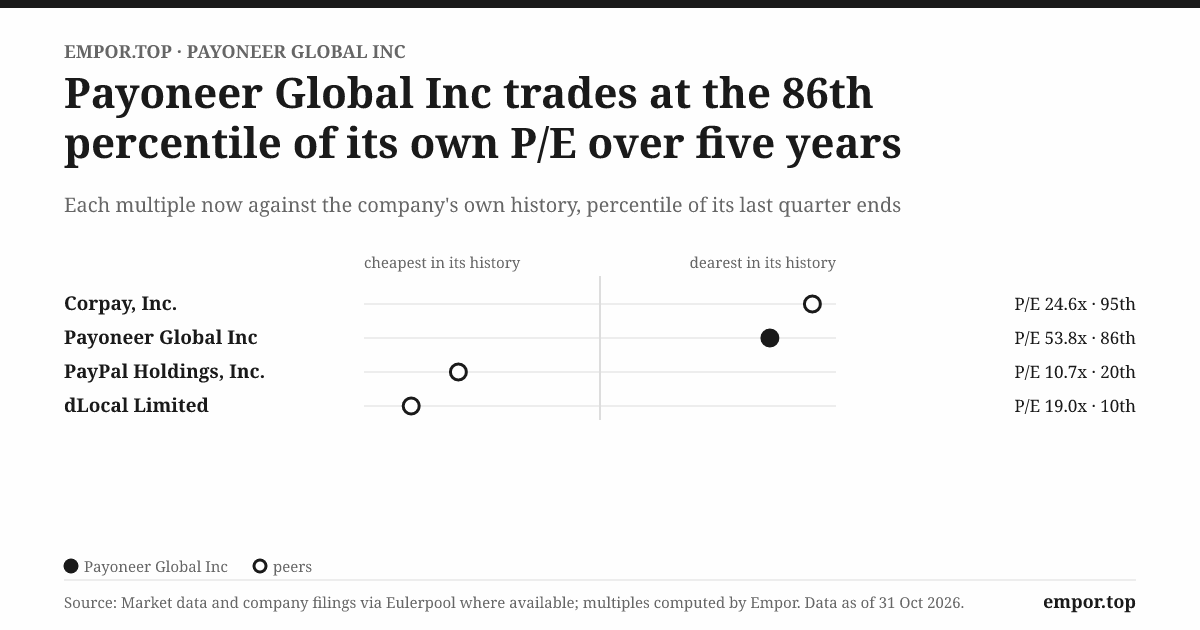
Valuation is complicated by the customer funds. Standard enterprise value calculations subtract cash from market value; if customer funds are treated as cash, Payoneer's enterprise value turns sharply negative, about minus $5 billion on some data providers' calculations, which is plainly meaningless.[^1] The customer funds are matched by obligations to customers, so they should be excluded from any valuation. The price-to-earnings ratio is not much cleaner: at $7.14, the stock trades at about 54 times trailing earnings, against a five-year median of about 28 times.[^1] But trailing earnings are depressed by merger costs, a high tax rate and the second-quarter loss, so that multiple overstates how expensive the business is on a normalized basis. Price-to-sales of about 2.5 times is easier to read; it implies the market, via Nuvei's offer, values Payoneer at a modest multiple of a revenue base that includes a shrinking interest stream.[^1]
The adviser's peer set offers one more frame. If listed peers such as Wise, Flywire, Remitly and dLocal traded at roughly 9 to 13 times estimated 2026 EBITDA, a buyer paying $2.75 billion for Payoneer was paying a price within the range a profitable cross-border payments company might command, though the comparison depends heavily on how Payoneer's interest income is treated.1 What the price appears to assume is a payments business with moderate growth and recovering margins, not a dominant platform with pricing power.
Imagine, for a moment, a skeptical activist who bought shares at $5 and was handed a vote on $7.40. The questions would be pointed. Why did operating costs grow faster than fee revenue for two years running, with research spending near 15% of revenue and stock compensation of about $73 million in 2025, a sum that ate up a large slice of what the buybacks returned?3 Why does a company that asks to be valued as a platform not publish the retention, product-adoption and revenue-per-customer data that would prove it is one? Why does the balance sheet, which holds no funded debt, now carry about $72 million of lease liabilities, mostly from a new long-dated office lease in Israel, at the very moment margins were compressing?3 And why should owners trust a standalone plan that was confidently raised in May and abandoned by August? Some of those questions have good answers: the lease reflects a long-term home for the company's largest engineering base, and the sale itself delivered a premium. But they are the questions any credible standalone case would have to answer, and the company has not yet answered most of them in public.
If Payoneer remains independent, three indicators matter most. The first is revenue growth excluding interest income, most recently 10% in the second quarter of 2026, which captures whether the fee business is growing fast enough to replace the fading interest stream.[^5] The second is operating margin, most recently 6.2%, falling, and best read once merger costs drop out.[^1] The third is concentration: the largest marketplace's share of revenue, 21% in 2025 and falling, read alongside Greater China's 34%.3 Capital-advance charge-offs serve as a quality check on underwriting rather than a headline growth measure.
The stress test is simple. If the deal closes, the investment question moves to Nuvei, which will have to integrate Payoneer's network and prove that the combination is worth what it paid. If the deal fails, Payoneer must explain again how its core business earns through lower interest rates and slower total growth, without the cushion of a buyer's price.
Playbook: Business & Investing Lessons
Go back to the seller who could reach customers around the world from a workshop or a laptop but could not easily get the money home. Payoneer's whole story starts with that seller's problem, and its lessons come from the gap between solving a problem and owning a relationship.
The first lesson is about trust at both ends of a transfer. A corridor is a product only when the customer can trust the money at both ends. Payoneer's 7,000-plus corridors are not lines on a map; each depends on banks, processors, card networks and regulators who agree to let money move. The company built its business by assembling those permissions one at a time, and its most important acquisition in China was not a product but a license to operate the domestic leg. For founders, the lesson is that in cross-border finance, the hard asset is not the app. It is the slow accumulation of permissions and partners who will sit at the far end of the transaction. For investors, it is a reminder that every corridor carries a dependency, and that a network built on other people's infrastructure is only as strong as those relationships.
The second lesson is about what turns products into a platform. More products make a platform only when the same customer keeps coming back. Payoneer added accounts, transfers, cards, merchant services, working capital and, with Skuad, payroll. The logic was sound: each new tool gave a customer one more reason to stay. But the company never published the data that would prove customers were actually staying because of the breadth. Product count is an input; retention is the output. A company that tells investors it is a platform should be able to show cohorts, revenue per customer and churn. Until it does, the platform is a strategy, not a fact.
The third lesson is about the interest-rate tide. A favorable rate cycle can flatter a great payments business. For three years, Payoneer earned around a quarter of a billion dollars a year on customers' idle balances, revenue that required no extra customers and carried enormous margins. That income made the business look more profitable and more resilient than its fee engine alone could support. When rates turned, the fee business had to grow fast enough to fill the hole, and in the second quarter of 2026 it could not quite do so. The broader lesson is to separate earnings from what a company does from earnings from what the economy happens to be doing. Investors who capitalized peak interest income as if it were permanent were paying for the weather.
The fourth lesson is about buybacks and certainty. Buybacks are a capital-allocation decision only until a merger agreement says otherwise. Payoneer spent more than $265 million repurchasing shares in 2025 and the first half of 2026, a signal that management saw the stock as undervalued. Then it agreed to sell the company, and the buybacks stopped. In hindsight, the repurchases at around $5 look well timed against a $7.40 exit. But the sequence also shows how quickly a standalone capital-allocation story can be replaced by a sale. A buyback says the board believes in the future; a sale says it prefers a certain price today. Both can be rational, but they are not the same statement.
Epilogue
Tonight, Payoneer sits in a waiting room. Stockholders have voted yes. The merger agreement remains in force. The remaining closing conditions, including regulatory approvals across the jurisdictions where Payoneer is licensed, still have to be satisfied, and the market's 3.6% spread reflects both the time that may take and the small risk that it does not happen.15[^1]
There are two forks from here. If the deal closes, Payoneer becomes part of Nuvei, and its shareholders receive $7.40 a share in cash. The public story ends. The operating story continues inside a private, combined company: whether Nuvei can integrate Payoneer's small-business network and corridors with its own merchant-processing franchise, whether the largest marketplace relationship survives the change of ownership, and whether the combined company can extract the efficiencies that justified the price. None of that will be visible to former PAYO holders, but it will decide whether the deal was a good one for Nuvei.
The integration carries a quieter test of the very moat this story has questioned. A change of control is the moment when a large partner reconsiders its terms, when a bank partner reviews its exposure, and when a regulator in a distant corridor asks who now stands behind the license. If Payoneer's relationships really are as embedded as its strategy claims, they will pass to the new owner with little friction. If they were held together mainly by inertia and price, the handover is where that would show first. In that sense, even a completed deal will eventually answer the question the public market never could: whether the corridors belonged to Payoneer, or merely ran through it.
If the deal terminates, everything that was suspended comes back. Payoneer would need to reinstate guidance, restart earnings calls, and show the market a third and fourth quarter that answer the questions the second quarter left open. The first number to watch would be revenue growth excluding interest income, last reported at 10%.[^5] The second would be operating margin after merger costs, last reported at 6.2%.[^1] The third would be the trend in customer-balance yields as rates move. Management would also have to decide whether to resume buybacks, and at what price, having just shown that it was willing to sell the company at $7.40.
Two disclosure gaps will remain whatever happens. Payoneer does not name its largest marketplace or describe the status of that relationship, and it does not publish retention data. Those gaps are the reason investors have had to judge the moat by inference rather than evidence. They will either close under new owners, become irrelevant inside a private company, or remain the central unknown for a standalone Payoneer.
Outro
Somewhere tonight, a seller in Shenzhen or Lagos or Manila is checking an account to see whether the marketplace payout has arrived. The money crosses a border, changes currency and lands in a balance the seller can spend or send home. It is a small miracle of modern commerce, repeated millions of times, and Payoneer spent two decades making it ordinary.
That is the contrast that defines the company now. A business built to move small-business money across thousands of corridors is waiting on a single transaction to determine where it goes next. Payoneer connected the seller to the world; the next chapter decides whether it became the seller's financial home.
References
-
2026 Definitive Merger Proxy — Payoneer, 2026-08-11 ↩↩↩↩↩↩↩↩
-
Nuvei to Buy Payoneer for $2.75 Billion — Reuters via Investing.com, 2026-06-15 ↩↩↩
-
2025 Annual Report on Form 10-K — Payoneer, 2026-02-26 ↩↩↩↩↩↩↩↩↩↩↩↩↩↩↩↩↩↩↩↩↩↩↩↩↩↩↩↩↩↩↩↩↩↩↩↩↩↩↩↩↩↩↩↩↩↩↩↩↩↩↩↩↩↩↩↩↩↩↩
-
Q1 2026 Earnings Call Transcript — The Motley Fool, 2026-05-08 ↩↩↩
-
Q2 2026 Quarterly Report on Form 10-Q — Payoneer, 2026-08-06 ↩↩↩↩↩↩
-
Yuval Tal: Payoneer's Pioneer — CTech by Calcalist, 2020-11-30 ↩↩↩
-
Payoneer Begins Trading After SPAC Merger — Payments Dive, 2021-06-29 ↩
-
Form 8-K on 2021 Business Combination — FTAC Olympus Acquisition Corp., 2021-08-05 ↩
-
Q2 2024 Earnings Call Transcript — Seeking Alpha, 2024-08-07 ↩↩
-
Q4 2025 Earnings Call Transcript — The Motley Fool, 2026-02-26 ↩↩↩
-
Payoneer's Skuad Acquisition and B2B Strategy — Payments Dive, 2024-08-08 ↩
-
Payoneer Buys Payroll Startup Skuad for $61 Million — TechCrunch, 2024-08-07 ↩↩
 LinkedIn
 WhatsApp
 Reddit
 Hacker News
 Email
 Kindle
 RSS Feed
 Spotify
 Apple Podcasts
 Amazon Music
 Audible
 YouTube