Paymentus: The Bill That Became a Payments Network
I. A bill gets paid 724 million times
It is the least memorable financial act of the month. A notification arrives saying the electricity bill is ready. Someone opens an app or a web page, glances at the amount, picks a saved card or bank account, taps a button, and goes back to whatever they were doing. Nobody tells friends about it. Nobody remembers it a week later. If it works, it vanishes from consciousness entirely, which is exactly the point.
On the other side of that tap, the experience is not forgettable at all. For the utility, the insurer, the credit union or the county tax office collecting the money, a bill payment is a cost centre, a compliance obligation and a customer-service event rolled into one. The payment has to find the right account in a billing system that may be decades old. The card network has to approve it. The money has to settle. The customer record has to update before the next dunning letter goes out by mistake. Someone has to answer the phone when a customer insists they paid. Multiply that by millions of households and the humble bill becomes an operational machine, and an expensive one.
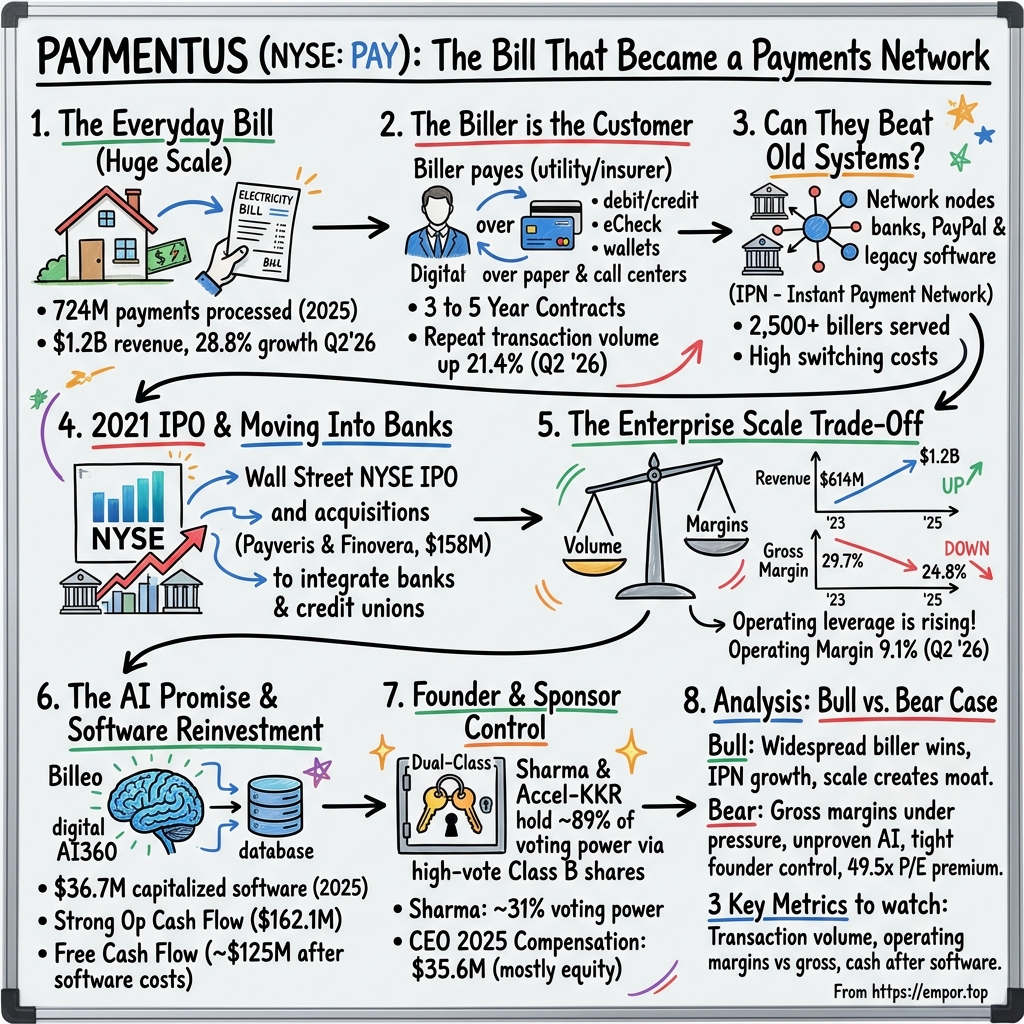
Paymentus Holdings sits in the middle of that machine. In 2025 the company processed about 724 million payments for more than 2,500 billers and financial institutions, and its revenue reached about $1.2 billion.1 In the second quarter of 2026, revenue grew almost 29% from a year earlier, a pace few payments businesses of its size were managing.[^2] Those figures belong to a company whose product most of the people using it have never consciously noticed. The household thinks it paid the power company. The power company knows it paid Paymentus to make that payment easy, cheap and reliable.
That oddity is the beginning of the investment question. Can a routine bill payment become a durable business, or is Paymentus simply a useful layer in a crowded market, one that earns a slice of each transaction only until a bank, a processor or a larger software vendor decides to take it back? The stakes are concrete. Paymentus has to keep winning bigger billers, and it has to keep enough economics from each payment after card fees, bank fees and the bargaining of those same large clients. Growth that comes with thinning margins is a different kind of business from growth that compounds.
Three more questions run underneath. The first is whether the company's integrations and partner network constitute a moat, or whether they are good engineering that a competitor could replicate. The second is whether the cash the business generates survives the bill for the software it must keep writing. The third is about power: Paymentus is listed on the New York Stock Exchange under the ticker PAY, but its founder and chief executive, Dushyant Sharma, and the private-equity firm Accel-KKR still control most of the votes through high-vote Class B shares.2 Outside shareholders own a growing slice of the economics without owning the steering wheel.
Sharma has been chief executive since the beginning and chairman since 2013.2 The company he built was founded in 2004, around an idea that sounds obvious now and was not then.3 Most bill-payment technology of the era was built from one end or the other. Banks built bill-pay portals to serve their depositors. Billers built or bought payment pages to serve their own customers. Card processors built rails to move the money. Paymentus set out to connect the biller's back office directly to the consumer's payment habits, whatever those habits happened to be: a card, a bank transfer, a phone call, a digital wallet, a text message. The bet was that whoever owned that connection would own a quiet but indispensable piece of the economy.
It was not an overnight success. For most of its life Paymentus was a private company, growing quietly in Charlotte, North Carolina, signing utilities and municipalities one at a time, the kind of customer that moves slowly, buys cautiously and rarely leaves.3 By the time Accel-KKR invested in 2011, the company had a working platform and a customer base; by the time it listed in 2021, revenue had passed $300 million a year.4 Sharma's defining trait, visible across those two decades, has been persistence in an unfashionable niche. He kept building the plumbing of bill payment while most of the fintech world chased consumer apps and trading platforms, and he has kept control of the company he built through every round of outside capital.
Twenty-two years later, the bet has produced scale. Whether it has produced an edge strong enough to endure competition and changing payment economics is the rest of this story, and it starts with a question that sounds trivial but is not: who, exactly, is the customer?
 Subscribe on LinkedIn
II. The biller was the customer, not the payer
Picture the chief information officer of a mid-sized water utility, sometime in the last decade. Her customers pay in at least half a dozen ways. Some still mail paper cheques to a lockbox. Some call a contact centre and read a card number to an agent, who types it into a terminal. Some pay through their own bank's bill-pay portal, which sends the money days later with a reference number that may or may not match the account. A few use a payment page the utility bolted onto its website years ago, built by a contractor long since departed. Each channel has its own vendor, its own reconciliation file, its own failure modes. Every month, staff spend hours matching payments to accounts by hand.
Paymentus sells that executive a way to replace the patchwork. The company integrates with the biller's core systems, the billing and customer-information software where the account of record lives, and then presents bills and accepts payments across digital and assisted channels: web, mobile, interactive voice response, agent-assisted calls, text, and more.1 Behind the presentation layer, it processes credit cards, debit cards, eChecks and digital wallets, and posts the result back into the biller's system.1 The consumer sees a clean payment screen. The biller sees one integrated platform instead of a junk drawer of vendors.
This is why the payer is not really the customer. The household chooses how to pay, but the biller chooses who processes the payment. Paymentus wins or loses at the procurement table of utilities, insurers, telecom operators, government agencies, banks and credit unions, not in an app store. That distinction shapes everything from its sales cycle to its margin profile.
The money flows in an unusual way. Paymentus earns most of its revenue through transaction fees, and does not charge separate licence or implementation fees.1 Depending on the contract, the fee may be paid by the consumer as a convenience charge, absorbed by the biller, or split between the two.1 Pricing can be tiered by volume. Some contracts carry annual or monthly minimums and early-termination penalties, and some customer or reseller agreements include guaranteed minimums and revenue sharing.1 Initial contracts typically run three to five years.1
Think of it as a toll road rather than a software licence. Paymentus builds the on-ramp into each biller's systems at its own cost, then collects a toll every time a car drives through. That means it does not get paid upfront for the construction work. A signed customer generates nothing until the platform goes live and the first payments start flowing, which makes the business quieter and more repetitive than a classic software company once a biller is running, and lumpier before it.
Because the fee is per transaction, growth has several levers rather than one. New billers go live and add fresh streams of payments. Existing billers push more of their customers into digital channels, or simply grow. And the size and type of each payment changes what Paymentus earns, because a credit-card payment on a large insurance premium carries different economics from a small eCheck on a water bill. In the second quarter of 2026 the company processed about 213 million transactions, up a little over 21% from a year earlier.[^2] Revenue grew faster than transactions, which means each payment was bringing in more money on average, a point that matters a great deal later.
There is a temptation to call all of this recurring revenue, and the bill itself encourages it. People pay their electricity, insurance and phone bills every month whether the economy is booming or not. Those are non-discretionary obligations, and they give Paymentus a base of repeat usage that most transaction businesses would envy.1 But Paymentus does not disclose what share of its revenue is recurring in any formal sense.1 It reports transaction-based fees, with seasonality, contract-by-contract pricing and a changing customer mix. The fair description is recurring use, not a proven subscription mix. A household's electricity bill recurs. The biller's contract with Paymentus recurs only until renewal, and the price at which it renews is the question that matters.
The implementation process makes that clearer still. A large biller can take months to integrate, test and launch, and the revenue arrives only on the far side of that work. Management has repeatedly described a pipeline of signed billers waiting to go live, yet those bookings are not quantified publicly, a point it acknowledged on its second-quarter 2026 call.[^2] Investors therefore see the business through a slightly delayed lens: today's revenue reflects launches decided a year or more ago, and today's sales success shows up in tomorrow's numbers.
And then there is the economic wrinkle that turns a simple payment into a complicated business. When Paymentus processes a card payment, a large share of the fee it collects flows straight back out to card networks, issuing banks and processors as interchange and processing costs.1 Those payment costs sit inside cost of revenue.
So more transactions can grow revenue rapidly while the gross margin, the share left after paying the rails, moves in the opposite direction, especially when the new transactions come from large billers with big payments and strong bargaining power. Revenue is a measure of how much money passes through the toll booth. Gross profit is what the toll operator keeps. Paymentus has spent the past three years proving it can grow the first, and the market has been trying to decide how much the second is really worth.
That puts the competitive question squarely on the table. If the biller is the customer, the biller also has choices.
III. The network has to beat the biller's old system
Every Paymentus sale begins as a three-way decision. A biller can keep running its own payment stack, the in-house code and patchwork of vendors it already has. It can extend the legacy system it already licences, often from a large bank-technology vendor that also runs its core processing. Or it can outsource to a specialist. The first option feels free because the costs are buried in IT budgets. The second feels safe because nobody gets fired for staying with the incumbent. The third has to be meaningfully better to overcome both.
Paymentus describes the field it competes in as fragmented. Its main competition, it says, comes from legacy bill-payment vendors, from financial institutions' internal systems and from other electronic bill-payment providers.1 That framing is revealing: the most formidable rival is often not another company at all, but inertia and the biller's own IT department.
A rival's annual report fills in the names. ACI Worldwide, which runs a large bill-payment business of its own, lists its direct competitors in that market as Alacriti, FIS, Fiserv, InvoiceCloud, Kubra, One Inc., PayNearMe and Repay.5 That list spans giants with core-banking franchises and thousands of bank clients, niche specialists in insurance or utilities, and venture-backed challengers.
ACI does not publish market shares for bill payment, and neither does Paymentus, so there is no reliable scoreboard. Comparing consolidated revenue would mislead, because FIS and Fiserv run vast businesses in which bill pay is a small corner, while Paymentus is almost entirely bill pay. What the list does establish is that Paymentus competes against companies with far larger balance sheets and existing relationships with the very banks and billers it wants to sign.
So why would a biller choose Paymentus? The company's case rests on three mechanisms. The first is integration depth, which can shorten launches and make the platform harder to rip out once installed.1 The second is channel breadth. The third is distribution through partners, and here the company makes its boldest claim.
That claim is the Instant Payment Network, or IPN. Paymentus describes it as a network that extends a biller's reach beyond its own website and app, into banks' bill-pay services, software platforms and other partners, including PayPal.1 The pitch is that once a biller is on the Paymentus platform, its bills can be paid from more places, with real-time posting rather than the slow, error-prone files of old bank bill-pay. And the more billers join, the more valuable it should be for a bank or wallet to connect, and vice versa. That is the logic of a two-sided network, the same logic that made card networks so durable.
To see why that matters, it helps to remember how bank bill-pay used to work. A customer logged into their bank, typed in the name of the power company and an account number, and pressed send. The bank then either mailed a paper cheque or batched the payment into a file that reached the biller days later, often with a mistyped account number that someone at the utility had to chase down.
The consumer believed the bill was paid on Tuesday. The utility might not know until the following week. Every one of those gaps generated a phone call, a late fee dispute or a manual correction. A network that posts the payment straight into the biller's system the moment it is made removes that friction, and it is easy to see why a bank would rather offer that experience than the old one.
It is a coherent idea. It is not yet a proven one. Paymentus does not quantify how much revenue or retention comes from IPN, how many payments flow through partner channels, or whether billers on the network renew at higher rates or better prices than those that are not.1 There is no disclosed cohort data showing that each new participant improves the service for the others. A network effect is a claim about economics, not about architecture, and the economic evidence is not on the page. The honest status of IPN is distribution with network potential: it plausibly widens reach and makes Paymentus more useful, but it has not been shown to create the self-reinforcing advantage the word "network" implies.
Switching costs are on firmer ground, but only somewhat. Integrations with a biller's core systems, staff trained on the platform, customers who have saved payment methods, and three-to-five-year contracts with minimums and termination penalties all make replacement real work.1 A utility does not switch payment platforms on a whim, and the downside of a botched migration, with customers unable to pay and late fees going out in error, is the kind of thing that ends careers.
Paymentus's website reports client retention of 99.5%.3 That is a striking number. It is also a company-reported claim without a published definition of the cohort, the time period or whether it counts revenue or logos. It cannot be checked against a churn history, a win-rate trend or customer-level price realization, because Paymentus does not publish those.
The 99.5% figure deserves its proper weight, which is real but limited. It is evidence that billers rarely leave once they are live, consistent with the integration story. It is not evidence that billers who stay keep paying the same rates, and that is where the pressure actually shows up in a business like this. A large biller does not need to leave to hurt Paymentus. It only needs to renegotiate. The concentration disclosures help a little: no single customer accounted for more than 10% of revenue in 2023, 2024 or 2025.1 But the company does not disclose its top-five or top-ten revenue shares, so the full shape of its exposure to the largest accounts remains opaque.
Run the classic industry forces against this market and the pressures become concrete. Buyer power is significant at the top end: a large utility or insurer that brings tens of millions of payments a year can negotiate hard, multi-source, or threaten to keep the work in-house. Substitution is ever-present, because banks and billers can build their own systems and real-time bank payments are changing how money moves.
Large processors and core-banking vendors can bundle bill pay with services a client already buys, which turns a bill-pay decision into a line item in a much bigger negotiation. Supplier power sits with the card networks and banks whose fees make up a large share of Paymentus's costs, and which Paymentus cannot meaningfully negotiate. And consumer habits drift: from cheques to cards to wallets to account-to-account transfers, each shift reshuffling which providers sit closest to the payment.
None of this means Paymentus lacks advantages. It plainly wins business; a company does not grow revenue from about $615 million to about $1.2 billion in two years by losing bake-offs.1 But winning is not the same as entrenching. The practical test of a moat in this market is simple to state and slow to observe: the company must keep winning enterprise accounts against those rivals, and then keep their economics intact after implementation, when the switching costs should be working in its favour and the client's bargaining power is pulling the other way. Investors can watch the first half of that test in revenue growth. The second half is mostly hidden.
To understand how Paymentus came to be standing at that table at all, it helps to go back to the moment it raised the money to extend its reach into the one channel it did not yet command: the banks.
IV. The 2021 IPO funded a move into the bank channel
May 2021 was a giddy month to sell a fintech stock. Interest rates sat near zero, payments companies traded at multiples that would look extraordinary a year later, and investors were hunting for anything that combined software margins with transaction growth. Into that market walked Paymentus, with a business that had quietly grown for nearly two decades.
The initial public offering priced at $21 a share, with Paymentus selling 10 million new Class A shares.4 Alongside the public deal, affiliates of Accel-KKR bought about 2.4 million more shares in a private placement worth $50 million.4 The public offering raised about $210 million, according to contemporary coverage.6 The stock jumped about 40% on its first day of trading.7 Public markets had decided that a bill-payment processor looked like a technology company, and priced it accordingly.
Not all the money stayed in the company. The prospectus said about $57.4 million of the net proceeds would redeem preferred shares held substantially by Accel-KKR and the founder.4 That is not unusual for a sponsor-backed listing, but it is worth noting who was paid first. Accel-KKR had been involved since 2011, when Paymentus Holdings was formed in connection with its investment and acquired the assets of the original Paymentus Corporation.4 The IPO was, among other things, a liquidity event for the private owners who had backed the business for a decade.
The rest funded a strategic push. Within months, Paymentus agreed to buy Payveris, a company that provided digital money-movement and bill-payment technology to banks and credit unions.[^9] Paymentus already served billers directly. Payveris gave it a route into financial institutions, the institutions whose own bill-pay portals had been one of the main competitors Paymentus described. Instead of only competing with bank bill-pay, Paymentus could power it. The same year, it bought Finovera, a smaller business with bill-aggregation technology, the software that helps a consumer see all their bills in one place.8
The prices were modest relative to what the company became. Payveris cost about $145.5 million and Finovera about $12.9 million, a combined $158 million, or roughly 40% of 2021 revenue.8 In 2022, Paymentus folded Finovera into Payveris, and made a further small acquisition, PROFIT, for about $4.3 million.8 PROFIT was a minor extension, not a new growth engine, and the company treated it that way.
Did the deals work? This is where investors run into the limits of disclosure. Paymentus integrated the acquired businesses, but it has never broken out how much revenue Payveris contributes, how many bank or credit-union clients came with it, how those clients have retained, or what return the company has earned against the purchase price.8 Without target-level revenue, the purchase multiples cannot be benchmarked reliably against comparable deals. The record therefore supports neither an overpayment verdict nor a claim of proven acquisition discipline.
The IPO coverage also captured an ambition worth holding up against the record. Payments Dive's report on the listing led with Paymentus eyeing international expansion alongside product enhancements.6 Five years on, the company still earns substantially all of its revenue from billers in the United States, with some Canadian-dollar revenue and operations in Canada and India that are mostly a cost base rather than a market.1 That is not a broken promise so much as a priority that quietly gave way to a larger opportunity at home, where enterprise billers turned out to offer more growth than new countries. But it is a useful calibration for how to read Paymentus's forward-looking ambitions: the plans that became revenue were the ones closest to the core.
There is one piece of counterevidence, and it should be weighed for what it is. Paymentus reported no impairment of goodwill or acquired intangible assets in 2023, 2024 or 2025.1 That means the company's annual testing did not find the acquired businesses worth less than their carrying values. It does not mean they earned their cost of capital. Impairment tests ask whether an asset is worth at least what is on the books, a far lower bar than whether buying it was a good use of shareholders' money. The absence of a write-down narrows the bear case, the outright mistake, but does not establish the bull case.
What can be said with more confidence is what happened next. Paymentus has not announced an acquisition of comparable size since 2022, and the growth that followed was described by the company as organic, driven by new biller launches and rising transactions at existing clients.1 Revenue rose by about three-quarters from 2022 to 2024 and kept climbing, with no disclosed acquisition-led step change behind it.1 Whatever the bank-channel deals contributed, the operating story increasingly depended on a different engine: big billers signing up, going live and pushing enormous volumes through the platform.
That engine was about to show investors both its power and its price.
V. Enterprise wins brought volume—and a thinner gross margin
In the third quarter of 2025, a set of large enterprise billers went live on the Paymentus platform. By the fourth quarter they were contributing a full quarter of volume, and the effect showed up immediately in the numbers: more transactions, larger average payments, and higher revenue per transaction.[^11] For a business that earns a toll on each payment, landing a handful of very large billers is like opening a new interstate onto the toll road. Traffic surges. So does the bill for the asphalt.
The longer arc explains why those launches mattered so much. Paymentus's revenue grew from about $615 million in 2023 to about $872 million in 2024 and about $1.2 billion in 2025.1 That is close to doubling in two years. Revenue growth accelerated from about 24% in 2023 to about 42% in 2024, then eased to about 37% in 2025.1 Most companies decelerate as their base grows. Paymentus's growth rate rose in 2024 before easing in 2025, and it did so without a disclosed acquisition behind it. Management attributed the growth to new billers launching and to more transactions at existing ones.1
Here is the catch. Over the same two years, gross margin fell from about 29.7% to about 24.8%.1 Put in toll-road terms, for every $100 of revenue the company collected in 2023, it kept almost $30 after paying the card networks, banks and processors and its other direct costs. By 2025, it kept less than $25. Management attributes the pressure to the mix of large, high-volume enterprise billers and to payment costs.1 Big clients negotiate lower rates, and their larger payments carry interchange costs that scale with the amount. Paymentus says economies of scale partly offset that mix effect.1 Partly is the key word.
And yet the operating margin moved the other way. It rose from about 2.9% in 2023 to about 6.3% in 2025.1 How can a company keep less of each revenue dollar at the top and more at the bottom? Because its operating expenses, including sales, research and general administration, grew far more slowly than revenue. Headcount tells the story vividly: full-time employees rose from 1,273 at the end of 2023 to just 1,340 at the end of 2025, about 5% more people supporting almost twice the revenue.1 The platform was absorbing far more transactions without requiring a matching increase in the people who run it. That is what operating leverage looks like.
The latest quarter extended the pattern. In the three months to June 2026, revenue rose almost 29% to about $360 million, and GAAP operating margin reached about 9.1%, up from about 5.7% a year earlier.9 Operating profit roughly doubled.9 Transactions grew a little over 21%, and average revenue per transaction rose to $1.69 from $1.59, mainly because of the enterprise mix.[^2] The bigger billers bring bigger payments, and bigger payments carry bigger fees, even if Paymentus keeps a smaller share of each one after costs.
One detail separates operating profit from what shareholders keep. As profits have grown, so has the tax bill. The effective tax rate was about 17% in the second quarter of 2025 and about 29% a year later.9 That is why net profit grew more slowly than operating profit over the year: about 79% compared with about 105%.9 A rising tax rate is a normal consequence of a company that has used up the easy offsets of its earlier, less profitable years. It does mean that investors extrapolating operating leverage straight to earnings per share will overshoot, and the higher rate is a reasonable baseline from here.
Management prefers to show this leverage through a non-GAAP lens. Adjusted EBITDA in the quarter rose about 54% to $48.8 million, and the company reported an adjusted EBITDA margin of 41.3%.[^2] That margin looks startling next to a 9.1% operating margin, and the gap is worth explaining, because it is a definitional choice rather than a contradiction. Paymentus measures that margin against contribution profit, its revenue minus the direct payment-processing costs, rather than against total revenue.
Strip out interchange and similar pass-through costs, and adjusted EBITDA also excludes stock compensation, depreciation and amortization. The GAAP operating margin carries all of those costs. The adjusted number is useful for seeing how the profit Paymentus actually controls grows with scale. It is not the figure that shows what a shareholder earns, and the two should not be confused.
Listen to management over time and the language shifts in a telling way. On the fourth-quarter 2025 call, the enterprise launches were framed as a growth accelerant that lifted revenue per transaction and validated the company's ability to serve the largest billers.[^11] By the second-quarter 2026 call, analysts were probing the consequences: how the changing mix affected contribution profit, and why quarterly patterns had become harder to read.[^2] Management's answer was candid in one respect. It said the changing customer mix had made historical seasonality harder to forecast, and acknowledged that it does not quantify bookings publicly.[^2] That is not evasion. But it does mean investors are asked to trust a pipeline they cannot see, while the gross margin they can see has been moving down.
Weigh it and the verdict is reasonably clear. The enterprise push has, so far, increased scale and improved operating leverage despite the lower gross margin. That is real evidence for the growth case, not management rhetoric: it shows in GAAP operating profit, not just in adjusted metrics. But the evidence is also bounded. Gross margin fell in each of the last two full years, and the company itself attributes that to the very customers driving its growth. Nothing in the record shows a floor. If the next wave of enterprise billers is larger still, and negotiates harder still, the mix pressure could keep compounding, and operating leverage only works as long as revenue keeps outrunning expenses.
So the KPI that decides the tension is not transaction growth by itself. A toll road can always add traffic by cutting the toll. The figure that matters is gross and operating margin after each major launch, read together, and contribution profit per transaction alongside them. If contribution profit per transaction holds while operating margin keeps climbing, the enterprise strategy is compounding. If contribution profit per transaction erodes and operating margin stalls, Paymentus is simply processing more low-margin volume.
Management's answer to that worry is not only to process payments more efficiently. It is to sell billers something more than payments.
VI. The AI story is a promise about the next layer
On the second-quarter 2026 call, Dushyant Sharma spent a striking share of his prepared remarks not on transactions but on a product called Billeo, which he described as an AI-native service-commerce suite.[^2] It was the kind of pivot that every software chief executive in 2026 was making: the claim that the company was not merely a processor but a platform for the next wave of artificial intelligence. The question for an investor is whether Billeo is a new layer of economics or a new layer of narrative.
The strategic logic is coherent, and it starts from a fear. Billers worry about being disintermediated in their relationship with customers. If AI agents begin answering customers' billing questions, negotiating payment plans and executing payments on their behalf, whoever owns that agent sits between the utility and the household. Paymentus already holds the bill presentment, the payment workflow and the data about how and when customers pay. Its argument is that those three things belong together, and that a biller is better served by an integrated system that handles the customer conversation and the payment in one place than by bolting an AI chatbot onto a separate payment page.[^2]
Sharma's descriptions fall into distinct pieces, and they deserve to be separated. Billeo AI360 was described as a business-intelligence tool, a replacement for the internal reporting systems billers use to understand their own billing and payment data.[^2] Agentic service tools, software agents that can act on a customer's behalf within the billing workflow, were presented as an extension. So was a data vault, a secure repository for the billing and payment information that those tools would draw on.[^2] These are three products at different stages, and the call did not distinguish clearly between what clients are paying for today and what is still being built.
Check them against the record and the picture is thin. Management cited positive feedback from clients and prospects.[^2] It did not disclose bookings for the AI products, a count of paying customers, or revenue by product.[^2] Paymentus capitalized about $36.7 million of internal-use software development in 2025, money spent building the platform and recorded as an asset rather than an expense.1 Some portion of that presumably went into the new products, but the company does not break out how much. Nor does it attribute any revenue to AI.
There is also the question of how fast Paymentus has historically turned new capabilities into durable revenue. The record here is mixed rather than damning. The core platform clearly converted: biller integrations and channel breadth became a business of about $1.2 billion in revenue. But the acquired bank-channel technology from 2021 never got a revenue line of its own, so there is no way to show whether those capabilities scaled as promised. And IPN, the network that has been part of the pitch since before the IPO, still has no quantified revenue contribution. A company that has not separately proven earlier extensions should be judged by what its new ones produce, not by how they are described.
Management's own answer sets the timetable. Asked when the newer products would show up in results, Sharma said the effects of these innovations could appear over the next few years.[^2] That is a reasonable, even admirably honest, answer for a new enterprise software line selling into conservative utilities and insurers with long procurement cycles. It is also an answer that places the AI story outside the window of the current valuation's near-term earnings. Technical features, patents and enthusiastic pilot clients are not revenue.
There is a second side to the AI story that the prepared remarks did not dwell on. If AI agents can act for billers, they can also act for consumers. A household's personal assistant, built by a bank, a wallet provider or a large technology platform, could one day pay every bill automatically by whichever route is cheapest, without the consumer ever seeing a biller's payment page.
In that world, the presentment layer that Paymentus has spent two decades building becomes less important, and the competition shifts to whoever controls the agent. Billeo is, in part, a defensive move against exactly that possibility. That makes it more strategically necessary than an optional upside bet, and it also means that failing to commercialize it would carry a cost beyond missed revenue.
The verdict, then, is that AI is plausibly strategic to the core business, because billers may well want customer service and payments integrated, and Paymentus has the workflow position to offer that. Commercialization remains unproven. The confirming evidence would be specific: paid deployments, disclosed customer counts, and eventually revenue or contribution profit attributable to the new suite. Until those appear, Billeo is an option, not an asset, and its value should be judged accordingly.
Options, however, are not free. Every dollar spent building them shows up somewhere, and in Paymentus's case, the place it shows up changes the headline cash figure in an important way.
VII. The cash is real; the software bill changes the headline
Open Paymentus's 2025 cash-flow statement and the first number is a pleasant surprise. Cash from operations was about $162 million.1 That is almost two and a half times the company's net income of about $67 million.1 For a business often discussed as thin-margin, it is a lot of cash. Then move down the page to the investing section, and a second line appears: about $36.7 million of capitalized software costs.1 The headline and the footnote tell slightly different stories, and the gap between them is the subject of this chapter.
Start with why operating cash ran so far ahead of earnings. Paymentus attributes about $67 million of the difference to non-cash charges, chiefly depreciation and amortization, stock-based compensation, the amortization of contract-acquisition costs and warrant costs, and non-cash lease expense.1 Those charges reduce reported profit without consuming cash in the year. A further $28.5 million came from changes in working capital, the timing of what customers owed and what the company owed its suppliers.1 Working-capital gains are real cash, but they are not a recurring source of it; a business cannot keep shrinking its receivables relative to revenue forever. And the stock compensation add-back is real cash saved only because employees were paid in shares, which dilutes existing owners instead.
The cash did not evaporate in the first half of 2026 either. Operating cash flow was about $79 million in the six months to June.9 Cash and equivalents climbed from about $321 million at the end of 2025 to about $378 million by June 2026.9 Paymentus has no disclosed funded debt; its material financing obligation is about $7 million of operating leases.1 Interest income on the cash pile, about $9.5 million in 2025, was a meaningful contribution to pretax profit of about $85 million.1 Whatever else can be said about the business, it is liquid and does not depend on lenders.
That interest income is a quiet sensitivity. It rose with the cash balance and with the higher interest rates of recent years, and it now accounts for more than a tenth of pretax profit. Lower short-term rates would shave it, not because the business weakened but because the cash earned less. The company holds that cash in bank deposits, money-market funds and short-term deposits, and says it does not invest for trading or speculative purposes.1
There is a smaller sensitivity on the cost side. Paymentus runs operations in Canada and India, pays local-currency expenses there, and does not hedge its foreign-currency exposure; the company says a 10% currency move would not have a material effect.1 So far the reported effects have been tiny, but an unhedged offshore cost base grows in importance as the company leans on it to keep headcount flat while volumes surge.
Now the reinvestment. Paymentus spends on its platform in two ways. Some research and development is expensed, run straight through the income statement: about $62 million in 2025, up from about $44 million in 2023.1 In dollars that rose, yet as a share of revenue it fell from about 7% to about 5%. The other portion is capitalized: development costs for internal-use software that meet accounting criteria are recorded as an asset and amortized over its estimated useful life.1 That capitalized spending held around $34 million to $37 million a year from 2023 to 2025, falling as a share of revenue from about 5.5% to about 3%.1 Physical capital spending, by contrast, is trivial: under half a million dollars in 2025.1
This is where the definition of free cash flow matters. A common shorthand subtracts only physical capital expenditure from operating cash flow. For Paymentus, that yields a free cash flow close to the full $162 million, because the company buys almost no physical equipment. But Paymentus's own definition of free cash flow also deducts capitalized software and other eligible items.1 On that basis, 2025 free cash flow was roughly $125 million. The difference, about $37 million, is about a fifth of the headline. For a company valued on its cash generation, a fifth is not a rounding error.
None of this is an accusation of aggressive accounting. Capitalizing internal-use software is standard practice under U.S. accounting rules, and Paymentus describes the criteria it follows and the useful lives over which it amortizes the asset.1 Its auditor, PwC, issued an unqualified opinion on the 2023 to 2025 statements and on internal controls.1 But capitalization involves judgment: which costs qualify, when a project reaches the development stage, how long the software will remain useful.
Those judgments move cost from the income statement to the balance sheet, which flatters reported profit in the year and shifts the cash outflow from operating to investing activities. The point is not that Paymentus does anything unusual. It is that the software bill is a real and recurring cost of staying competitive, and a careful reader should count it.
The capital-allocation record is short and easy to read. Paymentus paid no dividend in 2025, and its filings disclose no share buyback.1 Its one large external deployment remains the 2021 bank-channel acquisitions. Since then, cash has gone into internal software and into funding growth, with the remainder accumulating on the balance sheet. That accumulation is a choice, and not an obviously wrong one for a business whose biggest risk is technological relevance. It does raise the question every cash-rich growth company eventually faces: at what point does the pile need a purpose?
The confirmation test is the same one that applies to the AI promise. Compare the cash left after software investment with the growth and returns that software base produces. If the roughly $125 million of company-defined free cash flow keeps growing faster than the capitalized spending behind it, the reinvestment is earning its keep. If capitalized software has to rise sharply just to defend the core, the headline cash figure will flatter the business more each year.
Who decides how that cash is used, and how much accountability they face for the answer, is the next chapter of this story.
VIII. The founder and the sponsor still hold the voting keys
In June 2026, Paymentus held its annual shareholder meeting. The say-on-pay proposal, the advisory vote on executive compensation, passed with about 659.6 million votes in favour and just 0.94 million against.10 On its face, it looked like a ringing endorsement. But votes at Paymentus are not counted share for share. They are counted vote for vote, and the votes belong mostly to two holders.
Paymentus is the listed company; Accel-KKR is a major shareholder, not its parent. That boundary matters. The private-equity firm's own fund economics have nothing to do with Paymentus's financial statements, and Accel-KKR's portfolio decisions are its own. What it holds is power.
Paymentus has two classes of common stock. Class A shares, the kind sold in the IPO and traded on the NYSE, carry one vote each. Class B shares carry ten.2 As of April 2026, Accel-KKR held about 40 million Class B shares and 2.5 million Class A shares, giving it about 58% of total voting power.2 Sharma held about 22.6 million Class B shares and 0.2 million Class A shares, about 31% of voting power.2 Together, they controlled nearly nine-tenths of the votes, despite holding a far smaller economic stake.
The control has loosened, slowly. At the IPO, Accel-KKR and Sharma collectively held about 98% of the voting power.4 By the end of 2025, after Accel-KKR distributed about 15.8 million Class B shares in 2024 and about 47.4 million in 2025 to its own investors, some of which were converted into Class A shares, the pair controlled about 89%.1 The direction of travel is toward more public ownership. Meanwhile, the largest outside holders of Class A stock include Wasatch Advisors, with about 13.6% of the class, and Capital International Investors, with about 12.2%.2 Those are serious institutional owners, and they own their shares with very little ability to change the board.
Sharma's own stake is the strongest argument for alignment. A founder who has run the company for over two decades and holds more than 22 million shares has every incentive to care about long-term value. The dual-class structure allows him to take a patient view, to invest in software and AI products that may take years to pay off, without worrying about quarterly activist pressure. That is the standard defence of founder control, and it is not empty.
But the same structure weakens the ability of minority shareholders to discipline decisions. And 2025 offered a test case in compensation. Sharma's reported compensation was about $1.1 million in 2023 and about $1.2 million in 2024.2 In 2025 it was about $35.6 million, of which about $34.2 million was stock awards.2 Set against GAAP net income of about $67 million, a single year's reported award equalled more than half of the company's profit.
Proportion is important here, and so is accuracy. A reported stock award is valued at the grant date, not cash received. It may vest over years, depend on performance conditions, or turn out worth more or less than reported depending on the share price. The jump was largely equity, not a comparable rise in cash pay. Even so, the awards dilute ownership and remain a cost to shareholders. Investors still need to judge the award's vesting schedule, its performance hurdles and the dilution it creates.
The say-on-pay result must be read through the voting structure. With high-vote Class B shares held by Sharma and Accel-KKR, and roughly 97% of combined voting power represented at the meeting, the overwhelming approval does not, by itself, establish what minority Class A holders thought.10 The vote passed because the controlling holders approved it. That is the dual-class structure working as designed.
Other governance signals are more reassuring. Paymentus names a lead independent director and says its audit committee members meet NYSE independence requirements in the 2026 proxy.2 The auditor reported no material weakness in internal controls.1 There are smaller items worth noting rather than dramatizing: the chief executive's spouse is a company vice president, paid about $0.3 million in each of the last three years.1 CFO Sanjay Kalra has held his role since March 2023, and the general counsel, Andrew Gerber, left that role in April 2026.2 None of those is a red flag on its own. Together they describe a company still shaped, to an unusual degree, by its founder.
The previous year's annual report disclosed another family connection: a vice president who was the son of a director received about $0.4 million in 2024 and about $0.3 million in each of 2023 and 2022.11 The amounts are immaterial to a company of this size. What they illustrate is the texture of a business that grew up as a founder-led private company and still carries some of those habits into public life, which is exactly the setting in which independent oversight earns its keep.
A skeptical investor would put one question to the board. What measurable operating outcomes justify a $34 million equity award and continuing control? The answer should come in the form of specific performance conditions tied to things like revenue, contribution profit or operating margin, and in a record of those conditions being met. Founder control can fund patience. It also raises the burden of proof, because the normal market mechanisms for holding management accountable are muted.
With the business, the cash and the governance in view, it is time to weigh what the market is paying for all of it.
IX. Analysis & Bear vs. Bull Case
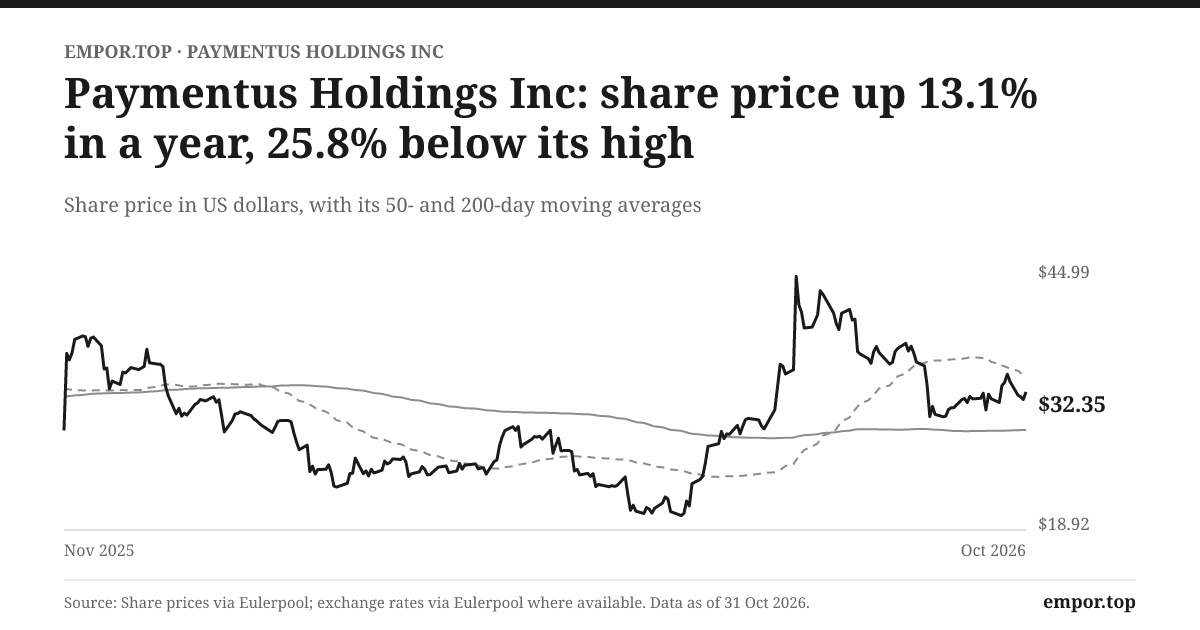
On the last trading day of October 2026, Paymentus shares closed at about $32, roughly a quarter below their 52-week high of about $44 and well above the low of about $20 they touched within the same twelve months.12 That range alone says something about how the market has treated this stock: one-year volatility near 60%, and a peak-to-trough fall of about 80% at some point in the past five years.12 This is a company whose price swings far more than the electricity bills it processes. The market value stood at about $4.1 billion, with an enterprise value of about $3.7 billion once the cash pile is netted off.12
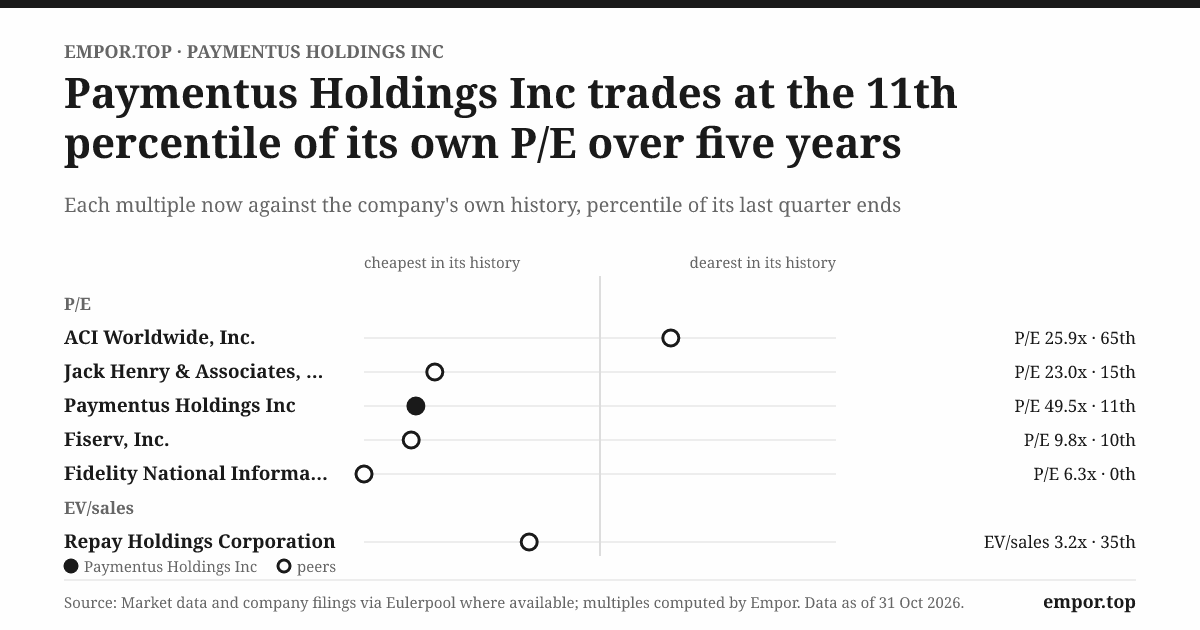
At that price, the shares traded at about 49.5 times trailing earnings.12 That is roughly half the stock's own five-year median multiple of about 100 times, which sounds like a bargain until one remembers how that median was formed: in the euphoric aftermath of a 2021 fintech listing, when earnings were tiny and the share price was high.
Flip the multiple over and the earnings yield is about 2%: each $100 invested in the shares buys about $2 of current annual profit, with the rest of the price resting on growth. On sales, the enterprise traded at about 2.8 times revenue and about 24 times EBITDA.12 Measured on the free cash flow shorthand that ignores capitalized software, the yield was about 3.9%; on the company's own, stricter definition, it would be lower.
Peers offer rough context, nothing more. Flywire, which processes education and healthcare payments, traded at about 2.95 times enterprise value to sales at the end of October; BILL Holdings, which serves small-business payables and receivables, at about 2.44 times; and ACI Worldwide, the bill-pay rival that also runs large banking-software franchises, at about 3.51 times.131415 Paymentus sits in the middle of that band. But the comparison flatters precision it does not have. Revenue at a payments company can include or exclude pass-through interchange, growth rates differ sharply, and margin structures are not comparable. A business that grows revenue near 30% with a 9% operating margin and one growing in single digits with a 20% margin can trade at the same multiple of sales for entirely different reasons.
What does the price appear to assume? At nearly 50 times earnings, the market is paying for earnings growth well above the revenue growth rate for several years. In other words, it is betting that the operating leverage visible since 2023 continues, that gross margin stabilizes rather than keeps falling, and that the business keeps winning large billers. It is not, at this multiple, paying much for the AI option. The price embeds confidence in execution, not in transformation.
Why Paymentus wins, and why it might not
The case that Paymentus wins from here rests on evidence, not on narrative. It has a specialized bill-pay platform with deep integrations into billers' systems, a wide array of payment channels, a partner network that reaches into banks and digital wallets, and a growing list of enterprise deployments. Its client count, its transaction volumes and the operating leverage of the past three years all show execution at scale. A business that nearly doubled its revenue in two years while adding only about 5% more people is doing something right operationally.
The case that it does not win is equally concrete. The market is fragmented and crowded with larger, better-capitalized competitors, from core-banking giants to specialist rivals. In-house systems remain the default alternative for many billers and banks. Paymentus discloses no market share, no top-five revenue concentration and no customer-level retention history that would prove it has cornered anything. Its own gross margin is falling as it wins the biggest clients, which is exactly what one would expect if those clients hold the bargaining power.
Run Hamilton Helmer's seven powers against Paymentus, narrowly, and only two candidates survive scrutiny. Switching costs are plausible: integrations with a biller's core systems, multi-year contracts with minimums and termination penalties, and the operational risk of migrating millions of customers' payment methods all create friction. The 99.5% retention claim is consistent with that friction. But switching costs protect the relationship, not necessarily the price, and the margin trend suggests large clients have been able to extract better terms at the outset even if they do not leave afterwards.
Network economies are possible through IPN, but unquantified; there is no evidence yet that each new participant makes the network more valuable to every other one. Scale economies exist in the sense that the platform absorbs volume cheaply, which shows up in operating leverage, but scale has not translated into gross-margin advantage. There is no evidence of a counter-positioning move that incumbents cannot copy, no cornered resource, no brand power with consumers, who mostly do not know the company exists, and process power is plausible but unproven. The narrow reading: switching costs and possible network effects, neither quantified enough to call a durable moat established.
Porter's lens confirms the same pressures: buyer and supplier power, substitutes and rivalry weigh against Paymentus. Integration complexity and the trust required to handle sensitive payment flows moderate the threat of new entrants, the one force that clearly works in Paymentus's favour.
The risks that would break it
The material risks are easiest to understand by mechanism. If enterprise launches slow, revenue growth slows, because a signed contract earns nothing until it goes live, and the company has said bookings are not disclosed. If payment mix shifts further toward high-value card payments or interchange rises, gross margin falls, because those costs pass through cost of revenue. If a cybersecurity breach or major outage hits the platform, the damage would land on sensitive consumer payment data and on billers' trust, the single most important asset a payments processor has.
And there is a quieter risk in the balance sheet: one reseller accounted for more than 10% of receivables at the end of 2024 and 2025, and still did at June 2026.9 Paymentus does not name that reseller, disclose the balance or provide an ageing schedule. Receivables were about $106 million at June 2026, with a credit-loss allowance of under half a million dollars.9 The modest allowance is favourable. The concentration is a counterweight, because a single partner's financial trouble could turn into a collection problem.
Counterevidence must sit beside each thesis claim, not in a footnote. Gross margin declined from about 29.7% to about 24.8% over two years, even as operating margin improved. The absence of impairment on past acquisitions in the last three reported years does not prove they earned attractive returns. The free cash flow shorthand overstates what is left after reinvestment by about a fifth. And the say-on-pay vote, which looks like overwhelming approval, mostly reflects the controlling holders' votes.
The bull case, at its strongest, runs like this. Paymentus keeps signing and launching enterprise billers, implementation gets faster and cheaper as the platform matures, and operating leverage converts a large, repeat-use payment network into much stronger earnings and cash. Gross margin stabilizes as mix effects work through and scale benefits accumulate. The AI suite eventually adds a higher-margin software layer on top. In that world, a multiple near 50 times trailing earnings could compress quickly through earnings growth rather than through price.
The bear case is equally straightforward. Growth slows from a high base as the biggest wins are lapped, enterprise mix keeps pressing gross margin lower, competitors and bank-technology giants use bundling to hold prices down, and AI takes years to produce meaningful sales. Meanwhile investors pay about 49.5 times earnings for a business whose operating margin, even after its improvement, is still in single digits, and whose governance gives them little say.
Three KPIs resolve the debate, and they should be read together. The first is transaction growth alongside new biller launches, most recently a little over 21% growth in transactions in the second quarter.[^2] The second is operating margin read beside gross margin, most recently about 9.1% operating margin, rising, against a gross margin that fell over the last two full years.91 The third is cash after capitalized software, roughly $125 million in 2025 on the company's own definition. Transactions tell whether the network is growing. The two margins tell whether growth is profitable. Cash after software tells whether profit survives reinvestment.
Valuation discipline closes the circle. Peer multiples are rough context, because revenue definitions and growth rates differ. The five-year median P/E is not a fair-value anchor; it was formed in a market that priced fintech differently. What matters is whether the business can grow earnings fast enough, for long enough, to justify what is being paid today.
Those questions sound abstract until they are tied back to the business itself, and the business has some unusually clear lessons to teach.
X. Business & Investing Lessons
The first lesson is about what Paymentus actually sells. In payments, the invisible workflow is the product. When the water utility's executive signed with Paymentus, she was buying the integration that made payments land in the right account, in real time, without her staff matching files by hand. The consumer sees a clean screen.
The biller sees a back office that finally works. That is why Paymentus could grow for two decades with a brand almost nobody outside the industry recognizes. The wider lesson for founders is that some of the most durable businesses are the ones whose customers' customers never learn their names, and the wider lesson for investors is that the place to look for an edge in such businesses is in the plumbing, not the interface.
The second lesson is the one that defines the last three years. Scale can widen the bottom line while thinning the first one. The 2025 enterprise launches showed that trade-off: revenue and operating margin rose as gross margin fell, because the company barely had to hire to absorb the volume. That combination confounds anyone who judges a payments company by its gross margin alone. But it is also a trade that has to keep working: lower margin per dollar is only a good deal if operating costs keep falling faster as a share of revenue. A business that wins its biggest customers by giving them better economics has to be very sure it can make the arithmetic work afterwards.
The third lesson sits in the cash-flow statement. A software company's cash story includes the code it capitalizes. Paymentus's cash flow after software investment shows why investors need to count that cost. In a business whose most important asset is code, the line between operating cost and investment is a judgment call, and investors need to make that call themselves rather than inherit it from whoever built the spreadsheet.
The fourth lesson is the most important for the moat debate. A network claim earns its name through customer proof. Paymentus's Instant Payment Network has the architecture of a two-sided network, but a network effect is a statement about economics: each new participant has to make the service measurably better for the others, and that should show up in retention, pricing power or acquisition costs. Until Paymentus discloses evidence to prove it, IPN is a distribution asset with network potential. Founders who build such architectures should measure and publish the economics, because investors will otherwise discount the word "network" to the evidence behind it.
The fifth lesson is about who holds the keys. Control can fund patience, but it also raises the burden of proof. Sharma's founder control and Accel-KKR's voting power let Paymentus invest in software, products and AI that may take years to pay off without fear of an activist campaign. That patience has value. But the $34 million stock award and the say-on-pay vote illustrate how little those formal signals say about minority-shareholder approval. When outside shareholders cannot vote management out, management has to earn trust through disclosure instead: performance conditions, measurable targets and clear reporting of the economics that justify the control.
All five lessons converge on the same idea. Paymentus has built something real and repeated. The open question is whether each added transaction and each software dollar earns an adequate return, and the next few quarters will start to answer it.
XI. Epilogue
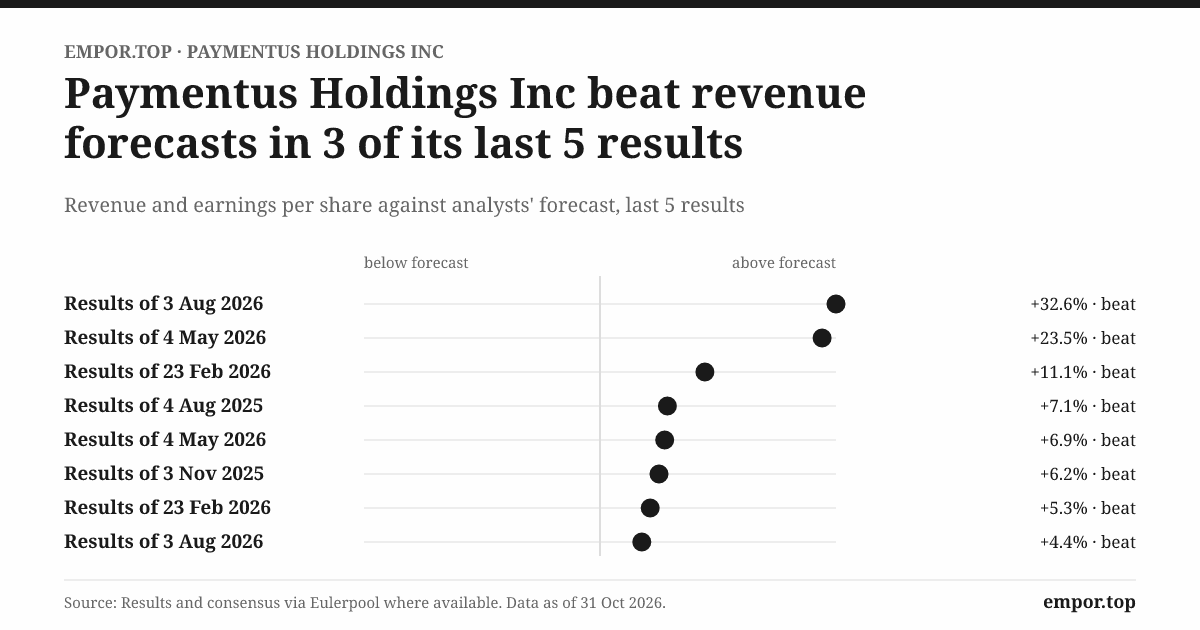
Paymentus enters the final months of 2026 with momentum and with its own guidance as the measuring stick. After the second quarter, management raised its full-year outlook: revenue of about $1.425 billion to $1.44 billion and adjusted EBITDA of about $175 million to $185 million.[^2] It also said its bookings gave it visibility into 2027.[^2] That combination is the strongest signal a company can send without disclosing the bookings themselves: we know what is coming, and it is enough to raise the bar.
The first test is simple: execution against that guidance. Revenue near the top of the range would mean the enterprise billers are performing as management expected and the pipeline is converting on schedule. A miss would revive the oldest worry about the model, that a signed contract is only a promise until a biller goes live, and the company's admission that seasonality has become harder to forecast would suddenly look less like candour and more like a warning.
The calendar makes the first of those moments close at hand. The third-quarter report, due in the coming weeks, is the next scheduled checkpoint. It will be the first quarter in which the 2025 enterprise launches are fully in the year-earlier base, so growth will have to come from new billers and organic volume rather than from lapping a step change. That makes it the cleanest read yet on whether the engine runs without the boost of a single large cohort.
The second test is the one this story keeps returning to. Watch gross margin and operating margin together, especially as the enterprise customers launched in 2025 mature and the next cohort goes live. If gross margin stabilizes and operating margin keeps climbing, the enterprise strategy is compounding. If gross margin keeps falling and operating leverage stalls, Paymentus is busier but not stronger.
The third is cash after capitalized software, alongside the reseller receivable concentration and debtor days. Debtor days fell from about 52 at the end of 2024 to about 32 at the end of 2025, which helped the 2025 cash flow, and a reversal would hurt it.1 The fourth is governance: further Accel-KKR distributions or Class B conversions, which would gradually shift power toward public shareholders, and the vesting and performance outcomes attached to Sharma's equity award. And beyond all of those sits the longer-dated question of whether Billeo produces paid deployments and, eventually, revenue.
Each of those moments maps back to the questions that opened this story. Does the integration create a moat, or only friction? Does the cash survive the software bill? Does founder control serve outside shareholders? And underneath them all is the question no single quarter will settle: does more volume make the network more valuable, or does it mainly make the payment processor busier?
XII. Outro
Go back to the household from the beginning of this story. Someone taps "Pay" on the electricity bill and moves on with their evening. It takes a second. It will be forgotten by morning.
On the other side of that tap, the biller sees something different: a payment that posted correctly, a customer who did not need to call, an account that will need to work again next month, and the month after that. Paymentus has turned that invisible obligation into a business of about $1.2 billion in revenue, built on the unglamorous genius of making sure nothing goes wrong.1 Its defining challenge is that the qualities that make it valuable to billers, its invisibility and its reliability, are not the qualities that make it legible to investors. The more invisible the system becomes to consumers, the more visible its economics must become to the people who own it.
References
-
Annual Report on Form 10-K for FY2025 — Paymentus Holdings, Inc., 2026-02-24 ↩↩↩↩↩↩↩↩↩↩↩↩↩↩↩↩↩↩↩↩↩↩↩↩↩↩↩↩↩↩↩↩↩↩↩↩↩↩↩↩↩↩↩↩↩↩↩↩↩↩↩↩↩
-
2026 Proxy Statement — Paymentus Holdings, Inc., 2026-04-22 ↩↩↩↩↩↩↩↩↩↩
-
Final IPO Prospectus on Form 424B4 — Paymentus Holdings, Inc., 2021-05-26 ↩↩↩↩↩↩
-
Paymentus Raises $210 Million in IPO, Eyes International Expansion — Payments Dive, 2021-05-27 ↩↩
-
Form 10-K for FY2022 — Paymentus Holdings, Inc., 2023-03-03 ↩↩↩↩
-
Quarterly Report on Form 10-Q for Q2 2026 — Paymentus Holdings, Inc., 2026-08-04 ↩↩↩↩↩↩↩↩↩
-
2026 Annual Meeting Voting Results on Form 8-K — Paymentus Holdings, Inc., 2026-06-08 ↩↩
-
Form 10-K for FY2024 — Paymentus Holdings, Inc., 2025-03-11 ↩
-
PAY Statistics & Valuation — StockAnalysis, 2026-10-30 ↩↩↩↩↩
-
Flywire Statistics & Valuation — StockAnalysis, 2026-10-30 ↩
-
BILL Holdings Statistics & Valuation — StockAnalysis, 2026-10-30 ↩
-
ACI Worldwide Statistics & Valuation — StockAnalysis, 2026-10-30 ↩
 LinkedIn
 WhatsApp
 Reddit
 Hacker News
 Email
 Kindle
 RSS Feed
 Spotify
 Apple Podcasts
 Amazon Music
 Audible
 YouTube