First Advantage: The Background Check That Became a $2.2 Billion Bet
I. The Deal That Changed the Company
Somewhere right now a person has accepted a job offer, signed the consent form and is waiting. They have told their old employer they are leaving. They have probably told their family. Between them and their first day sits a background check, and until it clears, the new job is a promise and nothing more. Most people never think about the company doing that check. On October 31, 2024, the company doing a very large share of those checks got much bigger, and its shareholders took on a much larger bet.
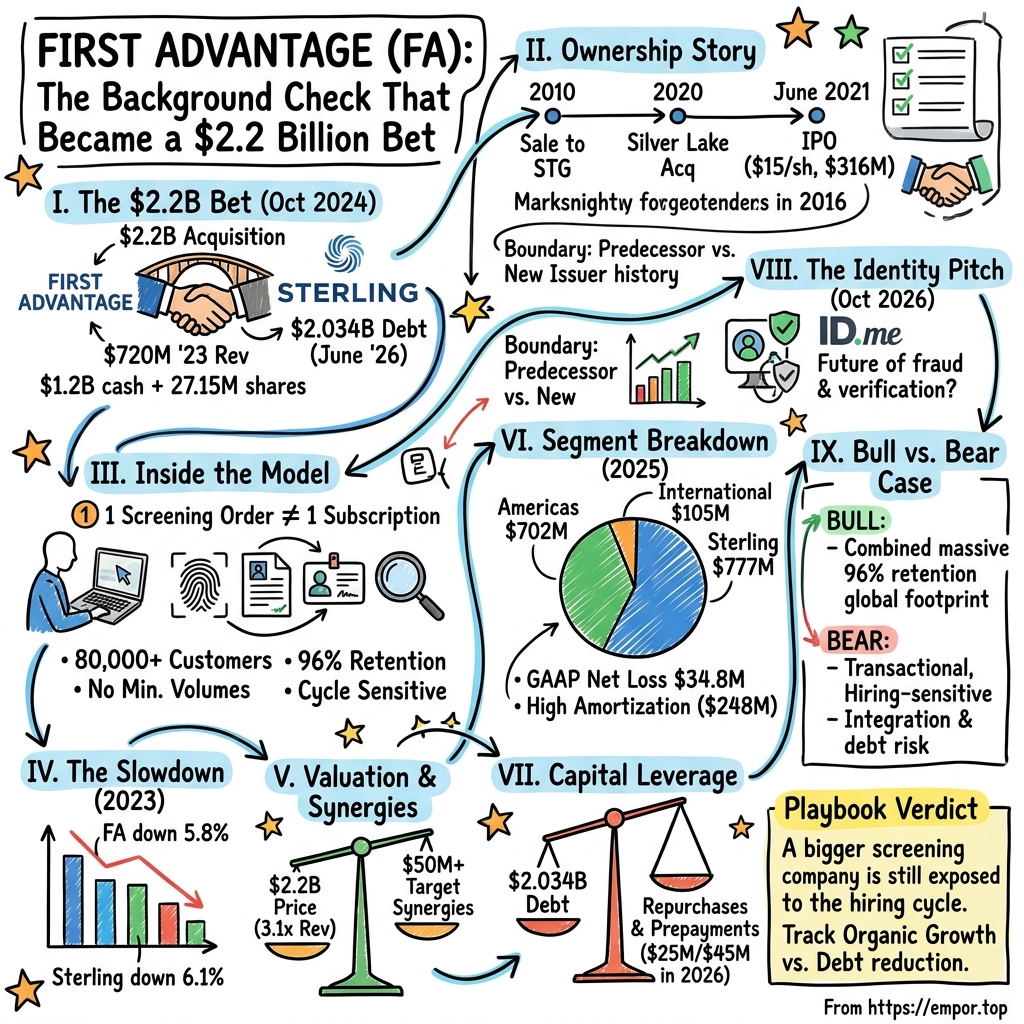
That day First Advantage, an Atlanta-based screening company, closed its acquisition of Sterling Check, one of its two largest listed rivals, in a deal valued at about $2.2 billion.[^1] Sterling shareholders received a mix of cash and stock. The cash portion came to roughly $1.2 billion, and on top of it First Advantage issued about 27.15 million new shares to Sterling's owners.[^1]1 To pay the cash and refinance the debt it inherited, First Advantage borrowed heavily, which turned a company that had spent its first public years carrying moderate debt into one whose balance sheet would define the next chapter.1
What did the money buy? Sterling brought about $720 million of revenue in 2023 and about $185 million of adjusted EBITDA, the profit measure screening companies like to quote before interest, tax, depreciation, amortization and a long list of one-off costs.2 At $2.2 billion, First Advantage paid a little over three times Sterling's annual sales and somewhere around eleven to twelve times its projected EBITDA.[^1]3 For a business that would nearly double First Advantage's revenue overnight, that is a serious price, though not an outlandish one, as the bankers' comparison tables in the merger filing would show.
The trouble was the timing, and the timing is what makes this a story rather than a press release. Both companies were shrinking when they agreed to combine. Sterling's revenue had fallen about 6% in 2023 and its adjusted EBITDA had fallen slightly faster.2 First Advantage's own revenue had slipped by a similar amount.1 Employers had stopped hiring at the frenzied pace of 2021 and 2022, and a screening company's revenue moves with the number of people being hired. So First Advantage was buying scale at the bottom of a cycle, paying a fair multiple for a business whose earnings were heading the wrong way.
Management's pitch was that combination would solve problems neither company could solve alone. A bigger company could offer broader coverage across countries and industries, sell each company's products to the other's customers, and strip out duplicated costs. The company put a figure on that last promise: about $50 million of annual run-rate cost synergies.[^1] Two years later, that promise is the yardstick, and the debt is the scoreboard. At the end of June 2026, First Advantage carried about $2.03 billion of long-term debt.4
The question hanging over the company is whether Sterling made its growth more durable or whether First Advantage simply bought size just as demand weakened. Four smaller questions follow from it. The first is how much of today's growth is organic, earned from customers rather than bought with the acquisition. The second is whether a business built on one-off screening orders can become something steadier than a bet on hiring volumes. The third is whether Sterling can be absorbed while debt comes down and reported returns recover from the hole the deal dug. The fourth is whether the stock's valuation, and the continuing influence of private-equity owner Silver Lake, are justified by what the business actually earns.
Answering any of them starts with a deceptively simple question: which company are we actually talking about? First Advantage is an old name, but the company that trades under it today is young, and its financial history is shorter than its brand suggests.
 Subscribe on LinkedIn
II. One Name, Several Different Companies
In June 2021, at the height of the post-pandemic hiring boom, First Advantage came back to Nasdaq. The offering priced at $15 a share, and the company sold about 29.3 million shares, raising roughly $316.5 million after costs.51 It was a good moment to sell a hiring-linked business to public investors. Job openings were at records, employers were desperate to onboard staff quickly, and screening volumes were surging. The prospectus told the story of a global, technology-driven screening platform. What it did not have, and could not have, was a long public record under its current owners.
That is because the issuer behind the ticker was incorporated only in November 2019, in connection with Silver Lake's purchase of the business.5 The name, the customers and many of the people are older. The legal and financial entity that investors own is not.
The family tree is worth a minute, because it explains why long-run numbers about "First Advantage" can mislead. An earlier First Advantage was formed in 2003 under First American, the title insurance group, and listed on Nasdaq as a broader collection of businesses that included employer screening alongside other data and information services.6 That company's revenue in the mid-2000s, and its profits, belonged to a different mix of activities. In 2010, the screening business was sold to Symphony Technology Group, a private-equity firm, and spent most of a decade in private hands.5 In 2020, Silver Lake, the technology-focused buyout firm, acquired it from Symphony, and the IPO followed about eighteen months later.5
So the figures from 2004 to 2008 that sometimes appear beside First Advantage's name are the predecessor's figures. They describe a company with different businesses, under a different parent, before a decade of private ownership. They cannot tell an investor how today's screening company grows through a cycle or how reliably it turns profit into cash. The useful record begins in 2019 and is barely seven years long. Within that window sits one boom, one hiring slowdown and one transforming acquisition, which is not a lot of evidence for long-run claims.
The IPO also showed whose company this was. A large slice of the proceeds, about $200 million, went to repay debt that had funded the buyout.1 Silver Lake did not sell out. It remained the controlling shareholder and kept board seats and governance rights that would persist as long as it held a quarter of the shares.57 Existing holders sold more stock in a follow-on offering in November 2021, but the sponsor stayed in charge.1 In practical terms, public investors had bought a minority stake in a sponsor-controlled company whose capital structure had been designed by a buyout firm.
Running that company was Scott Staples, who has been chief executive since April 2017.7 Staples did not come up through the screening industry. Before First Advantage he was a co-founder of Mindtree, the IT services company, where he led its business in the Americas.5 That background shapes how he talks about First Advantage: as a technology and services platform, built around automation, software integrations and global delivery, rather than as a records-retrieval shop. It also explains some of the company's choices, including heavy spending on product and technology and an appetite for building delivery capacity in lower-cost locations. An IT services veteran understands scale, utilization and the cost of every manual touch. Whether those instincts produce lasting advantage in screening is one of the things this story has to test.
The boom that framed the listing is easy to forget now. Revenue rose about 40% in 2021 and another 14% or so in 2022, peaking at about $810 million, as employers scrambled to refill jobs emptied by the pandemic and turnover churned through warehouses, hospitals and retail floors.1 A screening company in that environment looks like a growth company, because every resignation produces a vacancy and every vacancy produces a check. Investors buying at $15 were, in part, buying that moment. The question was what the business looked like when the moment passed.
The first test of the newly public company arrived quickly. Could a business that had just listed on the strength of a hiring boom keep growing once the boom faded? And could public shareholders, rather than the sponsor's ownership structure, become the main story? Before answering, it helps to understand exactly what First Advantage sells, and why its revenue behaves the way it does.
III. A Screening Order Is Not a Subscription
Picture a hospital system hiring a nurse. The recruiter clicks a button inside the hospital's applicant tracking system, the software that manages job candidates. That click sends an order to First Advantage for a package of checks. A criminal-record search runs across the counties and states where the candidate has lived. Someone, or increasingly something, verifies the nursing license, the past employers and the degree. The candidate may be routed to a clinic for a drug test. Identity is confirmed, so that the person being screened is actually the person who applied. Some of the data comes from First Advantage's own databases; some comes from courts, schools, labs and third-party providers that charge for every lookup. When everything is finished, the completed report lands back in the hospital's system, and that is generally when First Advantage records the revenue.1
That moment, the delivery of a completed report, is the heartbeat of the business. Most revenue is transactional: a customer orders a package or selected screens for one individual, and the price depends on which checks are included, how many orders the customer places, the customer's requirements, pass-through fees such as court charges, and how products are bundled.1 There is no monthly software fee rolling in regardless of activity. If the hospital hires a thousand nurses this year, First Advantage processes a thousand packages. If it freezes hiring, the orders stop.
Contracts make that plain. They typically run three years, which sounds comfortingly long, but they generally lack minimum or committed volumes.1 A three-year contract here is less like a lease and more like a preferred-supplier agreement: it sets terms and prices, and the customer decides how much to use. That is the single most important fact about the company's economics, and it explains why "contracted" and "recurring" mean less here than they would at a subscription software company. Hiring surges push volume up fast. A hiring freeze pulls it down just as fast. The company does not quantify how much of its revenue recurs in any predictable way.1
Not every step is equally profitable. Some checks rely on First Advantage's own data and automated workflows, and those carry the best economics. Others depend on outside parties, such as a county court that charges a fee per search, a lab that runs the drug panel or a registrar that verifies a degree, and much of that cost is passed through to the customer at little or no margin. The richer the package in proprietary, automated steps, the more of each order the company keeps. The more it leans on third parties, the more it behaves like a well-run broker. That mix, invisible to the candidate, explains much of the margin difference between screening businesses.
Against that, First Advantage has built real scale. The company says it serves more than 80,000 customers, including about two-thirds of the Fortune 100, and processes more than 200 million screens a year across more than 200 countries and territories.8 Gross retention, the share of existing customer revenue it keeps from one year to the next, was 96% for 2025 and again in the second quarter of 2026.19 That is a strong number. It means very few customers walk away in a given year, and it suggests that once a large employer wires a screening vendor into its hiring workflow, it rarely rips that vendor out.
Who else is in the room
The competitive field is crowded at the bottom and concentrated at the top. Before Sterling joined First Advantage, the three large listed specialists, First Advantage, Sterling and HireRight, each generated roughly $700 million to $760 million of annual revenue.1021 Around them sat Checkr, a venture-backed platform popular with gig-economy and technology employers; Accurate Background; ADP, which offers screening as part of a much larger payroll and human-capital suite; and a long tail of regional and specialist providers. HireRight's own annual report described a fragmented market with many competitors, ranging from global firms to small local operators.10 That is the honest starting point. This is not a duopoly. It is a market where a few large firms compete for the biggest employers while thousands of smaller ones compete for everyone else.
Michael Porter's five forces, applied to a single order, show where the pressure comes from. The buyer is often powerful. A large employer can split its volume between two providers, run a formal request for proposals when its contract ends, or use one vendor in the United States and another abroad. The suppliers matter too. Courts, data aggregators, drug-testing labs and education registrars sit between First Advantage and the facts it needs, and their fees and coverage shape both cost and speed. Rivalry is genuine, because the largest providers sell broadly similar products to the same human-resources departments. Against those pressures sit two forces that favor scale. The first is compliance. In the United States, screening is regulated as consumer reporting under the Fair Credit Reporting Act, and state and local rules on criminal history, drug testing and candidate notices multiply the complexity. A national employer would rather have one vendor that understands all of it than a patchwork of local shops. The second is global delivery. A multinational hiring in forty countries values a single vendor that can check records in each of them.
It helps to see what compliance means in practice. When a report turns up something that might cost a candidate the job, federal law generally requires the employer to send a notice and a copy of the report before acting, give the candidate a chance to dispute it, and then send a second notice if it goes ahead. The screening company must follow reasonable procedures to ensure accuracy, handle disputes within set deadlines and avoid reporting certain stale information. Layer on city and state "ban-the-box" rules about when criminal history can be considered, rules on marijuana testing that vary from state to state, and data-protection regimes abroad, and the job begins to look less like data retrieval and more like regulated logistics. Every mistake carries the risk of a consumer lawsuit, and class actions over screening practices are a recurring cost of the industry.1 A large employer outsourcing that risk wants a vendor big enough to absorb it.
Integrations add friction. First Advantage reports more than 100 integrations with applicant tracking and human-capital management systems, and more than one billion records in its proprietary databases.1 An integration means the recruiter never leaves their usual software to order a check, and an in-house database means some searches can be answered faster and more cheaply than by sending someone to a courthouse. Both make switching inconvenient. Neither makes it impossible. Large competitors have their own integrations with the same software vendors, and a rival can assemble similar data coverage by buying it from aggregators or building it over time. These are signs of serious infrastructure, not proof of a moat that customers cannot cross.
Sterling added one feature that matters here. First Advantage says a majority of Sterling's enterprise contracts are exclusive or make Sterling the primary provider.1 That helps explain retention and gives the combined company more protected volume at its largest accounts. It does not change the absence of minimum commitments. An exclusive provider of zero orders still earns nothing.
So what kind of advantage is this? It is the advantage of being the safe choice for a complex, compliance-heavy, multinational employer. That is credible and valuable. It is also limited. Retention of 96% shows customers rarely leave; it does not show that First Advantage can raise prices faster than costs, and the company does not publish price realization. Customer count shows breadth; it does not show depth. The concentration history is a reminder: one unnamed customer accounted for 12% of revenue in each of 2023 and 2024, although no single customer reached 10% in 2025 after Sterling's revenue was added.1 A business that can lose or gain a big slice of revenue based on one employer's hiring plan is not a utility.
That leads to the measures that actually tell investors whether the model is working. Customer count alone is a vanity figure. What matters is organic order growth from the existing base, gross retention, and revenue per customer, with pricing and large-customer concentration in the background. Those measures were about to face their hardest test, because the hiring boom that had carried First Advantage to the public market was ending.
IV. When Hiring Slowed, the Model Showed Through
On February 29, 2024, the day First Advantage announced the Sterling deal, it also held its call on 2023 results. The message on that call was a forecast of more pain before relief. Management told analysts it expected the macroeconomic drag on its existing customers' volumes to continue, to ease through the year and to turn positive in the fourth quarter of 2024.11 In other words, the company's own base business was still shrinking, and the turnaround was a few quarters away.
The numbers behind that forecast were sobering. First Advantage's legacy revenue in 2023 was about $764 million, down nearly 6% from the year before.1 Sterling, across town in the competitive sense, was living the same year. Its revenue fell about 6% and its adjusted EBITDA fell nearly 7%.2 In the fourth quarter, Sterling's existing customers ordered about 14% less than a year earlier, a decline that new customers, upselling and cross-selling only partly offset.2
That 14% figure is the cleanest window into how the model behaves under stress. Sterling did not lose its customers in 2023. Its customers simply hired fewer people. Base volume fell by double digits without any visible loss of competitive position, which is exactly what a transaction-led model with no minimum commitments would predict. The same mechanism that delivers spectacular growth in a hiring boom delivers sharp declines in a hiring slowdown. Scale did not protect either company. Both were large, both were well integrated with big employers, both kept most of their customers, and both still shrank.
Set against the boom, the size of the swing becomes clear. The company found itself shrinking within twelve months, with no change in its products, its customer list or its management.1 Very few things changed except the number of people employers wanted to hire. For a long-term investor, that sequence is the most important piece of historical evidence the current company has, because it is the only full cycle in its short public life.
This matters because the consensus story about First Advantage, especially after the deal, can drift toward a smoother narrative: a global platform with sticky enterprise customers and high retention. Retention was high in 2023 too. It did not stop revenue from falling. The 2023 record does not reject the idea that First Advantage has durable customer relationships. It narrows it. Customers stay; their volumes do not.
The recovery, and what is inside it
Then the cycle turned, and the reported numbers exploded. Revenue for 2025 rose 83% to about $1.57 billion.1 Very little of that was the base business. The company attributed about $659.5 million of the increase, roughly 77 percentage points of the growth, to Sterling's consolidation.1 New First Advantage customers added about 3.5 points and existing customers about 2.8 points, partly offset by lost accounts and macro-driven declines.1 Strip out the acquisition, and the underlying business grew in the mid-single digits, which is respectable but ordinary.
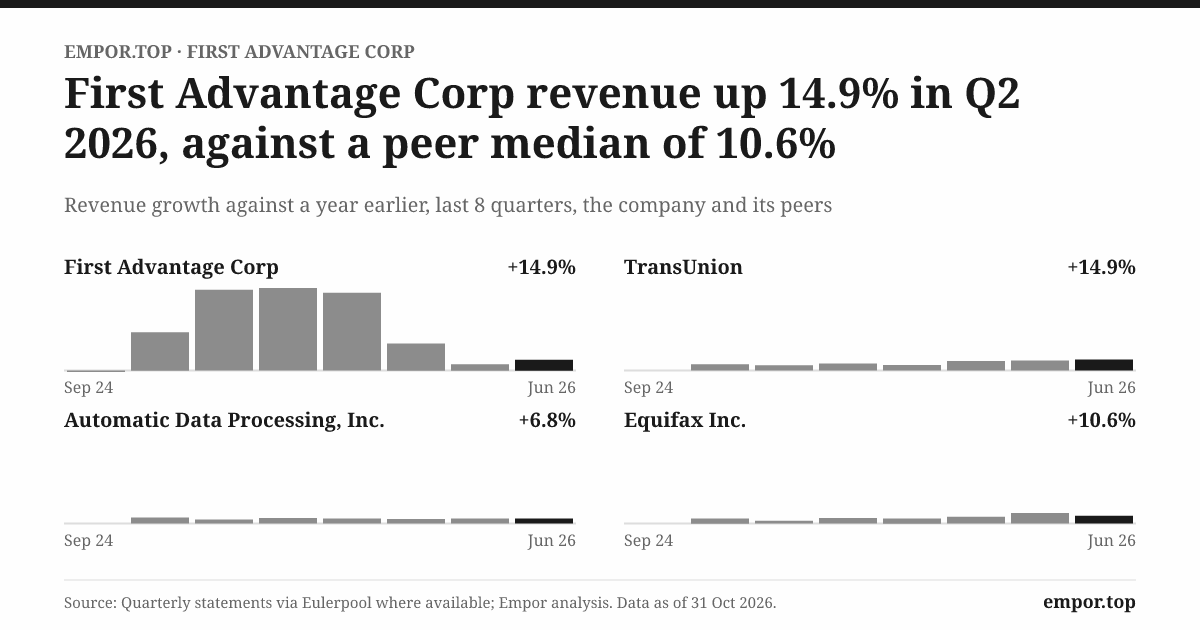
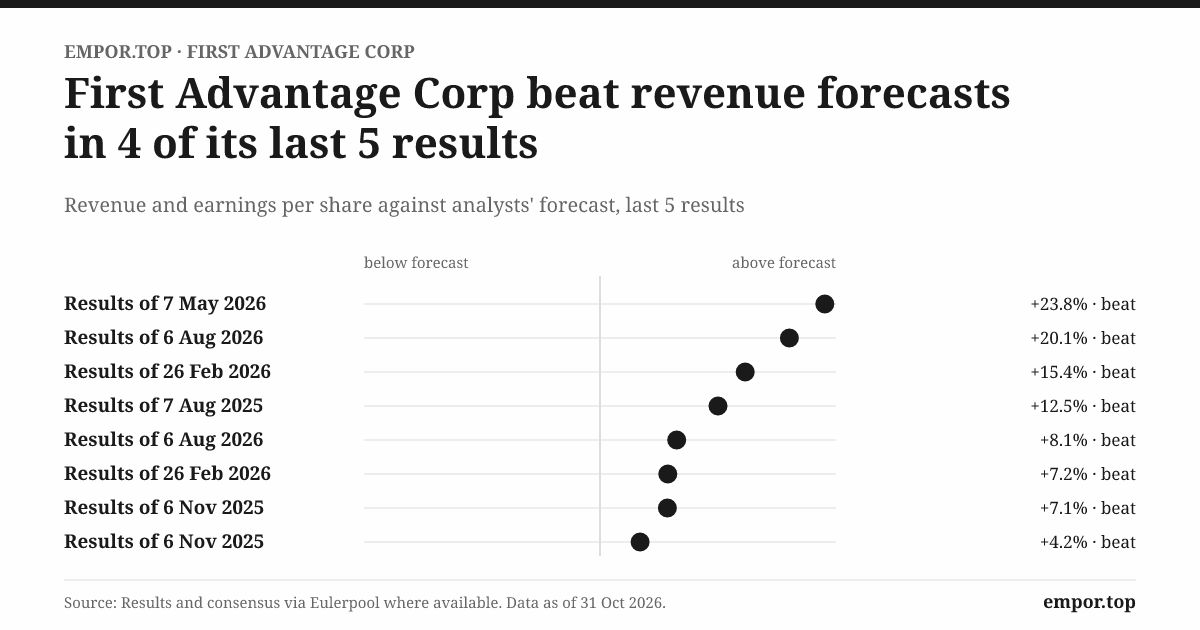
The more interesting chapter came in 2026. Once Sterling had been part of the company for a full year, the acquisition stopped inflating comparisons, and the growth figure started to mean something. In the second quarter of 2026, revenue rose 14.9% to about $448 million.[^13] That was well above management's long-term growth algorithm of 7% to 9%, the range it tells investors to expect over a full cycle.9 It looked like a breakout.
The analyst questions on the second-quarter call went straight at the obvious issue. How much of that growth was repeatable? Management's answer was candid and important. Several customers had run unusually large initiatives that generated exceptional order volumes, and those initiatives supplied roughly half of the quarter's base growth.9 Without them, management said, growth would still have been 11% to 12%.9 That is still above the algorithm, and it suggests the base business is genuinely healthier than it was in 2023. It also tells investors that a meaningful part of the headline came from a handful of customer-specific surges, which by definition will not repeat at the same scale.
Compare the two calls. In early 2024, the company laid out a timetable for recovery: base declines easing through the year and turning positive in the fourth quarter.11 By the middle of 2024, quarterly revenue was roughly flat year on year, and by mid-2026 base growth was clearly positive.19 On the narrow question of whether management's 2024 forecast of a turn was borne out, the record is broadly supportive. On the broader question of whether the company separates recurring demand from temporary surges, the second-quarter call was more forthcoming than many companies would be. Volunteering that half the base growth came from unusual initiatives is the kind of disclosure that makes the rest of the commentary easier to trust.
So the downturn and the recovery tell one story together. First Advantage's growth is real but cyclical, and the bigger company is no less exposed to hiring than the smaller one was. Which raises the question that sits under everything else: if scale did not remove the cycle, what exactly did the $2.2 billion buy, and was it worth the price?
V. The Sterling Price Was Fair; the Timing Was the Risk
Put yourself in Scott Staples' chair in early 2024. Your revenue is falling. Your largest rivals are in the same position. You have cash on the balance sheet, though less than a year earlier because you paid a special dividend. You could sit tight, cut costs and wait for employers to start hiring again. Or you could use the downturn, when rivals are cheaper and their owners more willing to sell, to buy one of them.
On February 29, 2024, First Advantage chose the second path and announced the Sterling deal.[^1] Reuters described it plainly as a background screening firm buying a rival.12 That framing captures the strategic logic. This was not an adjacency play. It was consolidation: two of the three largest listed specialists becoming one.
Staying independent was not a comfortable option. A hiring recovery would eventually have lifted volumes, but in a market where the largest customers increasingly wanted one global vendor, standing still risked losing share to whichever rival consolidated first. Buying Sterling also removed one of the two large listed competitors that First Advantage met most often in enterprise bids, which changes the competitive dynamics at the top of the market, at least until customers find or build alternatives. The deal was offense and defense at once. That is also why it was expensive: First Advantage was paying not only for Sterling's cash flows but for the privilege of making sure nobody else owned them.
The first question any shareholder should ask about a deal like this is what was bought. Sterling brought about $719.6 million of 2023 revenue, a deep enterprise customer base and global screening capabilities, particularly in markets and industries where First Advantage was thinner.2 Its adjusted EBITDA margin in 2023 was about 25.7%, which was materially below the roughly 32.9% that First Advantage's Americas business earned.23 So First Advantage was buying a business that converted less of each sales dollar into profit than its own core. The bull reading is that the gap was an opportunity, because consolidation would let the combined company bring Sterling closer to First Advantage's cost structure. The bear reading is that the gap was a reason the combined margin would be lower, at least until synergies arrived.
Was the price defensible?
The headline multiple was a little over three times 2023 revenue and about 11 to 12 times projected EBITDA.[^1] In the merger proxy, First Advantage's financial adviser compared that with selected prior transactions in the industry and data-services space, and the selected multiples ran from about 11.2 to 12.3 times.3 The Sterling price sat inside that range. On the comparison the bankers chose, then, this was not an obvious overpayment. It was a market price for a market asset.
The caveat is that "market price" is not "cheap." Comparable deals are usually struck in better conditions, when the target's earnings are stable or rising. Sterling's earnings were falling. Paying a normal multiple for declining earnings means accepting that the multiple will look higher if the decline continues, and lower only if the business recovers and the promised savings arrive. The price relied on the cycle turning. As it happened, the cycle did turn, but it turned slowly. By its first full year in First Advantage's hands, the Sterling segment reported about $777 million of revenue, above the roughly $720 million Sterling had reported on its own for 2023.12
Then there is the cost of waiting. The deal took eight months to close, after regulatory review.[^1]1 For the whole of that period, both businesses ran through a weak hiring market with the uncertainty of a pending merger hanging over their employees and customers. That is not unusual for a deal of this size, but it means the integration clock started later than it could have.
Synergies: actioned, realized, and the difference
The original $50 million annual run-rate target covered duplicated costs: overlapping offices and technology platforms, duplicated corporate functions, and fulfillment work that could be consolidated into fewer centers.[^1] By the second quarter of 2026, management said it had actioned about $63 million of run-rate synergies, comfortably above the original target.9
That sounds like a clean win, and it may become one. But the word "actioned" deserves attention. In corporate language, actioning a synergy usually means taking the step that should produce the saving: closing the office, consolidating the platform, eliminating the role. The saving itself shows up in the accounts later, and sometimes partly. A synergy actioned in 2026 may be fully visible in 2027 margins, offset by wage inflation, absorbed by reinvestment, or eaten by the costs of running two systems during migration. The figure is a waypoint, not a destination. The proof will be in reported margins and in cash flow.
It is also worth being clear about what the reported revenue leap does and does not mean. Sterling accounted for most of the 2025 revenue increase.1 That is acquisition accounting. It is not evidence that the combined company is winning customers faster than before, and it should not be read as growth in the usual sense. The test of whether the deal created value is whether the combined company grows faster, earns more per dollar of sales, or generates more cash per dollar of capital than the two companies would have separately.
The case for the deal rests on cross-selling and service consolidation. Cross-selling means offering Sterling's customers First Advantage products they did not previously buy, and vice versa. Consolidation means moving work onto the cheaper platform and closing the more expensive one. Against those sit three costs. The first is mix: Sterling's lower margin pulls the combined average down until it improves. The second is amortization: when one company buys another, it books the value of customer relationships and technology as intangible assets and writes them down over time, which reduces reported profit for years even though no cash leaves the building. The third is integration itself, which costs money before it saves money.
A simple piece of arithmetic shows what is at stake. If Sterling's segment margin, about 27% in 2025, rose to the roughly 30% the Americas business earned, the combined company would add something like $20 million to $25 million of annual adjusted EBITDA from that improvement alone.1 That is meaningful, but it is a fraction of the roughly $250 million a year of depreciation and amortization the company now books. Closing the margin gap helps. It does not, by itself, make the deal look cheap on reported earnings. The heavy lifting has to come from growth and from debt reduction.
The price, in other words, was fair. The timing was the risk, and the bill for that risk was paid in debt. Whether the deal earns its cost depends on where the combined company actually makes its money, which is a question the accounts answer more precisely than the press releases do.
VI. One Company on Paper; Three Businesses in the Accounts
In 2025, First Advantage reported a full year of combined results, and did something revealing: it split the business into three segments. First Advantage Americas, the original company's home market; First Advantage International, its operations outside the Americas; and Sterling, kept as its own segment during integration.1 On paper, there was one company. In the accounts, there were three, each with its own economics.
Americas generated about $702 million of revenue and about $212 million of adjusted EBITDA.1 Sterling generated about $777 million of revenue and, strikingly, the same $212 million or so of adjusted EBITDA.1 International was much smaller, at about $105 million of revenue and $17 million of adjusted EBITDA.1
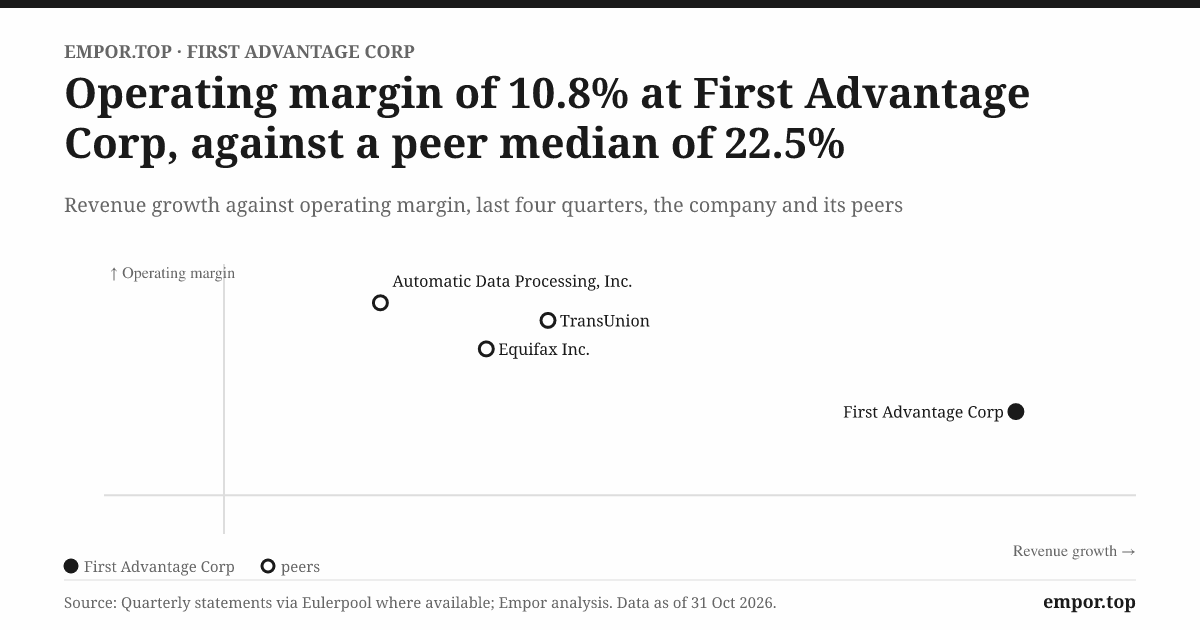
Translate that into plain terms. Sterling was about half of the combined company's 2025 revenue, and Americas and Sterling contributed roughly equal amounts of segment profit. That means Sterling earned about 27 cents of adjusted EBITDA on each dollar of sales, while Americas earned about 30 cents. The gap had narrowed from where it stood before the deal, which is an early sign that integration is improving Sterling's economics, or that Americas' margin has softened, or both. International earned about 16 cents on each dollar, a much thinner business that matters for global coverage more than for profit. If you want to know where First Advantage's profit lives, it lives in two large North American-centered businesses of similar size, and the rest of the world is a supporting act.
But segment adjusted EBITDA is a flattering lens. It excludes the costs a shareholder ultimately bears: depreciation, the amortization of acquired intangibles, interest, integration and transaction costs, and share-based compensation. The reported numbers tell a harsher story. In 2025, First Advantage reported a GAAP net loss of about $34.8 million.1 Depreciation and amortization reached about $248.6 million, much of it the write-down of intangible assets created by the Sterling deal and earlier buyouts.1 That single line was larger than either main segment's adjusted EBITDA.
The year the profit disappeared
To understand why, rewind to 2024. That year, First Advantage reported an operating loss of about $62 million on revenue of about $860 million, after an operating profit of about $82 million in 2023.1 In the fourth quarter alone, the first in which Sterling was consolidated, the company lost about $81 million at the operating line.1 Taken at face value, that looks like a collapse.
It was not, at least not in the underlying service business. The decomposition is in the cost lines. Selling, general and administrative expense more than doubled, rising to about $264 million from about $117 million in 2023.1 Of that increase, about $113 million came from costs tied directly to the Sterling transaction: advisory and deal fees, the accelerated expense of Sterling equity awards converted into First Advantage awards, refinancing costs and bonuses.1 Those are real costs, and shareholders paid them, but they are the costs of doing a deal, not the costs of running a screening business. At the same time, the cost of services rose to about 52.2% of revenue from 50.6%, partly because Sterling's business carried a higher service-cost mix.1 So the 2024 loss was mostly a deal tax, with a smaller but persistent mix effect beneath it.
Then came the rebound. In 2025, SG&A fell to about $236 million as most of the transaction costs rolled off, and operating profit recovered to about $141 million, an operating margin of about 9%.1 By the second quarter of 2026, the quarterly operating margin had climbed to nearly 13%.[^13]
But look closer at what improved. The rebound was largely the absence of 2024's one-off costs, not a transformation of the underlying cost structure. The cost of services kept rising as a share of revenue, reaching about 54.3% in 2025.1 That is the opposite of what a successful integration should eventually produce, and it reflects the Sterling mix, pass-through costs and the price of serving a larger base. Meanwhile, depreciation and amortization stayed enormous.
So the accounts reveal a company with two sizable, profitable businesses beneath a heavy layer of acquisition costs. The segments show that the combined platform generates real operating profit. They do not show that the company earns a decent return on the capital it has spent. A return on invested capital below 4% over the twelve months to June 2026 says that, measured on reported profit, First Advantage is not yet earning anything like its cost of capital.4 Some of that is accounting, because amortization is a non-cash charge. Some of it is economics, because that amortization represents money spent to buy the business, and the interest on the debt used to fund it is very much a cash cost.
One more line in the accounts deserves a glance, because it is where integrations often leak. Receivables, the money customers owe for completed reports, swelled to about 117 days of revenue at the end of 2024, largely an artifact of consolidating Sterling's balance sheet on October 31 while only two months of its revenue appeared in the year.1 By the end of 2025 the figure was back near 71 days, a healthier level.1 Yet the allowance for doubtful accounts roughly doubled to about $8.1 million, and contract assets, revenue earned but not yet billable, rose to about $16.9 million from about $5.9 million.1 The company does not publish an ageing of its receivables or annual write-offs, so investors cannot see which customers pay slowly. None of this is alarming at the current scale. It is worth watching, because a large employer that slows its hiring often slows its payments at the same time.
Which brings the story to the real constraint on everything management wants to do: the balance sheet.
VII. The Buyback Has to Compete With the Debt
In the second quarter of 2026, First Advantage did two things that pull in opposite directions. It bought back about $18.7 million of its own stock, the first meaningful use of a new $100 million repurchase authorization approved in February.[^13]1 And it kept paying down debt: a $25 million voluntary prepayment in May, followed by another $45 million in early August.[^13] Each dollar sent to selling shareholders was a dollar not used to shrink a $2 billion loan, and each dollar used to shrink the loan was a dollar not returned to owners. Capital allocation is a series of choices like that one, and First Advantage's balance sheet makes the choice unusually visible.
Start with the size of the obligation. At the end of June 2026, long-term debt net of financing costs stood at about $2.03 billion, against about $238 million of cash.4 The underlying term loan, about $2.19 billion, matures in 2031 and carries a floating rate; it was repriced in July 2025.41 By the time of the second-quarter call, voluntary repayments since Sterling's close exceeded $165 million.9 That is real progress, but it has trimmed the loan by less than a tenth. Measured against total debt, the cash on hand would cover roughly one dollar in nine.
The 2031 maturity buys time. There is no wall of debt coming due next year, and the company reported that it was in compliance with its covenants and had not drawn on its revolving credit line.1 The one leverage test in the agreement only springs into force if the revolver is more than 40% drawn, at which point first-lien leverage must stay below 7.75 times.1 That is a loose covenant, typical of sponsor-era financing. It means lenders are unlikely to force the company's hand. It does not mean the debt is cheap or harmless. Because the rate floats, every move in benchmark interest rates feeds straight into the interest bill, partly cushioned by swaps the company uses to fix some of the exposure.1
Profit that is negative, cash that is positive
Here the numbers seem to contradict each other. In 2025, First Advantage reported a GAAP net loss of about $34.8 million.1 Yet it generated about $195.1 million of operating cash flow and, after roughly $54 million of capital spending, about $141 million of free cash flow.1 How can a company lose money and still produce that much cash?
The reconciliation is mostly about non-cash charges. The largest is that $248.6 million of depreciation and amortization, which reduces reported profit but does not consume cash in the year it is recorded.1 Share-based compensation added back another $24.5 million.1 Working capital went the other way, using cash as receivables grew by about $29.7 million and payables fell by about $16 million.1 The cash was real. The comparison with 2024, when operating cash flow was only about $28.2 million because acquisition fees and Sterling's cash award payouts drained the year, shows how much one-off deal costs had distorted the picture.1
But treat the add-backs with care. Amortization of acquired intangibles is non-cash in the year it hits the income statement, but, as the accounts show, it reflects the acquisition price. Share-based compensation is similar: no cash leaves the company, but each award dilutes existing owners, which is why a buyback partly exists to offset it. Free cash flow is the better measure of what the business throws off today. GAAP earnings remain the better measure of whether the capital spent to build it is earning a return.
There is a tempting long-run statistic, too: that over two decades First Advantage has turned many times its reported profit into operating cash. That figure stretches across the predecessor company, a decade of private ownership and two buyouts. It describes several different companies stitched together, and it cannot vouch for the current issuer's cash quality.
Two ways to give money back
The current buyback is not the company's first experiment with returning capital, and the earlier one is instructive. In 2023, in the middle of the hiring slowdown, First Advantage paid a special dividend of about $217.7 million.1 It had also bought back about 9 million shares for roughly $119.5 million through 2024.1 With the benefit of hindsight, that cash went out shortly before the company took on more than $2 billion of new debt to buy Sterling. The decision can be defended, because the dividend was paid while the balance sheet was lightly levered and before the deal existed. It can also be questioned, because a controlling sponsor received the largest share of any special dividend, and the money was gone when the company needed to finance its biggest acquisition.
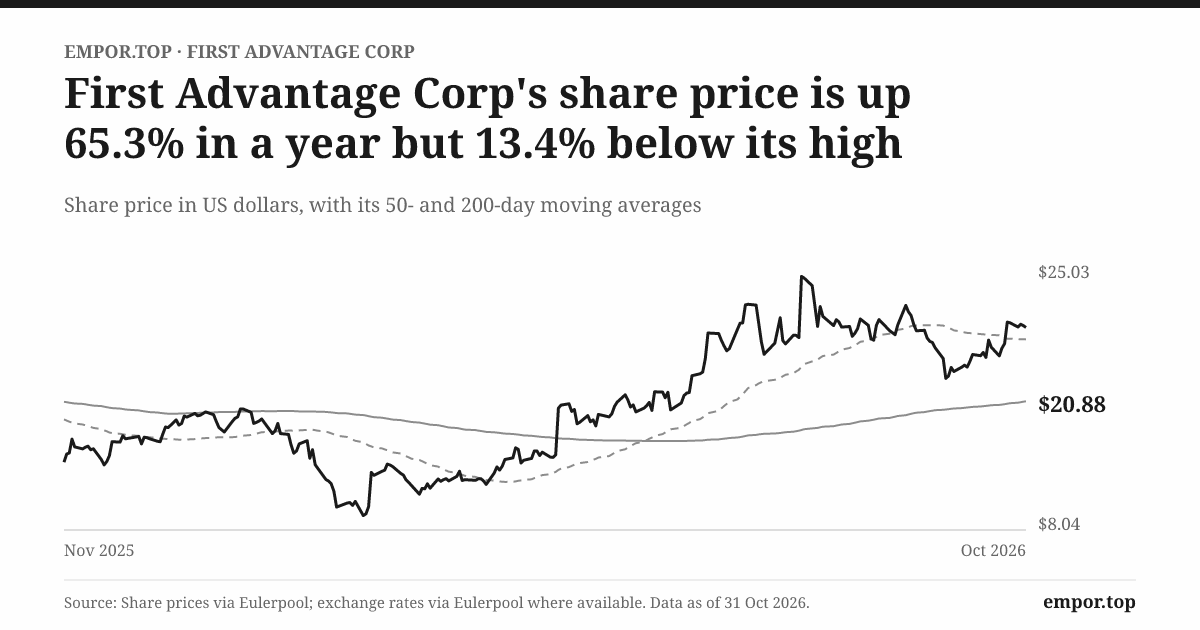
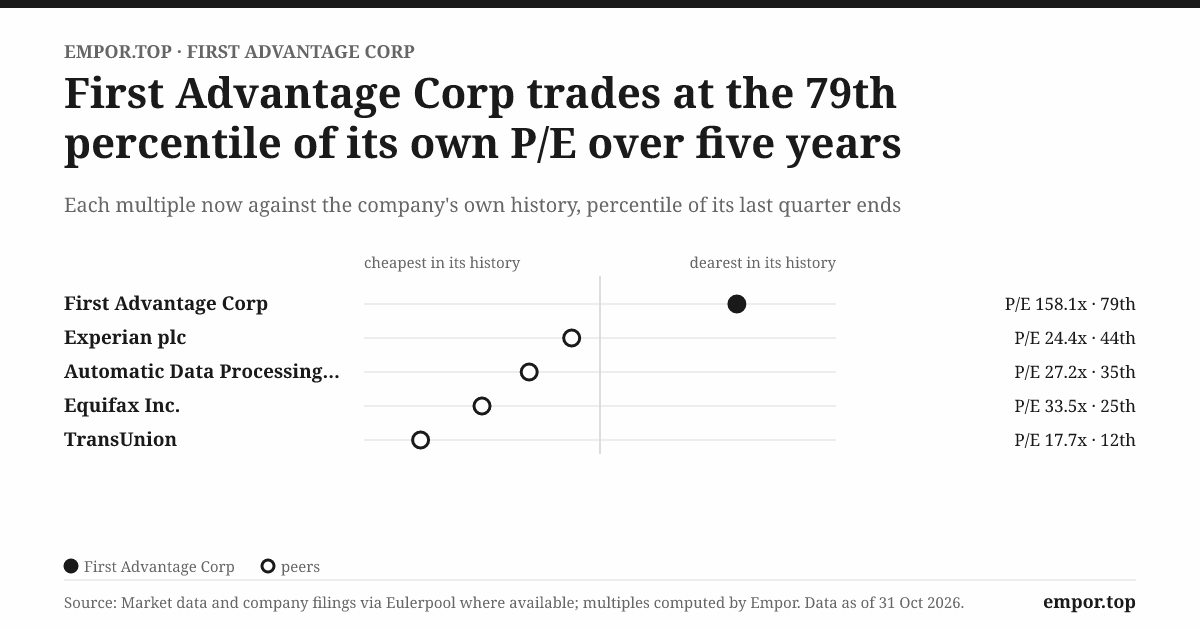
That history frames how investors should read today's buyback. Management describes its repurchases as disciplined.9 The test of that claim is price. In the twelve months to the end of October 2026, the shares traded between about $8.95 and $24.12, and they closed the month at about $20.88, within about 13% of the high.4 At that price, the stock trades at roughly 158 times trailing reported earnings, an earnings yield of about 0.6%.4 On a free-cash-flow basis the picture is less extreme, with a yield of about 6.6%.4
Now compare the alternatives. Every dollar used to prepay the floating-rate term loan earns, in effect, the interest rate on that loan, risk-free and immediately. Every dollar used to buy stock earns the business's future free cash flow per share, with all the risk that entails. A buyback can beat debt reduction if the stock is cheap relative to what the business will generate. It is harder to justify when reported earnings are thin and the balance sheet is the dominant risk. First Advantage is doing both, and investors should judge the buyback by asking whether the company would be better off with $18.7 million less debt.
Interest is where the debt bites hardest. Imagine benchmark rates rising by one percentage point on a floating-rate loan of more than $2 billion. Before hedges, that would add something over $20 million a year to the interest bill, which is larger than the company's entire net profit in the second quarter of 2026.4 The swaps soften that blow, and falling rates would work the other way, but the arithmetic explains why every prepayment matters. Reducing the loan is not only a way to lower risk. It is the most direct lever the company has for lifting GAAP earnings, because each dollar of debt retired removes a dollar of floating-rate exposure from an income statement that has very little room to spare.
The three numbers to watch together are net debt, interest expense and cash conversion, the share of adjusted EBITDA that becomes operating cash. They will show whether the integration is producing cash rather than merely producing adjusted profit. And they will determine how much room the company has to fund the next leg of its strategy, which management describes not as more screening but as identity.
VIII. The Platform Pitch Meets the Evidence
On October 21, 2026, ten days before this story's present day, First Advantage and ID.me announced an exclusive partnership and a new identity-fraud check for hiring.8 ID.me, best known as the digital identity provider used by American government agencies, brought its identity proofing, the process of confirming that a person is who they claim to be, often by matching a selfie against a government ID. First Advantage brought its background data and its compliance machinery. The results of the identity check would appear inside the background screening report, so employers could use them in hiring decisions within the rules of the Fair Credit Reporting Act.8
Joelle Smith, First Advantage's president, called identity fraud detection one of the most critical trust factors in hiring.8 The problem she was describing is real and growing. Remote hiring has made it easier for a candidate to interview as one person and show up as another, or not show up at all while someone else does the work. Deepfaked interviews, synthetic identities stitched together from real and invented data, and organized fraud rings targeting remote technology jobs have turned "is this person real?" into a question that employers now ask before "does this person have a criminal record?" The partnership positions First Advantage at the front of that question.
So the strategic logic is sound. Identity verification is adjacent to the core: it uses the same customer relationships, sits in the same workflow and draws on overlapping data. If it works, it could raise revenue per hire, deepen relationships and make the screening report more valuable. It could also extend the product beyond the moment of hiring into ongoing monitoring of existing employees, which would be closer to recurring revenue than one-off pre-hire checks.
Why the bar should stay high
The evidence for commercial success, however, is still thin. On the second-quarter call, management described Digital Identity as a modest share of contract value, a growing area of interest rather than a material revenue line.9 The company does not report identity revenue separately, and it does not quantify recurring revenue or monitoring as a share of sales.1 Announcing a product is a technical and commercial milestone. It is not yet a revenue stream.
The company's own history counsels caution. In September 2023, First Advantage paid $41 million in cash for Infinite ID, a U.S. digital identity company, and Staples said its technology complemented the company's other identity verification and fraud products.13 The acquisition was small enough that the company did not adjust its 2023 guidance for its contribution.13 Three years later, identity remains a modest part of the business. That does not mean the Infinite ID purchase failed; small acquisitions often seed capabilities that matter later. It does mean that First Advantage has been talking about identity as a growth vector for several years, and the revenue has not yet followed in any measurable way. The ID.me partnership should be judged by the same standard.
There is also a two-sided technology story here, and it applies to the whole business, not just identity. Automation and artificial intelligence can make screening cheaper and faster. Optical character recognition can read documents; machine learning can match records; software can route most orders without a human touch. That lowers First Advantage's cost of fulfilling a report and can improve fraud detection. The same forces can lower the value of a routine check. If a criminal-record search that once required a courthouse researcher can be completed instantly by software, customers will eventually expect to pay less for it, and new competitors with lighter cost structures can offer it. AI is a cost advantage for the scale player that adopts it first and a pricing threat to everyone who sells commodity checks. Which effect dominates depends on whether First Advantage keeps the savings or passes them on.
The company is spending to be on the right side of that change. Product and technology expense roughly doubled from about $49 million in 2023 to about $102 million in 2025, although the 2025 figure included about $27.6 million of Sterling's costs and about $11.8 million of additional investment in the legacy business's people.1 Capital spending ran at about 3.4% of revenue in 2025, part of it capitalized software development.1 The company had more than 9,500 employees at the end of 2025.1 The acquisition makes it impossible to tell whether the company is investing more per dollar of revenue than before, or simply carrying two technology budgets on the way to one.
The commercial pipeline offers another clue. On the second-quarter call, management said it signed 20 enterprise bookings in the quarter, each expected to generate at least $500,000 of annual contract value.9 Those are meaningful wins. But annual contract value in this business is an estimate of future order volumes, not a committed payment, since contracts generally lack minimum volumes. A $500,000 booking becomes $500,000 of revenue only if the customer hires the people it expects to hire.
There is a quieter version of the same opportunity in continuous monitoring, checking existing employees and contractors on a rolling basis rather than once at hiring. In regulated industries such as transportation, health care and financial services, employers already rescreen staff, and identity fraud gives other employers a reason to start. Monitoring would be the nearest thing First Advantage has to subscription revenue, because it is tied to headcount rather than to hiring. The company does not report how large it is, so the promise remains a description rather than a number.
The evidence to watch is concrete. Identity and monitoring revenue as a share of sales would show whether the platform pitch is becoming the business. Customer adoption of the ID.me product, its contract value and its effect on retention would show whether employers pay for it. Until those appear, identity is an option attached to a screening company, a potentially valuable one, but an option nonetheless. Which leaves the central question: what is the screening company itself worth, and what has to go right?
IX. Analysis & Bear vs. Bull Case
On October 31, 2026, First Advantage's shares closed at about $20.88, about 13% below their 52-week high and more than double their 52-week low.4 The market valued the equity at about $3.6 billion, and adding net debt gave an enterprise value of about $5.4 billion.4 That swing, from below $9 to above $24 inside a year, tells its own story. Volatility over the past year ran above 60%.4 Investors have veered between treating First Advantage as a leveraged, cyclical screening company and treating it as a consolidator emerging into a growth phase. The truth sits somewhere between, and the evidence can narrow it.
The bull case begins with scale. The combination created a specialist with roughly twice the revenue HireRight reported for 2023, with more than 80,000 customers, about two-thirds of the Fortune 100 and reach across more than 200 countries and territories.108 For a multinational employer, that breadth matters. A company hiring in dozens of countries wants one compliance-literate vendor, one integration into its hiring software and one contract. First Advantage can now offer that to more employers than anyone else in its specialist niche.
Retention supports the bull case. At 96%, customers rarely leave.9 Enterprise wins support it too: 20 bookings in a single quarter, each with expected annual value of at least half a million dollars, suggests the combined company is winning large accounts rather than merely keeping them.9 Base trends have improved, from double-digit declines in 2023 to growth above the long-term algorithm in 2026.29 Synergies have been actioned above the original target.9 If organic growth holds near the high single digits, synergies translate into margins, and free cash flow keeps going to debt reduction, the equity becomes a larger share of the enterprise value each year without any multiple expansion at all. That is the classic leveraged-consolidation playbook, and it works when the cycle cooperates.
The bear case starts where the business model starts. Screening is hiring-sensitive and largely transactional. Contracts generally have no minimum volumes. Customers can and do use multiple providers, rebid contracts and shift volume. The 2023 record showed that even with high retention, base volumes can fall by double digits without any loss of customers, simply because employers hire fewer people.2 The current growth includes customer-specific initiatives that management itself described as unusual and that supplied about half of second-quarter base growth.9 When those fade, growth will slow.
The bear would add the balance sheet. More than $2 billion of floating-rate debt sits beneath a business whose GAAP earnings are thin and whose return on invested capital is below 4%.4 The bear would note that the cost of services has risen as a share of revenue rather than fallen, that the integration is not finished and that adjusted EBITDA excludes costs shareholders genuinely bear.1 And the bear would point out that the previous capital-return decision, a $217.7 million special dividend in 2023, sent cash out shortly before the company levered up.1
Michael Porter's forces were laid out at the level of a single order; here they add up to a verdict. Buyer power is meaningful because large employers can multi-source and rebid, though the absence of any 10% customer in 2025 shows the risk is spread more thinly than before.1 Supplier power is moderate, with courts, data aggregators and labs setting costs First Advantage must absorb or pass on. The threat of new entrants is low at the top of the market, where compliance complexity and global coverage take years to build, and higher in simpler domestic segments, where venture-backed platforms such as Checkr have shown that software-first entrants can win share. Substitutes are a slow-moving threat, as employers, governments and identity providers find new ways to verify credentials. Rivalry is intense but rational among a handful of large firms.
Hamilton Helmer's 7 Powers framework asks which durable advantages a company has. Scale economies are the strongest candidate: fixed costs of compliance, technology, data and global delivery can be spread over more orders, and the Sterling deal was a bet on exactly that power. Switching costs exist through integrations and workflow embedding, and 96% retention is consistent with them, but they protect the relationship, not the volume or the price. Cornered resources, such as exclusive data, are weak; the one billion records are an asset, yet much public-record data is available to competitors who pay for it. Network economies, counter-positioning and brand are modest at best. Process power, the hard-to-copy operating know-how of a large fulfillment operation, is plausible but unproven in public numbers. The verdict is that First Advantage holds one real power, scale, supported by moderate switching costs, and lacks evidence of the pricing power that would turn that position into rising margins on its own.
Then comes the price. At about 158 times trailing GAAP earnings, against a five-year median of about 80 times, the shares are priced on the expectation that reported earnings will rise sharply.4 The comparison with the company's own history is imperfect, because the Sterling deal changed the perimeter and loaded the income statement with amortization. Measured on enterprise value to EBITDA, about 12.7 times, the valuation looks more ordinary, and the free-cash-flow yield of about 6.6% suggests the market is not paying an extravagant price for the cash the business produces today.4 What the multiple appears to assume is that the integration works, debt falls, interest costs shrink and amortization eventually rolls off, so GAAP earnings catch up with cash flow. If organic growth falls back toward the bottom of the algorithm and margins stall, the gap between earnings and price will look much wider.
A skeptical activist reading the same record would press on three points. The first is sequencing. With leverage still high and GAAP earnings thin, why buy back any stock before the debt is materially lower, especially after the 2023 special dividend left less cash on hand when the company decided to borrow for Sterling? The second is disclosure. A company that asks to be judged on organic growth, synergies and cash conversion could publish organic growth by segment, a clean bridge from actioned to realized synergies, and the revenue contribution of identity products, and it does not yet do all three. The third is the board. A sponsor holding well under half the shares still carries governance rights designed for a controlling owner, and the withhold vote suggests not every holder is comfortable with that. None of these points says the strategy is wrong. Each says the burden of proof sits with management.
Then there is Silver Lake. As of April 2026, its affiliates held about 52.1% of the shares, making First Advantage a controlled company.7 In August 2026, Silver Lake sold 12.5 million shares in a secondary offering and distributed others, bringing its disclosed stake down to about 42.8%.1415 First Advantage received no proceeds.14 The sale ended Silver Lake's majority but not its influence. It remains the largest holder by far, with governance rights under its stockholders' agreement that continue while it holds at least 25%.7 T. Rowe Price, the next largest holder, owned about 7.8% at the April snapshot.7 Each further sale would reduce sponsor influence and add tradable shares, which can weigh on the price around offerings.
Management alignment is meaningful but not overwhelming. Staples held about 3.5% of the company as of April 2026.7 His reported compensation swung from about $705,000 in 2023 to about $4.1 million in 2024, a year of equity grants, and then about $1.28 million in 2025, including a $50,000 one-time Sterling integration bonus paid in March 2026.7 Steven Marks became chief financial officer in November 2024, after his predecessor retired, so the integration's financial reporting has been led by a newer CFO.16 At the June 2026 annual meeting, say-on-pay passed easily, about 157 million votes to 2.5 million.17 Director Mark Gillett, a Silver Lake nominee, received the largest withhold vote of any nominee, about 33 million shares.177 The vote does not say why, but it is the clearest sign that some holders are uneasy about the sponsor's footprint on the board.
The audit record is clean. Deloitte issued an unqualified opinion on the 2025 accounts and found internal controls effective; its critical audit matter was revenue recognition, because transaction processing is so automated that the auditor had to test systems rather than paper.1 Legal exposure is a cost of doing business. The company accrued about $8.7 million for probable litigation at the end of 2025, down from about $11.6 million, much of it tied to consumer and potential class-action claims arising from background checks.1 In a business that issues reports that can cost someone a job, that liability will not disappear.
So which way does the evidence lean? First Advantage has a credible scale-and-compliance advantage for large, global employers, supported by high retention and broad delivery. Evidence for pricing power, exclusive data or a durable subscription base is thin. At this valuation, the bull case needs sustained organic growth, synergy conversion, deleveraging and a GAAP earnings recovery all at once. Acquisition-led growth and episodic customer surges will not be enough.
Three measures will settle the argument. The first is organic revenue growth excluding customer-specific surges, most recently described by management as about 11% to 12% in the second quarter of 2026, above the long-term algorithm.9 The second is segment adjusted EBITDA and integration costs alongside GAAP operating profit; the operating margin reached about 12.7% in the second quarter of 2026, up from about 9.7% a year earlier.[^13] The third is net debt alongside cash generation, with long-term debt at about $2.03 billion in June and falling slowly.4 Those three will show whether the bet is paying.
X. Playbook: Business & Investing Lessons
Every acquisition is a story told twice: once in the announcement, when everything is synergies and scale, and once in the accounts, when everything is cost. First Advantage's two tellings have not yet converged, and that gap holds the lessons.
The first lesson is that a bigger screening company is still a hiring company. Sterling's 2023 volume decline made the point: retention did not protect revenue.2 Founders who build transaction businesses, and investors who buy them, should remember that loyalty does not guarantee volume.
The second lesson is that a fair price can still be a hard deal. First Advantage paid a multiple inside the range of comparable transactions.3 The business's falling revenue and profit, plus more than $2 billion of floating-rate debt, made it a hard deal. A price can be defensible on a spreadsheet and still expensive in real life, because the comparables assume conditions the buyer did not get.
The third lesson is that actioned synergies are a waypoint and cash returns are the score. The company says it had actioned more savings than it originally targeted.[^1]9 Margins, free cash flow and debt reduction belong on the scoreboard, alongside the reported loss and low return on invested capital.14 In leveraged consolidation, the scoreboard is the only thing the lenders read.
The fourth lesson is that a new product is an option until customers pay for it. The ID.me partnership is a smart, timely answer to a real problem, and Infinite ID was a reasonable bet three years earlier.813 Identity remains a modest share of contract value.9 For investors, that means valuing identity as a call option, not as a business line. For founders, it is a reminder that an announcement creates attention, while only an invoice creates revenue.
Put together, the playbook is simple to say and hard to do. Buy scale in a downturn if you must, but measure it in cash, margins and debt, never in combined revenue. First Advantage has done the buying. It is now in the measuring phase.
XI. Epilogue
Tonight, First Advantage stands at an awkward, interesting point. The integration is far enough along to show results, not far enough to declare victory. The hiring cycle is supportive. The stock has more than doubled from its low of the past year. And the company has guided 2026 revenue to about $1.67 billion to $1.71 billion.[^13] That is the most revealing number in the forward picture. After a first half in which revenue rose about 12%, the full-year range implies growth of only about 6% to 9% for the year, roughly the long-term algorithm of 7% to 9%, which means management is planning for a much slower second half.[^13]9 The company is, in effect, telling investors not to extrapolate the surge.
The next few results days will decide which version of the story holds. The third-quarter report, which in past years has arrived in early November, will show whether the unusual customer initiatives that inflated the second quarter kept running or began to fade, as the guidance implies.13 The full-year report early in 2027 will show something larger: whether growth excluding those surges stayed above the algorithm, whether the integration reached its finish line, whether the cost of services finally began falling as a share of revenue, and whether the gap between adjusted EBITDA and GAAP operating profit narrowed. Investors should read the adjusted-to-GAAP reconciliation as carefully as the headline, because that reconciliation is where the cost of the Sterling deal lives.
If organic growth settles in the high single digits, synergies show up in margins and free cash flow keeps shrinking the debt, the reported earnings that today make the valuation look stretched will rise into it. Each year of debt reduction shifts value from lenders to shareholders, and each year of amortization rolling off narrows the distance between earnings and cash. That is the good path, and it does not require heroics.
If growth falls back toward the bottom of the algorithm as hiring cools, the debt will feel heavier, the buyback will look premature, and a multiple built on recovering earnings will have nothing to hold it up. The bad path does not require a recession. It only requires an ordinary slowdown in hiring, of the kind the company lived through in 2023.
Three other threads will matter. The ID.me partnership needs to turn into paid customer adoption and, eventually, a disclosed revenue line.8 Silver Lake's next move, whether it sells more or holds its remaining stake, will determine how quickly First Advantage becomes an ordinary widely held company.15 And executive incentives, buybacks and debt repayment will have to be balanced so that the business is not starved and shareholders are not overpaid.
The tension remains exactly where the story began. First Advantage bought scale at the bottom of the cycle. The cycle has turned. Now it has to prove that scale is worth more than its cost.
XII. Outro
Go back to the person waiting for their background check to clear. They will probably never know the name of the company running it, or that the click that started their check passed through a system built by stitching two rivals together with $2 billion of borrowed money. To them, the check is friction: a few anxious days between an offer and a start date.
First Advantage's entire business is that friction, multiplied across millions of people, tens of thousands of employers and more than 200 countries.8 It is trying to turn the cost of checking one person into an advantage that grows with every person checked. Whether that scale earns more than the cost of owning it is still the story.
References
-
Form 10-K for fiscal 2025 — First Advantage, SEC, 2026-02-26 ↩↩↩↩↩↩↩↩↩↩↩↩↩↩↩↩↩↩↩↩↩↩↩↩↩↩↩↩↩↩↩↩↩↩↩↩↩↩↩↩↩↩↩↩↩↩↩↩↩↩↩↩↩↩↩↩↩↩↩↩↩↩↩↩↩↩
-
Sterling Reports Fourth Quarter and Full Year 2023 Results — Sterling, 2024-02-29 ↩↩↩↩↩↩↩↩↩↩↩
-
Form S-4/A merger filing — First Advantage, SEC, 2024-05-31 ↩↩↩↩
-
Form 10-Q for Q2 2026 — First Advantage, SEC, 2026-08-06 ↩↩↩↩↩↩↩↩↩↩↩↩↩↩↩↩
-
Form S-1 Registration Statement — First Advantage, SEC, 2021-05-28 ↩↩↩↩↩↩
-
Form 10-K for fiscal 2008 — First Advantage (predecessor), SEC, 2009-03-02 ↩
-
2026 Proxy Statement — First Advantage, SEC, 2026-04-24 ↩↩↩↩↩↩↩↩
-
First Advantage and ID.me Launch FCRA-Compliant Identity Fraud Check for Hiring — ID Tech, 2026-10-21 ↩↩↩↩↩↩↩↩
-
Q2 2026 Earnings Call Transcript — Stock Analysis, 2026-08-06 ↩↩↩↩↩↩↩↩↩↩↩↩↩↩↩↩↩↩↩
-
Q4 and Full Year 2023 Earnings Call Transcript — First Advantage, 2024-02-29 ↩↩
-
Background screening firm First Advantage to buy rival Sterling in $2.2 billion deal — Reuters via Investing.com, 2024-02-29 ↩
-
First Advantage Third Quarter 2023 Results, Exhibit 99.1 to Form 8-K — First Advantage, SEC, 2023-11-09 ↩↩↩↩
-
Form 8-K on secondary offering — First Advantage, SEC, 2026-08-12 ↩↩
-
Annual Meeting Voting Results, Form 8-K — First Advantage, SEC, 2026-06-08 ↩↩
 LinkedIn
 WhatsApp
 Reddit
 Hacker News
 Email
 Kindle
 RSS Feed
 Spotify
 Apple Podcasts
 Amazon Music
 Audible
 YouTube