CONMED Corporation: The Surgical Device Maker That Bought Its Way to a New Core
I. The Quarter That Grew While Sales Fell
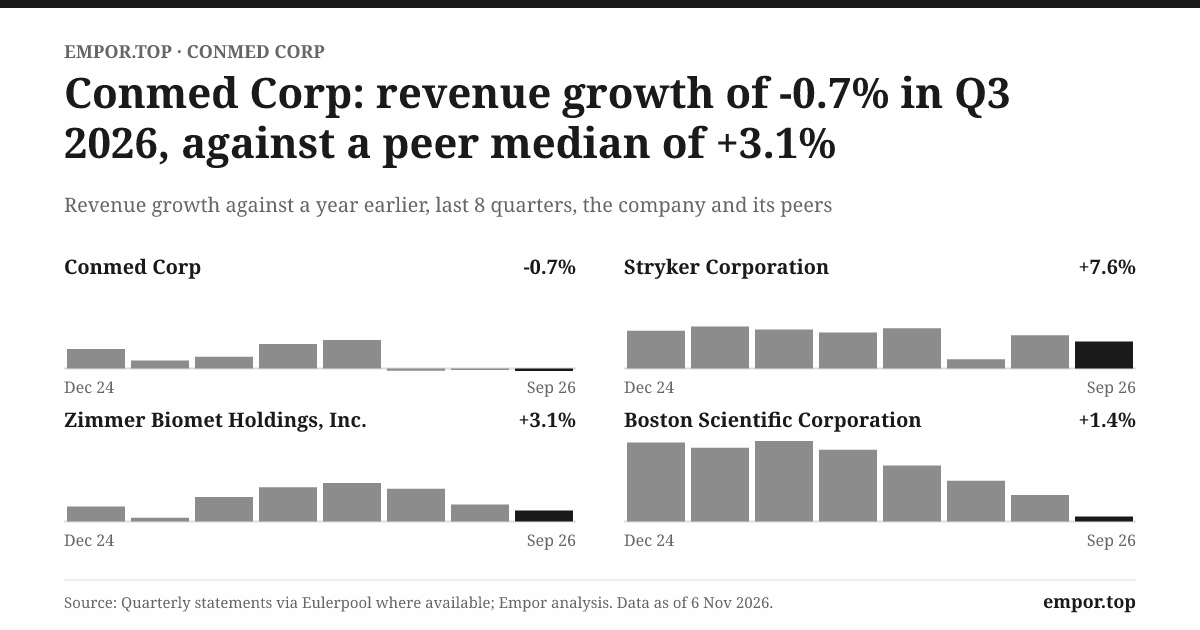
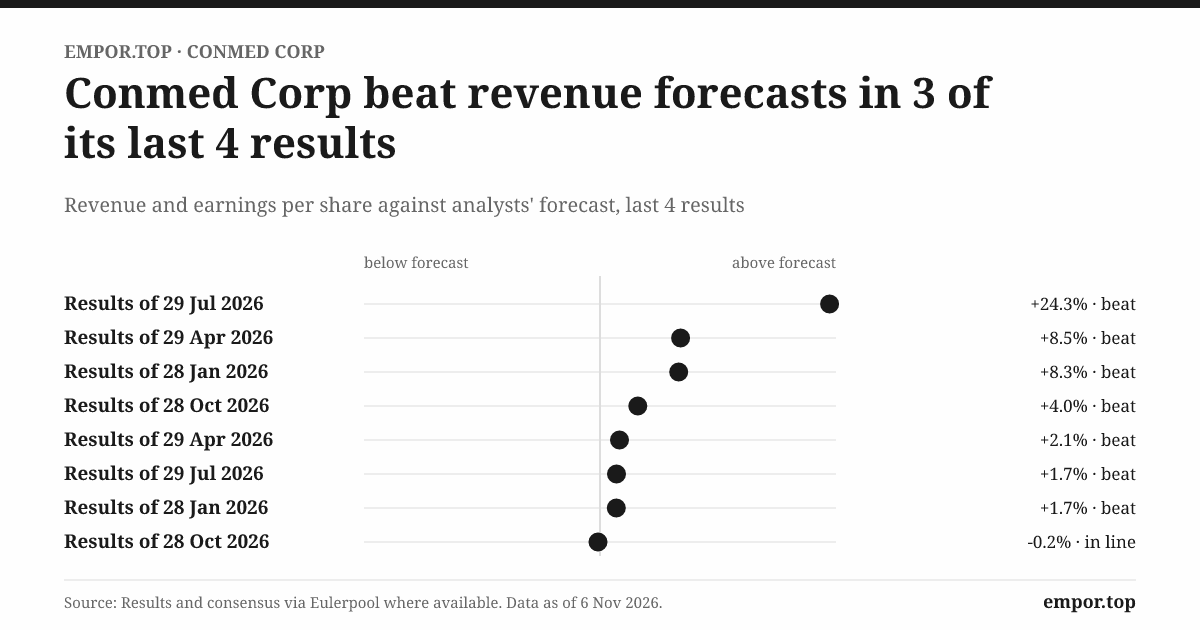
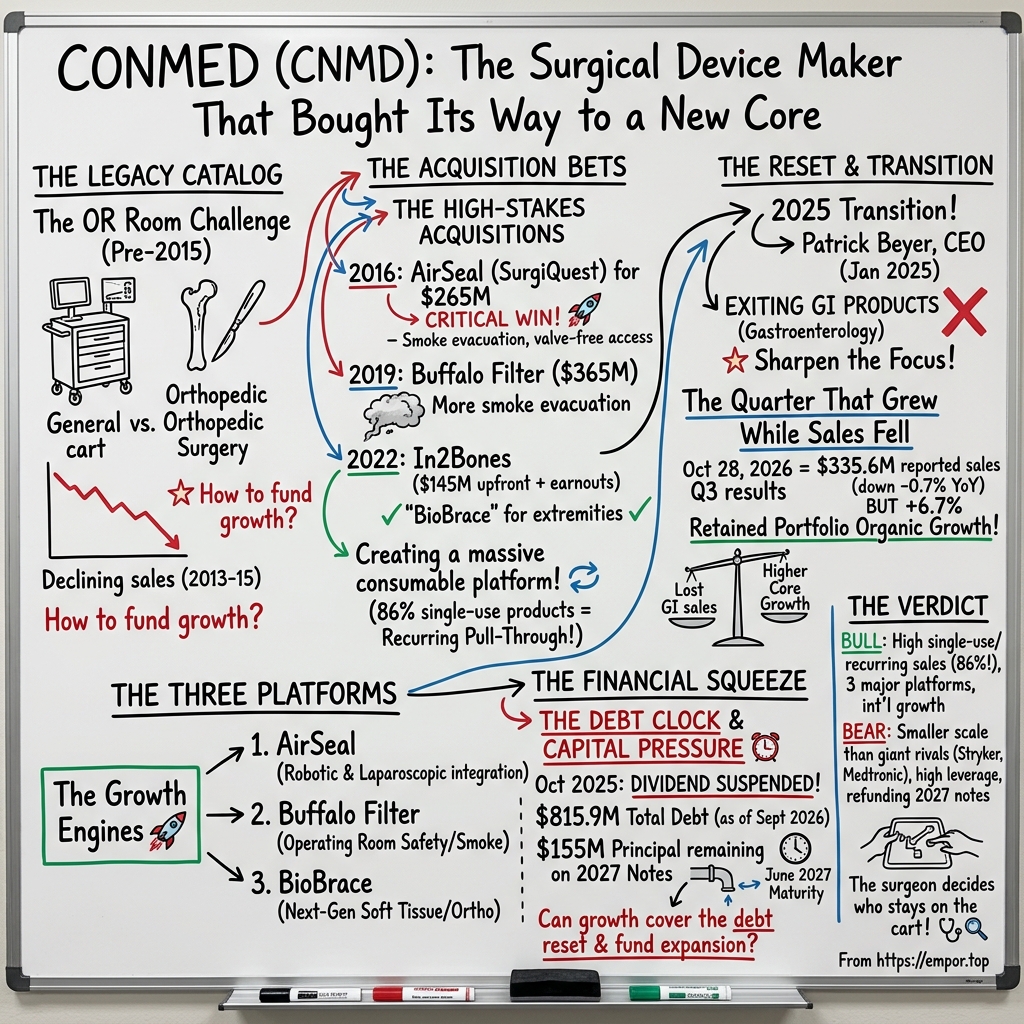
On October 28, 2026, CONMED Corporation put out a third-quarter earnings release that seemed to say two opposite things. The headline number was $335.6 million in sales, which was 0.7% less than the company had sold a year earlier.[^1] A little lower down, CONMED offered the figure it actually wanted investors to look at: once you remove the gastroenterology products it had decided to stop selling and strip out currency moves, sales grew 6.7%.[^1] The same release then raised the company's adjusted earnings-per-share guidance for the year and narrowed its organic growth range.[^1] So on one afternoon the company was shrinking, growing, getting more profitable and getting more cautious, depending on which line you read.
Both readings are accurate, and that is what makes CONMED worth a long look. This is a mid-sized American surgical-device company. It booked $1.375 billion of sales in 2025 across two product groups: General Surgery, which covers the tools of laparoscopic and robotic abdominal surgery, and Orthopedic Surgery, which covers sports medicine, soft-tissue repair and powered instruments.1 For accounting purposes it reports a single operating segment.1 For years it was a broad catalog company that sold a little of almost everything an operating room uses. In 2025 it started deliberately making itself smaller. It walked away from a gastroenterology line, suspended its dividend, changed its chief financial officer and told investors to judge it on the products it intended to keep.
That decision is why the reported numbers and the company's preferred numbers now point different ways. The decision also carries a bill. Exiting a product line removes sales right away, while the retained portfolio has to grow fast enough to fill the hole and then pay down a debt pile that was still large in the autumn of 2026. At September 30, CONMED carried $815.9 million of debt.2 For most of the previous year, almost all of the company's borrowing had sat in a single instrument: convertible notes due in June 2027. A large repurchase in June 2026 had cut the principal still outstanding on those notes to roughly $155 million, but it had not eliminated it, and it had not made the total debt much smaller.23
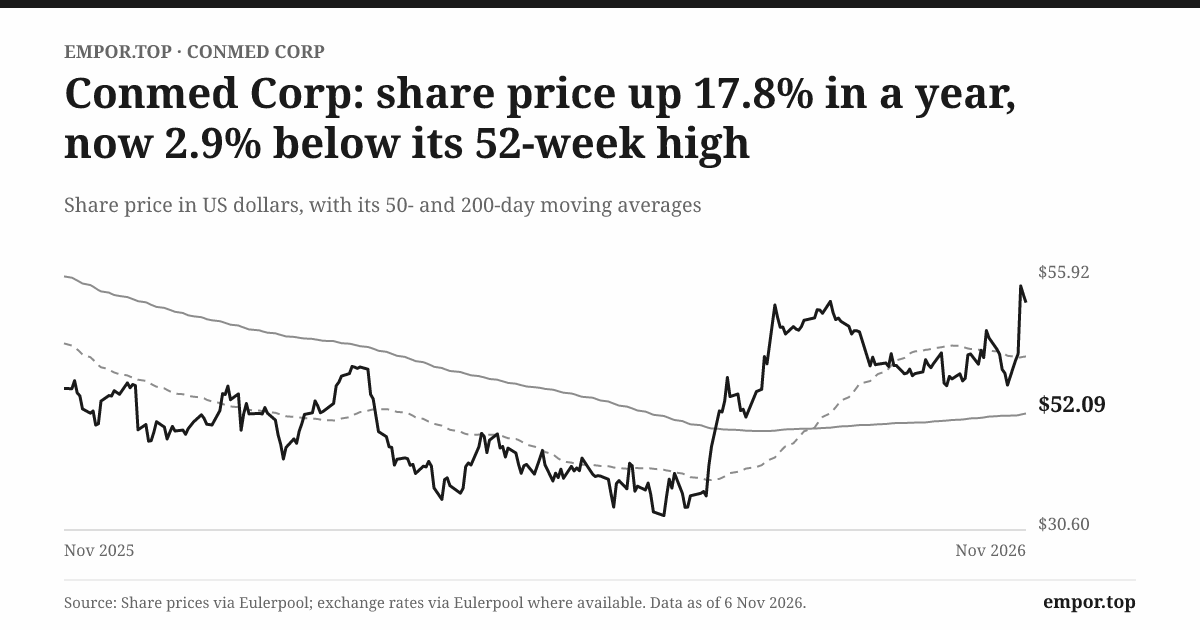
The market, for its part, had already decided to give the reset the benefit of the doubt. In the week after the results, the shares traded close to their highest level of the year, about two-thirds above their 52-week low.[^5] That rally raised the stakes. A company priced on recovery has to deliver one, and the third-quarter report was the first in which investors could see the retained business without the noise of the GI products obscuring it.
The tension came out on the third-quarter call. Analysts noticed that the company's sales guidance had come down by more than that quarter's revenue shortfall alone would explain, and they asked John Gallagher, CONMED's chief financial officer, to account for the difference.4 Gallagher answered with a bridge of familiar parts: foreign exchange, the comparison against the exited GI business, and orders that had shifted from one quarter to another.4 Each part was reasonable. Taken together, though, they showed a company whose recovery depends on many small things going right in the same period.
Put plainly, CONMED faces three questions, and the rest of this story follows them in turn. The first is whether the products it chose to keep can grow fast enough to make a shrinking top line a good trade. The second is whether the margin rebound that began in 2026 after a dismal 2025 is real and durable, or whether it is just the absence of one-off costs. The third is whether management can retire the last of the 2027 notes, keep buying back stock and still fund the products meant to carry the next decade.
The company's own track record makes all three harder to take on faith. Over the ten years to 2025, CONMED's revenue grew about 6.7% a year.1 That is respectable, but much of it came from acquisitions, and earnings over the same decade rose and fell sharply instead of compounding.1 So when management's chosen measure in October 2026 says the business has momentum while the reported line says it is contracting, a long-term investor has reason to look back at how CONMED got to this point and why a company built on breadth decided that breadth was no longer enough.
 Subscribe on LinkedIn
II. A Broad Surgical Catalog Becomes a Portfolio Question
Picture a modern operating room just before the first incision. A tower of capital equipment stands near the table, holding a camera system, a light source and an insufflator that inflates the abdomen with carbon dioxide so surgeons have room to work. On the back table are trays of single-use instruments: trocars that open ports into the body, electrosurgical pencils that cut and seal tissue, filters that pull surgical smoke out of the air. In the orthopedic suite next door, a sports-medicine surgeon is getting ready to repair a torn rotator cuff with anchors, sutures and a powered shaver. CONMED sells products for both rooms.1
The company began far from that world. In 1970 Eugene Corasanti founded the business in Utica, in upstate New York, and for decades he ran it as chairman, chief executive and president.5 Its early products were basic electrosurgical and patient-care disposables. Its turning point came on December 31, 1997, when it bought Linvatec and related assets from Bristol-Myers Squibb.5 Linvatec brought arthroscopy and powered surgical instruments, and with them an orthopedic franchise that made CONMED a real two-room company. It also came with an early sign of how expensive buying growth could be: at closing, CONMED took a one-time, non-cash charge of $34.0 million to write off in-process research and development it had acquired.5 Accounting rules of the time required that charge, so it did not mean the deal was a mistake. It did mean that the first year of the bigger company began with a large hit to reported earnings, and later deals would follow the same sequence of acquisition, accounting charge and then a wait to see whether the growth arrived. The deal established the pattern that runs through the rest of this story: CONMED tends to grow by buying a product line and then trying to make it bigger inside its own sales channel.
That pattern produced scale. It did not produce steady growth. The clearest warning came in the middle of the 2010s. Total sales fell in 2014 and again in 2015, and orthopedic sales dropped two years in a row as product gaps and market pressure hit the franchise Linvatec had built.61 A company that had spent decades adding product lines found that a long catalog does not grow on its own momentum. Each line competes for the same sales reps, the same R&D budget and the same hospital contracts, so a weak line consumes resources rather than simply standing still.
The economic logic of the catalog was sound, and it still is. Capital equipment such as an insufflator, an energy generator or a powered-instrument console gets installed once. After that, each procedure on that equipment can use disposable tubing, filters, blades, burrs or anchors. That is the razor-and-blade arrangement that medical-device investors love. CONMED, however, does not report contractually recurring revenue or customer retention rates, and almost all of its revenue comes from product sales recognized when goods change hands, not from long-term service contracts.1 CONMED does have a small service business: about $55.9 million of 2025 revenue came from services delivered over time, against $1.319 billion of goods sold at a point of transfer.1 That is about 4% of sales. The rest is product, sold directly to hospitals and surgery centers or through specialty distributors.1 The pull-through is a habit. It is not a subscription, and habits can be broken by a competing system, a new hospital purchasing contract or a surgeon who moves to a different hospital.
By 2015, CONMED's leadership faced a familiar dilemma for a mature device company. It could stay a broad supplier with flat sales and thin margins, which in 2015 meant operating margin of only about 7%.1 Or it could pay up for something that grew faster than the rest of the catalog and hope the new product would change the mix. The company chose the second option, and it chose a product with an unusual feature: it solved a problem surgeons could actually feel during an operation. In late 2015 CONMED agreed to buy a privately held company called SurgiQuest, and with it a device called AirSeal.7
The decade that followed mostly repeated that move, with Buffalo Filter, In2Bones and Biorez added to the catalog in turn. The GI exit in 2025 was the first time in this story that CONMED chose to subtract instead. To judge whether the subtraction makes sense, start with the purchase that set the template.
III. The $265 Million AirSeal Bet
In January 2016, CONMED closed its acquisition of SurgiQuest and placed AirSeal inside its Advanced Surgical portfolio.6 The price announced in November 2015 was $265 million.7 For that money CONMED got a company it expected to book roughly $46 million to $49 million of revenue in 2015.7 Dividing one by the other, CONMED paid between about 5.4 and 5.8 times the target's expected sales, before any savings from combining the businesses. For a company whose own sales had been shrinking and whose own operating margin was in the single digits, that was a confident price.
What made CONMED confident becomes clear inside a laparoscopic operation. In keyhole surgery, the surgeon inflates the abdomen with carbon dioxide so there is space to see and work. Traditional ports use mechanical valves to keep the gas in. Every time an instrument goes in or comes out, or suction removes smoke or fluid, pressure drops, and the working space can partly collapse like a tent losing air. AirSeal replaced the mechanical valve with a pressurized curtain of gas, which gave surgeons valve-free access, stable pressure and continuous smoke evacuation in one system.7 A simple comparison is the difference between a door you must open and close each time someone passes and an air curtain at a shop entrance that keeps the climate steady while people walk through. For surgeons doing long laparoscopic and robotic procedures, especially with robotic arms docked at fixed ports, steady pressure is a working condition they notice, not a minor convenience.
That fit the razor-and-blade logic already described: the purchase price was really a bet on procedure volume—how many hospitals would install the system and how many cases per year would flow through each one.
The first year exceeded what CONMED had promised. AirSeal sold $68.4 million in 2016, above the $55 million to $60 million the company had originally forecast.6 For a recently acquired product moving through a new and larger sales organization, beating the forecast is real evidence, and stronger evidence than most acquirers manage to show. It indicated that the clinical benefit was real enough for hospitals to adopt quickly and that CONMED's sales force could sell a premium consumable system at scale.
The rest of 2016, however, showed why one strong product could not fix the whole company. While AirSeal was beating its forecast, orthopedic sales fell 5.1%.6 CONMED also discontinued its Altrus product offering and recorded $4.5 million of non-cash charges for inventory and fixed assets tied to that exit.6 Company-wide operating margin fell to about 5% that year, down from about 7%.1 One acquired product was growing quickly, and an older franchise was losing ground alongside it.
Industry comparisons do not settle whether the price was cheap or expensive, because there is no consistent public set of comparable insufflation deals priced the same way. The public figures support a sales-multiple calculation and a first-year sales result. They do not support a return-on-capital verdict, since CONMED never reported AirSeal's profit or its cumulative cash return. What can be said is narrower and still useful. AirSeal is the clearest case in CONMED's history of an acquired product being commercialized faster than planned, and a decade later it remains one of the three platforms management says will drive growth.[^1]
That makes AirSeal both evidence for the acquisition strategy and a standard for every deal that followed. CONMED had shown it could take one differentiated device and make it larger. The open question was whether that was a repeatable skill or a single good result. A company that wants to justify paying five or six times sales for growth assets needs to show the result more than once.
IV. Buffalo Filter, In2Bones and the Cost of Becoming a Platform Company
Electrosurgery cuts and seals tissue with heat, and heat applied to tissue produces smoke. For decades that plume of vaporized material was treated as a nuisance in the operating room. Over time it came to be seen as an occupational hazard for nurses and surgeons who breathe it daily, and hospitals and regulators increasingly favored capturing it at the source. In February 2019, CONMED bought Buffalo Filter, a smoke-evacuation specialist, for $365 million.8 The deal extended an idea already inside AirSeal: if CONMED could own the air in the abdomen, it could also own the air above the operating table.
Buffalo Filter brought filters, evacuators and smoke-capturing pencils into General Surgery. In the part of 2019 that CONMED owned it, the business recorded $49.6 million of sales.8 Dividing the price by those sales gives roughly 7.4 times, but that number is only a rough indicator of scale and should not be read as a clean entry multiple. The sales were booked after the deal closed, not over a full pre-deal year, and CONMED said in its filing that the unit's earnings were not separately measured.8 Even allowing for that, CONMED was clearly paying a higher price per dollar of sales for smoke evacuation than it had paid for AirSeal. The purchase also helped push borrowings from roughly $460 million at the end of 2018 to roughly $790 million a year later.1
The following year tested the expanded portfolio. When COVID-19 shut down elective surgery in 2020, CONMED's two product groups behaved very differently. Orthopedic sales fell 19.1% as hospitals delayed sports-medicine procedures and froze capital purchases.[^11] General Surgery fell only 0.8%, and CONMED said AirSeal and Buffalo Filter both kept growing through the year.[^11] A shoulder repair can wait; an urgent abdominal procedure often cannot, and the consumables used in it keep selling. Total revenue still fell almost 10%, and operating margin dropped back to about 5%.1 The pandemic did not show that the platforms protected the company from downturns. It showed that the General Surgery side, with its acquired platforms, was the steadier of the two businesses.
The next round of buying went to the orthopedic side. In 2022 CONMED agreed to buy In2Bones, a foot-and-ankle and upper-extremity implant company, for $145 million upfront plus up to $110 million more if revenue targets were met.9 The earnout structure moved some of the risk back to the sellers, so CONMED would pay the additional amount only if the products performed. How that played out says a lot. By the end of 2025, the fair value CONMED assigned to the remaining In2Bones earnout was just $2.2 million.1 That figure does not prove the deal failed, because earnouts are often written with stretch targets. It does mean that most of the $110 million of potential upside the deal had been priced for is not, on CONMED's own estimates, going to be paid.
The other 2022 orthopedic addition was Biorez, maker of BioBrace, a bioinductive scaffold that surgeons use to reinforce soft-tissue repairs such as rotator cuffs and ligaments. At the end of 2025, CONMED carried a $59.2 million contingent-consideration liability tied to Biorez.1 That is a large future claim on cash for a company with roughly $150 million of annual free cash flow. Because payment depends on performance, the size of the liability also signals that CONMED expects the product to do well. But CONMED does not disclose BioBrace sales, so the liability cannot be used to argue that the product line already matters to revenue. These marks also moved reported earnings around. In 2024 CONMED booked a roughly $41 million non-cash gain from remeasuring contingent consideration, and in 2025 a roughly $23 million non-cash charge.1 Investors trying to read the income statement had to look through the acquisition accounting as well as the business.
Viewed as a whole, the acquisition record is mixed. Against AirSeal's strong first year sit the Altrus discontinuation and the 2016 restructuring charges, an In2Bones earnout that mostly did not pay, and borrowing that climbed above $1 billion by the end of 2022, the year net profit turned into a loss of about $80 million.1 CONMED's return on invested capital stayed in the mid-single digits for most of the decade, peaking near 9% in 2024 before falling back to about 5% in 2025.1 Those returns sit below what most estimates would treat as a medical-device company's cost of capital. They are blended figures that include goodwill from every deal, so they cannot isolate the return on any one transaction, and CONMED does not publish deal-level returns. Still, a company whose acquisitions consistently earned well above their cost would normally show it in the blended numbers. CONMED's do not.
The fairer verdict is that the deals left CONMED with a better portfolio than it had in 2015, without proving that buying growth was a consistently profitable use of capital. The company that came out of this period has two reporting product lines and, according to management, three platforms carrying the growth story: AirSeal, Buffalo Filter and BioBrace.[^1] Two were bought outright as already-commercial products, and the third is still early in its commercial life. To see whether those platforms can hold their ground, the place to look is the operating room, where surgeons, nurses and hospital purchasing departments decide what stays on the cart.
V. The Operating Room Is the Market
A laparoscopic cholecystectomy, the removal of a gallbladder through small incisions, is one of the most common procedures in general surgery, and it shows how a device company really earns its revenue. Before the patient arrives, the circulating nurse sets up the tower. If the hospital has an AirSeal unit, the case will use AirSeal access ports and a tube set. If the surgeon's preference card lists a particular smoke-evacuation pencil, that pencil gets opened. If the hospital's group purchasing agreement favors a competitor's stapler, that stapler goes on the tray. Nothing in the setup is permanent. Every disposable is re-chosen each time a case is scheduled, by the combined weight of surgeon preference, nursing habit, purchasing contracts and the equipment already in the room.
CONMED's two product groups depend on that daily choice in different ways. General Surgery, at $800.1 million, was 58% of 2025 sales.1 It includes AirSeal, Buffalo Filter's smoke evacuation, advanced energy devices and endomechanical tools such as trocars and suction-irrigation instruments. Orthopedic Surgery, at $574.6 million, was the other 42%.1 It includes sports-medicine implants, soft-tissue repair devices including BioBrace, powered instruments for bone cutting and shaping, and the In2Bones extremity line. Because CONMED reports only one segment, it does not publish operating profit for either group.1 Investors can track where sales are growing, but they cannot tell from public results which product line earns the profit, or how much of the company's value each one accounts for. Any claim that General Surgery is the profit engine is an inference.
The orthopedic room runs on slightly different economics. A sports-medicine surgeon repairing a shoulder works through an arthroscope with a camera, a fluid pump and a powered shaver whose handpiece and console are capital equipment and stay in the hospital for years. The blades and burrs that attach to the handpiece are disposable. So are the anchors that hold torn tendon against bone and the sutures that tie it down. A hospital that standardizes on one company's console has a reason to keep buying that company's blades, much as a camera owner keeps buying lenses that fit the mount. The pull is weaker than it sounds, though, because implant choices such as anchors and scaffolds are driven by surgeon preference and training rather than by the console, and sports-medicine surgeons are courted heavily by every large orthopedic company. That is why the orthopedic franchise can lose ground in some years even with a large installed base, as it did in the middle of the 2010s and in 2020.
What can be measured is how much of the business repeats. Single-use products accounted for $1.184 billion of 2025 sales, about 86% of the total.1 The share was 92% in General Surgery and 79% in Orthopedic Surgery, where capital equipment such as powered-instrument consoles is a bigger part of the mix.1 So CONMED is mainly a consumables company, and that has value: each procedure creates another purchase, and the revenue tracks surgical volumes rather than hospital capital budgets. CONMED does not disclose what price increases it achieves.
Competitors can offer many such reasons, because CONMED is small in this market. Its roughly $1.4 billion of sales compares with Stryker's $25.1 billion in 2025,10 Johnson & Johnson MedTech's $33.8 billion,11 and Medtronic's $36.4 billion in its fiscal year ended in April 2026.12 Those totals cover diversified companies selling into many surgical categories, so they are not direct market-share comparisons. They do show who sits across the negotiating table. When a hospital system renegotiates its supply contracts, a giant can bundle staplers, energy, implants, capital equipment and service into a single package. CONMED usually competes product by product and has to earn each slot on the purchasing list.
The usual way to think about this is Michael Porter's five forces, and here they point in a clear direction. Buyer power is the dominant force. Hospitals and the group purchasing organizations that negotiate for them push hard on price, and CONMED has no single customer large enough to give it leverage: no customer exceeded 10% of net sales in 2023, 2024 or 2025.1 That diversification guards against losing one big account, but it is not evidence of pricing power, and CONMED does not disclose its largest customers' shares, its retention or its realized prices. Rivalry is intense because every major competitor sells something that can substitute for most of CONMED's catalog. Supplier power is mainly an operational issue: CONMED lists supply disruption and backorders as risks and increased inventory to protect against them.1 Regulatory approval requirements keep new entrants out, but the incumbents are already large and established.
Hamilton Helmer's seven powers framework gives a sharper test of where CONMED might have a durable advantage. Scale economies favor the larger rivals. CONMED has no network effects. Brand matters with individual surgeons more than with hospitals as institutions. The two powers worth taking seriously are switching costs and process power, and AirSeal is where they would show up. When a hospital has placed AirSeal units, trained its nurses and written the system onto surgeons' preference cards, moving away means retraining staff and changing a routine that works. Those are real switching costs, but they are modest, since any insufflator can inflate an abdomen and the setup can change one case at a time. The case for process power is that AirSeal's valve-free, pressure-stable design has become part of how certain robotic and complex laparoscopic surgeons prefer to work. Buffalo Filter broadens CONMED's smoke-evacuation offering and strengthens its pitch to hospitals that want to capture smoke as standard practice. Neither product establishes a switching-cost moat across the whole company. Each is a product-level advantage that has to be defended every procurement cycle.
The most important test of that advantage is a direct substitution threat from the most powerful company in robotic surgery. Intuitive's da Vinci 5, the newest version of the dominant surgical robot, has its own built-in insufflator.[^1]13 That is a concern for a stand-alone insufflation business: if the robot comes with its own gas management, why would a hospital buy a second system? CONMED's response was to announce that AirSeal works with da Vinci 5's 8-millimeter cannulas, so surgeons can still use AirSeal ports and pressure control on the new robot.[^1] At the Wells Fargo healthcare conference in September 2026, CEO Patrick Beyer said that more than 10% of Intuitive procedures still use CONMED's insufflator.13
That claim can be read two ways. If true, a meaningful share of surgeons on the world's leading robot still choose a third-party gas system, which is real evidence that AirSeal does something they value. It also means roughly nine in ten Intuitive procedures do not use AirSeal, and the platform owner now offers a built-in alternative. Compatibility keeps AirSeal in consideration. It does not guarantee that AirSeal gets chosen. The protection Intuitive's integration removes is the one CONMED most needs, which is the fact that hospitals have historically had no in-robot option at all.
So CONMED's competitive position is narrower than "a surgical moat." It is a set of differentiated products that earn repeat purchases case by case, sold by a smaller company into a market of powerful buyers and large, bundling competitors. The proof of any advantage has to appear in reported results: in platform growth, in steady repeat disposable sales and eventually in margins. Technical compatibility and management's description of the market are not enough. Responsibility for producing that proof had just passed to a new chief executive.
VI. Patrick Beyer Inherits the Reset
On January 1, 2025, Patrick Beyer became chief executive of CONMED.14 He was not an outside turnaround hire. Beyer had joined the company in December 2014 as president of CONMED International, after running ICNet, a privately held infection-control software company, until its sale.14 He went on to oversee International and then Global Orthopedics, and served as chief operating officer through 2024 before taking the top job.14 He knew the company's international business, which by 2025 accounted for about 44% of sales,1 and he knew the orthopedic franchise that had given CONMED so much trouble. He succeeded Curt Hartman, who had led the company through the Buffalo Filter, In2Bones and Biorez deals.
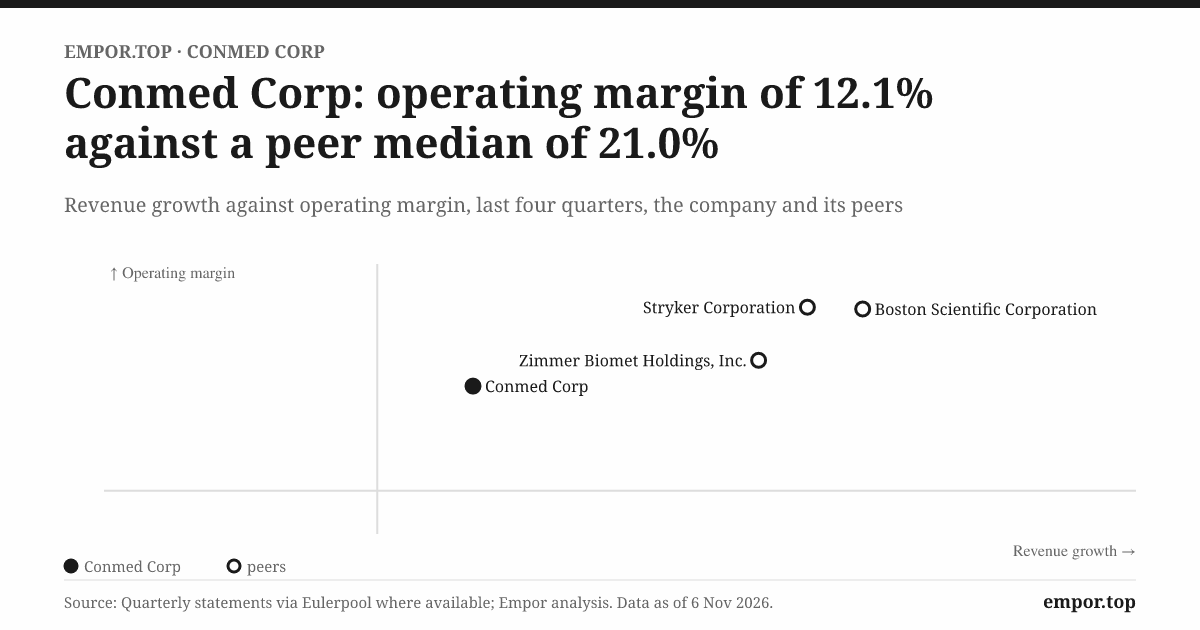
Beyer's first full year did not go well on reported numbers. GAAP operating income fell to $102.6 million in 2025 from $200.3 million in 2024, roughly halving in a year when sales rose about 5%.1 Some data services report a higher 2025 operating-profit figure, around $141 million, on their own definitions. The audited 10-K figure is the one that counts as reported operating profit, and it shows operating margin falling from about 15% to about 7.5%.
The filings identify specific causes. CONMED recorded $12.2 million of cash and stock-based compensation in 2025 for advisory services provided by Hartman after he stepped down.1 Paying a former chief executive that much for advice during the transition is unusual, and shareholders should note it: it is a related-party-style cost that bought continuity at a price. Higher consulting fees from an optimization program and the swing from a contingent-consideration gain in 2024 to a charge in 2025 also hurt results.1 These items explain a large share of the decline. They do not explain all of it, and CONMED does not decompose the drop into a full bridge. Even after the identified items, 2025 was a weak year operationally, with supply problems and the start of the commercial changes that would weigh on U.S. sales into 2026.
The strategic correction was concrete. In 2025 CONMED decided to exit its gastroenterology products and focus resources on minimally invasive surgery, smoke evacuation and orthopedic soft-tissue repair.[^1][^18] It suspended its quarterly dividend effective October 31, 2025 and authorized a $150 million share repurchase program.1 It also changed chief financial officers: Todd Garner's tenure in the role ended in 2026, and John Gallagher held the job by the third-quarter call.4 A new CEO trimming the portfolio, redirecting cash returns and changing the CFO within roughly eighteen months is a coherent reset in principle. In practice it puts many moving parts on the same income statement at once.
The incentive plan shows what the board chose to reward during the transition. Beyer's 2025 annual bonus was weighted 50% to currency-adjusted sales, 40% to adjusted earnings per share and 10% to operating cash flow.14 Sales achievement came in at 95% of goal, the only measure that fell short. Adjusted EPS achievement came in at 146.9% and operating cash flow at 200%, which produced a total bonus payout of 126.8% of target.14 So in the year GAAP operating income halved, the CEO's bonus paid out above target because the adjusted earnings measure and the cash measure beat their goals by wide margins. The adjusted EPS measure, by design, excluded many of the costs that drove the GAAP decline. Boards do commonly use adjusted measures for good reasons, but investors are entitled to notice when the measure that pays out diverges this much from the one they see in the audited results.
Beyer's total reported compensation for 2025 was $7.63 million, of which roughly $5 million came in stock and option awards.14 On the proxy's measurement date he beneficially owned 14,819 shares, well under 0.1% of the roughly 30.1 million shares outstanding.14 Equity awards will build his stake over time, but for now the CEO's personal fortune is tied to CONMED far more through future grants than through shares he owns outright. The largest holders are index and active institutions, including BlackRock, Vanguard, Fuller & Thaler and Earnest Partners, each of which reported more than 5% of the stock, and none of which controls the company.14
Shareholders approved the pay program at the May 2026 annual meeting, with about 26.2 million votes for and 1.7 million against on say-on-pay.15 That is a comfortable margin and not a protest vote. It means investors as a group were willing to accept the bonus outcome and the transition costs, at least for one year. Seven of eight directors were independent, and every board committee consisted solely of independent directors.14 The governance structure is conventional. The open question is whether a conventional board will hold management accountable for GAAP results once the adjusted measures stop looking so different.
That question is really about convergence. If the reset works, the one-off costs disappear, the GI comparison drops out of the year-over-year numbers, and adjusted and reported earnings move back toward each other. If they stay apart, with new restructuring, new consulting programs and new contingent-consideration swings each year, then "adjusted" turns out to be a lasting description of how the company is run. The first evidence of which way it is going appears in the 2026 quarterly results, where the retained portfolio had to show it could grow without the GI products.
VII. The Three Platforms Have to Carry the Growth
When Beyer spoke on the third-quarter call in late October 2026, his main theme was focus. CONMED, he said, was concentrating on three growth platforms: AirSeal in minimally invasive surgery, Buffalo Filter in smoke evacuation and BioBrace in orthopedic soft-tissue repair.4 The prepared remarks presented a company that had cleared away distractions. The analysts' questions went to the numbers that did not quite fit that presentation. If the retained business was growing more than 6%, why had full-year sales guidance come down? And if sales guidance was coming down, why was adjusted EPS guidance going up?4
To answer that, follow 2026 one quarter at a time, because each quarter told a slightly different story. In the first quarter, reported sales fell 1.3% as the GI exits began to reduce the top line.16 Management presented that as the expected cost of the reset, and on the first-quarter call it stressed that the products being kept were growing even while the products being dropped pulled the total down.16[^21] By the second quarter, growth in the retained portfolio, measured organically and at constant currency, had reached 6.0%.[^18] By the third quarter it was 6.7%.[^1] In other words, the measure CONMED asked investors to watch had improved each quarter.
Over the same period, management narrowed its full-year organic growth range to 5% to 5.5%, and its reported-sales guidance implied a decline of 0.6% to 1.1% for the year.[^1] Narrowing a range late in the year is normal, since there is less uncertainty left. What matters is which end moved. A company with accelerating momentum usually raises the bottom of its range. CONMED's narrowing, together with the reduced sales guidance analysts asked about, suggested that the fourth quarter would not continue the improvement seen from the second to the third quarter at the same pace. The retained portfolio was growing, but not quickly enough to let management be more optimistic about the full year.
Breaking the third quarter down by product group shows where the growth came from. General Surgery grew 6.4% organically at constant currency, and Orthopedic Surgery grew 7.2%.[^1] Orthopedics growing faster than General Surgery is a meaningful change for a franchise that shrank in 2014, 2015, 2016 and 2020. Reported General Surgery sales still fell, because the GI products being exited had been counted in that group.[^1] For General Surgery to keep its 2025 position as the larger product line, at $800.1 million of sales,1 the retained general surgery products have to grow quickly enough to replace the GI revenue that has gone.
Geography makes the picture uneven. International sales grew 13.8% organically at constant currency in the third quarter.[^1] U.S. sales fell 11.0% on a reported basis and rose only 0.8% organically.[^1] That is the main weakness in the quarter. The United States is CONMED's largest market and home to its most valuable hospital customers, and once the exited products are removed, U.S. sales were barely growing. Management blamed the GI exit, which hit the domestic numbers hardest, and commercial changes in the U.S. sales organization. It said it did not expect U.S. orthopedics to recover until the first half of 2027.4 Commercial changes in a device company usually mean reorganized sales territories, new representatives or changed distributor relationships, and they tend to cost sales for several quarters before any benefit shows. That may be the right decision. It also means the turnaround of the largest market has been pushed beyond the 2027 debt deadline.
The gap between the two geographies is more than a footnote, because it shows where the product case is actually proven. Outside the United States, CONMED sells partly through its own subsidiaries and partly through specialty distributors, and about 44% of 2025 sales went to customers abroad.1 Growth near 14% there suggests that hospitals choose AirSeal, smoke evacuation and the sports-medicine line when the selling motion is undisturbed. Inside the United States the products are the same, so near-flat organic growth there points mainly to execution: territories, representatives, contracts. That is better news than weak demand would be, since execution can be fixed, but fixing it falls to management, and CONMED's record in the domestic orthopedic business has made investors cautious before.
Each of the three platforms needs its own test, and each test is different. For AirSeal, the question is whether compatibility with da Vinci 5 keeps the system in robotic procedures as hospitals adopt Intuitive's integrated insufflator. The signal will be AirSeal's growth in robotic cases, which CONMED describes in general terms but does not report as a product-level revenue figure.413 For Buffalo Filter, the third quarter showed a split: growth through CONMED's own direct sales channel was healthy, while orders from original-equipment manufacturers, who buy smoke-evacuation components to build into their own products, were weaker.4 OEM orders tend to be lumpy, and they are part of the order-timing explanation CONMED gave for the gap in its guidance.
BioBrace needs the most caution. It is a new kind of product: a scaffold that encourages the body to build new tissue around a repair rather than just holding the repair together, like a trellis that helps a plant grow instead of a splint that holds a limb still. Surgeons have used it to reinforce rotator cuff, Achilles and ligament repairs, and CONMED treats it as one of its three growth platforms.4 But the company does not disclose BioBrace revenue. Without a sales figure, an adoption curve, reimbursement data or a disclosed count of surgeons using it, investors cannot tell whether BioBrace is a $20 million product or a $100 million one. The best indirect sign is the $59.2 million Biorez earnout liability on CONMED's balance sheet,1 which shows management expects BioBrace sales to grow significantly. Expectations built into an earnout are not commercial proof. CONMED's own history is the reason for caution here: AirSeal was a proven commercial product with $46 million to $49 million of revenue when CONMED bought it,7 and it took the company's full sales force to push it past its first-year forecast. BioBrace may become a second AirSeal, but nothing disclosed so far allows it to be valued as one.
The guidance discussion on the third-quarter call showed how management explains a gap. Gallagher attributed the lower sales outlook partly to foreign exchange, partly to the comparison against the exited GI business and partly to orders that moved between quarters.4 He also said tariffs would still cost roughly $0.35 a share in 2026.4 That gives the full arithmetic: an adjusted EPS guidance of $4.54 to $4.61 that was raised despite lower sales guidance and a remaining tariff hit.[^1] The higher earnings guidance came from cost control and mix, not from more revenue. That is a legitimate way to make money for a while, but a company cannot cut its way to a growth platform indefinitely.
Three measures will settle most of the debate, and they should be tracked over the next several quarters more closely than any management narrative. The first is organic constant-currency growth in the retained portfolio, which most recently read 6.7% and has been rising. The second is GAAP operating margin, which rose from about 5.7% in the third quarter of 2025 to about 11% in the third quarter of 2026, on a weak year-earlier base and still below the roughly 15% CONMED reported for full-year 2024.[^1]1 The third is free cash flow after working-capital changes, which has been weakening. The first measure shows whether the products are winning. The second shows whether winning makes money. The third shows whether the money reaches shareholders and creditors. Organic growth means little to equity holders if inventory and receivables absorb it or interest expense consumes the recovery, and with a debt maturity eight months away, the third measure is the one that matters most right now.
VIII. The Dividend Is Gone; the 2027 Notes Are Still There
For most of a decade, CONMED paid shareholders about $22 million to $24 million a year in dividends, a steady cost that barely changed whether profits rose or fell.1 In 2020, when net profit fell to about $9 million, the dividend cost more than twice what the company earned.1 In October 2025 the board stopped it. The quarterly dividend was suspended effective October 31, 2025, and the board authorized a $150 million share repurchase program in its place.1 Cash that had gone to shareholders in fixed quarterly amounts would now go to them only when management chose to buy shares.
Choosing buybacks over dividends is a capital-allocation decision with a simple rationale: buybacks are flexible, while a dividend becomes a commitment shareholders expect to keep. CONMED said it expected to repurchase at least $25 million of stock a year beginning in 2026.1 Through the first nine months of 2026, it had spent $49.9 million on buybacks, already twice that minimum.2 The timing raises a question. Those repurchases happened in the same year the company had to deal with a debt maturity larger than its market value.
That maturity is the 2.25% convertible notes due in June 2027. At the end of 2025, about $800 million of principal was outstanding, carried on the balance sheet at $793.9 million, and the notes made up nearly all of CONMED's $834.9 million of total debt.1 Convertible notes are bonds that can turn into shares if the stock rises above a set conversion price. CONMED issued them when borrowing was cheap and its stock price was much higher, and the low 2.25% coupon reflected the value of that conversion option to investors. When the share price fell well below the conversion level, the conversion feature lost most of its value and the notes became ordinary debt with a fixed repayment date. CONMED said it expected to seek new financing to handle the maturity.1
In June 2026 it took the main step. CONMED agreed to repurchase $645.2 million of principal on the 2027 notes for $637.2 million in cash, slightly below face value.3 After the transaction, about $155 million of principal remained due in June 2027.2 Paying slightly less than par for most of the issue reduced the size of the cliff by more than three-quarters and removed most of the refinancing risk a year ahead of time. It was a sound move in risk management.
It did not reduce the debt itself. At September 30, 2026, total debt was $815.9 million, only about $19 million below the year-end 2025 level.2 Year to date, then, the repurchase mainly replaced one kind of borrowing with another. Low-coupon, fixed-rate convertible debt was swapped for other borrowings, including draws on CONMED's secured bank facility, and a meaningful part of the new debt carries variable rates. Revolver availability fell to $468.5 million from $648.5 million at year-end.21 Variable-rate debt costs more when rates rise and less when they fall. Either way, the interest bill is now more exposed to rate movements than it was when nearly all the debt carried a fixed 2.25%. The bank facility also has financial covenants and limits on dividends, borrowing and some acquisitions or disposals, and CONMED reported that it was in compliance.12 The company has said it expects to repay the remaining notes from operating cash and revolver capacity.2
That plan depends on cash generation, which looks stronger over the long run than it does recently. Over the twelve years from 2014 to 2025, CONMED produced about $1.1 billion of operating cash flow against about $433 million of cumulative net profit.1 That 2.4-to-1 ratio reflects heavy non-cash charges such as amortization of acquired intangibles, which reduce reported profit without using cash. It means the income statement has consistently understated how much cash the business produces, which is good news for a company with debt. In 2025 alone, operating cash flow was $170.7 million against just $47.1 million of net income.1
The yearly figures are less reliable than the long-run ratio suggests. The 2025 gap included the roughly $23 million non-cash contingent-consideration charge, which reduced profit but not cash, and working capital moved with the timing of receivables, inventory and payments.1 In the first nine months of 2026, operating cash flow fell to roughly $100 million from about $124 million a year earlier.2 CONMED is reporting higher profits while generating less cash, which is the opposite of what a company facing a maturity wants.
The working-capital detail shows where the cash is going. At the end of 2025, trade receivables were $247.8 million, with a $6.3 million allowance for doubtful accounts, up modestly from the year before.1 Receivables equaled about 66 days of sales, close to the long-run average and below the 77-day peak of 2018.1 CONMED says its historical credit losses have not been material. It does not publish an ageing table or name slow-paying customers, so the evidence is reassuring without being conclusive. Inventory is the bigger issue. CONMED held about 200 days of inventory relative to cost of sales at the end of 2025, compared with about 160 days in 2014, after building stock deliberately to cope with supply-chain disruptions.1 Each additional day of inventory is cash tied up on warehouse shelves rather than available to repay the notes.
The treasury itself offers little extra cushion. CONMED ended 2025 with $40.8 million of cash, of which $29.3 million sat with foreign subsidiaries, and about $69.3 million of investments, mostly mutual funds, money-market funds and securities.1 Set against more than $800 million of debt, those balances are working cash, not a reserve. Other income does not hide anything either: the main 2025 non-operating item was the cost of amending the credit agreement, including a small loss on early extinguishment.1 For CONMED, repaying debt depends on cash from operations and on bank capacity, not on money already set aside.
Over the long term, the free cash went to a few places. From 2014 to 2025 CONMED produced about $865 million of free cash flow, after capital spending.1 About $273 million, roughly a third, went to dividends.1 Cash on hand was about $14 million lower at the end of 2025 than at the end of 2013.1 The rest went to acquisitions, debt service and share repurchases, including about $162.6 million spent buying 6.1 million shares under an earlier program.1 Twelve years of real cash generation did not leave CONMED with spare cash. It left the company with a product portfolio, a lot of goodwill and a debt load.
This brings capital allocation to a near-term choice. CONMED has about $155 million to repay by June 2027, a buyback program that had used about a third of its authorization, a group of growth platforms that need sales and R&D investment, and nine-month operating cash flow of about $100 million that is trending lower. R&D was $55.9 million in 2025, about 4.1% of sales and essentially unchanged as a share of revenue.1 If cash generation weakens further, something will have to give. A management team that keeps buying back stock aggressively while drawing on a floating-rate revolver to repay notes would be making a bet on its own share price with borrowed money. That bet could work, but investors should recognize it as a bet. How that bet looks depends on what the market is currently paying for CONMED's shares.
IX. Analysis & Bear vs. Bull Case
On November 6, 2026, CONMED's shares closed at $52.08, just under their 52-week high of $53.66 and well above the 52-week low of $31.95.[^5] The company's market value was about $1.6 billion, and its enterprise value, which adds debt and subtracts cash, was about $2.4 billion.[^5] The stock had risen by about two-thirds from its low in a year when reported sales were falling. Investors were buying the story management was telling: that the GI exit was the bottom and that a focused CONMED would grow.
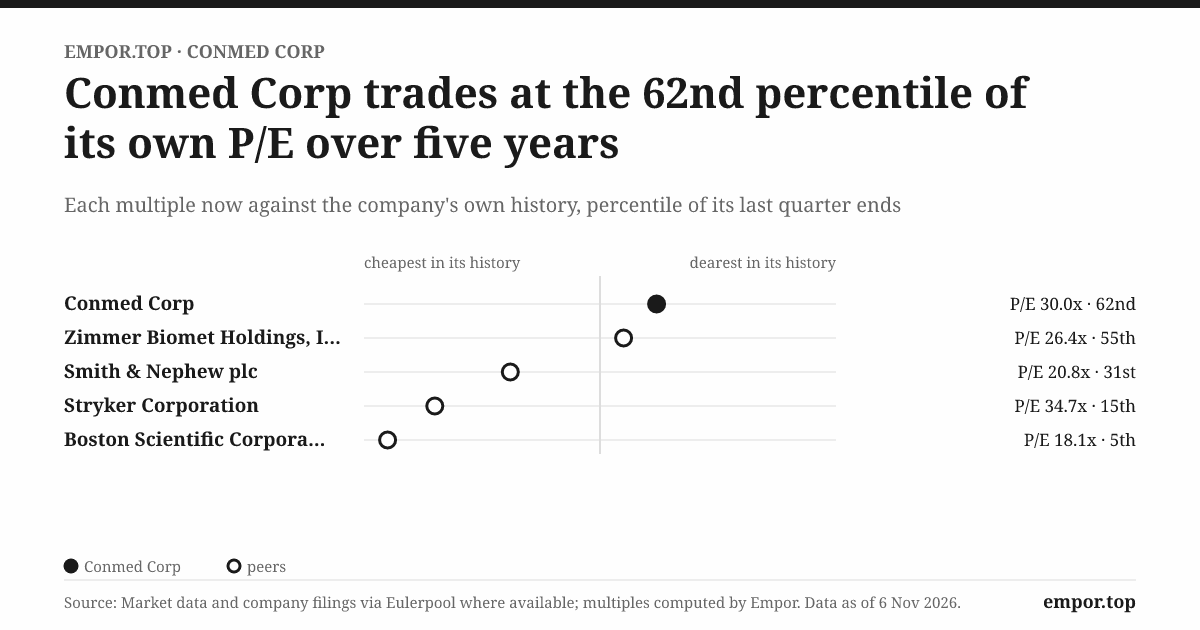
Before deciding whether that price looks demanding, the valuation figures need to be checked, because they do not agree with each other. Some data services quote CONMED at about 30 times earnings, compared with a five-year median of about 23 times. The arithmetic does not support that figure. Trailing twelve-month diluted GAAP earnings per share were about $2.42, the sum of the last four reported quarters.[^1]1 Dividing $52.08 by $2.42 gives about 21.5 times, which is below the five-year median, not above it. The 30-times figure apparently uses a different, lower earnings base. On the reported numbers, the stock does not trade at a premium to its own history on trailing earnings. On the company's adjusted EPS guidance of $4.54 to $4.61,[^1] the multiple is closer to 11 times, which shows how much the gap between adjusted and reported earnings matters to how cheap CONMED looks.
Cash-based measures give a similar picture. Enterprise value is about 11 times trailing EBITDA, and the free cash flow yield on the market value is a little above 8%.[^5] For a medical-device company with a mostly consumable revenue base, those are not high multiples. They are the multiples of a company the market does not fully trust: the free cash flow yield reflects investors discounting the sustainability of that cash, the debt and the risk that adjusted earnings never fully turn into GAAP earnings. Same-date valuation comparisons with peers on a consistent basis are not available, so no statement about CONMED being cheap or expensive relative to peers is made here. What the price appears to assume is that the retained portfolio keeps growing at mid-single digits and that margins recover gradually, not that CONMED becomes a high-growth company.
The bull case starts in the operating room. AirSeal provides a differentiated workflow that a meaningful minority of robotic surgeons still choose, and it remains compatible with da Vinci 5.[^1]13 Buffalo Filter gives CONMED a stake in smoke evacuation as hospitals move toward capturing smoke as routine practice. BioBrace gives the orthopedic business a product that is newer and potentially higher-margin than standard anchors and sutures. Its mostly single-use revenue base means growth follows procedure volumes, which tend to rise with aging populations and greater use of minimally invasive surgery.1 International organic growth near 14% in the third quarter[^1] shows that the products can gain share where the commercial organization has not been disrupted. On this view, 2025 was the low point of a reset, the 2026 margin recovery is the first evidence, and the much smaller remaining 2027 note balance would remove the threat that kept the stock near its low.
The bear case uses the same facts and reaches the opposite conclusion. The growth platforms are mostly not separately quantified, so investors are being asked to trust management's description of them. The late-year guidance revision tempered the case.[^1]4 U.S. organic growth below 1% in the largest market is a serious concern for a company with heavy fixed costs, and management has pushed the U.S. orthopedic recovery into 2027.4 Intuitive's integrated insufflator is a direct substitution threat to CONMED's best-known product, from a company with far more influence in the robotic operating room. And for a company with roughly $816 million of debt and falling nine-month operating cash flow, the buybacks look more like a show of confidence than a disciplined use of capital.
Weighing the bull and bear cases, the moat argument is narrower than either side's version. Hospital buyer power limits pricing across the catalog,1 while the scale gap with Stryker, Medtronic and Johnson & Johnson MedTech leaves CONMED without bundling leverage.101112 Its advantages are product-specific switching costs and the workflow preference built around AirSeal. Neither is strong enough to defend against an integrated platform on its own. The history does not rule out a moat. It reduces the claim to a few defensible product niches that have to keep winning procurement decisions. The test that would confirm or refute even that narrower claim is AirSeal's continued growth in robotic cases as da Vinci 5 spreads. CONMED does not report that figure separately, so investors will have to infer it from General Surgery's organic growth.
Management credibility deserves the same check. Over the first three quarters of 2026, the pattern was consistent: the organic sales range narrowed, free cash flow guidance came down, and adjusted EPS guidance went up.164 Management's explanations were specific: currency, GI comparisons, OEM order timing, tariffs and U.S. commercial changes. They were not vague. But a company that keeps meeting its earnings target while missing its sales and cash targets is managing what it can control, not showing that the business is improving. Combined with the above-target 2025 bonus in a year GAAP operating income halved,141 the record gives a skeptical investor fair grounds to ask whether the adjusted measures are being emphasized because they are informative or because they look better.
An activist reviewing CONMED would likely raise four points. The first is the gap between adjusted and GAAP results, and the board's practice of paying management on the adjusted figure. The second is the acquisition record: AirSeal is a clear success, but the Altrus write-down, the mostly unpaid In2Bones earnout and returns on invested capital in the mid-single digits do not support a general claim of acquisition discipline.61 The third is the $12.2 million paid for the former CEO's advisory services,1 which is hard to justify to shareholders who saw operating profit halve that year. The fourth is the order of capital uses: buying back stock with a variable-rate revolver available while a note maturity is still outstanding. None of these points suggests anything improper. Each is a reasonable question about whether capital is being used in shareholders' interest.
The risks are clearest when tied to how they would actually hurt the business. Rate and refinancing risk works through the floating-rate borrowings that replaced the convertible notes. Tariff and supply-chain risk works through the roughly $0.35-a-share 2026 tariff cost and the inventory CONMED is holding as protection against supply disruptions.41 Working-capital risk works through inventory days near 200 and receivables timing, both of which can absorb cash from growth. Competitive risk works through Intuitive's integration and the bundling power of the large diversified companies. Execution risk works through the U.S. commercial reset and the remaining effects of the GI exit. Currency matters too, because about a third of sales are in local currencies and CONMED's hedges only partly protect against translation effects.1 Legal risk does not appear material on current disclosure: CONMED reports only routine litigation, and its auditor, PwC, issued clean opinions on both the financial statements and internal controls.1
Four developments would settle the question, and each can be measured. Retained-portfolio growth has to stay positive after the GI comparisons drop out in 2027. GAAP operating margin has to move back toward the roughly 15% CONMED achieved in 2024 without adjustments. Operating cash flow has to recover as inventory and receivables stabilize. And the final plan for the remaining notes has to be carried out without new strain on the balance sheet. These are not unrealistic goals. But CONMED has not yet hit all of them in the same year. Even 2024, its best recent year on margins, came with a roughly $41 million non-cash gain from contingent-consideration remeasurement that flattered reported profit.1 On the record so far, then, the case that the business can earn mid-teens GAAP margins without help from acquisition accounting remains plausible but unproven, and 2027 is the year that should test it most cleanly.
X. Playbook: Business & Investing Lessons
CONMED's history is not one of failure. It is the more common story of a company that did several things well and then had to find out which of them would last. Its record offers three lessons worth carrying forward, and each of them comes from this company in particular.
The first comes from 2016, when AirSeal sold $68.4 million against a forecast of $55 million to $60 million.6 That beat was real, and CONMED has been entitled to point to it for a decade. But a first-year beat only shows that a product can be sold. It does not show that the purchase earned its cost, and the cost was more than five times the target's sales.7 The full return depends on years of compounding growth that CONMED has never reported product by product. The lesson for anyone paying a premium for a growth asset is that a good product can earn back a bold price, but the first year is evidence, not a return. Investors should ask how the asset was doing in year five, not how it did at launch.
The second comes from the 86%. In 2025, about 86 cents of every dollar CONMED earned came from products used once and thrown away.1 That is the best feature of the business, and it is often misread as a contract. An insufflator in the room or a console on the cart gives CONMED an opportunity. Revenue happens only when a nurse opens another CONMED tube set for the next case. Intuitive's built-in insufflator turns that point into a commercial threat, because a platform owner can make the consumable choice for the hospital. The lesson CONMED illustrates is that capital equipment opens the door, while consumables tell you whether the customer came back. Device investors should value companies on evidence of repeat use, such as procedure counts, disposable sales per installed system and retention, and not just on installed base. Those are measures CONMED does not publish, and the lack of them is itself information.
The third comes from 2025, the year CONMED subtracted instead of adding. Exiting GI products cleared up the story, freed sales capacity for the three platforms and gave management a focus it had lacked for years. It also lowered the reported top line right away, pushed headline growth below zero and asked the retained products to make up the difference. A focused company does not automatically become a more valuable one. Focus is a choice with a bill attached: exit the old line, then grow the retained base fast enough to replace it. Investors judging a portfolio reset should look past the clarity of the explanation to how long it takes the retained base to grow past the revenue that was given up. In CONMED's case that point has not yet arrived.
There is a fourth lesson, which concerns capital structure rather than products. CONMED issued low-coupon convertible notes when its stock was high and conversion looked likely. When the stock fell, the notes stopped being potential equity and became an $800 million obligation with a fixed repayment date, which management spent much of 2026 handling.13 Convertible debt is a bet that the share price will rise, and when the bet loses, the cheap coupon turns into a large principal repayment. Companies that issue it should plan for the case where the stock does not cooperate, and CONMED's 2026 shows what that planning costs when it starts late.
Taken together, these lessons describe CONMED itself. A device becomes a platform only when clinical value turns into repeat use. Acquisition price and technical differentiation are only the starting point, and the rest has to be shown year after year in the company's reported results.
XI. Epilogue
As of November 7, 2026, CONMED is a $1.6 billion company with a recovering margin, a portfolio narrowed to the products it believes in, a stock near its 52-week high and a debt deadline about seven months away.[^5]2 Its third quarter showed the retained business growing at its fastest pace of the year, while the U.S. business, the largest one, was barely moving once the exited products were excluded.[^1] Several upcoming events will show whether the company has successfully made itself smaller.
The first is the fourth-quarter report and the 2026 Form 10-K, expected early in 2027. They will show the first full year of GI exits: reported sales against organic sales, a full-year GAAP operating margin to compare with 2025's 7.5%, and full-year operating and free cash flow to compare with the strong cash figures of 2024 and 2025.1 If organic growth comes in near 5% and the GAAP margin moves well into double digits, the reset will have gained a year of credibility. If the cash flow decline seen in the first nine months continues through the full year, investors will start asking what happens to the remaining notes, and asking it louder.
The second is guidance for 2027, the first year in which reported and organic growth should begin to converge as the GI comparison drops out. That guidance will be the clearest statement yet of what management thinks the focused company can do. Within it, the most important figure for the long-term story will be domestic growth. Management has said U.S. orthopedics should recover in the first half of 2027.4 That is a dated commitment investors can check, and checking promises against results is how a new CEO earns credibility.
The third is the remaining roughly $155 million of 2027 notes, due in June.2 CONMED has said it expects to use operating cash and revolver capacity to repay them.2 That plan is credible given the revolver capacity it has. The question is what else gets squeezed while it happens. If buybacks continue at their 2026 pace while the revolver funds the maturity, CONMED will end 2027 with less flexibility but potentially fewer shares outstanding. If buybacks slow, management will be signaling that it ranks balance-sheet repair ahead of supporting the share price. Either choice says something about management's priorities.
The fourth development is slower and harder to see: whether AirSeal keeps its place on da Vinci 5 tables, whether Buffalo Filter's OEM orders recover, and whether BioBrace becomes a product large enough that CONMED starts reporting its sales. A company usually starts disclosing a product's numbers once it is confident they are good.
Good products and a smaller maturity help. They do not yet answer the questions about margins and cash. CONMED has reduced the debt cliff that worried investors most in 2025 and still has to resolve the margin and cash questions that will decide the stock's value.
XII. Outro
The October 2026 quarter showed sales falling and the business growing at the same time, and both were true. The difference came down to which portfolio was being counted: the one CONMED used to have or the one it decided to keep.
Back in the operating room where this story began, the decision is the same one hospitals make every day. Each device on the cart is there because a surgeon, a nurse and a purchasing contract all agreed it should be, and each of them can change their mind before the next case. CONMED made the same choice in 2025. Over the next year it will have to show that the products it kept deserve their place, and it will have to do so before the 2027 deadline arrives.
References
-
2025 Form 10-K — CONMED / SEC, 2026-02-17 ↩↩↩↩↩↩↩↩↩↩↩↩↩↩↩↩↩↩↩↩↩↩↩↩↩↩↩↩↩↩↩↩↩↩↩↩↩↩↩↩↩↩↩↩↩↩↩↩↩↩↩↩↩↩↩↩↩↩↩↩↩↩↩↩↩↩↩↩
-
2027 Convertible Note Repurchase Agreement — CONMED / SEC, 2026-06-04 ↩↩↩
-
Q3 2026 Earnings Call Transcript — The Motley Fool, 2026-10-28 ↩↩↩↩↩↩↩↩↩↩↩↩↩↩↩↩
-
SurgiQuest Acquisition Announcement — CONMED / SEC, 2015-11-16 ↩↩↩↩↩↩
-
Buffalo Filter Acquisition and Pro Forma Filing — CONMED / SEC, 2019-02-11 ↩↩↩
-
In2Bones Acquisition Announcement — CONMED / SEC, 2022-05-04 ↩
-
Wells Fargo 21st Annual Healthcare Conference Q&A — Stock Analysis, 2026-09-09 ↩↩↩↩
-
Q1 2026 Earnings Call Transcript — The Motley Fool, 2026-04-29 ↩↩↩
 LinkedIn
 WhatsApp
 Reddit
 Hacker News
 Email
 Kindle
 RSS Feed
 Spotify
 Apple Podcasts
 Amazon Music
 Audible
 YouTube