The Buckle, Inc.: The Denim Chain That Kept Its Margin
I. A 468-Store Chain, and a Question About What Comes Next
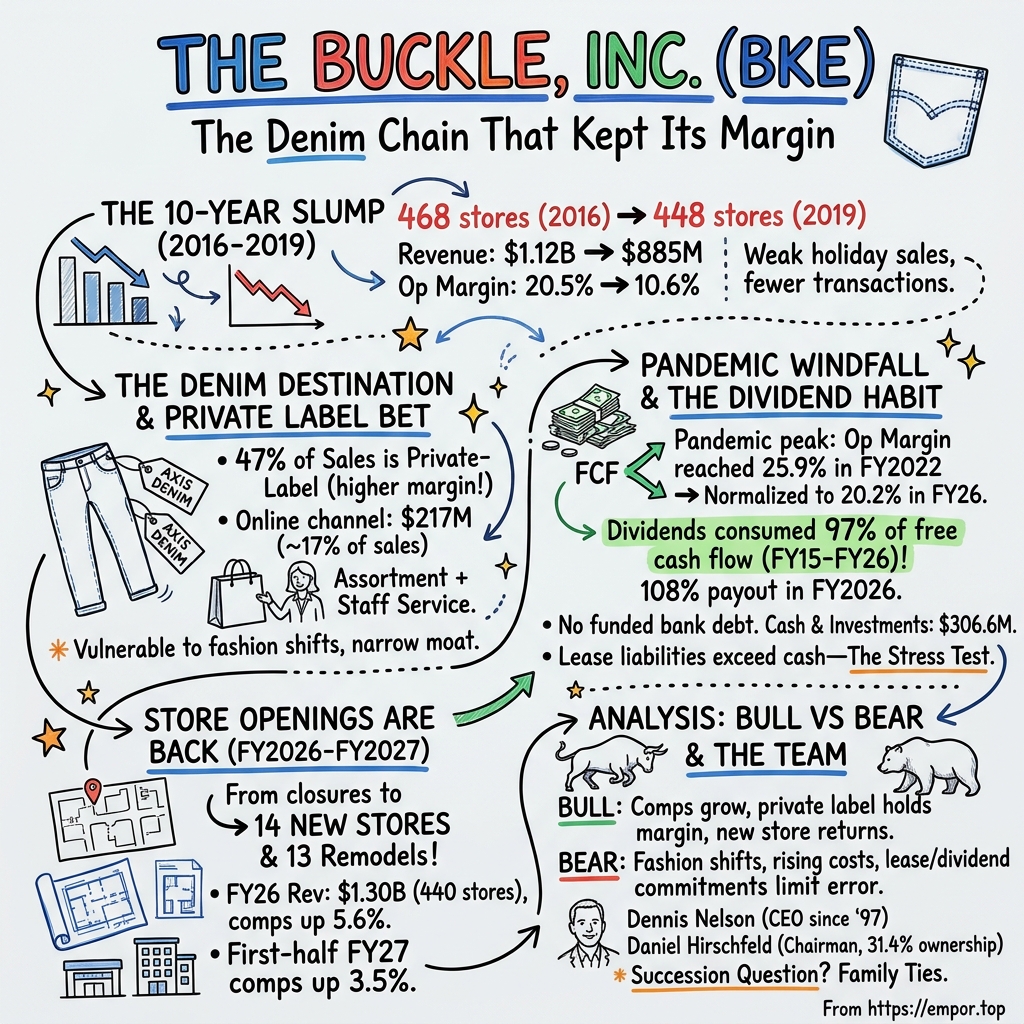
At the end of January 2016, The Buckle ran 468 stores across 44 states, most of them tucked into the enclosed malls of middle America, and it had just closed a year with about $1.12 billion of sales.1 On paper it was a fine business. It owed no bank money, it earned more than 20 cents of operating profit on every dollar it sold, and it sent most of that profit back to its owners every year.1
Ten years later, the chain was smaller. At the end of January 2026, Buckle operated 440 stores in 42 states.2 Its sales had reached about $1.30 billion, which sounds like progress until the arithmetic is done.2 Spread across a decade, that is growth of roughly 1.5% a year, slower than the general rise in consumer prices over the same stretch. In real terms, the company sold a little less to Americans in 2025 than it had in 2015.
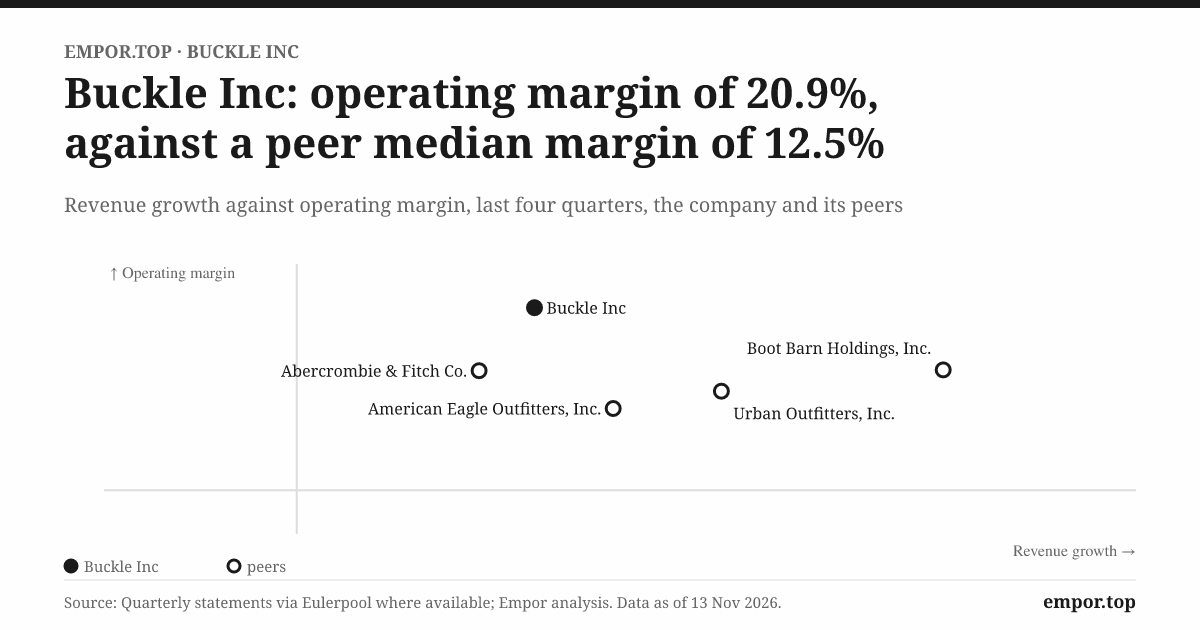
That would be an unremarkable story of a mall retailer slowly fading, except for two things. The first is that Buckle never stopped making money. Through a brutal sales slide, a pandemic and a decade of empty food courts, its operating margin stayed in the double digits, and in its most recent fiscal year it sat at about 20%.2 The second is that, after years of closing more stores than it opened, Buckle has started building again. Management plans 14 new stores and about 13 full remodels for the current fiscal year, and by early November 2026 the store count had climbed back to 451.23
A word on the calendar before going further, because Buckle's fiscal year is a trap for the unwary. The company's year ends around the last Saturday of January, so that the holiday season and the January clearance sit inside the same year. This story names each year after the January in which it ends. The year that closed on January 31, 2026 is fiscal 2026 here, even though Buckle itself calls it fiscal 2025. The year now under way, which ends in January 2027, is fiscal 2027.
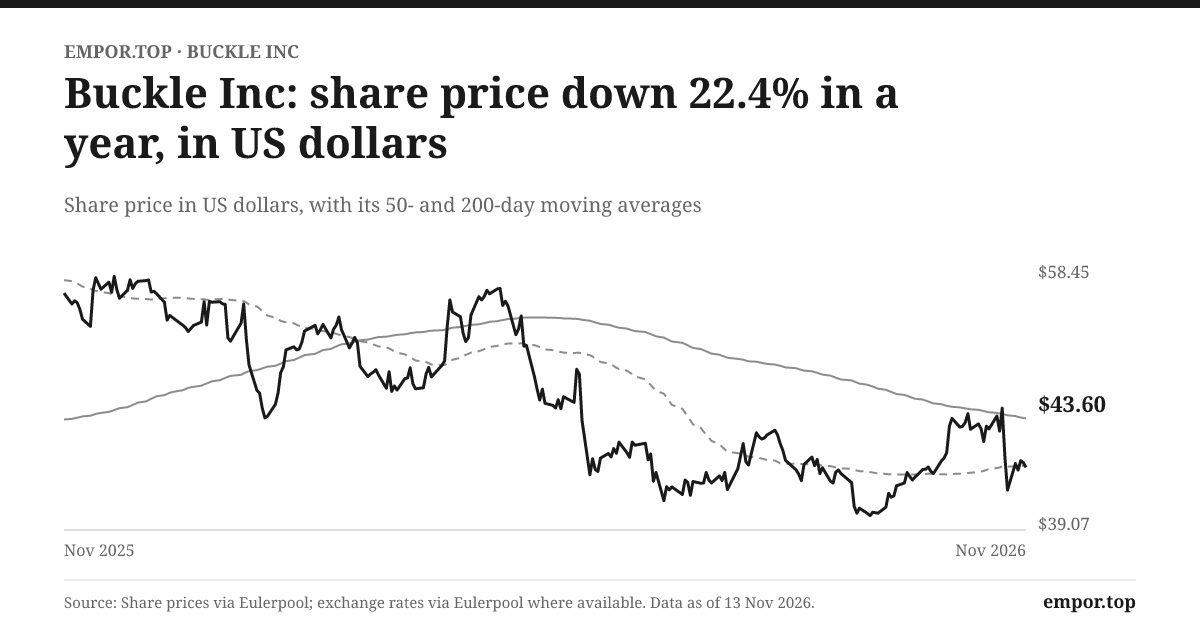
The question this story sets out to answer is simple to state and hard to settle. Is the recent growth the start of a durable new chapter, or a rebound inside a business that struggled to grow for a decade? The answer matters because the market is pricing Buckle as if it already knows. At $43.60 a share on November 13, 2026, the company was valued at about $2.2 billion, or about 10.6 times its earnings, with a trailing dividend yield of more than 9%.2 That is the price of a business investors expect to throw off cash, not one they expect to grow.
The people who will decide the answer are the same people who presided over the slump. Dennis Nelson started at Buckle as a part-time salesperson in 1970, became president in 1991 and has been chief executive since 1997.4 Daniel Hirschfeld, whom the company describes as its founder, has been chairman since 1991 and owns about 31% of the shares.4 Nelson is 76 and Hirschfeld is 84.4 There has been no change of regime to blame for the weak decade, and no new team to credit for the recovery. The record is theirs, all of it.
So the story follows three threads. The first is the store and fashion proposition: what customers get inside a Buckle that they cannot get elsewhere, and how much evidence there is that it keeps them coming back. The second is the return of growth: whether the comparable-store gains of the past year are broad enough to justify building new stores again. The third is the money: a company that has paid out nearly every dollar of free cash it generated, sometimes more, and now wants to spend more on stores, all while carrying a long tail of leases.
Each thread runs back to the same place. A chain of jeans stores that kept its margin through bad years has earned the right to be taken seriously. Whether it has earned the right to grow is a different claim, and the best place to start testing it is on the sales floor.
 Subscribe on LinkedIn
II. From the Mall Floor to the Denim Destination
Walk into a Buckle and the first thing that greets you is the denim. Jeans are stacked and hung in long rows by fit, wash and rise, with more variety in a single store than most department stores carry in a whole floor. Denim accounted for about 42.5% of Buckle's sales in the year to January 2026, more than tops, accessories and footwear.2 A salesperson, whom Buckle calls a teammate, will usually be at your elbow within moments, ready to pull sizes and steer you between fits. The store expects you to try things on.
The jeans on the wall come from two places. About 53% of sales came from national brands, the labels a shopper might find in other stores.2 The rest, about 47%, came from labels Buckle controls itself: BKE, Buckle Black, Ace High, Daytrip, Reclaim, Willow & Root and more than a dozen others.2 Most shoppers would not know which is which without checking the tag. That mix, a recognizable name beside an in-house label that looks just as at home, is the heart of what Buckle sells.
The company grew out of a single store in Kearney, Nebraska, a railroad town in the middle of the state. It was incorporated in 1948 as Mills Clothing, "a conventional men's clothing store with only one location."2 In 1967 the business bought a store called the Brass Buckle, and in the early 1970s it turned into a jeans shop.1 The first branch opened in Columbus, Nebraska, in 1976, and the first mall store followed in 1977, just as enclosed malls were spreading across the country.2 The company took the name The Buckle, Inc. in April 1991, and the following March it filed to sell 1,955,000 new shares to the public, an offering valued at about $33 million.25 Buckle still keeps its headquarters and its only distribution center in Kearney.2
That geography explains a lot. Buckle grew up in the malls of small and mid-sized American cities, far from the fashion capitals, selling to young people who wanted the jeans they saw in magazines and on music television, and who wanted help choosing them. Of the 440 stores at the end of January 2026, 285 were in malls, 85 in strip centers and 67 in lifestyle centers, the open-air shopping districts that have taken traffic from enclosed malls.2 The average store is about 5,600 square feet, roughly the size of two tennis courts, with about four-fifths of that given over to selling space.2
The way Buckle makes money is as plain as retail gets. A customer pays at the register or online, and the company books the sale at that moment, or when an online order is handed to the carrier.2 There is no subscription, no contract and no minimum commitment. Every sale has to be earned again with the next visit. Buckle does run a loyalty program, Buckle Rewards, which hands out rewards once a shopper earns 300 points, and its top two tiers are reserved for holders of the Buckle private-label credit card issued by Comenity Bank.2 The richest tier requires spending at least $1,000 a year on that card.2 The program gives a reason to come back. It does not lock anyone in.
Online selling has become a real part of the business without becoming a separate one. Buckle sold $217 million online in the year to January 2026, about 17% of sales, up nearly 10% from the year before.2 The website sells the same mix as the stores, to largely the same kind of customer, and the stores handle much of the brand-building that sends people there.
Behind the sales floor sits an operating habit that is easy to overlook and central to the model. Buckle runs a single 240,000-square-foot distribution center in Kearney, completed in the company's fiscal 2010, through which merchandise arrives daily and leaves, mostly by FedEx, usually within one or two business days.2 New merchandise ships to most stores every day.2 The point is not speed for its own sake. Daily, store-by-store replenishment lets Buckle send each location what is selling there rather than dumping a seasonal allocation and hoping. Stores also transfer goods among themselves. The reward is fewer markdowns, because unsold stock is less likely to pile up in the wrong place. The cost is more freight, more handling and more people.
Markdowns are where the judgment lives in any apparel business, and Buckle's auditor knows it. Deloitte, which gave the company a clean opinion for the year to January 2026, singled out the reserve for inventory markdowns and obsolescence as its critical audit matter, because estimating how much merchandise will have to be sold below cost requires significant judgment.2 That is not a warning sign. It is a reminder that the profit Buckle reports depends on management being right about which jeans will sell at full price.
The people are the other half of the experience. Buckle employed about 8,000 teammates at the end of January 2026, of whom about 2,900 worked full time and about 700 sat in the corporate offices and the distribution center.2 The company says turnover in its stores and distribution center is high, mainly because so many roles are part time.2 That is the paradox of a service-led retailer: the service rests on a workforce that keeps changing. Buckle's answer, visible in its history, has been to promote from within and to keep a small, stable leadership core. Nelson himself started on the sales floor.4
Now the harder question. What did Buckle build that shoppers could not easily get elsewhere? The honest answer is a format, not a fortress. The combination of a deep denim assortment, attentive staff, private labels that sit naturally beside national ones, and inventory tailored to each store is distinctive in American apparel retail. But Buckle publishes no customer retention rates, no repeat-purchase data and no market share.2 No customer comes close to 10% of revenue, because its customers are individual shoppers.2 So the advantage can be seen in the format and the mix, and in the profits, but it cannot be measured in loyalty or pricing data, because the company does not provide any.
That makes the moat, at best, narrow and unproven. Buckle may well have something customers value. The evidence that they would pay more for it, or stay with it when fashion moves, has to come from the company's own history. And that history contains a severe test. A model built on fashion relevance and mall traffic was about to discover what happens when both turn at once.
III. The Sales Slide That Took Ten Years to Outgrow
The holiday season of 2016 should have been routine. Buckle had been through decades of them, and the playbook was well rehearsed: build denim inventory, staff up, send fresh merchandise to every store each day. Instead, the year that ended in January 2017 turned into the worst Buckle had recorded as a public company. Sales fell 12.9%, to about $975 million.6 Comparable-store sales, which strip out the effect of opening and closing stores, fell 13.5%.6 Online sales, which were supposed to be the cushion, fell too, by about 5%.6
The usual explanation for a retailer's falling sales is that it is closing stores. That was not what happened here. Buckle began the year with 468 stores and ended it with 467.6 The decline came from inside the stores that stayed open, and the filing shows exactly where. The number of comparable-store transactions fell by about 10%, and the average price of each piece sold fell by about 4%.6 Shoppers who did come in bought slightly more items per visit, but not nearly enough to matter.6
Those two numbers tell different stories, and both are bad. Fewer transactions means fewer people walking in and deciding to buy, which is a traffic and relevance problem. A lower average price means that those who bought were buying cheaper items or buying on promotion, which is a pricing and mix problem. A retailer can survive one or the other for a while. Facing both at once suggested that the merchandise had lost some of its pull, at the same time as the malls around it were losing footfall.
There was a second, more technical reason the reported numbers looked as bad as they did. Early in that year, Buckle replaced its old Primo Card program with a new scheme called Buckle Guest Loyalty.6 Under the accounting rules for loyalty programs, a retailer that hands out points has to set aside part of each sale as a promise of future rewards, and book revenue only when those rewards are redeemed or expire. The new program reduced reported sales by about $15.4 million in its first year.6 Excluding that effect, comparable-store sales fell about 12.2% rather than 13.5%.6 It was a real difference, and management was right to point to it. But it explained barely a tenth of the decline. The rest was customers.
Profit absorbed the blow better than sales, but not painlessly. Operating income fell from about $230 million to about $153 million, and the operating margin dropped from 20.5% to 15.7%.6 Gross profit, which Buckle reports after the costs of buying, distribution and store occupancy, fell from 43.0% of sales to 40.7%.6 That is the cruelty of a store-based business in a downturn. Rent, depreciation and the distribution center do not shrink when shoppers stay home, so every lost dollar of sales takes a disproportionate bite out of profit.
The company did not sit still. It relaunched buckle.com on a new e-commerce platform in June 2016, and it rolled out the new loyalty program.6 Neither was enough to turn the tide, and neither should be read as proof of a lasting digital edge. They were the sensible moves any mid-sized retailer was making at the time, which is exactly why they did not differentiate Buckle.
The slide continued, more slowly. In the following year, which ran 53 weeks to early February 2018, sales slipped to about $913 million, and Buckle opened two stores while closing twelve.7 In the year to February 2019, sales fell another 3.1%, to about $885 million, and Buckle opened no new stores at all while closing seven, ending with 450.7 By then the bleeding had nearly stopped: comparable-store sales fell less than 1%, and transactions were almost flat.7 What kept falling was price. The average retail price per piece fell again, by 2.6%, even as customers bought a little more per visit.7 Operating margin bottomed at about 13.6% that year, according to the company's own filing.7
So from peak to trough, sales fell by about a fifth and operating profit by nearly half. Yet Buckle never lost money in any of those years, never borrowed from a bank and never suspended its dividend. That resilience is the first half of the Buckle story, and it is a genuine achievement. Plenty of mall-based apparel chains of that era did not survive the same decade.
The second half of the story is less comfortable. The slump falsifies any strong claim that Buckle's brand, its staff service or its denim specialization alone can guarantee growth. All three were in place in 2016. The stores were staffed by the same kind of teammates, selling the same deep denim assortment, under the same leadership. None of it stopped transactions from falling by a tenth in a single year. What the format provided was a floor under profit, not a floor under sales.
The footprint response confirms the point. Over the ten years to January 2026, Buckle opened 40 stores and closed 68.2 That is not a company that saw obvious white space and held back. It is a company that found, location by location, that some of its stores no longer earned their keep. Revenue did not recover to its 2016 level until the extraordinary year to January 2022, when reopening demand lifted it by more than 40% in twelve months.8
That history is the right lens for the recovery that followed. A rebound can be entirely real, with more customers, higher prices and better margins, while the underlying business is still a low-growth, fashion-exposed retailer. The two are not in conflict. The question is which one the next five years will look like, and part of the answer depends on what Buckle chose to do with its money when growth was scarce.
IV. A $1.3 Billion Retailer With No Acquisition Story
Most American retailers of Buckle's size have, at some point, tried to buy their way out of a slow decade. A second banner aimed at a different shopper, a struggling rival picked up cheaply, a digitally native brand bought at a premium: the playbook is well known, and so is its failure rate. Buckle's recent annual reports describe nothing of the kind. Its filings for the past three fiscal years disclose no acquisition program and no deal of consequence, and its operations remain what they have been for decades: one company, two store banners, Buckle and Buckle Youth, and one distribution center.2
That makes Buckle's capital-allocation story unusually easy to read. There is no purchase price to judge against industry comparisons, no goodwill to write down and no integration to blame. Money that comes in either goes into stores, the headquarters, the distribution center and technology, or it goes out to shareholders. The company has not repurchased a single share in the past three fiscal years; it still has authority to buy 410,655 shares under a plan approved in 2008.2 Dividends, in other words, are the only outlet that matters.
Spending on the business has been modest by any standard, and it is now rising. Buckle invested about $37 million in stores, renovations, the headquarters and distribution in the year to February 2024, about $42 million the following year and about $45 million in the year to January 2026.2 That last figure was roughly 3.5% of sales. For context, that is about what it costs to keep a chain of this size fresh rather than to expand it. The budget for the current year is much larger, about $60 million to $65 million, mainly for stores and technology, plus a replacement corporate aircraft.2
The aircraft deserves a sentence, because it is the kind of detail a skeptical shareholder notices. In the first half of the current year, Buckle spent about $44.5 million on capital projects, of which about $20 million went to corporate projects that included the new plane.9 A company based in a small Nebraska city, with stores spread across 42 states, has a practical case for a corporate aircraft. It is still an expense that competes for the same dollars as new stores and dividends, and the board approved it in the same year it decided to accelerate store growth.
The change in posture on stores is the real news. After a decade in which closures outnumbered openings, management planned 14 new stores and about 13 remodels for the year that ends in January 2027.2 On the March 2026 call, management said at least half of the remodels would be relocations to outdoor centers, moving stores out of enclosed malls and into the open-air centers where shoppers increasingly park.10 Nelson framed it in characteristically understated terms: "We have always taken an opportunistic approach to our opening of stores."10 By the start of August, Buckle had opened eight stores, remodeled ten and closed two, and the store count stood at 446.11 By early November it was 451.3
Opportunistic is the right word, and it cuts both ways. Buckle is not announcing a target of hundreds of new stores or a national expansion plan. It is picking locations one by one, often swapping an aging mall box for a better-placed open-air site. That limits the risk of over-building. It also limits how much growth the new stores can deliver. Fourteen new stores on a base of 440 adds about 3% to the fleet, before closures.
Every one of those stores comes with a lease, and leases are where Buckle's balance sheet carries its real obligations. At the end of January 2026, the company had about $384 million of operating lease liabilities on its balance sheet, with a weighted average of about 6.3 years left to run.2 The undiscounted payments it was committed to totaled about $474 million.2 On top of that, it had signed leases that had not yet started, with about $28 million of legally binding minimum payments.2
Those figures explain an oddity in how Buckle's numbers sometimes appear. Many data services show the company with zero borrowings until 2019 and roughly $300 million to $380 million of debt ever since, giving it a debt-to-equity ratio of about 0.9.28 Buckle did not suddenly take out loans. A change in accounting rules that took effect in 2019 required companies to put long-term leases on the balance sheet, and that is the "debt." Buckle reported no bank borrowings in any of the past three fiscal years, and it keeps a $25 million unsecured credit line with Wells Fargo, available through July 2028, mainly to back about $1.7 million of letters of credit.2
Against those lease commitments, Buckle held about $307 million of cash and investments at the end of January 2026, and about $323 million by the start of August.211 That is a comfortable cushion, but it is not as large as the leases themselves. A store is a promise to pay rent for years, whether or not customers show up. The 2016 slump showed how quickly fixed store costs can eat into margin when traffic falls. Buckle's lease book today is the equivalent of more than a year and a half of free cash flow.
So the capital story is not about acquisitions or financial engineering. It is about a much simpler test. Can Buckle add stores, and move old ones, without giving back the margins that make the chain valuable in the first place? Those margins rest heavily on one decision Buckle made over the past decade, a decision about whose name goes on the jeans.
V. The Private-Label Bet Behind the Margin
Picture two pairs of jeans hanging side by side on a Buckle wall. One carries a national label a shopper might also find at a department store. The other is BKE, Buckle's best-known in-house brand, cut in a similar fit and wash, priced in the same range. A teammate explains the difference in rise and stretch, the shopper tries both, and one goes home. Nobody signed a contract. Nobody is committed to buying the next pair. But if the shopper picked the BKE pair, Buckle very likely made more money on the sale.
That is the economic logic of private label in a sentence. When Buckle sells a national brand, the brand owner takes its share of the margin before Buckle sees any of it. When Buckle sells its own label, it captures more of that margin itself, and it gets to decide the design, the fit, the fabric and the timing. The company says private-label merchandise generally earns a higher margin than branded goods.2
Buckle has leaned into that logic hard over the past decade, and this is perhaps the most important strategic shift in its recent history. In the year to January 2017, national brands made up about 65% of sales and private labels about 35%.6 By the year to January 2026, private labels had risen to about 47%.2 In men's denim, the category that built the company, Buckle's private brands made up more than three-quarters of sales by early 2026.12
The margin effect is visible in the accounts. Gross profit, measured after buying, distribution and occupancy costs, rose from about 40.7% of sales in the slump year to about 49.0% in the year to January 2026.62 Not all of that is private label. Higher prices, fewer markdowns and the recovery in sales, which spread fixed store costs over more revenue, all helped. But a gain of roughly eight points of gross margin, in an industry where a single point is worth fighting over, is the clearest evidence in Buckle's record that its merchandise decisions have worked.
Here is the twist in the title, though. Buckle kept its operating margin, but it did not expand it. In the year to January 2016, before the slump, operating margin was about 20.5%; in the year to January 2026 it was about 20.2%.12 Gross margin rose by about six points over that span, from about 43% to 49%.12 So the cost of running the stores and the company, selling, general and administrative expense, rose by roughly the same amount, from about 22.5% of sales to about 28.8%.12 Put simply, for every $100 of sales, Buckle now keeps about $6 more after paying for merchandise and store space, and then spends about $6 more on wages, marketing, incentive pay and everything else. The private-label gains paid for a costlier operating model rather than flowing through to profit.
That matters for how far the margin story can stretch. If private label is a one-time mix shift that has largely been captured, the next decade will not get the same tailwind. If it is a durable advantage, customers should keep choosing Buckle's brands at full price, and the share should keep edging up. Recent quarters do not settle it. Private label was 47.5% of sales for the full year to January 2026, 48% in the first quarter of the current year, and 44.5% in the second quarter, slightly above the year before.10129 The share moves around with the season and the merchandise, which is what one would expect if customers are choosing pair by pair rather than following a brand.
It is worth being careful about what a large own-label share proves. It proves that Buckle can design, source and sell its own product, and that shoppers inside its stores buy it. It does not prove that customers would seek out BKE anywhere else, or that they would pay a premium for it over a comparable national brand. Buckle sells its labels only through its own stores and website, and it publishes no data on repeat purchases, price premiums or brand awareness. Commercial success inside a captive channel is real. It is not the same as a brand with independent pulling power.
There is also a concentration hiding inside the private-label story. In the year to January 2026, a single vendor, Axis Denim, which produces private-label denim for Buckle, accounted for 20.6% of the company's net sales.2 No other vendor accounted for more than 10%.2 That is a production exposure, not a related-party arrangement: Axis is a supplier, and nothing in Buckle's filings links it to the company's insiders. But it means that roughly one in every five dollars Buckle takes in comes from merchandise made by one producer. Buckle does not disclose the terms of that relationship, its geographic sourcing or what alternatives it has lined up.
Buckle's general sourcing posture both helps and complicates this. The company says it has no long-term or exclusive contracts with any of its brand-name or private-label manufacturers, that it plans private-label production three to six months before delivery, and that it has not had material difficulty with foreign-made goods.2 Without long contracts, Buckle is not locked into bad terms, and it can shift production if a supplier falters. Without long contracts, it also has no guarantee of supply if conditions tighten. The flexibility is genuine; so is the dependence on a single large producer.
The 2026 calls showed how these pieces move together. In the second quarter of the current fiscal year, Buckle's merchandise margin rose by 110 basis points, or 1.1 percentage points of sales.9 But 65 basis points of that came from refunds of tariffs Buckle had previously paid; strip those out, and the underlying merchandise-margin gain was about 45 basis points, which management attributed mainly to private label.9 At the same time, buying, distribution and occupancy costs rose by 70 basis points of sales, because new and relocated stores carried higher rent and depreciation.9 Net of everything, gross margin rose about 40 basis points.9 In the first quarter, without any refund benefit, gross margin had fallen about 50 basis points.12
That sequence captures the tension precisely. Private label is still adding margin, but at a modest pace. New stores are taking margin away through occupancy costs, at least until they mature. And the one-time tariff benefit flattered the quarter that looked best. A shareholder who wants to know whether the private-label engine is still running should look at merchandise margin excluding refunds, which was positive but small.
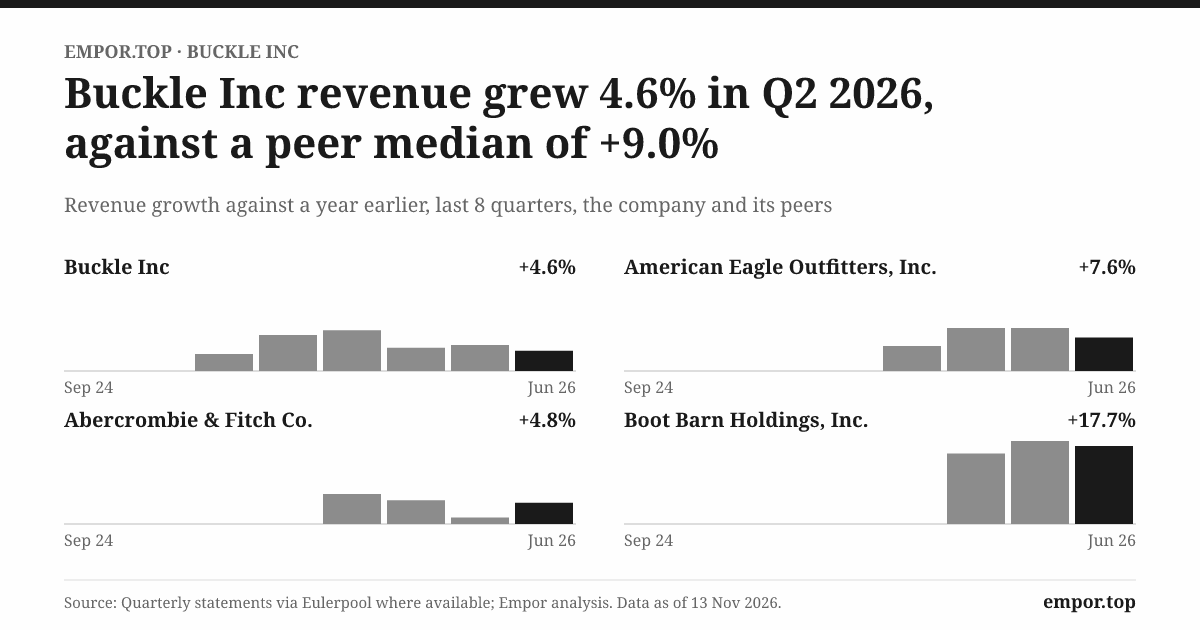
The competitive set sharpens the point. The closest thing to a fast-growing comparable is Boot Barn, a western and workwear specialty retailer that sells a lot of denim and boots. In its fiscal year to March 2026, Boot Barn's sales rose about 18%, to about $2.25 billion, from 539 stores in 49 states.13 That is a different business, more focused on western wear and with a store-growth program far larger than Buckle's, but it shows what a growing specialty apparel chain looks like in the same market. Buckle also competes for the same young shopper's wallet with American Eagle, Abercrombie & Fitch and Urban Outfitters, each of which has its own brands, store formats and customer base. None of them publishes a market-share figure that would let a reader compare them directly, and Buckle does not either.
Measured against the classic sources of competitive advantage, Buckle's private-label strategy gives it something real but limited. It has brand and assortment control: it decides what goes on the wall, and its own labels let it move faster and earn more per sale. It has no visible switching costs, because a shopper can walk to another store in the same mall at no cost. It has no scale advantage over far larger apparel groups, and no cornered resource, such as an exclusive supplier or a unique location, that rivals cannot replicate. The forward proof is straightforward. If Buckle can sustain full-price demand for its labels, and hold merchandise margin after the tariff refunds fade, the private-label bet is an advantage. If merchandise margin stalls once those refunds are gone, it was a one-time harvest.
Either way, the margin that private label built has had to fund something, and for most of Buckle's history that something has been a remarkable flow of cash to shareholders. That flow was never larger than in the strange years that followed the pandemic.
VI. The Pandemic Windfall and the Dividend Habit
In the spring of 2020, Buckle's stores, like almost every apparel store in America, went dark. For a mall-based chain whose model depended on shoppers trying on jeans in a fitting room, it should have been a disaster. Instead, the year to January 2021 ended with sales essentially flat at about $901 million and operating margin rising to about 18.6%.8
Then came the year that broke every pattern in the company's history. In the year to January 2022, sales jumped 43.6%, to about $1.29 billion, and operating margin reached 25.9%, the highest on Buckle's modern record.8 Net profit nearly doubled, to about $254 million.8 The ingredients were familiar from across apparel retail that year: stimulus money, pent-up demand and a rush to replace wardrobes after a year at home. Buckle went into it with lean inventory, holding fewer days of stock than at any point in its modern record, so it sold more at full price and cleared less on markdown.8
The question that year raised, and that hangs over the company still, is how much of that earnings power was repeatable. The record since then gives a clear answer: much less than the peak. Operating margin eased from about 24% to about 20%, before ticking up to about 20.2% in the year to January 2026.82 Over the three years to January 2026, revenue fell about 1.2% a year and net profit fell about 6.3% a year. The five-year growth rates look strong only because they start from the depressed pandemic base. The surge of 2021 was a major inflection, but it was a peak, not a new baseline.
What did not change through any of this was the dividend habit. Buckle pays a regular quarterly dividend, currently 35 cents a share, and in most years it adds a special dividend on top; last year's was paid in the fourth quarter.2 In the year to January 2026, the special dividend was $3.00 a share, and total dividends paid came to about $225 million.2 In the bumper year to January 2022, Buckle paid out about $348 million, well above that year's record profit.8
The distinction between regular and special dividends matters enormously for anyone reading Buckle's headline yield. At $43.60 a share, the regular dividend alone, $1.40 a year, yields about 3.2%. The rest of the trailing yield of about 9.3% comes from the special payout.2 The special dividend is not a promise. It is the board's decision each year about how much surplus cash to release, and it can shrink or vanish without anything being "cut" in the formal sense. Reading the 9% as a yield the stock will deliver every year is a mistake the company's own pay-out structure invites.
How much of its profit has Buckle actually turned into cash? Over the twelve years from fiscal 2015 to fiscal 2026, it reported about $2.0 billion of net profit and generated about $2.4 billion of operating cash flow, or about 122% of profit.28 That is a strong conversion record. It reflects depreciation and stock-based pay, which reduce reported profit without consuming cash, partly offset by money tied up in inventory. In the year to January 2026, inventory absorbed about $19 million of cash and receivables about $4 million.2 Nothing in the long record suggests Buckle's profits are flattered by aggressive accounting; if anything, the cash has run ahead of earnings.
Now follow the cash out the door. Over the same twelve years, Buckle's free cash flow, the cash left after capital spending, totaled about $2.1 billion. Dividends paid totaled about $2.0 billion, or about 97% of it.28 Cash and short-term investments rose by about $122 million over the whole period, from about $185 million to about $307 million. Put simply, nearly every dollar Buckle could have spent, saved or used to buy back shares went to shareholders as dividends.
Year by year, the pattern is even more striking. The payout ratio, dividends paid as a share of net profit, was above 100% in seven of the twelve years. It peaked at about 150% in the year to February 2018, in the middle of the slump, when profit was weak but the special dividend continued.8 The median year saw Buckle pay out slightly more than it earned. In the year to January 2026, it paid about 108% of profit, and about $19 million more than its free cash flow, with the difference coming out of the cash pile, which fell by about $17 million.2
There is a case that this is simply disciplined. A company with limited growth opportunities, no appetite for acquisitions and a dominant shareholder who prefers cash has little reason to hoard money. Returning it lets shareholders reinvest elsewhere. The high return on equity, about 49% in the year to January 2026, is partly the arithmetic consequence of paying out so much: equity stays small because the profit leaves.2
There is also a case that the habit leaves little room for error. The cushion that supports it is real: about $307 million of cash and investments, no bank debt and the undrawn credit line.2 Buckle also earns about $15 million a year in interest and dividends on that cash, much of it from tax-free municipal bonds, corporate bonds and Treasuries.2 That is a meaningful secondary source of profit, about 5% of pre-tax income, and it falls when interest rates do. The cash itself sits largely at Wells Fargo, above insured limits.2
But the lease book, at about $384 million, is larger than the cash.2 And every new store adds to it before anyone knows how that store will perform. In the slump years, the special dividend continued even as sales fell by a fifth. Had the downturn lasted longer, or come with a sharper cash squeeze, the board would have faced an unpleasant choice between the payout and the balance sheet.
That is the stress test worth running now. Suppose comparable sales flatten, as they have started to in recent months, while capital spending climbs to $60 million or more and new-store rents arrive. Free cash flow would shrink while the obligations grow. Would the board preserve the special dividend, trim it, or protect the cushion? Buckle's history suggests a strong preference for paying, but the company has never had to make that call while also building stores at the current pace. The answer will be visible in the size of the special dividend declared at the end of this year, and that, in turn, depends on whether the recovery is as sturdy as it looked a year ago.
VII. The Store Openings Are Back; the Proof Is Not Yet In
On March 13, 2026, Buckle's executives dialed into their year-end earnings call with the best news they had delivered in years. Sales for the year to January 2026 had risen 6.6%, to about $1.30 billion, and comparable-store sales were up 5.6%.102 For a company that had spent most of the previous decade shrinking, that was a genuine turn. And the announcement that came with it was even more telling: 12 to 14 new stores and a similar number of remodels for the coming year.10
The quality of that growth is worth taking apart, because it was broader than many retail rebounds. Transactions rose about 4.2%, meaning more customers bought something.2 Average unit retail, the average price of each item sold, rose about 3.6%.2 Customers bought slightly fewer items per visit, about 1.2% fewer, which offset part of the gain.2 That is almost the mirror image of the 2016 slump, when transactions fell by a tenth and prices slid. More shoppers, paying more per item, is what a healthy specialty retailer looks like.
Online did its part without becoming a separate story. Online sales rose about 9.8%, to $217 million, faster than the business as a whole.2 The channel remains an extension of the stores, selling the same merchandise to largely the same shoppers. Growth there is welcome, but it does not change the economics of the model, and it is not a hidden second business waiting to be valued separately.
The engine underneath was women's. In the fourth quarter, women's merchandise rose about 12% and reached 46% of sales, up from 43%.10 Women's denim sales rose about 10.5%, with the average price of a pair climbing from about $83 to about $90.10 Men's merchandise, the business on which Buckle was built, fell slightly, and men's denim fell about 3.5%.10 Kids' sales, through the Buckle Youth banner and the youth sections of regular stores, rose about 16%.10 The recovery, in other words, was concentrated. A women's denim cycle that favored the looser and higher-priced fits Buckle sells did a great deal of the lifting.
That concentration is the first reason to be careful about calling this a new growth regime. A recovery driven by one product cycle in one customer group is exactly the kind that fashion can reverse. Buckle's own history says so: the 2016 slump was, at its core, a moment when the denim on the wall stopped pulling customers in. Ten-year sales growth of about 1.5% a year is the base rate the current team must beat, and one strong year does not reset it.
The months since have made the case harder to make. In the first quarter of the current fiscal year, which ended in early May 2026, sales rose about 6.1% and comparable-store sales about 5.1%.12 In the second quarter, sales grew about 4.6% and comparable sales only about 2.1%.9 Across the first half, sales rose 5.3% and comparable sales 3.5%.119 Then, in early November, Buckle reported that third-quarter comparable-store sales had risen just 0.6%, and that October comparable sales had fallen 0.5%.3 Total sales were still growing, by about 2.6% in the quarter, but much of that came from the new stores.3
So the shape of the past year is a curve bending downward. Comparable sales went from more than 5% growth to roughly flat in about three quarters. Online growth slowed too, to between 2% and 3% in the first two quarters of the current year.129 The new stores are adding sales, as new stores do. What is fading is the momentum inside the existing stores, the clearest signal of whether customers are coming back more often.
The margin picture is murkier still, and it needs to be cleaned before it can be read. In the first quarter, Buckle recognized a $19.1 million settlement from long-running litigation over card interchange fees, the charges merchants pay to banks every time a customer swipes a card.11 The company booked it as a reduction to selling expenses.11 The effect was to push first-quarter operating margin to about 20.6%, up sharply from about 16.0% a year earlier.12 On a headline basis, the quarter looked like a breakout.
Take the settlement out, and the picture reverses. Without that $19.1 million, first-quarter operating profit would have been about $40 million, or roughly 14% of sales, about two points below the year before. Management acknowledged that, excluding the settlement, selling, general and administrative costs rose by about 1.5 percentage points of sales, mostly from incentive and equity pay, with store wages and other costs adding the rest.12 Across the first half, operating margin excluding the settlement was about 15.8%, compared with about 17.3% a year earlier. Sales grew by more than 5%, yet the underlying margin fell by about a point and a half.
The second quarter told the same story without any one-off to obscure it. Operating margin fell to about 17.4% from 18.4%.11 Gross margin rose about 40 basis points, helped by the tariff refunds, but selling, general and administrative expense climbed to about 30.4% of sales from 29.0%.119 Management laid out the causes in unusual detail: marketing up 45 basis points, store labor up 35, health insurance up 30, store supplies up 20 and other costs up 45, partly offset by lower incentive pay.9 Marketing spending had shifted toward streaming television, Spotify, search, social media creators and email, and providers had raised their prices.9
The tariff refunds deserve their own sentence, because analysts asked about them directly. On the August 21 call, Mauricio Serna of UBS pressed on how much of the margin gain came from refunds and whether more were coming.9 Tom Heacock, the chief financial officer, said Buckle had received about $2.5 million in refunds in the quarter, a little over $2 million of which went into cost of goods sold, and that "all of the refunds that we expect to receive, were received," apart from a small amount expected in the third quarter.9 The benefit, in other words, is over. It flattered the second quarter, and the comparison will turn against Buckle when it laps that quarter next year.
Underneath all of this are the risks that work directly through the model. Fashion shifts and discretionary spending drive transactions, which is what the 2016 slump and the 2026 slowdown have in common. Tariffs and foreign sourcing drive the landed cost of merchandise, and Buckle has no long-term contracts to lock in prices. Leases make poor store economics sticky: a store that disappoints still pays rent for years. On the second-quarter call, Nelson said the men's business is "a little more weather sensitive" and that footwear is "difficult right now for most people," both reminders that the merchandise mix can turn against the company quickly.9
Artificial intelligence belongs on the list, but lower than the headlines might suggest. AI tools are already reshaping how shoppers discover clothes and how retailers forecast demand and plan assortments. That could sharpen online competition and raise the bar for Buckle's merchandising. But Buckle's model rests on in-store service and a physical assortment, and its filings do not identify AI as a material standalone growth driver or disruption. It is a factor in the discovery and forecasting race, not the center of the story.
So the recovery had several real contributors: more transactions, higher prices, online growth and, more recently, new stores. One full year of that was not enough to overturn a low-growth decade, and the most recent quarter's comparable-store sales suggest the momentum is fading. The proof that would change the picture is specific. Buckle needs another full year of positive comparable-store sales, a measurable sales contribution from new stores, and an operating margin that holds up once the settlement and tariff refunds are stripped out. Until then, the honest reading is that the store openings came back before the evidence did, and that the people who decided to build them are the same people who will have to explain the results.
VIII. The Long-Tenured Team's Succession Question
Dennis Nelson took his first job at Buckle in 1970, as a part-time salesperson.4 He went full time in 1973, when the business was still essentially a Nebraska jeans store with a handful of locations.4 By 1991 he was president and a director, and in March 1997 the board made him chief executive.4 He has been with the company for more than half a century, nearly three decades of it in the top job. Few executives anywhere in American retail have spent as long at one company, and fewer still started on the sales floor of the store they would one day run.
Above him sits Daniel Hirschfeld, chairman since April 1991 and before that president and chief executive.4 Hirschfeld is 84, Nelson is 76.4 Together they have run Buckle through every chapter of this story: the mall boom, the 1992 listing, the 2016 slump, the pandemic surge and the current push into new stores. That continuity is unusual, and it carries real benefits. The operating habits that held Buckle's margin through the bad years, from daily store-level replenishment to disciplined markdowns, are the kind of institutional knowledge that tends to get lost in leadership changes.
Ownership reinforces the continuity. Hirschfeld held about 16.2 million shares, or about 31.4% of the company, as of March 2026.4 Nelson held about 4.2%, and the executive officers and directors as a group held about 38.4%.4 Two index giants, BlackRock and Vanguard, held about 9.2% and 7.8% respectively, according to the proxy, though Vanguard later reported a smaller stake of about 5% after reorganizing how its funds file.414 The proxy does not identify a formal controlling shareholder. But with nearly a third of the shares in the chairman's hands, no outside shareholder is likely to force a change the founder does not want.
The family ties at the top are disclosed plainly. Thomas Heacock, the chief financial officer since 2017 and a director, is Nelson's son-in-law.42 Carissa Crocker, a vice president in men's merchandising, is Nelson's daughter.4 There is also a long-running financial link to the chairman: Buckle holds a $1.5 million note receivable from a life-insurance trust controlled by Hirschfeld, which arose from premiums the company paid on a personal policy between 1994 and 1996.2 The note carries 5% interest and is payable from the policy's proceeds.2 It is small next to Buckle's sales, but it is a related-party asset that has sat on the balance sheet for about three decades.
None of these arrangements is improper, and they are disclosed. What they do is narrow the circle. When the chief executive's son-in-law is the chief financial officer and the chairman controls a third of the votes, the board's independent directors carry more of the burden of challenge than they would at a widely held company. Buckle's board had 12 nominees at its June 2026 meeting, nine of whom it classified as independent, and its five-member audit committee is independent.4
Pay offers one way to see how the incentives work. Nelson's total compensation was about $11.7 million in the year to January 2026, up from about $8.8 million the year before and about $9.8 million two years earlier.4 The latest package included a base salary of $1.3 million, a cash bonus of about $4.5 million and stock awards of about $5.7 million.4 The bonus is tied to what the company calls pre-bonus net income, its main performance measure.4 Over the same three years, net income went from about $220 million to about $196 million and then back to about $210 million.2
Lay those side by side and the relationship is roughly what the design intends, but steeper. When profit fell about 11%, Nelson's total pay fell about 10%. When profit rose about 7%, his pay rose about a third, and his cash bonus by about 60%. Pay plans that reward improvement above a target behave this way, because the bonus pool grows faster than profit once the target is cleared. The structure ties pay to results. It also means that the year-to-year swings in executive pay are larger than the swings in the business, which can look generous when the recovery is modest.
Shareholders mostly accepted it. At the June 2026 annual meeting, the advisory vote on executive pay received about 43.0 million votes in favor and about 1.5 million against.15 One director stood out. Karen Rhoads, an independent director, had about 13.5 million votes withheld, far more than any other nominee.15 Because the chairman alone controls about 16 million shares, a withheld total that large implies that a substantial portion of the outside shareholders who voted declined to support her. Buckle has not explained the dissent, and it does not appear to have led to any change.
The leadership bench has also been thinning. Kari Smith, executive vice president of stores, and Michelle Hoffman, senior vice president of sales, retired in February 2026.2 In August, independent director Angie Klein resigned to take a new professional role; the company reported no disagreement.16 Those are normal departures in isolation. Together, at a company whose two most senior figures are 76 and 84, they sharpen the question nobody at Buckle has yet answered in public.
That question is succession. The 2026 proxy does not disclose a succession plan for either the chief executive or the chairman.4 There is no named heir, no described process and no disclosed role for the independent directors in choosing one. Perhaps the plan exists and is simply private, as is common at many companies. But at a business where so much of the operating culture lives in the heads of two men who have been there since the 1970s, the absence of a public plan is itself material.
How management talks about results offers a partial read on how it would handle a hard transition. Buckle has a habit of transparency on operating detail. It publishes monthly sales figures, and on its quarterly calls its executives break down margin changes into basis points by line item, from health insurance to store supplies.93 When first-quarter costs rose, Heacock acknowledged that some incentive pay had been pulled forward and said it should ease.12 Those are concrete explanations, not spin.
What the calls lack is forward commitment. Buckle offers no earnings forecast and no multi-year targets on its calls, and the analyst questions come from a small group; on each of the 2026 calls, only two analysts asked questions.10129 On the March call, when an analyst asked about cash flow, Heacock noted that cash flow was not included in the release.10 That limits the ability to judge management against promises, because there are few promises to judge. In 2016 and in 2026 alike, the record shows a management team that explains what happened clearly and commits to little in advance. That makes it hard to accuse them of overpromising, and equally hard to give them credit for foresight.
The fairest verdict is that long tenure and heavy insider ownership have aligned leadership with shareholders: Hirschfeld, in particular, collects far more through his share of the dividend than any pay package could give him, just as every other shareholder does. The same concentration makes succession and independent oversight more consequential than usual. The forward evidence that would settle the question is a disclosed, board-led transition process, and, in the meantime, continued delivery on sales and margin by the current team. Neither has appeared yet. Which is why the investment case, at today's price, has to be built on what the business can show rather than who is running it.
IX. Analysis & Bear vs. Bull Case
On November 13, 2026, Buckle shares closed at $43.60, about 24% below their 52-week high of about $57.2 Over the previous five years, the stock had at one point fallen by half from a peak.2 At that closing price, the market valued Buckle at about 10.6 times its trailing earnings, about 7.8 times its earnings before interest, taxes, depreciation and amortization, and about 9 times its operating profit.2 The trailing dividend yield was about 9.3%, and the free-cash-flow yield about 8.5%.2
Those numbers look cheap. Whether they are cheap depends on what the market is comparing them with. Against its own history, Buckle is not obviously discounted: its five-year average price-to-earnings ratio was about 10.5 times, almost exactly where the stock sits now.17 The market has priced Buckle as a low-growth cash machine for years, and it still does. Against peers the gap is wider: around the same date, Boot Barn traded at about 18.7 times earnings, American Eagle at about 19.9, Urban Outfitters at about 17.1 and Abercrombie & Fitch at about 14.2.18 On enterprise value to EBITDA, the gap was smaller: Buckle's 7.8 times compared with about 10.5 for Boot Barn, 9.5 for Urban Outfitters, 7.6 for American Eagle and 6.5 for Abercrombie.18
The comparison has to be made carefully. Boot Barn is growing sales at close to 20% a year with a store program many times the size of Buckle's; a higher multiple is the market's bet on that runway. American Eagle, Abercrombie and Urban Outfitters each have different brands, customers and product mixes, and their earnings multiples reflect their own cycles. What the peer table does say is that the market expects less from Buckle than from almost anyone in its set. A multiple of about 10 times earnings for a company with no debt and a 20% operating margin implies an expectation of flat-to-declining profit over time, with the dividend doing most of the work.
So the investment spine is simple to state. Buckle can win from here if its denim-led assortment and higher-margin private labels keep customers coming back, if its stores and staff keep converting visits into sales, and if its debt-free balance sheet lets it build new stores and pay dividends at the same time. It can lose if customers move on, if the denim cycle that powered the recovery fades, or if store costs, wages and marketing absorb the margin that private label built.
Industry structure tilts the field against any apparel retailer, and Buckle is no exception. Rivalry is intense: American Eagle, Abercrombie, Urban Outfitters, Boot Barn, department stores, off-price chains, online-only brands and the denim makers' own stores all compete for the same young shopper's jeans budget. The threat of substitutes is high, because a shopper can buy a perfectly good pair of jeans almost anywhere. Individual buyers have little bargaining power over price, but they can switch at no cost, which is a more powerful form of leverage. Supplier power is hard to judge, given the company's dependence on one large producer and lack of long-term contracts. The threat of new entrants into physical retail is limited by the cost of leases and inventory, but online, barriers are low. None of these forces favor Buckle in particular.
Run Hamilton Helmer's seven powers over the business, and only one shows real evidence: branding through private labels and the curated assortment around them, with their higher margins. The other powers are absent or too weak to establish an advantage; daily replenishment and store-level inventory tailoring are visible and replicable, and did not prevent the 2016 slump. Counter-positioning does not apply. The honest verdict is that Buckle's edge is real but narrow, and the 2016 slump already showed its limits.
The bull case begins with comparable-store sales. If the third quarter's near-flat result proves a pause rather than a turn, and comps return to low single-digit growth, the new stores will add to that, and sales can grow at a mid-single-digit rate for several years. Private labels would continue to sustain merchandise margin, ideally while Buckle broadens its producer base so that no single supplier carries a fifth of sales. New stores, particularly the relocations to open-air centers, would earn attractive returns within two or three years. And cash generation would cover both the higher capital budget and the dividends, regular and special, without draining the cushion.
The bear case begins in the same place and reads it the other way. The year-to-January-2026 bounce, driven by a single women's denim cycle, proves temporary, and comparable sales drift negative, as they did in October. The tariff refunds that helped the second quarter are gone, and merchandise margin stalls. Wages, health insurance, marketing and occupancy costs keep rising faster than sales, as they did in the first half, so operating margin slides toward the mid-teens. Fashion shifts weaken price realization, and the higher average prices of 2025 start to reverse. Lease commitments from the new stores lock in costs before their sales record is known. And the payout habit leaves the board with little slack.
A skeptical investor would press on the dividend first. If the special payout leaves little free cash flow, why prioritize it over the returns from new stores, over building a larger cash buffer against a downturn, or over the costs of an orderly succession? Why does a company with no debt and a captive founder shareholder keep its share count roughly flat through stock awards rather than reduce it with buybacks when the stock trades near ten times earnings? Why replace the corporate aircraft in the same year that store spending rises and comparable sales slow? Those are fair questions, and the answers will come from what the board actually does at the end of this year, not from what it says.
There is a counterargument worth giving its due. The dividend habit has disciplined Buckle. A management team that knows the cash will go out the door has every reason to spend carefully on stores, and the decade-long record of closing more stores than it opened suggests a willingness to cut losses rather than chase growth. The absence of acquisitions, in an industry littered with expensive failures, is itself evidence of restraint. A company that does not try to grow beyond its means cannot waste much money trying.
Three numbers will tell investors which story is true. The first is comparable-store sales, split between transactions and average price. The latest reading was a gain of 0.6% in the third quarter, down from 5.6% for the year to January 2026, and the direction is downward.32 The second is operating margin excluding the litigation settlement and tariff refunds. That measure fell by roughly a point and a half in the first half of the year, to about 15.8%. The third is free cash flow after capital spending and lease payments, compared with the regular and special dividends, which exceeded it in the year to January 2026.2
Valuation, finally, has to stay in its place. A price-to-earnings ratio near its five-year average does not establish that Buckle is undervalued; it establishes that the market sees roughly the same company it has seen for five years. A 9% yield is not a substitute for checking whether that yield is covered. Both are useful context. Neither answers the question that matters, which is whether the business can grow again. And for that, Buckle's own history offers lessons more useful than any multiple.
X. Playbook: Business & Investing Lessons
The first lesson belongs to the holiday of 2016. The slump showed that Buckle's margin could survive a sharp fall in comparable sales, but it could not make customers come back.6 A good margin can buy time, but it cannot make customers come back. For founders, that is a warning against mistaking a profitable model for a durable one. For investors, it is a reminder that the most important number at a specialty retailer is not the margin; it is the traffic that produces it.
The second lesson belongs to the BKE pair on the wall. Buckle's private-label shift brought a real margin benefit.62 But Buckle publishes no repeat-purchase data, no price premium, no evidence that its customers would follow BKE outside its doors. A brand you control is useful; a customer who returns is proof. The lesson for any company building private labels is that control of the product is not the same as control of the customer, and the margin it creates can just as easily be spent on a costlier operating model as banked.
The third lesson belongs to the dividend checks. Buckle's dividend record has been consistent, even through a severe slump and a once-in-a-generation boom.28 That consistency has been rewarding for shareholders, and it has kept management honest about spending. It has also left the company with less room for error as it builds stores again. Cash is earned twice: once in the store, and again when you decide what not to spend. The investor's lesson is to read a special dividend as a decision, not a promise, and to ask each year whether the decision still fits the business.
The fourth lesson is about the people. Dennis Nelson's rise from the sales floor to chief executive reflects operating knowledge no consultant could replicate.4 The chairman's ownership means that Buckle's leadership lives with the results. But the same longevity means that the company's culture, its habits and its judgment are concentrated in very few hands, and the company has said nothing publicly about who comes next. Long tenure can preserve what works; only a plan can preserve it beyond the people who built it.
XI. Epilogue
Tonight, Buckle stands at 451 stores in 42 states, its largest fleet since 2018, with a store in Edwardsville, Illinois, opened in October and another in Round Rock, Texas, opened just after.3 Its cash pile is intact, its balance sheet carries no bank debt and its regular dividend is unchanged. On the surface, it is a retailer in expansion mode.
Underneath, the most recent signals are mixed. Comparable-store sales grew 3.5% in the first half of the fiscal year, then just 0.6% in the third quarter, with October slipping into decline.113 The first-half margin looked strong only because of a one-off legal settlement, and the second-quarter margin fell even with a tariff refund helping. The recovery that made the new stores possible is now being tested by the slowdown that followed it.
The next moment that matters arrives on November 20, 2026, when Buckle reports its third-quarter earnings.3 The sales are already known; the rest is not. The call will show whether the slowdown came from fewer transactions or lower prices, whether the women's denim cycle is still running, and whether the new stores are adding sales without pushing occupancy and payroll costs further ahead of revenue. It will also show how merchandise margin looks now that tariff refunds have run their course.
Then comes the decision that has defined Buckle's relationship with its shareholders for years: the special dividend. The board's choice at the end of this year will reveal how it weighs a store program that is accelerating, comparable sales that are flattening and a cash cushion that is smaller than the company's leases. A payout in line with last year's would signal confidence that the cash engine is intact. A smaller one would signal caution, or a recognition that growth costs money. Either choice will tell investors more than any statement could.
Over the next year, three things will decide whether Buckle is entering a new growth phase. The first is whether comparable-store sales return to growth, and through which lever, more customers or higher prices. The second is whether the new and relocated stores add enough sales to justify their rent, which will begin to show up in the occupancy line within a few quarters. The third is whether free cash flow, after the higher capital budget, still covers the regular and special dividends without dipping into the cushion.
And beneath all of it sits the question Buckle has not yet addressed. Any disclosed board process for succession, for the chief executive or the chairman, would change how investors assess the company's continuity. Until then, the recovery, the stores and the dividends all depend on the judgment of two men who have been at the top of the company since 1991.
XII. Outro
Somewhere in Kearney, Nebraska, there is a distribution center that ships new jeans to most of 451 stores every day, a few miles from where a one-room men's clothier opened in 1948. The chain it grew into is smaller than it was a decade ago in some ways, larger in others, and more profitable than almost any of the retailers it is compared with. It has survived what took down many of its mall neighbors, and it has sent nearly all of what it earned back to the people who own it.
Buckle is a high-margin, low-growth retailer trying to prove that disciplined stores and its own denim can become a growth story again. Its next chapter will not be written in a strategy deck. It will be written in fitting rooms in Edwardsville and Round Rock, in the returns on the new open-air stores, and in the cash left over after the next special dividend is paid. The question the new stores are asking is the same one the old ones answered for fifty years: whether Buckle's way of selling denim can keep earning its place.
References
-
The Buckle, Inc. Form 10-K for fiscal year ended January 30, 2016 — SEC, 2016-03-25 ↩↩↩↩↩↩
-
The Buckle, Inc. Form 10-K for fiscal year ended January 31, 2026 — SEC, 2026-04-01 ↩↩↩↩↩↩↩↩↩↩↩↩↩↩↩↩↩↩↩↩↩↩↩↩↩↩↩↩↩↩↩↩↩↩↩↩↩↩↩↩↩↩↩↩↩↩↩↩↩↩↩↩↩↩↩↩↩↩↩↩↩↩↩↩↩↩↩↩↩↩↩↩↩↩↩↩↩
-
Buckle Reports October 2026 Net Sales — The Buckle, Inc. via Business Wire, 2026-11-05 ↩↩↩↩↩↩↩↩↩
-
The Buckle, Inc. 2026 Proxy Statement — The Buckle, Inc., 2026-04-22 ↩↩↩↩↩↩↩↩↩↩↩↩↩↩↩↩↩↩↩↩
-
The Buckle, Inc. Form 10-K for fiscal year ended January 28, 2017 — SEC, 2017-03-29 ↩↩↩↩↩↩↩↩↩↩↩↩↩↩↩↩
-
The Buckle, Inc. Form 10-K for fiscal year ended February 2, 2019 — SEC, 2019-04-03 ↩↩↩↩↩
-
Buckle (BKE) Q2 2026 Earnings Call Transcript — The Motley Fool, 2026-08-21 ↩↩↩↩↩↩↩↩↩↩↩↩↩↩↩↩↩
-
The Buckle (BKE) Q4 2025 Earnings Call Transcript — The Motley Fool, 2026-03-13 ↩↩↩↩↩↩↩↩↩↩↩
-
The Buckle, Inc. Form 10-Q for quarter ended August 1, 2026 — SEC, 2026-09-10 ↩↩↩↩↩↩↩↩
-
Buckle (BKE) Q1 2026 Earnings Call Transcript — The Motley Fool, 2026-05-29 ↩↩↩↩↩↩↩↩↩
-
Boot Barn Holdings, Inc. Form 10-K for fiscal year ended March 28, 2026 — SEC ↩
-
Vanguard Portfolio Management Schedule 13G for The Buckle, Inc. — SEC, 2026-07-31 ↩
-
The Buckle, Inc. Form 8-K, Annual Meeting Voting Results — SEC filing copy, 2026-06-02 ↩↩
-
The Buckle, Inc. Form 8-K on director resignation — SEC, 2026-08-31 ↩
 LinkedIn
 WhatsApp
 Reddit
 Hacker News
 Email
 Kindle
 RSS Feed
 Spotify
 Apple Podcasts
 Amazon Music
 Audible
 YouTube