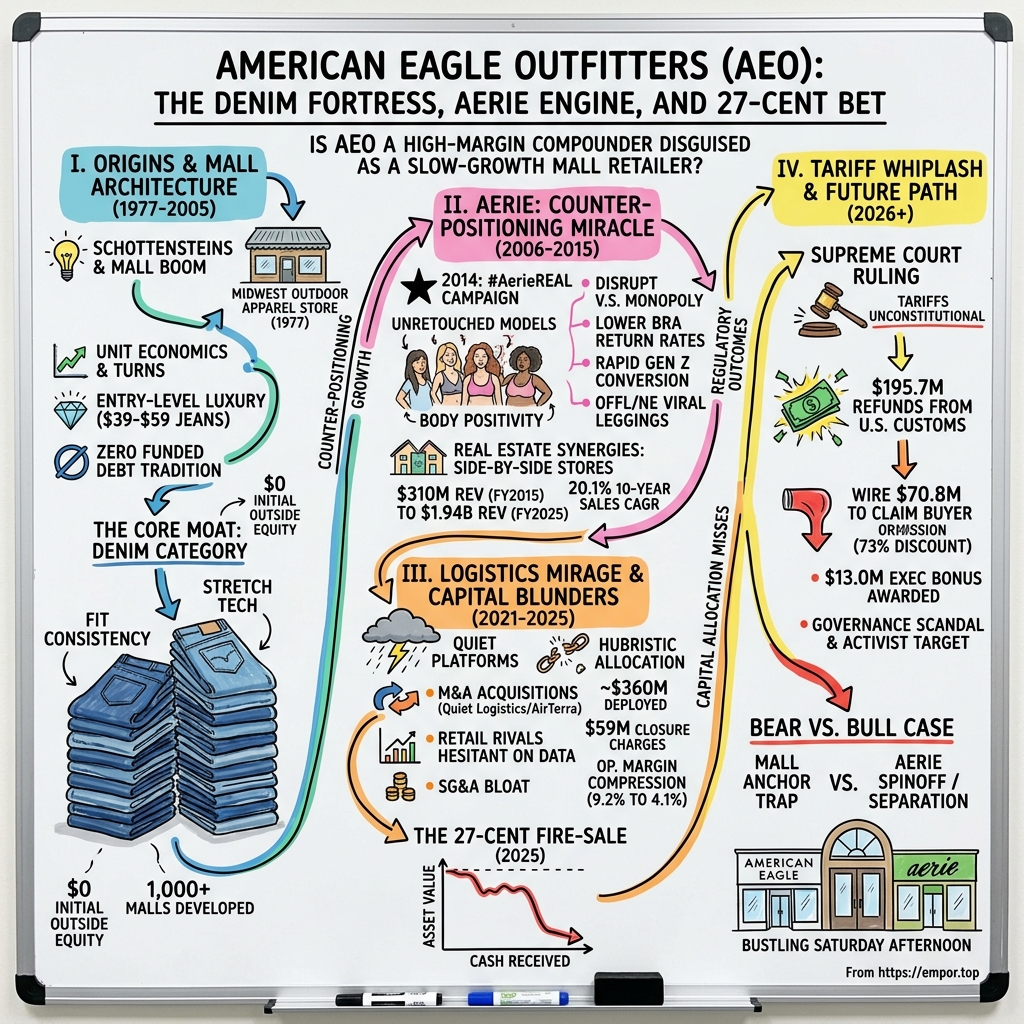
American Eagle Outfitters: The Denim Fortress, the Aerie Engine, and the 27-Cent Bet
I. Prologue: The $70 Million Midnight Check and the Two Faces of American Eagle (00:00 – 00:15)
The windfall that left the building
In the summer of 2026, money arrived at American Eagle Outfitters' Pittsburgh headquarters from an unlikely sender. On February 20, 2026, the U.S. Supreme Court struck down the tariffs imposed under the International Emergency Economic Powers Act (IEEPA)12. American Eagle had paid roughly $192 million of those duties on jeans, bras, hoodies and leggings. Through the end of its second fiscal quarter, U.S. Customs and Border Protection sent back $195.7 million in refunds and interest2.
For a retailer that earned $192 million in net income in the whole of fiscal 20251, that was about a year's profit returned in a few months. It did not all stay. During fiscal 2025, months before the ruling, management had sold $68.9 million of those refund claims to a third-party buyer for $18.6 million in cash, about 27 cents on the dollar2. When the refunds came in, American Eagle was contractually required to wire the buyer $70.8 million. The gap between what it received in the sale and what it paid back, $52.2 million, went through the income statement as interest expense2.
So American Eagle's shareholders got a large windfall, minus a large payment to a claims trader, minus $13.0 million of extra executive incentive expense tied to the gross refund2. That sequence captures the company better than any slogan. It is an operator that can build brands and has a recurring habit of giving away value through capital decisions.
Two companies under one ticker
The company has two halves. The first is Aerie, an intimates and loungewear brand that started as a back-corner test inside American Eagle stores. Its revenue rose from about $310 million in fiscal 2015 to $1.94 billion in fiscal 2025, roughly 20% compound growth for ten years19. Few U.S. specialty apparel brands built from scratch have grown that fast for that long.
The second is the American Eagle brand: jeans, graphic tees and back-to-school. Over the same decade its revenue went from about $3.16 billion to $3.41 billion, under 1% a year19. It is large, profitable and hardly growing.
The question this episode asks is whether AEO is a high-margin intimates compounder hidden inside a slow mall retailer, or a family-led company whose operating gains keep being offset by capital mistakes.
The four questions
Four questions drive the story:
- The Aerie paradox. Is this a growth company inside a utility, and can the market see it?
- The capital allocation question. After a roughly $360 million logistics venture was shut down and the tariff claims were sold at 27 cents, how much trust does management deserve with the next dollar?
- The mall anchor. American Eagle has no funded debt but carries $1.70 billion of operating lease liabilities1. How rigid is that cost base if mall traffic declines?
- The survivor's moat. Aéropostale, Wet Seal and Forever 21 all went bankrupt. American Eagle did not. Was that a moat, or good management of lease timing?
To answer them, the story starts with a family that made money from retailers that failed.
 Subscribe on LinkedIn
II. Origins: The Schottensteins and the Mall Architecture (1977–2005) (00:15 – 00:40)
Liquidators who built a brand
The Schottenstein family of Columbus, Ohio built its fortune largely by buying stores, inventory and leases from retailers that were closing and selling the goods at discount. That business, run through Schottenstein Stores and later including Value City and the shoe chain that became DSW, teaches a particular view of retail. Brands come and go. What lasts is real estate, inventory turnover and the cash that comes out of each store.
American Eagle began in 1977 as a mall concept founded by brothers Jerry and Mark Silverman. Its original identity was outdoorsy, sitting somewhere between a camping store and a preppy collegiate one. The Schottensteins invested early and eventually took control. That fact explains much of what followed. American Eagle was not built by fashion designers who later learned real estate. It was built by real estate and inventory operators who later learned fashion.
The timing suited them. Through the 1980s and 1990s, enclosed regional malls became the main place American teenagers spent free time and money. A chain that could repeat a standard store box across hundreds of malls, and buy inventory centrally, could grow quickly using the cash its existing stores produced.
Jay Schottenstein's first tour
The Silverman era ended in the early 1990s. Jay L. Schottenstein, the son of patriarch Jerome Schottenstein, became chief executive and ran the company from 1992 to 20021. He shared the family's caution about money. In public he is known less for runway shows than for patience: he talks about stores, cash and the long term. Under him the company standardized its fleet and professionalized sourcing, and in 1994 it went public on NASDAQ10. It later moved to the New York Stock Exchange.
The 1990s mall competition was crowded. Gap was the default. Abercrombie & Fitch sold exclusivity and sex appeal through shirtless models and dim stores. Pacific Sunwear sold Southern California surf culture. American Eagle took a less glamorous position: the friendly, approachable store, priced below Abercrombie and easier to like.
Jeans as the core franchise
Over time that position came to rest on denim. Jeans are unlike most fashion items. A graphic tee is an impulse purchase, but jeans depend on fit. Once a teenager finds a cut, rise and stretch that works, there is a strong reason to keep buying the same one. Management has long described American Eagle as a leader in jeans for young shoppers. The company does not publish an audited market-share figure, so that claim is best treated as a strong franchise rather than a measured monopoly. The economics were still clear: an everyday product, a fit that brings customers back, and a price that teenagers or their parents could afford.
Self-funding as habit
The early years set a financial pattern that still holds: stores were paid for from operating cash flow, not borrowing. Today AEO carries no funded debt1. That conservatism came from the liquidation business, where the family had watched leveraged retailers fail.
For investors, the founding story matters because of incentives. A company run by people who think like landlords will be good at opening and closing stores and good at managing cash. It may be less comfortable with businesses that are not stores, and later chapters show that. First, though, came the decision that made the company: a bet that body image was the weak spot of the biggest brand in lingerie.
III. The Counter-Positioning Miracle: The Birth and Rise of Aerie (2006–2015) (00:40 – 01:10)
January 2014: the unretouched photos
In January 2014 Aerie announced that it would stop retouching the models in its advertising: no airbrushing of stomachs or thighs, and no digital reshaping11. The campaign was called #AerieREAL.
To see why that was bold, recall the competitor. Victoria's Secret dominated American intimates. Its prime-time fashion show was a television event built on a narrow and highly sexualized beauty standard, and its teen line, Pink, set the template for young shoppers. Every competitor was imitating that look. Aerie went the other way.
This is counter-positioning in the sense Hamilton Helmer uses: a new entrant adopts a model the incumbent cannot copy without damaging its existing business. Victoria's Secret could not drop fantasy marketing without undermining the brand that made it the leader. Aerie had no such brand to protect.
From test to engine
Aerie had launched in 2006 as an intimates test, mostly inside American Eagle stores, aimed at raising basket sizes and competing with Pink. For years it was small. #AerieREAL changed the trajectory. The brand's revenue reached about $310 million by fiscal 2015 and $1.94 billion by fiscal 202519. Aerie went from under a tenth of company revenue to 35%1.
The campaign also helped the economics. Customers who see bodies like their own may buy closer to the right size, which can reduce returns, and they may share the brand on social media without paid promotion. Those mechanisms are plausible, but AEO does not disclose returns or acquisition cost by brand, so they cannot be measured. What can be measured is the profit. In fiscal 2025 Aerie earned $345.9 million of segment operating income, a margin of about 17.8%1. American Eagle's margin was about 13.3%1. With roughly a third of sales, Aerie produced over 40% of segment profit.
Leggings and OFFL/NE
Aerie then moved from bras into loungewear, sleepwear and activewear. The crossover legging became a viral product, and the company built a sub-brand around activewear, OFFL/NE by Aerie. That moved Aerie closer to Lululemon and Alo Yoga, and into a more competitive market.
The shared stockroom
The real estate operators also found a structural advantage. American Eagle and Aerie were increasingly placed side by side: two storefronts sharing a stockroom, staff and one lease negotiation. AEO reports 184 side-by-side configurations1. The idea is straightforward. Each mall lease supports two brands, and a mother shopping for her son's jeans walks past her daughter's leggings.
Testing the moat
Was this a lasting moat or a first-mover marketing advantage? The record suggests the edge has narrowed.
Counter-positioning works only while the incumbent cannot respond. Victoria's Secret did respond. It ended its fashion show, broadened its sizing and recast its marketing. Direct-to-consumer brands such as Skims and Savage X Fenty used the same body-positive language and amplified it through celebrities. A message that set Aerie apart in 2014 is now standard across the category.
The financial evidence is mixed. Aerie still grows and earns a higher margin than the American Eagle brand. Its margin today, around 18%, is good for specialty apparel, but it requires constant reinvention rather than a unique message. The fair conclusion is that the historical claim holds: #AerieREAL was a highly effective counter-positioning move. The forward claim, that Aerie has a durable structural advantage, is weaker. Its advantage now looks more like strong brand execution, which has to be renewed every season. The figure to watch is whether segment margin stays above about 15% as the standalone fleet grows past 400 stores.
While Aerie was growing, the original brand was slowing, and the company brought back its patriarch.
IV. The Return of the Patriarch and the Denim Utility (2015–2020) (01:10 – 01:35)
December 2015
In December 2015 the board gave the CEO job back to Jay Schottenstein, more than a decade after his first tenure ended1. He became Executive Chairman and CEO. Few public companies have a controlling-family chairman return to run operations, but it signaled what the company would prioritize: fewer outside executives with large turnaround plans, and more family judgment about stores and cash.
He has remained in the role. The CEO and CFO positions have not changed hands in the past five years3. For investors, that stability is an asset, because strategy has been consistent. It is also a risk, because the chairman whose job is to oversee the CEO is the CEO.
A large, mature brand
Under his second tenure, the American Eagle brand grew slowly. Its revenue rose from $3.16 billion in fiscal 2016 to $3.41 billion in fiscal 202519. Its company-operated store count fell from 943 to 8051.
That does not mean decline. A brand that kept about the same revenue while cutting 138 stores raised revenue per store and moved sales to digital channels, which now account for about 35% to 38% of total company revenue1. The more useful description is a mature cash-generating business. In fiscal 2025, the American Eagle segment earned $455.1 million of operating income1. That profit paid for corporate overhead and funded Aerie's expansion.
Closing stores without heavy penalties
The fleet reduction was done carefully. Instead of breaking leases and paying termination fees, AEO mostly let unprofitable mall stores close when their leases expired. That approach depends on short lease terms, a point Section VII returns to. A liquidation family understands that the cheapest store closure is one that happens at lease expiry.
Earnings into cash
The strongest evidence that this is a real business is cash conversion. Over fiscal 2016 to 2025, AEO reported about $1.9 billion of cumulative net income and generated about $4.06 billion of operating cash flow, more than twice its reported profit159.
The main reason is that retail accounting deducts large non-cash charges. Depreciation and amortization totaled about $2.1 billion over the decade9. Store and goodwill impairments, which reduce reported earnings without using cash in that year, added more. After about $2.0 billion of capital spending, free cash flow was roughly $2.05 billion, a little more than cumulative net income19.
There is an important caveat. Depreciation is not free money. Stores need remodeling and replacement, so a large share of that depreciation is cash the company will eventually spend again. The ratio that matters is free cash flow, and it shows that each dollar of reported profit turned into slightly more than a dollar of cash available for dividends and buybacks. That is solid. It does not make AEO a compounder.
Governance: a family minority stake
The Schottenstein family controls about 9.6% of the shares, with Jay Schottenstein personally holding about 7.65% including options3. BlackRock alone owns nearly 14%, and BlackRock, Vanguard and Dimensional together own more than a quarter3. So the family has influence, but not voting control. Related-party dealings are modest. They include Schottenstein-affiliated store leases in Las Vegas and elsewhere and an in-store music service, totaling about $4.2 million in fiscal 2025, all approved by the Audit Committee3. These are too small to matter economically. The bigger governance issue is concentration of power in one role, which matters more once capital starts going to businesses outside retail.
That happened in 2021, when pandemic profits funded the company's largest strategic bet in a generation.
V. The Logistics Mirage: The $360 Million Quiet Platforms Misadventure (2021–2025) (01:35 – 02:00)
November 2021
By late 2021 AEO had record profits. Stimulus spending and reopening helped produce fiscal 2021 net income of $419.6 million, the best in its history19. On November 2, 2021, the company announced it would acquire Quiet Logistics, a fulfillment provider based in Massachusetts, to build an "open-access" supply chain network that other retailers could use[^11]. The purchase price was about $350 million[^11]. It later added AirTerra, a parcel delivery startup. In total, AEO committed roughly $360 million to logistics1.
The pitch was easy to understand. Mid-sized retailers struggled to match Amazon's delivery speed. If they shared warehouses and carrier contracts on a common network, all of them could ship faster at lower cost, and AEO would own the network.
Why it failed
The plan had a basic flaw. A logistics provider has to be neutral. A competing apparel brand would need to give American Eagle its inventory levels, order patterns and customer addresses. That is commercially sensitive information, and handing it to a rival that sells to similar shoppers in similar malls was a hard sell.
Logistics is also a scale business with established competitors: UPS, FedEx, Amazon's own network and many third-party fulfillment specialists. Moving AEO's own goods efficiently gave it no special advantage in selling that service to others.
The losses came in stages. In fiscal 2023 AEO wrote down $70.8 million of goodwill and trade names tied to the logistics businesses8. In fiscal 2025 it decided to shut down third-party logistics and recorded $59.0 million of restructuring and impairment charges, with the wind-down completed in early fiscal 20261. Coincidentally, the 2023 write-down was nearly the same amount as the 2026 payment to the tariff-claim buyer.
The margin record
Over the decade, operating margin fell from 9.2% in fiscal 2016 to 4.1% in fiscal 202519. Quiet Platforms is part of the explanation, but not all of it. Rising SG&A, store impairments and the fiscal 2025 restructuring charges also contributed. Unallocated corporate costs reached $428.8 million in fiscal 20251, a large fixed charge sitting above two brands that together earned about $800 million of segment profit.
Credit for the exit
Management deserves some credit. Many companies keep funding a failing venture to avoid admitting the mistake. Schottenstein shut this one down within four years and moved investment back to stores and digital systems. Ending a failed project is a real form of discipline.
The capital allocation test
The claim to test is that AEO is a disciplined capital allocator. The record over 15 years does not support it. Before Quiet Platforms, the company closed the Martin + OSA concept and the 77kids children's chain. Over the past decade it has recorded more than $350 million of cumulative impairments19. The evidence fits a narrower claim: AEO is disciplined about store-level capital, including fleet size, lease timing and remodels, and has repeatedly lost money when it moved outside the mall. What would confirm improvement is capital spending staying below about 4.5% of sales through fiscal 2027 with no acquisitions outside apparel.
The logistics loss happened over four years. The next mistake took only a few months.
VI. The 27-Cent Fire-Sale: Customs Duties and Asymmetric Governance (02:00 – 02:25)
The sale
During fiscal 2025, AEO, like every large apparel importer, was paying IEEPA tariffs on goods from Asia. The tariffs faced legal challenges, but the outcome and timing were uncertain. A market grew up in which hedge funds and specialist claims buyers paid importers cash for the right to any future refunds.
AEO participated. Under what it called a Participation Agreement, it sold $68.9 million of its refund claims for $18.6 million in cash2. The accounting is a useful detail. AEO did not record the deal as a sale. Under ASC 470, it treated the $18.6 million as a secured borrowing. In effect it was a loan repaid out of any refunds, with the lender keeping most of the upside2.
The ruling
On February 20, 2026, the Supreme Court found the IEEPA tariffs unlawful12. AEO had paid about $192 million of those duties and filed refund claims through Customs' CAPE system2. In the first half of fiscal 2026 it received $195.7 million, of which $191.9 million reduced cost of sales and $3.8 million reduced SG&A2.
Then it had to repay the claim buyer. The calculation is simple:
- AEO received $18.6 million in cash when it sold the claims.
- After the refunds, it paid the buyer $70.8 million.
- The difference, $52.2 million, was recorded as accretion within net interest expense, most of it ($44.7 million) in the second quarter2.
The buyer received almost four times its money in under a year. AEO's shareholders gave up that return.
Was it a mistake at the time?
In fairness, judgments made before an outcome should not be graded on the outcome. When AEO sold the claims, the ruling was uncertain, and some lawyers expected the government to win. Selling part of a contingent asset reduces risk. AEO also kept most of its claims, which is why gross margin still benefited by $191.9 million.
But the reason for the hedge matters. Companies hedge when they cannot absorb a loss. AEO had no debt, an undrawn $700 million credit line and about $359 million of cash at the start of fiscal 202551. It did not need $18.6 million. Accepting 27 cents on the dollar to remove uncertainty it could easily carry is a decision a liquidity-constrained company might make. AEO was not constrained. Selling a fraction of the claims was a reasonable portfolio decision. The price was the problem.
The bonus
In the same quarter as the refunds and the $52.2 million charge, AEO recorded $13.0 million of incremental executive incentive expense tied to the gross tariff gain2. That timing is what an activist would focus on: executives were paid partly on the gross refund, while shareholders absorbed the cost of selling part of it cheaply.
The longer-term pay record is more balanced. Jay Schottenstein's reported total pay fell from $16.79 million in fiscal 2023 to $14.98 million in fiscal 2024 and $12.66 million in fiscal 2025, following operating profit downward36. Pay has moved with results. The tariff bonus is the exception that tests the pattern.
Shareholder votes
Shareholders voiced limited concern. At the June 2026 annual meeting, about 13.1% of votes cast opposed Jay Schottenstein's re-election, while say-on-pay passed with about 96.7% support4. In 2025, director Cary D. McMillan received about 17.1% opposition, and say-on-pay passed with about 96.1%7. Those votes came before the tariff bonus appeared in a proxy statement, so the 2027 meeting will be the first chance for shareholders to vote on it.
The conclusion: the management-quality claim that pay tracks long-term value creation mostly holds over three years. The tariff episode narrows it. It shows a board willing to pay on a gross figure that the company's own financing decision had reduced. The 2027 proxy will show whether the Compensation Committee adjusted for the $52.2 million.
That leads to the largest obligation on the balance sheet, and it is not debt.
VII. The Real Estate Balance Sheet: Debt-Free on Paper, $1.7 Billion in Leases (02:25 – 02:45)
Two readings of the balance sheet
When the fiscal 2025 annual report came out, the headline was simple: no bank debt, no bonds, $238.9 million of cash1. The notes showed more. Operating lease liabilities were $1.70 billion, up from $1.45 billion a year earlier, and about $383 million of rent is due in fiscal 2026 alone1.
The funded side
The funded debt record is clean. In April 2020, during pandemic closures, AEO issued $415 million of 3.75% convertible notes to secure liquidity9. It retired almost all of them by fiscal 2022 through exchanges for cash and shares, and the notes were gone before fiscal 202458. Those exchanges diluted shareholders somewhat, but they removed any refinancing deadline.
Behind that sits a $700 million asset-based revolving credit facility, maturing in June 2027 and undrawn at year-end apart from $12 million of letters of credit1. Its covenant is a springing test: a 1.0x fixed-charge coverage requirement applies only if availability falls very low1. It functions as insurance. Rating agencies do not rate AEO because it has no public debt to rate.
The lease side
The more important obligation is rent. Undiscounted future lease payments total about $2.28 billion: roughly $380 million a year in each of the next two years, declining after that1. Those payments continue in a recession and when traffic is weak.
Two factors reduce the risk. The average remaining lease term is about 6.2 years1, so each year a meaningful share of the fleet reaches a decision point to renew, renegotiate or close. That is how American Eagle survived the mall decline. Aéropostale and Wet Seal had too many stores with too many years left on their leases. AEO's rolling expirations let it shrink gradually.
The second factor is that the auditors review this closely every year. Ernst & Young identifies retail store long-lived asset impairment as a critical audit matter1. Each year management has to estimate whether each store's future cash flows support its carrying value, including its right-of-use lease asset. In fiscal 2025 the answer was no for a number of stores, and AEO recorded $21.3 million of store impairments1. The amount is small. Its recurrence shows that some part of the fleet is always losing value.
Supply chain and receivables
AEO owns no factories. It designs in-house and sources from third-party manufacturers mainly in Vietnam, China, Cambodia and Bangladesh, with much of the buying done through a single non-exclusive international buying agent1. No single factory accounts for more than 10% of purchases, but reliance on one agent is a concentration risk that is easy to miss. Inventory ended fiscal 2025 at $702 million, up about 10%, which management linked to bringing goods in early ahead of sourcing changes1.
Receivables also showed strain. AEO's allowance for credit losses rose from $8.9 million to $25.5 million in fiscal 2025 after a $17.3 million provision tied to "the deterioration of credit quality for a specific customer"1. The company does not name the customer. For a business that mostly gets paid at the register, a problem with a wholesale or licensing partner of that size is a reminder that the non-store businesses carry their own risks.
Where the cash went
Over ten years, AEO paid about $858 million in dividends and spent about $795 million on buybacks19. Over the past five years, diluted share count fell about 14.7%, from 206.5 million to 176.1 million1. Part of that buyback offset the shares issued to retire the convertible notes.
The conclusion: "debt-free" is accurate as a description of the capital structure and misleading as a description of risk. AEO's leverage is about $380 million a year of rent. It is manageable because leases expire on a rolling schedule. It also means that a sustained decline in mall traffic would cut directly into profit.
VIII. Playbook: Business & Investing Lessons (02:45 – 03:05)
Lesson 1: Attack the incumbent where its identity prevents a response. Aerie did not win on price. In 2014 it published unretouched photos when Victoria's Secret's whole brand depended on fantasy, and Victoria's Secret took years to respond because responding meant changing who it was. The lesson for founders is to look for what a leader cannot change without hurting its core business. The limit is that once the leader does change, that advantage disappears.
Lesson 2: Running good logistics for yourself does not make it a product others will buy. AEO moved its own merchandise well and concluded that competitors would pay to use its network. They would have had to give a direct rival their inventory and customer data. About $360 million later, the business was closed. Being good at an internal function is not the same as having a product.
Lesson 3: Don't sell protection you can afford to carry yourself. A company with no debt and an undrawn $700 million credit line sold a contingent asset at 27 cents on the dollar. A specialist buyer took the other side because it understood the claim better. The rule for boards: when the company can absorb a risk easily, accepting a deep discount to remove it is not prudence. It is giving value away.
Lesson 4: The length of your leases determines how well you survive a downturn. American Eagle outlasted Aéropostale, Wet Seal and Forever 21 mainly because its leases expired on a rolling schedule. A 6.2-year average remaining term means every year some stores can be closed without penalty. For anyone investing in physical retail, the lease maturity schedule is as important as the debt schedule.
Lesson 5: Measure a retailer by free cash flow, not by headline cash conversion. Operating cash flow at more than twice net income looks impressive until depreciation is accounted for. AEO's free cash flow, roughly equal to its earnings over a decade, is the figure that explains how it paid dividends, bought back stock and survived poor fashion seasons. Buyers of retail stocks should start with free cash flow.
IX. Analysis & Bear vs. Bull Case (03:05 – 03:30)
The current price
On October 1, 2026, AEO closed at $17.97, for a market capitalization of about $3.0 billion and an enterprise value near $4.5 billion including leases and net of cash9. The reported trailing P/E of about 9x is distorted by the tariff refund. Removing the net windfall (the $191.9 million cost benefit less the $52.2 million accretion, after tax) gives a normalized multiple near 14.5x. On audited fiscal 2025 earnings of $1.09 per diluted share, the multiple is about 16.5x1.
Peers are cheaper. Abercrombie & Fitch trades near 12x trailing earnings, Urban Outfitters near 12x, and Gap around 10x to 12x. Over the past decade AEO has traded between roughly 8x and 18x earnings. A premium to peers is unusual for a company whose operating margin fell by half over ten years. It suggests the market is already giving some credit for Aerie, or expecting earnings to recover now that Quiet Platforms is closed.
Hamilton Helmer's 7 Powers
- Counter-positioning (Aerie): Strong from 2014 through the late 2010s and weaker since, as Victoria's Secret changed direction and Skims and others adopted the same message (Section III).
- Branding: Real, but the kind that has to be renewed. Teen denim and Gen Z intimates both depend on staying current.
- Switching costs: Moderate for jeans because of fit, close to zero for leggings, tees and loungewear.
- Scale economies: Moderate in sourcing and lease negotiation across about 1,160 stores1. Quiet Platforms showed that this scale did not carry over to logistics.
- Cornered resource: Partial. Jennifer Foyle, President and Executive Creative Officer, who led Aerie's rise, is the closest thing to one, and her pay of $7.25 million in fiscal 2025 reflects that3. Key-person risk is real.
- Network effects and process power: Minimal.
Conclusion: AEO has branding and modest scale. Neither protects it strongly against well-funded or fast-moving competitors.
Porter's Five Forces
- Buyer power: high. Millions of individual shoppers, with no customer above 10% of revenue1, but each can switch with a tap.
- Supplier power: moderate. Many factories, but dependence on one buying agent and exposure to tariffs, cotton prices and forced-labor enforcement1.
- Substitutes: very high. Shein, Temu, Zara, H&M and TikTok Shop compete on trend speed and price.
- New entrants: high in basics, lower in national denim. Anyone can start a Shopify brand. Few can operate 800 stores with consistent fits.
- Rivalry: intense. Abercrombie and Hollister, Gap, PacSun and Urban Outfitters compete for the same shoppers with frequent promotions.
The bear case
- Declining mall traffic. The core brand grew under 1% a year for a decade, and its stores depend on mall traffic.
- Fast-fashion pressure on prices. Every promotional season lowers average unit retail.
- Fixed rent. About $380 million a year in rent does not fall when sales do.
- Governance discount. One person as chair and CEO, a logistics failure, a cheap claims sale and a bonus on the gross refund. A skeptical investor would expect a permanent discount.
The bull case
- Aerie's standalone value. About $1.9 billion of revenue at about 18% segment margin1. Valued like an activewear and intimates company, it could be worth most of AEO's market cap by itself. That assumes Aerie could be separated and still keep the shared stockroom and lease benefits. It also assumes a growth multiple for a brand growing well below Lululemon's peak rate.
- Denim durability. Jeans still benefit from being tried on in person.
- Cleaner earnings ahead. With the logistics business closed and its charges past, fiscal 2026–2027 free cash flow should benefit, though some of the tariff gain went to the claim buyer and to executives.
- Activist potential. Shareholder dissent of 13% to 17%, $428.8 million of unallocated corporate costs1 and a clear sum-of-the-parts argument make AEO a plausible activist target.
Overall: priced as one company, AEO looks roughly fairly valued against its history and somewhat expensive against peers. The upside depends on events such as an Aerie separation, lower corporate costs or management changes. The family's stake and position make those less likely, but not impossible.
Three KPIs to track
- Aerie comparable sales and segment margin. Fiscal 2025 margin was about 17.8%1. The bull case needs it to stay above 15% as the store count grows.
- Gross margin excluding one-time items. The first half of fiscal 2026 is inflated by $191.9 million of refunds2. The underlying gross margin is what shows whether AEO has pricing power.
- Unallocated corporate costs as a share of revenue. About 7.7% in fiscal 2025 ($428.8 million on $5.55 billion)1. With logistics closed, it should fall below 7%.
X. Epilogue (03:30 – 03:40)
As of October 2026, AEO is in an unusual position. Its first half was the most profitable in years. Revenue grew 8.5% to $2.58 billion and operating income reached $239.6 million, compared with $17.9 million a year earlier2. Most of that improvement came from a one-time court ruling. The next 18 months will show what the underlying business earns.
Four developments will decide the central questions.
The 2027 proxy statement. It will show whether the Compensation Committee reduced the $13.0 million tariff-related award to account for the $52.2 million cost of the claims sale. If it did, the board will have shown it can hold itself accountable. If it did not, the tariff episode will look less like a one-time misjudgment and more like how this board operates.
Aerie reaching 40% of revenue. At 35% now, Aerie is close to the point where it can no longer be presented as a secondary brand. Once it passes 40%, the sum-of-the-parts argument will be harder to ignore, and so will questions about whether the company's structure fits it.
Lease expirations. About a fifth of the fleet comes up for decision each couple of years. If AEO closes another 50 or more underperforming American Eagle stores through fiscal 2027, it is continuing the discipline that kept it alive. If it renews them under landlord pressure, rent stays fixed while traffic declines.
OFFL/NE against Lululemon, Vuori and Alo. Activewear is where Aerie's next stage of growth has to come from, and the competitors are well funded and fast.
The open tension is the one the story began with. This company built a multibillion-dollar brand from almost nothing. It also keeps making capital decisions that give back part of what its operations earn.
XI. Outro (03:40 – 03:45)
Nearly fifty years ago, a family that made money from failing retailers backed a small outdoor-themed store in a suburban mall. Since then the department store has declined, Amazon has grown, and most of American Eagle's 1990s mall competitors have gone bankrupt.
Picture a mall concourse on a Saturday afternoon in 2026. Many storefronts are dark. At the end of the hall, two lit storefronts share one stockroom: denim on the left, leggings on the right, and fitting rooms in use on both sides. That is the result of the family's approach. They know how to run stores very well. What they still have not shown is that they can deploy capital outside those stores as well as they run the stores themselves.
American Eagle sells jeans to teenagers and body-positive loungewear to their sisters, and it has shown Wall Street that a company with no debt can still find expensive ways to hedge.
References
-
American Eagle Outfitters, Inc. Form 10-K for the Fiscal Year Ended January 31, 2026 — SEC EDGAR, 2026-03-30 ↩↩↩↩↩↩↩↩↩↩↩↩↩↩↩↩↩↩↩↩↩↩↩↩↩↩↩↩↩↩↩↩↩↩↩↩↩↩↩↩↩↩↩↩↩↩
-
American Eagle Outfitters, Inc. Form 10-Q for the Quarterly Period Ended August 1, 2026 — SEC EDGAR, 2026-09-10 ↩↩↩↩↩↩↩↩↩↩↩↩
-
American Eagle Outfitters, Inc. DEF 14A Notice of Annual Meeting of Stockholders and Proxy Statement — SEC EDGAR, 2026-05-15 ↩↩↩↩↩↩
-
American Eagle Outfitters, Inc. Form 8-K Report of Voting Results of Annual Meeting — SEC EDGAR, 2026-06-29 ↩
-
American Eagle Outfitters, Inc. Form 10-K for the Fiscal Year Ended February 1, 2025 — SEC EDGAR, 2025-03-20 ↩↩↩
-
American Eagle Outfitters, Inc. DEF 14A Notice of Annual Meeting of Stockholders and Proxy Statement — SEC EDGAR, 2025-05-15 ↩
-
American Eagle Outfitters, Inc. Form 8-K Report of Voting Results of Annual Meeting — SEC EDGAR, 2025-07-01 ↩
-
American Eagle Outfitters, Inc. Form 10-K for the Fiscal Year Ended February 3, 2024 — SEC EDGAR, 2024-03-15 ↩↩
-
SEC EDGAR Company Facts XBRL Financial Data: American Eagle Outfitters, Inc. (CIK 0000919012) — SEC, 2026-09-10 ↩↩↩↩↩↩↩↩↩↩↩↩↩
-
SEC EDGAR Filing Submissions History: American Eagle Outfitters, Inc. (CIK 0000919012) — SEC, 2026-09-10 ↩
-
Aerie Launches #AerieREAL Campaign Promoting Unretouched Models — Adweek, 2014-01-22 ↩
-
U.S. Supreme Court Decision on International Emergency Economic Powers Act Tariffs — Supreme Court of the United States, 2026-02-20 ↩↩
 LinkedIn
 WhatsApp
 Reddit
 Hacker News
 Email
Email Kindle
 RSS Feed
 Spotify
 Apple Podcasts
 Amazon Music
 Audible
 YouTube