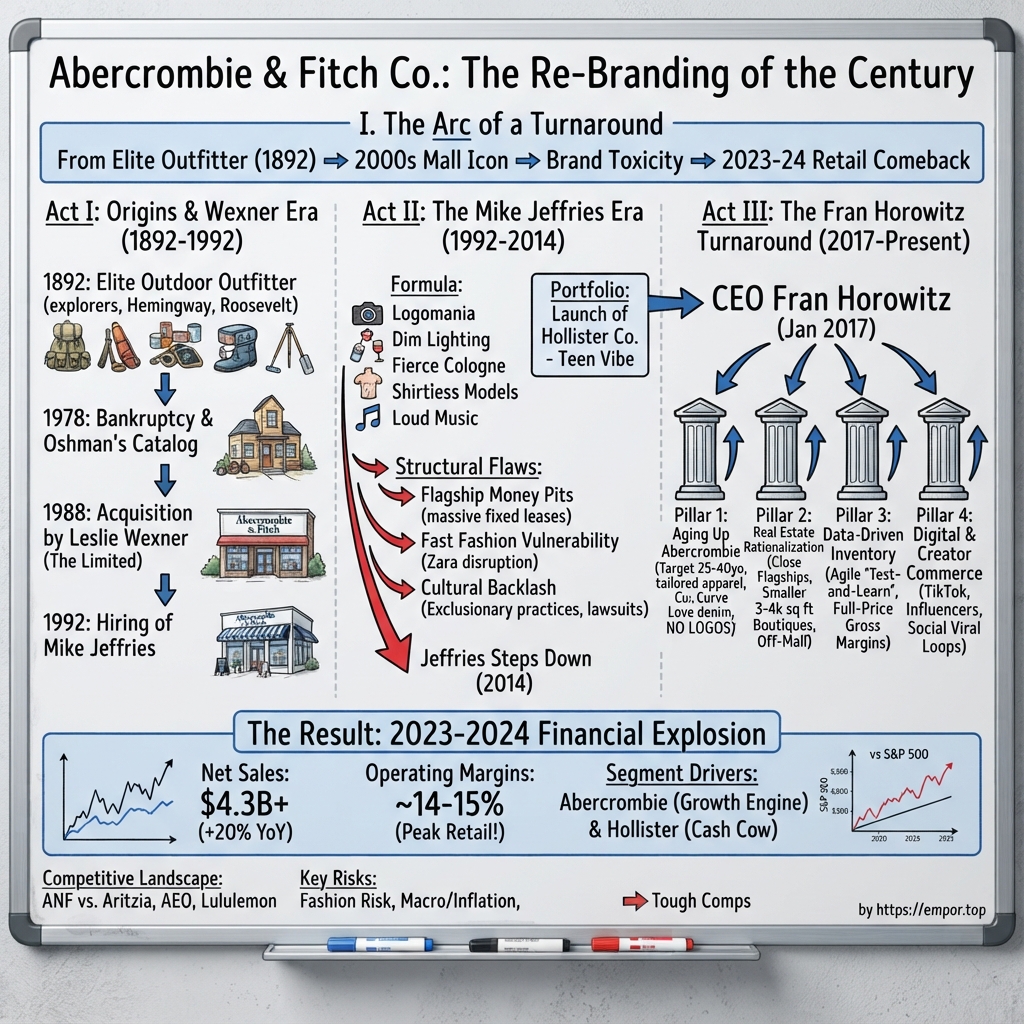
Abercrombie & Fitch Co.: The Re-Branding of the Century
I. Introduction & Episode Roadmap
There is a particular sound that anyone who was a teenager in 2005 can still summon on command: the thump of house music leaking out of a darkened mall storefront, the wall of cologne that hit shoppers thirty feet before the entrance, and the shirtless greeter standing in the doorway like a bouncer at a nightclub that served Auntie Anne's pretzels. For roughly a decade, Abercrombie & Fitch operated less as a traditional apparel retailer than as a engine for manufacturing adolescent status anxiety, charging a premium for the privilege.
Two decades later, the commercial presentation is markedly different. In February 2026, Abercrombie & Fitch served as an official fashion partner of the National Football League, hosting activations around the Super Bowl with players, their families, and league figures — the first arrangement of its kind for the brand.[^1] The merchandise on offer centered on tailored trousers, linen sets, and denim engineered for fit rather than to signal social exclusivity. The logo, once the primary value proposition of the garment, had largely vanished.
That transition defines the arc of the business: a 132-year-old enterprise that began by outfitting Teddy Roosevelt for African safaris, transformed into an exclusive fixture of American mall retail, nearly collapsed under cultural shifts and execution missteps, and subsequently executed a strategic repositioning. In 2023, its stock returned roughly 285% — outperforming Nvidia during a year of intense market focus on artificial intelligence hardware.1
The company today. Abercrombie & Fitch Co. trades on the New York Stock Exchange under the ticker ANF. In fiscal 2025 — the year ended January 31, 2026 — the retailer generated record net sales of $5.27 billion, up 6% year over year, and reported operating income of $699 million. That represented a 13.3% operating margin, or 12.5% when adjusted for a one-time litigation benefit.23 Diluted earnings per share reached $10.46. The company operates through two primary reporting segments: Abercrombie Brands (comprising Abercrombie & Fitch and abercrombie kids) and Hollister Brands (comprising Hollister, Gilly Hicks, and the YPB activewear line). Trading at roughly $112 per share in early August 2026, the equity carried a market capitalization near $5.0 billion against a 52-week range of $65 to $133 — a wide spread signaling that investors continue to debate the sustainability of its recent performance.4
The thesis. The ANF narrative is frequently framed as a simple fashion turnaround — Abercrombie caught the wide-leg denim cycle, younger consumers rediscovered Hollister, and brand perception modernized. That explanation is incomplete and potentially misleading for investment analysis. The rebound was driven by a multi-year structural overhaul of the company's cost base, store footprint, inventory model, and target customer demographic. Fashion trends dictated the timing of the top-line acceleration, but operational structure determined earnings durability. The key analytical question is how much of the ~13% operating margin reflects permanent operational efficiency versus a favorable trend cycle. Fiscal 2025 results provided initial data on that question, though the evidence remains mixed.
The roadmap. The analysis begins with a compressed look at the company's 130-year history to contextualize its structural evolution. It then examines the Mike Jeffries era, which built both a lucrative operating model and significant operational vulnerabilities. Next comes the transition period, the arrival of Chief Executive Officer Fran Horowitz, and the execution of a four-pillar operational rebuild. That leads into a granular review of segment economics, geographic mix, capital allocation, and the tariff friction that reshaped fiscal 2025. Finally, the analysis evaluates adjacent growth initiatives, management execution credibility, core operational risks, and a balanced bull-and-bear ledger — including the structural reality that the namesake brand is no longer the largest revenue contributor.
The narrative begins where every retailer origin story starts: with a manufacturer of canvas tents.
 Subscribe on LinkedIn
II. The First Two Acts: Elite Outfitters to Leslie Wexner's Mall Experiment (1892–1992)
David T. Abercrombie was a former prospector and engineer who, in 1892, opened a shop in lower Manhattan selling field gear — tents, camping equipment, fishing tackle, and guns.5 Abercrombie was a manufacturer focused on product durability. His partner, Ezra Fitch, a lawyer from Kingston, New York who began as a customer, sought aggressive commercial expansion.
The two men clashed over a recurring theme in the company's history: product purity versus market scale. Abercrombie departed, leaving Fitch to expand the business into a premier American outfitter. The company supplied Theodore Roosevelt's expeditions, sold shotguns to Ernest Hemingway, and equipped Charles Lindbergh.5 By 1925, an Abercrombie & Fitch purchase signaled practical utility and outdoor readiness.
That initial positioning succeeded through functional credibility. The gear performed in demanding environments, endorsed by prominent figures. The brand represented a certificate of competence rather than social exclusivity — a distinction that proved critical in later years.
That market position eventually eroded. Post-war demographics shifted to suburban communities, recreational outdoor gear democratized, and sporting goods sales moved to department stores and national chains. Designed around expedition outfitting, the company failed to adapt to broader consumer shopping habits. Abercrombie & Fitch filed for bankruptcy in 1977. Oshman's Sporting Goods purchased the intellectual property the following year, running it primarily as a mail-order catalog.5
Enter Leslie Wexner. In 1988, The Limited — Leslie Wexner's Columbus, Ohio-based retail conglomerate — acquired Abercrombie & Fitch for $47 million.5 The purchase yielded little operating infrastructure, but provided a brand name with historical prestige and minimal structural baggage. Wexner recognized that mall retail relied on immersive store environments. To build that concept for Abercrombie, he hired Mike Jeffries in 1992.
The company completed an initial public offering on the NYSE in 1996, with The Limited gradually divesting its stake thereafter.5 By the time the business operated independently, its positioning had shifted entirely: an 1892 expedition outfitter re-emerged as a suburban teen apparel brand.
What an investor should take from the first hundred years. Two structural lessons emerge. First, the brand proved capable of surviving insolvency and repositioning under new ownership well before the modern era. That resilience demonstrates that the trademark carries durable consumer recognition adaptable to new target markets. Second, the failure mode in 1977 mirrored the strain that re-emerged decades later: the business continued selling to a customer base that had moved on. Operational refinements cannot substitute for core customer alignment.
Jeffries understood the retail consumer of 1996 with precision. The central question for the business was the durability of the operational model he established.
III. The Mike Jeffries Era: Logomania, Fragrance, & Operational Excess (1992–2014)
Mike Jeffries did not merely design a store; he constructed an environment defined by bouncer-like gatekeeping, placing merchandise within a highly sensory backdrop.
The retail specifications were precise and commercially effective. Store lighting was dimmed to club-like levels, concealing garment stitching and making price tags difficult to read. The house fragrance, Fierce, was continuously diffused through ventilation systems at concentrations that made the storefront an olfactory landmark detectable from mall food courts. Music played at volumes designed to stifle casual conversation, suppressing the parent-child negotiations that often derail impulse purchases by teenagers. Sales associates were designated as "models" and evaluated primarily on physical appearance, while shirtless greeters staffed the entrances. The merchandise itself consisted of basic cotton apparel featuring an embroidered moose logo, commanding elevated price margins because consumers were buying status rather than raw textiles.
The customer was purchasing social inclusion—an asset with virtually no cost of goods sold.
The second engine. In 2000, Jeffries launched Hollister Co., a Southern California surf-themed brand positioned at a lower price point for a slightly younger demographic.5 This was a strategic piece of portfolio architecture: it enabled the company to open hundreds of additional mall stores without diluting the core Abercrombie premium, as the two brands nominally targeted distinct customer segments. Hollister expanded rapidly, becoming the larger of the two nameplates by revenue by the early 2010s.6 Gilly Hicks, an intimates concept, was introduced in 2008 as a third brand line.5
For roughly a decade, this operating model generated strong financial returns. However, three structural flaws were accumulating within the foundation, each compounding the impact of the others.
Flaw one: the flagships. Jeffries pursued a high-cost strategy of building expansive, multi-floor flagship stores in premier global retail locations, including Fifth Avenue, London, Paris, and Tokyo. While these locations served as high-profile marketing venues, on the balance sheet they represented long-dated, fixed-cost liabilities committed at the top of a global tourism cycle. Unlike short-term debt, long-term commercial leases cannot easily be prepaid. When foot traffic along those high-end retail corridors eventually slowed, rent obligations remained fixed. The company subsequently spent years negotiating early contract terminations, seeking exits from leases originally scheduled to run as late as 2031.78
Flaw two: the logo dependency. When a garment's primary value stems from an embroidered logo, it lacks defensible design features. It relies entirely on brand equity—an asset uniquely vulnerable to shifts in youth culture. Concurrently, fast-fashion retailers such as Inditex's Zara and H&M were accelerating design-to-shelf cycles down to weeks, while Fast Retailing's Uniqlo was scaling high-quality apparel basics at price points Abercrombie could not match. A logo-centric product line had no operational defense against either model.
Flaw three: the culture, which became the liability. In a 2006 interview, Jeffries articulated the company's brand positioning directly, stating that Abercrombie targeted "the cool kids" and adding, "a lot of people don't belong [in our clothes] and they can't belong. Are we exclusionary? Absolutely."[^10] The remarks drew limited initial attention, but in 2013 they spread widely across social media. The public reaction spawned viral campaigns, including efforts that distributed Abercrombie apparel to unhoused individuals specifically to subvert the brand's high-status image.9 Legal complications emerged in parallel: in EEOC v. Abercrombie & Fitch Stores, the U.S. Supreme Court ruled 8–1 in June 2015 that the company's dress code policy violated federal civil rights law by refusing to hire an applicant wearing a hijab, even though she had not explicitly requested a religious accommodation.10
Beyond the cultural commentary, the core issue for investors was financial. Exclusivity functions as a marketing strategy only while a broad consumer base desires inclusion. When consumer preferences shifted, exclusivity transformed from a brand asset into a commercial liability, with negative associations attaching directly to the logo. Logomania and exclusionary branding failed simultaneously because the visible logo forced consumers to publicly signal alignment with the brand's culture.
The collapse. Comparable-store sales declined, gross margins compressed under heavy discounting, and mall foot traffic eroded. Activist investor Engaged Capital, holding less than 1% of outstanding shares, submitted a letter to the board in December 2013 urging directors not to renew Jeffries' employment agreement and to initiate a CEO search.11 In January 2014, the company separated the chairman and CEO roles and appointed new independent directors, naming Arthur C. Martinez as non-executive chairman.11 Engaged settled with the company that April, and Jeffries retired on December 9, 2014.1213
A lingering postscript remains: Jeffries was arrested in October 2024 on federal sex-trafficking and interstate prostitution charges related to alleged conduct during and after his tenure.14 After initially being declared unfit to stand trial in 2025 and hospitalized, Bureau of Prisons evaluators subsequently found him competent, positioning the case to move toward a trial date in late 2026.1516 For ANF shareholders, this matter is primarily a reputational and disclosure concern rather than an operational one, as the allegations center on the former executive personally. Nonetheless, it underscores the persistent brand risk stemming from executive legacy and highlights the challenging baseline from which modern management rebuilt the business.
The board was left with the challenge of identifying leadership capable of repositioning the brand to consumers who had spent a decade rejecting it.
IV. The Lost Years & The Strategy Reset (2014–2017)
For two years following Mike Jeffries' departure, Abercrombie & Fitch operated under interim governance.
Arthur C. Martinez served as executive chairman alongside an "Office of the Chairman" composed of senior executives who managed day-to-day operations while the board conducted a CEO search.1317 The prolonged leadership transition produced operational caution while revenue continued to slide. Total net sales, which had peaked above $4.5 billion in fiscal 2012, fell by more than $1 billion to roughly $3.5 billion by fiscal 2017.618
The critical risk during this period extended beyond top-line erosion to a fundamental diagnostic challenge: the company's two core brands were failing for opposing reasons, meaning a single, uniform turnaround strategy would have compounded the damage.
Hollister faced a standard retail problem. As a teen brand with a stale aesthetic, it was losing market share to faster, lower-cost fast-fashion competitors, even though its target audience still sought similar core apparel. Turnaround required improving supply chain speed and updating merchandise assortments.
Abercrombie, by contrast, faced a severe structural obstacle. The flagship label was irrelevant to teenagers—who rejected the brand identity associated with an older generation—and repellent to young adults who remembered its previous exclusionary positioning. Negative brand equity presented a far steeper recovery hurdle than building from scratch, as existing consumer resistance had to be dismantled before a new narrative could take hold.
The board appointed Fran Horowitz as chief executive officer in February 2017.19
Who she is. Horowitz brought a merchant's background focused on customer demand rather than design theory or corporate finance. She earned a liberal arts degree from Lafayette College in 1985 and an MBA from Fordham University in 1990, beginning her career on the retail floor at Bloomingdale's.19 Horowitz joined Abercrombie & Fitch Co. in 2014 as brand president of Hollister, subsequently serving as president and chief merchandising officer across all nameplates prior to taking the CEO role.19
Two principles defined her operating style across her tenure. The first was an insistence on portfolio balance—spanning brands, regions, distribution channels, genders, and categories. On the company's first-quarter fiscal 2026 earnings call, when asked about the men's assortment, Horowitz noted, "balance is my favorite word. Everybody knows that."[^22] This operational focus served as a risk-management doctrine: no single trend, geographic market, or demographic was permitted to become a single point of failure for the business.
The second principle was aligning product design, brand voice, and customer experience into a unified execution triad. On the same first-quarter fiscal 2026 call, Horowitz summarized customer conversion: "The team is hard at work every day, aligning that product, voice and experience. And when that customer is willing to spend and you get it right, they choose us."[^22] This formulation framed market share gains as the product of ongoing operational execution rather than permanent structural moats or consumer lock-in.
Horowitz built out her executive core alongside Scott Lipesky, who served as chief financial officer through the turnaround before transitioning to chief operating officer, with Robert Ball assuming the CFO position.[^22]
Her foundational strategic assessment established the direction for the company's multi-year rebuild: cease attempts to win teenagers back to Abercrombie, allow Hollister to capture the teen market, and reposition the namesake brand toward a distinct young adult demographic.
V. The Fran Horowitz Turnaround Architecture (2017–2022)
In 2017, Horowitz confronted a strategic dilemma: managing two mall apparel brands competing directly for the same 16-year-old demographic, with one nameplate widely rejected by that audience. Conventional retail playbook suggested attempting to revive the troubled brand by restoring its status among teenagers. Horowitz took the opposite approach, shifting the target customer entirely.
Pillar 1: Decoupling the brands and aging Abercrombie up
The central insight was that Abercrombie's brand liabilities were concentrated within a specific demographic: consumers who had experienced the Jeffries era as teenagers and had since aged into their late twenties and thirties. Now employed and entering new life stages, these consumers were largely underserved by a retail market split between disposable fast fashion and traditional department store offerings.
Repositioning the namesake brand required shifting focus from logo-centric design toward apparel suited for young adults—such as tailored trousers, durable linen, and denim designed for changing adult proportions. In 2019, Abercrombie introduced its "Curve Love" denim line, engineered with additional room through the hip and thigh to eliminate the waistband gap common in traditional women's denim cuts.20
Analytically, Curve Love illustrated the mechanics of the rebrand more effectively than marketing campaigns. Rather than introducing a transient fashion trend, the line offered an engineering solution to a widespread fit problem. In apparel retail, solving fit creates a structural switching cost: once consumers find denim that fits reliably, their incentive to comparison-shop in subsequent seasons declines. That anatomical stickiness helped sustain Abercrombie's adult repositioning where a purely aesthetic refresh might have proven short-lived.
Across the product line, visible logos were largely removed in favor of fit, drape, and fabric quality. Concurrently, Hollister was left to focus exclusively on high school consumers, removing internal competition between the two nameplates.
Pillar 2: Buying its way out of the real estate
The high-cost flagships also required address. Prior to the pandemic, management began negotiating early lease exits. In 2019, the company announced a major wave of flagship closures, subsequently accelerating efforts to exit long-term lease commitments that had been structured to run as late as 2031.87 Abercrombie's Fifth Avenue location was later reconstituted in a significantly smaller, lower-cost footprint rather than its original multi-level format.21
These store exits imposed substantial cash costs and earnings penalties in the periods when charges were recognized. For investors evaluating current profitability, those historical write-downs removed long-dated fixed liabilities that previously depressed operating margins. Management replaced multi-floor flagship locations with smaller, omni-channel-enabled stores in off-mall lifestyle centers and high-density residential areas, using localized digital sales data to guide site selection.
While closing flagships did not generate incremental customer demand, it permanently reduced the company's fixed-cost base. Unwinding those commitments altered the financial structure of the business, lowering its break-even threshold ahead of subsequent sales growth.
Pillar 3: "Read and React" — the inventory model
Traditional apparel retailers typically commit inventory purchases up to a year in advance, relying heavily on mid-season price markdowns to clear excess stock when demand forecasts prove inaccurate.
Abercrombie transitioned to an operational framework termed "Read and React," placing conservative initial inventory orders, monitoring early sell-through data, and reordering high-demand items during the season. On the company's fourth-quarter fiscal 2025 earnings call, Horowitz cited Hollister's unexpected 15% revenue growth as a test of the model, noting that agile sourcing allowed the company to chase millions of incremental units to meet unforecasted demand.[^1] This operational flexibility rested on a global sourcing network spanning more than 16 countries, built to reduce geographical concentration.[^1]
The trade-off of this lean ordering model is potential volume loss if demand spikes before inventory can be replenished. However, it significantly reduces end-of-season excess stock, supporting higher full-price sell-through and protecting gross margins from heavy discounting.
The primary operational constraint of inventory chasing is higher unit cost. Expedited ocean and air freight carry elevated expense. On the first-quarter fiscal 2026 earnings call, when questioned about rising fuel costs impacting chase economics, Horowitz acknowledged that margin pressure typically concentrates in the second half of the fiscal year, though she maintained that chasing proven demand remained economically superior to ordering speculative inventory in advance.[^22]
Pillar 4: Digital and the creator economy
Marketing allocation shifted from traditional print and billboard advertising toward creator affiliate programs and targeted social media content, notably within wedding-guest dress campaigns on platforms like TikTok. For Abercrombie's repositioned product line, creator video provided a practical medium to demonstrate garment fit, drape, and movement across varied body types—attributes that static print advertising could not convey effectively.
This shift accelerated digital channel adoption, establishing an omni-channel ecosystem where online and physical storefronts reinforce demand. In fiscal 2025, digital channels accounted for 44% of total sales across the enterprise, while total platform visits exceeded one billion for the first time.[^1]
Crucially, digital penetration varied significantly between the company's two primary segments. Abercrombie generated roughly 59% of its fiscal 2025 revenue online, whereas Hollister generated 31% digitally, with teenagers continuing to favor physical store visits.[^1] This variance highlights that Abercrombie & Fitch Co. operates as a multi-brand portfolio with distinct channel economics: the adult namesake brand functions largely as a digital-first operation, while Hollister remains rooted in physical retail foot traffic.
The plan, made public
In June 2022, management formalized these operational initiatives during an investor presentation, unveiling the Always Forward Plan. The target metrics called for net sales of $4.1 billion to $4.3 billion and a sustainable operating margin at or above 8% by the end of fiscal 2025, alongside long-term goals of $5.0 billion in sales and a sustainable operating margin at or above 10%.22
These financial targets served as a key benchmark for evaluating management's execution track record over the multi-year turnaround period.
When presented in mid-2022, the plan's targets appeared ambitious relative to near-term performance, as fiscal 2022 subsequently proved to be one of the most operationally challenging years in the company's modern history.
VI. Financial Explosion & Segment Economics (2023–Present)
To evaluate Abercrombie & Fitch Co.'s recent financial trajectory, it is helpful to begin with fiscal 2022—the year before the company's operational turnaround gained broad market attention.
In fiscal 2022—the year ended January 2023—Abercrombie & Fitch Co. generated $3.70 billion in net sales, $93 million in operating income, and net income of $2.8 million. Operating cash flow stood at negative $2.3 million, while free cash flow was negative $167 million.18 When management introduced the Always Forward Plan six months into that fiscal year, promising to roughly double revenue growth and quadruple operating margins, a cash-burning retailer was making commitments that appeared exceptionally ambitious relative to its immediate financial results.
The subsequent operational performance fundamentally reframed the company's investment narrative.
Fiscal 2023 generated $4.28 billion in net sales and $485 million in operating income—producing an 11.3% operating margin, up from 2.5% in the prior year.18 That single-year expansion represents the largest margin swing in the company's modern history. The structural mechanism behind the shift was straightforward: approximately $580 million of incremental revenue flowed onto a cost base already streamlined by years of store right-sizing and flagship lease terminations. When a high-fixed-cost retailer adds half a billion dollars in full-price sales, the resulting operating leverage creates substantial earnings acceleration.
Fiscal 2024 marked the peak of that expansion cycle. Net sales reached $4.95 billion, operating income rose to $741 million, and the operating margin expanded to 15.0%—yielding diluted earnings per share of $10.69.1823 Both primary financial targets set in the Always Forward Plan were achieved a full year ahead of schedule.
Fiscal 2025 introduced critical analytical nuances to the narrative. Net sales expanded 6% to a record $5.27 billion, yet operating income declined to $699 million, causing the adjusted operating margin to compress by 250 basis points to 12.5%.[^1]2
The primary driver of that compression was external trade friction. On the fourth-quarter earnings call, Chief Financial Officer Robert Ball attributed the margin contraction principally to approximately $90 million in tariff expenses absorbed within cost of sales—representing roughly 170 basis points of margin pressure—alongside product-mix headwinds.[^1] Operating expenses as a percentage of sales actually leveraged slightly, as growth in marketing and store occupancy investments was more than offset by leverage in general and administrative costs.[^1]
Evaluating the operational evidence. The fiscal 2025 results support two distinct analytical interpretations. A constructive view holds that the core operating model demonstrated resilience: overhead expenses leveraged, sales expanded across every geographic region, and a 250-basis-point external cost shock was absorbed without evidence of internal operational deterioration. A more cautious interpretation suggests that fiscal 2024 represented a cyclical margin peak, revealing that the company lacked sufficient pricing power to fully pass through unexpected input cost increases within the fiscal year. In practice, both perspectives hold merit: operational cost discipline remains intact, but pricing power has practical limits.
The brand split, and the fact that undermines the popular narrative
Market consensus frequently positions Abercrombie's adult brand repositioning as the primary growth engine and Hollister as a mature, steady cash generator. In fiscal 2025, that narrative diverged from reported reality.
Hollister Brands generated $2.74 billion in net sales, recording 15% growth for the second consecutive year on a 13% increase in comparable store sales. Abercrombie Brands generated $2.52 billion, declining 1% alongside a 7% drop in comparable sales—with the six-point spread between reported net sales and comparable store performance driven primarily by new store openings and third-party channel expansion.[^1]6
Contrary to common assumptions, the namesake label contracted while the teen-focused nameplate expanded to become the enterprise's primary revenue driver.
On the fourth-quarter call, management noted that Abercrombie was comparing against a record fiscal 2024 baseline, highlighting that the brand returned to top-line growth by the fourth quarter with a 4% net sales increase—though comparable sales remained down 1%.[^1] In the first quarter of fiscal 2026, Abercrombie Brands grew 3% on flat comparable sales, while Hollister Brands remained flat relative to its prior-year performance.[^22] Across both business segments, reported net sales growth has relied increasingly on store footprint expansion and wholesale partners rather than organic acceleration within existing locations.
While expanding store count represents a viable growth path, unit expansion reflects a fundamentally different operational dynamic than same-store demand acceleration.
Geography
The company's revenue structure remains heavily concentrated in its domestic market. In fiscal 2025, the Americas segment generated $4.29 billion of the $5.27 billion enterprise total, while Europe accounted for $818 million and Asia-Pacific contributed $158 million.6 Representing roughly four out of every five revenue dollars, the Americas segment expanded by 7% during the year.[^1]
Regional performance in Europe, the Middle East, and Africa (EMEA) experienced near-term headwinds. In the first quarter of fiscal 2026, EMEA net sales dropped 10% and comparable sales fell 11%, as geopolitical instability in the Middle East weighed on consumer demand—an impact concentrated in Hollister that reduced total-company growth by more than 50 basis points relative to internal targets.[^22] Management responded by adjusting inventory receipts, aligning promotional strategies, and preserving inventory health, while the United Kingdom—the region's largest individual market—continued to expand.[^22]
Asia-Pacific (APAC) presents a distinct strategic decision point. On the fourth-quarter earnings call, Ball candidly observed that while APAC net sales had increased, returns had not fully reflected the capital invested, prompting a formal review of strategic options including joint ventures, franchising, and licensing agreements.[^1] In the first quarter of fiscal 2026, APAC net sales rebounded 24% with 15% comparable sales growth—a surge that added complexity to exit deliberations.[^22] Asked whether the strong quarterly rebound altered management's stance, Ball confirmed that the strategic review was continuing, with emphasis on scaling the regional footprint through capital-light models.[^22]
This strategic process demonstrates a disciplined approach to capital efficiency, prioritizing return on invested capital over top-line geographic scale.
Capital allocation
The company maintains a strong balance sheet with no significant debt burden. Fiscal 2025 closed with $760 million in cash and approximately $1.2 billion in total liquidity, supported by $619 million in operating cash flow and $378 million in free cash flow after $241 million in capital expenditures.[^1]18
Capital deployment has focused overwhelmingly on share repurchases. In fiscal 2025, the company deployed $450 million to buy back 5.4 million shares—representing approximately 11% of outstanding shares at the beginning of the year.[^1]2 On the fourth-quarter call, management noted that cumulative repurchases exceeded $1.2 billion since 2021.[^1] Consequently, weighted average diluted shares declined from 62.6 million in fiscal 2021 to 48.5 million in fiscal 2025, with management guiding toward approximately 44 million shares for fiscal 2026.18[^22]
The company pays no dividend and has avoided speculative corporate acquisitions, reflecting a disciplined capital posture compared to the capital-intensive retail expansion of earlier eras.
From an investment perspective, repurchasing 11% of outstanding shares within a single fiscal year represents an aggressive capital allocation decision whose long-term value depends on execution timing. Enterprise market capitalization stood at approximately $6.1 billion at the end of fiscal 2024 before declining to roughly $4.6 billion by the end of fiscal 2025—indicating that share repurchases occurred during a period of contracting equity valuation.24 Because these repurchases were funded entirely through operating cash flow rather than debt issuance, the financial risk associated with valuation fluctuations remains inherently contained.
VII. Hidden & Emerging Businesses: Sizing Optionality
Every retailer of scale maintains smaller initiatives that either grow into primary growth drivers or quietly fade into segment footnotes. Abercrombie & Fitch Co. has three emerging concepts worth tracking — though the appropriate analytical framing for all three is optionality rather than immediate earnings impact.
YPB ("Your Personal Best"). Launched in 2022 as an activewear line, YPB represents an effort to retain adult customers outside of work and formal social settings. Strategically, the instinct is sound: consumer spending has shifted decisively toward performance-adjacent apparel, and a brand unable to dress its core demographic for active occasions cedes wallet share to established specialists like Lululemon, Vuori, and Alo.
Financially, the company does not separately disclose YPB revenue. Management commentary has remained qualitative: YPB was cited among the strongest categories in the fourth quarter of fiscal 2025, and during the first-quarter fiscal 2026 earnings call, Horowitz noted "nice acceleration this year so far."[^1][^22] Investors should view YPB as a defensive retention play — an additional touchpoint for existing customers — rather than a direct assault on specialist activewear brands. Competing head-on with Lululemon requires technical fabric development and a community-oriented marketing apparatus that Abercrombie has not sought to build.
Gilly Hicks. Originally launched in 2008 as a standalone intimates concept, Gilly Hicks was affected by the Jeffries-era real estate expansion and was subsequently re-concepted as an inclusive underwear, lounge, and activewear line operating primarily side-by-side with Hollister rather than in standalone locations.5 The line last appeared as a separately disclosed reporting item in fiscal 2014 segment data at approximately $25 million in revenue, and has since been folded into Hollister Brands reporting.6
The shop-in-shop format provides key operational efficiency. Rather than incurring separate lease, staffing, and fixture costs for a standalone concept, Gilly Hicks occupies incremental floor space within existing, profitable Hollister stores. This structure increases sales per square foot without expanding fixed overhead, representing a far more disciplined deployment than the original standalone footprint and reflecting a structural pivot away from capital-intensive concept rollouts.
The newer chapters. Two additional commercial initiatives emerged in fiscal 2025 and fiscal 2026. The first is a global licensing arrangement for abercrombie kids, which management reported generated a halo effect among consumers unaware of the children's line, followed by an expansion into baby and toddler apparel framed as capturing customers "from age zero" to build long-term lifetime value.[^1] The second is an expanded push into franchise, wholesale, and licensing partnerships, particularly in EMEA, where retail distribution relies more heavily on department-store concessions and digital wholesale channels.[^1][^22]
The underlying strategic logic centers on capital efficiency, generating top-line revenue without committing to long-term leases. The corresponding strategic risk is channel control. Wholesale and licensing agreements relinquish a degree of control over product presentation, pricing, and promotional cadence. For a business whose turnaround depended on strict full-price discipline and curated customer experience, third-party distribution introduces brand equity risk. While management's execution in these channels remains early, third-party distribution has already grown large enough to create a noticeable spread between reported net sales and comparable store sales in both fiscal 2025 and the first quarter of fiscal 2026.[^1][^22]
None of these initiatives will dictate near-term shareholder returns over the next two years. Collectively, however, they will determine whether the enterprise can sustain a secondary growth phase once store fleet optimization reaches maturity.
That leads directly to the question of competitive dynamics, and which rivals are attempting to capture market share from the repositioned business.
VIII. Competitive Landscape & Structural Frameworks
Apparel retail remains among the most intensely competitive consumer sectors, governed by low switching costs, minimal regulatory barriers, and the absence of defensible patents or network effects. Scale economies offer limited protection below massive global volumes. With each new season, every competitor must earn back its customer base, as past purchases carry no binding obligation to return.
That competitive backdrop frames the primary dynamics across the industry.
Aritzia (TSE: ATZ) represents the most direct threat to Abercrombie's adult women's line, competing in elevated, workwear-adjacent tailored separates and outerwear with a loyal customer base. Aritzia operates at higher price points, while Abercrombie's counter-strategy centers on accessibility: offering comparable silhouettes at lower prices alongside a denim franchise Aritzia has not duplicated. The strategic risk for Abercrombie lies in upward price migration; attempting to narrow that price gap risks competing directly against a brand with better-established premium credentials.
American Eagle Outfitters (NYSE: AEO) offers the closest structural benchmark — a two-brand specialty retailer of similar revenue scale with strong denim market share, where Aerie serves a younger female demographic. The comparison is instructive because despite operating in identical fashion cycles with overlapping customer bases, financial performance diverges significantly. In fiscal 2025, American Eagle generated $5.50 billion in revenue — slightly above Abercrombie's $5.27 billion — but produced $328 million in operating income, yielding an operating margin of roughly 6.0%.25 Abercrombie generated $699 million in operating income on its revenue base, yielding a margin more than double American Eagle's rate.2
That margin gap provides key evidence of operational differentiation. Because both retailers face similar trend cycles and demographic overlap, the performance divergence stems from promotional discipline, lean inventory management, and cost structure rather than temporary fashion trends.
Gap Inc. (NYSE: GAP) competes across similar wear occasions through Banana Republic and its namesake brand, while executing its own operational turnaround. In fiscal 2025, Gap produced $15.37 billion in revenue and $1.12 billion in operating income, representing a 7.3% operating margin.26 Although Gap generated nearly three times Abercrombie's revenue, it delivered less than double its operating profit, reinforcing Abercrombie's higher relative capital efficiency.
Lululemon (NASDAQ: LULU) competes for activewear spend, backed by brand equity and community engagement that Abercrombie's YPB sub-brand cannot currently match. In fast fashion, Inditex's Zara and SHEIN maintain clear advantages in production speed and low unit pricing. Abercrombie counters with garment durability, standardized fit metrics, and size consistency across seasons. However, sustaining that value proposition requires maintaining fabric quality while absorbing tariff and freight cost inflation — a key operational test through 2025 and 2026.
Hamilton Helmer's 7 Powers, applied honestly
Counter-Positioning — the strongest of the company's competitive advantages. Abercrombie counter-positioned primarily against its own legacy operating model. Management abandoned logo-dependent, discount-heavy, flagship-driven mall retail in favor of full-price adult apparel in smaller off-mall locations. This shift fits the definition of counter-positioning due to collateral damage: legacy competitors cannot replicate the strategy without unwinding their own promotional models, writing down real estate portfolios, and alienating existing customer bases. The margin gap relative to peers reflects, in part, the cost incumbents incur by failing to make that transition.
Brand — modernized, but with limited pricing power. Abercrombie successfully rebuilt brand resonance by focusing on fit and garment quality. However, under Helmer's framework, brand power requires the ability to command premium pricing above equivalent competitor products. Here, the evidence remains mixed. Abercrombie was unable to fully pass through fiscal 2025 tariff increases within the year, and management's pricing strategy reflects caution. On the fourth-quarter earnings call, CFO Robert Ball noted that "revised ticket pricing across brands largely focused on fashion elements of the assortment," while CEO Fran Horowitz highlighted that prices were intentionally held steady on core denim and entry-level T-shirts.[^1] Restricting price increases in core volume categories indicates moderate brand pricing power rather than unconstrained pricing authority.
Process Power — established but bounded. The "Read and React" inventory model represents a genuine organizational capability, developed across a global network spanning more than 16 countries. The approach requires operational discipline to deliberately under-commit initial inventory. However, the system relies on standard supply chain practices rather than proprietary technology, and its cost advantages erode when freight expenses rise — as management projected for the second half of fiscal 2026.[^22]
Absence of structural moats. Abercrombie lacks significant scale economies relative to global giants like Inditex or Gap, possesses no network effects, and offers no structural switching costs beyond customer familiarity with garment fit. It holds no cornered resources or proprietary trade secrets. Rather than possessing a deep competitive moat, the enterprise functions as a disciplined operational turnaround within a challenging industry.
Porter's Five Forces
Buyer power: extremely high. Switching costs remain zero. A customer's engagement with the brand can cease if a single seasonal collection fails to resonate.
Threat of substitutes: extremely high. Shoppers can easily substitute purchases with direct-to-consumer labels, resale platforms, fast-fashion retailers, or simply deferring apparel spending.
Rivalry: intense and persistent. Competitors reset assortments every season, requiring continuous execution.
Supplier power: moderate and rising. Diversification across more than 16 countries mitigates single-source dependency, but the supply chain remains exposed to broad commodity, freight, and tariff pressures. Management specifically flagged rising synthetic fabric costs during the first-quarter fiscal 2026 earnings call.[^22]
Barriers to entry: low for new apparel labels, high for scale. Launching an independent fashion brand requires minimal capital, but establishing 829 profitable retail locations and an online platform drawing over one billion annual visits presents a substantial barrier.
Synthesis. Abercrombie's competitive positioning relies on operational execution and organizational culture rather than structural moats. Those advantages are tangible and visible in peer margin comparisons, yet they remain vulnerable to merchandising missteps across consecutive seasons. Evaluating management's capital allocation and execution discipline provides the logical next step in assessing long-term investment sustainability.
IX. Management Credibility & The Skeptical Investor Stress Test
Evaluating executive credibility requires comparing current outcomes against historical guidance.
The Always Forward test. In June 2022, while generating negative free cash flow, management introduced the Always Forward plan, setting targets of $4.1 billion to $4.3 billion in net sales and a sustainable operating margin at or above 8% by the end of fiscal 2025.22 The company reached the revenue range and surpassed the margin goal two years early in fiscal 2023, reporting $4.28 billion in net sales and an 11.3% operating margin.18 Its longer-term targets of $5 billion in revenue and a 10% operating margin were surpassed in fiscal 2025, when net sales reached $5.27 billion and the adjusted operating margin reached 12.5%.2
Delivering on multi-year targets established during an operational trough provides tangible evidence of execution credibility.
Quarterly guidance discipline. Beyond multi-year goals, quarterly guidance discipline offers a clearer view of management's operational visibility, particularly when navigating operational friction.
On the fourth-quarter fiscal 2025 earnings call, management pre-announced a planned operational drag: an enterprise resource planning (ERP) system cutover in the first quarter of fiscal 2026 expected to restrict inventory receipts, reducing quarterly revenue growth by one to two percentage points and operating margin by more than 100 basis points.[^1] Three months later, the actual impact materialized at roughly 100 basis points of top-line drag and 90 basis points of margin compression — aligning closely with the initial projection.[^22]
Similarly, after identifying early sales pressure in the Middle East during March, management quantified the headwind in May at approximately 50 basis points of enterprise growth relative to expectations. Rather than lowering full-year expectations, management maintained its fiscal 2026 guidance for net sales growth of 3% to 5%, an operating margin of 12% to 12.5%, and diluted earnings per share of $10.20 to $11.00.[^1][^22]
Furthermore, when equity analysts queried whether Hollister's underlying comparable sales were weaker than reported once regional headwinds were excluded, Chief Financial Officer Robert Ball clarified that because EMEA operations skew heavily toward Hollister, applying the 50-basis-point enterprise impact understated the specific drag on that brand.[^22] Such transparency in conference call disclosures suggests a focus on analytical precision over narrative management.
Areas for investor scrutiny. Despite recent execution, three operational factors warrant caution.
First, the absence of extended long-range targets. When asked on the fourth-quarter call whether a 12% to 12.5% operating margin represented a permanent baseline, Ball declined to provide financial targets beyond fiscal 2026, pointing instead to qualitative factors such as cash flow generation, overall four-wall store margins near 30%, and balance sheet strength.[^1] While prudent given ongoing tariff and freight volatility, the decision leaves investors without a formal multi-year benchmark to measure long-term performance.
Second, the composition of revenue growth. Enterprise net sales growth has increasingly relied on new store openings, third-party distribution channels, and foreign exchange movements, while comparable-store sales have lagged headline growth across both brand segments.[^1][^22] Although management explicitly discloses this gap, sustaining growth through physical store expansion requires ongoing capital investment. For fiscal 2026, the company plans approximately 50 store openings and 20 closures, supported by $225 million in capital expenditures.[^22] Capital-dependent growth carries higher structural execution risk than organic same-store volume expansion.
Third, share repurchases as earnings-per-share support. During fiscal 2025, net income contracted and diluted earnings per share fell from $10.69 to $10.46, meaning the repurchase of 11% of outstanding shares helped cushion per-share results.18 For fiscal 2026, guidance of $10.20 to $11.00 per share assumes a reduced share count of approximately 44 million shares down from 48.5 million in fiscal 2025 — indicating that the midpoint of earnings-per-share guidance can be achieved without net income expansion.[^22] While organically funded through operating cash flow, per-share stability driven by share retirement differs fundamentally from net income growth.
Core questions for the bear thesis.
Is a 12% operating margin sustainable long term? Specialty apparel retailers historically experience margin compression toward high-single-digit levels as fashion cycles shift and promotional discounting re-emerges. Management noted on the fourth-quarter call that the business sustained double-digit operating margins across three years of supply chain disruptions, input inflation, and tariffs.[^1] While three years demonstrates operational resilience, it does not cover a full economic cycle. Demonstrating margin stability through a broader consumer downturn would counter bear arguments, whereas merchandising missteps requiring heavy promotional clearance would validate them.
Can growth persist against elevated comparisons? Hollister has recorded consecutive years of 15% annual revenue growth.[^1] Compounding against record sales baselines naturally tempers growth rates over time, as reflected in flat comparable-store sales during the first quarter of fiscal 2026.
What are the risks if Hollister decelerates? This dynamic represents the central vulnerability of the business model. With Hollister operating as the larger segment and driving overall revenue growth while Abercrombie Brands recorded a 7% comparable sales decline in fiscal 2025, consolidated performance depends heavily on maintaining traction with teen consumers — a demographic characterized by rapid preference shifts and low brand loyalty.[^1]6
X. Material Risk Radar & The 3 KPIs That Matter Most
Not every macroeconomic risk carries equal weight for Abercrombie & Fitch Co. Four specific variables feature direct, identifiable transmission mechanisms into the company's income statement.
Fashion execution risk — the primary non-diversifiable vulnerability. The recent top-line acceleration was propelled by distinct trend cycles: wide-leg denim, tailored trousers, linen sets, and wedding-guest apparel. While the Read and React operating model mitigates the financial fallout of forecasting errors, it cannot prevent merchandising missteps. An off-trend seasonal assortment inevitably generates excess stock, leaving heavy markdowns as the sole liquidation path — directly compressing gross margin. Average unit retail (AUR) serves as the primary early-warning indicator. In the first quarter of fiscal 2026, AUR increased in the low single digits, which management characterized as evidence of broad product acceptance rather than category mix.[^22] A shift into negative AUR territory would signal waning consumer traction.
Tariffs and trade policy — an active financial headwind. Trade policy represents a direct external variable resetting profitability. Fiscal 2025 results absorbed approximately $90 million in tariff expenses, imposing roughly 170 basis points of margin pressure.[^1] Management's fiscal 2026 outlook models a 15% tariff on all U.S. imports during the second half of the year alongside a 10% effective rate in the second quarter. Those assumptions were revised twice between March and May as policy details evolved, reducing expected full-year gross margin drag from 70 basis points down to roughly 20 basis points.[^1][^22] Separately, the company filed for approximately $100 million in International Emergency Economic Powers Act (IEEPA) tariff refunds, but incorporated zero benefit from those potential recoveries into its official guidance.[^22] Excluding that potential windfall reflects a conservative forecasting stance.
Freight, fuel, and input costs. In the first quarter of fiscal 2026, lower freight costs provided a 180-basis-point gross margin tailwind, fully offsetting near-term tariff pressure. However, management warned that freight will reverse into a margin headwind in the second half of the year as higher fuel costs and shipping rates flow through inventory.[^22] This dynamic carries heightened importance for Abercrombie relative to slower peers, as its inventory chase model relies heavily on expedited freight. Supply chain speed remains a competitive asset only so long as shipping costs remain manageable.
Macroeconomic pressures and geopolitical volatility. The core Abercrombie demographic comprises 25-to-40-year-old consumers whose discretionary spending correlates with white-collar employment stability. Weakness in professional hiring, student loan obligations, or broader inflationary pressure directly affects this group's discretionary apparel budget. Concurrently, regional geopolitical events pose immediate operational risks. Geopolitical conflict in the Middle East contributed to a 10% drop in EMEA net sales during the first quarter of fiscal 2026. While the company maintains sourcing vendor relationships in the region, management reported that no material inventory receipt disruptions had occurred.[^22]
Enterprise software transition. In March 2026, the company completed a merchandising enterprise resource planning (ERP) system cutover, replacing legacy software built fifteen years earlier for a less complex operating model.[^1] Management positioned the upgrade as essential infrastructure to support international expansion across franchise, wholesale, and licensing channels. While major enterprise software transitions frequently cause operational disruptions in retail, this deployment proceeded within management's predicted cost and timeline window. Nevertheless, the strategic expectation that updated software will unlock higher-margin growth across new channels remains an unproven hypothesis.
The three KPIs
The broader operational outlook reduces to three primary key performance indicators for ongoing evaluation.
1. Comparable sales by brand, focusing on Abercrombie Brands. Comparable sales isolates organic underlying demand by removing the impact of store fleet expansion, third-party distribution channels, and foreign exchange fluctuations. This metric highlighted the core segment divergence in fiscal 2025 — when Hollister's comparable sales grew 13% while Abercrombie Brands contracted 7% — a disparity masked by 6% consolidated net sales growth.[^1] Segment comparable sales provides the clearest early signal of brand resonance and organic customer retention.
2. Consolidated operating margin. Operating profitability evaluates whether recent financial gains reflect permanent structural efficiency or temporary fashion momentum. The core test is whether operating margins can remain in double-digit territory during less favorable consumer conditions. The business maintained double-digit operating margins across fiscal years 2023 through 2025 despite freight volatility, general inflation, and tariff headwinds.[^1] Sustaining double-digit margins through a broader consumer slowdown would validate the durability of the current operating model.
3. Average unit retail paired with inventory unit growth. Average unit retail measures brand pricing power, while inventory unit counts track supply chain discipline. Evaluated together, these metrics reveal whether sales growth stems from full-price consumer demand or promotional volume clearing. In the first quarter of fiscal 2026, inventory at cost fell 2% while unit volume rose in the low single digits, accompanied by low-single-digit AUR expansion.[^22] A scenario where inventory units accumulate while AUR growth decelerates would indicate deteriorating promotional discipline.
XI. Bear vs. Bull Investment Case
Two coherent, evidence-based cases frame the investment outlook for Abercrombie & Fitch Co. The divergence between the bull and bear arguments is unusually wide, explaining why the equity traded in a broad 52-week range of $65 to $133.4
The case for owning it
The cost structure is permanently different. Closing high-cost flagships, right-sizing store footprints, and transitioning to smaller omni-channel locations removed long-dated fixed liabilities that cannot spontaneously recur. Four-wall store operating margins averaged roughly 30% across the fleet in fiscal 2025, reflecting deliberate site selection rather than legacy real estate commitments.[^1] Fashion trends fluctuate, but canceled leases represent permanent cost reductions.
The peer comparison highlights operational efficiency. Generating $699 million in operating profit on $5.27 billion in revenue while a direct competitor, American Eagle Outfitters, earned $328 million on $5.50 billion demonstrates structural rather than incidental outperformance.225 Operating in identical macro environments with overlapping customer demographics, Abercrombie delivered more than double the operating margin of its closest peer—a spread driven by promotional discipline, inventory management, and lower fixed real estate overhead.
A diversified portfolio mitigates single-brand risk. Because Abercrombie targets 25-to-40-year-old young adults while Hollister serves high school consumers, demand weakness in one segment can be offset by strength in the other. Fiscal 2025 validated this portfolio structure when Abercrombie Brands recorded a 7% comparable sales decline while consolidated revenue expanded 6% and generated a double-digit operating margin.[^1] The multi-brand model functioned as an operational hedge in practice rather than merely a theoretical strategy.
International expansion and category extensions offer upside. International markets in EMEA and APAC account for less than 20% of net sales, providing geographic expansion potential through capital-light franchise, wholesale, and licensing agreements rather than owned store leases.[^1] In addition, expanding the kids line into baby and toddler apparel aims to extend customer lifetime value, while the core Americas store footprint continues to expand with approximately 50 openings against 20 closures planned for fiscal 2026.[^22]
Balance sheet strength provides operational flexibility. Ending fiscal 2025 with approximately $1.2 billion in total liquidity, minimal debt, and $378 million in free cash flow allowed management to fund $450 million in share repurchases entirely through operating cash flow.[^1][^22] Net cash reserves insulate the business from short-term demand softness, providing stability that leveraged competitors lack.
The case against
Peak-cycle earnings risk remains the primary concern. Consolidated operating margin contracted from 15.0% in fiscal 2024 to 13.3% in fiscal 2025 (or 12.5% adjusted for a one-time litigation benefit).182 Although management attributed the compression primarily to approximately $90 million in tariff expenses, the result illustrated that external cost shocks cannot easily be passed along to consumers in full. Projecting double-digit operating margins as a permanent baseline assumes structural pricing power that specialty apparel retailers historically struggle to maintain across full economic cycles.
Revenue growth relies increasingly on capital deployment. Net sales growth across both segments has outpaced comparable-store sales, with the difference driven by store expansion, wholesale channels, and licensing partnerships.[^1][^22] Sustaining physical unit growth requires ongoing capital investment, with fiscal 2026 capital expenditures budgeted at approximately $225 million.[^22] Expanding physical retail footprints requires continuous capital commitment, making growth more capital-intensive than same-store volume expansion.
Enterprise growth relies heavily on teen demographic trends. Consolidated top-line momentum has shifted toward Hollister Brands, which generated 15% annual revenue growth in fiscal 2025 following a similar expansion in fiscal 2024.[^1] Teen fashion preferences change rapidly, representing an inherently volatile consumer segment. Relying on Hollister to drive top-line expansion reintroduces concentration risk centered on teen brand loyalty.
Pricing power in core categories remains unproven. Management chose to hold prices steady on core denim lines and entry-level T-shirts while implementing selective price increases on seasonal fashion items.[^1] While protecting core volume avoids alienating budget-conscious shoppers, it indicates that price elasticity in high-volume basics is limited, restricting the company's ability to offset broader cost inflation through broad-based price increases.
The business lacks structural competitive moats. Specialty apparel retail operates with minimal switching costs, low barriers to entry, and high product substitution. The company's recent performance reflects rigorous operational execution rather than proprietary technology or network effects. Consequently, long-term performance remains heavily dependent on ongoing executive execution, making leadership continuity and merchandising judgment critical operational variables.
The valuation reflects balanced market expectations. At a market capitalization of approximately $5.0 billion against fiscal 2025 free cash flow of $378 million, the valuation embeds neither a permanent growth premium nor distress.418 The market pricing reflects ongoing debate over whether recent double-digit operating margins represent a durable operational baseline or a cyclical peak.
In summary, Abercrombie & Fitch Co. has established a restructured operating model capable of driving significant profitability, but its long-term durability across shifting fashion cycles and macroeconomic downturns remains to be proven.
XII. Playbook & Epilogue
Strip away the moose logo, the store fragrance, and the Super Bowl activations, and four transferable operational lessons emerge.
Brand equity can be rehabilitated — but only by changing the customer, not the messaging. The reflexive response to a damaged brand is an advertising campaign. Abercrombie executed a far more complex and costly operational shift: changing the product, shifting the target demographic, and altering the internal culture that produced the initial damage, allowing the messaging to follow naturally. The critical insight was that the consumers who rejected Abercrombie in 2013 were the same individuals who would buy from the brand in 2023 — a decade older, with different garment needs and a fading memory of high school. Waiting for a critical demographic to age into new life stages represents a viable strategy if an enterprise has the balance sheet strength to survive the wait. Most retailers in that position instead chase the exact cohort that rejected them.
Shrinking store footprint functions as a growth strategy when fixed costs are the primary constraint. Exiting flagship locations initially resembled a retreat and imposed substantial cash charges during implementation. However, those exits permanently lowered the revenue threshold required for operating profitability. The operating leverage that produced the fiscal 2023 margin expansion was built between 2018 and 2022 through systematic lease negotiations. Financial markets often undervalue this restructuring work because expenses appear as upfront restructuring charges while benefits materialize years later as operating margin expansion.
Follow the customer through life stages rather than short-term trend cycles. The company's most structural long-term asset is an architecture capable of acquiring a customer at fourteen through Hollister, retaining them at twenty-eight through Abercrombie, and — following the baby and toddler expansion — outfitting their children.[^1] That framework represents a lifetime-value model rather than a seasonal trend play. While it does not eliminate fashion risk, it ensures that a customer lost to a weak seasonal collection at one brand is not necessarily lost to the enterprise.
Align forward guidance with operational execution. Management established credibility by publishing multi-year targets during a loss-making year and achieving them ahead of schedule, pre-announcing a planned ERP system cutover and landing within projected guidance ranges, identifying an underperforming international region and initiating a formal strategic review, and excluding a potential $100 million tariff refund from official guidance rather than embedding unearned upside. These practices are individually modest, but cumulatively they give management's forward statements greater analytical weight — making the decision to refrain from extending long-range margin targets an important variable to monitor.
Epilogue. In August 2026, Abercrombie & Fitch Co. sits in a critical transition phase for long-term investors: past the proof-of-concept stage, past initial market euphoria, and squarely inside a test of operational durability. The company has grown net sales for fourteen consecutive quarters and holds a double-digit operating margin through a tariff regime it did not choose.[^22] Concurrently, its namesake brand experienced a negative comparable-sales year, operating margins compressed from peak levels, and the equity traded across a wide 52-week range.
The 1892 outfitter that equipped Theodore Roosevelt eroded when its core customer base migrated to suburban retail formats. The 2005 mall retailer that targeted high school exclusivity lost traction when youth culture rejected visible status branding. In both eras, the enterprise mistook the temporary popularity of a single product line for the structural durability of the business. The central question for the coming decade is whether modern management has built a permanently adaptable operational model — or whether the company has simply, for a third time in its history, aligned with a fashion trend cycle that currently favors its assortment.
The empirical evidence supports management competence, cost discipline, and a substantially restructured operating foundation. It does not yet demonstrate long-term permanence. In specialty apparel retail, structural permanence remains rare.
References
-
Abercrombie's 285% Surge in 2023 Beats Even Sizzling Nvidia — The Business of Fashion, 2024-03-05 ↩
-
Abercrombie & Fitch Co. Reports Fourth Quarter and Full Year Results (Form 8-K Exhibit) — U.S. Securities and Exchange Commission, 2026-03-04 ↩↩↩↩↩↩↩
-
SEC EDGAR Filings — Abercrombie & Fitch Co. (CIK 0001018840) ↩
-
The history of Abercrombie & Fitch, a brand searching for a new identity — The Business of Business ↩↩↩↩↩↩↩↩
-
Abercrombie & Fitch Co. Annual Report on Form 10-K, Fiscal 2025 (Segment and Geographic Disclosures) — U.S. Securities and Exchange Commission, 2026-03-26 ↩↩↩↩↩↩
-
With tourist traffic dwindling, Abercrombie & Fitch is accelerating plans to close expensive flagship stores — Modern Retail ↩↩
-
Abercrombie & Fitch, Looking To Reconnect With Shoppers, Is Closing 3 Flagship Stores—And May Close More — Forbes, 2019-05-29 ↩↩
-
Harsh anti-Abercrombie & Fitch video goes viral — Fortune, 2013-05-16 ↩
-
Abercrombie Resolves Religious Discrimination Case Following Supreme Court Ruling in Favor of EEOC — U.S. Equal Employment Opportunity Commission ↩
-
The Activist Report, September 2014 — Olshan Frome Wolosky LLP ↩↩
-
Abercrombie & Fitch Co. Form 8-K Exhibit 99.1 — U.S. Securities and Exchange Commission, 2014-12 ↩
-
Abercrombie & Fitch boss resigns as retailer struggles — BBC News, 2014-12-09 ↩↩
-
Former Abercrombie CEO Mike Jeffries is arrested in federal sex trafficking case — NPR, 2024-10-22 ↩
-
Former Abercrombie & Fitch CEO is ruled unfit for trial and ordered hospitalized — NBC News, 2025 ↩
-
Judge eyes 2026 sex trafficking trial for ex-Abercrombie CEO after BOP competency finding — amNewYork ↩
-
Abercrombie's Martinez to Retire as Executive Chairman — WWD ↩
-
Abercrombie & Fitch Co. Consolidated Financial Statements, Fiscal 2018–Fiscal 2025 (Forms 10-K) — U.S. Securities and Exchange Commission ↩↩↩↩↩↩↩↩↩↩
-
Abercrombie Showcases Its Customers and Fans in New "Denim Your Way" Campaign — Abercrombie & Fitch Co. Press Release ↩
-
Abercrombie & Fitch Unveils New Fifth Avenue Flagship — WWD ↩
-
Abercrombie & Fitch Co. Announces Always Forward Plan — Abercrombie & Fitch Co., 2022-06 ↩↩
-
Abercrombie & Fitch Co. Reports Fourth Quarter and Full Year Fiscal 2024 Results (Form 8-K Exhibit) — U.S. Securities and Exchange Commission, 2025-03-05 ↩
-
Abercrombie & Fitch Co. Profile & Historical Financial Data — Morningstar ↩
-
American Eagle Outfitters, Inc. Annual Report on Form 10-K, Fiscal 2025 — U.S. Securities and Exchange Commission, 2026-03-30 ↩↩
-
The Gap, Inc. Annual Report on Form 10-K, Fiscal 2025 — U.S. Securities and Exchange Commission, 2026-03-17 ↩
 LinkedIn
 WhatsApp
 Reddit
 Hacker News
 Email
Email Kindle
 RSS Feed
 Spotify
 Apple Podcasts
 Amazon Music
 Audible
 YouTube