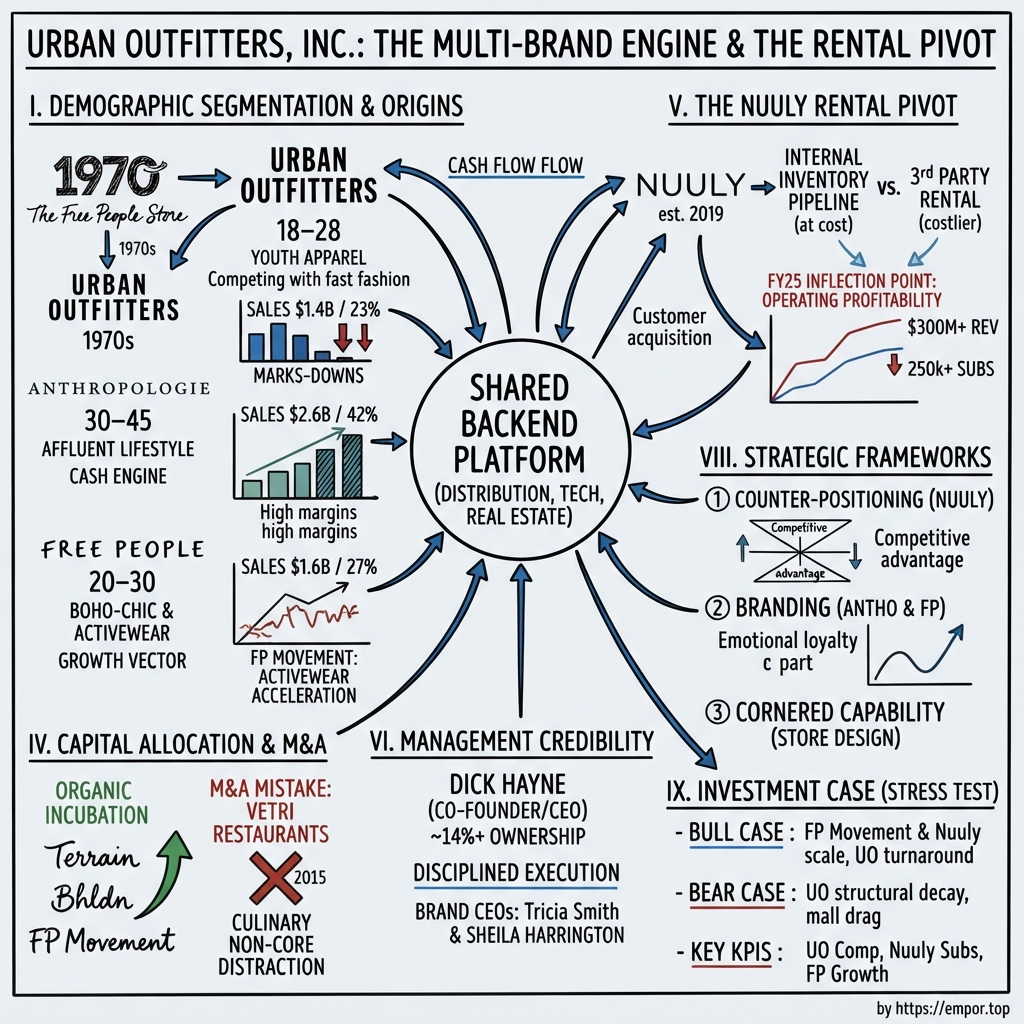
Urban Outfitters, Inc.: The Multi-Brand Engine & The Rental Pivot
I. Introduction & Episode Roadmap (00:00 - 12:00)
On the afternoon of February 25, 2026, a 78-year-old executive who has run the same company for more than half a century got on a conference call and said something that would have sounded absurd to almost anyone who followed apparel retail a decade earlier. Richard "Dick" Hayne told analysts that Urban Outfitters — the brand, not the corporation — had returned to full-year profitability.3 Not soared. Not doubled. Returned. The flagship that gave the company its name and its ticker had spent years as the portfolio's problem child, and its recovery to "modestly above breakeven" was treated as a milestone worth announcing.3
That single sentence contains the whole puzzle of Urban Outfitters, Inc.
On that same call, URBN reported that fiscal 2026 net sales reached a record $6.17 billion, up 11.1% in the largest financial year of its history.2 Operating income rose 28% to $605.6 million, gross margin expanded 126 basis points to 36.0%, and diluted earnings per share climbed to $5.06.12 Operating cash flow reached $575.2 million against $260.2 million of capital spending, leaving the balance sheet holding $1.16 billion in cash and marketable securities with no funded debt.1 By May 2026, management could claim seven consecutive quarters of record sales and profits.4
So: how does a company whose namesake brand was, until very recently, losing money in its home market post the best financial results in its 56-year existence?
The Multi-Brand Portfolio Strategy
The answer is structural, not fashionable. URBN is not one retailer. It is four consumer businesses and a logistics utility wearing a single holding-company hat. The Anthropologie Group serves women roughly 28 to 45 with apparel, home furnishings, garden goods and bridal.1 The Free People Group serves women roughly 25 to 30 with bohemian apparel, and — through FP Movement — has built a fast-scaling activewear brand aimed squarely at the Lululemon and Alo Yoga customer.1 The Urban Outfitters brand serves 18-to-28-year-olds, the most volatile and most competitively contested demographic in all of apparel.1 And Nuuly, launched in 2019, rents clothing by subscription.6
Each of these serves a different life stage. Each has its own creative leadership, its own merchandising point of view, its own risk of getting a season wrong. What they share is a back end: fulfillment centers, technology, real estate negotiation, sourcing relationships, and a balance sheet.
Hayne himself described the mechanism plainly when JPMorgan's Matthew Boss asked on the Q1 FY27 call how the portfolio produces such consistency. "I don't want to say that the brands are always consistent," Hayne answered. "There's ups and downs in each of the brands. What allows for the consistency across URBN is the fact that when some brands are way up, some other brands might be less up."4 It is a candid admission dressed as a boast: the corporate result is smooth precisely because the brand results are not.
Episode Thesis
Here is the argument this piece will test rather than assume. URBN's durable advantage is probably not its fashion taste. Taste is real, but taste is cyclical, personality-dependent, and — as the Urban Outfitters brand's long stretch of losses demonstrated — perishable. The more defensible edge is the shared operating platform: fulfillment scale that a single $1.5 billion brand could never justify, real estate expertise that lets four different concepts negotiate as one counterparty, and an incubation engine that has repeatedly turned internal ideas into standalone businesses without acquisition premiums.
The counter-argument, which deserves equal weight, is that a diversified portfolio of mid-priced apparel brands is still a portfolio of mid-priced apparel brands. Diversification smooths results; it does not create pricing power. And the record numbers of the last two years arrived during an unusually favorable stretch for the affluent American consumer — a point Hayne himself effectively conceded when he said in May 2026 that URBN's customers "reside in the top half of that K" in a K-shaped economy.4 A thesis that depends on the top half of the K staying spendy is not a moat. It is a weather report.
Roadmap
- Origins and demographic segmentation — from a 400-square-foot storefront across from Penn to a deliberate architecture of age-segmented brands.
- The portfolio economics — where the revenue actually sits, where the profit actually sits, and why those two answers differ.
- Capital allocation and M&A lessons — the restaurant acquisition that did not work, versus the internal brands that did.
- The Nuuly bet — how a vertically integrated rental business reached profitability while venture-funded competitors burned through capital.
- Management credibility and governance — a founder with 20% of the stock, a $1 salary, a family-heavy org chart, and a succession question nobody has answered.
- Earnings-call evidence — what analysts actually press management on, and whether the answers are specific.
- Frameworks, stress test, and the three KPIs that matter.
To understand why the platform exists at all, one must go back to a moment when the founder realized his best customers were about to age out of his only store.
 Subscribe on LinkedIn
II. Origins: The Campus Store & Demographic Segmentation (1970–1990s) (12:00 - 27:00)
The original store measured about 400 square feet in West Philadelphia, across from the University of Pennsylvania. It opened in 1970 with roughly $5,000 in pooled capital from three founders: Dick Hayne, his classmate Scott Belair, and Judy Wicks. Named Free People, the shop sold second-hand clothing, furniture, jewelry, and home decor to college students in what company history describes as "a casual fun environment."6
That retail format diverged sharply from the dominant 1970 department store model, which relied on rigid merchandise categorization, comparison-friendly arrangements, and standardized lighting. Free People organized products by mood rather than department. Battered furniture, packing crates, and an unfinished aesthetic turned browsing into an exploratory experience. Candles, jackets, and vinyl records sat side by side, shifting the selling proposition from individual merchandise categories to a broader lifestyle aesthetic.
While modern retail strategists describe this approach as "experiential retail" or "lifestyle merchandising," in 1970 it emerged from aesthetic preference paired with a shortage of capital for standard store fixtures. What began as a practical store layout became a foundational design philosophy for the enterprise.
From Storefront to System
The business incorporated in Pennsylvania in 1976 under the name Urban Outfitters.1 A key structural expansion occurred in 1984, when Meg Hayne — Dick Hayne's wife and currently Co-President and Chief Creative Officer — established an internal private-label wholesale division.6 That division eventually developed into Free People, reclaiming the original storefront's brand name.6
Adding a wholesale operation altered the company's operating profile. Unlike direct retail, which bears store leases, floor payroll, and inventory markdowns, wholesale distributes products to third-party retailers who absorb those storefront operating costs. Designing garments once to monetize them across two distinct distribution channels created structural cost efficiencies. By fiscal 2026, the Wholesale segment generated $314.3 million in net sales and $61.8 million in segment operating income — a 19.7% operating margin that consistently outperforms retail store margins.1
The Insight That Built the Portfolio
The underlying strategy behind URBN's portfolio developed around customer retention across life stages.
Urban Outfitters catered specifically to college-aged shoppers, a demographic that naturally outgrows the brand's aesthetic as customers transition into post-college careers and living spaces. Rather than attempting to stretch the core Urban Outfitters brand upward — a move that risks alienating incoming younger shoppers while failing to retain older ones — management built a portfolio of targeted brands.
In 1992, URBN opened the initial Anthropologie store in a converted automobile shop in Wayne, Pennsylvania, targeting creative, affluent women aged 30 to 45 with higher-priced apparel and home furnishings.6 Free People was subsequently expanded from a wholesale label into a standalone retail chain, opening its first store in Paramus, New Jersey, in 2002.1
This multi-brand structure operates as a demographic ladder. Customers enter the ecosystem at Urban Outfitters as college students, transition to Free People in their mid-twenties, and move to Anthropologie in their thirties. The arrangement allows URBN to maintain long-term customer relationships across decades by transitioning consumers between distinct internal brands.
URBN completed its initial public offering on Nasdaq in 1993 at $18 per share.6 Public equity funded geographic and digital expansion, including the first international Urban Outfitters store in London in 1998, e-commerce platforms launched between 1998 and 2004, and the first international Anthropologie store in London in 2009.1
The Shared Backend
The financial viability of this multi-brand system relied on centralizing back-office operations while keeping creative direction decentralized. Corporate services — including distribution, technology infrastructure, real estate leasing, and vendor sourcing — were unified. Today, that shared supply chain network includes major owned fulfillment facilities: a 1-million-square-foot facility in Gap, Pennsylvania; 956,000 square feet in Indiana, Pennsylvania; 880,000 square feet in Kansas City, Kansas; and 400,000 square feet in Peterborough, England.1
Shared infrastructure alters single-brand unit economics. Large-scale automated fulfillment facilities require substantial merchandise volume to justify capital expenditure. By aggregating order volume across four retail concepts into a shared logistics network, URBN achieves fulfillment scale that individual mid-sized brands could not support independently. On the fourth-quarter fiscal 2026 earnings call, Co-President and Chief Operating Officer Frank Conforti noted that algorithmic inventory positioning across regional hubs reduced packages per order and delivered delivery-cost leverage.3
For investors, URBN's development illustrates an operating strategy built around shared platform economics rather than brand acquisitions. By replicating a centralized back-end infrastructure across distinct age-targeted concepts, URBN lowers internal brand incubation costs and corporate overhead — an architecture that determines how revenue and operating profits are distributed across its business segments.
III. Portfolio Breakdown: Segment Economics & Materiality (27:00 - 47:00)
Walk into an Anthropologie on a Saturday afternoon and the first thing you notice is that nobody is in a hurry. There are candles, ceramics, an entire furniture floor, a beauty counter, and a dress rack where the price tags are not apologizing for themselves. Walk into an Urban Outfitters on the same afternoon and the energy is entirely different: louder, younger, denser, and — for most of the last several years — carrying a lot more red discount signage.
Those two shopping experiences represent the portfolio in miniature.
Anthropologie Group: The Ballast
The Anthropologie Group is the largest single business in the company. In fiscal 2026, it generated roughly 49% of Retail segment net sales — 47.2% from North America and 1.8% from Europe — translating to approximately $2.6 billion on a total Retail base of $5.28 billion.1 The brand ended the fiscal year with 254 stores globally and 1.84 million square feet of selling space, making its physical footprint second only to Urban Outfitters.1
What makes Anthropologie the portfolio's ballast is less its size than its operational discipline. Full-year comparable Retail segment sales rose 5.9% in fiscal 2026, and Tricia Smith, the group's Global CEO, noted on the first-quarter fiscal 2027 call that the brand had delivered 21 consecutive quarters of positive comps.24 For fiscal 2027, management guided the brand toward a mid-teens operating profit rate.3
The mechanism driving those margins represents URBN's closest proxy for pricing power. Anthropologie's merchandise is heavily weighted toward proprietary labels — including Maeve, Pilcro, Celandine, and Lyrebird — which management explicitly credits for the brand's product positioning and margin structure.3 Own-brand products capture both manufacturing and retail margins while preventing direct price comparison on third-party platforms like Amazon. Smith articulated this demand dynamic on the first-quarter fiscal 2027 call, stating that "our customer responds very well to newness and fashion and generally doesn't see price as the barrier."4
That claim has been supported by consumer behavior: the brand sustained positive comps through widespread promotional discounting across mid-tier retail, and management described the first quarter of fiscal 2027 as a historically low markdown period for the brand.3 Anthropologie remains vulnerable to merchandising missteps, however. The brand experienced soft February sales in both 2025 and 2026, with management attributing the latter slowdown to winter storms and excess winter inventory.34 A retail model that relies on fresh spring inventory to recover quarterly momentum remains fundamentally tied to merchandise execution.
Free People Group: The Growth Vector
The Free People Group — comprising the flagship Free People brand and FP Movement — generated roughly 25% of Retail segment sales in fiscal 2026, or about $1.3 billion, alongside the majority of URBN's $314.3 million Wholesale segment.1 While it remains the smallest retail division by sales volume, its trajectory presents the portfolio's sharpest growth profile.
FP Movement serves as the main driver of that expansion. The activewear brand opened its first standalone location in 2020 and expanded to 88 stores by the end of fiscal 2026, adding 25 locations in a single year to increase selling square footage by 44.6%.16 In the fourth quarter of fiscal 2026, the brand posted a 21% comparable Retail segment sales increase and 29% total revenue growth.3 That momentum continued into the first quarter of fiscal 2027, with total brand revenue rising 32% on a 15% retail comp, six new store openings, and a 48% increase in wholesale volume.4
On the first-quarter fiscal 2027 call, Sheila Harrington, Global CEO of the Free People Group and the Urban Outfitters brand, announced an organizational pivot, stating that the company would cease treating FP Movement as a sub-label and begin managing the two as "two independent ecosystems."4 URBN appointed Andrea Perez as FP Movement's first Global President, reporting directly to Harrington.3
This transition illustrates URBN's internal incubation framework: launching as a store-within-a-store, expanding into standalone locations, establishing dedicated leadership, and transitioning to a separate financial entity. Harrington described the shop-in-shop model as "a highly successful incubator" whose locations outperform legacy productivity metrics in multiple markets.4 Whether FP Movement can evolve into a major profit center depends on international expansion — an initiative management has targeted but has not yet proven at scale.4
Urban Outfitters Brand: The Flagship Dilemma
Urban Outfitters remains the company's largest brand by physical footprint, operating 2.12 million selling square feet across 253 stores, while generating approximately 25% of Retail segment sales, or about $1.34 billion.1 The disparity is telling: the flagship occupies more retail square footage than Anthropologie while generating significantly less revenue, creating a persistent store-productivity deficit.
That structural drag also depressed operating profitability. The brand competes against fast-fashion and ultra-fast-fashion operators — including Shein, Temu (the international platform of Pinduoduo), Inditex's Zara, H&M, and Uniqlo — whose operating models compress the timeline from social media trend to store shelf. When Urban Outfitters operated on traditional supply chain lead times, delayed merchandise led to elevated inventory markdowns.
Management outlined a two-stage strategy to restore profitability. On the fourth-quarter fiscal 2026 call, Chief Operating Officer Frank Conforti described the plan as "almost like a 2-legged race": first rebuild product margins by curtailing promotional discounts, then expand comparable sales to gain leverage over store occupancy and fixed costs.3 Conforti indicated that markdown reduction was largely complete, noting there was "still a little meat left on the bone," but "nowhere near the opportunity that we saw a year and 2 years ago."3 The second phase showed progress, with global comparable sales growing 10% in the fourth quarter of fiscal 2026 and 9% in the first quarter of fiscal 2027, led by 12% gains in Europe across both periods.34
Brand leader Shea Jensen detailed merchandising adjustments driving the shift, including a two-year restructuring of the BDG denim line, expansion into woven bottoms, the repositioning of the Out From Under lounge label into athleisure, and broader accessory assortments.3 The brand added one million new customers in fiscal 2026, a cohort Jensen described as regular-price shoppers purchasing with higher frequency.3
Management projected a low single-digit operating profit margin for the brand in fiscal 2027, with a target of high single digits "in the coming years."3 Narrowing that margin gap represents the largest single operational earnings lever within URBN's portfolio.
Nuuly and Menus & Venues: Sizing It Honestly
Nuuly has moved beyond early-stage experimentation. The Subscription segment generated $568.4 million in net sales during fiscal 2026 — representing 9.2% of consolidated revenue, up from 6.8% in fiscal 2025 and 4.6% in fiscal 2024 — while contributing $34.9 million in segment operating income.1 Its scale and financial contribution warrant dedicated analysis later in the narrative.
By contrast, Menus & Venues — the company's restaurant and events division — remains immaterial. Operating nine locations, the segment accounts for less than 1.0% of Retail segment net sales according to regulatory filings.1 This analysis examines it in the subsequent section strictly for its lessons on capital allocation.
Myth vs. Reality
Three common market narratives warrant evaluation against public disclosures.
Myth: URBN is a declining brick-and-mortar retailer. Reality: The company added 69 stores while closing 18 in fiscal 2026, reaching 784 total locations. Over the five-year period ending January 2026, URBN's total shareholder return indexed to $258.29, outperforming the S&P 500 Apparel Retail index ($215.18) and the broader S&P 500 ($201.03).1 While physical store square footage for the flagship Urban Outfitters brand contracted by 2.0%, expansion across Anthropologie, Free People, and FP Movement drove net portfolio growth.1
Myth: Anthropologie drives top-line expansion. Reality: Anthropologie functions primarily as profit ballast. In fiscal 2026, its 5.9% comparable sales growth trailed Urban Outfitters (7.3%) and lagged FP Movement by a wide margin.23 Its core role remains margin preservation and earnings stability rather than peak sales acceleration.
Myth: Nuuly operates as a marketing vehicle. Reality: Nuuly approaches 10% of total corporate sales, generates positive operating profit, and operates through an independent, million-square-foot automated fulfillment facility.1
The central strategic question facing URBN is not whether individual segments can operate effectively, but whether corporate aggregation provides ongoing synergy — a capital allocation test with clear historical precedents across the business.
IV. Capital Allocation & M&A Benchmark: Organic Incubation vs. Acquisition (47:00 - 01:05:00)
On November 16, 2015, URBN announced that it was buying a group of Philadelphia restaurants.7
Not a brand. Not a factory. Restaurants.
The Vetri Detour
The Vetri Family group had been built by Marc Vetri, a James Beard Award-winning chef, and his business partner Jeff Benjamin. The transaction covered Pizzeria Vetri, Osteria, Amis, Alla Spina and Lo Spiedo — but not Vetri, the flagship fine-dining room that carried the chef's name and reputation.7 Terms were not disclosed.7
Hayne's stated logic was demographic: "Spending on casual dining is expanding rapidly, and thus, we believe there is tremendous opportunity to expand the Pizzeria Vetri concept."7 The strategic version was that URBN's stores were becoming lifestyle destinations, and lifestyle destinations should feed people. Put a fast-casual pizza counter inside an Anthropologie and you extend dwell time, raise basket size, and buy a reason to visit a physical store in an era when the internet was making physical stores optional.
The seller's account, given to Philadelphia magazine the day after the announcement, is revealing in a different way. Vetri said the two companies were "very similar in culture and vision regarding innovation, entrepreneurship and pushing the limits," and recounted URBN's pitch as: "We know how to scale and build things. How about we show you how to build and you run the brand?"8 Read carefully, that is a description of what the seller was getting — capital and expansion capability. It contains no claim about what URBN's apparel business would get in return.
The market did not buy it. URBN shares fell on the announcement.18 The skepticism was well-founded, and the reasoning is worth spelling out because it generalizes.
Apparel retail and restaurant operation share a superficial resemblance — both involve real estate, hourly labor, and consumer traffic — and almost nothing underneath. Apparel inventory sits for a season; food inventory spoils in days. Apparel gross margins run in the high thirties at URBN; restaurant margins are structurally thinner and far more sensitive to labor cost. Apparel scales by shipping the same SKU to 250 stores; restaurants scale by replicating a kitchen culture, which does not ship. And critically, restaurant expansion consumes management attention at a rate wildly disproportionate to its revenue contribution.
By 2019 the portfolio was being dismantled: Alla Spina closed, Osteria was sold to chef Jeff Michaud and restaurateur Michael Schulson, and Lo Spiedo was rebranded.9 What survives is Menus & Venues — nine locations contributing less than 1% of Retail segment sales.1
URBN never took a headline-grabbing writedown, largely because the deal was small enough that it never had to. That is the mercy of the story and also its lesson: the damage from a bad adjacent-industry acquisition is rarely the purchase price. It is the years of executive bandwidth. And the self-correction — quietly shrinking rather than doubling down — is itself a data point about management temperament.
The Incubation Playbook
Set the restaurants against what URBN builds when it stays in its lane.
Terrain, the garden and outdoor-living concept, began in 2008 when URBN acquired J. Franklin Styers Nurseries in Glen Mills, Pennsylvania and rebuilt it as a garden center blending retail, events and a café.6 It was an acquisition, but a small one directly adjacent to Anthropologie's existing home category. Today Terrain sits inside the Anthropologie brand family in the company's segment definition.1
BHLDN, the bridal line, launched on Valentine's Day 2011 — a pure line extension requiring no new store fleet at inception, using Anthropologie's existing dress design capability and customer list.6
FP Movement followed the shop-in-shop-to-standalone path already described, reaching 88 stores before URBN gave it dedicated leadership.13
Nuuly was built from scratch inside the company.
The pattern is consistent and the economics behind it are simple. An acquisition requires paying a control premium to a seller who knows more about the asset than you do, then integrating a foreign culture. An incubation requires paying only the operating losses during the ramp — and those losses are tax-deductible against the profitable core, run through the income statement rather than the balance sheet, and can be stopped at any time. When the incubation is adjacent to an existing brand, the customer acquisition cost is close to zero because you are marketing to a list you already own.
There is an honest caveat here. Incubation is slow. FP Movement took roughly six years from first standalone store to 88 locations. Nuuly took roughly six years from launch to $568 million.16 A company in a hurry cannot use this playbook. A founder-controlled company with a 56-year time horizon can.
Capital Discipline and Shareholder Return
URBN's balance sheet policy is unusually plain: no funded debt, no dividend. The company has not paid a cash dividend since its 1993 IPO and states it does not anticipate doing so.1 Its contractual obligations at January 31, 2026 consisted of $1.44 billion of operating leases and $1.09 billion of purchase commitments — real obligations, but not borrowings.1 Against those it held $1.16 billion of cash and marketable securities.1
The buyback behavior is where it gets interesting, and where the record is mixed. URBN repurchased $153.9 million of shares under its program in fiscal 2026, $52.3 million in fiscal 2025, and nothing in fiscal 2024.1 Then in the first quarter of fiscal 2027, with the stock near multi-year highs, the company bought 4.6 million shares for approximately $300 million — reducing shares outstanding by about 5% in a single quarter, and roughly double the entire prior year's program spend.4
An activist would flag the timing. The heaviest buying came after seven consecutive record quarters, not during the fiscal 2023 stretch when free cash flow was negative and the shares were far cheaper.1 Management's stated fiscal 2027 plan in February had been merely "to repurchase shares to at least offset any dilution" — and then it spent $300 million in three months.34 That is not a scandal; it is a company with $1.16 billion of idle cash and few acquisition targets it trusts. But it is procyclical, and investors who value countercyclical capital allocation should note the gap between the February statement and the May action.
Capital allocation, in the end, is a behavioral signature of the people making the decisions — and at URBN those people have unusually direct skin in the game.
V. The Nuuly Pivot: Subscription Economics & Profitability Turn (01:05:00 - 01:25:00)
In 2019, clothing rental was retail's most fashionable concept and one of its least profitable. Rent the Runway had raised hundreds of millions of dollars while building toward a public listing, Le Tote was scaling rapidly, and major department stores were piloting rental offerings. Industry consensus held that younger consumers preferred access over ownership, and that the operator with the largest closet would win.
URBN responded by opening its own closet.
Why the Structure Mattered More Than the Idea
Nuuly launched in 2019 at $88 per month for six items, selected from URBN's internal brands alongside hundreds of third-party labels and curated vintage pieces.10 As of mid-2026, the subscription rate stands at $98 per month for six items, with up to four add-on items available at $22 each.11 The division is led by David Hayne, Dick Hayne's son, who also oversees URBN's technology organization.4
The structural advantage of this arrangement is straightforward to articulate but difficult for standalone competitors to duplicate. An independent rental platform must purchase inventory at wholesale rates or retail prices, leaving its cost of goods bound to third-party margin requirements. URBN's rental business, by contrast, sources inventory from Free People, Anthropologie, and Urban Outfitters at internal cost.
Operationally, the model mirrors the difference between fleet leasing using vehicles bought from a dealership versus fleet leasing using vehicles built in-house. While both models charge comparable monthly fees to end users, only the vertically integrated operator retains the manufacturer's margin.
The unit economics of clothing rental turn primarily on garment utilization: how many times an item can be rented before retirement. URBN details these mechanics in its critical accounting disclosures, noting that rental product costs are amortized into cost of sales over the subscription period based on expected rental cycles per unit.1 Lost, damaged, and retired items are charged directly to cost of sales as incurred.1
This accounting treatment is central to evaluating reported segment profits. If a dress averages twelve rentals over its lifetime, its cost per rental represents one-twelfth of its initial cost. If durability issues reduce that utilization to six rentals, the unit cost doubles. URBN explicitly warns that significant variation between actual rental cycles and estimated utilization "could materially affect the amount of rental product amortization included in cost of sales."1 As of January 31, 2026, rental product carried on the balance sheet totaled $246.4 million — representing 4.9% of total assets — following $232.4 million in annual inventory purchases.1 Consequently, Nuuly's reported profit margins remain sensitive to internal garment durability assumptions that outside investors cannot independently verify.
The Raymore Machine
Beneath its digital consumer interface, a clothing rental platform operates as an industrial laundering and reverse-logistics utility. Every returned item must be inspected, cleaned, repaired, photographed when necessary, restocked, and re-shipped on tight turnarounds to generate multiple revenue cycles per season.
URBN constructed specialized logistics infrastructure to support this volume. The Subscription segment operates out of a 1,024,000-square-foot fulfillment center in Raymore, Missouri, supplemented by a 309,000-square-foot facility in Bristol, Pennsylvania.1 The Raymore facility was previously leased until March 2026, when URBN purchased the real estate outright — a capital allocation decision that drove fiscal 2027 capital expenditure guidance up from approximately $385 million in February to approximately $475 million by May.134 Roughly half of that fiscal 2027 capital budget is dedicated to logistics, divided between expanding subscription facility capacity and executing a second phase of automation at the Kansas fulfillment center supporting the retail division.4
Acquiring the Raymore facility outright rather than extending the lease converted a recurring operating obligation into an owned balance-sheet asset. The transaction signals management's expectation of long-term operational demand while diverging from the asset-light strategy favored during the sector's venture-capital era.
The Profitability Turn
Nuuly reached a financial turning point in fiscal 2025, generating $378.4 million in net sales and $13.3 million in segment operating income — marking its first profitable year following a $17.1 million segment operating loss in fiscal 2024.1 Active subscribers expanded by 53% year over year to surpass 300,000.12 Following those results, management established a public revenue target exceeding $500 million for fiscal 2026.13
The business cleared that milestone. In fiscal 2026, subscription net sales grew 50.2% to $568.4 million, supported by a 45.3% increase in average active subscribers.12 Segment operating income expanded to $34.9 million — a $21.6 million increase that delivered more than 260 basis points of operating margin expansion, aligning with guidance Chief Operating Officer Frank Conforti provided to analysts.13 In the fourth quarter of fiscal 2026 alone, subscription revenue rose 43% alongside a 40% increase in subscribers.3
Top-line and margin expansion persisted into the first quarter of fiscal 2027. Subscription revenue grew 35% year over year as average active subscribers rose 33% — adding more than 110,000 subscribers compared to the prior-year period — while generating $10 million in segment operating profit at a 6% operating margin.4 Conforti noted during the Q1 FY27 call that the brand was approaching 500,000 active subscribers.4 Chief Executive Dick Hayne concluded the call by asserting that Nuuly was moving toward a long-term goal of $1 billion in annual sales.4
The Comparison That Makes the Point
Nuuly's financial trajectory stands in contrast to standalone rental models. Rent the Runway completed a 1-for-20 reverse stock split in 2024 to preserve its Nasdaq listing.14 The company subsequently surrendered a controlling equity stake to lenders through a debt-for-equity restructuring that eliminated over $240 million in debt from its balance sheet.15 For the twelve months ended April 30, 2026, Rent the Runway generated approximately $350 million in revenue — roughly 60% of Nuuly's fiscal 2026 revenue — despite absorbing substantially higher cumulative capital burn.16
This divergence demonstrates that while consumer demand for apparel rental was real, standalone models struggled to support the underlying capital costs of inventory. In a business dominated by inventory cost of goods, vertical integration proved decisive. Industry reporting by CNBC in 2023 characterized URBN as having outmaneuvered early rental pioneers, an assessment supported by subsequent operational results.17
What Would Falsify the Bull Case
Two primary risk factors test the durability of Nuuly's margin profile. First, the unit-utilization accounting discussed above: if actual garment turn rates fall short of internal models, amortization expenses will rise and compress segment margins even if subscriber counts remain steady. Second, marketing dependency. Management has consistently linked subscriber growth to performance marketing investments, acknowledging that corporate SG&A growth has run at or above total sales growth in part due to Nuuly acquisition spending.34 David Hayne's observation that the market retains "an incredible awareness gap" highlights both the addressable market opportunity and the ongoing marketing expenditures required to capture it.3 A subscription model reliant on elevated acquisition spending functions more like a recurring marketing expense than a self-sustaining annuity. While Nuuly's margin expansion through fiscal 2026 signals improving operating leverage, it does not fully eliminate the risk of rising long-term acquisition costs.
That dynamic leads directly to the leadership team making these bets, and to the unusual structure of who owns what.
VI. Management Credibility, Ownership, & Governance (01:25:00 - 01:43:00)
An exchange on the first-quarter fiscal 2027 earnings call illustrates the character of URBN's leadership. UBS analyst Jay Sole asked Dick Hayne about artificial intelligence. Hayne, who co-founded the business in 1970, responded: "Jay, I would love to do that, but I'm going to hand it over to my son, Dave, who does this day in and day out and is quite familiar with all the things that we're doing."4
That response highlights two defining features of URBN's governance at once: executive self-awareness in delegating technical operations, and a central leadership structure that runs directly through the founder's family.
Richard "Dick" Hayne
Hayne is 78 years old and has served as Chairman since the company's incorporation in 1976.5 He served as principal executive officer until 2007, stepped down, and returned to the CEO role in January 2012 following a period of merchandising drift at the flagship brand.5
His compensation structure is unusual among major public retailers. Hayne requested a $1 annual salary in fiscal 2009 and has maintained it since. For fiscal 2026, his total compensation reached $1,042,012, consisting almost entirely of a $1,005,000 performance bonus.5 That sum represents roughly 0.2% of URBN's fiscal 2026 net income — a negligible figure for a chief executive managing a $6 billion enterprise.
Base salary is secondary because of Hayne's equity position. As of March 11, 2026, Hayne beneficially owned 17,693,578 common shares, representing 20.0% of the 88.4 million shares outstanding.5 His spouse, Margaret Hayne, owned an additional 6.5% of outstanding shares, an interest he disclaimed.5 Board member Harry Cherken, Jr. held 9.9%, primarily as co-trustee of Hayne family trusts.5 David Hayne filed a Schedule 13D in February 2026 disclosing a 5.11% stake.5 Collectively, all current directors and executive officers held 32.1% of common stock.5
This equity structure aligns the chairman's personal net worth directly with total shareholder returns, making share price performance far more meaningful to leadership than annual executive compensation.
The Governance Trade-Off
The trade-off of this ownership concentration is a governance structure with limited independent oversight.
Of URBN's ten board members, eight are classified as independent under Nasdaq standards.5 However, one of those independent directors — Harry Cherken, Jr., a retired real estate partner at Faegre Drinker Biddle & Reath who negotiated retail leases for URBN "nearly from its inception" — serves as co-trustee for trusts holding 9.9% of company stock alongside members of the Hayne family.15 While Cherken satisfies formal exchange rules for independence, his dual role as family trust administrator and long-standing legal counsel complicates his function as an unaligned oversight check.
The broader executive structure exhibits similar family concentration. Margaret Hayne serves as Co-President, Chief Creative Officer, and director.5 Azeez Hayne, her nephew, serves as Chief Administrative Officer.5 David Hayne leads the Nuuly division and the company's technology organization.4
Institutional investors have raised little public objection; URBN's 2025 advisory say-on-pay proposal received approximately 99% shareholder approval.5 However, with corporate insiders controlling nearly a third of total voting power, external voting outcomes face inherent structural headwinds.
The central governance uncertainty remains executive succession, an area where regulatory filings offer limited visibility. URBN's 2026 proxy statement contains no designated successor or explicit transition timeline. While the board's Compensation and Leadership Development Committee "regularly receives reports on talent, succession planning, employee engagement," management has not publicly identified who will lead the enterprise when the founder steps down.1 For a business whose strategic identity and corporate culture have been guided by one founder across five decades, succession planning remains a primary long-term risk.
A Trading Disclosure Worth Noting
Recent executive equity transactions also highlight insider activity alongside corporate capital deployment. On July 10, 2025, Dick Hayne established a Rule 10b5-1 trading plan to sell up to 800,000 common shares between October 10, 2025, and October 9, 2026, while a trust co-managed by Margaret Hayne adopted a concurrent plan for up to 700,000 shares; both trading plans were terminated on March 2, 2026.1
From a compliance perspective, these represent standard pre-arranged trading instructions that were adopted, disclosed, and subsequently canceled in accordance with regulatory requirements. From a capital allocation perspective, the timing is notable: insider plans covering up to 1.5 million shares were terminated days after URBN released record fiscal 2026 results, shortly before the company deployed $300 million into open-market share repurchases during the first quarter of fiscal 2027.4 While regulatory filings show full compliance and no impropriety, the sequence illustrates how closely corporate cash deployment and insider equity management intersect.
Brand Leadership
To mitigate key-person dependency on the founder, URBN has expanded its operational leadership team across its core divisions.
Tricia Smith, Global CEO of the Anthropologie Group since April 2021, brings an extensive retail merchandising background to the portfolio. Smith spent 25 years at Nordstrom, progressing from sales floor positions to Executive Vice President and General Merchandise Manager for Women's, Young Contemporary, Designer, and Specialized Apparel between October 2016 and September 2019, followed by a role as Executive Vice President and Chief Merchandising Officer at Tilly's.1 Her leadership at Anthropologie has coincided with 21 consecutive quarters of positive comparable sales growth.4
Sheila Harrington oversees the Free People Group and assumed management of the Urban Outfitters brand in fiscal 2026, placing URBN's fastest-growing segment and flagship recovery brand under a single leader.34 Harrington spearheaded the strategy to decouple Free People and FP Movement into distinct operating entities to accelerate standalone expansion.4
Frank Conforti, Co-President and Chief Operating Officer, directs global operations and financial strategy alongside Chief Financial Officer Melanie Marein-Efron, while Shea Jensen manages merchandising and marketing restructuring at the flagship Urban Outfitters brand.34
For investors, URBN presents a distinct governance profile: high insider ownership creates strong alignment between executive wealth and stock performance, while an experienced operating bench manages daily brand execution. However, the company's concentrated control structure and unannounced succession plan mean corporate governance remains fundamentally dependent on founder stewardship. Evaluating how this leadership architecture responds under pressure requires examining management's performance during quarterly analyst exchanges.
VII. Earnings Call Evidence & Analyst Q&A Dissection (01:43:00 - 01:58:00)
Prepared remarks are a press release read aloud. The Q&A is where you find out whether management understands its own business.
URBN's calls follow a consistent choreography: Hayne opens with two minutes of thanks and framing, Conforti delivers a detailed brand-by-brand walk, a brand CEO presents, Marein-Efron gives guidance, Hayne closes, and then the analysts get roughly thirty minutes. The panel is stable — Bank of America, Citi, JPMorgan, Goldman Sachs, UBS, Wells Fargo, Guggenheim, Baird, Telsey, and two specialist retail-channel checkers, Janet Kloppenburg and the Retail Tracker's Marni Shapiro and Mark Friedman.34
What Analysts Actually Press On
Three themes recur, and none of them is revenue growth.
First: Anthropologie's volatility. Lorraine Hutchinson of Bank of America opened both the Q4 FY26 and Q1 FY27 calls with the same target. In February 2026 she asked about "a bit of a volatile fourth quarter." In May 2026 she asked directly: "What did you fix? What was the impact on margins? And how comfortable are you with the brand's ability to continue to profitably comp positive?"34
Tricia Smith's answers were specific rather than defensive. In February she described a high single-digit January comp driven by spring transitional product received in December, then a February shortfall in stores, then a plan for mid-March receipts.3 In May she reported the plan had worked: a 2% comp for the quarter, positive in March and April after a soft February, driven by pants, denim, dresses, shoes and Mother's Day beauty gifting, with full-price furniture comps positive.4
That is a testable claim followed by a verified outcome one quarter later. It is the strongest single piece of evidence for management credibility in the recent record. The weaker part of the same answer is the repeated attribution of soft store sales to weather — a genuine factor in February 2026, and also the most convenient explanation available to any retailer in any first quarter.
Second: the durability of the Urban Outfitters recovery. Simeon Siegel of Guggenheim asked in February what the "pressure points driving the loss" were, and in May how much improving Urban Outfitters profitability contributed to total company EBIT margin.34 Conforti's answers have been consistent across both calls: the markdown recapture is mostly done, the remaining lever is occupancy leverage from comp growth, low single-digit operating margin this year, high single digits over time.34
The consistency matters. A management team that changes its explanation of a turnaround between quarters is usually improvising. This one has told the same two-legged-race story twice, with the same quantified targets.
Third: markdowns and speed to market. Janet Kloppenburg asked the sharpest question of the Q1 FY27 call. Anthropologie's turn from a soft February to positive March and April comps, she observed, "suggests to me that the lead times of the brand are much more efficient than they've been in the past."4
Smith's answer was notable for what it declined to claim. The team had deployed "some of our shorter lead opportunities" to develop product through the fourth quarter. Then the qualifier: "I wouldn't say that the entire model has changed, Janet, but it's given us opportunities to react to some of those opportunities as they present themselves."4
That is a management team refusing an easy narrative win. URBN has partial speed capability — a read-and-react layer on top of a conventional development calendar — not a Zara-style compressed cycle across the assortment. Conforti then extended the point, describing the ability to use technology to speed the product life cycle as "one of the most impactful initiatives that we're working on," while explicitly placing it in "the early innings."4
Investors should hold that distinction firmly. The competitive gap versus ultra-fast fashion is being narrowed by exception, not closed by design.
The AI Question and the Tariff Question
Two newer themes deserve separate treatment because they are where the specificity gap is widest.
On AI, David Hayne's answer was the most concrete on any recent call: machine learning driving personalization and recommendation algorithms, search and discovery, product listing enhancement, website translation, order fraud screening, and logistics optimization; a launched AI customer service agent; Gemini deployed company-wide with Claude and other tools rolling out; and a focus on compressing the product development life cycle.4 Marein-Efron tied it to the P&L, attributing part of fiscal 2027's SG&A growth to "strategic technology investments" including "agentic AI," and framing the expected payoff as "higher sales and lower markdowns."3
This is more specific than most retail AI commentary. It is also, at this stage, spending without a disclosed return metric. No analyst has yet pinned management to a measurable outcome, and investors have no way to separate genuine cycle compression from ordinary software capitalization.
On tariffs, the disclosure has been unusually granular. Conforti walked through the sequence on the Q1 FY27 call: IEEPA tariffs imposed in spring 2025 pushed rates as high as 50% on Indian sourcing before being ruled illegal; URBN filed for refunds and expected approximately $100 million in the second quarter, to be recorded as a one-time benefit; a new 10% Section 122 tariff took effect in mid-March 2026 and ran through the end of July, was also ruled illegal, but still had to be paid; and management chose to plan the second half at a conservative 15% blended rate.4 Separately, Middle East–related fuel surcharges were guided at roughly 70 basis points of unfavorable quarterly impact.4
Note the shape of that disclosure: management gave the assumption, the direction of the error, and the consequence. "If it turns out receipts from any country face a different charge than 15%, we will have an additional cost or benefit versus our plan."4 That is how a guidance framework should be constructed, and it stands in contrast to the softer AI commentary.
One caution for readers of the coming quarter: the approximately $100 million tariff refund is a non-recurring item.4 Second-quarter fiscal 2027 results, due shortly after this writing, will contain a benefit that does not repeat, and headline comparisons will need adjusting.
The Narrative Consistency Test
Compare February 2026 with May 2026 and the story holds. In February, Hayne said the macro economy was strong and the company saw "no shift in our customers' behavior, except for that due to extreme weather."3 In May, he said customer behavior had "remained remarkably consistent over the past few years" and that URBN's customers "are financially secure and are more interested in fashion than price."4
Consistent — and worth challenging. That is a statement about a specific, affluent slice of the consumer base, offered as reassurance without supporting data on transaction values, credit behavior, or cohort retention. The Q1 FY27 evidence — average unit retail up in stores, regular-price sales outpacing total comp at Urban Outfitters, record-low markdown rates at both Free People and FP Movement — supports it.4 But it is a claim that will be tested, not proven, by the next downturn.
Which is exactly what the strategic frameworks are for.
VIII. Strategic Frameworks: 7 Powers & Porter's 5 Forces (01:58:00 - 02:13:00)
Frameworks are useful only if they distinguish. Applied lazily, every company has a brand, every company has scale, and every analysis concludes that the moat is wide. Applied honestly, most of the boxes come back empty. An honest assessment fills in only the ones URBN can actually defend.
Hamilton Helmer's 7 Powers: Three Present, Four Absent
Counter-Positioning — present, and the strongest of the three. Helmer's definition requires a business model that an incumbent cannot copy without damaging its existing economics. Nuuly qualifies in an inverted way: URBN is the incumbent retailer, and the rental platforms were the insurgents. A pure-play renter cannot match Nuuly's cost of goods without becoming a vertically integrated apparel designer and manufacturer — which would require capital it does not have and destroy the asset-light story it sold investors. Conversely, a traditional retailer with no rental infrastructure cannot copy Nuuly without building a million-square-foot industrial laundry. The evidence that this power is real is the divergence in outcomes: Nuuly at $568.4 million in fiscal 2026 net sales and profitable, compared to its best-known standalone competitor at roughly $350 million in trailing revenue following a debt-for-equity restructuring.11516
The limit on this power: it protects the rental business, which represents 9.2% of company revenue.1 It does not protect the remaining 90.8%.
Branding — present at Anthropologie and Free People, weak at Urban Outfitters. Helmer's branding power means a customer will pay more for a functionally identical product because of who made it. Anthropologie's own-label penetration, low promotional cadence, and 21-quarter comp streak are consistent with that.34 Free People's fourth-quarter fiscal 2026 performance — Sheila Harrington described deliberately walking away from markdown business while accelerating regular-price sales, with margins near historic highs for the brand — offers the clearest evidence: a brand that grows while removing discounts demonstrates pricing power.3
At Urban Outfitters, branding power is materially weaker. The core customer is 18 to 28 years old, switching costs are zero, and the competitive set includes fast-fashion operators who can deliver a similar silhouette in weeks at a fraction of the price. The brand's recovery has come from improved merchandising and markdown discipline rather than premium pricing relative to competitors.
Cornered Resource / Cornered Capability — arguably present in store design and visual merchandising. This is the hardest of the three to prove and the one investors should weigh most cautiously. URBN's in-house architecture and visual merchandising organization produces store environments that are difficult to replicate — the Anthropologie format in particular has been imitated for three decades without being matched. The underlying mechanism is a creative organization with tacit knowledge accumulated over decades, and creative organizations do not transfer easily.
The evidence is suggestive rather than conclusive. The clearest supporting data point is in Europe: Dick Hayne told analysts in May 2026 that the European high street was "reasonably soft" amid struggling economies and elevated energy prices, "especially true in Germany," yet Urban Outfitters and Free People posted double-digit European comps. His conclusion — "the only explanation I can come up with is we have very good product, and we're taking market share" — represents an inference rather than a direct measurement.4
Absent: Scale Economies, Network Economies, Switching Costs, Process Power. URBN's fulfillment scale is meaningful relative to a single brand but small compared to Inditex, H&M, or Amazon. There is no network effect — a Nuuly subscriber gains no utility when another subscriber joins. Switching costs are effectively zero in apparel; Nuuly's monthly cancellation policy reflects low friction. And process power — a superior operating method competitors cannot copy — is precisely what URBN has not achieved in speed-to-market, as Tricia Smith and Frank Conforti both acknowledged.4
Three powers out of seven, with the strongest covering under a tenth of revenue, define a real but bounded competitive position.
Porter's Five Forces
Bargaining power of buyers: high in youth apparel, moderate elsewhere. An 18-year-old choosing between Urban Outfitters, Shein, and Zara faces no switching costs and high price transparency. An Anthropologie customer purchasing a $148 dress from an exclusive proprietary label has less leverage, which explains the strategic rationale of the own-brand model.
Threat of substitutes: high and structurally rising. Ultra-fast fashion represents one substitute. Resale is the more structural alternative: platforms like Depop, Poshmark, ThredUp, and Vinted allow consumers to acquire the same aesthetic at lower price points, with secondhand supply partly composed of URBN's past production. Nuuly serves as a partial hedge by converting the access-over-ownership impulse into URBN revenue. Notably, regulatory filings frame Nuuly as offering "a more sustainable way to explore fashion," positioning it within the same consumer mindset that drives resale.1
Competitive rivalry: high. Anthropologie competes with Aritzia, J.Crew, Madewell, and independent boutiques. Free People competes with Reformation, Sézane, and similar boutiques. FP Movement enters a crowded activewear category against Lululemon, Alo Yoga, Vuori, and Nike. Urban Outfitters competes across the broader youth retail market. Public filings explicitly note that certain competitors possess substantially greater brand recognition as well as superior financial, marketing, and operational resources.1
Bargaining power of suppliers: low, and deliberately contained. Global apparel manufacturing remains fragmented. URBN discloses that no single country accounts for the majority of its production and that it maintains dual sourcing for most proprietary products.1 That geographical flexibility provided a structural buffer during recent tariff adjustments, allowing the company to shift production origins rather than absorb full rate increases.14
Threat of new entrants: low at scale, high at the entry level. A new brand can launch digitally and reach $50 million in sales. Reaching $6 billion across 784 stores, four core brands, three continents, and an industrial rental operation requires decades of capital investment and a unified fulfillment network. The primary barrier is not market entry, but operational scale.
The net picture reveals a company with modest structural protection in a highly competitive industry, maintaining financial performance through portfolio structure and operational discipline.
IX. Investment Case: Bull vs. Bear Stress Test, Risk Radar, & KPIs (02:13:00 - 02:28:00)
The Bull Case
The bull case rests on four core propositions, ranked by the strength of supporting evidence.
The Urban Outfitters brand margin recovery represents the largest identifiable earnings lever, and it is partly de-risked. The brand returned to full-year profitability in fiscal 2026, and management projects a low single-digit operating profit margin in fiscal 2027, targeting high single digits in subsequent years.3 Applied across approximately $1.34 billion in retail sales alongside wholesale revenues, shifting from breakeven to high-single-digit margins represents nearly $100 million in potential operating income. The initial phase of this recovery — markdown recapture — is already visible in reported gross margin expansion rather than remaining an unproven forecast.13
FP Movement is expanding rapidly enough to alter corporate performance. Generating 32% total revenue growth on a 15% retail comp, 48% wholesale expansion, and 21 new store openings scheduled for fiscal 2027 establishes a clear trajectory toward material scale.34 Unit economics remain favorable because the label was incubated directly within an established customer base.
Nuuly's margin expansion reflects multi-period operational leverage. Advancing from a $17.1 million operating loss to $13.3 million in segment profit, and then reaching $34.9 million, demonstrates sustained structural progress.1
The capital structure amplifies operational progress. Carrying zero funded debt, maintaining $1.16 billion in liquid assets, and executing targeted share repurchases allows operational gains to compound on a per-share basis.14
The Bear Case: An Activist's Stress Test
A rigorous stress test highlights key structural counter-arguments to the growth narrative.
The peak-cycle vulnerability. Seven consecutive quarters of record results coincided with sustained spending among affluent consumers. Chief Executive Dick Hayne acknowledged that URBN's customer base resides in the top half of a K-shaped economy.4 Should demand normalize among high-income demographics, a portfolio of discretionary apparel brands facing fixed store occupancy costs could experience rapid margin deleverage. URBN's multi-brand model diversifies across consumer ages, but not across income cohorts.
The Urban Outfitters real estate footprint. The flagship brand accounts for 2.12 million selling square feet — exceeding Anthropologie's store footprint — while generating lower total revenue, even as square footage contracted 2.0% in fiscal 2026.1 Rationalizing store real estate remains constrained by lease terms, with URBN holding $1.44 billion in total operating lease obligations.1 Consequently, comparable-sales gains at the flagship partly reflect denominator adjustments as underperforming locations close.
The unclosed speed gap. Management acknowledged that the core product calendar remains conventional, describing technology-driven lead-time initiatives as being in "the early innings."4 Against fast-fashion competitors operating on multi-week production cycles, maintaining a read-and-react capability offers operational mitigation rather than structural parity.
Procyclical capital allocation. Management stated in February 2026 that buybacks would primarily offset share dilution, yet deployed approximately $300 million into repurchases during the first quarter of fiscal 2027.34 That acceleration concentrated repurchases during a period when the stock traded near multi-year highs.
Governance concentration. Corporate control remains highly centralized: a 78-year-old founder-CEO holding 20.0% of common stock, a Co-President and Chief Creative Officer spouse, a Chief Administrative Officer nephew, a son directing technology and the subscription division, an independent director serving as co-trustee for trusts holding 9.9% of shares, and no public succession plan.15 While individual appointments bring operational experience, the concentration limits independent oversight for public shareholders.
Disclosure limitations. URBN's regulatory filings omit Nuuly's exact subscriber count, churn rate, customer acquisition costs, and internal garment utilization assumptions — the core metrics governing subscription unit economics.1 Furthermore, financial statements aggregate all four retail brands into a single operating segment, preventing independent verification of brand-level operating margins.1 As a result, investors rely heavily on management commentary to evaluate brand turnarounds and subscription profitability.
Material Risk Radar
Fashion and markdown risk remains a core operational vulnerability, making inventory management critical. Total inventory expanded to $700.9 million as of January 31, 2026, up from $621.1 million a year earlier, representing 14.0% of total assets.1 Management pledged to maintain inventory growth at or below overall sales growth.4 In fashion retail, elevated inventory levels represent potential gross margin compression through future markdowns rather than simple working-capital expansion.
Trade policy and supply chain disruptions represent active headwinds. Recent tariff shifts created a 35-basis-point drag on full-year fiscal 2026 operating margins — including a 75-basis-point impact in the fourth quarter — while Middle East geopolitical conflicts added approximately 70 basis points in quarterly freight surcharges.34 Dual-sourcing strategies and geographical diversification provide operational flexibility.1 However, because URBN imports the vast majority of its merchandise, raw import cost exposure remains significant.
Consumer macro sensitivity affects portfolio segments unevenly. Historically, discretionary youth apparel experiences demand softness earlier than affluent lifestyle categories. Consequently, the flagship Urban Outfitters brand remains susceptible to broader consumer pullbacks as it stabilizes operating margins.
Transformation execution risk centers on two primary initiatives: expanding FP Movement internationally without an established global footprint, and translating artificial intelligence investments into quantifiable lead-time reductions rather than elevated technology overhead.
Accounting judgments warrant ongoing evaluation. Rental product amortization relies on internal estimates of garment rental cycles.1 Additionally, fiscal 2026 results included a $46 million contribution to a donor-advised fund recorded within other expense, which management excluded from non-GAAP figures — a standard adjustment that expanded the spread between reported diluted EPS of $5.06 and adjusted diluted EPS of $5.44.123
Non-material risk factors provide balance-sheet stability. With zero funded debt, URBN faces no refinancing pressure. Customer concentration is negligible, with regulatory filings confirming that no single wholesale customer accounts for more than 10% of net sales.1 Independent auditor Deloitte & Touche issued an unqualified opinion on the company's internal financial controls.1
The Three KPIs That Matter
Evaluating URBN's operational trajectory requires tracking three specific metrics over top-line growth.
1. Urban Outfitters brand comparable Retail segment sales and operating profit rate. This combination serves as the primary operational swing factor. Management established clear targets — low-single-digit operating margins in fiscal 2027 and high single digits over the long term — creating a measurable performance benchmark.3 Sustainable recovery requires simultaneous comparable-sales growth and margin expansion; positive comps driven by promotional discounting would signal a return to previous margin compression.
2. Nuuly average active subscribers and segment operating margin. Tracking subscriber growth alongside operating margin determines subscription quality. Subscriber expansion without margin gains indicates high customer acquisition costs, while margin expansion alongside flat subscriber growth suggests a maturing market. Over the past three fiscal years, both metrics improved concurrently, validating the segment's operating model.134
3. FP Movement store count and comparable sales growth. Activewear expansion represents URBN's primary organic retail growth vector. Store additions reflect capital deployment, while comparable-sales growth serves as the productivity check. Sustained store growth accompanied by decelerating comps would signal market saturation or brand cannibalization.
Together, these three performance indicators demonstrate whether URBN's growth initiatives are scaling efficiently while verifying the structural recovery of its flagship brand.
X. Epilogue & Playbook Lessons (02:28:00 - 02:40:00)
There is a symmetry to this story that is almost too neat. The company began in 1970 as a 400-square-foot shop called Free People, selling secondhand clothes to students who wanted to look like they had not tried. Fifty-six years later, its fastest-growing business rents clothing by the month so that customers never have to own it, and one of its most valuable brands is called Free People. The company has, in a sense, spent five decades circling back to its founding insight: that for a certain kind of customer, clothing is something you pass through rather than accumulate.
What the intervening decades added was infrastructure.
Playbook Takeaways
Demographic portfolio hedging beats brand stretching. The instinct when customers age out is to age the brand with them. URBN's founder refused, building new brands instead. The consequence is visible in fiscal 2026 results: the flagship spent years underperforming while the corporation set records, because Anthropologie and Free People carried the load. The cost of this approach is complexity and duplicated creative overhead. The benefit is that no single fashion miss is existential. For any consumer business facing a graduating customer cohort, that trade-off is worth studying.
Organic incubation usually beats adjacent-industry M&A — but not because acquisitions are bad. URBN's restaurant detour failed not because restaurants are an inherently bad business, but because they share almost no operating DNA with apparel, making the true cost executive attention rather than purchase price. Meanwhile, Terrain, BHLDN, FP Movement, and Nuuly were built internally, funded through the income statement, and marketed to an established customer list. The generalizable rule is narrower than "build, don't buy": acquire only what shares your operating system; build everything that shares your customer.
Vertical integration converts a threat into a margin. The rental wave could have been purely dilutive to URBN — a substitute that allowed customers to stop purchasing apparel. Instead, the company built the substitute itself and discovered that owning the supply chain provided the primary economic advantage. The competitors who defined the category are smaller today than the retailer who joined it late.1516 The transferable lesson is that when a new consumption model threatens a category, the relevant question is not whether the model works, but who has the lowest cost of goods inside it.
A shared back end is what makes a multi-brand strategy affordable. Multiple brands sharing fulfillment centers, a single technology organization, a unified real estate function, and a joint sourcing network create a fundamentally different cost structure than independent companies. This is the least glamorous part of the URBN story, and arguably the most important.
Closing Thoughts
The summary of Urban Outfitters, Inc. in August 2026 is that it is executing effectively against a favorable macro backdrop, backed by a real but bounded competitive position and a governance structure that concentrates discretionary control within a single family.
The evidence for execution is genuine and specific: positive comparable sales across every retail brand, the flagship restored to profitability, gross margin up 126 basis points despite tariffs, a rental business reaching scale and profitability while category pioneers restructured, and a management team meeting its public targets.1234
The evidence for durability remains thinner. Only three of Helmer's seven powers apply, with the strongest covering less than a tenth of corporate revenue. The speed gap against ultra-fast fashion has been narrowed rather than closed, by management's own acknowledgment. The customer base that management describes as financially secure and price-insensitive has not been stress-tested by a severe economic downturn in this configuration. And the succession question — the primary risk over a decade horizon — lacks a public resolution.
What URBN has proven is that a 1970 college shop can evolve into a $6 billion multi-brand operating platform through demographic segmentation, back-end consolidation, and a discipline of organic incubation over acquisition. What it has yet to prove is whether that platform generates durable excess returns through a full economic cycle, or whether recent record results reflect an exceptionally favorable consumer environment meeting a well-run retail operator. Time and an eventual economic downturn will distinguish between the two.
References
-
Urban Outfitters, Inc. Annual Report on Form 10-K for the fiscal year ended January 31, 2026 — U.S. Securities and Exchange Commission, 2026-04-01 ↩↩↩↩↩↩↩↩↩↩↩↩↩↩↩↩↩↩↩↩↩↩↩↩↩↩↩↩↩↩↩↩↩↩↩↩↩↩↩↩↩↩↩↩↩↩↩↩↩↩↩↩↩↩↩↩↩↩↩↩↩↩↩↩
-
URBN Reports Record FY26 Q4 Sales and Operating Results — Urban Outfitters, Inc., 2026-02-25 ↩↩↩↩↩↩↩
-
Urban Outfitters, Inc. Q4 Fiscal 2026 Earnings Conference Call Transcript — Seeking Alpha, 2026-02-25 ↩↩↩↩↩↩↩↩↩↩↩↩↩↩↩↩↩↩↩↩↩↩↩↩↩↩↩↩↩↩↩↩↩↩↩↩↩↩↩↩↩↩↩
-
Urban Outfitters, Inc. Q1 Fiscal 2027 Earnings Conference Call Transcript — Seeking Alpha, 2026-05-20 ↩↩↩↩↩↩↩↩↩↩↩↩↩↩↩↩↩↩↩↩↩↩↩↩↩↩↩↩↩↩↩↩↩↩↩↩↩↩↩↩↩↩↩↩↩↩↩↩↩↩↩↩↩↩↩
-
Urban Outfitters, Inc. Definitive Proxy Statement (Schedule 14A) for the 2026 Annual Meeting — U.S. Securities and Exchange Commission, 2026-04-01 ↩↩↩↩↩↩↩↩↩↩↩↩↩↩
-
URBN to Acquire The Vetri Family of Restaurants — GlobeNewswire, 2015-11-16 ↩↩↩↩
-
Marc Vetri: Why I Sold to Urban Outfitters — Philadelphia magazine, 2015-11-17 ↩
-
What is Urban Outfitters doing with the Amis restaurants? — The Philadelphia Inquirer, 2019-05-15 ↩
-
URBN Launches Nuuly, a Subscription Rental Service for Women's Apparel — Urban Outfitters, Inc., 2019 ↩
-
Nuuly shows rental is good business with subscribers topping 300,000 — Glossy ↩
-
URBN Reports Record Q4 Sales and FY'25 Profits — Urban Outfitters, Inc., 2025-02-26 ↩
-
Rent the Runway Announces 1-for-20 Reverse Stock Split — Rent the Runway, Inc., 2024 ↩
-
Rent the Runway to Swap Debt for Equity in Revival Effort — The Business of Fashion ↩↩↩
-
Rent the Runway (RENT) Revenue 2020-2026 — StockAnalysis ↩↩↩
-
How Urban Outfitters' Nuuly is outsmarting Rent the Runway — CNBC, 2023-11-09 ↩
-
Urban Outfitters' stock falls after acquiring Vetri — PhillyVoice, 2015 ↩
 LinkedIn
 WhatsApp
 Reddit
 Hacker News
 Email
Email Kindle
 RSS Feed
 Spotify
 Apple Podcasts
 Amazon Music
 Audible
 YouTube