Beam Therapeutics: The Edit Before the Medicine
I. The Quarter the Revenue Disappeared
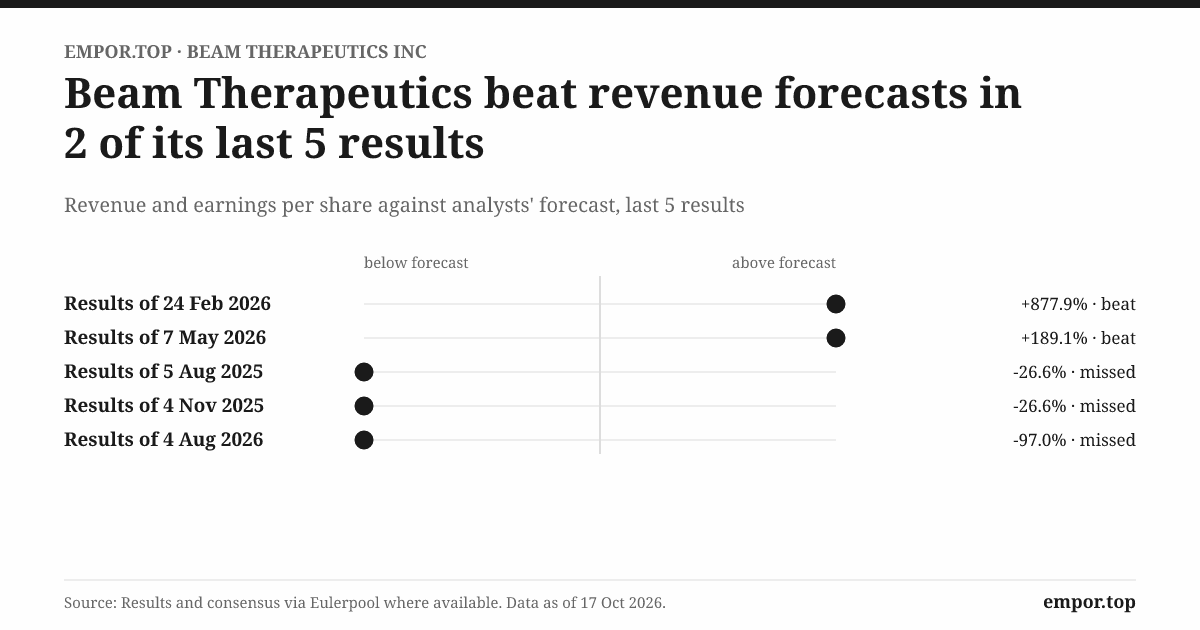
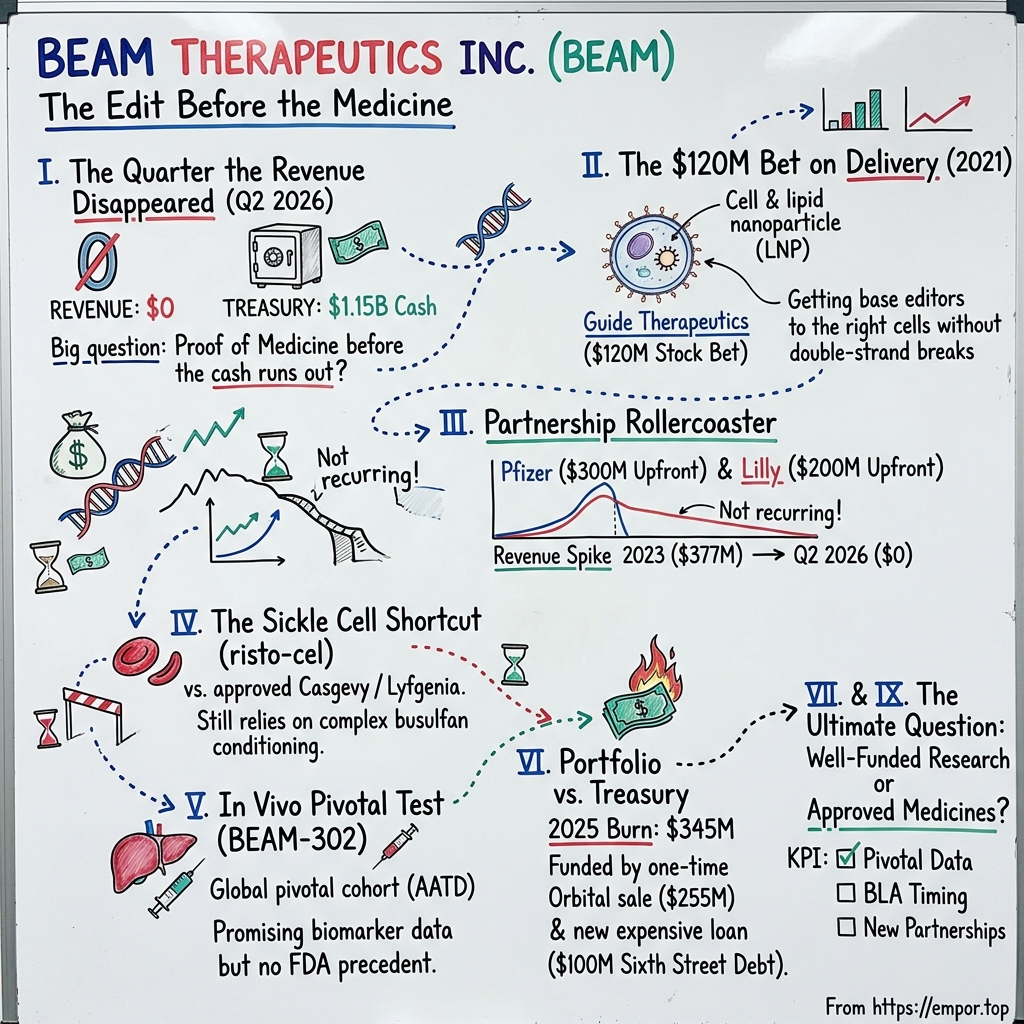
On the first line of Beam Therapeutics' income statement for the three months to June 30, 2026, where a company records what it earned from the outside world, there was a zero.2 It wasn't a rounding error, and it wasn't a timing glitch that a footnote would fix later. In the second quarter of 2026, Beam recognized no revenue at all.2
For most companies a zero on the top line would be an obituary. For Beam it arrived during what management presented as the most consequential stretch of the company's life. Its sickle-cell program had finished dosing patients in its main trial, and its lead liver program for alpha-1 antitrypsin deficiency was heading into a pivotal cohort meant to support a regulatory filing.3 The science was moving forward just as the revenue line went blank.
That contrast is the story. Beam is a company built on a laboratory idea, that you can change a single letter of DNA inside a living cell without cutting the DNA in two. It has spent nearly a decade and more than a billion and a half dollars of cumulative losses trying to turn that idea into medicine.1 The revenue it has reported along the way never came from selling a drug. It came from pharmaceutical partners paying for access to Beam's technology, and in mid-2026 the last of those big research collaborations ran out.2
So the zero isn't really about a bad quarter. It shows what kind of business Beam actually is. The cash that partners paid up front had already arrived years earlier and been booked as revenue gradually, as Beam did the work. When the work ended, the accounting ended too.2 What's left is a company with a large treasury, a promising pipeline, and nothing yet to sell.
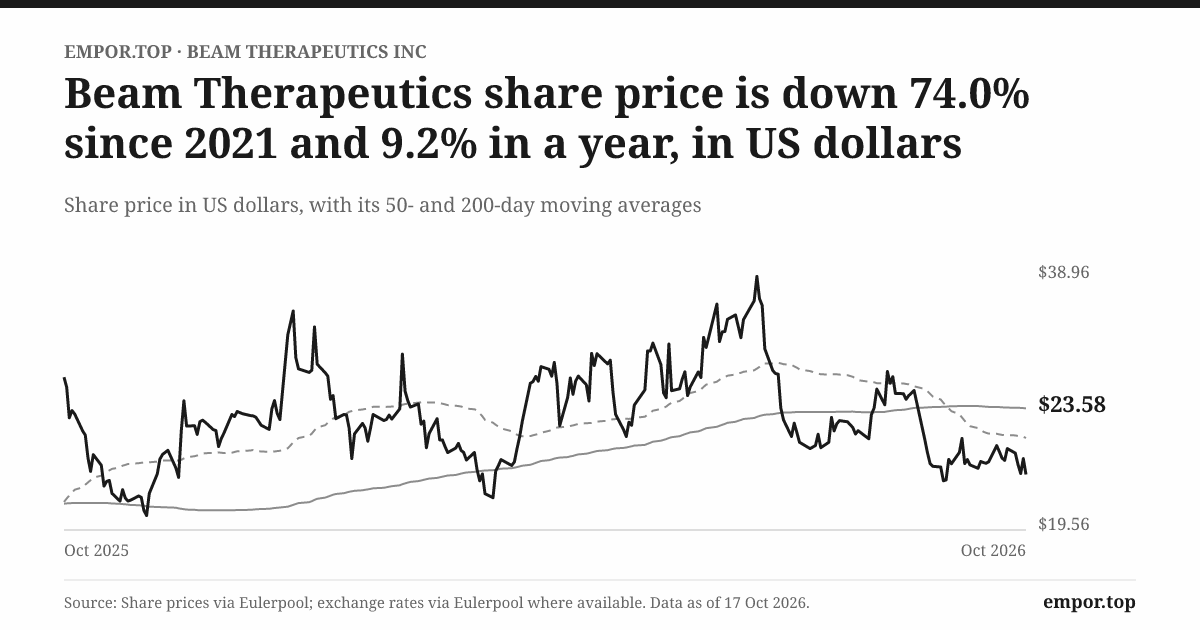
The treasury is large. At June 30, 2026, Beam held about $1.15 billion in cash, cash equivalents and marketable securities.2 On October 17, 2026, the stock market valued the whole company at roughly $2.4 billion, at a share price of $23.58.1 Put those two numbers together and almost half of what investors pay for a Beam share is backed by money sitting in Treasury bills and commercial paper. The other half is a bet on what the science becomes.
The cash also leaks steadily. In 2025, Beam's operations consumed about $345 million.1 That's the honest benchmark for the treasury. At that pace, $1.15 billion is a few years of runway, which is a long time for a startup but a short time in drug development. Pivotal trials, regulatory reviews and manufacturing scale-up all take years, and they tend to cost more as they get closer to market.
Three questions decide whether that runway is enough. The first is whether risto-cel, Beam's edited-cell therapy for sickle cell disease, can compete in a market where two gene therapies are already approved and selling slowly. The second is whether BEAM-302, an intravenous medicine that edits liver cells inside the body, can establish in vivo base editing as a real therapeutic category rather than a striking set of biomarker charts. The third is whether the balance sheet can bridge the gap left by the completed collaborations without crippling dilution or expensive debt.
It helps to be clear about what Beam is and isn't. It's an independent clinical-stage biotechnology company incorporated in Delaware in January 2017, listed on the Nasdaq Global Select Market, with no parent pharmaceutical group, no private-equity sponsor and no controlling founder bloc.1 Its consolidated economics are its own and those of a few wholly owned subsidiaries, including Guide Therapeutics, a delivery-technology company it bought in 2021.1 Every dollar of loss and every dollar of cash in this story belongs to Beam's shareholders.
Calling it a "platform company with cash" is accurate but too generous, because a platform only matters when something gets built on it. Beam has built clinical programs. It hasn't yet built a medicine a doctor can prescribe. The rest of this story follows how Beam got here: the bet on delivery, the partnership money that came and went, the two lead programs, the treasury, and the people deciding how to spend it. The first thing to understand is that the hardest part of gene editing was never only the edit. It was getting the edit to the right cell.
 Subscribe on LinkedIn
II. The $120 Million Bet on Getting the Edit to the Right Cell
In February 2021, Beam had not yet put a single medicine into a human being. It was a year past its IPO and flush with cash. That month it agreed to buy Guide Therapeutics, a small Atlanta-area company most investors had never heard of, for about $120 million in Beam stock.[^4] Guide didn't make a drug. It made a way of finding the right container to carry one.
To see why that mattered, picture what a base editor has to do. Every human cell carries about three billion letters of DNA. A disease like alpha-1 antitrypsin deficiency can come from one wrong letter in one gene. Beam's base editors are molecular machines, built from a modified CRISPR protein fused to an enzyme that chemically converts one DNA letter into another. The CRISPR part works like a GPS that finds the address. The enzyme works like a pencil and eraser that changes one letter at that address.5
The design rationale, and the reason Beam exists, is what the machine doesn't do. Standard CRISPR nuclease editing cuts both strands of the DNA double helix and relies on the cell's repair crews to patch the break, and those repairs can be messy. Beam's editors are designed to change the letter without making that double-strand break.5 The analogy Beam's founders liked is the difference between scissors and a pencil. But a design rationale isn't a clinical result. Whether avoiding the break makes base editing safer or more effective in patients is a hypothesis that trials have to test, not a fact to bank.
The technology came out of the lab of David Liu at Harvard and the Broad Institute, whose group described the first base editors in 2016. Beam was formed around that work with co-founders including Feng Zhang and J. Keith Joung, and it took licenses to the underlying intellectual property.5 John Evans, a former senior executive at Agios Pharmaceuticals, became CEO and turned an academic invention into a company with a pipeline.5
A pencil is useless if it can't reach the page, though. For blood diseases, Beam can take a patient's stem cells out of the body, edit them in a dish and put them back. That's the ex vivo route, and it's how its sickle-cell program works. For the liver, and for most of the body, the editor has to travel through the bloodstream inside a protective bubble. The standard bubble is a lipid nanoparticle, or LNP: a tiny droplet of fat that wraps the editing instructions, survives the trip and gets absorbed by the target cells. LNPs naturally drift to the liver, which is one reason liver diseases became Beam's first in vivo targets.
Guide brought a library of novel lipids and a screening engine that could test many delivery formulations at once, tagging each with a DNA barcode so researchers could see which droplets reached which tissues.[^4] In plain terms, Beam paid $120 million in stock for a faster way to find better delivery vehicles, at a time when its first liver medicine didn't exist yet.
Beam also spent heavily on the physical side of making medicines. It built an internal manufacturing facility in Research Triangle Park, North Carolina, and capital spending peaked at about $34 million in 2023 as that buildout finished.11 By 2025 capital expenditure had fallen to about $15 million as the facilities became operational.1 That shape is normal for a biotech building toward late-stage trials: a hump of construction followed by a lower run rate. It also means Beam owns more of its supply chain than a virtual biotech would, which helps with control and speed and adds fixed cost.
Was Guide worth it? The honest answer is that nobody can tell yet. The delivery technology now underpins Beam's liver programs, including BEAM-302, the program entering a pivotal cohort.1 That's real strategic value. But there was no clean public-market comparable for a private delivery platform in early 2021, so there's no fair benchmark for calling the price high or low, and the asset hasn't produced a dollar of commercial return. The right verdict is narrow: Guide bought a capability that clinical progress has so far supported, not one that has earned back its price.
The same caution applies to the moat argument Beam's bulls like to make. Beam holds patents and licenses and has a proprietary approach to editing.1 Competitors aren't standing still, though. They can pursue nuclease editors, prime editors, epigenetic editors, different delivery systems and different targets, and some of them already have approved products. Patents decide who can use a particular tool. They don't decide which tool patients and doctors end up preferring. The evidence that would turn Beam's technical reach into a durable advantage is safe, durable editing in people, reproduced across several programs with the same delivery machinery. Until that shows up, the delivery bet is a well-funded hypothesis.
Delivery explains how Beam could build medicines. It doesn't explain how Beam paid for building them. For that, the story turns to the pharmaceutical companies that wrote Beam its largest checks.
III. From Pfizer's Upfront to the Empty Revenue Line
In January 2022, Pfizer announced an exclusive four-year research collaboration with Beam focused on in vivo base editing for rare genetic diseases of the liver, muscle and central nervous system.4 The headline number was a $300 million upfront payment, with up to $1.05 billion more in potential development, regulatory and commercial milestones and royalties on any resulting products.4 For a company with no product, it was a vote of confidence from one of the largest drugmakers in the world, and a lot of cash to arrive in one wire transfer.
That transaction is the template for how Beam has made money, so it's worth spelling out. A partner pays a nonrefundable upfront fee for access to Beam's technology on selected targets. It may reimburse Beam's scientists' time on the joint research. If a program reaches defined development or regulatory steps, milestone payments follow. If a partner-led product ever reaches the market, Beam can earn commercial milestones and royalties, which Beam describes as ranging from single digits to low double digits of net sales.1 There's nothing subscription-like in any of this. Each payment depends on a scientific event or a new deal.
The accounting adds a second layer. Cash comes in up front, but under revenue-recognition rules Beam books revenue gradually as it performs the research. So the upfront first shows up as deferred revenue, a liability that represents work owed, and runs down into the income statement over the research term.1 Cash arrives early and revenue arrives later. When the work stops, revenue stops too, even though the cash was spent long ago.
That's why Beam's revenue history looks like a seismograph. The company reported no revenue at all through 2020, before any collaboration was recognized.5 Collaboration revenue began in 2021 at about $51 million and was about $60 million in 2022.1 Then in 2023 it jumped to about $377 million.11 That wasn't a new underlying run rate. It was mostly two large events: Eli Lilly's $200 million upfront, paid in October 2023 when Lilly took over Beam's rights in a Verve Therapeutics collaboration, recognized almost at once, together with a large chunk of Pfizer revenue.1 In 2024, with no comparable event, revenue fell to about $63 million.1
The concentration matches the lumpiness. In 2023, Lilly and Pfizer together accounted for almost 89% of revenue.1 In 2025, Pfizer alone accounted for about 78%.1 In the first half of 2026, Lilly accounted for about 78% of the roughly $31 million Beam earned, all of it in the first quarter.2 Beam has always had a few customers, and they're very large ones. That's the reverse of a diversified customer base. The buyers here hold most of the power.
The endings explain the zero. Pfizer's four-year research term concluded in December 2025.1 Pfizer then exercised its option to take an exclusive worldwide license to one liver-targeted development candidate, and let its options on two other rare-disease programs lapse, so rights to those programs reverted to Beam, subject to a possible low single-digit earn-out on future sales.1 The Apellis research collaboration, a five-year deal on complement-driven diseases, ended in June 2026 without extension.2 Apellis had opted into one program in 2025 for a fee of about $3.8 million, and Apellis itself was acquired by Biogen in May 2026.2
How should an investor read Pfizer's choice? Both ways, which is why it's interesting. Taking a license to one liver candidate after four years of close-up work is meaningful validation of Beam's liver delivery and editing capabilities from a partner that saw the raw data. Declining two of three options shows that big pharma picks programs. It doesn't endorse platforms. A partner's money flows to the specific candidates it believes in and walks away from the rest.
By June 30, 2026, Beam reported no trade accounts receivable, no contract assets and no deferred revenue left on its balance sheet.2 The well was dry in accounting terms. Zero revenue isn't the same as zero progress, though. The quarter had no revenue because the research obligations were finished, not because a product failed or a customer stopped paying. Beam was simply between deals.
That raises the central question about the funding model. Can collaboration income become a durable engine, or will Beam need a fresh deal every time it wants new non-dilutive money? The record so far points to the second. Each big inflow came from a discrete transaction, and none created a recurring base that survived its own research term. Beam's future milestone income depends on partner-led programs progressing, which Beam doesn't control. Future royalties depend on partner products reaching the market, which hasn't happened.
The live versions of this question were Beam's year-end 2025 results in February 2026 and its second-quarter results in August 2026.[^9]3 On both occasions, the release and the analyst calls that followed centered on the clinical pipeline and the new Sixth Street credit facility, and on how Beam planned to fund pivotal work. The thing investors should test in those calls is whether management names what replaces Pfizer and Apellis, and which specific milestones could produce cash, rather than leaning on the size of the treasury.[^17]
The revenue model, then, is episodic by design. It funded the platform's early years and validated parts of it, but it isn't a business that sustains itself. For Beam to become one, it needs its own products, and its first candidate is aimed at a disease where others got there first.
IV. The Sickle Cell Shortcut That Still Takes a Long Road
In December 2023, the U.S. Food and Drug Administration approved two gene therapies for sickle cell disease on the same day. One was Casgevy, developed by Vertex Pharmaceuticals and CRISPR Therapeutics, the first approved medicine built on CRISPR editing. The other was Lyfgenia, from bluebird bio.67 For a disease that had waited decades for curative options beyond bone marrow transplants, it was a historic day. Beam's own sickle-cell candidate was still in its trial.
Sickle cell disease comes from a single mutation in the gene for the beta chain of hemoglobin, the protein that carries oxygen in red blood cells. The faulty hemoglobin makes red cells stiffen into crescent shapes that jam small blood vessels and cause excruciating pain crises, organ damage and early death. There's a natural workaround. Before birth, people make fetal hemoglobin, which doesn't sickle, and some people inherit genetic variants that keep fetal hemoglobin switched on for life. Those people, when they also carry the sickle mutation, tend to have much milder disease.
Casgevy and risto-cel both try to recreate that lucky inheritance. Doctors collect a patient's blood stem cells, edit them so they keep producing fetal hemoglobin, and infuse them back. The difference is the tool. Casgevy uses CRISPR's scissors to cut a regulatory region of DNA and disrupt a switch. Beam's risto-cel, formerly called BEAM-101, uses a base editor to change letters in the promoter region of the fetal hemoglobin genes, mimicking the natural variants found in people with hereditary persistence of fetal hemoglobin, without double-strand breaks.1 Beam completed dosing in its BEACON Phase 1/2 trial, and the company has reported high induction of fetal hemoglobin.[^9]
The market proof matters, so look at it plainly. Casgevy generated about $116 million of revenue in 2025.6 That's real demand. Patients are being treated and payers are paying list prices measured in millions of dollars. It's also modest next to the eligible population and next to Vertex, which sells tens of billions of dollars of cystic fibrosis medicines. Casgevy's slow climb is the best available evidence about what risto-cel would face.
Reuters documented why the early rollout was slow.8 The treatment pathway is a gauntlet. Patients have stem cells collected over several sessions. Manufacturing takes weeks to months. Then comes conditioning with busulfan, a chemotherapy drug that wipes out the existing bone marrow so the edited cells can take root, with side effects that include infertility risk and serious infections. Patients spend weeks in hospital at a qualified transplant center, and before any of it starts, insurers have to approve a very expensive one-time treatment. Each step thins the funnel. That's evidence of friction, not proof demand will never develop. Demand for these therapies is clearly building, just slowly.
Here's the problem for risto-cel. Its initial treatment plan still uses busulfan conditioning.1 The base editor may be more elegant than the scissors, but the patient still goes through collection, manufacturing, chemotherapy conditioning and a long hospital stay. The heaviest burden in the pathway stays where it is.
Beam's answer is ESCAPE, an antibody-based conditioning approach meant to clear space in the bone marrow without genotoxic chemotherapy. A Phase 1 healthy-volunteer study of BEAM-103, part of that approach, has begun to test the concept.[^9] If it works, it could change the economics and appeal of every ex vivo gene therapy, not just Beam's. But it's early Phase 1 work, and it won't be part of risto-cel's initial launch. ESCAPE is a real option on a better second-generation product. It doesn't fix the first-generation one.
So what's the case for winning? Base editing may avoid some risks associated with double-strand breaks, such as unintended large DNA rearrangements, and Beam can argue its edit more faithfully copies a protective variant found in nature. If trials show stronger or more consistent fetal hemoglobin induction, faster recovery or a cleaner safety profile, physicians could prefer it. The case against is just as specific. Beam hasn't shown a head-to-head clinical advantage over Casgevy or Lyfgenia, hasn't secured approval, and hasn't run a commercial launch. It would enter as the third product in a category where the approved two are proving that medical success and commercial success come at different speeds.
It's also worth setting the size of the company against the task. Beam ended 2025 with 511 employees, 399 of them in research and development.1 That's a research organization. Launching a cell therapy takes a commercial team, treatment-center contracts, payer negotiations and patient-support services, all of which cost money before a single sale.
The markers that would settle the question aren't the number of patients dosed in BEACON. They're the timing of a Biologics License Application, the FDA's decision, the safety and efficacy data regulators review, the readiness of treatment centers, and how many patients start therapy in the first year. Under Beam's new credit facility, FDA acceptance of a risto-cel filing would also unlock $100 million of additional borrowing, a detail that ties the clinical calendar directly to the balance sheet.2
Risto-cel is the program where Beam faces approved competition. The program that tests whether base editing can do something nobody has approved before sits in the liver.
V. BEAM-302 Moves from a Promising Edit to a Pivotal Test
In September 2026, at the European Respiratory Society congress, Beam presented updated data from its Phase 1/2 trial of BEAM-302 in alpha-1 antitrypsin deficiency and said dosing was underway in a global pivotal cohort designed to support a potential accelerated approval.[^7] For a medicine that edits DNA inside a patient's body after a single infusion, that's a significant threshold. It moves the program from asking whether it works at all to asking whether it works well enough, for long enough, to convince a regulator.
The disease is a protein that gets stuck. The liver normally makes alpha-1 antitrypsin, or AAT, and ships it through the blood to the lungs, where it acts as a bodyguard, restraining an enzyme called neutrophil elastase that would otherwise chew up delicate lung tissue. In the most common severe form of the disease, a single-letter mutation called PiZ makes the protein misfold. It piles up inside liver cells, damaging the liver, while too little reaches the lungs, which deteriorate into emphysema. Patients get hit from both ends.
BEAM-302 attacks the root cause. Doctors give an intravenous infusion of lipid nanoparticles carrying instructions for a base editor. The particles travel to the liver, the editor finds the PiZ mutation and converts the faulty letter back, and the edited cells start making normal AAT.[^8] If it works as designed, the effect could last for the life of those cells, from one treatment.
In March 2026, Beam reported data from 29 patients across the dose-exploration parts of the trial, with follow-up of up to 18 months.[^8] The company said patients showed increases in total and functional AAT, meaning protein that actually performs the bodyguard role, along with falls in the misfolded mutant protein and in neutrophil elastase activity.[^8] Beam described BEAM-302 as well tolerated up to the 75 mg dose, with no serious adverse events across the trial's parts, and called the safety profile consistent with other LNP-based therapies.[^8] The September presentation extended that follow-up.[^7]
The most important number in this field is a threshold. A level of about 11 micromolar of functional AAT is widely cited as protective, roughly the level seen in people with milder genetic variants who rarely develop lung disease.[^8] The question for BEAM-302 is whether patients reach that line and stay above it. A one-time medicine that lifts AAT briefly and then fades would be a scientific achievement and a commercial disappointment.
The disconfirming evidence belongs right next to the encouraging data. The FDA hasn't approved any in vivo gene-editing medicine delivered like this, so BEAM-302 is building the regulatory path as it walks it.1 Durability beyond 18 months is unknown, and permanent edits carry long-tail questions about off-target changes elsewhere in the genome that only years of follow-up can answer. And Pfizer's decision to license one of three programs after four years inside Beam's liver work shows that informed partners pick carefully. It doesn't directly judge BEAM-302, but it reminds investors that close-up insiders don't treat every Beam liver program as a winner.
There's also the commercial question hiding under the clinical one. AATD patients today can receive weekly augmentation therapy, infusions of AAT purified from donated plasma, which raises blood levels but does nothing for the liver. A one-time edit that corrects both problems would be a meaningful advance. Pricing, payer acceptance and the size of the diagnosed population, much of which remains undiagnosed, will determine what that advance is worth. A corrected biomarker isn't yet a durable treatment, and a durable treatment isn't yet a sale.
That's why the pivotal cohort matters more than any single chart. Exploratory dose-finding trials are designed to learn. Pivotal cohorts are designed to prove, against endpoints agreed in advance, with enough patients and follow-up to support a filing. Accelerated approval would rest on a biomarker, likely functional AAT, that regulators accept as reasonably likely to predict clinical benefit, with confirmatory evidence to follow. Investors who want to judge the September update should compare Beam's claims with the actual endpoints and follow-up periods in the presentation, not just the headline adjectives.[^7]
The next tests are clear. Functional AAT has to reach and hold a protective level in the pivotal population, the safety record has to hold up with longer follow-up, and the FDA has to accept the accelerated path Beam has proposed. If all three happen, BEAM-302 becomes the proof that base editing can work as a systemic medicine, and the value of everything else on Beam's liver bench gets re-rated. If any fails, Beam keeps the platform and loses its clearest proof point.
Proving all of this takes years of trials, and years of trials take money. That brings the story to the treasury and to an unusual windfall that made Beam's 2025 earnings look much better than its operations were.
VI. A Portfolio of Options, One Finite Treasury
In December 2025, Bristol Myers Squibb completed its acquisition of Orbital Therapeutics, a young RNA-medicine company. Beam wasn't a party to the deal, but it owned 75 million Orbital shares, and when BMS paid out, Beam received about $255 million in cash, with up to about $26 million more possible from escrow.1 It booked a pre-tax gain of about $255 million in the fourth quarter.1
The way Beam came to own those shares is the kind of detail that deserves a careful look. In September 2022, Beam entered a collaboration with Orbital and received the 75 million shares in exchange.9 The relationships were close. Beam's president, Giuseppe Ciaramella, advised Orbital scientifically. CEO John Evans and Beam director John Maraganore sat on Orbital's board. ARCH Venture Partners, an affiliate of Beam, held roughly 30% of Orbital.9 Beam disclosed these as related-party relationships in its proxy. The outcome was good for Beam's shareholders, who got a quarter of a billion dollars in cash for a stake contributed through a technology arrangement. But a skeptic would note that insiders sat on both sides of the original deal, which is exactly why such disclosures exist. Investors should expect the same transparency the next time Beam's people and its affiliated investors cross paths.
What the Orbital gain shouldn't do is fool anyone about the operating business. Beam's 2025 net loss narrowed to about $79 million.1 Its operating loss, the result of actually running the company, was about $384 million, and cash from operations was negative $345 million.1 The gain sat below the operating line, and the cash landed in the investing section of the cash-flow statement.1 Strip it out and 2025 looks a lot like 2024, a year with a roughly $376 million net loss and about $347 million of operating cash burn.1
Over the long run, Beam's earnings and cash tell a puzzle worth solving. From 2017 through 2025, cumulative net losses came to about $1.6 billion, but cumulative cash from operations was only about $1.1 billion negative.1 Why did half a billion dollars less cash leave than the losses imply? Three reasons explain most of it. First, stock compensation, which was more than $480 million over those years, is a real cost to shareholders through dilution but uses no cash.1 Second, depreciation of labs and manufacturing facilities added a further non-cash charge.1 Third, and most important to understand, partner upfronts came in as cash years before they were booked as revenue: $300 million from Pfizer in 2022, $200 million from Lilly in 2023 and about $75 million from Apellis.1 Later, as that deferred revenue was recognized, the process ran the other way, and reported revenue arrived with no fresh cash behind it. That's part of why operating cash outflows of about $347 million in 2024 and $345 million in 2025 were heavier than revenue alone would suggest.1
Add capital spending and the total free cash outflow over those nine years was about $1.3 billion, with no dividends paid.1 That money went into research, clinical trials, the Research Triangle Park plant and platform development. Whether it was well spent will be decided by the products it produces, and none has been approved yet.
Beam has refilled the tank mainly by selling shares. The February 2020 IPO raised about $190 million net at $17 a share.5 Over the years Beam sold about $864 million of stock gross through an at-the-market program, at an average price of around $63 a share, much of it in the 2021 biotech boom when the stock traded far above today's levels.1 In March 2025, it raised about $470 million net in a registered direct offering at about $28 a share, with large existing holders such as Fidelity, Farallon, ARK and Vanguard participating.1 The share count rose from about 56 million at the end of 2020 to about 103 million by June 2026, plus about 1.4 million pre-funded warrants.2 Selling heavily at high prices was good capital-markets judgment. Still, each Beam share now owns about half as much of the company as it did five years ago.
In February 2026, Beam tried a new kind of fuel. It signed a senior secured credit facility of up to $500 million with Sixth Street Lending Partners, drawing $100 million at closing, its first real funded borrowing.2 Up to $300 million more becomes available in delayed draws tied to milestones, including the risto-cel filing acceptance, plus a $100 million accordion.2 The loan matures in 2033.2
That money isn't cheap. The rate is three-month SOFR plus 6.5%, which worked out to about 10.5% at mid-2026, and Beam owes a 4% exit fee at maturity.2 The lenders hold a first-priority lien on substantially all of Beam's assets, including its intellectual property.2 And there's a covenant worth remembering: if Beam's market value falls below $1.75 billion, it must keep at least $40 million of liquidity, a floor that rises to $80 million and then $125 million as it draws more.2 At $2.4 billion in October 2026, Beam sits above that trigger, but not by a wide margin for a stock with one-year volatility of about 73%.1 The floors are small next to Beam's treasury, so the covenant isn't a near-term danger. It is a sign that lenders priced in the risk of a lower stock.
So how long is the runway? It's tempting to divide $1.15 billion by $345 million and announce a little over three years. That's a reasonable starting point and nothing more. Pivotal trials and launch preparation tend to raise spending. New partner upfronts, milestone payments and debt draws can lower net burn. Interest on the loan, more than $10 million a year on the first draw alone, adds a new fixed cost.2 The useful way to think about it is as scenarios. If burn holds near 2025 levels, Beam can reach several key readouts without new equity. If burn rises and no new partners appear, the next equity raise comes sooner and at whatever price the clinical data have earned.
A large treasury buys time. It doesn't buy proof. And how Beam spends that time depends on which of its many programs it pushes forward, and on the competitors those programs face.
VII. The Platform Has to Outrun the Options
Imagine a chessboard where Beam's pieces sit on two sides. On one side are the ex vivo blood programs, led by risto-cel and backed by the ESCAPE conditioning work. On the other are the in vivo liver programs, led by BEAM-302 and followed by BEAM-301 for glycogen storage disease type Ia and BEAM-304, all relying on the same LNP delivery machinery.1 Across the board are opponents who have been playing longer, or playing with different pieces.
Start with what Beam actually has. Two programs carry most of its value. Risto-cel is the hematology bet, close to a filing and facing approved competition. BEAM-302 is the liver bet, now in pivotal testing and potentially first of its kind. BEAM-301, BEAM-304 and the broader platform are future options. They could reuse editing and delivery capabilities, which is the efficiency a platform promises. But each needs its own clinical trial, its own safety record and its own regulatory approval. Optionality is real, but it should be valued at the probability that each option converts, and Beam's history of converting technical milestones into revenue is a history of partner payments, not product sales.
Now the competition. Vertex and CRISPR Therapeutics already sell Casgevy, and bluebird bio sells Lyfgenia.67 Intellia is pursuing in vivo CRISPR medicines for the liver. Editas, Verve and Prime Medicine each work with distinct editing approaches, with Verve focused on cardiovascular editing and Prime on prime editing, a tool also invented in David Liu's lab. Market values give a feel for how investors price these companies, though not for who will win patients. CRISPR Therapeutics, with an approved product, has traded at roughly twice Beam's value, while Intellia, Verve and Prime have traded below it, with sharp swings that show how fast clinical-stage valuations move on a single readout.1 Market value isn't market share, and in a field with almost no product sales, there's barely any share to measure.
Run the industry forces through that structure and a clear pattern emerges. Buyers, in two senses, hold strong power. Pharmaceutical partners, Beam's only revenue source so far, choose which programs to license and walk away from the rest, as Pfizer did with two of its three options.1 Payers and treatment centers, the eventual buyers of any product, face high-cost one-time therapies and complex logistics, and the slow uptake of Casgevy shows they don't rush. The threat of substitutes is high: CRISPR nucleases, prime editing, epigenetic editing, RNA medicines and conventional drugs can all target the same diseases, and for AATD, augmentation therapy already exists. Supplier power is moderate. Beam has internalized manufacturing but still depends on specialized vendors and contract research organizations. Barriers to entry are high in capital and expertise, which protects Beam from new garage startups but not from well-funded rivals already in the field.
Hamilton Helmer's seven powers framework sharpens the moat question. Beam's strongest claims are a cornered resource, its licensed base-editing intellectual property, and process power, its accumulated know-how in editor design and LNP delivery from Guide and years of iteration. Both are potential advantages, not proven ones, because neither has yet produced pricing power or durable revenue. Switching costs and network effects are weak before any product is approved and adopted. Brand matters little in a field where physicians choose by data. Scale economies are unproven, since Beam's spending is built for development, not mass production. Counter-positioning, a rival unable to copy a new model without hurting its own business, doesn't really apply when incumbents like Vertex can and do license or build new modalities. The bottleneck for every one of these powers is clinical validation. Base editing's avoidance of double-strand breaks is a mechanistic distinction. Until trials show it translates into better outcomes, it's a reason to hope rather than a moat to count on.
The cost structure tells you where the value is supposed to come from. Beam spent about $410 million on R&D in 2025, nearly three times its revenue that year.1 Of its 511 employees at year end, about 78% worked in research and development.1 That's a company spending to discover and prove, with no mature operating leverage to speak of. The workforce has also moved with strategy: it peaked at 507 in 2022, fell to 436 after a late-2023 pipeline reprioritization, and rebuilt to 511 by 2025.1 That's a management team willing to cut when priorities change, and now growing again into pivotal work.
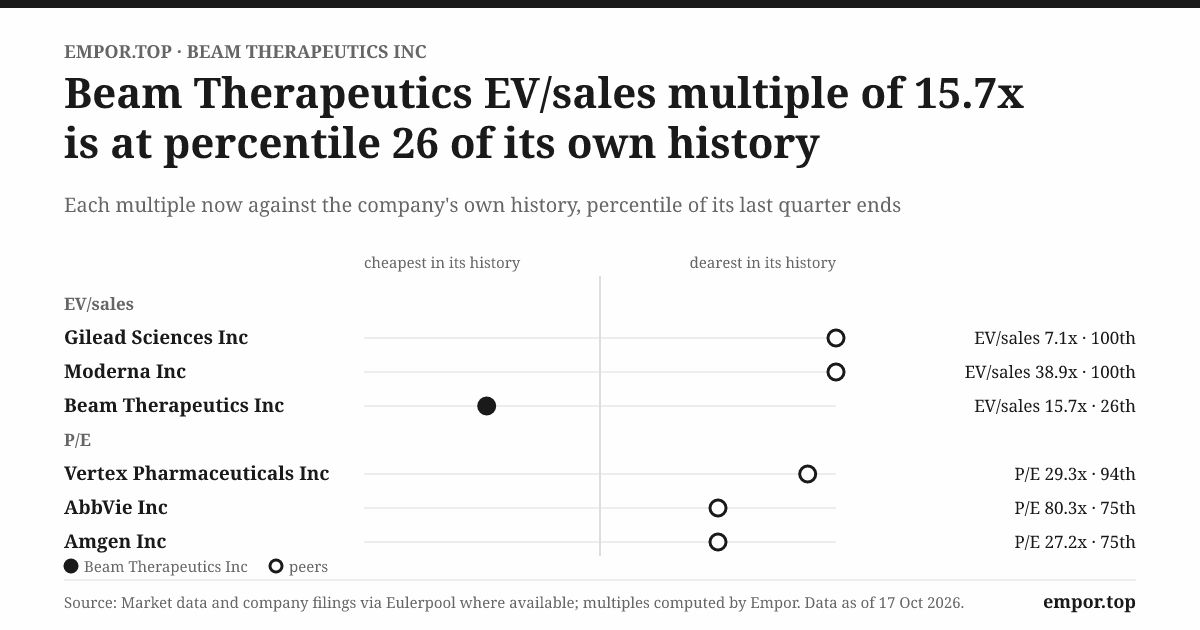
Valuation follows from all this. On October 17, 2026, Beam traded at about 15.6 times trailing sales, with a free-cash-flow yield of about negative 15.5%.1 Both numbers are close to meaningless as conventional measures, because the "sales" are collaboration lumps that have just fallen to zero, and there are no earnings to multiply. A more useful way to read the price is to split it. Cash and securities of about $11 a share, against a share price of about $23.58, mean the market is paying roughly $12 a share, or about $1.2 billion, for the pipeline, the platform and the delivery know-how, net of the cash those will consume.12 Enterprise value of about $1.5 billion is the market's price for everything Beam hasn't yet proven.1
Is that a defensible position or a portfolio of expensive experiments? The fair verdict is in between. Beam has a credible technical thesis and enough breadth to take several shots on goal, which is more than most clinical-stage biotechs can say. It hasn't established a commercial moat, and it won't until clinical differentiation, delivery, safety and intellectual property combine into a product people choose. Whether that happens depends partly on science and partly on the people choosing which programs to fund.
VIII. What the Checks Say About the People and the Plan
When John Evans stood up to present Beam's year-end 2025 results in February 2026, he had a complicated message. Two lead programs were heading toward pivotal and regulatory milestones. Two major research collaborations had ended or were ending. And the company was unveiling its first secured debt facility on the same day.[^9] Credibility, in moments like that, comes less from what a CEO says than from whether earlier promises turned out to be true.
Evans came to Beam with a background in biotech business development, most notably as a senior executive at Agios Pharmaceuticals, a company that took precision medicines from the lab to approval.5 He has led Beam through its IPO, the 2021 boom, the long biotech bear market and the reshaping of its pipeline. His style, as seen in Beam's materials over the years, has been to frame Beam as a long-term platform builder, which is fitting for a company whose products are years away, and also convenient for one whose revenue is erratic.
Pay is the first check. Evans received about $5.8 million in total compensation in 2025, including a $755,000 salary, about $4.4 million in stock and option awards and a cash bonus of about $660,000.9 That was a little lower than in 2024 and 2023.9 The stock-heavy mix links much of his pay to the share price, which is the point. But it's worth stating the obvious: a company with no product revenue and an operating loss near $400 million paid its CEO more than $5 million. Equity awards align upside with shareholders. They don't substitute for commercial proof.
Ownership is the second check, and here the picture is better than many biotechs. Evans owned about 2% of Beam's shares, and executives and directors together owned about 3.8%.9 At today's price, Evans's stake is worth tens of millions of dollars, enough for the stock's direction to matter to him personally. Beyond insiders, ownership is concentrated among institutions: Fidelity at about 12.7%, ARK Investment Management at about 12.4%, Farallon at about 10.1%, and the large index managers Vanguard, BlackRock and State Street with substantial stakes.9 There's no founder control bloc and no dual-class structure. ARK's large position is worth noting because it's a concentrated, thematically driven holder whose buying and selling can move a stock like Beam on its own.
Governance is the third check. Seven of Beam's eight directors are independent, and the board is chaired by John Maraganore, the former CEO of Alnylam, who built one of the few genetic-medicine platforms that grew into a commercial company.9 At the June 2026 annual meeting, the say-on-pay proposal passed with about 98% of votes cast in favor, and the re-elected directors, including Evans and Maraganore, won between about 89% and 99% support.10 That records shareholder approval. It doesn't validate results. The lower end of that range suggests a slice of investors had reservations about at least one director. The same Maraganore sat on Orbital's board alongside Evans, which is part of why the related-party disclosures around the Orbital stake deserve attention.9
There was also management turnover in a sensitive seat. CFO Terry-Ann Burrell resigned effective August 2024, Evans served as interim principal financial officer, and Sravan Emany became CFO in December 2024.12 The handoff was orderly, and Emany arrived in time to run the 2025 equity raise and the Sixth Street negotiations. A short gap in the finance chair isn't a red flag, but for a company where capital raising is a core competency, it's worth remembering.
Capital allocation is the check that matters most, and it should be judged in proportion. The roughly $120 million Guide acquisition bought a capability that now underpins clinical liver programs, and the Orbital stake turned into a $255 million gain when BMS bought the company.[^4]1 Neither was a purchase of a marketed business, and neither proves a repeatable playbook. The late-2023 restructuring, which cut staff after a pipeline reprioritization, shows a willingness to stop work that wasn't earning its keep.1 On the other side of the ledger sit roughly $1.3 billion of cumulative free cash outflow and a doubling of the share count, which is the normal cost of building a biotech but a cost nonetheless.1
The auditors add a quieter signal. Deloitte, Beam's auditor since 2018, issued an unqualified opinion on the 2025 financial statements and internal controls and reported no material weakness.1 Its critical audit matter was the estimation of R&D expense and accruals for clinical service providers, because judging how far along each trial and vendor is requires management judgment.1 That's a standard concern for a clinical-stage company, and a reminder that some of Beam's reported costs are estimates of work in progress. Beam reported no material pending legal proceedings in its 2025 annual report or its mid-2026 quarterly filing.12 The company has no public bond ratings, and conventional checks such as debtor days and inventory turns don't describe a business with no trade receivables and no product inventory.2
The real test of management is the one investors can run themselves. On the February 24, 2026 year-end call and the August 2026 second-quarter call, analysts pressed on pivotal plans, on what replaces the ended collaborations, and on runway.[^17] The question to ask of each answer is simple: did management give concrete timelines and spending implications, or did it lean on the size of the treasury and the promise of the platform? Over the next year, the gap between what Beam said on those calls and what it delivers will be the most honest measure of the people running it.
IX. Analysis & Bear vs. Bull Case
On October 17, 2026, a Beam share cost $23.58, about 38% below its 52-week high of $37.92 and a fraction of the more than $138 it reached in 2021.1 The company's market value was about $2.4 billion, and its free-cash-flow yield was about negative 15.5%.1 Investors at that price are weighing a pile of cash against a stack of trials, and deciding how much to pay for the gap between them.
The bull case starts in the liver. BEAM-302 has produced reported increases in functional AAT, reductions in the toxic mutant protein and follow-up out to 18 months without serious adverse events in the dose-exploration parts of its trial, and it has entered a pivotal cohort aimed at accelerated approval.[^8][^7] If it succeeds, Beam becomes the company that proved one infusion can rewrite a disease-causing letter in a living organ, and every later liver program inherits some of that credibility. In the blood, risto-cel offers a distinct editing mechanism that copies a natural protective variant without breaking DNA, and ESCAPE offers a route to a gentler second-generation treatment.[^9] Behind both sits a treasury of about $1.15 billion plus up to $300 million of milestone-linked debt, enough to fund the next clinical tests without an immediate trip to the equity market.2 And the market, bulls would argue, is pricing all of that at an enterprise value of about $1.5 billion.1
The bear case is just as concrete. BEAM-302 still needs pivotal evidence, longer safety follow-up and FDA agreement on a regulatory path that has no precedent. Risto-cel faces two approved competitors whose slow uptake shows how hard this market is, and it will launch with the same busulfan burden they carry.8 Collaboration revenue has already shown it can fall to zero in a single quarter.2 A clinical failure or delay would burn cash with no product sales to offset it. And the funding stack has gotten costlier: shares have nearly doubled in five years, and the new debt costs about 10.5% a year, sits on top of the equity, and is secured by the intellectual property that is Beam's core asset.2
The moat claim needs a direct test. Bulls say avoiding double-strand breaks makes base editing a safer, better tool. The record so far says this: it's a mechanistic distinction with supportive early safety data, but it hasn't been shown to produce better outcomes than Casgevy, Lyfgenia or other approaches in any comparative evidence. Partner behavior narrows the claim further. Pfizer, after four years of access, licensed one candidate out of three. The history doesn't reject Beam's edge, but it reduces it from a platform moat to a program-by-program contest. The event that would confirm the larger version is BEAM-302 sustaining protective functional AAT in its pivotal cohort with a clean safety record.
The financial-strength claim gets the same treatment. Bulls point to $1.15 billion of liquidity. The record shows operating cash burn of about $345 million in 2025, a 2025 profit picture flattered by the one-off Orbital gain, and repeated reliance on equity raises when deals didn't fill the gap.1 The treasury is a real strength, but a time-limited one. The KPI that settles it is quarterly operating cash burn against new partner cash.
The risks that matter are all tied to the business. Clinical safety and efficacy come first, followed by regulatory endpoints, especially for an in vivo editing therapy with no approved precedent. Manufacturing and treatment logistics determine whether risto-cel can actually reach patients. Partner concentration determines whether non-dilutive money returns. Intellectual-property competition from rival editors and delivery systems could erode the platform's distinctiveness. The cost of capital, now including secured debt, sets the price of every delay. Currency, trade receivables and bond refinancing, the usual items on a risk list, don't apply here: Beam operates in U.S. dollars, has no trade receivables and has never issued public bonds.1
Three numbers deserve most of an investor's attention. The first is BEAM-302's functional AAT level and its durability in pivotal development, measured against the roughly 11 micromolar protective threshold. The earlier dataset showed rising levels with follow-up to 18 months, and the direction from here is the most important fact in the company.[^8] The second is risto-cel's regulatory progress, meaning filing, acceptance and treatment-center readiness, which sits at the edge of a filing after BEACON completed dosing.[^9] The third is quarterly operating cash burn net of new upfront or milestone cash. The latest reading is a quarter with zero revenue, set against a 2025 operating outflow of about $345 million.12
At the October 17 valuation, cash is a substantial floor component, not a valuation answer. A shareholder buying at $23.58 gets about $11 of cash and securities per share and pays the rest for uncertain clinical and commercial success, while knowing that the cash will be spent pursuing that success.12 Whether that price is generous or stingy depends entirely on the next readouts, which is exactly why they matter so much.
X. Epilogue
Tonight, somewhere in a clinical trial site, a patient with alpha-1 antitrypsin deficiency is recovering from a single infusion of BEAM-302, one of the first people dosed in its global pivotal cohort.[^7] Beam has no products for sale, about $1.15 billion of cash and marketable securities at the last count, and a revenue line that read zero in its most recent reported quarter.2 What happens to that patient, and the others enrolled after them, will do more to decide what Beam becomes than anything its executives say.
The next chapters are observable, which is the good news for investors. The first is in the liver. Over the coming quarters, the measure to watch is whether functional AAT in the pivotal population reaches the protective range and stays there, and whether the trial's design satisfies the FDA's requirements for accelerated approval. Success would turn Beam from a platform with promising data into the company that opened a new class of medicine. A shortfall, whether levels fading or a safety signal, would leave Beam with a costly platform and a reason for every partner to wait.
The second chapter is in the blood. Risto-cel now has to move from clinical promise to a credible filing and launch plan. That means a Biologics License Application the FDA accepts, which would also unlock additional Sixth Street borrowing, followed by an FDA decision and the unglamorous work of signing up treatment centers and convincing payers.2 The busulfan step will still be there. The question is whether Beam can win patients in a market that Casgevy and Lyfgenia have shown to be slow, and whether ESCAPE progresses quickly enough to give risto-cel a gentler second act.
The third chapter is about money. Beam has shown it can sign large deals, and also that they end. The test now is whether it can sign new collaborations on terms that fund development without giving away too much of what its programs are worth. A strong BEAM-302 readout would raise Beam's bargaining power overnight. A weak one would shift that power to the partners.
Underneath all three is the runway. The size of the credit facility doesn't settle that question, and neither does the headline cash figure. Reported operating burn and real clinical progress settle it, quarter by quarter. Beam has enough money to reach the next decisive moments. It doesn't have enough to reach many of them twice.
XI. Outro
Go back to that blank line on the second-quarter income statement. Zero revenue, in the same months Beam was preparing to dose patients in a pivotal trial of a medicine that edits DNA inside the body. A conventional balance-sheet story would read that zero as decline. Here it reads more like a clean slate: the end of the partnership era, with only the science, the cash and the people left.
Beam is spending a finite treasury to turn a precise edit into a medicine. The pencil works in the lab and, so far, in a few dozen patients. The edit is only the beginning of the story. Patients, regulators, partners and cash will decide, one trial and one financing at a time, whether it becomes a business.
References
-
Form 10-K for the Fiscal Year Ended December 31, 2025 — Beam Therapeutics Inc., SEC, 2026-02-24 ↩↩↩↩↩↩↩↩↩↩↩↩↩↩↩↩↩↩↩↩↩↩↩↩↩↩↩↩↩↩↩↩↩↩↩↩↩↩↩↩↩↩↩↩↩↩↩↩↩↩↩↩↩↩↩↩↩↩
-
Form 10-Q for the Quarterly Period Ended June 30, 2026 — Beam Therapeutics Inc., SEC, 2026-08-04 ↩↩↩↩↩↩↩↩↩↩↩↩↩↩↩↩↩↩↩↩↩↩↩↩↩↩↩↩
-
Q2 2026 Results, Exhibit 99.1 — Beam Therapeutics, SEC, 2026-08-04 ↩↩
-
Pfizer and Beam Enter Exclusive Multi-Target Research Collaboration — Pfizer, 2022-01-10 ↩↩
-
Form 424B4 IPO Prospectus — Beam Therapeutics Inc., SEC, 2020-02-07 ↩↩↩↩↩↩↩
-
Why Gene Therapy for Sickle Cell Is Slow to Catch On With Patients — Reuters, 2024-09-28 ↩↩
-
2026 Definitive Proxy Statement — Beam Therapeutics Inc., SEC, 2026-04-17 ↩↩↩↩↩↩↩↩
-
Form 8-K, 2026 Annual Meeting Voting Results — Beam Therapeutics Inc., SEC, 2026-06-08 ↩
-
Form 10-K for the Fiscal Year Ended December 31, 2023 — Beam Therapeutics Inc., SEC, 2024-02-27 ↩↩
-
Form 8-K, CFO Appointment of Sravan K. Emany — Beam Therapeutics Inc., SEC, 2024-12-06 ↩
 LinkedIn
 WhatsApp
 Reddit
 Hacker News
 Email
 Kindle
 RSS Feed
 Spotify
 Apple Podcasts
 Amazon Music
 Audible
 YouTube