Anthropic: The Company That Put a Price on Intelligence
I. $83 a Share, and the Clock Starts
On the morning of November 19, 2026, a company that had existed for barely five years became one of the most valuable businesses on any stock exchange in the world. The night before, Anthropic, PBC had priced its initial public offering at $83 a share.1 Nasdaq had already certified its Class A common stock for listing under the ticker ANT, and when the shares began to change hands, the Associated Press described the debut as the biggest IPO on record, as the company traded as a $1.5 trillion business.23
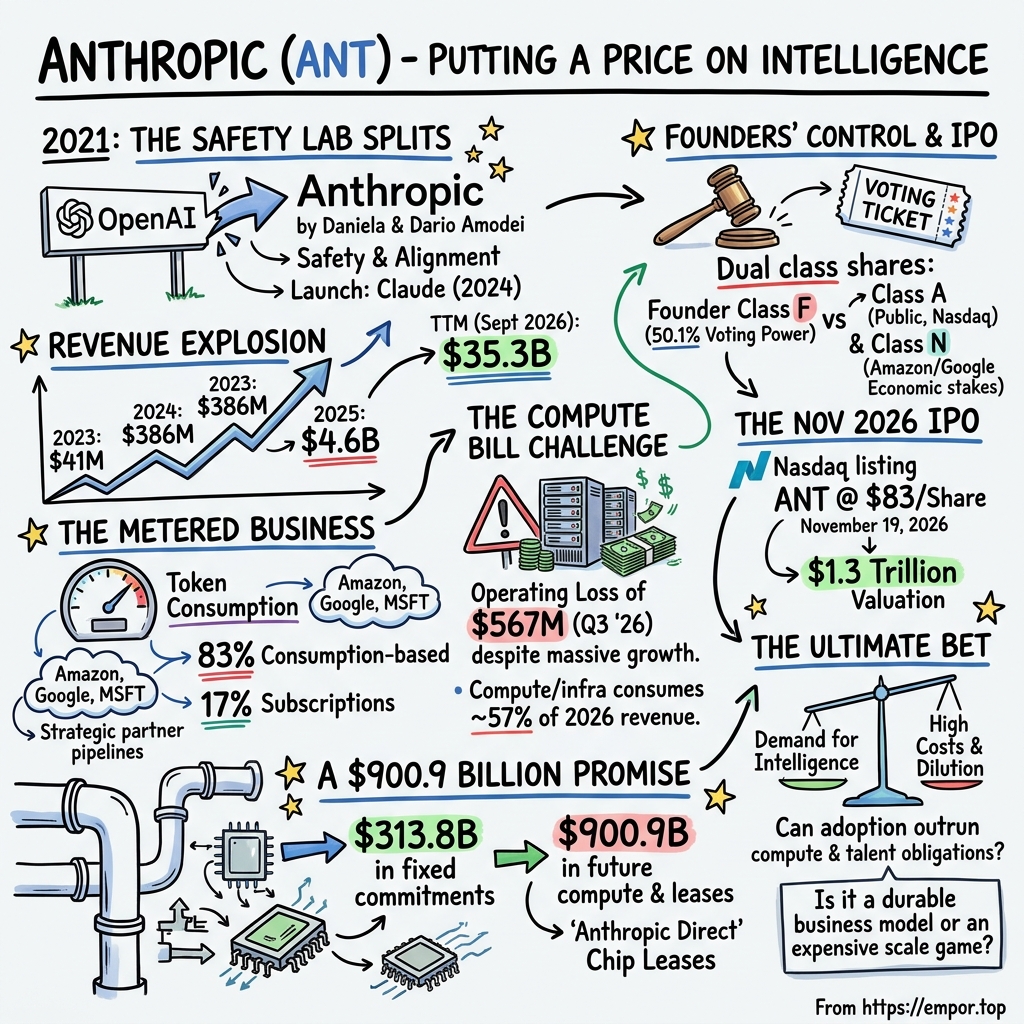
Even at the offering price, before a single public trade, the arithmetic was startling. At $83 a share, Anthropic's market value and enterprise value both came to about $1.3 trillion, roughly 37 times the revenue it had earned over the previous twelve months.4 The revenue itself was the other half of the shock. In 2025 Anthropic took in about $4.6 billion. In the twelve months through September 2026 it took in about $35.3 billion, nearly eight times as much, and the September quarter alone produced around $17 billion.4
Here is the contrast that makes this story worth telling slowly. A business adding revenue at a pace almost no company has ever recorded was, over the same twelve months, still losing money on an operating basis, and its headline net loss ran to about $121 billion.4 Most of that net loss was an accounting effect that will need careful unpacking later. But the operating loss was real, and so were the obligations sitting behind it: hundreds of billions of dollars of promises to buy computing capacity over the next two decades.4
That is why the IPO is less a finish line than a starting gun. Four questions were set in motion on listing day, and every later chapter of this story returns to them. The first is whether Claude, the family of AI models Anthropic sells, can keep winning customers in a market where rivals release new models every few months. The second is whether that usage can produce profit once the cost of the computers that run the models has been paid.
The third is whether Anthropic can meet its enormous capacity commitments without returning to investors again and again for fresh capital. And the fourth is how much say the people now buying its shares will actually have, given that the founders kept majority voting control.1
It helps to be precise about what investors bought. The listed company is Anthropic, PBC, a Delaware public benefit corporation, together with its subsidiaries.1 It is not a holding company sitting above some larger empire. Its most important partners, Amazon, Google and Microsoft, appear throughout its prospectus in three roles at once: as investors, as suppliers of computing power, and as sales channels through their cloud marketplaces.4 Those companies' own vast businesses are not Anthropic's revenue. What flows to Anthropic is the money customers pay to use Claude, whether they pay Anthropic directly or through a cloud provider's storefront.
The paper trail to this morning was short and fast. Anthropic filed its registration statement publicly on October 26, 2026, amended it for the third time on November 17, and the Securities and Exchange Commission declared it effective on November 18.56 The final prospectus followed on listing day.1 Three weeks from first public filing to first trade was brisk for any company.
For a company asking public investors to absorb an offering of this size, the response said a great deal about the appetite waiting on the other side of the order book, and Axios summed up the mood in a headline: Claude, it said, crushed it on Wall Street.7
Appetite is not the same as proof. The 37-times sales multiple is computed on trailing revenue through September 2026, which captures a business still growing at a pace that cannot last forever. There is no record of how Anthropic's shares behave through a disappointing quarter, a model launch by a competitor, or a quarter where the company misses its own plan. The IPO gives Anthropic a public price and a great deal of public money. It does not, by itself, tell anyone what the business is worth.
What the listing does do is start a clock. From now on, every quarter will produce a public report card on whether fast-growing usage can pay for the chips, data centers and people that make it possible, and for the long-dated promises that stretch well beyond the next few quarters. To understand why those promises exist, and why the company that made them looks the way it does, the story has to go back to 2021, when a small group of researchers walked out of the most famous AI lab in the world and decided to build a rival.
 Subscribe on LinkedIn
II. The Safety Lab Leaves OpenAI
In 2021, a group of senior researchers at OpenAI made a decision that, at the time, looked more like a philosophical protest than a business plan. Led by the siblings Dario and Daniela Amodei, they left to start a new company devoted to AI research and safety.4 They called it Anthropic, a word that means "relating to human beings," and the name was a statement of priorities. The company they built would chase the most capable AI systems it could create, but it would do so while trying to understand and constrain them.
Dario Amodei was the scientist of the pair. Trained as a physicist, with a doctorate from Princeton and research in biophysics before he turned to machine learning, he had worked at Baidu and Google before joining OpenAI, where he rose to lead research.4 He was known in the field for two convictions that sat uneasily together.
One was that scaling up neural networks, feeding them more data and more computing power, would keep making them dramatically more capable. The other was that this very success made the systems potentially dangerous, and that the people building them had an obligation to study the risks while they still could.
Daniela Amodei brought a different kind of rigor. She had worked in operations and risk at Stripe before joining OpenAI, where she managed safety and policy work.4 If Dario was the one who could explain why scaling laws mattered, Daniela was the one who could turn a research group into an organization that hired, paid, sold and complied. At Anthropic she became president.4 The division of labor mirrored the company's dual identity: a frontier laboratory on one side, a functioning enterprise on the other.
They did not leave alone. The company counts seven co-founders, among them Jared Kaplan, a theoretical physicist whose work on how model performance improves with scale became foundational to the field; Tom Brown, who had led engineering on OpenAI's large language models; Sam McCandlish; Chris Olah, a pioneer of interpretability research, the effort to see what is actually happening inside a neural network; and Jack Clark, a former journalist who had run policy at OpenAI.4
The seven co-founders receive equal compensation, according to the prospectus.4 It is the kind of arrangement that reads as a founding pact rather than a pay policy.
Why build a separate company rather than argue from within? The founders' public explanation was that safety research had to happen at the frontier, on the most powerful models, because the risks of weak models tell you little about the risks of strong ones. But being at the frontier is expensive. It means training models that cost hundreds of millions and then billions of dollars, which means raising enormous amounts of money, which means selling a product.
The founding bargain, in other words, contained its own tension from the first day: to study the most powerful AI safely, Anthropic would have to build it, and to build it, Anthropic would have to commercialize it.
The corporate form was designed to hold that tension. Anthropic was organized as a public benefit corporation, a Delaware structure that obliges directors to balance the financial interests of shareholders against a stated public purpose and the interests of people affected by the company's conduct.1 In plain terms, the charter gives the board permission, and in some sense a duty, to make choices that may not maximize near-term profit if they serve the mission.
Anthropic's public purpose is framed around the responsible development of advanced AI for the long-term benefit of humanity.4 Investors buying ANT bought into that charter. They own shares in a company that is legally allowed to say no to some profitable things.
For its first two years, Anthropic was mostly a research organization with a product attached. It reported its first commercial revenue in 2023: about $41 million.4 That is a rounding error next to what came later, but it marked the moment the lab became a vendor. The real change came in 2024, when Anthropic launched the Claude 3 family of models.
The new generation came in several sizes, from fast and cheap to large and capable, and the prospectus credits it with widening the range of tasks customers could hand to Claude and accelerating adoption.4 Revenue rose to about $386 million that year, almost ten times the year before.4
That jump is the first piece of hard evidence in this story, and it is worth being careful about what it proves. The consensus narrative, repeated in many profiles of the company, is that Anthropic's safety focus became a commercial advantage: that enterprises, wary of AI's risks, chose the careful lab. It is a tidy story. It may even be partly true. But the record that Anthropic itself has put in front of investors does not establish it.
The prospectus describes the company's safety commitments and research at length, yet it offers no evidence that those commitments independently won contracts, raised prices or reduced customer churn.4 What the revenue data shows is that customers started buying more Claude once Claude 3 made it more useful. That is a capability story, not a principle story.
The skepticism did not come only from analysts. In the week before the listing, The Atlantic ran a piece under the blunt headline "Who Is Anthropic Kidding?", questioning how a company founded on caution about AI could square that identity with a trillion-dollar listing built on selling as much AI as possible.8 Two days later the same magazine cast the company as "the reluctant winner of the AI race."9 Both framings capture something real. Anthropic's founders set out to slow down a race and ended up near the front of it.
None of that makes the safety mission irrelevant to investors. It shapes product choices, such as what Claude will and will not do, and it may shape how regulators and large enterprises view the company. It also carries costs that a pure profit-maximizer might avoid, from research teams that do not ship products to deployment decisions that leave revenue on the table. The honest verdict is that the founding split explains who Anthropic is, but it does not explain why customers pay. That has to be tested through what they buy, how much, and whether they stay.
So the question changed shape once Claude was sold at scale. The issue was no longer whether a safety-minded lab could build a competitive model. It was whether a model could become a service that customers used every day, the way a company uses electricity or cloud storage, and whether the bill would keep rising as they did.
III. Claude Becomes a Metered Business
Picture a developer at a mid-sized software company on a Tuesday afternoon. The team has been testing Claude to summarize support tickets, and it works, so they wire it into the production system. Next month, they add code review. The month after, a sales team starts drafting proposals through it. Nobody signs a new contract at any of these moments. The bill simply goes up, because every request sent to Claude and every answer returned are measured, and the meter keeps running.
That meter is the core of Anthropic's business. The unit it counts is the token, a chunk of text roughly the size of a short word or part of a longer one. Customers pay for the tokens they send in and the tokens Claude sends back, and the price per token depends on which model they choose: the largest, most capable models cost more per token than the smaller, faster ones.4
Think of it as a utility tariff for thinking. A customer who asks a small model to classify an email pays a little; a customer who asks the most powerful model to read a long contract and draft an analysis pays much more.
This metered, consumption-based revenue supplied about 83% of Anthropic's revenue in 2025 and about 79% in the first nine months of 2026.4 The rest came from subscriptions: monthly or annual plans for individuals and teams who use Claude through its own apps, with terms that generally run twelve months or less.4 So for every $5 Anthropic earned in 2026, roughly $4 came from the meter and $1 from a subscription.
The shift between those two years is small but meaningful. Subscriptions rose from about one-sixth of revenue to about one-fifth, while total revenue was multiplying many times over.4 That means subscription revenue grew even faster than the business as a whole, which suggests that more people and teams were paying for Claude as a daily tool rather than only as a component inside someone else's software. Subscriptions are not permanent, since most last a year or less, but they are more predictable than the meter. A subscriber pays whether they have a busy month or a quiet one.
The meter has a seductive property. When a customer's business grows, or when they find new uses for Claude, Anthropic's revenue grows automatically, without a sales call. This is the same dynamic that made the big cloud computing businesses so powerful: land a customer with a small workload, and let usage expand. It also means Anthropic's revenue can respond to workload growth almost instantly, which helps explain how quarterly revenue more than tripled between March and September 2026.4
But the meter runs in both directions. Revenue that rises with usage can fall with usage. If a customer finds a cheaper model that does the job well enough, it can route the next million requests elsewhere, sometimes by changing a few lines of code. If a customer's own business slows, its AI bill slows too. Anthropic itself warned that rapid technical progress can make models obsolete and that competitors may reach comparable capabilities.4 In a metered business, those warnings translate directly into revenue risk, because there is often no contract standing between a customer's decision and Anthropic's top line.
Large enterprises add a layer of commitment. Anthropic says its bigger customers increasingly sign annual or multi-year agreements with non-cancelable minimum spending commitments.4 Under these deals, the customer promises to spend at least a set amount over the term, usually in exchange for better pricing or guaranteed capacity, and pays for usage against that commitment. It is a bit like a mobile phone plan with a minimum monthly bill: the customer can use more, but cannot easily use less.
Here is where the investor has to stop and notice what is missing. Anthropic does not disclose what share of its total revenue is covered by these minimum commitments.4 It might be a small sliver of the business or a large foundation; the company does not say. That single absence changes how the revenue should be read. Without it, nobody outside the company can separate revenue that is contractually promised from revenue that depends on customers continuing to choose Claude, day after day, request by request. The durability of the revenue base is only partly measurable.
There is one clue that works in the company's favor. Deferred revenue, money customers have paid in advance for services not yet delivered, rose from about $269 million at the end of 2025 to almost $2 billion by September 2026.4 Customers do not prepay for things they plan to abandon next month. That increase suggests that more customers were willing to commit cash upfront, whether through annual subscriptions or enterprise agreements. Set against quarterly revenue of $17 billion, though, $2 billion of prepayments is a modest cushion: well under two months of sales.4
What are customers actually doing with all those tokens? The prospectus describes a broad spread of uses, from software development, where tools such as Claude Code let programmers hand whole tasks to the model, to customer service, document analysis and research.4 Coding, in particular, became one of the most visible workloads in the AI industry during 2025 and 2026, because a programmer working with an AI agent can consume vastly more tokens than a person chatting with a chatbot. An agent that reads a codebase, writes changes, runs tests and tries again might send thousands of requests to complete a single task.
That observation matters for the economics, but it should not be stretched. Anthropic does not break out revenue by product, by use case or by customer industry.4 Claude Code and other tools are evidence that customers are routing broader and heavier workloads through Claude. They are not, on what the company discloses, separate financial engines whose revenue or margins can be measured on their own. A product launch is not a revenue line until the company reports it as one.
The metered model also answers a question that often confuses newcomers to AI businesses: why does revenue move so fast? A traditional software company sells seats, and adding seats requires salespeople, procurement cycles and budget approvals. A token business can see a single large customer double its usage in a month because it moved one product feature onto Claude. That is the upside. The same speed is why a single quarter's growth rate says less about the next quarter than it would at a seat-based company. Momentum in usage is real, but it is not locked in.
So the business Anthropic took public is, at its heart, a meter attached to a very expensive machine. Customers pay by the token, some promise minimum spending, a growing minority subscribe, and the company does not say how much of the whole is contractually committed. That leaves the question that matters most for the next chapter. Every token that Claude produces has to be computed on a chip, in a data center, drawing power, and someone has to pay for that.
As usage scales, does the cost of serving each additional request fall, the way it eventually did for the great cloud businesses? Or does the cost of computing absorb the growth as fast as it arrives?
IV. Growth Meets the Compute Bill
The September quarter of 2026 should have been a victory lap. Anthropic recorded revenue of about $17.0 billion in those three months, more than eleven times what it had earned in the same quarter a year before.4 It was the kind of number that, in most industries, would describe a full year for a large established company. And yet, in that same quarter, Anthropic lost about $567 million at the operating level, after earning an operating profit of almost $1 billion in the quarter before.4 The company had crossed into profitability for exactly one quarter and then stepped back out.
To see why, start with the revenue curve, because it is genuinely extraordinary. Anthropic went from about $41 million in its first commercial year, 2023, to about $386 million in 2024, about $4.6 billion in 2025, and about $33.2 billion in just the first nine months of 2026.4 Revenue grew roughly tenfold in each of the first two years.
In 2026 the pace did not slow so much as compound: revenue in the first nine months of the year was more than seven times the total for all of 2025.4 There are very few precedents for a company of this size growing at this rate, and none in enterprise software at this scale.
Now put the cost of producing that revenue beside it. In the first nine months of 2026, Anthropic spent about $18.8 billion on compute and infrastructure, the chips, data centers, networking and power needed to train and run its models.4 That is about 57% of revenue. Put simply, of every $100 a customer paid Anthropic, about $57 went straight to the machines.
Compare that with what investors are used to in software. A mature software company might spend a small fraction of each sales dollar on the servers that deliver its product, because once code is written, serving one more customer costs very little. AI models do not work that way. Every answer Claude gives requires fresh computation, and the largest models require a lot of it.
Compute behaves less like the fixed cost of software and more like the raw material of a manufacturer: it rises with every unit sold. That is the single most important fact about Anthropic's economics, and it is why the "software multiple" instinct many investors bring to this stock deserves suspicion.
The machines were not the only rising cost. Anthropic no longer reports research and development as a separate line; instead, it groups its operating costs into compute and infrastructure, personnel, sales, marketing and partnerships, a litigation settlement charge, and other operating and administrative costs.4 Working backward from the reported totals is revealing. Over the first nine months of 2026, Anthropic's operating loss was about $1.3 billion on $33.2 billion of revenue.4
Subtract the compute bill, and everything else, the people, the sales and partnership costs, the offices and administration, came to roughly $15.7 billion, or about 47% of revenue. So the full picture of each $100 of revenue looks like this: about $57 for compute, about $47 for everything else, and a loss of about $4.
One good quarter, then a step back
The quarterly sequence tells a more dramatic story than the nine-month total. In the March quarter of 2026, Anthropic's operating margin was about negative 35%. In the June quarter it swung to about positive 8%. In September it fell back to about negative 3%.4 It is tempting to draw a straight line through the first two quarters and call it operating leverage, the point at which revenue grows faster than costs and profits begin to compound. The September quarter is a warning against drawing that line too early.
The arithmetic between quarters shows why. From March to June, revenue grew by about $6.9 billion, while total operating costs grew by only about $4.2 billion, so roughly 40 cents of every new revenue dollar dropped through to operating profit. That is what leverage looks like. From June to September, revenue grew by another $5.4 billion, but costs grew by about $6.9 billion.4 In that quarter, each extra dollar of revenue came with about $1.28 of extra cost. The leverage of the spring did not merely fade; it reversed.
Several explanations fit those numbers. A company racing to add capacity typically pays for new data centers and chips before they are fully used, so cost arrives ahead of revenue. Personnel costs were climbing too: headcount reached about 5,300 by September 2026, up roughly 170% in a year.4 Sales and partnership costs, which include the fees paid to cloud marketplaces, rise with revenue sold through those channels.4
Each of these is plausible, and each implies a different future. If September's loss reflects capacity bought ahead of demand, margins could recover as that capacity fills. If it reflects pricing pressure, they may not. One profitable quarter followed by a loss is not enough to tell the difference.
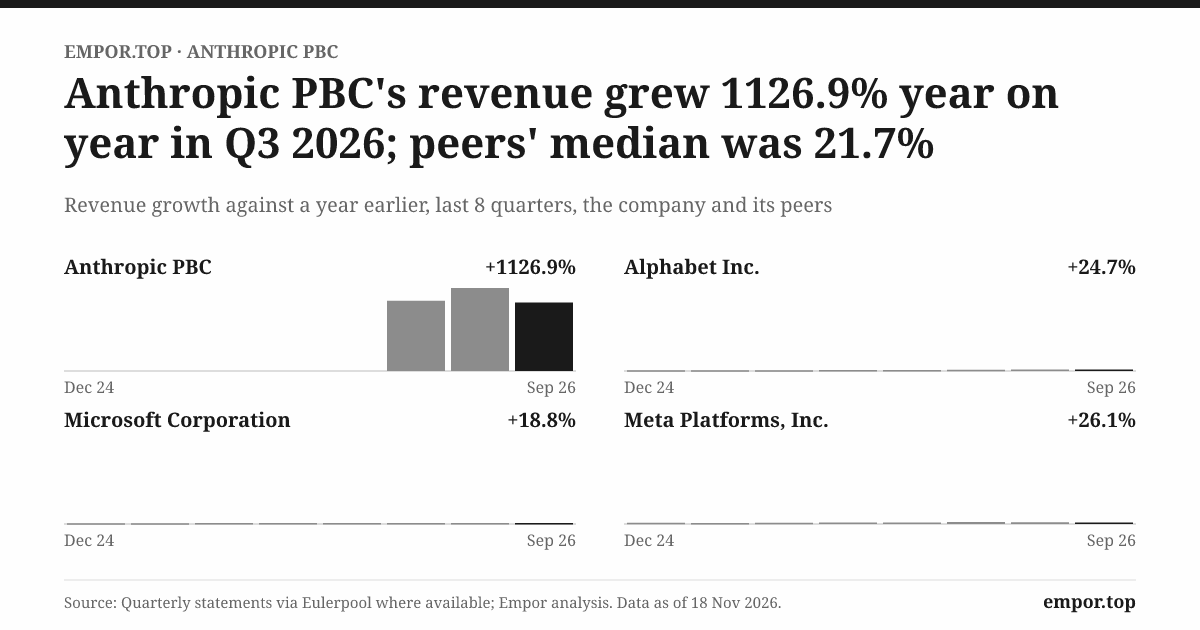
Contemporary reporting added a less comfortable possibility. In its coverage ahead of the IPO, Reuters described Anthropic's rapid growth alongside spiraling costs, and noted competition from OpenAI and from Chinese AI models as factors affecting its share of the market.10 The growth figures support the same reading. Revenue growth in the September quarter, compared with a year earlier, was about 1,127%, down from about 1,368% in June.4 At those rates the word "slowdown" sounds absurd, and it is still enormous growth. But direction matters. The growth rate peaked in the June quarter, and the September quarter was the first in which it fell.
The loss that is not really a loss
Then there is the headline number that will appear on every financial data screen: a net loss of about $121 billion over the twelve months through September 2026.4 For a company with $35 billion of trailing revenue, that looks like a catastrophe. It is mostly something else.
For years, Anthropic raised money not only by selling shares but through instruments that convert into shares later: convertible notes, particularly from Amazon, and SAFEs, a common startup contract that promises investors equity at a future funding round. It also had derivative contracts tied to its financing.4 Accounting rules require these to be valued at fair value each quarter.
Here is the twist. When Anthropic's own valuation soars, the shares those instruments will convert into become more valuable, so the liability on Anthropic's balance sheet grows, and that increase is recorded as a loss. The better the company did in the private markets, the bigger its accounting loss became.
The scale of this effect is enormous. In the June quarter of 2026 alone, the change in fair value of these instruments was a charge of about $59.6 billion; over the first nine months of 2026 it totaled about $94.3 billion.4 None of that was cash leaving the company. In the same nine months, Anthropic's net loss was about $104 billion, yet its operating activities generated about $6.6 billion of cash.4
The headline loss tells investors that the company's capital structure was expensive to unwind and that early investors converted on generous terms. It does not tell them that Anthropic spent $121 billion. The operating line, a loss of about $4.1 billion over the twelve months, is the number that describes the business.4
There was one genuinely unusual cash cost in the record. In 2025, Anthropic recorded a $1.5 billion charge to settle Bartz v. Anthropic, a class action brought by authors over the use of copyrighted books in training data.411 That charge sits in the operating results for 2025 and is a reminder that the raw materials of AI, the text and images models learn from, carry legal costs that are still being priced.
Strip away the accounting noise, and the verdict on this chapter is clear. Anthropic has demonstrated demand of a kind almost no company has ever seen. It has not demonstrated stable operating leverage. The company's own cost structure says that more than half of every revenue dollar goes to compute, and the most recent quarter says that the cost of serving new revenue can outrun the revenue itself.
The question that settles this is testable, and the first answers will arrive within months. Once the capacity Anthropic is now paying for has been delivered and put to work, does the operating margin climb and stay positive across several quarters? Or does competition force price cuts that keep each token expensive to produce relative to what customers will pay? The answer depends partly on Anthropic's own engineering and partly on something it controls far less: the companies through which it reaches customers, and from which it buys its computing power.
V. The Moat Is Also a Supply Chain
Imagine a bank's technology team deciding how to buy Claude. It already runs most of its systems on one of the big cloud platforms, so the simplest route is to open that platform's marketplace, select Claude, and charge the usage to the existing cloud bill. No new vendor review, no new procurement contract, no new payment system. The purchase takes an afternoon. What the bank may never think about is that the cloud provider whose storefront it just used could also be one of Anthropic's largest shareholders, one of its biggest suppliers of computing power, and, in some product lines, a competitor.
That scene captures the double edge at the center of Anthropic's market position. Start with the side that looks strongest. In the first nine months of 2026, no single customer accounted for more than 10% of Anthropic's revenue, and the top five customers together made up about a quarter.4 More telling is the direction. In the March quarter of 2026, about 64% of revenue came from customers outside the top five; by the September quarter, that share had risen to about 79%.4
Put differently, the five biggest customers went from supplying more than a third of revenue to roughly a fifth within six months, even as total revenue more than tripled.
That is a meaningful shift. Early-stage AI companies often depend on a few giant contracts, and a single renegotiation can wipe out a quarter. Anthropic's customer base was broadening fast, which reduces the risk that any one buyer can dictate terms. Anthropic does not name its largest customers in the concentration disclosure, and it does not give comparable top-five figures for 2025, so the trend cannot be traced further back.4 But on the evidence it does provide, customer concentration is real without being extreme.
Now turn the coin over. About 44% of Anthropic's revenue in the first nine months of 2026 came through cloud marketplaces, the storefronts run by Amazon Web Services, Google Cloud and Microsoft's Azure.4 The marketplace takes a fee, and Anthropic records those fees within its sales, marketing and partnership costs.4 Distribution through the clouds is a superb way to reach customers who already trust those platforms with their data. It is also a toll road. For nearly half the business, someone else owns the customer's billing relationship and collects a cut on the way.
Reuters put it starkly when it first reported on the prospectus in September, describing a filing that laid bare Anthropic's deep dependence on its Big Tech partners.12 The dependence runs on several tracks at once. Amazon and Google are among Anthropic's largest economic owners. They, along with Microsoft, supply much of the computing capacity Anthropic uses to train and serve Claude. They operate the marketplaces through which a large share of its customers pay. And Google, through its Gemini models, sells directly competing AI.4 Few businesses have ever had their landlord, banker, shopkeeper and rival so thoroughly overlapping.
The financing ties are concrete. Amazon's investment came partly through convertible notes that can turn into stock or, in some circumstances, be settled in cash or set off against amounts Amazon owes Anthropic under their commercial agreements.4 Some of those notes carry no interest and mature in 2034.4 Google provided financing through its own arrangements.4 This is not unusual in a capital-hungry industry, but it means that the line between an investment, a supply contract and a sales channel is genuinely blurry.
A dollar that Amazon invests may come back to Amazon as payment for compute, while a dollar a customer pays through Amazon's marketplace passes through Amazon's hands before it reaches Anthropic.
An investor would naturally want to know how much revenue and cost runs through these related parties in total. The answer is that Anthropic does not publish one consolidated, reliable figure.4 It discloses the marketplace share of revenue, and it describes the financing arrangements in detail, but it does not provide a single schedule summing revenue received from, and costs paid to, its strategic investor-suppliers.
The 44% marketplace figure is not the same thing: some of that revenue comes from customers who simply chose a convenient route to buy, and the fees are only a slice of it. The relationships are disclosed. Their combined economics are not.
The competitive field adds pressure from the other side. OpenAI, the company the founders left, remains the most prominent competitor for model demand, and Google's Gemini competes both as a model and as part of a cloud platform that bundles it with everything else Google sells.4 Low-priced models from Chinese developers have also emerged as an option for cost-sensitive workloads, and contemporary reporting linked them to pressure on Anthropic's share.10 In a metered business, the competitor does not need to win the whole customer. It needs to win the next workload.
So does Anthropic have a moat, an advantage that customers cannot easily replace? The strongest evidence for one is behavior: the customer base broadened, and concentration fell. Those are signs of adoption and, plausibly, of preference. But a moat is tested by what happens when a rival offers something comparable for less, and the record Anthropic has put before investors does not contain the evidence that would settle it.
There is no multi-year retention series, no customer-level churn rate and no history of price realization showing whether Anthropic has held its prices as competitors cut theirs.4 Usage growth in a market that is itself exploding can come from many customers using a little more of everything.
The honest verdict on the moat, then, is that it is intact but unproven. Distribution through three clouds widens Anthropic's reach in a way no single-cloud rival can match, and customer concentration is moderate and falling. Yet marketplace dependence means a large share of revenue rides on partners who also supply Anthropic's costs, finance its balance sheet and, in Google's case, compete for the same customers. Distribution through a partner can bring access, but it can also bring fees and bargaining power that flow the other way.
The test that would confirm or break the claim is specific. If Anthropic can raise the share of revenue it bills directly, while keeping net retention high and prices steady as rivals launch new models, its moat becomes visible. If marketplace share rises and pricing softens, the moat is narrower than the growth suggests.
And the leverage that matters most may not be on the sales side at all. The same cloud giants that sell Claude are the ones Anthropic depends on to build the machines that run it, which is why the most consequential numbers in its prospectus are not about customers. They are about capacity.
VI. A $900.9 Billion Promise of Capacity
Somewhere in the long middle of Anthropic's prospectus is a phrase that marks a strategic turn: "Anthropic Direct." For most of its life, Anthropic rented computing power from the big cloud providers, paying for capacity much as a startup pays for servers. Anthropic Direct describes a different approach, one in which the company leases chips and dedicated facilities itself rather than buying everything as a cloud service.4 It is the moment a tenant starts signing its own leases and planning its own buildings.
The logic is that of a chess player thinking several moves ahead. Under the cloud-only model, Anthropic paid for chips and data centers as one bundled service, on the provider's schedule and at the provider's price. By separating the two, it can secure data center space and power early, which are the slowest things to build, while deferring some of the largest decisions about which chips to buy until it knows more about what it will need.4
A data center takes years; a new generation of AI chips arrives every year or so. Locking in the building while keeping the choice of chips open is a way of buying time and flexibility in an industry where both are scarce.
The scale of what Anthropic has committed to is the most striking set of numbers in this entire story, and it is easy to misread, so it is worth going slowly. There are two different figures, describing two different things.
The first is narrower and more certain. At September 30, 2026, Anthropic had about $313.8 billion of expected future payments under compute and infrastructure commitments that are fixed or carry guaranteed minimums, with terms ranging from one to twenty years.4 These are the obligations Anthropic must pay whatever happens to demand. Nine months earlier, at the end of 2025, its remaining non-cancelable commitments had been about $54.6 billion.4 In three quarters, the fixed promise had grown nearly sixfold.
The second figure is broader. Counting commitments and leases entered into as of September 30 and in the weeks after it, including short-term commitments and leases that had not yet begun, Anthropic disclosed aggregate commitments of roughly $900.9 billion.14 Of that, about $451.6 billion is expected to be paid before 2031, and about $70.7 billion in the next twelve months.1
Some of these arrangements have no fixed minimum, so the eventual payments are not yet determined, though the company expects them to be significant.4 The two figures should never be added together or used interchangeably. One is the floor Anthropic is contractually locked into. The other is the full scope of the building program it has set in motion.
To give those numbers a human scale: the broader commitment of about $900 billion is more than 25 times Anthropic's trailing twelve-month revenue. Even the narrower fixed floor, $313.8 billion, is close to nine times trailing revenue. A homeowner who signed a mortgage nine times their annual income would be considered heavily stretched. A homeowner who signed up for a building program 25 times their income would be considered either visionary or reckless, depending on whether their income kept growing.
Anthropic's case is that its income will keep growing. It has lived through a period in which demand repeatedly outran capacity across the industry, and it argues that securing capacity is the precondition for capturing demand. That claim has real support in its own record: revenue has grown rapidly, and a company that cannot serve demand loses it to a rival that can.
But the claim also has a falsifying condition built into it. If demand grows more slowly than the capacity arrives, or if prices per token fall faster than volumes rise, the commitments do not shrink. They become fixed costs attached to a smaller business.
The cash that buys the time
Against that schedule, Anthropic's liquidity is substantial. At September 30, 2026, it held about $131.9 billion of cash and short-term investments, mostly money-market funds, U.S. Treasuries and agency securities, corporate debt and commercial paper.4 That cushion earned it about $2.4 billion of interest income in the first nine months of the year, ten times the prior-year period.4 The IPO adds to it: Anthropic sold about 956.4 million new shares at $83, which works out to roughly $79 billion before underwriting costs, alongside a concurrent $26 billion private placement of Class N shares.1
The next twelve months of broader committed payments, about $70.7 billion, are covered several times over by the cash on hand and raised at listing.
That is the reassuring view, and it is accurate for the near term. The less comfortable view looks beyond the first year. The roughly $451.6 billion expected before 2031 is more than the company's cash, its IPO proceeds and its private placement combined, so Anthropic's ability to meet it depends on operating cash generation, more financing, or both.
Anthropic had to raise money repeatedly to reach this point, through preferred stock, SAFEs, convertible notes and partner financing.4 The question is not whether it can pay next year's bills. It is whether the business will generate enough cash, quickly enough, to keep the schedule from requiring a steady stream of new shares.
The debt picture is moderate relative to these figures, but it needs careful definitions. Anthropic reported about $6.2 billion of indebtedness at September 30, 2026, all of it the Amazon convertible notes.4 It also has a $14.8 billion revolving credit facility, a bank line it can draw on when needed, on which nothing was drawn at that date.4 Financial data services classified a much larger amount, about $41.8 billion at the end of 2025, as borrowings, but that figure sweeps in convertible financing and other balance-sheet items rather than conventional funded debt, so the instrument-level disclosures are the better guide.4
The credit facility comes with guardrails. It is secured by substantially all of the assets of Anthropic and its guarantor subsidiaries, and starting with the quarter ending December 31, 2026, it requires Anthropic to keep at least $5 billion of liquidity.4 Anthropic also guarantees certain infrastructure obligations of its subsidiaries.4 With well over $100 billion of cash, the $5 billion floor is not tight today.
It becomes relevant only in a scenario where the commitment schedule drains cash faster than the business replenishes it, which is precisely the scenario the skeptics worry about. No credit rating agency rationale appears in the offering documents, so there is no independent credit opinion on the company to weigh alongside its own disclosures.1
It is also worth noticing what Anthropic is not doing with its capital. The prospectus foregrounds people, compute and infrastructure. It does not describe a transformative acquisition, and while it refers to equity grants connected with acquisitions, it gives no deal-by-deal record that would allow anyone to judge whether past purchases created value.4 For now, Anthropic's capital allocation is almost entirely a single bet: buy capacity, hire researchers, and serve demand.
Its actual spending on property and equipment was still modest in 2026, about $925 million in the first nine months, plus nearly $2 billion of prepayments for leased assets and equipment, but the company says capital spending is expected to increase significantly.4 The commitments are where the real capital allocation decisions live.
So the hardest operating question in the whole story is not a revenue number at all. It is the relationship between three things: what the delivered compute costs, how fully it is used, and how those compare with the contractual payments coming due. A data center running at full utilization serving paying customers turns a commitment into a profit engine.
A data center half full turns it into a burden. Bookings and announcements will not settle this; only delivered capacity, utilization and cash generation after capital spending can. And because public shareholders cannot see inside that machine, the next question is how much power they have over the people who are building it.
VII. The Founders' Company Goes Public
Every IPO is a transfer of something. Usually it is a transfer of ownership and, with it, a share of control: the founders and early investors sell part of the company, and new shareholders gain a voice in how it is run. Anthropic's offering transferred a great deal of ownership. It transferred very little control.
The numbers on the offering itself show a company raising capital rather than cashing out. Of the 980 million Class A shares sold in the IPO, about 956.4 million were new shares issued by Anthropic, with the proceeds flowing to the company, and only about 23.6 million were sold by existing holders.1 The underwriters also had an option to buy up to 147 million additional new shares.1
Alongside the public offering, Anthropic sold $26 billion of Class N shares in a concurrent private placement.1 Almost all of the money raised went into the company's treasury, which is consistent with a business whose central problem is funding capacity.
To understand who controls what, it helps to picture three doors into the company, each with a different key. Class A shares are the public shares: they carry economic ownership and votes, and they are what trades on Nasdaq as ANT. Class N shares carry economic ownership but are generally non-voting while held in that form; they convert into voting Class A shares on certain transfers.4 And Class F shares, held by the founders, carry voting power sized to keep the founders at 50.1% of total voting power.4
That 50.1% is the most important governance fact about Anthropic. It means that, as long as the structure holds, the founders can decide any ordinary shareholder vote. Public Class A holders can buy as much of the company as they like and still not outvote them. The structure is common in technology IPOs, where founders argue that long-term bets need protection from short-term market pressure. In Anthropic's case, the argument has an additional layer: a public benefit corporation whose mission may sometimes conflict with profit maximization is designed to resist exactly the pressures that public shareholders sometimes bring.
The two largest economic owners sit behind the second door. Immediately before the offering, Amazon held about 1.92 billion Class N shares and Google about 1.65 billion.4 At the IPO price, those stakes were worth roughly $160 billion and $137 billion respectively. They are enormous economic positions, held by companies that also supply Anthropic's compute and sell its models through their clouds. But because Class N is non-voting while it stays Class N, those stakes do not by themselves give Amazon or Google ordinary voting control. The design keeps the strategic partners economically committed without letting either one steer the company through the ballot box.
The people running the company are the founders who built it. Dario Amodei is chief executive and Daniela Amodei is president; Krishna Rao, who joined from outside the founding group, is chief financial officer.4 Among the seven co-founders, only the Amodeis are executive officers, and Rao is the only other one.4 The equal-pay pact among the founders carries over into the public company, and Anthropic says it uses market-based cash and equity compensation for its employees, reviewed twice a year.4 What it cannot yet offer is a multi-year record of executive pay set against performance, because it has never had to publish one.
There is one piece of behavior worth weighing carefully. Before the IPO, the founders sold shares in tender offers, organized sales in which outside investors bought shares from employees and existing holders. In 2025, Dario and Daniela Amodei sold shares at $5.61 each.4 In April 2026, a syndicate tender at about $25.91 a share bought roughly 179.9 million shares for about $4.66 billion in total, and among the sellers were the founders, the CFO and Daniela Amodei's spouse.4 Public investors bought at $83, about 15 times the 2025 tender price and more than three times the April 2026 price.
That sequence does not imply wrongdoing. Founders of fast-growing private companies routinely sell some stock in tenders, to diversify wealth tied up in a single company and to let employees do the same, and Anthropic disclosed these sales in its prospectus. It is, however, relevant context. The founders captured liquidity at prices far below where public investors entered, and they retained decisive voting control after the IPO. Alignment between founders and shareholders is real, since the founders still own large stakes whose value depends on the business, but it is not perfectly symmetrical.
For now, the tools public shareholders normally use to hold management accountable have not yet been tested. There is no proxy voting history, because Anthropic has never held a public annual meeting. There is no say-on-pay vote and no record of shareholder dissent.4 The board and its new committees are described in the prospectus, but the transition to public-company oversight is only weeks old.4 And there is no public earnings call on record: Anthropic has never answered an analyst's question as a listed company.
That last absence will be filled soonest, and it will matter. On the first few earnings calls, the most revealing moments will come not in the prepared remarks but in the questions. How does management describe capacity utilization? What does it say about customer retention and pricing? Does it give a straight answer on the commitment schedule, or retreat to the language of opportunity?
Comparing what Anthropic chooses to emphasize with what analysts push on will be the first public test of whether a founder-controlled company explains itself as clearly as it raises money. And that explanation matters most when set against the price the market just paid.
VIII. What the IPO Price Must Believe
A price is a prediction compressed into a number. At $83 a share, investors valued Anthropic at about $1.3 trillion, which meant paying about 37 times trailing sales for the equity, or about 38 times trailing sales for the whole enterprise once cash and debt are accounted for.4 Over the same twelve months, the company earned no operating profit, recorded a net loss of about $121 billion, and generated a free-cash-flow yield of essentially zero.4 The interesting question is not whether that price is high. It obviously is. The question is what the price has to believe.
A simple worked example makes the assumption visible. Suppose, someday, Anthropic becomes a mature business earning a net profit margin of 25%, generous for a company that spends more than half of every revenue dollar on compute, and suppose the market values it at 25 times those earnings, a typical multiple for a high-quality, slower-growing technology company. To justify $1.3 trillion on those assumptions, Anthropic would need annual revenue of roughly $208 billion, about six times its trailing figure.
And that is only to justify today's price, not to earn a return above it. The IPO price assumes that the extraordinary growth of the past three years continues for a long time, and that the economics eventually look far better than they do today.
There is no company-specific history to compare this valuation with, because Anthropic had never traded publicly before. Nor is there a clean peer comparison. The largest listed technology companies that sell AI are also cloud providers, chipmakers or advertising businesses, with very different mixes of revenue, profitability and infrastructure ownership. Setting Anthropic's multiple beside theirs would compare a pure model company with conglomerates, and would obscure more than it reveals.
The bull case and the bear case, argued with evidence
The bull case is not built on hope; it has operating evidence behind it. Revenue grew roughly tenfold in each of the past few years and kept accelerating through mid-2026.4 Subscriptions rose as a share of the business, a sign of habitual use. Customers are reached through every major cloud and through Anthropic's own sales force, and the share of revenue from outside the top five customers rose steadily.4
Most strikingly, the business generated about $6.6 billion of operating cash in the first nine months of 2026, the first time in its history that operating activities produced cash rather than consuming it.4 For a company of this age, that is a significant milestone.
The bear case is equally concrete. Compute and infrastructure consumed about 57% of revenue in the first nine months of 2026, and the September quarter returned to an operating loss after a single profitable quarter.4 Year-over-year revenue growth fell in September for the first time. Accounts receivable, money customers owe but have not yet paid, rose from about $909 million at the end of 2025 to about $7.9 billion by September 2026.4
The top five customers were still about a quarter of revenue, and 44% of revenue came through marketplaces controlled by companies that are also suppliers and competitors.4 And sitting behind all of it is a commitment schedule many times larger than the company's revenue.
The cash flow deserves its own scrutiny, because it is the bull case's strongest argument. Over 2023 through 2025, Anthropic's net losses added up to about $51.8 billion, while cash used in operations was only about $10.0 billion.4 The gap is mostly the non-cash fair-value charges on convertible instruments and SAFEs, plus stock-based compensation, which rose to about $1.2 billion in 2025.4 So the headline losses overstated cash burn. But the positive cash flow of 2026 also benefited from timing. Deferred revenue rose by about $1.7 billion as customers prepaid, which brought cash in before the service was delivered.4
Receivables rose by about $7 billion, which worked the other way. The allowance for credit losses was about $109 million at September 2026, small relative to receivables, and write-offs were tiny, but Anthropic does not publish an ageing table showing how long its invoices have been outstanding.4 The cash is real. Whether it repeats without help from prepayments is not yet established.
The industry's forces and the powers that might protect Anthropic
A wider lens helps explain why the bear case has teeth. Consider the five forces that shape profitability in any industry. Supplier power is high: a handful of chipmakers and cloud providers control the scarce resource Anthropic needs most, and three of those cloud providers are also its investors and sales channels. Buyer power is moderate and shifting: no customer exceeds a tenth of revenue, but metered pricing lets customers move workloads at low cost, and large enterprises can and do buy from several model providers at once. The threat of substitutes is high, from rival frontier models, from open-weight models customers can run themselves, and from cheaper models good enough for routine tasks.
Rivalry is intense, with OpenAI, Google and well-funded challengers releasing new models in a rapid cycle. Only the threat of new entrants is genuinely low, because training frontier models now requires capital on a scale few organizations can raise, a barrier Anthropic's own commitments help illustrate. An industry with powerful suppliers, mobile buyers, plentiful substitutes and fierce rivalry is not, by default, a high-margin one.
Hamilton Helmer's framework of seven powers asks a sharper question: which durable advantages, if any, let a company earn returns above its cost of capital? Scale economies are the most plausible for Anthropic, since a bigger customer base spreads the fixed cost of training each model across more revenue; but rivals of similar size enjoy the same economics, so scale is a ticket to compete rather than a moat. Switching costs exist where enterprises build workflows, prompts and evaluation systems around Claude's particular behavior, but the absence of a published retention or churn series means they cannot be measured, and metered pricing makes partial switching easy. Counter-positioning may have applied in the early days, when a safety-focused lab could offer things that rivals chasing pure capability would not; it is harder to sustain now that all frontier labs court the same enterprise buyers.
Brand matters to enterprises choosing a trusted vendor, but as the founding story showed, the filing does not prove that trust wins contracts or protects prices. Cornered resources, in the form of top researchers, are real but mobile in a talent market where people move between labs. Network effects and process power are not evident in what the company discloses. The honest conclusion is that Anthropic has strong positions, but none of Helmer's powers is yet demonstrably durable.
Now play the role of a skeptical long-term holder, or an activist with a seat at the table. The first challenge would be timing: what justifies committing hundreds of billions of dollars to capacity years ahead of the demand it is meant to serve, if models become substitutable and customers move to cheaper rivals? The second would be disclosure: why not publish the share of revenue covered by minimum commitments, a retention series, receivables ageing and consolidated related-party economics, all of which public investors need to judge the business?
The third would be governance: with founders holding 50.1% of the vote and having sold shares well below the IPO price, what mechanism holds them accountable if the capacity bet goes wrong? None of these challenges proves the company is mispriced. Each identifies a place where the price relies on trust rather than evidence.
Three measures will settle the case more than any others. The first is operating margin after compute costs, which has swung from about negative 35% to positive 8% to negative 3% across 2026's three quarters, and needs to turn and stay positive. The second is operating cash flow measured net of working-capital timing, set against receivables that reached about $7.9 billion and are rising fast. The third is delivered capacity and its utilization measured against committed spending, where the only reading so far is the commitment itself: about $313.8 billion of fixed obligations, growing faster than revenue.
If those three move in the right direction, the bull case strengthens with every quarter. If they do not, the price will have to find a smaller story to believe. What those measures teach is not only about Anthropic, but about what it takes to turn a laboratory into a public company.
IX. Lessons from Building a Frontier Lab into a Public Company
Anthropic reached the public market at the precise moment it was converting years of private funding and cloud partnerships into one of the largest capacity plans any company has ever announced. That timing is what makes its story instructive. It is not a finished success or a cautionary tale. It is a company caught mid-leap, and the lessons it offers come from the leap itself.
The first lesson is that a product can outrun its origin story. Anthropic was founded as a safety laboratory, and for its first two years it behaved like one, with revenue measured in tens of millions. What turned it into a commercial platform was not a principle but a product: the Claude 3 family in 2024 made the models useful for enough tasks that customers began to pay in earnest, and revenue rose almost tenfold that year.4 The safety identity explains the company's culture, its charter and its choices about what Claude will and will not do.
It does not, on the evidence published so far, explain why customers pay or why they stay. For founders, the lesson is that a mission can attract talent and capital, but only a product attracts revenue. For investors, it is that a mission is a claim to be tested with retention and pricing data, not a moat to be assumed. At Anthropic, the safety story got the company founded; the product got it paid.
The second lesson is that growth is not a margin. Few companies have ever produced a revenue curve like Anthropic's in 2026, and it would be easy to let that curve stand in for proof of a great business. But the June quarter's operating profit was followed by a September loss, and in that September quarter each new dollar of revenue came with more than a dollar of new cost.4 When Anthropic's third-quarter figures emerged in early November, the coverage led with a shrinking net loss and jumping revenue, which was accurate and also beside the point, because the shrinking loss was mostly an accounting effect while the operating line moved the wrong way.13
The lesson for anyone studying AI businesses is that the meter on the revenue side and the meter on the cost side spin together. Revenue that costs as much to produce as it brings in is a turnover figure, not an earnings stream. Operating margin across several consecutive quarters will say more than any single quarter's growth rate.
The third lesson is that capacity is an option only if demand arrives on time. Anthropic Direct is a genuinely clever piece of strategy: secure the slow-to-build data centers early, keep the fast-changing chip decisions open, and gain flexibility a pure cloud tenant lacks. But a commitment schedule is also a forecast written in contracts. The fixed floor grew nearly sixfold in nine months, to about $313.8 billion, and the broader program reaches roughly $900.9 billion.14
Every one of those dollars encodes a belief about how much intelligence the world will buy, at what price, and when. If the belief is right, the capacity is a weapon. If it is early, even by a year or two, the capacity becomes a cost that does not care how good the models are. For founders, the lesson is that in capital-intensive technology, timing errors are paid in cash, not in pride.
The fourth lesson is that a public share is not always a public vote. Anthropic's IPO raised enormous sums from public investors, yet the founders kept 50.1% of the voting power, and the two largest economic owners hold shares that do not vote while they remain Class N.4 Buyers of ANT bought exposure to the business, not authority over it. That design may serve the mission, by insulating a public benefit corporation from short-term pressure.
It also means that the usual corrective, shareholders replacing directors or blocking decisions, is unavailable. Investors in founder-controlled companies end up relying on the founders' judgment and on disclosure, which is why the quality of Anthropic's reporting will matter more than it would at a company where shareholders hold the keys.
Each of these lessons points to something that can actually be watched. The first points to paid usage and retention, the evidence of whether customers stay when rivals offer alternatives. The second points to operating margin after compute, quarter after quarter. The third points to delivered capacity and utilization measured against the payments coming due. The fourth points to the quality and candor of disclosure from a company whose shareholders cannot vote it out.
And running underneath all four is the humbler measure of collections: whether the money customers owe actually arrives. Anthropic has shown that it can commercialize frontier AI at a speed no one had seen before. It has not yet shown that speed, scale or a safety identity can become lasting pricing power and returns on capital.
X. Epilogue
Tonight, after its first day of trading, Anthropic is a public company with a cash pile larger than the annual revenue of most of the world's corporations and a schedule of promises larger still. Its shares have a market price. Its business does not yet have a verdict.
The next twelve months contain about $70.7 billion of expected payments under the broader commitment schedule.1 Anthropic entered that period with substantial cash and added to it through its IPO and private placement.4 That cash buys time, which is the most valuable thing a company in Anthropic's position can own. It does not buy an answer.
The first answers will come in the first public earnings reports, which Anthropic's investor relations site will host.14 Operating margin will show whether the September loss was a temporary cost of capacity arriving ahead of revenue or a sign of pricing pressure.
The second test will be cash. The early public quarters will show whether cash from operations keeps funding capital spending and whether receivables convert to cash at a steady pace. A company whose customers pay promptly and in advance has a very different risk profile from one that must carry its customers' bills for months.
The third test is Anthropic Direct: whether delivered capacity is used at high rates, its cost per unit of computing falls, and the company can tune the pace of chip purchases to demand.4 A commitment schedule that bends with demand would be a strategic achievement. One that holds rigid while demand wobbles would be the central risk of the whole story made real.
The legal overhangs deserve attention in proportion to their effect on the business. Anthropic has already paid the price of the largest copyright fight it has faced, through the $1.5 billion Bartz settlement.11 Reddit, Inc. v. Anthropic PBC, a dispute over the use of Reddit's content, was sent back to state court in March 2026 and remains pending.15 Other copyright and regulatory claims may emerge, and the company warns that they could bring costs or restrictions.4 These matter to investors chiefly if they change what data Anthropic can license, which products it can offer, how customers behave, or what its costs will be.
The first proxy statement will show how a founder-controlled public benefit corporation reports to the people who own most of its economics but little of its vote. Voting results, even when they cannot change an outcome, will show whether public holders are content with the bargain they accepted at the IPO.
Together, these measures will answer the questions that opened this story. The listing answered none of them. It simply made every answer public.
XI. Outro
On the first morning of trading, $83 a share sat beside Anthropic's vast commitment schedule.1 The price could change every second the market was open; the contracts would endure for decades.
Anthropic sells intelligence by the token and has financed the machines to produce it against demand it expects to arrive at scale.
The founders set out to make the race toward powerful AI safer; their company has since made one of the largest bets in corporate history on its continued acceleration. The public market has now taken a seat at that table, and the bet is still on.
References
-
Anthropic, PBC — Final Prospectus, Form 424B4 — SEC, 2026-11-19 ↩↩↩↩↩↩↩↩↩↩↩↩↩↩↩
-
Nasdaq Listing Certification for Anthropic Class A Common Stock — SEC, 2026-11-17 ↩
-
Anthropic Begins Trading as a $1.5 Trillion Company in the Biggest IPO on Record — Associated Press, 2026-11-19 ↩
-
Anthropic, PBC — Registration Statement Amendment No. 3, Form S-1/A — SEC, 2026-11-17 ↩↩↩↩↩↩↩↩↩↩↩↩↩↩↩↩↩↩↩↩↩↩↩↩↩↩↩↩↩↩↩↩↩↩↩↩↩↩↩↩↩↩↩↩↩↩↩↩↩↩↩↩↩↩↩↩↩↩↩↩↩↩↩↩↩↩↩↩↩↩↩↩↩↩↩↩↩↩↩↩↩↩↩↩↩↩↩↩↩↩↩↩↩↩↩↩↩↩↩↩↩↩↩
-
The Reluctant Winner of the AI Race — The Atlantic, 2026-11-18 ↩
-
Anthropic's IPO: A Close Look at AI Frontrunner's Rapid Growth, Spiraling Costs — Reuters, 2026-11-10 ↩↩
-
Anthropic IPO Prospectus Lays Bare Deep Dependence on Big Tech Partners — Reuters, 2026-09-29 ↩
-
Anthropic's Quarterly Loss Shrinks, Revenue Jumps Ahead of Blockbuster IPO — Reuters, 2026-11-02 ↩
-
Reddit, Inc. v. Anthropic PBC — Remand Order — CourtHouse News, 2026-03-30 ↩
 LinkedIn
 WhatsApp
 Reddit
 Hacker News
 Email
 Kindle
 RSS Feed
 Spotify
 Apple Podcasts
 Amazon Music
 Audible
 YouTube