Alignment Healthcare: Can Growth Make the Care Model Pay?
I. The Quarter Growth Stopped Looking Like Good News
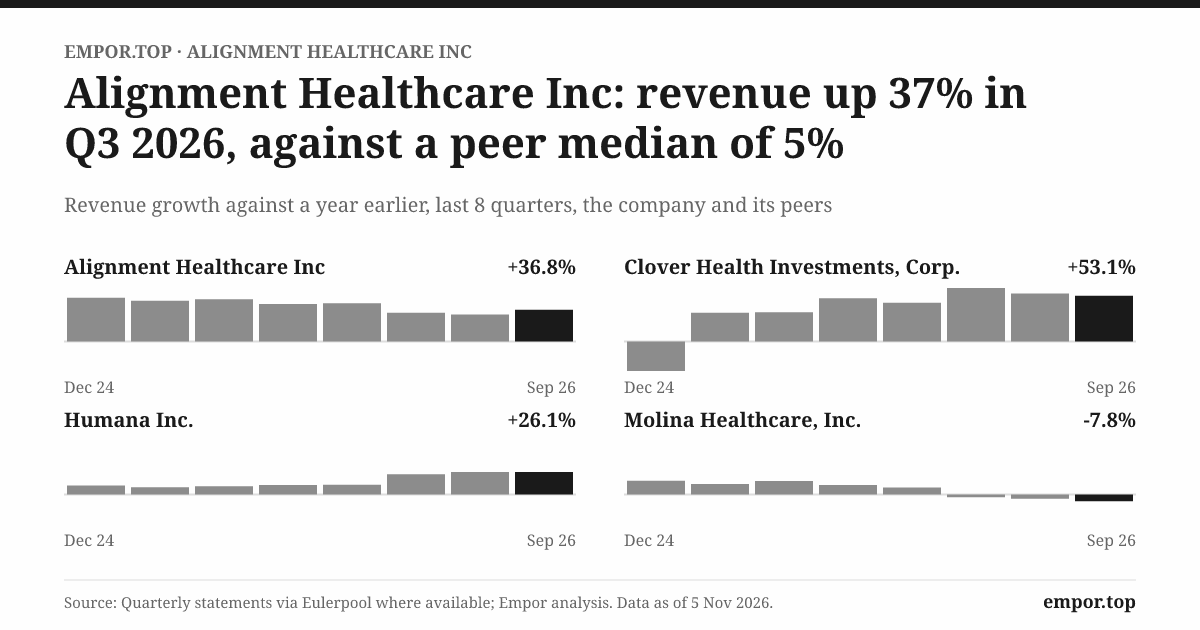
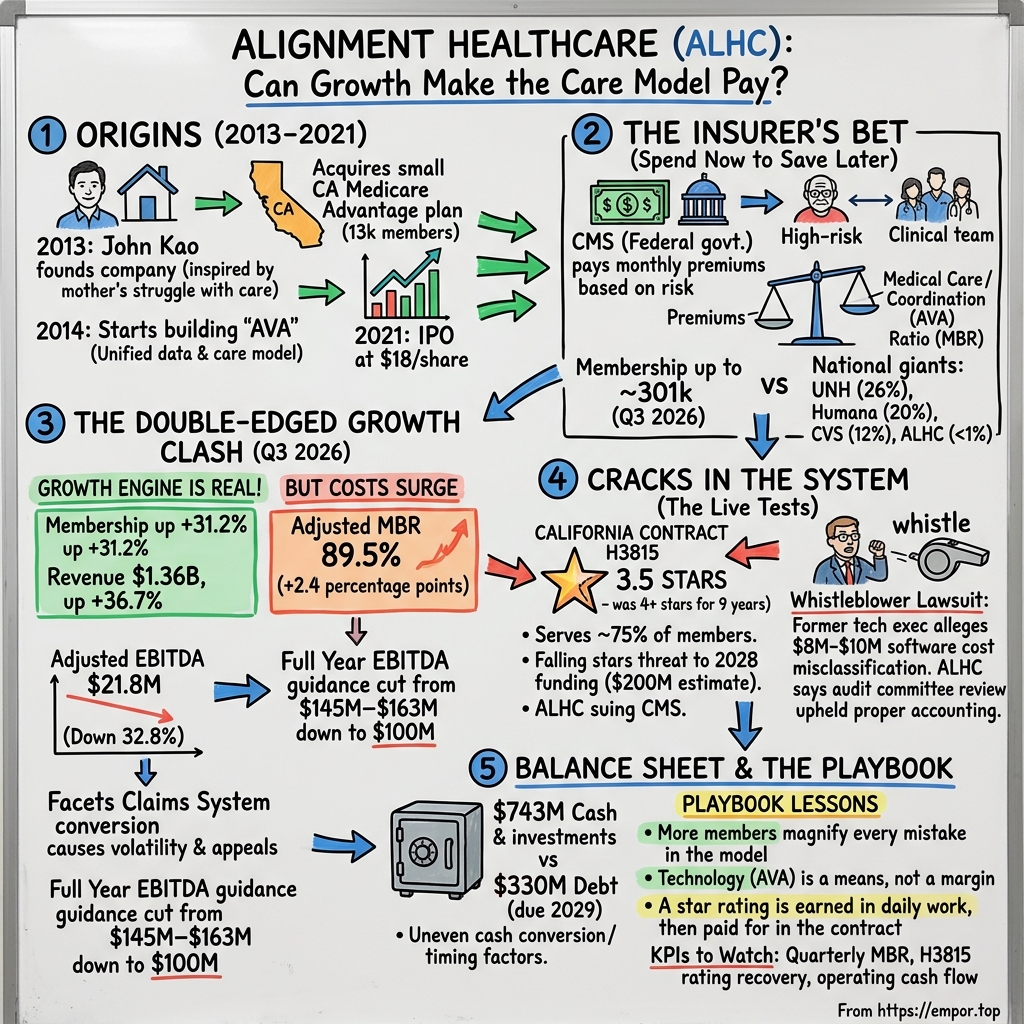
On the afternoon of October 29, 2026, Alignment Healthcare put out a press release that seemed to argue with itself.[^1] The first half told investors the company was winning. Membership had grown 31.2% in a year, to roughly 301,200 seniors.[^1] Third-quarter revenue had reached about $1.36 billion, up 36.7%.[^1] Management raised its revenue outlook for the full year, and the expected total now topped $5 billion.[^1]
The second half explained why none of that felt like a celebration. The same release cut the outlook for adjusted gross profit and adjusted EBITDA, the profit measure Alignment asks investors to watch.[^1] The reason sat in a single ratio. Alignment's adjusted medical benefits ratio, the share of premium spent on members' medical care, had risen to 89.5%, up 2.4 percentage points from a year earlier.[^1] Adjusted EBITDA for the quarter fell almost a third, to about $21.8 million.[^1]
So the company now expected to collect more money from more members, and to keep less of it. On a conventional reading, a business that grows 37% while its profit shrinks has a problem with what it is selling. For a health insurer the problem is more specific. The product is a promise to pay for care, and every additional member is an additional set of unknown medical bills.
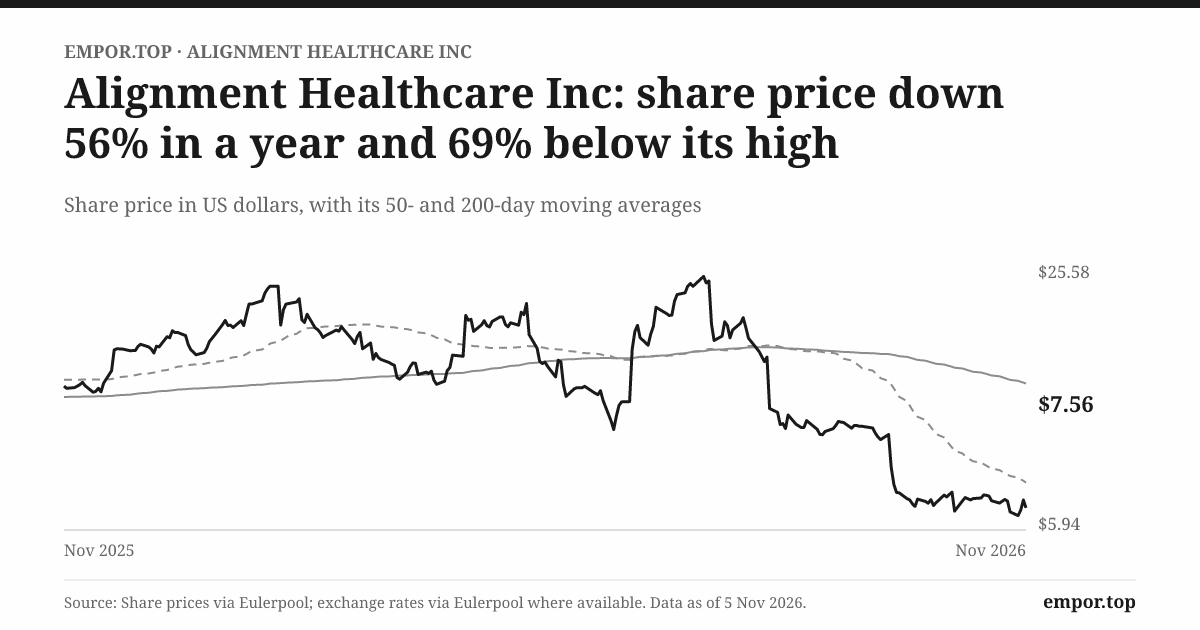
The stock market had already been asking that question. By November 5 the shares traded at about $7.56, nearly 70% below their 52-week high of about $24.53, and the whole company was valued at roughly $1.5 billion.[^1] That is a modest price for a business with more than $5 billion of expected revenue, and it is the market's way of saying it does not yet trust how much of that revenue will survive the claims.
To see why, it helps to know what Alignment actually sells. Nearly all of its revenue comes from Medicare Advantage, the private alternative to traditional Medicare in which the federal government pays an insurer a monthly amount for each enrolled senior.3 The insurer then pays the doctors, hospitals, nursing facilities and pharmacies. What it keeps after those bills, and after running the business, is its profit.
That model concentrates Alignment's fortunes in two places. One is the federal government, which sets the rates, approves the bids and grades the plans. The other is California, and in particular a single contract, known by the code H3815, that serves about three-quarters of the company's members.1 In October 2026 that contract received a 3.5-star quality rating for 2027, below the four-star threshold that unlocks bonus payments, and the company sued the government over the result.7
Alignment's pitch is that it is a different kind of insurer. It says that coordinating care closely, using its own data platform, and building tight relationships with local physicians can make a smaller plan both better for seniors and cheaper to run.6 That is an attractive idea. It is also a claim that must be weighed against the scale and bargaining power of the giants it competes with, insurers whose Medicare Advantage books are many times its size.
Three questions now hang over the company. Can care management actually bend medical costs down, rather than simply adding a layer of expense? Can Alignment repair the quality rating on its largest contract before the payment consequences arrive? And can a growth engine this fast keep its balance when claims arrive later, or larger, than expected?
The October quarter put all three questions on the table at once. Alignment told investors it was ready to grow again, with a target of at least 20% top-line growth for 2027.2 In the same breath it reset its profit expectations for 2026 lower. More than $5 billion of revenue, a smaller profit than promised three months earlier, and a management team saying the engine was sound: that was the mismatch. It starts with a son, a mother and a small health plan in Southern California.
 Subscribe on LinkedIn
II. The First Plan Was the Company's First Acquisition
John Kao tells the founding story as a personal one. He has said that watching his mother struggle to find her way through a fragmented healthcare system, with specialists who did not talk to one another and paperwork that seemed designed to defeat her, convinced him that the system was organized around everyone except the patient.6 The name he chose for the company was the thesis: if the insurer, the doctor and the senior were aligned, care could be both better and cheaper.
Plenty of people have had that thought. What made Alignment different from a consulting deck was how it started. In 2013 the new company did not build a care-management service and then go looking for customers. It acquired a California Medicare Advantage plan with about 13,000 members.5 From its first day as an operating business, Alignment held a licensed health plan, a government contract and real seniors whose bills it had to pay.
That choice shaped everything afterwards. A care-coordination startup that sells services to insurers is paid for activity, and never has to discover whether its ideas save money. A health plan has no such luxury. Every hospital admission it fails to prevent shows up as a cost on its own income statement. By buying a plan, Alignment volunteered to be graded by the harshest teacher in healthcare: its own claims ledger.
The company has not disclosed what it paid for that first plan.5 That gap matters for one reason. Without a price, there is no way to judge whether the founding acquisition was cheap or rich compared with other health-plan deals, or how much of the later value was bought rather than built. The honest description is narrower: the acquisition supplied a licence, a contract and a foothold, and most of what came after was constructed on top.
Capital arrived quickly. General Atlantic, the growth-equity investment firm, invested $125 million in 2014.5 It is worth keeping the two names apart from the start. General Atlantic was an investor, not the operator, and its own fortunes as a fund are a separate story from Alignment's as a company. Its role mattered because it gave a young plan the money to invest years ahead of profit, and because, as later chapters show, its eventual exit became an event in its own right.
The building began early. Alignment's IPO prospectus says the company started work on a unified data architecture in 2014, the platform it later named AVA.5 The idea was to pull together claims, clinical records, pharmacy data and the observations of care teams into one place, so that the plan could spot a senior heading toward trouble before trouble arrived. For an insurer, that is the difference between paying for a hospital stay and paying for a nurse's visit that prevents it.
Alongside the technology came the care model: clinicians who would see the sickest members directly, concierge staff who would help seniors navigate their benefits, and arrangements with local physician groups that gave doctors a share of the financial risk.5 None of these elements was unique on its own. Alignment's argument was that the combination, run by one company with one data platform, could do what fragmented systems could not.
By early 2021, the company was ready to ask public investors to fund the next stage. It filed for an initial public offering in March of that year.15 The offering sold 27.2 million shares at $18 each. Of those, 21.7 million were new shares, whose proceeds went to Alignment, and 5.5 million were sold by existing holders, whose proceeds went to them.5 The distinction is worth holding onto. The first group of shares paid for growth. The second paid insiders who were taking some money off the table.
The prospectus described the playbook in broad terms: grow membership in existing markets, enter new geographies, and pursue strategic acquisitions where they made sense.5 In practice, the later filings tell a story dominated by the first two. Alignment's growth since the IPO has come mainly from enrolling more seniors and expanding into new states, not from a disclosed series of large acquisitions. The company bought its way in once, and has largely grown organically since.
The revenue line shows how fast that organic engine ran. Alignment's revenue was about $756 million in 2019; by 2025 it had reached roughly $3.95 billion, a compound rate of around a third a year over six years.3 That is growth most technology companies would envy, produced in one of the most heavily regulated corners of the American economy.
But the prospectus also carried the premise that has never been fully proven. Alignment was asking investors to believe that better coordination and better data would lower the total cost of care for elderly, often chronically ill members, and that this advantage would hold as the company grew from tens of thousands of members to hundreds of thousands. A small plan with an obsessive founder can do remarkable things. The question was whether the same results would survive scale.
The cash flows from those years are a reminder of how much faith that required. Across 2019 to 2025, Alignment's cumulative net losses came to roughly $686 million, while its operations generated only about $7 million of cash over the same seven years.3 The IPO money did not buy a profitable business. It bought time for an unprofitable one to prove its model.
That brings the story to the machinery itself. To judge whether the model can work, it is necessary to understand exactly how a Medicare Advantage plan turns a government check into a profit, and where a care model has to earn its keep.
III. The Insurer's Bet: Spend More Now to Pay Less Later
Picture a 78-year-old woman in Orange County who has chosen an Alignment plan during the autumn enrollment window. She has diabetes, a heart condition and a prescription list that runs to a second page. From January onward, the federal government will send Alignment a payment every month on her behalf.3 Alignment promises, in return, to pay for nearly everything her doctors, hospitals and pharmacy charge for the year.
That monthly payment is the heart of the business. The industry calls it PMPM, per member per month, and it is not a flat fee.3 Each year Alignment submits a bid to the Centers for Medicare & Medicaid Services, the federal agency known as CMS, estimating what it will cost to provide Medicare benefits in each county it serves. CMS compares that bid with a county benchmark. If the bid comes in below the benchmark, part of the difference comes back to the plan to fund extra benefits, such as dental coverage or lower co-pays, that help it attract members.3
Then comes risk adjustment. The government pays more for sicker members and less for healthier ones, based on the diagnoses recorded by their doctors.3 The woman in Orange County, with her chronic conditions, brings in a larger payment than a healthy 66-year-old who rarely sees a doctor. The logic is sensible: plans should not be punished for enrolling people who need care. The consequence is that accurate documentation of member health becomes part of an insurer's revenue engine, and part of its regulatory exposure.
Alignment also receives premiums for Part D, the prescription drug benefit, and smaller amounts from capitation arrangements and services provided to outside providers.3 But these are side channels. In 2025, earned premiums made up nearly all of the company's revenue.3 Alignment is an insurance company, and its revenue is premium.
On the other side of the ledger sits the cost of care. Alignment pays providers in two main ways. Some are paid fee-for-service, a price for each visit, test or procedure. Others receive capitation, a fixed monthly amount per member that makes the provider responsible for a defined set of services.3 Capitation shifts some of the risk to the doctors; fee-for-service keeps it with the plan. The mix matters, because it determines who absorbs the bill when a member gets sicker than expected.
The single number that captures the whole contest is the medical benefits ratio, or MBR: the share of premium that goes out the door as medical expense and quality-improvement spending.3 If Alignment collects $100 for a member and spends $88 on care, its MBR is 88%. The remaining $12 has to cover salaries, marketing, technology, rent and, eventually, profit.
Here is why that ratio dominates everything else. On a revenue base of about $5 billion, each percentage point of MBR is worth roughly $50 million. When the ratio moved up 2.4 points year over year, that was not a rounding error. It was the difference between a year of steady progress and a guidance cut. Membership growth adds premium, but a few points of MBR can wipe out the profit that growth was supposed to deliver.
The 2025 numbers show the balance at work. Earned premiums grew 46.4%, while medical expenses grew 43.8%.3 Costs grew more slowly than revenue, which is the direction the model needs. Yet the cost base was so large that even that small gap in growth rates translated into only a thin improvement in profit. Medicare Advantage is a business of large numbers and narrow margins, where the gross take on each premium dollar is measured in single digits once the doctors and hospitals have been paid.
Administrative costs tell a happier story. Alignment reported adjusted selling, general and administrative expense, the cost of running the plan rather than paying for care, at 9.7% of revenue in 2025, down from 11.1% the year before.11 That is genuine operating leverage: the company spread its overhead across many more members without increasing that overhead at the same pace. SG&A rose about 19% in 2025, much more slowly than revenue.3
But scale efficiency on overhead is the smaller lever. Administrative costs consume roughly ten cents of each premium dollar; medical costs consume nearly ninety. A one-point gain in SG&A is welcome. A two-point miss in MBR overwhelms it. Investors who focus on the falling overhead ratio are watching the right trend in the wrong place.
So where does the care model come in? Go back to the woman in Orange County. Suppose Alignment's data flags her as high risk: a missed prescription refill, an emergency room visit in the spring, a rising blood sugar reading. In the care model Alignment describes, a clinician or care coordinator reaches out, arranges a home visit or a clinic appointment, adjusts her medication and helps her keep the follow-up.5 If that intervention prevents a hospital admission, Alignment avoids a bill that can easily run into tens of thousands of dollars.
The catch is the calendar. Alignment pays for the nurse, the clinic and the coordinator now. The saving, if it comes, shows up later, and it shows up as something that did not happen. Nobody sends an invoice for an avoided hospital stay. That is why care management is so hard to evaluate from outside: its costs are visible and immediate, while its benefits are counterfactual and delayed.
AVA sits in the middle of that process. It is the platform that gathers the data, scores members' risk and routes work to clinical teams.3 The company has made strong claims about its predictive power, including that its models can identify a large share of members who will later be admitted to hospital.5 Those claims deserve a precise reading. Predicting a hospital admission is not the same thing as preventing one, and preventing one is not the same thing as lowering the plan's total costs once the price of the intervention is counted. A forecast is a tool. The saving has to be demonstrated separately.
On that point the disclosures are thin. Alignment reports as a single business segment, so there is no separate line for the care model or the technology to compare against the insurance results.1 The company does not publish a standalone return on AVA, a like-for-like series of medical cost savings for members managed through its programs, or a separate research and development expense line.3 Investors are asked to judge the engine by the car's overall fuel economy, and that number, the MBR, is affected by a dozen other things.
That leaves the underwriting tension that defines this business. A member who costs a great deal to care for can still be profitable, if the premium accurately reflects how sick that member is and the care is managed well. But the premium is set a year in advance, through a bid that is only an estimate. If utilization runs hotter than the bid assumed, or a quality rating falls and the bonus disappears, the plan has already committed to the year's benefits. Growth then means taking on more of the same mistake.
Every Medicare Advantage insurer faces that tension. The question for Alignment is whether its local, care-intensive approach gives it an edge in managing it, or simply a different way of being exposed to it. That depends on where it competes and against whom.
IV. A Local Challenger in a Market Built for Giants
Every autumn, from mid-October to early December, millions of American seniors sit at kitchen tables with brochures, websites and sometimes a broker on the phone, comparing Medicare plans. They weigh monthly premiums, drug coverage, which doctors are in the network, and the star ratings displayed beside each plan. Alignment's logo sits on that menu alongside names most seniors already know far better.
The scale of the competition is easy to state and hard to overstate. In 2026, UnitedHealthcare held about 26% of national Medicare Advantage enrollment and Humana about 20%, according to KFF's annual analysis.4 CVS Health, through Aetna, held about 12%, Kaiser Permanente about 6% and Elevance Health about 5%.4 Together, those five organizations accounted for roughly seven in every ten Medicare Advantage members in the country.
Alignment, with about 301,200 members at the end of the third quarter of 2026, is a fraction of one percent of that market.[^1] The largest carriers measure their Medicare Advantage books in millions of members. They negotiate with national hospital systems, run their own pharmacy benefit operations in some cases, and spread their technology and compliance costs across enormous revenue bases.
It would be misleading, though, to imagine Alignment fighting UnitedHealthcare across the whole country. Medicare Advantage is fought county by county. A senior in Riverside chooses among the plans available in Riverside, with the doctors and hospitals that serve Riverside. In each market, Alignment faces some combination of national carriers and regional plans, and the outcome depends on local networks, local benefits and local reputation.3
That local structure is the foundation of Alignment's competitive argument. A national insurer must run a standardized playbook across hundreds of markets. Alignment says it can do something closer to bespoke work: build deep relationships with particular physician groups, deploy its own clinicians where members need them most, and design benefits around the specific populations it serves.6 In an interview with Healthcare Dive in March 2026, Kao described the company's approach as deliberately different from the large carriers, centered on the senior's experience and the provider relationship rather than on sheer volume.6
There is a plausible economic logic to that pitch. Physician groups that share in the financial upside of keeping members healthy have a reason to cooperate with the plan's care managers. Seniors who feel personally looked after are more likely to stay. And a smaller footprint may allow a company to respond faster to problems in a particular market than a giant can.
Plausible logic is not evidence, however, and here the record is incomplete. Alignment does not publish membership retention rates, medical cost trends or MBR by market in a form that would allow a direct comparison with competitors in the same counties.3 There is no disclosed study showing that Alignment's members cost less to care for than comparable members of a national plan, after adjusting for health status. The strongest version of the claim, that the model produces structurally lower costs, remains unproven from the outside.
What the record does show is mixed. Management has said that some of its best quality performance has come in its smaller plans.2 That is encouraging, but it cuts both ways. If the model works best at a small scale, the question becomes whether it can be replicated in the large California contract that holds most of the members. That contract is precisely where the quality advantage stumbled.
The other forces in the market are not on Alignment's side either. CMS is the economic customer for most of the company's revenue, and CMS sets the rules of the game: annual payment rates, the bid process, risk-adjustment models and the star ratings.3 Providers are not passive suppliers. They negotiate contracts, appeal denied claims and dispute payments, and those disputes, as the third quarter of 2026 demonstrated, can move the MBR materially.2
The senior, meanwhile, holds a powerful option: she can leave. Medicare Advantage members can switch plans each year during the annual enrollment period, and there are additional windows to change.3 Switching costs exist—a new network, unfamiliar doctors, the bother of paperwork—but they are modest compared with, say, an enterprise software contract. A satisfied member may stay for years. A dissatisfied one can be gone by January.
That combination, an annual rebid with the government and an annual choice by the customer, means Alignment never locks in its economics. Each autumn it must persuade CMS that its bid is reasonable and persuade seniors that its plan is the best choice in their county. Growth from a small base is entirely achievable in that environment; Alignment's own enrollment numbers prove it. But the national market's growth is not a moat. A rising tide lifts every plan that can enroll members, including the giants.
So the verdict on competitive position has to be narrow. Alignment has a large runway, because its share is tiny and the market it serves is large. Its edge, if it exists, must show up in measurable local outcomes: members who stay, quality ratings that hold, medical costs that run below the bid, and physician groups that remain loyal. Of those four, the quality rating is the one the government publishes for everyone to see.
If the care model is truly the advantage, the star ratings should be where it shines most clearly. That makes the October 2026 ratings, and what happened to the largest contract, the most important piece of evidence in this story.
V. Nine Years Above Four Stars, Then the Biggest Plan Slipped
In early October 2026, CMS released the star ratings for 2027 Medicare Advantage plans. For most of Alignment's contracts, the news looked familiar. Six of its seven eligible plans were rated four stars or higher.1 On a simple tally, that is a strong showing for any insurer.
The seventh plan was the one that mattered. H3815, Alignment's large California contract, received 3.5 stars.1 Because that contract serves about 75% of the company's plan members, the share of Alignment members in plans rated at least four stars collapsed: from about 98% for 2026 to about 25% for 2027.2 Six plans succeeded, but they covered only a quarter of the members. The one plan that slipped covered three-quarters.
To understand why that half-star was so consequential, it helps to know what four stars buys. Medicare Advantage plans that score four stars or above qualify for quality bonus payments, which raise the benchmark used to calculate what the government pays them.9 A higher benchmark gives a plan more room to fund extra benefits, lower premiums or richer drug coverage, which in turn helps it attract and keep members.9 Stars are both a report card and a financial lever. Lose them, and a plan either accepts lower margins or trims the benefits that won it members in the first place.
There is a timing quirk that makes the damage arrive later than the headline. Star ratings released in the autumn of 2026 are labelled for 2027, but their payment effects flow through to 2028, because they feed into the bids and benchmarks for that later year.7 That is why Alignment's lawsuit focuses on 2028 payments. In its complaint, the company estimated that the ratings could reduce its 2028 payments by more than $200 million.7
That figure deserves a careful frame. It is the company's own estimate, made in a legal complaint designed to show the court that the harm is large and real. It is not an adjudicated loss, an audited figure or a settled forecast. But even as a rough scale, it is striking. More than $200 million is roughly twice the minimum adjusted EBITDA Alignment now expects for all of 2026.[^1] A quality score, half a star below the line, could in principle cost more than a year's operating profit.
Management has a strong historical record to point to, and it is fair to present it. Kao and his team have said that Alignment took its founding plan from three stars to 4.5 stars, and that the company maintained ratings of four stars or above for nine consecutive years.2 For a plan that started with an inherited three-star rating, that is a real achievement, and it is the best single piece of evidence that the care model can improve quality. The 2027 result is therefore a serious stumble, not the latest entry in a long history of failure.
What went wrong? Management's explanation on the third-quarter call was specific. It pointed to misses on measures drawn from the Health Outcomes Survey, which asks members about their physical and mental health and counts three times as heavily as some other measures, and on Part D drug measures.2 It also said the industry's cut points, the thresholds a plan must clear to earn each star level, came in higher than expected.2 The company said it was making changes to workflows, data and provider engagement to address those gaps.2
Those explanations are worth taking seriously, and worth testing. Higher cut points affect every plan, so they can explain why the bar was harder to clear but not why Alignment's largest plan failed to clear it while six of its smaller plans succeeded. Survey-based measures are hard for any plan to influence directly, because they depend on how members feel about their own health. That is precisely the kind of outcome a high-touch care model is supposed to improve. If the model's strongest claim is that seniors feel better looked after, a miss on survey measures in the largest contract is uncomfortable evidence.
Alignment has also turned to the courts, and its litigation history here is mixed. The company challenged parts of its 2025 ratings and won a partial victory relating to an Arizona contract.8 But in July 2026, an appeals court rejected its challenge to other 2025 ratings.8 Then, in October 2026, Alignment filed a new suit against CMS over the 2027 ratings, arguing for a recalculation under a different legal theory.7
Litigation over star ratings has become common across the industry, and some plans have won recalculations. But a court victory, even if it comes, would change the score, not the underlying operations. If H3815's rating is lifted on a technicality, the plan will still need to improve on the measures where it fell short, or the same problem will return next year. Legal relief can buy time. It cannot substitute for better performance.
The deeper issue is concentration. Alignment is not a diversified insurer with dozens of large contracts; it has one contract that dwarfs the others. When that contract is rated well, the company's quality story looks excellent. When it slips, the company's financial exposure is enormous. Six good plans covering a quarter of members do not offset one weaker plan covering three-quarters.
The history therefore narrows the quality claim rather than rejecting it. Alignment has shown it can lift and sustain quality ratings, which is real evidence of capability. It has not shown that the capability holds in its largest, fastest-growing market under the pressure of scale. The test that will confirm or falsify the narrower claim is clear: the next set of ratings for H3815, released in the autumn of 2027, and whether the company's share of members in four-star plans recovers.
The quality slip was the bad news that arrived in early October. The worse news, for the 2026 profit line, arrived a few weeks later, and it came not from the government but from Alignment's own claims system.
VI. The Claims-System Conversion That Rewrote the 2026 Outlook
Three months earlier, the mood had been very different. On the second-quarter call at the end of July 2026, Alignment reported the lowest medical benefits ratio of its life as a public company, an adjusted MBR of about 86.3%.10 Management raised its full-year guidance, taking the adjusted EBITDA outlook to a range of about $145 million to $163 million.10 Executives spoke of strong visibility into costs and described the business as well on track for the year.10
By October 29, that confidence had been replaced by a reset. The third-quarter MBR jumped to 89.5%, more than three points above the second quarter's level.[^1] Adjusted gross profit rose only 11.6% from a year earlier, while revenue rose 36.7%.[^1] In other words, the company grew its top line three times faster than the profit it made on that revenue. Management cut the full-year adjusted EBITDA outlook to at least $100 million, well below the range it had offered in July.[^1]
On the call, an analyst asked the question that was on many minds: was the new claims system to blame? During 2026, Alignment had been converting its claims processing onto Facets, a widely used health-plan administration platform.2 Kao acknowledged that the conversion had created volatility in paid claims and timing differences.2 It was a significant admission. The engine that pays doctors and hospitals had been replaced mid-flight, and the company was still working out what the new system's numbers meant.
To understand why a software conversion matters so much, think about how an insurer estimates its costs. Doctors and hospitals bill weeks or months after they provide care. At the end of each quarter, the plan has paid some of the bills for that period, but not all of them. It must estimate the rest, using past patterns of how quickly claims arrive. If a new system changes how fast claims are processed, or how many are initially denied and later appealed, those historical patterns stop being a reliable guide. The insurer's estimate of its own costs becomes less certain.
Management broke the third-quarter MBR increase into pieces. Roughly half of the year-over-year rise, it said, reflected seasonality in Part D drug costs and deliberate investment in clinical programs.2 The rest came from things the company had not planned: higher levels of provider appeals and payment disputes, rising costs in skilled-nursing care, and an unusual number of catastrophic cases, members whose care became extremely expensive.2
That decomposition matters, because it separates the explainable from the worrying. Part D seasonality is a known pattern under the redesigned drug benefit, in which plans bear more cost later in the year. Clinical investment is a choice. But appeals, disputes and skilled-nursing costs are signals of a different kind. Appeals and disputes suggest providers were pushing back on how claims were being paid, perhaps because the new system was denying or underpaying claims that then had to be reworked. Rising skilled-nursing costs point to utilization, the volume of care members actually used.
The analysts on the call pressed on exactly those points. They asked how much of the cost increase reflected the Facets transition rather than a true underlying trend, how the 2027 bids had been built given the new cost picture, and whether the fourth quarter could serve as a base for modelling 2027.2 Management said appeals had begun to decline and that it was assuming continued elevated costs in the fourth quarter rather than counting on recovery benefits that had not yet materialized.2 It also advised analysts not to annualize the fourth quarter, warning that seasonal patterns would distort any simple extrapolation.2
There was a positive control in the quarter, and it is fair to note it. Adjusted SG&A continued to fall as a share of revenue, meaning the company was still spreading its overhead efficiently across a larger membership.[^1] And the decision to assume elevated costs in the remaining quarter, rather than bake in hoped-for improvement, is the more conservative of the available choices. A management team that has just been surprised is wise not to forecast its way out of the surprise.
Still, the comparison between the two calls is the most important evidence here. In July, management described strong visibility and a record-low MBR. In October, it described volatility it could not fully see through and a lower forecast. Both statements cannot be equally reliable descriptions of the same underlying business, three months apart. Either the July visibility was weaker than it sounded, or something genuinely changed in the third quarter. Management's explanation, a system conversion combined with a cost trend, is plausible. It is not yet proven.
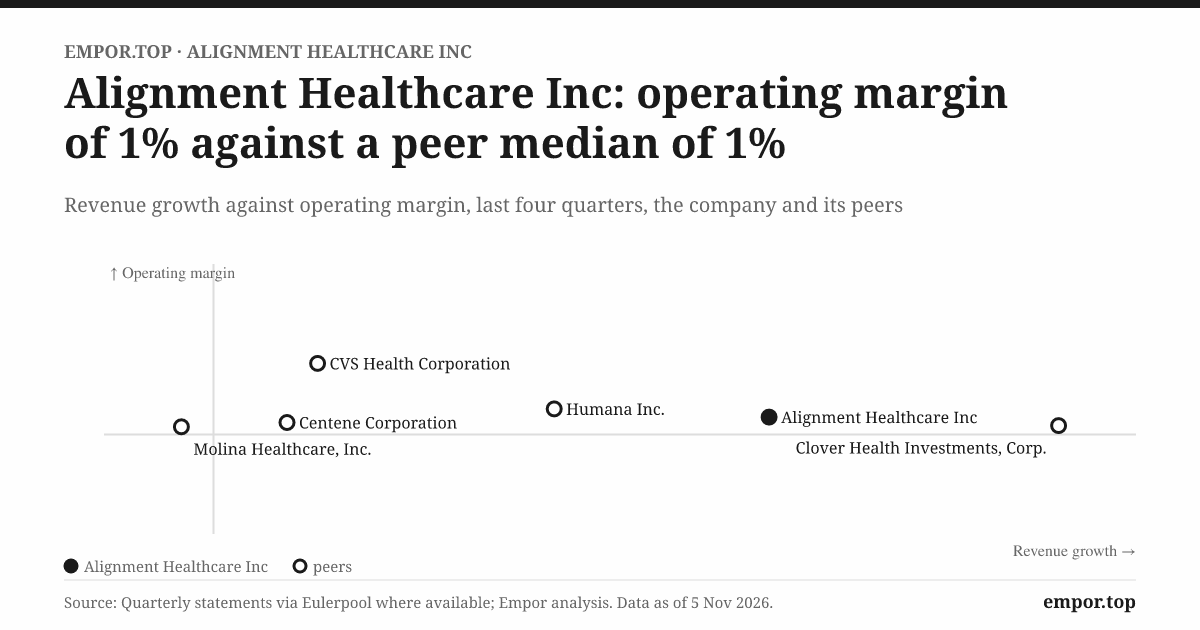
The reported numbers show how thin the margin for error is. In the third quarter of 2026, Alignment posted an operating loss of about $3.8 million and a net loss of about $8.1 million, after two profitable quarters.[^1] On more than $1.3 billion of quarterly revenue, a swing of a few points in the MBR was enough to tip the company back into a loss. That is what a narrow-margin insurer looks like when costs move against it.
Medical expenses grew 40.3% in the quarter, faster than revenue's 36.7%.1 For a company whose whole investment case rests on growing revenue faster than costs, that is the wrong direction. One quarter does not define a trend, especially when a system conversion is muddying the data. But it does mean the burden of proof has shifted. Until the MBR returns toward the levels of the first half of 2026, the setback cannot simply be dismissed as timing.
There is also a scale lesson buried in the quarter. Alignment grew membership more than 30% in a year, which means a large share of its members were new to the plan, with health histories and utilization patterns the company knew less well. Combine that with a new claims system and the noise multiplies. Rapid growth makes every estimate harder at precisely the moment when accurate estimates matter most.
The question this leaves is simple to state and hard to answer. If the higher costs moderate as the Facets system settles and appeals decline, margins can recover and the third quarter will look like a bump. If appeals, utilization or the claims transition keep surprising, the same membership growth that lifted revenue will magnify the miss. The next two earnings calls are where investors will find out which.
The Facets episode raises a broader question about how much confidence to place in the company's operating systems and in the numbers they produce. That question has another, more pointed dimension: a lawsuit alleging that Alignment's reported profits were inflated by the way it accounted for its software.
VII. AVA's Promise Meets a Lawsuit About Software Costs
The allegation came from inside the house. In July 2026, a former senior technology executive who said he had helped build AVA filed a whistleblower lawsuit against Alignment.12 His central claim was that the company had misclassified software-related operating costs as capital spending, a choice that would make reported profits look stronger.12
The specifics are what made the claim matter. The former executive alleged that about $8 million to $10 million had been misclassified in 2024, and roughly another $10 million in 2025.12 Put that beside Alignment's adjusted EBITDA for 2024, which was only about $1.3 million.[^17] If the allegation were true, it would mean that the company's headline profit measure for that year was not merely overstated, but that the improvement it showed could have been largely an accounting artefact.
To see why the classification matters, think of software accounting as the difference between building a house and cleaning one. When a company develops new software that will be used for years, accounting rules allow it to capitalize qualifying costs: record them on the balance sheet as an asset, then expense them gradually through amortization over the software's useful life. When a company maintains existing software, fixes bugs or runs day-to-day operations, those costs must be expensed immediately.3 Building the house is capitalized. Cleaning it is not.
The line between the two is a matter of judgment, and every software-heavy company has to draw it. Capitalizing a cost that should have been expensed does not change the cash leaving the company. It changes when that cost appears in profit. Moved to the balance sheet, a cost no longer reduces this year's EBITDA at all, because EBITDA excludes the amortization that eventually follows. That is why the dispute concerns where some costs belong, not whether AVA exists. The software is real. The question is how it was accounted for.
Alignment had about $218 million in gross capitalized software at the end of 2025, up from about $179 million a year earlier.3 The company's disclosures on AVA's economics remain limited.3 AVA is presented as the engine of the care model, but its economics, both its cost and its return, sit inside the consolidated figures where outsiders cannot isolate them.
The former executive also alleged a motive. His complaint said the accounting inflated EBITDA in ways that linked to executive bonuses, and noted that adjusted EBITDA carried a 35% weighting in the company's 2024 incentive plan.12 That is the kind of detail that turns an accounting dispute into a governance question.
Alignment has denied the allegations firmly. The company says its audit committee retained outside counsel and an independent accounting firm to review the concerns, and that the review found them unfounded.12 It points to clean audit opinions on its financial statements. Deloitte issued an unqualified opinion on the 2025 financial statements and concluded that internal control over financial reporting was effective at the end of 2025, with no material weakness reported.3 The company also reported that its disclosure controls were effective as of September 30, 2026.1
Those are real pieces of counterevidence, and they deserve weight. An audit committee investigation with outside advisers and a clean audit opinion from a major firm are exactly the safeguards investors rely on. But they are not a final verdict on a lawsuit. Auditors test financial statements as a whole for material misstatement; they do not adjudicate every judgment call, and an internal investigation is commissioned by the company whose conduct is in question. The safeguards make the allegations less likely to be correct. They do not make them disappear.
The legal posture shifted in October 2026. A judge declined to dismiss the key claims at the pleading stage.13 That ruling needs a precise reading. At the pleading stage, a court asks only whether the allegations, if true, would state a legal claim. It does not decide whether they are true. The judge explicitly did not rule on the merits.13 The company continues to deny the allegations, and the case continues.
Compensation enters the story here, and it must be handled carefully. Large pay is not proof of wrongdoing, and executive incentives tied to EBITDA are common across the industry. But incentives explain behaviour, so they belong in the analysis. Kao's total 2025 compensation was about $11.3 million, including about $8.5 million in stock awards and about $1.9 million in incentive pay.[^15] His pay had been about $14.3 million in 2023 and $6.4 million in 2024, years in which the company lost roughly $148 million and $128 million respectively.[^15] Kao's beneficial ownership was about 3.3%, a figure that includes shares held in trust and options he could exercise.[^15]
The governance backdrop changed meaningfully in 2026 as well. In March, affiliates of General Atlantic sold 13.17 million shares in a secondary offering, and the agreement that had allowed General Atlantic to designate board members ended.[^15] Alignment received no proceeds from that sale.[^15] After the sale, no single shareholder held more than about 7.5%, and large index and active managers such as Vanguard, Fidelity and Wellington topped the register.[^15] The founding investor's exit removed a long-anticipated overhang on the stock and left a board without a controlling outside sponsor.
Shareholders sent mixed signals at the June 2026 annual meeting. The advisory say-on-pay vote passed comfortably, about 169 million votes for and nearly 9 million against.14 But director David Hodgson received about 108 million votes for and nearly 70 million withheld, a level of dissent that is unusual for a director election.14 Investors were broadly content with pay and markedly less content with at least one board member.
The finance function has also seen change. James Head became chief financial officer in May 2025 after Thomas Freeman resigned effective May 2, 2025.[^15] A CFO transition is routine in itself, but it means the person now presenting the numbers was not in the seat for the full period the whistleblower complaint covers.
How should an investor weigh all this? The allegations are unproven and disputed, and the company's safeguards, the audit committee review and clean audits, are genuine counterevidence. But the scale of the alleged misclassification relative to 2024 adjusted EBITDA makes the question material, and the court's decision to let the case proceed means it will not go away soon. The evidence that would change the conclusion is concrete: a court outcome, any restatement or correction of past results, and future disclosures about how much software cost is capitalized versus expensed. If capitalization rates stay steady and no correction ever comes, the case will fade. If they shift, investors will notice.
The software dispute is ultimately a question about the quality of reported profit. The next question is about the quality of reported cash, and whether Alignment's balance sheet gives it the room to absorb setbacks like the third quarter without changing course.
VIII. Cash, Debt and the Price of Growing Up
At the end of September 2026, Alignment held about $743 million in cash, cash equivalents and short-term investments.1 For a company that lost money for most of its life, that is a substantial cushion. It sits alongside $330 million of convertible notes due in November 2029 and an undrawn $200 million revolving credit facility.1 On the surface, the balance sheet looks like a company that has graduated from survival mode.
The financing arc that led here has several chapters. The 2021 IPO supplied the first large pool of public capital. Then came years of operating losses that steadily consumed it. Across 2021 to 2024, net losses totalled well over half a billion dollars.3 By 2024, the company needed to refinance its debt, and in November of that year it issued $330 million of 4.25% convertible notes, using part of the proceeds to repay $215 million of term loans from Oxford, its previous lender.3
Convertible notes are a particular kind of financing. They pay a modest interest rate because investors also receive the option to convert their notes into shares if the stock rises above a set price. For the company, that means cheaper borrowing now in exchange for possible dilution later. With the share price near $7.56 in November 2026, far below where conversion would likely make sense, the notes look more like ordinary debt that must be repaid or refinanced by late 2029.[^1]
The revolving credit facility adds flexibility, but it comes with conditions. It requires consolidated senior secured leverage of no more than 2.5 times and a minimum level of consolidated EBITDA that rises over time: $60 million for the June 2026 test, $70 million in June 2027 and $80 million from June 2028 onward.1 The company reported compliance at the end of September 2026.1 Those floors are manageable against current guidance of at least $100 million in adjusted EBITDA for 2026, but they are not far below it. A run of quarters like the third would bring the covenants into view.
Cash flow is where the most careful reading is needed. In 2025 Alignment generated about $140 million of operating cash flow, and after about $27 million spent on property and equipment, roughly $113 million of free cash flow.3 On a net loss of about $1 million, that looks like a business throwing off far more cash than its profits suggest.
Part of the gap is ordinary. The cash-flow statement adds back noncash costs: about $30 million of depreciation and amortization and about $62 million of stock-based compensation in 2025.3 Those are real costs to shareholders, the stock compensation especially, since it dilutes ownership, but they do not consume cash in the year. The rest of the gap came from working capital, and here the company's own words are the important caveat. Alignment said the increase in 2025 operating cash flow was helped by the timing of medical payments and by changes to the Part D program.3
That is the insurer's version of a familiar accounting trap. A health plan collects premiums monthly and pays claims weeks or months later. If it grows quickly, or if claims are processed more slowly, the gap between cash in and cash out widens, and operating cash flow looks strong. When growth slows or claims catch up, that cash flows back out. The money is real, but part of it belongs to doctors and hospitals who have not yet been paid.
The first nine months of 2026 showed the pendulum moving. Operating cash flow was about $158 million, down from about $190 million in the same period of 2025, which the company attributed mainly to the timing of medical payments and to changes in accrued compensation and prepaid expenses.1 Cash generation is still positive, but the direction of travel, combined with a claims-system conversion that changed payment timing, means the reported figure is harder than usual to interpret.
The longer record reinforces the point. Free cash flow over 2019 to 2025 was negative by roughly $166 million.3 The company has never paid a dividend.3 One strong cash year, helped by timing, does not yet amount to a track record.
Receivables add a smaller nuance. At the end of September 2026, of about $243 million in net receivables, roughly $150 million were pharmacy rebate receivables, money owed by drug manufacturers through the pharmacy benefit.1 Government receivables carry little credit risk, but rebate balances depend on estimates and collection. The company reserves substantially all of its risk-sharing deficit receivables, amounts that provider groups owe when their costs exceed agreed budgets, because of collection risk.1 That is prudent, and it also tells you that sharing financial risk with providers does not always mean collecting from them when they lose.
Capital deployment has been modest and focused on the operating business. Property and equipment purchases fell from about $41 million in 2024 to about $27 million in 2025, even as revenue grew more than 46%.3 Internally developed software continues to be capitalized, which returns the story to the accounting dispute: the size of that capitalized line is exactly what the whistleblower case challenges.
General Atlantic's March 2026 share sale did not add a dollar to Alignment's treasury.[^15] Ownership events and capital events are different things, and investors who conflate them can misread the company's financial position.
The verdict on the balance sheet is reassuring but bounded. Liquidity is meaningful, the revolver is untouched and the next debt maturity is three years away. The company can afford to invest through a difficult quarter or two. But the balance sheet does not prove the durability of earnings, and the cash flow that looks strongest is the cash flow most affected by claims timing. What investors need is not a bigger cash pile but a claims-normalized cash-flow bridge: operating cash flow after stripping out the swings in medical payables, year after year.
The investment question can now be asked in full.
Analysis & Bear vs. Bull Case
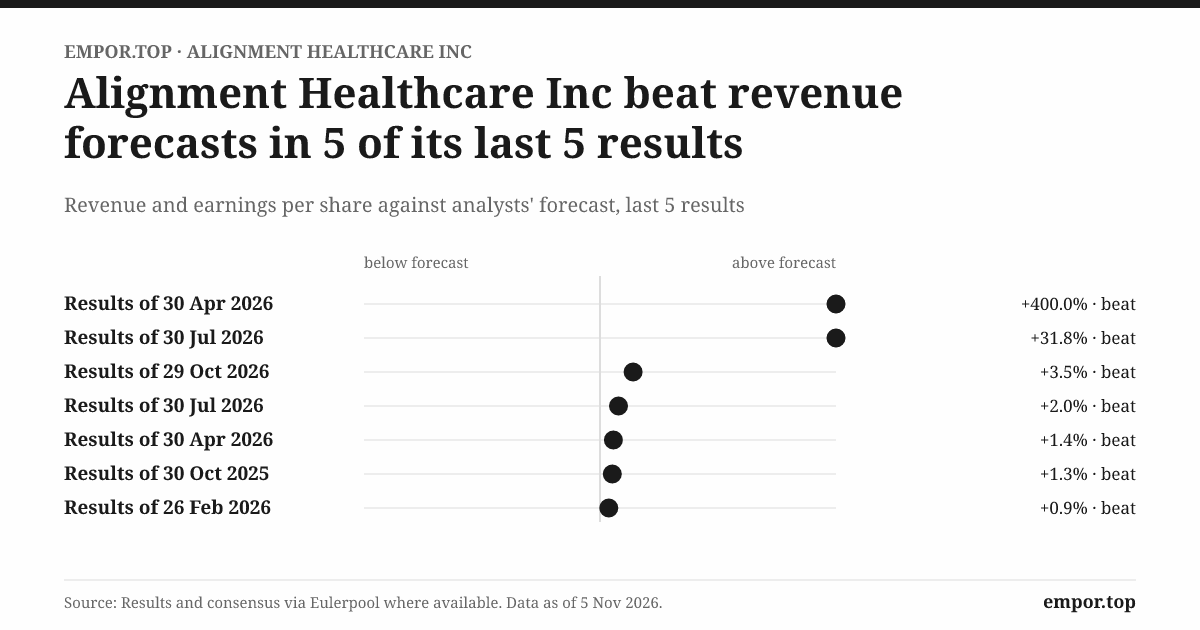
Put two quarters side by side. The second quarter looked strong; the third brought a sharp reversal.10[^1] A neutral investor looking at those two snapshots has to ask what evidence, over the next two years, would show which quarter better represents the business.
The growth record is not in dispute. Alignment has repeatedly expanded revenue and membership.3[^1] It has shown that it can enrol seniors in large numbers and expand into new markets. That part of the thesis has been demonstrated.
The bull case builds from that foundation. Membership growth creates operating leverage, and the falling SG&A ratio proves that overhead can be spread across a larger base. The provider-centred clinical model gives Alignment a plausible route to lower medical costs if the care management works. The company says it lifted its founding plan from three stars to 4.5, evidence that it knows how to improve quality.2 If medical costs normalize after the Facets conversion and H3815 recovers its rating, the growth base already in place could support meaningfully better margins.
The bear case starts from the structure of the industry. CMS sets the core economics every year. Members can switch plans annually. Providers contest payments and, as the third quarter showed, those contests move costs. Competitors have vastly greater scale. And one California contract holds most of the company's members, which concentrates its fate in a single grade from a single regulator.1
Michael Porter's five forces framework helps organize these pressures. Buyer power is substantial, because the government, through CMS, is effectively the customer for nearly all revenue, and it sets rates, approves bids and assigns ratings.3 Supplier power shows up in the providers, who negotiate contracts and appeal payments; the third-quarter disputes are its most recent expression.2 The threat of substitution comes through member choice: every senior can pick another plan or return to traditional Medicare each year. Rivalry is intense, with national carriers that dwarf Alignment in scale.4 The barriers to entry, licences, local provider networks and execution, are real, but they protect incumbents generally rather than Alignment specifically.
Hamilton Helmer's seven powers framework asks a sharper question: does Alignment possess a durable advantage that competitors cannot easily copy? Scale economies favour the giants, not Alignment. Network economies are weak in health insurance, since one member's enrolment does not make the plan more valuable to another. Switching costs are modest. Brand helps in local markets but does not compete with national names. Counter-positioning is the most interesting candidate: Alignment's high-touch, provider-centred model might be something large insurers cannot copy without disrupting their own standardized operations. A cornered resource, perhaps AVA or a particular set of provider relationships, and process power, the accumulated know-how of running a care-intensive plan, are the other possibilities.
Tested against the record, those candidate powers are relevant but unproven. The filings do not show sustained peer-leading medical costs, comparable retention data or independent evidence that AVA's predictions produce net savings.3 The star-rating record supported process power until H3815 slipped. Counter-positioning works only if the model consistently produces better results, and the third quarter showed the model's results can deteriorate abruptly. The moat claim is not rejected by the evidence, but it is narrowed: Alignment has a capability, not yet a demonstrated power.
The long financial record should be used carefully. Alignment lost money every year from 2021 to 2024, then reached roughly break-even on a GAAP basis in 2025.3 That is real progress, but it is one year of near break-even, not a decade of proven earnings power. The latest guidance reduction and the accounting litigation temper the case for management's execution. A management team that described strong visibility in July and cut guidance in October has, at minimum, a credibility gap to close.
Valuation does not resolve the debate. On November 5, 2026, the shares traded at about 14.4 times EV/EBITDA and about 38.4 times trailing earnings.[^1] Those multiples sit on thin and volatile profit; a small change in the MBR moves the denominator dramatically. Against revenue, the company looks cheap, valued at about 0.3 times sales. Against its profit, it looks expensive. Neither framing settles the question, because the business's value depends almost entirely on what margin it can sustain. There is no long history of profitable trading to compare against, and the company's peers have very different scale and business mixes.
What does the current price appear to assume? At roughly $1.5 billion in market value and about $1.1 billion in enterprise value, the market is not pricing in a return to the confidence of the second quarter. It is pricing in meaningful uncertainty about whether margins recover and whether the rating damage can be contained. A neutral reading is that the market sees a fast-growing insurer with an unproven margin structure, not a proven compounder.
Three measures will decide which story is correct. The first is the adjusted MBR, quarter by quarter. Its latest reading is 89.5%, the wrong direction.[^1] The second is membership by star-rating tier, especially the fate of H3815. The share of members in four-star plans has fallen sharply.2 The third is operating cash flow after adjusting for medical-payable movements, the measure that reveals whether reported cash is durable. Nine-month operating cash flow was down from the prior year.1
Now take the skeptical investor's seat. Suppose the California rating stays below four stars for another year, so the payment hit becomes recurring rather than a single event. Suppose claims trends stay elevated after the Facets conversion settles, revealing a real cost problem rather than a timing glitch. And suppose the whistleblower case leads to a correction of reported profitability for 2024 or 2025. Under that combination, Alignment would be a large, low-margin insurer with a concentrated quality problem and a credibility deficit. An activist in that scenario would push on board accountability, on how compensation targets are set and on whether the company should slow growth to fix underwriting.
Then take the other side. Suppose costs normalize as appeals decline, H3815 regains four stars through operational improvement or litigation, and the accounting case fades without correction. In that scenario, Alignment would have more than 300,000 members, a falling overhead ratio and a care model that had weathered a stress test. The operating leverage built into that base could produce margins the current price does not reflect.
Both scenarios are plausible on today's evidence. That is the honest verdict. The growth case is proven; the durability of the margin, the quality advantage and the cash conversion are not. The investment thesis depends on margin recovery, a better result at H3815 and credible cash generation, and the next two years of disclosures will show which way each one breaks.
Playbook: Business & Investing Lessons
Go back to that first California plan of about 13,000 members.5 It was small enough that a founder could know its problems by name, and small enough that one clinical team could change its results. Now the company serves about 301,200 seniors.[^1] Almost everything Alignment's story teaches comes from the distance between those two numbers.
The first lesson is that scale has two sides. The company says it took its founding plan from three stars to 4.5, but H3815's fall to 3.5 showed how results across three-quarters of the membership could swing the company's economics by hundreds of millions of dollars. Founders tend to think of growth as a way to spread fixed costs. For an insurer, growth also spreads every flaw in the model across more lives and more dollars. More members magnify the model, and magnify every mistake in it.
The second lesson is that quality is an operating system, not a marketing claim. The star rating that unlocks bonus payments is built out of thousands of small actions: a member reminded to refill a prescription, a survey answered after a good visit, a provider who follows the workflow. Alignment's miss on survey and drug measures in its largest contract shows how quickly those small actions can fall out of sync when a business grows fast. A star rating is earned in the daily work, then paid for in the contract.
The third lesson concerns technology. AVA is genuinely central to how Alignment describes itself, and the company's predictive claims are bold. Its predictions matter only when they change care, claims and cost. The dispute over how AVA's development costs were accounted for adds a sharper edge: even the cost of the technology has become contested.
The fourth lesson is about cash. Alignment's 2025 operating cash flow looked strong, and part of the strength came from the timing of medical payments.3 For insurers, operating cash flow is partly a calendar effect: a delayed claims payment can look like earnings strength until the bill arrives.
Underneath all four lessons sits one idea that belongs to Alignment specifically. The company built a care model meant to make the healthcare system feel more humane to a senior who is struggling to navigate it. But it chose to deliver that model as an insurer, which means it is graded every year by the government's rates, the government's ratings and its own claims ledger. The care model can create a path to growth. The insurer still has to earn the premium, the rating and the cash, each year, from the beginning.
Epilogue
Tonight, in early November 2026, Alignment stands in the middle of the season that decides its next year. The annual enrollment period is under way, seniors are comparing plans, and Alignment is selling 2027 benefits it designed before it knew H3815's rating or how the third quarter would end. Management has said it is targeting at least 20% top-line growth in 2027.2 Enrollment will almost certainly grow again. The question is what kind of growth it will be.
The first decisive moment will come with the fourth-quarter results and the 2027 guidance in early 2027. That is when management will show whether the elevated costs it assumed for the fourth quarter proved conservative, and how it expects the MBR to behave as it adds new members and settles the claims system, with the lower rating in its largest contract looming over 2028 payments. Investors will be listening for the detail management promised on provider and clinical actions, and for how the July and October messages are reconciled.
The second is the fate of H3815. Two paths could change its rating. The October 2026 lawsuit could produce a recalculation that reduces the more than $200 million of 2028 payment exposure the company estimated in its complaint.7 Or the operational changes management described could lift the contract's performance when CMS releases ratings in the autumn of 2027. The first path would be welcome relief. Only the second would show that the quality problem has been solved.
The third is the accounting case. After the October ruling that let the key claims proceed, the case moves toward discovery, possible arbitration fights and, eventually, a resolution.13 Each step will be read for what it reveals about how software costs were classified. Alongside the litigation, the company's own disclosures about capitalized software will show whether anything has changed in practice.
Those outcomes will answer the questions this story began with: whether margins, quality and cash generation can hold up as Alignment grows.
If those things do not happen, the story will look different: a company that proved it could grow, and struggled to prove it could grow profitably. Alignment says its model is ready to scale. The next set of results has to show that growth can pay for its own claims.
Outro
The story began with a son watching his mother lose her way in a healthcare system that seemed built for everyone except her.6 Alignment's name was a promise to that senior: that the plan, the doctor and the patient could finally pull in the same direction.
Thirteen years later, that promise covers more than 300,000 people and more than $5 billion in expected annual revenue. It is still a personal idea, carried by care teams and coordinators and a data platform meant to notice when someone is struggling. But it now lives inside an insurer that must bid against giants, satisfy a regulator's scorecard and close its books each quarter on claims it is still estimating. Alignment has to care like a local advocate while competing and accounting like a national insurer. Whether it can do both is the whole story.
References
-
Form 10-Q for the quarter ended September 30, 2026 — SEC, 2026-10-29 ↩↩↩↩↩↩↩↩↩↩↩↩↩↩↩
-
Alignment Healthcare Q3 2026 Earnings Call Transcript — OpenFilings, 2026-10-29 ↩↩↩↩↩↩↩↩↩↩↩↩↩↩↩↩↩↩↩
-
2025 Annual Report on Form 10-K — SEC, 2026-02-27 ↩↩↩↩↩↩↩↩↩↩↩↩↩↩↩↩↩↩↩↩↩↩↩↩↩↩↩↩↩↩↩↩↩↩↩↩
-
Medicare Advantage in 2026: Enrollment Update and Key Trends — KFF, 2026 ↩↩↩
-
Alignment Healthcare's idiosyncratic take on Medicare Advantage — Healthcare Dive, 2026-03-18 ↩↩↩↩↩
-
Alignment sues CMS over 2027 Medicare Advantage star ratings crash — Healthcare Dive, 2026-10-13 ↩↩↩↩↩
-
Alignment loses 2025 star ratings appeal against CMS — Becker's Payer Issues, 2026-07-14 ↩↩
-
2025 Medicare Advantage and Part D Star Ratings — CMS, 2024-10-10 ↩↩
-
Alignment Healthcare Q2 2026 Earnings Call Transcript — OpenFilings, 2026-07-30 ↩↩↩↩
-
Alignment Healthcare Q4 2025 Earnings Call Transcript — The Motley Fool, 2026-02-26 ↩
-
Whistleblower accuses Alignment of inflating profits to fuel executive bonuses in new lawsuit — Becker's Payer Issues, 2026-07-08 ↩↩↩↩↩
-
Judge rejects Alignment's bid to toss former executive's whistleblower lawsuit — Becker's Payer Issues, 2026-10-06 ↩↩↩
 LinkedIn
 WhatsApp
 Reddit
 Hacker News
 Email
 Kindle
 RSS Feed
 Spotify
 Apple Podcasts
 Amazon Music
 Audible
 YouTube