Clover Health: Can Growth Become a Healthier Business?
I. A 56% Growth Quarter, and the Question Behind It
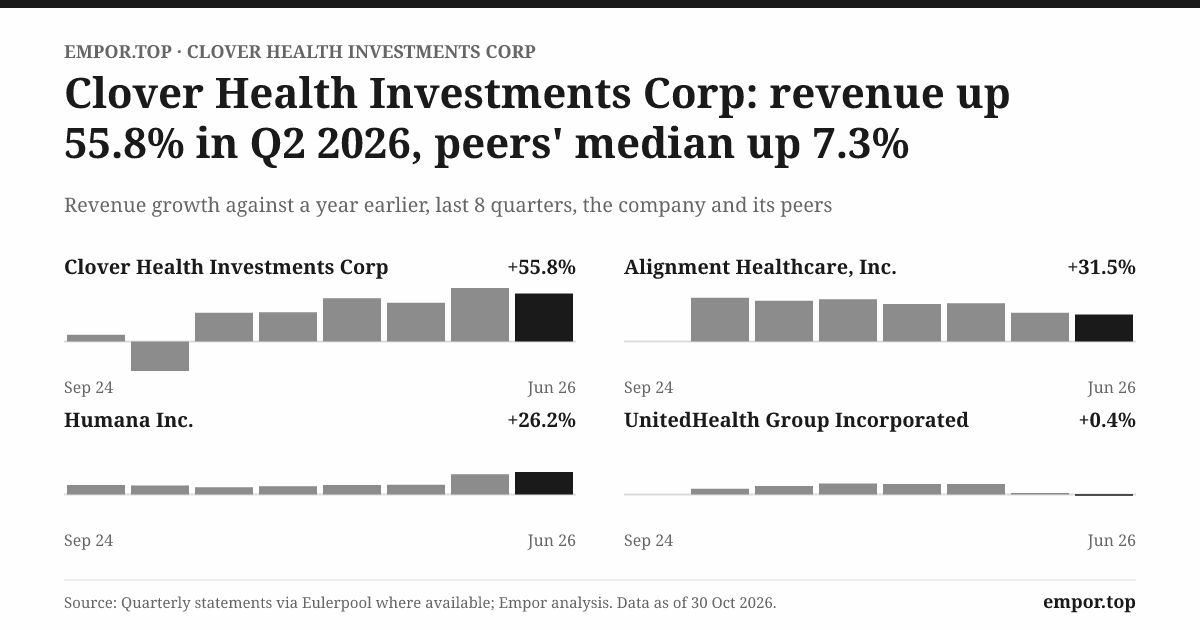
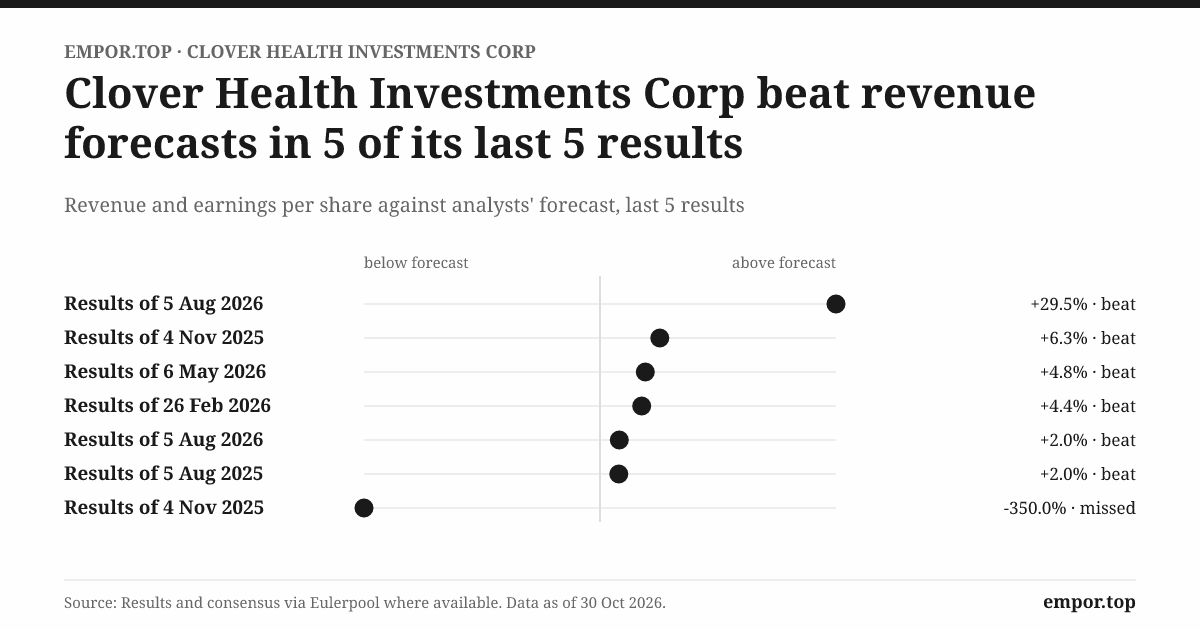
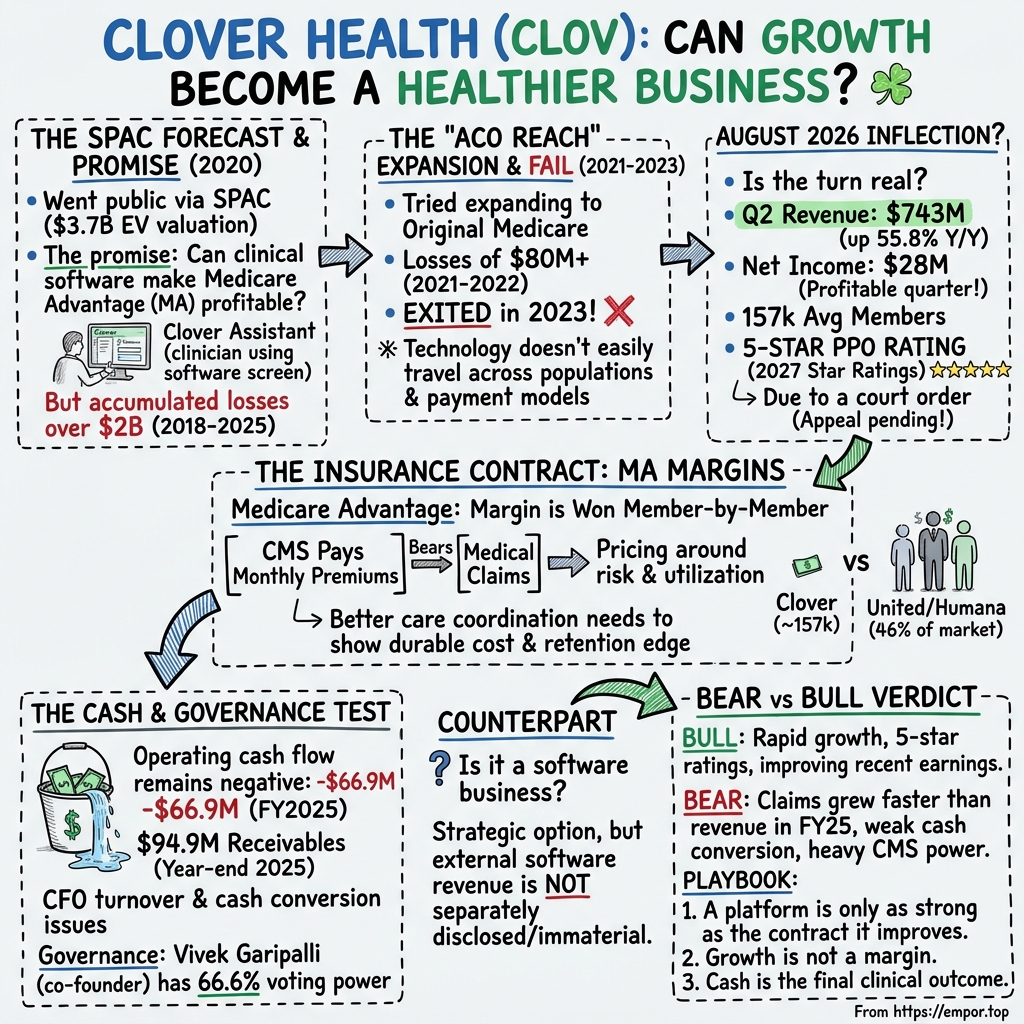
On August 5, 2026, Clover Health put out a set of numbers that read unlike anything the company had published in its five and a half years as a public company. Revenue for the second quarter came to about $743 million, up almost 56% from the same quarter a year earlier.1 Net income was $28 million.1 A year before, the same quarter had produced a loss of about $10 million.2 The company raised its full-year outlook, now guiding to revenue of between $2.92 billion and $3.00 billion and to GAAP net income of between $20 million and $35 million for 2026.2 The interim chief financial officer told analysts that the economics of each annual group of members, which insurers call a cohort, were improving year over year as expected, and that this gave management the confidence to raise the forecast.[^3]
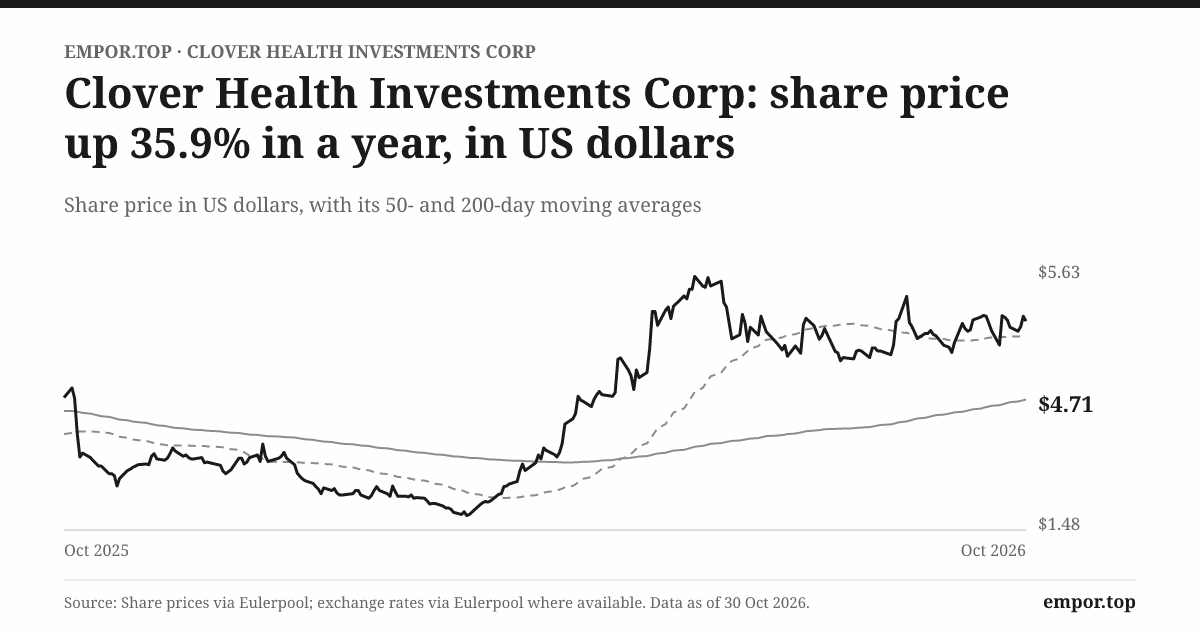
For a company whose name had become shorthand for the excesses of the 2021 SPAC boom, this was a remarkable moment. Clover's shares had fallen by more than 90% at their worst point over the previous five years.3 On October 30, 2026, they traded at $4.71, which put the company's market value at about $2.4 billion and roughly 1.0 times its sales.3 The low of the previous twelve months had been $1.70. Investors who bought near that low had nearly tripled their money. Investors who bought at the listing were still nursing heavy losses.
So the first question is simple and hard at the same time. Has Clover found a repeatable way to make Medicare Advantage profitable, or has a favorable stretch finally made a difficult business look better?
The case for taking the turn seriously starts with scale. The company averaged about 157,000 Medicare Advantage members in the second quarter, against 113,803 at the end of 2025.[^3]4 That is a jump of almost two-fifths in six months, and it came with profit rather than the deepening losses that rapid enrollment growth usually brings to a small insurer. Medical costs as a share of insurance premiums, the single number that best summarizes an insurer's health, improved to about 87.6% from 88.4% a year earlier.5 Less than a point sounds trivial. On roughly $3 billion of annual revenue, each point is worth about $30 million, which is more than the company's entire guided net income for the year.
The case for caution is just as concrete. In 2025, the year before this quarter, Clover burned cash. Cash from operations was negative by about $67 million.4 Medical claims grew faster than revenue, and the company's gross profit shrank even as its sales grew by about 40%.4 Across the eight years from 2018 through 2025, Clover recorded about $2 billion of cumulative net losses and consumed about $817 million of operating cash.4 One profitable half-year cannot erase that record. It can only begin to argue with it.
That is the tension this story follows. It runs through four questions, and each one has a different kind of evidence attached. The first is whether Clover can turn a much larger Medicare Advantage membership into durable claims profits, which means profits that survive a full year of the larger membership actually using healthcare. The second is whether its clinical software, now sold through a unit called Counterpart Health, can become a meaningful business outside Clover's own insurance plans, rather than a talking point. The third is whether earnings can survive the gap between accounting profit, stock-based pay and the slow collection of money owed by the government. The fourth is whether a company in which the founder controls about two-thirds of the votes can earn trust after an expensive expansion that it later abandoned.6
None of those questions can be answered from a single quarter. Insurance profit is a lagging fact, because the bills for care delivered in June can arrive in September and be adjusted the following spring. Cash is a lagging fact too, because a large share of what Medicare owes Clover is settled through retrospective adjustments months after the care has been delivered. And trust is the slowest-moving fact of all.
The turn is real enough to investigate. Whether growth, claims economics and cash generation now reinforce one another, rather than pulling in different directions as they did in 2025, is the question the rest of this story has to test. To see why that is so difficult, it helps to start where Clover's founders started: with a doctor, a patient and a screen.
 Subscribe on LinkedIn
II. The Software Promise Meets the Insurance Contract
Picture a primary-care visit in suburban New Jersey. An older patient sits on the exam table. Before the conversation turns to blood pressure, the physician glances at a screen running Clover Assistant, the company's clinical software. It pulls together the patient's history, recent claims, lab results and medication records, and it flags what Clover's systems think the doctor should not miss: a diabetes test that is overdue, a drug combination that deserves a second look, a condition that has not been documented this year.4 The doctor does not have to use the suggestions. The bet is that, across thousands of visits, catching those gaps early prevents the hospital stay that would cost far more later.
That scene sits at the heart of the story Clover told the world. Vivek Garipalli, who co-founded the company and served as its chief executive from July 2014 until the end of 2022, came to Clover with a background that mixed finance and hospital operations.7 He had been associated with CarePoint Health, a group of hospitals in Hudson County, New Jersey, and the relationship would follow Clover into its related-party disclosures for years.4 His co-founder Andrew Toy, who became chief executive on January 1, 2023, came from the other side of the world of technology: he had co-founded Divide, a mobile security startup acquired by Google, and had worked on enterprise products for Android before joining Clover in 2018.8 Garipalli brought the knowledge of how care gets bought and paid for. Toy brought the software instinct that every problem has a data solution. The company's identity was built on the assumption that those two worldviews could be fused.
To understand where that fusion can create money, and where it cannot, it helps to look at the contract that actually pays the bills. Medicare Advantage is the private alternative to traditional Medicare. Instead of the federal government paying doctors and hospitals directly for each service a senior receives, it pays a private insurer a fixed monthly amount for each enrolled member, and the insurer takes on the obligation to pay for that member's care.4 The monthly payment is adjusted for the member's expected health, a process called risk adjustment, and for the plan's design and quality ratings.4 Sicker members bring higher payments. Healthier members bring lower ones.
The analogy is a fixed-price catering contract. Medicare tells the caterer how much it will pay per guest. The caterer decides on the menu, books the kitchen staff and buys the food. If the guests eat more than expected, or the price of food jumps, the caterer absorbs the difference. Clover's software is a better kitchen system. It can help the chef avoid waste and spot problems early. But it does not change the price per guest, and it cannot stop guests from being hungrier than forecast.
That is why the margin in this business is made or lost in the space between premiums and care costs, not in software adoption by itself. Substantially all of Clover's revenue comes from Medicare Advantage insurance.4 In 2025 that meant about $1.9 billion of revenue, with medical claims of about $1.57 billion.4 The company does not report its software revenue separately.4 For all the attention given to Clover Assistant, it is, in the financial statements, a tool inside an insurer rather than a business standing on its own.
What the software actually changes is harder to pin down than the marketing suggests. Clover has said for years that its platform helps physicians identify and manage chronic disease earlier. Its filings, however, do not establish what share of care decisions the software changes, nor how many dollars of claims it saves per member.4 That is not unusual. Proving that a recommendation on a screen prevented a hospitalization is genuinely difficult, because the counterfactual patient never exists. But it means the claim that technology gives Clover a cost edge is, so far, a hypothesis that has to be tested in the claims ratio rather than in the product demo.
The scale of the arena matters too. Medicare Advantage now covers tens of millions of Americans, and the industry is dominated by a few giants: UnitedHealthcare and Humana together account for roughly 46% of enrollment.9 Against that, Clover's roughly 157,000 average members in the second quarter of 2026 represent well under 1% of the market.[^3]9 The company competes in a handful of states, with its deepest roots in New Jersey. Its size cuts both ways. A small insurer can grow quickly from a small base, which is part of why its percentage growth looks so spectacular. But it negotiates with hospitals and doctors without the bargaining weight of a national carrier, spreads its fixed costs across fewer members, and has less statistical cushion when a few very expensive patients arrive in the same quarter.
A little arithmetic shows how much money flows through each member. Divide second-quarter revenue by average membership and Clover took in roughly $1,600 a month for each person it covered, or close to $19,000 a year. Out of that, it must pay for doctor visits, hospital stays, prescriptions and the extra benefits it advertises, and still cover its own salaries, software and marketing. A swing of a few hundred dollars a year in what the average member costs is the difference between a profitable plan and a losing one, which is why a handful of unexpectedly expensive patients can matter so much to an insurer of this size.
This is where the advantage test begins. If Clover's approach to coordinating care really is better, two things should eventually show up in the data. Members should stay longer, because they value the care experience, and claims per member should run lower than the plan's risk scores would predict, because problems are caught early. Both are measurable. Neither has yet been disclosed in a form that lets an outsider compare Clover against its peers on a like-for-like basis.
The verdict on the founding idea is therefore narrow but clear. Clover's technology is a means of improving the insurance business today. A stand-alone software thesis remains plausible, because other insurers and provider groups face the same problems, but it is unproven because the company does not report the economics of selling that software to outsiders. That distinction, between an insurer with a good tool and a software company that happens to own an insurer, was blurred deliberately at the moment Clover went public. Public investors would spend years paying for the blur.
III. The SPAC Forecast That Set the Bar
In October 2020, in the middle of the pandemic and at the peak of a fever for special-purpose acquisition companies, Clover announced that it would merge with Social Capital Hedosophia Holdings Corp. III, one of the blank-check vehicles sponsored by the venture investor Chamath Palihapitiya.10 The transaction implied an enterprise value of about $3.7 billion for a company that had never made a profit.10
The price was justified with a forecast. In the registration statement filed with regulators, the deal was presented at about 4.2 times Clover's projected 2021 revenue and about 2.1 times its projected 2023 revenue.10 Read those two multiples together and they tell a story of their own. If the valuation was cheap relative to 2023 sales, that was because 2023 sales were projected to be roughly double 2021 sales. The bargain only existed if the company doubled in two years. The S-4 framed the opportunity around Medicare Advantage and Clover Assistant, and treated growth and technology as mutually reinforcing: more members would generate more data, more data would make the software better, and better software would make each new member more profitable.10
It is worth separating three numbers that often get confused in the retelling. The first is the valuation the deal implied, which was an agreed price for the combined company. The second is the cash that actually reached Clover's balance sheet from the SPAC trust and accompanying private investment, which funded the company's next phase. The third is the price at which the shares later traded, which reflected what public investors were willing to pay day by day. The S-4 is the source for the first and for the projections.10 The balance sheet tells the second part: Clover's cash and short-term investments rose from about $97 million at the end of 2020 to about $615 million at the end of 2021, and its financing cash inflows that year came to about $925 million.4 Clover Health Investments, Corp. is the listed parent; its filings consolidate the insurance subsidiaries and, later, Counterpart Health, and there is no outside sponsor whose figures need to be separated from the company's.4 The legacy private company became the accounting predecessor in the business combination, and Class A shares began trading on Nasdaq on January 8, 2021.4
Less than a month later, the story took a hit. On February 4, 2021, the short seller Hindenburg Research published a report titled "Clover Health: How the 'King of SPACs' Lured Retail Investors Into a Broken Business Facing an Active, Undisclosed DOJ Investigation."11 The report argued that Clover had failed to disclose a Department of Justice inquiry and criticized its business practices. Clover responded that it had received a request for information from the Justice Department, that it had been aware of the inquiry, and that it had concluded the matter was not material.12 The next day, the company disclosed that it had received notice of an investigation from the Securities and Exchange Commission.12 That SEC investigation dragged on for more than three years; in September 2024, the SEC staff told Clover it had concluded the investigation and did not intend to recommend enforcement action.4
The episode mattered less for its legal result than for what it revealed about the bargain public investors had struck. They had bought a story in which disclosure, technology and execution were all supposed to be first-class. Within a month, the first of those was under question. And the second and third would soon be tested by the numbers themselves.
Revenue did grow. In 2021 it reached about $1.5 billion, more than double the prior year.4 But the growth came with an operating loss of about $637 million, a loss larger than any the company had posted before.4 Much of the revenue jump came not from the core insurance business but from a new program in traditional Medicare, which this story turns to next. The forecast had treated growth as the engine of profitability. In practice, the fastest-growing part of the business turned out to be the part that lost money fastest.
Follow the path through to the end of 2025, and the scorecard against the SPAC promise is sobering. Revenue did eventually reach about $1.9 billion in 2025, and the trailing twelve months through June 2026 came to about $2.5 billion.41 On a top-line basis, the company arrived at the destination the forecast implied, but years late and by a different road. Meanwhile, cumulative losses mounted, and shareholders' equity at the end of 2025 stood at about $309 million.4 At the October 2026 share price, the market valued that equity at about 6.4 times its book value, which is a measure of how much of the current valuation depends on future earnings rather than on assets already on the balance sheet.3
So did going public give Clover the capital and time to prove its model, or leave investors underwriting a technology story ahead of the evidence? The honest answer is both. The listing financed an ambitious growth phase and bought the company runway that a private insurer with heavy losses might not have found in 2022, when private capital for loss-making healthcare businesses dried up. But the valuation depended on rapid scaling and on economics that did not arrive on the timetable the forecast laid out. Investors in 2021 were not buying an insurer with a technology tool. They were buying a software platform whose economics, they were told, would eventually transform an insurer. The cleanest test of that belief came from the place where Clover pushed its platform furthest from home.
IV. A Bigger Medicare Bet—and the Retreat from ACO REACH
In 2021, Clover stepped into a federal experiment. Medicare's innovation center had created a program called Direct Contracting, later renamed ACO REACH, that allowed organizations to take financial responsibility for the care of people in traditional Medicare, not just those who had chosen a private Medicare Advantage plan.13 The participating organization worked with physicians whose patients were assigned to it. If total spending for those patients came in below a benchmark set by Medicare, the organization shared in the savings. If spending came in above the benchmark, it shared in the losses.13
For Clover, the logic was seductive. Medicare Advantage covered only part of the senior population, and Clover's insurance footprint was small. Traditional Medicare covered millions more. If Clover Assistant really helped physicians manage patients better, then the program offered a way to deploy it across a much larger population without having to win every member in an annual sales battle. More beneficiaries meant more data. More physician relationships meant more distribution for the software. And the revenue could diversify the company away from pure insurance risk. The program looked like the platform thesis made real.
It also made the revenue line explode. The surge in Clover's reported 2021 revenue came substantially from this business, because under the accounting for the program, the medical spending Clover took responsibility for flowed through its revenue and costs.14 That was the trap embedded in the opportunity. Clover's revenue grew because it had signed up for a much larger pool of financial risk, not because it had found a more profitable way to deliver care.
The operating test was harder than the strategic logic. Clover's entity lost about $30 million in 2021 and about $52 million in 2022, roughly $82 million in all across the two performance years, according to Medicare's public results for the program.13 These were not trivial pilot losses. They were large relative to a company whose entire market value was falling fast, and they arrived while the core insurance business was also losing money. Clover responded by narrowing its exposure after the poor early results, reducing the number of participating physicians and, in turn, the number of beneficiaries for whom it bore risk.14
Management's own descriptions changed with the evidence. During 2022 the program was still described as a way to extend Clover's platform and diversify its revenue, with the company emphasizing improved performance as it pruned its network.14 By late 2023, the tone had shifted to focus and profitability. On December 1, 2023, Clover announced that it would exit ACO REACH after the 2023 performance year, saying the decision would accelerate its path to profitability and let it concentrate on its Medicare Advantage business.15 Trade press noted the shift as a retreat from what had once been presented as a central growth avenue.16
What is the right way to read this? The most generous interpretation is that Clover ran an experiment, measured the result, and stopped funding a model that did not work. That is real discipline, and many companies in similar situations kept pouring money into strategic bets long after the numbers turned. The less generous interpretation is that the experiment was not an experiment at the time. It was the centerpiece of a growth story, it was large enough to dominate the company's revenue, and it lost real shareholder money before it was abandoned.
Both readings contain truth, and the weight of the evidence supports a specific conclusion. The ACO REACH exit is evidence against unbounded platform optionality. It shows that Clover's clinical software did not automatically travel into a different payment model, with different patients, different physician incentives and a benchmark set by someone else. That weakens the claim that Clover's technology readily scales across populations. It does not, by itself, prove that the core Medicare Advantage model cannot work. The populations, contracts and incentives are different, and Clover has more control over its own plans than it had over a pool of traditional Medicare patients assigned through participating doctors.
There is a second lesson in the episode, about what kind of company Clover had been. A software business expands by selling the same product to more customers at a cost close to zero. An insurance business expands by taking on more risk, and each unit of risk has to be priced. ACO REACH looked like software expansion and behaved like insurance expansion. The revenue was risk, not subscriptions.
The exit also made the subsequent focus on Medicare Advantage more credible as a course correction. A company that has shown it will stop a losing bet is easier to believe when it says it is concentrating on what works. But credibility earned by exiting once has to be preserved by behaving differently the next time a growth opportunity appears. The investor question that carries forward is whether Clover now shows discipline by scaling only where claims results and cohort economics support it. That question has a sharp edge in 2026, because the company had just added tens of thousands of new members in a single enrollment season.
V. The Medicare Advantage Margin Is Won Member by Member
Every autumn, during the annual enrollment period that runs from mid-October to early December, millions of seniors sit at kitchen tables with brochures, phone calls from brokers and plan-finder websites, and choose how their healthcare will be paid for in the coming year. They compare premiums, drug coverage, dental and vision extras, and whether their doctors are in the network. When one of them picks a Clover plan, the transaction looks like a sale. In economic terms, it is closer to the start of a year-long wager. Clover takes on the promise to cover that member's care for the year at a price set months earlier, before anyone knows whether that member will need a knee replacement, a cancer treatment or nothing more than an annual checkup.
The economics of that wager have two sides, and both are only partly in Clover's control. On the revenue side, premiums reflect benchmarks set by the Centers for Medicare & Medicaid Services, risk adjustment based on members' documented health conditions, the plan's design and its quality ratings.4 On the cost side, claims reflect how often members use care, the prices Clover has negotiated with doctors and hospitals, and how healthy the enrolled population turns out to be.4 Every year, insurers submit bids to Medicare in early summer for the following year's plans, effectively locking in a price before they know what their membership will look like.4 And every year, members can leave. A strong year can be followed by repricing, cuts to benefits or member attrition.
That annual cycle is what makes rapid growth so dangerous for an insurer. New members are, in a sense, strangers. Their health conditions may not yet be fully documented in Clover's systems, which means the risk-adjusted premium paid for them may not yet reflect how sick they actually are. Their doctors may not yet be using Clover's tools. Their pent-up needs, from deferred procedures to unfilled prescriptions, may show up in the first months of enrollment. Insurers talk about cohort maturation for this reason: a group of members who joined in a given year typically becomes more profitable in its second and third years, as their conditions are documented, their care is coordinated and their unusual early claims settle down.
Clover's 2025 results are the clearest illustration of why the theory matters. Revenue grew by about 40% that year. Medical claims expense grew by about 56%, to about $1.57 billion.4 Gross profit, meaning revenue left after paying for care, fell to about $356 million from about $365 million.4 Put simply, Clover added roughly half a billion dollars of revenue and ended up with slightly less money to cover its overhead than the year before. Every new member brought in premium, but on average brought in even more claims. The operating loss widened, and the final quarter of 2025 alone lost about $49 million.4
Then came 2026. The membership base expanded sharply again, reaching about 157,000 on average in the second quarter.[^3] And instead of a repeat of 2025, the company turned profitable, posting about $27 million of net income in the first quarter and $28 million in the second.1 The insurance benefits expense ratio, Clover's preferred measure of how much of each premium dollar goes to care, came in at about 87.6% in the second quarter compared with 88.4% a year earlier.5
The puzzle is how a company that lost money on growth in 2025 made money on even faster growth in 2026. Management's answer, delivered on the second-quarter call, is cohort maturation: the members who joined in earlier years are now cheaper to serve relative to their premiums, and the company's clinical model is getting better at managing new arrivals.[^3] That is plausible and consistent with how Medicare Advantage economics work. But there are other contributors that an independent reader has to weigh. Medicare's payment rates change every year for the whole industry, and a more generous update can lift revenue per member for every plan at once, whatever its clinical model. Clover's 2026 benefit designs and bids were set after the painful 2025 experience, and may have been priced more conservatively. And early-year claims estimates are just that, estimates, subject to revision as late bills arrive. The company describes its expense ratio as a non-GAAP measure, which is a reminder that it is a management-defined lens rather than an audited line.2
The way to separate these explanations is to ask management for measurable statements, not adjectives. What is the expense ratio for members in their first year versus their third? How much of the year-over-year improvement comes from rate increases, and how much from lower utilization? How have reserves for prior periods developed, meaning, did claims for earlier quarters turn out higher or lower than first estimated? Until those numbers are published, cohort maturation remains a credible framing whose size cannot be checked from outside.
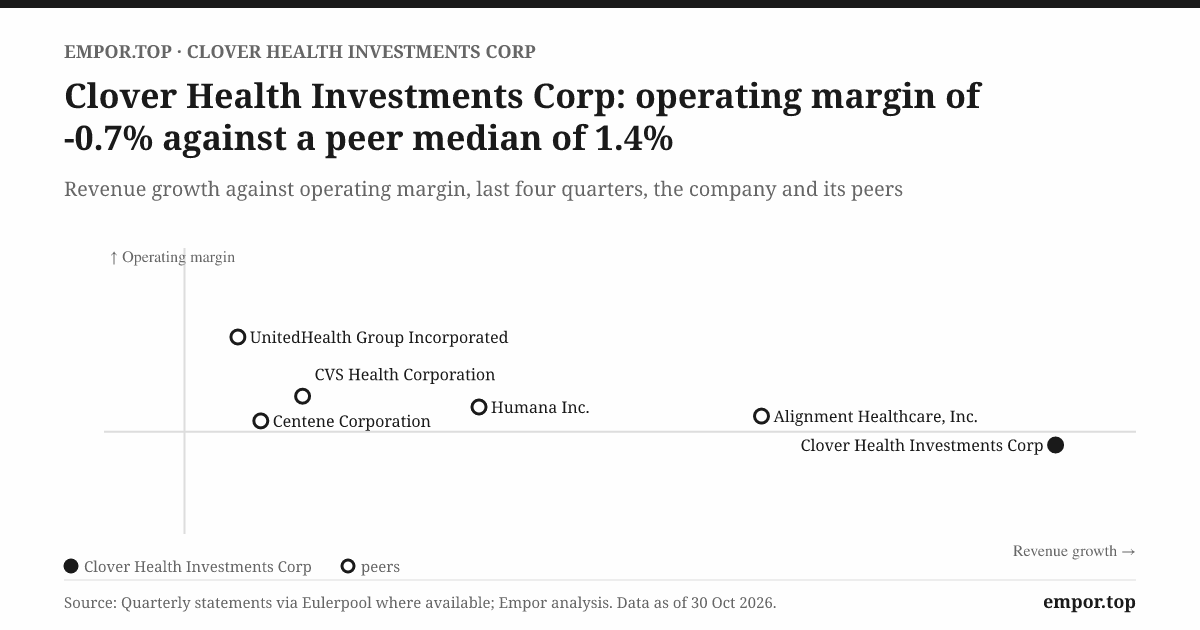
Scale makes the comparison with peers revealing. UnitedHealthcare, Humana and CVS Health's Aetna each serve millions of Medicare Advantage members across the country, and UnitedHealthcare and Humana alone account for nearly half of enrollment.9 Alignment Healthcare is a closer comparison, because it is also a fast-growing, technology-emphasizing Medicare Advantage insurer concentrated in a few markets. Clover's growth rate is striking, but its member base is a small fraction of the national leaders. When a large insurer reports a medical cost ratio a point better or worse than Clover's, the comparison is distorted by geography, by the mix of HMO and PPO members, and by how much of the book is new. A small, fast-growing insurer will always have a higher share of new, unseasoned members than a giant that grows by a few percent a year.
There is one structural feature of Clover's book that deserves particular attention. More than 97% of its members are in its PPO plan.17 A PPO, or preferred provider organization, lets members see doctors outside a tight network, usually without referrals. That openness is a selling point for seniors who want to keep their own physicians, and it is part of how Clover has differentiated itself against larger rivals' tighter HMO networks. But it also means Clover has less control over where care happens and what it costs, which places more weight on the software's ability to influence physicians who are not exclusively tied to Clover. In this sense, the clinical software and the PPO strategy are bound together. If Clover Assistant does not shape care, an open-network plan is simply an expensive one.
Standing over all of this is CMS, the dominant economic counterparty. Because substantially all of Clover's revenue comes from Medicare Advantage, the government's payment formulas, risk-adjustment rules and quality ratings effectively set the price of Clover's product.4 An insurer of Clover's size does not negotiate with CMS. It reacts to it. When the federal government tightens risk-adjustment rules, as it has in recent years, the revenue available for a given patient can fall regardless of how well the plan manages care. When quality ratings change, as the next part of this story shows, the effect on economics can be dramatic.
So test the local-plan proposition against the market. Clover's pitch to a member is a plan with broad access to doctors, generous benefits and a care model built on data. Its rivals' pitch is a well-known brand, national provider networks, bundled pharmacy services and the bargaining power to secure better hospital rates. For Clover to win sustainably, member retention, provider access, benefits and medical cost performance must together overcome those advantages, year after year, through annual repricing. That is possible in a focused geography where Clover has deep physician relationships. It is not something that has yet been demonstrated outside its core markets.
The verdict on this central question is calibrated. Clover has demonstrated growth and a recent earnings rebound. The decisive proof, however, is whether newer cohorts mature into better claims margins without a return to aggressive, low-quality growth, and that proof requires a full year of the larger membership base to pass through the claims system. Three indicators will tell the story better than any adjective. The first is the medical cost ratio together with how reserves for prior periods develop; its latest reading improved to about 87.6% in the second quarter. The second is membership retention by cohort, which Clover does not yet break out. The third is operating cash flow after receivables settle, last seen at negative $67 million for full-year 2025. Before turning to cash, though, one of the most powerful drivers of the 2027 outlook needs its own examination, because it arrived through a courtroom.
VI. Star Ratings: A Tailwind with a Court Case Attached
On October 8, 2026, Clover filed a short report with the SEC that carried outsized significance. Its PPO plan, the one covering more than 97% of its members, had received a five-star rating from Medicare for 2027.17 Its HMO plan had received 4.5 stars.17 The disclosure was one of the most consequential of the year. And it came with a footnote that a careful investor could not ignore: the rating followed a court order that had removed disputed measures, and an appeal remained pending.17
Star Ratings are Medicare's report card for private plans. CMS scores each plan from one to five stars across dozens of measures, from whether members get recommended screenings and how well chronic conditions are controlled, to how members rate their experience and how the plan handles complaints and appeals. The ratings matter for three reasons. They influence quality bonus payments, which raise the benchmark against which a plan bids and therefore the money available to fund benefits. They shape member choice, because the ratings appear on Medicare's plan-comparison tools. And plans that reach the highest rating gain enrollment advantages that lower-rated plans lack. For a small insurer competing against national brands, a five-star rating is one of the few signals that can be seen by every shopper on equal terms.
The road to the five-star PPO was not straight. Clover's 2026 PPO rating had been the subject of a dispute with CMS over how certain measures were calculated. In May 2026, a court decision vacated certain 2026 PPO ratings; CMS then recalculated the rating, and Clover appealed.1 The 2027 disclosure followed a court order that removed disputed measures from the calculation.17 The appeal, as of the October filing, remained pending.17
This sequence raises a question that every investor in the company should hold in mind. Is the five-star rating evidence of better execution, or partly the product of a legal outcome that could still change? The answer is that it is some of both, in proportions that cannot be fully separated from outside. A rating that improves because disputed measures were removed by court order is not the same as a rating that improves because members got more screenings and better chronic-disease control. It may still be fair, if the disputed measures were genuinely miscalculated, but it is a different kind of evidence.
There is a reason Clover fought so hard. The financial weight of ratings in Medicare Advantage is large relative to an insurer's thin margins. A plan's quality bonus can make the difference between offering a richer benefit package than competitors and having to cut benefits. A higher-rated plan can either use the money to attract members with better benefits or retain more of it as margin. For a company guiding to between $20 million and $35 million of net income on roughly $3 billion of revenue in 2026, even a small shift in revenue per member from ratings can swing profitability.2 And because Star Ratings published in one autumn affect payments the following calendar year, the 2027 rating will shape 2027 economics, not 2026's.
On the second-quarter call, management framed the ratings work as part of the same clinical model that drives its cost improvements, linking care quality to both member outcomes and plan economics.[^3] In the supplemental shareholder materials, the company emphasized its focus on quality.18 That linkage is the right one to test. If Clover's clinical approach is genuinely better, the rating should be a symptom of it, and member outcomes and claims costs should improve alongside the score. If the rating rises while claims ratios worsen, or while member retention falls, the improvement is more about measurement than care.
There is a wider pattern here worth naming. Medicare Advantage insurers of every size have increasingly fought CMS over Star Ratings in court, because the financial stakes have grown and because small changes in methodology can push a plan across a bonus threshold. Clover's victory places it in that pattern rather than outside it. Legal success does not establish a durable competitive advantage, because the next year's rating will be calculated from scratch, and CMS adjusts its measures and thresholds over time.
So the verdict is two-sided. Higher ratings can improve the economics and the appeal of Clover's plans, and the five-star PPO is a genuine asset heading into 2027 enrollment. But the legal path and the durability of the underlying operating improvement remain part of the thesis rather than settled facts. The disclosed result is meaningful. The legal and regulatory record is not finished. And even a sustained five-star rating would only answer one of the story's questions. The other big claim Clover makes about its future rests not on government grades but on whether anyone outside the company will pay for its software.
VII. Can Counterpart Become More Than a Clover Tool?
Clover eventually gave its technology a new name and a new address. Counterpart Health became the subsidiary through which the company offers its clinical software, Counterpart Assistant, to other Medicare Advantage plans and to physician groups.4 The idea was intuitive. If Clover Assistant helps Clover's own doctors catch care gaps and manage chronic illness, why not sell it to everyone else facing the same problem?
By August 2026, management was describing several ways Counterpart could get paid. In the supplemental shareholder Q&A published with the second-quarter results, the company outlined possible arrangements ranging from fixed or per-member fees to shared savings and even capitation, in which a customer pays Counterpart a set amount per patient and Counterpart takes on some responsibility for the cost of care.18 The breadth of the menu is telling. It suggests a product still searching for the commercial structure that customers will accept.
Those payment models are not equivalent, and the difference matters to investors. A fixed or per-member software fee looks like classic software economics: recurring revenue, high gross margins and limited risk. A shared-savings arrangement pays only when the customer's costs fall, which makes revenue lumpy and dependent on outcomes that take a year or more to measure. Capitation is effectively insurance by another name, with all the risk that implies. The further Counterpart drifts from simple fees toward shared savings and capitation, the more it resembles the business that ACO REACH turned out to be, and the less it resembles the software platform the market might like to imagine.
The opportunity, described in proportion, is real but unquantified. A successful external software business could diversify Clover's revenue away from a single government payer, and the problems Counterpart addresses are common across the industry. But the company does not separately disclose external Counterpart revenue, contracted recurring revenue, customer concentration, contract length or retention.41 Clover's 2025 revenue of about $1.9 billion was overwhelmingly insurance.4 Its other income, which includes investment returns on its portfolio, cannot be used as a proxy for software traction.4
This is where the record of the past bears on the claim of the present. That claim dates to the SPAC period, when Clover Assistant was central to the investment case.10 The company held investor events showcasing the software, including a 2023 presentation focused on Clover Assistant.[^20] And the one large attempt to deploy the platform beyond Clover's own members, in ACO REACH, ended in losses and an exit.15 Across more than five years as a public company, the conversion rate of technical milestones into separately reported external software revenue has been, on the public record, zero. That does not mean Counterpart will fail. It means its claims deserve to be weighed at the confidence its revenue disclosures support, and today those disclosures support very little.
The distinction between capability and commercialization deserves to be stated plainly. A product launch, a clinical study, a pilot with a provider group or a case study about improved diabetes control is evidence that the technology works in some setting. It is not evidence that customers will pay for it on recurring terms at a profitable margin. The questions that separate the two are mundane and decisive. What do customers pay? How long do contracts last? How do renewals work? Does selling the software require Clover to bear insurance risk? How much does it cost to serve each customer, including the clinical staff who often have to accompany healthcare software for it to change anything?
Management's current description of Counterpart is more modest in its claims than some of the language of 2020 and 2021, which focused on the transformative potential of the platform. That modesty is healthy. But it also means the burden of proof has shifted to disclosure. The confirming evidence would be a separate report of external revenue, recurring contracts, customer retention and contribution margin. A company that believes Counterpart will become a significant business has every incentive to publish those figures as soon as they are material, because doing so would change how the market values it.
Until then, Counterpart is strategic optionality. It could extend Clover's clinical approach beyond its own membership and turn a cost center into a revenue line. Its current financial weight cannot be established from reported segment data, because Clover reports a single Insurance segment.4 In the story of this company, it belongs behind the insurance business, not in front of it. And the insurance business still has to pass the test that matters most to anyone who owns it: turning profits into cash.
VIII. The Cash Test, and Who Controls the Company
Open the 2026 proxy statement and two facts sit almost side by side. Andrew Toy's reported total compensation as chief executive fell to about $1.32 million in 2025, from about $9.5 million in 2024 and about $10.2 million in 2023, because he received no new stock award in 2025.6 And Vivek Garipalli, now executive chair, held about 66.6% of the company's total voting power through his Class B shares and other holdings.6 The first fact suggests a board willing to cut executive pay after a difficult stretch. The second explains why that board's choices ultimately rest with one person.
To judge whether leadership converts the growth story into cash, start with the cash itself. By the end of 2025, Clover had accumulated substantial net losses and operating cash outflows.4 The gap between them might seem comforting: cash losses were less than half of accounting losses. But the explanation is not that Clover was secretly generating cash. Much of the difference reflects noncash charges, and the largest of those has been stock-based compensation.
Consider the three years from 2023 through 2025. Clover's net losses across those years totaled about $341 million.4 Over the same period, stock-based compensation added back in the cash-flow statement totaled about $359 million.4 In other words, roughly the entire accounting loss of those three years was matched by pay in the form of shares. That is not a cash cost to the company in the year it is recorded, but it is a real cost to shareholders, paid in dilution rather than dollars. A company whose losses roughly equal its stock compensation is, in a sense, breaking even before paying its employees in equity, and then paying them by issuing more of the company.
The second explanation for the gap between profit and cash is timing, and 2025 showed how much it can matter. That year, operating cash flow was negative by about $67 million.4 Part of the drain came from a jump in healthcare receivables, which used about $43 million of cash, and from accrued retrospective premiums, which used about $23 million.4 Healthcare receivables rose to about $95 million at the end of 2025 from about $52 million a year earlier, before easing to about $73 million at June 2026.41 Accrued retrospective premiums, which are amounts Clover expects CMS to pay after reconciling members' risk scores, rose to about $64 million from about $41 million.4
Here the right question is not whether the money is safe. The company says most of its receivables are owed by CMS, the federal government, which limits the risk that a counterparty will fail to pay.4 The question is whether the estimates behind those balances are right and how long they take to collect. Healthcare receivables include items such as pharmaceutical rebates, estimated using contracted terms, utilization and collections.4 Retrospective premiums depend on risk-adjustment calculations that CMS finalizes later. Clover does not publish an aging table for its receivables, nor a history of overdue balances.4 When receivables grow far faster than revenue, as they did in 2025, the danger is not default. It is that part of the reported profit was an estimate that will be trimmed when the government finishes its arithmetic. The decline in receivables in the first half of 2026 is mildly reassuring. A full year of collections against the larger membership base would be more so.
Capital deployment tells a quieter story than many growth companies offer. Clover's recent annual report describes no material acquisition.4 The defining capital decision of its public life was the costly expansion into ACO REACH, which the company later exited.13 The other notable deployment was a share repurchase. In 2024, the board authorized up to $20 million of Class A repurchases, and Clover bought back about $18.3 million of stock in 2025.4 That sum is modest beside $2 billion of cumulative losses, and beside negative free cash flow of about $69 million in the same year.4 It is also small next to the share issuance implied by stock compensation. A skeptic would ask whether buying back shares made sense while cash conversion was weak and the balance sheet's cash and short-term investments fell to about $95 million from about $222 million.4 A defender would reply that the company had no debt, held about $224 million of other investment securities, and was signaling confidence at a low share price.4 Both are fair; the buyback reads more like a gesture than a capital-allocation strategy.
Related-party dealings deserve precision rather than drama. The older relationship with CarePoint Health, the hospital system once associated with Garipalli, has wound down. CarePoint filed for bankruptcy in November 2024, its contracts transferred to Hudson Regional in May 2025, and Clover's CarePoint-related costs fell to about $4.4 million in 2025, roughly 0.2% of revenue.4 That chapter is effectively closed.
The newer arrangement is more relevant. In 2026, Clover Care Services agreed to buy medication therapy management services from GoldenScript, a company 25% owned by an affiliate of Garipalli.6 The terms pay $1 per member per month, subject to a minimum of about 100,000 members, plus $135 for each pharmacogenomic test.6 Clover also agreed to issue GoldenScript a warrant for about 910,600 shares at an exercise price of one cent each.6 At Clover's current membership, the per-member fee alone would come to a little under $2 million a year, small against the company's cost base. The concern is not size but structure. A minimum member commitment, per-test pricing whose volume Clover's own clinicians influence, and a near-free warrant to a company partly owned by the controlling shareholder's affiliate are exactly the kinds of terms that warrant independent price comparison. Clover does not disclose the actual 2026 expense under the agreement nor any independent benchmarking of its prices.1 Audit-committee oversight of related-party transactions exists, but disclosure is what lets outside shareholders check it.
The finance chair has also been a revolving one. Scott Leffler resigned as chief financial officer in January 2024. His successor, Kuipers, left on March 30, 2026, and Clay Thornton was appointed interim CFO.19 Three finance chiefs in a little over two years is unusual for a company in the middle of a turnaround that depends so heavily on reserve estimates, receivables and cash timing. It was Thornton who delivered the confident message on the second-quarter call.[^3] Analysts and investors are still waiting for the company to name a permanent CFO, and the explanation for the turnover has been sparse.
The governance structure frames all of this. Garipalli's affiliated entities hold about 83.6 million Class B shares, and his voting power declined only slightly, from about 68.6% in the 2025 proxy to about 66.6% in 2026, as new Class A shares diluted it.6[^22] Toy's holdings represented about 8.9% of voting power.6 At the June 2026 annual meeting, the advisory vote on executive pay passed with about 1.0 billion votes for and fewer than 10 million against.20 That looks like overwhelming support. But when the executive chair controls two-thirds of the votes, a say-on-pay result mostly measures the controlling holder's view. The vote tells outsiders little about how independent shareholders feel.
There is one more piece of evidence about the reporting system itself. Clover's 2025 auditor issued an unqualified opinion and reported that internal control over financial reporting was effective, with no material weakness.4 That is meaningful: it says the books were kept to the required standard. It is not proof that the business strategy is sound or that the cash economics work. An audit tests whether the numbers are fairly stated, not whether they are good.
The verdict on management is therefore mixed in a specific way. Leadership has narrowed the strategy after a costly expansion, and the chief executive's reported pay fell sharply. But cash conversion has not yet been demonstrated over a full year, the CFO seat keeps changing hands, related-party terms need more disclosure, and concentrated voting control leaves accountability as an open concern. The skeptical investor's view of Clover begins exactly here, and it is time to put that view against the optimist's.
IX. Analysis & Bear vs. Bull Case
Imagine a skeptical investor on a call with Clover's management, holding two pages. One shows the second quarter of 2026: $28 million of net income on revenue growing at 56%.1 The other shows full-year 2025: negative operating cash flow of about $67 million and gross profit that fell despite 40% revenue growth.4 The investor's question is simple. Which page better predicts the next five years?
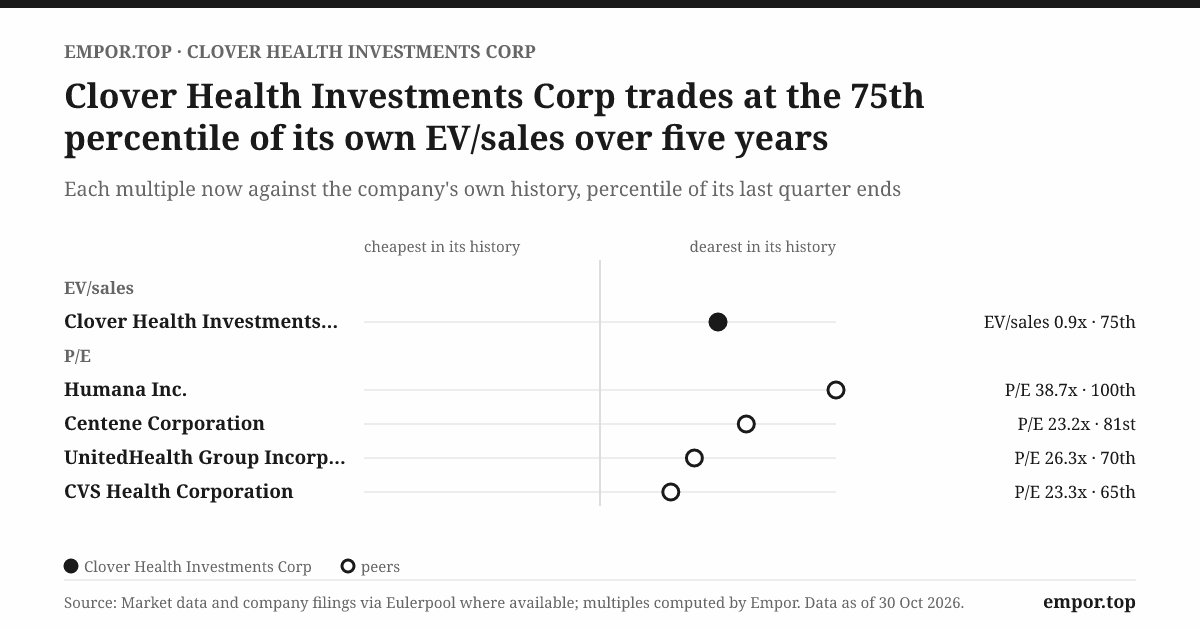
The market's current answer sits in the share price. At the end of October 2026, Clover was valued at about $2.4 billion, or roughly 1.0 times trailing sales, with an enterprise value of about 0.9 times sales once its net cash is subtracted.3 Trailing earnings per share remained slightly negative because of losses in the second half of 2025.3 That multiple is high for Clover's own history: it traded at about 0.37 times sales in 2022 and 2023 and about 0.63 times in 2025, below the roughly 1.29 times of the 2021 euphoria.3 It is also high relative to peers. Alignment Healthcare traded at about 0.4 times sales and Humana at about 0.35 times in October 2026.2122 Those comparisons are rough, because Humana is a giant with a very different growth profile and Alignment's business mix differs, but the direction is clear. The market is paying roughly two and a half to three times what it pays for peers per dollar of revenue. That implies an expectation that Clover's margins will expand substantially, or that its growth will continue well beyond what larger insurers can achieve, or both. Measured against 2026 revenue guidance of about $3 billion, the forward multiple is closer to 0.8 times, which narrows but does not close the gap.2
It helps to translate that price into the margins it seems to assume. If Clover reaches about $3 billion of revenue and someday earns a net margin of 3%, which would be a respectable result for a Medicare Advantage insurer in a normal year, it would make about $90 million. At a market value of $2.4 billion, that would still be a price of more than 25 times those hypothetical earnings. The current valuation, in other words, does not simply assume that the 2026 turnaround holds. It assumes either that Clover keeps growing far faster than the industry for years, or that its clinical model eventually produces margins well above what most insurers earn, or that Counterpart turns into a business worth paying for on its own. Each of those is possible. None is yet visible in a full year of audited results.
The case for Clover begins with momentum. The company has shown it can grow membership quickly, adding more than 40,000 members between the end of 2025 and mid-2026.4[^3] Its recent earnings show that growth need not be destructive, at least in the early quarters of 2026. Its PPO, home to nearly all its members, carries a five-star rating for 2027, which will help both economics and marketing during the enrollment season now underway.17 It has no debt.4 And its clinical platform may support better care and plan economics in ways that larger, older insurers with fragmented systems struggle to match.
The case against begins with the 2025 numbers. Claims grew faster than revenue that year, operating cash generation remains inconsistent, and no public data yet establish a durable cost advantage or a material external software business.4 The five-star rating is subject to a pending appeal.17 A cyber incident in 2026 led to four putative data-breach class actions filed in July.1 The CFO seat is held on an interim basis.19 And the company is betting much of its 2027 profit on new members maturing in a predictable way, which is precisely the bet that went wrong in 2025.
The competitive structure explains why the stakes are so high. Start with the buyer, which is really two buyers. CMS has structural power over Clover's price, because it sets payment formulas, risk-adjustment rules and quality measures, and Clover is far too small to influence them. Members, the other buyer, can compare plans on a government website and switch every year, which gives them meaningful power and keeps benefit competition intense. On the supply side, hospitals and physician groups influence both the cost and the breadth of Clover's network, and a small insurer has less negotiating leverage than a national one; the CarePoint bankruptcy showed how a single provider system's troubles can reach into a plan's network.4 Rivalry is fierce, with large insurers bringing scale, brands, pharmacy integration and broad distribution through brokers. And the threat of substitution comes from technology: other payers and provider groups are building or buying care-management software, and artificial intelligence could make the kind of pattern-spotting Clover Assistant performs widely available.4 On balance, the forces are unfavorable for a small Medicare Advantage insurer, as they are for most of the industry outside the largest players.
Hamilton Helmer's 7 Powers framework asks a sharper question: what, if anything, lets Clover earn returns that competitors cannot copy? Scale economies favor the giants, not Clover. Network economies are weak in insurance, because one member's enrollment does not make the plan more valuable to another. Switching costs exist only mildly, since members can leave each year, though seniors who like their doctors and benefits often stay. Brand is modest outside Clover's core markets. Cornered resources, such as exclusive provider relationships or proprietary data, are not evident in the record. Counter-positioning, the idea that incumbents cannot copy Clover's approach without damaging their own businesses, is the most interesting candidate: a broad PPO network supported by software is harder for HMO-centric insurers to match without changing their cost model. But that is a hypothesis. The process-power argument, that Clover's clinical model produces better outcomes through accumulated know-how, would be the strongest power if proven, and it is exactly the one that requires cohort-level claims data the company does not yet publish. The evidence available today supports a focused clinical capability, not yet a power strong enough to protect margins.
The record also tests management's narrative. The ACO REACH retreat showed that the platform did not automatically travel into a different payment model. That history should govern how investors judge any future claim that Counterpart, or another expansion, will scale. Claims should be judged by contracted revenue and returns, not by pilots and potential. Similarly, the 2025 claims surprise followed a period of aggressive growth. The 2026 profit follows another. The difference is that this time management says the cohort economics are maturing, and the quarterly numbers so far agree.
What would show that the investment case is failing? The falsifiers are specific. A worsening medical cost ratio, or reserves for prior quarters developing unfavorably, would suggest that the 2026 profit was estimated too generously. Renewed cash outflow after receivables normalize would suggest that accounting profit is not converting. A reversal of the Star Ratings on appeal, or a lower rating in the next cycle, would remove a key 2027 tailwind. Weak member retention through the current enrollment season would suggest that growth is rented rather than earned. And Counterpart remaining immaterial despite continued promotion would mean the software premium in the valuation rests on hope.
The verdict holds both possibilities in tension. Clover offers a credible but unproven path to value through better-maturing Medicare Advantage cohorts and higher ratings. Its scale, claims volatility, cash conversion and limited software disclosure keep that case fragile. The story's lessons, though, extend beyond whether this particular bet pays off.
X. Playbook: Business & Investing Lessons
On December 1, 2023, Clover announced it would leave ACO REACH.15 It walked away from the largest source of its reported revenue growth after roughly $82 million of losses across the program's first two performance years.13 It was a humbling moment, and it holds most of what Clover's journey has to teach.
The first lesson is that a platform is only as strong as the contract it improves. Clover's software was the same in its own Medicare Advantage plans and in ACO REACH. What differed was the contract: who set the benchmark, which patients were included, and how much control Clover had over the doctors using its tools. In one contract the software is a lever; in the other it was a passenger. For founders building technology for regulated industries, the payment model is not a detail to be solved after product-market fit. It is the product-market fit.
The second lesson is that growth is not a margin. Clover's 2025 results showed how claims could outrun premiums.4 In a software business, a new customer is mostly profit. In an insurance business, a new member is a liability until proven otherwise. Investors who apply software growth multiples to insurance enrollment are counting the liability as an asset.
The third lesson is that a strategic option becomes an asset only when customers pay for it. Counterpart Health may yet become a real business. But since the SPAC presentation of 2020, Clover has promoted its technology as a platform for others to buy, without separately reporting revenue from those sales.104 The gap between a showcase and a contract is where most healthcare software ambitions go to wait. An option that has been promoted for six years without a disclosed price tag deserves a discount, not a premium.
The fourth lesson is that cash is the final clinical outcome for a business model. Receivables timing and stock compensation help explain the gap between Clover's accounting results and cash generation.4 But an explanation is not a substitute. If the care model works, it will eventually produce cash that does not need a footnote: claims paid, premiums collected, money left over, year after year. Until it does, every profit figure carries an asterisk.
The fifth lesson is that control can make a long bet possible and make accountability harder. Garipalli's control gave Clover stability through its setbacks.6 It also means that outside shareholders cannot vote their way to change. When governance does not provide leverage, transparency has to: published milestones, cohort-level data, related-party pricing benchmarks and a permanent finance chief. For a controlled company, disclosure is the only form of accountability that outsiders can enforce.
XI. Epilogue
Tonight, as the annual enrollment period for 2027 runs its course, Clover Health is selling its plans with a five-star PPO rating and a profitable half-year behind it. Somewhere in New Jersey, a senior is weighing a Clover brochure against one from a national insurer, and the decision that senior makes, multiplied by tens of thousands, will shape the company's next year as much as anything in its software.
The next chapters will arrive in a predictable order. Third-quarter results will show whether the larger membership base kept its claims in check through the summer and early autumn, when the costs of members who joined in January have had time to surface. Full-year 2026 results, due early in 2027, will be the first audited look at a full year of the expanded membership, including how claims reserves for earlier periods developed. If the medical cost ratio holds near its second-quarter level and prior-period reserves prove adequate, management's cohort-maturation story will have survived its most important test. If reserves have to be strengthened, the 2026 profit will look more like a timing effect.
The appeal over the Star Ratings will continue in the background. If the five-star result holds, the 2027 economics will benefit from it, and the question will become whether Clover can earn the same rating again from measures that are not in dispute. If the appeal reverses part of the result, the company will have to show that its plans can attract members on benefits and service without the rating's halo.
Cash will be the slowest verdict. The decline in healthcare receivables during the first half of 2026 was a start.1 What investors need to see is a full year of positive operating cash flow, with stock compensation shown clearly, after receivables and retrospective premiums have settled. That would move Clover from a company whose profits need explaining to one whose profits explain themselves.
Two other events will help settle the governance question. The appointment of a permanent chief financial officer, and that person's tenure, will indicate whether the finance function has stabilized. And the first disclosed figures on GoldenScript expense would show whether the related-party arrangement is as small as its terms imply.
And then there is Counterpart. The first separately disclosed external revenue, customer count, retention rate or contribution margin would mark the moment the software story became a business. Until that moment, every renewed expansion beyond the core insurance plans should be treated as a capital-allocation decision that has to clear the lesson of ACO REACH.
The tension that remains is the one this story opened with. The next year will reveal whether the latest improvement was a durable change in the business, or the product of timing and favorable conditions.
XII. Outro
Go back to the clinician's screen from the start of this story. The software flags an overdue test, a risky drug combination, a condition that needs attention. Perhaps the doctor acts on it, and perhaps that prevents an expensive hospital stay months later. That is the promise Clover has been making since its founding, and it is an attractive one.
But the screen does not pay the bill. Clover does. It priced that member's care months before the visit, and it will learn only later whether the price was right. That is the hardest part of insurance, and no amount of software has yet made it easy. Clover Health is a test of whether technology can make a small insurer better at that one thing: pricing care before it knows what care will cost. The answer will not appear on the doctor's screen. It will appear in member outcomes, in claims margins and, finally, in cash.
References
-
Q2 2026 Form 10-Q — Clover Health Investments, Corp., 2026-08-07 ↩↩↩↩↩↩↩↩↩↩↩
-
Clover Health Reports Second Quarter 2026 Results, Exhibit 99.1 to Form 8-K — Clover Health Investments, Corp., 2026-08-05 ↩↩↩↩↩
-
Clover Health Historical Financial Ratios — Stock Analysis ↩↩↩↩↩↩
-
2025 Form 10-K — Clover Health Investments, Corp., 2026-02-27 ↩↩↩↩↩↩↩↩↩↩↩↩↩↩↩↩↩↩↩↩↩↩↩↩↩↩↩↩↩↩↩↩↩↩↩↩↩↩↩↩↩↩↩↩↩↩↩↩↩↩↩↩↩↩↩↩↩↩
-
Clover Posts $28M Q2 Profit, Rebounds from Earlier Loss — Becker's Payer Issues, 2026-08 ↩↩
-
2026 Proxy Statement — Clover Health Investments, Corp., 2026-04-28 ↩↩↩↩↩↩↩↩↩
-
2023 Proxy Statement — Clover Health Investments, Corp., 2023-04-25 ↩
-
Clover Health Names Andrew Toy CEO — Healthcare Dive, 2022-08 ↩
-
Medicare Advantage in 2026: Enrollment Update and Key Trends — KFF, 2026 ↩↩↩
-
Amendment No. 3 to Form S-4 — Clover Health / Social Capital Hedosophia Holdings Corp. III, 2020 ↩↩↩↩↩↩↩
-
Clover Health: How the "King of SPACs" Lured Retail Investors Into a Broken Business Facing an Active, Undisclosed DOJ Investigation — Hindenburg Research, 2021-02-04 ↩
-
Chamath Palihapitiya-Backed Clover Health Gets Notice of SEC Investigation — CNBC, 2021-02-05 ↩↩
-
ACO REACH Financial and Quality Results Data — Centers for Medicare & Medicaid Services ↩↩↩↩↩
-
Clover Health Exits ACO REACH to Accelerate Path to Profitability — Clover Health, 2023-12-01 ↩↩↩
-
Clover Health Exits ACO REACH — Healthcare Dive, 2023-12-04 ↩
-
Star Ratings Form 8-K — Clover Health Investments, Corp., 2026-10-08 ↩↩↩↩↩↩↩↩
-
Q2 2026 Supplemental Shareholder Q&A — Clover Health Investments, Corp., 2026-08 ↩↩
-
CFO Transition Filing — Clover Health Investments, Corp., 2026 ↩↩
-
Annual Meeting Voting Results — Clover Health Investments, Corp., 2026-06-10 ↩
-
Alignment Healthcare Historical Multiples — MarketCapArena ↩
 LinkedIn
 WhatsApp
 Reddit
 Hacker News
 Email
 Kindle
 RSS Feed
 Spotify
 Apple Podcasts
 Amazon Music
 Audible
 YouTube