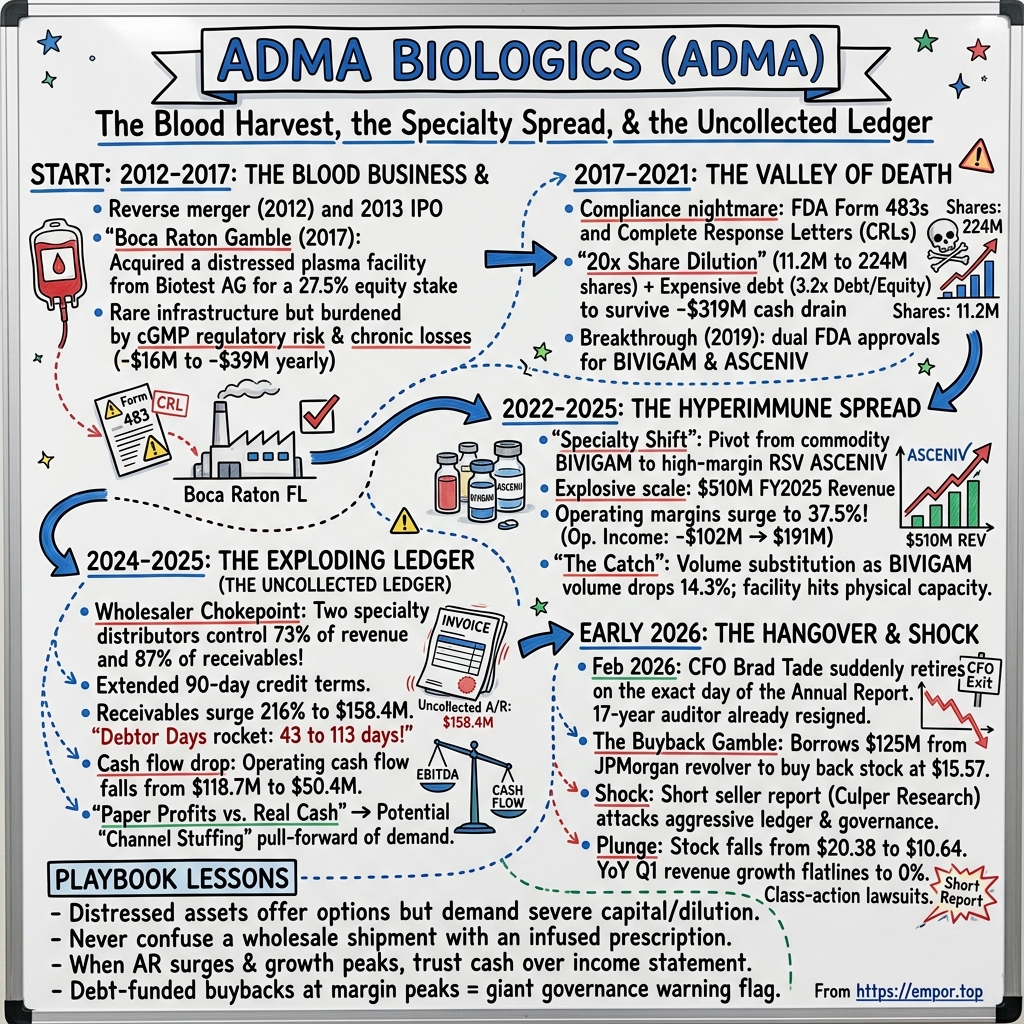
ADMA Biologics: The Blood Harvest, the Specialty Spread, and the Uncollected Ledger
I. The $10.64 Hangover and the 113-Day Mystery
On February 25, 2026, ADMA Biologics filed the best annual report in its history. The company that had spent most of its life losing money reported about $510 million of revenue for 2025 and about $191 million of operating profit, a margin of roughly 37.5%.1 For a business that refines human blood plasma, an industry where the giants are happy with margins in the teens or twenties, those were numbers that looked more like software. The same day, the man who had signed off on them stepped away. Chief Financial Officer Brad Tade had announced his retirement five days earlier, effective February 25, the day the 10-K was filed.2 His successor, Paul Kohler, had joined the company only in December.3
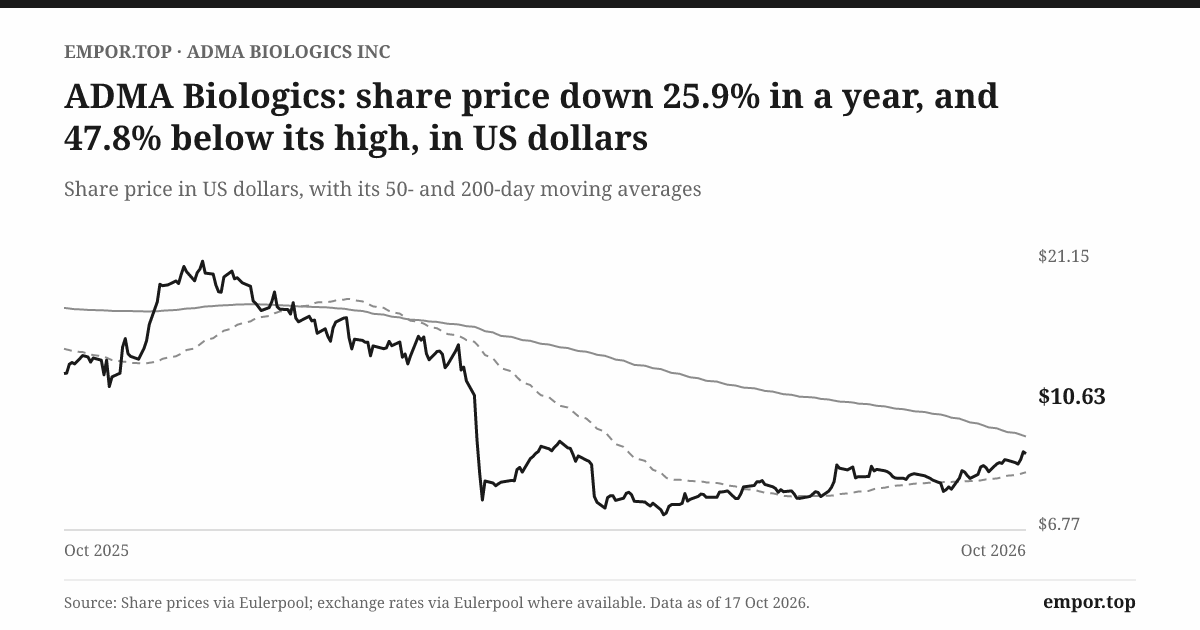
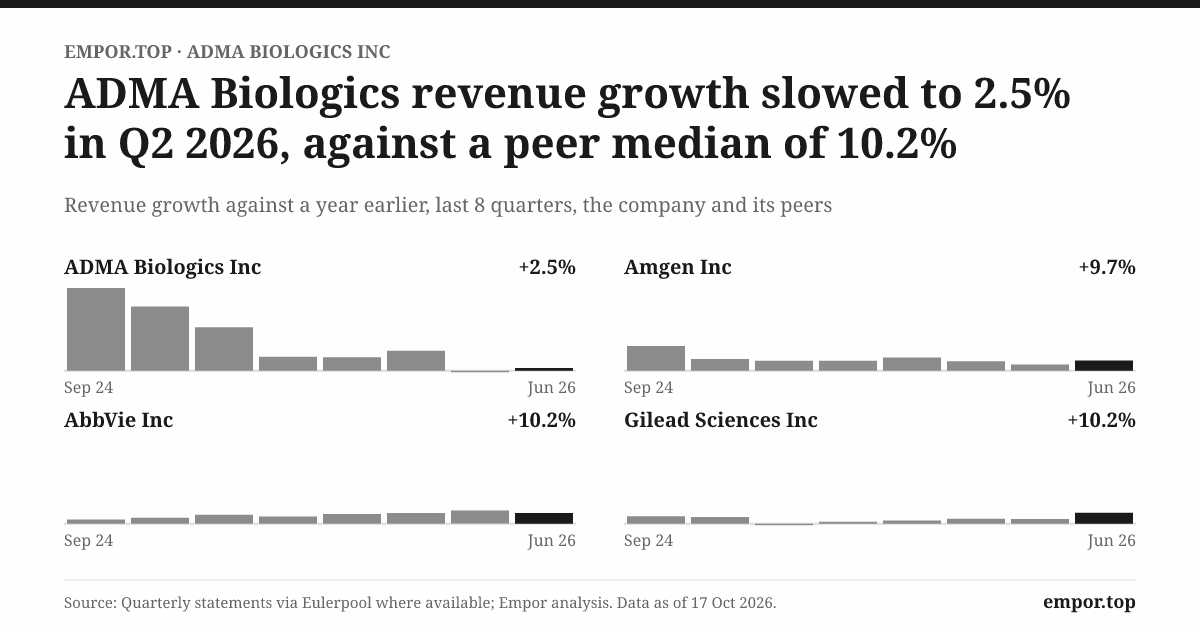
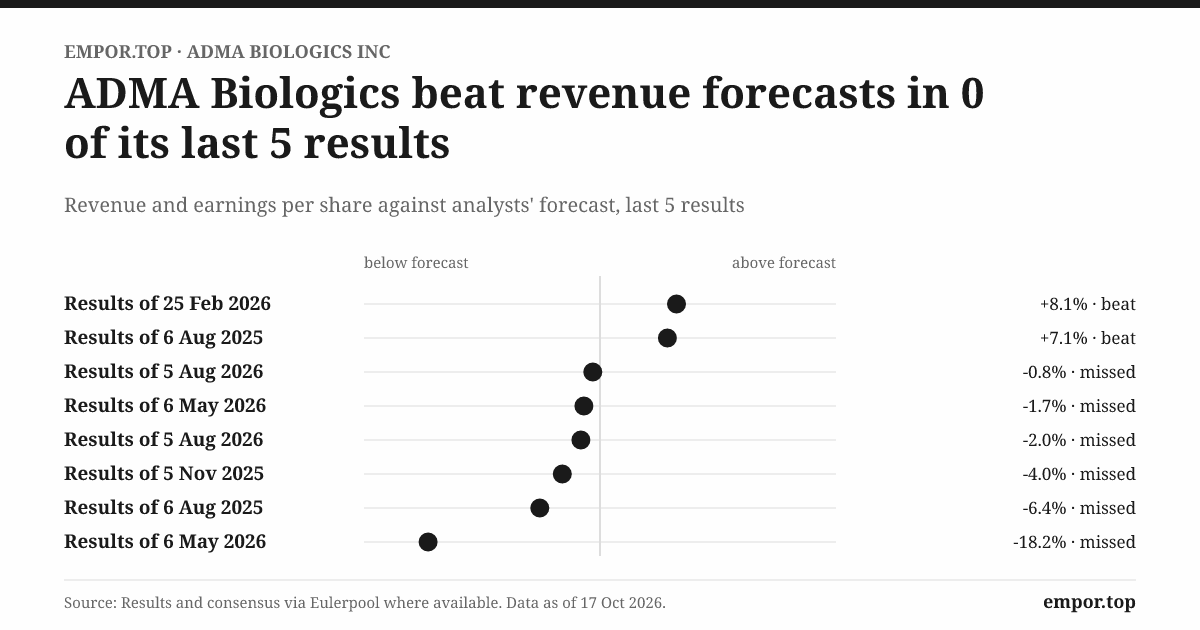
What followed reads like a stress test written by an unkind examiner. On March 2, ADMA drew $125 million from a fresh bank revolver to buy back its own stock at about $15.57 a share.4 Three weeks later, on March 24, the short seller Culper Research published a report accusing the company of stuffing its distribution channel with its star drug.5 Then the first quarter of 2026 came in with revenue of about $114 million, exactly what ADMA had sold in the first quarter of 2025: zero growth, from a company that had been growing at 40% to 80% a year.6 The second quarter grew just 2.5%.6 By October 17, 2026 the shares sat at $10.64, about 48% below their 52-week high of $20.38.
The tension in this story fits in a single figure from that celebrated 10-K. At the end of 2025, customers owed ADMA about $158 million, more than the roughly $139 million the company had booked in the whole fourth quarter.1 Put another way, ADMA was waiting about 113 days on average to be paid for what it sold, up from 43 days a year earlier.1 A company growing that fast, with margins that rich, should have been drowning in cash. Instead, its operating cash flow had fallen by more than half.1
That is the 113-day mystery, and it sits on top of a genuinely extraordinary business achievement. Over three years ADMA had compounded revenue at roughly 49% a year, and over the decade it had gone from a $5 million company to a half-billion-dollar one.1 It had done this in a corner of medicine controlled by multibillion-dollar incumbents, with a factory that a German company had once been unable to get through FDA inspection, and with a drug, ASCENIV, that most investors had never heard of five years earlier. The question the market began asking in 2026 was whether that drug was a durable specialty franchise or whether 2025 had been flattered by distributors loading their shelves.
Four questions carry the episode. The first is whether ADMA built a protected niche in ASCENIV or borrowed sales from 2026 by shipping into its two dominant distributors on generous terms in 2025. The second is whether ASCENIV's margin explosion came from a repeatable breakthrough or from a one-time mix shift, in which the same factory simply stopped making cheap product and made expensive product instead. The third is whether a run of governance signals, the departure of a 17-year auditor, the timing of the CFO's exit and a long history of small but persistent dealings with the founding family, masked commercial cracks. The fourth is whether the board made a costly mistake by borrowing to buy back stock at $15.57 weeks before it fell to the $10 range.
Tonight, ADMA is worth about $2.6 billion and trades at roughly 15.6 times trailing earnings, below its own five-year median of about 21.7 times. Believers see an orphan-like drug franchise priced like a commodity refiner. Skeptics see a receivables balance, a class action and a revolver draw that have yet to resolve. To judge between them, the story has to start where ADMA's economics start: with a donor, a needle and a centrifuge.
 Subscribe on LinkedIn
II. The Blood Business and the Boca Raton Fire Sale (2012–2017)
Every gram of immunoglobulin in an ADMA vial began as a donation. In the United States, paid donors sit in collection centers while a machine draws their blood, spins out the straw-colored plasma and returns the red cells. That plasma is frozen, pooled with thousands of other donations, tested and then sent into a process older than most of the companies that run it. Cold ethanol fractionation, developed by Edwin Cohn during the Second World War, works like a careful sieve: by changing temperature, acidity and alcohol concentration step by step, the refiner coaxes different proteins to fall out of solution one after another. Albumin comes out in one fraction, clotting factors in others, and immunoglobulin G, the antibodies that patients with weak immune systems cannot make themselves, in yet another. From the day plasma is collected to the day a vial ships can take most of a year, which means a fractionator always has an enormous amount of money tied up in tanks, freezers and inventory.
That physics shapes the industry. Building a fractionation plant costs hundreds of millions of dollars, validating it with the FDA takes years, and running it profitably requires a steady supply of plasma from a network of collection centers. So the market has consolidated into a handful of global giants, led by CSL Behring, Takeda and Grifols, which together control most of the world's fractionation capacity. For a newcomer, competing head-on in standard immunoglobulin is like opening a small oil refinery next door to ExxonMobil: possible in principle, punishing in practice.
ADMA's founders did not set out to fight that war. Dr. Jerrold Grossman, a physician-entrepreneur who had spent decades in the plasma business, and his son Adam Grossman started ADMA in the mid-2000s around a narrower idea.7 Some donors carry unusually high levels of antibodies against particular viruses. If you could find those donors, collect their plasma and pool it, you could make a "hyperimmune" product: still a broad immunoglobulin, but enriched against a specific threat. The Grossmans' target was respiratory syncytial virus, or RSV, a common virus that can be dangerous for people whose immune systems are compromised. Their candidate, RI-002, would eventually be named ASCENIV.7
Adam Grossman became the company's chief executive and has remained so for its whole public life. He is not a scientist by training but an operator who grew up around plasma centers, and the defining trait of his tenure is persistence: a willingness to keep raising money and keep fixing problems long after more cautious managers would have sold. That trait would save the company and cost its early shareholders dearly.
The public-market route began unglamorously. ADMA became a public reporting company through a reverse merger in 2012 and then, in October 2013, registered an underwritten offering to list on Nasdaq and fund the RI-002 clinical program.7 What it was selling in those years was mostly plasma from its own small collection network. Revenue was about $5 million in 2014, against an operating loss of about $16 million.1 The company was, in effect, a development-stage biotech with a few blood centers attached, and it needed someone else's factory to make its drug.
That factory turned out to be in Boca Raton, Florida, and it belonged to Biotest AG, a German plasma company. Biotest's US operation made BIVIGAM, a standard intravenous immunoglobulin, and Nabi-HB, a hepatitis B hyperimmune product, and it also manufactured for ADMA. But the Boca plant had fallen into regulatory trouble with the FDA, and Biotest wanted out. In June 2017 ADMA bought the plant and the product rights, paying with cash and with equity that left Biotest holding a large minority stake, about 27.5% of the company.1
This was opportunism of the best kind. ADMA acquired a licensed fractionation facility, something that new entrants spend years and fortunes trying to build, at a moment when the seller was motivated and few others wanted a plant under an FDA cloud. Overnight it became vertically integrated: it collected plasma, fractionated it, filled vials and sold the finished drugs. In 2017 revenue more than doubled to about $22 million, and property and equipment on the balance sheet jumped from about $2 million to about $30 million.1
It also bought a problem. The plant came with its compliance history and its cost base, and the operating loss widened to about $39 million in 2017 and then about $60 million in 2018 as ADMA absorbed a factory it could not yet run at full speed.1 The bet was simple to describe and hard to win: fix the plant, get the drugs approved, and survive long enough for the revenue to catch up with the costs. What nobody could say in 2017 was how much of the company would be left to the original shareholders by the time that happened.
III. The Valley of Death: Form 483s, CRLs, and 20-Fold Dilution (2017–2021)
For a biologics manufacturer, the worst letters come from Silver Spring, Maryland. A Form 483 lists what FDA inspectors saw on the factory floor that they did not like. A Complete Response Letter tells a company that its application cannot be approved as submitted. In the years after the Biotest deal, ADMA received both: the FDA's inspection findings at Boca Raton and complete response letters on its pending applications stalled the company's plans to relaunch BIVIGAM and win approval for RI-002.8 Each letter added months, and each month cost tens of millions of dollars, because a plasma plant burns money whether or not it is allowed to ship.
The cost of this period is easiest to understand through the cash flow statement. ADMA did not produce positive operating cash flow in any year from 2014 through 2022, and the outflows grew as the company built collection centers and remediated the plant, reaching about $102 million in 2020 and about $112 million in 2021.1 Across the twelve years from 2014 to 2025, operating cash flow added up to roughly minus $319 million. That gap had to be filled by someone, and it was filled by new shareholders and expensive lenders.
Here the record tests a claim that ADMA's management has often made, that its interests are aligned with outside shareholders. The share count says something more complicated. Diluted shares rose from about 11 million in 2014 to about 224 million by 2023, a twentyfold increase, as the company sold stock in follow-on offerings and at-the-market programs and issued warrants and options.1 Some of that dilution was the unavoidable price of survival; a company with a stalled factory has no other currency. But the investor who bought ADMA in 2014 and believed the story was right about the drug and still saw an ownership stake that ended up a twentieth of its original size. Alignment in a turnaround is not the same as alignment in outcomes, and ADMA's early shareholders funded a recovery that later shareholders captured.
Debt was the other leg. Banks do not lend to loss-making fractionators, so ADMA borrowed from specialty credit funds, first Hayfin Capital and later Ares Capital, on terms that reflected the risk: high interest, tight covenants and steep penalties for early repayment.1 Debt rose from about $44 million in 2018 to over $150 million by 2022, and at the low point in 2019 it was more than three times the book value of equity.1 The cost lingered long after the danger passed: when ADMA finally paid off Hayfin at the end of 2023, net interest expense and the extinguishment loss together came to about $51 million, enough to turn an operating profit into a pre-tax loss for the year.1
The breakthrough came in 2019. The FDA cleared the outstanding issues at Boca Raton, allowing BIVIGAM to return to the market, and on April 1, 2019 approved ASCENIV for the treatment of primary humoral immunodeficiency in adults and adolescents.9 After more than a decade of development and two years of remediation, ADMA had what it had been promising: an approved specialty product, an approved standard product and its own licensed plant to make both.
Approval, though, is not revenue. Revenue reached about $29 million in 2019 and about $42 million in 2020, and losses stayed stubbornly high, around $40 million to $65 million a year at the operating line through 2022.1 The plant needed plasma, the plasma needed collection centers, and the commercial team needed time to persuade immunologists to prescribe a new product that cost more than the alternatives. Biotest, meanwhile, eventually sold its entire stake into the market, removing a large holder that might one day have sold at an inconvenient moment, but also removing the last link to the industrial partner that had built the plant.10
The verdict on this era is mixed but clear. Management showed genuine operational persistence, because many companies with a warning-letter plant and a stalled application simply disappear. But the survival was paid for almost entirely by shareholders, through dilution, and by the business, through years of punishing interest costs. When the growth finally arrived, it arrived for a company with twenty times the shares and a habit of borrowing at whatever price lenders would accept. The question for the next chapter was whether the drug that justified all of this could earn enough to make the sacrifice worthwhile.
IV. ASCENIV and the Hyperimmune Spread (2022–2025)
Picture an immunology clinic in 2023. A patient with primary immunodeficiency has been on standard immunoglobulin for years, infused every three or four weeks for life, and still keeps landing in hospital with lung infections. The physician has a choice: keep adjusting the dose of the same product, or try something different. ASCENIV was built for that moment. It is still an immunoglobulin, made from the same basic process, but it is pooled from donors screened for high levels of neutralizing antibodies against RSV and blended with normal plasma.1 ADMA's pitch to doctors was that for the hardest-to-treat patients, that extra antibody content matters. ADMA's pitch to investors was that because ASCENIV is different, it can be priced as a specialty product rather than a commodity.
To see why that matters, think about how a fractionator makes money. Every liter of plasma yields a roughly fixed number of grams of immunoglobulin. If you sell those grams as standard IVIG, like BIVIGAM, you are a price-taker in a market dominated by giants. If you sell the same grams as ASCENIV at a premium, the plasma, the factory and the labor cost about the same, but the revenue per gram is much higher, and almost all of the difference falls to profit. ADMA does not publish its net price per gram for either product, so the precise premium is not disclosed, but the effect shows up unmistakably in the income statement.
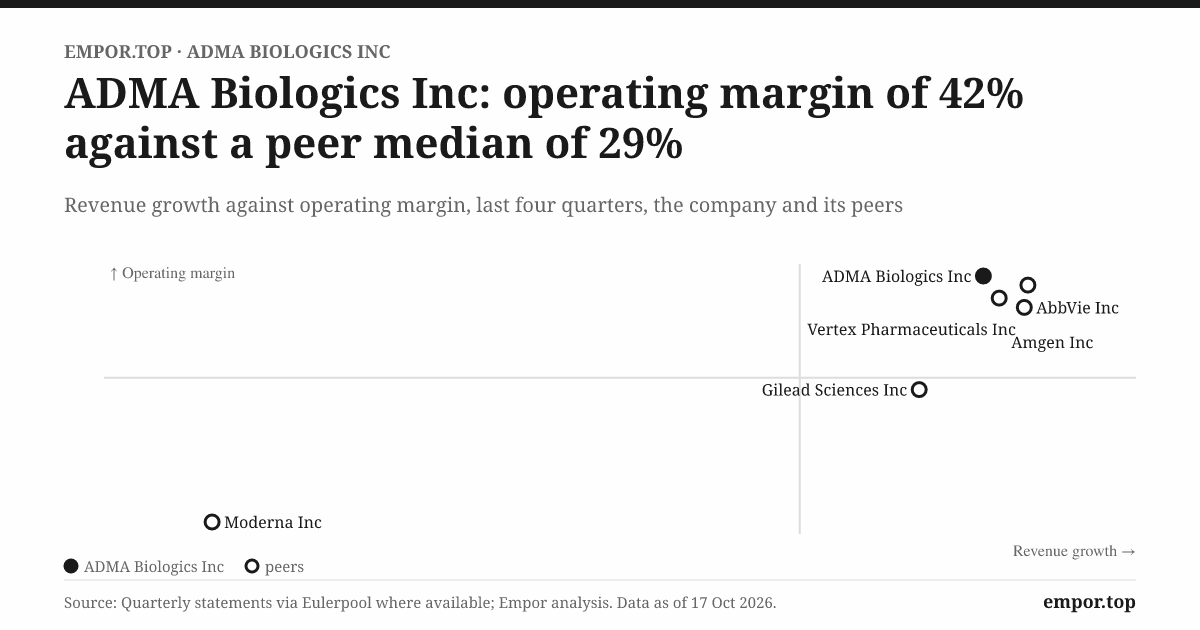
ASCENIV's sales went from about $93 million in 2023 to about $240 million in 2024 and about $363 million in 2025, when it made up roughly 71% of company revenue.1 Total revenue grew about 68% in 2023 and about 65% in 2024, then a slower 20% in 2025.1 And the operating margin, which had been negative a quarter of revenue in 2022, climbed to about 8% in 2023, about 33% in 2024 and about 37.5% in 2025.1 Operating profit went from a loss of about $39 million to a profit of about $191 million in three years.1 Few turnarounds in specialty pharma have been that steep.
The appeal of this business is its repeat nature. A patient who does well on an immunoglobulin tends to stay on it, infusion after infusion, for years. Demand does not move with the economy. And with ASCENIV, ADMA owns the screening know-how and the patents around identifying and pooling high-titer donors, so a rival would need to build its own donor-selection system and its own FDA approval to copy the product.1
Here, though, the record forces a narrower reading of the boom. If ASCENIV's growth came from ADMA building more capacity, both products should have grown. They did not. BIVIGAM's sales fell from about $142 million in 2024 to about $122 million in 2025, a drop of roughly 14%.1 The simplest explanation is that the Boca Raton plant was close to its limit and ADMA chose to fill it with the more profitable product. That is rational, and it is a big part of why the margin rose so fast. But it means the margin story was in significant part a mix shift, not an expansion: the same factory making more expensive vials and fewer cheap ones. A mix shift has a natural ceiling. Once BIVIGAM can be squeezed no further, growth must come from more plasma, better yield or a bigger plant, all of which cost money and time.
ADMA's reinvestment numbers point the same way. Research and development spending was about $5 million in 2025, under 1% of sales, and had been even lower in 2024.1 Capital spending rose to about $23 million in 2025 for yield improvements and automation at Boca, a meaningful step up but still under 5% of revenue.1 Headcount fell from 685 to 647, and the company agreed to sell three of its collection centers for about $12 million.1 This is the profile of a business being harvested around its existing licenses, not one building a pipeline. That is not necessarily wrong for shareholders, but it means there is little in development to replace ASCENIV if its pricing or volume falters.
The longer-term threat is biological rather than digital. There is no plausible artificial intelligence disruption to the act of giving someone antibodies they cannot make. But medicine is developing other ways to protect immunocompromised patients, including engineered monoclonal antibodies against specific viruses and new drug classes such as FcRn inhibitors, which reduce the need for immunoglobulin in some autoimmune conditions. None of these displaces a lifelong replacement therapy for primary immunodeficiency today, but they define the boundary of ASCENIV's niche: the more targeted the alternatives become, the smaller the population for which a broad, RSV-enriched immunoglobulin is clearly the best choice.
So by the end of 2025 the evidence supports a real but narrower version of the bull thesis. ASCENIV is a genuine product with genuine pricing power in a defined group of patients, and it turned ADMA into a profitable company. But a large part of the margin leap came from reallocating a fixed factory, and the question of how much more volume the drug could take was still open. The answer would show up not in the product line but in a part of the accounts most investors skip: who was buying all those vials, and how quickly they were paying.
V. Two Wholesalers and the Exploding Ledger (2024–2025)
When ADMA's finance team closed its books on December 31, 2025, the year looked spectacular on the income statement. On the balance sheet, one line looked strange. Accounts receivable, the money customers owed the company, stood at about $158 million, up from about $50 million a year earlier, a rise of more than 200% in a year when revenue grew by about 20%.1 The fourth quarter's sales were about $139 million.6 Customers owed ADMA more than everything it had sold them in the last three months of the year.
The explanation starts with who those customers are. ADMA does not sell mainly to hospitals or pharmacies. It sells to specialty distributors, and two of them dominate: BioCare and Priority Healthcare Distribution, which trades as CuraScript SD and is part of Cigna's Evernorth business. Together they accounted for about 73% of ADMA's 2025 revenue, about $372 million, and about 87% of its year-end receivables, roughly $138 million.1 ADMA's terms with its customers are typically payment within 90 days of sale, and the company has no long-term contracts that oblige them to buy minimum volumes.1 Ninety days is generous by the standards of drug distribution, and it means a distributor can take a lot of product before it has to pay for any of it.
That structure creates a well-known temptation. In a business where revenue is recognized when product ships to a distributor, a company can make a quarter or a year look better by shipping more than the end market needs that period, and the distributor, with three months to pay and the right to sell later, may be willing to hold the extra stock. The industry name is channel stuffing. It is not proven by a single number, and ADMA has denied it. But the symptoms are recognizable: receivables growing much faster than sales, cash lagging profit, and then a slowdown when distributors stop ordering to work down their inventory.
The cash flow statement is where the gap becomes impossible to ignore. In 2024, ADMA's reported net profit of about $198 million overstated its cash generation by design, because about $84 million of it came from an accounting release of a reserve against deferred tax assets, a recognition that past losses would now offset future taxes rather than any cash coming in the door.1 Operating cash flow that year was still a healthy $119 million. In 2025 the picture inverted. Net profit was about $147 million, but operating cash flow fell to about $50 million.1 Working capital absorbed roughly $140 million, mostly the receivables surge of about $108 million and an inventory build of about $36 million.1 Only about a quarter of ADMA's 2025 EBITDA arrived as cash, compared with about 80% the year before.1
Management's account was that the receivables reflected strong late-year volume and customer mix, and that distributor inventories matched underlying patient demand.5 That account deserves a hearing, because there are innocent versions of this pattern: a big shipment in December, a change in which distributor carried which volumes, or a timing difference that unwinds in January. The test of the innocent version is what happens next, and the next two quarters were not kind to it. Revenue stopped growing in the first quarter of 2026 and barely grew in the second.6 If distributors had been buying only what patients were using, a drug growing at 40% a year in early 2025 should not have stopped dead a year later.
One more detail sharpens the point. Against $158 million of receivables concentrated in two counterparties on extended terms, ADMA's allowance for doubtful accounts and contractual credits was about $0.3 million, roughly 0.2% of the balance.1 That is an assertion that every dollar will be collected in full with no meaningful discounts or credits, which is plausible for large, creditworthy distributors but leaves no cushion if any of those balances are later settled with price concessions, returns or chargebacks.
Weighing the evidence, the record does not prove channel stuffing; that would require evidence of distributor inventory levels and terms that ADMA does not publish. But it does reject the simpler story that 2025's profits were high-quality earnings. The balance sheet and the cash flow statement show a company that recognized revenue much faster than it collected cash from two customers on unusually long terms, followed by a sharp deceleration in orders. Whether that was a stuffed channel or a lumpy one, the cash had not yet arrived. And in the first weeks of 2026, as that ledger closed, ADMA's leadership made a series of moves that would put its governance under the same magnifying glass.
VI. The C-Suite Exit, the Short Attack, and the Borrowed Buyback (Early 2026)
The weeks between late February and late March 2026 were the most consequential in ADMA's recent history, and they make more sense against a longer pattern of governance signals.
The first came in October 2024. CohnReznick, the accounting firm that had audited ADMA for about 17 years, resigned.11 Auditor resignations are not unusual for a company that has grown from a micro-cap into a mid-cap, and CohnReznick's required letter confirmed that there were no disagreements with management and no reportable events.11 KPMG, a Big Four firm, was engaged at the end of that month and went on to give unqualified opinions on both the financial statements and the internal controls for 2025.121 KPMG's one critical audit matter was the sufficiency of evidence over inventory, which at about $206 million was the largest asset on the balance sheet.1 The change of auditor, in other words, upgraded the scrutiny rather than escaping it. But it meant that the year of the receivables surge was audited by a firm in only its second year on the account.
The second signal was the family's footprint. ADMA leases its Ramsey, New Jersey headquarters and warehouse from Areth LLC, an entity controlled by Adam Grossman and his father, Jerrold Grossman, who is the company's vice chairman; the rent is about $10,000 a month, with the lease running through the end of 2026.1 ADMA also bought plasma-related equipment and services from GenesisBPS, which the Grossmans controlled until September 2025, though these purchases were small and shrinking, about $0.1 million in 2025.1 None of this moves the economics of a half-billion-dollar company. What it shows is a board comfortable with the founding family transacting with the company year after year, which is the kind of culture short sellers point to and long investors must weigh.
The third signal was pay and dissent. Adam Grossman's total compensation rose from about $6 million in 2023 to about $10.2 million in 2025, much of it in stock and options.3 Shareholders approved the pay plan with about 89% support in 2025 and about 96% in 2026, but they registered unease elsewhere: in 2024 about 29% of votes cast withheld support from Chairman Steven Elms, and in 2025 about 26% withheld support from director Lawrence Guiheen.151413 Those are large protest votes for a company of this size, and they predate the short report.
Into that context came the CFO transition. On February 20, 2026, ADMA announced that Brad Tade would retire, effective February 25.2 Tade had been central to the turnaround years and was paid about $2.8 million in 2025.3 A retiring CFO signing one last 10-K and leaving the same day can be orderly succession, especially with a successor already inside the building. It can also look to outsiders like a reluctance to own what comes next. The company presented it as the former; the market, a few weeks later, would read it more skeptically.
Then came the buyback. The capital story had changed course in 2025. In August, ADMA replaced its expensive private credit with a $300 million facility from JPMorgan Chase: a $75 million term loan, fully drawn, and a $225 million revolving line, initially undrawn, priced at a floating benchmark rate plus a margin, with an effective rate of about 6.4% at year end.1 The agreement came with covenants capping total leverage at 2.5 times and requiring fixed-charge coverage of at least 1.2 times.1 In May 2025 the board had authorized up to $500 million of share repurchases, and the company bought back about $32 million of stock that year.1 At the end of 2025 ADMA held more cash than funded debt, a small net cash position of roughly $15 million.1
On March 2, 2026, ADMA went much further. It entered an accelerated share repurchase with JPMorgan for $125 million, at an initial price of about $15.57 a share, and funded it by drawing on the revolver.4 In one move the company's funded bank debt rose to roughly $197 million and its net cash disappeared.14 An accelerated repurchase delivers most of the shares up front and settles the final price later, so the company gets the reduction in share count immediately. The board's logic was easy to see: after a decade in which the share count multiplied twentyfold, returning shares to a company that now believed itself undervalued looked like overdue justice for owners.
The timing is what the record judges. The buyback was executed after the year-end receivables surge was already known internally, after the CFO had announced his exit, and weeks before a quarter in which revenue would show no growth at all. Three weeks later, on March 24, Culper Research published its short report, built around exactly the evidence in the 10-K: the 113 days of receivables, the two distributors, the executive turnover.5 ADMA responded publicly on March 27, denying the allegations.5 In July, a federal securities class action, Mazzarino v. ADMA Biologics, was filed in New Jersey against the company, both Grossmans and Tade, alleging that investors had been misled about distributor terms and the quality of revenue.6
And then came the numbers that mattered most. First-quarter revenue of about $114 million matched the prior year; second-quarter revenue of about $124 million was up just 2.5%.6 Operating margins actually stayed high, above 40%, which tells you that the pricing and cost structure of ASCENIV had not cracked.6 What had cracked was volume growth. The shares that ADMA bought at around $15.57 were, by October, worth about two-thirds of that.
The verdict here should be stated plainly. Buying back stock is not wrong, and the share count needed repair. But borrowing most of a new credit line to buy at a high price, at the very moment cash conversion had collapsed and the CFO was leaving, was a confidence signal that the company's own balance sheet did not support, and the market punished it accordingly. The interesting question is no longer whether that decision was a mistake. It is what kind of business is left once the noise clears, and whether its advantages are as durable as its 2025 margins implied.
VII. Analysis, Moats & Bear vs. Bull Case
Imagine the argument staged in a conference ballroom in 2026. The bull holds up a single label: ASCENIV, now approved for children too, sold to patients who stay on therapy for life, priced at a premium, and available for about 15.6 times trailing earnings when the company's own five-year median is about 21.7 times. The bear holds up a single number: 113 days. Both are looking at the same company. The way to decide between them is to ask what, specifically, protects ADMA's profits, and how strong each protection is.
Start with Hamilton Helmer's idea of a cornered resource, something valuable that a company controls and rivals cannot easily get. ADMA's best claim here is ASCENIV itself: its patented method for identifying and pooling high-titer donor plasma, its FDA license and the clinical data behind it.1 A competitor wanting to copy it would need its own donor screening program, its own manufacturing validation and its own approval, a multi-year journey. That is real protection, though it protects a method and a label, not the underlying molecule, and large fractionators could pursue their own hyperimmune products if the niche became large enough to justify the effort.
Switching costs are the second source of strength. Immunologists are reluctant to move a stable immunodeficient patient from one immunoglobulin to another, because individual patients can react differently to different products and a bad reaction can be serious. Once a patient does well on ASCENIV, inertia works in ADMA's favor. The limit is that ADMA does not disclose patient retention or the number of patients on therapy, so the strength of this effect has to be inferred from revenue rather than measured directly.
Barriers to entry are formidable. Building a fractionation plant like Boca Raton costs hundreds of millions of dollars and years of validation, which is why ADMA could only enter the industry by buying a distressed one. That barrier protects ADMA from new entrants, but not from the incumbents, who already own far larger plants and plasma networks.
Process power, the ability to operate better than rivals because of accumulated know-how, is where ADMA's record is weakest. The same plant that now earns 40% margins was, less than a decade ago, the subject of FDA findings serious enough to stall approvals. ADMA has fixed it and kept it running, and KPMG's audit focus on inventory is a reminder of how much value sits in tanks and freezers that must stay in compliance. A single bad inspection could still interrupt supply. That is not a moat; it is a vulnerability that has been managed well recently.
Now turn to Michael Porter's forces, and one stands out above the rest: the bargaining power of buyers. Two distributors take nearly three-quarters of ADMA's revenue and owe nearly nine-tenths of its receivables, with no minimum purchase commitments.1 ADMA does not control the final price paid by hospitals and payers, and those two buyers can slow orders, ask for longer terms or negotiate concessions. The 2025 receivables and the 2026 slowdown are precisely what buyer power looks like when it is exercised. Suppliers matter too: ADMA relies on its own and third-party plasma collection and on single-source suppliers for some testing kits and consumables, so supply disruptions or plasma cost inflation would hit margins.1 The threat of substitutes from monoclonal antibodies and FcRn inhibitors is slow but real. And rivalry with the big fractionators is muted only because ADMA plays in a corner they have chosen not to contest aggressively.
Put together, ADMA's moat is narrow and specific: a defensible specialty product with sticky patients, sitting on top of a plant that is hard to replicate, sold through a channel ADMA does not control. The moat explains the margins. It does not protect the volumes.
The market's price reflects that ambiguity. At $10.64, ADMA is valued at about $2.6 billion, with an enterprise value of about $2.7 billion, about 11.5 times EBITDA, about 5.1 times sales and a free cash flow yield of about 4.5%. Among plasma peers, CSL Limited, the diversified global leader, trades at roughly 18 to 20 times EBITDA, while Grifols, weighed down by debt and its own governance controversies, trades at roughly 6 to 8 times. ADMA sits in between, which is roughly where a business with CSL-like margins and Grifols-like questions would be expected to sit. The price appears to assume that ASCENIV's profitability holds but that growth is uncertain and that the receivables and litigation carry some risk of costing money.
Three numbers will decide which reading proves right. The first is debtor days, which stood at about 113 at the end of 2025 against about 43 a year earlier; a return toward the level of 2023 and 2024 without write-offs or concessions would substantially answer the channel stuffing charge. The second is ASCENIV's volume, as distinct from its price: whether the pediatric approval in May 2026 adds new patients or merely offsets slowing adult demand.16 The third is cash conversion, which fell to about a quarter of EBITDA in 2025 against about 80% the year before; a return toward that earlier level would show that the paper margins are turning into money.
The bull case, laid out at its strongest, runs like this. ASCENIV is a genuine therapy for a population of patients who need it for life, protected by patents and an FDA license, and the 2026 pediatric label widens the pool of eligible patients.16 The early-2026 slowdown was the natural digestion of a large year-end shipment, not a collapse in demand, and the fact that margins stayed above 40% through it suggests that ADMA did not have to cut prices to move product.6 As receivables normalize, tens of millions of dollars of trapped cash return to the business, enough to pay down much of the revolver. On that view, a stock at 15.6 times earnings, a third below its own history, is pricing a temporary accounting wrinkle as a permanent flaw.
The bear case is just as coherent. The 2025 spike was in significant part shipments ahead of demand, and the flat first half of 2026 is the real growth rate of a drug that has already penetrated most of its natural market. The two distributors, having seen ADMA's dependence on them, will press for discounts or concessions, and the company's near-zero reserve against receivables leaves no buffer for them. The class action could expose internal communications that damage management's credibility further, and the board has replaced a net cash position with nearly $200 million of floating-rate debt to buy shares now worth far less.
The evidence today leaves the bull thesis intact but unproven, and narrower than its 2025 version. The product is real; the profit margins are real; the growth rate and the cash conversion are not yet confirmed. What decides the case is not argument but the next set of filings, which is where the lessons of this story begin to come into focus.
VIII. Playbook: Business & Investing Lessons
The first lesson begins in a Florida plant that nobody else wanted. In 2017, ADMA bought Biotest's troubled Boca Raton facility when the FDA's concerns had turned it from an asset into a liability for its owner. That was the right asset at the right price, and it eventually produced hundreds of millions of dollars a year of high-margin sales. But it took most of a decade to pay off, and the shareholders who financed the wait were diluted twentyfold. A distressed regulatory asset is an option, and the premium on that option is paid in years of cash burn. The line to remember: in a turnaround, the plant gets saved by the shareholders who never get to own it.
The second lesson concerns where a sale happens. ADMA's revenue is recognized when a vial ships to a distributor, not when a nurse hangs it on an IV pole. With two distributors taking most of the volume and 90 days to pay, a year of rapid "growth" can mean a year of full warehouses, and the first sign is usually the receivables line, not the income statement. A wholesale shipment is a promise to pay, not proof of a patient.
The third lesson sits in the cash flow statement for 2025. ADMA reported nearly $200 million of operating profit and about $50 million of operating cash, with roughly $140 million swallowed by receivables and inventory. When profits soar and cash shrinks in the same year, the income statement is describing the future and the cash flow statement is describing the present, and only one of them can be spent. Margin is an opinion until the wire clears.
The fourth lesson is about the order of confident gestures. A company that had just seen its receivables triple, whose CFO had just announced his exit, and whose growth was about to stall, borrowed $125 million on a new revolver to buy its own shares at about $15.57. Weeks later the shares were trading in the low teens and then around $10. Buybacks are a fine use of surplus cash; they are a dangerous use of borrowed confidence. When a board levers up to buy back stock just as the cash dries up, the buyback is not a signal of strength but a bet on it.
The fifth lesson is the arithmetic of a full factory. ADMA's margins soared because Boca Raton made more ASCENIV and less BIVIGAM, turning the same liters of plasma into far more valuable grams. That is a brilliant trade once. But a mix shift runs out when the cheap product has been squeezed out, and from there growth requires more plasma, better yields or a bigger plant. A margin built on reallocating capacity has a ceiling the size of the factory.
IX. Epilogue
Tonight, ADMA is a profitable company with a valuable drug, a levered balance sheet and an open question about its customers. Its next few months will answer more of that question than the past nine.
The first moment that matters is the 2026 annual report, which will arrive early next year. Investors will turn straight past the income statement to the receivables footnote and the concentration disclosure. If debtor days have returned to something near the 40-to-60 range of earlier years, with no meaningful write-offs, credits or returns, the channel stuffing charge loses most of its force and the 2025 cash shortfall becomes a timing story. If receivables remain stretched, or if they fall only because ADMA has granted discounts to get paid, the charge gains weight and the 2025 margins look less like a new baseline.
The second moment is in a federal courtroom in Newark. The defendants in Mazzarino v. ADMA Biologics will ask the court to dismiss the case before discovery.6 If it is dismissed, a cloud lifts. If it survives, plaintiffs will gain access to internal documents about distributor terms and end-of-year shipments, which would keep the governance questions alive for years and could carry settlement costs.
The third moment is on the prescription pad. The pediatric approval in May 2026 gave ADMA a new population to reach.16 If that shows up as quarterly revenue climbing back toward double-digit growth, the 2026 slowdown will look like a pause; if quarterly revenue stays stuck in the $115 to $125 million range, it will look like the new normal for a drug that has found its ceiling.
The fourth is the quieter matter of credit. With roughly $200 million of floating-rate bank debt after the buyback, ADMA must stay within JPMorgan's covenants: total leverage below 2.5 times and fixed-charge coverage above 1.2 times.1 At current profit levels there is headroom, but that headroom depends on the same EBITDA that the bears say is overstated. A company that only recently escaped expensive private credit should not need to see those lenders again.
Each of these moments touches one of the central questions. The receivables test the quality of the 2025 boom; the court tests the governance; the pediatric launch tests whether ASCENIV can grow beyond a mix shift; the covenants test whether the buyback was merely poorly timed or genuinely dangerous. None has been settled yet, and that is why a company with 40% margins trades at a discount to its own history.
X. Outro
Inside the clean rooms at Boca Raton, the work has not changed since the day ADMA took over the plant. Frozen plasma from thousands of donors is thawed, chilled, adjusted and spun, and gram by gram the antibodies that keep an immunodeficient child out of hospital are separated from everything else. It is slow, exacting, almost medieval work dressed in stainless steel, and ADMA learned to do it well enough to earn margins its giant rivals would envy.
That is the paradox of this company. ADMA solved one of the hardest problems in biotechnology, taking a factory the FDA had stalled and turning it into a licensed engine for a premium drug, and then walked into one of the oldest traps in commerce: shipping faster than customers paid. ADMA has proved that human blood can yield software-like margins. It has not yet proved that those margins become cash, and until the distributors write the checks, even a miraculous medicine is just inventory sitting in someone else's warehouse.
References
-
Form 10-K: Annual Report for the Fiscal Year Ended December 31, 2025 — ADMA Biologics, Inc., 2026-02-25 ↩↩↩↩↩↩↩↩↩↩↩↩↩↩↩↩↩↩↩↩↩↩↩↩↩↩↩↩↩↩↩↩↩↩↩↩↩↩↩↩↩↩↩↩↩↩
-
Form 8-K: Departure of Directors or Certain Officers (CFO Transition) — ADMA Biologics, Inc., 2026-02-25 ↩↩
-
Definitive Proxy Statement on Schedule 14A — ADMA Biologics, Inc., 2026-04-15 ↩↩↩
-
Form 8-K: Entry into Accelerated Share Repurchase Agreement — ADMA Biologics, Inc., 2026-03-02 ↩↩↩
-
Form 8-K: Response to Short Seller Report Disclosures — ADMA Biologics, Inc., 2026-03-27 ↩↩↩↩
-
Form 10-Q: Quarterly Report for the Period Ended June 30, 2026 — ADMA Biologics, Inc., 2026-08-05 ↩↩↩↩↩↩↩↩↩
-
Form S-1/A: Registration Statement Under the Securities Act of 1933 — ADMA Biologics, Inc., 2013-10-04 ↩↩↩
-
Form 10-K: Annual Report for the Fiscal Year Ended December 31, 2023 — ADMA Biologics, Inc., 2024-02-28 ↩
-
ASCENIV (Immune Globulin Intravenous, Human - slra 10% Liquid) — U.S. Food and Drug Administration, 2019-04-01 ↩
-
SEC EDGAR Filings Repository for ADMA Biologics, Inc. (CIK 0001368514) — U.S. Securities and Exchange Commission ↩
-
Form 8-K: Resignation of Certifying Accountant CohnReznick LLP — ADMA Biologics, Inc., 2024-10-09 ↩↩
-
Form 8-K: Engagement of Independent Registered Public Accounting Firm KPMG LLP — ADMA Biologics, Inc., 2024-10-31 ↩
-
Form 8-K: Voting Results of the 2026 Annual Meeting of Stockholders — ADMA Biologics, Inc., 2026-06-02 ↩
-
Form 8-K: Voting Results of the 2025 Annual Meeting of Stockholders — ADMA Biologics, Inc., 2025-06-04 ↩
-
Form 8-K: Voting Results of the 2024 Annual Meeting of Stockholders — ADMA Biologics, Inc., 2024-06-04 ↩
-
Form 8-K: FDA Approval of ASCENIV Pediatric Indication Expansion — ADMA Biologics, Inc., 2026-05-04 ↩↩↩
 LinkedIn
 WhatsApp
 Reddit
 Hacker News
 Email
 Kindle
 RSS Feed
 Spotify
 Apple Podcasts
 Amazon Music
 Audible
 YouTube