UMH Properties: The Land Beneath the Growth
I. The rent check and the capital raise
On the first of the month, somewhere in central Pennsylvania or eastern Ohio, a resident sends a payment to UMH Properties. Most of the money is not rent on a house. The resident may already own the house: a factory-built home that arrived on a truck in two sections, was set on a foundation, connected to water and power, and given a small yard. What the payment covers is the ground under it. It pays for a homesite with a paved road in front, a sewer line beneath and a mailbox at the corner, inside a community that the resident did not build and cannot easily leave.
That payment is the foundation of the business. It arrives every month, it tends to rise every year, and the tenant base is spread across tens of thousands of households, so no single one of them matters much. For a landlord, it is close to an ideal customer relationship.
What happens next is the more interesting part of the story. The rent goes into UMH's operating account. From there the company has to choose between paying shareholders a dividend, repaving a road, buying a new rental home for an empty lot, or adding to the money needed to acquire another community somewhere in the Rust Belt or the Southeast. For more than a decade, the answer has usually been all of those at once. Because the rent alone could not pay for all of them, the company also drew on its credit line, sold new shares or issued preferred stock.
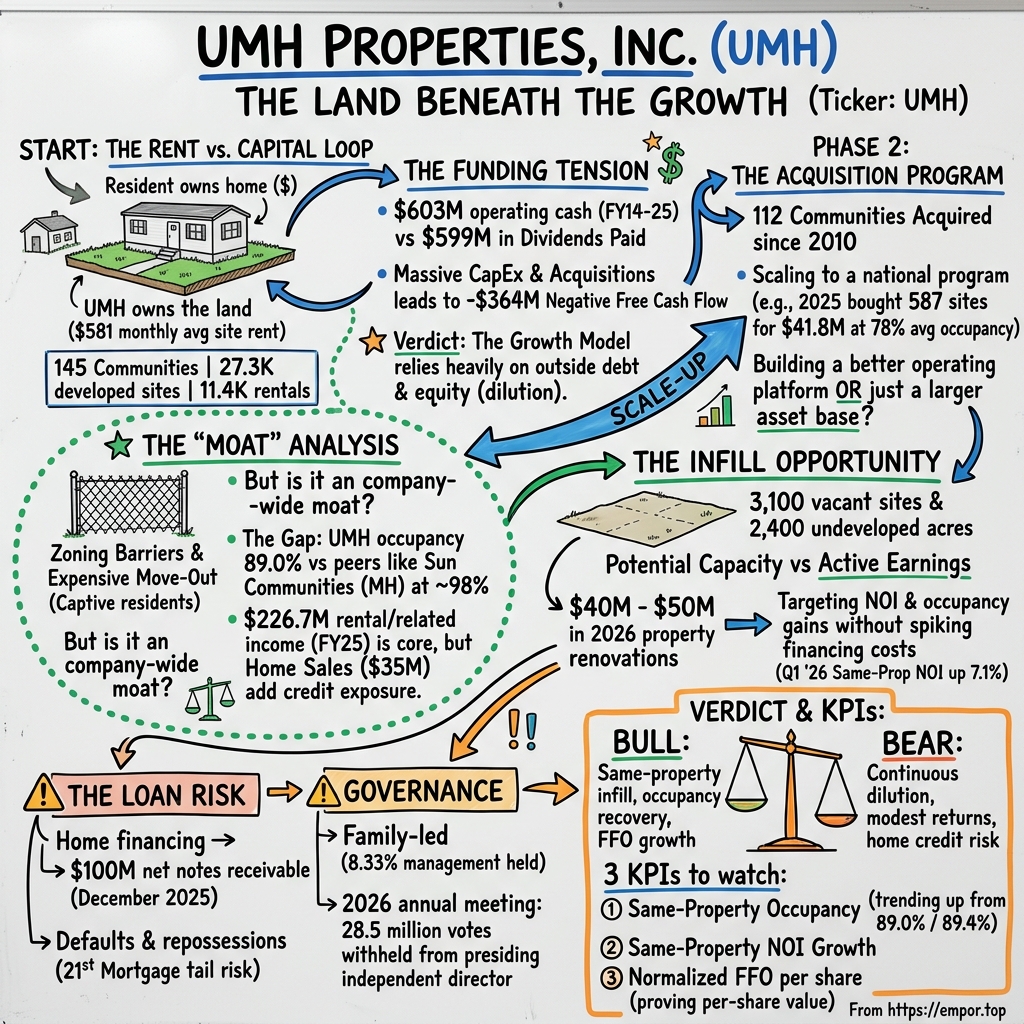
The numbers show the pattern clearly. Over the twelve fiscal years from 2014 through 2025, UMH reported about $127 million of cumulative net profit, which is modest for a company whose assets reached about $1.7 billion. Over the same years it generated about $603 million of cash from operations, nearly five times its accounting profit.1 The difference is not a trick. A manufactured-housing community is mostly land, roads and pipes, and accounting rules require the owner to depreciate the buildings and improvements every year, even when the community is gaining value. That charge reduces profit without any cash leaving the bank. Measured by operating cash, UMH looks healthier than its income statement suggests.
The rest of the cash-flow statement complicates that picture. After capital spending, free cash flow across those twelve years was roughly negative $364 million. Over the same period, the company paid about $599 million of dividends,1 almost exactly the amount it generated from operations. All of the investment program therefore had to be funded from outside the company. Net cash spent on investing activities over the twelve years came to roughly $1.5 billion. Net cash from financing activities came to about $1 billion, and that figure is already after paying the dividends. Before them, the company raised something like $1.6 billion from lenders, preferred holders and new common shareholders. In simple terms, the residents' rent paid the shareholders, and new capital paid for growth.
That arrangement is the central question for anyone considering UMH as a long-term holding. Can the company grow its communities and keep paying shareholders without repeatedly returning to the debt and equity markets? If not, does the capital it raises earn enough to justify the dilution and the debt?
Some sense of scale helps. At the end of September 2026, UMH reported 145 communities with roughly 27,300 developed homesites and about 11,400 company-owned rental homes on those sites.2 Three of those communities sat in joint ventures with Nuveen, the investment manager, in which UMH held stakes of 42% and 40%, while it consolidated the other 142 on its own books.3 Nuveen's broader business has nothing to do with this story. It is UMH's partner in a few properties, not its parent. UMH is a self-managed U.S. real estate investment trust, founded in 1968 and listed on the New York Stock Exchange, with essentially no foreign-currency exposure. The financial risks that matter for it are interest rates and the cost of capital.1
As a REIT, UMH must distribute most of its taxable income, so the dividend is a structural feature of the business rather than a discretionary gift. Even so, the size of the payout relative to reported profit is striking. In 2025, dividends equalled about 274% of GAAP net income. Over the past decade the ratio has ranged from about 120% in its best year to around 1,200% in its worst.1 REIT investors are used to this. They rarely judge payouts against net income, and use funds from operations instead: net income with the depreciation added back and one-time gains and losses removed. On that measure, UMH reported normalized FFO of $0.26 per diluted share in the third quarter of 2026.2 The dividend does not look absurd on an FFO basis. FFO, though, ignores the money spent on new homes, renovations and acquisitions, so it can make a business look self-funding when its cash flows are not.
Three questions follow from this opening. The first is whether gains inside the existing communities (higher occupancy and higher rent on the same set of sites) can carry more of the growth, so that the company depends less on buying new communities. The second is whether the business of helping residents finance their homes has created a credit exposure larger than it looks. The third is the one that decides the others: whether management can deploy each new dollar of borrowed or newly issued capital at a return that leaves existing shareholders better off per share, rather than just owners of a larger company.
To answer them, the story begins with the shopping spree.
 Subscribe on LinkedIn
II. Fifty-five communities became a national buying program
In the summer of 2012, UMH announced a deal that was large by its standards. It agreed to buy 11 manufactured-housing communities in Pennsylvania and New York for $28.25 million.4 At the time, the company was a modest regional landlord with a few dozen properties, most of them in the Northeast and Midwest, and a reputation as a steady dividend payer that did little to draw attention. The 2012 portfolio purchase signalled a change in how the company intended to grow. Previously it had bought communities one at a time as opportunities arose. It was now willing to buy them in bundles, and fairly cheaply.
The company's history before then can be told briefly, because it matters mainly as background. Eugene Landy founded the business in 1968 and has remained its chairman for more than half a century.5 His son Samuel Landy became chief executive and has led the company through the entire period this story examines.5 For decades UMH (originally United Mobile Homes) owned communities and sold homes in them, and it was conservative and largely unnoticed. What changed in the 2010s was the pace. Older, family-owned communities across Pennsylvania, Ohio, New York and later Indiana, Michigan, Tennessee and the Carolinas were coming to market, often with deferred maintenance and empty lots. The Landys were willing to buy them, fix them up and fill them.
The scale of that effort is clear from the company's own account. UMH says it has roughly tripled in size since 2010, acquiring 112 communities with about 19,400 developed homesites.6 That is most of the current portfolio. Today's UMH, with about 27,300 sites, is mainly the product of acquisitions made over the past fifteen years, not of the business that existed in 2010. The balance sheet tells the same story. Total assets rose from under half a billion dollars at the end of 2014 to about $1.7 billion at the end of 2025, while borrowings nearly tripled, from about $260 million to about $761 million.1
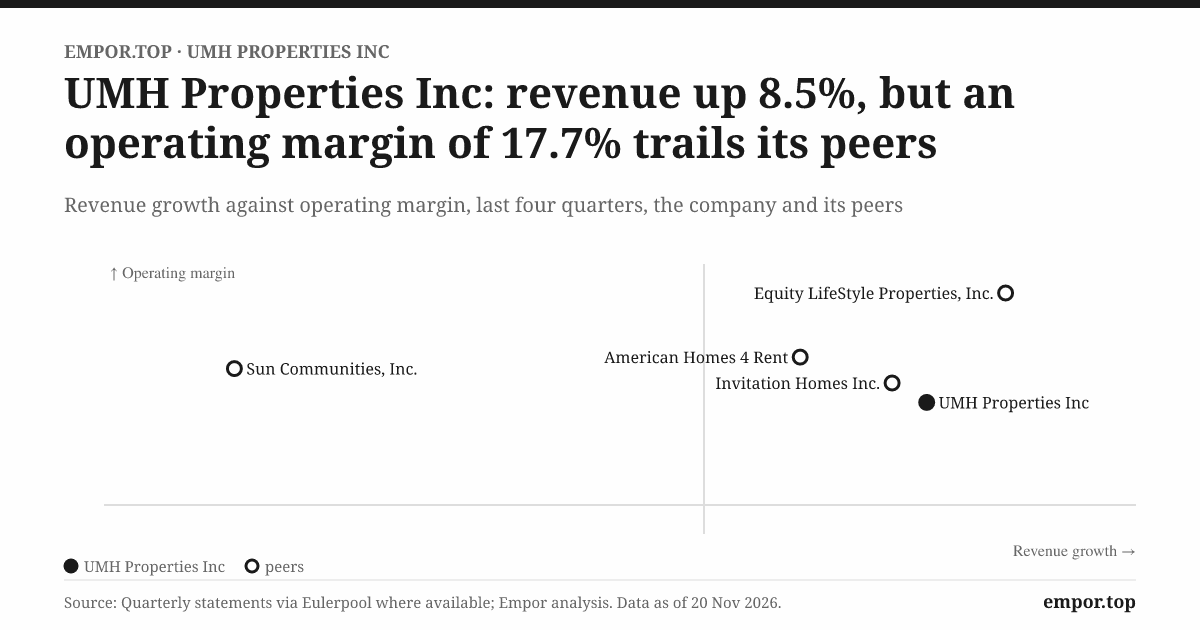
Revenue grew too. From fiscal 2015 to 2025, total revenue compounded at about 12.4% a year.1 It is tempting to read that as evidence of a strong operating business. It is better treated as a starting point for questions. A landlord's revenue can rise for four different reasons. It can buy more sites. It can build new sites on land it already owns. It can put its own rental homes on empty sites and collect rent on both the home and the land. Or it can fill more of its existing sites and raise rents on the occupied ones. Only the last of these is purely organic. The others require capital. Over the most recent three years, revenue grew about 10.2% a year,1 slower than the ten-year rate, which suggests the acquisition engine has been running at a lower speed than in its peak years.
The company's filings do not provide a clean multiyear breakdown of that growth by source, which is why the same-property figures discussed later carry so much weight. They are the only consistent measure separating what the existing portfolio earns from what was bought.
The 2025 acquisitions show what UMH buys today. During the year the company bought 587 developed homesites for $41.8 million, and the purchased communities were on average about 78% occupied at acquisition.1 That works out to a little over $70,000 per developed site. Within that average, the deals varied widely. Cedar Grove and Maplewood Village were fully occupied when UMH bought them, so they were stable income streams on day one. Albany Dunes, by contrast, was only 32% occupied, which made it a project.1 Buying Albany Dunes meant buying empty lots and betting that UMH's operating system of renovation, rental homes, sales and financing could fill them. Buying Cedar Grove meant paying for occupancy that someone else had already achieved.
Both are reasonable strategies, but they test different skills. In a full community, the return depends almost entirely on the price paid and the scope for raising rents. In a mostly empty one, the return depends on execution: how quickly vacancies can be filled, how much it costs, and whether the new residents stay. The company's filings do not disclose enough consistent deal-level net operating income or purchase capitalization rates for an outsider to judge whether UMH overpaid or bought cheaply relative to private buyers or larger public peers. The best an investor can do is compare UMH's own deals with each other and watch, over the following years, whether the purchased communities raise portfolio-wide occupancy and NOI.
The funding of the buying program also changed. In the early years, mortgage debt did most of the work. Over time the company added more instruments: an at-the-market program for common stock, which lets UMH sell shares into the market a few at a time; a dividend reinvestment and stock purchase plan that turns dividend checks and new investor money into newly issued shares; several series of preferred stock; and unsecured bonds and a revolving credit line.1 In 2025, for example, the common-stock ATM raised about $44 million net and the reinvestment plan about $9 million more.1 Each of these funded growth, and each meant that existing shareholders owned a slightly smaller share of a larger company.
That leads to the harder question about acquisitions. Buying sites makes a company bigger. Whether it makes the business better depends on what happens to the sites after the purchase. If UMH's communities, taken together, remain less occupied than the best public peers, then the acquisition program has assembled a large set of assets whose value depends on management closing that gap. The next question is what makes those assets worth owning in the first place.
III. Why a homesite can be harder to replace than a home
Consider the resident from the opening scene. Ten years ago they bought a two-section manufactured home for a fraction of what a site-built house in the same county would have cost. They placed it on a lot in a UMH community, signed a lease for the land and moved in. Since then they have added a porch, planted a garden and enrolled their children in the local school.
Now the rent on the lot rises by 5%. The resident's choices are limited. Moving the home is possible in principle; that is the original promise of the "mobile home." In practice it means hiring a specialist transport company, disconnecting utilities, possibly obtaining permits, finding another community with a vacant site that will accept an older home, and paying to set it up again. Depending on distance and the home's condition, that can cost a sizeable share of what the home is worth. Many older homes cannot be moved at all without damage. Selling the home in place is the other option, but the buyer will inherit the same lot rent. The resident is therefore, in a quiet way, captive.
That is the economic core of the manufactured-housing community business, and it explains why some of the best-performing REITs of the past two decades have been in this sector. The owner rents out land, a scarce and durable asset. The residents usually own the homes, so they bear most of the cost of maintaining the structures. Turnover is low because leaving is expensive. New competition is restricted because few towns want new manufactured-housing communities: zoning boards routinely reject them, and building one requires land, roads, utilities and years of approvals. The supply of homesites is close to fixed and demand for affordable housing keeps growing, so the owners of existing communities can raise rents steadily.
UMH's version of this model has a few additions. In fiscal 2025, rental and related income was about $227 million out of total income of about $262 million.1 Rent is therefore the core of the business, at roughly seven of every eight dollars. Most of the remainder, about $35 million, came from selling homes.1 Within the rental line there is a feature that sets UMH apart from many landlords. It owns about 11,400 rental homes,2 so on many sites it is the landlord for both the land and the house. That is a different business from pure lot rental, and the difference comes up again shortly.
The various revenue streams behave differently. Site and home leases generally run for a year or month to month, so rents reset frequently and inflation passes through fairly quickly.1 Some long-term leases tied to home purchases run as long as 25 years, with rent increases capped at the greater of 5% or the change in consumer prices.1 Home-sale revenue is recorded when the sale closes, with little remaining obligation.1 It therefore rises and falls with buyer demand and, importantly, with buyers' ability to get loans. UMH's own risk factors focus on that point: they emphasize home buyers' access to financing and the risk of lender repossessions far more than any technological threat.1 Rent is the steady part of the business. Home sales and financing are the cyclical, credit-sensitive part.
UMH's own figures provide evidence of the model working. In the first quarter of 2026, same-property site rent averaged $581 a month, up 5.1% from a year earlier, and same-property occupancy rose 110 basis points to 89.0%.7 The company's filings describe annual rent increases of roughly 5% to 6% across most of its communities.1 Those are real price increases, achieved while occupancy also rose, which is the combination a landlord with pricing power should be able to produce.
The obvious next step is to call this a moat and move on. The comparison with the sector's largest players makes that harder. Sun Communities, the biggest public owner of manufactured-housing communities, reported about 100,150 manufactured-housing sites and roughly 97.9% occupancy across its manufactured-housing and annual RV properties in 2025.[^8] Equity LifeStyle Properties, the other large public operator, runs a portfolio of similar scale with its own mix of manufactured-housing and RV properties, which makes any single-number comparison approximate. UMH's same-property occupancy of about 89% is about nine points below Sun's figure.
That gap is large, though the comparison is imperfect. Sun's figure combines manufactured-housing sites with annual RV sites, its portfolio is concentrated in Florida, Michigan and other high-demand markets, and Sun has spent decades refining its portfolio. Much of UMH's portfolio is in small-town Pennsylvania, Ohio, Indiana and Tennessee, in communities it bought precisely because they had empty lots to fill. A company that deliberately buys vacancy will naturally report lower occupancy than one that buys full communities. The 89% figure is partly a result of the strategy, not just a measure of performance.
Even with that adjustment, the evidence supports a narrower claim than a moat. Rents that rise 5% to 6% a year while occupancy improves show that UMH can raise prices and fill sites in its markets. They do not show a durable, company-wide advantage over other owners. The barriers to entry come from zoning, not from anything specific to UMH, and they protect every incumbent in a region equally. What UMH can claim is that it operates inside a well-protected business, and that it has been improving the parts it controls.
No customer accounted for more than 10% of revenue,1 consistent with the fragmented resident base. Fragmentation, though, also limits pricing power in its own way. These are often households with limited incomes. Rent increases that push lot rent toward the cost of a nearby apartment invite residents to leave, especially newer residents who have not yet invested much in their homes. Local politicians are paying more attention to the sector too, and several states and municipalities have discussed or adopted rules on lot-rent increases. Captive customers are valuable only while the owner avoids provoking political or economic resistance.
There are areas where UMH can genuinely outperform: knowledge of local markets in the regions it has worked for decades, a network for sourcing acquisitions among family owners who may prefer to sell to a familiar buyer, the ability to fill vacant sites with its own rental homes, and the capital-improvement work needed to make tired communities appealing again. These are operating capabilities. The company has not shown a distribution or cost advantage that competitors could not match; the large public peers and private equity buyers have the same tools and, often, cheaper capital.
The land scarcity that supports rents also has a cost for the buyer. Because new communities are so hard to build, existing ones are prized, and the prices of the few that come to market reflect that. The same barriers that protect UMH's rent roll raise the price of every acquisition it makes. Scarcity benefits the owner of the land, including the seller. That makes the other source of growth, the sites UMH already owns but has not filled, the more promising route.
IV. The vacant sites that have to earn their keep
On its third-quarter 2026 earnings call, management returned to one of its favourite figures. Across the portfolio, it said, UMH had roughly 3,100 vacant sites and about 2,400 acres of land available for development.8 For a company with about 27,300 developed sites, 3,100 vacancies is a significant number, more than one site in ten. Each one represents rent the company could collect without buying another community. The 2,400 acres add the possibility of building entirely new sites on land the company already owns.
It is an attractive argument. The test is whether those vacancies and acres can become profitable rent more cheaply than buying communities that are already full.
Filling a vacant site is not simple. It often starts with work on the infrastructure that no one sees. Water and sewer lines may need replacing, electrical service may need upgrading, and a pad has to be graded and prepared. The community itself may need improvement, such as repaving, landscaping, a clubhouse or new signs, so that a prospective resident chooses this community over another. Then the site needs a home. Either a buyer arrives with a new home, which UMH may sell them and may help finance, or UMH buys a home itself and rents it out. Only after that does the site produce rent.
That sequence is costly at the start and pays off later. The company expected to spend $40 million to $50 million on property renovations in 2026.1 It also spends heavily on developing new sites, and some of the costs it capitalizes show how much. In fiscal 2025, UMH capitalized about $5.9 million of interest and about $5.0 million of employee costs into land development.1 In the first nine months of 2026, capitalized interest was about $4.8 million and capitalized payroll and benefits about $3.8 million.3 Capitalization is a legitimate accounting treatment. Costs spent on building something are added to the asset's value rather than expensed immediately. It also means some of the company's real costs do not show up on the income statement until the sites are complete and depreciation begins. An investor should read those capitalized amounts as a signal that development is absorbing real money well before it produces revenue.
The distinction between operating growth and purchased growth matters most here. Total revenue can rise in a quarter even if the existing portfolio is weakening, provided the company bought enough new communities. The figures that strip out acquisitions are the same-property figures, which measure only communities owned throughout both comparison periods.
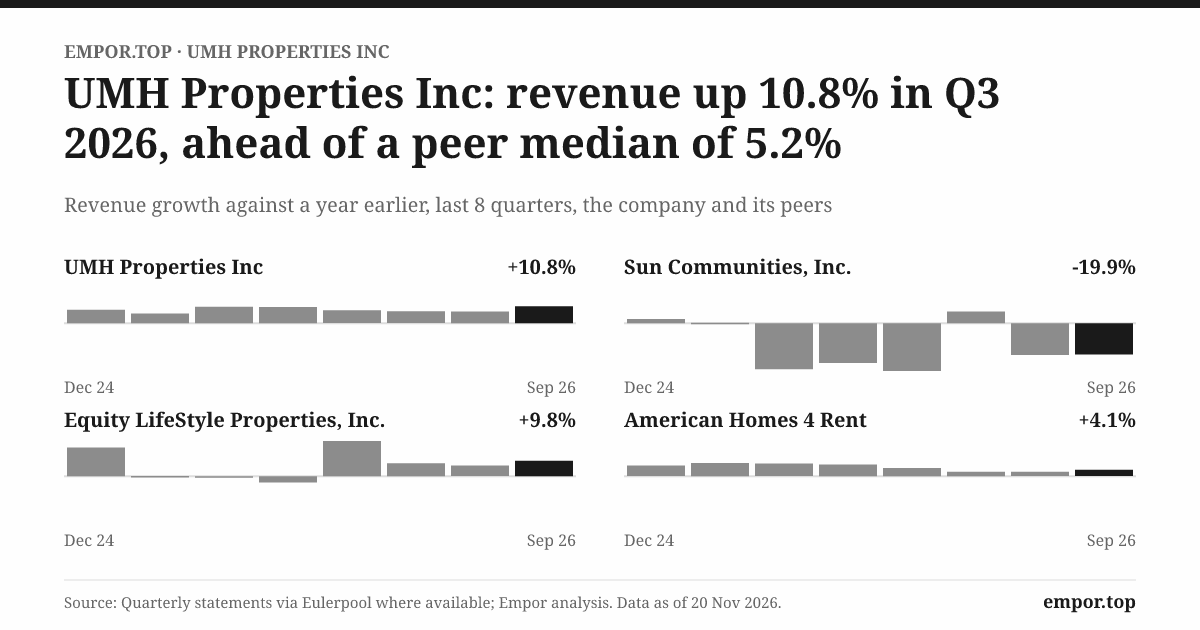
Those figures are encouraging. In the first quarter of 2026, same-property occupancy continued to improve, and same-property net operating income, meaning rental income less community operating costs, grew 7.1%.7 By the third quarter, management reported same-property NOI growth of nearly 10% for the quarter, with occupancy holding around 89%.2 Over the year, then, the existing portfolio was filling up and earning more. That is the main evidence for the bull case on operations, and it is sound evidence.
The details of the first quarter show the limits. Same-property rental income rose about 7.6%, but community operating expenses rose about 8.2%.7 NOI still grew because the revenue base is larger than the cost base, so a slightly faster percentage increase in costs consumed only part of the gain. That still leaves no room for complacency. Taxes, insurance, utilities, repairs and payroll are all rising, and a landlord whose costs grow faster than its rents will eventually see its margins narrow. The quarter showed positive operating leverage with real friction.
The rental homes require separate attention. They are UMH's main tool for filling vacant lots. Many households who would like to live in a manufactured-housing community cannot buy a home outright, cannot get a loan, or do not want to commit. Renting a home on the site makes moving in much easier. In return, UMH takes on a second asset, the house, along with its maintenance, wear and tear and depreciation. A rental home generates more revenue per site than land rent alone, but it also needs more capital and more management attention, and it brings in residents who are less tied to the community than homeowners. A resident who rents the home can leave as easily as an apartment tenant, which undermines the low-turnover feature that makes the land model attractive.
That is a real trade-off and an investor should not dismiss it. Rental homes add occupancy quickly. They also turn part of the business from a simple land-lease model into something closer to single-family rental, which has higher capital intensity and higher turnover. The more vacancies UMH fills with rental homes, the more capital each additional unit of occupancy requires.
The development claims call for similar caution. Management's references to acres and vacant sites describe potential capacity, not earnings. A vacant site in a community in a declining town may stay empty for years. Land designated for future development may face zoning hurdles or infrastructure costs that make it uneconomic. The company's materials describe the scale of the opportunity well. They say less about the rate at which past opportunities were converted. An investor can partly fill that gap by watching whether occupancy keeps rising quarter after quarter, and whether the increase comes with a proportionate rise in the rental-home fleet and development spending.
Three measures will answer the question: same-property occupancy, same-property NOI growth and the number of occupied rental homes. Each should be compared with renovation and development spending. If occupancy rises and NOI grows faster than capital spending, the vacant sites are earning their place. If occupancy stalls while spending continues, the 3,100 vacancies are not an opportunity but evidence of what the company paid for.
Either way, the money has to come from somewhere. That brings the story to the place where the dividend and the capital budget compete for the same cash.
V. The dividend meets the capital budget
UMH's annual cash-flow statements show the pattern: operating cash comes in, investment spending exceeds it, and outside capital covers the difference.
That is the defining financial fact about UMH, and it is worth being clear about what it does and does not mean.
What it does not mean is that the company is in trouble. Many good real estate companies fund growth with outside capital, because property is a long-lived asset that justifies long-term financing, and REIT rules require most taxable income to be paid out, which makes self-funding nearly impossible by design. A REIT that is not raising capital is often a REIT that has stopped growing.
What it does mean is that the dividend is not covered by free cash flow after investment, and that the company's growth depends on continued access to capital markets on acceptable terms. That gap persisted through 2025.1 At the end of 2025, borrowings stood at about $761 million.1 The common share count rose from about 81.9 million at the end of 2024 to about 84.9 million a year later,1 an increase of nearly 4% in a single year. The test that matters, then, is not whether UMH can keep paying the dividend this year. It almost certainly can. The test is whether the capital it raises produces more FFO per share than it costs.
The difference between operating cash flow and free cash flow is the key to this. Depreciation, the charge that makes GAAP profit look so small, is a real economic cost for the homes and some infrastructure, which wear out, and much less so for the land, which does not. Investment spending is a mixture of maintenance, the spending needed to keep the existing portfolio running, and growth spending to buy or build more. UMH's free cash flow figure combines the two. The company does not report a clean, long-run series separating recurring maintenance capital spending from growth spending, so outsiders cannot calculate precisely how much of the dividend is covered by truly recurring cash.
Operating cash flow has also been volatile, which makes the picture murkier. In fiscal 2022, cash from operations was about negative $7 million, as the company built up inventory of homes to sell.1 In fiscal 2023, the release of that inventory added about $55.5 million to operating cash flow,1 and operating cash flow jumped to about $120 million. Neither year represented the business's normal level. The 2023 figure in particular was a one-off reversal of the previous year's build-up and should not be treated as recurring. Across the cycle, operating cash has grown, from about $24 million in 2014 to about $82 million in 2025,1 but not in a straight line.
The tools that fill the gap deserve a closer look, because they are the levers the company uses to finance growth. The common-stock ATM is the most flexible: in 2025 it raised about $45 million gross and $44 million net on roughly 2.6 million shares.1 The dividend reinvestment and stock purchase plan raised about $9 million more, including about $3.5 million of reinvested dividends.1 That last figure shows something important. When shareholders reinvest their dividends, cash that went out as a dividend comes back as new shares, and the company has in effect paid part of the dividend in stock. Preferred stock adds another layer. In 2026, UMH sold about 245,000 Series D preferred shares through a separate ATM for about $5.3 million gross.2 Preferred holders receive a fixed dividend ahead of the common shareholders, which adds a fixed obligation that does not dilute the common share count but does have a prior claim on cash flow.
The company has also bought back some stock. The 2025 annual report records a $4.8 million repurchase of common shares,1 a small amount next to the issuance, but it shows that management sometimes judges its shares cheap enough to retire. Issuing shares through the ATM in one period and buying them back in another is defensible if the prices differ meaningfully. It deserves scrutiny if they do not.
Debt is the other large funding source. UMH's mortgage debt is mostly fixed-rate, at rates ranging from about 2.6% to 6.7% and averaging about 4.8%, with a weighted average maturity of about six years at the end of 2025.1 That structure limits near-term refinancing risk. In May 2026 the company also extended its unsecured revolving credit facility to 2030, with $260 million committed and an accordion that could add up to $340 million more under certain conditions, priced at SOFR plus 1.30% to 1.90% depending on leverage.9 Borrowing under the revolver is limited to 60% of the value of unencumbered communities, and at the time of the amendment the company had drawn just $10 million, leaving about $250 million available.9 That gives the company reasonable flexibility, though its availability still depends on property values, leverage covenants and lender commitments.
A fair assessment of management's record has to cover both sides. The access to capital is real and it has been used: the company has tripled in size, raised money through several market cycles and maintained the dividend. The record also includes 2018, when UMH reported a net loss of about $36 million and an operating loss,1 along with years of very low returns on capital. Return on invested capital has generally been between about 1% and 3%,1 which is low by any standard and well below what the company's debt costs. Some of that reflects the accounting: depreciation reduces the numerator and historical costs inflate the denominator. Even so, it is difficult to call the allocation of capital disciplined without evidence that the acquisitions have earned more than their cost of capital, and the company's filings do not provide deal-by-deal returns that would allow that judgment.
A skeptical investor, or an activist, would put the question plainly. Would shareholders be better off if UMH slowed acquisitions and put its cash toward paying down debt? Would they be better off if the dividend were reset at a level covered by recurring cash after maintenance spending, with the savings used to fill vacant sites without issuing stock? Each alternative has a cost. Slowing acquisitions could reduce long-run growth and give up deals the company has built relationships to win. Cutting the dividend would almost certainly hit the share price and could alienate the income investors who make up much of the shareholder base. Reducing leverage would make the equity safer but lower the return on it. The right answer depends on whether the next dollar invested earns more per share than the alternatives. The figure that settles the debate is normalized FFO per share over a multiyear period, set against the growth in share count and debt.
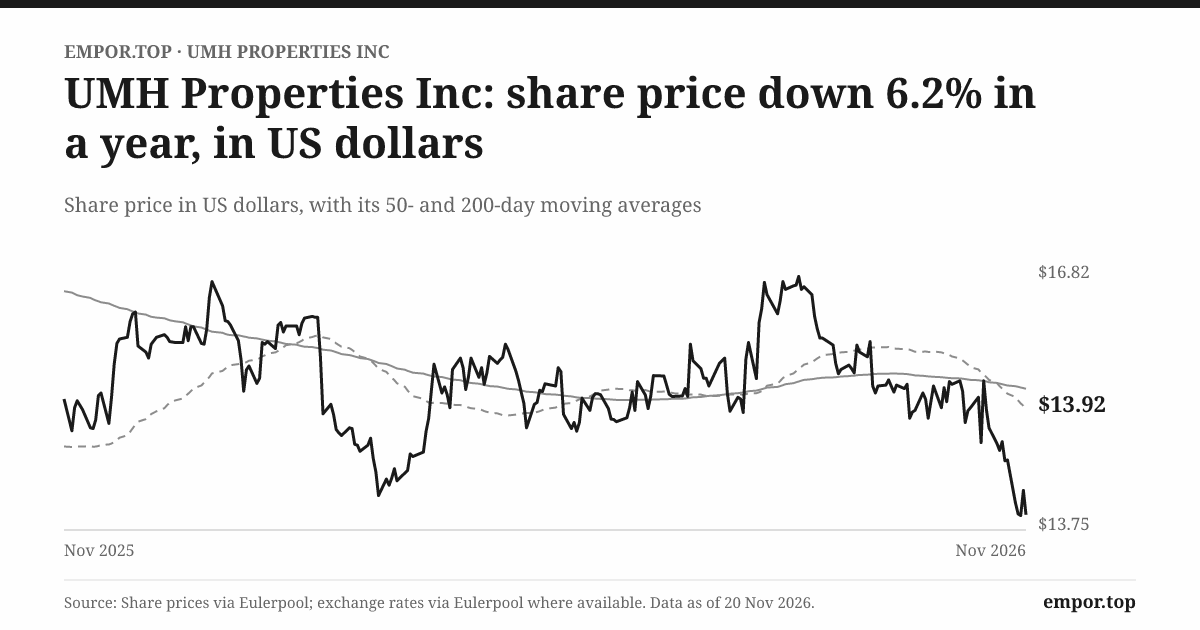
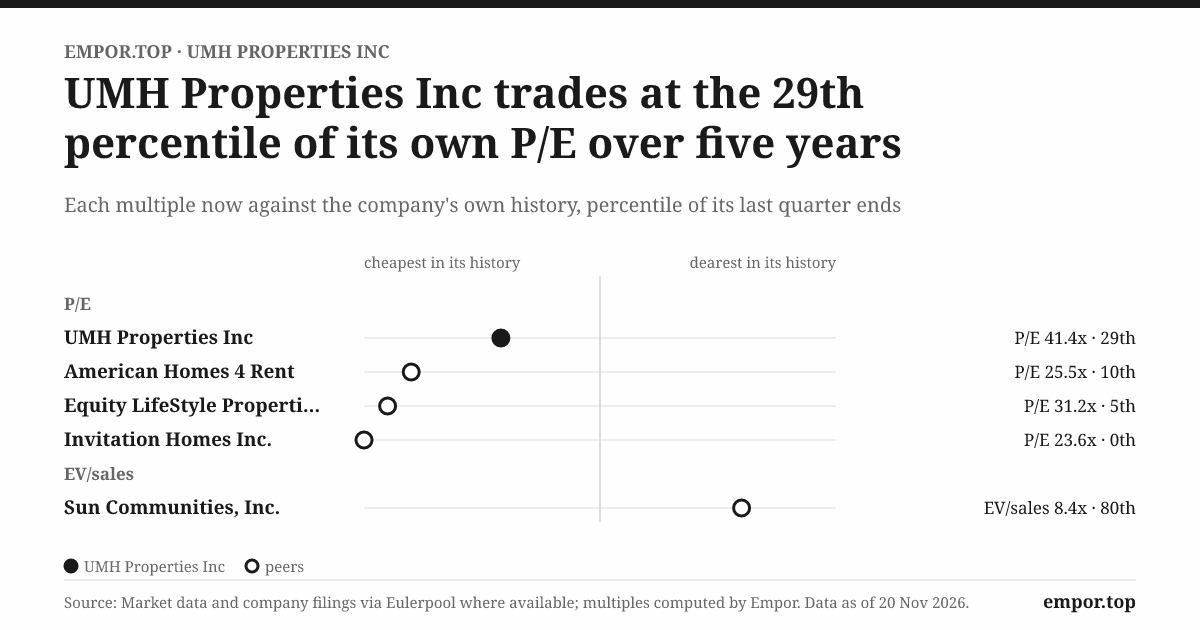
Valuation reflects the same tension. At about $13.92 per share on November 20, 2026, UMH traded at about 41 times trailing GAAP earnings, below its own five-year median of about 50 times.10 Those multiples are not very informative for a REIT, because GAAP earnings are depressed by depreciation. The earnings yield of about 2.4% and the free cash flow yield of about negative 2.5% are still worth noting, because they summarize the gap between the company's reported cash generation and the cost of its growth. A dividend yield of about 4.8%10 is what the market pays income investors to accept that gap. Comparing UMH with peers on FFO multiples would be more meaningful, but only if the figures were calculated on a consistent basis, and the third-party comparisons available give conflicting readings even for UMH itself.
Behind all of this is a part of the business that looks like a sideline but is really a credit operation, and it is where the next risk lies.
VI. The home sale that leaves a loan behind
Picture a sale at one of UMH's communities. A young couple has been renting an apartment in town and wants something of their own. UMH's sales office shows them a new home on a vacant lot. The price is far below that of a site-built house in the same county, but they still cannot pay cash, and a conventional mortgage is difficult to obtain for a home that sits on land the buyer does not own. So UMH, directly or through its financing arrangements, helps them get a loan. The sale closes and UMH records the revenue. The couple moves in and starts paying lot rent. The loan remains.
That loan is the part of the business that most investors overlook. The home sale is booked at closing as revenue. The note receivable, the couple's promise to repay, stays on UMH's balance sheet for years. If the couple keeps paying, UMH collects interest. If they lose their jobs or move away, UMH may end up repossessing the home, reselling it, and absorbing whatever loss results.
The scale is significant. At the end of 2025, notes receivable stood at about $100 million, net of fair-value adjustments, mainly from completed home sales.1 That is nearly three times the roughly $35 million of home-sale revenue the company recorded that year. The loan book is therefore not a short-term byproduct of sales. It is an accumulated portfolio of consumer credit, several years' worth of home sales held on the balance sheet.
The reserves against it appear small. At the end of 2025, UMH's reserve for uncollectible accounts, notes and other receivables was about $2.2 million, down from about $2.5 million a year earlier.1 Provisions added to that reserve have been steady at about $1.6 million in 2025 and about $2.1 million in each of the two previous years.1 Charge-offs and adjustments related to repossessed homes were about $1.9 million in 2025, $2.3 million in 2024 and $1.9 million in 2023.1 These are not alarming amounts relative to a company with more than a quarter of a billion dollars of revenue. They are also not zero, and they recur every year, which shows that defaults are a standing cost of doing business, not a rare event.
It is important to keep separate the collection of rent and the performance of the home loans. On recent calls, management has said that rent collections remain within historical norms.2 That is reassuring for the core landlord business, but it answers a different question. A resident can keep paying lot rent while falling behind on a home loan, or the reverse. The two are related, since a resident in financial trouble often misses both, but the rent statement does not describe the loan book.
Then there is what the company does not publish. UMH's filings do not break the notes receivable down by aging: how much is current, 30 days past due, 90 days past due, or on nonaccrual status. Without that breakdown, outsiders cannot tell whether the loan book is deteriorating or stable. The reserve level and recurring charge-offs give a rough picture. They do not give the detail that a bank's or consumer lender's disclosure would.
A broad indicator also needs careful interpretation. Days of revenue tied up in receivables have risen from about 113 in fiscal 2014 to about 146 in fiscal 2025.1 That sounds alarming, as if residents were taking nearly five months to pay rent. That is not what it measures. The figure includes the notes receivable from home sales, which are long-term loans, alongside ordinary rent and other receivables. The rise mainly shows that the home-loan book has grown faster than revenue. That is worth knowing in its own right, because it means more of the company's capital is tied up in consumer credit. It is not a measure of rent collection and should not be presented as one.
There is also a specific contingent exposure. UMH has an agreement with 21st Mortgage, a major manufactured-home lender, under which UMH may have to buy certain repossessed homes at 80% to 95% of the outstanding loan balance, subject to adjustments.1 At the end of 2025, about $1.9 million of loans were subject to that agreement.1 The amount is small, but it creates an exposure to the credit performance of loans that UMH does not even hold on its books. If defaults rose in a downturn, UMH would face repurchase obligations at exactly the time its own loan book was under pressure.
The financing ecosystem also includes Triad Financial Services, which administers a third-party program for home-buyer financing.1 It is best understood as part of the sales infrastructure that helps UMH sell homes, not as a separate high-growth business. The evidence does not support describing UMH as a lender with a landlord attached. The business is a landlord that has found it needs to be partly a lender to fill its communities.
The disclosures that would settle the risk are clear: overdue and nonaccrual notes by aging bucket, annual defaults and repossessions, recovery rates on resold homes, and the full size of loans covered by repurchase agreements. Until UMH publishes them, the loan book is a moderate, ongoing credit risk of uncertain size. It does not look like a crisis. It is the cost of selling affordable homes to buyers who often cannot get credit elsewhere.
Credit risk ultimately comes down to judgment: who decides which buyers get loans, which communities get bought, and how the company's capital is spent. That brings the story to the people at the top.
VII. A family-led company under a louder shareholder vote
UMH's annual meeting in May 2026 looked routine for most of its agenda. About 91% of eligible shares were represented, the directors were re-elected and say-on-pay passed.11 One figure stood out. Shareholders withheld about 28.5 million votes from Matthew Hirsch, the board's presiding independent director, compared with roughly 2.6 million to 3.3 million withheld from each of the other nominees.11 In a vote where most directors receive near-unanimous support, a withhold count roughly ten times larger is a clear message. The presiding independent director is supposed to be the board's check on management. A large share of the votes cast were registering disapproval of that person.
The vote does not by itself prove anything was wrong. Withheld votes can reflect proxy adviser recommendations on committee assignments, tenure or attendance, policies on director independence, or a specific dispute. It is a signal that something about the board's oversight concerned a meaningful number of shareholders, and it should prompt investors to look at how the company is governed.
UMH remains family-led, with Eugene Landy as chairman, Samuel Landy as chief executive and Michael Landy on the board.5 That brings continuity, institutional memory and a long-term outlook that a hired CEO might lack. It also creates a concentration of influence that independent directors have to balance.
Ownership complicates the picture. Despite the family's prominence, directors and executive officers as a group held about 8.3% of the common shares according to the 2026 proxy.5 The largest holders were index and institutional managers: Vanguard with about 9.6%, BlackRock with about 9.5% and T. Rowe Price with about 5.2%.5 Eugene Landy personally held about 2.3%.5 The management group has a meaningful stake that gives it some alignment with shareholders, but it does not control the company. UMH is family-led, not family-controlled. The years of share issuance described earlier have steadily diluted the family's percentage, because every share sold through the ATM is a share the family did not buy.
The company's incentive structure is reasonably aligned with the questions in this story. UMH ties executive pay to normalized FFO per share, total shareholder return, NOI growth, acquisitions and site development.5 FFO per share and total shareholder return are the right measures. Acquisitions and site development are measures of activity, and rewarding executives for activity can encourage growth for its own sake unless it is balanced against per-share returns.
The pay itself is moderate for a REIT of this size. Samuel Landy's 2025 total compensation was about $2.9 million and Eugene Landy's was about $0.8 million as chairman; the latter included a $50,000 retirement benefit, and the two figures included about $337,000 of non-equity incentive pay.5 These amounts are not excessive, and investors should not judge them in isolation. The relevant comparison is pay against results: a company whose return on invested capital has hovered in low single digits, whose share count has risen steadily, and whose GAAP earnings per share in 2025, about $0.31, were roughly where they had been in 2017.1 Pay that is modest relative to peers can still be generous relative to per-share outcomes.
Related-party arrangements are the governance topic that deserves the most attention. UMH formed an Opportunity Zone fund to invest in qualifying communities, taking advantage of tax incentives for investment in designated areas. At the end of 2025, UMH owned about 77% of the fund and consolidated it.1 The remaining interests were held by Eugene Landy at about 9.6%, Samuel Landy at about 4.8%, other family members and a family partnership at about 1% each, and one independent director at about 1%.1 The arrangement may be perfectly fair; Opportunity Zone tax benefits accrue to individual investors, so co-investment by insiders is not unusual. Still, it links family capital, a director's capital and company capital in the same vehicle, and the terms of that vehicle determine who gets what share of the returns.
UMH also earns management, oversight and development fees from its Nuveen joint ventures.3 The company does not quantify those fees as a share of revenue or costs. The Landy family's former 24% stake in the company's office landlord was transferred to Samuel Landy and other family members in January 2023.1 None of these arrangements is large relative to the company's overall economics, but they make the governance framework more important.
That framework has a gap. UMH does not have specific written standards for approving related-party transactions, and says instead that such transactions are approved only when they are in the best interests of shareholders.5 For a family-led company with insider co-investment in a consolidated fund, the absence of a written policy is a real weakness. A written policy does not guarantee fairness, but it sets the procedure, the decision-makers and the criteria in advance, which is exactly what independent shareholders need when insiders sit on both sides.
The auditor's work provides partial reassurance. For 2025, the auditor issued an unqualified opinion on the financial statements and on the effectiveness of internal controls, with no material weakness reported.1 That means the numbers are fairly stated and the controls over reporting work. It does not answer whether capital was allocated wisely or whether related-party terms were fair. Those questions fall to the board.
There is also a recent change worth watching. Anna Chew was identified as CFO in UMH's 2025 annual report and 2026 proxy.15 The September 2026 quarterly report was signed by Kevin Miller as CFO.3 A CFO transition at a company whose story depends on capital raising, debt management and receivables disclosure matters, and investors should listen for how the new CFO approaches leverage, issuance and the loan book.
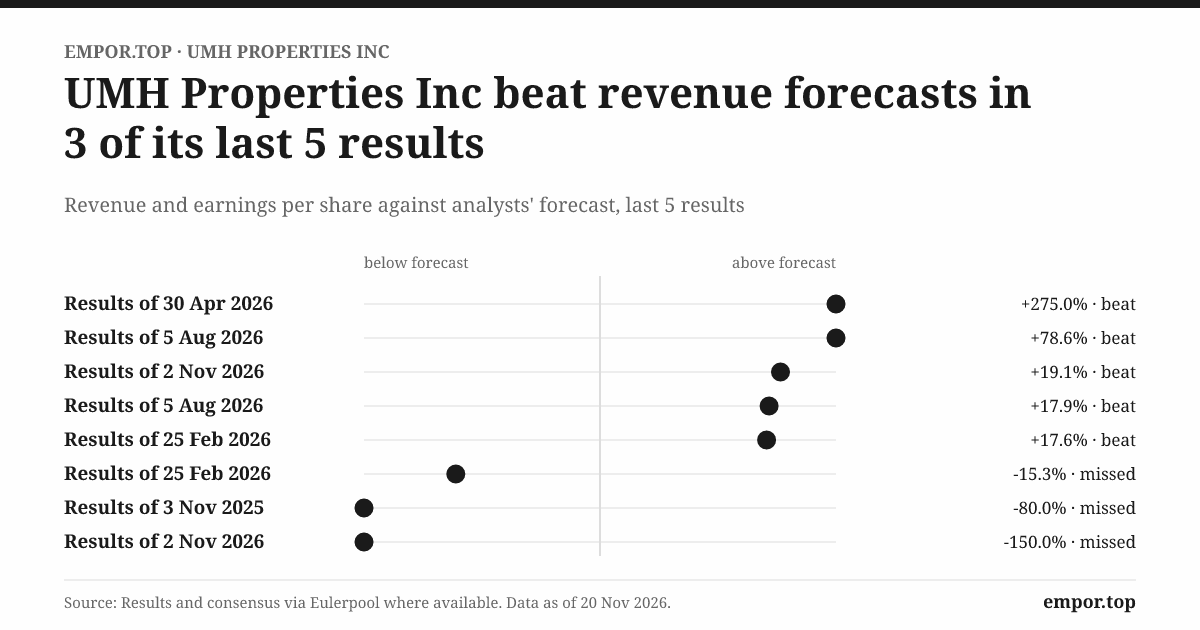
Management credibility is best judged by comparing what management says over time with what happens. Across recent calls, the story has been consistent: rising occupancy, rent increases in line with guidance, improving same-property NOI, a pipeline of vacant sites and an emphasis on FFO growth.812 Analysts have pressed on the drivers of FFO per share, debt costs and the pace of acquisitions, and management has generally answered with specific operating figures. The record available does not show a pattern of repeatedly missed guidance or unexplained changes in strategy. It also does not establish that the long-term plan has delivered per-share growth on the scale of the portfolio's growth, which is what the bull and bear cases have to address.
VIII. Analysis & Bear vs. Bull Case
On the third-quarter 2026 call, management made its case in its strongest form. Normalized FFO was $0.26 per diluted share, up about 4% from a year earlier.2 Same-property NOI grew nearly 10% for the quarter.2 Occupancy was improving, rents were rising and the company had thousands of vacant sites and acres of undeveloped land to grow into.8 For investors, the question is whether that capacity will earn an adequate return or whether financing and credit costs will absorb the gains.
The trailing returns are a sobering reference point. Return on equity over the twelve months to September 2026 was about 2.9%, return on capital employed about 2.8%, and return on invested capital about 3.0%.3 The dividend yield was about 4.8%.10 For a REIT these GAAP-based returns understate economic returns, because depreciation reduces earnings while land values may rise. Even with that adjustment, the picture is of a company whose reported returns have long trailed its cost of capital, and that has relied on property appreciation and rent growth to justify its expansion.
The core argument can be stated in two parts. UMH might succeed from here because homesites are scarce, rents can rise steadily, occupancy is improving, demand for affordable rental homes is strong and the company owns land it can develop without paying acquisition prices. UMH might fall short because its occupancy is lower than that of the largest peers, its cost of capital is higher than theirs, its growth requires continual dilution and debt, it carries credit exposure from home financing, and there is little published evidence that its acquisitions have earned attractive returns.
The five forces and the seven powers
Porter's five forces framework is a useful way to examine the industry once. The threat of new entrants is low, because zoning and the cost of building new communities keep supply restricted, and that is the strongest point in the incumbents' favour. Buyer power at the level of individual residents is weak, because the customer base is fragmented and moving a home is costly; no customer exceeded 10% of revenue.1 Collectively, though, residents have political power through local rent regulation, and affordability limits how far rents can rise before households choose another option. Supplier power is significant in one specific area: the sellers of existing communities, whose assets are scarce, can demand high prices, and home manufacturers and lenders shape what UMH can sell and finance. Substitutes are real: apartments, single-family rentals and manufactured homes on private land compete for the same households, especially at the newer and less committed end of the resident base. Rivalry is moderate for residents, because communities serve local markets, but intense for acquisitions, where UMH competes with Sun, Equity LifeStyle, private equity funds and private buyers for the same limited supply.
Hamilton Helmer's seven powers framework narrows the question. Of the seven, the ones that might apply to UMH are switching costs, cornered resource and, possibly, process power. Switching costs are real for homeowner residents, and the steady rent increases with improving occupancy show that they translate into pricing. They are much weaker for the 11,400 households renting UMH-owned homes, who can leave as easily as any tenant. The cornered resource, scarce zoned land, is real but shared: every incumbent community owner has the same protection in its local market, so it is an industry characteristic rather than an advantage unique to UMH. Process power would be the strongest claim available to UMH, namely a superior system for turning half-empty communities into full ones. The evidence for that is improving but incomplete. Same-property occupancy has risen, but the company does not publish community-level before-and-after results for its acquired properties, and its portfolio occupancy remains well below Sun's. Scale economies favour Sun and Equity LifeStyle, not UMH. Network effects, counter-positioning and brand do not apply in any meaningful way.
Overall, UMH's business sits inside a protected industry and operates a capability for filling vacancies that is producing measurable results. A distinctive moat specific to the company has not been demonstrated. The claim survives in narrower form: UMH has a protected position in its local markets and a turnaround skill that is improving, which is valuable but not the same as an enduring advantage over better-capitalized peers.
Weighing the two cases
The bull case holds that operating improvement and infill will turn into FFO growth per share. Occupancy has been rising, rent increases have been running at 5% or more, and same-property NOI has been growing at high single digits to around 10%. If that continues and the company fills a meaningful share of its 3,100 vacant sites, NOI should grow faster than the share count, and FFO per share should accelerate. The extended revolver and fixed-rate mortgage book limit near-term refinancing risk, and the company's demonstrated ability to raise capital means good opportunities need not be passed up.
The bear case holds that each improvement in the existing communities requires more capital, and that the per-share economics will continue to disappoint. Same-property NOI growth of nearly 10% sits alongside FFO per share growth of about 4%,2 a difference that reflects higher interest costs, a growing share count and the cost of preferred stock. Interest expense rose about 32% year over year in the first nine months of 2026.3 If the gap between property-level growth and per-share growth persists, the operational success will mainly benefit lenders and new shareholders.
That gap between NOI growth and FFO-per-share growth is the clearest single piece of evidence in this story. It shows the operating business improving while the financing structure absorbs much of the improvement. The bear case does not require the operations to fail. It requires only that the cost of capital continues to absorb the gains.
The current risks are specific to this business. Higher refinancing and borrowing costs directly reduce the profitability of acquisitions and development, which are the two main growth levers. Home-buyer financing and repossessions affect receivables and the returns on home sales. Rent regulation and local opposition can restrict the price increases on which the model depends. Execution risk lies in completing and filling sites on schedule and within budget. Earnings are also volatile because of UMH's portfolio of REIT securities. At the end of 2025 the company held about $65 million of mainly REIT common and preferred shares, carrying about $41 million of net unrealized losses, and said it did not intend to add to the portfolio.1 In the first nine months of 2026, a fair-value gain of about $39 million was mostly offset by realized losses of about $37 million.3 Those swings explain much of the volatility in quarterly GAAP profit and make FFO the more useful measure. Neither technological disruption nor currency exposure is a material risk in the company's filings.
Three measures matter most for following the company. The first is same-property occupancy, which has been rising and stood around 89% in the most recent quarters.27 The second is same-property NOI growth, which was running at high single digits to around 10% in 2026.27 The third is normalized FFO per share, which was $0.26 in the third quarter of 2026, up about 4% from a year earlier.2 Each should be read alongside debt levels, share issuance, investment spending and the quality of the loan book.
On management's tone, the arc from the third-quarter 2025 call through the second and third quarters of 2026 has been consistent: occupancy, rent growth, NOI growth and the pipeline of vacant sites.812 Analysts' questions have concentrated on normalized FFO guidance, debt maturities, acquisition pricing, same-property trends and home financing. The most useful answers are the numerical ones, such as occupancy gains, rent increases, borrowing costs and the amount of the credit line drawn. Broad statements about "strong demand" are easier to make than to verify.
On valuation, the trailing P/E of about 41 times compares with UMH's own five-year median of about 50 times.10 That suggests the market is paying a little less for each dollar of GAAP earnings than it has historically, although GAAP earnings are a poor basis for valuing a REIT. A consistent FFO-based comparison with peers would be more informative, and the readily available third-party comparisons do not calculate one consistently. The market seems to expect continued operating improvement, given the dividend yield of almost 5%. It does not seem to be paying for a fast-growing company.
IX. Business & Investing Lessons
Go back to the community from the opening scene. A home sits on its lot, a resident pays rent for the site, and behind the scenes UMH funds the road repairs, the utilities, the rental homes on vacant lots and the next acquisition. Over twelve years, about $603 million of operating cash coincided with about negative $364 million of free cash flow and about $599 million of dividends.1 Several lessons follow from that.
A resident may own the home, but the landlord still has to earn a return on the land. The usual description of the manufactured-housing model says the residents own the depreciating asset and the landlord owns the appreciating one. UMH shows that the landlord's side is not free. Roads wear out, water mains fail, vacant lots need homes, and filling a half-empty community means buying houses, laying pipes and offering credit. Land generates rent only after a great deal of capital has been spent on the land and around it. Investors who treat community land as a passive store of value will underestimate how much capital this business consumes.
A portfolio can grow faster than the value it creates per share. UMH roughly tripled in size by buying communities, and its revenue compounded at double-digit rates for a decade. Over the same period, its share count rose year after year, and GAAP earnings per share in 2025 were roughly where they had been in 2017. The lesson for any company that grows by acquisition is that growth in the total is not growth per share. The question is never only whether the company got bigger. It is whether each share now represents more cash earnings than before, and only normalized FFO per share, tracked over years and set against the dilution, can answer it.
Cash from operations is not cash left over. UMH's operating cash flow is nearly five times its GAAP profit, which makes the business look like a strong cash generator, and in one sense it is. That operating cash almost exactly matched the dividends paid, so every dollar of investment came from lenders and new shareholders. A company can have excellent cash conversion and still depend entirely on outside capital for growth. The two measures answer different questions, and a dividend investor needs both.
An affordable-housing business can turn into a credit-underwriting business. To fill its lots, UMH sells homes, and to sell homes to buyers who cannot get conventional mortgages, it helps finance them. The result is a loan book of about $100 million, almost three times a year's home sales, with recurring repossessions and no published aging schedule. That is a reasonable trade for filling communities, but it changes the nature of the risk. An investor who buys UMH for its rent roll is also, partly, buying a consumer lender. Founders and investors in any business that finances its own customers should recognize when a sales tool has become a balance-sheet exposure.
Scarcity benefits the owner, including the seller. The same zoning restrictions that make UMH's homesites hard to replace also make the communities it wants to buy expensive. A protected industry is a good place to own assets. It is a harder place to buy them cheaply, which is why acquisition-led growth in a scarce-asset sector demands rigorous pricing discipline.
X. Epilogue
Tonight, UMH stands at a point where the operating results are improving and the financing questions remain open. Recent results showed rising occupancy and rent increases in the 5% range.2 Normalized FFO per share grew more slowly than same-property NOI.2 Financing remains supported by the credit facility extension and fixed-rate debt.91 The company also has a new CFO, while disclosure and governance questions remain.
The next set of results will begin to answer the central questions. The first figure to watch is same-property occupancy, which has been around 89% in recent quarters. If it moves steadily toward the low 90s, that will be strong evidence that the vacant-site strategy is working inside the existing portfolio. If it stalls, the 3,100 vacancies may look more like a persistent feature of the communities UMH chose to buy. The second is same-property NOI growth, and in particular whether it continues to come from both rent and occupancy rather than from rent alone. Rent-only growth eventually meets the affordability limit; occupancy-driven growth can continue for longer.
The development pipeline deserves a specific kind of attention. The company says it has a large pipeline of vacant sites and undeveloped land.8 Investors should look for the conversion of those figures into completed, occupied homesites: sites finished, homes placed and occupancy gained, not acres described in presentations.
The balance sheet has its own timetable. The new CFO's approach to leverage and issuance will show in the next few quarters of financing activity, in the use of the revolver, and in the pace of the ATM programs. In late October 2026, UMH drew $20 million on its unsecured line and paid off a $12.9 million mortgage the following day,3 a routine move that shows how the company is using the facility to manage maturities. A larger future obligation is on the horizon. After December 31, 2027, Nuveen may, under specified conditions, require UMH to buy its 58% interest in the 2021 joint venture for cash equal to Nuveen's capital contributions of about $41.7 million.3 That is manageable within the company's current liquidity, but it is a real claim on cash at a known future date, and how UMH would fund it (with the credit line, with new equity or with asset sales) will show the company's financing priorities.
Better disclosure on receivables and related-party arrangements would settle much of the uncertainty. Next spring's proxy and the 2027 annual meeting results will show whether the board responded and whether shareholders were satisfied.
If occupancy rises, NOI grows faster than costs, credit losses stay limited and FFO per share begins to grow at a rate closer to NOI, UMH will have shown that its existing communities can generate more of the growth and that its capital raising built something that compounds per share. If occupancy stalls, interest costs keep rising and the share count keeps climbing, the company will complete another cycle of raising capital to grow without delivering per-share gains.
The question remains the one the opening scene posed: whether the capital UMH raises will produce stronger cash earnings per share for the people who already own it.
XI. Outro
In a UMH community, a manufactured home stands on a small, level lot. Its owner painted the shutters, built the deck and planted the flowerbed. The road in front, the water pipe underneath, the streetlight at the corner and the land itself belong to someone else, and that someone sends a bill every month.
UMH is not exactly in the business of selling homes or renting land. It owns the place that makes a home rentable, financeable and difficult to move. That position is powerful, but it comes with a demanding obligation: the place has to be built, maintained, filled and financed, and each new site requires an answer to the question that began this story.
The land may be scarce, but UMH still has to show that it earns a return on it.
References
-
2025 Form 10-K — UMH Properties, Inc., 2026-02-25 ↩↩↩↩↩↩↩↩↩↩↩↩↩↩↩↩↩↩↩↩↩↩↩↩↩↩↩↩↩↩↩↩↩↩↩↩↩↩↩↩↩↩↩↩↩↩↩↩↩↩↩
-
Third Quarter 2026 Results — UMH Properties, Inc., 2026-11-02 ↩↩↩↩↩↩↩↩↩↩↩↩↩↩
-
September 2026 Form 10-Q — UMH Properties, Inc., 2026-11-02 ↩↩↩↩↩↩↩↩↩
-
Form 8-K: 2012 acquisition of eleven communities — UMH Properties, Inc., 2012-08-01 ↩
-
2026 Proxy Statement — UMH Properties, Inc., 2026-04-17 ↩↩↩↩↩↩↩↩↩↩
-
Investor Presentation — UMH Properties, Inc., February 2026 ↩
-
Q1 2026 Operating Update — UMH Properties, Inc., 2026-07-02 ↩↩↩↩↩
-
Events & Presentations, including Q3 and Q2 2026 call transcripts — UMH Properties, Inc. ↩↩↩↩↩
-
Third Amended Credit Agreement — UMH Properties, Inc., 2026-05-07 ↩↩↩
-
Annual Meeting Voting Results — UMH Properties, Inc., 2026-05-29 ↩↩
 LinkedIn
 WhatsApp
 Reddit
 Hacker News
 Email
 Kindle
 RSS Feed
 Spotify
 Apple Podcasts
 Amazon Music
 Audible
 YouTube