Texas Roadhouse: From Cocktail Napkin to America's Largest Casual Dining Chain
I. Introduction: The Unlikely King of American Casual Dining
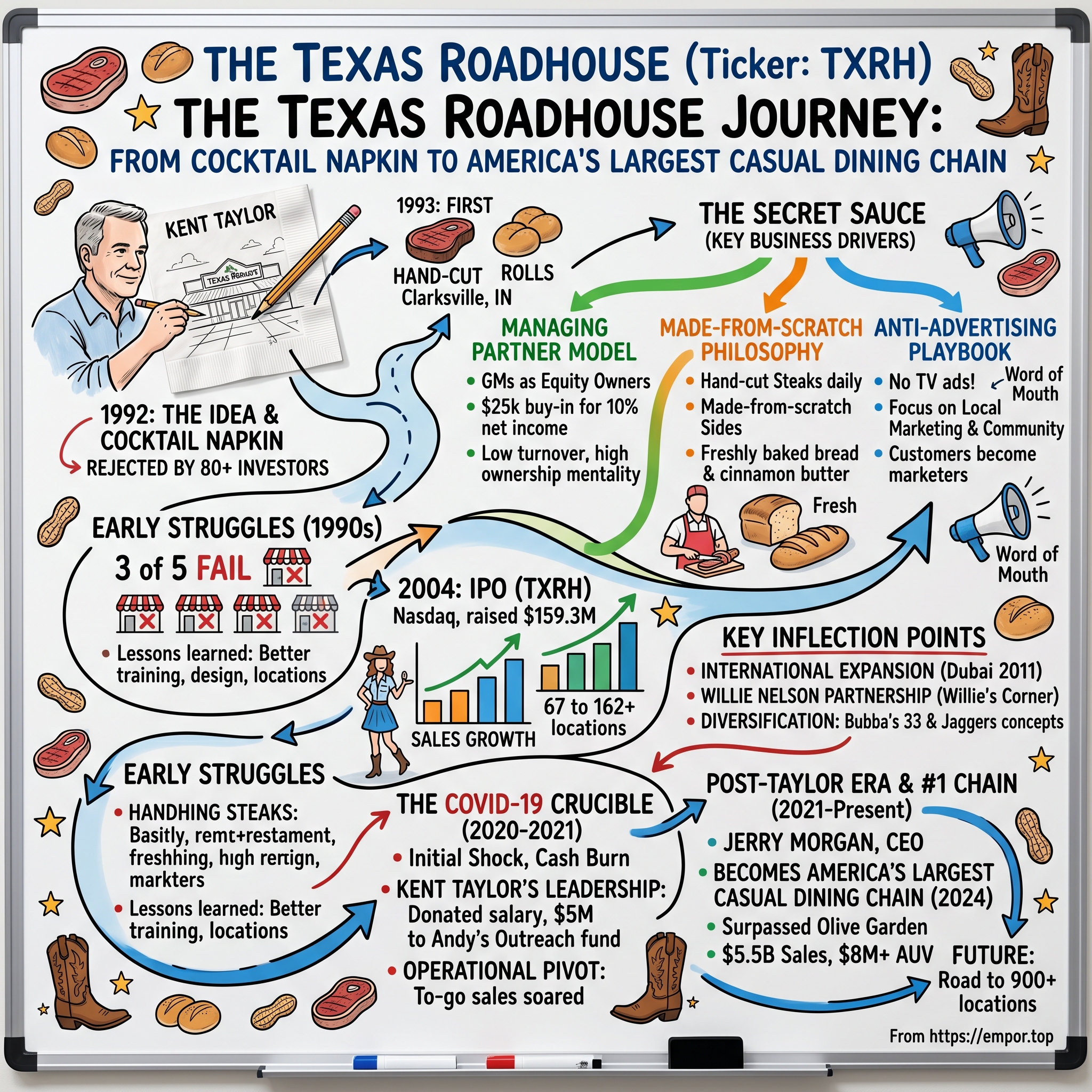
In April 2025, something remarkable happened in the American restaurant industry. Texas Roadhouse, the 664-unit steakhouse chain that has been growing rapidly for years, pushed past longtime leader Olive Garden and into the top spot in terms of systemwide sales. For the first time since 2018, the crown of America's largest casual dining chain sat atop a Louisville, Kentucky-based company selling Texas-themed steaks—a delicious irony that would have made founder Kent Taylor smile.
Last year, Texas Roadhouse reportedly saw a 14.7% increase in sales, pulling in $5.5 billion. While Olive Garden posted a meager 0.8% sales increase, Texas Roadhouse was running laps around its competition. In an industry where sales declined at four of the 10 biggest chains, and the average sales growth among the top 10 was just 0.6%, this performance borders on the miraculous.
The central question isn't just how Texas Roadhouse achieved this—it's why this company, founded by a man who was rejected by more than 80 investors and sketched his restaurant concept on a cocktail napkin, has thrived in a segment that experts have been declaring dead for two decades.
The answer lies in a combination of factors that read like a contrarian's playbook: servant leadership in an industry obsessed with labor cost-cutting, a managing partner model that treats store managers as equity owners, an anti-advertising philosophy that baffles marketing executives, and an almost stubborn commitment to made-from-scratch food at a time when efficiency reigns supreme.
But before Texas Roadhouse became America's largest casual dining empire, before the $5.5 billion in annual sales and the 800 locations worldwide, there was just a dreamer with a cocktail napkin, a deep love for skiing, and the conviction that blue-collar families deserved a legendary steak dinner at an affordable price. This is that story—and what investors can learn from a company that refused to follow the industry playbook.
 Subscribe on LinkedIn
II. Kent Taylor: The Unlikely Founder
The Making of a Maverick
Wayne Kent Taylor (September 27, 1955 – March 18, 2021) was an American businessman. He was the founder and CEO of the Texas Roadhouse restaurant chain. Taylor was born at Fort Leonard Wood, Missouri, to Powell Taylor, a lieutenant in the Army and Marilyn (Bergmann) Taylor.
Taylor grew up in Louisville, Kentucky. His father worked for General Electric after leaving the Army, and his mother was a buyer for a local boutique. The Midwest upbringing instilled values that would later define his leadership style—an unpretentious approach to business, a deep respect for working-class families, and an instinct that success came from treating people right.
He graduated from the University of North Carolina at Chapel Hill, which he attended while on a track scholarship. The discipline from competitive athletics would serve him well through decades of entrepreneurial trials. Taylor was never just fast—he was tenacious, a quality that would prove essential when facing rejection after rejection in his quest to build a restaurant empire.
The Colorado Detour
The Texas Roadhouse founder, a self-described skiing addict, moved to Colorado after earning an undergraduate degree at the University of North Carolina. To help pay for his skiing equipment and lift tickets, Taylor managed nightclubs and restaurants in Colorado. These weren't glamorous corporate jobs—they were ground-level positions where Taylor learned the fundamentals of hospitality, service, and the brutal economics of keeping a restaurant running.
His idyllic life of splitting time between work and the slopes came to an end when troubles in his personal life forced a retreat to his hometown. Taylor and his wife divorced in 1990, an event that forced him decidedly off pitch and back to Louisville, Kentucky.
Back Home and Hungry
Founder W. Kent Taylor, a Louisville native, lived in Colorado and worked at nightclubs and restaurants there. In 1990, Taylor returned to his hometown of Louisville, Kentucky. He began work as a Kentucky Fried Chicken manager and had dreams to open a Colorado-themed restaurant.
The KFC job was humbling—Taylor was 35 years old, freshly divorced, and managing a fast-food outlet after years in the hospitality industry. But even in this position, he couldn't turn off his entrepreneurial mind. Taylor began his career working as a manager in casual and fast food chains like Bennigan's and Kentucky Fried Chicken. But clashes with management, such as when he tried to add hot wings to KFC's menu, made him realize he was better off starting his own business.
The Buckhead Prologue
Taylor's first entrepreneurial venture came through an unlikely connection. Former Kentucky governor John Y. Brown, Jr. helped Taylor fulfill his dream by backing him with $80,000. In 1991, Taylor opened Buckhead Mountain Grill. Taylor was his own executive chef.
The Colorado-themed restaurant found success in Louisville, but the partnership would soon sour. Brown invested more money and wanted to open a second store in Clarksville, but complications in the partnership caused it to fall apart. Brown had elected to pursue another steak concept without Taylor, leaving Taylor with the decision to either stay committed to Buckhead or attempt to start a new business.
The business partners fell out over differences of opinion just before they were about to open a second location. Kent ended up going solo, and eventually sold his entire stake in the partnership. After losing ownership of his original Colorado theme, Taylor had to create an entirely new identity for his new eatery.
The Character of a Leader
Those who knew Taylor described a man who defied corporate conventions at every turn. The founder of the $2.4 billion brand drove Chevrolet Suburbans stuffed to the trunk with everything from architectural plans to a Santa suit. He wore cowboy hats, American flag boots, camouflage hoodies, and liked to count employees in meetings to see if they broke his two-pizza rule—if it took more than one pie to feed the room, you had too many opinions.
Taylor took off three months each year to go skiing, and once he left his succession plan on chairman Greg Moore's voicemail, just in case his heli-skiing trip went awry. One of his mottoes was, "Honey badger don't give a shit," a reference to the viral video where the uninhibited creature takes on venomous snakes and plunges into hives of stinging bees; Taylor kept a taxidermic honey badger in his office just to make sure you got the point.
Because isn't it a little unusual for a company to do almost no advertising? Is it wild to give away free peanuts and rolls and keep prices low, even as costs rise, or to keep the menu basically the same since it opened? Does it fly in the face of reason to prohibit coats and ties at headquarters and to have a CEO who dressed like he was part of the landscaping crew? These business practices might be unconventional, but for Kent and Texas Roadhouse, they worked.
This unconventional style wasn't affectation—it was philosophy. Taylor believed that authenticity trumped corporate polish, that treating people well created better businesses than optimizing spreadsheets, and that sometimes the best strategy was simply refusing to follow what everyone else was doing.
III. The Founding Story: 80 Rejections and a Cocktail Napkin
The Pitch Marathon
With his Colorado theme lost to his former partner, Taylor pivoted. The Texas-themed concept emerged from his travels during his time at Bennigan's. The late Kent Taylor was inspired by his trips to Dallas when he worked at Bennigan's—an actual Texas brand. CEO Jerry Morgan told the magazine that his predecessor, in particular, liked the idea of a roadside restaurant where you could stop and "get a good meal."
His goal was to create an "affordable, Texas-style" restaurant. But first, he needed capital—and that would prove nearly impossible.
He was turned down more than 80 times while seeking investors. Some accounts put the number even higher. Taylor struggled to raise capital for his new restaurant idea, telling Louisville Business First in 2016 that he'd been rejected more than 100 times by investors.
Company lore has it that Taylor was turned down more than 80 times while trying to raise money to make his dream of an "affordable Texas-style restaurant with Hand-Cut Steaks, Fall-Off-The-Bone Ribs, and Ice-Cold Beer" a reality — and once tried unsuccessfully to chase down basketball legend Larry Bird in an airport to pitch him.
The Famous Napkin
In 1992, Taylor finally found his believers—not in boardrooms or with venture capitalists, but with three doctors from Elizabethtown, Kentucky. John Rhodes became interested in Taylor's proposition of the new steak restaurant concept that Taylor showed to him through drawings on loose papers and cocktail napkins. Taylor was able to convince Dr. Rhodes and two of his colleagues to invest $100,000 each in 1992.
His initial investors were three doctors from Elizabethtown, Kentucky who invested $300,000. To show the investors his initial design for the first restaurant, Taylor sketched the design on a cocktail napkin.
The image of a future multibillion-dollar empire sketched on a cocktail napkin has become iconic in business lore. It speaks to the essence of entrepreneurship—the idea that great companies begin not in elaborate business plans but in passionate conviction.
After three doctors in Elizabethtown, Ky., eventually agreed to provide the necessary startup capital, Taylor famously sketched out the restaurant's design on a cocktail napkin and launched the first Texas Roadhouse in Clarksville, Ind., in 1993.
The Texas Irony
There's a delicious irony in the Texas Roadhouse origin story: It's an incredible success story for a Texas steakhouse chain that's not even from here. Yes, you read that right: Texas Roadhouse isn't a Texas company. It's actually based in Louisville, Ky.
Taylor, ever resourceful, knew that perception matters in the restaurant business. According to company lore, Taylor even got a P.O. box in Dallas for a Texas address to make his restaurant seem more authentic. The Kentucky native selling Texas steaks from an Indiana location was operating on pure audacity—and it worked.
A year later on February 17, 1993, the first Texas Roadhouse in Clarksville, Indiana opened its doors. In 1994, Taylor sold his shares in Buckhead Mountain Grill to focus solely on Texas Roadhouse.
IV. Early Struggles: Three of Five Fail
The Expansion Disaster
The first Texas Roadhouse in Clarksville showed promise. A second location followed in Gainesville, Florida, the city where Taylor had once competed in a track meet and held fond memories. But the early expansion revealed the brutal learning curve of the restaurant business.
In 1993, the second Texas Roadhouse opened in Gainesville, Florida. In 1994, three additional restaurants opened in Cincinnati; Ohio, Clearwater, Florida; and Sarasota, Florida. These three locations would all close because of poor building locations. Kent Taylor was forced to decide how to continue the success of the first two restaurants in Clarksville and Gainesville while dealing with the failures of the three new stores.
Three of the first five restaurants failed—a 60% failure rate that would have killed most companies in their infancy. The chain's early history was one of stops and starts, as three of its first five restaurants failed, providing what the company described as "some very valuable (and expensive) lessons."
The Survival Years
Taylor refused to let the failures break him. Instead, he did something unusual: he kept artifacts from his failed restaurants in his office, a constant reminder of what could go wrong. Until 1996, the Roadhouse was struggling just to pay its monthly bills. Taylor often had to skip cashing his own check to make payroll.
But Taylor learned from failure. Taylor decided that better in-store training, building designs, and restaurant decor would help improve Roadhouse's growth. Taylor hired a promising chef who worked in Louisville, Kentucky, Jim Broyles. Broyles was hired as the Director of Food and Beverages and transformed the way Roadhouse prepared and served food.
In 1996, Texas Roadhouse unveiled a new store prototype—a refinement that standardized the look, feel, and operational procedures that had worked in successful locations. Taylor added a board of advisors and put together a private placement that paid off the debt in 1998.
The Turnaround Strategy
The second Texas Roadhouse opened in Gainesville. "We were all over the map the first few years," the Gainesville restaurant's first manager noted in a March 2003 interview with Chain Leader.
Taylor recognized that success in the restaurant business required discipline beyond just good food. Site selection became paramount—he learned to study demographics, traffic patterns, and community composition. The three failed locations hadn't just offered bad food; they had been in the wrong places for the wrong customers.
Texas Roadhouse targets secondary markets for expansion, preferring communities with populations above 60,000 and a high concentration of working-class families. This targeting would become a cornerstone of the company's growth strategy—not competing in crowded urban markets against well-heeled rivals, but dominating in communities where families with modest budgets sought exceptional dining experiences.
The Late 1990s Surge
The chain expanded rapidly in the late 1990s, and by the end of 1999, 67 restaurants had been opened.
From two successful restaurants in 1993 to 67 by 1999—Texas Roadhouse had transformed from a struggling concept into a legitimate regional powerhouse. The growth trajectory validated Taylor's vision: Americans wanted quality steaks at reasonable prices, served in a lively atmosphere by staff who genuinely seemed to enjoy their jobs.
V. The Secret Sauce: Business Model Deep Dive
A. The Managing Partner Model
If there's one aspect of Texas Roadhouse's business model that deserves close study, it's the Managing Partner structure—a system that fundamentally transformed how the company thought about restaurant operations.
The Managing Partner at each Texas Roadhouse has an ownership interest in their restaurant.
This wasn't just a title—it was an entirely different economic arrangement. When a Texas Roadhouse staffer is promoted to General Manager at one of Texas Roadhouse's 392 owned locations, they are asked to pay a $25,000 buy-in fee which is available in the form of a loan and available for forgiveness after five years of service. In return for the fee, each new General Manager receives a base salary of $45,000 per year as well as 10% of the net income of their restaurant.
Recalls former Managing Partner Dan Burton, who ran a Texas Roadhouse in Cleveland in the early 2000s, "They gave you ownership. You did basically everything, from pest control to cutting grass."
Managing Partner Program: Each restaurant typically has a Managing Partner with equity interest, fostering an ownership mentality that drives local performance and community engagement.
The economics became compelling. All in average annual compensation for a Texas Roadhouse General Manager exceeds $100,000. This is in contrast to GMs at competitors who typically earn $65,000-85,000 per year. The benefit of this incentive is tangible. When one sits down Texas Roadhouse, the General Manager frequently comes to their table to check on refills, question food preparation, and promote specials. General Managers have a direct and measurable incentive to boost profitability and as a result they manage with ownership. This in turn drives customer service, as evidenced by the fact that 70% of Texas Roadhouse diners are repeat customers.
To Morgan, managing partners are a critical part of what's made Texas Roadhouse differentiated for the past 32 years. It's a concept that's evolved into a 650-unit casual giant that saw 44 consecutive quarters of same-store sales from the late 2000s until 2020 and earns $8.3 million in AUV, one of the highest in the industry for a brand its size.
The structure was created partly out of necessity—Taylor needed the money—but it also attracts entrepreneurs. "It permeates through all parts of the organization where people have that mentality that 'I own this, we own this,' " says Ortiz, who met Taylor when they both worked for Bennigan's in Denver.
The cascading effect of ownership mentality was profound. The model even led to better food. The low staff turnover meant the restaurants could take on more complex menu items like bread baked from scratch or ribs that took three days to cook.
The CEO described Texas Roadhouse as an operations-based company—a culture derived straight from founder Kent Taylor. It's no coincidence that Morgan and president Gina Tobin won Managing Partner of the Year at one point.
B. Made-From-Scratch Philosophy
While competitors were optimizing for labor efficiency by pre-portioning ingredients in commissaries and using frozen products, Texas Roadhouse doubled down on scratch cooking.
Texas Roadhouse stands out among casual dining restaurants for a variety of reasons: Hand-Cut Steaks: The restaurant is renowned for its high-quality, hand-cut steaks. Each restaurant has a butcher who cuts the meat on-site, ensuring freshness and quality. Made-from-Scratch Sides: Texas Roadhouse prides itself on offering made-from-scratch sides, which enhances the home-cooked feel of the meals. Freshly Baked Bread: One of the signature features is their freshly baked bread, served with a cinnamon butter that is a customer favorite.
In-House Preparation: Steaks are hand-cut daily, sides are made from scratch, and bread is baked fresh throughout the day, reinforcing a commitment to quality ingredients.
This operating strategy came directly from Taylor's original vision. The company's filings described this philosophy: "Offering high quality, freshly prepared food. A significant majority of our menu offerings consist of made-from-scratch entree and side items that are based on proprietary recipes and prepared daily at each restaurant. In addition we heavily invest in the training of and adherence to our recipe and quality standards."
The famous cinnamon butter rolls—baked fresh throughout the day and delivered warm to every table—became legendary. They weren't a gimmick; they were a statement of values. In a world of cost-cutting and efficiency optimization, Texas Roadhouse invested in the stuff that made customers feel valued.
C. The Anti-Advertising Playbook
Perhaps nothing distinguishes Texas Roadhouse more from its competitors than its approach to marketing—or rather, its deliberate avoidance of traditional marketing.
Texas Roadhouse has achieved its sales figures without any TV advertising. Instead, the chain focuses on food, service, and encouraging managing partners to become an integral part of the community.
While Applebee's, Chili's, and Olive Garden spend heavily on national television campaigns and celebrity endorsements, Texas Roadhouse allocated those resources elsewhere. The logic was counterintuitive: if you execute well on food and service, customers will become your marketers.
This overall approach was indicative of how Texas Roadhouse has navigated the industry's inflationary pressures in recent quarters—lean on the insight of managing partners and remain cautious to guard an everyday equity that's always been one of its competitive advantages. For a brand that doesn't advertise nationally or adjust its offerings all that much (a variety of mocktails are being tested currently), showing up as the Texas Roadhouse customers expect is an unrelenting part of the puzzle, Morgan said.
Strategies for building strong customer relationships without relying on traditional advertising. The company relied on local store marketing—managing partners embedding themselves in their communities, sponsoring little league teams, supporting local causes.
The results spoke for themselves. While competitors spent billions on advertising, Texas Roadhouse built one of the strongest brands in the industry through word-of-mouth and operational excellence.
VI. The IPO and Scaling the Dream (2004)
Going Public
In 2004, Roadhouse became a public company, listing under the symbol "TXRH" on Nasdaq at a price of $17.50 per share and raising $159.3 million.
The IPO prospectus revealed impressive growth metrics. The company had successfully grown the total number of Texas Roadhouse restaurants over the prior four years from 67 restaurants as of December 26, 1999 to 162 as of December 30, 2003, representing a 24.7% compounded annual growth rate. Over the same period, revenue increased from $71.0 million to $286.5 million, income from operations increased from $6.7 million to $34.3 million, and net income increased from $4.0 million to $23.1 million, representing compounded annual growth rates of 41.7%, 50.2% and 55.0%, respectively.
Texas Roadhouse is a growing, moderately priced, full-service restaurant chain. Our founder and chairman, W. Kent Taylor, started the business in 1993. Our mission statement is "Legendary Food, Legendary Service." Our operating strategy is designed to position each of our restaurants as the local hometown destination for a broad segment of consumers seeking high quality, affordable meals served with friendly, attentive service. As of June 29, 2004, 173 Texas Roadhouse restaurants were operating in 33 states.
The Post-IPO Strategy
The prospectus outlined clear strategic priorities that would guide the company for decades:
- Expanding the Restaurant Base: Continue evaluating opportunities to develop Texas Roadhouse restaurants in existing and new markets
- Improving Restaurant Level Profitability: Increase profitability through a combination of increased comparable restaurant sales and operating cost management
- Leveraging Scalable Infrastructure: Belief that general and administrative costs would increase at a slower growth rate than revenue
The company stated: "We believe we attract and retain talented, experienced, and highly motivated restaurant operators by offering performance based compensation programs to our restaurant managers and area managers, who are called 'managing partners' and 'market partners,' respectively."
Taylor's Continued Control
What made the IPO unusual was Taylor's determination to maintain control and stay operationally involved. The company is controlled by its founder and chairman, W. Kent Taylor, who owns approximately 60 percent of Texas Roadhouse stock.
Rather than cashing out and handing the reins to professional managers, Taylor remained the driving force behind major decisions. He continued selecting jukebox songs for restaurants, approving murals, and personally evaluating new store locations. Until his death, Taylor had been active in Texas Roadhouse's day-to-day operations, the company said. He oversaw decisions about the menu, selected the murals for the restaurants and personally picked songs for the jukeboxes.
In its 17-year history as a public company, Roadhouse has held only a single analyst day. Taylor's disdain for Wall Street rituals was legendary—he believed in running the business, not marketing to analysts.
VII. Key Inflection Points: 2010s–2021
A. International Expansion (2011)
In September 2011, Texas Roadhouse started their international expansion with the first international location in Dubai in the United Arab Emirates.
The international move was deliberate and measured. Unlike competitors who rushed into global markets, Texas Roadhouse approached international expansion with characteristic caution. As of August 2025, the chain operates about 800 locations in 49 U.S. states and 70 international locations in 11 countries.
B. The Willie Nelson Partnership
Each restaurant had a table called "Willie's Corner", with pictures and memorabilia of Willie Nelson. In 2002, Nelson signed a deal to become an official partner of Texas Roadhouse. Since then, Nelson has heavily promoted the chain, including a special on Food Network. Willie Nelson is the owner of Texas Roadhouse in South Austin, TX.
Kent Taylor and Willie Nelson struck up a friendship that would endure over the years. The partnership made perfect sense—both Taylor and Nelson embodied an independent, authentic spirit that defied corporate conventions.
C. Diversification: Bubba's 33 and Jaggers
While Texas Roadhouse remained the company's crown jewel, Taylor never stopped tinkering with new concepts.
Bubba's 33 turns 10 years old this year. The concept created by the late Kent Taylor is known for its pizzas, burgers and wings – much different from the steak-centered Texas Roadhouse brand Taylor founded 20 years earlier. Also unlike Texas Roadhouse, which was created to provide a family-friendly place where "everyone could come and have a great meal and great fun for a great price," Bubba's was born out of Taylor's competitive nature. "I had attended a restaurant CEO's meeting … I received the cold shoulder from the heads of Outback and Applebee's – no surprise there – but I got the same from the head of Buffalo Wild Wings. Since Texas Roadhouse was competing with the first two, I understood, but why would the head of a sports-bar franchise dis me?"
The first Jaggers location was opened in 2015 in Noblesville, Indiana, a suburb of Indianapolis. That restaurant opened in 2013 in Fayetteville, North Carolina, states away from the homeland of Taylor and his flagship brand.
It can resist the Shiny New Thing. Delivery isn't the only ballyhooed new thing Roadhouse has decided to forgo. When the fast-casual market started turning consumers' heads, it stuck with full service instead of plunging into that market, unlike P.F. Chang's (Pei Wei Asian Diner), Red Robin (Burger Works), California Pizza Kitchen (CPK Express), Cracker Barrel (Holler & Dash) and, more recently, Outback Steakhouse (Aussie Grill). Before adding sports bar concept Bubba's 33 to its fold as a potential second growth vehicle about five years ago, Roadhouse's stab at diversification was yet another casual concept, Aspen Creek. Time will tell if a no-go decision on limited service was the right one, but many of the other full-service giants' spinoffs have failed to catch fire.
D. The Counter-Intuitive Labor Investment
In an industry obsessed with reducing labor costs, Texas Roadhouse took the opposite approach.
It's contrarian on labor. Most restaurant operations are striving to reduce their labor needs, be it for reasons of cost or availability. Roadhouse is deliberately raising its staffing levels to improve service, even with the significant hit to margins.
About 2.8 points of that increase came from an increase in scheduled hours. The philosophy is based on an analysis that showed restaurants with higher staffing levels tended to generate more sales growth, in part because the staff is in place to handle the volume. Taylor noted in the company's analyst call that the average Roadhouse is now handling 94 more guests per week on average than it did a year ago.
The logic was simple: better-staffed restaurants provided better service, which drove more traffic, which increased profitability despite higher labor costs. While competitors chased efficiency metrics, Texas Roadhouse chased customer experience.
VIII. The COVID-19 Crucible (2020–2021)
A. The Initial Shock
When COVID-19 struck in March 2020, Texas Roadhouse was on a remarkable trajectory. Roadhouse was zipping along, on track to net its most successful year on record. Average weekly sales per restaurant were $105,000, up 4.5% over the previous year. And while the rest of the casual dining industry—think Applebee's and Olive Garden—was struggling, traffic kept jumping at Roadhouse. It was by far the best performer in the sector.
In early March, the brand's 600 units averaged weekly sales of $118,512, only $9,115 of which was driven by off-premises sales.
Then the world shut down. As the pandemic gathered force, average weekly sales plummeted. The company was burning through $5 million in cash a week—reminiscent of the early days when Taylor often had to skip cashing his own check to make payroll.
B. Kent Taylor's Leadership Response
Taylor's response to the crisis revealed everything about the leader and the culture he had built.
During the COVID-19 Pandemic in 2020, Taylor donated his entire salary and bonus, totaling over $800,000, to his employees.
W. Kent Taylor, the co-founder and CEO of Texas Roadhouse Inc., will be giving up his bonus and base salary this year to pay his chain's workers during the coronavirus pandemic. A spokesperson for the company confirmed reports to The Hill on Thursday that Taylor will be redirecting his bonus and the base salary he would have received from March 18 to Jan. 7, 2021 to the pockets of his chain's frontline workers instead.
"Kent Taylor has always said that Texas Roadhouse is a People-company that just happens to serve great steaks. His donation of his salary and bonus to help employees is the embodiment of that saying," the spokesperson said. "We are blessed to have his leadership." He added that the donation from Taylor's base salary will amount to just under $525,000 and his bonus is $525,000 as well. "On a prorated basis, the forgone salary and bonus would be just under a $1 million donation to employees," he said.
The spokesperson also told The Hill that Taylor recently donated $5 million to Andy's Outreach, which he described as charitable fund that help support the company's employees during "times of need."
That decision to send his salary back to employees? By the time the dust settled, 13 other executives in the organization did the same. Additionally, Taylor wrote a personal check for a $5 million gift to the company's employee relief fund, called Andy's Outreach Fund, which helps hourly workers in need. Texas Roadhouse as a company issued multiple stimulus packages for workers in excess of $15 million. "Tens of thousands," of frontline employees received them, which resulted in cars lining up outside restaurants for more than half a mile in some locations.
Sales that week soared 45 percent.
In March, the first act Taylor made was to forgo his salary and bonus until January 2021, making him one of the first of many industry CEOs to do so. Between his base salary bonuses, this move equaled more than a $1 million donation, which was put toward employee-focused initiatives. Following his lead, several other Texas Roadhouse executives also gave up compensation in order to help the company better manage its financial situation. Texas Roadhouse, which is 85 percent company owned, used this influx of cash to pay health insurance premiums for employees and to offer front-line employees at corporate stores financial stimulus packages in March and April.
C. Operational Pivot and Innovation
The pandemic forced Texas Roadhouse to do something it had long resisted: embrace off-premises dining.
In early March, the brand's 600 units averaged weekly sales of $118,512, only $9,115 of which was driven by off-premises sales. However, by early April, Texas Roadhouse units averaged $41,892 in weekly to-go sales.
In June, Texas Roadhouse witnessed average guest counts in dining rooms comparable to 2019 levels. Yet it still served roughly 2.5 times the number of to-go customers than it did two years ago. And thus, the brand sailed past the $106,000 weekly overall take it earned in Q2 2019, when off-premises was a natural afterthought for the steakhouse.
D. The Tragedy of Kent Taylor
In November 2020, Taylor contracted COVID-19. But Taylor had been feeling more introspective of late. In November 2020 he had contracted COVID and since then had suffered from severe tinnitus, a condition in which the brain responds to hearing loss by generating sounds to compensate for the ones the ear is no longer processing.
After struggling with unbearable tinnitus, Taylor died by suicide on March 18, 2021, at the age of 65.
"Kent leaves an unmatched legacy as a people-first leader, which is why he often said that Texas Roadhouse was a people company that just happened to serve steaks," his family and company said in a joint statement. "He changed the lives of hundreds of millions of employees and guests over the past 28 years. He also impacted hundreds of thousands of people through his generous and often anonymous donations."
The news floored the restaurant world and left a prodigious hole at Texas Roadhouse, a chain that couldn't be more like its founder if it tried. Few brands and founders, perhaps only KFC and Colonel Sanders, are more closely tied than Texas Roadhouse and Kent Taylor.
Taylor's succession plan was typical of his style—straightforward and personal. The contents included a scrap of lined paper where he'd simply scrawled: "Jerry Morgan, CEO, March 18, 2021." The executive vice president who received that note framed it for Morgan, who keeps it on display in his office—a reminder of the weight of the job.
IX. Post-Taylor Era: Jerry Morgan and The New Chapter (2021–Present)
The Seamless Transition
Jerry Morgan — a 23-year veteran of Texas Roadhouse who most recently served as its president — was immediately appointed to the role of CEO as part of a company succession plan. The board of directors said Morgan's operational background and long history with the chain will play a key role in "helping the Company and Roadies move forward after such a tragic loss."
Jerry Morgan is CEO, and Partner to all Roadies at Texas Roadhouse. A 23-year veteran of Texas Roadhouse, he has 35 years of total foodservice experience, including with Bennigan's and Burger King. His career with Texas Roadhouse began in 1997 as Managing Partner in Grand Prairie, Texas, which was store #26 and the first in Texas. As a result of the team's success, he was named Managing Partner of the Year in 2001, which is the company's highest recognition. Jerry was promoted to Market Partner in 2001, where he oversaw and grew operations in Texas and Oklahoma. In 2014, Jerry was awarded the Texas Roadhouse Legends Award. The following year, he was promoted to Regional Market Partner. Jerry was named President of Texas Roadhouse in 2020 and CEO in 2021 following the death of the company's founder, Kent Taylor.
Jerry Morgan, 'partner to all roadies', head coach, and CEO of Texas Roadhouse, the casual-dining chain, says his goal is to help his brand thrive as the restaurant industry embraces change, without compromising the values that made it successful in the first place. Morgan, who's been with the company for 29 years, believes his brand owes its success to the culture it has built and the employees who work to ensure its prosperity. He says his intent is to honor the brand's past while boldly leading it into the future.
Staying True to the Playbook
Late founder and CEO Kent Taylor turned Texas Roadhouse into one of the most unique, independent and consistently successful chains in the restaurant business. But after his passing in March, Roadhouse has a new leader, a 24-year veteran of the brand who rose through the ranks from managing partner to president and was hand-picked by Taylor to succeed him. So while Jerry Morgan has Taylor's full endorsement, his place at the top of the Louisville, Ky.-based chain nonetheless begs the question: What might change at the 28-year-old Roadhouse under its new CEO?
And the 610-unit chain plans to maintain its focus on the two things that have made it consistently great: its people and its food. Asked where he saw Roadhouse in five years, Morgan said as long as it can navigate the labor and supply chain issues the industry is currently facing, "everything should stay on track"—meaning more new restaurants, sales growth and profits.
But in general, Morgan's vision for his own legacy could have been torn right from the Taylor playbook. "I want to be known as a great operator and a trusting partner that cared enough about this company to do the right thing by the people," he said. And many of the chain's hallmarks, such as the peanut-shell-littered floors of its restaurants and the notoriously laid-back dress code of its corporate office (Morgan noted that Taylor would have given him a hard time for wearing a jacket on stage), will stay in place.
Becoming #1
In 2024, Texas Roadhouse became the biggest casual dining chain, surpassing Olive Garden, which had held the top spot since 2018, according to research firm Technomic. And while Darden Restaurant-owned LongHorn Steakhouse missed Wall Street's expectations in its fiscal third quarter of 2025, the chain has been the only brand in its parent company's portfolio to consistently post positive same-store sales growth over the past few years.
Texas Roadhouse, known for its affordable, good-quality steaks, Southern-style menu options, and famously delicious dinner rolls, has 664 restaurants. It saw a sharp sales jump of 14.7% over the last year, helping it land in the top spot with total U.S. sales of just under $5.5 billion. In comparison, Olive Garden's sales were just under $5.2 billion, meaning Texas Roadhouse far outperformed its next-best competition.
Record-Breaking Performance
But beyond what's ahead, there's little question this positioning resonated in 2024, the chain's 20th year as a publicly traded company; the brand turned 32 overall this past week. Positive traffic growth across all three brands (Jaggers and Bubba's 33 included) lifted revenue to nearly $5.4 billion as average-unit volumes exceeded $8 million for the first time in Texas Roadhouse history. Those revenue and AUV figures were $4.6 billion and $7.6 million, respectively, a year ago. In 2017, Texas Roadhouse was a roughly $2 billion enterprise.
The brand, which has outpaced the broader industry for several years now, reported a 7.7% increase in same-store sales at company restaurants and 6.3% increase at franchise restaurants. Of that 7.7%, 4.9% was traffic, marking positive gains on that metric for at least 11 years in a row at the chain.
Texas Roadhouse's average unit volumes exceeded $8 million in 2024 for the first time in the company's history. This essentially doubles where the company's AUVs were 10 years ago, according to Technomic data.
Looking Ahead
Morgan continued, "We are off to a strong start in 2025 with the completion of the previously announced acquisition of 13 franchise restaurants. In addition, due to the continued growth across our portfolio, our 800th restaurant is under construction and will open later this year. As we have consistently done, we will leverage the strength of our balance sheet to continue to fund our development growth while also returning capital to our shareholders."
The long-term target, raised a couple of years ago, is for 900 Texas Roadhouse locations, up from 700–800. The company should be at about 1,000 between brands.
X. Competitive Moat Analysis: Why Texas Roadhouse Wins
Porter's Five Forces Assessment
Threat of New Entrants: Moderate
The casual dining market generally features low barriers to entry, allowing new competitors to enter the market relatively easily. However, Texas Roadhouse's scale, brand recognition, and operational excellence create significant barriers for would-be competitors. Building a chain with $8 million+ average unit volumes takes decades, not years.
Bargaining Power of Suppliers: Moderate
Texas Roadhouse primarily sources its beef from a limited number of suppliers, which increases the bargaining power of these suppliers. The company has indicated that it buys beef mainly from four suppliers. This concentration of supply can lead to vulnerabilities in price stability and supply continuity.
The cost of beef is volatile, and Henkes said that these value steakhouse chains have an advantage over mom-and-pop shops because their corporate procurement offices negotiate food costs in advance. Both LongHorn Steakhouse and Texas Roadhouse have also absorbed some inflation costs to minimize price increases.
Bargaining Power of Buyers: Moderate
Consumer switching costs are low, allowing customers to easily choose alternatives. A survey indicated that 70% of diners consider multiple options before deciding where to eat, highlighting the fluidity within the market. This accessibility to substitute dining options increases the bargaining power of customers significantly.
Threat of Substitutes: High
The fast-casual dining segment has seen an annual growth rate of approximately 10% in 2024, with market leaders such as Chipotle and Panera Bread capitalizing on this trend. Fast-casual restaurants typically offer higher quality food than traditional fast food, creating a direct competition for Texas Roadhouse.
Competitive Rivalry: Intense
Texas Roadhouse operates in a highly competitive casual dining sector, with strong rivals such as Olive Garden, Outback Steakhouse, and Chili's. As of 2024, the casual dining market is valued at approximately $72 billion in the U.S., with a projected annual growth rate of 5.1%. The competitive landscape compels restaurants to enhance their offerings and customer service to attract and retain diners.
Hamilton Helmer's Seven Powers Framework
1. Scale Economies: Developing
Texas Roadhouse's 700+ domestic locations provide purchasing power, but the company's commitment to made-from-scratch preparation limits some scale efficiencies that competitors achieve through centralized commissaries.
2. Network Economies: Limited
Unlike platform businesses, restaurants don't benefit from direct network effects. However, the managing partner model creates a form of knowledge network—best practices spread through the market partner hierarchy.
3. Counter-Positioning: Strong
This is where Texas Roadhouse truly excels. Roadhouse has famously refused to follow the casual-dining pack into delivery, in no small part because Taylor can't fathom how a guy lugging a third party's hot bag can convey the same experience Roadhouse strives to deliver in its sawdust-carpeted dining rooms.
The company's counter-positioning includes: - No national advertising while competitors spend billions - Investing in staffing while competitors cut labor - Made-from-scratch food while competitors optimize for efficiency - Refusing delivery while competitors embrace it
4. Switching Costs: Moderate
Customer switching costs are low, but the combination of value, consistency, and service quality creates high loyalty. 70% of Texas Roadhouse diners are repeat customers.
5. Branding: Strong
Consistency: Whether diners visit a Texas Roadhouse in one state or another, they can expect a consistent quality of food and service, which builds trust and loyalty among customers.
The brand's association with value, quality steaks, and legendary rolls creates genuine pricing power in a category where most competitors rely on heavy discounting.
6. Cornered Resource: Strong (Managing Partners)
The Managing Partner model is Texas Roadhouse's secret weapon. The Managing Partner system and focus on employee engagement contribute to lower management turnover and better service quality, directly impacting the customer experience and unit performance.
This human capital advantage is difficult for competitors to replicate quickly—the culture took decades to build and permeates every level of the organization.
7. Process Power: Strong
Service quality remains a key differentiator for Texas Roadhouse. The restaurant achieved a customer satisfaction score of 86% in 2024, compared to the industry average of 78%. This focus on delivering a superior dining experience is vital in a crowded marketplace where customer loyalty is often hard to secure.
XI. Financial Performance and Unit Economics
Revenue and Profitability
In 2024, Texas Roadhouse reported total revenue exceeding $5.3 billion, a 16.0% increase from 2023, driven by new store openings and a 53rd week in the fiscal year. Net income grew 42.2% to $435.6 million, reflecting strong restaurant margin dollars. Capital allocation included $354.3 million in capital expenditures, $162.9 million in dividends, and $79.8 million in stock repurchases.
In 2024, Texas Roadhouse's revenue was $5.37 billion, an increase of 16.01% compared to the previous year's $4.63 billion. Earnings were $433.59 million, an increase of 42.22%.
Average Unit Volumes and Restaurant Margins
Texas Roadhouse is unusual among casual-dining chains because its per-unit sales look more like premium casual than legacy family dining in 2024, the company reported systemwide revenue near $5.4B and average unit volume that exceeded $8M for the first time.
Those very high AUVs translate into meaningful restaurant margin dollars. The company reported materially higher restaurant-margin dollars in 2024 and average weekly sales in the mid-$150k range for comparable restaurants, which gives each new build a large dollar cushion to cover fixed costs and deliver fast economic payback in healthy markets. Texas Roadhouse combines consistently strong traffic and higher checks with relatively disciplined unit economics (their disclosed average capital investment for new restaurants is in the neighborhood of $8.6M), so the math at full occupancy is compelling and high AUVs × reasonable restaurant margins versus a known capex baseline creates attractive long-run returns per restaurant.
Restaurant margin dollars increased 37.3 percent to $242.6 million from $176.7 million in the prior year primarily due to higher sales. Restaurant margin upped to 17 percent from 15.3 percent.
Stock Performance
Texas Roadhouse market cap as of November 06, 2025 is $10.68B.
The latest closing stock price for Texas Roadhouse as of November 12, 2025 is 167.59. The all-time high Texas Roadhouse stock closing price was 202.29 on November 29, 2024.
Texas Roadhouse has delivered nearly 271% total returns over the last 5 years, outperforming the S&P 500's 103% return.
XII. Bull Case and Bear Case
The Bull Case
1. Structural Market Share Gains
Tower said, "There's an opportunity to win share from weaker competitors, mostly independents," calling it "a tailwind for chain operators, assuming they get things right."
The casual dining industry continues consolidating, with weaker chains closing locations. Last year couldn't have been much worse for the full-service sector. Some of the country's biggest and most venerable chains declared bankruptcy and closed units, including Red Lobster, TGI Fridays and, early this year, Hooters of America. As my colleague Joe Guszkowski has noted, the sector shed locations last year, thanks largely to those filings and various struggles. It continued a long-term trend.
Texas Roadhouse's operational excellence positions it to capture this displaced demand.
2. Long Runway for Unit Growth
The formula works so well that the company believes it can reach 900 restaurants some day. Texas Roadhouse first announced that goal in 2022, and Morgan called it "still a very attainable number."
With only 700+ domestic locations versus Applebee's 1,567 and Olive Garden's 920, Texas Roadhouse has substantial room for new unit growth.
3. Multi-Brand Optionality
It's rare for a concept as large as Texas Roadhouse to have success with a second brand, let alone a third. But both Bubba's and Jaggers have shown promise. In 2024, Bubba's systemwide sales leapt more than 20%, and Jaggers rose 58%, according to Technomic data.
Morgan said Bubba's 33 worked on leadership and infrastructure in recent years to get to this inflection point. Now, he feels there's pieces to execute a "road to 200 locations strategy."
4. Exceptional Management Culture
The managing partner model creates aligned incentives that competitors struggle to replicate. Texas Roadhouse is able to use incentive programs to provide better service than its competitors which in turn drives traffic, spreading fixed costs and generating higher margins.
The Bear Case
1. Beef Cost Volatility
On the bottom line, rising beef costs are creating a bit of a headache for Texas Roadhouse. It's expecting commodity inflation of 7% in the current quarter, and it raised its guidance on full-year commodity inflation to 5%, from 4% previously.
As a steakhouse, Texas Roadhouse's margins are vulnerable to beef price spikes. While the company hedges and manages costs effectively, extended periods of elevated beef prices compress profitability.
2. Labor Cost Pressures
The company remains vigilant about inflationary pressures, forecasting commodity cost inflation between 3% and 4% and labor inflation of 4% to 5% in the upcoming year.
The company's commitment to higher staffing levels amplifies wage inflation's impact on margins.
3. Consumer Sensitivity
Additionally, inflation-battered diners looking for cheaper choices or eating at home, as well as the rise of fast-casual players like Chipotle (CMG), Cava (CAVA), and Sweetgreen (SG), pose further challenges for the industry.
Economic downturns disproportionately impact casual dining as consumers trade down to fast-casual or eat at home.
4. Valuation
As of today, Texas Roadhouse market cap is 10.70B. The Texas Roadhouse EPS (TTM) is 6.56.
At current levels, the stock trades at a premium to the market and most restaurant peers, leaving limited room for error.
XIII. Critical KPIs to Track
For investors monitoring Texas Roadhouse's ongoing performance, two metrics matter above all others:
1. Same-Store Sales Growth (Comparable Restaurant Sales)
This metric captures organic growth from existing locations—the truest test of brand health. The brand, which has outpaced the broader industry for several years now, reported a 7.7% increase in same-store sales at company restaurants and 6.3% increase at franchise restaurants. Of that 7.7%, 4.9% was traffic, marking positive gains on that metric for at least 11 years in a row at the chain.
The traffic component is particularly important—price increases can boost comps temporarily, but sustained traffic growth indicates genuine demand.
2. Average Unit Volumes (AUV)
AUV measures revenue per restaurant and directly impacts unit economics. Texas Roadhouse, as a franchisee, reported average unit volumes or AUVs at over $8 million. AUV refers to the average annual sales of a restaurant or, in layman's terms, just how much a chain is earning per store.
Texas Roadhouse's $8M+ AUV is exceptional for casual dining and provides substantial cushion for profitability. Any sustained decline in this metric would signal competitive or execution problems.
XIV. Conclusion: Lessons from a Cocktail Napkin
The Texas Roadhouse story defies conventional business wisdom at nearly every turn. In an industry obsessed with efficiency, the company invested in labor. While competitors pursued national advertising, Texas Roadhouse focused on community. When others chased delivery and digital, Kent Taylor stuck with the dining room experience.
Restaurant Business Online wrote: "It has benefited from consumer demand for steak coming out of the pandemic, but has helped its cause by investing in staffing and operations while keeping its prices lower than inflation."
The company's success isn't despite these contrarian choices—it's because of them. Taylor understood something fundamental: in hospitality, there are no shortcuts to genuine quality and service. The managing partner model, the scratch-made food, the commitment to treating people right—these weren't inefficiencies to be optimized away. They were the entire point.
"Kent's kind and generous spirit was his constant driving force whether it was quietly helping a friend or building one of America's great companies in [Texas Roadhouse]," Louisville Mayor Greg Fischer wrote. "He was a maverick entrepreneur who embodied the values of never giving up and putting others first."
As Texas Roadhouse approaches 800 locations and continues executing under Jerry Morgan's leadership, the question for investors is whether the company can sustain this exceptional performance as it scales further. The culture Taylor built—the managing partner model, the scratch-made commitment, the anti-advertising philosophy—remains intact. But maintaining cultural DNA at scale is the eternal challenge of growth companies.
What began with a cocktail napkin sketch and 80+ rejections has become America's largest casual dining chain. Kent Taylor didn't live to see that milestone, but the company he built—with its peanut-shell floors, line-dancing servers, and legendary rolls—continues serving as a testament to what happens when someone refuses to accept that business has to be done a certain way.
For long-term investors, Texas Roadhouse offers a case study in the power of culture, operational excellence, and patient capital allocation. The stock won't be for everyone—the valuation premium demands continued execution, and beef cost volatility creates inherent uncertainty. But for those who appreciate companies that win by doing the hard things well, rather than optimizing their way to mediocrity, Texas Roadhouse remains one of the most compelling operators in American business.
The lesson from Clarksville, Indiana? Sometimes a cocktail napkin sketch beats a 200-page business plan—if you're willing to face 80 rejections to prove it.
 LinkedIn
 WhatsApp
 Reddit
 Hacker News
 Email
Email Kindle
 RSS Feed
 Spotify
 Apple Podcasts
 Amazon Music
 Audible
 YouTube