First Merchants Corporation: The Midwest Consolidator at the Crossroads
I. The Cleanest Balance Sheet in Muncie Meets the Rate Shock
In the spring of 2023, the regional banking system in the United States went through the closest thing to a bank run that most living bankers had seen. Silicon Valley Bank failed in a weekend. Signature Bank followed. First Republic limped on for a few weeks, then went under. In each case the cause was the same mix: deposits that could leave with a tap on a phone, and long-dated bonds bought when rates were near zero that had lost much of their value once the Federal Reserve began raising rates at the fastest pace in four decades. Investors went through every regional lender's balance sheet looking for the next one.
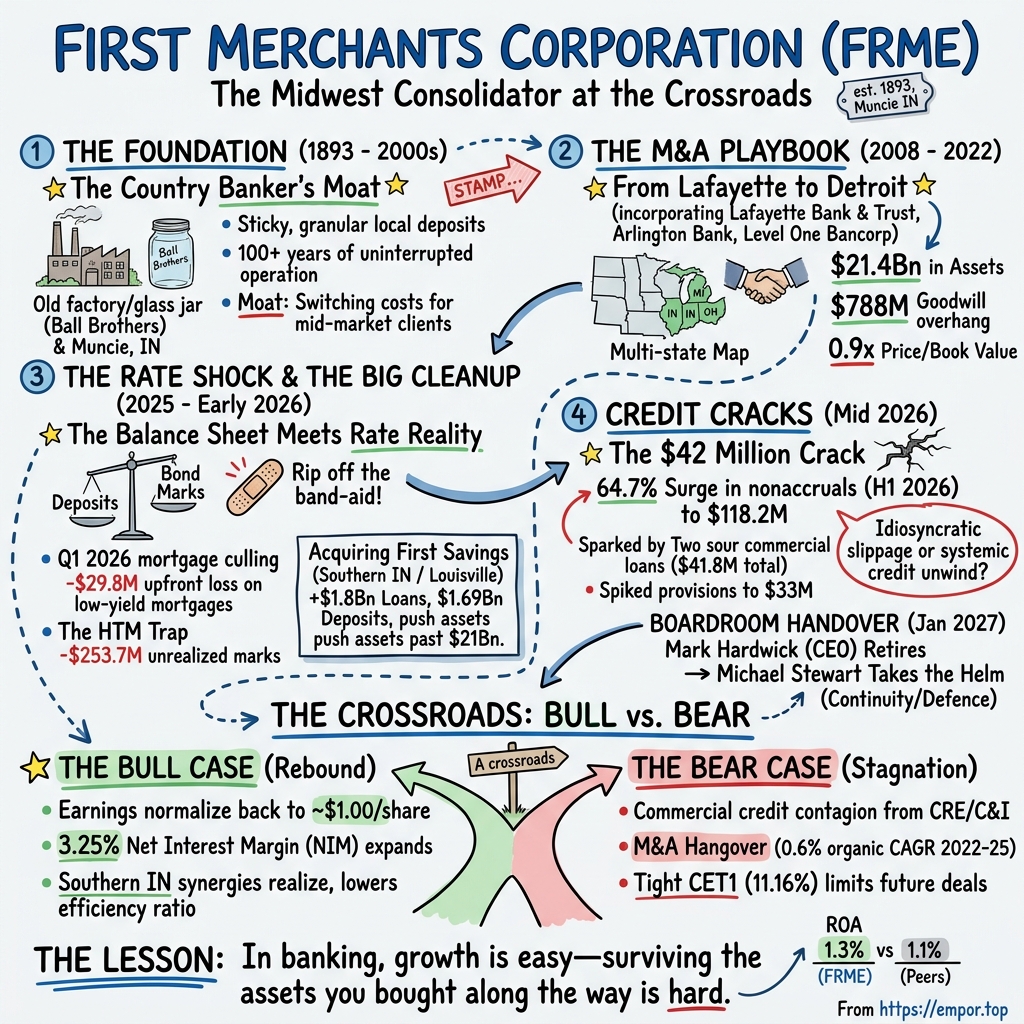
First Merchants Corporation of Muncie, Indiana, was not the next one. Its deposits were granular: thousands of small business operating accounts, county treasurers, farm families and factory payrolls spread across Indiana, Michigan and Ohio. Over the past decade the bank had earned about 1.3% on its assets on average, while the peer group Kroll Bond Rating Agency measures it against earned about 1.1%.1 That gap is wide for a business where the whole game is earning slightly more on loans than you pay on deposits, and keeping most of what you earn. There was no run in Muncie. The stock fell with the rest of the sector, and the bank kept lending.
This story opens three years later, when the quiet survivor started to look less quiet. On February 1, 2026, First Merchants closed its purchase of First Savings Financial Group, a lender based in southern Indiana, and passed $21 billion in total assets.23 It should have been a victory lap. Instead the first half of 2026 brought two shocks. In the first quarter, management moved a pool of low-yielding residential mortgages into the held-for-sale category and took a $29.8 million mark-to-market loss on them in one go.24 In the second quarter, two commercial borrowers went bad, and the bank set aside $33.0 million for credit losses in three months, compared with $5.6 million a year earlier.2 Nonaccrual loans, meaning loans on which the bank has stopped booking interest because it doubts it will be paid, rose by about 65% in six months, from about $72 million to about $118 million.2
The income statement shows the damage clearly. Quarterly profit had been running at about $57 million through 2025. It fell to $28.2 million in the first quarter of 2026 and $44.0 million in the second.25 Diluted earnings per share over the trailing twelve months dropped to $3.13, against $3.93 for the full year 2025.12 For a bank that had compounded net profit at about 13% a year over a decade, from $65 million in 2015 to $226 million in 2025, it was a jolt.1
That ten-year record is the first thing to examine, because the most flattering version of it is only partly true. Most of the growth came from buying other banks. Look only at the last three years, after the 2022 purchase of Level One Bancorp in suburban Detroit and before the First Savings deal, and net profit grew at about 0.6% a year.1 Over that stretch the business basically stood still while its balance sheet got bigger. And just as its growth engine has come to depend on acquisitions, cracks have appeared in its commercial loan book.
Then, on October 1, 2026, First Merchants announced that Mark Hardwick, its chief executive, would retire on January 1, 2027, and that Michael Stewart, the bank's president, would succeed him.6 So a 133-year-old Indiana institution goes into 2027 with a new leader, a new acquisition to digest, a credit book under scrutiny, and a share price about 10% below the stated book value of its equity.1
Three questions run through this story. Was the first half of 2026 a deliberate, aggressive cleanup, or the first sign of broader commercial credit trouble in the Midwest? Is the ten-year growth record genuine banking outperformance, or a series of acquisitions hiding flat organic earnings? And can Michael Stewart protect profitability and capital without diluting shareholders again or dropping the acquisition strategy that made the bank what it is? Answering them starts in Muncie, a gas boom town in the 1890s.
 Subscribe on LinkedIn
II. Gas City, Ball Brothers, and the Country Banker's Moat (1893–2000s)
In the late 1880s, drillers in east-central Indiana hit natural gas, and a lot of it. The Trenton Gas Field was one of the largest known at the time, and towns across the region ran newspaper ads offering free gas to any manufacturer willing to move in. Muncie took the deal. The Ball brothers, a family of fruit-jar makers from Buffalo, New York, moved their glassworks there in 1887 to make use of the cheap fuel, and the canning jar with their name on it became one of the best-known products in American kitchens. Steel, wire, glass and machine shops followed. Muncie went from a small county seat to an industrial town in under a decade.
Merchants National Bank opened in that town in 1893.7 Its founding purpose was simple: hold the payrolls and working capital of the businesses the boom had brought, and lend to the farms and shops around them. The gas did not last; by the early 1900s the field was largely spent. But the factories and the families stayed, and so did the deposits. The bank survived the panics of the early twentieth century, the Depression, and the long, painful deindustrialization of the Midwest after the 1970s, when Muncie and towns like it lost much of their manufacturing base.
The business model behind that survival is old and almost dull, and it still drives the company today. A community commercial bank gathers checking accounts from local businesses, often paying them nothing or close to nothing, because those accounts are where payroll is run and suppliers are paid. It lends that money back out as working capital lines, equipment loans and mortgages on commercial buildings, at rates several percentage points higher. The difference, the spread, is the bank's revenue. The underwriting is local and personal: the loan officer knows the owner, has seen the plant, and often knew the owner's father.
That local knowledge is the moat, to the extent there is one, and it is worth being exact about what it protects. Operating accounts are sticky because moving them is painful. A mid-sized manufacturer with automated payroll, a lockbox for receivables and a sweep account cannot switch banks over a basis point of rate; it would have to rewire its whole treasury function. And when that manufacturer needs a loan quickly, a bank whose credit committee sits forty miles away and whose loan officer can describe the business from memory can say yes faster than a money-center bank processing the request through a national underwriting desk. Commercial borrowers often value that speed more than a slightly cheaper rate.
In 1982, the bank reorganized under a holding company, First Merchants Corporation, a structure built to own more than one bank.1 The timing mattered. American banking law at the time sharply limited banks from operating across state lines, and in many states across county lines. As those rules loosened through the 1980s and then nationally with the Riegle-Neal Interstate Banking and Branching Efficiency Act of 1994, the giants consolidated. Bank One, Chase, Bank of America and others bought their way across the map. The question for every small-town bank in Indiana was whether to sell or to buy. First Merchants chose to buy, and the holding company was the vehicle for it. The shares have traded on NASDAQ since 1989.1
Today the company is worth about $2.5 billion on the stock market.1 The deposit base that started with glassworks payrolls has grown to about $16.75 billion.2 The question this history raises is the one the rest of the story keeps returning to: does the local relationship moat that worked in one county still work when the bank spans three states, and when the next dollar of growth comes from buying someone else's relationships rather than building its own? The answer started to take shape in the decade and a half after the financial crisis.
III. The Consolidation Playbook: From Lafayette to Detroit (2008–2022)
Consider an Indiana community bank in, say, 2015, with about $1.5 billion in assets. It has a good franchise: decent deposits, loyal borrowers, a CEO in his sixties. It also has a problem. The Dodd-Frank Act, passed after the 2008 crisis, brought a heavy load of compliance, risk management and reporting that costs roughly the same whether a bank has $1 billion in assets or $10 billion. Its core-processing technology is aging, and the vendor is raising prices. Its succession plan is thin. Its shareholders, many of them local families, would like liquidity. And then someone from Muncie calls.
That call, repeated many times, is the First Merchants playbook. Find community lenders that are too small to carry modern compliance and technology costs efficiently. Pay mostly in First Merchants stock. Then take out a big share of the target's overhead, often quoted across the industry at 30% to 40% of noninterest expense, by moving its customers onto the central platform, merging back-office functions and closing overlapping branches. If the price is right and the integration is clean, the deal adds to earnings per share within a year or two, and the combined bank is more efficient than either was alone.
Across the 2010s, this playbook carried First Merchants out of east-central Indiana into Lafayette, Indianapolis, northern Indiana, Columbus in Ohio and into Michigan. The financial record shows the result in one line: total assets rose from about $5.8 billion at the end of 2014 to about $15.5 billion at the end of 2021.1 Shareholders' equity rose from about $730 million to $1.9 billion over the same years, largely because the bank kept issuing new shares to pay for acquisitions.1
The largest step was Level One Bancorp. Announced in November 2021, the deal added a commercial bank in suburban Detroit with about $2.5 billion in assets, and closed in 2022.8 It took First Merchants into a large metro market for middle-market commercial lending, the companies with tens of millions to hundreds of millions of dollars in revenue that need real working capital lines and treasury services. It was a bigger bet than the earlier county-seat deals, and it changed the bank's revenue profile. Revenue went from about $712 million in 2022 to about $1.1 billion in 2024.1
Part of that revenue jump, however, has nothing to do with Level One. In 2023 and 2024 interest rates rose sharply, so interest income on loans rose with them, and the reported revenue figure for banks counts gross interest income before the bank pays its depositors. Interest expense rose too. The cleaner measure is net profit, and it tells the sobering story: about $222 million in 2022, $223 million in 2023, $201 million in 2024 and $226 million in 2025.1 A bank about 15% larger after Level One earned roughly the same in 2025 as it did in 2022.
Was that the deal's fault? Not entirely. The 2023 to 2024 period squeezed every regional bank as deposit costs caught up with loan yields, and First Merchants also took about $21 million of losses in 2024 to sell and reinvest underwater bonds, partly offset by a $20 million gain from selling branches.1 But the honest conclusion is that the acquisition playbook successfully moved the bank out of slow-growing rural counties into faster metro markets, and did not, over the last three years, translate into growth in earnings for shareholders.
There is also a cost that stays on the balance sheet. When a bank pays more for another bank than the target's net assets are worth, the difference is recorded as goodwill, an accounting asset that represents the value of the franchise bought. At First Merchants it had reached about $788 million by mid-2026.2 Goodwill cannot be lent out and does not count toward regulatory capital. So the bank's stated book value of about $43 a share overstates what shareholders actually own in tangible terms; strip out goodwill and other intangibles and tangible book value is about $30 a share.12 That is why the stock can trade at about 0.9 times book value and still be priced at about 1.3 times tangible book. The market is not ignoring the acquired franchises, but it is valuing them at less than the bank paid.
A skeptical investor would ask a direct question here: did the acquired loan books bring hidden credit risk or extra cost? On cost, the evidence is reasonably good. In normal quarters First Merchants has run an efficiency ratio, the share of revenue consumed by operating expenses, of about 54% to 55%, which is respectable for a regional bank.2 On credit, the record was clean through the Level One integration, with modest charge-offs. Whether that holds after First Savings is the question the second half of 2026 has opened. Before getting there, the story needs to examine the engine itself: how this bank makes money, and how much the rate shock cost it.
IV. Anatomy of a Midwest Balance Sheet: Spreads, Fees, and the HTM Trap
On the morning First Merchants reported its first quarter of 2026, the headline was ugly. Net profit fell about 49% from a year earlier, to $28.2 million.24 The efficiency ratio, normally in the mid-50s, jumped to about 74.5%.2 For a bank that had made a point of steadiness, it looked like something had broken.
What had happened was a deliberate decision. Management took a $357 million pool of performing residential mortgages, loans that were being paid on time but carried low fixed rates from the era of cheap money, and moved them into the held-for-sale category.24 Under accounting rules, loans held for sale must be marked to their current market value. Because those mortgages paid far less than current rates, they were worth less than face value, and the bank booked a $29.8 million loss upfront. Add merger costs from First Savings, and the quarter fell apart on paper. To understand why a bank would choose that, one has to understand how the machine works.
Start with the core. In 2025, First Merchants earned about $925 million of interest on its loans and securities and paid about $389 million of interest to depositors and lenders, leaving about $536 million of net interest income.1 That accounted for about 81% of its net revenue. The remaining fifth, about $127 million, came from fees: wealth management at about $35.5 million, deposit service charges at about $34.3 million, card interchange at about $19.8 million, and gains on selling loans at about $21.3 million.1 The fee lines are useful ballast, because wealth management and service charges do not swing much with interest rates. But this is fundamentally a spread business, and the spread is what investors are pricing.
The key measure of that spread is the net interest margin, net interest income divided by earning assets. In the second quarter of 2026 it was 3.25%, up from 3.10% a year earlier, or 3.38% when tax-exempt municipal income is adjusted to a pre-tax equivalent.2 That is a healthy margin for a regional bank in this environment; many peers run below 3%. Quarterly net interest income rose to about $159 million from about $133 million a year earlier, helped by First Savings and by older, lower-yielding assets maturing and being reinvested at higher rates.2
Banks do not spend on research and development or build factories. Their reinvestment is technology and branches, and both run through operating expense. First Merchants spent about $27.5 million on outside data processing in 2025, roughly flat with 2024, and about $28.6 million on premises and equipment, with 2,086 full-time equivalent staff at year end.1 Those are modest numbers for a $19 billion bank at the time, which is consistent with the bank's efficiency ratio but also raises the question whether a bank of this size can keep pace technologically with rivals ten times bigger.
Now the less comfortable part. When rates were near zero in 2020 and 2021, First Merchants, like most banks, was flooded with deposits and invested a lot of them in government agency mortgage bonds and municipal bonds paying 1% to 2%. When rates rose, those bonds lost value. Banks split such holdings into two buckets. Available-for-sale bonds are marked to market in a part of equity called accumulated other comprehensive income. Held-to-maturity bonds, which the bank commits to hold until they pay off, are kept at their original cost, and their losses appear only in a footnote.
At June 30, 2026, First Merchants held about $1.38 billion of available-for-sale bonds and about $1.91 billion held to maturity.2 The available-for-sale losses show up as a hit to equity of about $134 million.2 The held-to-maturity bonds had a fair value of about $1.65 billion, about $254 million below their carrying value, a loss that sits entirely off the balance sheet.2
Here is how that interacts with regulation. Banks of First Merchants' size are allowed to opt out of including those bond losses in regulatory capital, and First Merchants did. So its common equity tier 1 ratio, the main regulatory measure of loss-absorbing capital, is a reassuring 11%.2 But if one asked what the bank's equity would be worth if every bond were marked to market, the answer would be roughly $250 million lower than the reported tangible figure, a meaningful hole relative to tangible common equity of under $2 billion. This is the same accounting choice that hid the problem at Silicon Valley Bank. The difference is scale and funding: at First Merchants the bonds are a far smaller share of assets, and the deposit base is not the kind that runs. It is a drag, not a threat, but it is real, and it limits how freely the bank can reposition its bond portfolio without crystallizing losses.
That brings the story back to the mortgage sale. The $357 million of mortgages were the loan-book version of the same problem: assets earning 3% or so, funded by deposits now costing more. Holding them meant years of thin spread. Selling them meant taking the loss now and reinvesting the proceeds, or paying down expensive borrowings, at current rates. Management chose to take the pain upfront.4 It is a defensible decision, and a fairly brave one for a bank whose stock trades on reported earnings. It also means the first quarter's collapse says little about the bank's underlying earning power. The second quarter is a different matter, but before reaching it the story needs to explain the acquisition that complicated both quarters.
V. The Southern Indiana Frontier: Swallowing First Savings Financial (2025–2026)
On February 1, 2026, the signs began changing on bank branches in Clarksville, Jeffersonville and New Albany, the southern Indiana towns that look across the Ohio River at Louisville, Kentucky.3 First Savings Financial Group, a lender with a community banking franchise in that corridor, became part of First Merchants. To pay for it, First Merchants issued about 6.1 million new shares worth about $243 million.2
The strategic logic is clear on a map. First Merchants' footprint covered central and northern Indiana, Michigan and Ohio, but it had a gap in the south of its home state and no real presence in the Louisville metropolitan area, one of the larger economic centers on its doorstep. First Savings filled that gap at once. It brought about $1.84 billion of loans and $1.69 billion of deposits.2 For a bank whose model depends on dense local relationships, buying an existing franchise is much faster than building branches and hiring lenders one by one in a new market.
The price is a different question. The 6.1 million shares took the share count from about 57 million at the end of 2025 to about 62 million by June 2026, an increase of roughly 9% to 11% depending on the date measured.2 The deal added about $76 million of goodwill.2 And First Merchants paid in its own stock while that stock traded near or below its stated book value. When a bank issues shares at less than book value to buy another bank, existing shareholders give up a slice of their equity for each dollar of franchise acquired. That is not necessarily a mistake if the acquired earnings justify it, but the bar for success rises.
The balance sheet also had to absorb the target's funding. Borrowings rose from about $1.0 billion at year-end 2025 to about $1.6 billion at June 30, 2026, mostly through Federal Home Loan Bank advances, which reached about $1.41 billion.2 Federal Home Loan Bank advances are loans secured by mortgages and other collateral from a government-sponsored system that exists largely to provide banks with this kind of funding. Management has described using them partly to replace more expensive funding that came with First Savings.25 It is a normal use of the system, but it means a little more of the bank is now funded by wholesale money rather than by the local deposits that make up its moat.
Did the promised savings arrive? Management announced the deal with the usual targets for cost reductions.9 The early numbers are noisy. Operating profit in the first half of 2026 was about 26% lower than a year earlier, which looks bad, but most of that came from the mortgage loss in the first quarter and the credit provisions in the second, not from integration itself.2 The cleaner sign is the efficiency ratio. After spiking to about 74.5% in the first quarter, it returned to about 55% in the second.2 That is roughly where the bank ran before the deal, and with merger costs mostly behind it, there is room for it to improve further. Whether it actually falls below 54% is a question the 2027 numbers will answer.
So did First Merchants overpay? Measured against the strategic value of the deposit franchise and the Louisville corridor, the price was reasonable; buying a deposit base at roughly book value in a market with growing commercial activity is not expensive by regional bank standards. Measured against what it did to the shareholder in the near term, the deal was dilutive. Return on equity, already a modest 9.2% in 2025, fell to about 6.9% over the twelve months to June 2026.1 That is below most estimates of the cost of equity for a regional bank. Some of that drop will reverse as the one-off charges fade, but some reflects the larger equity base now chasing the same earnings. The deal looks sensible, and it will take until 2027 to know whether it was good. That is, assuming the loan book holds up, which is exactly what the second quarter called into question.
VI. The $42 Million Crack: Asset Quality and Middle-Market Credit
Every bank has a credit committee, and in most quarters its work is routine: renewals, a few watch-list names, a downgraded borrower or two. In the second quarter of 2026, First Merchants' committee faced something larger. Two commercial borrowing relationships, together about $41.8 million, could no longer show they could service their debt.2 The bank put both on nonaccrual and set aside about $29.7 million in reserves specifically against them, roughly 70 cents for every dollar lent.2 That pushed the quarter's provision for credit losses to $33.0 million, nearly six times the $5.6 million of a year earlier.2
The company does not name the borrowers or the industries, which is normal practice. But the size of the reserve says something: a 70% reserve suggests the bank expects to recover only a fraction of what it lent. These were not loans that slipped a payment. They were loans the bank believes have seriously impaired value.
To see why two loans can do so much damage, look at the shape of the book. At June 30, 2026, total loans were about $15.5 billion.2 Commercial and industrial loans, lending to operating businesses secured by receivables, inventory and equipment, were about 30% of the book. Commercial real estate owned by investors, office buildings, apartments, retail centers and warehouses rented to others, was about 21%. Commercial property occupied by the borrower itself was about 13.5%, residential mortgages about 18%, and construction about 6%.2 Investor-owned real estate and business loans together make up more than half the portfolio. That is the classic regional bank mix, and it means the bank's fortunes are tied to the health of Midwest middle-market companies and the value of commercial property.
Nonaccrual loans rose from about $72 million at the end of 2025, 0.52% of loans, to about $118 million at the end of June, 0.76%.2 Within that, business loan nonaccruals went from about $10.5 million to about $51 million.2 That jump is almost entirely the two relationships. Yet net charge-offs, the loans actually written off, stayed at about 0.10% of average loans in the quarter.2 Both things are true at once because of how modern credit accounting works.
Since 2020, US banks have used an accounting standard called current expected credit loss, usually called CECL. Under the older approach, a bank reserved for losses once they had become probable. Under CECL, a bank reserves for its best estimate of all the losses it expects over the life of each loan, from the day the loan is made, and updates that estimate as conditions change. The analogy is an insurer that books expected claims when it writes a policy rather than when the house burns down. The consequence is that bad news hits earnings early, often well before a loan is actually written off or foreclosed. The $29.7 million reserve against the two loans is CECL doing what it was designed to do. The total allowance rose to about $242 million, 1.56% of loans, from about $196 million or 1.42% at year end, partly because First Savings' loans came with their own reserves.2
CECL also concentrates a lot of judgment in a forecasting model. The bank's auditor, Forvis Mazars, flagged the economic forecast component of that allowance as its critical audit matter for 2025, the area of the audit requiring the most complex judgment.1 That is common across banks and not a red flag on its own. The auditor gave a clean opinion and found no material weaknesses.1 It is worth noting that the same audit firm, through its predecessor firms, has audited First Merchants since at least 1982.1 A tenure of more than four decades is long even by banking standards, and some governance specialists would argue that fresh eyes have value precisely when credit judgment matters most.
So which is it: two bad loans, or the edge of a broader decline? The best evidence comes from the bank's own history. Through the post-2008 recovery and the 2020 pandemic, First Merchants' return on assets stayed at or above 1.0% every year from 2014 onward, never dipping into a loss, which suggests underwriting that held up through two real stresses.1 Charge-offs at 10 basis points are low. And management's line on the second-quarter call was that the specific reserves fully covered the problem credits and that the rest of the book remained stable.5
Against that, consider what higher-for-longer rates do to exactly this kind of book. Business borrowers who took on floating-rate debt in 2021 now pay roughly twice as much interest. Investor-owned commercial property bought at peak prices must be refinanced at much higher rates as loans mature. Neither problem shows up all at once; it surfaces borrower by borrower as maturities arrive. And credit trouble at banks is rarely limited to the first two names. Those two loans were idiosyncratic, as far as the company has disclosed, but the conditions that produced them are not.
The fair conclusion is that the evidence narrows the bear case rather than rejecting it. There is no sign of systemic deterioration: charge-offs are low, the reserve is up, and the problems are concentrated. But a rise of this size in nonaccruals within one quarter is enough to shift the burden of proof. The test is simple. If nonaccruals stay around $118 million and quarterly provisions return to the $5 million to $8 million range through the second half of 2026, the cleanup thesis holds. If new names appear, it does not. And the person who will be judged on that result will not be the one who made most of those loans.
VII. The Boardroom Handover: Hardwick Steps Down, Stewart Takes the Helm
On October 1, 2026, First Merchants filed a short 8-K with the Securities and Exchange Commission. Mark Hardwick, chief executive, would retire effective January 1, 2027. Michael Stewart, the bank's president, would become chief executive.6 There was no search, no outsider and no drama. The filing reads like what it was, the execution of a succession plan built over years.
Hardwick's path is a familiar one in community banking: a finance executive who rose through the institution, served as chief financial officer and then took the top job. Under his leadership the bank went from a mostly Indiana lender into a three-state platform, completed the Level One deal, carried the company through the pandemic and the 2023 banking panic without a crisis of its own, and then bought First Savings. His pay reflects a successful regional bank CEO, not a celebrity one: about $2.4 million in total compensation in 2025, including about $827,000 of base salary, about $787,000 of stock awards and about $658,000 of cash bonus, up from about $1.8 million in 2023.10
Stewart is the operator. As president he oversaw the lending businesses and much of the acquisition integration, which means he is as responsible as anyone for both the commercial book that produced the two bad loans and the integration that has so far brought the efficiency ratio back to pre-deal levels.610 He was paid about $1.75 million in 2025.10 Continuity is a strength here: the bank's borrowers, examiners and lenders will deal with a familiar face. It is also a limitation. A new leader who helped build the current book is less likely to take a hard second look at it.
Shareholders have shown little appetite for a fight. At the May 2026 annual meeting, the say-on-pay vote passed with about 94% support, and every director was elected with more than 78% of the vote.11 Insiders as a group, 17 directors and executive officers, own about 1.77% of the shares, with Hardwick the largest at about 0.56%.10 That is meaningful money for the individuals involved but not enough to shape the outcome of any contested vote.
The register is dominated by index funds. Vanguard holds about 10.4%, BlackRock about 7.0% and Dimensional Fund Advisors about 4.9%.10 Passive holders like these tend to vote with management on routine matters and to care about the dividend, currently yielding about 3.7%.1 The dividend has been raised steadily, and the share of profits paid out has risen from about 17% in 2014 to about 37% in 2025.1 With trailing earnings depressed, the payout is running higher still, which narrows the margin for error.
One event a week before the CEO announcement deserves attention. On September 25, 2026, First Merchants issued $100 million of 6.75% subordinated notes due 2036.12 Subordinated debt sits below depositors and senior creditors, so it counts as tier 2 regulatory capital, a second layer of cushion behind common equity. A few days earlier, Kroll Bond Rating Agency had assigned the company its first ratings: BBB+ for senior debt at the holding company, A- at the bank, and BBB for the subordinated notes, all with a stable outlook.13 The bank also filed a shelf registration letting it issue securities quickly.14
Reading those three filings together, a pattern appears. The bank built capital and flexibility ahead of the transition. It is a prudent move. It is also an expensive one: 6.75% is a lot to pay for capital, and it signals that the bank wanted a bigger cushion than it had. Kroll's own report pointed to the bank's capital as the area to watch, noting the common equity ratio had moved toward peer levels rather than staying above them.13 Stewart inherits a bank with good earning power, a capital buffer that is adequate rather than generous, and a market that will notice any sign that he plans to keep buying. Which raises the question of what, exactly, First Merchants has that its competitors cannot buy.
VIII. Strategic Moat & The Competitive Ring
Picture the owner of a machine shop in Fort Wayne, a company with about $40 million in revenue, looking to borrow for a new production line and to move the company's operating accounts. Four banks are interested. Chase has a national brand, an enormous technology budget and a treasury platform used by the largest companies in the country. Huntington, based in Columbus with about $190 billion in assets, has a dense Midwest network. Old National, headquartered in Evansville and now Indianapolis-based for much of its commercial work, is a fellow Indiana consolidator that has grown much larger through its own mergers. And First Merchants has a relationship manager who has called on the company for years and a credit committee that can make a decision in days.
Which bank wins? Often First Merchants, for reasons that can be tested with Hamilton Helmer's seven powers framework, which asks what structural advantages let a business earn above-average returns over time.
The strongest power is switching costs. Once a mid-sized company runs its payroll, receivables and payments through a bank's treasury system, moving is costly and risky. This is real, and it is why the deposits held up in 2023. But it protects existing relationships, not new ones, and the competitors in this story offer the same switching costs once they have the account.
The second is a mild cornered resource: the local relationship managers and the long-standing municipal and community deposit relationships in mid-sized Midwest towns. These are hard for a national bank to replicate cheaply. But they walk out the door when people leave, and regional rivals hire lenders from each other constantly.
The weak point is scale. Banking technology, from mobile apps to fraud detection to treasury software, is a fixed cost that is much easier to carry across $200 billion of assets than $21 billion. Fifth Third and Huntington, each roughly ten times First Merchants' size, can spend far more on technology in absolute terms. First Merchants relies largely on outside vendors, as its data processing line shows, which keeps costs down but means its tools are generally available to competitors too. There are no network effects to speak of, and banking brands are local rather than powerful.
Michael Porter's five forces show the other side. The threat of new entrants is low, because a bank charter and federal deposit insurance are hard to get. But the threat of substitutes is high: private credit funds and direct lenders have taken a growing share of middle-market lending, often with more flexible terms, and fintech firms compete for payment and deposit flows. Commercial borrowers have meaningful bargaining power when rates are high and they shop for every basis point. And rivalry is intense: Old National, Horizon Bancorp, Park National and 1st Source all compete for the same Indiana, Ohio and Michigan relationships.5
So what is the moat worth in numbers? The best evidence is the bank's own track record. A ten-year average return on assets of about 1.3% against a peer average of about 1.1%, as Kroll measured it, is a lasting and meaningful edge, about 20% more profit per dollar of assets.13 The 3.25% net interest margin, above many regional peers, points the same way: the bank prices its deposits and loans well.2 The history does not reject the claim of an advantage. But it narrows it. The advantage is real in a specific form, sticky local deposits and good pricing in mid-sized markets, and it has not been strong enough to turn a bigger balance sheet into growing profits over the last three years. Kroll's own caution about capital converging toward peers is a reminder that the edge in profitability does not translate automatically into an edge in capital strength.
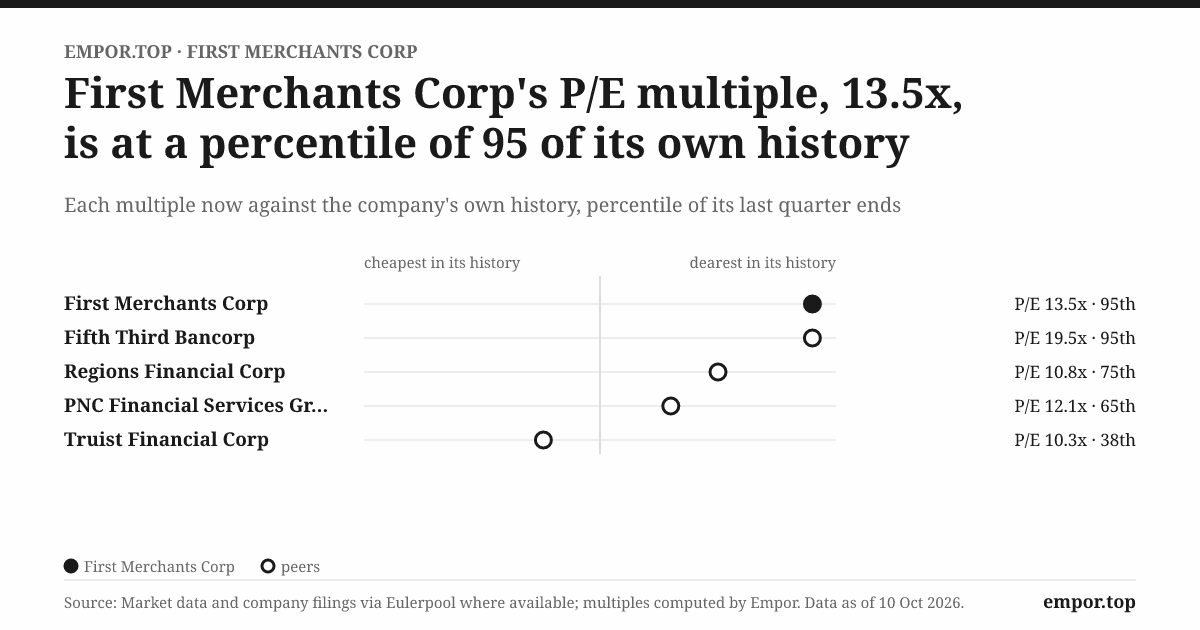
The market seems to have reached a similar view. At about 13.5 times trailing earnings, the shares look more expensive than their five-year median of about 10.9 times, but that is because trailing earnings are depressed.1 At about 1.3 times tangible book, First Merchants sits within the range of 1.0 to 1.4 times at which its regional peers trade.2 The market is pricing it as a good regional bank, not a special one. Whether that price is too low or too high depends on which way the next few quarters break.
IX. Bull vs. Bear Case: The Earnings Rebound or the M&A Hangover
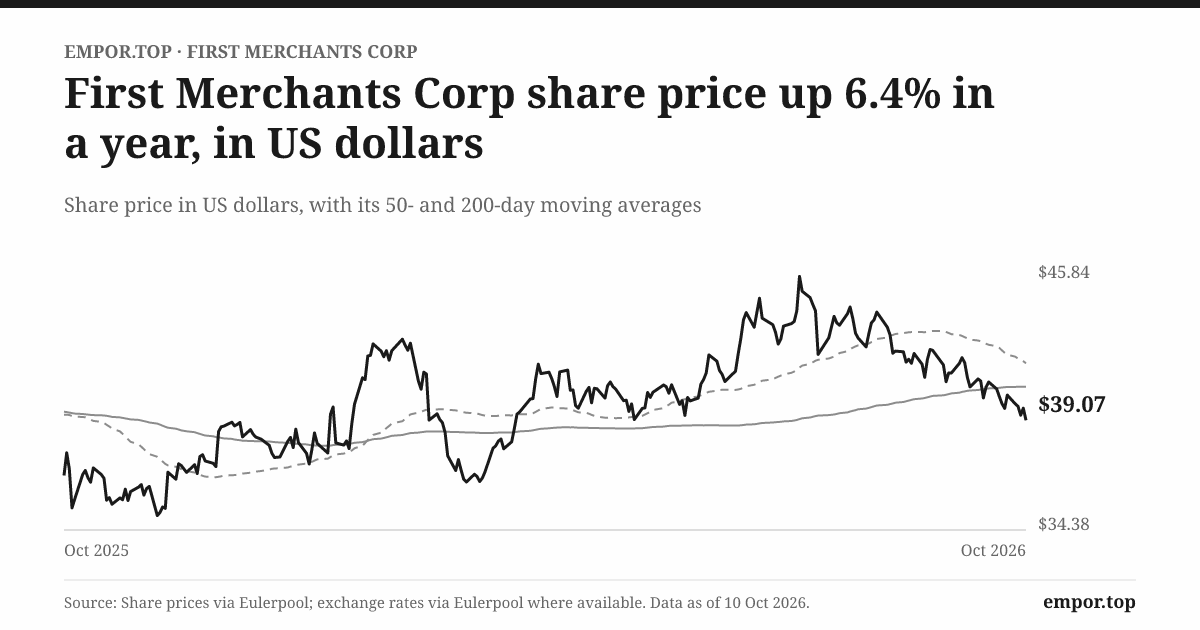
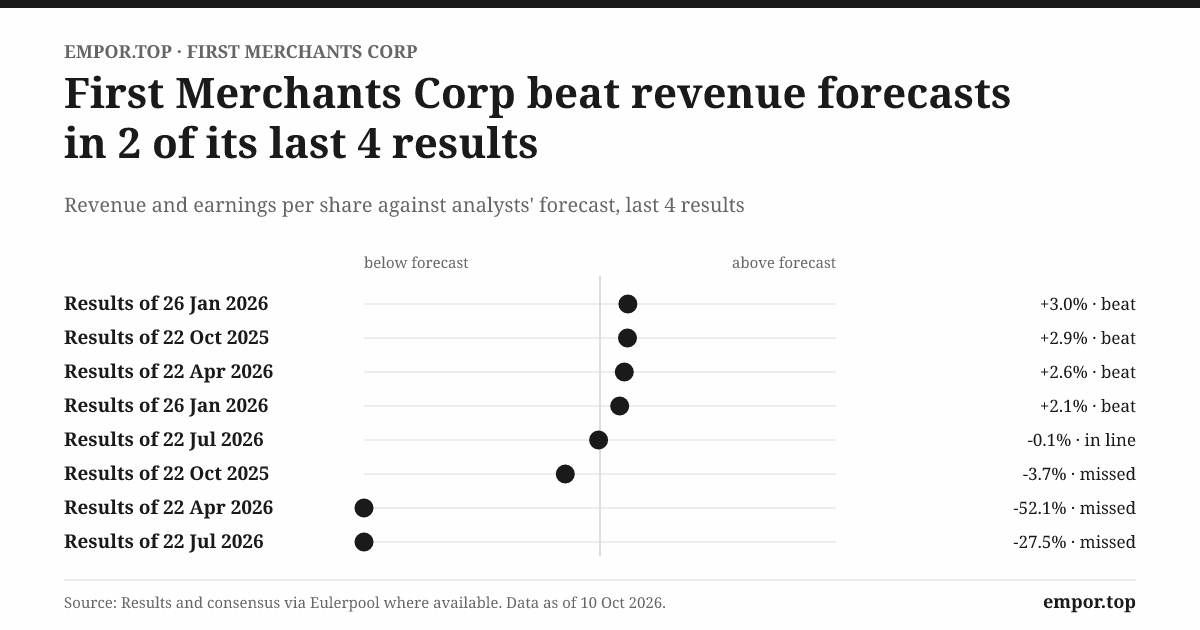
At $39.07, First Merchants stock sits about 14% below its 52-week high of $45.23.1 Analysts preparing for the third-quarter results, due in late October, are working on one main question: does quarterly earnings per share return to the $0.95 to $1.00 the bank produced through 2025, or do credit costs stay elevated at $20 million or more a quarter?1
The bull case begins with a simple sum. Strip out the $29.8 million mortgage loss from the first quarter and the $29.7 million specific reserve from the second, and the bank's underlying earning power looks much like it did before.2 On roughly 62 million shares, a return to about $0.95 to $1.00 a quarter would mean annual earnings of about $3.80 to $4.00 per share. At the current price, that is roughly 10 times normal earnings, below the five-year median and at the lower end of peer valuations.12 Add the rising margin, as low-yielding assets mature and get reinvested at higher rates, and full cost savings from First Savings bringing the efficiency ratio back below 54% in 2027, and there is a credible path to earnings growth from here. The dividend yield of about 3.7% pays shareholders while they wait.1
The bear case starts where the bull case stops. First, the credit problem may not be finished. Middle-market business loans and investor-owned commercial property make up more than half the book, and both face refinancing pressure that arrives loan by loan. If more borrowers follow the first two, provisions will stay high and the normal earnings never come back in full. Second, the acquisition treadmill: remove Level One and First Savings, and net profit grew about 0.6% a year from 2022 to 2025.1 That is the core record of organic growth, and it is weak. Third, capital: a common equity ratio of about 11.2% and newly issued subordinated debt at 6.75% suggest the bank does not have much room for another large deal without issuing more shares, likely below book value again.212 If acquisitions stop, the bank needs organic growth it has not recently shown. If they continue, shareholders face more dilution.
A skeptical activist would focus on one point. The bank trades at about 0.9 times stated book value.1 Every share issued to buy another bank at that price transfers value from existing shareholders. Every share bought back at that price adds value. The activist question to Stewart would be blunt: why buy other banks with cheap stock when you could buy your own? That question does not have an obvious answer, and the bank's response will say a lot about how the new CEO thinks about capital.
Weighing the evidence, the bull case rests on two assumptions that are plausible but unproven: that the credit problems are contained, and that the bank can grow loans organically at a healthy rate. The bear case rests on a pattern that is already visible: flat organic profits and a concentration in exposed loan categories. Neither side is decisive yet.
Three numbers will settle it. The first is the quarterly provision for credit losses, which was $33.0 million in the second quarter against a normal level of roughly $5 million to $8 million.2 The second is organic loan and deposit growth excluding First Savings, which needs to run above about 4% a year to show the franchise can grow on its own; the bank's recent record falls short of that. The third is the common equity tier 1 ratio, about 11.2% at mid-year, and whether it moves toward 12% or drifts lower.2 Watch those three, and the rest of the story follows.
X. Playbook: Business & Investing Lessons
The first lesson comes from the gap between the ten-year and three-year records. First Merchants grew revenue about 14% a year for a decade while net profit over the last three years grew about 0.6% a year.1 Acquisitions can make a bank bigger quickly; only pricing power and organic growth make it more valuable per share. For a serial acquirer, the real measure is not assets added but tangible book value and earnings per share compounded. A roll-up buys revenue; only the franchise can earn it.
The second lesson is from the first quarter of 2026. Most banks with low-yielding mortgages chose to hold them and absorb the thin spread quietly over a decade. First Merchants took a $29.8 million loss in one quarter to clear them out.2 The reported earnings looked terrible, and the economic decision was arguably sound: a loss that is already embedded in an asset does not get smaller by being hidden. Bad assets get cheaper to fix the earlier one admits they are bad.
The third lesson is about granularity. Two commercial relationships, about $42 million in a $15.5 billion book, cost the bank roughly half a quarter's profit.2 Diversification protects a bank against ruin, not against bad quarters. A middle-market lender's risk is not the average loan; it is the handful that go wrong at once, and in a high-rate environment those handfuls arrive more often.
The fourth lesson is the handover itself. Announcing Stewart's appointment three months before Hardwick leaves, with capital raised beforehand and a new rating in hand, gave borrowers, regulators and investors certainty at a moment when the bank had just reported its two weakest quarters in years.61213 A predictable succession is worth something in banking, where confidence is the product. But continuity is not the same as accountability, and the new CEO will be judged on the loan book he helped build.
XI. Epilogue
As 2026 draws to a close, First Merchants is a $2.5 billion company holding about $21.4 billion of assets, absorbing its largest acquisition in years and preparing for its first change of chief executive in nearly a decade.126 It is more profitable per dollar of assets than most of its peers, and it is digesting both a credit surprise and a balance sheet still carrying the scars of the rate shock.
The next moments that matter are already on the calendar. The third-quarter results, due in late October, and the fourth-quarter results in January will show whether nonaccruals peaked at about $118 million or whether more borrowers have joined the first two. If provisions fall back toward normal levels and nonaccruals hold steady, the first half of 2026 will look in hindsight like a deliberate cleanup and the stock's discount to book value will look harder to justify. If new problem loans appear, the market will treat the second quarter as the first chapter rather than the last.
Then comes Stewart's first real decision. Sometime in early 2027 he will tell investors what the bank plans to do with its capital. He could pause acquisitions, rebuild the common equity ratio toward 12% and buy back shares at below book value, which would be a significant change of direction for a company built by acquisition. Or he could keep looking for the next First Savings, betting that the playbook still works if the price is right. The first path tests whether the franchise can grow on its own. The second tests the patience of shareholders who have seen the balance sheet grow faster than their earnings. The bank has never had to choose so clearly before.
XII. Outro
In 1893, Muncie was a boom town on top of a gas field that everyone thought would last forever. It did not. The glassworks and factories that came with the gas lasted longer, and the bank that held their money outlasted most of them. Through panics, depression, deindustrialization and the 2023 run on regional banks, the institution that began as Merchants National Bank kept its depositors and kept earning.
That record is the strongest argument for First Merchants and the most important warning. The bank has always been better at surviving than at standing still, and its recent growth has come from buying other banks' customers and loans along with their problems. First Merchants survived 130 years of Midwest booms and busts by remembering what bigger banks forget: in banking, growth is easy. The franchise is made by surviving the assets you bought along the way.
References
-
Form 10-K FY2025 Annual Report — First Merchants Corporation, SEC EDGAR, 2026-02-25 ↩↩↩↩↩↩↩↩↩↩↩↩↩↩↩↩↩↩↩↩↩↩↩↩↩↩↩↩↩↩↩↩↩
-
Form 10-Q Q2 2026 Quarterly Report — First Merchants Corporation, SEC EDGAR, 2026-07-31 ↩↩↩↩↩↩↩↩↩↩↩↩↩↩↩↩↩↩↩↩↩↩↩↩↩↩↩↩↩↩↩↩↩↩↩↩↩↩↩↩↩↩↩↩↩↩
-
Form 8-K Completion of Acquisition of First Savings Financial Group — First Merchants Corporation, SEC EDGAR, 2026-02-02 ↩↩
-
Q1 2026 Earnings Release and Conference Call (Mortgage Portfolio Reclassification) — First Merchants Corporation, 2026-04-25 ↩↩↩↩
-
Q2 2026 Earnings Release and Conference Call Transcript — First Merchants Corporation, 2026-07-28 ↩↩↩↩
-
Form 8-K Executive Succession / CEO Retirement — First Merchants Corporation, SEC EDGAR, 2026-10-01 ↩↩↩↩↩
-
First Merchants Corporation Investor Relations — First Merchants Corporation ↩
-
First Merchants Corporation and Level One Bancorp Announce Merger Agreement — PR Newswire, 2021-11-04 ↩
-
Q4 2025 / FY2025 Earnings Release and Investor Presentation — First Merchants Corporation, 2026-01-27 ↩
-
DEF 14A Definitive Proxy Statement — First Merchants Corporation, SEC EDGAR, 2026-04-03 ↩↩↩↩↩
-
Form 8-K Annual Meeting Voting Results — First Merchants Corporation, SEC EDGAR, 2026-05-20 ↩
-
Form 8-K Issuance of $100m Subordinated Notes — First Merchants Corporation, SEC EDGAR, 2026-09-25 ↩↩↩
-
Rating Report: First Merchants Corporation & First Merchants Bank (Doc ID: 1017172) — Kroll Bond Rating Agency, 2026-09-17 ↩↩↩↩
-
Form S-3ASR Automatic Shelf Registration — First Merchants Corporation, SEC EDGAR, 2026-09-17 ↩
 LinkedIn
 WhatsApp
 Reddit
 Hacker News
 Email
Email Kindle
 RSS Feed
 Spotify
 Apple Podcasts
 Amazon Music
 Audible
 YouTube