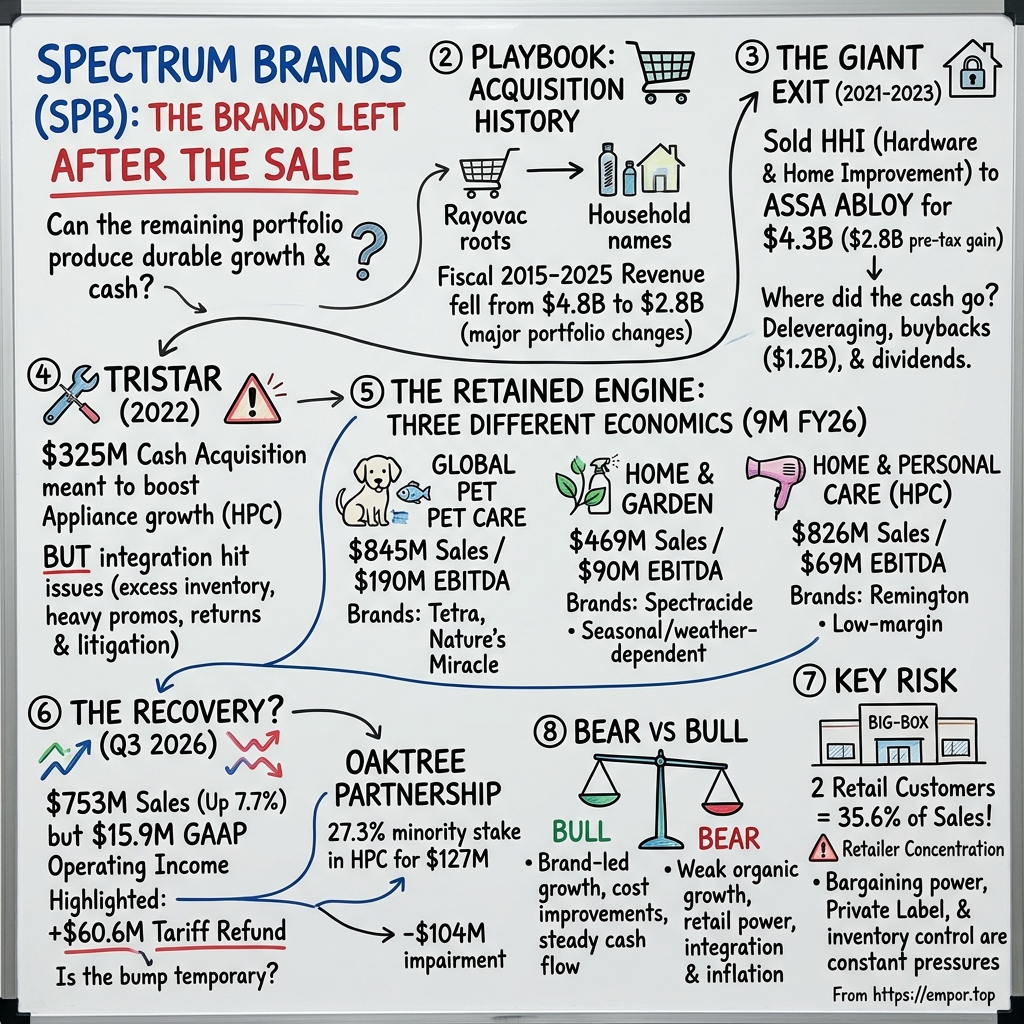
Spectrum Brands Holdings, Inc.: The Brands Left After the Sale
I. What Did Spectrum Keep?
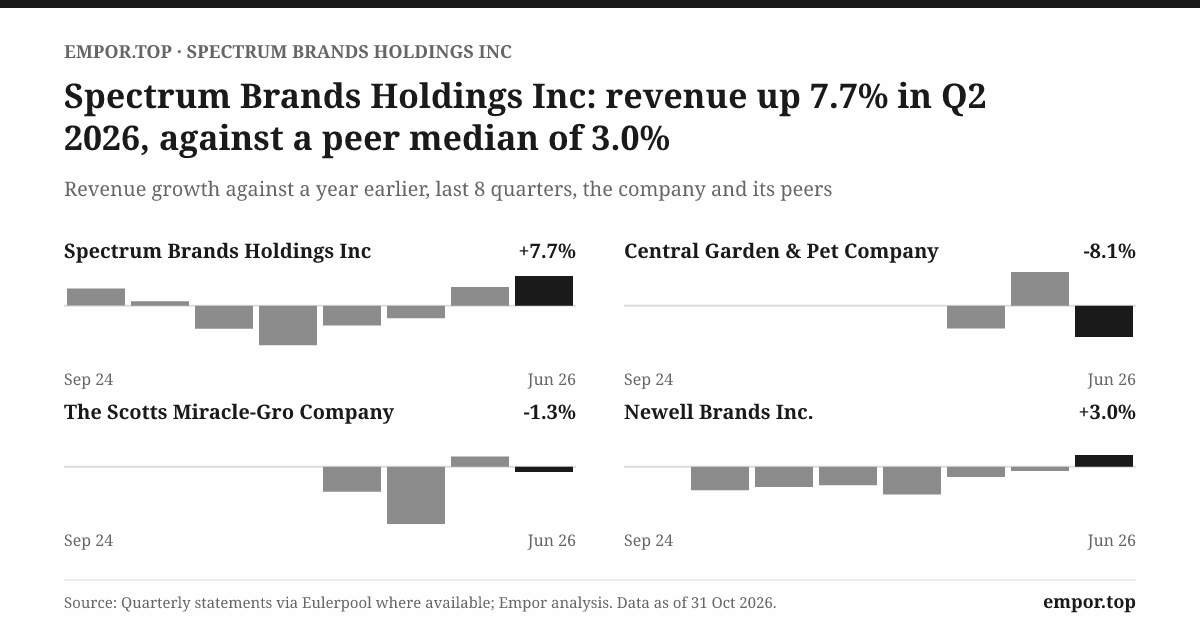
On August 7, 2026, Spectrum Brands published a quarterly report that seemed to say two different things. The first was good news. Sales in the three months to the end of June had risen 7.7% from a year earlier, to about $753 million, the company's best growth rate in more than two years.[^1] Home & Garden had just had a record quarter, and the pet business was growing again.1 For a company whose revenue had shrunk for most of the previous year, that looked like the turn shareholders had been waiting for.
The second message was in the notes, and it was stranger. The same quarter contained a $60.6 million refund of tariffs the company had paid on imported goods, which it booked as a reduction in its cost of goods sold.2 It also contained a $104 million write-down of intangible assets in Home & Personal Care, the appliance and grooming business, taken because the price a new outside investor had just paid for a slice of that business implied a lower value than the one on Spectrum's books.2 Spectrum had just reported strong growth, a one-off refund and a write-down in the same quarter, and they did not add up to a simple verdict.
Here is the size of the company at the center of this story. In fiscal 2025, which ended in September 2025, Spectrum sold about $2.8 billion of goods: aquarium filters and dog chews, weed killers and wasp sprays, toaster ovens and beard trimmers.3 A decade earlier the same corporate shell reported about $4.8 billion.3 Much of the difference is not decline. It is what Spectrum chose to sell. The batteries went in 2019, the auto-care brands with them, and in 2023 the company sold Hardware & Home Improvement, the business behind Kwikset locks, for $4.3 billion.4 What remains is a smaller set of businesses, and the investment question is whether the brands Spectrum kept can grow and generate cash on their own.
The latest quarter made that question harder to answer, not easier. On the company's own reported numbers, the quarter produced just $15.9 million of operating income and a $20.3 million loss from continuing operations.2 The figure most often quoted from it is something else: adjusted EBITDA of $158.3 million, a management measure that leaves out the impairment and other items.1 Some data providers show an operating profit of about $120 million for the quarter, which is simply the reported $15.9 million with the $104 million impairment added back.2 All three numbers describe the same quarter, and they cannot be used interchangeably. The adjusted figure also includes the refund. Strip that out and adjusted EBITDA was $97.7 million, which was still up 27.5% on the year before.1 That was a genuine improvement, but a much smaller one than the headline suggests.
There is a second complication, and it goes to the question of what a Spectrum share actually owns. In May 2026, funds managed by Oaktree Capital Management agreed to put $127 million into Home & Personal Care, split between convertible preferred equity and a first-lien term loan secured only on that business.5 After a final tranche closed in July, Oaktree owned about 27.3% of HPC on an as-converted basis and held a minority of its board seats.2 Spectrum still controls the business and still consolidates every dollar of its sales and costs into its own accounts.2 So the $2.8 billion company is still, on paper, a three-business company. But one of those businesses now has a second owner with its own claims on the cash, its own preferred return and its own exit rights.
That gives the story its question. Is the improvement of 2026 the start of a durable recovery for a slimmed-down brand company, or a temporary lift after years of buying, selling, writing down and restructuring? Does the Oaktree deal give HPC room to rebuild, or put another investor's claims ahead of Spectrum's shareholders inside the listed company? The headline quarter overstated how much of the rebound came from ordinary operations, but the rebound itself was real enough to take seriously. To judge it, the story has to start with how Spectrum came to own this particular collection of brands.
 Subscribe on LinkedIn
II. A Portfolio Built by Buying Brands
Spectrum Brands began life under another name, as a battery maker. In February 2005, Rayovac told investors it wanted to rename itself Spectrum Brands, and its chief executive, David Jones, explained why: the new name "more clearly describes who we are today," and signalled a "commitment to new brands going forward."6 That sentence describes the company's strategy for the next two decades. Rayovac had bought its way into lawn-and-garden products, pet supplies and personal care. The new name was meant to show investors it was now a multi-category brand owner.
The plan had a cost, and the bill came due fast. Buying those businesses had loaded the company with debt, and when credit markets froze in the financial crisis, the debt became unmanageable. On February 3, 2009, Spectrum Brands and its U.S. subsidiaries filed for Chapter 11 bankruptcy after missing a $25.8 million interest payment on their subordinated notes.7 The company emerged on August 28, 2009, with its brands intact and its old shareholders largely wiped out.7 The turnaround that followed was built by its new owners, and they were hedge-fund investors.
The most important of those owners was Philip Falcone's Harbinger Capital. In June 2010, Spectrum combined with Russell Hobbs, the small-appliance company that brought the Russell Hobbs, George Foreman and licensed Black+Decker kitchen brands still sold by Spectrum today,3 in a deal that left funds associated with Falcone controlling about two-thirds of the combined company.89 In January 2011, Harbinger Group took a controlling financial interest in Spectrum.9 The appetite that drove the combination was the same one that had driven Rayovac: put more recognizable brands under one corporate roof, sell them through the same large retailers, and use the scale to buy, ship and promote more cheaply than a single-brand company could.
That is also where the man who runs Spectrum today comes in. David Maura joined Harbinger in 2006 as a vice president and director of investments, after a career analyzing distressed debt and high-yield bonds, mostly in consumer products and retail, at First Albany, Merrill Lynch and Wachovia.10 He sat on the boards of Russell Hobbs and Applica, the appliance companies that were folded into Spectrum.10 He became a managing director at HRG Group, Harbinger's listed holding company, then executive chairman of Spectrum in January 2016 and chief executive in April 2018.10
When HRG and Spectrum merged in July 2018, collapsing the holding company into the operating company, Maura became executive chairman and CEO of the combined Spectrum Brands Holdings.11 He is a CFA charter holder with a business degree from Stetson University.10 Unlike most consumer-goods CEOs, he did not rise through marketing or sales. He came from the investor side, trained to read a balance sheet and to value a business as something that could be bought or sold. That background shows in almost every major decision in the rest of this story.
Under Maura, the buying turned into selling. In January 2019, Spectrum sold its global battery, lighting and portable-power business, the old Rayovac core, to Energizer for $2.0 billion, and later that month sold its auto-care brands, Armor All, STP and A/C Pro, to Energizer for $1.25 billion in cash and Energizer stock.12 Those two deals explain much of the step down in revenue from roughly $3.8 billion in fiscal 2018 to about $2.4 billion in fiscal 2019.3 The biggest sale was still to come.
The company that resulted has three reporting segments and about 3,000 full-time employees.3 Global Pet Care sells aquarium gear and fish food under Tetra, Marineland and GloFish, along with dog chews, treats and stain removers under Good 'n' Fun, DreamBone, SmartBones and Nature's Miracle.3 Home & Garden makes Spectracide weed and insect killers, Hot Shot and Black Flag pest control, Cutter and Repel insect repellents, and Rejuvenate cleaning products.3 Home & Personal Care sells kitchen appliances under Black+Decker, Russell Hobbs, George Foreman, PowerXL and Emeril Lagasse, and grooming products under Remington.3 A shopper would recognize many of these names. Few would know they belong to the same company.
That is why the long-run revenue record can mislead. Revenue fell about 5.1% a year from fiscal 2015 to fiscal 2025, which looks like a business in steady retreat.3 It is not a like-for-like comparison. The ten years include the battery and auto-care sales, a series of smaller disposals and, above all, the sale of Hardware & Home Improvement. The shorter record is closer to a real business trend, and it is not much better: about 1.4% a year of growth from fiscal 2020 to fiscal 2025, and a decline of about 3.6% a year over the last three of those years.3 Some of the long decline is portfolio arithmetic. The recent decline cannot be explained that way.
One acquisition belongs in this part of the story because it was meant to reverse the pattern. In February 2022, Spectrum agreed to buy the home-appliance and cookware business of Tristar Products, the direct-response marketer behind PowerXL air fryers and Emeril Lagasse-branded cookers.[^14] Management said the deal would add direct-to-consumer marketing skills and help create a faster-growing appliance platform.[^14] In other words, after years of selling businesses, Spectrum was buying again. The record so far raises an uncomfortable question about the company's acquisitions: did they build lasting capabilities, or did they mostly create businesses that later had to be repaired, simplified or sold? The clearest test of that question came in the deal that made Spectrum's balance sheet what it is today.
III. The $4.3 Billion Exit—and the Deal That Followed
On September 8, 2021, Spectrum signed an agreement to sell its Hardware & Home Improvement division to ASSA ABLOY, the Swedish lock and access-control giant, for about $4.3 billion in cash.[^15] Management described the price as more than 14 times HHI's expected fiscal 2021 adjusted EBITDA, and said it would use the money to cut debt, invest in growth and return capital to shareholders.[^15] For a company that had gone through bankruptcy twelve years earlier, the announcement looked like a reversal of fortune.
The business being sold was not like the rest of Spectrum. HHI was the largest residential door-hardware producer in the United States, selling Kwikset locks and Baldwin's premium lines to home-improvement stores, showrooms and homebuilders, along with Pfister faucets and other builders' hardware.13[^15] It had about $1.4 billion of U.S. sales in 2021.13 Its customers were contractors and homeowners on renovation projects as much as everyday shoppers, and its demand followed housing construction more than the weekly shopping list. Locks and faucets are not interchangeable with fish food and bug spray. HHI was probably the strongest franchise Spectrum owned, and it also had the least in common with the other businesses. That is what made it valuable to a buyer, and it is also why selling it changed Spectrum so much.
The deal then sat in limbo for almost two years. On September 15, 2022, the U.S. Department of Justice sued to block it.1413 The government's argument was straightforward. ASSA ABLOY already sold premium door hardware under Emtek and Schaub and smart locks under Yale and August. Combined with Kwikset and Baldwin, the government said, the merged company would have about 65% of U.S. premium mechanical door hardware, more than ten times its nearest rival, and over half of the fast-growing smart-lock market, leaving what it called "an effective duopoly."13 After more than seven months of litigation and the help of a mediator, the parties settled on May 5, 2023.
ASSA ABLOY agreed to divest Emtek and Schaub and Yale's residential smart-lock business to Fortune Brands, with a monitoring trustee to check that the remedy worked.1315 The sale closed on June 20, 2023, at the agreed $4.3 billion before customary adjustments, and Spectrum expected about $3.6 billion of net proceeds.4
The price stands up well on any measure Spectrum published. More than 14 times expected EBITDA is a full multiple for a hardware business tied to housing, and the antitrust fight showed how much ASSA ABLOY wanted Kwikset's position.[^15]13 One comparison has to be handled carefully, though. It is tempting to set HHI's sale multiple against what Spectrum paid for Tristar the following year and call one cheap and the other expensive. That comparison cannot be made, because Spectrum never disclosed Tristar's standalone EBITDA. The sale price can be judged on its own terms. Spectrum got a high price for a valuable business.
The accounting made the year look better than the business was. The sale produced a $2.8 billion pre-tax gain in fiscal 2023, recorded in discontinued operations.3 That is why fiscal 2023 net profit was about $1.8 billion and diluted earnings were nearly $53 a share, more than ten times any normal year.3 It was a one-time gain from selling a business, not earnings the remaining company could repeat. Any long-run chart of Spectrum's profit growth that includes 2023 is mostly measuring the HHI sale.
What matters is where the money went, and it can be traced. The first use was debt. At closing, Spectrum said it would cut borrowings by about $1.6 billion.4 Total borrowings fell from about $3.2 billion at the end of fiscal 2022 to about $1.7 billion a year later and to roughly $650 million by September 2024, where they stayed through fiscal 2025.316 For a company whose debt had once been about ten times its equity, the change was dramatic. While the cash waited to be spent, it earned interest: about $56 million of interest income in fiscal 2024 alone, mostly from investing the HHI proceeds.3
The second use was share buybacks, and they were large. Spectrum repurchased about $435 million of stock in fiscal 2023, including a $500 million accelerated repurchase agreement that finished settling in November 2023, then about $566 million in fiscal 2024 and $326 million in fiscal 2025.316 That is roughly $1.3 billion over three years, at average prices of about $75 to $77 a share in the first two years and slightly lower in the third.3 Combined with smaller purchases since, those buybacks reduced the share count from about 41 million around fiscal 2022 to roughly 23 million by mid-2026.310 Spectrum's owners now each hold a much larger share of what is left.
The third use was dividends, which continued at about $50 million a year in fiscal 2024 and 2025, down from about $66 million in fiscal 2023 as the share count fell.3 The fourth use, investment in the remaining brands, is harder to see in the numbers. Capital spending in fiscal 2025 was about $54 million, under 2% of sales, and research and development was about $23 million, under 1%.3 The money from HHI mostly went to lenders and shareholders, not into building the brands Spectrum kept.
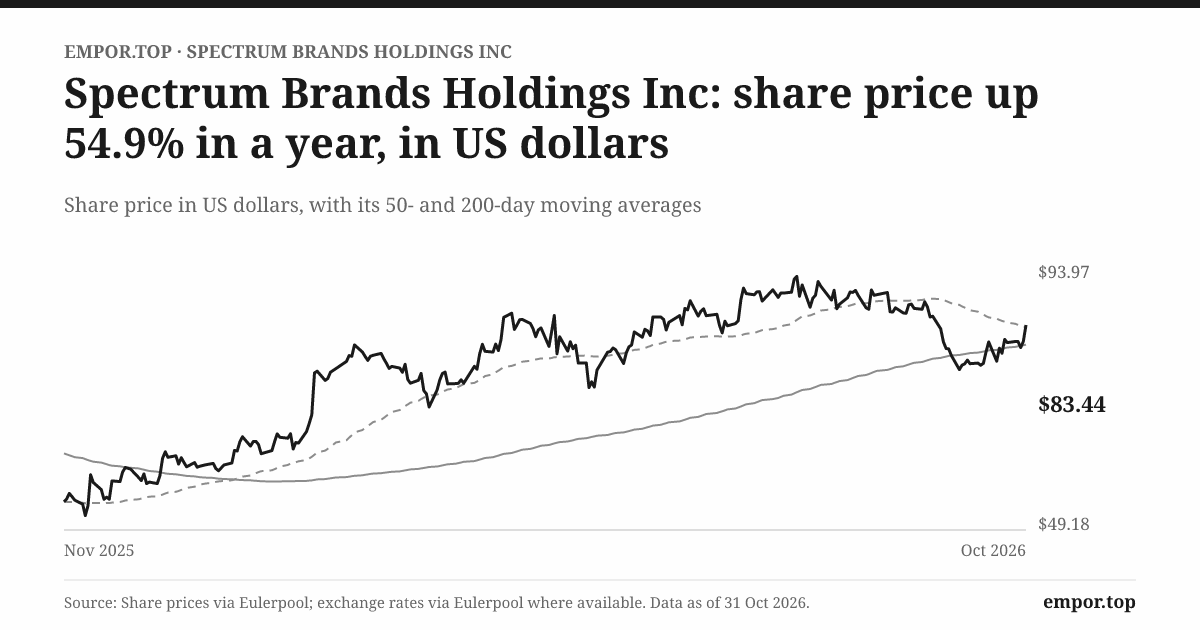
So was the exit good capital allocation? On the sale itself the evidence is favorable: a high price, a long antitrust fight carried through to closing, and proceeds used to repair a balance sheet that had sunk the company once before. Share buybacks are harder to grade. The stock traded as low as about $52 in the past year, well below the prices paid in fiscal 2023 and 2024, before closing above $83 in October 2026. Whether those purchases created value depends on what the business earns from here, which brings the story back to its central question. And by the time HHI's cash arrived, Spectrum had already made a large bet on a different business. That bet was Tristar.
IV. Tristar: The Growth Platform That Needed Repair
In early February 2022, David Maura announced a purchase that looked nothing like the companies Spectrum usually bought. Tristar Products was a New Jersey direct-response marketer, the kind of company that sells through late-night infomercials, shopping channels and "as seen on TV" displays. Its appliance and cookware brands included PowerXL air fryers and grills, Emeril Lagasse-branded multicookers and Copper Chef pans.[^14] Spectrum agreed to pay $325 million in cash at closing, plus up to $125 million more if the business hit performance targets.[^14] The deal closed on February 18, 2022.17
Management laid out a clear strategic case. Spectrum's Home & Personal Care business had well-known brands, global distribution and relationships with retailers on several continents. What it lacked, management said, was speed: products that caught a trend, marketing that could create demand rather than wait for it, and a direct line to consumers. Tristar was supposed to supply that. Its television and direct-response skills would be put behind Spectrum's brands, while Spectrum's sourcing, distribution and international reach would take Tristar's products into stores and countries Tristar could not reach alone.[^14]
Management forecast $20 million to $30 million of cost synergies and described the result as an appliance platform with about $1.8 billion of sales and $142 million of adjusted EBITDA.[^14] Spectrum was also exploring ways to separate HPC through a spin-off, merger or sale, work that later included a confidential Form 10 registration filed in July 2024, and a bigger, faster-growing appliance company would be easier to separate.3
One point should be clear before judging how that went. Spectrum disclosed the purchase price and the combined platform's figures, but not Tristar's own EBITDA. Without that, no one outside the company can say what multiple Spectrum paid, or whether it was cheap or expensive against other appliance deals. The deal has to be judged on what happened after it closed.
And what happened is documented in Spectrum's own filings. The acquired Tristar business suffered what Spectrum's fiscal 2024 and 2025 annual reports called "significant distribution challenges, increased levels of retail inventory, reduced sales, increased promotional spending and deductions, higher level of returns, and overall increased amount of costs."163 That is unusually blunt language for a 10-K. Each of those problems feeds the next. Retailers that are left holding too much stock stop reordering, then demand promotional money to clear what they have, then send product back. A company that sells through stores needs its products to leave the shelf on schedule, and these did not.
The problems were quickly reflected in the accounts. In fiscal 2023, Spectrum wrote off $111 million of HPC goodwill and $121 million of trade-name value, including the PowerXL and George Foreman names, and took a further $21 million non-cash charge to dispose of HPC inventory, mostly tied to an acquired Tristar brand.163 Product recalls handled with the U.S. Consumer Product Safety Commission added returns and costs.16
In fiscal 2024, Spectrum collected $65 million from its representation-and-warranty insurance, a policy that pays out when a seller's promises about a business turn out to be untrue.16 The company then went to court. Spectrum and HPC were seeking to recover losses linked to the recalls and, separately, damages for "alleged fraud committed by sellers of the Tristar Business and other persons" in connection with the sale, the company's 2025 annual report said.3 The company was still reporting litigation costs tied to the acquisition in the June 2026 quarter.2
The clearest measure of the gap comes from comparing the promise with HPC's actual results. At the deal, management described a platform with about $1.8 billion of sales and $142 million of adjusted EBITDA.[^14] In fiscal 2025, the whole HPC segment reported about $1.15 billion of sales and $57 million of adjusted EBITDA, a margin of about 5%.3 The two sets of figures are not strictly comparable, because the announcement combined pre-deal figures and the segment has since been reshaped. Even so, the size of the gap shows the deal fell far short of its promise. One more detail stands out. On the August 2026 call, management said part of HPC's North American sales decline came from exiting its U.S. direct-response television business.1 That was the capability Tristar had been bought to provide.
How much should one bad acquisition weigh in judging the company? The Tristar failure happened under the current management team, in the segment that is now partly owned by Oaktree, and it cost real money: write-downs, discarded inventory, recalls, litigation, and four years of distraction in a business already struggling with weak consumer demand and tariffs. It does not prove that every Spectrum brand is weak or that every acquisition the company makes will fail. It does show that Spectrum's ability to integrate an acquisition, and its judgment about whom it buys from, have not been proven. That puts more weight on the businesses Spectrum already owned, and on what they can earn without an acquisition story behind them.
V. Three Businesses, Three Different Economics
Picture the seasonal aisle of a big American retailer in May. On one end cap, Spectracide weed-and-grass killer is stacked by the gallon, with Hot Shot and Cutter nearby. Two aisles over, in pets, Tetra fish food and Nature's Miracle stain remover share a shelf with rivals and store brands. Further back, in small appliances, a Remington beard trimmer and a George Foreman grill sit beside Philips, Braun, Conair, Ninja and the retailer's own label. All of those Spectrum products belong to the same company. They compete in three very different markets, and they make very different amounts of money.
Start with how Spectrum gets paid, because it explains most of what follows. Almost all of its revenue comes from selling physical products to retailers and distributors, recognized when the goods change hands.3 There are no subscriptions and no meaningful long-term contracts; Spectrum says obligations extending beyond a year are not material.3 Each quarter's sales depend on retailers choosing to reorder, and they reorder based on how fast products sell, how much stock they already hold and how much promotional money the supplier is offering. That model can be steady when the brands are strong. It can also turn quickly, because a retailer can stop ordering long before a shopper stops buying.
The segment numbers show where the profit is. In the first nine months of fiscal 2026, Global Pet Care had about $845 million of sales and $190 million of segment adjusted EBITDA. Home & Garden had about $469 million of sales and $90 million of EBITDA. Home & Personal Care, the biggest by sales at $826 million, produced just $69 million.2 These are segment figures, before about $47 million of corporate costs and the other items that separate segment EBITDA from GAAP profit.2 And they include the tariff refund.
Comparing the segment results in the 10-Q with the figures excluding refunds that management gave on the call shows that roughly $32 million of the refund went to Pet Care, about $26 million to HPC and only about $2 million to Home & Garden.21 Without the refund, Pet Care's nine-month EBITDA was about $158 million, Home & Garden's about $88 million and HPC's only about $43 million. In other words, pet and garden each earn close to 19 cents of segment EBITDA on every dollar of sales. HPC earns about 5 cents.
The pet aisle and the garden shed
Global Pet Care is Spectrum's biggest profit source, and its strengths are specific. Tetra is one of the best-known names in aquarium fish food and is made largely at Spectrum's own plant in Melle, Germany. Glass aquariums come from Noblesville, Indiana. Dog treats, chews and companion-animal products are sold under a long list of mostly U.S. brands.3 Spectrum's competitors are formidable: Mars and Nestlé Purina, which sell broad lines across pet categories, and Central Garden & Pet in supplies.3 Spectrum itself calls pet supplies "highly fragmented with no competitor holding a substantial market share."3 That works in two directions. A fragmented market means no rival dominates the shelf, but it also means Spectrum's position is a series of niche strengths, in aquatics and certain chews, rather than one commanding share.
The record shows how fragile those niches can be. In fiscal 2025, Pet Care sales fell 6%, with organic sales down 6.8%, and the company blamed category softness, more pressure from private label, supply disruption from tariffs and "slower replenishment and reduced distribution within e-commerce attributable to tariff driven pricing negotiations."3 When Spectrum raised prices to cover tariffs, at least one large online channel ordered less until the two sides agreed terms. The August 2026 call confirmed it: part of North American pet growth that quarter came from a soft comparison with the prior year, when shipments had been suspended during pricing negotiations.1 A brand with real pricing power does not usually have its shipments stopped over a tariff pass-through.
Home & Garden is smaller and more seasonal. In fiscal 2025, about a third of its sales came in the April-to-June quarter alone.3 It is also the most domestic part of the company. Most of its liquids and aerosols are made at one plant in Vinita Park, Missouri, which spared it most of the tariff damage that hit the other two segments.32 Its rivals are serious: Scotts Miracle-Gro with Ortho and Roundup, S.C. Johnson with Raid and OFF!, Central Garden & Pet with Amdro, and store brands.3 Spectracide's position here may be the strongest single brand claim Spectrum has.
In fiscal 2025, a delayed spring cut sales of repellents and household pest control, but Spectracide outdoor products grew volume anyway, which the company credited to "its strong market position, investment in brand-awareness and positioning with key retail partners."3 The June 2026 quarter was a record, with sales up 19%.1 But garden demand depends on weather as much as on the brand. On the same call, management warned that some retailers were carrying elevated inventory after a poor stretch of weather from late June into July, which would "temper replenishment orders and weigh on fourth quarter results."1 A good brand helps win shelf space. The weather still decides how much of it sells.
Home & Personal Care is the problem segment, and its competitive field shows why. In kitchen appliances, Spectrum names Newell's Sunbeam and Oster, De'Longhi, SharkNinja, Hamilton Beach, SEB's T-fal and Krups, Whirlpool's KitchenAid, Conair's Cuisinart and store brands as competitors. In personal care it faces Philips's Norelco, Procter & Gamble's Braun, Conair, Wahl, Helen of Troy, SharkNinja and Dyson.3 Nearly all of HPC's products are made by contract manufacturers in Asia, which exposes the business to tariffs and freight costs.3 Over 60% of its sales are outside the United States, which limited, but did not prevent, the tariff damage.2 And one of its biggest names is borrowed. Black+Decker appliances are made under a trademark license from Stanley Black & Decker, and products sold under that license accounted for about 11.7% of Spectrum's total fiscal 2025 sales.3 A brand Spectrum does not own carries about a tenth of the company's revenue.
The scale of the competition is worth spelling out. SharkNinja, the most aggressive company in small appliances, reported about $6.4 billion of sales in 2025, more than twice Spectrum's entire revenue, and it spent about 5.8% of sales on research and development.18 Spectrum spent about 0.8% of its sales on research and development.3 The two companies overlap only in certain categories, such as kitchen appliances and grooming, so this is not a comparison of whole businesses. But in those categories, new products and fast product cycles win, and Spectrum is spending far less to develop them than its most aggressive rival.
The two customers
Every Spectrum brand, in every segment, depends on the same gatekeepers. In the first nine months of fiscal 2026, two retail customers each accounted for more than 10% of sales and together accounted for 35.6%; they also owed about 38% of the company's trade receivables.2 The share has edged up over time, from about 34% of sales in fiscal 2023 to 36% in fiscal 2025.3 Spectrum's own risk factors name the ways this can go wrong: retailers cutting inventory, demanding more promotion, pushing their own private labels, or consumers changing what they buy.3 The tariff episode showed some of those risks in practice. When Spectrum raised prices, these customers had enough power to cut distribution until terms were agreed.
So what are the brands worth? They are real, familiar and in some niches, such as aquatics and Spectracide's weed control, apparently strong. They help Spectrum win shelf space against small rivals. But the evidence does not show a broad competitive advantage across the portfolio. Pet supplies are fragmented, garden depends on the weather and the retailer's ordering, and appliances face better-funded rivals. A familiar logo can win shelf space, but it cannot force a retailer to reorder when it is cutting stock, or stop a shopper from switching to a cheaper brand. That is the context for Spectrum's 2026 recovery.
VI. The Recovery Quarter Has a Refund in It
The refund at the center of Spectrum's June quarter traces back to Washington. In March 2025, the U.S. government imposed sweeping new tariffs under the International Emergency Economic Powers Act, a law usually used for sanctions.2 Those tariffs hit Spectrum's businesses unevenly. They hurt HPC most, because most of the products it sells in the U.S. are made in Southeast Asia. They also hit some pet products sourced from China. They barely touched Home & Garden.2
Spectrum raised prices, pushed suppliers to share costs and moved production, and its fiscal 2025 results took much of the damage. Then, on February 20, 2026, the U.S. Supreme Court ruled the IEEPA tariffs unlawful.2 Customs began processing refunds through a new system in April, the Justice Department appealed the lower court's refund order in June, and refunds kept flowing anyway.2 Spectrum said it had paid about $66.4 million of IEEPA tariffs, of which it booked $60.6 million in refunds in the June quarter.2
That is why the quarter's reported numbers look so unusual. Gross margin, the share of each sales dollar left after the cost of the goods, jumped from 37.8% to 49.2%.1 Excluding the refund, it was 41.1%, still a gain of more than three percentage points.1 Adjusted EBITDA excluding the refund rose 27.5% to $97.7 million.1 At the bottom of the income statement, though, the quarter was a loss. The $104 million HPC impairment cut operating income to $15.9 million. Income tax took $28.8 million on just $8.5 million of pretax income, partly because of a $15 million tax charge tied to the HPC deal, and continuing operations lost $20.3 million.2 So the reported results were worse than the business, and the adjusted results were better than it. The truth sits between the two.
Separate the refund from the operating gains and the picture becomes clearer. Sales rose 7.7% in the quarter, or 6.6% excluding favorable currency movements.[^1] The segment trends were uneven, though. Over nine months, Pet Care sales grew 7.7% and Home & Garden 8.1%, while HPC fell 3.7%.2 Management attributed the improvement in margins, excluding the refund, to "higher sales volume, pricing, lower trade spend, favorable mix, and cost improvement actions," partly offset by higher tariffs.1
Some of those are durable and some are not. Pricing taken to offset tariffs is now in the base. Lower trade spend means Spectrum spent less money on retailer promotions, which helps margins only as long as volumes hold up without them. Cost programs have to keep delivering. And some of the volume was a recovery from a weak year, as the pet comparison with suspended shipments showed. The quarter was genuinely better, but a 49% gross margin is not the new normal, and management did not claim it was.
The refund also raises questions that are not yet settled. Spectrum disclosed that it is still evaluating the effects of the refunds on its customers, including "the potential risk of price concessions which may give rise to future obligations."2 In plain terms, retailers that absorbed tariff-driven price increases may ask for a share of the money back. The company was also subject to other tariffs, including temporary global tariffs imposed under a different trade law after the Supreme Court ruling.2
On the call, Maura noted the expiry of those temporary tariffs and the announcement of new Section 301 tariffs, and said management did not see them as a significant headwind for the rest of the year.1 He also described "modest inflationary pressure, particularly across commodities and freight."1 When analysts pressed on 2027, management was more cautious. It said it was too early to forecast next year's inflation and gave no fiscal 2027 figures.1 The answers on 2026 were specific. Those on 2027 were not.
Then there is the cash. Spectrum's operating cash flow for the first nine months was about $161 million, against $33 million a year earlier, and free cash flow after capital spending was about $134 million, against $8 million.2 Very little of that came from the refund. The cash-flow statement subtracts a $57.9 million non-cash refund accrual, meaning most of the refund was still a receivable at the end of June, and management said year-to-date adjusted free cash flow included only about $3 million of refund collections.21 Maura said a "more substantial cash collection occurred subsequent to the quarter close."1 The real driver of the improvement was working capital.
A year earlier, Spectrum had tied up about $111 million in inventory, receivables and other operating items; this year the figure was about $36 million.2 Some of that reflects better inventory management. Some is timing, and timing can reverse. Spectrum has also used receivables factoring, the sale of customer invoices to a bank for early cash, at varying levels over the years; factoring costs were $15.1 million in fiscal 2023 and $1.9 million in fiscal 2024.3 Factoring can make operating cash flow look stronger in one year at the expense of the next, so the cash record needs to be read with it in mind.
The full-year guidance tells the same story. Management kept its forecast of flat to low-single-digit sales growth for fiscal 2026, raised its forecast for adjusted EBITDA excluding refunds to mid-single-digit growth, and said it expected adjusted free cash flow of about half of adjusted EBITDA.1 Fiscal 2025 adjusted EBITDA was about $289 million, down from about $372 million the year before, on sales that fell from $2.96 billion to $2.81 billion.3 A mid-single-digit gain from that base would leave Spectrum at roughly $300 million, still well below fiscal 2024. Management's own guidance pointed to a recovery from a bad year, not a return to the earlier level. The fourth-quarter outlook added caution: pet sales were expected to fall year over year, garden replenishment was slowed by retailer inventory, and HPC's full-year decline was expected only to moderate.1
One more piece of housekeeping matters for anyone reading Spectrum's long-term cash record. Long-run tables for the listed entity show more than $19 billion of cash and investments in fiscal 2014 and 2015, falling to $124 million by September 2025. Those early figures belong to the years before the 2018 merger with HRG Group, Harbinger's holding company, whose accounts carried businesses beyond consumer products, so they say little about the consumer-products company that remains.11 They should not be used to build a story about cash being drained away. The reliable figures are the audited ones: $124 million of cash at September 2025 and about $259 million at the end of June 2026, with the $500 million revolving credit line undrawn and net leverage, by management's measure, at about one times EBITDA.31
The verdict on the recovery quarter is mixed but clear. The improvement was real: pet and garden grew, costs came down, and cash generation recovered sharply from a poor year. But the headline margin depended on a refund that will not recur, the cash improvement came mostly from working capital, and HPC was still shrinking. That brings the story to the business where both the refund and the write-down were concentrated, and to the investor who had just bought into it.
VII. Oaktree Takes a Minority Stake in the Appliance Business
On May 1, 2026, Spectrum filed a short notice announcing a deal that marked a new phase in HPC's history. Funds affiliated with Oaktree Capital Management, the Los Angeles investment firm best known for distressed debt and credit, agreed to invest $127 million in the Home & Personal Care business.5 The structure mattered as much as the size. Of the total, $67 million would buy convertible preferred equity carrying an 8% annual dividend, compounded quarterly. The other $60 million would be a first-lien term loan priced at the SOFR benchmark rate plus 5.5 percentage points, with recourse only to HPC.5 Most of the deal closed on May 11. The final $5.8 million of preferred stock waited for international regulatory approvals and was issued on July 8, taking Oaktree to about 27.3% of HPC on an as-converted basis.2
This was, in a sense, the result of several years of trying to separate HPC. Spectrum had explored a spin-off, a merger or a sale and had confidentially filed a registration statement for a separate company in July 2024, then cited market conditions that "may affect the timing or ability to execute on such initiatives."3 The Oaktree deal fell short of a full separation. Spectrum did not sell HPC and did not spin it off. It brought in a minority partner with capital and kept control.
Start with what that means for a Spectrum shareholder. Oaktree did not buy Spectrum stock. It bought into a subsidiary. Spectrum still owns the majority of HPC, appoints most of its board and consolidates all of its sales and profit into the parent's accounts; Oaktree holds a minority of the board seats.2 The listed company still reports three segments. But inside one of them, an outside investor now has claims that come ahead of Spectrum's common equity.
Those claims are detailed in the June-quarter 10-Q. The preferred stock is classified outside permanent equity, in what accountants call mezzanine equity, because Oaktree has "certain contingent put and conversion rights," some of which are "outside the control of the Company," and Spectrum considers the preferred "probable of becoming redeemable."2 Put more plainly, there are circumstances in which Oaktree can require Spectrum to buy the stake back, and Spectrum expects that to become possible. The 8% dividend accrues whether or not HPC can pay it.
Under the liquidation waterfall, Oaktree's share of HPC's income is the greater of that 8% accretion and its as-converted share of profit.2 In the June quarter, which included only about seven weeks of Oaktree's ownership, $5.3 million of income was allocated to the preferred holder while the parent's shareholders recorded a $26.8 million net loss.2 The term loan sits ahead of everything else at HPC. Together, they mean HPC's cash now has to serve Oaktree's interest and preferred return before any of it reaches Spectrum's shareholders.
What the price implied
Then there is the write-down. In the same quarter, Spectrum recorded a $104 million impairment of HPC's indefinite-lived intangible assets, the trade names it carries on its balance sheet without amortizing them. The company explained that the Oaktree transaction was itself the trigger: it revealed an "implied enterprise value of the HPC business associated with the noncontrolling interest," which changed the market inputs used to value those assets.2 The charge produced a $25.1 million tax benefit and no cash outflow.2 It is still informative, because an outside investor, after its own due diligence, had valued HPC below what Spectrum's balance sheet assumed.
The rough arithmetic shows how low that value was. Oaktree paid $67 million for about 27% of HPC on an as-converted basis, which implies roughly $245 million for all of HPC's equity, before the $60 million loan. The preference, the 8% dividend and the put rights mean the common equity is worth less than that simple calculation suggests, so it is only a rough guide. But even as a rough guide, it is striking. HPC had more than $1.1 billion of sales in fiscal 2025.3 In 2022, Spectrum paid $325 million upfront for Tristar alone.[^14] Four years later, an outside investor's price implied a value for the whole of HPC, Tristar included, in roughly the same range.
What does the partnership change in how HPC is run? On the August call, Maura said the partnership was "progressing well" and that there were "a number of potential exciting opportunities to create the right structure to maximize value at HPC," with more to be shared "as that relationship matures."1 That was the extent of the detail. He did not quantify any operating plan, described no governance change beyond the board seats, set no timetable for a separation and said nothing about when cash might flow from HPC to the parent. HPC's results that quarter showed the scale of the task. Sales rose 3.6%, but organic growth was only 1.1%; home appliances fell by a mid-single-digit percentage; and segment EBITDA excluding the refund was $14.4 million, a margin of about 5%.1 Management expected HPC's full-year sales to decline, only less steeply than in the first half.1
The case for the deal is fair. HPC is a low-margin business that Spectrum has struggled for years to sell or spin off. Oaktree brought cash without forcing a sale at a bad moment, an experienced partner, and a structure that keeps the HPC term loan off the parent's credit. Spectrum keeps the upside if a turnaround works. The case against it is also fair.
The money is expensive, the preferred stock and loan take HPC's cash first, the put rights could force Spectrum to spend cash later, and the impairment showed that an informed outside investor valued HPC at less than its book value. Until Spectrum discloses the governance terms, the arrangements between HPC and the parent, and any formal separation plan, the partnership is best read as a financing and a strategic option, not evidence that value has been unlocked. Whether that option is worth anything depends largely on the man who has made every major deal in this story.
VIII. Maura's Test: Can the Capital Story Match the Operating Story?
David Maura has been executive chairman of Spectrum since 2016 and chief executive since 2018, which makes him the author of almost every decision in this story.10 He sold the batteries and auto care, sold HHI through an antitrust lawsuit, bought Tristar, ran the buyback program and negotiated the Oaktree deal. He is 53, a former distressed-debt analyst, and one of the few consumer-goods CEOs whose career began on the buy side.10 His record looks different depending on whether it is judged on deals or on operations.
He has meaningful money at stake. The 2026 proxy shows Maura beneficially owning about 749,000 shares, or 3.3% of the company, worth roughly $62 million at the end-October share price of $83.44.10 Directors and executive officers together owned about 4.5%.10 That is a substantial stake for the CEO of a company of this size, and it means he loses alongside shareholders when the stock falls.
His pay deserves a close look. Maura received about $8.76 million in reported compensation for fiscal 2025, down from $10.58 million in fiscal 2024 and up from $7.42 million in fiscal 2023.10 The largest piece was a stock award with a grant-date value of about $6.75 million, priced at $90.26 a share in November 2024. Most of it depends on Spectrum hitting financial goals, and none of it vests until December 2027, provided he is still employed.10
His cash bonus was about $0.91 million, below target, because the company missed some of the plan's goals. The plan gives equal weight to adjusted EBITDA, net sales and inventory turns.10 The structure is reasonable on paper. It rewards operating results, not deal-making, and the bonus did fall when the business did. But the operating results it pays for are adjusted ones. Adjusted EBITDA leaves out impairments, restructuring and transaction costs, and those are exactly the costs that Spectrum's deals have generated.
Set pay against results and the picture is mixed. In fiscal 2025, sales fell about 5% and net profit attributable to shareholders fell from about $124 million to $99 million.3 The June 2026 quarter was a loss on a GAAP basis despite the jump in adjusted EBITDA.2 Shareholders were not troubled. At the August 2026 annual meeting, with 91.63% of shares represented, the advisory vote on executive pay passed with 97.56% approval, Maura was re-elected with 98.92%, and the lowest-supported director, Sherianne James, still received about 96%.19 The board is small: six directors after one resigned in November 2025, with Terry Polistina as lead independent director.10 The largest shareholders include Pzena Investment Management with about 10.7%, Callodine Capital with about 9.0% and BlackRock with about 8.3%.10 Pzena is a well-known value investor, which suggests its holding is a bet on the stock trading below what the company is worth.
Two deals, two verdicts
Maura's capital-allocation record comes down to two large decisions that point in opposite directions. The HHI sale was well done. Spectrum got a high price, carried the deal through an antitrust lawsuit to closing, and used the proceeds to cut borrowings from about $3.2 billion to about $650 million and to buy back roughly two-fifths of the share count.34 The Tristar purchase went badly. It was announced as a growth platform, then produced write-downs, inventory disposals, recalls, an insurance claim, fraud litigation against the sellers and, eventually, the exit from the very direct-response business it was supposed to bring.1631
The buybacks fall in between. They returned a great deal of cash, but most of the shares were bought at higher prices than the stock fetched in 2025, and their value depends on future earnings.3 Since February 2026, Spectrum has had another $300 million of buyback authorization, but it has spent cautiously: about $58 million in the first nine months of fiscal 2026, at an average price of about $61.2
The balance sheet gives Maura room to keep going. Borrowings were about $654 million and cash about $124 million at September 2025.3 By June 2026, debt was about $633 million, including $350 million of exchangeable notes due 2029 and the new HPC loan, and net leverage was about one times EBITDA, well below the company's long-term target of two to two-and-a-half times.21 Credit-rating agencies remain cautious. S&P's last full public rationale, from 2022, rated Spectrum B, deep in speculative grade. A June 2025 report of an affirmation at B+ suggests modest improvement since, but the rating is still well below investment grade.2021 Being under the leverage target means management could take on more debt for another acquisition or more buybacks. On the August call, Maura said Spectrum would be "opportunistic" with the remaining authorization.1 Given this company's history, any return to acquisitions would need close scrutiny.
The new CFO deserves a separate note. Faisal Qadir was appointed in September 2025 after more than a decade at Spectrum, including stints as CFO of both the pet and HPC businesses and head of investor relations; before that he worked at Black & Decker and Stanley Black & Decker.10 He was not CFO for Tristar, the HHI sale or the buybacks, so that record should not be pinned on him. His test is the reporting.
On the August call, the bridge from the headline numbers to the underlying ones was laid out clearly: gross margin with and without the refund, adjusted EBITDA with and without it, and adjusted EPS of $2.79 of which $1.90 came from the refund.1 That is the kind of reconciliation investors need. Not every answer was as clear. When an analyst asked about the split between price and volume and the share of sales from new products, Maura's first response was a broad overview of the balance sheet and "commercial health" rather than a figure.1
So has management earned confidence? It has earned credit for the HHI sale and for repairing the balance sheet. It has lost credit on Tristar, and the HPC impairment shows that the problem is not resolved. Its forecasts for fiscal 2026 have so far held up, with the EBITDA outlook raised rather than cut, but one year is a short record. The next test is whether results match guidance for several quarters in a row and whether adjusted results stop running so far ahead of GAAP ones. The investment case has to stand on more than this management team's deal-making.
IX. Analysis & Bear vs. Bull Case
At the end of October 2026, Spectrum's shares closed at $83.44, about 9% below their 52-week high of $91.57 and well above their low of $51.58. That gave the company a market value of about $2.1 billion and an enterprise value, including debt net of cash, of about $2.6 billion. On trailing figures, the stock traded at about 21 times earnings, 12 times EBITDA, 0.7 times sales and about one times book value, with a free-cash-flow yield near 8% and a dividend yield of about 2.3%, all measured against the fiscal 2025 accounts.3 Investors buying at that price are buying a company whose latest quarter included a refund, an impairment and a loss from continuing operations. What is the market assuming?
The answer depends on which EBITDA is used, and the gap is large. The 12-times multiple uses a reported EBITDA of about $215 million for fiscal 2025, after the costs that management's adjusted measure leaves out.3 Against management's guidance of roughly $300 million of adjusted EBITDA excluding refunds for fiscal 2026, the same enterprise value is less than nine times. Neither number is wrong. The gap between them is the restructuring, transaction, litigation and impairment costs that have recurred at Spectrum almost every year.
If those costs fade, the stock looks inexpensive. If they keep recurring, the higher multiple is the honest one. Spectrum has changed shape too often for its own past multiples to be a clean guide, and it has no close listed peer with the same mix of pet, garden and appliances, so the stock cannot be cleanly compared with its history or with peers. The more useful question is whether the earnings the market is paying for will hold up.
The returns on capital are low. Spectrum's return on invested capital was about 5.1% in fiscal 2025, and return on equity about 5.2%.3 That is below what most investors would consider the cost of capital for a company of this size and leverage. A book value of about one times the share price says the same thing differently: the market values Spectrum at roughly what it has invested, so it does not credit the business with earning more than its capital costs. The bull case needs those returns to rise.
Why it could win
The bull case is concrete. Spectrum's trusted brands give it positions in fragmented categories.3 It sells through the largest retailers in North America and Europe, and those retailers need suppliers who can fill an aisle across many small categories. Much of what it sells, such as fish food, dog treats, pest control and repellents, is bought again and again, which makes demand steadier than in discretionary goods.
Pet and garden, its higher-margin segments, grew in the first nine months of fiscal 2026.2 The balance sheet is in its best shape in decades, with net leverage around one times.1 And if HPC improves under the Oaktree partnership, or is eventually separated at a decent price, it becomes a source of value rather than a drag. On that view, investors are paying a modest multiple of adjusted earnings for a cash-generative pet-and-garden business, with a share count reduced by about two-fifths, and getting HPC as an option.
Why it may not
The bear case is concrete too. Retailer concentration and the tariff negotiations leave Spectrum exposed to demands for lower prices and reduced orders.23 Private-label pressure in pet and retailer demands for promotions can undo price increases.3 Revenue has declined in recent years, even after accounting for portfolio sales.3 Spectrum's research and development spending remains low relative to rivals competing on new products.318 Every few years since 2009 the company has changed shape through bankruptcy, a merger, divestitures, a failed acquisition and now a partial sale, and each change has brought charges that adjusted earnings leave out. On that view, the stock is priced on earnings that exclude recurring costs, in a business whose returns have stayed below its cost of capital.
Michael Porter's five forces give a useful way to weigh the two cases. Buyer power is the strongest force against Spectrum: a small number of retailers control much of its sales, set the shelf space and decide when to reorder. Rivalry is intense across pet, garden and appliances, with private label competing everywhere.3
Substitutes are easy in appliances, where a shopper can switch from one air fryer to another, and less easy in pest control and aquatics, where trust in effectiveness matters more. Supplier power matters most in HPC, which depends on contract manufacturers in Asia and is exposed to tariffs, while Home & Garden faces swings in chemicals, packaging and weather.32 The threat of new entrants is moderate. Brands and retail relationships take time to build, but online sales make it easier for new brands to reach shoppers.
Hamilton Helmer's "7 Powers" framework asks whether a company has a durable advantage that lets it earn more than its competitors. Spectrum's case rests on two possible powers. The first is branding, meaning customers will pay more for a trusted name. The evidence is mixed: some brands have shown strength, while pet private-label pressure and HPC's weak margins point the other way.3
The second is a cornered resource or scale advantage in distribution, meaning relationships with retailers that rivals cannot easily match. That relationship works both ways, though, because the retailers have as much power over Spectrum as Spectrum has with them. Spectrum shows no network effects, no meaningful switching costs, and no counter-positioning against rivals. Its process advantages are unproven, given the integration record. The evidence does not show a company-wide competitive advantage. At most it shows branding power in a few niches, mostly within pet and garden.
Two further risks deserve a sentence each. Tariffs and possible retailer price concessions still threaten margins, despite the refund.21 And HPC, with its preferred stock and term loan, is now the riskiest part of the structure. If it struggles, the parent may face a cash call or a put from Oaktree. If it thrives, part of the upside goes to Oaktree.
Three measures will settle the case. The first is organic sales growth by segment, especially whether pet and garden keep growing without help from easy comparisons.2 The second is segment adjusted EBITDA excluding refunds and other one-off items, particularly whether pet and garden margins hold up and HPC improves.21 The third is free cash flow, shown alongside working-capital changes and any factoring, compared with management's full-year target of roughly half of adjusted EBITDA.21 If all three hold up for several quarters, the bull case strengthens. If they stall, the lower multiple on adjusted EBITDA will have been misleading. Those measures also point to the lessons in Spectrum's history.
X. Playbook: Business & Investing Lessons
Put two moments from this story side by side. In June 2023, Spectrum completed the sale of its lock business for $4.3 billion after settling the Justice Department's lawsuit to stop the sale.4 Sixteen months earlier, it had paid $325 million upfront for Tristar, a deal it would spend the next four years writing down, suing over and partly dismantling.[^14]3 Spectrum's management made both decisions, within a few years of each other. Together they hold most of what Spectrum's history has to teach.
The first lesson is that a great sale buys a second chance, not a strategy. The HHI sale was close to the best outcome Spectrum could have hoped for. But a sale only creates value once. After that, the company has to earn returns with what it kept, and Spectrum's returns on capital remained low three years later.3 For founders and boards, the point is that the sale is only half the decision. What the company does with the proceeds, and with the businesses it keeps, determines whether the sale created value. For investors, a big exit is worth celebrating only after looking at what the company still owns.
The second lesson is that a familiar logo still has to earn its shelf. Tristar's brands were well known, and the strategy around them was coherent: Spectrum's distribution combined with Tristar's marketing. What sank the deal were execution problems, as the write-downs, recalls and litigation showed.3 A brand gets a product onto the shelf. The product still has to sell, and a retailer stuck with unsold stock stops reordering regardless of the name on the box. For anyone buying a consumer brand, the useful test is how quickly products sell through at retail, not how well known the brand is.
The third lesson is that a cleaner portfolio is not the same thing as a stronger business. Spectrum is now simpler than it has been in decades: no batteries, no auto care, no locks, and a minority partner in appliances. Yet its sales still fell in fiscal 2025, and the three-year trend is down.3 Selling the businesses that did not fit made Spectrum smaller and easier to understand. It did not make the remaining businesses grow faster. The improvement in pet and garden during 2026 is the first real evidence of organic progress, and it is only nine months old.2
The fourth lesson is about adjusted numbers. Spectrum's adjusted EBITDA has repeatedly excluded costs that later proved recurring, and this year it also included a one-off tariff refund.32 Those exclusions can be justified individually. Taken together, they describe a company whose "one-time" costs keep recurring. For Spectrum, the costs adjusted EBITDA leaves out have been as much a part of the business as the costs it includes.
What should an investor ask for when Spectrum makes its next big strategic claim, whether about HPC, an acquisition or a growth target? Three things. A segment-level result that shows the claim working where it is supposed to work. A cash result that shows profit turning into money. And a record over more than one quarter, because Spectrum has had good quarters before. A company that has been reshaped this many times needs to show, over several quarters, that the business underneath can perform.
XI. Epilogue
Spectrum's fiscal 2026 ended on September 30, 2026. At the end of October, the full-year results were still to come. Management's guidance set the bar clearly: flat to low-single-digit sales growth, mid-single-digit growth in adjusted EBITDA excluding tariff refunds, and adjusted free cash flow of about half of adjusted EBITDA.1 Management had already warned that the final quarter would be softer, with pet sales expected to fall, garden retailers working through excess stock and HPC still shrinking.1 The annual report will show whether the year met that bar on reported numbers as well as adjusted ones.
Several decisions are coming, and each bears on a question this story has raised. The first is the growth question. If Pet Care and Home & Garden keep growing in fiscal 2027 once easy comparisons and tariff pricing are behind them, that would be the first sustained evidence in years that Spectrum's brands can grow on their own. If growth fades back toward the flat-to-negative trend of fiscal 2023 to 2025, the 2026 rebound will look like a recovery from a weak year. Management has said the product pipeline supports volume and price growth in pet and garden in 2027, but declined to forecast inflation.1 The next few quarters will show whether that confidence was justified.
The second concerns the refund and the cash. Most of the $60.6 million was still to be collected at the end of June, and management said a substantial amount came in after the quarter closed.21 The full-year cash-flow statement will show how much arrived, how much retailers claimed back through price concessions, and how much of the cash improvement survives once working-capital timing evens out. If free cash flow meets the roughly 50% conversion target without help from factoring or the refund, the cash story holds. If not, the 2026 improvement will have been mostly timing.
The third concerns Oaktree. Every quarter now, Oaktree's 8% preferred return accrues inside HPC whether or not the business earns it.2 Spectrum has promised more detail "as that relationship matures."1 Investors should watch for the governance terms, the conditions under which Oaktree can exercise its put rights, whether HPC can pay cash to the parent, and whether a separation that has been discussed since at least 2024 finally happens. If HPC's margins rise from about 5% toward the level of the other segments, the impairment will look like the low point. If they do not, the put rights and the term loan become more pressing, and the parent may end up paying more to own a business it has tried for years to sell.
The fourth concerns credibility. Spectrum will report fiscal 2026 on both a GAAP and an adjusted basis, and the gap between them deserves as much attention as either number. A year in which adjusted results grow while GAAP results keep showing impairments and losses would repeat the pattern of the past. A year in which the two move closer together would suggest the restructuring is finally ending.
All of these come back to the question underlying the whole story. Can Spectrum make its remaining brands grow and generate cash, or will its biggest value creation keep coming from selling businesses? The record so far favors selling. Fiscal 2027 will show whether the pet and garden brands can change that.
XII. Outro
Go back to the June quarter one last time. It brought together an operating recovery, a tariff refund and an HPC write-down.21 That one quarter contained most of Spectrum's history: good brands, a deal that brought in cash, and another write-down.
Spectrum is not a simple brand-company turnaround, because it has rarely stayed the same company long enough to turn around. For twenty years it has been defined by what it bought, what it sold and what it wrote down, and investors have learned to judge it by its deals. The next chapter will be judged differently. It comes down to three businesses, a few dozen familiar names on store shelves, and one simple test: will shoppers and the retailers who serve them keep choosing those names once the refund and the deal-making are behind the company?
References
-
Spectrum Brands Q3 Fiscal 2026 Earnings Call Transcript — Stock Analysis, 2026-08-14 ↩↩↩↩↩↩↩↩↩↩↩↩↩↩↩↩↩↩↩↩↩↩↩↩↩↩↩↩↩↩↩↩↩↩↩↩↩↩
-
Quarterly Report on Form 10-Q for the quarter ended June 28, 2026 — Spectrum Brands Holdings (SEC), 2026-08-07 ↩↩↩↩↩↩↩↩↩↩↩↩↩↩↩↩↩↩↩↩↩↩↩↩↩↩↩↩↩↩↩↩↩↩↩↩↩↩↩↩↩↩↩↩↩↩↩
-
Annual Report on Form 10-K for fiscal 2025 — Spectrum Brands Holdings (SEC), 2025-11-18 ↩↩↩↩↩↩↩↩↩↩↩↩↩↩↩↩↩↩↩↩↩↩↩↩↩↩↩↩↩↩↩↩↩↩↩↩↩↩↩↩↩↩↩↩↩↩↩↩↩↩↩↩↩↩↩↩↩↩↩↩↩↩↩↩↩↩
-
Spectrum Brands Completes Sale of HHI to ASSA ABLOY (Form 8-K exhibit) — Spectrum Brands Holdings (SEC), 2023-06-20 ↩↩↩↩↩
-
Form 8-K: Oaktree investment in Home & Personal Care — Spectrum Brands Holdings (SEC), 2026-05-01 ↩↩↩
-
Form 8-K: Rayovac proposes name change to Spectrum Brands — Rayovac Corporation (SEC), 2005-02-15 ↩
-
Annual Report on Form 10-K for fiscal 2009 — Spectrum Brands, Inc. (SEC), 2009 ↩↩
-
Schedule 13D/A: Harbinger Capital Partners and Philip Falcone in Spectrum Brands Holdings — SEC, 2010-08-17 ↩
-
Quarterly Report on Form 10-Q — Harbinger Group Inc. (SEC), 2011 ↩↩
-
2026 Proxy Statement — Spectrum Brands Holdings (SEC), 2026-06-26 ↩↩↩↩↩↩↩↩↩↩↩↩↩↩↩
-
Spectrum Brands and HRG Group Complete Merger (Form 8-K exhibit) — Spectrum Brands Holdings (SEC), 2018-07-13 ↩↩
-
Quarterly Report on Form 10-Q for the quarter ended December 31, 2018 — Energizer Holdings (SEC), 2019 ↩
-
Competitive Impact Statement, United States v. ASSA ABLOY AB et al. — U.S. Department of Justice, 2023-05-05 ↩↩↩↩↩↩
-
Justice Department Sues to Block ASSA ABLOY's Proposed Acquisition of Spectrum Brands' Hardware and Home Improvement Division — U.S. Department of Justice, 2022-09-15 ↩
-
U.S. v. ASSA ABLOY AB and Spectrum Brands Holdings, Inc. — U.S. Department of Justice ↩
-
Annual Report on Form 10-K for fiscal 2024 — Spectrum Brands Holdings (SEC), 2024-11-15 ↩↩↩↩↩↩↩
-
Form 8-K: Completion of Tristar business acquisition — Spectrum Brands Holdings (SEC), 2022-02-18 ↩
-
SharkNinja Annual Report on Form 10-K for fiscal 2025 — SharkNinja (SEC), 2026 ↩↩
-
Form 8-K: 2026 Annual Meeting Results — Spectrum Brands Holdings (SEC), 2026-08-05 ↩
-
Spectrum Brands Holdings Inc. 'B' Rating Affirmed; Outlook Stable — S&P Global Ratings, 2022 ↩
-
S&P Global Ratings affirms Spectrum Brands Holdings at 'B+' — Cbonds, 2025-06-25 ↩
 LinkedIn
 WhatsApp
 Reddit
 Hacker News
 Email
 Kindle
 RSS Feed
 Spotify
 Apple Podcasts
 Amazon Music
 Audible
 YouTube