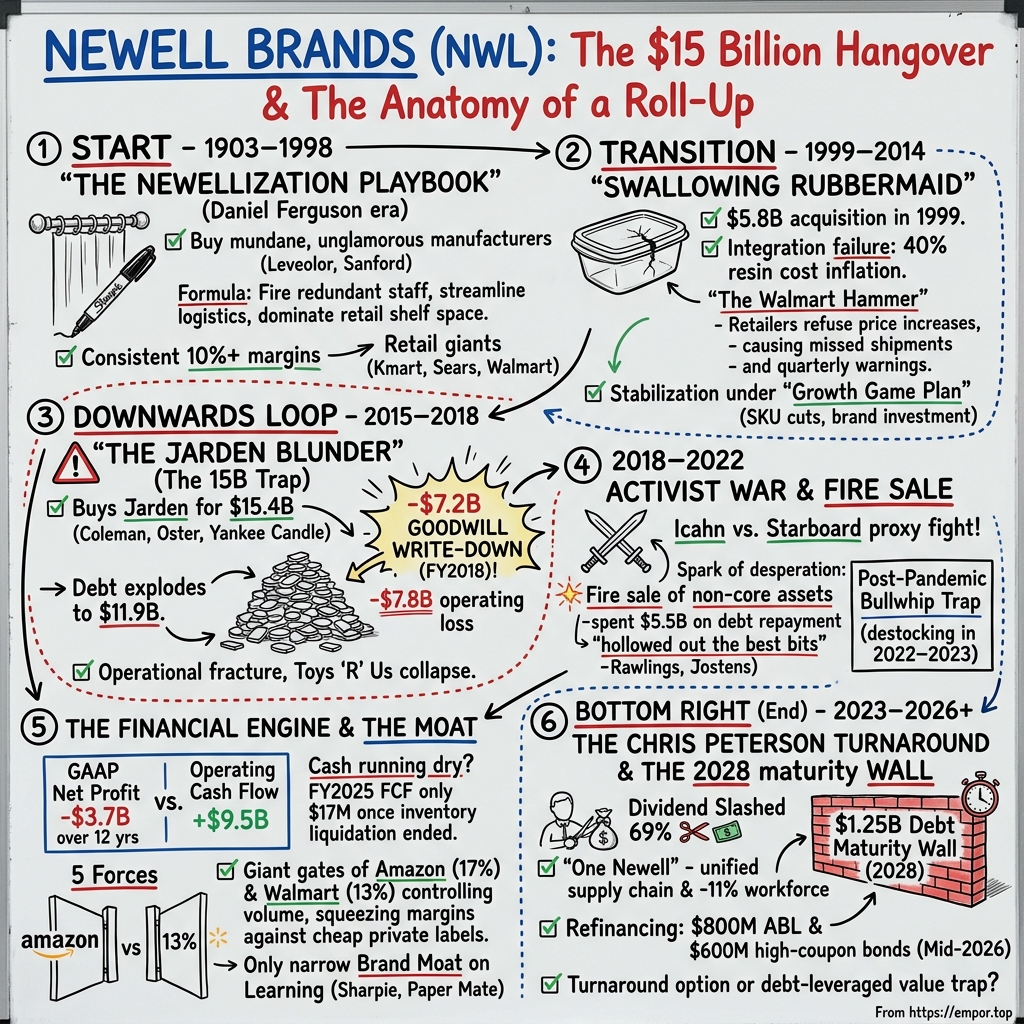
Newell Brands: The $15 Billion Hangover and the Anatomy of a Roll-Up
I. The $15 Billion Hangover
On December 14, 2015, two very different companies announced that they would become one. Newell Rubbermaid, the Atlanta-based maker of Sharpie markers, Paper Mate pens and Rubbermaid storage bins, agreed to buy Jarden Corporation, the sprawling holding company that owned Yankee Candle, Coleman coolers, Oster blenders, Mr. Coffee, Crock-Pot and dozens of other names, in a cash-and-stock deal valued at about $15.4 billion including debt.1 The combined company would have roughly $16 billion of sales, and management promised hundreds of millions of dollars in cost savings from putting the two portfolios under one roof.1 The press release called it the creation of a global consumer goods company. Wall Street mostly called it clever.
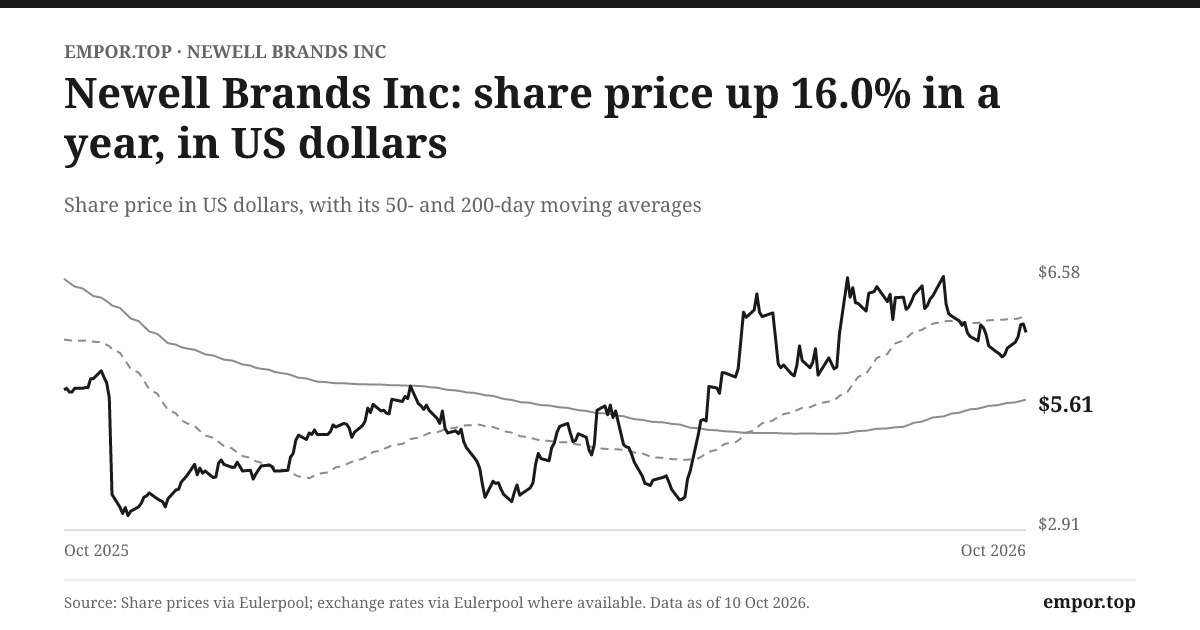
Hold that moment up against today. On October 10, 2026, Newell Brands trades at $5.61 a share, which values the whole company's equity at about $2.3 billion.[^2] That is roughly one-seventh of what Newell paid for Jarden alone. Somewhere between those two dates, a business that sells things almost every American household owns lost most of its value, and it did not lose it slowly. In fiscal 2018, just two years after the deal closed, Newell reported an operating loss of about $7.8 billion, driven by roughly $7.2 billion of write-downs of goodwill and trademarks, an accounting admission that the brands it had bought were worth far less than it had paid.[^2]2
That is the strange shape of this story. Newell is not a technology company disrupted by a new invention, nor a retailer killed by e-commerce. It makes markers, glue sticks, food containers, candles, baby car seats and camping stoves. People still buy all of them. The question is not whether these products have customers. It is whether the company that owns them can earn enough, after paying its lenders, to leave anything for its shareholders.
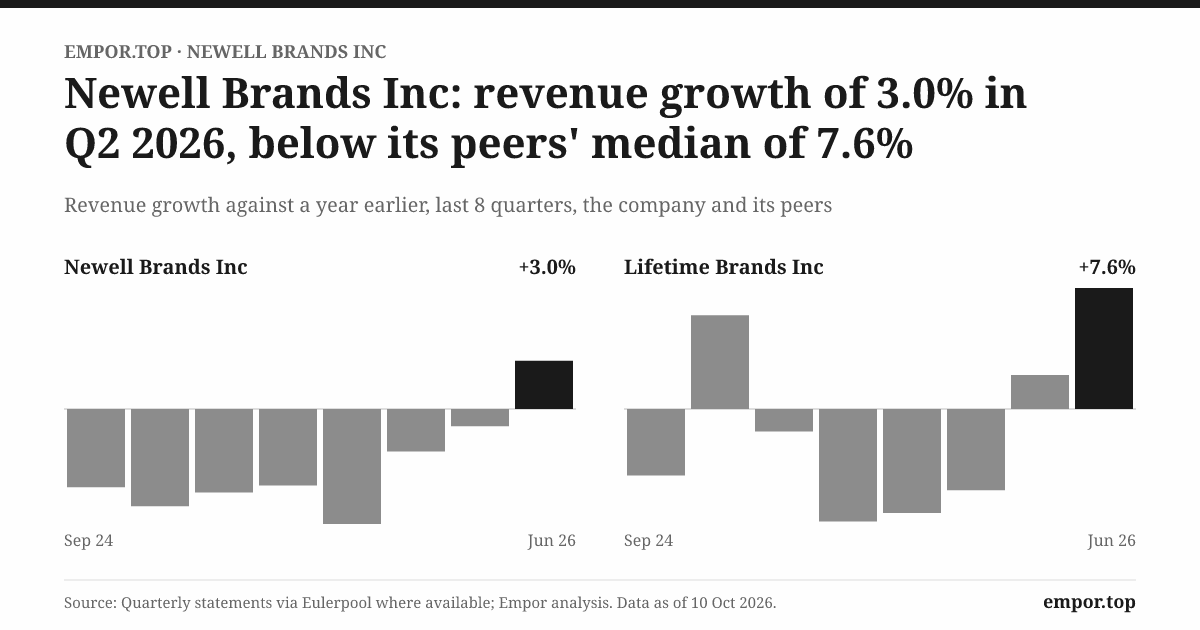
Today Newell employs about 21,900 people and sold about $7.2 billion of goods in 2025, organised into three segments: Home and Commercial Solutions, Learning and Development, and Outdoor and Recreation.2 It carries about $5 billion of borrowings against roughly $2.4 billion of shareholders' equity.23 Its credit ratings sit in the single-B range at S&P and Moody's, which is the polite way of saying that bond investors treat it as a meaningful default risk.45 Its revenue shrank every year from 2022 through 2025, before a 3% rise in the second quarter of 2026 gave the bulls their first good headline in four years.3
Three questions run through everything that follows. The first is whether that second-quarter uptick was the beginning of a real recovery under chief executive Christopher Peterson, or merely retailers refilling empty shelves. The second is whether Newell's operations can generate enough cash to pay roughly $350 million a year of interest and about $250 million of capital spending without the crutch of selling down inventory, which flattered the last three years. The third is whether a balance sheet that has already been patched twice in 2026 can get past a $1.25 billion bond maturity in 2028 without selling crown-jewel brands or diluting shareholders.26
To answer them, the story has to go back to a curtain-rod factory, because the habits that made Newell rich for most of a century are the same habits that made the Jarden deal look safe, and the same habits that the company is now trying to relearn.
 Subscribe on LinkedIn
II. The Hardware Hustle: Building the Newell Machine (1903–1998)
The company began with something nobody thinks about: the rod that holds up a curtain. In 1903 Edgar Newell took over a small brass curtain-rod business in Ogdensburg, New York, a river town on the Canadian border, and within a few decades the operation had moved to Freeport, Illinois, closer to the Midwestern hardware wholesalers who bought its products.7 For half a century Newell was an unremarkable family manufacturer of drapery hardware, selling to dime stores and hardware jobbers.
The man who turned it into a machine was Daniel Ferguson, who took charge in 1965. Ferguson was not a marketer. He was a numbers man who looked at a fragmented landscape of small, family-owned makers of household hardware and saw an arbitrage. These businesses were cheap because they were dull. Their owners had overhead built for independence, sales forces that duplicated each other, and inventories nobody had looked at closely in years. Newell could buy them at modest prices, close their head offices, plug them into its own accounting and distribution systems, and sell their products to the same buyers its existing salesmen already called on. Wall Street eventually gave the routine a name, "Newellization", and for a generation it was one of the most admired playbooks in American industry.7
The timing was the secret ingredient. From the 1960s through the 1990s, American retail consolidated around discount chains. Kmart, then Walmart and Target, wanted fewer, larger suppliers who could ship on time, fill orders completely and manage a whole category of the aisle. A buyer at a mass merchant would much rather deal with one vendor carrying fifteen product lines than with fifteen small jobbers. Newell's acquisitions were not just cost plays; each one made it a more useful counterpart to the retailers that were swallowing American shopping.
So the company kept buying. Over the decades it added glassware, cookware, window blinds and, most consequentially, writing instruments, building the Sanford business that would later house Sharpie and Paper Mate.7 The pattern repeated: buy a dull but solid manufacturer, take out cost, tighten the factory, push the product through the giant retailers. Critically, the targets were small relative to Newell, so each integration could be absorbed by a management team that had done it many times before.
The discipline shows up in the financial record that survives from the pre-Jarden era. In 2014, a year before the deal, the company earned an operating margin of about 10.6% on $5.7 billion of sales, and it collected its bills in about 80 days.[^2] Those are not glamorous numbers, but they are the numbers of a business that knew how to make plastic and metal objects at a profit and get paid for them. Return on equity that year was about 20%.[^2]
What made legacy Newell work, in other words, was not its brands. It was operational control over relatively simple supply chains, bought cheaply. That is worth stating plainly now, because it explains both the first stumble and the catastrophic second one. The playbook depended on targets that were small enough to digest and plain enough to re-engineer. The first time Newell broke that rule, it bought the most admired consumer brand in America.
III. The First Shattered Seal: Swallowing Rubbermaid (1999–2014)
In 1999, Newell agreed to buy Rubbermaid for about $5.8 billion in stock, more than doubling its size in one stroke.7 Rubbermaid was not a dusty family firm. Through much of the 1990s, Fortune had ranked it among America's most admired companies, a design-led maker of plastic housewares and toys that launched new products at a furious pace. On paper the logic was perfect: Newell's cost discipline, Rubbermaid's brand power, and the same discount retailers buying from both.
The reality arrived quickly. Rubbermaid had already been losing its grip before the deal, struggling with rising resin costs and service problems with its biggest customers, and the merged company issued a string of disappointing results as integration costs mounted and the expected savings failed to show up.7 The case became a standard business-school warning about mergers between companies with incompatible cultures: Newell's frugal, ledger-driven managers on one side, Rubbermaid's marketing and product-innovation culture on the other.7
The deepest lesson, though, came from the retailers. Rubbermaid's main input is plastic resin, a petrochemical whose price swings with oil. When resin costs rose, the natural move was to raise prices. But the customers who bought the most bins and containers were the same consolidated chains that had made Newellization possible, and they had no interest in absorbing a supplier's input inflation. The bargaining power that had once helped Newell scale now worked against it. A supplier that relies on a few enormous buyers learns that it can be efficient, but it cannot easily be expensive.
Rubbermaid did not destroy Newell. Over the following decade the company, renamed Newell Rubbermaid, worked through the problem with the tools it knew: closing plants, cutting product variants and restructuring repeatedly. When Michael Polk, a former Unilever and Kraft executive, became chief executive in 2011, he brought a consumer-marketing sensibility the company had sometimes lacked. His "Growth Game Plan" cut overhead and steered spending toward the brands most likely to win shelf space, such as Sharpie, Paper Mate and Graco. By 2014 the company was back to about $605 million of operating profit on $5.7 billion of sales, a margin a little above 10%.[^2]
So the verdict on Rubbermaid is nuanced. The company eventually stabilised the business and returned to its historic margins. But it took more than a decade, and the main thing it learned was arguably the wrong lesson. Management came away believing that big-brand integrations were painful but survivable, and that a patient enough restructuring would always bring margins home. The second time it bet on that belief, it bet with borrowed money.
IV. The Jarden Blunder: The Architect, the Spaceman, and the $15 Billion Trap (2015–2018)
To understand the Jarden deal, it helps to understand the man who built Jarden. Martin Franklin, a British-born financier with a taste for deal-making, had turned a small home-canning business into a consumer conglomerate over roughly fifteen years by buying one well-known but sleepy brand after another, often with high-yield debt. Coleman, Sunbeam, Oster, Mr. Coffee, Crock-Pot, FoodSaver, Yankee Candle, Rawlings, Jostens and Marmot all ended up under the Jarden umbrella.1 Franklin's model was the mirror image of Newellization. He left acquired brands largely alone, with their own management and their own cultures, and ran a lean holding company on top. Jarden was less a single company than a federation.
Michael Polk looked at that federation and saw unharvested savings. If Jarden's brands had been run independently, the reasoning went, then plugging them into Newell's centralised supply chain, procurement and back office would release a great deal of cost. Newell paid about $15.4 billion, including Jarden's debt, in a mix of cash and Newell shares, and the transaction closed in April 2016.1 The combined company renamed itself Newell Brands.
The balance sheet tells the scale of the bet better than any adjective. At the end of 2015, Newell had about $3.1 billion of borrowings. A year later it had about $11.9 billion.[^2] Total assets went from roughly $7 billion to about $34 billion, the bulk of the increase being goodwill and trademarks, which is accounting language for the premium paid above the value of the factories, inventory and receivables.[^2] Newell had swapped a balance sheet of physical things for a balance sheet of promises about brand value, and it had paid for the promises with debt raised near the top of a long economic cycle.
For about eighteen months, the headline numbers looked fine. Revenue jumped from about $5.9 billion to about $9.2 billion in 2016 and kept edging up toward $10 billion. Operating margin in 2017 reached about 12.8%, the best in the company's modern record.[^2] Reported net profit in 2017 was a striking $2.7 billion, though most of that came from a one-time accounting benefit from the US tax reform of that year rather than from selling more candles.[^2]
Underneath, the integration was going badly. Jarden's decentralised businesses did not slot neatly into a centralised machine, and the effort to merge systems and supply chains absorbed management attention just as the retail environment turned. Toys "R" Us, a major outlet for Graco baby gear, filed for bankruptcy in 2017 and liquidated in 2018, while the shift of shopping to Amazon compressed prices and made inventory less predictable. Retailers began cutting the stock they held of suppliers' products, which meant fewer orders for Newell even if shoppers were buying the same amount.
There was also the question of how the numbers had been presented. In September 2023, the Securities and Exchange Commission settled charges against Newell and Polk, finding that in 2016 and 2017 the company had used accounting and non-GAAP practices that made its core sales growth look healthier than it was. Newell agreed to pay a civil penalty of about $12.5 million, without admitting or denying the findings.8 For investors, the significance is not the size of the fine, which was small, but the timing: the growth story that justified the deal was being dressed up during exactly the period when the deal's economics were deteriorating.
The reckoning arrived in 2018. Newell reported an operating loss of about $7.8 billion, booking roughly $7.2 billion of impairments of goodwill and intangible assets.[^2]2 Shareholders' equity collapsed from about $14.1 billion to $5.2 billion in a single year.[^2] Return on invested capital, a measure of how much profit the company earned on the money tied up in it, plunged to about -50%.[^2]
It is worth being precise about what an impairment is. No cash left the building in 2018 because of that write-down. The cash had left two years earlier, when Newell paid for Jarden. The impairment was the moment the company admitted, in its own accounts, that a large share of what it had bought would never earn back its price. The verdict is hard to soften: the Jarden deal combined two opposite operating philosophies at the top of a cycle, financed by debt, and then had to be unwound under pressure. What followed was not an integration. It was a fire sale.
V. The Activist War and the Fire Sale (2018–2022)
By early 2018, Newell's share price had collapsed, and the person leading the charge against its board was the very man who had sold it Jarden. Martin Franklin, who had taken a seat on the Newell board after the deal and then left it, joined forces with the activist fund Starboard Value, and in February 2018 they launched a campaign to replace the entire board.9 The irony was hard to miss. The architect of the federation was now arguing that its new owners had mismanaged it.
Then a third player arrived. Carl Icahn built a large stake and, in March 2018, reached a settlement with Newell that gave him several board seats, effectively siding with Polk's continued leadership while pushing for aggressive action.10 Starboard later reached its own settlement. The proxy fight ended without a vote, but the outcome was clear: Newell would shrink, and fast.
Management had already announced an accelerated plan to sell businesses accounting for a large slice of sales and to use the proceeds to cut debt. Over 2018 and 2019, Newell sold, among others, the Waddington food-packaging business, Jostens, Rawlings, Pure Fishing and its industrial and commercial-products units. The cash flow statement captures the scale. In 2018 alone, investing activities brought in about $4.8 billion, almost all of it from divestitures, and financing outflows of about $5.5 billion went largely to repaying debt.[^2] Borrowings fell from about $10.6 billion at the end of 2017 to roughly $6.0 billion by 2022.[^2]
That was a genuine achievement in one sense: it kept a company with a broken balance sheet away from default. But fire sales have a predictable problem. Buyers, often private equity firms, pick the cleanest, highest-margin, most self-contained businesses, because those are the easiest to finance and run alone. Packaging and scholastic jewellery were steady cash generators with understandable economics. What remained with Newell was a heavier mix of discretionary hard goods: small kitchen appliances, camping gear, candles, baby products. These businesses face more competition from private label, more exposure to tariffs on imported goods, and more swings in retailer orders.
Polk retired in 2019, and Ravi Saligram, a former chief executive of Office Depot, took over late that year.2 Within months, COVID-19 transformed demand. Shoppers stuck at home bought blenders and bread makers, cleaning supplies and storage bins, camping stoves and coolers. Revenue jumped about 13% in 2021 to about $10.6 billion, and operating margin recovered to around 9.6%.[^2] For a moment it looked as if the hard work of the restructuring had found its reward.
It had not. Pandemic demand pulled purchases forward; it did not create a new baseline. Retailers, burned by empty shelves in 2020, over-ordered in 2021. When consumers switched their spending back to travel and restaurants in 2022, those same retailers cut orders sharply to work down excess stock. Newell's revenue fell about 11% in 2022 and another 14% in 2023.[^2] In 2022, operating cash flow turned negative, at about -$272 million, as the company was left holding inventory it had built for a demand surge that evaporated.[^2]
So the fire sale bought survival, but it did so by selling some of the steadiest businesses and keeping the more cyclical ones. When the post-pandemic bust hit, the company that remained had less ballast than the one that had existed before. To see why the remaining business is so exposed, it helps to look at what Newell actually sells, to whom, and on what terms.
VI. Anatomy of the Machine: Revenue Model, Segments, and Unit Economics
Picture a distribution center for a large American retailer. Pallets of markers, candles and food containers arrive on trucks, and every delivery is checked against the retailer's rules: was it on time, was it complete, were the cartons labelled correctly, were any damaged? Mistakes are not settled by a friendly phone call. They show up as deductions from the supplier's invoice. This is the world Newell lives in, and it explains a great deal about its economics.
The revenue model is simple. Newell recognises a sale at a point in time, when goods ship to or are delivered to retailers, distributors or, less often, consumers directly, and it prices per unit.2 There are no long-term volume commitments, no subscriptions and no minimum purchase contracts. In the sense that a software investor would use the term, recurring revenue is zero. Repeat business depends entirely on shoppers continuing to buy, and on retailers choosing to restock Newell's products rather than a rival's or their own.
In 2025, Newell's roughly $7.2 billion of sales split into three businesses of very different character.2
The largest, Home and Commercial Solutions, brought in about $3.8 billion, a little more than half of the total.2 It is a mixture of two worlds. One is Rubbermaid Commercial Products, which sells cleaning carts, waste bins and food-service equipment to businesses and institutions, a relatively steady market driven by facility maintenance. The other is consumer kitchen and home goods such as Oster, Crock-Pot, FoodSaver, Yankee Candle and Rubbermaid food storage. Small kitchen appliances are among the most competitive categories in consumer goods, crowded with private-label and low-cost imported rivals, and they have no meaningful switching cost: a shopper who buys a different slow cooker next time loses nothing.
Learning and Development, at about $2.6 billion, is the business most investors think of first.2 It holds the writing brands, Sharpie, Paper Mate, EXPO, Elmer's and Prismacolor, and the baby business, Graco and Baby Jogger. The writing franchise is seasonal, peaking around back-to-school, and is the closest thing Newell has to a profit engine with genuine brand loyalty. The baby business is more fragile, as the company's own auditors have signalled by flagging the goodwill attached to it as an area of significant judgment.2
The smallest segment, Outdoor and Recreation, sold about $785 million of Coleman, Marmot and Contigo products in 2025.2 This is the business that most benefited from the pandemic camping boom and most suffered from its end, and it is where margins have been weakest.
Then there is the question of who buys. Amazon was Newell's largest customer in 2025, at about 17% of sales, up from 13% two years earlier, and Walmart was second at about 13%.2 Together they account for nearly a third of the company's revenue, and the rest of the top customers read like a roster of American retail: Costco, Target, Home Depot, Staples and others.2 That concentration is the defining feature of Newell's economics. Each of those buyers controls shelf space, promotions and placement, and each sells its own private-label alternatives. Amazon's rising share is a double-edged sword: it is a growing channel, but one in which prices are visible instantly and a cheaper alternative sits one scroll away.
One corner of the business genuinely improved: getting paid. Newell collected its receivables in about 50 days in 2025, compared with about 109 days in 2016, the messy year after Jarden.[^2] Bad debts are negligible, with an allowance of about $22 million against roughly $1 billion of gross receivables, which reflects the creditworthiness of customers like Amazon and Walmart.2 Part of that speed comes from financial engineering rather than operational magic. Newell sells some receivables through a securitisation facility, run through a subsidiary called Jarden Receivables LLC with Royal Bank of Canada as the counterparty, which turns invoices into cash sooner; the company amended that agreement again on October 2, 2026.11 That is a legitimate and common tool, but it means the low receivable days partly reflect a financing choice, and the facility is one more lender relationship the company depends on.
The picture that emerges is of an asset-heavy brand merchandiser with no contractual lock-in, selling to buyers who are far larger and more powerful than it is. That is the backdrop against which the current management team set out to fix the company.
VII. The Chris Peterson Turnaround: "Where to Play and How to Win" (2023–2026)
In May 2023, Newell did something it had resisted for years. The board cut the quarterly dividend from $0.23 to $0.07 a share, a 69% reduction, to conserve roughly $260 million a year of cash.122 In the same month, Christopher Peterson, who had joined Newell as chief financial officer in 2018 and later ran its business operations, succeeded Ravi Saligram as chief executive.2 Mark Erceg, who had joined as chief financial officer in January 2023 after senior finance roles at companies including Canada Goose and Mead Johnson, became his partner in the turnaround.2
The dividend cut was the more revealing decision. For years, Newell had paid about $390 million a year to shareholders, even when its earnings and cash flow did not support it. In 2019 the dividend amounted to more than three and a half times that year's net profit, and in 2022 it was almost double.[^2] That money was, in effect, partly borrowed. Cutting it was an admission that the balance sheet could no longer subsidise a yield the business had not earned. Dividends paid fell from about $385 million in 2022 to about $120 million in 2025.[^2]
Peterson's strategy, which management framed as choosing "where to play and how to win", rested on a simple idea that would have been familiar to Dan Ferguson: run Newell as one company rather than a collection of fiefdoms. That meant consolidating the business units inherited from Jarden into a single operating model, merging distribution centers, sharing back-office systems and concentrating marketing spend on the brands and categories with the best chance of earning a return.213 It also meant trimming the product range, cutting unprofitable variants, and accepting lower sales in exchange for better margins.
The workforce data show how deep the cuts went. Newell employed about 24,600 people at the end of 2023 and about 21,900 at the end of 2025, a reduction of roughly 11% in two years.2 Research and development spending held around $114 million to $123 million a year, about 1.5% of sales, and capital spending stayed near $250 million.2 This is not a company investing heavily in new products. It is one harvesting what it has to stabilise its finances.
Has it worked? Partly. Operating margin, which was negative in 2023, recovered to about 6.2% in 2025.[^2] Working capital tightened, and the company stopped haemorrhaging cash through inventory build-ups. But revenue kept falling throughout, by about 14% in 2023, 7% in 2024 and 5% in 2025, and the company remained loss-making on a reported basis every year, partly because of continued impairment charges.[^2] Management's productivity savings were real, but they were being earned on a shrinking base.
Shareholders' attitude to management pay reflects that tension. Peterson's total compensation in 2025 was about $12.5 million, most of it in stock awards, and the company says about 89% of his pay is at risk.14 Erceg received about $5.7 million.14 At the May 7, 2026 annual meeting, the say-on-pay vote passed with about 78% support, but roughly 71 million shares, about 22% of those voting, opposed.15 That is not a revolt, but it is well above the dissent typical of large US companies, and it signals that a sizable group of investors is uncomfortable rewarding executives handsomely while the company reports losses.
There is one area where the governance record is clean: Newell reported no material related-party transactions with its directors or officers in its most recent proxy, and its board is led by an independent chair, Bridget Ryan Berman.14 Cash leaks to insiders are not the problem here. The problem is whether the core business throws off enough cash, and that requires looking past the accounting losses to the cash flow statement itself.
VIII. The Cash Conversion Engine: Accounting Losses vs. Operating Reality
Here is a puzzle that confuses many people who look at Newell. Over the twelve years from 2014 through 2025, the company reported cumulative net losses of about $3.7 billion. Over the same twelve years, it generated about $9.5 billion of cash from operations.[^2] How can a company lose billions on paper while bringing in billions in cash?
The answer is that most of Newell's losses were non-cash. The roughly $7.2 billion write-down in 2018, a further large impairment in 2020, and smaller but recurring write-downs since then all reduced reported profits without taking a dollar out of the bank.2 Add amortisation of the trademarks and customer relationships acquired with Jarden, which runs to hundreds of millions of dollars a year, and the gap between reported profit and cash generation becomes clear.2 In 2025, the auditors at PricewaterhouseCoopers flagged the goodwill testing for the Commercial and Baby units and the valuation of certain trademarks as a critical audit matter, after the company recorded about $290 million and $50 million of impairments that year.2 The losses are, in large part, the slow-motion accounting for the Jarden overpayment.
So where did the cash go? Over those twelve years, after capital spending, Newell generated about $6.0 billion of free cash flow. About $3.6 billion of that, roughly 60%, went out as dividends.[^2] The rest was absorbed by restructuring costs, plant closures and debt repayment. Cash on the balance sheet at the end of 2025, about $203 million, was almost exactly where it had been twelve years earlier.[^2] For all that cash generation, the company did not build a cushion.
The more pressing problem is what has happened recently. In 2023, Newell generated about $930 million of operating cash flow, but a large part of that, about $673 million, came from cutting inventory.2 That is not a bad thing; the company had too much stock after the pandemic and needed to sell it down. But it is a one-time release, not a recurring earning power. Imagine a shop that sells off half its stockroom: it has a great month of cash, but next month it needs to restock. In 2024, operating cash flow fell to about $496 million, and in 2025 to about $264 million, even though inventory reductions still contributed about $172 million that year.[^2]2
Set against roughly $247 million of capital spending in 2025, that left free cash flow of only about $17 million.[^2]2 And the first half of 2026 was worse on the cash line: operating cash flow was about -$204 million, partly reflecting the seasonal build of inventory before back-to-school and the holidays, but also a reminder that the inventory windfall has run its course.6
The verdict here cuts both ways. It is true that the headline losses overstated how badly the business was bleeding in past years; the cash engine was real. But the bullish version of that argument now faces a hard constraint. With inventory days stabilised and receivables already collected quickly, there is little left to squeeze from working capital. From here, cash has to come from selling more or earning more on each sale. And that cash must first satisfy lenders, whose claims became the central drama of 2026.
IX. Refinancing on the Brink: The Summer 2026 Maneuvers and the 2028 Wall
By early 2026, Newell's lenders had the company's attention. Its secured bank revolving credit facility, the line of credit that a company draws on to fund seasonal swings in working capital, carried a covenant based on the ratio of net debt to earnings. Those covenants were scheduled to tighten, and earnings had been shrinking. A breach would not have meant instant bankruptcy, but it would have handed banks leverage to demand fees, higher rates or restrictions at the worst possible moment.
Mark Erceg's answer came in two moves. On July 30, 2026, Newell entered into a new five-year, $800 million asset-based lending facility, led by JPMorgan Chase, and borrowed about $490 million under it to repay and terminate the old revolver.166 An asset-based loan is secured by specific assets, chiefly receivables and inventory, and the amount a borrower can draw rises and falls with the value of that collateral. In exchange for pledging those assets, Newell swapped the net-leverage covenant for a fixed-charge coverage test, which measures whether earnings cover interest and other fixed obligations, and which typically only applies when available borrowing room runs low.6 Think of it as moving from a loan judged on your overall debt load to one judged on the value of what is in your warehouse.
The second move came on August 19, 2026, when Newell issued $600 million of senior notes due 2031 carrying a 6.25% coupon, and used the proceeds to redeem in full its roughly $494 million of 6.375% notes due 2027, at about 101.5% of face value, with the remainder paying down the new facility.17 That pushed the nearest significant bond maturity out to 2028.
The rating agencies responded with relief rather than celebration. In August 2026, S&P affirmed Newell at B+ with a stable outlook, estimating its adjusted debt at about 5.5 times earnings before interest, taxes, depreciation and amortisation, and saying an upgrade would need leverage sustainably below 5 times.4 Moody's affirmed its B1 rating and moved its outlook from negative to stable.5 Both had downgraded Newell in 2025.45 A stable single-B rating is not an endorsement. It means the agencies no longer see the situation getting worse in the near term.
The 2026 refinancing was competent work. It removed the most immediate covenant risk, extended maturities, and bought time. But it did not reduce the debt. Newell's borrowings were about $5.0 billion at the end of June 2026, against equity of roughly $2.4 billion, and of an enterprise value of about $7.7 billion, around 70% is debt.6[^2] Interest is heavy: cash interest paid in 2025 was about $354 million.2
And there is a larger hurdle. Newell's $1.25 billion of 8.5% senior notes mature in 2028, and they alone cost about $106 million of interest a year.2 They will become a current liability, meaning one due within twelve months, in 2027. If Newell can refinance them at a lower coupon, interest costs fall. If credit markets tighten or the business weakens, it may have to pay more, sell assets, or both. Every refinancing so far has been a bridge to the next refinancing. Whether that bridge leads somewhere depends on the question underneath all of this: does Newell have a durable competitive advantage that can grow earnings, or just a collection of familiar names?
X. Frameworks: Porter's 5 Forces, 7 Powers, and Historical Falsification
Walk into a Target in August and you can watch the moat question play out in one aisle. Parents grab packs of Sharpies and Elmer's glue sticks without looking at the price, because that is what the school supply list says or what they have always bought. Two aisles over, a Rubbermaid storage bin sits beside a store-brand bin that looks almost identical and costs noticeably less, and next to an Oster kettle is a private-label kettle that boils water just as well.
That scene is the best summary of Newell's competitive position. It has real brand power in a narrow band of products, and very little elsewhere.
Start with the sources of lasting advantage that the strategist Hamilton Helmer describes in his "7 Powers" framework. Branding, the ability to charge more because customers trust or prefer a name, is genuinely present in writing instruments and craft supplies. Sharpie, Paper Mate, EXPO and Elmer's have a place in consumers' minds that private label has struggled to dislodge, and these are low-price items where shoppers have little reason to experiment. Commercial cleaning products sold to institutions also benefit from established relationships. But branding is weak in small kitchen appliances, where Oster and Sunbeam compete on price, and in outdoor gear, where Coleman's name has not prevented sharp declines. Scale economies, once Newell's great edge in dealing with retailers, have been eroded by contract manufacturers that let any brand produce at scale and by Amazon's marketplace, which gives small brands national reach. Switching costs, network effects and cornered resources are essentially absent: nobody is locked into a brand of food container. Nor does Newell have counter-positioning, the advantage of a business model rivals cannot copy; if anything, its dependence on brick-and-mortar retail makes a direct-to-consumer pivot harder for it than for a startup.
Michael Porter's five forces point the same way. The power of buyers is the dominant force. Amazon and Walmart alone account for nearly a third of sales, and they dictate prices, promotions and shelf placement while selling their own private-label alternatives.2 The threat of substitutes is high in storage, cookware and basic stationery, where store brands are adequate for most shoppers. Supplier power is moderate: resin, pulp and metals swing with global markets, and Newell hedges currency exposure, but it cannot hedge away a retailer's refusal to accept price increases.2 Rivalry is fierce from focused competitors such as Spectrum Brands, Helen of Troy, BIC and ACCO Brands, each of which competes in one or two of Newell's categories without carrying its debt or complexity.
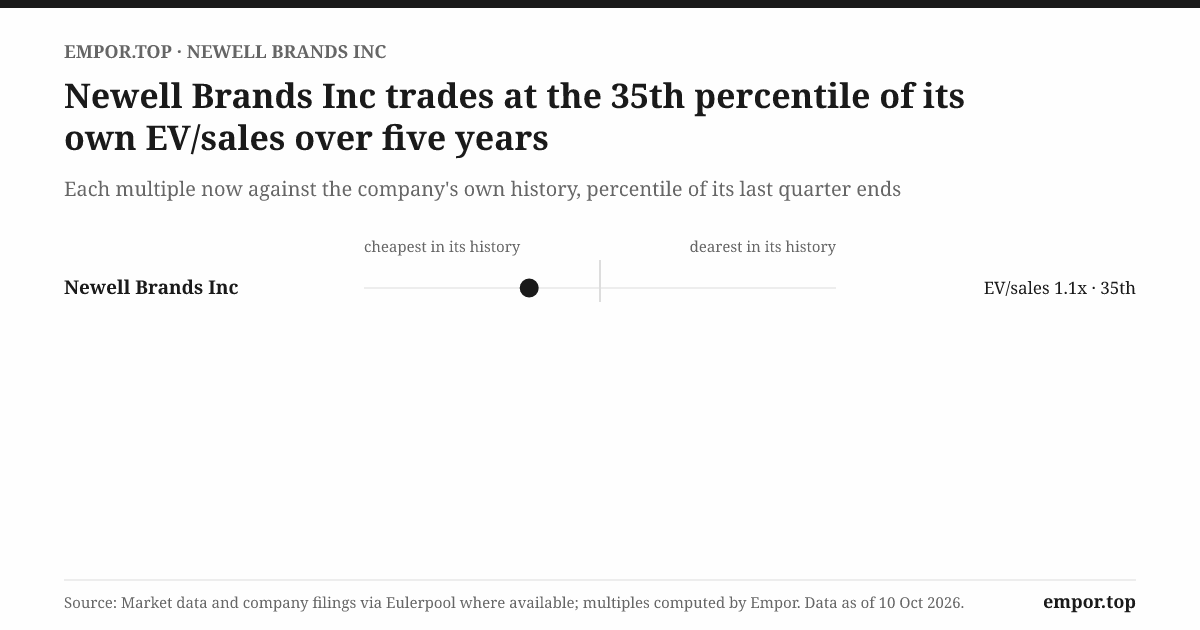
The market's verdict is reflected in valuation. Newell's enterprise value is about 1.1 times sales, compared with roughly 3.8 times for Church & Dwight, a consumer products company with stronger brands and steadier margins, and about 1.3 times for Spectrum Brands.[^2]18 Newell's return on invested capital was about 4.5% in 2025, below any reasonable estimate of its cost of capital, which means that, for now, the business does not earn back what it costs to fund it.[^2]
The bull case for Newell has usually rested on three claims, and the company's own history allows each to be tested.
The first claim is that Newell's portfolio of famous brands gives it a durable hold on retail shelves. The record narrows this sharply. Over the three years from 2022 to 2025, revenue fell at about 8.7% a year.[^2] Part of that was deliberate pruning and part was the post-pandemic hangover, but retailers also cut inventory and shelf space and leaned on private label when inflation squeezed shoppers. A brand that commands its shelf does not lose a quarter of its sales in three years. What survives is a smaller claim: the writing and commercial franchises have staying power; much of the rest does not. The test is whether Learning and Development grows sales through the 2026 back-to-school season.
The second claim is that consolidating the portfolio would unlock structurally high margins, the promise that justified Jarden. The record rejects it in its original form. Operating margin peaked at about 12.8% in 2017, went deeply negative in 2018 and remained negative in 2019, 2020 and 2023, and was about 6.2% in 2025.[^2] Restructuring has been continuous for a decade, which suggests the charges are less one-off than a recurring cost of running this portfolio. The 14% operating margin of the second quarter of 2026 is encouraging, but it is a single seasonal quarter, not a structural level.3
The third claim is that the business's cash generation could steadily pay down its debt. The record leaves this unproven at best. After ten years of divestitures and restructuring, borrowings remain above $5 billion, and free cash flow fell to about $17 million in 2025 once the inventory release faded.[^2] The claim would be confirmed by free cash flow recovering above roughly $300 million without working-capital help.
Put together, Newell's moat is narrow and localised, and the buyer power at its customers caps the returns its brands can earn. That leaves the stock's price, and what it assumes, as the final battleground.
XI. The Bull vs. Bear Case: Turning Point or Value Trap?
On October 10, 2026, Newell's share price of $5.61 sat about 12% below its 52-week high and well above its 52-week low of about $3.11.[^2] The market value of about $2.3 billion is roughly one-third of annual sales, and the shares trade at about book value.[^2] Adding net debt, enterprise value is about $7.7 billion, or about 13 times trailing operating profit.[^2] Over the last twelve months, the company reported a loss of about $0.53 a share.[^2] The stock has also been extraordinarily volatile, having fallen about 88% at its worst point in the past five years.[^2] These numbers describe a company priced as neither a healthy consumer goods franchise nor a certain failure, but as a leveraged bet on whether the recovery is real.
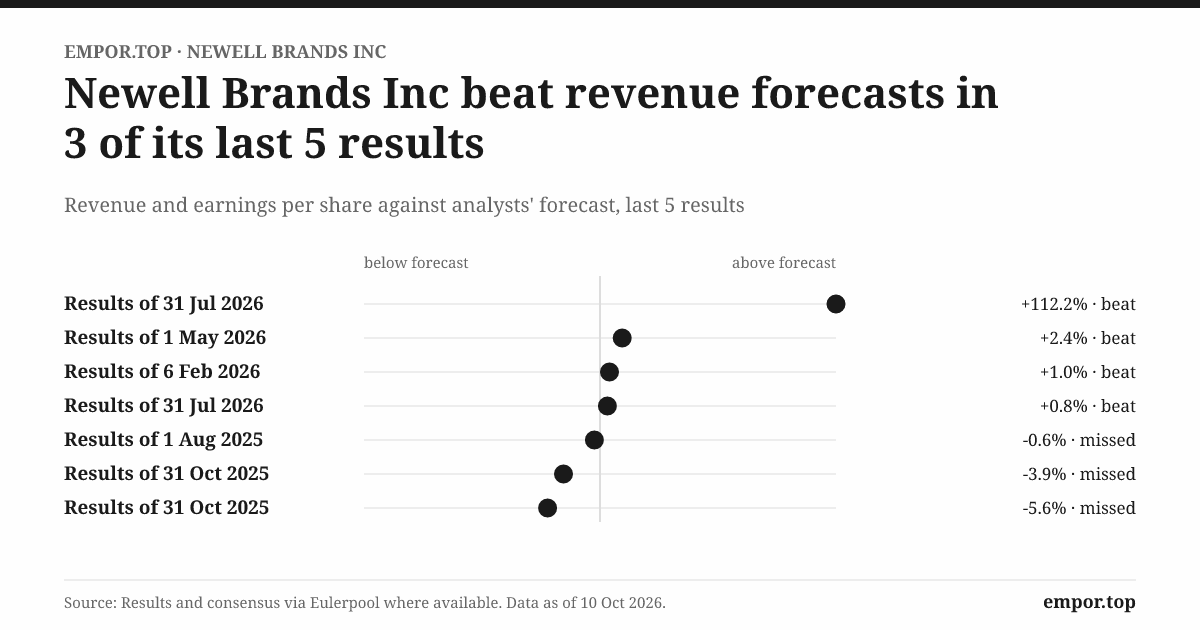
The bull case begins with the second quarter of 2026. Revenue rose about 3% to just under $2.0 billion, the first year-over-year increase after more than a dozen consecutive quarters of decline.36 Operating profit jumped about 65% to $283 million, and operating margin reached about 14.2%, up more than five points.3 Gross profit rose to about $812 million from about $685 million a year earlier.6 On the earnings call, management attributed the improvement to productivity savings and distribution gains, and argued the company had turned the corner.13 If that is right, operating leverage is powerful: on a sales base of about $7.2 billion, each percentage point of gross margin is worth about $70 million of operating profit, which goes straight to debt reduction. And because equity is a thin slice on top of a large debt stack, even a modest rise in enterprise value translates into a large percentage gain for shareholders. With the 2027 bonds refinanced and bank covenants replaced, the immediate threat of a liquidity crisis has receded, giving management until 2028 to show progress.
The bear case starts with the same quarter and reads it differently. A single quarter of growth after years of decline is easy to produce when the comparison base is depressed, and part of the improvement could reflect retailers stocking up ahead of price increases rather than stronger consumer demand. Cash flow is the sharper problem. With interest of more than $300 million a year and capital spending of about $250 million, Newell needs something like $550 million to $600 million of operating cash flow just to fund those two items before any debt reduction, dividends or restructuring, and it generated less than half that in 2025.2[^2] The 2028 maturity looms over everything: if it has to be refinanced in a tight market, the cost could eat much of whatever free cash flow the turnaround produces. And Newell remains exposed to tariffs and imported inputs, with gross margins vulnerable to trade-policy shocks.
An activist looking at Newell today would ask uncomfortable questions. Why does a company with this debt still pay a dividend of about $120 million a year, when that cash could retire debt carrying an 8.5% coupon? Why does it still own businesses, like small appliances and outdoor gear, where it has little brand power and which tie up capital? And is the honest end-state a smaller company built around writing instruments and commercial products, with everything else sold or harvested?
Three measures will do most of the work in settling the debate. The first is organic sales growth, which turned positive at about 3% in the second quarter of 2026 after years of decline; the question is whether it stays positive through the back-to-school and holiday quarters.3 The second is free cash flow excluding working-capital releases, which fell to roughly break-even in 2025; it needs to rise meaningfully, toward a few hundred million dollars, to show the business can de-lever on its own.[^2] The third is gross margin, which improved to about 41% in the second quarter on the company's figures; holding gains like that would show that plant consolidation is outpacing retailer price pressure.6
None of those measures can be read from a single quarter. They will be read over the next several. Before turning to those dates, it is worth asking what this long saga teaches.
XII. Playbook: Business & Investing Lessons
The first lesson belongs to the moment in December 2015 when Newell agreed to pay $15.4 billion for Jarden.1 On a spreadsheet, the deal looked accretive: add Jarden's earnings, subtract interest, layer on synergies. What the spreadsheet could not show was the work of merging a centralised company with a federation of more than a hundred brands, each with its own suppliers and habits. Newell's own history should have warned it. Newellization worked when targets were small and simple; Rubbermaid showed what happened when they were not. Jarden was larger and more complex than Rubbermaid, and it was paid for with debt. A roll-up works while targets are small and money is cheap; at scale, complexity eats the synergies first and the equity next.
The second lesson is about what a brand is worth when a retailer stands between it and the shopper. Newell owns dozens of names people recognise, yet Amazon and Walmart together buy nearly a third of its output and can replace many of those names with their own products.2 Owning many brands in many aisles does not add up to bargaining power, because each aisle is negotiated separately and each buyer has alternatives. Sharpie can hold its shelf; a slow cooker usually cannot. With research spending at about 1.5% of sales, Newell is not out-innovating private label in most categories. A trademark is a moat only where the shopper would walk past the store brand to find it.
The third lesson comes from the dividend. For years Newell paid out about $390 million a year to shareholders while its earnings and cash flow fell short, and in some years the payout exceeded profits several times over.[^2] Investors who prized the yield were being paid partly with borrowed money, until the 69% cut of May 2023 ended the pretence.12 A dividend funded by debt is not a return of capital; it is a restructuring that has been postponed.
The fourth lesson is about reading cash flow statements. In 2023, Newell reported operating cash flow of about $930 million while its sales were falling 14%.[^2] Investors who looked only at that line might have concluded the business was a robust cash machine. In truth, about $673 million came from selling down inventory, a release that could not be repeated.2 Two years later, operating cash flow was about $264 million. When a shrinking company reports strong cash flow, look first at the warehouse.
The fifth lesson is the simplest. The 2018 write-down of about $7.2 billion did not destroy value; it announced that value had already been destroyed two years earlier, at the moment of purchase. Impairments are the obituary, not the cause of death.
XIII. Epilogue
Tonight, Newell Brands stands in a better position than it did a year ago, and in a worse one than its brand names would suggest. The immediate liquidity scare has passed: the new asset-based facility is in place, the 2027 bonds are gone, and both major rating agencies have stabilised their outlooks.161745 The second quarter delivered the first revenue growth in years.3 But the business still carries about $5 billion of debt, its free cash flow has been thin, and the biggest bond maturity in its capital structure is now less than two years away.62
The next chapters are already scheduled. In early November 2026, Newell will report third-quarter results, which cover the back-to-school season. That report will show whether Learning and Development, the Sharpie and Paper Mate business, can grow sales and hold its pricing, and whether the overall company's organic growth stayed positive or slipped back into decline. A second consecutive quarter of growth would make the turnaround story more credible; a reversal would suggest the second quarter was mostly retailers restocking.
Then, around February 2027, comes the 10-K for fiscal 2026, the most important document of the year. It will show whether full-year operating cash flow recovered substantially without help from inventory reductions, whether free cash flow approached the level needed to pay down debt, and how much room remains under the new $800 million facility. It will also show whether the auditors and management again had to write down the value of brands such as Baby or Commercial.
And through 2027, investors will watch how management approaches the $1.25 billion of 8.5% notes due in 2028.2 If Newell starts buying back those bonds or launches a refinancing early, on reasonable terms, it will signal confidence and access to credit markets. If it waits, or if refinancing comes at a punishing rate, the pressure to sell assets will rise.
The fork in the road is clear. Down one path lies a slow but genuine recovery: modest sales growth, wider margins, rising free cash flow and leverage moving toward the levels the rating agencies want. Down the other lies a stalled turnaround in which the company's most valuable businesses, above all the writing franchise, become the assets that must be sold to satisfy bondholders, leaving a smaller, weaker company behind. Which path Newell takes will be decided not by speeches but by cash.
XIV. Outro
Picture an empty classroom at dusk. On a desk lies a black Sharpie; beside it sits a plastic Rubbermaid wastebasket. Both are so ordinary that nobody notices them, which is, in a sense, the highest compliment a consumer product can earn. Somebody had to design them, mould them, package them, ship them and persuade a buyer at a giant retailer to stock them, and for most of a century the company that did that work was very good at it.
Newell's story is what happens when a business built on doing unglamorous things well starts believing that its skill is buying rather than making. A century of nickel-and-dime manufacturing discipline was traded, in a single winter of deal-making, for a debt-fuelled empire of brands, and the company has spent every year since trying to buy back what it gave away. The marker still writes. The bin still holds trash. Whether the company that makes them can earn its way out from under its own history is the question its next few reports will answer.
References
-
Newell Rubbermaid to Acquire Jarden Corporation for $15.4 Billion — Reuters, 2015-12-14 ↩↩↩↩↩
-
Newell Brands Inc. Form 10-K for the Fiscal Year Ended December 31, 2025 — SEC EDGAR, 2026-02-13 ↩↩↩↩↩↩↩↩↩↩↩↩↩↩↩↩↩↩↩↩↩↩↩↩↩↩↩↩↩↩↩↩↩↩↩↩
-
Newell Brands Inc. Form 10-K for the Fiscal Year Ended December 31, 2024 — SEC EDGAR, 2025-02-14 ↩↩↩↩↩↩↩
-
Research Update: Newell Brands Inc. Rating Affirmed at 'B+'; Outlook Stable — S&P Global Ratings, 2026-08-05 ↩↩↩↩
-
Credit Opinion: Newell Brands Inc. CFR Affirmed at 'B1', Outlook Changed to Stable — Moody's Ratings, 2026-08-10 ↩↩↩↩
-
Newell Brands Inc. Form 10-Q for the Quarterly Period Ended June 30, 2026 — SEC EDGAR, 2026-07-31 ↩↩↩↩↩↩↩↩↩
-
Why the Rubbermaid Merger Crushed Newell: A Case Study in Post-Merger Failure — Harvard Business Review Archive ↩↩↩↩↩↩
-
SEC Enforcement Release: In the Matter of Newell Brands Inc. and Michael Polk (Admin. Proc. File No. 3-21734) — US Securities and Exchange Commission, 2023-09-29 ↩
-
Starboard Value Launches Proxy Fight at Newell Brands — The Wall Street Journal, 2018-02-12 ↩
-
Icahn Reaches Truce with Newell, Gaining Four Board Seats — Bloomberg News, 2018-03-19 ↩
-
Newell Brands Inc. Current Report on Form 8-K (Second Amendment to Receivables Purchase Agreement) — SEC EDGAR, 2026-10-02 ↩
-
Newell Slashes Dividend 69% to Preserve Cash Amid Retail Headwinds — Bloomberg News, 2023-05-10 ↩↩
-
Newell Brands Inc. Q2 2026 Earnings Call Transcript — Seeking Alpha / S&P Capital IQ, 2026-07-31 ↩↩
-
Newell Brands Inc. Definitive Proxy Statement on Schedule 14A — SEC EDGAR, 2026-03-26 ↩↩↩
-
Newell Brands Inc. Current Report on Form 8-K (Annual Meeting Voting Results) — SEC EDGAR, 2026-05-13 ↩
-
Newell Brands Inc. Current Report on Form 8-K (Credit Agreement and ABL Facility) — SEC EDGAR, 2026-07-30 ↩↩
-
Newell Brands Inc. Current Report on Form 8-K (Issuance of 6.250% Senior Notes Due 2031) — SEC EDGAR, 2026-08-19 ↩↩
-
Newell Brands Inc. Q4 and Full Year 2025 Earnings Call Transcript — Seeking Alpha, 2026-02-13 ↩
 LinkedIn
 WhatsApp
 Reddit
 Hacker News
 Email
Email Kindle
 RSS Feed
 Spotify
 Apple Podcasts
 Amazon Music
 Audible
 YouTube