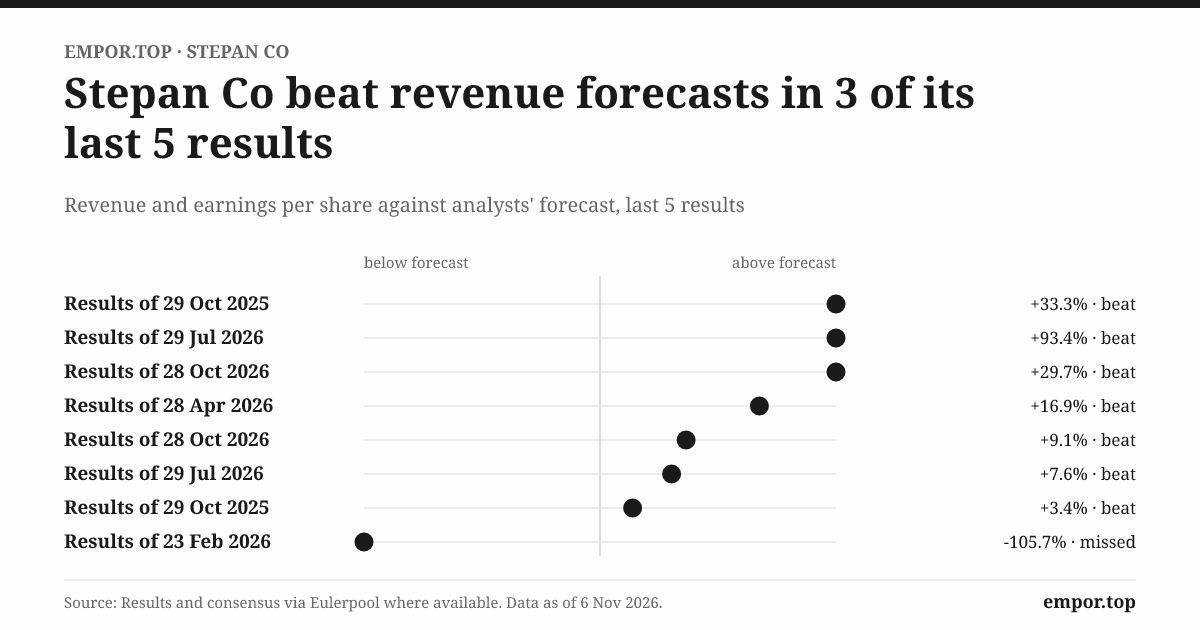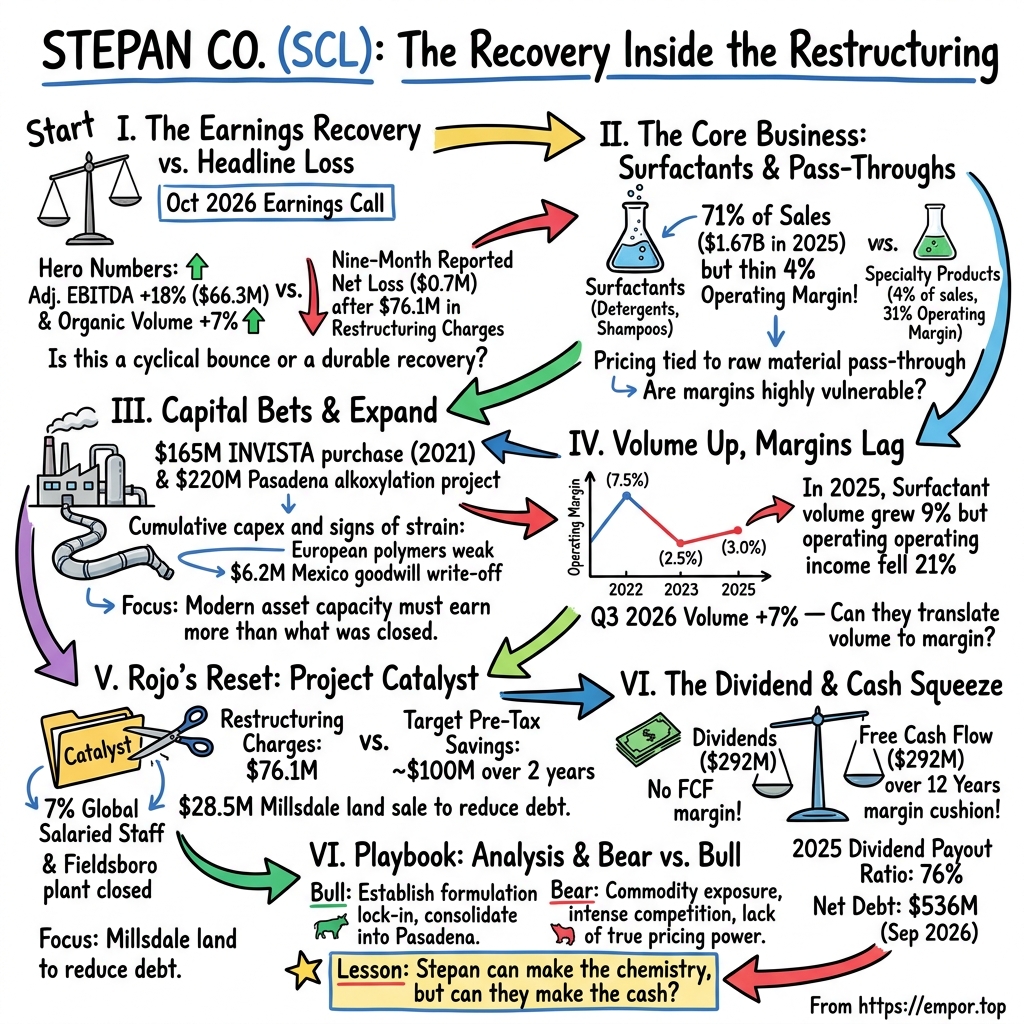
Stepan Company: The Recovery Inside the Restructuring
I. The earnings recovery hiding inside a loss
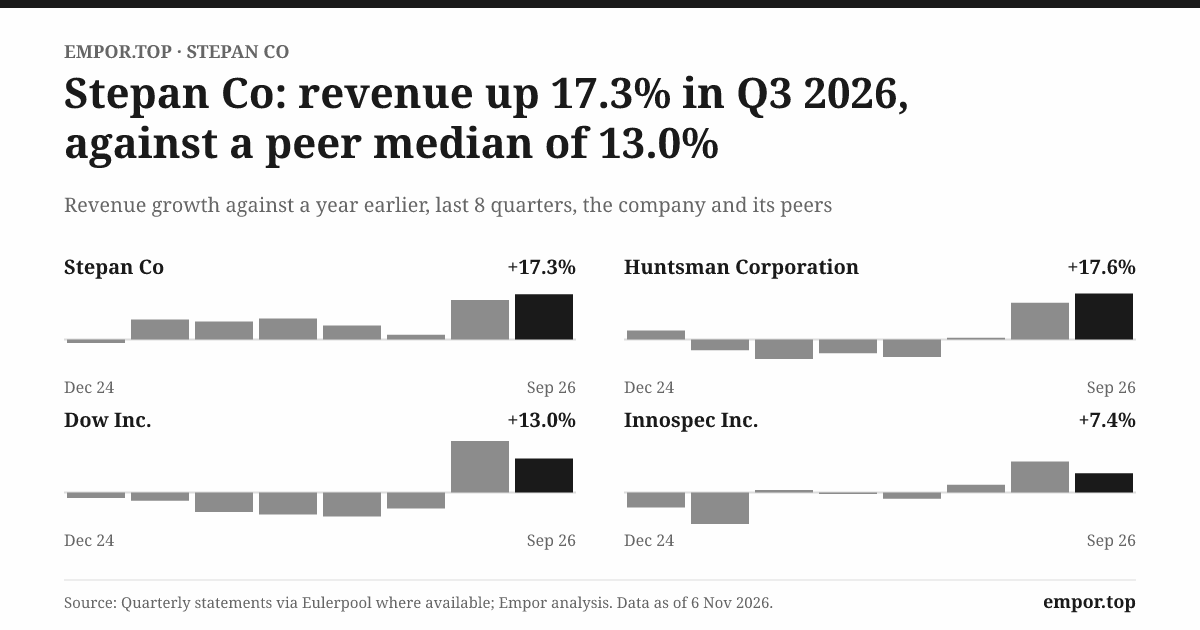
On the morning of October 28, 2026, Luis Rojo had good news to deliver, and a strange set of books to deliver it from. Stepan Company's third-quarter adjusted EBITDA had risen 18% from a year earlier, to $66.3 million.[^1] Organic volume, the tonnage the company shipped once acquisitions and divestitures were stripped out, had grown 7%, and Rojo told analysts that the growth showed up in all three of the company's segments.1 Adjusted earnings per share had nearly doubled.1
Yet anyone who flipped from the press release to the quarterly filing found a different picture. For the first nine months of 2026, Stepan reported a net loss of $0.7 million.2 The loss came from a single, deliberate source: $76.1 million of restructuring charges, the bill for closing a plant, decommissioning equipment at two others and cutting salaried staff.2 Strip those charges out and management's adjusted net income for the nine months was $59.1 million.[^1]
The quarter itself was not the problem. On a reported basis, third-quarter net income was $17.8 million, or $0.78 a share, up about 64% from a year earlier.1 The damage had been done in the first quarter, when Stepan booked the bulk of the restructuring cost and reported a net loss of about $41 million.2 Since then, each quarter has been profitable on the reported line. For the nine months, management said adjusted EBITDA was up about 15% and adjusted earnings per share up about 40%.1
Adjusted figures deserve a word of caution before the story leans on them. "Adjusted" means management has removed items it considers outside normal operations, and in 2026 the largest of those is the cost of shutting down capacity. That is a reasonable adjustment for a one-time plan. But restructuring is not free just because it is unusual: the equipment written off was bought with shareholders' money, and the cash spent on severance and decommissioning is gone. A careful reader keeps both lines in view.
This is a story about a company trying to convert one kind of evidence into another. Volume growth is the evidence management can show quickly. Margin and cash are the evidence that takes longer and is harder to manage. The rest of this story follows Stepan from its molecules, through the plants it bought and built, into the margin collapse that followed, the restructuring that answered it and the cash account that will judge it.
So which number is the truth? Both, and that is the whole story. One number describes a chemical company that is shipping more product to more customers than it was a year ago. The other describes a company paying heavily to shrink its own footprint because, for several years, it had more plant than profitable demand.
The question for a long-term investor sits in the gap between those two numbers. Can the volume Stepan is now winning become margin that lasts? Will the costly reset lift returns on the capital the company has poured into its plants? And after the plants are maintained and the dividend is paid, will anything be left over?
Those questions matter because Stepan is not a small operation tinkering at the edges of the chemical industry. It reported about $2.3 billion of sales in 2025.3 In the latest quarter, revenue reached about $692 million, up roughly 17% from a year earlier.[^1] It runs a global manufacturing network that makes ingredients most consumers have touched today without knowing it.
The company's roots run back to 1932, when Alfred C. Stepan Jr. started a chemical business in Chicago.[^5] More than nine decades later, the Stepan name is still on the door. F. Quinn Stepan Jr., a member of the founding family, has been chairman since 2017 after serving as chief executive from 2006 to 2022.4 His brother Richard is an executive officer.4 The family's heritage is long; its economic control is not. The largest holders in the 2026 proxy were BlackRock and Vanguard, and Quinn Stepan Jr. held about 4.6% of the shares.4
That combination, a family-run culture inside a widely held public company, helps explain the tone of the place. Stepan has raised its dividend for 59 consecutive years, a streak management mentioned again on the October call.1 It is the kind of record that makes a company feel permanent. It is also the kind of record that can make a board reluctant to ask whether the money is better spent elsewhere.
Before weighing that question, the story has to begin with the product. Revenue going up 17% sounds like a growth story. In this business, it may simply mean that the price of oil, palm kernel oil or ethylene went up. To understand whether Stepan earns a real spread or simply passes raw-material costs through to its customers, follow one molecule from the plant to the shelf.
 Subscribe on LinkedIn
II. The detergent ingredient that moves with raw-material prices
Pour a capful of laundry detergent into a washing machine, and most of the work that follows is done by a molecule shaped like a tadpole. One end loves water. The other end loves oil and grease. Drop billions of these molecules into a wash, and the oily tails grab the grime on a shirt while the water-loving heads pull it away into the rinse. Chemists call these molecules surfactants, short for surface-active agents, and they are Stepan's core business.
The same basic trick shows up everywhere. Surfactants make shampoo foam and body wash lather. They help a farmer's herbicide spread across a waxy leaf instead of beading up and rolling off. They clean factory floors, help recover oil from wells and keep ingredients mixed in industrial formulations. Stepan sells these molecules to the companies that make the finished products, from global consumer brands to regional manufacturers most people have never heard of.3
Here is how the money actually moves. Stepan does not usually sign long contracts that guarantee a customer will buy a fixed tonnage. Most revenue arises from purchase orders that specify quantities, and the company's supply agreements generally do not require minimum purchases.3 Revenue is recognized when product ships. The selling price reflects the cost of raw materials passed through, competitive conditions, pricing actions and the mix of products and customers.3
That structure has a consequence that is easy to miss. When the price of a key feedstock rises, Stepan raises its prices too, and revenue grows. When the feedstock falls, prices fall and revenue shrinks. In neither case does the company necessarily make more or less money per ton. The headline sales line is partly a thermometer for commodity markets rather than a scoreboard for the business.
Where do those raw materials come from? A surfactant molecule has to be built from something, and broadly there are two families of starting material. One comes from the petrochemical chain, the ethylene and other building blocks refined out of oil and natural gas. The other comes from plants, the fatty alcohols and acids made from palm kernel and coconut oil. Both are traded commodities whose prices move with energy markets, harvests, freight and geopolitics. Stepan sits in the middle, buying those inputs, reacting them into surfactants and selling the result to formulators. Its real product is the spread between what it pays for the feedstock and what the customer pays for the finished ingredient, and that spread is the only number that ultimately matters.
The 2025 portfolio shows where Stepan's economics really sit. Surfactants generated about $1.67 billion of the company's roughly $2.33 billion in sales, about 71% of the total.3 Polymers, mainly the polyols that go into rigid foam insulation and coatings, contributed about a quarter.3 Specialty Products, a small segment built around ingredients for food, flavors, nutrition and pharmaceuticals, contributed about $82 million, roughly 4%.3
Now look at what each segment kept. Surfactants earned about $67 million of segment operating income on its $1.67 billion of sales, a margin of roughly 4%.3 Specialty Products earned about $26 million on $82 million, a margin of roughly 31%.3 Put plainly, for every $100 of surfactants Stepan ships, it keeps about $4 of operating profit; for every $100 of specialty products, it keeps about $31.
That gap tells you two things at once. The specialty business is clearly differentiated; nobody earns 31% operating margins selling interchangeable product. Its star product line is medium-chain triglycerides, a fatty ingredient used in nutrition and pharmaceutical applications, and Rojo said on the October call that pharmaceutical shipments are seasonal and landed in the third quarter, as they had a year earlier.1 But the segment is far too small to carry a $2.3 billion company. The economic center of gravity is Surfactants, where scale matters and margins are thin.
Why sales growth can mislead
The fourth quarter of 2025 shows the thermometer effect cleanly. Surfactant selling prices rose 10%, largely because raw-material costs had gone up, while surfactant volume fell 7%.[^7] Sales in the segment looked healthy. The business was shipping less. In Polymers, the movement ran the other way: prices fell 12%, reflecting lower input costs and competition.[^7]
Then, in the third quarter of 2026, Polymer selling prices rose 22% while volume rose 3%.1 The same segment had swung from a double-digit price decline to a double-digit price increase in less than a year, and the main driver in both directions was what Stepan paid for its inputs. Anyone who reads Stepan's revenue growth as demand growth is reading the wrong instrument.
Who is Stepan fighting for these orders? The company names a crowded field: BASF, Evonik, Clariant, Nouryon, Croda, Sasol, a host of regional manufacturers and, importantly, some of its own customers, which can make certain surfactants in-house.3 Size alone does not decide the contest. BASF reported 2025 group sales of €59.7 billion, against Stepan's roughly $2.3 billion.5 But BASF is a sprawling company that makes everything from battery materials to crop protection chemicals, so the comparison shows the scale of the neighborhood rather than a like-for-like rival. Stepan does not publish market-share figures across its varied product markets, and no reliable industry-wide share comparison exists for its mix.
What would a moat look like here? It would look like customers who cannot easily leave. Stepan's customer base is broad: no single customer exceeded 10% of consolidated sales in any year from 2023 to 2025.3 That breadth protects the company from losing one account and collapsing. It also means no individual customer depends on Stepan in a way the numbers reveal. The company does not disclose its top-five or top-ten customer concentration, customer retention rates or any evidence that it commands a price premium over rivals.3
Stepan's best argument for differentiation is service. The company spent about $59 million on research, development and technical services in 2025, roughly 2.5% of revenue.3 Its chemists help customers formulate products, adjust recipes when a raw material changes, and qualify new ingredients. In a business like shampoo or crop adjuvants, where reformulating a product means testing, regulatory paperwork and the risk of an unhappy consumer, a supplier who makes that process painless has something worth paying for.
Rojo points to agriculture as an example of where that help pays. On the October call he described the U.S. market for tank-mix adjuvants, the additives farmers pour into the sprayer alongside a pesticide, at about $1 billion, and Brazil's at about $700 million.1 A formulator selling into those markets has to deliver a product that behaves the same way in a farmer's tank in Iowa as in Mato Grosso, and Stepan's pitch is that its labs and local plants make that easier. It even opened a new agricultural laboratory in Piracicaba, Brazil, in late 2025.6 The same logic applies in oilfield chemicals, where Stepan reported double-digit organic surfactant growth in the third quarter.1
Plausible, yes. Proven, no. Formulation support and technical service can make a customer reluctant to switch, but Stepan publishes no retention series, no measure of switching costs and no evidence of price realization that would show customers paying more for the relationship. And there is a recent episode, from the 2023 downturn, in which Latin American customers left for cheaper imports once the price gap widened. That is the mechanism that tests a service moat, and in at least one region it bent.
Geography adds another layer of exposure. Stepan operates plants across the Americas, Europe and Asia, and translates its subsidiaries' results into dollars.3 It hedges most currency exposures with forward contracts, but says the exposures of its subsidiaries in Argentina, Brazil, China and Colombia are not substantially hedged.3 The direct earnings risk is modest, a 10% adverse move would cut fair value by an estimated $4.2 million, but the point is broader.3 Stepan's local plants in Latin America are part of its competitive defence against imports, and local plants mean local currencies, local inflation and local tax disputes.
A quick look at the industry's five forces sharpens the picture. Buyers are diversified, which helps, but many sell into price-sensitive markets like laundry detergent, where every cent of ingredient cost matters. Rivalry runs at both global and regional levels. Customers' in-house production is a live substitute. Suppliers of petrochemical and oleochemical feedstocks set the cost cycle Stepan must pass through. And the barriers to entry, manufacturing know-how, formulation capability, customer qualification, may slow a newcomer without guaranteeing any incumbent good economics.
That leaves the central tension of the business. Diversified products and customers help Stepan survive almost anything; the company has done so for more than ninety years. But survival is not the same as earning a good return. Nothing in the structure of the market by itself explains why margins should return to the range they reached a few years ago. To find out what Stepan was betting would lift them, follow the money it spent.
III. The $165 million bet on polyester polyols
In 2021, Stepan made the largest acquisition in its recent history. It bought INVISTA's aromatic polyester polyol business for $165 million, plus working capital and taxes.7 The deal brought two manufacturing sites, customer relationships, intellectual property and a substantial increase in polyol capacity.7
Aromatic polyester polyols sound obscure, but most people have walked under them. They are a key ingredient in rigid polyurethane and polyisocyanurate foam, the stiff insulation boards that sit in commercial roofs and walls. When building codes push for better energy efficiency, more insulation goes into each building, and polyol demand rises. Stepan was already a major producer; the INVISTA deal made its Polymers footprint considerably larger.7
At almost the same time, Stepan committed to a project that defined the next several years of its capital budget: a new alkoxylation plant in Pasadena, Texas. Alkoxylation is the step where a chemical such as ethylene oxide is attached to an alcohol to build a nonionic surfactant, the type used in many cleaning, agricultural and industrial formulations. Think of it as a molecular assembly line where the length of the chain determines what the finished surfactant can do. Stepan described Pasadena as a roughly $220 million capital project, intended to give it modern capacity to serve higher-value markets.7
The shopping cart and the capital cycle
These were not isolated moves. Earlier purchases had expanded Stepan's surfactant customers and production in Brazil.7 In 2020 and 2021, the company also bought a bio-surfactant product line and then a fermentation plant in Lake Providence, Louisiana, for $3.5 million.[^11] The idea was that fermentation would let Stepan commercialize bio-surfactants, molecules made by microorganisms rather than from petrochemical or palm-based feedstocks, which consumer brands were exploring as they sought greener ingredients.[^11]
Put all of it together and the capital cycle becomes visible. Property, plant and equipment rose from about $683 million at the end of 2020 to about $1.3 billion by 2023.3 Capital expenditure peaked at about $260 million in 2023, around 12.5% of revenue, before falling back to about $122.5 million in 2025.3 Borrowings rose from about $250 million in 2020 to more than $700 million by 2023.3 Stepan was building and buying at the very moment its earnings were about to fall.
In fairness, nobody in the chemical industry knew in 2021 that the cycle was about to turn so hard. Demand was booming, customers were scrambling for supply and capacity looked scarce. Projects like Pasadena take years to engineer, permit and build, so the decision to commit capital is made on the demand picture of one year and paid for in the demand picture of another. The problem is that a manufacturer cannot easily slow a half-built plant when the market softens. By the time Pasadena was ramping, the market it had been designed to serve was paying less for the product than it had when the shovels went in.
There is a simple way to see what that build-out did to the company's economics. In 2014, every dollar of Stepan's total assets generated about $1.66 of annual sales.38 By 2025, the figure was about $0.99.3 Some of that decline reflects lower selling prices as raw-material costs fell, but most reflects a much larger asset base. A manufacturer that needs more plant for each dollar of sales must earn a higher margin on those sales simply to keep its returns steady. Stepan's margin went the other way, which is why its return on invested capital fell from the low-to-mid teens in the late 2010s to about 3% in 2025.38
What did the investments return? That is where the disclosure stops short. The company did not publish a standalone earnings multiple for the INVISTA business or a clean return series for it after acquisition.7 Without comparable transactions in aromatic polyester polyols, which are rare and often privately negotiated, calling $165 million cheap or expensive would be guesswork. The fairer test is what happened next to the businesses those investments touched.
Start with the smallest bet, because it gives the clearest answer. The fermentation plant was acquired to help commercialize bio-surfactants. In December 2025, Stepan agreed to sell its Lake Providence manufacturing assets to an undisclosed buyer, as part of what it called an effort to optimize its manufacturing footprint and focus on core growth opportunities.6 The terms were not disclosed.6 Whatever the bio-surfactant program achieved technically, the plant built to scale it did not become a business Stepan wanted to keep.
That matters beyond the $3.5 million. It is evidence that technical capability and strategic language about sustainability did not guarantee a durable commercial business, and it should temper how any future "next-generation" product is framed until customers buy it repeatedly.
The larger deals show warning signs rather than verdicts. The 2025 annual filing reported declining European polymer earnings and identified the European polymers reporting unit as sensitive in its goodwill testing, meaning the cushion between the unit's estimated value and its book value had narrowed.3 The INVISTA purchase included a European site, so that sensitivity sits close to the deal.7 In Surfactants, the Mexico reporting unit lost all $6.2 million of its remaining goodwill in 2025, a write-off that acknowledged that the business would not earn what Stepan once expected.3
None of this proves a particular acquisition failed. European polymer demand has been weak for macro reasons; Rojo described Europe and China as "a macro story" on the October call and spoke of pent-up demand to be captured over three to five years.1 But it narrows the claim. The acquisitions and the Pasadena build expanded Stepan's capabilities and capacity. They have not yet demonstrated returns above the cost of the capital they consumed.
The Pasadena plant is now ramping. Rojo said on the October call that utilization was running at roughly 75% to 80%, and that he expected more savings from reduced tolling, paying outside processors to make product, in the second half of 2027 than the first.1 Tolling is a quiet but important part of the Pasadena logic. When a company lacks the right equipment, it pays another manufacturer to run its chemistry, and it surrenders part of the margin in the process. Bringing that work in-house is one of the cleanest sources of savings a chemical company has, because the customer, the product and the selling price stay the same while the cost falls. If the Pasadena ramp works as management describes, some of the improvement in Surfactant margins over the next two years will come from that substitution, not from any change in demand.
That is real progress for a plant that took years to bring online. It also frames the challenge precisely. Stepan has spent heavily on newer, more efficient capacity. Now it has to show that the modern assets can earn more than the older ones it is closing. Before that test, the company had to live through a collapse in the earnings those investments were meant to grow.
IV. When volume returned, margins did not
The year 2022 looked like vindication. Stepan's revenue reached about $2.8 billion, operating profit about $207 million, and earnings per share a record of about $6.40.[^13] The operating margin was about 7.5%.[^13] Supply chains were snarled, customers were stockpiling, and anyone with reliable capacity and product on hand could push through price increases.
Then the tide went out. In 2023, revenue fell about 16%, operating profit fell to about $59 million, and the operating margin dropped to about 2.5%.[^13] Earnings per share fell roughly 72%, to about $1.76.[^13] Stepan explained the decline in two parts: lower surfactant unit margins and actions to recover market share in Latin America after lower-priced imports had taken business.[^13]
The second part is worth pausing on, because it is the clearest evidence in Stepan's recent record about the strength of its customer relationships. When imports undercut Stepan's Latin American prices, customers moved. Stepan won them back, but by accepting lower margins. That is not what a strong switching-cost moat looks like. A service relationship that holds only while the price gap stays narrow is a relationship with limits.
How much of 2023 was a return to normal and how much was a genuine break? The peak was exceptional. Destocking after the pandemic-era stockpile hit chemical companies across the industry. A fair reading says some of the 2023 collapse was the comedown from an unsustainable high. But the more telling evidence is what happened next, when demand recovered.
The year sales grew and profits shrank
In 2025, Stepan's sales rose about 7%.[^7] Operating income rose about 11%, which sounds like progress.[^7] Look underneath, though, and the improvement came partly from lower corporate expenses, while total segment operating income fell about 7%.[^7] In Surfactants, the largest business, sales grew about 9% while operating income fell about 21%.[^7]
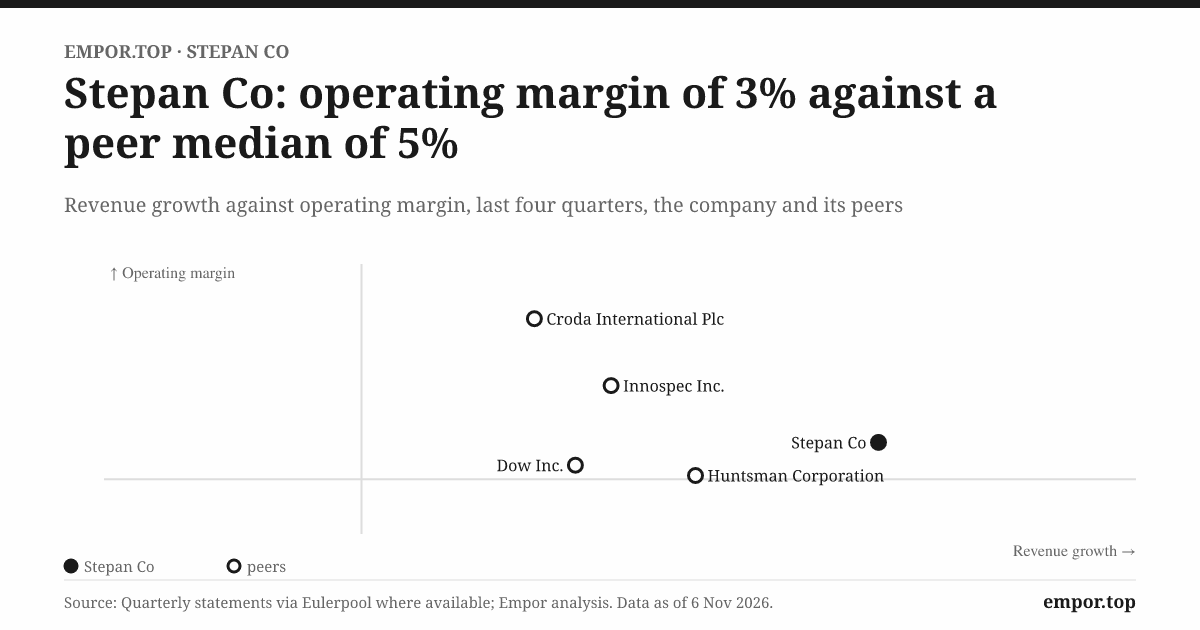
Read that again in plain terms. Stepan's main business sold more in 2025 and made materially less money doing it. The company's operating margin for the year was about 3.0%, well under half the 2022 level.3 From 2022 to 2025, revenue fell at about 5.6% a year and net profit fell at about 32% a year.3 The long-run picture is not a smooth recovery from a temporary dip. It is a lower plateau.
Why would Surfactants earn less while selling more? The answer lies in the mechanism described at the plant gate. When sales growth comes from passing through higher raw-material costs, revenue rises without adding any spread. When competitive pressure forces a company to absorb part of those costs, unit margins shrink. Underused capacity adds a third drag: a half-full plant spreads its fixed costs across fewer tons. Stepan has disclosed weak demand in commodity laundry surfactants, the very product category its new restructuring plan would target.[^14]
Against that backdrop, the third quarter of 2026 looks genuinely different. Organic volume rose 7% across the company.[^1] Surfactant organic volume rose about 8%, and the segment's adjusted EBITDA rose about 27%.1 Polymer volume rose about 3%, with double-digit growth in North American rigid polyols, spray foam and phthalic anhydride.1 Specialty Products volume rose about 20%, and its adjusted EBITDA rose about 5%.1 Rojo also said Stepan had added more than 300 new customers in 2026 and nearly 900 new customer-product combinations.1
Polymers tell a more mixed story. Rojo told analysts the segment was earning EBITDA margins of about 13% to 15%, which he described as healthy.1 North American demand for insulation-related polyols was strong. Europe and Asia remained soft, and a regulatory turnaround at the company's German polymer plant, required every four years, cost more than $2 million in the quarter.1 Polymer adjusted EBITDA rose about 4%, much less than the segment's 24% sales growth, because most of that sales growth was higher prices passed through from raw materials.1
The shape of 2026 so far is also worth tracing. The first quarter carried the restructuring loss. The second quarter was the strongest of the year, with reported operating margin of about 6.2%, helped in part by lower-cost inventory, according to Rojo.12 The third quarter's reported operating margin settled back to about 3.8%, only slightly above the year before.2 On the reported line, the business is improving, but by tenths of a percentage point rather than the jump the adjusted EBITDA figure suggests.
There is a subtle point in the Surfactant figures. Reported volume rose only about 3%, while organic volume rose about 8%.1 The difference reflects businesses Stepan sold, such as the Philippines quaternaries operation, which no longer count.1 The organic number is the right measure of underlying demand, but the reported number is what the company's plants actually shipped. Shrinking the portfolio and growing the remainder can both be true at once.
Management attributes the customer gains to a deliberate strategy. Stepan has long served the largest multinational consumer brands, which it calls Tier 1 customers, and has pushed to win more medium and smaller formulators, its Tier 2 and Tier 3 customers. Rojo said this base was growing at double digits and that the strategy was working "especially in the Americas," while Tier 1 accounts were also doing well.1 Smaller customers typically buy less volume but can pay better margins, because they need more formulation help and have fewer suppliers to choose from.
There is also a revealing tension between the February and October versions of the story. In February, Stepan justified closing Fieldsboro by pointing to lower demand for commodity laundry surfactants.[^14] In October, Rojo listed consumer products, including laundry, among the end markets that drove double-digit growth in Surfactants.1 Both statements can be true: Stepan may be winning laundry business with smaller formulators while the lowest-margin commodity tonnage keeps shrinking, and consolidating production may make the remaining laundry volume more profitable. But the distinction between profitable laundry growth and unprofitable laundry volume is exactly the kind of detail investors cannot see in the published numbers, and it is the detail that determines whether the closure was the right call.
That is a coherent theory. The question is whether the numbers will prove it. When Dave Storms of Stonegate asked on the October call how much of the margin improvement came from new customers versus share gains, Rojo declined to split it, answering that the gains were "across the board."1 When another analyst asked whether competitors' raw-material shortages had helped, the answer focused on the Tier 2 and 3 strategy and did not address the question directly.1 Mike Harrison of Seaport asked how much the second quarter had been flattered by customers buying ahead; Rojo suggested averaging the second and third quarters instead of quantifying the pull-forward.1
These are not damning answers. Management teams rarely hand out share-gain figures. But they show the gap between broad claims about growth and the concrete explanations of price, mix, volume and share that would let an investor verify the turn. Compare the call with Stepan's fourth-quarter 2025 and 2023 results commentary, and the pattern repeats: the company describes the direction of volume and price clearly, but does not publish a segment-level bridge showing how much of each profit change came from volume, how much from price over raw materials, and how much from cost.[^7][^13]
The countercase deserves equal weight. One strong quarter does not erase a year in which surfactant profit fell by about a fifth on rising sales. Management itself said it expected lower volume growth in the fourth quarter, along with maintenance and turnaround costs at its U.S. phthalic anhydride facility.1 Commodity laundry demand, the problem that prompted a plant closure, is not described as solved. The evidence supports a narrower claim: volume is improving, and the third quarter's margin was better. It does not yet show that Stepan keeps more of each incremental sales dollar across a full cycle.
Which brings the story to its central character. If volume alone could not restore margin, the other lever was cost. In February 2026, the man who had spent six years as Stepan's chief financial officer decided to pull it hard.
V. Rojo's reset comes with a $76 million charge
Luis Rojo did not come up through the chemistry labs. He spent more than two decades at Procter & Gamble, joining in 1997 and rising through finance roles to become North America Hair Care finance director and then global hair care finance director.4 In April 2018 he moved to Stepan as vice president and chief financial officer, and in October 2024 he became president and chief executive.4 He succeeded Scott Behrens, who had led the company from April 2022.4
His finance partner in the turnaround is newer to the role. Ruben Velasquez was appointed vice president and chief financial officer effective July 15, 2025, after Samuel Hinrichsen had served in the role through 2024.4 The pairing is telling: a chief executive who was the CFO, and a CFO taking over a company in the middle of a cost reset. Both have every reason to present the numbers precisely, because the restructuring's credibility depends on it.
That résumé matters for this story. At P&G, Rojo sat on the customer side of the table, inside one of the world's largest buyers of surfactants for shampoos and detergents. He learned how a consumer giant thinks about cost, supplier reliability and the price of a cheaper alternative. As Stepan's CFO, he then watched from the other side as the post-2022 slump exposed the company's cost base. When he took over, he inherited a footprint built for more demand than had arrived.
On February 23, 2026, alongside its full-year 2025 results, Stepan announced Project Catalyst, a plan to take about $100 million of pretax cost out of the business over two years.[^14] The actions were physical and specific. Stepan would close its Fieldsboro, New Jersey plant in response to lower demand for commodity laundry surfactants.[^14] It would decommission selected assets at Millsdale, Illinois, and Stalybridge in the United Kingdom, consolidating production into more efficient facilities.[^14] And it would eliminate about 100 salaried positions, roughly 7% of its global salaried workforce.[^1]
The plan amounts to an admission. Stepan had too much capacity for the commodity products where demand had weakened, and too many plants making overlapping things. Closing Fieldsboro concedes that some commodity laundry volume is not coming back at prices worth chasing. Decommissioning older equipment at Millsdale, long one of the company's major sites, concedes that newer capacity such as Pasadena can make some of the same molecules more cheaply. A reset this physical is a judgment that the cycle alone will not rescue the old footprint.
The economics behind consolidation are simple to state. A chemical plant has large fixed costs: operators, maintenance crews, utilities, insurance, environmental compliance and the depreciation on the equipment itself. Those costs are much the same whether the plant runs at half capacity or full. Run three half-empty plants and every ton carries three sets of overhead. Close one and move its volume to the other two, and the same tonnage carries two sets, while the remaining plants run closer to full and more efficiently. The catch is that the moved volume must actually arrive, and the closed plant's customers must accept product shipped from further away.
Promise against invoice
The promise and the invoice need to be held side by side. Management targeted $100 million of pretax savings across two years and initially expected about 60% of that in 2026.[^14] By the October call, CFO Ruben Velasquez said Stepan expected to exceed the 60% milestone for the year, and Rojo put 2026 savings in a range of about $66 million to $70 million.1 Savings were running at about $23 million in the third quarter, and Rojo said he expected 2027 to average somewhat above $25 million a quarter.1
Against that sits the bill. Through September, Stepan had recorded $76.1 million of restructuring charges.2 Most of that was non-cash, the write-down of equipment it would no longer run; Velasquez said cash restructuring payments were about $13 million year to date.1 That distinction matters. The accounting charge recognizes that past investments lost value. The cash charge is what shareholders pay now to stop the bleeding.
There is a question the savings target does not answer by itself. Rojo told Harrison that Stepan's fixed-cost base is roughly $800 million and faces normal inflation of 2% to 3% a year.1 On that base, inflation alone could absorb something like $16 million to $24 million a year. Some of the gross savings, in other words, will be spent standing still. How much of the $100 million reaches the bottom line net of wage inflation, utilities and maintenance is the number investors will need, and the company has not presented that net figure in the materials released so far.
Project Catalyst is also tied to a broader sale of assets. In 2025, Stepan sold its Philippines quaternaries business to Masurf, keeping a tolling agreement to continue serving customers in Southeast Asia, and agreed to sell the Lake Providence plant.6 In October 2026, it sold land near Millsdale for $28.5 million, with the proceeds earmarked for debt reduction.1 The Lake Providence sale closes the loop on the fermentation bet; the Millsdale land sale turns idle real estate into lower borrowings.
How should an investor read the man running the plan? Ownership offers one lens. The 2026 proxy reported that Rojo beneficially owned 80,739 shares, less than 1% of the company.4 His 2025 long-term incentive grant was split among stock appreciation rights, restricted stock units and performance shares, with performance shares carrying the largest weight.4 His total reported compensation for 2025 was about $4.33 million, up from about $2.98 million in 2024, a year split between two chief executives.4 The stake is meaningful for a career executive but small relative to the company; it neither proves nor disproves alignment.
Shareholders have not pushed back. At the April 2026 annual meeting, the say-on-pay proposal received about 17.0 million votes for and 1.23 million against.9 The proxy reported that the 2025 say-on-pay vote had drawn 96% support.4 Such votes tell you institutional holders were not alarmed by the pay design. They tell you nothing about whether a plant consolidation will work.
Rojo told analysts in October that the organizational redesign phase of the plan, the salaried workforce reduction announced in July, had been secured in the third quarter.1 That leaves the slower part of Catalyst, the physical moves between plants, still in progress. Cutting salaried roles delivers savings quickly and predictably. Moving production lines delivers savings only after products are requalified at their new sites and customers accept the change, which is why the second year of the plan matters more than the first.
The better test of credibility is behavior across time. Rojo's guidance for the savings has so far been specific, and the October figures came in ahead of the February plan. His answers on the drivers of volume growth have been less specific, as the exchange with analysts showed. Three questions will reveal the most on coming calls: what portion of savings is net of inflation, whether volume growth is reaching contribution margin rather than being bought with price, and what management will do if commodity laundry demand stays weak after Fieldsboro closes.
If the reset works, margins and cash should both rise. If it does not, Stepan will have paid a large restructuring bill and remained a low-return producer with a smaller footprint. And the place where the answer will appear first is not the earnings line, which can be adjusted, but the cash account, which cannot.
VI. The dividend is consuming the free-cash cushion
There is a pleasant story to tell about Stepan's cash, and it is true as far as it goes. From 2014 through 2025, the company earned about $1.1 billion of net profit and generated about $2.0 billion of cash from operations.38 For a manufacturer, cash coming in at nearly twice reported profit sounds like a sign of conservative accounting and real earning power.
The reason is mostly depreciation. Stepan's plants are expensive, and the accounting rules spread their cost over many years as a non-cash charge against profit. In 2025, depreciation and amortization was about $126 million, against net income of about $47 million.3 The cash from operations is real, but it carries an obligation: those plants wear out, and replacing and upgrading them costs real money.
That is where the pleasant story meets its limit. Subtract capital spending from operating cash flow, and over the same twelve years Stepan generated about $292 million of free cash flow.38 Over the same years, it paid about $292 million of dividends.38 The two figures match almost to the dollar. Stepan's cash and short-term investments stood at about $133 million at the end of 2013 and about $133 million at the end of 2025.3
Think of it as a household that earns a good salary, spends most of it on keeping the house up and building an extension, and gives the rest to the children as an allowance. Nothing is wasted, exactly. But at the end of twelve years, the savings account holds the same balance as at the start, and the extension was paid for with a mortgage. Over the same span, borrowings rose from about $274 million to about $691 million.38
The match between free cash flow and dividends was not even through the period. Between 2015 and 2020, Stepan generated healthy free cash flow and accumulated a cash pile of about $350 million.87 Then came the building and buying phase. Free cash flow was negative in 2021, 2022 and 2023, as capital spending on Pasadena and other projects exceeded operating cash.37 The dividend kept rising through all three years. Debt filled the gap.
The dividend itself grew steadily through every phase of this story. Stepan paid about $15 million in 2014 and about $35 million in 2025, more than doubling the payout over a period in which net profit fell.38 Each individual increase was small, a penny or two a quarter. Compounded over a decade, those pennies became one of the largest recurring claims on the company's cash after capital spending.
Where the cash got stuck
Working capital is the second plot line. A chemical company must buy raw materials, hold inventory and wait for customers to pay, and all of that ties up cash. Stepan's ordinary payment terms run 30 to 60 days.3 Debtor days, the average time customers take to pay, rose from about 51 days in 2014 to a peak of about 66 in 2023, before easing to about 61 in 2025.38
In 2026, the receivable balance jumped. Trade and other receivables were about $502 million at September 30, up from about $388 million at the end of 2025.2 Part of that reflects higher selling prices and higher volumes; a business selling 17% more by value will naturally have more invoices outstanding. Management said higher working-capital requirements reduced the quarter's free cash flow.[^1] In the third quarter, Stepan built about $32 million of working capital, and free cash flow came to about $8 million after $21 million of capital spending and $6 million of restructuring cash payments.1
Put differently, the underlying business threw off about $49 million of operating cash in the quarter before working capital moved.1 That is a respectable figure for a company of Stepan's size, and it would comfortably cover the quarter's roughly $9 million dividend and its capital spending.1 The working-capital build swallowed most of it. If receivables and inventory ease as prices stabilize, some of that cash will come back; if Stepan keeps growing at double-digit rates by value, working capital will keep absorbing cash, which is the quiet cost of growth in a business that has to wait to be paid.
The allowance for doubtful accounts offers some reassurance. It was about $10.5 million at the end of 2025, slightly lower than in prior years, and Stepan says its historical credit losses have not been significant.3 The company also sells some receivables to raise cash: proceeds from receivables financing were about $96 million in 2025, up from about $88 million in 2024.3 That is a common liquidity tool rather than a sign of distress, but it means reported operating cash flow is partly shaped by financing choices. Stepan does not publish an aging schedule of its receivables.
Then there is the debt. At September 30, 2026, borrowings were about $634 million and net debt about $536 million.2 Of the borrowings, about $292 million was classified as current, meaning due within a year.2 That sounds alarming until you look at what Stepan did in September: it entered a new $500 million credit facility, including a $350 million multicurrency revolver and a $150 million delayed-draw term loan, both maturing in 2031.2 Committed bank liquidity now runs five years, though Stepan will still need to refinance or repay maturing obligations. Net leverage, as management measures it, improved to about 2.4 times from 2.7 times a year earlier.1
The structure of the debt matters as much as its size. Stepan had about $279 million of unsecured notes due between 2026 and 2033, and about $230 million drawn on its revolving credit line at the end of the third quarter.2 Revolver borrowings float with interest rates, so the company's interest bill moves with the cost of money. And not all of Stepan's cash sits where the debt does: at the end of 2025, about $116.5 million of its roughly $133 million of cash was held by non-U.S. subsidiaries.3 Cash in Brazil or Europe can fund local operations, but bringing it home to pay down an American revolver can involve tax and timing frictions.
This is not a distressed balance sheet. Covenants require Stepan to maintain financial ratios and limit additional debt, dividends and buybacks, which keeps a lender's eye on the company.3 The company repurchased no shares in the first nine months of 2026 and still had about $125 million left under its buyback authorization.2 That restraint is sensible. The pressure is not insolvency; it is the absence of slack.
The dividend illustrates the shrinking cushion. Over 2014 to 2025, Stepan typically paid out about a fifth of its earnings as dividends.38 In 2025 it paid out about 76%, because earnings had fallen while the dividend kept climbing.3 At the November 6, 2026 share price, the stock's free cash flow yield was about negative 2.2%, meaning that over the trailing twelve months, after capital spending, the business consumed more cash than it generated.2[^5] The 59-year streak of increases continued in October with a raise of a penny a quarter, about 2.5%.1
Management says it expects positive free cash flow for 2026 and continued deleveraging.1 It did not give a dollar figure.1
Capital spending is the lever management controls most directly. At the start of the year, Stepan estimated 2026 capital expenditure at $100 million to $110 million, below the roughly $122.5 million spent in 2025 and well below the 2023 peak.3 With Pasadena built, the heavy construction phase is over, and the third quarter's $21 million of spending was a fraction of the pace of the build-out years.1 Lower capital spending will help free cash flow almost mechanically. The question is whether it stays low once the newly consolidated plants need their own maintenance, and whether today's restraint reflects a sturdier network or deferred upkeep. The full-year result will be the clearest single test of the recovery: free cash flow after capital spending and dividends, year-end receivables and inventory, and the level of net debt once the Millsdale land proceeds arrive. A recovery that pays for itself will show up there first. Which raises the question the stock market is answering every day: how much of that recovery is already in the share price?
VII. Analysis & Bear vs. Bull Case
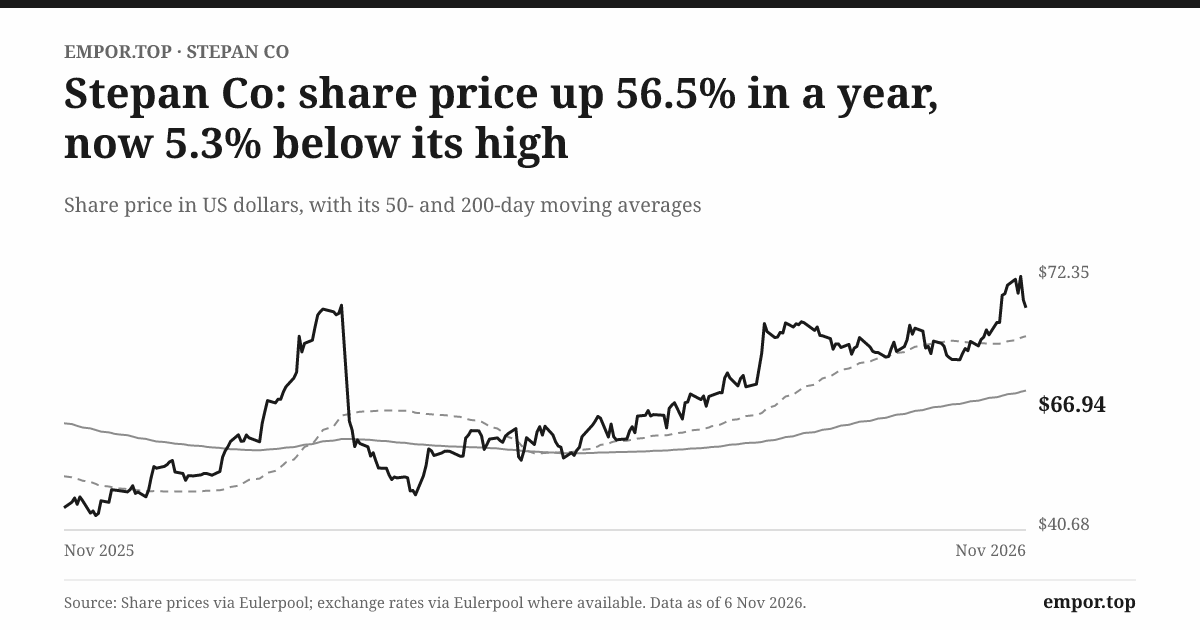
On November 6, 2026, Stepan's shares closed at about $66.94, roughly 5% below their 52-week high and well above the 52-week low of about $42.[^5] In a year when the company reported a nine-month loss, the stock had climbed more than 50% from its low. The market, in other words, was looking straight past the restructuring charges.
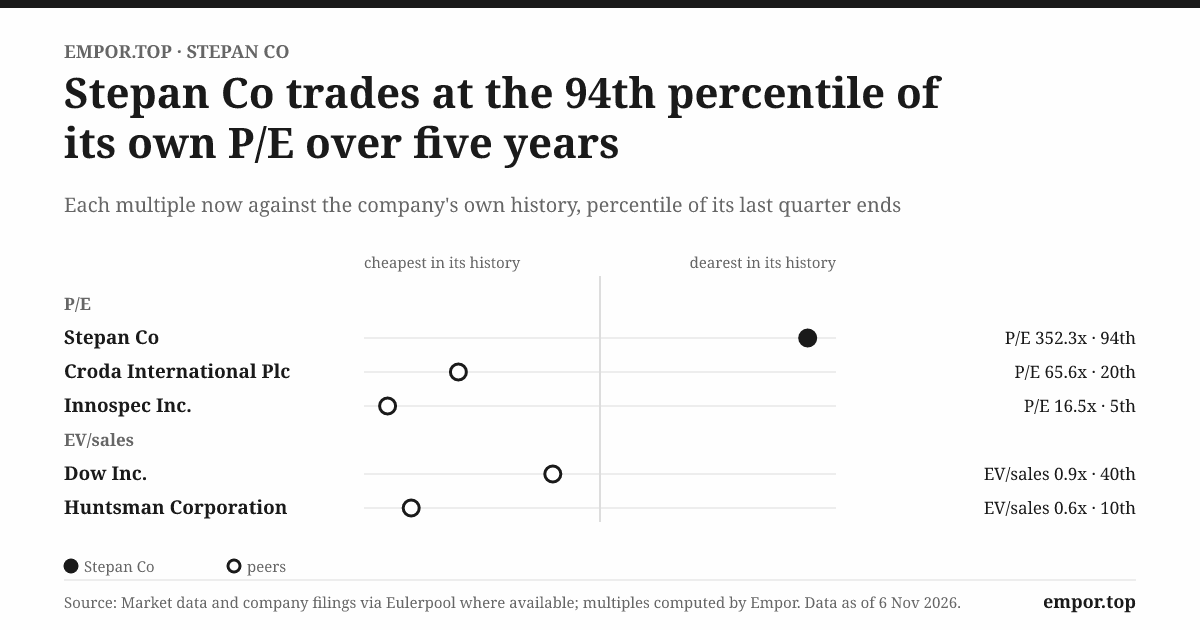
The headline valuation looks absurd. On trailing earnings per share of about $0.19, the price-to-earnings ratio was about 352 times, against a five-year median of about 25 times.[^5] But the ratio is a trick of the denominator. Trailing earnings include the first quarter's large restructuring charge, so the P/E says almost nothing about what the business might earn in a normal year. A more useful lens is enterprise value against EBITDA: about 12.9 times on the trailing figure.[^5] For a company whose largest segment earns a 4% operating margin, that is not a bargain-basement multiple.
Enterprise value is the right starting point because it counts everything a buyer of the whole company would have to pay for. Stepan's equity was worth about $1.5 billion at the November 6 price, and the company carried roughly $536 million of net debt at the end of September, which together account for most of the roughly $2.1 billion enterprise value.[^5]2 That debt is a reminder that shareholders do not own the recovery outright. Every dollar of improved cash flow has to service lenders before it reaches the equity, so a slower recovery hurts the share price more than the headline multiple suggests, and a faster one helps it more.
What does the price appear to assume? With an enterprise value of about $2.1 billion, the market is implicitly betting that Stepan's earnings recover a long way toward their pre-2023 range. In 2025, operating margin was about 3.0% and return on invested capital about 3%.3 If margins stayed there, the company would be earning well below any reasonable cost of capital, and the current valuation would be hard to defend on earnings alone. The price makes sense if Project Catalyst's savings stick, volume keeps growing and margins climb back toward something like 6% to 7%. It looks expensive if they do not.
A little arithmetic shows how much rides on the savings. Stepan's 2025 operating profit was about $69 million.3 If even half of the $100 million Catalyst target reached operating profit after inflation, and nothing else changed, operating profit would rise by roughly 70%, and on about $2.5 billion of revenue the operating margin would climb by about two percentage points. Add the full $100 million and the margin would approach the levels of the late 2010s. That is the bull case in a sentence: the savings alone, if real and lasting, could repair a large part of the margin damage. The bear case is equally simple: savings are gross, inflation is constant, and in a contestable market some of what a company saves tends to be competed away in lower prices to customers.
Why Stepan could win, and why it may not
The case for Stepan rests on four pillars. Its customer base spans regions, industries and thousands of accounts, so no single loss can sink it. It has decades of formulation and technical-service capability, which matter in markets like crop adjuvants and personal care where reformulating is costly. It operates a global manufacturing network with local production in markets such as Brazil, which Rojo said is better protected from Asian imports than Mexico.1 And it has an identifiable cost program, with savings arriving ahead of plan, to consolidate volume into its most modern plants.
The case against rests on what the record shows. There is limited proof of customer lock-in or pricing power, and the 2023 Latin American share loss showed customers responding to price. The largest segment earns thin margins in the best of recent years. Commodity exposure means revenue and costs swing with oil, ethylene and natural oils. And the company is in the middle of a costly restructuring whose net savings, after inflation, remain to be demonstrated.
Hamilton Helmer's 7 Powers framework asks which durable advantages a company possesses. Run Stepan through it once. Scale economies may exist in specific plants, such as Pasadena, but Stepan's total size is a fraction of its largest competitors, and no peer unit-cost comparison shows it as the low-cost producer. Switching costs are plausible in formulation-heavy niches, but the company publishes no retention data. Process power, the accumulated know-how of running complex chemistry reliably, is the most credible candidate, and the high margins in Specialty Products suggest it exists somewhere in the portfolio. Network effects, brand power with end consumers, counter-positioning and cornered resources do not apply in any meaningful way.
The verdict on the moat, then, is a narrow one. Stepan likely possesses process know-how and customer intimacy that protect individual product lines. The evidence does not establish a company-wide moat that would let it hold margins against importers or in-house production when a commodity cycle turns. The claim survives in a smaller version: Stepan is a capable, reliable supplier in contestable markets, not a protected franchise.
Porter's five forces confirm that reading. Buyer power is diluted by the breadth of the customer base but sharpened by price-sensitive end markets. Supplier power arrives through feedstock cycles that Stepan passes through with a lag and not always in full. Substitutes include customers' own production and alternative chemistries. New entrants face real barriers in manufacturing and qualification, but low-cost importers have shown they can enter regional markets. Rivalry is intense on every axis.
Who would push for change? Stepan's register is dominated by index and quantitative managers. BlackRock reported about 14.1% and Vanguard about 11.3% in their latest filings cited in the 2026 proxy, and Dimensional Fund Advisors reported about 5.2% as of September 30, 2026.4[^16] All directors and executive officers together held about 6.6%, and Quinn Stepan Jr. about 4.6% on his own.4 There is no controlling shareholder, which means the board answers to a broad base of large, mostly passive owners. Such holders rarely start campaigns, but they do vote, and they can back one if a concentrated investor arrives with a plan.
That investor would focus on capital allocation. Why maintain a 59-year dividend streak when twelve years of free cash flow covered only the dividend, leverage rose and return on invested capital fell to a small fraction of its historical level? Shouldn't asset sales and debt paydown come ahead of any discretionary expansion? The board's answer so far has been to keep raising the dividend modestly, halt buybacks and direct asset-sale proceeds to debt. A more aggressive investor might argue for freezing the dividend until free cash flow after capital spending clearly exceeds it, or for a sharper review of which product lines earn their cost of capital. The family's long stewardship and the dividend's symbolism make either move culturally hard.
Two quieter risks belong in the picture. The first is legal and environmental. Stepan carried about $8.3 million of environmental and legal liabilities at the end of 2025.3 Its Maywood, New Jersey site, a legacy industrial property, is governed by a 2024 consent decree with the United States and New Jersey authorities, and the company is contesting a 2023 Brazilian tax action seeking to rescind previously claimed PIS/COFINS tax credits.3 The filings do not point to a known loss beyond what has been accrued, and the auditor gave an unqualified opinion on both the financial statements and internal controls.3 These are long-tail exposures rather than a looming crisis, but long tails tend to cost more than the first estimate.
The second is trade. Rojo said on the October call that Asian imports are concentrated in Mexico, while Brazil is "more protected" by local production and market structure.1 That is the same competitive pressure that cost Stepan Latin American margin in 2023 and contributed to the Mexico goodwill write-off. Any shift in tariffs or freight costs that widens the price gap again would test the company's regional defences directly.
Three numbers will reveal more than any narrative. The first is segment operating income and margin, especially in Surfactants, where the 2025 margin was about 4%.3 The second is organic volume paired with price and mix, which in the third quarter showed 8% organic Surfactant volume growth alongside 10% higher prices.1 The third is free cash flow after capital spending and dividends, which was negative on a trailing basis.2 Investors will want a segment bridge that separates volume, price over raw materials and Catalyst savings, rather than having them blended into a single adjusted EBITDA figure.
Valuation should be judged conditionally. Compared with Stepan's own history, the stock trades on an EV/EBITDA multiple that assumes recovery; whether that is generous depends on normalized margins and cash. Comparisons with listed chemical peers would need to account for very different product mixes and accounting, and should be made only on the same date and with similar businesses. The decision rule for an investor is straightforward. A few quarters of higher volume are not enough. The durable case requires recovered margins and cash, with net debt declining. Until those three appear together, the stock price is paying for a recovery that the operating record has only begun to show.
VIII. Playbook: Business & Investing Lessons
In early 2021, Stepan bought a small fermentation plant in Lake Providence, Louisiana, for $3.5 million, to help bring bio-surfactants to market.[^11] Less than five years later, it agreed to sell the plant to an unnamed buyer on undisclosed terms.6 The amount was trivial for a $2.3 billion company. The lesson is not.
The first lesson is that a new technology is an option until customers buy it repeatedly. Bio-surfactants had everything a strategy deck loves: sustainability appeal, consumer-brand interest, proprietary know-how. What they did not have, at least at the scale that would justify a dedicated plant, was a steady stream of repeat orders. For investors in any industrial company, the moment to credit a new platform is when it appears in segment revenue, not when it appears in a press release. Stepan's own record now provides the base rate for its next green chemistry announcement.
The second lesson is that a full order book can still be a thin business. Surfactants account for about seven of every ten dollars Stepan sells, ship against purchase orders from a broad, loyal-looking base of customers, and earned an operating margin of about 4% in 2025.3 Volume and diversification are not the same as pricing power. When customers can buy from importers, rivals or their own plants, a supplier's revenue share tells you how busy it is, not how much it is worth. For founders and investors alike, the useful question is not how many customers you have but how many would pay more to keep you.
The third lesson is that a turnaround is measured after the charges, in the cash. Project Catalyst came with a $76 million restructuring bill and promises of $100 million of savings. The adjusted EBITDA line will show the savings. The cash flow statement will show whether they survive inflation, working capital and the dividend. For any restructuring story, the investor's job is to follow the money past the adjusted figures to the place where it either accumulates or does not.
The fourth lesson is about building capacity at the top of a cycle. Stepan's investments in INVISTA, Pasadena and the fermentation plant were made when 2022's record earnings made expansion feel safe. The capital arrived just as the cycle turned, and the company spent three years funding negative free cash flow with debt. Capacity is a promise to future demand. When the promise is made at a peak, the market gets to set its terms.
The fifth lesson concerns the 59-year dividend streak. A streak like that is a source of pride and a signal of resilience; it survived oil shocks, recessions and the 2023 collapse. But it also becomes a constraint. Once a board treats an unbroken record as part of the company's identity, the dividend stops being a residual of what the business can afford and becomes a fixed cost that the business must fund. A dividend streak is a promise to the past; the cash to keep it must be earned in the present.
The final lesson is that discipline is a behavior, not a slogan. Management credibility at Stepan will be earned the old-fashioned way: through savings that show up net of inflation, segment bridges that explain where profit came from, and net debt that falls year after year. No strategy label will substitute for those three things.
IX. Epilogue
Tonight, Stepan stands between two versions of itself. One is the company that reported a nine-month loss, closed a plant, cut about 7% of its salaried staff and wrote off assets it once thought would earn their keep. The other is the company that added hundreds of new customers this year, grew organic volume in every segment and lifted adjusted EBITDA by nearly a fifth in its latest quarter.
The next few months will decide which version is the more accurate. The first decisive moment will arrive with full-year 2026 results, expected in February 2027. That report will show whether Stepan delivered the positive free cash flow management promised, how much of the receivables build reversed by year-end, and how far net debt fell after the Millsdale land sale.1 A year-end free cash flow that comfortably covers the dividend would mark a real change from the last twelve years. A shortfall would mean the recovery is still being financed rather than funding itself.
Imagine the two outcomes side by side. In the first, Stepan reports positive free cash flow comfortably above the roughly $35 million dividend, net debt falls below where it started the year, and the fourth quarter shows Surfactant margin gains holding through the seasonal slowdown. That combination would suggest the company has turned the corner from a business that needs borrowing to grow into one that funds its own reinvestment. In the second, working capital stays elevated, the fourth-quarter turnaround costs bite, and free cash flow lands near zero. The adjusted EBITDA growth would still be real, but it would read as a better year inside the same old cash constraint.
The second moment will play out over 2027, the first full year after the Fieldsboro closure and with Pasadena running at higher utilization. If segment margins, especially in Surfactants, climb meaningfully while volume holds, it will suggest that the consolidation really lowered unit costs and that customers followed the production to its new home. If margins stall while volume grows, it will suggest that the new customers are being won on price.
The third test is about management's own consistency. Rojo has set specific numbers: $100 million of savings over two years, a 2026 figure above 60% of that, and an average quarterly run rate above $25 million in 2027.1[^14] Watch whether those numbers survive the next two calls unchanged, whether management reports them net of inflation, and whether it explains any miss as concretely as it has explained its successes.
The central tradeoff remains unresolved. A leaner manufacturing network can improve returns, but only if the profitable volume stays with it. Shut a plant and you lower your costs; you also lose the flexibility to serve a customer from a nearby site, and you hand an importer or rival a chance to make an offer. The company is betting that customers value its formulation help and reliability enough to follow it into a smaller footprint. The coming year will show whether they do.
X. Outro
Picture the gate at Fieldsboro, New Jersey, as the last trucks roll out and the production that once ran there shifts to newer, more efficient lines elsewhere in the network, including the Texas plant that cost roughly $220 million to build.7 It is the image of a company tidying its own house, closing the old room so the new one can be used.
But the image only matters if the arithmetic follows. Stepan spent about $122.5 million on capital projects in 2025 alone, and over twelve years its free cash flow merely matched the dividends it paid.3 The modern network has to earn returns the old one could not, or the closures will be remembered as an expensive way of getting smaller. Ninety-four years after Alfred Stepan opened his Chicago business, the craft is not in doubt. The return on the capital it consumes is.
Stepan can make the chemistry; now it has to make the cash.
References
-
Q3 2026 Earnings Call Transcript — Stock Analysis, 2026-10-28 ↩↩↩↩↩↩↩↩↩↩↩↩↩↩↩↩↩↩↩↩↩↩↩↩↩↩↩↩↩↩↩↩↩↩↩↩↩↩↩↩↩↩↩↩↩↩
-
Q3 2026 Form 10-Q — Stepan Company (SEC), 2026-11-04 ↩↩↩↩↩↩↩↩↩↩↩↩↩↩↩
-
2025 Form 10-K — Stepan Company (SEC), 2026-02-26 ↩↩↩↩↩↩↩↩↩↩↩↩↩↩↩↩↩↩↩↩↩↩↩↩↩↩↩↩↩↩↩↩↩↩↩↩↩↩↩↩↩↩↩↩↩↩↩↩↩↩↩
-
2026 Proxy Statement — Stepan Company (SEC), 2026-03-25 ↩↩↩↩↩↩↩↩↩↩↩↩↩
-
Stepan sells two sites — Speciality Chemicals Magazine, 2025-12-16 ↩↩↩↩↩
-
2021 Form 10-K — Stepan Company (SEC), 2022-02-25 ↩↩↩↩↩↩↩↩↩↩
-
2016 Form 10-K — Stepan Company (SEC), 2017-02-24 ↩↩↩↩↩↩↩↩↩↩
-
2026 Annual Meeting Voting Results, Form 8-K — Stepan Company (SEC), 2026-04-30 ↩
 LinkedIn
 WhatsApp
 Reddit
 Hacker News
 Email
 Kindle
 RSS Feed
 Spotify
 Apple Podcasts
 Amazon Music
 Audible
 YouTube