PROG Holdings, Inc.: The $420 Million Bet on What Comes Next
I. A Growing Company, a Shrinking Core
On the morning of October 28, 2026, Steve Michaels opened PROG Holdings' third-quarter call with a sentence most chief executives would love to say. Every business in the company had contributed to growth, he said, and revenue was up roughly 26% from a year earlier.[^1]
Revenue from continuing operations had reached about $726 million for the quarter.[^1] Gross merchandise volume, the dollar value of everything customers bought through PROG's products, was up 59%.[^1] On its face, that is a company in full stride.
Then came the other half of the morning. A few minutes later, the chief financial officer, Brian Garner, explained why PROG was cutting its full-year outlook for revenue and adjusted EBITDA.[^1] Households were still absorbing several years of elevated prices, he said, and fuel prices had jumped since March. The company would rather reflect that caution than bet on a sharp fourth-quarter rebound.[^1]
And in the same breath, management announced it intended to spend $100 million buying back its own stock through an accelerated share repurchase, expecting an initial delivery of about 2.7 million shares.[^1] The board also topped the buyback authorization back up to $500 million.[^1]
So within one call, investors heard three messages. The business is growing fast. The customer is under strain. And the best use of $100 million right now is the company's own shares. Those three messages do not contradict each other, but they do pull in different directions, and the tension between them is where this story lives.
The growth number itself needs unpacking, because it is really three numbers wearing one coat. Four, the buy-now-pay-later app PROG bought in 2021, more than doubled its revenue, up 113.8%.[^2] Purchasing Power, the payroll-deduction shopping business PROG bought at the start of 2026, grew its own merchandise volume 12.3% against its pre-acquisition year.[^2] And Progressive Leasing, the lease-to-own business that built this company, saw revenue slip 0.7%.[^2]
That last figure is the one that matters most, because Progressive Leasing is still most of PROG. In the quarter, it brought in about $553 million of the roughly $726 million total.[^2] Purchasing Power, which did not exist inside PROG a year earlier, explains most of the headline jump. Four is growing explosively, but from a base small enough that its entire quarterly revenue, about $37 million, is less than a fifteenth of leasing's.[^2]
Before going further, it helps to draw the boundary of what is being measured. PROG Holdings is the NYSE-listed parent, trading as PRG.1 It consolidates Progressive Leasing, Four, a small cash-advance app called MoneyApp and, since January 2, 2026, Purchasing Power.12 It sold Vive Financial, a second-look credit card business, in October 2025, and Vive's results now sit in discontinued operations, outside the continuing figures.1 So when someone compares 2026 with 2025, they are comparing a four-business company with a company that had one dominant business, one fast-growing small one, a small cash-advance app and a credit card unit that has since been sold.
That boundary problem shapes the test this story will apply. Acquired growth is not organic growth. Revenue growth is not durable earnings. And a company that grows by adding a new business has not necessarily fixed the business it already had.
The questions follow naturally. What made Progressive Leasing valuable in the first place, and how much of that value is still intact? Can Four and Purchasing Power genuinely diversify PROG's risks, or do they mostly diversify its revenue line? And after paying $420 million for Purchasing Power, does PROG have enough room to keep investing in the businesses, keep its lenders comfortable and still return cash to shareholders?
Management's answer, delivered with conviction on the call, was yes to all three.[^1] Michaels said the midpoint of the revised adjusted EBITDA outlook still sat at the high end of the range PROG gave in February, before a Middle East conflict pushed up gas and other prices for its customers.[^1] In his telling, the company was delivering its best case in a bad year.
The record supports a narrower version of that claim. The newer businesses are growing, and the consolidated result held up. But the core still supplies most of the revenue and most of the earnings, and the new businesses have not yet shown they can replace it. To see why that matters, the story has to go back to a purchase made by a different company, twelve years earlier, for a business with no stores at all.
 Subscribe on LinkedIn
II. The Business Aaron's Paid $700 Million For
In April 2014, Aaron's was a familiar name on American main streets. It rented sofas, televisions and washing machines from its own showrooms to customers who could not or would not buy them outright, and it had done so for decades. On April 14 of that year, it paid $700 million, net of cash acquired, for a company that did the same thing without a single showroom.3
That company was Progressive Finance Holdings, established in 1999 and headquartered in South Jordan, Utah, with a second call center in Glendale, Arizona.3 Aaron's described it as a leading virtual lease-to-own company. It had no stores of its own. Instead, it offered a technology-based application and approval process inside other retailers' stores, so Progressive did not need its own employees on the sales floor.3 At the time of the deal, it worked through more than 15,000 retail partner locations in 46 states.3
Think of the difference this way. A traditional rent-to-own store is like owning a restaurant: you pay for the building, the staff and the inventory, and you hope customers walk in. Progressive was more like a food-delivery app: it put its offer wherever customers already were, and it let someone else pay for the building. Aaron's was buying a way to reach customers without paying rent on thousands of locations.
The price looked rich against what Progressive was earning then. In the part of 2014 that Aaron's owned it, Progressive contributed about $549.5 million of revenue but only about $4.6 million of pretax earnings.3 Aaron's had framed the deal at about 10.6 times Progressive's estimated 2014 EBITDA, or 6.4 times estimated 2015 EBITDA once an expected tax benefit was counted.3
Those multiples tell you more about the buyer's hopes than about the outcome. The 2015 figure depended on Aaron's own projections and a tax benefit, and the thin first-year pretax profit was weighed down by deal costs and amortization. Neither number can settle whether $700 million was a good price. What can be said is that the asset grew into the most valuable part of the company, which is a different, and weaker, claim than saying the purchase earned a clear return.
The business also brought a young finance executive into its orbit. Steven Michaels, now 54, had been vice president of finance in Aaron's Sales & Lease Ownership division from 2008 to 2011.4 He moved to Progressive as vice president of finance in 2012 and added strategic planning and business development in 2013.4 When Aaron's bought Progressive in April 2014, he became Progressive's president.4
His path is the path of an operator who learned the business from the numbers outward. From February 2016 he served as chief financial officer and president of strategic operations at the parent, and in July 2020 he became chief executive of the Progressive Leasing segment.4 He has, in effect, sat in every chair from which this company is judged: the store business, the virtual business, the finance office and finally the top job.
The finance bench around him grew up inside the same building. Brian Garner, now 46 and chief financial officer since December 2020, joined Progressive as controller in 2012, the same year Michaels arrived, and climbed through finance and accounting roles in the leasing business before taking the top finance job.4 This is a management team that has not been imported from Silicon Valley or Wall Street. It is a team that has watched Progressive's lease pools pay, and fail to pay, through more than a decade of cycles, which is both its strength and, for a company trying to become something new, a potential blind spot.
That top job arrived through a separation. On November 30, 2020, the parent, then called Aaron's Holdings Company, completed the spin-off of its store-based business.5 Shareholders received one share of the new The Aaron's Company, trading as AAN, for every two shares they held.5 The remaining company renamed itself PROG Holdings and kept its NYSE listing under the new symbol PRG.5 Michaels became its CEO on the day of the separation.4
The logic of the split was easy to state. One company would own stores. The other would own the virtual model, its retail partnerships and its decisioning technology. Investors were being invited to value a store-free, technology-driven lease-to-own platform on its own terms, rather than as an appendage to a furniture chain.
How has that promise aged? On a raw decade view, revenue fell about 2.7% a year from 2015 to 2025.6 That number is partly misleading, because the earlier years include Aaron's stores. The fairer test starts after the spin-off. Standalone revenue was about $2.5 billion in 2020, peaked near $2.7 billion in 2021 and was about $2.4 billion in 2025.6 That is not a collapse, but it is not the high-growth trajectory a pure fintech story implies either. For half a decade the core business has moved sideways.
Profits have been steadier than revenue. Net profit was about $146 million in 2025, and over the three years from 2022 it grew around 14% a year, helped by tighter underwriting and buybacks rather than by a larger leasing book.6 So the post-spin record is a company that learned to earn more from roughly the same volume, not one that kept expanding the volume.
There is also a word that hangs over the company's description of itself and deserves a footnote of skepticism: asset light. PROG has no stores, and its property and equipment shrank to around $22 million by 2025.6 But every lease still requires PROG to buy a real couch or refrigerator, carry it on its balance sheet as lease merchandise and collect payments from customers who are often near-prime or below.[^1]6 It is light on buildings, not light on capital. It needs merchandise, receivables and funding to grow.
That distinction is the key to understanding how this business makes money, and why it can lose money quickly. The place to see it clearly is at the checkout counter.
III. How a Checkout Offer Becomes Revenue
Picture a shopper at a furniture retailer, or on a mattress website, ready to buy but without the cash or the credit score to do it the ordinary way. A card might decline. A store-branded loan might reject them. At that point the checkout screen offers another path: lease the item now, take it home today and pay for it over time.
That offer is Progressive Leasing. Behind the screen, the transaction is different from a loan. When the customer accepts, Progressive buys the merchandise the customer has chosen from the retailer. The customer then leases it, making regular payments over a short term, with the option to buy it outright along the way.6
Leases are written for 12 months but, on Michaels' account, have an average life of about six and a half months.[^1] Many customers exercise an early purchase option, including a 90-day buyout that lets them own the item for a price closer to its retail tag.[^1] Others keep paying to the end. Some stop paying, and the merchandise becomes a write-off.
Revenue arrives slowly, matched to that life. Lease revenue is recognized on a straight-line basis over the estimated lease term, rather than all at once at the sale.6 That means today's revenue reflects the size of the lease book built up over the previous months. Garner put it plainly on the call: revenue follows the asset base.[^1]
So the engine has three moving parts, and each must work for a lease to earn money. First, PROG must be in front of the customer at the moment of purchase. Second, it must decide well, approving people who will pay and declining those who will not. Third, it must collect, or recover what it can when payments stop.
The first part, placement, is a constant competition. PROG's 10-K identifies the battle for prominent positioning inside retail partners' payment platforms as a competitive factor.6 A lease offer buried three clicks deep in a checkout flow is a different product from one presented beside the credit card. Retailers decide where that offer sits, and retailers have other options to place there.
That is why scale cuts both ways. Progressive Leasing generated about 96% of PROG's 2025 revenue.6 Its 2025 GMV, the value of merchandise leased, was about $1.76 billion, down from about $1.93 billion in 2024.6 Active customers fell from about 934,000 to about 838,000.6 Fewer people leased fewer things through PROG in 2025 than the year before.
Management gave three reasons, and each reveals a different vulnerability. The first was Big Lots, the discount retailer whose bankruptcy and store closures took a large distribution point out of the network.6 The second was PROG's own choice to tighten its decisioning, approving fewer applicants to protect loss rates.6 The third was weaker consumer confidence and demand.6 One was a partner shock, one was a deliberate trade of volume for credit quality and one was the economy.
The concentration underneath that network is sharper than the "15,000 locations" image suggests. Two retail partners each accounted for more than 10% of PROG's consolidated revenue in 2025.6 PROG does not name them in that disclosure. So a business that looks like a broad web of storefronts in fact leans heavily on two relationships, and on those retailers' foot traffic, their checkout design and their willingness to keep PROG in pride of place.
By the third quarter of 2026, the picture had turned slightly. Progressive Leasing GMV grew 2.3% to about $420 million, with September the strongest month of the quarter.[^1] More importantly to management, the gross lease asset balance, the stock of merchandise on lease, grew year over year for the first time since April 2025.[^1] Since revenue follows that book, management said leasing revenue should turn positive in the fourth quarter.[^1]
That growth came despite a tougher filter. Approval rates were down nearly 300 basis points from a year earlier.[^1] Michaels argued that growing through tightening proved the demand was real and came from wider distribution and deeper share with partners rather than looser standards.[^1] There is evidence for that: e-commerce rose to 26.4% of leasing GMV from 23%, and the company's own PROG Marketplace app grew GMV by 85% in the quarter.[^1]
The cost side of the engine is where the tension shows. Lease merchandise write-offs were 8.3% of leasing revenue in the third quarter, against 7.4% a year earlier.[^1] Management expects the full year near the high end of its 6% to 8% target range, and Michaels went further, saying the 6% end of that range was "not really appropriate anymore."[^1] He framed that as a choice not to leave EBITDA on the table, since the business's gross margin had structurally improved.[^1] An investor can read it another way: the company is telling the market to expect permanently higher losses.
Management's defense of that higher loss tolerance rests on margin. Michaels said that, measured against the last time an inflation spike hit PROG's customers, leasing gross margin is up on average more than 200 basis points.[^1] In the third quarter, leasing gross margin was 31.8%, down only slightly from a year earlier, and leasing's selling, general and administrative costs were about $83 million, or about 15% of revenue.[^1] Put simply, for every $100 of lease revenue, PROG keeps about $32 after the cost of the merchandise and spends about $15 running the business, before losses and interest. A business with that spread can afford a point more of write-offs if the extra approvals bring in enough profitable customers. It cannot afford many more.
The third quarter also showed how lease economics can surprise in both directions. On the newer, tightened pools, customers paid better than expected, and more of them used the 90-day purchase option, which ends a lease early at a lower total yield.[^1] On older pools approved before the tightening, inflation and higher gas prices squeezed customers' day-to-day cash, and delinquencies rose.[^1] Good customers paid off too quickly to be very profitable, and weaker customers paid too slowly. Both hit the quarter.
There is a difference in how this year's tightening worked, and it is worth understanding because it speaks to process. Garner told analysts that in the first quarter of 2025 PROG had tightened "significantly" and "in one fell swoop," then let the portfolio play through.[^1] In 2026, by contrast, it made smaller, iterative changes in the second and third quarters and again toward year-end, trying to respond in closer to real time.[^1] Michaels estimated that the tightening put "several hundred basis points" of pressure on leasing GMV in the third quarter and would probably do the same in the fourth.[^1] The company is choosing to grow more slowly than it could, which is a sensible choice in a squeezed economy, and an admission that the growth it is reporting comes with a brake on.
The retailer pipeline is the other lever, and here management kept its cards close. Michaels said PROG felt good about its retail partner pipeline and saw near-term opportunity, even as the window for decisions narrowed ahead of retailers' holiday code freezes, and promised more "when it is appropriate."[^1] For a business that lost volume when Big Lots failed, a large new partner would matter more than any marketing tweak. Until a signing is announced, it is a hope, not a number.
A brief caution on one standard metric. Conventional debtor days, receivables measured against revenue, rose from 14 in 2014 to 35 in 2024 before falling to 25 in 2025.6 For a lease-to-own company, that metric says little on its own, because the main asset is the leased merchandise, not a receivable, and past-due lease receivables are written off after 120 days.6 The better gauges are write-offs, the lease asset balance and active customers.
So the engine is not a consumer brand that owns the shopping destination. It is retailer placement plus underwriting plus collections. Its scale is real. But a weaker partner, a stricter approval model or a squeezed customer can travel to the earnings line within a quarter or two. And because customers are trusting a product whose total cost is less obvious than a sticker price, the engine has one more part that is easy to overlook until a regulator points at it.
IV. The $175 Million Lesson in Consumer Trust
In April 2020, as most of America was locked indoors, the Federal Trade Commission announced charges against Progressive Leasing.78 The allegation went to the heart of how a checkout offer is presented.
According to the FTC, consumers had been told that Progressive's plans were "same as cash" or carried "no interest."8 In reality, the agency said, consumers paid more than the sticker price, and frequently paid approximately twice the sticker price if they made all their scheduled payments.8 The full cost, it alleged, was tucked behind a link labelled "Additional Lease Details."8
That is the anxiety at the center of this business made concrete. A shopper sees a $1,000 television, a friendly checkout option and a small biweekly payment. Unless someone shows them the total, they may not realize the television will cost around $2,000 if they lease it to term. The product is legal and can be useful. Its risk is that the customer does not understand it.
Progressive settled. It agreed to pay $175 million to the FTC, to be used for refunds to affected consumers.8 It was barred from misrepresenting the cost, terms or nature of its plans, required to clearly and conspicuously disclose the total cost to own a product and required to obtain customers' express, informed consent before charging them.8 It also had to monitor third parties, including the retailers that presented its offer.8 The commission's vote was 3–2, with Commissioners Rohit Chopra and Rebecca Kelly Slaughter dissenting.8
The settlement turned disclosure from a marketing choice into an operating rule. Every application flow, at every retail partner, now carries a regulator's requirement about what the customer must see before handing over payment information. That costs something in friction and conversion. It also protects the channel, because retailers that place PROG's offer are lending it their own brand.
The story did not end in 2020. In its third-quarter 2026 filing, PROG disclosed that the FTC had sent a request for information in 2024 concerning Progressive Leasing's compliance with the settlement.1 The company describes it as a request for information, not a civil investigative demand, and the disclosure does not itself establish a new violation.1 But it shows that the regulator is still watching how the product is sold, six years later.
The financial footprint of legal matters is currently small, at least on the figures PROG can estimate. At the end of 2025, it had accrued $3.8 million for probable legal and regulatory matters, up from $0.5 million a year earlier.6 Management said reasonably possible losses beyond those accruals were immaterial in aggregate, while noting that some matters could not be reasonably estimated.6 That last phrase matters: the accrual covers what can be measured, not every possible outcome.
The auditor's view adds texture. Ernst & Young gave PROG an unqualified opinion for 2025 and concluded that its internal controls over financial reporting were effective.6 It also identified the Progressive Leasing receivables allowance as a critical audit matter, meaning the estimate of how much lease money will not be collected involved especially challenging judgment.6 That is not a red flag. It is a reminder that the most important number in the leasing business is an estimate about human behavior.
The friction the FTC imposed shows up in management's language today. On the third-quarter call, Michaels described shortening the application for returning customers by three to four minutes "while continuing to provide applicants with fulsome and transparent disclosures."[^1] Pressed by an analyst on whether the faster flow lifted conversion, he said the consumer would like zero friction, "but we also have to make sure that they understand the transaction."[^1]
That sentence is the right frame. The question is not whether lease-to-own can survive a regulator; it already did. The question is whether customer-facing terms, internal controls and partner trust remain strong as PROG pushes for faster flows, more digital volume and more products sold to the same customer. A lease that a customer understands is a product. A lease that a customer later feels tricked by is a liability for PROG and for the retailer that offered it.
Trust was also the problem the next acquisition was meant to sidestep. A year after the FTC settlement, PROG bought a company whose pitch to shoppers was the opposite of a hidden total: four equal payments, shown up front.
V. The $22.7 Million BNPL Experiment
In the summer of 2021, buy-now-pay-later was the hottest idea in consumer finance. Shoppers were splitting purchases into installments at checkouts across the internet, and the leading platforms commanded valuations measured in tens of billions of dollars. PROG's entry ticket was much smaller.
In July 2021, PROG announced it had acquired Four Technologies, a BNPL payment company, for an estimated $22.7 million in cash.[^11] The price was a rounding error next to the $700 million Aaron's had paid for Progressive. It was a bet sized like an experiment.
Four's product is simple to describe. A shopper splits a purchase into short-term installments at checkout, typically paying over a few weeks.6 Four earns transaction and fee income on these short-term loans, and it also sells subscriptions, billed monthly or annually, under the Four+ name.6 Unlike a lease, the customer owns the item from the start. Four is lending money for a few weeks, not renting out a couch for months.
That difference shapes the credit risk. Michaels explained on the third-quarter call that Four's tickets are smaller and shorter than leases, and that even returning customers are underwritten again on each transaction.[^1] If a customer's finances deteriorate between purchases, Four can see it the next time they try to buy. A lease, by contrast, commits PROG to a customer for months.
For several years the growth was impressive. Four's GMV rose from about $101 million in 2023 to about $737 million in 2025.6 In the third quarter of 2026 it was about $330 million, up nearly 103%, the twelfth straight quarter of triple-digit growth.[^1] Management said that from under $15 million of GMV in 2021, Four was on track to grow roughly a hundredfold in five years.[^1]
The more important change is that the growth now comes with profit. Four's revenue grew 113.8% in the quarter to about $37 million, and its segment pretax earnings were $10.0 million.[^2] Management reported adjusted EBITDA of $11.4 million, a margin of about 31%.[^1] Through the first nine months of 2026, Four earned about $28 million before tax.1 In 2021 it was a startup. In 2026 it is a business that pays its own way.
It is tempting to divide that profit by the purchase price and declare a home run. That shortcut ignores what PROG spent after the deal: marketing, technology, operating losses in the early years and, most of all, credit losses. In 2025, Four's loan-loss provision was $40.3 million, more than double the $18.6 million of 2024, and its allowance rose from $9.2 million to $17.3 million.6 In the first nine months of 2026, Four charged off about $50 million of loans.1 Fast growth in consumer lending is always partly paid for in losses.
Management's account is that the losses are under control. Four's provision as a share of GMV fell by about 100 basis points year over year in the third quarter, and an enhanced underwriting model went into production that, in testing, caught more potential losses without declining more business.[^1] Four's take rate, its revenue as a share of GMV over twelve months, was 10.8%, against 10.7% a year earlier.[^1]
Not everyone accepted that account without questions. On the call, Raymond James analyst Bobby Griffin noted that a public report had pushed back on aspects of Four's credit, and asked management to unpack the trend.[^1] Michaels said the business was performing very well and that comparing December with June or September was inappropriate because of seasonality.[^1] Garner described the accounting as "typical CECL," with expected losses reserved up front, and said, "No re-agings."[^1] That is a direct answer, but it is still management's answer. The independent test is how charge-offs on each year's loans compare with what was reserved for them.
The customer behavior is the more interesting evidence. When PROG bought Four, the rationale was access to a younger, digital shopper and a new product at checkout.[^11] By the 2026 call, the language had shifted toward loyalty. Returning customers made up the large majority of orders, average purchase frequency was about five transactions per quarter, and Four+ subscribers contributed about 80% of GMV.[^1] Active shoppers grew about 68%.[^1]
Four has also been widening what customers can buy. Management said average order value rose more than 10% year over year as shoppers bought across newly added categories, and that Four's shopping catalog had passed 37 million items.[^1] It has started using automation on the service side as well: an AI support agent it calls FourBot now handles Four+ cancellations and refunds end to end, and in early September it resolved about 90% of refund claims without human intervention, by the company's account.[^1] Those details matter less as technology than as cost structure. A lender that can serve millions of small transactions with fewer human agents can keep margins healthy at a low ticket size. They also carry a risk worth naming: automated refunds and fast approvals are exactly the kind of customer-facing process regulators watch closely in consumer finance.
That shift matters because repeat customers are cheaper to acquire and, as Garner noted, carry better loss profiles.[^1] It is also where competition bites. Four competes at checkout with larger BNPL platforms, card issuers, retailers' own financing and other consumer-finance products.6 PROG's filings describe a crowded field and do not claim a market share or a lasting distribution advantage for Four.6 Michaels acknowledged Four is spending more on marketing this year than last, including paid acquisition and App Store placement.[^1]
So Four is a growth engine worth respecting, built from a small purchase price. But it is still a small part of PROG. Its third-quarter revenue was about 5% of the consolidated total.[^2] Its growth is evidence of demand for the product, not yet proof of a durable moat, and its contribution, while rising, does not yet change what drives PROG's earnings. For that, management made a much larger bet.
VI. Purchasing Power: A New Channel, at a New Price
On January 2, 2026, while most of corporate America was still recovering from the holidays, PROG announced it had completed its acquisition of Purchasing Power for $420 million in cash, funded with cash on hand and debt.2 It was the largest deal in PROG's life as a standalone company, almost twenty times what it had paid for Four.
Purchasing Power is an Atlanta-based voluntary benefit company.2 It does not sit at a retailer's checkout. It sits inside an employer's benefits menu. Employees at participating companies can buy goods and services, such as laptops, appliances or travel, through Purchasing Power and repay through deductions from their paychecks, or through allotments for some government workers.69
The deal brought more than 360 employer relationships and access to more than 7 million employees.2 Michaels' explanation of the deal was concise: "This acquisition will strengthen our ability to reach consumers through an employer-based channel."2
The strategic idea is genuinely different from Progressive's. Progressive depends on retailers deciding to place its offer at checkout. Purchasing Power depends on employers deciding to offer it as a benefit. The customer is often employed and repays automatically from payroll, which changes the credit profile. And in principle, an employee who uses Purchasing Power might also be a Four shopper or a Progressive lessee, which is the cross-selling opportunity management emphasizes.[^1]
That cross-selling remains an opportunity, not a result. On the third-quarter call, Loop Capital's Casey Coates asked when cross-selling and shared decisioning would become meaningful in results.[^1] Garner said the teams were partnering well, the data science team was being integrated and small changes were being deployed, while noting that open-enrollment season makes this time of year less fruitful.[^1] He did not give a number or a date.
Now to the price. When PROG announced the deal, management projected Purchasing Power would generate $680 million to $730 million of revenue and $50 million to $60 million of adjusted EBITDA in 2026.10 Dividing $420 million by those projections gives roughly 0.6 times revenue and about 7 to 8 times adjusted EBITDA. Those are management's projections, set by the buyer, not a market benchmark. Comparable public businesses differ in channel and mix, so there is no clean peer set against which to call the price cheap or expensive.
The purchase accounting tells the rest. PROG recorded total consideration of about $424 million, including about $319 million of acquired intangible assets, and the net cash paid after cash acquired was about $391.8 million.9 Much of what PROG bought, in other words, was not machinery or merchandise but relationships and a brand, booked as intangibles that will be amortized and tested for impairment.
PROG also bought a receivables book, and the gap between what was owed and what was expected says a lot. At the acquisition date, the gross contractual unpaid principal on the acquired portfolio was about $426.3 million, of which PROG expected to collect about $370.7 million.9 Even a payroll-deduction model, with repayments taken straight from paychecks, carries losses when employees leave jobs or programs end.
And it bought debt. Purchasing Power came with about $338.6 million of non-recourse, receivables-backed debt, reduced to about $291.6 million net by June 30, 2026.9 Non-recourse means the lenders can claim the pledged receivables but not PROG's other assets. It also comes with triggers. If the receivables perform badly, these facilities can stop new draws, switch to rapid amortization, where all collections go to repay lenders first, or accelerate repayment against the collateral.9
The first reported results were mixed but improving. In the second quarter, Purchasing Power had about $130.4 million of revenue and a small pretax loss of about $0.3 million.11 In the third quarter, revenue was about $131.8 million, pretax earnings were about $3.0 million and adjusted EBITDA was about $12.9 million, a 9.8% margin against 8.1% in the second quarter.[^2][^1] GMV was about $161 million.[^1] Across the first nine months, though, Purchasing Power reported a pretax loss of about $4.8 million.1
Garner attributed the third-quarter step-up to operating efficiencies, favorable product mix and lower interest on securitized debt after PROG used excess cash to pay down part of the warehouse facility.[^1] Michaels said PROG was ahead of schedule on capturing operational efficiencies identified during the acquisition.[^1] The deal team's homework, so far, is getting a passing grade on cost.
The revenue side needs one more season. Purchasing Power is a retail platform with pronounced fourth-quarter seasonality, and Garner told analysts the holiday season is "significant" for it.[^1] When Jefferies' John Hecht asked how October was trending, Michaels declined to comment beyond the quarter.[^1] Management did say Purchasing Power signed an employer with about 80,000 eligible employees in July, expected to launch before the holidays, and another with more than 50,000 eligibles after the quarter ended, expected to launch in the first quarter of 2027.[^1]
The way Purchasing Power wins new business is also different from leasing, and it has its own calendar. Michaels explained that its business development season is shaped by open enrollment, when employers' total-rewards teams are busy setting benefits for the coming year.[^1] Many conversations, he said, are likely to move forward again once the calendar flips to 2027.[^1] For retail partners, the bottleneck is the holiday code freeze; for employers, it is the benefits cycle. PROG now has two sales calendars to manage, which is one way of saying it has two genuinely different businesses.
The prior year also carried an unusual distortion. Raymond James' Griffin noted that Purchasing Power had been hurt in late 2025 by the long federal government shutdown, before PROG owned it.[^1] Michaels agreed it had an impact, but said the federal-government part of the business was fairly small, so it would not be a major factor in this year's comparison.[^1] That is a useful honesty: management declined an easy excuse for a flattering comparison.
There was a quiet admission in the outlook, too. Asked why Purchasing Power's fourth-quarter expectations were trimmed despite a strong third quarter, Garner said a large part was "us learning the business," including product mix, alongside the pressure on consumers.[^1] That is honest. It is also a reminder that PROG is forecasting a business it has owned for less than a year, during its most important quarter.
So the acquisition adds a distinct channel and meaningful revenue, and the third quarter was the best so far. But a full-year record of earnings, collections and realized synergies is still needed to judge whether $420 million bought a second engine or an expensive diversification of the revenue line. The next question is the one that decides that: inside PROG today, who actually earns the money?
VII. Growth Arrives, but Who Supplies the Earnings?
Imagine laying the third quarter out on a table in three piles. The first pile is Progressive Leasing: about $553 million of revenue and about $41 million of pretax earnings.[^2] The second is Purchasing Power: about $132 million of revenue and about $3 million of pretax earnings.[^2] The third is Four: about $37 million of revenue and about $10 million of pretax earnings.[^2]
Look at revenue, and the company appears diversified. Purchasing Power is now nearly a fifth of the total. Look at profit, and the shape changes. Leasing still produced most of the segment earnings, and Four, the smallest by revenue, produced more than three times Purchasing Power's pretax profit.
The nine-month view sharpens the point. Through September, Progressive Leasing earned about $138 million before tax, Four about $28 million and Purchasing Power reported a loss of about $5 million, before corporate costs and eliminations.1 Revenue share is not profit share, and neither is the same as value.
Each business converts revenue into profit differently. Four takes a fee on each transaction and carries no merchandise; its costs are mostly credit losses, marketing and technology. Purchasing Power sells actual products at retail prices, so much of its revenue is the cost of the goods it passes through. And management treats Purchasing Power's asset-backed interest expense as a cost of operations, so its adjusted EBITDA is burdened by financing costs that, for the other segments, sit below the line.[^1] That accounting choice is conservative in one sense, but it also means Purchasing Power's margins are not directly comparable to the others.
The consolidated growth figure also mixes three kinds of growth. Purchasing Power's revenue is acquired: it did not appear in PROG's 2025 results at all.[^1] Four's growth is organic, from a small base. And Progressive Leasing, the largest segment, was slightly down in revenue but turning up in GMV and lease assets.[^2][^1] Strip out the acquisition, and consolidated revenue would have been roughly flat, carried by Four's surge against leasing's slip.
At the consolidated level, the earnings line grew more slowly than revenue, which is the honest signature of an acquisition. Consolidated adjusted EBITDA was about $80 million, an 11% margin, and non-GAAP diluted earnings per share were $1.06, up about 22%.[^1] On a reported basis, net earnings were about $37 million, or $0.91 a diluted share, against $0.82 a year earlier.[^2] Revenue rose by about a quarter; reported earnings per share rose by about a ninth. Some of the difference is the cost of owning and financing Purchasing Power, some is leasing's yield pressure, and some is the benefit of a smaller share count, which flatters per-share figures relative to total profit.
MoneyApp, the small cash-advance product in the portfolio, belongs in this accounting only briefly. PROG reports it within "other" activities, and nothing in the filings suggests it contributes material revenue or earnings yet.1 It is optionality, not an engine.
The diversification management describes is real in one specific way. Michaels argued on the call that customer pressure "is showing up differently across our three segments," and that the dispersion is a benefit of the ecosystem.[^1] In the third quarter that held: leasing worked through a yield headwind while Four's margins and Purchasing Power's margins rose.[^1] Different products, at different price points, responded differently to the same squeeze.
He also made a larger claim: that the number of customers using more than one PROG product had grown since January, that these customers transact more often and stay longer and that this cross-product "flywheel" is where PROG's durable long-term advantage lies.[^1] He did not disclose how many such customers there are or what share of revenue they produce.[^1] Until he does, the flywheel is a hypothesis with a promising anecdote attached.
So the verdict on diversification is narrower than the revenue mix suggests. Purchasing Power changes PROG's revenue profile, and Four's profit is growing fast. But Progressive Leasing remains the primary earnings engine, and a further deterioration there would outweigh gains elsewhere for some time.
The key question carries forward cleanly. Can Four keep growing profitably while losses stay controlled? Can Purchasing Power turn its holiday season into sustained pretax earnings? And can Progressive Leasing stop shrinking? All three must happen for the portfolio to become balanced in profit, not just in sales. Meanwhile, management has been making decisions with the cash these businesses produce, and those decisions tell their own story.
VIII. Debt Down, Buybacks Up
There is a way to tell PROG's capital story as a single line: borrow when it makes sense, pay down quickly, buy back stock. That line has been consistent for four years. Whether it has always been well-timed is a separate matter.
The pattern started soon after the spin-off. PROG issued $600 million of 6% senior notes due 2029 and used the proceeds, in 2022, to fund a tender offer that repurchased $425 million of its own stock, with further buybacks in 2023.6 The company went from almost no debt to a meaningful layer of it in order to shrink its share count. That is a classic recapitalization: swap equity for debt when you think your shares are cheap and your cash flows are steady.
The shares of that era did not reward the bet immediately. PRG's stock suffered a fall of about 74% at its worst point over the past five years, a reminder that a company buying its own shares does not guarantee the share price will rise. The buybacks reduced the share count, which helped earnings per share. Whether they created value depends on the prices paid, which varied with a volatile stock.
In 2024, the board reauthorized up to $500 million of repurchases, and in 2025 PROG bought back about $51.8 million.6 It also restarted a quarterly dividend, now $0.14 a share.[^1]6 Then came Purchasing Power, and the balance sheet was asked to carry a larger load.
The deal was funded with cash on hand, an incremental term loan and borrowing under the revolver.29 Right after closing, PROG's net leverage stood at about 2.5 times trailing adjusted EBITDA, by management's measure.[^1] S&P Global Ratings had already reacted when the deal was announced: it affirmed PROG's BB- issuer rating but revised the outlook to negative, citing leverage and integration risk, and reporting on the action noted the senior notes rating moving to B+ as secured debt rose.12
What followed was fast. By June 30, 2026, the $125 million term loan was fully repaid and the revolver undrawn.9 By the end of the third quarter, PROG said it had repaid $260 million of recourse debt since the acquisition and that net leverage was back to 1.5 times, inside its 1.5 to 2 times target range for three consecutive quarters.[^1] Recourse debt stood at the original $600 million of notes, and total liquidity, including the revolver, was about $459 million.[^1]
That is tangible progress, and the cash generation behind it is real. But the 1.5 times figure excludes Purchasing Power's non-recourse debt. At September 30, PROG's gross debt was about $872 million, including the $600 million of recourse notes, against about $109 million of cash.1 The difference between gross debt and the recourse notes is mostly the receivables-backed facilities with their rapid-amortization triggers.19 Those lenders cannot reach PROG's other assets, but if their collateral underperforms, they can cut off Purchasing Power's funding at exactly the moment it is needed.
The cash that made the repayment possible deserves a careful reading. PROG's operating cash flow was about $334 million in 2025, against net profit of about $146 million, after a much weaker $138 million in 2024.6 For a lease-to-own business, that gap is not simply a sign of earnings quality. Operating cash moves with how much merchandise the company buys for new leases: when origination slows, cash piles up; when the lease book grows, cash goes into couches and televisions. Some of 2025's strong cash came from a shrinking book. As leasing grows again, that tailwind will reverse.
Garner was candid about this when KeyBanc asked about free cash flow. He said PROG had been "highly cash generative" in 2026, that some of Purchasing Power's heavy fourth-quarter needs would be met through its securitization and that the parent had been contributing cash to Four and Purchasing Power to help pay down their debt.[^1] He expected tax season to bring leverage down again early in 2027, saw no structural reason for softer leasing cash flows next year, and said the company did not anticipate needing facilities beyond its existing revolver and securitization, calling it "self-funding for the foreseeable future."[^1] If Four grows fast and uses more cash, he added, "that's a good problem to have."[^1] The plan holds together as long as the consumer does.
There is one more sensitivity in the funding stack. PROG says it does not use significant instruments to hedge market risks, and its main treasury exposure is interest rates on variable-rate debt and asset-backed financing.6 The 6% notes are fixed. Purchasing Power's facilities are where higher rates would bite, and management treats that interest as an operating cost of the segment.[^1]
The covenants are another quiet constraint. Under the corporate revolver, the maximum net debt to EBITDA ratio steps down from 3.25 times in 2026 to 3.00 times in 2027 and 2.50 times thereafter.9 PROG is comfortably inside those limits today. They are still worth knowing, because they define the room left if earnings fall while debt rises.
Against that background, the ASR is the most consequential capital decision of the year. Garner said that even after the $100 million repurchase and a heavy fourth-quarter working capital need at Purchasing Power, PROG expected year-end leverage to be "right at the top end" of its range, around 2 times.[^1] So the buyback will spend most of the leverage headroom created by nine months of repayment.
Michaels was explicit about why now. The balance sheet had the room, he said, and PROG had conviction in the business; nothing in the quarter had changed management's view of the three-year growth targets set at its March 2026 investor day.[^1] He said the ASR was expected to be accretive to 2027 earnings per share, and "we would not be acting at this scale if we were not confident."[^1] In the third quarter alone, PROG had already repurchased 885,000 shares for $36.7 million at an average of $41.47.[^1]
KeyBanc's Brad Thomas asked the obvious question: why commit to an ASR "at a time where there's so much uncertainty for the consumer"?[^1] Michaels answered with confidence in PROG's ability to control its portfolios and originate profitably, and pointed to Four's growth and year two of Purchasing Power ownership.[^1] It was a statement of belief rather than new evidence. A skeptical investor would note that the company lowered its outlook and announced its largest buyback since 2022 on the same day.
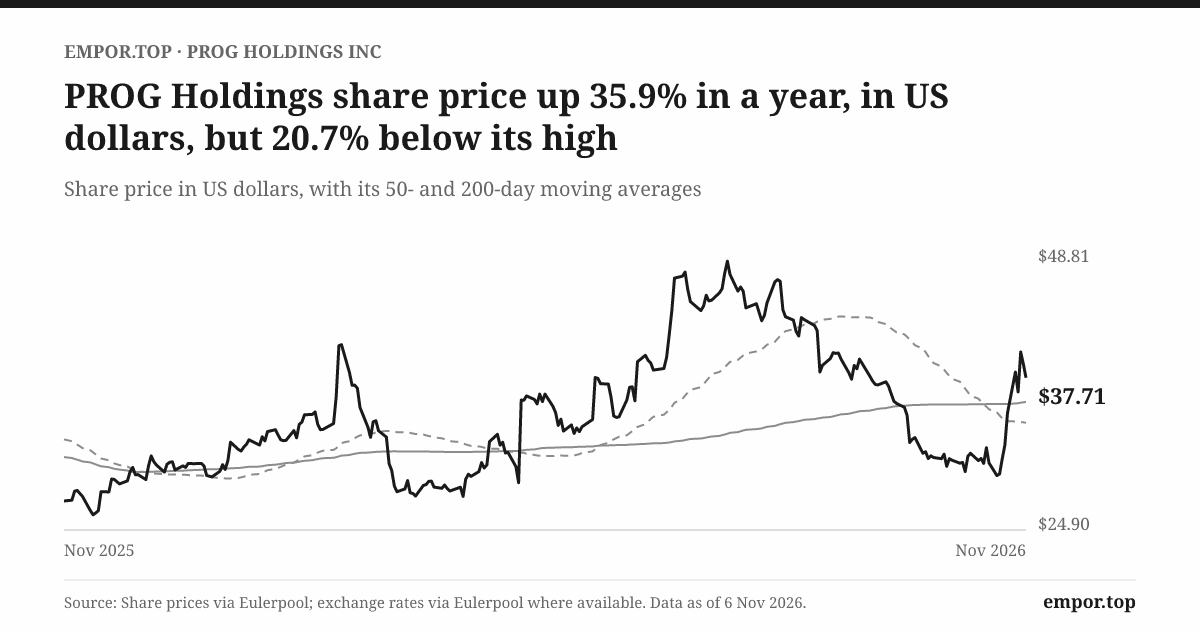
The shares closed at $37.71 on November 6, below the $41.47 average of the third-quarter repurchases. The ASR's final cost and the number of shares delivered will be set by the volume-weighted price during the program.[^1] That settlement will show whether the timing was good.
The people making these decisions matter as much as the decisions. Michaels' reported compensation was about $9.2 million in 2023, $13.3 million in 2024 and $9.9 million in 2025, against net earnings of about $139 million, $197 million and $147 million.4 His 2025 package included about $7.4 million in stock awards.4 Pay fell in 2025 along with earnings, which is the direction shareholders want.
Then, in May 2026, the board made a governance change. It named Michaels chairman as well as chief executive, appointed director Ray Robinson as lead independent director and granted Michaels a one-time $5 million restricted stock award vesting in years three through five.13 The grant ties a significant payout to his staying through the Purchasing Power integration and beyond. The combined role also concentrates authority in one person at exactly the moment the company is making its biggest bets.
Shareholders mostly went along. At the May annual meeting, executive compensation received about 32 million votes for and 2.8 million against, roughly 92% support of votes cast.13 Robinson drew the most director dissent, about 2.5 million votes against.13 Approval of pay does not settle the debate over combining the CEO and chair roles. It does show that holders such as BlackRock and Vanguard, which owned about 15.3% and 11.5% of the shares in their most recent ownership filings, did not revolt.4
What should an activist-minded investor make of this record? On one hand, management has done what it said: it borrowed for Purchasing Power and paid back recourse debt within nine months. On the other, the company is now buying back stock after cutting guidance, with a newly combined chair-CEO and a fresh retention grant, and it is doing so before the acquired business has been through a single holiday season under PROG. The decision is defensible. It also leaves less margin for error.
Credible capital allocation needs a durable business underneath it. That brings the story back to the question no buyback can answer: what, exactly, protects PROG's place at the checkout?
IX. What Would Make the Checkout Position Defensible?
Consider PROG's position through the eyes of a retail partner's CFO. That partner might be one of PROG's two largest.6 Every holiday season, that CFO decides which payment options appear on the checkout screen, in what order and on what terms. PROG is one of them. Others are knocking.
Big Lots showed what happens when a partner's fortunes turn. Its bankruptcy and store closures hurt Progressive Leasing in 2025.6 That happened while Four was growing, which is the point: a broad network can still contain concentrated points of failure, and newer products do not insulate the core from them.
The competitive structure is crowded. Progressive Leasing competes with other virtual lease-to-own providers and store-based rent-to-own operators, including Upbound Group's Acima and Rent-A-Center businesses.6[^17] It also competes with retailers' own financing programs, installment lenders, BNPL providers and other checkout options aimed at shoppers with weaker credit.6
Upbound is the closest public comparison, and it is larger. It reported about $4.7 billion of revenue in 2025, roughly twice PROG's approximately $2.4 billion.[^17]6 But Upbound combines store-based rent-to-own, Acima's virtual lease-to-own and other businesses, so that ratio is not a market-share figure. It does show that PROG's main rival has scale, and that the retailer choosing a lease provider has at least one well-resourced alternative.
Run the industry through Michael Porter's five forces, and the picture is consistent. Buyer power, in the form of retail partners, is high: they control placement.6 Rivalry is intense, and the 10-K warns that competitors may seek better payment-platform placement and may price or underwrite aggressively.6 Substitutes are many, from BNPL to store cards. Supplier power is moderate, mainly in the form of funding markets and the retailers that sell PROG the merchandise. The threat of new entrants is tempered by regulation and the need for underwriting data, but the FTC record shows that regulation is a cost for incumbents too.
Hamilton Helmer's seven powers framework asks a sharper question: which durable advantage lets a company earn more than its cost of capital over time? The candidates for PROG are few. Scale economies exist in decisioning data and integration, but Upbound is larger. Switching costs for retailers are modest; integrating a new lease provider takes effort, but it is done routinely. Consumers face almost none. There is no network effect in the classic sense, no cornered resource and no brand that draws shoppers to a retailer because PROG is there.
The most defensible candidate is process power: years of underwriting data and decisioning across economic cycles. Michaels leaned on exactly that on the call, saying "we have seen this movie before" and that the portfolio can be managed in "a very tight band."[^1] The short duration of leases, which turn over in months, lets PROG change its approval rules and see the results quickly.[^1]
The record narrows that claim. PROG tightened sharply in early 2025, tightened again in the second quarter of 2026 and again after the July call.[^1] Write-offs still rose above the prior year's level, and management told investors to expect the high end of the target range.[^1] Process power exists, but it manages losses rather than preventing them, and it cannot manufacture demand when partners shrink or customers retreat. The evidence does not establish a cornered market, consumer switching costs or sustained pricing power.
Technology is a two-sided force here rather than a threat of displacement. Lease-to-own is not software that an AI model can replace; someone still has to buy the refrigerator and collect the payments. But decisioning, fraud detection and application flow are where rivals compete, and better models, at PROG or at its competitors, can shift approval rates and losses quickly.6 PROG's own moves, from a shorter application for returning customers to Four's new underwriting model, show the company investing in that race.[^1] They do not show it winning, because every competitor is running the same race.
The bull case is still coherent. PROG has a large point-of-sale network, a lease book that has just turned back to growth and short-duration products that allow fast adjustment.[^1] Four has scale, profitability and a loyal subscription base.[^1] Purchasing Power adds an employer channel that does not depend on retailer checkouts.2 If all three continue, PROG could be a more balanced, more resilient company by 2028, and its buybacks could look prescient.
The bear case is equally coherent. Standalone revenue has moved sideways since the spin-off.6 The core depends on two large partners and on customers whose budgets are being squeezed by inflation and fuel prices.[^1]6 Credit losses are elevated. The newest acquisition is unproven through a full year and funded partly with secured debt that can tighten at a bad moment.9 In that version, PROG ends up with more complexity, more acquired intangibles and no durable growth.
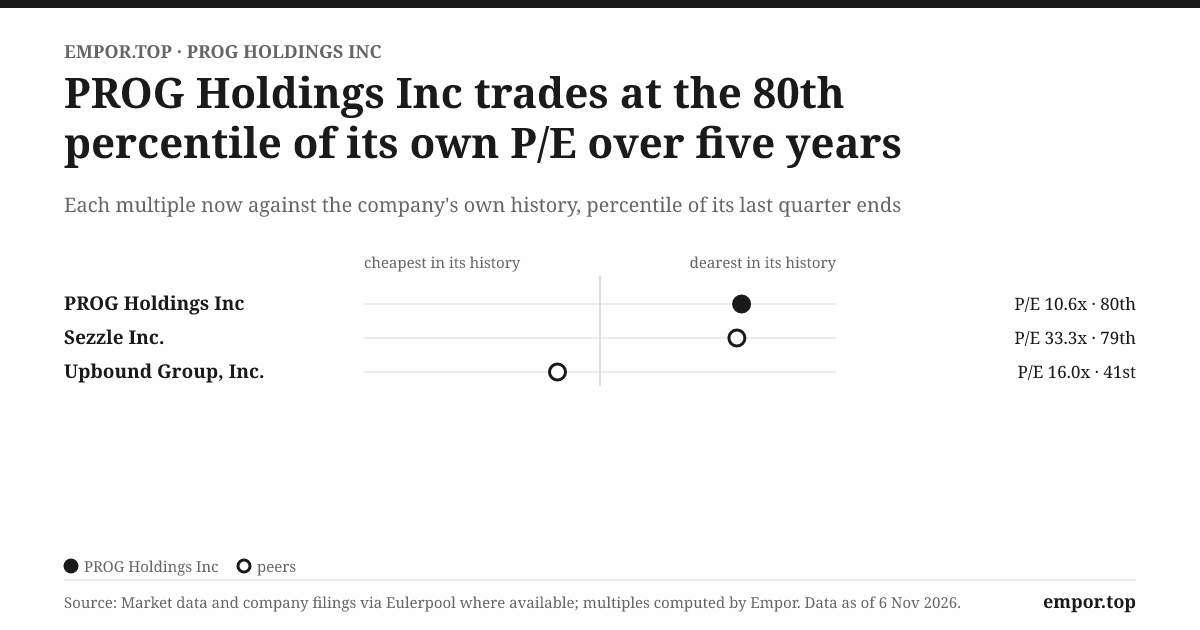
Valuation sits between those cases. On November 6, the shares traded at about 10.6 times trailing earnings, above the company's own five-year median of about 8.2 times. The market is paying more than it usually has for a PROG earnings dollar, which suggests it is giving some credit to the new mix. But the earnings base is changing with acquisition accounting, and the commonly quoted EV/EBITDA figure for PROG is distorted by how lease depreciation flows through EBITDA, so it is not a clean comparison across the changing business boundary.
Three operating measures will decide which case wins. The first is Progressive Leasing's GMV and lease asset balance: GMV grew 2.3% in the third quarter and the asset balance just turned positive, and the direction must hold through the holidays.[^1] The second is credit: leasing write-offs at 8.3% of revenue, against a 6% to 8% target, and Four's provision rate, which is improving.[^1] The third is segment pretax earnings at Purchasing Power after its seasonal peak, which were about $3 million in the third quarter after a loss earlier in the year.[^2]1
PROG has a real distribution and underwriting operation. Its investment case rests on preserving partner placement, managing credit and making new channels profitable. None of those is guaranteed by the past, and each is visible in the next few quarters. What PROG's history teaches about these bets may be the most useful part of all.
X. Playbook: Business & Investing Lessons
Three purchases frame PROG's life. Aaron's paid $700 million in 2014 for a store-free leasing company with thin first-year profits.3 PROG paid an estimated $22.7 million in 2021 for a BNPL app.[^11] And PROG paid $420 million in 2026 for a payroll-deduction platform with its own debt.2 Each looked different on announcement day from how it looked a few years later. Together they teach lessons that belong to this company.
The first lesson: distribution is an asset until the partner changes its mind. Progressive's original pitch was 15,000 storefronts it did not have to own.3 That reach made it valuable. But reach owned by someone else can be withdrawn, shrunk or reshuffled, and Big Lots showed how quickly a partner's collapse becomes your volume decline.6 For founders, renting someone else's customers is a fast way to scale and a slow way to build a moat. For investors, the right question about a distribution business is not how many doors it has, but how many of them it would miss.
The second lesson: a product's growth rate is not its contribution to the company. Four grew a hundredfold in five years, by management's count, and is now profitable.[^1] Yet in the third quarter its revenue was about a twentieth of PROG's total, and leasing still carried the earnings base.[^2] The fastest-growing line on the slide is the one that gets the attention. The line that pays for the buybacks is the one that deserves the scrutiny. Small acquisitions can become meaningful businesses; they rarely become the company in the time an investor is waiting.
The third lesson: a new channel earns its price through collections and profit, not its promised synergies. Purchasing Power arrived with 360 employer relationships, 7 million potential customers and a cross-selling story.2 It also arrived with a receivables book expected to collect about $56 million less than its contractual balance and a stack of secured debt with tripwires.9 The acquisition rationale will be judged by one number before any other: pretax earnings after its first holiday season inside PROG. Synergies are a forecast. Collections are a fact.
The fourth lesson is the one the FTC wrote into PROG's operating manual: in consumer finance, the disclosure is the product. A lease that costs roughly twice the sticker price if paid to term can be a rational choice for a customer who needs a refrigerator now.8 It becomes a regulatory and reputational problem when the customer does not see that total. PROG's $175 million settlement turned transparency from a courtesy into a condition of doing business, and the 2024 information request shows that condition never expires.18
And there is a fifth, for anyone allocating capital: buy back stock with the cash you have, not the confidence you feel. PROG has repaid debt quickly and has room to repurchase shares.[^1] The ASR may prove well-timed. But the decision to spend most of a year's deleveraging on a buyback, on the same morning the outlook was lowered, is a bet that management's view of 2027 is right. That bet is now on the balance sheet.
XI. Epilogue
Tonight, PROG stands at the start of the most revealing two months in its recent history. Black Friday is three weeks away, bringing the test of Purchasing Power's first holiday season inside PROG,[^1] Progressive Leasing's return to revenue growth,[^1] and the expected execution of PROG's $100 million ASR.[^1]
Management has drawn the scorecard in advance. Its revised 2026 outlook for continuing operations calls for revenue of about $3.0 billion to $3.05 billion, adjusted EBITDA of $345 million to $355 million and non-GAAP earnings per share of $4.70 to $4.85.[^1] That outlook assumes current conditions persist, no material change in decisioning, no meaningful rise in unemployment among PROG's customers and only the initial 80% delivery of ASR shares.[^1]
Watch Progressive Leasing first. If GMV keeps growing through the holidays while approval rates stay tight and write-offs fall back toward the middle of the target range, management's claim of a business "inflecting back to growth" will gain real support.[^1] If write-offs stay near the top of the range as the pre-tightening pools run off, the story becomes one of a core business that is stable only by shrinking its customer base.
Watch Four next. Its holiday quarter is busy, and its losses are reserved up front.[^1] Rising GMV alongside a stable or falling provision rate would answer the public questions about its credit. Rising losses would mean growth is being bought.
Then watch Purchasing Power, the deal that gives this story its title. The company expects the new 80,000-employee client to be live for the holidays and another, with more than 50,000 employees, to launch in early 2027.[^1] If fourth-quarter pretax earnings are strong enough to erase the nine-month loss and the securitized debt keeps falling, the $420 million price will start to look like it bought a second engine. If the season disappoints, the triggers in those receivables facilities become relevant, and the acquisition becomes a funding question as well as an earnings one.9
Finally, reconcile the cash. Garner expects leverage near 2 times at year-end after the ASR.[^1] The February results will show the final ASR price and share count, the year-end asset-backed debt balance and the integration spending, and with them whether shareholder returns, debt reduction and investment can all fit inside one balance sheet in 2027. They will also show whether S&P's negative outlook, set when the deal was announced, survives a full year of evidence.12
Michaels told analysts he believes "the best chapters of PROG's story are still in front of us."[^1] The next results will show whether the new channels add durable earnings while the legacy business stabilizes. Until then, PROG is a company growing in revenue, careful in credit and generous with its shareholders, all at the same time, and the tension between those three is not yet resolved.
XII. Outro
Go back to that October morning. Revenue up a quarter. The outlook down. A $100 million buyback on the table. It sounded like three different companies talking, and in a sense it was.
But all three depend on the same moment: a person at a checkout, or in an employee benefits portal, deciding whether to accept an offer from a company they may never have heard of. For PROG, that moment has to work three times over. The payment option has to earn the customer's trust, so the terms are understood. It has to earn its place on the retailer's screen or the employer's menu, against rivals who want the same spot. And it has to earn a return after credit losses, when the customer's budget is squeezed by the price of gas.
That is what makes PROG unlike a simple growth story. It is a company built on borrowed access: other people's stores, other people's employers, other people's money. Its future depends on turning that access into profit faster than a retailer, a borrower or a balance sheet can take it away.
References
-
Q3 2026 Form 10-Q — PROG Holdings / SEC, 2026-10-28 ↩↩↩↩↩↩↩↩↩↩↩↩↩↩
-
Purchasing Power Acquisition Close — PROG Holdings / SEC, 2026-01-02 ↩↩↩↩↩↩↩↩↩
-
Aaron's 2014 Form 10-K, Progressive Finance acquisition — SEC, 2015 ↩↩↩↩↩↩↩↩
-
2026 Proxy Statement — PROG Holdings / SEC, 2026-03-26 ↩↩↩↩↩↩↩↩↩
-
2025 Form 10-K — PROG Holdings / SEC, 2026-02-18 ↩↩↩↩↩↩↩↩↩↩↩↩↩↩↩↩↩↩↩↩↩↩↩↩↩↩↩↩↩↩↩↩↩↩↩↩↩↩↩↩↩↩↩↩
-
Progressive Leasing FTC Case Record and Settlement — Federal Trade Commission, 2020-04-22 ↩
-
Rent-to-Own Payment Plan Company Progressive Leasing Will Pay $175 Million to Settle FTC Charges — Federal Trade Commission, 2020-04-20 ↩↩↩↩↩↩↩↩↩↩
-
Q2 2026 Form 10-Q — PROG Holdings / SEC, 2026-07-29 ↩↩↩↩↩↩↩↩↩↩↩↩
-
Purchasing Power Acquisition Presentation — PROG Holdings, 2025 ↩
-
S&P Revises PROG Outlook to Negative After Purchasing Power Acquisition — Investing.com, 2025-12-09 ↩↩
-
2026 Annual Meeting Results and Leadership Changes — PROG Holdings / SEC, 2026-05-07 ↩↩↩
 LinkedIn
 WhatsApp
 Reddit
 Hacker News
 Email
 Kindle
 RSS Feed
 Spotify
 Apple Podcasts
 Amazon Music
 Audible
 YouTube