Sezzle Inc.: Can Pay-in-Four Become a Financial Ecosystem?
I. The Checkout That Became a Loan Book
On the afternoon of August 6, 2026, Charlie Youakim opened Sezzle's second-quarter earnings call with an anecdote rather than a number. Earlier in the quarter, he said, he had told his leadership team that the company's volume curves looked a lot like 2020 and 2021, the hypergrowth years. His tip-off was that May's gross merchandise volume had passed the previous December's holiday volume.
In recent years, Sezzle had had to wait until August for that to happen.1 For a business built on online shopping, that is like a ski resort reporting that a weekday in spring was busier than Christmas week. Then Youakim did what he had done three months earlier and raised full-year guidance again.1
The quarter behind that mood was strong by almost any measure. Revenue rose about 52% from a year earlier to $149.7 million, net income was $40.8 million, and gross merchandise volume, the dollar value of purchases shoppers financed through Sezzle, grew about 38% to a record of roughly $1.3 billion.1 Management now expected revenue to grow about 35% for the year and adjusted net income to reach $185 million.1 The number Youakim most wanted listeners to remember was neither of those. It was 854,000, the count of active subscribers paying Sezzle a monthly fee, up 76% in a year.1
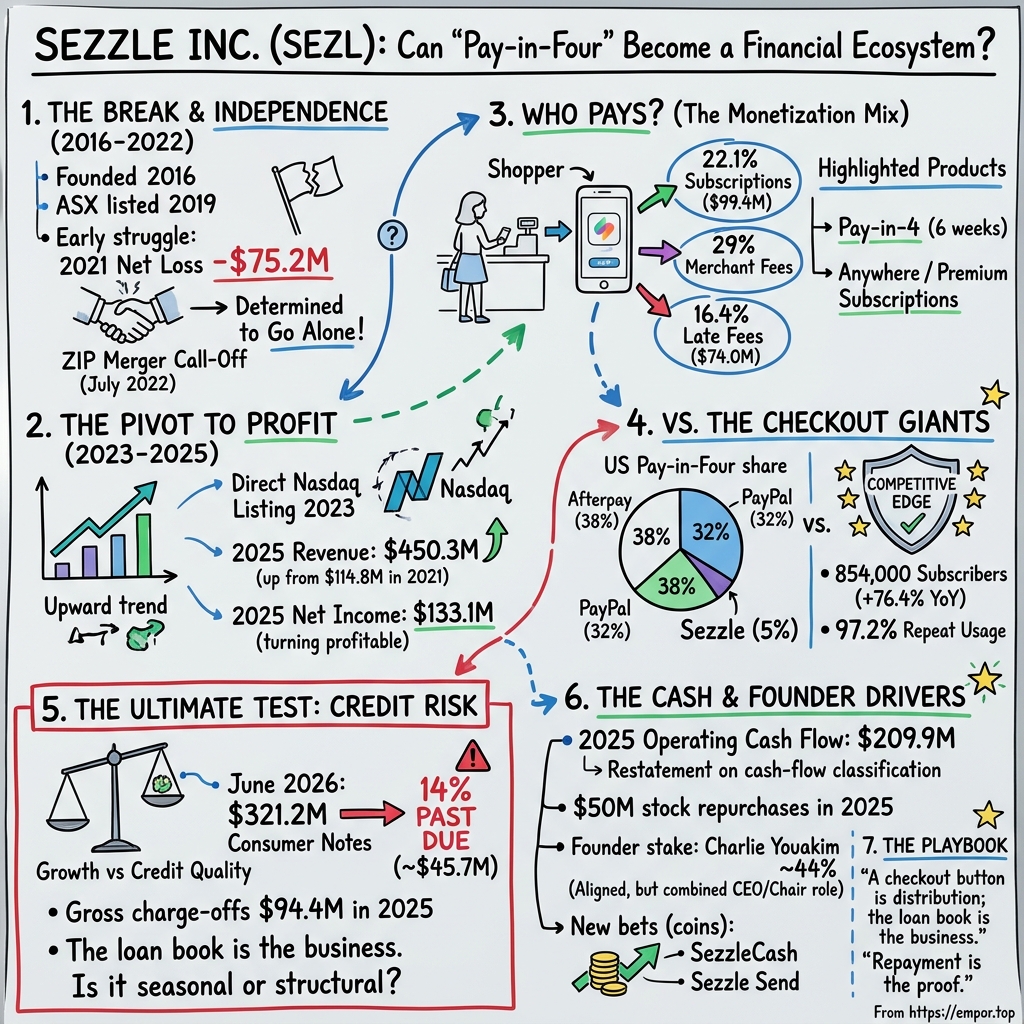
There was another number from the same quarter that did not appear in his opening remarks. At June 30, 2026, Sezzle carried about $321 million of consumer installment notes on its balance sheet, and about $46 million of them, roughly 14 cents of every dollar, were between one and ninety days past due.2 Against that book the company held a credit-loss allowance of $32.0 million, about a tenth of the balance.2 That is the quiet half of the Sezzle story. Every "Pay in 4" button on a merchant's checkout page is also a small, unsecured loan to a shopper, and the shopper who taps it becomes, for six weeks, Sezzle's borrower.
That tension frames the three questions this story keeps returning to. The first is whether the subscription business is making Sezzle's revenue more durable, or whether it simply dresses up a transaction business in a monthly fee. The second is whether the company can keep enlarging its loan book without the credit quality of that book sliding as it grows. The third is whether the profits now arriving each quarter turn into cash that shareholders can actually receive, after the business has funded the loans that create those profits.
Before going further, the boundaries matter. Sezzle Inc. is a Delaware public benefit corporation whose shares trade on the Nasdaq Capital Market under the ticker SEZL.3 It is not a subsidiary of anyone. In 2022 it agreed to merge with the Australian BNPL company Zip, and many investors still half-remember Sezzle as "the one Zip was buying," but that deal never closed and Zip never controlled Sezzle's economics.4 Everything in this story is Sezzle's own business, run by the same founders who started it.
The paradox at the center of the second quarter is that two things were true at once. Growth was not just fast but accelerating in the metrics management cares about: more subscribers, more purchases per user, more revenue per user. And the loan book that growth produced was carrying more late balances in absolute terms than it had six months earlier, while the company's own finance chief was telling investors to expect credit provisions to climb through the rest of the year.1 Neither fact cancels the other. They describe a lender in the middle of an expansion, which is exactly the moment when a lender's true quality is hardest to see.
The reporting clock also shapes what can be known. The latest full set of figures is for the quarter ended June 30, 2026. Sezzle scheduled its third-quarter results for November 4, 2026, so the cohorts of shoppers acquired during the spring marketing push, the ones whose repayment will tell investors whether that growth was healthy, had not yet been reported on as of late October.5
So the story begins with a puzzle. A company that started as a payment button has turned itself into something that looks like a subscription app, a consumer lender and a would-be bank, and it now books more revenue in a single quarter than it did in 2018, 2019 and 2020 combined. To understand whether that is a durable business or a lending cycle at its sunny peak, it helps to go back to the summer when Sezzle nearly stopped being an independent company at all.
 Subscribe on LinkedIn
II. The Merger That Fell Through
On February 28, 2022, Sezzle signed an agreement to be acquired by Zip Co, the Sydney-based buy-now-pay-later company, through a merger subsidiary with the playful name Miyagi Merger Sub.4 It was the logical deal of a frothy moment. Pay-in-four had been one of the hottest corners of fintech through the pandemic, Block had agreed to buy Afterpay, and smaller players were consolidating in the hope that scale would let them survive against PayPal, Affirm and Klarna.
Then interest rates started rising, BNPL valuations collapsed, and the logic of the deal soured. On July 11, 2022, the two companies signed a termination agreement "by mutual consent," and Zip paid Sezzle $11 million to cover its legal, accounting and other deal costs.4
The filing that announced the end of the deal said nothing about why it ended.4 What it meant was plainer. Sezzle would have to make its own model work, as a small company, in a market whose cost of funding had just jumped and whose investors had suddenly stopped paying for growth. Sezzle came out of 2022 with the same operating regime and a problem that no merger would now solve for it.
That problem was visible in the income statement. Sezzle had been founded in 2016 and had gone public on the Australian Securities Exchange in July 2019.61 The early years were a classic land grab. Total income went from about $1.6 million in 2018 to roughly $115 million by 2021.67 But each dollar of growth had come with losses attached.
Sezzle lost $75.2 million in 2021 and another $38.1 million in 2022.78 Youakim later offered a vivid snapshot of those years: in the second quarter of 2019, the quarter before the ASX listing, Sezzle's gross margin after transaction costs was negative, a loss of about $260,000 on $2.6 million of revenue.1 The company was, in effect, paying to lend.
Charlie Youakim was well suited to that phase and its aftermath. He trained as a mechanical engineer at the University of Minnesota, earned an MBA at the university's Carlson School and began his career as an engineer and software developer.9 Before Sezzle, he founded Passport Labs in 2010, a software and payments company for transportation, the kind of business where the product is a payment that has to work every time.9 At Sezzle he planned much of the technology architecture himself.9
His co-founder, Paul Paradis, came from the other side of the house: he started his career in sales with the Minnesota Timberwolves, ran sales and marketing at two consulting firms, and joined Sezzle as chief revenue officer in 2016 before becoming president in 2020.9 An engineer who builds and a salesman who closes is a familiar founding pair, and it maps neatly onto the two halves of a BNPL company: the credit and payments plumbing, and the merchant distribution.
Revenue kept rising through the turn. Total income rose from about $126 million in 2022 to about $450 million in 2025.83 The growth rate was not steady. It slowed to about 27% in 2023 as the company tightened underwriting, then jumped to around 70% in 2024 and 66% in 2025.83 The more important change was below the revenue line. Sezzle reported its first annual profit, $7.1 million, in 2023, followed by $133.1 million in 2025.83
How Sezzle got to Nasdaq tells a related story. In 2023 it moved its listing from Sydney to New York: it registered existing shares for resale and began trading on Nasdaq through a direct listing.10 The resale prospectus of August 2023 allowed existing holders to sell; it was not a conventional initial public offering, and it did not raise a pool of fresh growth capital for the company.10 That detail matters for how the profit turn should be read. Sezzle did not reach profitability by burning a big new IPO war chest. It reached profitability by changing what it did with the customers it already had, which is the subject of the next section.
There is a popular version of this arc that sees Sezzle as a rocket that simply kept climbing. The record supports a narrower claim. The revenue climb is real and long. The profit record is real but young: three profitable years, all of them in a period of generally resilient American consumer credit. Every one of those profitable years came after the 2022 retrenchment, which means the current model has not yet been tested by a recession, a sharp rise in unemployment, or a funding market that closes for lenders of Sezzle's size.
That caveat should travel with the story. When later sections weigh Sezzle's claims about subscriber loyalty and credit discipline, the relevant history is not only the last three good years but also the earlier ones, when growth and losses moved together. The question the failed merger left behind is whether Sezzle learned how to make the four installments pay, and who, exactly, ends up paying for them.
III. Who Pays for the Four Installments?
Picture a shopper on a phone, about to buy a $120 pair of sneakers. At checkout she sees the option to split the price into four payments of $30, the first due today and the rest every two weeks, about six weeks in all.3 She taps it. The merchant gets paid almost immediately, minus a fee. Sezzle now holds a small, interest-free loan to the shopper.
A few days later the Sezzle app suggests she join Sezzle Anywhere, a subscription that lets her use the same split-pay option at almost any store, not just Sezzle's partner merchants.1 Within a few minutes, one purchase has opened three possible revenue streams: the merchant's fee, the shopper's subscription, and, if she misses a payment, a late fee.
The original pay-in-four bargain was simple. The merchant paid because the installment option made shoppers more likely to complete a purchase and spend more. Sezzle charges merchants a percentage of the purchase plus a fixed fee per transaction, and it earns additional income from partners, interchange on its virtual cards, consumer fees and subscriptions.3 That merchant fee is the reason a 0% loan to a consumer can be a business at all: the merchant, not the borrower, pays for the credit.
By 2025 that was no longer the main way Sezzle made money. Merchant and partner income was only about 29% of revenue.3 Subscriptions brought in $99.4 million, about 22%.3 Late-payment fees were $74.0 million, about 16%.3 The rest came from consumer fees and other income tied to products such as On-Demand. In other words, more than two-thirds of Sezzle's revenue came from consumers rather than from the merchants who were supposed to be paying for the service. That is the single most important fact about Sezzle's model, and it explains both its recent profitability and its central risk.
The product shelf behind that mix is less complicated than it sounds, and none of it is a separate business segment. Pay-in-four is the core. Sezzle On-Demand lets a shopper use the product without subscribing, paying a fee each time instead.3 Sezzle Premium and Sezzle Anywhere are monthly subscriptions that unlock larger limits and wider merchant coverage.3 In early 2026 Sezzle added Pay in 5, which spreads repayment over one more installment and, Youakim told analysts in May, was "already proven to have results."11 The engine is one consumer relationship with several price tags attached.
Sezzle has also been building reasons for shoppers to open the app between purchases. An "Earn" tab, launched in June 2025, offers surveys, trivia, giveaways and cashback, and by the first quarter of 2026 it had logged 4.8 million visits; management said consumers showed a 55% increase in BNPL conversion within 30 days of their first Earn activity.11 Card-linked offers reward spending on Sezzle's virtual card at partner merchants.1 None of this is revenue on its own. It is the plumbing of habit, and habit is what a subscription business ultimately sells.
The turn toward subscriptions was a deliberate choice, and the second-quarter call showed it in motion. Sezzle used to lead with On-Demand when shoppers first met it at a merchant's checkout; now it leads with the subscription, and On-Demand appears mainly at enterprise merchant checkouts.1
The result is that the On-Demand user count has been falling while subscriptions rise, which a TD Cowen analyst asked about directly. Youakim said some On-Demand users were converting, but that most of the change came from what Sezzle chose to show people first.1 That is a candid answer, and an important one: the subscriber surge is partly a product of Sezzle steering its own funnel, not purely of new demand.
Does this make Sezzle's revenue recurring in the way investors use that word for software? Only in a limited sense. Subscription fees are paid in advance, but Sezzle recognizes its subscription obligations over periods of a year or less, and the company does not disclose a minimum subscription term, subscriber retention by cohort, or what share of revenue is contracted.3 A month-to-month app subscription that a shopper can cancel the day after a big purchase is a closer cousin of a gym membership than of an enterprise software contract. It can be sticky. It is not committed.
Then there is the question every consumer lender eventually has to answer: who pays late? The answer is the consumer. Late fees of $74 million in 2025 were not a rounding error; they were larger than all the profit Sezzle had earned in any year before 2025.3 Late-fee income has a peculiar quality as a revenue stream. It rises when customers struggle, so it can flatter revenue at exactly the moment credit is getting worse. And much of it is never collected.
By June 2026 Sezzle carried $18.7 million of gross delinquency-fee receivables, up from $14.8 million at the end of 2025, against an allowance of $14.0 million.2 Put plainly, the company expected to collect only about a quarter of the late fees still sitting on its books. In 2025 it booked a separate provision for these "other credit losses" of $33.5 million, a figure equal to almost half the late fees it reported as revenue that year.3
That does not make late fees fictitious. Fees that are collected are real income, and the provision is the accounting system doing its job. It does mean the 16% of revenue labeled "late-payment fees" is worth considerably less than its headline, and that a reader should never look at late-fee revenue without the matching loss line beside it.
Management's preferred lens for all of this is a non-GAAP measure it calls revenue less transaction-related costs, sometimes "net transaction margin." It takes revenue and subtracts transaction processing expense, the provision for credit losses and net interest expense, and the company targets a range of 55% to 65% of revenue.1 In the second quarter of 2026 it came in at 63.5%, near the top of that range.1 In the first quarter it had been an unusually high 74%, and CFO Lee Brading warned investors not to annualize it.11 The reason is seasonal and worth understanding.
Brading explained the pattern on both calls with unusual patience. Revenue yield, total revenue divided by GMV, tends to peak in the first quarter, because some holiday payments and their fees spill over into January. Credit losses are lowest in the first quarter, because American consumers receive tax refunds early in the year and use them to catch up on what they owe.11
Through the rest of the year the yield drifts down and the provision drifts up, so the fourth quarter tends to be the low point for revenue yield.1 For 2026 he expected revenue yield roughly equal to 2025's 11.4%, after a second-quarter reading of 11.7% that had benefited from an easy comparison with the year before.1
The analysts' questions on the second-quarter call mostly circled this machinery. Oppenheimer's Rayna Kumar asked whether the jump in revenue yield came from mix or pricing. Brading's answer was that a year earlier the yield had been unusually low, and that changes in "types of fees or the rates that we had" had now settled, so the comparison would be more normal from the third quarter onward.1
Needham's Kyle Peterson asked why yield would stay flat when Pay in 5 should be accretive; Brading said newer products such as the Pagaya-powered long-term loans and SezzleCash carry lower take rates even when their profitability is similar.1 These are reasonable answers. They also confirm that the revenue line is shaped by fee design choices that the company can, and does, adjust.
So who pays for the four installments? The merchant pays for some of it, the subscriber pays for more of it, and the borrower who falls behind pays for a meaningful slice, with a large share of that slice later written off. Sezzle has built a genuine subscription revenue stream of nearly $100 million a year. It has not yet shown that the stream is durable through a downturn, or that subscriber economics hold up once fee-driven revenue is netted against the losses that come with it. The next question is whether any of this is defensible when the checkout page also offers PayPal, Afterpay, Klarna and Affirm.
IV. The Subscription Bet Meets the Checkout Giants
Go back to the sneaker checkout and look at the row of buttons. A typical large American online store today may show PayPal's Pay in 4, Afterpay, Klarna, Affirm and Sezzle side by side, sometimes under the same "pay later" heading. The shopper chooses in a second, often by habit. The merchant can add or drop any of them with an integration change. That row of buttons is the competitive arena, and Sezzle's strategy is essentially an attempt to win the shopper before she ever reaches it.
The industry's structure is unforgiving in three ways. Consumers multi-home: the same shopper can carry three BNPL apps and pick whichever offers the bigger limit that day. Merchants multi-source: there is little technical cost to offering several providers at once. And the biggest rivals already sit inside larger distribution systems, PayPal in its wallet and Block's Afterpay inside Cash App and Square, which lets them bundle installments with products the consumer already uses.
The cleanest measure of where Sezzle stands comes from the Federal Reserve. A Fed research note published in June 2026 estimated 2025 market shares across U.S. buy-now-pay-later issuance. In pay-in-four loans, the original product, Afterpay and Block together held about 38% and PayPal about 32%; Klarna had 9%, and Affirm and Zip about 8% each. Sezzle had 5%.12 Across all BNPL credit, including longer loans, Sezzle's share was about 3%.12 The Fed sized the total market at roughly $157 billion of annual issuance, about half of it in pay-in-four.12 Sezzle, by this measure, is the smallest of the six named players in pay-in-four, at roughly one-seventh the size of either leader.
That number deserves a moment, because it contradicts a common impression. Sezzle's growth rates and profit margins have recently looked better than many larger rivals', which can make it feel like a market leader. It is not. It is a niche lender, focused, in Youakim's words, on "Middle America, value-seeking consumers," that has found a profitable corner of a market dominated by two giants.11 Profitable corners can be excellent businesses. They can also be the first places a giant chooses to cut price.
Sezzle's strongest counterargument is engagement. In the second quarter of 2026, Sezzle added 140,000 net new subscribers, its largest gain since launching the program.1 Repeat users accounted for 97.2% of orders, and the average consumer made 7.2 purchases in the quarter, up from 6.1 a year earlier.1 Average quarterly revenue per monetized user rose about 16%.1 Youakim called frequency "the metric that tells us whether the ecosystem is actually working."1 These are real behavioral numbers. A shopper who uses an app seven times a quarter is not a one-off checkout click.
Do they amount to a moat? A moat is evidence that customers cannot easily leave or that rivals cannot easily copy what the company offers. Frequency and repeat usage are consistent with loyalty, but they are also consistent with a shopper who uses Sezzle often while still using Afterpay and Klarna often too. Sezzle does not disclose subscriber retention by cohort, churn rates, or how much of its subscribers' BNPL spending it captures relative to rivals. Without those, the engagement data shows a well-used product, not a protected one.
The merchant side tells a more nuanced story. Sezzle reports that no single customer accounted for 10% of its revenue in 2024 or 2025, although one merchant had represented about 14% as recently as 2022.38 The company does not disclose its top-five or top-ten merchant shares. It does warn investors that a significant portion of its business depends on a limited number of scaled e-commerce platforms.3 That warning points straight at the most contested relationship in Sezzle's history.
In June 2025 Sezzle sued Shopify under the antitrust laws.3 Its central claims are monopolization, attempted monopolization and restraint of trade, and in May 2026 the court dismissed Sezzle's tying claim without prejudice but let its monopolization, attempted monopolization and restraint-of-trade claims proceed.2 Brading told analysts that discovery was expected to run through 2027.1
Sezzle says it does not expect the case to materially affect its financial statements, and it seeks an injunction and damages.2 The right way to read the suit is as evidence of a strained platform relationship. A small payments company does not take one of the largest e-commerce platforms to court over a minor irritation. But the filings do not describe a lost customer or a collapse in Shopify-related volume, so the suit is a risk signal, not a reported loss.
On the merchant offensive, Sezzle's newest weapon is On-Demand. Because On-Demand lets the consumer pay a fee, Sezzle can offer lower prices to enterprise merchants with thin margins, and Youakim named Poshmark, Gymshark and Debenhams among recent wins.1 Paradis added a revealing detail in the Q&A: in Sezzle's early days, a merchant would commit to one BNPL provider exclusively, but over the past two or three years Sezzle had started to be "added alongside other BNPL providers," as case studies showed that a second or third provider brought incremental sales.1
That is good news for Sezzle's sales pipeline. It is also an admission that the market has moved to multi-sourcing, which is exactly the condition that makes a durable merchant-side moat hard to build. Sezzle did not disclose the volume or economics of the new enterprise wins.
Management's own strategic framing points the same way. On the first-quarter call, Brading said Sezzle views merchants "primarily as a customer acquisition channel" and that the merchant side was becoming "a less important part of our overall business."11 Youakim compared BNPL to the history of credit cards, which began as closed-loop store products and became open-loop networks usable anywhere.11 If that analogy holds, the winner is the provider that owns the consumer relationship rather than the merchant slot, which is precisely the bet Sezzle Anywhere represents.
Youakim was careful about the timeline. He told analysts that the transition from closed-loop to open-loop BNPL would probably take five to ten years to play out, and that even the credit-card industry kept a closed-loop corner in private-label store cards.11 Sezzle's open-loop push is also geographically concentrated: Canada, where it was rolling out a virtual card that could eventually be used anywhere, is about 10% of its volume, so the bulk of the bet is being placed in the United States.11
The war-game, then, looks like this. Sezzle cannot outspend PayPal or Block on distribution, so it is trying to make its own app the place a value-focused shopper starts, with subscriptions, rewards, card-linked offers and now cash products that give her reasons to open it even when she is not shopping.1 The giants can copy individual features.
What they would struggle to copy quickly is Sezzle's underwriting data on its particular customer base and its willingness to tune products for that customer. Whether that is enough is the open question. For now the evidence shows a growing, engaged subscriber base inside a market where Sezzle holds a small share and both consumers and merchants keep their options open. The true test of whether those engaged customers are good customers sits on the balance sheet.
V. Growth Arrives in the Receivables
Open Sezzle's balance sheet at June 30, 2026, and the largest asset is not cash or software. It is $321.2 million of consumer installment notes, measured at amortized cost.2 Each note is a promise from a shopper to repay a purchase, generally within 56 days.2 This is not the familiar trade receivable of an industrial company, where a creditworthy corporate customer pays an invoice in 60 days. It is a portfolio of hundreds of thousands of small, unsecured consumer loans, most of them made to people who chose not to put the purchase on a credit card. And $45.7 million of that book, about 14%, was already past due.2
To read a lender, follow the aging. Sezzle reports its past-due notes in buckets, the way a doctor might chart a fever. Between the end of 2025 and June 2026, the balance between 29 and 56 days late rose from about $8.3 million to $11.9 million, and the balance between 57 and 90 days late rose from about $9.8 million to $11.0 million.2
Some of that rise is simply the book getting bigger and the seasons turning, since year-end balances benefit from holiday-period loans that are still young. But the later buckets matter most, because the longer a note stays unpaid, the less likely it is ever to be paid. Sezzle charges off notes once they are more than 90 days delinquent.2
The chain from those buckets to profit runs through three accounting lines. When Sezzle makes a loan, it sets aside a provision, an estimate of how much of that loan it expects to lose, and that provision is an expense in the income statement. The running total of those estimates, minus what has actually been written off, sits on the balance sheet as the allowance. When a note passes 90 days, it is charged off against the allowance.
If the original estimates were too low, the provision has to rise later to refill the allowance, and profit falls. If they were too high, the excess flows back and profit rises. That last effect is not hypothetical: on the first-quarter call, Youakim explained that part of that quarter's unusually low provision came from an "overestimation" in the prior quarter that "leaked into" the first quarter, and added that loss estimates "are almost 100% guaranteed to be incorrect one way or the other."11
The scale of the losses has grown with the business. Gross charge-offs, the notes written off before any later recoveries, were $94.4 million in 2025, more than double the $43.9 million of 2024.3 Revenue grew about 66% that year, so charge-offs grew faster than the business.3
Part of that is mechanical, since Sezzle was pushing harder into new users, and new users default more often than seasoned ones. Part of it may be a mix shift toward larger or longer products. The filings do not split the increase between those causes, which leaves a reader with the headline fact: in the year Sezzle earned the most it had ever earned, it also wrote off the most.
The first half of 2026 looked steadier. Sezzle booked a $44.3 million provision and had $40.8 million of net charge-offs, so it put slightly more into the allowance than it used.2 That is what a prudent lender should be doing during a growth spurt. It also coincides with the most favorable season, since tax refunds help first-quarter collections.11
A second clue sits beside the notes. Delinquency-fee receivables, the late fees billed but not yet collected, had grown to $18.7 million by June 2026, carrying an allowance of $14.0 million.2 That balance grows when more shoppers miss payments, and it has been growing. It is a quieter indicator than the notes themselves, but it moves in the same direction.
Product design shapes these numbers too. When Pay in 5 launched, Youakim acknowledged on the May call that it "does just logically have a slightly higher provision inherent to the idea," but said Sezzle had designed the product mix so that "the fees that are collected from some of the failures" roughly offset the extra losses, making it "almost like financially plays out as a wash."11 Brading added that Sezzle expected initially higher loss rates on Pay in 5 as it scaled.11
That is a revealing piece of economics. It means part of the model is built on the expectation that some borrowers will fail, and that the fees those borrowers pay will help cover the losses they cause. It is a legitimate design for a short-term lender, but it binds revenue and credit even more tightly than the headline revenue mix suggests, because a slice of the income depends on the same delinquencies the allowance is reserving against.
Management's case is coherent and explicit. Brading told investors in August that the full-year provision should fall between 2.5% and 3% of GMV, that individual quarters could exceed 3%, and that the step-up in provisions after the first quarter was expected because of seasonality and because Sezzle had just brought on a record wave of new subscribers.1
When Needham's Kyle Peterson asked whether anything had changed in repayment rates or consumer health on a like-for-like basis, Youakim said "everything seems just normal," with nothing unusual in the customer profile or the economy.1 He then added a caveat that deserves to be remembered: if the new products, especially Sezzle Send, attract more new users than expected, the provision will be higher than investors have modeled, because "new users have higher loss rates."1
That is an honest framework, and it is also a framework that ties growth and credit tightly together. Every time Sezzle steps on the marketing accelerator, it adds a cohort of borrowers it knows less about. The 2.5% to 3% range is a management target, not a measured outcome for the new cohorts, and the spring 2026 cohorts were still too young at the end of June to show their full loss curves.
The test is not whether the provision lands in the range for the year, which management can influence through underwriting decisions in the back half. The test is whether each vintage of loans, tracked from origination through 90 days, loses about what it was expected to lose.
The auditors flagged the same pressure point. In its report on the 2025 financial statements, Baker Tilly identified the allowance for credit losses as a critical audit matter, because the historical-loss-rate assumptions behind it require significant judgment.3 A critical audit matter is not a qualification or a warning that the numbers are wrong; it is the auditor's way of telling readers where the hardest estimates live. For Sezzle, the hardest estimate is the one that decides how much of its revenue becomes profit.
There is also a funding reason to watch these numbers. Sezzle's revolving receivables facility, which provides much of the money it lends, sizes its borrowing base off eligible pledged notes and reduces the advance rate if collateral loss rates rise.2 Worse credit therefore does not only reduce profit; it can also reduce how much Sezzle can borrow against its book at the moment it might most need flexibility.
Here, then, is the honest scorecard for the loan book. Growth and profits are strong, provisions in the first half kept pace with write-offs, and management has given investors a concrete range to hold it to. Against that, the past-due buckets are larger than they were six months earlier, 2025 write-offs more than doubled, and uncollected late fees are rising.
The history narrows management's claim rather than rejecting it: Sezzle has shown it can earn good margins through a full year of seasonal credit, but it has not yet shown that its rapidly growing subscriber base produces loans as good as the smaller, older one did. The number that would settle it is vintage-level net charge-offs and roll rates for the 2026 cohorts once they have aged through 90 days. Until then, the receivables are where growth shows up first, and where its quality will be decided. The next question is what happens to the cash those loans generate.
VI. The Cash Was Not Where the Headline Said
Read Sezzle's 2025 cash-flow statement quickly and it looks like a business throwing off far more cash than it earns. Operating cash flow was $209.9 million, against net income of $133.1 million.3 A year earlier the pattern was the same: $130.6 million of operating cash flow against $78.5 million of net income.3 For many companies, cash flow running well ahead of profit is the cleanest possible sign of quality. For a lender, it needs a second look.
The reconciliation explains most of the gap. A provision for credit losses is an expense that reduces net income but does not use cash in the year it is booked, so it is added back in the operating cash-flow calculation. In 2025 Sezzle added back $89.3 million of credit-loss provisions and another $33.5 million of other credit-loss provisions, plus equity compensation.3 Those add-backs alone exceed the gap between profit and operating cash flow. Working-capital changes pulled the other way, including a $36.0 million increase in other receivables and a $13.0 million fall in merchant payables.3
The deeper issue is where the cash actually goes. When Sezzle lends, the purchase of a consumer note is now reported as an investing outflow, and repayments come back as investing inflows.3 The losses on those loans, however, run through the income statement as provisions, which are then added back to operating cash. The result is that "operating cash flow" captures the revenue and the noncash loss estimate, while the money actually lent out and the money lost when notes are written off appear elsewhere. For a business whose core product is a loan, operating cash flow is not the same thing as cash left over for shareholders.
The classification itself has a history. In its 2025 annual report, Sezzle disclosed that it had incorrectly classified purchases and repayments of consumer notes as operating rather than investing activities, and it restated the 2024 cash-flow statement.3 The error did not change net income or any balance-sheet value; it moved cash between two lines of one statement.3 But it did change how a reader would have interpreted Sezzle's cash generation, and it exposed a gap in the company's controls.
The auditor's verdict was split in an instructive way. Baker Tilly gave an unqualified opinion on the financial statements themselves, meaning the numbers as restated were fairly presented, but concluded that Sezzle had not maintained effective internal control over financial reporting because of a material weakness in how these cash flows were classified.3 By the second quarter of 2026, Sezzle said it had implemented an enhanced control but did not yet consider the weakness remediated.2
In March 2026 the company also changed auditors, replacing Baker Tilly with PricewaterhouseCoopers, which it asked shareholders to ratify at the 2026 annual meeting.9 The proxy does not give a reason for the change.9 A new, larger auditor taking over in the middle of a remediation is not a red flag on its own, but it means the next audit opinion on Sezzle's controls will come from a fresh set of eyes.
Against this cash picture, Sezzle has been returning money to shareholders. It repurchased and retired $20 million of stock in 2024 and $50 million in 2025, and bought back another $28 million in the first half of 2026 under a $100 million program, most of it, about $24.8 million, in the first quarter alone.31311 Those are meaningful sums for a company of Sezzle's size. They also arrived while the company's loan book, and the funding needed to carry it, kept expanding.
That funding comes chiefly from Sezzle's revolving receivables facility. In May 2026 Sezzle amended it to a $300 million commitment, with a $75 million increase option and a maturity of May 7, 2029.2 The timing mattered: on the May call, Brading had noted that the existing facility was due to mature the following April.11
The amended facility charges three-month SOFR plus 3.86%, requires a minimum drawn balance of $50 million, and lets Sezzle borrow up to 92.5% of eligible pledged notes, a ratio that falls to 85% if collateral loss rates rise.2 At June 30, Sezzle had drawn $123.5 million and had $126.3 million unused.2 Brading put total liquidity, unrestricted cash plus undrawn capacity, at more than $205 million and described leverage of about 0.5 times trailing adjusted EBITDA.1
The facility also carries restrictions on distributions, share repurchases and affiliate transactions.2 Sezzle has no public credit rating disclosed in its filings; its debt is privately negotiated.3 So the real credit view on Sezzle belongs to its lenders, expressed through the borrowing base and covenants. The extension to 2029 removed a near-term refinancing deadline, and that is a genuine improvement. But the money available to Sezzle still depends on the quality of the very notes whose past-due balances are rising.
Put the pieces together and the verdict is clearer than the headline. Sezzle's cash generation is real: a business that earns over $130 million a year with low leverage is not cash-starved. But operating cash flow should not be called free cash flow here, because a lender's cash is consumed by the loans it makes, and Sezzle's loan book is growing. The restatement and the unremediated weakness mean the cash-flow statement itself needs careful reading for at least another audit cycle.
The figure investors need, and Sezzle does not report as such, is cash generated after funding net consumer-note originations, after losses, after repurchases and after funding costs, measured over several years. The decision about how much of that cash to hand back, and how much to keep for the next downturn, belongs to the man who still controls the company.
VII. The Founder's Flywheel—and Its Tests
Midway through his prepared remarks in August, Youakim described an experiment. In the second quarter Sezzle had spent $19.4 million on marketing, a figure he acknowledged was likely more than most analysts had modeled.1 The company's rule, he explained, is to push marketing as far as it can while each new customer still pays back the cost of acquiring them within six months, and on the data so far the spring cohorts were still inside that window.1
Then he did something unusual for a growth-company CEO with a winning hand. He said the step-up was "a deliberate step-up to test out higher levels of marketing spend and not a new run rate," and told investors to expect lower spend in the third quarter, all else equal.1 "Business is a bit art and a bit science," he said, and while the science said Sezzle could keep spending, "our gut is telling us that we feel more comfortable with strong return curves at lower levels of marketing spend."1
That moment captures the founder's style better than any biography. Youakim runs Sezzle like an engineer running a stress test: push the system, measure the response, back off before the edge. When KBW's Ryan Tomasello asked why Sezzle would pull back if payback was so strong, Youakim answered with arithmetic. The six-month threshold is the edge, he said, and the return only becomes visible over six months; if the estimate is off by 30%, payback stretches toward eight months, and Sezzle would not know until the cohorts had aged further.1 He compared the quarter to "hitting the gas in the car just to kind of see how the car reacted."1
The marketing push was not new. Sezzle spent about $31.5 million on marketing in 2025, more than three times the $9.0 million of 2024.3 The second quarter's $19.4 million was therefore larger than half of the entire 2025 budget, in a single quarter. The payback claim is management's measurement, and the company does not publish the underlying cohort data, so outsiders cannot check it. The behavior around it, however, is checkable: Youakim said spend would fall in the third quarter, while warning that new-product launches might offset some of the decline.1 Whether the third quarter matches that guidance is one of the simplest credibility tests the November results will offer.
The people around Youakim have changed in one important seat. Karen Hartje stepped down as chief financial officer effective January 31, 2026, and Lee Brading took over on February 1.9 Brading is not a career growth-company CFO. He spent years at Wells Fargo Securities and its predecessor Wachovia, rising to managing director and global head of credit research, and earlier worked as an audit manager at BDO Seidman; he joined Sezzle in 2020 and ran investor relations and corporate development before becoming CFO.9 A former credit analyst in the finance chair of a consumer lender is a sensible pairing, and his patient explanations of seasonality on both 2026 calls fit the profile. Paul Paradis remains president.9
Paradis's first job, selling for the Minnesota Timberwolves, has come full circle: Sezzle now sponsors the basketball team, a deal Youakim described in May as a brand-awareness play rather than a performance channel, while the paying channels are web, social, in-app and connected-TV advertising.11 It is a small detail with a larger point inside it. Sezzle's marketing is overwhelmingly measured, direct-response spending, the kind whose payback can be calculated cohort by cohort, which is exactly why investors keep asking to see those cohorts.
How is the founder paid? Modestly, given the results. Youakim's reported total compensation was about $1.94 million in 2023, $2.22 million in 2024 and $1.10 million in 2025, while net income rose from $7.1 million to $133.1 million.9 His 2025 pay included a base salary of about $552,000 and a cash profit-sharing bonus of $496,408, paid at 90% of target.9 Pay fell in the year profit was highest largely because no large stock award was made, so the figure says more about grant timing than about any discount Youakim granted himself. The real alignment is elsewhere: his stake in the company.
That stake is large, and how large depends on how it is counted. Youakim's Schedule 13D amendment of March 2026 reported beneficial ownership of 44.08%, including shares held through Cerro Gordo LLC and a family trust.14 The 2026 proxy showed 13.4 million shares, or 39.4%, under its own beneficial-ownership rules as of September 29, 2026.9 The two figures are measured differently and should not be read as a decline. Either way, a single founder holds close to two-fifths or more of the company, with BlackRock, at about 7%, the only other holder above 5% named in the proxy.9 In 2023 Youakim, Paradis and Paul Purcell together held about 46%.10
Concentrated founder ownership cuts both ways. It means the person making capital-allocation decisions bears a large share of the consequences, which is the strongest argument for the share buybacks: a founder with 40% of the company has little reason to overpay for its own stock. It also means minority holders have limited ability to influence the board.
Sezzle's board has five members, three of them independent; Youakim is both chair and CEO, and the board has not designated a lead independent director.9 One previously independent director, Karen Webster, resigned in April 2026.9 At the 2025 annual meeting, she had received the highest withhold vote of any director, about 1.59 million shares, and the say-on-pay resolution passed with about 98.9% support.15 Investors who wanted to protest had few levers, and mostly did not pull them.
There is one more thread that matters to minority holders. Youakim has pledged 11.86 million shares as collateral for personal borrowing, a $20 million demand loan according to his 13D filing.914 Sezzle is not a party to the loan.14 A demand loan can be called by the lender at any time, and if it were called and not repaid, the lender could sell the pledged shares, which would add a large block to the public float and could pressure the price at an awkward moment. Sezzle's audit and risk committee must approve pledging under company policy.9 The arrangement is disclosed and modest relative to the stake, but it is a governance exposure worth watching, not a footnote to skip.
The related-party record is small and plainly disclosed. In 2025 Nicholas Paradis, the president's brother, worked at Sezzle for about $283,800 in total compensation, and David Myos, Youakim's brother-in-law, earned about $197,000.9 The company says their pay followed standard employee practices.9 Together that is less than a tenth of one percent of 2025 revenue. Sezzle reports no management fees, royalties, affiliate loans or related-party receivables.39 For a founder-controlled company, that is a clean record.
On the calls, the gap between management's narrative and the analysts' requests is consistent. Management speaks in terms of payback periods, product "home runs" and engagement metrics; analysts keep asking for things the company measures but does not publish, such as cohort economics, the split of growth between user count and revenue per user, and the pace of credit normalization.
Youakim told Tomasello that he did not really focus on the split between user growth and revenue per user, and instead looked at product take-up rates.1 He also said Sezzle had had "only a couple products where I'd call them singles or strikeouts."1 That is a confident claim, and the next section tests it against the newest products he expects to be home runs.
VIII. When a Product Launch Is Still Only a Bet
In June 2026, Sezzle began a phased rollout of SezzleCash to its Anywhere subscribers. It is a cash advance: a subscriber can draw money and repay it either in full or in five installments, with no down payment.1 The company said every eligible subscriber had access by the end of the quarter.1 Behind it, Sezzle was preparing Sezzle Send, a person-to-person transfer product: a user sends money to anyone with a phone number, the recipient gets the full amount immediately and need not be a Sezzle customer, and the sender repays Sezzle in full or over five payments.1 Anywhere subscribers would pay no service fee, while non-subscribers would pay about $3 for a $100 send.1
The strategic logic is easy to follow. Until now, almost everything Sezzle sold was tied to a purchase. Youakim said these two products are about "liquidity and moving money," everyday financial needs with "nothing to do with a checkout page."1 Sezzle Send has an extra twist: every transfer to a non-user is, in his words, "a potential low-cost acquisition," because the recipient is introduced to Sezzle without the company paying for an ad.1
On the first-quarter call, Youakim had sketched a broader ambition that included deposit accounts, card products and a mobile phone plan on AT&T's network.11 By August, Brading said Sezzle planned to submit a national bank charter application during the third quarter, and estimated 12 to 18 months for the full approval process across the OCC, the FDIC and the Federal Reserve.1
The early signals are real but small. The company said the average SezzleCash advance was about $165, and nearly 10% of eligible new Anywhere subscribers requested an advance as their first transaction.1 Sezzle said Sezzle Send had about 100,000 people on its waitlist before launch.1 Youakim noted that most of Send's code was written with AI tools, taking a small team "from concept to launch-ready in a matter of weeks rather than months."1 He also cited an AI support chatbot handling 68% of consumer inquiries and an AI shopping assistant producing 3.6 times the product click-through rate of a control group.1
None of those numbers is revenue, lifetime value or a credit-loss rate. A waitlist measures curiosity. A 10% first-use rate among new subscribers says the product appeals to people who joined in part to get it. Faster development is a cost advantage, not a demand signal. And a cash advance is the purest form of consumer credit Sezzle has offered: there is no merchant paying a fee and no purchased goods involved, only a borrower and a repayment promise.
Management said as much. "As with any new lending product, we're being conservative early and still fine-tuning the underwriting," Youakim said, adding that guidance assumed no material upside from SezzleCash and "zero contribution from Sezzle Send."1 Brading confirmed that the Pagaya partnership for longer-term loans, which earns Sezzle a fee without taking credit risk, was also "not a material impact at this point."111 Of the products launched in early 2026, Youakim himself ranked Pay in 5 first because it was already producing results, and said the mobile plan and enhanced long-term lending would never be large financial contributors.11
That candor should govern how the products are framed. Youakim's "high hit rate" claim has some support in the subscription business, which now produces about a fifth of revenue.3 On-Demand's shift from lead product to secondary offering shows how commercialization can take time and economics can change.1 The newest products do not yet have a commercial record at all.
The test is straightforward and still ahead. Sezzle would need to report adoption, repeat usage, revenue contribution and loss rates for SezzleCash and Send, and show that subscribers who use them stay longer than those who do not. Until it does, they are options on the consumer relationship, potentially valuable and potentially expensive, and the loan book remains the business that pays for them.
IX. Playbook: Business & Investing Lessons
The lessons start in July 2022, when the Zip deal fell apart and Sezzle was left alone with losses, rising rates and no rescuer. What it did next, and what it has not yet proven, reads like a short manual on consumer lending dressed up as a payments company.
The first lesson is that a checkout button is distribution; the loan book is the business. Sezzle spent its early years winning merchant slots and lost tens of millions of dollars doing it. The business turned profitable only after it started treating the consumer relationship, and the credit attached to it, as the product. That is why the aging buckets matter more than the merchant logos.
The second lesson is that recurring revenue still has to recur. Sezzle has built a substantial subscription base in a product category built on free, one-off loans. But a subscription that can be cancelled after any purchase, with no disclosed retention or minimum term, is a habit rather than a contract. For founders, the lesson is that a subscription only changes the quality of revenue when the customer would feel its absence. For investors, it is that subscriber counts are a vanity metric until cohort retention is shown.
The third lesson is that a cash-flow headline can hide a funding cycle. Sezzle's operating cash flow looked spectacular until its cash-flow restatement and material weakness exposed how much the headline depended on classification. Any lender's cash flow needs to be read after originations, losses and buybacks. Otherwise the reader is admiring money that has already been lent to someone else.
The fourth lesson is that a founder's stake is alignment, not a substitute for oversight. Youakim's large ownership stake and the buybacks reflect a founder willing to bet on his own company. Yet the same founder chairs the board, has pledged shares against a callable personal loan, and faces no lead independent director. Alignment tells investors what the founder wants. Oversight tells them what happens when he is wrong.
Run together, the lessons say one thing about Sezzle. In lending, growth only counts when pricing, repeat behavior and credit losses survive the same cycle together. The final question is whether that combination is strong enough to outlast the giants and the next downturn.
X. Analysis & Bear vs. Bull Case
Set three facts beside each other. Sezzle's subscriber count rose about 76% in a year to 854,000.1 The Federal Reserve estimates that Sezzle originated about 3% of all U.S. buy-now-pay-later credit in 2025.12 And at June 30, 2026, about 14% of its notes were past due.2 The first fact is the bull case in a sentence. The second is the scale problem. The third is the reason the argument cannot be settled from growth numbers alone. Sezzle grew revenue about 66% in 2025 and earned $133 million.3 The investment debate is about whether those results reflect a competitive advantage or a well-run lender enjoying a benign credit environment.
The bull case begins with the consumer. If subscribers keep using Sezzle seven or more times a quarter and revenue per monetized user keeps rising, lifetime value compounds: each new subscriber is worth more than the last, and marketing that pays back in six months becomes a machine for converting cash into future profit. The customer base is diversified, with no single party accounting for 10% of revenue in 2024 or 2025.3
The amended facility pushed the main funding maturity out to 2029 and leverage is low.21 The founder owns roughly two-fifths of the company and has run it through both losses and profits.9 And if the national bank charter is eventually granted, Sezzle could fund itself with deposits rather than a secured credit line, which would lower its cost of money and broaden its product set, a large option that is neither guaranteed nor priced into management's guidance.1
The bear case begins with the market. Afterpay and PayPal between them originated about 70% of U.S. pay-in-four loans in 2025.12 Both own large consumer wallets and can bundle installments for free into products people already use. Pay-in-four is a commodity at checkout, and Paradis himself described merchants adding Sezzle alongside other providers rather than instead of them.1
Credit losses are rising in absolute terms, with write-offs more than doubling in 2025.3 More than two-thirds of revenue comes from consumers, including a large late-fee stream that rises when borrowers struggle.3 And the disclosures that would separate a moat from a good run, subscriber retention by cohort, merchant concentration below the 10% threshold, contracted recurring revenue, are not published.
Porter's five forces sharpen the picture. Rivalry is intense because shoppers can choose among several providers in a single click and merchants can offer them all at once. Buyer power is high on both sides: merchants can push down fees, particularly enterprise merchants with thin margins, which is precisely why Sezzle built On-Demand to shift some of the cost to consumers.1 Large platforms such as Shopify hold considerable bargaining power over which providers appear and how, and the antitrust suit shows how much that relationship matters to Sezzle.2
The threat of entry is moderate: building a BNPL product is not hard for a well-funded payments firm, but building an underwriting record on millions of small loans takes years. Supplier power belongs mainly to funders, since Sezzle's lenders set the borrowing base and covenants that determine how much it can lend.2 Substitutes are everywhere, from credit cards to debit to the giants' own installment products.
Hamilton Helmer's seven powers are a stricter test, because each power requires both a benefit and a barrier that stops rivals from copying it. Branding has some support: shoppers return to Sezzle frequently, and subscribers pay a monthly fee for access to what is free elsewhere, which suggests the brand means something to its target customer. Switching costs are thin; the filings show no contractual lock-in, and a subscriber who cancels loses only future benefits.
Counter-positioning is the most interesting candidate. Sezzle's willingness to charge consumers subscription and On-Demand fees lets it offer merchants lower prices than rivals whose models rely on merchant fees, and a giant like PayPal might hesitate to copy that without antagonizing its own consumers. Whether that counter-position is durable or simply a pricing choice rivals can match is not yet clear.
The remaining powers are weaker. Scale economies favor the larger players, not Sezzle, at 5% share of pay-in-four.12 Process power, the accumulated know-how of underwriting a particular customer segment, is plausible, given Sezzle's machine-learning models and its record of profitable quarters, but there is no disclosed peer comparison of loss rates or unit costs to prove it. Network effects are limited; a shopper's use of Sezzle does not make it more valuable to other shoppers, though Sezzle Send is an attempt to create one. No cornered resource is evident. The honest summary is a company with a modest brand power and a possible counter-positioning, not a fortress.
The material risks each have a mechanism. A consumer slowdown would hit Sezzle twice, by reducing purchases and by weakening its borrowers' ability to repay, and its target customer is the value-focused shopper likely to feel a downturn first. Merchant pricing pressure from competitors could erode the remaining merchant income.
Higher loss rates would not only hurt profit but could shrink the facility's borrowing base, tightening funding just when it is needed.2 The Shopify case could resolve in Sezzle's favor or simply prolong a strained relationship with a major platform. And regulation is a live variable: any tightening of rules on late fees or BNPL credit disclosures would bear directly on the consumer-fee revenue that now dominates the model.
Two items that often matter in global companies are minor here. Sezzle's foreign-exchange exposure comes mainly from its Canadian business; it reported transaction losses of only about $0.1 million in each of 2024 and 2025 and does not hedge.3 It reported no material uncertain tax positions or accrued tax interest or penalties at the end of 2025.3 Neither belongs near the center of the thesis.
Three operating measures carry most of the information. The first is credit: vintage-level net charge-offs and the past-due share of the book, which stood at about 14% in June and had risen in absolute terms since December.2 The second is subscriber quality: subscriber growth and revenue per monetized user, with late fees and their matching losses reported beside them; subscribers were rising fast and revenue per monetized user was up about 16%.1 The third is cash after lending: cash generated after net note originations, losses and repurchases, a measure Sezzle does not yet report, but which the cash-flow statement allows a careful reader to approximate.
On valuation, the useful frame is what any price must assume. A valuation that treats Sezzle's 2025 profit as a base to compound assumes that losses on the 2026 cohorts land near management's 2.5% to 3% of GMV range, that subscribers stay, and that the giants do not compete away the consumer fees.
A valuation that discounts the profit heavily assumes the current margins are a credit-cycle peak. The market's verdict at any moment is a bet on which of those three assumptions breaks first. Sezzle has proved it can grow and earn; it has not yet proved it has a durable advantage, and the answer will come from its cohorts rather than its headlines.
XI. Epilogue
As of late October 2026, Sezzle is a company between reports. Its last word to the market was the August call, with its raised guidance, its record subscriber gain and its warning that provisions would rise through the second half.1 Its next words are already scheduled. On November 4, 2026, Sezzle will report third-quarter results.5 Fifteen days later, on November 19, shareholders will vote at a virtual annual meeting on the election of five directors, the ratification of PwC as auditor and an advisory say-on-pay resolution.9
The third-quarter report is where the spring experiment comes due. The subscribers Sezzle bought with its $19.4 million second-quarter marketing push will have been on the platform for three to six months, long enough for the first repayments and the first defaults. If provisions rise roughly in line with the 2.5% to 3% of GMV range, subscriber growth holds and marketing spend falls as Youakim said it would, the August narrative will have passed its first test.
If provisions overshoot, or if past-due balances keep climbing faster than the book, the record subscriber quarter will start to look like an expensive cohort. Either way, investors will learn whether revenue yield followed the seasonal path Brading described, and how much late-fee income came with its matching losses.1
Several quieter threads will also move. The cash-flow control weakness remains under remediation, and the first audit of Sezzle's controls by PwC will report on it.29 SezzleCash will have a full quarter of history, and Sezzle Send will have launched, so the products guidance assigned little or nothing will either begin to show economics or remain promises.1 Brading said Sezzle planned to submit its bank charter application in the third quarter; if submitted, it would start a regulatory clock of a year or more.1 And the annual meeting will refresh the picture of ownership and voting power around a founder who has pledged most of his shares.9
Each of these maps back to the questions this story began with. Subscriber retention and revenue per user will say whether subscriptions make revenue more durable. Vintage losses will say whether the loan book can grow without decaying. Cash after originations and the remediation will say whether profits become distributable cash. None will be settled by one quarter. All of them will move.
The tension that remains is the one the company has carried since the merger fell through. Sezzle has chosen to be the lender that knows its value-focused customer best, and to keep that customer close with an app that does more each quarter. If that choice is right, the larger book will season into the same quality as the smaller one, and the subscriptions will start to look like a franchise. If it is wrong, the first sign will not be a missed revenue target. It will be a quiet rise in the 57-to-90-day bucket, a few months before anyone on a conference call mentions it.
XII. Outro
Go back once more to the sneaker checkout. In 2019 the "Pay in 4" button was the whole of Sezzle: a small loan, a merchant fee and a company losing money on both.1 Today that same button opens a subscription app with rewards, a cash advance, peer-to-peer transfers, plans for a phone service and a national bank charter application Sezzle planned to submit.1 Sezzle had become profitable at scale without a merger partner or a primary IPO raise.310 At the same time, delinquencies remained material.2
That is what makes Sezzle distinctive: it is a consumer-finance company that has learned to sell like a subscription app, and it will be judged like a lender. The app can make the relationship stickier, but every additional purchase, advance and transfer still has to earn its way past the losses and the cost of funding. At Sezzle, the checkout is the invitation; repayment is the proof.
References
-
Second Quarter 2026 Earnings Call Transcript — Sezzle Inc., 2026-08-06 ↩↩↩↩↩↩↩↩↩↩↩↩↩↩↩↩↩↩↩↩↩↩↩↩↩↩↩↩↩↩↩↩↩↩↩↩↩↩↩↩↩↩↩↩↩↩↩↩↩↩↩↩↩↩↩↩↩↩↩↩↩↩↩↩↩
-
Q2 2026 Form 10-Q — Sezzle Inc., 2026-08-07 ↩↩↩↩↩↩↩↩↩↩↩↩↩↩↩↩↩↩↩↩↩↩↩↩↩↩
-
2025 Form 10-K — Sezzle Inc., 2026-02-26 ↩↩↩↩↩↩↩↩↩↩↩↩↩↩↩↩↩↩↩↩↩↩↩↩↩↩↩↩↩↩↩↩↩↩↩↩↩↩↩↩
-
Q3 2026 Release Notice, Form 8-K — Sezzle Inc., 2026-10-08 ↩↩
-
2026 Definitive Proxy Statement — Sezzle Inc., 2026-10-09 ↩↩↩↩↩↩↩↩↩↩↩↩↩↩↩↩↩↩↩↩↩↩↩↩
-
First Quarter 2026 Earnings Call Transcript — Sezzle Inc., 2026-05-06 ↩↩↩↩↩↩↩↩↩↩↩↩↩↩↩↩↩↩↩
-
Buy Now, Pay Later Beyond "Pay in 4": A Comprehensive Product Overview — Federal Reserve Board, 2026-06-05 ↩↩↩↩↩↩
-
2025 Annual Meeting Voting Results, Form 8-K — Sezzle Inc., 2025-06-13 ↩
 LinkedIn
 WhatsApp
 Reddit
 Hacker News
 Email
 Kindle
 RSS Feed
 Spotify
 Apple Podcasts
 Amazon Music
 Audible
 YouTube