Prologis: The Warehouse That Became a Global Platform
I. The Warehouse at the Edge of the City
Picture the building first, because everything else in this story rests on it. It is a long, flat box of concrete tilt-up walls, perhaps thirty or forty feet tall inside, with a row of loading doors along one side and a yard full of trailers on the other. There is nothing beautiful about it. You have driven past hundreds of them on the way to an airport and never wondered who owns them.
Yet a retailer, a parts distributor or a third-party logistics company might spend months hunting for exactly this box, because of where it stands: a short drive from millions of households, near a port or a rail ramp, on a road that trucks can actually use, and increasingly with enough electrical capacity to run automation, refrigeration or chargers for electric vans.
That customer has a problem that sounds simple and is not. Land near big cities is scarce, zoning is slow, construction is expensive and the power grid does not deliver new capacity on a retailer's schedule. A landlord who already owns the building, the next building over and a dozen more in other cities can offer something a local owner cannot: a choice of locations, a single relationship and, more and more, services around the building itself, from solar panels and battery storage to forklifts and racking. That landlord is Prologis.
The scale is hard to hold in your head. At the end of 2025, Prologis owned or managed about 1.3 billion square feet of logistics space in 20 countries, leased to roughly 6,500 customers.1 That is more floor area than many mid-sized cities, assembled not as a single campus but as thousands of buildings clustered around the places where goods change hands. In the first nine months of 2026, the portfolio was 95.5% occupied.2 In a business where an empty building earns nothing and still pays property tax, that number is the difference between a landlord and a utility-like collector of rent.
The financial engine behind those buildings is large, but it is still, overwhelmingly, a rent engine. In 2025 Prologis reported about $8.8 billion of revenue, and more than nine of every ten dollars was rent.1 The rest came mostly from managing property on behalf of outside investors, a business that matters more to Prologis's reach than its revenue line suggests. The market values the whole enterprise at roughly $121 billion of equity, and about $156 billion once debt is counted.3
How did a warehouse landlord get here? The story has three acts that will recur throughout this episode. The first is a near-death experience. In 2008, the company that carried the ProLogis name had expanded across continents on borrowed money, and when credit froze it had to sell assets in Asia to pay down debt.4 The second is consolidation. After merging with its rival AMB in 2011, the combined company spent a decade buying other warehouse owners, each deal larger than the last.56 The third is the rent spread: in-place leases signed years ago sit well below today's market rents, so every expiring lease is a chance to reprice the building upward. In 2026, Prologis estimated its in-place leases were roughly 16% below market.2
That spread is the heart of the bull case, and it sets up the questions this story keeps returning to. The first is whether rent growth is outrunning a slowdown in reported profit. Revenue has compounded at roughly 15% a year for a decade, but net profit barely moved over the three years to 2025 and fell about 9% in that final year.1 The second is whether the co-investment and development machinery expands the returns that reach Prologis shareholders or simply makes it harder to see where those returns land. The third is whether today's capital allocation, above all the proposed roughly £14 billion combination with the British landlord SEGRO, can justify its price.7
There is also a new face at the top. Hamid Moghadam, who co-founded AMB in 1983 and ran the combined company for more than a decade, became executive chairman on January 1, 2026. Daniel Letter, a long-time Prologis executive who had served as president, became chief executive, and Timothy Arndt stayed on as chief financial officer.8 Some financial data services still list Moghadam as CEO; the proxy is clear that the baton passed.
So the shape of the episode is set. Prologis has unusual scale and, right now, strong leasing numbers. What it has to prove, quarter after quarter, is that the scale keeps producing rent and per-share returns as the demands of growth, development and acquisition get larger. To see why the company believes it can, we have to go back to two separate bets on the same unglamorous building.
 Subscribe on LinkedIn
II. Two Warehouse Bets, One Company
In the early 1980s, warehouses were an afterthought in American real estate. Office towers and shopping malls were where the prestige and the big institutional money went. Industrial buildings were owned by local developers, by the manufacturers who used them, or by families who had bought a parcel near the rail yard decades earlier. Rents were modest, the buildings were plain and nobody wrote magazine features about them.
Hamid Moghadam saw it differently. An engineer by training, schooled at MIT with a Stanford MBA, he co-founded AMB in San Francisco in 1983 with Douglas Abbey, initially as an adviser investing in real estate on behalf of pension funds and other institutions.8 That origin matters, because it planted the habit that still defines the company: Prologis has always been as comfortable managing other people's money as its own.
AMB did not start as a builder with a balance sheet looking for buildings. It started as a steward of institutional capital looking for the asset class where that capital would compound most reliably, and over time it concluded that the answer was industrial property near major distribution hubs. AMB went public as a REIT in the late 1990s and narrowed its focus toward logistics buildings near airports, seaports and big population centers.5
The other bet came from Santa Fe. Security Capital, an investment group that liked to create specialist REITs, formed Security Capital Industrial Trust in the early 1990s to do one thing: own and develop distribution buildings at national scale. It later renamed itself ProLogis and pushed aggressively into Europe and Asia, building a reputation as the industrial developer that would follow its customers anywhere.9 Where AMB was the careful asset manager, ProLogis was the expansionist builder, combining a development pipeline with funds that sold stabilized buildings to outside investors.
Both companies saw the same three things in industrial property. The market was fragmented, which meant a well-capitalized owner could consolidate it. The best buildings were strategically placed, which meant location created scarcity that rents could capture. And tenants increasingly needed networks rather than isolated sites, which meant a landlord with buildings in many markets could become a supplier to the supply chain rather than just a lessor of space. A shoe brand or a grocery wholesaler did not want to negotiate with forty landlords; it wanted to call one.
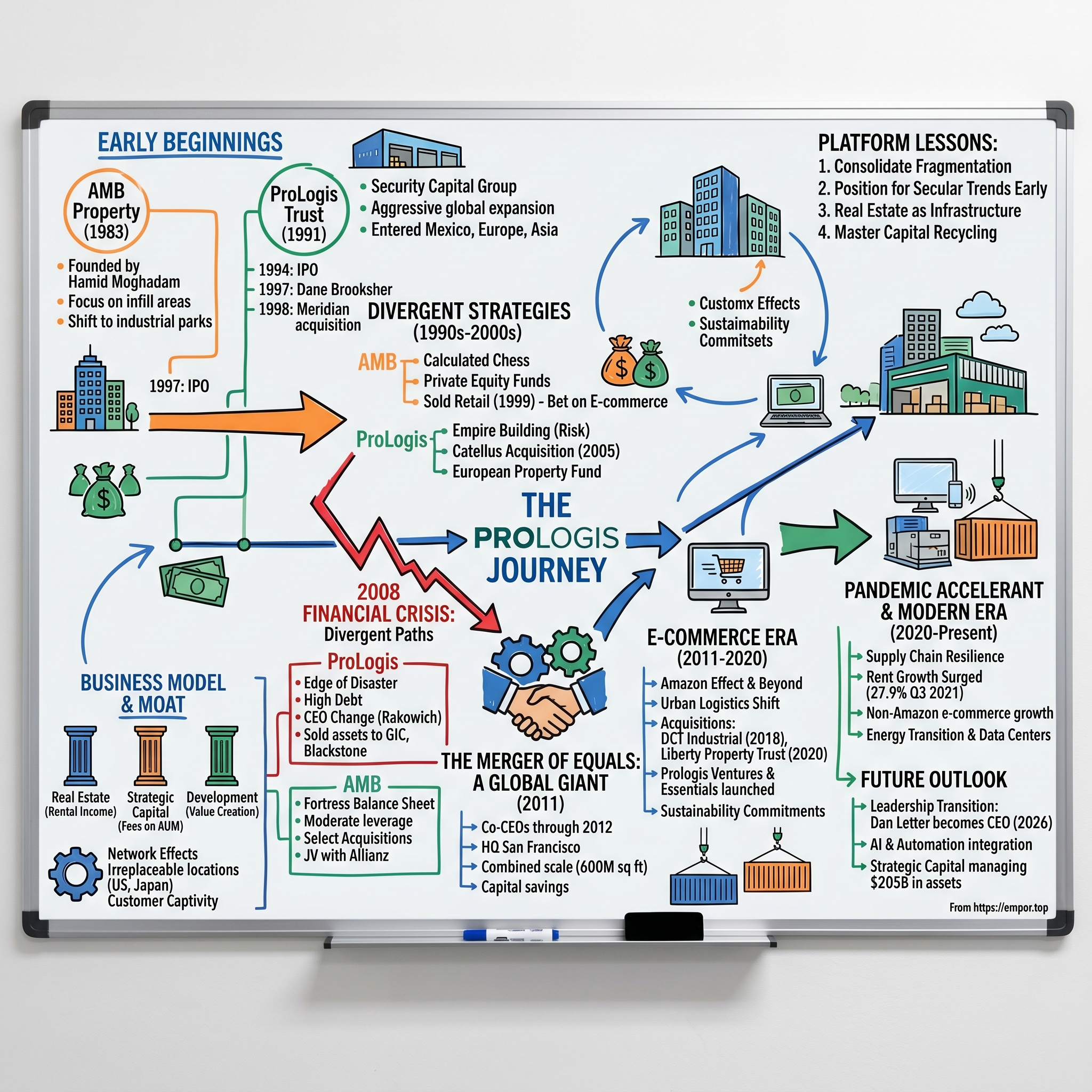
The two companies competed for two decades, and then in January 2011 they agreed to stop. The AMB–ProLogis deal was structured as a merger of equals: each ProLogis share was converted into 0.4464 AMB shares, the combined company took the ProLogis name, and management promised about $80 million a year of savings in general and administrative costs.5 Moghadam and ProLogis chief executive Walter Rakowich became co-CEOs, with Moghadam due to take sole charge after Rakowich's planned retirement.5 The combined company had more than $40 billion of assets under management, which made it the largest industrial real estate owner in the world.5
The merger made strategic sense on paper. AMB brought a high-quality U.S. portfolio and an institutional-capital culture; ProLogis brought global reach and a development machine. The G&A savings were real but small relative to the asset base. The deeper logic was that a single platform could offer customers coverage across the Americas, Europe and Asia while raising capital from sovereign wealth funds and pension plans on a scale no rival could match.
But mergers of equals are also mergers of histories, and ProLogis brought a scar. Only three years earlier, its global ambition had nearly broken it. The question the merger could not answer by itself was whether a bigger global footprint would make the company more resilient, or whether it would magnify the cost of ambition the next time credit dried up. To understand why that question was not academic, the story must return to the autumn of 2008.
III. The Expansion That Nearly Broke the Platform
In late 2008, the global financial system was locking up. Lehman Brothers had failed in September. Commercial paper markets seized. Banks hoarded cash and stopped refinancing even sound borrowers. For a real estate company built on development, the timing was brutal: development is a business where you spend money for two or three years before a building produces rent, and you rely on the capital markets to refinance the bridge.
ProLogis had spent the boom years building across three continents. It developed buildings, sold many of them into property funds it managed, and used the proceeds and fees to fund the next round. That model worked beautifully as long as the funds had cash to buy and lenders had cash to lend. When both stopped at once, the machine reversed. The company's own 2008 annual report described the pressure plainly, saying that the disruption in the capital markets had significantly limited its access to capital and that it had to change its business plan to reduce debt and preserve liquidity.9 Development starts were cut back sharply, the dividend was reduced, and leadership changed: Walter Rakowich replaced Jeffrey Schwartz as chief executive in November 2008.9
The most visible act of triage came in December 2008. ProLogis agreed to sell its operations in China and its interests in two Japanese property funds to GIC, Singapore's sovereign wealth fund, for about $1.3 billion.4 The proceeds were earmarked to pay down debt.4 The company expected to record a loss of roughly 4% to 6% of the book value of the assets it was selling.4
Think about what that meant. China was the growth story every global logistics company wanted, and Japan was one of the most valuable logistics markets in Asia. ProLogis was not choosing to exit them because it had stopped believing in them. It was selling some of its best long-term options because it needed cash immediately, to a buyer with a long horizon and no refinancing problem.
Here is where the consensus narrative and the record diverge. The popular telling is that ProLogis overexpanded internationally and the crisis proved global ambition was a mistake. The record supports a narrower conclusion. The problem was not that the company owned buildings in Shanghai or Osaka; it was that it financed a long-duration, illiquid asset base with debt and with a fund model that depended on continuous fresh capital. When that capital vanished, the company had to sell assets at a loss to buy time. The combined company did not abandon international markets; Prologis still operates across Europe, Asia and the Americas.1 What changed was the funding discipline.
This is the strongest historical test of the claim that scale and capital access make Prologis financially resilient. In 2008, ProLogis had scale and it had capital partners. Neither prevented a crisis. Resilience was recovered, but it was bought through asset sales, retrenchment and dilution. That history should temper any claim that size alone is a moat against a downturn.
It also explains why the company's co-investment model deserves careful reading. Today, outside investors co-own a large share of the properties Prologis manages. That capital lets the company build and buy more than it could on its own balance sheet, and it generates fees. But outside capital does not remove the listed company's exposure. Prologis still commits its own equity to ventures, may have to fund its share of development or debt repayment, and carries development risk on buildings that are not yet leased.1 Co-investment can spread risk; it cannot erase it, as 2008 showed when the funds that were supposed to absorb buildings suddenly could not.
The modern balance sheet looks very different. At September 30, 2026, Prologis carried A-level ratings from both Moody's and S&P, both with stable outlooks.10 On its share of debt, the average remaining maturity was about 7.6 years and only about 5% was floating-rate, which means a sudden spike in short-term interest rates would hit relatively little of the debt right away.10 Earnings before interest and other fixed charges covered those charges about six times over.10 Debt was about 4.5 times adjusted EBITDA, or 4.9 times if one-time development gains are excluded.10 Those are investment-grade numbers that bear little resemblance to the ProLogis of 2008.
Yet the same rating agency that upgraded Prologis to A2 in March 2025 flagged a sensitivity: leverage could rise as data-center development expands.11 Data centers are an even more capital-hungry form of development than warehouses, with longer build times and power infrastructure that must be secured years ahead. The lesson of 2008 is not that Prologis is fragile today. It is that the risk shows up when a development pipeline grows faster than the capital that will ultimately own it. With the balance sheet repaired, the merged company turned that capital access toward a different strategy: buying its competitors.
IV. The Merger Becomes a Buying Machine
By the mid-2010s, Prologis had a repaired balance sheet, a currency in its stock and a strategic thesis: in logistics real estate, the biggest and best-located portfolio would win. If organic development was slow and land scarce, buying someone else's portfolio was a shortcut to scale.
The first big move came in April 2015. Prologis agreed to acquire KTR Capital Partners' industrial portfolio and operating platform for about $5.9 billion, in a venture with Norges Bank Investment Management, the manager of Norway's sovereign wealth fund.12 The deal brought about 60 million square feet of mostly U.S. logistics space, along with development land.12 It was a template for what followed: use the co-investment model to share the cost, buy a platform rather than just buildings, and plug it into the existing network.
Then came the public companies. In 2018, Prologis acquired DCT Industrial Trust, a U.S. logistics REIT, for about $8.5 billion including assumed debt.13 In early 2020, just before the pandemic, it closed on Liberty Property Trust for about $13 billion.6 Each time, the logic was similar: Prologis paid in its own stock, absorbed a portfolio concentrated in markets where it was already strong, cut overlapping overhead and kept the best buildings.
The biggest came in 2022. Duke Realty, an Indianapolis-based REIT that had transformed itself from a diversified office and industrial owner into a focused logistics landlord, had a high-quality portfolio in markets like Southern California, New Jersey, Chicago and Atlanta. Prologis made an unsolicited all-stock proposal, Duke initially rebuffed it, and Prologis raised its offer. The final agreement in June 2022 valued Duke at roughly $26 billion including debt, with Duke shareholders receiving 0.475 Prologis shares for each Duke share.6
How expensive was Duke compared with the earlier deals? Prologis's own merger presentation answers that, and the answer is unflattering to the price. On the announced offer premium to Duke's share price, Duke was 31.8%, compared with 21.3% for DCT and 15.6% for Liberty.6 On the premium to consensus net asset value, the gap was starker: Duke was 25.9% above estimated NAV, Liberty 21.8%, while DCT had been bought at a 3.5% discount to NAV.6 In plain terms, Prologis paid materially more for each dollar of Duke's underlying real estate than it had in its previous public deals.
Management's case was that the price was justified because Duke's buildings were in exactly the high-rent coastal and infill markets where Prologis expected the strongest rent growth, because the cost savings would be significant, and because the deal would be immediately accretive to Core FFO and AFFO per share.6 The presentation also showed that DCT and Liberty had generated strong relative shareholder returns after their acquisitions.6 But that comparison ended in May 2022, before Duke even closed. It was a backward-looking slide used to justify a forward-looking bet.
There is a subtler point about the currency. Because Duke was paid in Prologis stock, the price was not just the premium but also what Prologis shares were worth at the time. Prologis's shares traded at a rich multiple in 2022, which made its stock an attractive currency. That is a classic acquirer's advantage: when your own stock is expensive, you can buy assets with it and still come out ahead on a per-share basis, even paying a premium.
The risk is that the premium you paid is baked into the deal, while the rich multiple on your own stock is not. Prologis's share count expanded sharply as a result; shareholders' equity on the balance sheet jumped from about $33 billion at the end of 2021 to about $53 billion at the end of 2022.1
What did these acquisitions change for the listed company? Portfolio scale and market presence expanded dramatically. Prologis became the dominant owner in nearly every major U.S. logistics market. But integration, dilution and the price paid remain parts of the return calculation. Since 2022, revenue has continued to grow strongly while net profit has been roughly flat.1
Some of that gap reflects the accounting of large acquisitions, especially the depreciation on newly marked-up buildings. Some reflects a softer leasing market after the pandemic surge. The honest verdict is that Duke was the most expensive of Prologis's big public deals by its own measures, but expensive is not the same as value-destroying. The test is per-share Core FFO and AFFO over the years that followed, not the size of the portfolio.
That test only works if the buildings themselves keep producing durable rent. Scale only matters if the locations and leases turn into cash. So it is time to step inside the rent roll.
V. The Rent Roll: How a Warehouse Makes Money
Every lease in the Prologis portfolio eventually expires. When it does, the landlord faces a moment of truth: will the next tenant, or the same tenant renewing, pay more, less or nothing at all? That moment happens thousands of times a year across the portfolio, and it is where the economics of the business actually live.
Start with the money. In 2025, Prologis reported about $8.8 billion of revenue, of which roughly $8.2 billion was rental revenue.1 Leases generate recurring rent, recognized evenly over the life of each lease even when the contractual rent steps up over time.1 Most of the costs of running a warehouse, such as common-area maintenance, property taxes and insurance, are passed through to tenants.1 That pass-through structure is one reason warehouses are attractive to own: the landlord collects rent while the tenant bears much of the cost inflation, at least until the lease is renegotiated.
The customer base is broader than the consolidated financial statements suggest. Prologis reported more than 4,000 customers in its consolidated properties, but about 6,500 across the owned-and-managed portfolio, which includes buildings held in co-investment ventures where outside investors own a share.1 That distinction matters. When Prologis talks about 1.3 billion square feet and 6,500 customers, it is describing the operating platform it runs. When an investor values Prologis shares, the relevant economics are the company's share of that platform plus the fees it earns for running the rest.
Now the lease term. At the end of 2025, the weighted average remaining lease term on the owned-and-managed portfolio was about 3.9 years, or 4.2 years on Prologis's own share.1 Compare that with an office building, where leases of ten years or more are common, or a shopping center anchored by a twenty-year grocery lease. Warehouse leases are shorter, which cuts both ways. In a rising rent market, short leases are a gift: the landlord can reprice the portfolio quickly. In a falling market, they are a liability: rents roll down just as fast. A 3.9-year term means roughly a quarter of the portfolio's rent comes up for renegotiation in a typical year.
This is where the rent spread comes in. During the pandemic and its aftermath, warehouse rents in many markets rose dramatically, while tenants who had signed leases years earlier kept paying the old rates. That created a large gap between in-place rents and market rents. In the first nine months of 2026, when leases commenced, net-effective rents on those leases were about 35.5% higher than on the leases they replaced.2 On Prologis's estimate, the remaining in-place leases were still about 16% below market.2 On the third-quarter call, management translated that gap into roughly $780 million of future net operating income that could be captured as leases roll, before any further market rent growth.14
The spread deserves careful framing, because it is easy to treat it as money in the bank. It is not. A below-market lease is an option, not guaranteed profit. Its value is realized only when the lease expires, the building re-leases quickly, the tenant does not demand heavy concessions and market rents have not fallen in the meantime. If market rents slip, the spread shrinks before it is captured. If a tenant leaves and the building sits empty for six months, the rent increase is offset by lost income. The spread is a strong signal of pricing power today, but its conversion into earnings depends on conditions over the next several years.
What about customer concentration? Amazon was Prologis's largest customer at the end of 2025, accounting for about 5.3% of owned-and-managed net effective rent.1 The top ten customers together were about 15.2%, down from about 16.3% a year earlier, and the top 25 about 21.6%.1 No single customer accounted for more than 10% of revenue.1 That leaves real exposure to a customer-level disruption, for example if the largest e-commerce tenant decided it had overbuilt its network. But it does not make Prologis dependent on any one tenant. Losing the largest tenant entirely would be painful but not fatal, because the buildings would return to the market, where they would be re-leased at whatever rent that market then supported.
There is one more piece of accounting that a listener needs to understand, because it explains why Prologis's reported profit can look disconnected from its leasing story. Real estate companies must depreciate their buildings, even though well-located warehouses often appreciate in value. In 2025, Prologis recorded about $2.5 billion of real estate depreciation and amortization, a non-cash charge that reduces GAAP net income.1
On top of that, gains from selling properties or contributing them to ventures can swing profit up or down from year to year. That is why REITs report measures like funds from operations, which add back depreciation and strip out most property gains. Prologis's preferred measure is Core FFO, a company-defined metric that further excludes items management considers non-recurring. Investors should use Core FFO and AFFO alongside net income, remembering that both are management's own definitions.
There is a second engine inside the Real Estate segment, and it is the one that turns land into value rather than collecting rent on what already stands. At the end of 2025, Prologis had a consolidated development portfolio with a total expected investment of about $5.1 billion, of which about $3.0 billion had already been spent; roughly $686 million of that expected cost was for data centers.1 Management projected a weighted average stabilized yield of about 6.7% on the pipeline and an estimated development margin of about 25%.1
Translate that into plain economics. If Prologis spends $100 to build a warehouse and the finished, leased building produces about $6.70 a year of net operating income, and if buyers of stabilized warehouses are willing to accept a yield closer to 5%, then the finished building is worth noticeably more than it cost. That gap is the development profit, and it is why a landlord with land, permits and tenant relationships can create value that a pure buyer of buildings cannot.
The catch is that the profit exists only on paper until the building is leased. At the end of 2025, the development portfolio was only about 53.5% leased.1 The rest was a wager that tenants would arrive before the cost of carrying empty buildings ate the margin. The latest numbers show that wager getting a little harder. Developments Prologis started in the third quarter of 2026 carried an estimated yield of about 6.6% but an estimated margin of only about 16%, while buildings that stabilized in the quarter came in at a yield of about 5.6%.3
Those quarterly figures are noisy, but the direction matches what management itself said: construction costs are elevated and interest rates are higher, which squeezes the spread between what a building costs and what it is worth.14 Development is still creating value; it is creating less of it per dollar than it did when money was cheap. That matters because Prologis is now spending more on development, not less, and because development gains are one of the items that make GAAP profit lurch from year to year.
The rent roll, then, is the economic center of Prologis. Real estate operations and development produce the bulk of revenue and profit. High occupancy and wide rent spreads show current pricing power. But with a lease term under four years, the company must constantly re-lease space into local markets whose conditions change faster than the headlines suggest. And not all of the money Prologis earns comes from rent on its own buildings. Some comes from sitting above the building, managing other people's capital.
VI. The Money Above the Building
Imagine a warehouse in a suburb of Rotterdam. Prologis built it, leased it and manages it day to day. But Prologis owns only a slice of it. The rest belongs to a co-investment venture whose other investors might be a Dutch pension fund, a sovereign wealth fund and an insurance company. Prologis earns a fee for managing the venture's assets, another for managing the properties, and, if the venture outperforms agreed hurdles, a share of the profits known as a promote. When the venture sends cash back to its owners, Prologis receives its share as a distribution.
This is the strategic capital business, and it is where the AMB heritage lives on. In 2025, strategic capital revenue was about $592 million, or roughly 6.7% of total revenue.1 That is meaningful but secondary to rent. At the end of 2025, Prologis had about $11.1 billion invested in and advanced to unconsolidated ventures, and it received about $645 million in operating distributions from those ventures during the year.1
Why does this matter if the revenue is relatively small? Because the strategic capital business lets Prologis operate a platform far larger than its own balance sheet could support. That managed footprint includes space owned partly or mostly by venture partners.1 Its scale gives Prologis more market data, more customer relationships and more negotiating leverage with suppliers and utilities. It also gives it a ready buyer for stabilized buildings, since ventures can acquire properties that Prologis develops. The listed company captures fees, promotes, distributions and its share of property income, while the partners provide much of the equity.
The relationship cuts the other way too. Ventures are related parties under the equity method of accounting, which means Prologis does not consolidate their full revenues and debt.1 The company says it did not guarantee third-party venture debt at year-end, but it may have to fund its share of venture development, debt repayment or operating shortfalls.1 It also faces a subtle conflict: when Prologis sells or contributes a building into a venture it manages, it is on both sides of the transaction.
Prologis discloses fees and distributions, but it does not separately quantify how much of strategic capital revenue comes from related-party ventures versus other sources, so investors cannot calculate a precise related-party share of revenue.1 That gap is narrow, since most of the fees plausibly come from ventures by their nature, but it means the full $592 million should not be described as related-party income without qualification.
There is also a recent signal worth noting. In the third quarter of 2026, Prologis trimmed its guidance for strategic capital revenue excluding promotes, from $660–680 million to $650–660 million.3 That is a small change, but it runs counter to the idea that the fee stream is a steadily compounding second engine. Fee revenue depends on asset values and capital raising, both of which slowed as higher interest rates pressured property valuations.
Now reconcile cash and earnings, because this is where the venture structure shows up most clearly. Over the twelve years from 2014 to 2025, Prologis generated about $34.5 billion of operating cash flow against about $25.6 billion of net profit.1 Cash ran ahead of profit by about a third. Depreciation is the main explanation: it is a large non-cash charge that reduces profit but not cash. Venture accounting adds noise, because equity-method earnings and the cash distributions actually received differ in timing and amount, and promotes are generally collected in the quarter after they are recognized.1 The direction is reassuring: Prologis's profits are, if anything, understated relative to cash.
The dividend question needs the right frame. If you take operating cash flow and subtract all capital expenditure, including development of new buildings, Prologis's cumulative free cash flow over the same twelve years was negative, about $8 billion in the red, while the company paid out about $22.4 billion in dividends.1 At first glance that looks like a company borrowing to pay its dividend. But that measure is not a clean dividend-coverage test for a REIT, because it treats every dollar spent on new development as if it were maintenance.
Development is growth investment, funded partly with debt, venture capital and sales of stabilized buildings. A fairer test compares the dividend with AFFO, which subtracts recurring capital spending on existing buildings but not new development. Prologis's 2025 dividend payout was about 110% of GAAP net profit, which sounds alarming but mainly reflects depreciation depressing the denominator.1 Measured against Core FFO, the dividend looks more comfortable.
So the strategic capital platform adds a meaningful but secondary revenue stream, and it exposes Prologis to a much larger operating footprint than its consolidated buildings alone. The open question is how much venture-level fee income and cash consistently reach Prologis relative to the capital it commits, and the company does not publish a complete fee-to-distribution reconciliation that would settle it. With that caveat, it is time to look at what the whole machine actually earned as the pandemic boom faded.
VII. A Rent Boom Meets a Profit Slowdown
In the spring of 2020, as the world locked down, something strange happened in warehouse land. Shoppers who could not visit stores ordered online, and retailers who had run lean inventories discovered they needed more of everything, stored closer to customers. Tenants competed for whatever space was available, and the price of a well-located building rose with the scramble.
Prologis was the landlord standing at the center of that rush. Revenue jumped about 33% in 2020 and another 25% or so in 2022, partly from acquisitions and partly from rising rents.1 That extended a decade of rapid growth.1 That is an extraordinary pace for a real estate company and reflects both the long-term shift toward e-commerce and the company's buying spree.
But the pandemic was an accelerant, not a permanent growth rate. By 2023, the surge had reversed. Retailers that had over-ordered found themselves with too much inventory and too much space. Some of the largest occupiers slowed their expansion plans. New supply that had been started during the boom came on line just as demand cooled. National warehouse vacancy rose from its lows to a peak of about 7.5% before easing to about 7.1% by the third quarter of 2026.14 Market rents in many U.S. regions flattened or fell slightly before resuming modest growth in 2026.
Here is the puzzle. If rents were falling or flat in the market, how could Prologis keep reporting rent increases of 35% or more on new leases? The answer lies in the lag. Leases signed in 2018 or 2019, at pre-pandemic rents, were still expiring in 2024, 2025 and 2026. Even if market rents had cooled from their peak, they remained far above where those old leases started. So each expiring lease reset upward, even as the market softened. The in-place mark-to-market remained about 16%.2
Now look at reported profit. Net profit grew only about 0.5% a year from 2022 to 2025, and fell about 9% in 2025.1 Diluted earnings per share fell from about $3.91 in 2024 to about $3.56 in 2025.1 The headline reading is that the business is stalling. The more careful reading is that GAAP profit is buffeted by forces unrelated to leasing: gains on property sales fluctuate; foreign exchange moves; depreciation rises after acquisitions mark buildings up to current values; interest expense rises as debt is refinanced at higher rates.
The 2026 guidance shows this split clearly. In October 2026, Prologis raised the midpoint of its full-year Core FFO guidance slightly, to a range of $6.25 to $6.29 per share, while cutting its net earnings guidance from $4.40–4.55 to $4.05–4.15 per share.3 Management attributed the gap largely to items below the operating line, such as lower expected gains on real estate.3 That is not a contradiction.
It is a reminder that GAAP and Core FFO measure different things. But it also means investors must decide which number they trust. Core FFO is a company-defined measure; it excludes items management considers non-recurring, and those items are not always as non-recurring as advertised. Real estate gains, for example, are a regular part of Prologis's business model through its venture contributions.
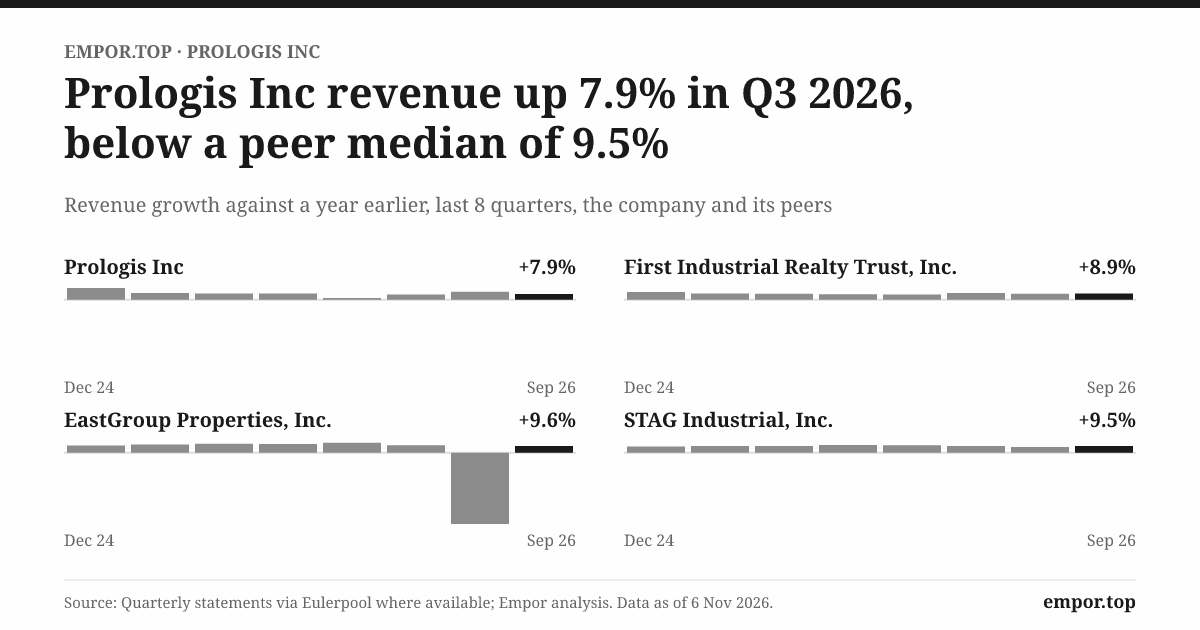
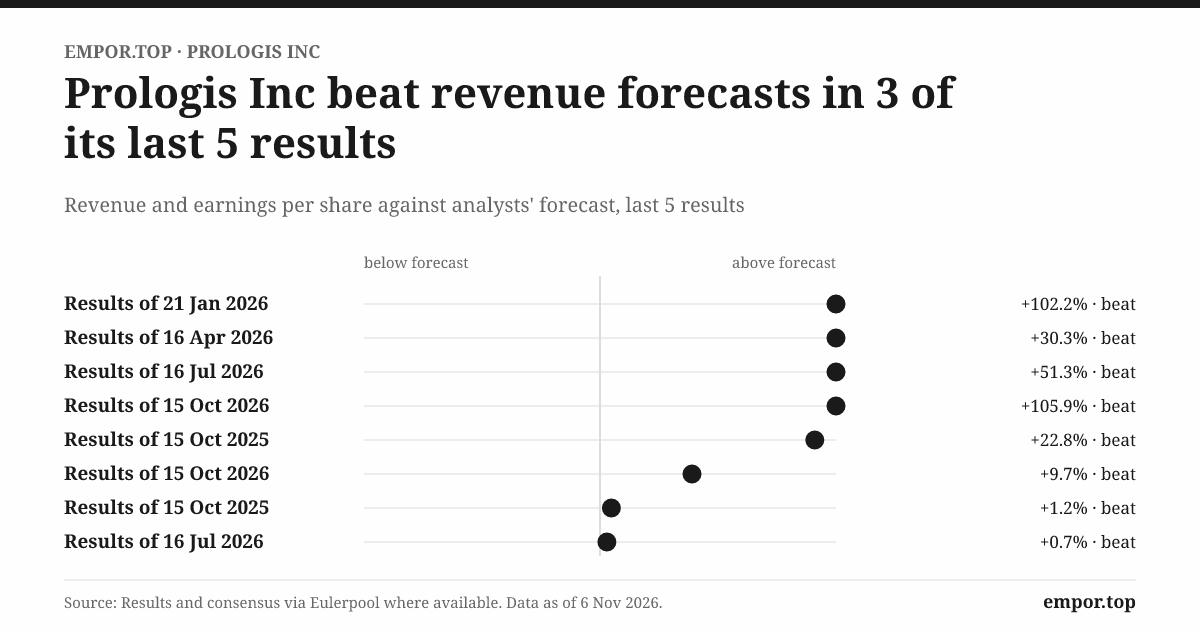
The third quarter itself was solid. Core FFO was $1.60 per share, up from $1.49 a year earlier.3 Occupancy ended the quarter at about 95.6%.3 Net-effective rents on leases that commenced in the quarter were about 38% higher than the expiring leases they replaced, close to management's full-year aim of 40%.143 Cash same-store NOI, which measures how much more cash the same buildings produced compared with a year earlier, grew about 5.9%.3 Management also raised its full-year guidance for cash same-store NOI to 7.0%–7.5%.3
On the call, Letter framed demand in measured terms. He said customers were running lean on inventory and that excess capacity within their networks had largely cleared, citing demand from e-commerce, advanced manufacturing and the data center supply chain.14 That is a more cautious tone than the boom years, and it is backed by data: leases commenced in the quarter were down about 15% from a year earlier, even as signed leases reached about 60 million square feet.14 The company also trimmed the top end of its average occupancy guidance, to 95.25%–95.5%.3 Read together, the message is that demand is recovering but not surging, and that rent growth is coming more from the roll-up of old leases than from a tightening market.
Comparing the third quarter with earlier calls in 2026 shows consistency rather than drama. In each quarter, management emphasized the mark-to-market, steady occupancy and selective development, and avoided promising a return to pandemic-era rent growth. Where analysts pressed on construction costs and development starts, management pointed to elevated construction costs and higher interest rates as reasons new supply had moderated, which supports existing rents.14 That argument is reasonable but self-serving: it means Prologis benefits from rivals building less, even as it raised its own development starts guidance to $5.0–5.75 billion.3
So the slowdown in GAAP profit does not negate the rent-growth evidence. But neither does a wide lease mark-to-market guarantee the same profit growth. Three indicators matter most for tracking whether the leasing engine is still converting into earnings. The first is occupancy, which ended the third quarter at about 95.6%. The second is cash same-store NOI growth, which ran at about 6% in the quarter and was guided to 7% or more for the year. The third is net-effective rent change on commenced leases, at about 38%. If those three hold, the spread is rolling through. If they slip, the spread was a mirage. The next question is whether Prologis's advantage is durable enough to keep winning those lease renewals.
VIII. The Moat Has to Survive a Lease Expiration
Put yourself in the seat of a head of logistics at a national retailer. Your network needs a large regional distribution center outside Dallas, a smaller cross-dock near the Port of Newark, an urban building in Los Angeles close enough to make same-day deliveries, and something in Poland to serve Central Europe. You could run four separate searches, negotiate with four landlords and sign four sets of lease terms. Or you could call one company that owns buildings in all four places and ask what it has.
That phone call is the clearest picture of Prologis's competitive advantage: a network of buildings in the markets that matter most.1 For a customer that wants a network rather than a building, that coverage reduces search costs and simplifies the relationship.
But a moat has to survive a lease expiration, and here the evidence is more nuanced than the marketing. Run the economics through the forces that actually set rent. Start with the tenants' bargaining power. It is moderated by the fact that customers are dispersed; the top ten account for only about 15% of rent.1 High occupancy also limits tenants' alternatives, since there is less vacant space to play landlords against each other. On the other hand, leases expire every few years and competing local space is always available in some form. When a lease rolls, the tenant can and does shop around. Prologis's breadth gives it many buildings, but in any single submarket it is one landlord among several.
Next, the threat of substitutes. A warehouse is hard to replace with anything else; goods have to sit somewhere between the factory and the customer. But tenants can substitute one location for another, change their network design, use third-party logistics providers or automate to need less floor area. Over the long run, technology that lets a tenant store more goods in less space reduces demand per unit of commerce. That has not yet slowed Prologis's leasing, but it is a structural force the company does not control.
New entrants face real barriers in Prologis's core markets. Land near major cities is scarce and expensive, zoning is slow, and construction costs have risen. Those barriers protect existing landlords. But they protect all existing landlords, not just Prologis. A family that has owned a warehouse near Newark for forty years enjoys the same scarcity. The barrier is a feature of the location, not of the owner.
Now test the switching costs. A tenant's logistics network can make a particular location important, and moving out of a building involves real costs: relocating inventory, reprogramming systems, retraining staff, perhaps disrupting customer service for weeks. But Prologis does not disclose retention rates, exclusive multi-market contracts or evidence that customers pay a premium to stay with one landlord across markets. Without that evidence, switching costs should be treated as plausible rather than proven. The strongest disclosed evidence is the rent spread itself: Prologis has been able to raise rents sharply on expiring leases, which means tenants are paying market rates or close to them. That is evidence of pricing power in the market, not necessarily of a Prologis-specific premium.
Who are the competitors? In Europe, SEGRO is a major owner of logistics property, concentrated in the United Kingdom and continental Europe, with an emphasis on urban warehouses around London and big-box sheds along key European corridors.15 Goodman, the Australian group, is a large global owner and developer of industrial property that has moved aggressively into data centers.
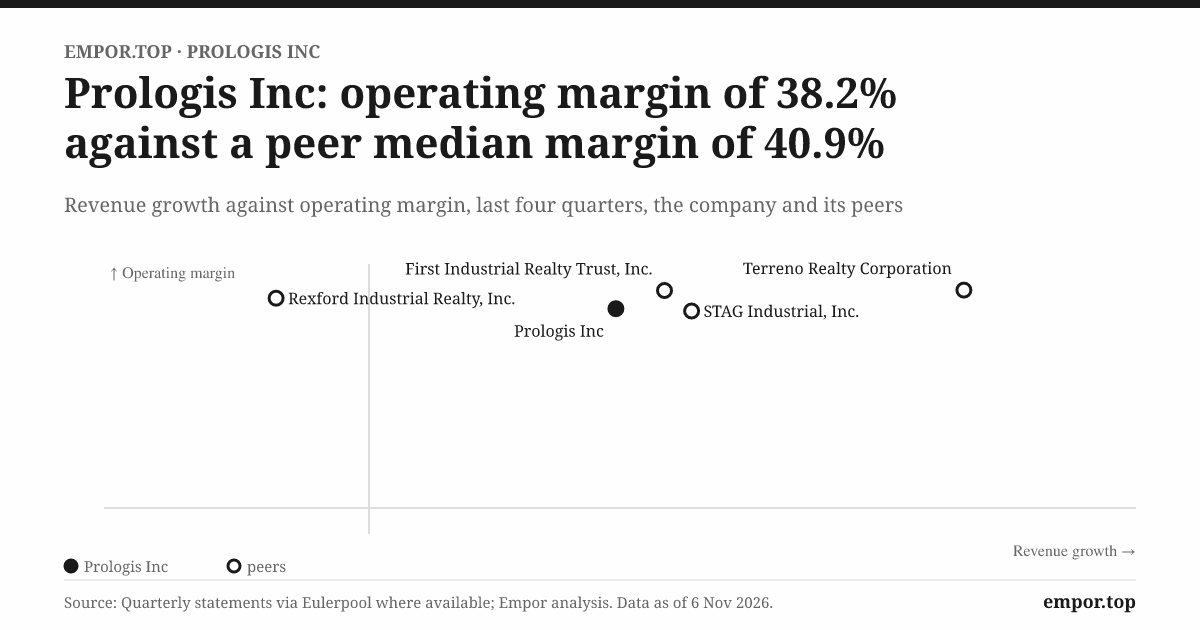
In the United States, listed peers include First Industrial, Rexford, EastGroup and Terreno, each with a different geographic focus: Rexford in infill Southern California, EastGroup in Sunbelt cities, Terreno in a handful of coastal markets. These companies own far less space than Prologis, and their portfolios differ in location, building size and tenant mix. No directly comparable market-share figure exists to say how large Prologis's slice of global logistics space truly is; the honest statement is that it is the largest listed owner by a wide margin.
What about the new services? Prologis has built a business called Essentials that sells customers equipment, energy and operational services: solar panels, battery storage, electric vehicle chargers, forklifts and racking. It has also moved into data centers, using its land bank and its relationships with utilities to secure power for computing facilities.1 These are potentially useful extensions of the property relationship. A tenant that buys solar from its landlord, or depends on its landlord for charging infrastructure, has another reason to stay. But these services are still small relative to rent. They are not yet the source of most revenue or profit, and their contribution to retention is not disclosed.
So the moat is real but relative. The strongest evidence is breadth of locations, customer relationships and demonstrated rent spreads. It is not lock-in: tenants can multi-source, leases expire and local competition still sets the rent. Prologis wins because it owns the right buildings in the right places, and because it has the capital and relationships to keep adding more. That brings us to the man who now has to decide how to spend that capital, and to the biggest decision of his first year.
IX. The New CEO's First Big Capital Test
In late July 2026, after months of public back-and-forth, SEGRO's board said it had unanimously concluded that the financial terms of Prologis's "best and final" proposal were at a level it would be minded to recommend to shareholders.16 It was a significant moment. SEGRO had rejected earlier approaches, and Prologis had taken its proposal public in June after being rebuffed.17 Now the British landlord's board was signaling that the price was right. On August 4, the two companies announced a recommended combination.18 For Daniel Letter, who had been chief executive for barely seven months, it was the first big capital-allocation test of his tenure.
The path to that moment says something about Prologis's style. SEGRO had turned down earlier approaches, and in June 2026 Prologis chose to make its interest public rather than keep negotiating privately, a move that put pressure on SEGRO's board by inviting its shareholders to weigh the offer for themselves.17 Under British takeover rules, a public approach starts a clock: the bidder must either make a firm offer or walk away by a set deadline. Prologis raised its terms, labelled the improved proposal its best and final, and asked for more time, which SEGRO agreed to give once it signalled it would recommend the price.16
Calling an offer best and final has teeth in Britain, because the bidder generally cannot raise it afterward except in limited circumstances, such as a rival bid.16 It was a disciplined way to run an auction with only one bidder: make the price public, make it final, and let the target's shareholders do the arguing. It also showed that the new chief executive was willing to pursue a large deal persistently against an initially reluctant board, much as Moghadam had pursued Duke in 2022.
Letter is a Prologis insider in the fullest sense. He rose through the company over many years to become president, and the board chose him as Moghadam's successor in a planned, long-signalled transition.8 That continuity is reassuring to investors who value the operating discipline of the Moghadam era. But it also means the SEGRO deal is not a break from the past; it is the past, extended. It is another large, stock-funded acquisition of a high-quality logistics portfolio, in the tradition of DCT, Liberty and Duke. The question is whether Letter can execute it with the same results, and whether the price makes sense.
The terms are worth walking through slowly. SEGRO shareholders were offered 0.0920 new Prologis shares for each SEGRO share, with a partial cash alternative capped at about £3.5 billion.18 At the prices used in the July proposal, that valued each SEGRO share at about 1,031.7 pence, and the whole company at roughly £14 billion, or about $18.8 billion.1618 That was a premium of about 39% to SEGRO's share price before the approach became public, and about 14% to SEGRO's adjusted net asset value at the end of June.16 Shareholders who chose cash would receive about 258 pence plus 0.0690 Prologis shares per SEGRO share, with elections scaled back if total cash demand exceeded the cap.1618
The premium to NAV, about 14%, is lower than Prologis paid for Duke, but higher than the discount it paid for DCT. More interesting is how the premium has moved since. Because most of the consideration is Prologis stock, the value of the deal to SEGRO shareholders rises and falls with Prologis's share price. The July valuation assumed a Prologis price of about $150.16
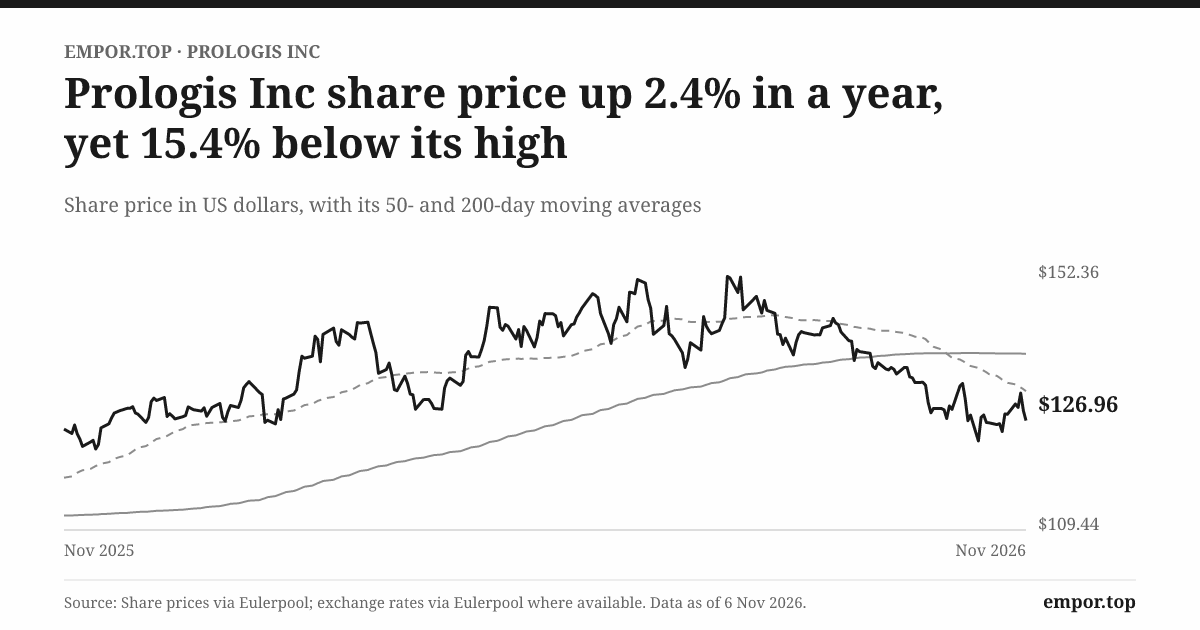
By November 6, Prologis traded at about $127.3 At that price and the July exchange rate, a SEGRO holder taking the basic mix of cash and shares would receive something closer to 910 pence a share, very near SEGRO's NAV. That shift is good news for Prologis shareholders, who would now be giving up less value per SEGRO share. It is also a reminder that stock-funded deals carry their own currency risk.
How is the cash being funded? Prologis said the cash portion would come from a committed term loan facility, existing liquidity and other available sources.18 On the same day it announced the SEGRO deal, Prologis also launched and priced an offering of 15 million new common shares, raising about $2.1 billion, with the proceeds earmarked for general corporate purposes including potential acquisitions such as SEGRO.19 That is a notable detail. This raise, combined with the new shares issued to SEGRO holders, means the share count will grow meaningfully, so every future dollar of Core FFO will be spread across more shares. SEGRO shareholders would end up owning about 8.9% of the enlarged company if the cash alternative is fully taken up.16
What did management say the deal would do to per-share earnings? Here is the number that matters most, and it is not flattering. Prologis said that in the first full year after completion, assuming annualized run-rate synergies, the combination would be broadly neutral to minimally dilutive to Core FFO per share and AFFO per share.18 In plain English: even after the cost savings, the deal is not expected to add to per-share earnings in its first full year.
That contrasts sharply with Duke, which management said would be immediately accretive.6 The SEGRO case therefore rests on the long term: a bigger European platform, a larger land bank, a deeper development pipeline and the ability to capture SEGRO's own rent spread over time. The combined European operating portfolio would be about 368 million square feet, roughly 47% larger than Prologis's European footprint alone, and the combined company would manage about $269 billion of assets.18
The approval process has moved forward. SEGRO's shareholders approved the combination in late September, a milestone Letter highlighted on the third-quarter call.14 The deal does not require a vote by Prologis shareholders.18 It still needs court sanction of the scheme, regulatory approvals and the London Stock Exchange's approval of a secondary listing of Prologis shares, which is a condition of completion.18 The companies expected to complete the transaction in the first half of 2027.18
Put the ambition beside the record. Duke carried the highest offer premium and NAV premium among Prologis's 2018, 2020 and 2022 public deals.6 SEGRO is larger than DCT or Liberty and is expected to dilute per-share earnings at first, rather than add to them. What evidence does management have that this combination clears its cost of capital? The public answer so far is strategic: scale in Europe, more land, more customers. Those are plausible benefits. But they are claims, not proof. The way to judge them is after completion, in per-share Core FFO, NOI growth in the European portfolio and the yields on development built on SEGRO's land.
Credibility also rests on how the balance sheet absorbs the deal. At the end of the third quarter of 2026, Prologis reported about $8.8 billion of liquidity, debt at about 4.5 times adjusted EBITDA and fixed charges covered about six times.103 Prologis expects to maintain its A2 and A ratings after the combination.18 Yet Moody's had already flagged rising leverage from data-center development as a rating sensitivity.11 Adding a term loan for the SEGRO cash on top of an expanding data-center pipeline is exactly the combination that could test those thresholds. Investors should track leverage and per-share FFO after the deal closes, not just the pro forma slides.
Incentives and oversight form the final piece. Moghadam's reported total compensation for 2025 was about $25.0 million, mostly in stock awards, slightly up from 2024.8 That was in a year when GAAP net profit fell about 9%.1 At the April 2026 annual meeting, the advisory say-on-pay vote passed, but with about 480 million votes in favor and about 344 million against, a dissent of roughly 42% of votes cast, compared with 91% support the year before.208
That is an unusually large protest for a large-cap company. It does not prove misalignment, and shareholders could have been objecting to specific features such as the size of transition awards. But it is a material governance signal, and it came just months before the board approved a large, initially dilutive acquisition. The next proxy statement's response to that dissent will be worth reading closely.
The SEGRO deal is a plausible European extension. But the size, the funding, the integration and the per-share returns are the test, not the map. The board's recommendation and the shareholder vote are milestones, not proof of value creation. With that, it is time to step back and ask what this company teaches.
X. Playbook: Business & Investing Lessons
Go back to three moments in this story. A warehouse on the edge of a city, chosen not for its architecture but for its distance from a port and a population center. A December 2008 sale of Chinese and Japanese assets to a sovereign wealth fund, made not by choice but because the bank was calling. And a lease rolling over in 2026 at a rent more than a third higher than the one it replaced. Each one carries a lesson that belongs to Prologis particularly clearly.
The first lesson is that a network is more valuable than a pile of buildings. Prologis built its platform by owning warehouses in the places where supply chains converge, across many cities and countries. The line to remember: in logistics real estate, the map is the moat, but only where every pin on it is a place someone needs to be.
The second lesson is that a rent spread is only an option until the lease turns. Prologis's in-place leases have sat well below market for years, and that gap has supported rising rents as leases roll. But the gap is not profit. The line to remember: a below-market lease is a coupon you can only cash on the day it matures, and the market sets the face value that day.
The third lesson is that capital partners can expand the platform, but they cannot make risk disappear. Prologis in 2008 had partners, funds and a model designed to recycle capital. When the funds stopped buying and the banks stopped lending, the company had to sell assets at a loss. Today's Prologis is much stronger, with A ratings and long-dated debt. But it still commits its own equity to ventures, funds development before buildings are leased and may have to support ventures in a downturn. The line to remember: other people's money can carry your buildings, but it will not carry your debt.
The fourth lesson is that the deal premium is the beginning of the return calculation, not the end. Prologis paid a 25.9% premium to NAV for Duke, a far richer price than it paid for DCT or Liberty.6 It has agreed to buy SEGRO at a premium to NAV, and has said the deal will not add to per-share earnings in its first full year.18 Every premium is a bet that the buyer can make the assets worth more than the seller could. The line to remember: in a stock deal, the premium is paid on day one, and the proof arrives one lease renewal at a time.
For founders and investors, the wider lesson is that physical assets can become platforms, but only when location, capital and discipline reinforce one another. Scale alone cannot substitute for buying at the right price or financing with the right structure. The 2008 crisis showed what happens when scale outruns financing. The Duke and SEGRO deals will show whether scale can outrun price.
XI. Analysis & Bear vs. Bull Case
Picture an investor at a desk on November 6, 2026, looking at two numbers that seem to tell opposite stories. One is a GAAP profit line that has barely grown in three years. The other is a rent spread showing that Prologis's tenants pay about 16% less than the market would charge. Which number tells the truth about the next five years?
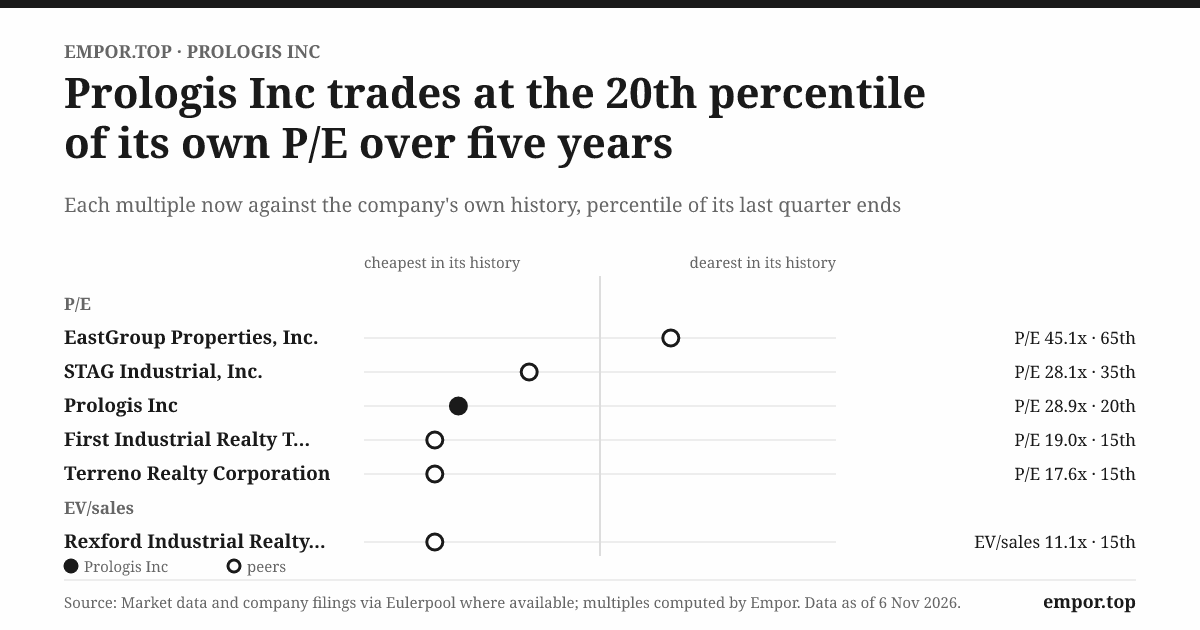
Start with the price. On November 6, Prologis traded at about 28.9 times trailing earnings, compared with its own five-year median of about 34.9 times.3 The dividend yield was about 3.3%, and the enterprise value was about 18.3 times EBITDA.3 At first glance, the stock looks cheaper than its own recent history. But REIT investors know that GAAP earnings are a poor guide to value, because depreciation and property gains distort them.
A better comparison is price against Core FFO. With 2026 Core FFO guidance of about $6.27 at the midpoint, the share price of about $127 implies roughly 20 times Core FFO.3 That is still a premium valuation for a REIT, and it implies the market expects continued growth well above inflation. The share price was also about 15% below its 52-week high, so some of that premium has already been squeezed out.3
The bull case has concrete support. Occupancy is high, at about 95.6% at the end of the third quarter.3 The in-place mark-to-market of about 16% represents roughly $780 million of future NOI if leases roll at today's market rents.14 Cash same-store NOI growth is running at about 6% to 7%, well above inflation.3 Customer reach is broad and concentration is moderate. Debt maturities are long and mostly fixed-rate, so rising rates hit the cost of capital slowly. The credit ratings are strong. And there is optionality: the development pipeline, the land bank and the power relationships that support data centers could widen the company's opportunity set over the next decade.
The bear case is equally concrete. Reported profit has slowed, and the 2026 net earnings guidance was cut even as Core FFO guidance rose.3 Warehouse demand remains cyclical, as the 2023–2024 slowdown showed. Leases roll every few years, so the rent spread can narrow if markets soften. Development leaves capital exposed before projects stabilize; at the end of 2025, the consolidated development portfolio was only about 53.5% leased.1 Data centers are a new, capital-intensive bet with different risks than warehouses. And the SEGRO combination will dilute per-share earnings at first, add debt and require integration across a different regulatory and tenant environment.18
Now apply the frameworks. Porter's five forces, run through the actual economics, suggest a business with moderate tenant power, high barriers to new entry in core markets, low threat of substitution for the asset class and limited supplier power, since construction and land are bought from fragmented markets. Rivalry among landlords is local and intense at the submarket level, which caps how much any one landlord can charge above market.
Hamilton Helmer's 7 Powers adds nuance. Scale economies are Prologis's clearest power: its size lets it spread overhead, buy materials and energy more cheaply and raise capital at lower cost. Its cornered resource is its land and buildings in supply-constrained locations, though that is shared with every other owner in those locations. Network effects are weak in the classic sense; a tenant does not benefit directly from other tenants using Prologis.
Switching costs are moderate and unproven, since retention data is not disclosed. Brand matters to institutional capital partners more than to tenants. Process power, the ability to develop, lease and manage at scale, is plausible but hard to measure. Counter-positioning does not apply. The verdict is that Prologis holds a relative advantage built mostly on scale and location, not an unbreakable moat.
Test the dividend properly. The GAAP payout ratio of about 110% in 2025 looks alarming but is distorted by depreciation.1 Measured against Core FFO, the dividend is covered. The more stringent test is AFFO, which subtracts recurring maintenance capital, leasing commissions and tenant improvements. Prologis reports AFFO in its supplemental materials, and that is the number to watch. Free cash flow after growth development is not a fair measure of dividend coverage, because development is funded partly with debt and venture capital.
Now stress-test SEGRO against a skeptical investor's question. Does the added European network create more value per share than the price and execution risk consume? Management says the deal will be broadly neutral to minimally dilutive in its first full year.18 The value must come later, from rent growth, development and synergies.
A skeptic would note that Duke was sold to shareholders as immediately accretive while SEGRO is not, that the equity raise and term loan add leverage, and that integrating a British company with its own culture and tenant relationships is harder than integrating a U.S. peer. The bull would answer that SEGRO's assets are high-quality, the price fell as Prologis's stock declined, and European logistics is less consolidated than the U.S. market. Both views have evidence. The resolution will come in per-share Core FFO in 2028 and beyond.
If an investor could watch only three gauges, they would be the ones this story has kept returning to. Occupancy ended the third quarter at about 95.6% and has been steady to slightly higher over the past year, which says the buildings are full.3 Cash same-store NOI growth was about 5.9% in the quarter, with full-year guidance raised to 7% to 7.5%, which says the same buildings are producing more cash each year.3
And net-effective rent change on commenced leases was about 38%, still very wide, which says the reset is still paying; each rollover, though, uses up part of the remaining gap to market.3 When all three move together, the rent engine is working. When rent change falls while occupancy softens, the engine is running on its past.
The risk radar, kept to what matters, has five mechanisms. Logistics demand and rent spreads determine whether the leasing engine keeps running. The cost of capital and leverage determine whether the development and acquisition strategy creates value. Development lease-up determines whether capital tied up in new buildings starts earning. Foreign-exchange translation affects reported results; about 8% of 2025 revenue was in foreign currencies, much of it hedged through local-currency borrowing.1 And large-deal execution, now centered on SEGRO, determines whether scale continues to translate into per-share returns.
XII. Epilogue
Tonight, Prologis stands at a hinge. Its new chief executive has been in the job less than a year. Its largest acquisition in four years is moving through the British courts and regulators. Its leasing engine is still running strongly, but its reported profit has stalled. And the next few quarters will deliver a series of tests that will decide which story wins.
The first test arrives with the next rollover cohort of leases. If occupancy holds around 95% and rent change on commenced leases stays above 30%, the mark-to-market is converting into income and the bull case holds. If occupancy slips below 94% or rent change narrows sharply, the market is softening faster than the spread is rolling, and the bear case gains weight.
The second test is the development pipeline. Prologis raised its 2026 development starts guidance to as much as $5.75 billion.3 Those buildings will take years to lease and stabilize. If they stabilize near their projected yields of about 6% to 7%, the pipeline creates value. If they sit partly empty, they become a drag on returns and a drain on capital. The data-center portion carries the most uncertainty, because it depends on securing power and signing large tenants.
The third test is SEGRO. Completion is expected in the first half of 2027.18 After that, investors will watch the integration milestones, the financing costs and, above all, per-share Core FFO in the first full year. If the result is close to neutral, as management guided, the deal will have done what it promised. If it is meaningfully dilutive, or if leverage rises enough to pressure the ratings, the deal will have cost more than it delivered.
The fourth test is the full-year 2026 results, the first under Letter as chief executive. They will show whether the company met its Core FFO guidance and how it explains the gap between GAAP earnings and Core FFO. They will also include a new proxy statement, which will reveal how the board responded to the large say-on-pay protest.
Behind all of these sits the question that has run through this story: how much of the value that Prologis creates reaches its shareholders, and how much flows to its tenants, partners and the sellers of the companies it buys? The answer will be found not in the size of the map, but in per-share outcomes, one quarter at a time.
XIII. Outro
Go back to that warehouse at the edge of the city. Concrete walls, loading doors, a yard full of trailers. It sits between a port, a road network and a customer waiting for goods. It is ordinary until commerce needs it in exactly that place.
Prologis is a bet that location, repeated at global scale, can turn real estate into infrastructure. The bet has worked for four decades, through a near-death crisis, a merger of equals and a buying spree that made it the largest logistics landlord in the world. It will keep working only so long as the rent, the capital and the price continue to earn their keep. Every promise in this story, every spread, every premium and every pipeline, comes down to the same moment: a lease signed for a real building, at a rent the market will bear.
References
-
2025 Form 10-K — Prologis, Inc., SEC, 2026-02-13 ↩↩↩↩↩↩↩↩↩↩↩↩↩↩↩↩↩↩↩↩↩↩↩↩↩↩↩↩↩↩↩↩↩↩↩↩↩↩↩↩
-
Prologis Reports Third Quarter 2026 Results — Prologis, 2026-10-15 ↩↩↩↩↩↩↩↩↩↩↩↩↩↩↩↩↩↩↩↩↩↩↩↩↩
-
ProLogis China and Japan Asset Sale to GIC — ProLogis, SEC, 2008-12 ↩↩↩↩
-
Prologis and Duke Realty Merger Presentation — Prologis, 2022-06 ↩↩↩↩↩↩↩↩↩↩
-
Recommended SEGRO Combination, Form 8-K — Prologis, SEC, 2026-08 ↩
-
2026 Proxy Statement — Prologis, Inc., SEC, 2026-03-19 ↩↩↩↩↩
-
Q3 2026 Supplemental Information, Exhibit 99.1 — Prologis, SEC, 2026-10-15 ↩↩↩↩↩
-
Prologis ratings upgraded to A2 by Moody's, outlook stable — Investing.com, 2025-03-03 ↩↩
-
Prologis Signs Definitive Agreements to Acquire $5.9 Billion Portfolio from KTR Capital Partners — Prologis, 2015-04-19 ↩↩
-
Prologis tops Q3 estimates, raises development starts forecast again — FreightWaves, 2026-10-15 ↩↩↩↩↩↩↩↩↩
-
Best and Final Proposal and Request for PUSU Deadline Extension — Prologis, 2026-07-22 ↩↩↩↩↩↩↩↩
-
US-based Prologis takes $16.6 billion bid for UK landlord SEGRO public after rejection — Reuters via Investing.com, 2026-06-24 ↩↩
-
Prologis Announces Recommended Acquisition of SEGRO plc — Prologis, 2026-08-04 ↩↩↩↩↩↩↩↩↩↩↩↩↩↩↩
-
Prologis Announces Pricing of Common Stock Offering — Prologis, 2026-08-04 ↩
-
2026 Annual Meeting Results, Form 8-K — Prologis, Inc., SEC, 2026-04-30 ↩
 LinkedIn
 WhatsApp
 Reddit
 Hacker News
 Email
 Kindle
 RSS Feed
 Spotify
 Apple Podcasts
 Amazon Music
 Audible
 YouTube