The Progressive Corporation: The Company That Prices the Risk—and Its Own Growth
I. Nearly Tied for No. 1—and Slowing Down
On November 3, 2026, Tricia Griffith joined Progressive's third-quarter call with a set of numbers that would make most chief executives relaxed. The company had about 40.5 million policies in force. Net premiums written had grown to $22.3 billion for the quarter. The underwriting operations had kept more than eleven cents of every premium dollar as profit after paying claims and expenses.12
Griffith did not sound relaxed. She sounded like a general describing a front line that had just moved. Shopping, she told analysts, had been at an all-time high. Competitors were cutting rates, spending more on advertising and paying agents higher commissions. Progressive, she said, was comfortable losing new business when it was competing against rates it believed were underpriced.2
The tension sits in two numbers. A year earlier, premiums written had been growing about 14% a year. This quarter, they grew 4%.1 Policy count still rose 6%, but the gap between those two figures is the story of the moment. Progressive was adding customers faster than it was adding dollars, because it had been cutting prices in places to stay competitive, and because a growing share of its customers were choosing six-month policies, which carry about half the premium of a twelve-month one.1 Growth had not stopped. It had changed shape.
The slowdown comes at the precise moment Progressive reached the summit of its industry. In 2025, it wrote about $69.0 billion of U.S. private passenger auto premiums, just behind State Farm's $69.2 billion. That gave it roughly 18.6% of the national market against State Farm's about 18.6%. Berkshire Hathaway's GEICO-led group was a distant third at about 11.6%, and Allstate fourth at about 10.2%.3
For most of the company's history, the idea of Progressive standing level with State Farm would have sounded absurd. State Farm was the neighborhood agent on every main street in America. Progressive was the Cleveland outfit that insured the drivers nobody else wanted.
What kind of company is it today? Progressive is an Ohio-incorporated insurance holding company that operates almost entirely in the United States.4 Its Personal Lines segment, which covers cars, motorcycles, boats, RVs, homes and renters, produced about 89% of third-quarter premiums. Commercial Lines, which insures small-business vehicles, trucks and a growing set of business policies, provides most of the rest.1
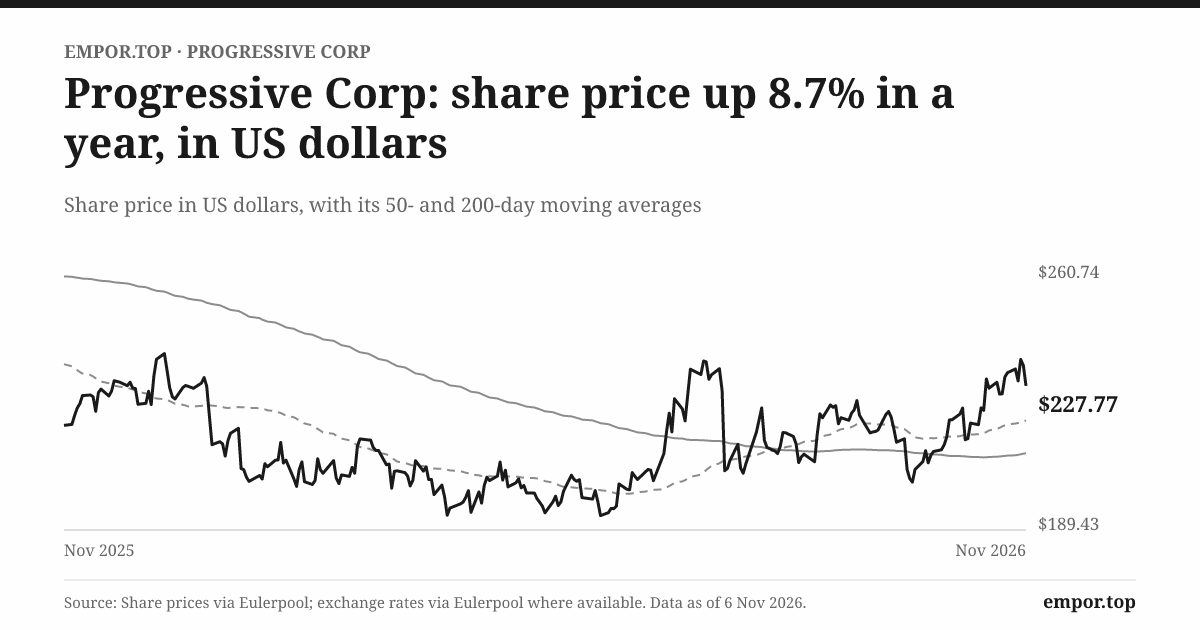
It sells directly, online and by phone, and through more than 40,000 independent insurance agencies.5 It employs about 70,000 people, up from about 49,000 just four years earlier.5 On November 5, 2026, the stock market valued it at about $137 billion, with the share price within about 1% of its 52-week high.5
That price frames the three questions this story has to answer. The first is whether Progressive built an enduring underwriting advantage, a genuinely better ability to price risk, or whether it simply rode the most favorable pricing cycle in a generation. The second is whether it can keep growth profitable now that competition and customer shopping have returned. The third is whether Griffith, who has run the company since 2016, can deploy a fast-growing pile of capital, expand into home and commercial insurance, and do it without diluting the discipline that built the company in the first place.
Before any of that, one distinction has to be clear, because it will come back in every chapter. In insurance, premium growth is not the same thing as good growth. An insurer can grow premiums at almost any speed simply by charging less than its rivals. The bill for that choice arrives later, sometimes years later, when the claims come in. The real test of an insurer is what remains after claims, expenses and the capital needed to stand behind every promise.
Progressive's own yardstick says the same thing. For decades it has told shareholders that its objective is to grow as fast as it can while achieving a combined ratio of 96 or better, meaning claims and expenses consume no more than 96 cents of each premium dollar, leaving at least four cents of underwriting profit.5
In 2025, Progressive kept about 12.6 cents of each premium dollar.5 That is three times its own target. It is also the kind of number that invites competitors in. Which is why the company that reached the top of American auto insurance now has to prove something different from what got it there: not that it can grow in a hard market, when everyone else is raising prices, but that it can earn its keep in a soft one. To see why Progressive believes it can, it helps to go back to two lawyers in Depression-era Cleveland, and a company that almost did not survive its second birthday.
 Subscribe on LinkedIn
II. Two Cleveland Lawyers Bet on Car Insurance
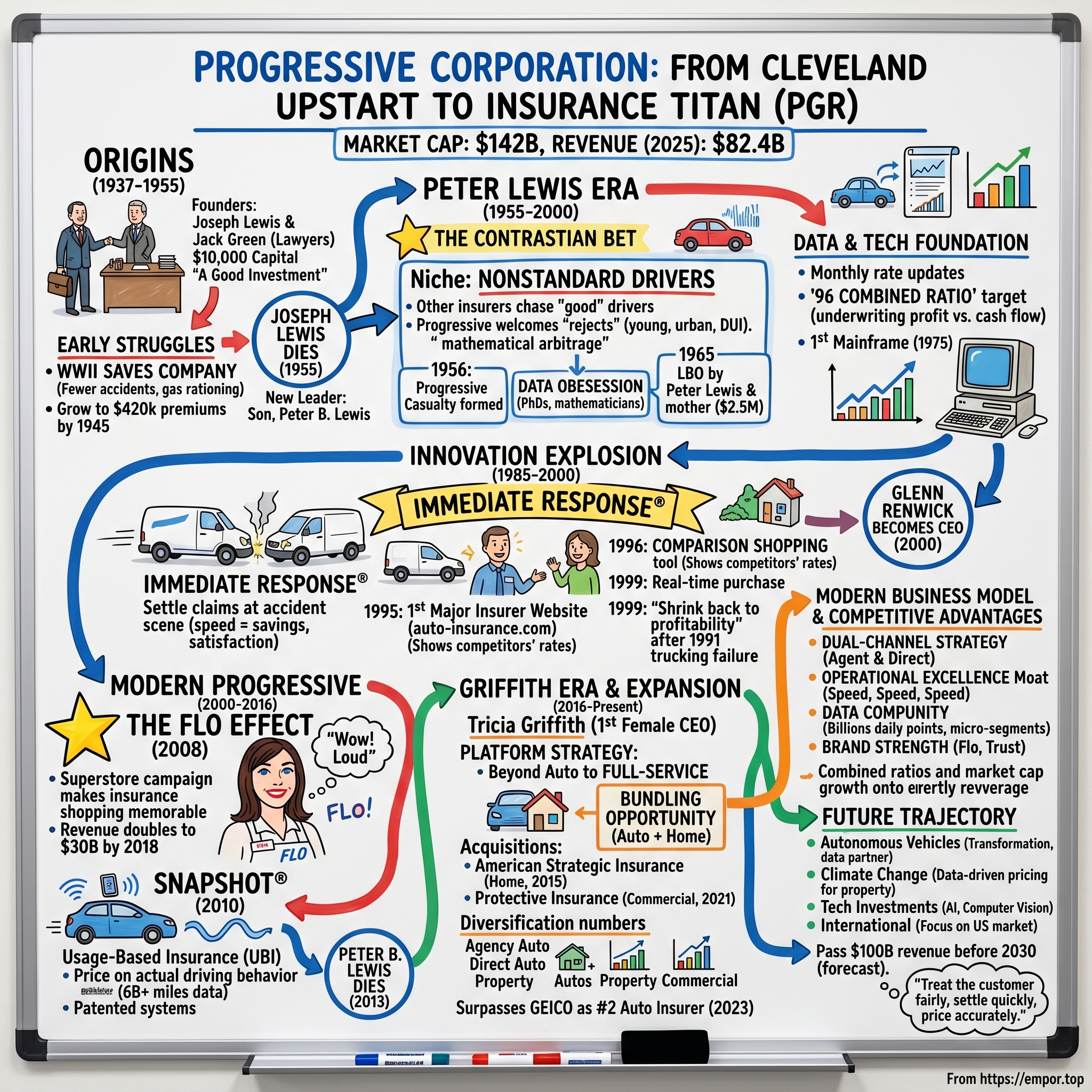
On March 10, 1937, Joseph Lewis and Jack Green started Progressive Mutual Insurance Company in Cleveland.6 They were young attorneys, and the company's own account of why they did it is disarmingly modest. They wanted to give vehicle owners security and protection, and they thought an insurance company was a good investment for a couple of lawyers who were just getting started.7 Their capital was about $10,000.8 One company history says that money was borrowed from Lewis's mother-in-law.9
The timing was strange and, in a way, perfect. Cleveland was an automobile city in a country still climbing out of the Depression. Millions of people owned cars, but car insurance was sold mainly to people with steady incomes who could pay a full year's premium up front. Lewis and Green went after the rest. Progressive offered drive-in claims service before any other auto insurer, so a customer could drive a damaged car to a claims office rather than wait for an adjuster.
And in another industry first, it let customers pay premiums in installments, which mattered enormously to people who could not afford an annual bill.7 Those two ideas contained, in miniature, the company's whole personality. Make insurance accessible. Make claims easy. Find the customers the incumbents had not bothered to serve.
The early business was tiny, and it was fragile. Lewis and Green wrote less than $10,000 of premiums in their first year. By 1939, the company's original capital had dwindled to less than $1,500, and a Chicago consultant advised the partners to get out of insurance altogether.9 For an insurer, that is closer to a near-death experience than it sounds. Capital is the cushion that stands between a policyholder's claim and the insurer's ability to pay it. Lose the cushion and you lose the right to keep writing business.
They did not quit. Within a few years the company had steadied, and by 1946 premium revenue had reached about $480,000.9 The popular version of what saved Progressive is wartime rationing. One widely repeated company history puts it bluntly: World War II saved Progressive, because people finally had jobs and money to afford cars and insurance, but gasoline was rationed, so they drove less and had fewer accidents.9
It is a satisfying story, and it is probably part of the truth. But it should be held at arm's length. It comes from a reference history rather than contemporaneous accounts, and it explains why loss costs might have fallen without explaining why this particular insurer, and not its many rivals, survived to grow. The better reading is that the war bought time, and the founders used it.
By 1951, growth had pushed the company into new offices in downtown Cleveland, and it had assets of about $2 million and more than 25,000 policyholders.78 It was a real, if regional, business. Then, in the mid-1950s, the generations turned. Joe Lewis died, and Jack Green became chief executive. In 1955, Joe's son Peter began his career at Progressive.7
The origin matters to an investor in 2026 for a reason that has nothing to do with nostalgia. Lewis and Green nearly learned the cost of a thin capital cushion firsthand. What they built instead was a business that tried to find a defensible pool of risk, people who needed insurance and were badly served, rather than a business trying to be big. Their son and successor would turn that instinct into a doctrine, starting with the drivers every other insurer was trying to screen out.
III. The Risk Other Insurers Wouldn't Price
Peter Lewis arrived at the family business with an unusual credential for a 21-year-old. He was born in Cleveland on November 11, 1933, and went to Princeton, where he wrote his senior thesis on compulsory automobile insurance.10 His Princeton classmates later wrote that the thesis became the business that allowed him, as chief executive, to develop the specialty of insuring high-risk drivers so successfully. They also wrote, with the candor of old friends, that he was never warm and fuzzy.10
Colleagues at Progressive described him as larger than life in personality and demeanor in every way.11 He also became one of the great philanthropists of his generation. Princeton alone received more than $220 million from him, including $101 million for the Lewis Center for the Arts, at the time the largest single gift in the university's history.10 The man who made a fortune pricing other people's risks gave much of it away on his own terms.
To understand the bet Lewis made, start with how insurers sorted drivers in the 1950s. A driver's age, driving record, accident history and the kind of car he drove all fed into a crude judgment: acceptable or not. The acceptable drivers got "standard" or "preferred" policies. Everyone else, the young, the ticketed, the people with an accident or two, were turned away or pushed into state-run assigned-risk pools. The industry called these drivers "nonstandard." The logic of exclusion was simple. If you cannot tell a merely unlucky driver from a truly dangerous one, refuse them both.
In 1956, Progressive Casualty Insurance Company was formed to write insurance for exactly those drivers.7 The company calls it the first specialty underwriter of nonstandard insurance.6 One reference history says the new subsidiary wrote about $83,000 of premiums in its first year, and within three years premiums outside Ohio topped $5 million a year, spread across states from Michigan to Mississippi.9
Why did this work, when every rival assumed it could not? The answer is the thread that runs through the rest of this story. A risky driver is not uninsurable. He is simply expensive, and the expense is knowable if you collect enough information. A 19-year-old with two speeding tickets will, on average, cost more in claims than a 45-year-old with a clean record.
But the average hides wide variation. Some of those 19-year-olds are much safer than others, and an insurer that can tell them apart can charge each one a price that is high enough to cover the risk and still low enough to win the customer.
Lewis's insight was that the nonstandard market was not a pile of bad risks. It was a pile of poorly measured risks. Measure them better and you could charge the right price for each, and serve a market the incumbents had abandoned.
That required a willingness most companies lack: letting customers walk away. If Progressive's data said a driver needed to pay $1,000 and the customer would only pay $700, the right answer was to lose the sale. The company's later rhetoric, which Griffith repeated on the 2026 call, traces directly to this.2
In 1965, the Progressive Corporation was incorporated as a holding company, and Peter Lewis became chief executive, a role he held for 35 years.78 The holding company was formed on Jack Green's retirement, through a leveraged buyout that brought Progressive Casualty and three related insurance agencies under the Lewis family's control.9 It was a bold piece of financial engineering for a small regional insurer: a young chief executive borrowing to buy control of the company his father had co-founded.
In 1971, Lewis took Progressive public with the sale of 110,000 shares.9 By 1987, the company passed $1 billion in premiums, and its stock was listed on the New York Stock Exchange under the ticker PGR.7
Lewis also built habits that outsiders found odd and insiders treated as sacred. In 1977, Progressive became the first insurer to publish its loss reserve report.6 Much later, in 2003, it became the first to release monthly financial results.6 Bloomberg's obituary of Lewis described a firm built on transparency, reporting results monthly instead of quarterly.11
For an insurer, transparency is not public relations. Reserves, the money set aside to pay claims that have happened but not yet been settled, are the biggest judgment call on the balance sheet. A company that publishes its reserve analysis is inviting shareholders to check its homework.
The doctrine was not infallible, and the record shows it. In the late 1980s, Progressive's nonstandard niche began to fill with competitors, including Allstate and other large carriers.9 California's Proposition 103, adopted in 1988, mandated rate rollbacks just as about 28% of Progressive's business was concentrated there; the company eventually refunded about $51 million and laid off 800 workers at its California office.9
A move into trucking insurance that began in 1986 lost about $84 million by 1992 and was shut down.9 Profits fell from about $93 million in 1990 to about $33 million in 1991, and Lewis cut about 1,300 jobs.9 Better pricing had not protected the company from regulatory shock, from an overconfident expansion, or from competitors who copied the niche.
The modern record contains a similar warning. In 2022, Progressive's net income collapsed to about $722 million, from $5.7 billion two years earlier.5 The story of that trough is more nuanced than "the model broke." The company-wide underwriting margin was 4.2%, just above the 4% target, but Personal Lines, the heart of the business, slipped to 3.2%, below it.5 Inflation in used-car prices, repair costs and injury claims had outrun the rates Progressive had filed.
Then the investment portfolio, hit by the sharp rise in interest rates and falling markets, swung comprehensive income to a loss of about $2.1 billion.5 The following year, 2023, Progressive had to add about $1.1 billion to reserves for prior accident years, an admission that its earlier estimates had been too low.5
So the founding claim, that Progressive prices risk better than its rivals, survives its own history, but in a narrower form. It did not stop a cycle-driven profit collapse. It did not prevent reserve misses. What the record does support is speed of recovery once rates caught up with costs: the companywide underwriting margin went from about 5% in 2023 to more than 11% in 2024, and Personal Lines from 3.2% in 2022, below the target, to above 11% in 2024.5
The advantage looks less like a fortress and more like a reflex: faster detection, faster repricing. Whether that reflex is unique, or merely a lead competitors can close with their own data, is the question that carries forward. And the next generation of Progressive's innovations, the ones that made it a household name, were not about pricing at all. They were about showing up.
IV. Claims at the Scene, Quotes on the Screen
Picture a two-car collision at a suburban intersection in the mid-1990s. Glass on the asphalt, a dented fender, two shaken drivers waiting for the police. Then a specially marked vehicle pulls up, and a Progressive claims representative steps out. He was not called by the police. He was called by the customer. He looks at the damage and starts the claim right there, at the curb.
Progressive called it the Immediate Response Vehicle. The company dates the first ones to 1994, describing them as specially marked and outfitted vehicles that brought trained claims professionals to wherever customers needed them, even to the scene of an accident.7 It built on a 24-hour, seven-day Immediate Response claims service the company introduced in 1990.7 By 1994, according to Cleveland's local encyclopedia of history, Progressive operated a fleet of about 2,600 such vehicles, equipped with laptop computers.8
The logic was elegant. Insurance is an odd product, because the customer pays for something he hopes never to use. The one moment he truly experiences what he bought is the claim, and that moment is usually miserable. By turning up at the scene, Progressive made the claim part of the product. There was a hard economic logic too. Claims handled quickly tend to cost less: fewer rental days, less time for injury claims to swell, less chance that a frustrated customer hires a lawyer. Service and cost control pointed in the same direction.
At almost exactly the same time, Progressive attacked the other painful moment in buying insurance: shopping. In 1993, it became the first auto insurer to offer comparison rates and the option to buy by phone.6 In 1994, it launched 1-800-AUTO-PRO, a toll-free line where a caller would receive a Progressive quote alongside comparison rates from up to three competitors, and could buy immediately.7
Think about how strange that was. A company was voluntarily telling customers when a rival was cheaper. The bet was that Progressive's pricing was good enough to win often, and that being the trusted place to compare would bring in more shoppers than it lost.
Then came the web. In 1995, when most Americans had never used a browser, Progressive became the first auto insurance group to launch a website, auto-insurance.com; two years later the site became progressive.com.6 By 1996, consumers could get comparison rates online, and by 1997 they could buy an auto policy online in real time.7 That same year, Progressive entered the S&P 500.6
These moves gave Progressive something its rivals mostly lacked: a direct relationship with customers. For much of its history Progressive had been an agency company, and in 1992 it was the largest seller of auto insurance through independent agents in the country.7 The new phone and web channels added a second road to the customer. That became the dual-channel model Progressive still uses.5
In 2025, about 58% of personal auto premiums came through the direct channel; by the third quarter of 2026, it was 59%.15 State Farm and Allstate historically relied on their own captive agents; GEICO built itself on direct sales. Progressive kept both doors open, which let it meet customers wherever they preferred to shop.
It is tempting to turn this into a tidy myth: Progressive invented online insurance and has owned the digital customer ever since. The record does not support that. Being first to a website in 1995 is not a moat in 2026. Every major insurer now quotes online in minutes, and comparison sites and agents make prices transparent in a way 1-800-AUTO-PRO only hinted at. What matters now is not who launched first but how well each insurer converts a shopper into a customer and keeps them.
The present-day evidence there is mixed. On one side, Griffith told analysts that in both 2024 and 2025 Progressive captured over 40% share of shoppers while holding less than 20% market share.2 If accurate, that means Progressive wins far more than its fair share of people who actively compare prices, which is exactly what the 1990s strategy was designed to achieve. On the other side, the third quarter of 2026 showed how the same openness cuts both ways.
Direct personal auto quote volume fell 6% from a year earlier, though the rate at which quotes turned into sales rose 4%.1 Fewer people asked Progressive for a price, but more of those who asked said yes. That is the signature of a company whose pricing is competitive but whose share of attention is under pressure from rivals spending heavily to win shoppers back.
The roadside adjuster and the online quote were the right ideas, built for a clear customer purpose, and they helped define the brand. But they were operating choices, not patents, and their value today depends on how well Progressive executes against competitors who long ago copied the playbook. The company that pioneered these tools needed something more to become a national giant: a leadership regime that would scale them, and a face that every television viewer in America would recognize.
V. Flo, Snapshot, and the Long Scale-Up
In 2008, a cheerful woman in a white apron, standing behind the counter of a gleaming white "Superstore," began appearing in American living rooms. Her name was Flo, and she sold insurance as if it were a box of cereal.6 The joke was in the premise: insurance as a retail product you could pick off a shelf. Flo became so recognizable that by 2012, Advertising Age had named her one of the top ten female ad icons.6
A year later, in 2009, Progressive became the first auto carrier to offer a Name Your Price option during quoting, inviting shoppers to start from the budget they had in mind rather than the coverage an insurer wanted to sell them.6 The tool was marketing, but it was marketing with a point of view.
It accepted that most people shop insurance on price, and it tried to turn that fact from a weakness into a reason to visit Progressive first. Flo got people to the counter. Tools like this were meant to keep them there long enough to see a quote.
Flo arrived in the middle of the Glenn Renwick era, and Renwick is the bridge between the founder's company and today's. He joined Progressive in 1986, rose to run operations, and succeeded Peter Lewis as chief executive at the turn of the century, formally serving as chief executive of the parent company from 2001 until 2016.128 Lewis stayed on as chairman, and when he died on November 23, 2013, Renwick summed up the inheritance plainly: the history of Progressive was very much the history that Peter Lewis laid down.1113
Renwick's job was not to reinvent the doctrine. It was to industrialize it: take the pricing discipline, the claims service and the direct channel, and turn them into a machine that could run at national scale.
The machine had three gears. The first was advertising. The second was distribution through both agents and direct channels. The third, and the most interesting intellectually, was data. In 2004, Progressive piloted a usage-based insurance program called TripSense for Minnesota drivers. In 2011, it rebranded the program as Snapshot.6 The idea was a logical extension of what Peter Lewis started in 1956. Traditional pricing relies on proxies: your age, your ZIP code, your credit history, your accident record.
Those proxies are correlated with risk, but they are not the risk itself. Snapshot measures something closer to the real thing: how a person actually drives. Through a plug-in device or, for most new enrollees today, a smartphone app, it observes how a customer actually drives.5 A careful driver who happens to be young can earn a lower price; a careless driver who looks good on paper can be priced accordingly.
The theory is powerful. But adoption is not proof of superior economics, and the company's own disclosures show adoption moves around. In 2025, Snapshot enrollment rates rose 6% in the direct channel but fell 2% through agents. In the third quarter of 2026, the pattern reversed: adoption rose 8% among agency customers, after Progressive widened eligibility, and fell 4% in direct. About half of direct new-business customers chose Snapshot in both years.15
Snapshot is available everywhere except California.5 Those figures say the tool is widely used. They do not, on their own, say how much better Progressive's loss ratios are because of it. Competitors including State Farm and Allstate have their own telematics programs, and the company does not publish a figure isolating Snapshot's effect on profitability.
The results of the machine, though, are undeniable. Revenue rose from about $32 billion in 2018 to nearly $88 billion in 2025.5 Personal Lines policies in force rose from about 23.9 million at the end of 2020 to about 37.4 million at the end of 2025, a gain of more than 13 million households, vehicles and boats in five years.5
Progressive has spent heavily to drive that growth. Its advertising spend reached $5.1 billion in 2025, up $1.1 billion in a single year, and management said it would keep advertising as long as the spend was efficient and the company stayed on track for its profit target.5
But the post-pandemic surge also shows how much of Progressive's growth came from conditions rather than pure skill. When inflation in claims costs exploded in 2022 and 2023, nearly every auto insurer raised rates sharply. Customers, shocked by their renewal bills, shopped. Progressive, which raised rates early and then turned its advertising back on as its margins recovered, was positioned to catch them. That is a real achievement. It is also a cyclical one. When a competitor fixes its own rates and starts advertising again, the same shopping wave flows the other way.
That is precisely what the retention data shows. Progressive's primary measure of how long customers stay is "policy life expectancy," the company's actuarial estimate of how long a newly written policy will remain in force. In 2025, the trailing twelve-month figure for personal auto fell 7%. By the third quarter of 2026, it was down 9% year over year, on both a three-month and twelve-month basis, which management attributed primarily to increased shopping and competition and, to a lesser extent, a shift in mix.15 In the direct channel, the three-month measure was down 11%.1 Recognition and analytics brought customers in. They did not make those customers stop shopping.
On the call, Jim Curtis, newly named president of Personal Lines, framed the decline as policy life expectancy simply reverting to a more normalized level, and noted that roughly 90% or more of customers accept their renewal offer.2 That is a reasonable interpretation, and the coming quarters will test it. If it is normalization, the decline should flatten as shopping settles. If it is something more, it will keep falling as rivals cut rates.
Brand, distribution and data supported real scale. The evidence does not show that they eliminated price sensitivity, because nothing in auto insurance does. And in 2016, the person who would be judged by both the boom and its aftermath took the helm.
VI. Griffith's Growth Mandate Meets the Underwriting Cycle
On May 12, 2016, Progressive announced that Glenn Renwick would retire as chief executive after almost 30 years with the company, staying on as executive chairman. His successor, effective July 1, was Tricia Griffith, then the Personal Lines chief operating officer.12
Griffith's résumé is a portrait of the company's internal culture. She joined Progressive in 1988 as a claims representative, the job of the person in the Immediate Response van, and spent years in managerial roles in the Claims division. In 2002 she was named chief human resources officer, an unusual detour for a future insurance CEO. In 2008 she returned to Claims as group president overseeing all claims functions, then served as president of customer operations, and in April 2015 became Personal Lines COO.12 She is, in other words, someone who learned the business from the scene of the accident outward. That matters in a company whose central claim is that it understands loss costs better than its rivals.
Her tenure has two chapters, and they look very different. The first is a record of extraordinary growth. Revenue rose from about $42.7 billion in 2020 to about $87.7 billion in 2025, and net income from $5.7 billion to $11.3 billion.5 In between lies the hole. Net income fell to about $722 million in 2022 before recovering to $3.9 billion in 2023 and $8.5 billion in 2024.5
For anyone tempted to treat Progressive as a steady compounder, that sequence is the corrective. Property-casualty insurers' results move with four forces the company only partly controls: how often claims happen, how expensive each claim is, catastrophe experience, and how well earlier reserve estimates hold up.
The mechanics of the 2022 swing show why insurance pricing always runs behind reality. Imagine an insurer that sets a six-month premium in January based on what claims cost last year. By June, used-car prices have jumped and body shops are charging more for labor and parts. Every claim from those policies costs more than the price assumed.
The insurer can file for higher rates, but in many states it has to justify them to regulators, and the new rates only apply as policies renew. So for months, sometimes a year or more, the insurer is paying today's claims with yesterday's prices. That is what happened across the industry in 2022.
The cure creates its own problem. Once Progressive raised rates enough to restore profitability, its customers felt those increases and some of them shopped. Meanwhile, rivals that raised rates later and harder sent their own customers shopping, and Progressive, now priced adequately, could catch them with advertising. That is a large part of how policies in force surged.
Now the pendulum is swinging back. With margins rich across the industry, competitors are cutting rates. Rate decreases help Progressive defend its customers, but they lower premium per policy. That is exactly the gap between 6% policy growth and 4% premium growth in the third quarter.1
What did management actually say about it? The call is worth reading closely, because prepared remarks and analyst questions told different parts of the story. Griffith's prepared message was consistent with every year of her tenure: Progressive would grow as fast as it could while maintaining underwriting discipline, and would advertise to maximize growth as long as that spend remained efficient.2 Lori Niederst, the chief Personal Lines officer, described the competitive picture plainly: carriers were trading margin for growth with rate reductions, increased advertising and higher agent commissions. She said September had been softer.2
The analysts pushed on exactly the spots a skeptic would. Elyse Greenspan of Wells Fargo asked about September's direct new business and October trends. Griffith declined to give anything beyond what Progressive had published, and repeated that the company wants to write to a 96 combined ratio over the lifetime of a policy.2 That refusal is consistent with a long company habit of disclosing monthly results but not guiding. It also means investors cannot rely on management to signal turning points in advance.
Tracy Benguigui of Wolfe Research asked about the most sensitive subject on the call: reserve releases. Progressive had recorded about $1.3 billion of favorable reserve development in personal auto during the first nine months of 2026, meaning claims from earlier years were costing less than it had expected and the excess was flowing back into profit.1 She asked how that interacted with Florida's excess-profit law and with the loss estimates the company would use for 2025 accident-year business.
Andrew Quigg, who became CFO in 2026, said personal auto bodily injury had been a driver of the favorable development, that the company did not believe an additional Florida accrual was necessary at that point, and that Progressive had the right, adequate reserves.2
Curtis explained that loss estimates are set state by state, by accident year.2 The answers were specific about mechanism, but they could not settle the deeper question, which only time will answer: whether the reserves set for 2025 and 2026 will prove as conservative as those set for 2024.
Mike Zaremski of BMO asked about claims inflation. Griffith said incurred severity, the average cost per claim, was running at about 4%, with personal injury protection costs rising mainly in New York and New Jersey. Quigg said the year-to-date bodily injury trend was more like 6%, while Florida trends had been more benign.2 Those are the inputs that will determine whether today's margins hold. A company cutting rates while claim costs rise 4% to 6% a year is, by definition, eating into its margin. The only question is how quickly.
The most forward-looking exchange on the call was about technology, and it cut against the comfortable assumption that Progressive's digital lead is a one-way advantage. Bob Huang of Morgan Stanley and David Motemaden of Evercore ISI both asked about AI agents that could shop for insurance on a customer's behalf. Griffith said the company was now in the next generation of technology, including generative and agentic AI, but that agent-driven inbound interactions were still a rounding error relative to overall volume.2 Niederst added the more consequential point: agentic shopping creates the potential for elevated and sustained levels of shopping.2
Think about what that means for an insurer. Today, inertia keeps most customers renewing. If software can re-shop a policy every six months at no effort to the customer, inertia weakens for everyone. Progressive, which has recently won a disproportionate share of active shoppers, might win more of them. It would also lose more of its own customers to whoever is cheapest that week. A world of sustained shopping rewards the most accurate pricer and punishes everyone else, which is the bet Progressive has been making since 1956, now played at machine speed.
Two details in the 10-Q make the slowdown concrete. Personal vehicle new-business applications fell 1% in the quarter, while renewal applications rose 9%.1 In other words, growth now comes mainly from keeping customers won during the surge, not from winning new ones. And Commercial Lines, where Progressive took targeted rate cuts and spent more on advertising and agent incentives to grow, saw its underwriting margin fall to 7.4% from 10.8% a year earlier, even as premiums rose 9%.1 Commercial Lines is showing, in miniature, what buying growth in a competitive market costs.
There was also a leadership change on the call itself. Griffith thanked Pat Callahan, who was retiring from the Personal Lines president role to take on strategic initiatives, and introduced Curtis in that job.2 With a new CFO and a new head of the largest segment, the team that steered the post-pandemic recovery is partly turning over just as the cycle turns.
The fair verdict on Griffith's record so far is that it shows major scale gains and a demonstrated willingness to reprice when conditions change. The 2022 trough is a blemish, but the speed of the recovery is evidence for the company's reflexes. The current test is different and, arguably, harder. Raising prices in a hard market is painful but straightforward.
Holding prices in a soft one, while watching rivals take customers, requires conviction. Management's own checkpoints are the right ones to watch: policy growth, premium growth, renewal retention and accident-year profitability. To understand which of those matter most, it is time to open up the engine itself.
VII. Where the Insurance Engine Makes—and Loses—Money
Every insurer runs on the same basic bargain. Collect a premium now. Pay claims later. Invest the money held in between. If the premium covers the claims and expenses, the insurer earns an underwriting profit. Whatever the investments earn is a second stream of income on top. If the premium falls short, the investment income has to cover the gap, and in bad years it cannot.
Progressive's underwriting profit is built from a handful of moving parts, and each one is a lever. Start with policy count: how many customers it insures. Multiply by premium per policy: what each one pays, which depends on rates, coverage and whether the policy runs six months or twelve. Subtract the claims those policies generate, which depend on frequency, how often accidents happen, and severity, how much each one costs.
Subtract the cost of acquiring customers, chiefly advertising and agent commissions, and the cost of running the company. What remains is underwriting profit. Renewal retention ties the whole thing together, because a customer who stays for years is far cheaper to serve than one who must be won again with advertising.
This is also why "revenue" is a slippery word for an insurer. Premiums written measure the business sold in a period. Premiums earned measure the portion of that coverage that has actually been provided, because a twelve-month policy sold in December is mostly earned the following year. Investment income comes from the float. Reported revenue mixes all three, plus realized gains on securities. When Progressive's revenue grew only 3% in the third quarter of 2026, a figure that includes investment results, it was telling a slightly different story from the 4% growth in premiums written and 5% in premiums earned.1
Where does the money actually come from? In the third quarter of 2026, Personal Lines accounted for about 89% of net premiums written, and it earned an underwriting margin of 12.0%. Commercial Lines earned 7.4%. The company as a whole earned 11.3%, against its target of at least 4%.1 For full-year 2025, underwriting produced about $10.3 billion of pretax profit, while the investment portfolio produced about $3.3 billion.5 Underwriting, in other words, is the main event. The investment portfolio is an important supporting act, not the reason the company exists.
Two adjustments sharpen that picture. The first is Florida. Florida law caps the profit any insurance group can earn on personal auto insurance over a three-accident-year period, and requires excess profit to be returned to policyholders. In 2025, Progressive recorded a $1.2 billion policyholder credit expense under that statute, which cut the companywide margin by about 1.5 points.5 Excluding the credits, Personal Lines would have earned about 14.2% in 2025.5
That is not just an accounting footnote. It is a vivid example of a structural limit on profitability: in Florida, Progressive's second-largest state, regulators claw back profits once they exceed a statutory ceiling.5 The same mechanism flatters year-over-year comparisons in 2026. Personal Lines' third-quarter margin rose to 12.0% from 10.5%, but the prior-year quarter included $950 million of these Florida credits.1
The second adjustment is reserves. In 2025, Progressive recorded about $1.4 billion of favorable development on prior-year claims, compared with about $1.1 billion of unfavorable development in 2023.5 In the first nine months of 2026, favorable development reached about $1.5 billion.1 Rough arithmetic helps here. With roughly $64 billion of premiums earned over nine months, $1.5 billion of releases is worth about two and a half points of margin.
Strip those out and the underwriting margin on current-year business still looks comfortably above 4%, but it is closer to 10% than 12.5%. That is still very strong. It is also a reminder that part of today's profit is the reward for being conservative in the past, a reward that cannot be counted on every year.
Now the moat, argued in full once. Progressive's case for a durable edge rests on four claims, and each can be tested.
The first is scale. Progressive now stands roughly level with State Farm in U.S. private passenger auto premiums.3 Scale matters in insurance because it spreads fixed costs, including technology and national advertising, over more premium, and because a larger book produces more data to refine prices.
Griffith told analysts that Progressive's non-acquisition expense ratio, the cost of running the company excluding sales costs, had fallen about half a point a year over the last 15 years, and that policies in force per employee were up more than 10%.2 Lower overhead per policy is a genuine cost advantage, the kind that compounds.
The second is underwriting performance against the industry. Progressive's five-year annualized underwriting margin and premium growth exceeded the industry through 2024, according to its 2026 proxy.14 AM Best, the insurance rating agency, cites strong operating performance and favorable underwriting and claims technology among its strengths.1516 That is independent evidence that the company's margins are not simply the industry tide.
The third is distribution. Few rivals operate both a large direct business and a large independent-agent business. That lets Progressive meet the customer who wants to buy on a phone at midnight and the customer who wants an agent to compare prices on her behalf.
The fourth is data, of which Snapshot is the visible symbol.
Now put the disconfirming evidence beside those claims. Customers can shop and switch at every renewal, and they are doing so in record numbers. Agents can place a customer with any of several carriers, so agent relationships are not exclusive. Rates are regulated state by state, which means national scale does not override local loss trends, legal environments or regulatory caps.
Florida's excess-profit law is one example; California, where Progressive cannot use Snapshot, is another. Policy growth has slowed, personal auto retention has weakened, direct quote volume is falling, and 2022 showed that a surge in loss costs can compress results sharply even for the industry's best pricer.
Concentration itself is not proof of pricing power. A market where the top four carriers hold more than half of premiums sounds oligopolistic. But auto insurance is a product where each carrier sets its own price, customers compare easily, and the second-largest carrier is behaving like a challenger rather than a cartel member. Progressive's leadership in winning shoppers is evidence of good pricing, not evidence that it can raise prices at will. Indeed, the Florida credits suggest the opposite: when profits get too high, regulators intervene.
Weighed together, the history narrows the moat claim without rejecting it. Progressive's advantage is best described as an execution edge: a lower cost structure, faster recognition of loss trends, a willingness to walk away from underpriced business, and dual distribution that catches shoppers in both channels. It is not immunity from the cycle. The test that would confirm or falsify the edge is specific.
As competitors cut rates in 2026 and 2027, Progressive should be able to retain customers and keep accident-year combined ratios well inside 96, without the help of reserve releases. If retention keeps falling and margins converge toward the industry, the edge was more cyclical than structural.
Finally, the float. Progressive's investment portfolio was about $99.2 billion at the end of September 2026, mostly in high-quality bonds; at year-end 2025, about 44.5% of the fixed-income portfolio was in U.S. government securities, and the average credit rating was AA-minus.15 Investment income rose from about $1.9 billion in 2023 to about $3.6 billion in 2025, helped both by a much bigger portfolio and by higher interest rates; the recurring book yield was 4.3% in the third quarter of 2026.15
The float also explains a number that looks spectacular and means something else. Between 2023 and 2025, Progressive's operating cash flow totaled about $43 billion, against net income of about $24 billion.5 The gap of nearly $20 billion did not come from some hidden cash-generating genius. It came mostly from two liabilities growing as the company grew: reserves for claims that had happened but not yet been paid, which rose by about $13 billion, and premiums collected for coverage not yet provided, which rose by about $8 billion.5
That cash is real, and Progressive invests it. But it belongs, in effect, to future claimants. A growing insurer looks like a cash machine; a shrinking one would see the same machine run in reverse. That is why a free-cash-flow yield borrowed from industrial companies tells an insurance investor very little.
That income meaningfully supports returns. But the portfolio can also swing the balance sheet. In the third quarter of 2026, comprehensive income fell about $2.25 billion from a year earlier, mostly because of unrealized losses on bonds, even though underwriting was strong.1 An investor reading Progressive's results has to keep two engines separate: the underwriting engine, which reflects the company's skill, and the investment engine, which mostly reflects interest rates.
Auto remains the center of all of it. But for a decade, Progressive has been trying to widen the relationship with each customer, by insuring the house as well as the car.
VIII. The Home-and-Commercial Expansion: Useful Adjacent Bets, Not a New Core
In December 2014, Progressive announced that it would pay about $875 million in cash to raise its stake in ARX Holding Corp., the parent of American Strategic Insurance, from 5%, which it had held since 2012, to about 67%.17 ASI was one of the top 20 homeowners insurers in the country, with more than $1 billion of premium.17 The deal closed in April 2015, and a stockholders' agreement allowed, and in some circumstances required, Progressive to buy the rest of ARX by the end of 2021.18
The rationale was spelled out by Glenn Renwick in the announcement. Progressive needed the reliable availability of many more products than it intended to manufacture, he said, and ASI provided a significant array of the most important products beyond auto.17 ASI's chief executive, John Auer, put the ambition more vividly: his company's intention had long been to become the Progressive of home insurance.17
The strategy has a name inside Progressive. The company sorts its customers into personas: Sams, Dianes, Wrights and Robinsons. The Robinsons are households that bundle auto and home insurance with Progressive, and increasing their share is, in the company's words, a key initiative.1 The logic is that a household that buys both auto and home stays longer, because switching two policies is more trouble than switching one, and because bundled customers tend to be more stable. Before ARX, Progressive could only offer homeowners coverage through partners. ASI gave it its own product.
Was the price right? The announcement gives a cash figure but not a clean public multiple of earnings or book value that would allow a confident comparison with other insurer deals, so neither "bargain" nor "overpaid" can be proven from the public record. What can be said is that the deal was large for its time but small relative to the company: Progressive wrote about $20.6 billion of net premiums in 2015.18 This was a strategic addition, not a transformation.
Homeowners insurance also carries risks auto insurance does not. A car accident in Ohio is unrelated to a car accident in Texas. A hurricane in Florida damages tens of thousands of homes at once. That concentration means home insurers need reinsurance, careful state-by-state exposure management and rate adequacy in markets where regulators may resist increases. Progressive's 2015 risk disclosures warned that the ARX acquisition might not produce the anticipated benefits, and that goodwill and intangible assets could become impaired.18
The record since then shows a business Progressive had to rein in before it could grow it. The 10-Q for the third quarter of 2026 describes the company selectively increasing the availability of its personal property products since late 2025, reopening new business in some agency and direct markets, and lifting targeted underwriting restrictions on older roofs, medium- to high-value homes and unbundled homeowners policies.
Restrictions remain in place in markets where it is still improving profitability and reducing exposure to volatile weather.1 Reading between those lines, the home book went through a period of tightening, a sign that the bundling vision ran into the economics of catastrophe risk.
Now the pendulum has swung toward growth. Homeowners new-business applications rose 22% in the third quarter of 2026, and the personal property business posted a 27.2% underwriting margin, helped by light catastrophe losses.1 Griffith told analysts that home is one of Progressive's largest opportunities over the next couple of years.2 But the 27% margin is a weather result as much as a skill result, and trailing twelve-month retention in personal property was down 7% year over year.1
Progressive has not published a product-specific long-term profit target for homeowners, and the rollout is too young to judge. The risk to watch is simple: a company famous for auto pricing discipline expanding fastest in the line where one bad hurricane season can erase years of profit.
Commercial Lines tells a more mature story. Progressive began writing commercial insurance for small businesses in 1971, and by now it is a proven secondary business with about 1.2 million policies in force at the end of 2025.519 In February 2021, Progressive agreed to buy Protective Insurance Corporation for $23.30 per share in cash, or about $338 million, to expand its capabilities in larger trucking fleets and affinity programs, and to bring in workers' compensation coverage for the transportation industry, a new area for Progressive.20
The price represented premiums of about 49% and 63% to the unaffected prices of Protective's two share classes.20 Those are deal premiums, the price of control, not proof of overpayment, and the acquisition was tiny relative to Progressive's size.
The trucking connection also carries a lesson from Progressive's own past. Its first move into trucking in the late 1980s lost about $84 million and was shut down by 1992.9 Protective was a more cautious approach: buying expertise rather than building it from scratch. The early 2020s also showed how quickly commercial auto can turn. Commercial Lines margins fell to about 1.2% in 2023 before recovering to 13.0% in 2025.5 The current quarter's slip to 7.4% shows the line is again sensitive to competition.1
Adjacent lines deserve attention because they can widen the customer relationship and give agents more reasons to place business with Progressive. Neither home nor commercial is replacing auto as the center of the economics. They are options on a broader company, and options have to be exercised carefully. The question of how carefully leads straight to the person who controls the money.
IX. Griffith's Capital Choices and the Governance Test
In December 2025, Progressive's board declared an annual variable dividend of $13.50 per share, about $7.9 billion in total, payable in January 2026.5 Then, through the first nine months of 2026, the company repurchased about 7.7 million of its own shares for about $1.6 billion.1 In March 2026, it borrowed $1.5 billion, selling $500 million of 4.60% notes due 2031 and $1 billion of 5.15% notes due 2036.21 By the end of September, its total capital, debt plus shareholders' equity, had reached about $42.9 billion, up $5.7 billion from the end of 2025, mainly because of comprehensive income earned during the year.1
This is the financial-engineering chapter of the story, and it rests on a capital philosophy Progressive has described for years. The company says it holds capital in layers. The first, which it calls regulatory capital, sits in its insurance subsidiaries and is enough to satisfy state requirements and to support writing all the business it can at its target.
A second layer is held for even more extreme conditions.5 Anything beyond those is available to return to shareholders. The order of priorities, repeated on calls, is to fund growth first, keep a buffer for bad scenarios, and only then consider repurchases and dividends.2
That structure explains a distinctive habit. Progressive pays a tiny regular dividend, ten cents a quarter, plus a large variable dividend in years when it has excess capital.5 The variable dividend was 75 cents per share at the end of 2023, $4.50 at the end of 2024 and $13.50 at the end of 2025, a sequence that rose with profits.5 An investor who looks only at the regular dividend sees a yield of about 0.2%, which badly understates what shareholders actually receive in a strong year.
Buybacks deserve more scrutiny. Progressive says it repurchases shares when it believes they trade below its own estimate of long-term fair value, and to offset dilution from employee stock awards.1 The average price of its 2026 repurchases works out to a little over $200 a share. With the stock near $233 on November 5, near its 52-week high, the question an activist would ask is straightforward: is buying stock at a peak-earnings multiple the best use of capital when competition is rising?
The company's answer, implicitly, is that the volume is modest, a little over 1% of the share count, and that it keeps the bulk of excess capital for growth and the variable dividend. That restraint is consistent with the stated hierarchy.
Two cautions belong here. First, not all of the capital is fungible. Insurance subsidiaries can pay dividends to the parent only within regulatory limits, so the holding company's liquidity is distinct from the subsidiaries' float. At year-end 2025, the parent had access to about $13.0 billion of securities held in a non-insurance subsidiary, a substantial cushion that sits outside regulated entities.5 Second, the balance sheet is conservative but not unlevered in the insurance sense. Debt was about 19.6% of total capital in September 2026, under the company's 30% policy ceiling.1
But Progressive writes about $2.90 of premium for every dollar of statutory surplus, and AM Best notes that its underwriting leverage is elevated relative to its private-passenger auto peers.515 AM Best affirmed the insurance subsidiaries at A+ (Superior) in May 2026, citing the strongest level of risk-adjusted capitalization, while also flagging a history of mixed reserve development.15 That is a strong rating with a clearly stated caveat.
Now the people. Griffith's reported total compensation rose from about $15.6 million in 2023 to $17.7 million in 2025 as earnings recovered.14 Most of it is performance-based: cash incentives tied to policy growth and insurance profitability under the company's Gainshare program, which covers nearly all employees, and long-term performance shares.145 Her 2025 stock award was valued at about $11.0 million at the grant date, which is not the same as cash received.14
More striking is her ownership. Her directly owned shares were worth about 95 times her salary, against a company guideline of six times.14 Whatever else one concludes, this is a chief executive with a very large personal stake in the long-term share price.
Outside the executive suite, ownership is dispersed. Progressive has no controlling shareholder; the largest holders disclosed in the 2026 proxy were the index giants Vanguard, with about 8.8% of the shares, and BlackRock, with about 7.2%.14 There is no family or founder bloc left to shield a strategy through a bad patch, as the Lewis family's control once could. Management's discipline is enforced by the board and by the share price, which is to say by results.
The May 2026 annual meeting offered a governance signal worth noting without overreading. The advisory vote on executive pay passed easily, with about 464 million votes for and 19 million against.22 Lawton Fitt, the independent chair, received about 67.9 million votes against her re-election, more dissent than the CEO received.22 The filing does not say why.
Common reasons for such votes at large companies include tenure, the number of boards a director sits on, or proxy-adviser policies, but none is established for this case, and the vote did not change the outcome. It is a signal to watch, not a crisis.
There was also a quiet transition in finance. John Sauerland, Progressive's longtime CFO, announced plans to retire in January 2026, and Andrew Quigg became CFO effective July 4, 2026.1422 On the November call, Quigg handled the hardest questions on reserves and severity trends with specific answers.2 Whether his explanations hold up against future reserve development is part of the credibility test ahead.
The behavioral record on capital is mostly good. Griffith's team has funded enormous growth, kept leverage moderate through the 2022 shock, returned excess capital through variable dividends that rise and fall with earnings, and avoided large or transformative acquisitions. The next evidence will come from three places: how accurately management explains reserve development, whether retention stabilizes, and what return the company expects from capital it retains rather than distributes. And all of that feeds into a single number the market sets every day: the price.
X. The Investor's Case: A Powerful Insurer at a Cyclical Multiple
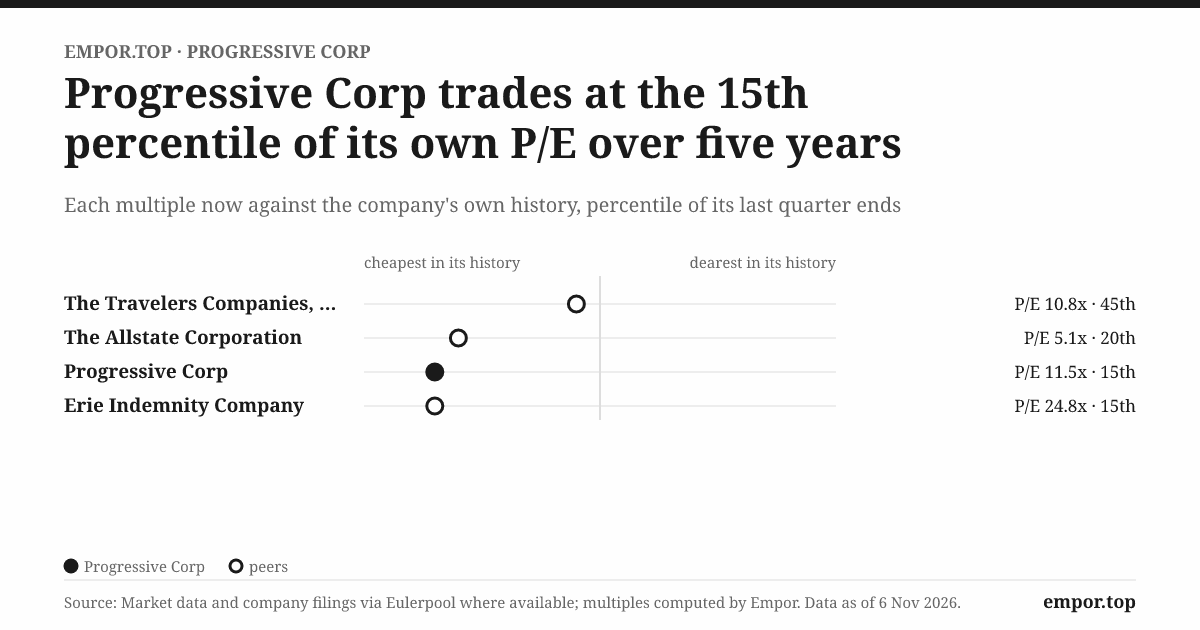
On November 5, 2026, Progressive's shares closed at about $233, within 1.3% of their 52-week high. At that price, the stock traded at about 11.7 times the last twelve months' earnings, far below its five-year median of about 18.8 times.5 On the surface, that is a puzzle. Why would a company near its all-time high trade at a deep discount to its own history?
The answer is in the denominator. Earnings per share over the last twelve months were about $19.88, near a record.5 The market is not paying a low multiple for a struggling company. It is paying a low multiple for earnings it suspects are elevated. The peer comparison points the same way. At the end of October, Travelers traded at about 10.4 times earnings, Chubb at about 12.8 times and Allstate at about 5.2 times.23 Progressive's multiple is in the middle of that group, a big change for a company that historically commanded a premium.
A rough piece of arithmetic shows what is at stake. Progressive earns on the order of $85 billion of premiums a year. At its 2025 margin of 12.6%, that produces underwriting profit of roughly $10 billion before tax. At the company's own target of 4%, the same premiums would produce roughly $3.4 billion. The difference, after tax, is something like $5 billion to $6 billion, or about $9 a share.
Take that out of current earnings and the stock would be trading at around 21 times. The multiple looks cheap only if margins stay well above the level management itself describes as its goal. The real question for valuation is not whether margins normalize, because Progressive's own target says they eventually should, but how far and how fast.
The bull case rests on the scale, cost and distribution advantages already described, alongside five-year underwriting outperformance.3142 Its bond portfolio, strong AM Best rating, Griffith's personal stake and recovery from the 2022 shock provide further support.51514
The bear case is equally concrete. Premium growth has slowed from double digits to low single digits. Personal auto retention is falling. Competitors are cutting rates and spending more to win customers. Claim severity is still rising in the mid-single digits.12 Part of current profits comes from reserve releases that may not recur. The home expansion adds catastrophe exposure just as the company leans into it. And state-by-state rate regulation, including Florida's profit cap, limits the upside in good years without limiting the downside in bad ones.
The reserve question deserves proportion. Progressive's auditor issued an unqualified opinion on its 2025 financial statements, but identified the valuation of about $43.3 billion of loss and loss-adjustment-expense reserves as a critical audit matter, because it requires especially subjective and complex judgment.5 That is standard for an insurer of this size, not a red flag in itself.
But the company's own record shows development has swung both ways: about $1.1 billion unfavorable in 2023, about $1.4 billion favorable in 2025.5 AM Best calls the history somewhat inconsistent.16 The 2022 collapse and today's favorable releases together make the point that calendar-year margins are an incomplete guide to what Progressive earns through a full cycle.
Step back and look at the industry through Michael Porter's five forces. The threat of new entrants is modest at national scale, because building an auto insurer requires capital, state licenses, data and brand; but insurtech startups and embedded insurance from automakers keep trying, and agentic AI shopping tools could lower the cost for any carrier to reach shoppers. Supplier power, from repair shops, parts makers, medical providers and plaintiffs' lawyers, shows up in claim severity and is significant; it is the main reason loss costs outran rates in 2022.
Buyer power is high: individual customers have no leverage alone, but collectively they shop every renewal, and agents can steer them between carriers. The threat of substitutes is low for now, because driving requires insurance by law, though autonomous vehicles and changes in liability could reshape the product over decades. Rivalry is intense, and rising, as the third-quarter call made clear.
Hamilton Helmer's seven powers sharpen where Progressive's edge actually lies. Scale economies are its clearest power: falling overhead per policy and a national advertising budget that smaller rivals cannot match. Its process power, the embedded habits of pricing, claims handling and repricing quickly that Peter Lewis instilled and that show up in its cost and margin record, is also real, and hard to copy because it is cultural as much as technical. Brand is meaningful in attracting shoppers but not in keeping them; Flo gets the quote, the price wins the sale.
Switching costs are weak in auto alone and somewhat stronger for bundled Robinsons, which is exactly why the company is pushing home insurance. Network economies and cornered resources are largely absent, and counter-positioning, once powerful when Progressive's direct model threatened captive-agent rivals, has faded as those rivals built their own direct channels. Two strong powers, scale and process, and one moderate power, brand, describe a durable but contestable advantage.
Three indicators can settle the debate between bull and bear. The first is the accident-year combined ratio, the profitability of the current year's business before reserve releases; it shows whether margins are holding on their own. The second is policy growth, up 6%, alongside personal auto retention, down 9%.1 The third is the separation of underwriting profit from investment income, which shows how much of earnings comes from the company's own skill.
The multiple of 11.7 times, against a five-year median of 18.8 times, is context, not a target. And insurer cash-flow figures, including an apparent free-cash-flow yield of about 11.5%, are less useful than for an industrial company, because much of that cash supports future claims.5
XI. Playbook: Business & Investing Lessons
Go back to 1956. A young Princeton graduate, a few months into the job at his late father's company, helped launch a subsidiary to insure the drivers everyone else was refusing.710 In November 2026, that company stood level with State Farm, and its chief executive told Wall Street she was comfortable losing new customers rather than matching prices she thought were too low.2
Seventy years separate those moments, and they express the same idea. From near collapse in 1939 to an earnings trough in 2022, the company reached nearly $88 billion of revenue in 2025.95 Five lessons belong to this company and no other.
The first: a niche becomes a strategy when you build a better way to price it. Progressive’s nonstandard-auto business showed that risks incumbents had dismissed could be measured and priced. For founders, the lesson is that the most valuable markets are often the ones incumbents have labeled unservable, because the incumbents stopped looking.
For investors, the question to ask of any niche player is whether its edge comes from knowledge competitors lack or merely from their indifference, because indifference ends the moment the niche becomes profitable, as Progressive learned when Allstate and others piled into nonstandard auto in the 1980s.
The second: service is part of the product when the promise is to show up after a loss. The Immediate Response van put that principle into practice: handling the worst moment of a bad day well can earn both loyalty and lower claim costs. Any business that sells a promise to perform later, a warranty, a subscription, a guarantee, should ask what its version of the roadside adjuster is.
The third: growth is a choice only if you can afford to say no. Progressive’s willingness to lose new business at the wrong price is credible because it has the margins, the capital and the patience to wait. A company that needs growth to meet its debt payments or its stock-market story cannot afford to walk away.
The 2026 slowdown is the moment that discipline is tested in public. Grow into a soft market and margins erode; refuse to grow and the share price may suffer. The lesson is that discipline costs something, and the companies that practice it are the ones that can pay the price.
The fourth: a moat is a habit, not a patent. Progressive’s early innovations were copied. What has endured is the habit of measuring and repricing faster than rivals. For investors, that means valuing the process rather than the product: watch retention, conversion and loss ratios, not press releases about the next technology.
The fifth: capital discipline is tested after the good years. Progressive’s recovery from the 2022 trough to a $13.50 variable dividend in 20255 shows why the hardest capital decisions come at the peak, when cash is abundant and buybacks at a high share price feel safe. A variable dividend gives back excess capital without committing to keep paying it.
The investor lesson underneath all five is the same one the opening chapter set up: reward evidence of repeatable underwriting, not headline premium growth. In insurance, the score is not tallied when the policy is sold. It is tallied when the claim is paid.
XII. Epilogue: The Next Renewal
Somewhere in Ohio tonight, a Progressive customer opens an email. Her six-month auto policy is up for renewal. Her premium has dropped a little, because Progressive has cut rates in her state, but an ad she saw on her phone promises a competitor will beat it. She has about two weeks to decide. Multiply her by tens of millions and you have the battlefield on which Progressive's next chapter will be fought.
Inside the company, pricing teams are reading the same signals at the state level: claim severity rising around 4% to 6%, competitors trading margin for growth, quote volume down and conversion up.12 Every rate decision now is a bet on which of those forces wins. Cut too much and margins erode as claim costs rise. Cut too little and the customer in Ohio walks.
Three numbers will tell the story from here, and they are the ones to track. The first is policy growth, which stood at 6% in September 2026, down from double digits a year earlier.1 If it stabilizes while premium per policy stops falling, Progressive is holding share profitably. The second is personal auto policy life expectancy, down 9% year over year.1 If management's "normalization" reading is right, the declines should narrow in 2027; if they keep widening, competitors are winning back the customers Progressive gained during the surge.
The third is the accident-year combined ratio, the profitability of new business stripped of reserve releases. Progressive's companywide third-quarter margin was 11.3%, against its 4% target.1 Convergence toward the target is expected as rate tailwinds fade. The question is whether it arrives gently over several years or sharply in a single bad one.
There are other moments to watch. The board's next decision on the variable dividend, expected at the end of the year, will reveal how management judges the gap between capital needed and capital held.2 Monthly results, which Progressive publishes on a cadence few insurers match, will show whether September's softness was a blip or a trend. The next annual report will show whether 2026 reserve releases continue into 2027, and statutory capital disclosures will show how the insurance subsidiaries stand after the dividend and buybacks. The homeowners rollout will reveal whether Progressive can deepen bundling, the Robinsons strategy, without taking on catastrophe exposure it later regrets. And the next hurricane season will deliver its own verdict on that.
The central questions of this story remain open at the margin. Progressive did build an underwriting advantage, but the history shows it is an execution edge rather than a fortress. It can keep growth profitable, but only if it accepts slower growth when rivals cut prices, which is exactly what management says it will do. And Griffith has deployed capital conservatively, though the true test of that comes when the excess shrinks. Progressive can quote a price in seconds. The real wager is whether that price still holds when the claim arrives.
XIII. Outro
Go back one more time to that intersection in the 1990s. Broken glass, two drivers waiting, and a Progressive van pulling up to the curb. The adjuster steps out, looks at the damage and keeps the promise the customer paid for months earlier. That is the moment insurance stops being an abstraction and becomes a test of whether the company priced the risk correctly.
Now picture the same customer, three decades later, opening her renewal email. One promise has been fulfilled; another price has to be set. That is the whole of Progressive in two frames. Its defining product was never the mascot, the website or the van. It was the judgment behind the price. That judgment still determines which risks Progressive takes.
References
-
Form 10-Q for the quarter ended September 30, 2026 — The Progressive Corporation, 2026-11-02 ↩↩↩↩↩↩↩↩↩↩↩↩↩↩↩↩↩↩↩↩↩↩↩↩↩↩↩↩↩↩↩↩↩↩↩
-
Q3 2026 Earnings Call Transcript — Stock Analysis, 2026-11-03 ↩↩↩↩↩↩↩↩↩↩↩↩↩↩↩↩↩↩↩↩↩↩↩
-
2025 Property and Casualty Market Share Report — NAIC, 2026-03-18 ↩↩↩
-
2025 Annual Report to Shareholders — The Progressive Corporation, 2026 ↩↩↩↩↩↩↩↩↩↩↩↩↩↩↩↩↩↩↩↩↩↩↩↩↩↩↩↩↩↩↩↩↩↩↩↩↩↩↩↩↩↩↩↩↩↩↩
-
Progressive's history: 1937 – Today — Progressive ↩↩↩↩↩↩↩↩↩↩↩
-
History of Progressive — Progressive, 2017-06-26 ↩↩↩↩↩↩↩↩↩↩↩↩↩
-
Progressive Corp. — Encyclopedia of Cleveland History, Case Western Reserve University ↩↩↩↩↩
-
The Progressive Corporation History — International Directory of Company Histories via FundingUniverse, 1999 ↩↩↩↩↩↩↩↩↩↩↩↩↩
-
Peter B. Lewis ’55 — Princeton Alumni Weekly, 2014-04-02 ↩↩↩↩
-
Progressive Leader Peter B. Lewis Dies at 80 — Insurance Journal (Bloomberg), 2013-11-24 ↩↩↩
-
Progressive Announces CEO Transition — The Progressive Corporation, 2016-05-12 ↩↩↩
-
Longtime Progressive CEO Peter Lewis Dies at 80 — KSL.com (Associated Press), 2013-11-23 ↩
-
2026 Proxy Statement — The Progressive Corporation, 2026-03-23 ↩↩↩↩↩↩↩↩↩
-
AM Best Affirms Credit Ratings of The Progressive Corporation and Its Subsidiaries — AM Best, 2026-05-01 ↩↩↩↩
-
Best’s Credit Rating Disclosure: Progressive — AM Best, 2026 ↩↩
-
Progressive to Acquire Controlling Interest in ARX Holding Corp. — The Progressive Corporation (SEC Exhibit 99), 2014-12-16 ↩↩↩↩
-
Progressive Expands Commercial Lines Products with Acquisition of Protective Insurance — The Progressive Corporation, 2021-02-16 ↩↩
-
Senior Notes Term Sheet — The Progressive Corporation, 2026-03-23 ↩
-
2026 Annual Meeting Voting Results, Form 8-K — The Progressive Corporation, 2026-05-12 ↩↩↩
-
Travelers Companies Valuation and Peer Snapshot — TrendArc Invest, 2026-10-30 ↩
 LinkedIn
 WhatsApp
 Reddit
 Hacker News
 Email
 Kindle
 RSS Feed
 Spotify
 Apple Podcasts
 Amazon Music
 Audible
 YouTube