The Procter & Gamble Company: Can the Brand Machine Still Grow?
I. The Tide Aisle at the Turning Point
Walk down the laundry aisle of almost any American supermarket and the first thing you notice is orange. Tide bottles stand in rows at eye level, flanked by Gain in green, Downy in blue and pink, and further down, in plainer packaging, the store's own detergent at a noticeably lower price. Nothing in that aisle looks dramatic.
Yet every bottle there is the visible end of a contest that most shoppers never see: a fight over what a family believes cleans best, what a retailer believes will sell fastest, what price a tired parent will accept on a Tuesday evening, and which brand earns the shelf space at eye level rather than near the floor.
The Procter & Gamble Company has been winning versions of that contest for nearly two centuries. It sells Tide and Ariel, Pampers and Charmin, Gillette and Oral-B, Crest and Head & Shoulders, and in the year to June 2026 those products and many others brought in about $87 billion of sales.1
Most of what P&G makes gets used up and bought again within weeks. That rhythm of repeat purchase is the foundation of the whole enterprise: it gives the company a forecastable river of demand, the scale to run factories at full tilt, and the cash to advertise on a scale few rivals can match.
The trouble is that the river has been flowing slowly. Over the last three fiscal years, P&G's revenue grew about 2% a year; over ten years, just under 3%.1 In fiscal 2026, organic sales, which strip out currency swings and acquisitions, rose only 1.4%.1 For a company the stock market values at roughly $410 billion, that is the central puzzle.
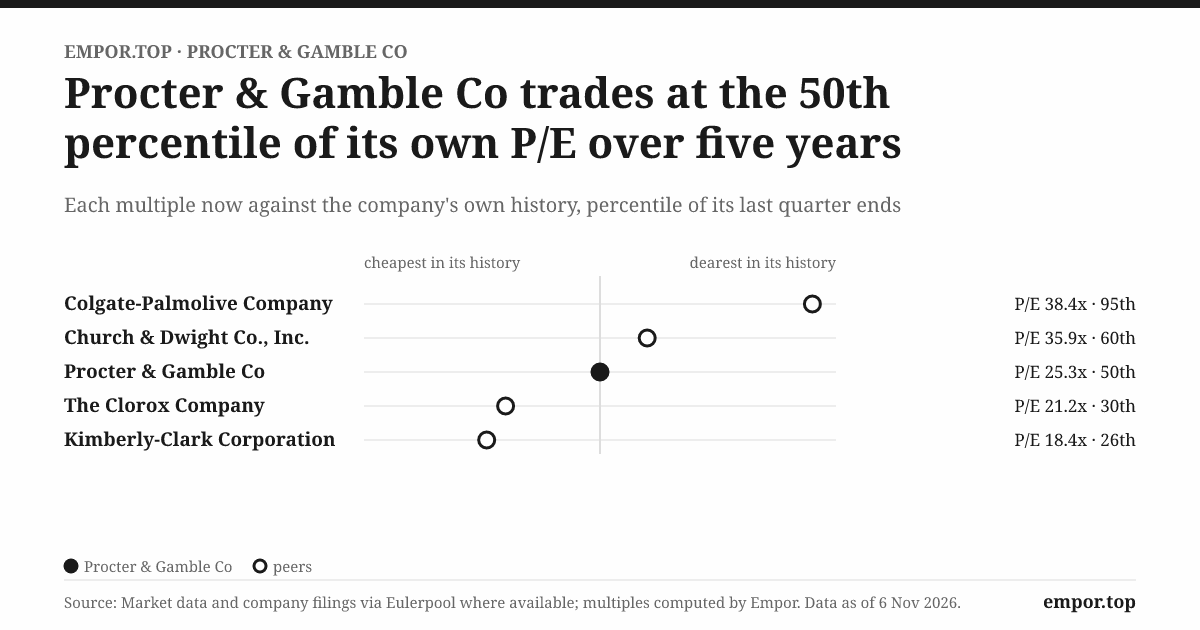
Investors pay about 25.6 times the last twelve months of earnings for P&G, a little above the 24.9 times that has been its median over five years.1 That is the price of a business people expect to keep compounding. The recent growth record looks more like a business holding its ground.
Into that puzzle stepped a new chief executive. Shailesh Jejurikar, a P&G lifer who had run the company's fabric and home care business and then served as chief operating officer, became CEO on January 1, 2026, with his predecessor Jon Moeller moving to executive chairman.2 By the time P&G reported its first quarter of fiscal 2027 on October 22, 2026, Jejurikar was signing the results as chairman of the board, president and chief executive.3
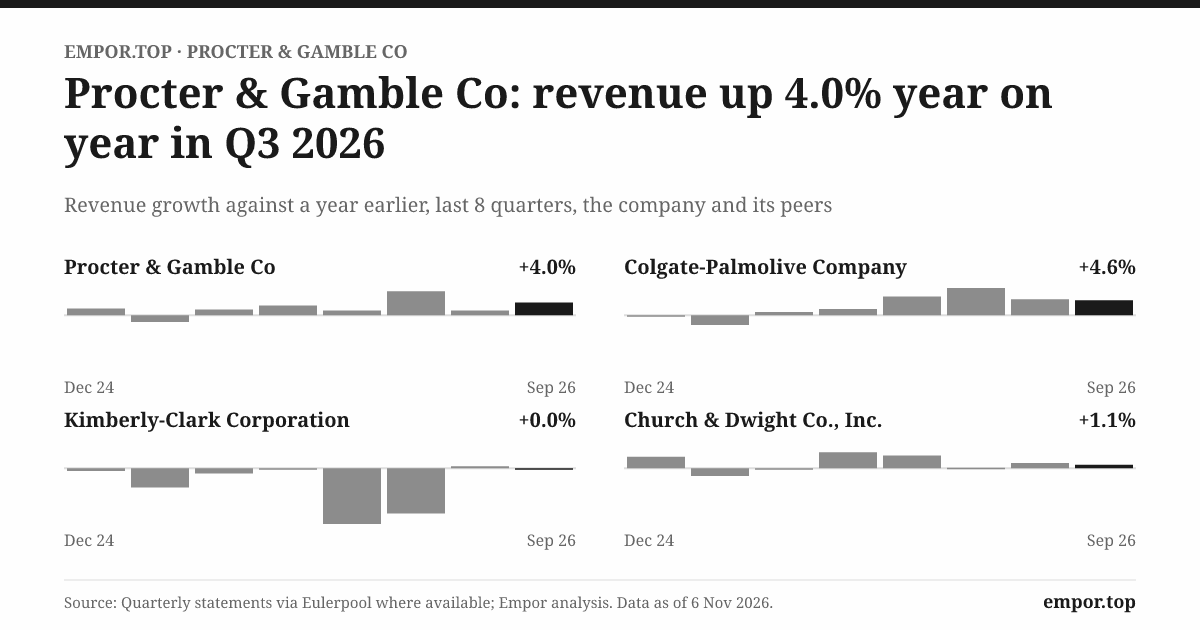
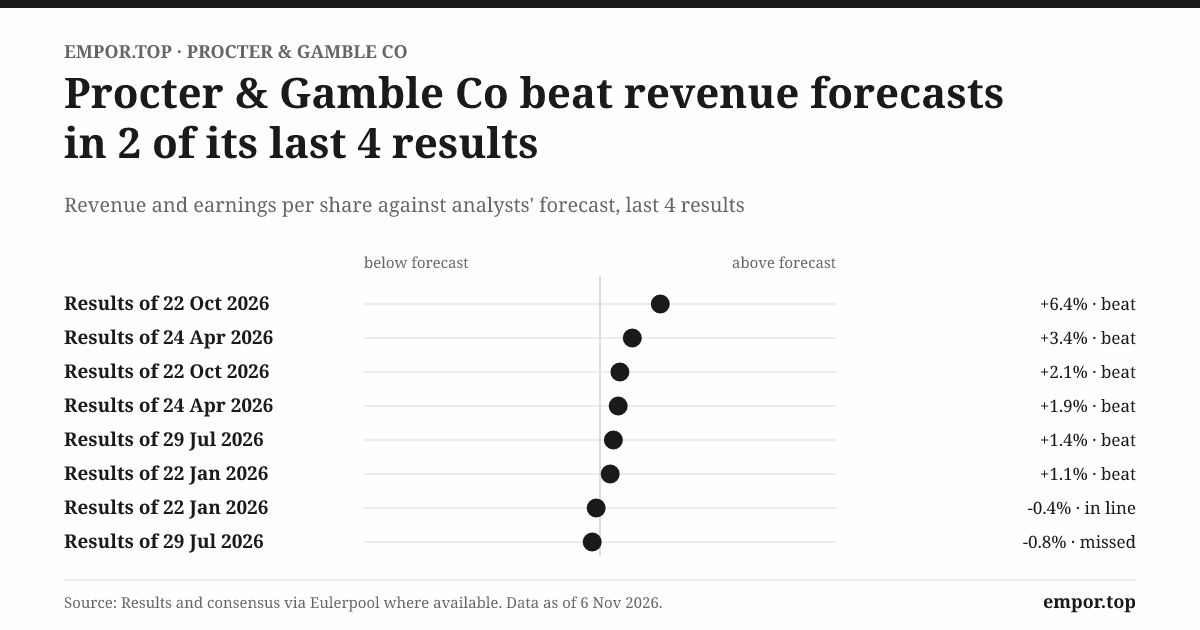
That first quarter of fiscal 2027 was the best news P&G shareholders had heard in a while. Net sales rose 4% to $23.3 billion, and organic sales also rose 4%.3 More important than the headline was its composition.
Volume, the number of units actually sold, contributed about 2.4 points of the growth, with richer product mix adding about one point and pricing only a sliver.3 For a company accused of leaning on price increases during the inflation years, a quarter driven by people buying more stuff was exactly the kind of evidence the bulls had been waiting for.
And yet P&G did not raise its organic growth outlook. Management held its forecast for fiscal 2027 at 1% to 3% organic sales growth, while warning of about $1.4 billion of after-tax commodity cost headwinds from raw materials, energy and transport.3 On the earnings call, chief financial officer Andre Schulten put the uncertainty plainly: "There's a bull case to be made, but there's a bear case to be made here."4
One quarter, in other words, did not settle anything. Profit barely moved; diluted earnings per share rose just 1% to $1.97, because gross margin fell 1.6 percentage points as commodity costs and reinvestment in products ate the benefit of higher volume.3
So the question this story tries to answer is not whether P&G is a great company. Its history settles that it has been one. The question is whether the machine it built, a system for turning everyday products into preferred brands and preferred brands into cash, can still produce growth that justifies the price, at a moment when shoppers compare prices instantly, retailers own the shelf and the data, and a new leader is deciding what to keep and what to change.
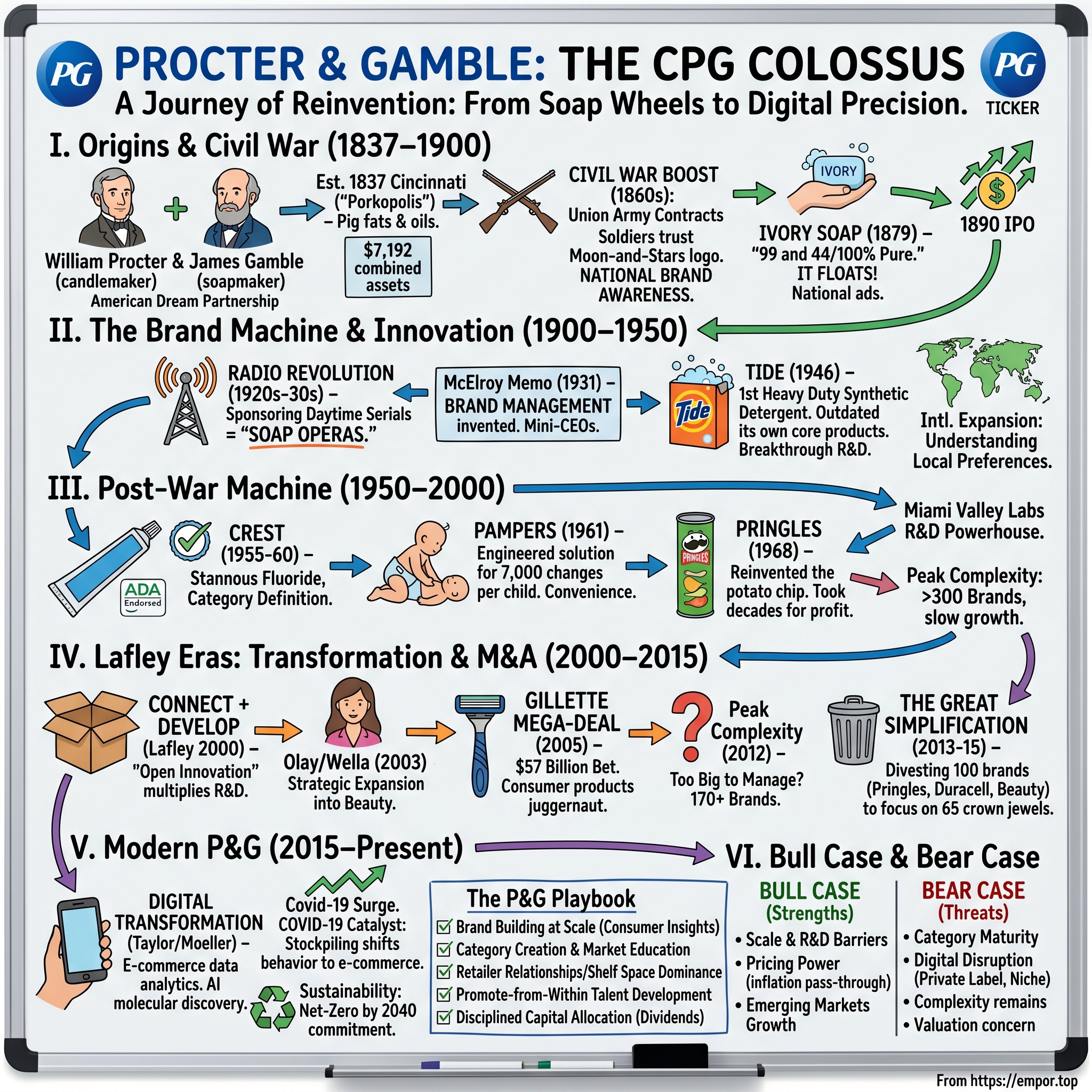
To answer it, the story has to go back to a candle maker and a soap maker in a muddy river town, follow them through the invention of the brand manager and the detergent, through a near-collapse at the top in 2000, a $57 billion bet on razors, and a decade of pruning that sold off more than a hundred brands.
Each of those chapters left something behind in the system Jejurikar now runs. Some of it is strength. Some of it is scar tissue.
 Subscribe on LinkedIn
II. Two Immigrants, One Soap Bar—and a New Way to Sell
Cincinnati in the 1830s was a city built on pigs. Its slaughterhouses were so numerous that the town earned the nickname Porkopolis, and every carcass left behind fat, which meant tallow for candles and the raw material for soap.
Two immigrants who had come from the British Isles were working in those trades: William Procter, a candle maker, and James Gamble, a soap maker. They had married sisters, which gave them a shared father-in-law, Alexander Norris, and the suggestion that the two men combine forces apparently came from him.5
The logic was practical. Both trades depended on the same animal fats and the same lye, so a combined business could buy raw materials together and sell to the same merchants. On October 31, 1837, the partnership of Procter & Gamble began, with paid-in capital of a little over $7,000.5 It was hardly an auspicious year to start anything.
A financial panic had swept the country that spring, and banks were failing across the young republic. The partners survived by doing the unglamorous things well, buying fat from the packing houses, making goods of consistent quality, and shipping them down the Ohio and Mississippi rivers.
They did well enough that, by the end of the 1850s, annual sales had passed $1 million.5 Then came the war that turned a regional manufacturer into a national name. As conflict approached, the founders' sons bought up rosin, a key soap ingredient, in New Orleans at about a dollar a barrel, before supply from the South was cut off.5
During the Civil War, the company supplied the Union Army with soap and candles.5 The contracts mattered for the cash they brought, but the more lasting effect was subtler: soldiers from towns all over the North learned to use P&G products in camp and carried that familiarity home. Distribution had created a habit before advertising had created a brand.
The product that crystallised the idea arrived in 1879. James Norris Gamble, the founder's son and a trained chemist, developed a white soap meant to be good enough for both laundry and bathing, and the company named it Ivory.[^6]
Legend says the floating property was the result of a happy accident in the mixing; what is certain is that the soap floated, and P&G understood what that meant. A bar that bobbed to the surface of a washtub or bath was a bar that a customer could find. It was a product claim that every household could test for itself.
P&G paired that claim with another one. In 1882 the company committed about $11,000 to advertising Ivory, a large sum at the time, with the promise that it was "99 44/100% pure."5 The number was deliberately precise, the kind of figure that sounds as if somebody in a laboratory measured it.
Together, "it floats" and "99 44/100% pure" made Ivory one of the first modern brands: a product whose performance could be demonstrated at home, attached to a memorable promise, sold under a consistent name, and available wherever a shopper went.
The company kept building around that core. It opened its Ivorydale manufacturing complex in 1886, introduced one of America's earliest profit-sharing systems for workers in 1887, and set up its first research laboratory in 1890.[^7][^6]
In 1924, it started formal market research, sending people to ask homemakers how they actually used its products.[^6] And when radio arrived, P&G did something that would define the next century of consumer marketing. In 1933 it became a key sponsor of radio's daytime serials, the dramas that soon came to be known as soap operas.5
The soap opera was not just a clever ad buy. It was P&G investing in the medium as well as the message, creating entertainment whose audience was exactly the household buyer it wanted to reach, and then filling the breaks with its soaps.
It was an early version of what a modern marketer would call owning the channel. For decades, P&G had a direct line into the kitchens of America, and it used that line to teach people what to want from a bar of soap or a box of washing powder.
That founding era established the idea that still runs through P&G: pair genuine product performance with a recognisable promise and relentless distribution, and an ordinary household good can command loyalty. But the early story also carries a warning that the rest of this episode keeps testing.
Ivory's advantages existed in a world where shoppers had few alternatives, where a manufacturer's ad was one of the main sources of information about a product, and where the grocer was a small shopkeeper rather than a global retailer with its own brands.
The question for today is whether that advantage still translates. The next chapter shows how P&G tried to make it repeatable, by turning it from a single bar of soap into a system.
III. Tide Made the Portfolio a Growth Engine
In 1946, a company still known for soap put a box of something different on American shelves. Tide was a synthetic detergent, and P&G's own history calls it "the washday miracle."[^6] The chemistry behind it had been years in the making.
P&G had introduced Dreft, a lighter-duty synthetic, back in 1933, but the hard part was creating a heavy-duty detergent that could clean ordinary work clothes without leaving behind the residue that soap left in hard water.[^6] When P&G cracked it, Tide was so clearly better that it quickly displaced soap powders, including some of P&G's own.
That willingness to cannibalise its own products is one of the most important habits P&G built. A company that protects yesterday's winners leaves room for a rival to bring tomorrow's. P&G repeatedly chose to compete against itself instead, which helps explain why Tide, launched eighty years ago, still anchors the laundry aisle.
The organisational engine behind such launches had been set out a few years earlier. In 1931 a young advertising manager named Neil McElroy, frustrated that Camay soap was competing for attention with the far larger Ivory inside the same company, wrote a memo proposing "one man—one brand."5
Each brand would get a dedicated manager responsible for its marketing, its performance and its results, competing even against sister brands. McElroy would later become P&G's president and then US Secretary of Defense, but his memo was arguably his most durable legacy.5 Brand management, as the discipline came to be called, became the template for consumer companies everywhere.
What made P&G's version unusual was how it linked the brand manager to everything else. Market researchers studied how people actually washed, brushed and cleaned. Scientists turned those observations into product features. Manufacturing engineers figured out how to make them at scale. Advertising teams turned the features into claims. And a sales force made sure the finished product reached the shelf. Each part was ordinary on its own. Joined together, they formed a machine for converting a technical improvement into a consumer habit.
The machine kept expanding into categories where a family could see the difference. In 1955 P&G introduced Crest, the first fluoride toothpaste clinically proven to fight cavities.[^6] Proving it was not enough. Crest became a market leader only after 1960, when the American Dental Association endorsed it, and it passed Colgate in 1962.5
That sequence is a useful lesson in itself: the technology came first, but the commercial breakthrough came from an independent stamp of credibility that turned a laboratory result into something a parent would trust.
Pampers tells the same story with more difficulty. The idea came from Vic Mills, a P&G researcher who, according to company history, started thinking about disposable diapers after watching his grandchild.5[^6] The product was test-marketed in 1961, and the early version flopped on price: at about 10 cents a diaper, it was a luxury most families would not pay for daily.5
P&G had to engineer its way down to roughly 6 cents a diaper, which required a manufacturing process fast enough to make disposables cheaply in huge numbers.5 Pampers had to win three contests at once: consumer acceptance, manufacturing scale and retailer space. The invention was the easy part.
Alongside those home-grown products, P&G bought its way into adjacent categories. In 1957 it acquired the Charmin Paper Company, which took it into tissue and towels, and Clorox, the bleach maker.5 The second deal turned into a landmark antitrust case.
The Federal Trade Commission argued that combining the dominant bleach brand with the country's biggest advertiser would discourage rivals from entering the market and give Clorox advantages no competitor could match. The case went all the way to the Supreme Court, which in 1967 upheld the FTC's order that P&G divest Clorox.65
The Clorox case is a footnote in most histories of P&G, but it reveals something about the company's power. The government's argument was, in essence, that P&G's scale in advertising and distribution was itself a competitive weapon, strong enough that placing it behind a market leader would lessen competition.
It is rare for a regulator to describe a company's marketing machine as a structural advantage. It is also a reminder that adjacency has limits: the more powerful the system becomes, the more scrutiny each expansion attracts.
Today, the machine is a sustained expense, not a list of famous launches. In fiscal 2026 P&G spent about $2.1 billion on research and development, roughly 2.4% of sales, and $4.4 billion on capital equipment, about 5.1% of sales.1 The R&D share looks modest next to a pharmaceutical or technology company, but consumer-products innovation is often less about discovery than about engineering.
Much of the real investment sits in the factories that make a slightly better diaper at a slightly lower cost, millions of times a day. The capital spending figure, which has risen from about $3.3 billion two years earlier, shows where P&G is putting its money now.1
The record supports a narrower claim than the corporate mythology suggests. P&G invented or popularised whole categories: synthetic detergent, fluoride toothpaste, mass-market disposable diapers. But its history also includes products that failed, and its successes required years of price engineering, endorsements and distribution. Novelty alone did not create the positions.
What created them was the system's ability to turn novelty into habit, and then to keep improving the product before competitors could catch up. That distinction matters for every new product P&G launches today. Invention is a capability. A durable, profitable category position is an outcome, and it has to be earned again each time. By the late 1990s, P&G's leaders believed the system had grown too slow and too comfortable to keep earning it, and they tried to change everything at once.
IV. When a Change at the Top Became a Crisis
On June 8, 2000, P&G's board met in Cincinnati and accepted the departure of its chief executive. Durk Jager, a blunt Dutchman who had spent three decades at the company, retired effective July 1, after holding the top job for barely more than a year.[^9] The same day, the company warned again that profits would fall short.
Its fiscal fourth-quarter earnings came in around 55 cents a share, against the 64 cents Wall Street expected, and volume growth had slowed to 1% to 2%, which the company blamed on competitive pressure and reduced marketing support on several key businesses, including fabric and home care.[^9] It was the second earnings warning since a restructuring announced a year earlier, and P&G's shares fell almost 5% that day.[^9]
To understand how a company built on discipline arrived at that moment, it helps to understand what Jager had been trying to fix. By the late 1990s P&G was large, profitable and slow. Its processes for testing and launching products were thorough to the point of paralysis, and its geographic organisation meant country managers often had more say over a brand than anyone trying to run it globally.
Growth had become harder to find. Jager's answer was a restructuring called Organization 2005, which reorganised the company around global business units, set aggressive growth targets and, in 1999, announced about 15,000 job cuts.75
The diagnosis was not wrong. The treatment was too much, too fast. Executives were moved across divisions in bulk, new products were pushed out quickly, and costs rose while the organisation was still learning its new shape. The company was trying to change its structure, its culture, its product pipeline and its pace all at the same time, and the core businesses suffered from the distraction.
That is how a fabric-and-home-care franchise as strong as Tide's ended up losing momentum for lack of marketing support. Shoppers did not care about P&G's reorganisation chart. They noticed when the brand they knew became less visible and relatively more expensive.
The man who replaced Jager was a very different personality. Alan George Lafley, universally called A.G., was then running P&G's global beauty care business and North America.[^9] He had made his name in laundry and then beauty, the kind of operator who preferred standing in customers' homes to presenting in conference rooms.
His first public diagnosis was characteristically restrained: the company, he said, "didn't make enough tough choices to balance top and bottom line growth."[^9] He also warned that the transition would take a year longer than planned.[^9]
Lafley's reset was less a revolution than a narrowing. He told the organisation to focus on its biggest brands, its biggest customers and its biggest countries, rather than spreading attention thinly across every possible opportunity. He cut projects that did not fit, flattened layers, and pushed spending back toward the brands that produced most of the profit.
In March 2001 the company announced another 9,600 job cuts, about 9% of its global workforce, on top of the roughly 7,800 still outstanding from the 1999 plan, alongside the consolidation of business units and the closure of plants.7 Lafley called the programme "the next step in our plan to restore long-term growth."7
It would be easy to tell this as a morality tale in which a reckless outsider was replaced by a steady insider. That version misses the point. Jager was a P&G veteran too, and many of his structural changes, such as the global business units, survived him.
The crisis is better understood as an execution failure: the strategy demanded speed from an organisation designed for caution, and nobody built the bridge between the two. Lafley kept much of the new structure but rebalanced the priorities, reconnecting innovation to what consumers actually wanted and accepting that the core brands needed investment before anything else.
The most interesting of Lafley's moves addressed P&G's oldest pride, its own laboratories. Under a programme called Connect + Develop, the company deliberately went looking for ideas, technologies and products from outside inventors, suppliers and smaller firms, then applied its own development, manufacturing and marketing to commercialise them.
By 2006, two P&G executives wrote in the Harvard Business Review, the approach produced more than 35% of the company's innovations and billions of dollars of revenue.8 Their favourite example was Pringles Prints, crisps printed with trivia and pictures, which used an inkjet technique sourced from a small bakery in Italy and moved from concept to launch in under a year, a process they said might once have taken two.8
Connect + Develop mattered because it quietly redefined where P&G's advantage lay. It suggested the company's edge was not that it invented everything itself, but that it could take an idea and make it work at a scale and speed no one else could. That is a more honest description of the machine, and also a more fragile one, because it implies that the decisive asset is commercialisation, which depends on distribution, retail relationships and marketing reach rather than patents.
By the middle of the decade, the reset appeared to be working. Lafley had restored confidence, the core brands were growing again, and the company had the balance sheet and the self-belief for its boldest test of the renewed strategy: a deal large enough to change P&G's scale, and to expose it to a kind of risk its own history had never quite prepared it for.
V. Gillette: A Premium Deal With a Long Afterlife
On January 28, 2005, P&G and Gillette announced from Cincinnati and Boston that their boards had approved a merger.9 P&G issued 0.975 of its own shares for each Gillette share, valuing the razor maker at about $57 billion, the largest acquisition in P&G's history.9 The offer represented an 18% premium to Gillette's closing price the day before.9 James Kilts, Gillette's chairman and chief executive, joined P&G's board as vice chairman responsible for Gillette.9
The deal carried a famous endorsement. Warren Buffett's Berkshire Hathaway owned 96 million Gillette shares, which converted into about 93.6 million P&G shares.9 Berkshire's backing helped frame the transaction as two blue chips joining forces rather than one company swallowing another.10
The structure deserves attention, because headlines called it an all-stock deal and that was only half true. P&G simultaneously announced plans to buy back $18 billion to $22 billion of its own shares over the following 12 to 18 months.9 Issue stock with one hand, buy it back with the other, and the economic result is close to a part-cash acquisition.
P&G said so explicitly: the combination was essentially similar to a transaction funded with about 60% stock and 40% cash.9 Paying partly in shares let P&G share some of the risk with Gillette's owners, while the buyback limited dilution for its own shareholders and loaded more debt onto a balance sheet that could carry it.
What was P&G buying? Gillette brought the world's dominant razor and blade franchise, Duracell batteries, Braun appliances and Oral-B toothbrushes.9 Strategically the fit looked clean. Oral-B complemented Crest. Gillette's male consumers complemented P&G's female-skewed beauty brands. And razors had a famously attractive model: the handle was cheap or even given away, and the blades carried high margins and repeat purchases for years. In a company that lived on repeat purchases, that looked like the purest version of the business.
The price, measured against Gillette's own earnings, was rich. P&G's transaction presentation showed the offer at about 18.8 times Gillette's 2004 earnings before interest, tax, depreciation and amortisation, falling to about 14 times once expected cost savings were counted.11 The company estimated revenue and cost synergies with a present value of about $14 billion to $16 billion and planned to cut about 6,000 jobs, roughly 4% of a combined workforce of 140,000.9 It also raised its long-term sales growth target from 4%–6% to 5%–7%.9
Those synergy figures were management estimates, not realised value. They were also large relative to the premium. If the synergies were real, P&G was paying a premium of perhaps $9 billion for a stream of savings worth considerably more. If they were optimistic, the premium was simply a transfer of value to Gillette's owners.
Whether P&G overpaid against a fully comparable set of industry transactions is unclear; the cleaner way to judge the deal is as a strategic premium whose value depended on two things: whether the synergies arrived, and whether the grooming category stayed as attractive as it looked in 2005.
The integration case was that P&G's system would make Gillette's brands stronger: P&G's distribution in emerging markets, its consumer research, its retailer relationships, and its ability to spread marketing costs across a larger portfolio. For several years that case looked persuasive. Gillette's blades travelled into markets where P&G already sold detergents and diapers, and the combined company had more weight with retailers than either had alone.
Then the category changed underneath it. Starting in the early 2010s, start-ups such as Dollar Shave Club and Harry's sold razors online by subscription at prices well below Gillette's, and they marketed themselves partly as a rebellion against paying for premium blades.
Facial hair came back into fashion, which meant many men simply shaved less often. Gillette responded with price cuts and new products, but the damage showed up in the numbers. By mid-2019 P&G's grooming sales had declined in 11 of the previous 12 quarters.12
In the fourth quarter of fiscal 2019, P&G took a non-cash impairment of about $8.3 billion before tax on its Shave Care goodwill and the Gillette brand intangible.13 The company attributed the writedown to currency devaluations in markets outside the US, increased competition, and a shrinking market for blades and razors driven by lower shaving frequency in developed markets.1312
Moeller, then CFO, described the competitive change succinctly: "New competitors have entered at prices below the category average."12 The charge pushed P&G to a quarterly net loss of about $5.2 billion and dragged fiscal 2019's operating margin down to about 8%, against a usual 20% or more.1213
That impairment is the most important single piece of evidence in this story about the limits of brand power. Gillette was, by almost any measure, one of the best-known brands in the world. Its share was dominant, its technology was real, and its distribution was global.
Yet when consumer behaviour shifted and cheaper alternatives arrived, the brand did not stop the economics from eroding. Brand recognition protected Gillette's position at the top of the category; it did not protect the size of the category or the price the top position could command.
There is a fair counterargument. An impairment is an accounting judgement about the carrying value of an asset, not a verdict that the whole deal failed. Gillette still generates profits inside P&G, Oral-B has grown into one of the company's important brands, and Duracell was later exchanged in a deal that recovered value. P&G did not disclose a full accounting of realised synergies against the original estimate, so the deal's ultimate return cannot be calculated precisely from outside.
But the impairment narrows the claim that famous brands alone create durable pricing power. It shows that P&G paid for a category's economics as they existed in 2005, and that those economics were more exposed to substitution than either company had assumed. A successful acquisition should leave behind more than scale.
It should leave lasting earnings, reinvestment options and a market position that survives a change in how people live. Gillette left P&G with scale, a strong oral-care business and a sobering lesson about what happens when the product is excellent but the habit it depends on starts to fade. By the time that lesson was written down in 2019, P&G had already begun dismantling much of the empire the Gillette era had helped create.
VI. The Portfolio Grew Too Wide to Defend
On August 1, 2014, A.G. Lafley, who had returned as chief executive the previous year, told investors something remarkable for a company that had spent a century accumulating brands. P&G would sell, discontinue or consolidate somewhere between 90 and 100 of them.14
The brands it would keep, 70 to 80 at the time, had accounted for about 90% of sales and more than 95% of profit over the previous three years.14 The rest, Reuters reported, had seen sales decline for three years.14 Lafley summarised the logic in four words: "Less will be much more."14
The announcement was a confession as much as a strategy. P&G had grown into a sprawl of brands, many of them small, many of them acquired along with bigger prizes, and each of them demanded attention from managers, retailers and supply chains.
A brand doing $50 million a year still needed packaging, a factory slot, a shelf negotiation and someone to worry about it. Multiply that across a hundred brands and the complexity becomes a strategy in itself, one that dilutes the company's ability to invest behind its winners.
Lafley's return also reflected the board's judgement that the previous regime, under Bob McDonald, had not delivered. McDonald, who succeeded Lafley in 2009, presided over a period of weak growth and investor frustration; Lafley was brought back in 2013 to restore focus. His second tenure was, in effect, a second Lafley reset, this time aimed at the portfolio rather than the organisation.
The simplification was not new in 2014; it accelerated a long retreat from food and other categories that had started more than a decade earlier. In 2008 P&G agreed to merge its Folgers coffee business into J.M. Smucker in an all-stock deal valued at about $3.3 billion, with P&G shareholders receiving a majority of the combined company.15
In 2012 it completed the sale of Pringles to Kellogg for about $2.7 billion, ending its life as a food company.16 In 2014 it sold most of its pet food business, including Iams and Eukanuba, to Mars for $2.9 billion.17
Then came Duracell, the most elegant piece of the clean-up. P&G announced in October 2014 that it would exit the battery business.18 A month later, Berkshire Hathaway agreed to exchange its P&G shares, then worth about $4.7 billion, for a recapitalised Duracell company that P&G would stuff with roughly $1.7 billion to $1.8 billion of cash before handing it over.19
The structure was a tax-efficient split-off: Berkshire got an operating business plus cash, and P&G retired a large block of its own stock without paying the capital-gains tax that a straightforward sale would have triggered. It was a neat example of capital recycling. It was also an admission that a business acquired as part of Gillette did not belong in P&G's future.
The biggest transaction came in July 2015. P&G accepted an offer from Coty for 43 beauty brands, including Covergirl, Clairol, Wella and a fine-fragrance portfolio, in a deal headlined at $12.5 billion.20 The brands had about $5.5 billion of sales in fiscal 2015, down 8% from the year before.21 Including debt Coty would assume, P&G put the value at about $15 billion, and it expected a one-time gain of $5 billion to $7 billion.20
The Coty deal was not a straightforward cash sale. P&G structured it as a Reverse Morris Trust, a technique that lets a company separate a business into a new entity, merge that entity with another company, and distribute the stake to its shareholders without a big tax bill.
P&G shareholders could exchange all, some or none of their shares, and would end up owning about 52% of the enlarged Coty.20 In effect, P&G's owners swapped part of their stake in a broad consumer-goods company for a majority stake in a focused beauty company.
What remained was the operating thesis that still defines P&G today: about ten product categories in which the company held leadership positions, and a much smaller set of brands, later described as about 65, chosen because they had the scale, the growth and the margins to justify investment.2223 Laundry, diapers, paper towels and tissue, feminine care, razors, oral care, hair care, personal health care and a few others became the core. Everything else was a candidate for exit.
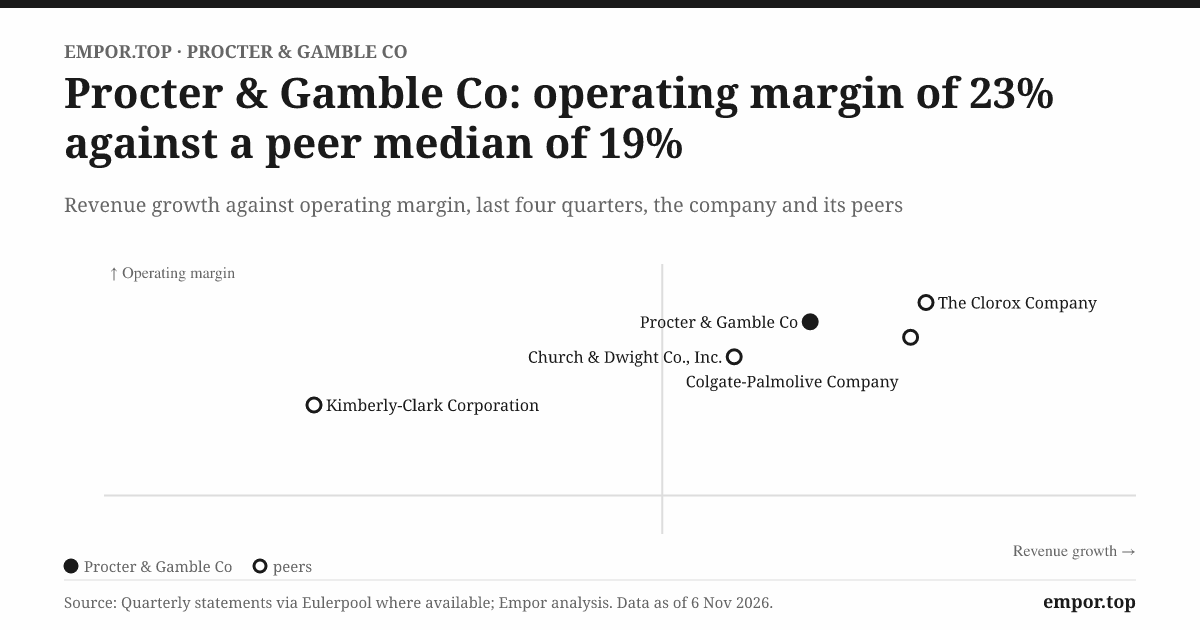
So was the reset a triumph? In one sense, plainly yes. P&G became easier to manage, its margins later expanded, and from fiscal 2016 onwards its operating margin moved into the 20%-plus range where it has stayed in every year except the Gillette impairment year.131 The company that Jejurikar inherited is far more focused than the one Lafley inherited the second time.
But a more critical reading is warranted. The brands that left took their earnings with them, and the companies P&G shrank by selling businesses did not suddenly grow faster: revenue fell from about $71 billion in fiscal 2015 to around $65 billion in fiscal 2016, partly because of divestitures and partly because of a strong dollar, and it did not climb back above its 2015 level until fiscal 2020.13
Simplification was a necessary correction to a decade of portfolio drift, not a free win. The question it left open is the one that still matters most. A smaller, sharper P&G is easier to run. It still has to prove that its core categories can grow organically, on their own merits, faster than the economies they serve. The place to test that is the shelf itself.
VII. The Tide Aisle Is the Real Business
Picture the category manager at a large American retailer, sitting in a planning meeting with a spreadsheet that shows every laundry product on the shelf, how fast each one sells, what margin the store makes on it, and how much space it occupies. Her job is to make that aisle as profitable as possible.
Into that meeting walks a P&G sales team with a new version of Tide, a claim about cleaning performance backed by laboratory tests, a television and digital advertising plan that will send shoppers looking for it, a supply plan that promises the shelves will never run empty, and a price.
That meeting, repeated thousands of times a year across tens of thousands of retailers, is P&G's real business. Everything else, the research labs, the factories, the advertising, exists to win it. And the most important fact about the meeting is that both sides hold real power.
Start with P&G's largest segment. Fabric and Home Care, which includes Tide, Ariel, Downy, Gain, Cascade, Dawn and Febreze, produced about $30.3 billion of sales in fiscal 2026 and about $5.6 billion of net earnings.1 It is the segment where P&G's advantages are clearest. Detergent is heavy, bulky and expensive to ship, which rewards a company with factories near its customers. Performance is testable: a shopper can see whether a stain comes out.
And the category rewards relentless incremental innovation, from concentrated liquids to Tide Pods in 2012.[^6] P&G competes here with Unilever, which owns Persil in some markets and Omo elsewhere, with Henkel, which owns Persil in the US and much of Europe, and with retailers' own brands. In the latest quarter, Fabric and Home Care organic sales grew almost 5% with volume up about 4%, and Schulten said P&G's North American value share in fabric care was up about 0.7 points over three months.34
The second pillar is Baby, Feminine and Family Care, home to Pampers, Always, Tampax, Bounty and Charmin. It had about $20.4 billion of sales and $3.9 billion of net earnings in fiscal 2026.1 Together with Fabric and Home Care, the two segments produced about 58% of P&G's sales and net earnings.1 P&G reports more than 30% global share in taped diapers, pants and wipes.1 That is real leadership, but it is contested leadership.
In diapers, P&G competes with Kimberly-Clark's Huggies in the US, with Japanese companies such as ユニ・チャーム Unicharm and 花王 Kao in Asia, and with fast-growing local brands in China and elsewhere. Affordability matters more here than almost anywhere, because a family going through several diapers a day notices every cent. Family care, meaning paper towels and toilet paper, is even more exposed to cheaper store brands, and on the latest call management admitted it was "not yet back to share growth."4
The remaining segments, Beauty, Health Care and Grooming, are meaningful but smaller. Beauty includes Olay, Pantene and Head & Shoulders and competes with L'Oréal and Unilever. Health Care, which includes Crest, Oral-B and over-the-counter medicines like Vicks, competes with Colgate-Palmolive in oral care. Grooming is Gillette and Venus, where competition from cheaper subscription brands never went away.
In the latest quarter, Health Care volume fell almost 3% because of a slow cold-and-cough season, and Grooming volume edged down even as its sales grew on price and mix.34 The early-October acquisition of Thorne, a nutritional-supplements business, adds a new piece to Health Care, and management promised more detail at its upcoming Investor Day.34
P&G describes its advantage through what it calls five vectors of superiority: product performance, packaging, brand communication, retail execution and value.1 The framework is a useful lens, but it is management's language, and it should be treated as a set of hypotheses rather than proof. If P&G's products really are superior on all five, the evidence should show up in three places: rising market share, rising volume, and the ability to raise prices without losing customers.
Through the inflation years P&G raised prices repeatedly while its sales kept rising, which supports the claim; in July 2025, with shoppers already cautious, it said it would raise US prices again to offset higher costs.24 In the slower period since, volume has been weak and share uneven, which complicates the claim. The latest quarter, with volume leading growth, is a point in the claim's favour, but one quarter is still one quarter.
The other side of the meeting is the retailer, and the most important retailer is Walmart. Walmart and its affiliates accounted for about 16% of P&G's sales in each of the last three fiscal years, and P&G's ten largest customers accounted for about 43%.1
That concentration is the single biggest structural constraint on P&G's pricing. Walmart can demand promotions, allocate shelf space, and expand its own store brands. It can also use its data on what shoppers buy to negotiate with knowledge that P&G cannot fully match.
Walmart's leverage is not a sign that it is a weak credit or a slow payer. P&G's receivables actually fell in fiscal 2026, to about $6.1 billion, and the company collected its bills in about 25 days on average, down from 27 the year before.1
P&G does not disclose how old its receivables are or whether any large customer pays late, so payment quality beyond those headline measures remains unknown. But nothing in the disclosed figures suggests stress. The issue with Walmart is bargaining, not bad debt.
The way P&G finances its operations reveals another side of its scale. In fiscal 2026 it held about 69 days' worth of inventory and took about 137 days, on average, to pay its suppliers.1 That gap means P&G's cash conversion cycle was negative, about minus 43 days: it collects from retailers and holds goods for less time than it takes to pay the companies that supply its raw materials and packaging.1 Effectively, P&G's suppliers help finance its working capital.
That is a powerful advantage that only a buyer of P&G's size can command, and part of it comes through supplier-financing programmes that let suppliers get paid early by banks while P&G pays later. It also carries a caution. Inventory days have risen from about 49 to 69 over the past decade, which means more goods sitting in warehouses relative to sales.1
In fiscal 2026 alone, inventory absorbed about $641 million of cash while payables provided about $919 million.1 Rising inventory can mean deliberate investment in supply resilience, but it can also be an early warning of slowing sell-through. It deserves monitoring.
So what is the moat, and how could it break? P&G's advantages are real: scale in manufacturing and advertising, products with measurable performance, deep retailer relationships and a supply chain that can deliver to every shelf. Those advantages support leadership in categories where people buy again and again. But the moat has visible weak points.
Switching costs for the shopper are essentially zero: trying a cheaper detergent costs a few dollars and no effort. Retailers can and do expand private labels whenever P&G's prices rise too far. Specialist brands, as Gillette learned, can attack profitable niches from below. And price increases only work if shoppers accept them, which is a question answered every week at the checkout.
The evidence supports a moat based on category leadership and scale. It does not yet prove durable pricing power independent of the economy. The test of that is not a strategy presentation. It is whether volume, share and price realisation improve together over several years, which is exactly the test the new chief executive inherited.
VIII. The New CEO Inherits a Cash Machine With a Growth Test
When Shailesh Jejurikar took the chief executive's office on January 1, 2026, he inherited something most new CEOs would envy: a business that throws off enormous amounts of cash almost regardless of the economy.2 He also inherited the question that every P&G leader since Lafley has faced. The cash is not in doubt. The growth is.
Jejurikar is the archetypal P&G insider. He joined the company in India and spent more than three decades inside it, rising through the fabric and home care business, which he went on to run globally, before becoming chief operating officer under Jon Moeller.2 Moeller himself was a finance man who had served as CFO before becoming CEO,12 and his tenure was defined by managing through inflation, supply-chain chaos and currency swings.
Jejurikar is an operator from the largest segment, which suggests the board wanted continuity of strategy with a sharper focus on execution in the categories that matter most. A succession from inside, after a long apprenticeship, is P&G's tradition. It reduces the risk of a Jager-style shock. It also raises the question of whether anyone inside the system is likely to challenge the system.
Consider what he inherited in numbers that matter. In fiscal 2026, P&G's sales were about $87 billion, its operating margin was about 22.7%, and it generated about $19.6 billion of cash from operations.1 Over the twelve years from fiscal 2015 to 2026, the company produced about $199 billion of operating cash against about $150 billion of net profit.113
That gap, a third more cash than reported earnings, reflects the non-cash charges like depreciation, amortisation and the Gillette impairment, along with the supplier financing that keeps working capital negative.
What P&G does with that cash is the defining feature of its capital allocation. Over those twelve years, free cash flow, meaning operating cash minus capital spending, totalled about $158 billion, and dividends absorbed about $100 billion of it, or roughly 63%.113 Buybacks took much of the rest.
In fiscal 2026 alone, P&G paid about $10.2 billion in dividends and bought back about $5 billion of stock, together roughly equal to the year's free cash flow of about $15 billion.1 Cash on hand at the end of fiscal 2026 was about $9.9 billion, barely different from where it was a dozen years earlier.1 P&G, in other words, hands back almost everything it earns.
That is a deliberate choice, and it says something about how management sees the business. A company that returns essentially all of its free cash is telling investors it does not have better uses for the money inside the business. For a mature consumer-goods company, that can be a sign of discipline: it avoids empire building and keeps managers focused.
It is also a quiet admission that growth opportunities requiring large amounts of capital are limited. The dividend, raised for 70 consecutive years through fiscal 2026, has become a commitment that shapes every other decision.25
Within that envelope, Jejurikar inherited a business still investing. Capital spending rose to about $4.4 billion in fiscal 2026 from about $3.8 billion the year before, and research and development stayed at about $2.1 billion.1 At the same time, headcount fell about 4% to around 104,000 as restructuring continued.1
On the latest call, Schulten described part of the productivity agenda as a 15% reduction in manufacturing headcount, alongside automation and digitisation of the supply chain.4 The pattern is productivity-led reinvestment: fewer people, more machines, and the savings recycled into products and marketing rather than into a fatter margin.
It is worth being careful about what the reported profits say. P&G's net profit was essentially flat at around $16 billion in fiscal 2026, and diluted earnings per share edged up from $6.59 to $6.62.1 But that stability was flattered by one-off items. Fiscal 2026 included a $343 million gain from dissolving the Glad joint venture with Clorox, while fiscal 2025 had included a $752 million non-cash charge for accumulated currency translation losses in Argentina.1
Strip those out and the underlying operating profit actually fell by about $700 million, as operating margin slipped from about 24.3% to 22.7%.1 Currency also helped the headline: about two points of fiscal 2026's reported sales growth came from foreign exchange.1 The business that Jejurikar inherited was, in operating terms, a little weaker than its reported earnings suggested.
His pay and ownership are now part of the record. For fiscal 2025–26, Jejurikar's reported total compensation was about $19 million, including a $14 million long-term incentive award, while his annual bonus paid out at about 60% of target, a reflection of results that fell short of the plan.2
P&G requires its CEO to hold shares or share units worth eight times salary.2 The structure ties most of his reward to long-term share performance, which is the right design. Whether it is the right amount is a matter for shareholders.
Some shareholders signalled doubt. At the October 2026 annual meeting, about 71 million votes were cast against Jejurikar's election as a director, the highest opposition of any nominee, even though the say-on-pay resolution passed comfortably, with about 1.5 billion votes for and 138 million against.262 Seventy-one million votes is a small fraction of the total, so this was not a rebellion.
But the fact that the new CEO, rather than any independent director, drew the most dissent is a credibility signal. It may reflect a wait-and-see attitude toward a leader who has yet to show results, or unease about concentrating authority in a new chief executive. Either way, the vote converts execution into the clearest test of his authority.
The first-quarter call showed what analysts want to know. Lauren Lieberman of Barclays asked whether the margin improvement tied to volume was structural or temporary. Schulten's answer was both: part of it came from long-term productivity programmes and part from quarter-specific factors, including slower pass-through of commodity costs and a roughly $90 million partial tariff refund.4
Other analysts pressed on the sustainability of growth. Schulten said he expected roughly 3% organic growth in the first half and only slight acceleration in the second, and he called the competitive environment "fierce."4 His most revealing line was about where growth would come from: "Growth going forward is not about taking share. Growth going forward is about growing our categories."4
That answer deserves attention because it implicitly lowers the bar for what counts as success. If growth must come from category growth, and categories in North America are growing at close to 3% in value, then P&G's organic growth is likely to track its markets rather than exceed them.4 That is consistent with the company's 1% to 3% guidance. It is less consistent with the idea that a new CEO will unlock a step change in growth.
Asked about earnings, Schulten said: "I'm confident in the range, but we'll need time to figure out where in that range we'll end up."4 Investors should track whether that kind of message stays consistent across the next several calls.
The guidance for core earnings per share growth of zero to 3% already absorbs about $0.79 a share of headwinds from commodities, interest, lower non-operating income and currency, which management described as an eleven-point drag on core EPS growth.3 Hold that line, and P&G will have shown it can absorb a large cost shock. Miss it, and the market will start to question whether productivity can keep pace.
There is also a balance-sheet cushion to track, though it is not the central story. About $6.5 billion of P&G's long-term debt matures in fiscal 2027, a meaningful refinancing task.1 But the company's credit ratings, Aa3 from Moody's and AA- from S&P as of mid-2026, are among the strongest of any industrial company, and P&G has ready access to commercial paper and bond markets.1
Net interest expense is expected to rise by about $300 million after tax in fiscal 2027, part of the headwind already in guidance.3 The balance sheet is a constraint on how much more P&G can borrow to fund buybacks, not a threat to the company.
So Jejurikar's inheritance is a paradox. He runs one of the most reliable cash machines in corporate history, and almost all of that cash is already spoken for. The only way to create more room is to grow faster, and the market has priced P&G as though he will.
IX. Analysis & Bear vs Bull Case
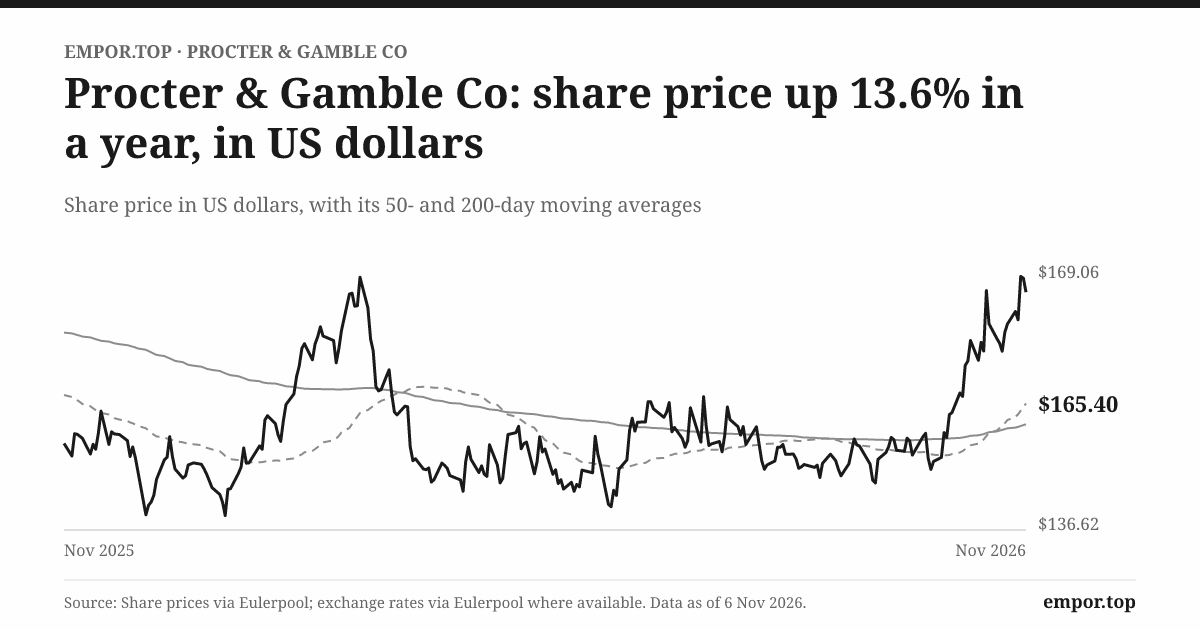
As of early November 2026, P&G's shares traded at about $167, within a fraction of their 52-week high.1 Its enterprise value was about 17.7 times earnings before interest, tax, depreciation and amortisation.1
The dividend yield was about 1.9% and the free-cash-flow yield about 3.9%.1 Those numbers describe a stock that investors treat as a defensive compounder, a place to park money that will grow steadily through good economies and bad.
The puzzle is whether the business deserves that treatment at today's growth rates. Revenue growth has slowed from its ten-year pace over the last three years.1 Operating margin fell in fiscal 2026.1 And the market's price-to-earnings-to-growth ratio, which compares the multiple to the earnings growth rate, sits near 7, a figure that only makes sense if investors are paying for stability rather than growth.1
The first question is whether the latest quarter marks a change. Organic sales rose 4%, with about 2.4 points from volume, about one point from mix and a small contribution from price.3 Volume rose in Fabric and Home Care, Baby, Feminine and Family Care and Beauty, but fell in Health Care and edged down in Grooming.3 The quarterly record shows why caution is warranted.
Over the past two years, P&G's quarterly revenue growth has swung from slightly negative to more than 7%, with no consistent trend.127 Management's own forecast for about 3% organic growth in the first half implies that the second quarter will be weaker than the first.4 A single good quarter in an uneven series is evidence, not proof.
The bull case rests on several things that are true. People buy detergent, diapers, toilet paper and toothpaste no matter what the economy does, and they buy them every few weeks. The company says it holds the number one or two position in most of its categories, which gives it scale in manufacturing, advertising and retail negotiations.
Its research and marketing can be applied across a global base, so a single innovation like a better detergent formula can be rolled out in dozens of countries. And its cash generation funds both investment and distributions. In the latest quarter, P&G returned about $3.9 billion to shareholders while still spending about $1.4 billion on capital projects.3
The bear case is equally grounded. P&G's categories are mature, and in developed markets they grow roughly with population and prices. Private labels offer a cheaper alternative in almost every category, and they gain whenever shoppers feel squeezed. Retailers like Walmart hold real leverage. Input costs, such as oil-based chemicals, pulp and resin, swing with commodity markets, and P&G now expects about $1.4 billion of after-tax commodity headwinds in fiscal 2027 alone.3
Currency movements can wipe out growth in a single year. And the company must keep reinvesting in products and marketing to defend share, which caps how much margin it can retain. In the latest quarter, productivity savings of about 2.5 percentage points of sales were almost entirely consumed by commodity costs and reinvestment.3
To weigh those cases properly, it helps to look at P&G's industry through Michael Porter's five forces. The threat of new entrants is low in most of P&G's core categories, because building a global detergent or diaper business requires enormous capital, manufacturing know-how and distribution.
But Gillette's experience shows that entry can come through a different door: online, direct-to-consumer brands that bypass the shelf. Supplier power is modest; P&G's scale gives it leverage over suppliers.1
Buyer power is high: Walmart and other large customers can push for lower prices and more promotions.1 The threat of substitutes, especially store brands, is constant. And rivalry among the major players, Unilever, Colgate-Palmolive, Kimberly-Clark, Henkel and L'Oréal, is intense; Schulten's word for it was "fierce."4 Overall, the industry structure is favourable to a scale leader but far from protected. The two forces that matter most, buyer power and substitution, are the ones P&G controls least.
Hamilton Helmer's seven powers offer a second lens. P&G clearly has scale economies: its advertising, research and manufacturing costs are spread across about $87 billion of sales, which allows it to outspend most rivals while still earning higher margins.
It has branding power, in Helmer's specific sense that customers will pay more for an objectively similar product because of trust built over time. Pampers and Tide earn premiums because parents and families trust them. It has a degree of process power, the accumulated know-how embedded in manufacturing lines and consumer research that competitors cannot easily copy.
It lacks network effects, which do not apply to detergent. Switching costs are low, as the five-forces discussion showed. It has no meaningful cornered resource, since its technologies can be imitated over time. And counter-positioning is a power that P&G's challengers, not P&G, have used: Dollar Shave Club attacked Gillette with a model that Gillette could not copy without undercutting its own pricing.
P&G's moat, in other words, is built on scale, brand and process. Those powers are real but not absolute, and the one that is most vulnerable, branding, depends on consumers continuing to believe the premium is worth paying.
The Gillette impairment, the 2014 portfolio reset and the Jager crisis each put limits on the claim that P&G's quality is as durable as its valuation implies. Together, they narrow it: P&G is a high-quality operator of categories with stable demand, but its record of protecting pricing in categories facing structural change is mixed, and its record of capital allocation includes at least one very expensive mistake.
A skeptical activist would focus on three issues. The first is capital allocation. Dividends have consumed about 63% of free cash flow over twelve years, and buybacks most of the rest. That leaves little room to invest in growth or absorb a downturn without borrowing, and it means future dividend increases depend on future growth, which has been slow. An activist might argue that the dividend has become an obligation that constrains strategy rather than a reward for performance.
The second is portfolio complexity, which has returned in a smaller way: the Thorne acquisition takes P&G into supplements, a category with different economics from its core, and management has said little yet about price or returns.4 The third is governance: the concentration of the chair and chief executive roles in a single new leader, after a year of mediocre organic growth and a vote in which he drew the most dissent, is the kind of arrangement an activist would question.263
Three measures matter most for following P&G from here. The first is organic volume growth: it rose in the latest quarter after a year of weak organic sales growth.31 Volume is the purest test of whether shoppers are choosing P&G's products more often. The second is operating margin: it fell in fiscal 2026, and core operating margin fell another 0.8 points in the latest quarter even as sales rose.13
It shows whether growth is coming at the cost of profitability. The third is inventory days, which have continued to rise.1 It is the earliest warning of whether goods are moving through the supply chain as fast as they are being made.
At a modest premium to its own five-year median multiple, P&G's shares already assume that the company will keep delivering steady growth and stable margins. Measured against its own history rather than its rivals, the premium is small, but the price leaves limited room for a sustained growth disappointment.
The evidence that would change the case is straightforward: organic volume growth sustained across several quarters, segment margins stabilising or recovering, and inventory turns improving without any loss of category share. If those three move together, the bulls will have their proof. If they diverge, the market's patience may be shorter than its history suggests.
X. Playbook: The P&G Way
Somewhere inside P&G today, a product team is trying to make a single new feature matter: a detergent that cleans in colder water, a diaper that holds more without getting bulkier, a toothbrush head that removes more plaque. The team has a budget drawn from a company that spends about $2.1 billion a year on research and $4.4 billion on equipment, and the support of an organisation of about 104,000 people.1
Its job is to turn one improvement into a habit for hundreds of millions of households. That challenge, repeated across thousands of products for nearly two centuries, is what the P&G way really means. Five lessons come out of it, and each belongs to this company more than to any other.
The first lesson is that a brand is a promise consumers can test at home. The histories of Ivory, Tide, Crest and Pampers show how a verifiable product claim can carry a brand. When P&G's brands have struggled, the promise has often become harder to prove or less important to the buyer, as Gillette showed when men no longer needed premium razors as often. For founders, the lesson is simple: the most durable brands are built on a product that keeps its word, every time.
The second lesson is that scale pays only when it travels through the system. P&G's advantage comes from linking research, manufacturing, advertising and retail execution. When those links weaken, scale becomes overhead, as Jager's reorganisation revealed in 2000. The investor's takeaway is that scale is a capability to be used, not an asset to be held. A big company that cannot move its innovations quickly through its own system is merely large.
The third lesson is to prune before complexity becomes strategy. The 2014 portfolio reset and earlier divestitures showed P&G choosing focus over attachment to businesses that no longer fit.
Every growing company accumulates such businesses. The discipline is in recognising them before they define the company.
The fourth lesson is that a famous brand is not a blank cheque. The Gillette deal showed that a brand does not guarantee the category economics that justify its price. For any acquirer, the lesson is to underwrite the category, not just the brand: who might offer a substitute, how habits could change, and what the business would be worth if they did.
The fifth lesson is that cash returned is cash not reinvested. P&G's long record of dividend increases is remarkable.25 But almost every dollar of free cash that leaves the company is a dollar that cannot fund a new product, a new market or a new acquisition.
That is a fine trade when the core products are earning their place on the shelf. It is a more dangerous one if growth stalls, because a company committed to returning all its cash has little margin for error. The dividend is a promise to shareholders, and it is kept only as long as the products keep earning the next purchase.
Together, those five lessons describe a playbook that links product performance, brand investment, distribution and disciplined focus. They do not say that every brand or acquisition will compound value. Gillette and the portfolio reset show that management must keep testing the economics behind the brand story, because the story itself never stops being persuasive, even when the numbers have started to turn.
XI. Epilogue
On the evening of November 9, 2026, P&G stands in an unusual place. Its shares sit close to their highest level of the past year, buoyed by a first quarter in which volume finally led growth. Its chief executive has completed his first ten months in the job and his first quarter of a full fiscal year in charge.
And its guidance for fiscal 2027 is unchanged at 1% to 3% organic sales growth, even though the first quarter delivered 4%.3 The gap between those two numbers is the story's unresolved tension.
The next moments that will decide it are already on the calendar. Later this month, P&G is due to hold an Investor Day at its Cincinnati headquarters, where management has promised to explain more about Thorne and to present its view of what the consumer-goods company of the future looks like.4 That presentation will show whether Jejurikar intends to change the operating plan or refine it.
Then, in January, comes the second-quarter report, which management has already warned will reflect materially higher cost headwinds, with oil prices around $100 a barrel built into its assumptions.4 If organic growth holds near 3% and margins stabilise despite those costs, the first quarter will look like the start of a trend. If growth slips and margins fall further, it will look like a favourable moment in an uneven series.
Three things are worth watching across those quarters. The first is whether growth is volume-led across most segments, rather than concentrated in one or two categories or driven by price increases. The first quarter showed volume growth in three of five segments; the next quarters will show whether Health Care and Grooming join them.
The second is whether Fabric and Home Care remains the largest profit engine, and whether Baby, Feminine and Family Care, where family care has not yet returned to share growth, sustains its scale.4 The third is whether organic sales, operating margin and inventory days move in the right direction together, because each one alone can be flattered by timing.
Each outcome would mean something different for the central questions. A string of volume-led quarters with stable margins would suggest that P&G's brands are earning their premium again and that the new CEO has found a way to grow faster without spending down the company's strengths.
Growth driven mainly by price, with falling volume, would suggest the opposite: that P&G is relying on its brands to extract more from fewer buyers, a strategy with a limited shelf life. And falling margins alongside rising volume would suggest that growth is being bought through reinvestment, which is defensible only if it leads to durable share gains.
The story, then, remains open. One strong quarter does not resolve the growth and margin questions that have hung over P&G for a decade. The next evidence will come from execution across multiple quarters, not from another statement of strategy, however polished. P&G has spent nearly two centuries proving it can build brands. What it has to prove now is that it can still grow them.
XII. Outro
Go back to that laundry aisle one more time. The orange Tide bottle is still at eye level, still more expensive than the store brand a few feet away. A shopper stands in front of it, looks at both, and reaches for one. The aisle has changed since a bar of white soap first floated in a Cincinnati washtub in 1879. The shopper is still choosing whether a promise is worth paying for.
That is what makes P&G distinctive. It has turned the most ordinary decisions in a household into one of the most valuable businesses on earth, by making each of those decisions slightly more likely to go its way.
Its scale gives that effort reach, its laboratories give it substance, and its brands give it memory. But none of those things can make the choice for the shopper. P&G does not sell the same bottle forever; it has to keep earning the next purchase.
References
-
Form 10-K for the fiscal year ended June 30, 2026 — The Procter & Gamble Company (SEC), 2026-08-04 ↩↩↩↩↩↩↩↩↩↩↩↩↩↩↩↩↩↩↩↩↩↩↩↩↩↩↩↩↩↩↩↩↩↩↩↩↩↩↩↩↩↩↩↩
-
2026 Proxy Statement — The Procter & Gamble Company (SEC), 2026-08-28 ↩↩↩↩↩↩
-
P&G Announces Fiscal Year 2027 First Quarter Results — Procter & Gamble, 2026-10-22 ↩↩↩↩↩↩↩↩↩↩↩↩↩↩↩↩↩↩↩
-
Procter & Gamble Q1 FY2027 Earnings Call Transcript — Stock Analysis, 2026-10-22 ↩↩↩↩↩↩↩↩↩↩↩↩↩↩↩↩↩
-
The Procter & Gamble Company: company history — Encyclopedia.com ↩↩↩↩↩↩↩↩↩↩↩↩↩↩↩↩
-
Annual Report of the Federal Trade Commission, 1967 — Federal Trade Commission ↩
-
Connect and Develop: Inside Procter & Gamble's New Model for Innovation — Harvard Business Review, 2006-03 ↩↩
-
P&G to Acquire The Gillette Company, press release (Exhibit 99.1) — The Procter & Gamble Company (SEC), 2005-01-28 ↩↩↩↩↩↩↩↩↩↩
-
P&G Announces Plan to Acquire Gillette — The Washington Post, 2005-01-28 ↩
-
P&G Acquisition of Gillette: Transaction Presentation (Form 425) — The Procter & Gamble Company (SEC), 2005-01-28 ↩
-
Procter & Gamble sales, profit beat expectations; takes $8 billion Gillette writedown — Reuters via Investing.com, 2019-07-30 ↩↩↩↩↩
-
Form 10-K for the fiscal year ended June 30, 2020 — The Procter & Gamble Company (SEC), 2020-08-06 ↩↩↩↩↩↩↩
-
P&G to sell up to 100 brands to revive sales, cut costs — Reuters via Yahoo Finance, 2014-08-01 ↩↩↩↩
-
The J. M. Smucker Company to Merge P&G's Folgers Business into the Company in an All-Stock Transaction — Procter & Gamble, 2008-06-04 ↩
-
P&G Completes Sale of Pringles to Kellogg — Business Wire, 2012-05-31 ↩
-
P&G Abandons Foods, Sells Pet Food Brands to Mars for $2.9B — Manufacturing.net, 2014 ↩
-
P&G to exit Duracell battery business — Reuters via Yahoo Finance, 2014-10-24 ↩
-
Warren Buffett's Berkshire Hathaway buys Duracell from P&G — The Christian Science Monitor, 2014-11-13 ↩
-
P&G Accepts Coty's $12.5 Billion Offer for 43 Beauty Brands — The Procter & Gamble Company (SEC), 2015-07-09 ↩↩↩
-
Procter & Gamble to sell 43 beauty brands to Coty — The Washington Post, 2015-07-09 ↩
-
Procter & Gamble to slash about 100 brands — Los Angeles Times, 2014-08-01 ↩
-
P&G to increase prices as shoppers remain cautious — Associated Press, 2025-07-29 ↩
-
Annual Meeting Voting Results, Form 8-K — The Procter & Gamble Company (SEC), 2026-10-16 ↩↩
-
Form 10-Q for the quarter ended September 30, 2026 — The Procter & Gamble Company (SEC) ↩
 LinkedIn
 WhatsApp
 Reddit
 Hacker News
 Email
 Kindle
 RSS Feed
 Spotify
 Apple Podcasts
 Amazon Music
 Audible
 YouTube