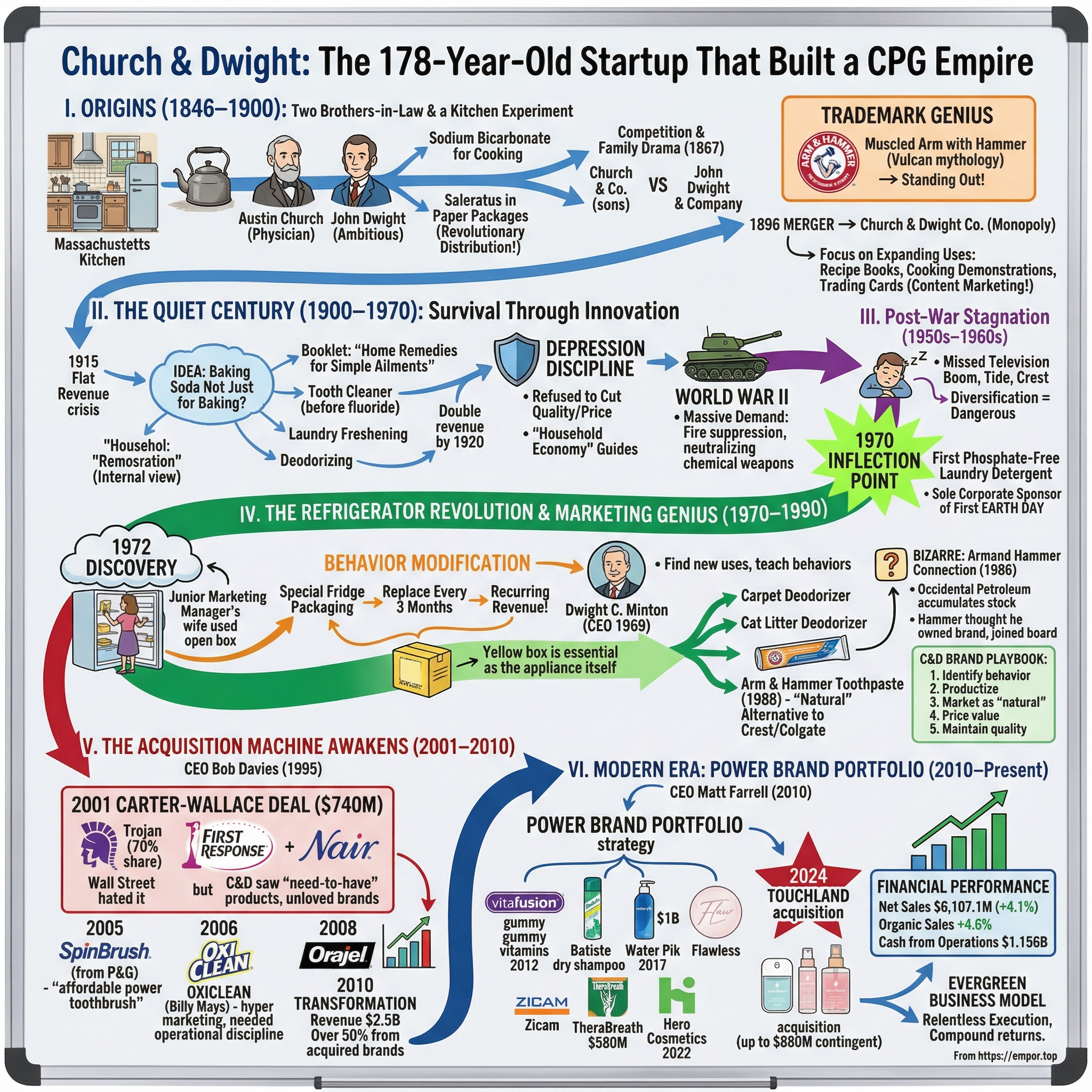
Church & Dwight: The Baking-Soda Company That Became a Serial Acquirer — and Is Now Editing Its Own Deal Book
I. Cold Open & Episode Roadmap (8–10 min)
On the last day of 2025, a transaction closed with almost no fanfare. Church & Dwight Co., Inc. handed over two brands — VitaFusion and L'il Critters, the gummy-vitamin business it had bought for $650 million in 2012 — to a private supplements maker called Piping Rock Health Products, along with the manufacturing and distribution facilities in Vancouver and Ridgefield, Washington that came with them.1 The purchase price was not disclosed. What was disclosed was the cost of getting out: a pre-tax charge of $58.5 million, $45.6 million after tax, booked in the fourth quarter.2
Five weeks later, on the February 2026 earnings call, chief executive Rick Dierker described the decision in language that should stop any long-term investor mid-scroll. Acknowledging that the company could not fix the vitamin business was, he said, "one of the biggest strategic pivot points in our company history."3
Read that again in context. This is a company founded in 1846 by a physician named Austin Church and his brother-in-law John Dwight, who began preparing bicarbonate of soda for commercial sale out of a Brooklyn kitchen.4 It has been selling essentially the same white powder for 180 years. And the pivot point its CEO reaches for is not the invention of a product or the entry into a category — it is the admission that an acquisition didn't work.
That tension is the spine of this story.
Here is the snapshot. Church & Dwight trades on the NYSE under CHD, runs out of the Princeton South Corporate Center in Ewing, New Jersey, and organizes itself into three divisions: Consumer Domestic, Consumer International, and Specialty Products.56 Fiscal 2025 net sales were $6.203 billion, up 1.6% reported and 0.7% organic — the organic figure depressed by roughly 130 basis points from the vitamin business it was exiting.7 With about 236.9 million shares outstanding as of March 20268 and a share price around $98 at the time of the August 2026 second-quarter report,9 the equity has been valued in the low-to-mid $20 billions.
On one reading, CHD is one of the most reliable compounders in American consumer staples. Management calls its framework the "Evergreen Model": roughly 3–4% organic sales growth, gross margin expansion, marketing investment held at or above 11% of sales, and earnings per share growing faster than the top line.10 The dividend has been raised for thirty consecutive years, most recently by 4.2%.7 Nine of the ten brands that carried the company into the modern era were acquired after 2001 — this is, structurally, an acquisition company wearing a heritage brand's clothes.5
On the other reading, the last four years have been a slow-motion audit of that acquisition record, and it did not come back clean. In 2022, the company wrote down $411 million of intangibles tied to Flawless, a hair-removal device brand it had bought three years earlier.11 In 2024, it took a further $357.1 million pre-tax against the vitamin business.12 In 2025, it exited Flawless, Spinbrush, and the Waterpik showerhead line outright,13 then sold the vitamins. The count of what CHD calls its "power brands" — the internal designation for the assets it deems strategically core — peaked at fifteen when Hero Cosmetics was added in 202214 and stood at seven in the fiscal 2025 annual report.2
And in the middle of that cleanup, in May 2025, the company agreed to pay $700 million at closing plus an earn-out of up to $180 million for Touchland, a hand-sanitizer brand with roughly $130 million of trailing sales.15 Buying aggressively while writing off prior deals is the kind of behavior that either signals conviction or signals a company that hasn't updated its underwriting. Which one it is, is a question this article will hold open rather than settle by assertion.
The path from here: a compressed origin story that explains why brand-stretching is in the company's DNA; the construction of the acquisition machine from 2001 onward and an honest grading of it; the segment economics and competitive structure as they stand today; the 2022–2025 reckoning in detail; Dierker's reset and his actual capital-allocation record; the bull and bear cases stress-tested against the company's own history; and the small number of metrics that will tell you, over the next three to five years, whether the revised story holds.
It starts with a commodity so cheap it should never have supported a durable business at all.
 Subscribe on LinkedIn
II. Origins: The Sodium Bicarbonate Monopoly (1846–1970) (15–20 min)
Sodium bicarbonate is not a product. It is a chemical — NaHCO₃, a white crystalline salt that costs almost nothing to make from soda ash and carbon dioxide, has no patent protection, and can be manufactured by anyone with a reactor and a dryer. In 1846, when Dr. Austin Church and John Dwight began preparing it for commercial distribution, they had no proprietary process worth defending and no barrier to entry beyond distribution.4
What they had instead was a question that the company has been answering, in different forms, for 180 years: what else can this powder do?
The early answer was leavening. Bicarbonate makes bread rise, and in a nineteenth-century American household that was a genuine labor-saving technology. But the interesting part of the story is what happened once that market was saturated. The founders' descendants ran two competing family firms for decades — Church & Co. on one side, John Dwight & Co. on the other, each selling the same substance under different marks — before consolidating their interests in 1896 under the name Church & Dwight Co., Inc.4 The unifying asset in that reunification was a trademark that had been adopted in 1867: the arm of Vulcan, the Roman god of fire, gripping a hammer.4
The Arm & Hammer logo is worth pausing on, because it is the earliest evidence of the mechanism that still drives this company. A commodity with no cost advantage and no patent was given a name, a mark, and a fixed visual identity. That did not make the chemistry better. It made the powder findable — a consumer looking for baking soda reached for the yellow box rather than comparison-shopping a fungible input. In modern terms, the company converted a commodity into a search term.
Then it did the harder thing: it kept inventing reasons to buy more of it. Over the following century, baking soda was repositioned as a medicine, a tooth cleaner, a laundry booster, a cleaning abrasive, and eventually a deodorizer. Each repositioning cost the company almost nothing in research and development, because the product never changed. The innovation was in the use case, not the molecule.
This is the template. It has a specific and unusual economic property that is worth naming plainly, because everything CHD does later is a variation on it. Most consumer-goods companies grow by adding products, which means adding formulations, factories, inventory, and complexity. Church & Dwight learned to grow by adding occasions — new moments in the day when the same box gets opened. The marginal cost of a new occasion is a marketing campaign. The marginal revenue is a whole new consumption cycle.
The manufacturing side reinforced it. In 1968 the company built a sodium bicarbonate plant in Green River, Wyoming, sited to draw on the natural soda ash reserves — trona — in the region.4 That decision gave CHD something most consumer companies never have: ownership of its own key raw material at the source. In a category where the input is a commodity, being the low-cost producer of that commodity is not a glamorous advantage, but it is a real one, and it explains why the company could later price Arm & Hammer aggressively against far larger competitors without destroying its own margin.
The limitation of this era is equally important and often skipped. For roughly 125 years, Church & Dwight was a very good single-product business and nothing more. It had brand recognition disproportionate to its size, a defensible cost position in one input, and essentially no diversification. Revenue was small, the category was mature, and the company's fate was tied to how many additional uses American households could be persuaded to find for one substance.
That constraint is the thing to carry forward. The stretch-the-brand playbook was invented here because it had to be — it was the only growth vector available to a company that made one thing. It was not a strategy chosen from a menu. It was the strategy of a company with no alternatives. And when alternatives eventually appeared, in the form of an acquisition market for consumer brands, the company's willingness to reach for them would turn out to be shaped by this history: a management culture trained to believe that a good brand plus better distribution equals growth.
The first test of that belief came in the 1970s, and it worked spectacularly.
III. Becoming a Real CPG Company: The Refrigerator Deodorizer to the First Acquisitions (1970–2001) (15–20 min)
In April 1970, Church & Dwight was the sole corporate sponsor of the first Earth Day.4 That is an odd sentence to write about a baking-soda company, and it is not a public-relations footnote — it is a positioning decision that arrived roughly two decades before "sustainability" existed as a marketing category.
The same year, the company began marketing a phosphate-free laundry detergent built on soda ash. Phosphates were the workhorse builder in detergents at the time and were increasingly blamed for algal blooms in freshwater systems. Every major detergent manufacturer was on the wrong side of that argument. Church & Dwight, whose chemistry happened not to need phosphates, was on the right side of it — and marketed accordingly. This was counter-positioning in its purest form: not a better product, but a product whose incumbent competitors could not easily copy without disowning their own formulations and cost structures.
Then, in 1972, came the campaign that belongs in every marketing curriculum. Church & Dwight told American consumers to open a box of baking soda and leave it in the refrigerator to absorb odors. Within about a year, more than half of American refrigerators contained one.
Sit with the economics of that for a moment. The company took a fifty-cent commodity and converted it into a consumable that is never consumed. The box does not run out. It does not get used up in any visible way. It simply becomes stale — and the only way to know it is stale is to replace it on a schedule the manufacturer suggests. CHD had manufactured a recurring purchase out of thin air, with zero incremental product development, in a category where the customer cannot verify whether the purchase was necessary.
There is no polite way to describe how good that is as a business outcome. It is also, importantly, not repeatable at will. The refrigerator campaign worked because baking soda had a genuine functional property, a century of accumulated household trust, and a price point low enough that nobody audits the decision. Most brand-extension attempts fail. The company's own history from this era includes an underarm deodorant that did not work commercially.
The 1980s brought a strange interlude. In 1986, Church & Dwight formed a joint venture, Armand Products, with Occidental Chemical Corporation.4 Occidental Petroleum's chairman at the time was Armand Hammer — no relation whatsoever to the trademark, which predated him by decades — and contemporaneous press coverage reported that Hammer took an equity position in the company and a board seat in the same period; the company's own published history records the joint venture rather than the stake. The episode is a curiosity, but it makes one point worth keeping: this is not a company that has been permanently insulated from outside pressure on its ownership or strategy. It has simply not faced much of it recently.
Through the 1990s, the shape of the business remained recognizably narrow. Arm & Hammer had been extended into laundry detergent, toothpaste, cat litter, and cleaners, and the extensions worked. But CHD was still, in revenue terms, a company whose fortunes rested on how many things one brand could credibly do. It was competing in laundry against Procter & Gamble and in oral care against Colgate-Palmolive — companies with tens of billions in revenue, global distribution, and research budgets larger than CHD's entire sales base.
The strategic problem by the late 1990s was arithmetic. Brand extension has a ceiling. Each new use-case is smaller than the last, and eventually you are launching baking-soda-based products into categories where the consumer sees no logical connection. Growth of 3–4% a year requires either a much bigger brand or more brands.
Management chose more brands. And the pivot, when it came, was abrupt: as the company's own investor materials later put it, nine of its ten principal brands were acquired after 2001.5 A business that had spent a century and a half building one franchise organically decided, in the space of about two decades, to buy almost everything else it sold.
That decision is the reason there is an investment debate about Church & Dwight at all. Everything from here is about whether the company that was brilliant at stretching a brand it invented is equally good at buying brands other people invented.
IV. The Acquisition Machine: Building (and Pruning) the Power-Brand Portfolio (2001–2022) (40–50 min)
The opening move was not subtle. In 2001, Church & Dwight bought the consumer brands of Carter-Wallace — Trojan condoms, First Response pregnancy tests, Nair depilatories, Arrid antiperspirant — and separately acquired USA Detergents, owner of the value laundry brand Xtra. In one year, a baking-soda company acquired positions in contraception, home diagnostics, hair removal, and deodorant.
The logic was distribution arbitrage, and it was sound. CHD had shelf relationships with every American grocery, drug, and mass retailer, built over 150 years of selling a product those retailers had to carry. It had a supply chain optimized for low-cost, high-turn household goods. What it lacked was enough products to push through that pipe. Carter-Wallace's brands were strong names inside a conglomerate that had lost interest in them. Bolted onto CHD's distribution and cost base, they got better.
This became the template, and the company formalized it into stated criteria that management has repeated in essentially the same words for two decades: acquire brands holding the number one or number two share position in their category; prefer high-growth, high-margin, "fast-moving consumables"; keep the assets capital-light; and buy things where CHD's distribution and manufacturing scale confer an advantage the seller did not have.10
The next wave filled in the household portfolio. Spinbrush, the battery-powered toothbrush line, arrived in 2005. Orange Glo International — the owner of OxiClean, then a direct-response television phenomenon — followed. Orajel, the oral analgesic, came in 2008. These were classic bolt-ons: modest prices, immediate distribution synergy, brands that had outgrown their owners' capabilities.
Then the deals got bigger, and the character of them changed.
The 2012 deal that would take thirteen years to unwind
In August 2012, CHD agreed to buy Avid Health, Inc. for $650 million in cash. Avid owned VitaFusion, the leading adult gummy vitamin brand, and L'il Critters, the leading children's version. Trailing twelve-month sales through June 2012 were approximately $230 million, with EBITDA of roughly $58 million — about 2.8 times sales and 11 times EBITDA.16 Then-CEO James Craigie framed it as "a great addition to our existing portfolio" that brought "a new growth platform," consistent with the company's stated strategy of buying number one or number two brands in high-growth areas.16 The deal closed on October 1, 2012, financed with $400 million of senior notes, commercial paper, and cash.16
The strategic bet underneath was specific and, at the time, entirely reasonable: that the gummy format would displace the pill across the vitamin category, and that whoever owned the leading gummy brands would ride that format shift. Formats do displace each other in consumer goods — pods displaced liquid detergent, sticks displaced tubs. The question nobody asks loudly enough at the moment of purchase is whether the format shift creates a defensible position or merely creates a large, visible, easily-copied opportunity.
Hold that thought. It resolves in Section VI.
The 2017 deal that bought a durable and a fragile business in one box
In July 2017, CHD agreed to acquire Water Pik, Inc. from the private equity firm MidOcean Partners for approximately $1 billion in cash, closing on August 8.17 Waterpik's trailing twelve-month net sales through June 2017 were about $265 million with roughly $80 million of EBITDA — a 30% margin, and a purchase price near 3.8 times sales and 12.5 times EBITDA. Roughly 70% of those sales were water flossers; the balance was replacement showerheads.17 CEO Matthew Farrell explained the fit in strategic rather than financial terms: "Oral care is important to us strategically. Waterpik represents a powerful addition to our existing oral care portfolio."17
Two things about this deal matter for the later story. First, CHD bought two quite different businesses in one transaction — a growing, clinically-supported oral care device franchise and a mature, discretionary hardware line. Second, water flossers are a durable, not a consumable. They cost real money, they last for years, and the purchase can be deferred indefinitely when household budgets tighten. That is a direct violation of the company's own stated preference for fast-moving consumables, and it was not treated as one at the time.
The 2019 deal that concentrated on a single retailer
On March 28, 2019, CHD agreed to buy the Flawless and Finishing Touch women's hair-removal device brands from Ideavillage Products Corporation for $475 million in cash, plus an earn-out of up to $425 million tied to trailing twelve-month net sales targets running through the end of 2021. Trailing sales were approximately $180 million. Farrell called Flawless "the Company's 12th power brand."18 The deal closed on May 1, 2019.18
Flawless was a direct-response and retail-concentrated product — a small electric device sold heavily through a narrow set of channels. The structure of that business means the addressable demand is not really the consumer; it is the buyer at a handful of retailers who decides whether to give the product a slot. That is a customer-concentration risk of an unusually acute kind, because a single delisting decision does not reduce sales at the margin, it removes them.
The 2021 and 2022 deals: paying up for growth
By late 2021 CHD was competing for assets in the hottest corner of the consumer market — fast-growing, digitally native personal care brands — and paying accordingly. In November 2021 it acquired TheraBreath, a mouthwash brand, for $580 million against approximately $86 million of trailing twelve-month net sales through September 2021.19 That is roughly 6.7 times sales. In September 2022 it agreed to buy the Hero Cosmetics business, maker of the Mighty Patch acne patch, for approximately $630 million against about $115 million of trailing sales and roughly $45 million of EBITDA — a 40% EBITDA margin, and multiples of about 5.5 times sales and 14 times EBITDA. Hero was described as the company's 15th power brand and the number two brand in the U.S. acne category.14 The deal closed in October 2022.
Those are not cheap multiples by the standards of consumer staples, where mature brands change hands in the low-to-mid single digits of sales. They were, however, broadly in line with what strategic buyers were paying in that specific window for fast-growing, DTC-native personal care assets. Paying a growth multiple is not automatically an error. It is an error only if the growth does not persist long enough to justify it — which is precisely the question the next four years answered, differently for different brands.
What the portfolio looked like at its peak
By 2023–2024, the portfolio spanned three segments and roughly a dozen-plus designated power brands across Consumer Domestic, Consumer International, and a small Specialty Products division selling animal nutrition products and industrial sodium bicarbonate. The company had been remade. Baking soda was still the emotional center of the brand story and still the single largest domestic franchise, but the majority of the growth algorithm now depended on brands purchased with shareholder capital in the preceding twenty years.
Here is the fair way to grade the machine at this point, before the reckoning. The 2001–2008 cohort — Carter-Wallace, USA Detergents, OxiClean, Orajel — worked. Those were cheap, they fit the distribution logic, and several of them are still core today. The 2012–2019 cohort was more expensive, more thematic, and less obviously suited to CHD's actual competitive advantage. Somewhere between "buy a strong brand and put it through our pipe" and "buy exposure to a category trend," the criteria stopped doing the work they were designed to do.
The count that tells the story most economically: fifteen power brands in 2022, and seven in the fiscal 2025 annual report.214 Almost half the strategically core portfolio, as management itself defined it, was gone within three years.
The next two sections explain how — first the structure of the business that survived, then the mechanics of what broke.
V. Segment Economics & Industry Structure Today (30–35 min)
Walk down the laundry aisle of an American supercenter and you are looking at one of the most economically brutal categories in consumer goods. It is enormous, it is entirely mature, the products are chemically similar, the shelf is controlled by three or four retailers, and the biggest competitor spends more on advertising in the category than most participants earn in it. This is where Church & Dwight makes a large share of its money, and understanding how it survives there explains most of what the company is.
Start with the shape of the business as reported for fiscal 2025. Consumer Domestic generated $4.774 billion of net sales, up 0.9%. Consumer International generated $1.129 billion, up 5.4%. Specialty Products generated $299.0 million, down 1.4%.7 So the domestic consumer business is roughly 77% of the company, international about 18%, and the specialty chemicals and animal nutrition business about 5%.20
Inside Consumer Domestic, the split has historically run about 55% household products and 45% personal care — which works out to roughly 42% and 35% of consolidated sales respectively.20 Household means laundry, cleaning, and cat litter. Personal care means oral care, condoms and family planning, acne treatment, and hair care. They behave very differently: household is defensive, price-sensitive, and lower-margin; personal care is where the acquired growth brands live and where both the upside and the impairments have come from.
Specialty Products deserves exactly one paragraph and no more. It sells industrial sodium bicarbonate and animal nutrition products, it is roughly acyclical, and it shrank slightly in 2025. It is a stable diversifier attached to the company's raw-material position, not a second growth engine, and it should not be sized as one in any investment case.
Who CHD is actually competing against
The competitive set is not a peer group; it is a size mismatch. Procter & Gamble and Unilever operate at multiples of CHD's revenue with global R&D, media, and distribution infrastructure. Clorox and Colgate-Palmolive compete brand-by-brand in cleaning and oral care. Kenvue, the consumer health business spun out of Johnson & Johnson, and Edgewell overlap in personal and oral care. And private label — retailer-branded product — is the structural pressure that applies to every one of them simultaneously.
CHD's own risk disclosures name that pressure directly, citing customer actions "including increasing shelf space or on-line share of private label and retailer-branded products."2 This is not boilerplate. It is the same mechanism that produced two of the write-downs in the next section.
The counter-position, and its evidence
CHD's answer to the size mismatch is not to fight P&G on premium formulation. It is to occupy the value and extreme-value tiers deliberately, with Arm & Hammer priced as the value option and Xtra as the extreme-value option, so that a consumer trading down within the category has somewhere to go that is still a CHD brand.
The important thing is that there is behavioral evidence this works, not just a slide claiming it does. At CAGNY in 2026, management reported that Arm & Hammer had become number one in U.S. wash loads by volume and units, surpassing Tide Original — a share position achieved not by matching Tide's price but by undercutting it.10 Arm & Hammer's share of the lightweight cat litter segment rose from 4% to 8% during 2025.10 And in the second quarter of 2026, management told analysts that Arm & Hammer held its laundry share even as a competitor — Henkel — raised promotional spending sharply.9
Holding share against an aggressive promotional push is the more informative of those data points. Share gained during a competitor's retreat can be given back. Share held while a competitor spends into the category suggests the consumer is choosing the brand on its own merits rather than on the week's price.
The second piece of evidence is subtler and comes from a place management would rather not have needed. Explaining the 2025 portfolio exits on the Q4 call, the company disclosed that the divestitures had cut its private-label exposure from 12% to 5% of sales.3 That is an admission worth reading twice: about one-eighth of the portfolio was sitting in categories where retailer-branded product was actively taking share, and the fix was to sell those categories rather than to defend them.
Five forces, honestly applied
Supplier power is genuinely low. The company owns bicarbonate production sited on natural soda ash reserves, and the rest of its inputs are commodities.4 This is a real advantage and one of the few that has persisted for a century.
Buyer power is high and getting higher. Walmart and its affiliates accounted for 23% of consolidated net sales in each of 2025, 2024, and 2023; no other customer exceeded 10%.2 Nearly a quarter of the business sits with one buyer that also sells competing private-label product in most of CHD's categories. That is not a CHD-specific problem — it applies to every consumer goods supplier in America — but concentration of that magnitude means retail negotiations set the terms of margin, not the other way around.
Rivalry in the mature categories is moderate and mostly rational; the large players tend to compete on innovation and promotion rather than destroying category economics. Substitution is the sharpest of the five: private label at the low end and subscription or direct-to-consumer entrants at the innovative end. New entrant threat at scale is genuinely low — nobody is building a competing national household products distribution network — but new entrant threat at the brand level is close to zero-barrier, and that is the point that matters most. Hero, TheraBreath, and Touchland all existed as viable competitors precisely because a small team with a good product and a social media strategy can now reach national scale without a factory. CHD's acquisition strategy is, in effect, a subscription to that dynamic: it buys the disruptors rather than being disrupted by them. That is a rational response, but it also means the company is a structural price-taker in an auction market for exactly the assets that threaten it.
The seven powers question
Run the portfolio through Hamilton Helmer's framework and three of the seven have some claim.
Counter-positioning is real. P&G cannot price Tide down to Xtra's per-load cost without cannibalizing the most profitable brand in its portfolio. That is the textbook definition — an advantage that exists because the incumbent's own economics prevent it from responding.
Scale economies exist in manufacturing and distribution, but they are modest relative to the true giants. CHD is subscale versus P&G and Unilever on media and global logistics, and management has said so implicitly: international sales are 18% of the company versus roughly 59% for competitors, which it frames as runway.10 Runway is another word for a gap you have not yet closed.
Branding is genuine, but narrower than the marketing language suggests. Arm & Hammer's power in baking soda and its adjacencies is deep and old. Elsewhere it is thinner.
Here is where the section has to be blunt about vocabulary. "Power brand" is a label Church & Dwight applies to its own assets. It is not an external certification of a moat, and the historical record establishes that the label carried limited predictive value: Flawless was designated the 12th power brand in 201918 and was being shut down or sold six years later.13 TheraBreath was the 14th, and is now one of the company's stated growth pillars. Hero was the 15th.14 Same label, opposite outcomes. Investors should treat the designation as management's intent, not as evidence of durability.
Which brings us to the four years in which that distinction stopped being theoretical.
VI. The Reckoning: Impairments, a Guidance Cut, and a CEO Transition (2022–2025) (40–50 min)
On February 3, 2023, Church & Dwight reported a year in which reported earnings per share fell 49.4%, from $3.32 to $1.68.11 Net sales had actually grown 3.6% to $5.376 billion, and adjusted EPS was down only 1.7% to $2.97.11 The gap between those two numbers — reported earnings roughly halved, adjusted earnings roughly flat — was a single line item: $411 million of non-cash intangible asset impairment on the Flawless business, of which $349.3 million landed in Consumer Domestic and $61.7 million in Consumer International.112122
The reason given was almost startling in its simplicity. A major retailer had discontinued select products.11
2022: the diligence miss, in one sentence
Three years and $475 million after buying it, the company wrote off a large fraction of the Flawless intangibles because one customer changed its mind about carrying the product. That is not a macroeconomic event. It is not a category collapse. It is the exact risk embedded in the structure of a device brand sold through a concentrated retail channel — the risk that was visible in the business model at the time of purchase and was evidently underweighted.
What makes it a more useful data point than a simple write-down is what management said next. In the same release, the company stated that it "continues to believe in the long-term growth opportunities for the Flawless brand."11 Track that statement forward: in May 2025, the company announced it was shutting down or selling Flawless.13 The distance between "we continue to believe in the long-term growth opportunities" and "we are exiting this business" was twenty-seven months. Management credibility is built out of exactly these comparisons — not from whether an investment goes wrong, which happens to everyone, but from how long the company keeps defending it after the evidence has turned.
2024: the harder failure, because the category was growing
In the third quarter of 2024, CHD recorded non-cash impairment charges of $357.1 million pre-tax, $270.1 million after tax, against assets acquired in the 2012 vitamin transaction.12 The valuation resulted in a full write-off of the $281.3 million VitaFusion and L'il Critters trade name, with the remainder split between customer relationships and property, plant and equipment.12 Management attributed it to "a reduction in the Company's expectations about the long-term growth and profit outlook for the VMS business,"12 and the annual report was more specific: decreased market share and deteriorating financial performance driven by competition from new category entrants, including private label.12
That last clause is the whole story, and it is a materially worse outcome than a write-down caused by a shrinking category.
On the Q1 2025 earnings call, Dierker quantified it. The gummy vitamin category grew 4.8%. Church & Dwight's own consumption in it declined 19%.23 The company was losing roughly a quarter of its business in a market that was expanding.
Think about what has to be true for that to happen. Demand was fine. Consumers wanted gummy vitamins. They simply did not want CHD's gummy vitamins at CHD's price when a retailer's own-label version sat next to it at a lower one. The format shift that justified the 2012 acquisition thesis — gummies displacing pills — turned out to be real. What was not real was the assumption that owning the leading gummy brands would confer a durable position once the format became mainstream. A format is not a moat. Once gummy manufacturing became widely available, the branded premium had to be justified by something other than being first, and it wasn't.
For an investor grading the acquisition-discipline claim, this is the sharpest available piece of disconfirming evidence, because it isolates the variable. Macro conditions did not break the thesis. The moat claim itself was wrong.
The disclosure management made about Waterpik, which was more useful than the impairment
In the same annual reporting cycle, the company disclosed something that impaired nothing and told investors more than either write-down. As of the October 1, 2024 annual test, the Waterpik trade name carried a value of $644.7 million, and its estimated fair value represented 135% of that carrying value.12 The company explained that the global Waterpik business had continued to experience declining customer demand, driven by lower consumer spending on discretionary products and by water flosser consumers switching to value-branded alternatives.12
Decode the number. A 35% cushion on a $645 million asset is not comfortable. Trade name valuations are built from projected royalty streams; a sustained mid-single-digit deterioration in the forecast can consume that headroom. Management said as much, warning that continued decline could trigger a future impairment.12
Two features of that disclosure are worth flagging. First, the substitution mechanism named — consumers switching to value-branded water flossers — is the same mechanism that destroyed the vitamin business, and it is arriving in a category where CHD is the premium incumbent rather than the value challenger. The company's entire strategic identity is built on being the brand consumers trade down to. Waterpik is the asset where it is the brand consumers trade down from. Second, this was a live, forward-looking, quantified piece of disconfirming evidence that the company published about itself. That deserves credit as disclosure practice, and it also remains, as of this writing, the single most useful number in the file for anyone testing the durability of the acquired portfolio.
March 2025: a new CEO who had signed the old checks
On September 16, 2024, the board announced that Rick Dierker, then chief financial officer and head of operations and a fifteen-year company veteran, would succeed Matthew Farrell as president and chief executive effective March 31, 2025, with Farrell continuing as chairman through the transition.24 Lead director Ravi Saligram praised Dierker's "innate ability to get to the heart of issues and drive execution," and Farrell said Dierker had the qualities "to sustain our Evergreen model."24 Dierker, for his part, spoke of creating value "through innovation, technology, and accretive acquisitions."24
This was a continuity appointment, not a rupture. No activist forced it; no outsider was imported to clean house. And the credibility implication needs stating plainly rather than glossed: the executive now unwinding the Waterpik showerhead line, the Flawless deal, and the vitamin business was the chief financial officer when several of those transactions were signed and financed. That cuts both ways. It means he owns the record. It also means he is unusually well positioned to know which assets were beyond repair, which is arguably why the exits happened quickly once he had the authority to make them.
May 2025: the guidance cut
On April 30, 2025, reporting first quarter results, CHD cut its full-year outlook hard. Organic sales growth guidance went from 3–4% to 0–2%. Adjusted EPS growth guidance went from 7–8% to 0–2%. Gross margin guidance flipped from 25 basis points of expansion to 60 basis points of contraction. Operating cash flow guidance fell from $1.156 billion to $1.05 billion.13 Organic sales in the quarter had declined 1.2%, with domestic down 3.0% while international grew 5.8%.13 The stock fell about 6.7% pre-market.23
Dierker's explanation on the call was specific rather than evasive, which matters. He attributed roughly 300 basis points of the shortfall to retailer destocking, and described a consumer environment in which U.S. category growth had decelerated from about 2.5% in the second half of 2024 to 1.5% in the first quarter of 2025, with March flat and April running negative 1%.23 He also volunteered an observation that cut against his own book: consumers were not trading down to value tiers at the rate one would expect, which removes a convenient explanation for CHD's own weakness.23
By the second quarter, guidance was maintained rather than cut further, and management pointed to sequential improvement in category growth.25 The company also guided third quarter adjusted EPS to $0.72, down 9% year over year.25 A year that had begun with a 7–8% earnings growth target ended up delivering 2.6% adjusted EPS growth on 0.7% organic sales.7
2025: the prune
Alongside the cut, the company announced it would shut down or sell Flawless, Spinbrush, and the Waterpik showerhead business — roughly $150 million of sales, about 2% of the total, at below-average profitability.13 Dierker was candid on the call that the primary trigger was tariff exposure mitigation rather than performance alone: gross twelve-month tariff exposure was approximately $190 million, and the portfolio and supply chain actions were expected to cut that by roughly 80%.23 The company took approximately $51 million of pre-tax charges in the second quarter for those exits25 and $45.6 million pre-tax, $34.5 million after tax, for the full year.2
On vitamins, management initially attempted a turnaround — new products, improved taste, refreshed marketing launching in May 2025 — and promised an update on the second quarter call.23 The update, ultimately, was the sale to Piping Rock.
Total exit charges for 2025 came to $104.1 million pre-tax across both actions.2
The claim management made, and how to test it
On the Q4 2025 call, Dierker offered the framing the company wants investors to carry forward: "In 2025, our brands grew about 1% consumption. If you strip out all the businesses and portfolio changes we made, it would have grown 3.5%."3
That statement is arithmetically true and analytically incomplete. It is true that the remaining portfolio grew consumption faster than the reported total. It is also true that the excluded businesses were not a random sample — they were, in every case, brands the company had acquired and then failed to grow. Describing their removal as a portfolio improvement is fair as a statement about the go-forward asset base. Describing it as strategic focus, without acknowledging that the underlying decisions were capital-allocation errors that destroyed several hundred million dollars of book value, would be revisionism.
To management's credit, Dierker did not do that. His characterization of the vitamin exit as a strategic pivot point in company history3 is an unusually direct acknowledgment for a CPG chief executive, and the charges were disclosed in the open rather than buried in restructuring line items.
The calibrated verdict
Here is what the record supports. Five acquired brands or brand lines — Flawless (2019), Spinbrush (2005), the Waterpik showerhead business (part of the 2017 deal), VitaFusion and L'il Critters (2012) — were impaired, shut down, or sold within three to twenty years of purchase, and the pattern spans two chief executives. That is a real, recurring outcome, not a single bad quarter.
It does not reject the "disciplined acquirer" claim outright. Carter-Wallace, OxiClean, Batiste, TheraBreath, and Hero are on the other side of the ledger, and several are carrying the company's growth today. What the record does is narrow the claim substantially. The evidence supports a version that reads: Church & Dwight is a competent acquirer of consumable brands that plug into its existing distribution and cost structure, and a materially worse acquirer of durables, devices, and thematic category bets. Every one of the failures falls in the second bucket. Every one of the successes falls in the first.
That revised claim is testable. The forward evidence is whether the newest cohort — Touchland, Miss Mouth, and the still-scaling Hero and TheraBreath — reaches the three-to-five year mark without impairment. Touchland is a consumable. Miss Mouth is a consumable. On the narrowed version of the thesis, they should work. If they don't, the narrowing was too generous.
Which makes the capital allocation decisions of the current CEO the most informative thing available.
VII. Current Management: Dierker's Reset and the Capital Allocation Record (25–35 min)
Twelve days after his first earnings call as chief executive ended with the stock down nearly 7%, Rick Dierker went into the market and bought stock. Across May 13 and 14, 2025, he purchased 13,334 shares at prices between $92.80 and $94.78, spending $1,252,214 of his own money.26 Three months later, on August 12, he bought another 5,470 shares at $91.57, a further $500,887.27
That is a meaningful gesture and a bounded one. It is meaningful because open-market buying by a sitting CEO, at a moment when the stock is being punished for guidance he just cut, is a costly signal — the kind of behavior that is expensive to fake. It is bounded because the resulting position is not founder-scale: following the August purchase, Form 4 filings showed direct ownership of roughly 27,212 shares and indirect ownership of about 9,332 more.27 Against a company with about 237 million shares outstanding,8 that is a rounding error in ownership terms, even if it is a large fraction of one executive's liquid net worth. The proxy's stock ownership guidelines require the CEO to hold shares equivalent to six times base salary,8 which is a governance floor rather than an alignment story.
Governance, in the shape it actually takes
Church & Dwight has no dual-class structure. The board comprises eleven directors, ten of whom the company identifies as independent under NYSE listing standards.8 Deloitte & Touche serves as auditor.
The most informative governance data comes from the annual meeting held in May 2026. The advisory vote on executive compensation passed with 170,032,434 shares in favor and 22,968,505 against — approximately 88.1% support.28 Auditor ratification carried with about 92.5%.28 All directors were elected. And a stockholder proposal seeking to permit stockholder action by written consent — a mechanism that would make it easier for shareholders to act between annual meetings — failed, but with 85,102,575 votes in favor against 107,107,651 opposed, roughly 44% support.28 The board had recommended against it.8
None of these is a red flag on its own. Say-on-pay support in the high 80s is within the normal range of institutional dissent rather than a rebuke. But 44% support for a written-consent proposal is toward the higher end of what such proposals typically attract, and it is worth naming as a data point rather than smoothing over: a meaningful minority of the shareholder base wanted more direct procedural power at exactly the moment the company was working through a multi-year cleanup of prior capital allocation. The proxy for the 2026 meeting listed no contested board matters beyond that proposal.8
Institutional ownership is, as with any S&P-scale staples company, dominated by index funds. That has a specific consequence for this story: the largest holders are structurally passive, which means the pressure to explain a capital allocation record comes from sell-side questioning and active minority holders rather than from a concentrated owner who can force change.
The Touchland decision
Then there is the deal, which is the real test.
On May 12, 2025 — two weeks after cutting full-year guidance — Church & Dwight announced it would acquire Touchland, a premium hand sanitizer brand, for $700 million at closing in cash and restricted stock, plus an earn-out of up to $180 million contingent on 2025 net sales. Touchland's trailing twelve-month net sales through March 2025 were approximately $130 million with roughly $55 million of EBITDA — a 42% margin. It was described as the fastest-growing hand sanitizer brand in the U.S. and the number two player in the category, and as CHD's eighth power brand.15 Founder Andrea Lisbona stayed with the business.15
The final consideration, as recorded in the fiscal 2025 annual report, was $656.0 million net of cash acquired, plus a $159.0 million earn-out payable in the first half of 2026, plus $50 million of company stock as founder equity compensation vesting over time, plus a $5 million deferred indemnification payment.2
Call it roughly six times trailing sales and about fifteen times trailing EBITDA on the base consideration. That is expensive — more expensive as a sales multiple than Hero, more expensive than Waterpik, in the same range as TheraBreath. And it was signed in the same calendar year the company was writing off the vitamin business and shutting down Flawless.
The skeptical read is obvious and should not be waved away: a company with a demonstrated pattern of overpaying for growth assets that subsequently disappointed responded to that pattern by paying up for another growth asset. If the underwriting process is what failed before, buying again at a full multiple within months does not demonstrate that the process changed.
The counter-argument has actual substance, though, and it sits in the narrowed thesis from the last section. Touchland is a fast-moving consumable with a 42% EBITDA margin, sold repeatedly rather than owned durably. It is exactly the asset type CHD has historically integrated well, and the opposite of the device and durables bets that failed. The company also had balance sheet room: leverage has run around 1.5 times, and management has continued to describe roughly $6 billion of acquisition firepower as a competitive advantage in a soft market.2310
Early evidence has been supportive rather than conclusive. On the Q4 2025 call, management reported Touchland sales above expectations and driving double-digit growth, with its Power Mist product ranking second on Sephora.com by sales and distribution expanding into Canada and the Middle East.3 Regulatory complexity around alcohol-based formulations is forcing a staged international rollout.3 Two quarters of outperformance against a $815 million commitment is a start, not a verdict.
A second, much smaller deal followed: Miss Mouth, a stain remover, acquired in June 2026. In its first partial quarter inside CHD, consumption grew more than 50% and the brand gained 3.5 share points, from a household penetration base of 2.5% against a category average near 50%, and all-commodity-volume distribution of 35% against a category level near 80%.9 The distribution gap is the entire investment case — this is a product that works and simply is not on enough shelves, which is the precise problem CHD's retail relationships were built to solve. It is also small enough to be a footnote, and should be sized as one.
Balance sheet and returns
Leverage has been maintained near 1.5 times EBITDA.10 In 2025 the company returned approximately $900 million to shareholders while also funding Touchland,10 and raised the dividend 4.2% to $0.3075 per share quarterly, extending a thirty-year increase streak.7 That streak survived the impairment years intact, which is a genuine consistency data point: the write-downs were non-cash, cash generation held up, and the capital return commitment was never interrupted.
Capital allocation priorities as stated by CFO Lee McChesney on the Q4 2025 call, in order: total-shareholder-return-accretive M&A first, then organic capital expenditure and innovation, then debt reduction, then shareholder returns.3 M&A is explicitly priority one. Investors evaluating this company should internalize that ranking, because it means the acquisition record is not a side issue — it is the primary mechanism by which capital gets deployed.
Is the reset working?
The most recent evidence is the second quarter of 2026, reported in August. Organic sales grew 5.8% against a 3% outlook, with volume up 4.3% and price/mix contributing 1.5 points. Reported revenue was $1.53 billion. Domestic organic sales rose 5.1%, led by TheraBreath mouthwash and toothpaste, Arm & Hammer cat litter and Zicam; international organic sales rose 9.1% across Europe, Asia and Latin America. Global e-commerce reached 25.5% of consumer sales, growing 22.7%. Adjusted gross margin was 45.4%, up 40 basis points. Adjusted EPS was $0.89. Full-year organic growth guidance was raised from 3–4% to 4–5%, and adjusted EPS growth guidance from 5–8% to 6–8%.9
TheraBreath reached 25.3% mouthwash share, a gain of 4.5 points, and its toothpaste launch reached 1% share.9 Arm & Hammer cat litter consumption grew 7.5%, gaining 0.8 points to 24.5% share.9
Dierker told analysts he was "more optimistic about the future than I've ever been."9 McChesney described the reinvestment philosophy in more measured terms: "When we feel we are over-delivering, we spend back" on marketing, innovation and AI development.9
Volume-led growth of 4.3% is the number that carries the analytical weight here, and it deserves explanation. Consumer companies can generate organic growth two ways — selling more units, or charging more for the same units. Price-led growth in a soft consumer environment is fragile, because it depends on the shopper not noticing or not having an alternative. Volume-led growth means more households are actually buying more product. In a category environment management itself described as weak a year earlier, that is the more durable form.
But two quarters is two quarters. Dierker has now been in the job about eighteen months, and his record consists of one sharp guidance cut followed by two beats. The guidance cut is a fact about the environment and about the initial target-setting; the beats are a fact about execution against a lowered bar. It takes several more quarters — and specifically a quarter in which conditions turn against the company again — to distinguish a real operating reset from a favorable comparison base.
VIII. The Church & Dwight Playbook: What's Durable, What's Been Revised (20–25 min)
Strip away the segment tables and the deal history and Church & Dwight runs on three claims. It is worth stating each one, then stating what 180 years of evidence has done to it.
Claim one: stretch the brand. Take a trusted, low-cost-of-goods name and extend it into adjacent use-cases and price points. This one holds up. It was invented out of necessity in the nineteenth century, it produced the refrigerator deodorizer, and it is still producing: management's stated 2026–2030 plan is to grow Arm & Hammer from about $2 billion to $3 billion in sales through category expansion and a good-better-best pricing architecture.10 The lightweight litter share doubling from 4% to 8% in a single year10 is the same mechanism running in real time — same brand, new format, new occasion.
The limitation, which the company's own numbers illustrate, is that stretching works within a zone of credibility and stops working outside it. Arm & Hammer can credibly go from laundry to cat litter because the consumer already understands the product as an odor absorber. It cannot credibly go into acne patches, which is why Hero had to be bought rather than launched.
Claim two: counter-position on value. This one also holds, and it is the most underappreciated part of the business. Being the brand that consumers trade down to is a genuinely advantaged position in a decade of household budget pressure, and CHD has the cost structure — including its own bicarbonate production — to defend it. Displacing Tide Original at the top of the U.S. wash-loads ranking is the concrete evidence.10
The revision the last four years forced is that this advantage is category-specific and does not travel. In water flossers, CHD is the premium incumbent losing consumers to value brands.12 In gummy vitamins, it was the branded player losing to private label in a growing market.12 The counter-positioning power exists where CHD is the challenger. Where CHD is the incumbent, the same force runs against it. Any framing that treats "value positioning" as a company-wide moat rather than a brand-specific one is describing a smaller advantage than it appears.
Claim three: disciplined acquisition. This is the one the record has genuinely revised, and the revision should be stated without euphemism. The criteria management recites — number one or two share, high growth, high margin, fast-moving consumables, asset-light10 — are sensible. The problem is that the company repeatedly bought assets that violated them. Water flossers and hair-removal devices are not fast-moving consumables. A category-format bet on gummies was not a share position that could be defended. Applying stated criteria selectively is not the same as having discipline, and the honest characterization of the twenty-year record is disciplined criteria on paper with uneven execution in practice.
There is one thing worth crediting on the other side, and it should be credited precisely because the underlying deals deserve criticism. The pruning was done in the open. The impairments were disclosed with amounts, asset categories, and stated mechanisms. The Waterpik headroom figure was published before any impairment occurred, along with a warning that further decline could trigger one.12 The vitamin exit was described by the CEO as a strategic pivot point rather than repackaged as a routine portfolio optimization.3 Companies that intend to obscure a capital allocation record do not publish a 135% headroom number about their second-largest acquired trade name.
That is a statement about disclosure quality, not about deal quality. Investors should not confuse the two — but they should also not ignore the first, because management candor is one of the few forward-looking signals available when the operating history is mixed.
Which sets up the question every long-term holder actually has to answer: does the durable part of this business justify the risk in the contested part?
IX. Bull vs. Bear Case & the Skeptical-Investor Stress Test (25–30 min)
The bull case
Start with what has actually persisted. Through a year in which reported earnings halved on an impairment, a year in which a $357 million write-down landed, and a year in which guidance was cut by half at the first quarter, Church & Dwight kept raising its dividend, kept generating operating cash flow above a billion dollars, and kept its leverage near 1.5 times.710 The Evergreen Model's targets — 3–4% organic growth, EPS growth ahead of sales — were missed in 2025, but the framework has held over a much longer span than one bad year.
The international business has become something more interesting than a rounding error. Consumer International grew 5.4% organically in 2025 while domestic grew 0.9%,7 and 9.1% in the second quarter of 2026.9 The mechanism is not mysterious: Hero, TheraBreath, and Batiste are being pushed through distribution networks in Europe, Asia, and Latin America where they were previously absent. Management has set an explicit target of doubling international sales from roughly $1 billion to $2 billion, largely through acquisition, and noted that international is 18% of CHD versus roughly 59% for competitors.10 That gap is a real, mechanically identifiable growth vector rather than an aspiration — the brands exist, the demand exists, and the constraint is distribution.
E-commerce at 25.5% of consumer sales, growing 22.7%,9 is a genuine structural shift and one that partially offsets retailer concentration. A brand that can reach consumers directly through Amazon and specialty online channels is marginally less dependent on the buyer at a mass retailer who might delist it — the exact risk that cost the company $411 million in 2022.
And the 2025 prune, whatever its origins, left the company with a demonstrably better asset mix: private label exposure cut from 12% to 5% of sales, and the removal of the lowest-margin businesses contributing to guided gross margin expansion of about 100 basis points in 2026 against an Evergreen target of only 25–50.3
The bear case
Morningstar has assigned Church & Dwight a no-moat rating, arguing its sales could stumble against mounting competitive pressures.29 That framing is a useful foil precisely because it forces the question: what, specifically, would have to be true for a moat to exist here?
The bear case does not rest on the core business. Baking soda, laundry, and cat litter are defended, cheap to supply, and hold share against larger rivals. It rests on the growth layer — and the growth layer is bought, not built.
Run the acquisition batting average over the last dozen years and the picture is uncomfortable. Of the major deals since 2012: the vitamin business was impaired and sold; Flawless was impaired and exited; part of Waterpik was exited and the remainder carries a disclosed impairment warning; TheraBreath and Hero are working. That is not a disaster, but it is far from the "proven M&A machine" framing the narrative tends toward, and the failures were larger in dollar terms than the wins have yet been.
The private-label mechanism is the specific thing that should worry a skeptic, because of where it showed up. Losing share to private label in a declining category is a normal industry problem. Losing roughly a quarter of your consumption in a category growing 4.8%23 means the brand was not doing the work the acquisition price assumed it would do. If that can happen in gummy vitamins, the question is which other acquired brands are premium-priced in categories where a competent retailer could replicate the product. Waterpik's own disclosure suggests the answer is at least one.12
An activist would push on four things. First, portfolio complexity: a company with roughly $6.2 billion of revenue supports a designated portfolio of seven power brands plus a long tail, and the last four years demonstrated the tail was destroying value. Second, capital allocation authority: M&A is stated as priority one,3 the record is mixed, and the CEO who now controls that priority was the CFO who financed several of the disappointments. Third, target-setting: entering 2025 with 7–8% EPS growth guidance and cutting to 0–2% within four months13 is a forecasting miss large enough to warrant asking how the initial number was built. Fourth, the tension between announcing an $815 million acquisition and announcing a shutdown of prior acquisitions in the same quarter.
The company has answers to each. The exits were substantially tariff-driven,23 the guidance cut reflected a genuine and broad consumer slowdown that showed up across staples, the disclosure was transparent, and Touchland fits the asset profile the company handles well. But an investor should notice that the answers require accepting management's framing at several points, and the historical record gives at least some reason to discount that framing.
The synthesis
The honest conclusion is not a verdict. It is a partition.
The core U.S. household franchise — Arm & Hammer and its adjacencies, Xtra, the value laundry position, the owned bicarbonate supply — is durable, cheaply defended, and supported by observable share behavior against much larger competitors. That part of the business does not require faith.
The acquisition-driven growth layer is where the thesis is genuinely contested, and the last four years supplied real evidence on both sides. The narrowed claim from Section VI is the one the evidence supports: this is a good acquirer of consumables that fit its distribution, and a poor acquirer of durables and category themes. The bull case and the bear case are, at bottom, a disagreement about whether the company has internalized that distinction or merely gotten lucky in which assets it happened to buy most recently.
Nothing about the current information set resolves that. What resolves it is time, and specifically the performance of the newest cohort.
X. Current Risk Radar (15–20 min)
Private-label and value-brand substitution. This is not a generic macro risk for Church & Dwight; it is the documented mechanism behind two separate write-downs and it operates through a precise channel. A retailer with scale can commission a physically comparable product, price it 20–40% lower, and place it directly adjacent on the shelf and in the search results. Where the branded premium rests on trust and habit — laundry, oral care — this is survivable. Where it rests on being first to a format, as in gummy vitamins, it is not. Every premium-priced brand in the acquired portfolio carries some version of this exposure, and the company's own filings name it as a risk factor.2
Input costs and tariffs. Gross tariff exposure was assessed at roughly $190 million on a twelve-month run-rate basis in early 2025 and reduced to about $25 million through supply chain reconfiguration and the portfolio exits.233 That is a real mitigation, achieved quickly. But the exposure has not vanished: management flagged approximately $25–30 million of Middle East-derived inflation as a 2026 headwind on the second quarter call, expected to moderate in the second half, partially offset by about $15 million of anticipated tariff refunds.9 Waterpik, whose product is imported, remains the most exposed line.
Retailer concentration. With Walmart at 23% of consolidated sales,2 a single customer's assortment decisions move the company's revenue. The Flawless precedent establishes that this is not a theoretical concern: one retailer's discontinuation of select products triggered a nine-figure impairment.11 E-commerce growth partially diversifies this, but Amazon is itself a concentrated channel with its own private-label ambitions.
Integration and execution on the new cohort. Touchland is the largest commitment made under the current CEO and represents roughly 13% of a year's revenue in purchase price against a brand with a $130 million sales base.15 For that to earn its cost of capital, Touchland has to grow substantially and hold its margin. The regulatory complexity around alcohol-based formulations that is slowing international rollout3 is a specific, disclosed friction on the main expansion path. Investors should treat this as the highest-variance item on the risk list, not because there is evidence it is going badly — the early evidence is positive — but because the historical base rate for CHD's larger acquisitions is genuinely mixed.
Leverage and cost of capital. At roughly 1.5 times EBITDA10 the balance sheet is not a source of stress. It becomes one only if the stated M&A-first capital priority3 is executed at pace in a higher-rate environment. This is a watch item rather than a current problem.
Category-level demand shifts. GLP-1 medications and broader wellness spending changes have been raised across the consumer sector as a potential disruptor to categories adjacent to health and wellness. Church & Dwight has not disclosed a material identified impact, and with the vitamin business now sold, its direct exposure to the supplements category is substantially reduced. This belongs on a scanning list, not in a valuation model, absent company disclosure.
Governance and accountability. The 44% support for a written-consent stockholder proposal28 is the clearest available signal of shareholder appetite for greater procedural leverage. It failed, the board opposed it,8 and it changes nothing operationally. But it is the kind of vote that tends to recur, and it is worth tracking whether support rises.
XI. KPIs to Watch Going Forward (10–12 min)
Most consumer staples companies invite investors to track a dozen metrics. For Church & Dwight, at this specific moment in its history, three carry nearly all the information.
1. Organic sales growth split between Domestic and International. The single most consequential question in the growth story is whether international outperformance is structural or a good stretch. The gap has been wide — 5.4% versus 0.9% in fiscal 2025, and 9.1% versus 5.1% in the second quarter of 2026.79 Management has committed to doubling international revenue to roughly $2 billion, largely through acquisition.10 If international organic growth sustains high single digits across a full cycle including a weak quarter, the second growth engine is real and the case for paying up for global-ready brands strengthens. If it converges back toward domestic rates within a few quarters, the recent numbers were distribution catch-up on brands that had simply never been sold abroad — valuable, but finite.
2. Impairment-free performance of the post-2021 acquisition cohort on a three-to-five year horizon. This is the direct forward test of the narrowed thesis from Section VI, and it is the metric that will decide whether the acquisition machine deserves the benefit of the doubt. Touchland, Miss Mouth, Hero, and TheraBreath are the cohort. The relevant checkpoints are annual: whether trade name carrying values are tested and pass with comfortable headroom, whether the company continues to disclose that headroom as it did for Waterpik,12 and whether any of the four appears in an exit announcement. The prior cohort produced failures at intervals of three to twelve years after purchase, so a clean two years proves little; the useful window runs to roughly 2029.
3. Power-brand share performance, brand by brand. Management disclosed at CAGNY 2026 that four of eight power brands grew share in 2025.10 That ratio is the most compact statement of competitive health the company publishes, and it is the number that would have flagged the vitamin problem years before the write-down — consumption falling while the category grew. Watching it improve, hold, or deteriorate is a better early-warning system than watching consolidated organic growth, which blends winners and losers into a single uninformative figure.
Two secondary items are worth monitoring without elevating them to primary status. Gross margin trajectory is guided to expand roughly 100–120 basis points in 2026 against an Evergreen Model target of 25–50 basis points.93 Management has attributed the outperformance to productivity, favorable new-product mix, the addition of higher-margin acquired brands, and the exit of lower-margin private-label-exposed businesses.3 Three of those four are one-time in character. The question to carry forward is what the run-rate looks like once the portfolio-exit benefit annualizes out. And e-commerce penetration, at 25.5% and growing over 20%,9 is worth tracking as a proxy for how much of the business is escaping the physical shelf.
XII. Recent News & Where the Story Stands (as of Q3 2026) (8–10 min)
As of early September 2026, the sequence of events sits roughly like this.
The VitaFusion and L'il Critters divestiture to Piping Rock closed on December 31, 2025, completing the portfolio actions announced across the year and drawing a line under the 2012 vitamin bet.71
In early February 2026, the company reported full-year 2025 results: $6.203 billion of net sales, 0.7% organic growth, reported EPS of $3.02 and adjusted EPS of $3.53, adjusted gross margin flat at 45.2%, and a thirtieth consecutive annual dividend increase.7 It guided 2026 to 3–4% organic sales growth — with reported sales down 0.5% to 1.5% because of the divestitures — roughly 100 basis points of adjusted gross margin expansion, 5–8% adjusted EPS growth, and about $1.15 billion of operating cash flow.7
At CAGNY in February 2026, management laid out three growth pillars for 2026–2030: expanding Arm & Hammer from roughly $2 billion to $3 billion through category extension and tiered pricing; scaling oral care led by TheraBreath from about $1 billion to $1.5 billion, supported by research indicating that 89% of TheraBreath mouthwash buyers expressed interest in buying the toothpaste; and doubling international sales through acquisition.10 Dierker's framing of the M&A ambition was characteristically expansive: "We're doubling down M&A within our international business. It doesn't mean we're doubling down less in the U.S. It's just an and, not an or."3
In August 2026, the second quarter results beat and the full-year outlook was raised on both organic growth and earnings.9 Management noted it had reviewed roughly 100 potential deals over the preceding six to twelve months and that an organizational restructuring had improved deal flow.9
So where does that leave the story? A 180-year-old company has spent four years discovering that roughly half its designated core portfolio was not core, has removed it, and has replaced part of it with a new set of acquisitions bought at similar multiples to the ones that disappointed. The operating results since the reset have been better than guided, twice. The core franchise — the powder, the value position, the cat litter, the owned raw material — never stopped working.
What has not yet been established is whether the deal book has actually been rewritten or merely reprinted with different brand names. That is not a question analysis can settle in September 2026. It is a question that resolves on the balance sheet, one annual impairment test at a time, over the next three to five years.
References
-
Church & Dwight to Sell VitaFusion and L'il Critters Brands — Church & Dwight Investor Relations, 2025-12 ↩↩
-
Church & Dwight Co., Inc. Form 10-K for fiscal year 2025 — U.S. Securities and Exchange Commission, filed 2026-02 ↩↩↩↩↩↩↩↩↩↩
-
Church & Dwight (CHD) Q4 2025 Earnings Call Transcript — The Motley Fool, 2026-02-03 ↩↩↩↩↩↩↩↩↩↩↩↩↩↩↩↩
-
Church & Dwight Reports Q4 2025 and 2025 Results and Provides 2026 Outlook — Church & Dwight Investor Relations, 2026-02 ↩↩↩↩↩↩↩↩↩↩↩
-
Church & Dwight Co., Inc. DEF 14A Proxy Statement — U.S. Securities and Exchange Commission, filed 2026-03-19 ↩↩↩↩↩↩↩
-
Earnings call transcript: Church & Dwight tops revenue view in Q2 2026 — Investing.com, 2026-08 ↩↩↩↩↩↩↩↩↩↩↩↩↩↩↩↩
-
Church & Dwight at CAGNY 2026: Strategic Growth Plans Unveiled — Investing.com, 2026-02 ↩↩↩↩↩↩↩↩↩↩↩↩↩↩↩↩↩↩
-
Church & Dwight Reports Fourth Quarter and Full Year 2022 Results — Form 8-K press release exhibit, U.S. Securities and Exchange Commission, 2023-02-03 ↩↩↩↩↩↩↩
-
Church & Dwight Reports Q3 2024 Results — Church & Dwight Investor Relations, 2024-10-31 ↩↩↩↩↩↩↩↩↩↩↩↩↩
-
Church & Dwight Reports First Quarter 2025 Results — Church & Dwight Investor Relations, 2025-04-30 ↩↩↩↩↩↩↩
-
Church & Dwight to Acquire Hero, creator of the Mighty Patch Brand, for $630 million — Business Wire, 2022-09-06 ↩↩↩↩
-
Church & Dwight to Acquire the Touchland Brand for $700 million Plus Earn-out — Church & Dwight Investor Relations, 2025-05-12 ↩↩↩↩
-
Church & Dwight to Acquire Avid Health, Inc. for $650 Million — Form 8-K press release exhibit, U.S. Securities and Exchange Commission, 2012-08-20 ↩↩↩
-
Church & Dwight Completes Purchase of Water Pik — Form 8-K press release exhibit, U.S. Securities and Exchange Commission, 2017-08-08 ↩↩↩
-
Church & Dwight to Acquire FLAWLESS Brand for $475 Million Plus Earn-out — Form 8-K press release exhibit, U.S. Securities and Exchange Commission, 2019-03-28 ↩↩↩
-
Church & Dwight to acquire TheraBreath for US$580 million — Global Cosmetics News, 2021-12-08 ↩
-
Church & Dwight Co., Inc. Form 10-K for fiscal year 2024 — U.S. Securities and Exchange Commission ↩↩
-
Church & Dwight Reports Fourth Quarter and Full Year 2022 Results — Business Wire, 2023-02-03 ↩
-
Church & Dwight Co., Inc. Form 10-K for fiscal year 2022 — U.S. Securities and Exchange Commission ↩
-
Earnings call transcript: Church & Dwight Q1 2025 sees stock drop on revenue miss — Investing.com, 2025-04-30 ↩↩↩↩↩↩↩↩↩↩
-
Church & Dwight Announces CEO Transition — Church & Dwight Investor Relations, 2024-09-16 ↩↩↩
-
Church & Dwight Reports Q2 2025 Results — Church & Dwight Investor Relations, 2025-08 ↩↩↩
-
Church & Dwight Co. CEO Richard A. Dierker Acquires 13,334 Shares — TradingView News, 2025-05 ↩
-
Church & Dwight CEO Dierker buys $500k in shares — Investing.com, 2025-08-12 ↩↩
-
Church & Dwight shareholders elect directors and approve executive pay at annual meeting — Investing.com, 2026-05 ↩↩↩↩
-
No-Moat Church & Dwight's Sales Could Stumble in the Face of Mounting Competitive Pressures — Morningstar ↩
 LinkedIn
 WhatsApp
 Reddit
 Hacker News
 Email
Email Kindle
 RSS Feed
 Spotify
 Apple Podcasts
 Amazon Music
 Audible
 YouTube