PDF Solutions, Inc.: The Data Layer Inside the Fab
I. The Yield Problem Behind the AI Boom
Picture a wafer fab at three in the morning. The building is quiet in the way only a very expensive place can be quiet: filtered air, amber light in the lithography bays, robots gliding along overhead rails carrying sealed pods of silicon from one tool to the next. Each pod holds two dozen wafers, and each wafer will pass through hundreds of steps of deposition, etching, implanting, polishing and patterning before a single chip on it is tested. Somewhere in that sequence, a chamber drifts slightly out of tune. Nothing alarms. The wafers keep moving. Weeks later, at electrical test, the problem finally surfaces as a cluster of dead dies at the edge of the wafers, and by then thousands more wafers have already followed the same path.
That is the yield problem, and it is one of the oldest and most expensive puzzles in modern industry. A leading-edge fab costs many billions of dollars to build, so almost all of its economics are fixed. Every good chip that comes off the line is close to pure margin; every bad one is the same fixed cost spread over less to sell. When a new process is ramping, the difference between a fab that learns quickly and one that learns slowly can be months of output. When the chips in question are accelerators for artificial-intelligence data centres, each one selling for thousands of dollars, a few points of yield stop being an engineering statistic and become a board-level number.
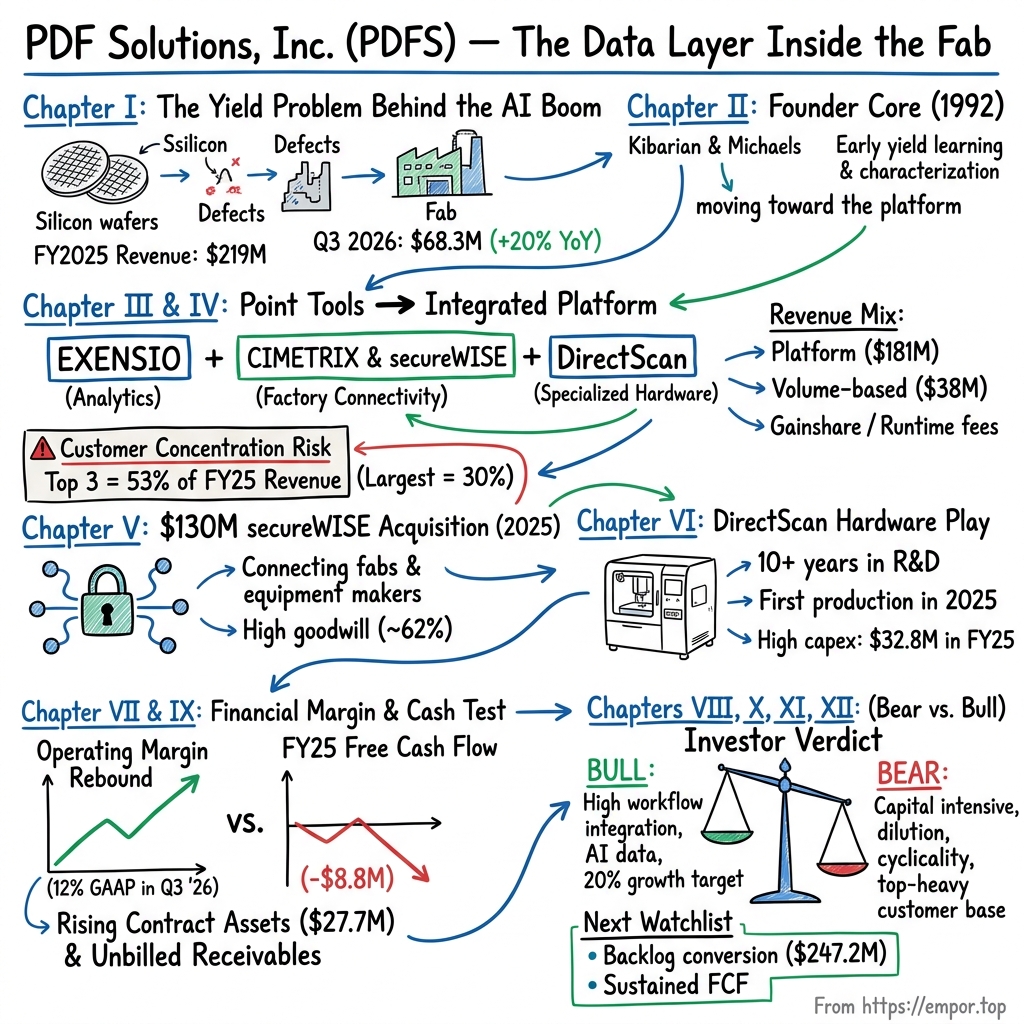
PDF Solutions has spent more than three decades selling into that gap. Its pitch is that the clues to a yield problem already exist inside the factory, scattered across equipment logs, inline measurements, wafer maps, test results and production histories, and that the hard part is connecting them fast enough to act. The company sells analytics software called Exensio to analyse that data, connectivity software from its Cimetrix and secureWISE businesses to pull it out of equipment and move it between companies, engineering and characterization services to help customers interpret it, and specialized hardware, the DirectScan e-beam system and its Characterization Vehicle test structures, to generate data that ordinary tools miss.1 It is, in short, trying to be the data layer inside the fab.
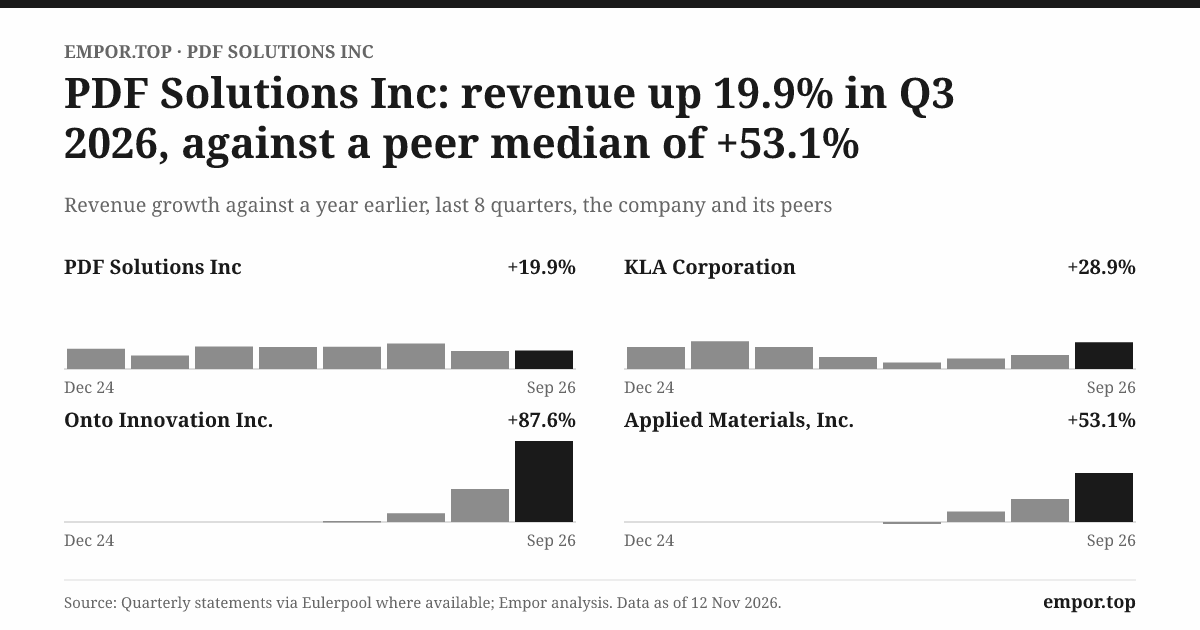
The business has the feel of something that should be riding the semiconductor boom. In FY2025 revenue reached about $219 million, up 22% from the year before.1 In the third quarter of 2026 it hit a record $68.3 million, up 20% from a year earlier, and management reaffirmed its target of 20% growth for the full year.2 Those are real numbers for a company that spent much of the previous decade growing slowly or not at all.
Then come the complications, and they arrive almost immediately. Three customers supplied 53% of FY2025 revenue, and the largest of them alone accounted for 30%.1 The company does not name them. A business with that profile is less a broad software franchise than a specialist whose fortunes ride on a handful of relationships, each of which can expand, pause or renegotiate.
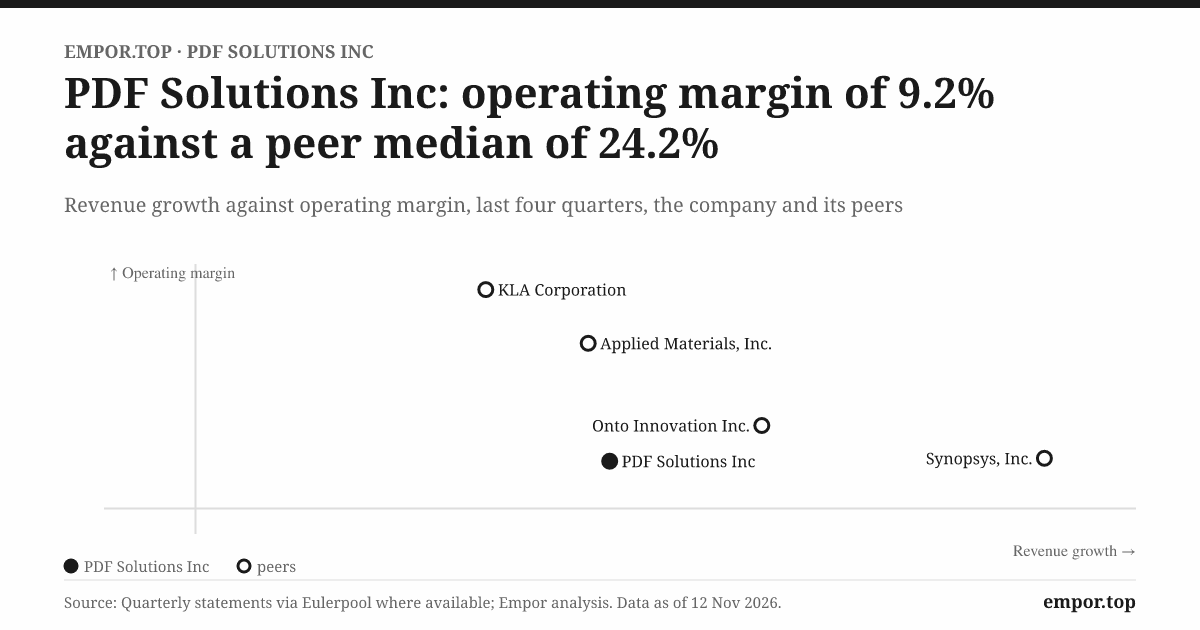
The second complication is profit. For all that growth, FY2025 ended with operating profit of only $5.8 million, a 2.7% margin, and a small net loss.1 The first nine months of 2026 looked very different, with operating margin of roughly 10% and net income of $15.9 million.2 Something changed, and part of the work of this story is working out what.
The third complication is cash. Over the past dozen years PDF Solutions has generated far more operating cash than its accounting profits would suggest, yet much of that cash has gone back into equipment, acquisitions and employee equity rather than into anything an owner could take home. In FY2025 the company spent more on capital equipment than its operations generated, leaving free cash flow negative.1
So the questions that frame this story are simple to state and hard to answer. Does the bundle of software, connectivity, engineering and hardware create a position customers cannot easily replace? Can growth finally convert into free cash after the equipment investment and the stock compensation that pays its engineers? And can management make its recent acquisitions and its long-gestating hardware earn back what they cost? The yield problem is real, and chipmakers will pay to solve it. Whether PDF Solutions captures enough of that value, consistently, is the open question. The answer starts with two engineers who decided, at the beginning of the 1990s, that yield was a business.
 Subscribe on LinkedIn
II. The Founders Build Around Yield
In the early 1990s, making chips was getting harder in a way that worried even the people who were best at it. Every new generation shrank transistors and wires, and every shrink multiplied the ways a process could go wrong. A defect that would have been harmless at one geometry became fatal at the next. Fabs that had once learned their processes through experience and intuition now needed something more systematic: a way to design test structures, measure what failed, model why, and feed the answer back into both the process and the chip design.
John Kibarian and Kimon Michaels were trained for exactly that problem. Both earned graduate degrees in electrical and computer engineering at Carnegie Mellon University, one of the few places where yield modelling was treated as a serious research discipline rather than a factory-floor craft.3 Kibarian has been the company's president and chief executive since 1991; Michaels, a co-founder, has served on the board and as an executive in charge of products and solutions for most of the company's life.3 PDF Solutions traces its founding to 1992.4 Thirty-four years later, both men are still there, which is unusual enough in Silicon Valley to be a story in itself.
The early company sold expertise more than software. Its engineers designed Characterization Vehicles, specially built test chips laden with structures that could reveal how a given process behaved, and combined them with analysis to help fabs climb the yield curve faster.4 Some of those engagements were paid partly through Gainshare, a fee tied to the customer's subsequent production, which meant PDF Solutions shared in the upside of the improvements it helped create.4 It was a clever model for a small firm with scarce, specialized knowledge: rather than argue about the value of its advice up front, it could bet on its own results. The company listed on Nasdaq in 2001.5
That model produced a profitable business for a time. In FY2014 revenue was about $100 million and operating margin was nearly 28%, the kind of profitability most small software companies only dream about.1 But the Gainshare stream had a weakness built into its design: it depended on specific customers producing large volumes on specific process nodes. When those nodes matured and volumes moved on, the royalties faded, and revenue stalled for years. By FY2018 revenue had fallen to about $85 million and the company was losing money.1
The response began before the decline became obvious. Around 2013 and 2014, management turned toward two bets that still define the company. The first was an e-beam inspection and characterization effort, a way to measure electrical behaviour on production wafers directly inside the fab rather than relying solely on test chips.6 That effort became the DirectScan platform. The second was a rebuild of the company's collection of point software tools into one analytics platform, Exensio, designed to ingest data from across the manufacturing chain rather than solve one narrow problem at a time.6
It is worth pausing on why the platform rebuild mattered. A point tool is like a specialist doctor who sees one organ. Useful, but the patient's real problem may sit somewhere between organs, in the interaction between a deposition step on Tuesday and a test failure three weeks later. A platform that links equipment data, measurements and test results is closer to a medical record that every specialist can read. The ambition PDF Solutions has carried ever since is to own that record: to be the place where a fab's data comes together, rather than one of many tools that touch a fragment of it.
The ambition was coherent. The execution took a long time, and that delay is the historical test this story has to keep applying. DirectScan was conceived as a growth engine in the middle of the last decade. The company reported its first production-fab users only in 2025, when two systems shipped to a customer's manufacturing site where the customer was using them to improve yields.7 For roughly a decade, the e-beam effort was a research and development story, consuming engineering and capital while the core business struggled to grow.
Revenue did eventually recover, reaching $219 million in FY2025, a little more than twice the FY2014 level.1 The founders' focus on manufacturing data has been consistent across all of it, through the Gainshare era, the lean years and the platform era. That consistency is a genuine strategic asset: few competitors have spent three decades accumulating process knowledge across so many fabs. But domain experience is not the same thing as a defensible position. A long history in yield proves the company understands the problem. It does not, on its own, prove that customers cannot buy a competing tool or build one in-house. To judge that, the story has to go inside the product itself and watch how a customer actually uses it.
III. From Point Tools to an Integrated Platform
Imagine the yield team at a large chipmaker on a Monday morning. A product that ramped smoothly for months has started losing a few points of yield. The equipment engineers have their own logs from the tools, kept in one system. The metrology team has thickness and overlay measurements in another. The test floor has wafer maps showing which dies failed and how. The production-control group knows which lots went through which chambers on which days. Each data set is owned by a different team, stored in a different format, and sometimes sitting in a different company altogether, because the equipment maker, the foundry and the fabless designer may each hold a piece of the picture. Finding the cause means stitching all of it together, by hand if necessary.
That stitching is the job PDF Solutions wants to own. Exensio is the analytics layer, the software that ingests the data, aligns it by wafer, lot and time, and lets engineers search for correlations and root causes.1 Cimetrix supplies the connectivity software that equipment makers embed in their tools so the tools can speak the industry's data standards and stream information to the factory.1 secureWISE, acquired in 2025, provides secure remote connections that let equipment suppliers access and service their tools inside customers' fabs, a sensitive capability because fabs guard their data jealously.1 Engineering and characterization services help customers set the system up and interpret what it shows. And DirectScan, together with the Characterization Vehicle test structures, adds data the factory's ordinary tools do not generate, especially fine-grained electrical measurements taken during production.1
The pitch, in plain terms, is a set of pipes and a brain. The pipes pull data out of equipment and move it across company boundaries; the brain makes sense of it. Each piece is sold on its own, but the company's argument is that together they become more valuable, because data that already flows through PDF Solutions' connectors is cheaper and faster to analyse in PDF Solutions' software.
The company reports its revenue in two buckets that roughly map onto how customers pay. Platform revenue, about $181 million in FY2025 and up 15%, includes software licenses, support, SaaS subscriptions, engineering services and hardware.7 Volume-based revenue, about $38 million and up 70%, includes Cimetrix runtime licenses paid as equipment ships, secureWISE data-transmission fees, and Gainshare tied to customer production.7 The faster-growing bucket gets the attention, but it is worth keeping proportion: platform revenue is nearly five times larger and remains the core of the business. The volume bucket also includes the newly acquired secureWISE, so some of that 70% growth was bought rather than grown.
Management likes to talk about recurring revenue, and the figure sounds reassuring: 94% of FY2025 revenue, by the company's measure.1 The definition deserves a careful look. It includes revenue that recurs, or has recurred in the past, and that explicitly includes volume-based fees.1 A runtime license paid each time an equipment maker ships a tool recurs only as long as tools keep shipping; a Gainshare fee recurs only as long as the customer keeps producing. That is habit, not contract. The number tells investors that most revenue comes from customers and arrangements that have paid before. It does not tell them how much is locked in by multi-year commitments the way a conventional subscription business would mean the term. The fluctuation in the number itself is a hint: the company reported 81% recurring in FY2024 and 95% in FY2023, a swing that a truly contracted base would not show.1
Backlog, which the company reports as remaining performance obligations, offers a firmer anchor. It stood at $254.2 million at the end of FY2025 and $247.2 million at the end of September 2026, against trailing annual revenue of about $251 million.1[^8] Most of it is expected to convert within two years. But the measure excludes contracts without firm customer commitments and certain usage-based fees, which means the fastest-growing revenue streams are partly invisible in it.[^8] Backlog is therefore a floor on contracted work, not a forecast of total revenue, and its recent direction will matter when the story reaches the epilogue.
Why might customers stay? The plausible mechanism is integration. Once a fab has wired its tools to stream data through Cimetrix, built its engineering workflows inside Exensio and accumulated years of correlated history in the system, replacing the vendor means rewiring equipment, retraining engineers and losing continuity in the data. Process knowledge compounds the effect: PDF Solutions' engineers have seen problems across many fabs, and that pattern library is hard to replicate. These are real switching costs in principle. The difficulty is that the company does not publish the evidence that would prove them: no customer retention rates, no net revenue retention, no win rates in competitive bids, no customer-level return on investment.1 The moat is plausible, and it is described well, but it is not measured.
The competitive set is broad. The company's own filings name large electronic-design and software vendors, semiconductor equipment and inspection companies, specialist analytics providers, and, perhaps most importantly, customers' own engineering teams, which can and do build internal systems.1 KLA, the inspection and process-control giant, and Synopsys, the design-software leader, are useful reference points because each touches parts of the same data problem. But both are many times larger and sell very different product mixes, so neither is a clean comparison, and no reliable market-share measure for PDF Solutions' specific niches is published. The honest picture is a specialist with deep roots in a valuable workflow, competing against giants on one side and customers' in-house teams on the other.
If the platform does deepen its role in customer operations, the clearest sign should be in how customers pay. That is where the story's most interesting recent change has taken place, as more of PDF Solutions' income began to move with the data flowing through it.
IV. When Customers Started Paying by the Data Flow
There is a moment in every equipment maker's shipping dock that matters to PDF Solutions even though no one from PDF Solutions is in the room. A newly built tool, an etcher or a deposition chamber worth millions of dollars, gets crated and loaded for a fab in Taiwan, Korea, Arizona or Japan. Inside its control software sits a Cimetrix connectivity module. When that tool ships, a runtime license fee is due.1 When it reaches the fab and the equipment maker needs to reach it remotely through secureWISE, data begins to flow and fees accrue.8 And when the fab producing on a process PDF Solutions helped characterize ramps its output, a Gainshare fee may follow.1 None of those payments requires a new sale. They move with the activity of the industry.
That is a different business from the one PDF Solutions ran in its middle years, when much of its revenue came from projects, licenses and services sold one engagement at a time. Over the past decade the mix has shifted toward subscriptions, runtime licenses, data fees and a revived form of Gainshare, which gives the company a way to participate in customer production rather than simply sell tools to it.1 The volume-based bucket reached about $38 million in FY2025, growing 70%.7 On the Q4 2025 call, management attributed part of that growth to Gainshare and record Cimetrix runtime licenses, alongside the newly acquired secureWISE, though it declined to break out the acquisition's contribution.7
Gainshare is the most distinctive piece and the one most often misunderstood. It is not a subscription. The fee varies with the customer's manufacturing outcomes or volumes, so if the customer's production of a given product rises, so does the fee, and if production falls, the fee falls with it.1 The auditor flagged Gainshare accruals as part of a critical audit matter on revenue recognition, because the company must estimate amounts owed before customers report final figures.1 That is not an accusation of anything improper; it is a reminder that this revenue involves judgment, and that the estimates can move.
The opportunity is obvious. If a customer's AI-driven production surge flows through PDF Solutions' connectors and royalty arrangements, the company participates without having to win a new deal. The risk is the mirror image. Volume-based revenue is, by construction, exposed to the semiconductor cycle and to the production decisions of a few customers. The third quarter of 2026 provided a small demonstration: volume-based revenue was about $10 million, down 19% from the second quarter and up only 10% from a year earlier, after growing 45% year over year in the second quarter.98 One quarter does not make a trend, but it shows how quickly this stream can decelerate.
Then there is concentration, which may be the single most important fact about the business. In FY2025 three customers supplied 53% of revenue: the largest 30%, the next two 13% and 10%.1 The largest customer's share has swung widely, from 35% in FY2023 to 19% in FY2024 and back up to 30% in FY2025.1 Those swings are not noise. They mean that a single customer's project timing, node decisions or contract renewal can move the company's growth rate by many percentage points. The third-quarter geographic split makes the same point from another angle: revenue from Japan jumped to $21.7 million, about a third of the quarter's total, from $6.6 million in the second quarter.9 The company does not name the customer behind that jump, but a $15 million regional swing in a single quarter, for a company with $68 million of quarterly revenue, is a reminder of how lumpy concentrated revenue can be.
The SMIC dispute shows what can happen when one of those relationships breaks. 中芯国际 SMIC, the Chinese foundry, stopped paying fees to PDF Solutions in 2019, and the matter has spent the years since in arbitration and court proceedings.1 The company won a confidential arbitration award in November 2025, but SMIC has challenged it and no proceeds have been booked.[^8] Whatever the eventual outcome, the episode demonstrates that a fee stream tied to a customer's production is only as reliable as the customer's willingness to keep paying it.
The analytical temptation is to read repeat data flows and deep integration as pricing power. They are not the same thing. Stickiness means a customer is unlikely to leave; pricing power means the vendor can raise prices without losing it. A large chipmaker with 30% of a vendor's revenue holds significant leverage in any negotiation, whatever the switching costs. The company does not quantify renewals, lost bids, price increases or whether its biggest customers also use competing tools in parallel.1 Installed presence is established. Pricing power is unproven.
What would strengthen the case? Three pieces of evidence, all visible in future filings. First, a gradual fall in the top customers' share of revenue, showing that growth is broadening rather than deepening dependence. Second, continued growth in platform revenue, the larger and more contracted pool, at or above the company's overall rate; in the third quarter of 2026 it grew 22% year over year, which is encouraging.9 Third, volume-based fees that persist and grow through a full industry cycle rather than spiking with a temporary production surge. Until those signals accumulate, the shift toward paying by the data flow is best read as broader participation in the industry, with all of the industry's cyclicality attached. And the biggest single bet on that data-flow future was not built inside the company. It was bought.
V. The $130 Million Bet on secureWISE
In February 2025, PDF Solutions announced the largest acquisition in its history: secureWISE, bought from Telit Cinterion for $130 million in cash.10 The deal closed in March.1 For a company whose annual revenue was then running below $200 million, it was an enormous check, and to write it, PDF Solutions did something it had not done in years: it borrowed. Of the purchase price, about $70 million came from new bank debt and the rest from cash on the balance sheet.7 The company that had spent most of the previous decade with almost no borrowings ended FY2025 with about $77 million of debt.1
The logic is easiest to understand from the inside of a fab. When an advanced etching tool misbehaves, the fastest fix often comes from the engineers who built it, sitting thousands of miles away. But a fab cannot simply open its network to outsiders; its process recipes and production data are among the most valuable secrets in the industry. secureWISE provides a controlled, audited connection between supplier and factory.10 Management's argument was that this corridor, already installed across a large share of the world's advanced fabs, could become a highway for much more than service calls: equipment data, analytics and, eventually, the collaboration between equipment makers, fabs and fabless designers that Exensio is meant to support.10
On paper, the fit is strong. Cimetrix gets data out of equipment; secureWISE moves it securely between companies; Exensio analyses it. On the Q4 2025 call, management described concrete integration steps: bundling secureWISE with the Cimetrix software kit, connecting it to the company's data-exchange network for assembly and test contractors, and extending it toward fabless customers.7 It also cited an eight-figure contract with a leading equipment supplier.7 By the second quarter of 2026, Kibarian described a renewal with an existing equipment customer as the largest in secureWISE's history, covering that customer's 300-millimetre fabs for several years, and said the business could grow at least as fast as the company overall.8
Now the harder part: was the price right? The purchase accounting gives one clue. Of the $130 million, about $80 million, roughly 62%, was recorded as goodwill, with the rest assigned largely to customer relationships and developed technology.[^8] Goodwill is the accountant's word for the part of a purchase price that cannot be pinned to identifiable assets; it is, in effect, the premium paid for future growth and synergies. A high goodwill share is not proof of overpayment, and it is common in software deals. But it raises the bar, because unlike a machine or a customer contract, goodwill only earns its keep if the combined business produces more than the parts would alone. The company also spent about $5.4 million on acquisition and integration costs.1
What PDF Solutions has not done is tell investors what secureWISE earns. The company does not disclose the acquired business's standalone revenue or profit, and it describes pro forma results as not material.1 When management was asked on the Q4 2025 call to separate secureWISE from organic growth, the CFO said the business was not broken out.7 At the time of the deal, management said it expected the purchase to be slightly accretive to earnings per share in 2025 and more so in 2026 and beyond.10 That expectation cannot be tested from the outside. The volume-based revenue line, which includes secureWISE, grew sharply, but so did Gainshare and Cimetrix runtime licenses, and the filings do not isolate any of them.7
This is a familiar pattern for PDF Solutions. The company has spent years assembling its platform through a combination of internal development and acquisitions, including Cimetrix, the equipment-connectivity software maker bought in 2020.4 The strategic theme behind those deals is coherent and has stayed consistent: get closer to the data at its source, then make it useful. But the company does not report the returns of individual acquisitions consistently enough to claim a proven acquisition record. Cimetrix appears to have become a real contributor, given management's repeated references to record runtime licenses.7 Whether secureWISE does the same, at a price that makes sense, is not yet visible.
A skeptical investor would put three questions to management. How much incremental revenue and gross profit can be attributed to secureWISE since it closed? How much of the platform's expansion over the past eighteen months is organic? And what cash return, after the cost of the debt used to fund it, has the deal produced? None of these is unanswerable; the company simply has not chosen to answer them. The secureWISE purchase may prove to be the move that turned PDF Solutions from an analytics vendor into a network spanning the industry. It is also the company's largest capital commitment ever, made with borrowed money and justified largely by strategic fit. Its counterpart on the hardware side, DirectScan, was the opposite kind of bet: built, not bought, and a very long time in the making.
VI. The Hardware That Took a Decade to Reach Production
The first production deployment came in the second half of 2025, with two e-beam machines at a customer's manufacturing site.7 For PDF Solutions, it was the moment the hardware effort it had begun more than a decade earlier finally crossed from engineering milestone into the factory proper. In all, four DirectScan systems shipped during 2025, bringing the installed base to six.7
To understand why anyone would put that much effort into a machine, it helps to understand the blind spot it is meant to cover. Most inline inspection in a fab is optical or physical: tools look for particles, scratches and pattern defects, or measure film thicknesses and line widths. Those measurements reveal whether something looks wrong. They do not reveal whether a given transistor or contact will actually work electrically, which is usually discovered only at the end of the line, weeks later, when the chip is tested. DirectScan uses an electron beam to probe purpose-built test structures on production wafers while they are still being made, giving the fab an early electrical reading.1 The analogy is a doctor who can take a blood test during surgery rather than waiting for the patient to recover. As processes grow more complex, with transistors stacked in three dimensions and new materials at every layer, catching electrical failures early becomes more valuable, and DirectScan's data feeds straight into Exensio.
The momentum continued into 2026. The company placed one machine in the first quarter and three more in the second, two of them at new customers and one at a new factory of an existing customer, which management said left it two-thirds of the way to its goal for the year.8 On the Q4 2025 call, Kibarian had said the company expected to nearly double the number of machines in the field during 2026.7 And in the second quarter, PDF Solutions signed an eight-figure, five-year DirectScan contract with a mature-node customer, a sign that the market might extend beyond the leading edge.8
Those are genuine steps. They are also, so far, steps of a particular kind. A shipment is not a production deployment; a production deployment is not a repeat order; and a repeat order is not proof of attractive recurring economics. Asked on the Q2 2026 call how long it takes for an evaluation to convert into contracted revenue, Kibarian said it typically takes close to a year and declined to speculate on timing.8 Asked about visibility into 2027, he said customer discussions were ongoing and that the company planned to communicate production targets later in 2026.8 The honest reading is that DirectScan has a growing number of machines in the field and at least one long-term contract, but the company does not disclose utilization, revenue per system or the rate at which pilots become repeat customers.
Meanwhile, the bill has grown. Increasingly, PDF Solutions places the machines with customers under subscription-style arrangements rather than selling them outright, which means it owns the hardware and records it as capital spending.7 Capital spending, including equipment prepayments, rose from about $17.8 million in FY2024 to about $32.8 million in FY2025, roughly 15% of revenue, which is an unusual burden for a business that describes itself largely as software.1 Management attributed most of it to DirectScan systems and said 2026 spending would be roughly similar.7 In practice it ran higher: capital spending reached about $39.7 million in the first nine months of 2026, against $23.1 million in the same period a year earlier.9 Research and development, meanwhile, reached $64.2 million in FY2025, about 29% of revenue, and R&D headcount rose from 189 to 225 people during the year.1
The subscription model has a logic: it lowers the barrier for customers to adopt a new tool and, if the machines are used, should produce a stream of recurring fees over several years. But it also moves the risk onto PDF Solutions' balance sheet. If a machine sits underused, the company has bought an expensive piece of equipment that earns little. The economics depend on utilization and renewal, and neither is disclosed.
History argues for proportion here. That long path was accompanied by a collapse in the company's operating margin from its Gainshare-era highs. That record does not mean the product will fail; long development cycles are normal for semiconductor equipment, and the recent momentum is real. It does mean that technical milestones at PDF Solutions have historically converted to revenue slowly. DirectScan could become a meaningful extension of the data layer, giving the company a proprietary data source no pure software rival can match. On the evidence published so far, it is an execution test, not an established earnings driver, and it is not yet large enough to carry the investment thesis on its own. What it is already large enough to do is shape the company's cash flow, which is where the most important question in this story sits.
VII. The Margin Rebound Meets the Cash Test
The third quarter of 2026 was the best PDF Solutions has reported in years. Revenue reached a record $68.3 million. GAAP operating income was $8.3 million, a 12% margin, and net income was $6.8 million, or 16 cents per diluted share.2 For a company that had hovered around break-even for most of the previous decade, those numbers looked like a turning point. Even so, the long arc is what gives them meaning.
From FY2014 to FY2025, revenue a little more than doubled, from about $100 million to $219 million, a compound growth rate of roughly 8.5% a year over the decade to FY2025.1 Over the same span, operating profit fell from $27.8 million to $5.8 million, and operating margin from nearly 28% to under 3%.1 In between, the company lost money at the operating line in every year from FY2018 through FY2024.1 That is the central paradox of PDF Solutions' modern history: it grew the top line through the decade while its operating economics deteriorated. The Gainshare-rich business of 2014 earned high margins on a narrow base; the platform business that replaced it was broader but, for years, far less profitable, because the company was paying for the platform rebuild, the e-beam programme and a larger workforce at the same time.
The first nine months of 2026 show what operating leverage can look like once revenue grows faster than costs. Operating margin for the period was about 10.4%, and GAAP net income reached $15.9 million.2 The improvement is substantial, and it deserves credit. The cost lines tell much of the story: GAAP gross margin was about 71% for the nine months, while operating expenses grew far more slowly than revenue; in the second quarter, for example, they rose only about 5% from a year earlier against 19% revenue growth.98
But investors should be careful about which margin they are looking at. In the third quarter, the GAAP operating margin was 12%; the company's non-GAAP operating margin, which excludes stock-based compensation, amortization of acquired intangibles and certain other costs, was 28%.9 Management's long-term model targets a 27% non-GAAP operating margin alongside 20% growth and 77% gross margin.7 The gap between 12% and 28% is not a technicality. Most of it is stock compensation and the amortization of acquisitions, both real costs to shareholders even though neither involves a cash payment in the period.
Following profit into cash reveals a second paradox. Over the dozen years from FY2014 to FY2025, PDF Solutions generated about $211 million of cash from operations, even though its cumulative net result over the same period was a loss of about $31 million.1 How does a company lose money and still generate cash? Mostly through non-cash charges. Stock-based compensation was $25.9 million in FY2025 alone, and over the years such charges, along with depreciation and amortization, were added back in the cash-flow statement.1 Working-capital swings matter too: operating cash flow rose to $24.1 million in FY2025 from $9.7 million a year earlier, and management credited stronger collections.1
The catch is that operating cash is not owners' cash. After capital spending, free cash flow over those twelve years totalled only about $80 million, and FY2025's was negative, about $8.8 million, because equipment purchases exceeded operating cash flow.1 The same pattern held through the first nine months of 2026: operating cash flow was about $31.8 million and capital spending about $39.7 million, so free cash flow remained negative even in the company's best year of operating profit in more than a decade.9
And stock compensation deserves a moment on its own. Adding it back in the cash-flow statement is correct accounting; the company did not write a cheque. But the shares it issues to employees dilute existing owners just as surely as a cash expense would reduce their returns. A shareholder evaluating PDF Solutions has to treat the roughly $26 million a year of equity compensation as part of the cost of running the business, which is precisely what the non-GAAP measures leave out.
Two further details sharpen the picture of profit quality. For three years running, a line called interest income and other carried a large share of the company's pretax profit: roughly 41% in FY2025, about 86% in FY2024, and more than all of it in FY2023.1 In other words, in those years the interest earned on the cash pile, along with currency effects, did much of the work that the operating business could not. That cushion has since thinned, because the cash went into secureWISE and the company took on debt carrying interest of around 6%.[^8] And the return on the capital the business employs remains low: about 5% over the twelve months to September 2026, on both capital employed and invested capital, a level that barely clears the cost of the company's own borrowings.[^8] The operating rebound is real, but it is rebuilding from a low base.
So has growth finally become profitable, distributable economics? The verdict is that it has become profitable at the operating line, and that is a real change after seven years of losses. It has not yet become distributable. The decisive test will be several consecutive periods of positive free cash flow after DirectScan spending, achieved without the share count growing to pay for it. That test depends less on the market and more on choices made by the people running the company, and the people running the company have been in place for a very long time.
VIII. The CEO's Long Tenure and the New Capital Structure
John Kibarian has been chief executive of PDF Solutions since 1991.3 Thirty-five years in the top job is an extraordinary tenure in any industry, and it shapes how the company behaves. He still holds about 6.4% of the shares; Kimon Michaels, the co-founder who serves on the board and as an executive vice president, holds about 3.9%; and directors and executive officers as a group held about 11% before the 2026 offering.3 Adnan Raza, the chief financial officer, is the most prominent executive who came from outside the founding group.3
The style that comes through on earnings calls is that of an engineer explaining a system. Kibarian talks easily about e-beam physics, connectivity standards and the structure of fab budgets; on the Q4 2025 call, asked about the company's partnership with SAP, he answered by describing how manufacturing-orchestration contracts sit in finance budgets while analytics contracts sit in engineering.7 Raza handles the numbers and is generally concrete about capital spending and guidance. Taken together, the pairing reads as founder-led conviction in the technology and a finance chief tasked with translating it into targets.
Pay is modest at the top and tilted toward adjusted measures. Kibarian's total compensation was about $694,000 in 2025, far below the pay of most technology chief executives and less than half that of his own CFO, whose total was about $1.4 million.3 The incentive plans, however, rewarded revenue and adjusted EBITDA, a profit measure that excludes stock compensation.3 In a year when GAAP net income swung to a small loss, adjusted EBITDA could still look healthy. The founder's ownership aligns him with shareholders far more than his salary does; the broader incentive structure, which applies to the whole executive team, is calibrated on measures that leave out the main cost of dilution.
Governance signals are mixed but not alarming. Six of the eight directors are independent, with Joseph Bronson as lead independent director.3 At the June 2026 annual meeting, the advisory vote on executive pay passed overwhelmingly, with about 31 million votes in favour and only about 100,000 against; the separate proposal to expand the equity plan drew noticeably more resistance, nearly 4.9 million votes against.11 Shareholders, in other words, were relaxed about what executives are paid and more cautious about how many new shares the company can issue.
Then there is Advantest. In 2020 アドバンテスト Advantest, the Japanese test-equipment maker, bought about 3.31 million PDF Solutions shares for $65.2 million and entered commercial agreements with the company, a strategic partnership that brought a major equipment maker onto the shareholder register.1 Related-party revenue from Advantest was meaningful but never dominant: about $8.8 million in FY2025, roughly 4% of revenue.1 In May 2026, Advantest sold its entire stake in a registered offering.12 On the Q2 2026 call, the CFO said the company had helped the investor exit at more than twice its original return.8 With the sale, Advantest ceased to be a related party.[^8]
The same offering changed PDF Solutions' own balance sheet. Alongside Advantest's shares, the company sold about 1.95 million new shares, including the underwriters' option, for net proceeds of about $81.8 million.12 Advantest's secondary sale brought the company nothing; the primary issuance brought in cash and diluted existing holders by roughly 5%. Cash and equivalents rose to about $107 million by September 2026, from $42 million at the end of 2025.[^8] The bank facility, by then a $75 million revolving credit line, of which $45 million was drawn, plus a term loan of a little over $21 million, remained in place with covenants on leverage and fixed-charge coverage that the company reported meeting.[^8] On the Q4 2025 call, Raza had said the priority was to rebuild cash before any large paydown of debt.7
Buybacks, the other lever a company can use to offset dilution, have been small and shrinking. The company repurchased about $6.9 million of stock in FY2024 and only about $244,000 in FY2025, while issuing shares to employees through its equity plans every year.3 There is no dividend and never has been in the period covered here.1 Shareholders in PDF Solutions have been asked to take their return entirely from growth.
Put the whole sequence together and the capital-allocation story of the past two years comes into focus. The company borrowed to buy secureWISE and stepped up capital spending to put DirectScan machines in the field. In May 2026, with the share price well above its 2020 level, it raised equity. Each move can be defended individually. Collectively, they show a management team investing aggressively for growth, funded by debt, dilution and operating cash. That is not reckless, but it is not the profile of a company that has proven it can self-fund its ambitions.
Guidance discipline offers a more favourable data point. In 2024 revenue grew only about 8%, and growth was close to flat for the first half of the year.[^14] In 2025 it accelerated to 22%, in line with management's guidance, which the CFO noted on the Q4 call.7 Management then guided to 20% growth in 2026, reaffirmed it on the Q2 call, and reaffirmed it again in November based on results through the third quarter and the fourth-quarter pipeline.82 Nine-month growth of about 21% suggests the target is within reach. The pattern is a management team that sets one top-line target, repeats it and, so far, has hit it. What it explains less readily is mix. The company does not publish growth by customer, and it does not separate acquired from organic revenue, so investors cannot tell how much of the swing from a stalled 2024 to a 22% 2025 came from execution, how much from a few large customers' timing, and how much from secureWISE.
The analyst questions on recent calls tell a similar story. Analysts from firms including D.A. Davidson, Rosenblatt Securities and Craig-Hallum asked repeatedly about the same few topics: how much of the growth is secureWISE, how many DirectScan machines are in the field and how quickly pilots convert, how capital spending will be phased, and what is driving backlog.78 Management's answers were concrete on machine counts, capex and the growth target, and general on the questions that matter most for returns: secureWISE's standalone contribution, DirectScan conversion timing and the 2027 outlook.78 Customer concentration, the business's most important structural risk, did not come up in either call's question session.78 The founder's long tenure and consistent strategy are real positives. The next credibility test is whether management can explain returns as clearly as it explains technology, and the most immediate place that test applies is on the balance sheet, where some of the revenue already recognized has yet to become cash.
IX. The Unbilled Revenue Question
At the end of September 2026, PDF Solutions' balance sheet carried about $96.9 million of current receivables, money customers owed the company, and roughly $39.5 million of that had not yet even been invoiced.[^8] Another $7.6 million of unbilled receivables sat in the long-term section, not expected to be billed within a year.[^8] And a separate line, contract assets, had jumped from $11.3 million at the end of 2025 to $27.7 million.[^8] For a company with quarterly revenue in the high sixty millions, those are large numbers. They are also, in their way, the quiet centre of the cash question that ended the last chapter.
A short translation helps. Under modern revenue accounting, a company records revenue when it has delivered what it promised, not when it sends the bill. If PDF Solutions completes a phase of an engineering project or delivers software under a multi-year arrangement whose invoices are spread over time, it books the revenue now and records an unbilled receivable: the right to invoice later. A contract asset is a step further removed: revenue recognized where the right to payment still depends on something else happening, such as a milestone or a condition in the contract. Neither is improper. Both mean that revenue has arrived on the income statement before cash has arrived in the bank.
The company explained the rise in contract assets in exactly those terms: revenue was recognized before contingent collection conditions were satisfied, and no impairment was recorded.[^8] The allowance for credit losses stood at about $0.9 million, and write-offs in FY2025 were only about $0.2 million, matching the year's provision.1 On those measures, there is no sign of bad debts.
The long-run collection record is also better than it once was. Receivables equal to about 138 days of revenue at the end of FY2025 sound high for a software company, and they are, but the figure has been much worse: it peaked at about 221 days in FY2018, during the years when revenue was shrinking and disputes like the one with SMIC were starting.1 The FY2025 improvement in operating cash flow, credited to collections, suggests the company can convert these balances when it needs to.1
The reason this deserves attention anyway is concentration. At the end of FY2025, two customers accounted for 64% of gross receivables.1 That means the collection question is not really about hundreds of customers paying on average terms; it is about whether two or three very large relationships pay on schedule. A small allowance makes sense if those customers are large, creditworthy chipmakers, which they almost certainly are. But the SMIC episode is a reminder that even a large and once-valued customer can stop paying, and that the resulting dispute can last years. The company does not publish an ageing table for its receivables, nor does it disclose how much of a given quarter's unbilled balance was later collected.[^8]
There is also a structural reason these balances are larger at PDF Solutions than at a typical software company. Its contracts mix licenses, multi-year services, hardware accepted on delivery and volume fees that customers report after the fact, which means revenue is often recognized on one schedule and invoiced on another.1 Gainshare accruals carry the estimation judgment the auditor flagged as a critical audit matter.1 The long-term unbilled balance, money the company has earned on paper but will not invoice for more than a year, is the clearest example of how far ahead of cash the income statement can run. None of that is unusual for a company selling complex, multi-element arrangements to a few large buyers. It does mean that reported revenue at PDF Solutions is a more judgment-laden number than at a pure subscription business, and that cash collection is the independent check.
Put plainly, this is a monitoring issue rather than an alarm. The balances are explainable, the allowance and write-offs are small, and nothing in the filings suggests impairment. What would settle the matter is the passage of time: unbilled receivables and contract assets that convert to cash over the next few quarters, especially from the concentrated customers behind them, would turn a question into a closed file. Balances that keep rising faster than revenue would turn it into a problem. Those are the lessons a story like this one leaves, and they are worth drawing out before weighing the whole case.
X. Playbook: Business & Investing Lessons
Think back to DirectScan's first production systems and PDF Solutions' secureWISE acquisition. Between those two images sits most of what PDF Solutions has to teach.
The first lesson is that a fab problem can be persistent without a vendor's revenue being predictable. Yield will matter as long as chips are made; every new node, every new packaging technique, every new material makes it harder. PDF Solutions picked a problem that is unlikely to go away. And yet its revenue has swung with the fortunes of a handful of customers, and with Gainshare and runtime fees that rise and fall with production. A problem's persistence says nothing about the stability of any one vendor's share of the solution. Founders who pick a durable problem still have to build a diversified way of getting paid for it.
The second lesson: a first production system is a beginning, not a payback. The DirectScan machines in production are a genuine milestone, the kind that engineering teams celebrate and investor presentations highlight. But the economics of a hardware platform are decided later, by how many systems customers order again, how heavily they use them and how long they keep paying. The investment has bought PDF Solutions the right to find out. It has not yet bought the answer.
The third lesson is that revenue that recurs by habit is not the same as revenue contracted in advance. PDF Solutions' recurring-revenue figure sounds like a subscription business, and it isn't one. It includes usage-based fees, while its backlog excludes much of the same revenue. Investors who borrow a software multiple for revenue that behaves like an industrial royalty are buying the label rather than the cash flow.
The fourth: an acquisition earns its price in cash, not in strategic fit. secureWISE fits the platform, and its renewals suggest real customer commitment. But the company has not told shareholders what the business earns. Strategic coherence is necessary for a good deal. It is not sufficient, and only disclosure can turn a well-told story into a demonstrated return.
The fifth lesson belongs on the wall of any company that pays its engineers in stock: non-cash can still be expensive to owners. Stock compensation remains a substantial cost to shareholders, even when the most-quoted profit measures leave it out. Those five lessons set up the real argument, the one between the investor who sees a platform quietly embedding itself in the world's fabs and the one who sees a talented specialist whose economics never quite catch up with its ambitions.
XI. Analysis & Bear vs. Bull Case
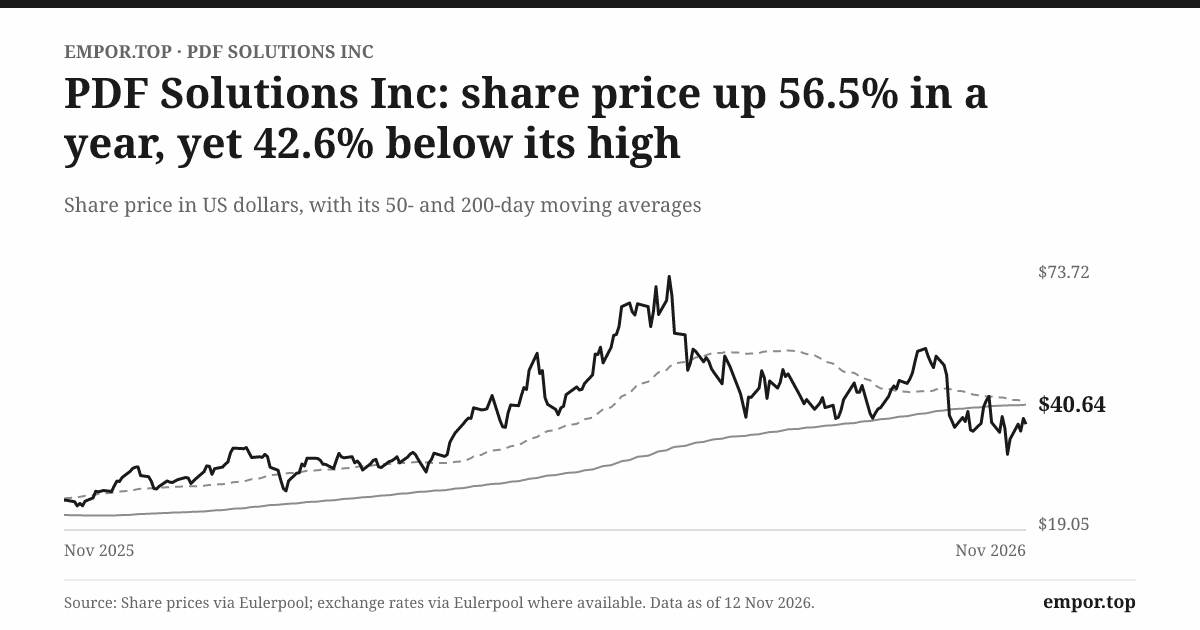
At $40.64 a share on November 12, 2026, PDF Solutions was worth about $1.6 billion, or about 6.4 times its trailing sales.13 The price sat more than 40% below its 52-week high of about $71 and well above its low of about $24, a range that tells its own story about how uncertain investors are.13 On trailing earnings the stock traded at about 178 times, an earnings yield of roughly 0.6%; its enterprise value was about 38 times EBITDA.132 For reference, KLA traded at about 13.6 times sales and 30 times EV to EBITDA, and Synopsys at about 10 times EV to sales and 45 times EV to EBITDA.1415 Neither is a true comparable. Both are far larger, far more profitable and sell very different product mixes. But the comparison does show that the market is paying PDF Solutions a multiple of sales that is lower than those giants' yet still demanding for a company with single-digit GAAP operating margins on a trailing basis and negative free cash flow.
The P/E deserves a particular caution. Its five-year median of about 355 times sounds as though today's 178 times is cheap by comparison, but that median was computed on years when earnings were close to zero, which inflates any ratio built on them. A historical median of a distorted ratio is not a floor. The real question embedded in the valuation is whether operating margins will keep expanding toward management's long-term target and whether that expansion will finally show up as free cash.
Where the Walls Hold and Where They Give
The best way to judge the competitive position is through the forces that act on it. Start with buyers. PDF Solutions sells to some of the most powerful companies in the world, chipmakers and equipment makers with enormous engineering budgets and purchasing departments to match. When three of them supply more than half your revenue, buyer power is not a theoretical concern; it is the defining feature of the market. Each renewal is a negotiation with a customer who knows exactly how much it matters to you.
Substitutes are the second pressure. The company's own filings name customers' internal engineering teams as competitors, and the largest fabs have the resources to build analytics systems in-house.1 Larger vendors, including design-software and process-control companies, sell adjacent tools and can bundle them.1 The arrival of AI makes this pressure more acute rather than less: as general-purpose machine-learning tools improve, the cost for a sophisticated customer to build its own analytics falls. PDF Solutions' response, products like Exensio Studio AI, built on source code licensed from Intel, and Exensio Aurora, announced in September 2026 as a platform for petabyte-scale manufacturing data and agentic AI, is strategically sensible.79 Product announcements are not yet evidence of separately material revenue, and the company does not report them as a distinct line.
Rivalry and new entrants are moderate. The niches PDF Solutions occupies, equipment connectivity, secure remote access, yield analytics and e-beam electrical characterization, are specialized, and building credibility inside fabs takes years. That favours incumbents. Supplier power is low for the software but more relevant for hardware, though the company discloses no supplier concentration.1
Now Hamilton Helmer's lens, which asks what kind of durable power, if any, the business has. The most credible is switching costs: integration into tool software, factory workflows and accumulated data histories make it expensive for a customer to rip out PDF Solutions' systems. A second candidate is a cornered resource of sorts, the company's three decades of process knowledge across many fabs, which shapes the analytics and services in ways a newcomer could not easily reproduce. A third, emerging, is a network effect: if secureWISE and Cimetrix connect equipment makers, fabs and designers on a common platform, each new participant makes the network more useful to the others. That is the boldest form of the bull case, and the one least supported by disclosed evidence. Scale economies, branding and counter-positioning are weak or absent; PDF Solutions is small against its adjacent rivals. And process power, in Helmer's sense of an organization that does things better and cheaper in a way rivals cannot copy, is not demonstrated by the margin history.
The verdict on the moat is that switching costs are real and probably durable, but they have not translated into the pricing power that would show up as high and stable margins. The decade-long collapse in operating margin, while revenue doubled, is the strongest evidence against any claim that the position is unassailable. The moat narrows to this: customers find it hard to leave, but the most important of them are large enough to set terms.
Two Ways the Story Ends
The bull case has a credible mechanism behind it. Revenue grew 20% in the third quarter of 2026 and about 21% for the nine months, and management is on track to meet its 20% target for a second consecutive year.2 Operating margin rose to about 10% for the first nine months, the strongest result in more than a decade.2 Platform revenue, the larger and more contracted pool, grew 22% year over year in the third quarter.9 The product line now spans the data's journey from equipment to factory to design house, with secureWISE adding a footprint across many of the world's 300-millimetre fabs. DirectScan machines are multiplying in the field, and a five-year contract with a mature-node customer suggests the market might extend beyond the leading edge.8 If those trends continue, operating leverage could carry margins toward management's long-term model, and a company with this embedded position could become a cash-generative platform.
The bear case is not that the yield problem disappears. It is that the economics never quite arrive. The long record shows revenue growth without durable operating profit. Free cash flow remained negative through the first nine months of 2026, as capital spending on DirectScan absorbed operating cash.9 Stock compensation remains a substantial cost to shareholders.1 Revenue and receivables are concentrated in a few customers. The company publishes no retention, pricing or market-share data. Backlog has been falling for two consecutive quarters.9 And the largest recent investments, secureWISE and the DirectScan fleet, have not yet been shown to earn their cost.
The material risks sit on top of that structure. Semiconductor investment and production cycles move volume-based fees and the timing of large deals. Top-customer dependence means that a single renewal or node decision can reshape a year. Geopolitics is a live exposure for a business with about 16% of its third-quarter revenue from China, another third from Japan, and with customers, cash and operations in several currencies around the world, in an industry increasingly shaped by export controls.91 Conversion of backlog, unbilled receivables and contract assets is a practical risk to cash. And execution risk runs through both DirectScan and the secureWISE integration.
The SMIC dispute remains unresolved. PDF Solutions won a separate costs award in August 2026; SMIC sought to set the main award aside, a hearing was held in September 2026, and no decision had been reported by the third-quarter filing.[^8] The company has also pursued the matter in U.S. federal court.16 Legal costs spiked to about $2.6 million in the fourth quarter of 2025 and have since fallen to under half a million dollars a quarter.9 No proceeds are booked. The right way to think about it is as a legal cost with a possible recovery, not an asset in any base case.
For an investor trying to track the story through the noise, three measures matter most. The first is platform revenue growth, most recently 22% year over year in the third quarter, because it is the larger, more contracted pool and the best test of whether the platform is broadening.9 The second is whether receivables and contract assets convert to cash.[^8] The third is free cash flow after capital spending and stock compensation, which remained negative through the first nine months of 2026.9 If all three move in the right direction, the bull case will be demonstrating itself. If they do not, growth will be outrunning its economics. Valuation at 6.4 times sales remains demanding even after the fall from the high, and it depends far more on sustained margin and cash conversion than on any return to historical multiples.
XII. Epilogue
Tonight, as the company heads into its year-end, PDF Solutions sits with about $247 million of backlog, a record quarter just behind it, a new analytics architecture launched in September, and a fleet of e-beam machines still needing to prove their return.9 It also sits with a puzzle in its most recent results. Backlog fell from about $271 million at the end of June and from $292 million a year earlier, even as revenue reached a record.9 A company converting backlog into revenue faster than it books new work can post excellent quarters for a while. It cannot do so forever. On the Q2 call, the CFO said management expected to grow backlog as the company exited 2026, which makes the year-end figure a clean, testable promise.8
The first moment that will decide the next chapter is the fourth-quarter report in early 2027. It will show whether the 20% growth target was met, and, just as importantly, how much came from platform revenue versus volume-based fees, which slowed sharply in the third quarter. A target met on the strength of the platform would support the broadening thesis. A target met on a few large upfront deals or a temporary production surge would leave it open.
The second moment is backlog. If the year-end figure rises, as management has said it expects, the third-quarter dip will look like timing. If it continues to fall, investors will have to ask whether 2026's growth is borrowing from 2027.
The third is cash. The company ended September with about $107 million of cash after the May offering, and about $66 million of debt principal.[^8]9 Management has said it expects operating cash flow to increase and capital spending to stay elevated.78 A year in which free cash flow finally turns positive, without another share sale, would answer the story's hardest question. Another year of negative free cash flow would leave it hanging, and the dilution from the May offering would start to look less like opportunism and more like necessity.
Then there are the slower-moving tests. DirectScan should be judged by repeat deployments and utilization, not systems shipped; management has promised to say more about 2027 production targets.8 secureWISE should be judged by cross-selling and by whether the company ever chooses to disclose its contribution against the $130 million it paid. And the share count should be watched alongside stock compensation, because a company that grows its revenue and its share count at similar rates has only grown for its employees.
Each of those moments maps onto the same central question. PDF Solutions has proven it can grow. It has proven it can turn growth into operating profit. It has not yet proven it can turn operating profit into free cash at a scale that rewards its owners for a decade of patience. The next chapters should be judged by conversion, not announcements: backlog into revenue, revenue into cash, and machines in the field into repeat business. The tension that remains is whether a company built by engineers to make other people's factories more productive can make its own economics as efficient as the yields it promises.
XIII. Outro
Go back to the fab at three in the morning. The robots are still gliding overhead. The chamber that drifted out of tune has been caught, this time, by a correlation that surfaced in software after data streamed out of the tool through a connector, was routed securely to the equipment maker's engineers and was matched against an electrical reading taken by an e-beam on the wafer itself. Every part of that chain is something PDF Solutions sells. That is the company's unusual proposition: a software and data business whose products are judged not on screens but inside factories, where hardware, process physics and a customer's production plans decide what it earns.
It is unlike a conventional software company because it cannot escape the physical world it serves. Its fees move with tool shipments and wafer starts, its hardware sits on its own balance sheet, and its biggest customers are among the most demanding buyers on earth. The yield problem is real, and it will outlast every product cycle. What remains unresolved is whether PDF Solutions owns enough of the solution to earn durable returns from it, and that verdict, unlike a yield report, is still being written in cash.
References
-
PDF Solutions, Inc. Form 10-K for FY2025 — SEC, 2026-02-24 ↩↩↩↩↩↩↩↩↩↩↩↩↩↩↩↩↩↩↩↩↩↩↩↩↩↩↩↩↩↩↩↩↩↩↩↩↩↩↩↩↩↩↩↩↩↩↩↩↩↩↩↩↩↩↩↩
-
PDF Solutions Reports Third Quarter 2026 Financial Results — PDF Solutions, 2026-11-05 ↩↩↩↩↩↩↩↩
-
PDF Solutions Q4 2025 Earnings Call Transcript — The Motley Fool, 2026-02-12 ↩↩↩↩↩↩↩↩↩↩↩↩↩↩↩↩↩↩↩↩↩↩↩↩↩
-
PDF Solutions Q2 2026 Earnings Call Transcript — Stock Analysis, 2026-08-06 ↩↩↩↩↩↩↩↩↩↩↩↩↩↩↩↩↩
-
Q3 2026 Management Report, Form 8-K Exhibit 99.2 — SEC, 2026-11-05 ↩↩↩↩↩↩↩↩↩↩↩↩↩↩↩↩↩↩
-
Management Summary: secureWISE Acquisition — PDF Solutions, 2025-02-19 ↩↩↩↩
-
2026 Annual Meeting Voting Results, Form 8-K — SEC, 2026-06-16 ↩
-
PDF Solutions v. SMIC Case Docket — U.S. District Court, Northern District of California ↩
 LinkedIn
 WhatsApp
 Reddit
 Hacker News
 Email
 Kindle
 RSS Feed
 Spotify
 Apple Podcasts
 Amazon Music
 Audible
 YouTube