Prestige Consumer Healthcare: The Brands, the Borrowing, and the Bet
The $1.2 Billion Answer to a Shrinking Year
In June 2026, a company whose sales had just shrunk did something most shrinking companies cannot: it bought its biggest brand ever. On June 12, Prestige Consumer Healthcare closed its purchase of Breathe Right, the adhesive nasal strip found on the nightstands of snorers across North America, along with a handful of related over-the-counter brands.1 A few weeks later it closed a second deal, for the Australian skincare business LaCorium Health.2 Together the two purchases cost about $1.2 billion, and nearly all of it was borrowed.2
The timing is what makes the moment worth slowing down for. The fiscal year Prestige had reported only weeks earlier, the twelve months to March 2026, ended with revenue down 4.3% to about $1.09 billion.3 That was not a disaster, since the business still threw off about $246 million of free cash flow that year,3 but it was the clearest signal yet that the brands Prestige already owned were not growing on their own. So the company reached for the tool it has always reached for. It went shopping.
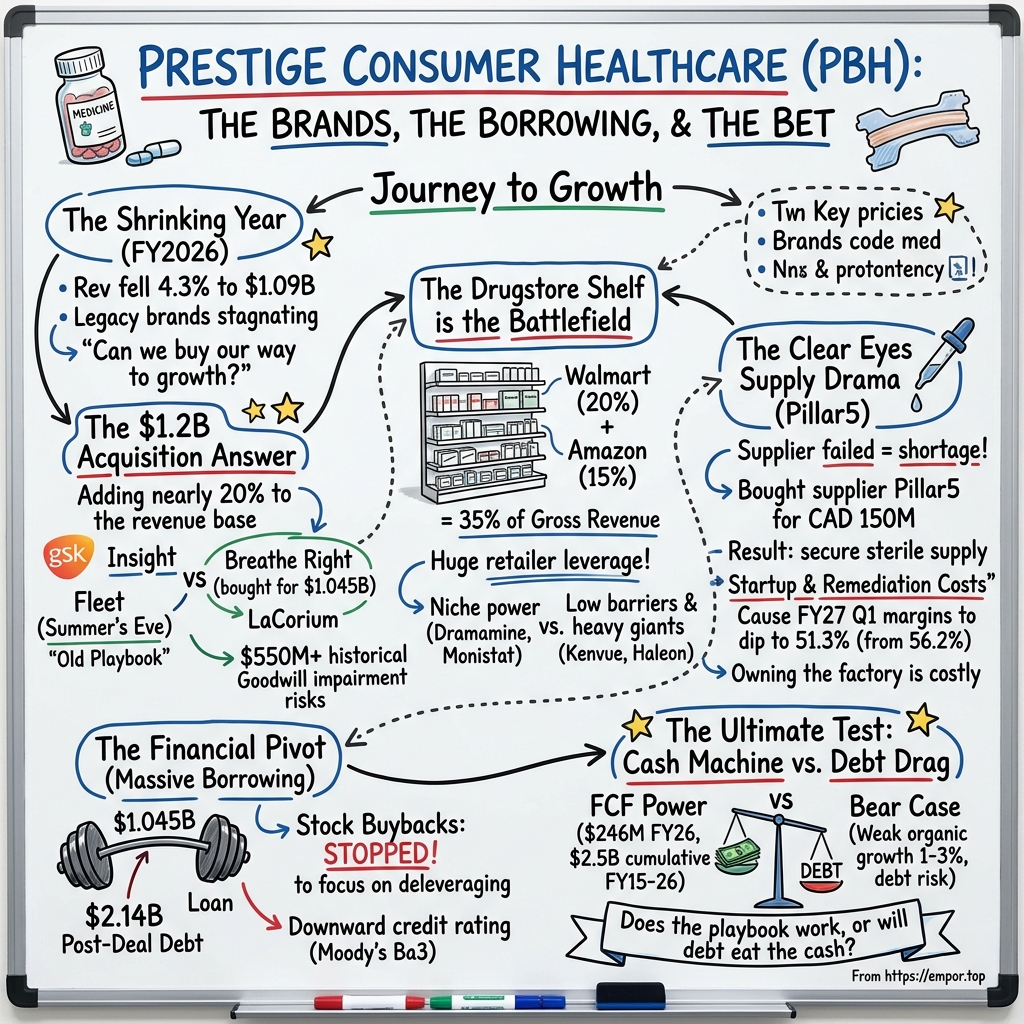
That is the jolt at the center of this story. Prestige's answer to falling sales was to spend about $1.2 billion on new brands, mostly financed with new debt, and to add nearly a fifth to its revenue base in a single summer.[^4] Whether that was a confident move by a disciplined acquirer or an expensive way to paper over an ageing portfolio is the question the next few years will settle.
Four smaller questions sit underneath it, and they will carry the listener through everything that follows. The first is whether the older brands, the Dramamines, Monistats and Clear Eyes of the portfolio, are in structural decline or merely in a bad patch. The second is whether Prestige can fix a supply problem that has kept one of its best-known eye-drop brands off shelves for years, a problem it tried to solve by buying the factory itself. The third is whether the cash the business generates can bring its newly doubled debt back down before something goes wrong. And the fourth is the one that hangs over every consumer brand company in America: how much power do Walmart and Amazon hold over a company that sends them more than a third of its sales?
Before any of that, it helps to see the business at its actual size. Prestige reports two segments, both of them over-the-counter healthcare. North American OTC is the giant, with about $914 million of fiscal 2026 sales, and it supplies most of the company's revenue and gross profit.3 International OTC, built largely around Australia and Canada, contributed about $175 million.3 There is no hidden third business, no software division, no royalty stream. This is a company that buys packaged remedies, markets them, and ships them to retailers.
That simplicity is also why the two revenue stories now in front of investors sit so awkwardly together. The first story is organic: what the brands Prestige already owned did on their own, and in fiscal 2026 that number fell.3 The second is reported: what the company will book once the new acquisitions are inside the walls. Management's outlook for fiscal 2027 calls for organic growth of only 1% to 3%, while reported revenue is expected to rise by nearly 20% once Breathe Right and LaCorium are counted.[^4] Both numbers will be true at the same time. Only one of them tells you whether the machine underneath is getting stronger.
The honest verdict at the outset is this: the deals buy real scale and real cash flow, but they do not answer whether Prestige's legacy portfolio has a durable growth engine. That test begins with the next few quarters of organic results and with whether Clear Eyes comes back to the shelf. To understand why the company keeps answering slow growth with acquisitions, though, you have to go back to how it was built in the first place, because Prestige has always been a company that buys what others stop tending.
 Subscribe on LinkedIn
The Company That Buys Brands Others Stop Tending
Picture the corporate portfolio review at a giant pharmaceutical company. Somewhere on a slide near the back sits a cluster of small, old, perfectly profitable brands: a motion-sickness pill, a cold-sore cream, a laxative your grandparents knew. None of them is large enough to move the parent's share price. None of them earns much attention from the marketing department. They are, in the language of those meetings, non-core. Prestige was built to be the buyer on the other side of that slide.
The company listed on the New York Stock Exchange in February 2005, selling 28 million shares at $16 apiece under its private-equity sponsor, MidOcean Partners, which later sold its entire stake.4 From there the story is a sequence of acquisitions, each one reshaping the portfolio. In 2012 Prestige paid $660 million for a bundle of over-the-counter brands from GlaxoSmithKline.5 In 2014 it paid $750 million for Insight Pharmaceuticals, a deal that brought in women's health products including Monistat.5 Revenue, which had been about $333 million in fiscal 2011, more than doubled to roughly $715 million by fiscal 2015.5
Then came the largest bet of the old era. In January 2017, under a new chief executive, Prestige paid $825 million for C.B. Fleet, the Virginia company behind Summer's Eve feminine care and Fleet enemas.3 The Fleet deal deepened Prestige in women's health and pushed revenue past $1 billion for the first time in fiscal 2018.3 A year and a half later the company moved the other way, selling its household-cleaning business, which carried about $156 million of sales, to narrow the portfolio back toward healthcare.3 It was a statement of identity: Prestige would be a consumer health company and nothing else.
The method behind all this is easy to describe and hard to execute. Prestige buys mature consumer brands, often from owners who have stopped investing in them, and then supplies what those brands were missing: concentrated marketing attention, better retail distribution, and line extensions such as new flavors, formats or pack sizes.3 It is not a laboratory. It does not invent new molecules. It is closer to a skilled restorer of old houses, betting that a fresh coat of paint and a better estate agent will lift the value of a sound structure.
That is the playbook as the company tells it. The record tells a more modest story. Over the ten years from fiscal 2016 to fiscal 2026, revenue grew about 3.0% a year.3 Over the latest five years it grew about 2.9% a year.3 Over the latest three, it shrank about 1.2% a year.3 Strip out the years when a big acquisition landed, and Prestige has never really been a growth company at all. The playbook has built a billion-dollar platform, but the growth mostly came through the front door with a purchase agreement attached.
And the playbook has failures in it. In fiscal 2019, Prestige took impairment charges of more than $200 million, including write-downs on Fleet, the dental-accessory brand DenTek and the denture cleaner Efferdent, with management pointing to brand performance that had fallen short of what had been projected at acquisition.[^7] That year the company reported a net loss.3 Four years later it happened again: in fiscal 2023, impairment charges of more than $300 million pushed Prestige to an operating loss even as revenue reached a record.[^8] Across its history, goodwill and tradename write-downs have exceeded $550 million.3
It is worth being precise about what an impairment is. When Prestige buys a brand, most of the price lands on the balance sheet as an intangible asset, a tradename or goodwill, valued on a forecast of the cash that brand will produce for years to come. If the brand later underperforms that forecast, accountants write the asset down. No cash leaves the building on the day of the charge. The cash left years earlier, when the company paid for a future that did not arrive.
So these were non-cash losses, but they were not costless. They are the ledger's way of admitting that some acquired brands were worth less than Prestige paid. Women's health, the category that Fleet and Monistat built, remains the place where that risk is most concentrated today, which is why the company's auditor singled out the Summer's Eve and Monistat tradenames and the North American Women's Health goodwill for special scrutiny in fiscal 2026.3
That is the test to carry into today's deals. Prestige plainly has a way of buying brands and keeping them profitable. What the record does not yet prove is that it has a repeatable way of reviving them, of turning a neglected trademark into a growing one, rather than sometimes turning an optimistic forecast into a later write-down. The brands themselves, though, are only half of the business. The other half is the shelf they sit on.
The Drugstore Shelf Is the Business
Stand in the motion-sickness section of a big-box store the week before a family road trip. There are a handful of boxes, one of them orange and familiar, Dramamine, and beside it a store-brand alternative with the same active ingredient at a lower price. A parent picks the familiar box because the kids got sick last summer and this one worked. That moment, multiplied across millions of small purchases in wart removal, sore throat, feminine care, eye care and digestive care, is the entire economic engine of Prestige. And the person who decided whether that orange box was on the shelf, how much of it, and whether it was on promotion that week, was not the parent. It was the retailer.
Start with how Prestige actually gets paid. It sells packaged over-the-counter products wholesale to retailers, drug chains, supermarkets, dollar stores and e-commerce platforms, largely on a per-unit invoice basis.3 There are no subscriptions, no multi-year volume commitments, no minimum guarantees.3 The recurring nature of the revenue comes from the consumer, whose upset stomach, dry eyes or sore throat comes back again and again, not from any contract. That is why demand is fairly steady through economic cycles, and also why it wobbles with things Prestige cannot control: a mild flu season, a retailer deciding to hold less inventory, a promotion calendar that shifts.3
The core of that engine is North America. North American OTC produced roughly 84% of fiscal 2026 revenue and about $501 million of gross profit, while International OTC contributed about $175 million of revenue and $95 million of gross profit.3 Gastrointestinal and women's health are the largest product categories the company discloses.3 The international business carries a healthy gross margin, but North America is where the story will be decided.
Put that business beside its competitors and the scale gap is enormous. Prestige's roughly $1.1 billion of revenue is small beside Kenvue, the former Johnson & Johnson consumer health arm, with about $15.1 billion of 2025 revenue.6 It is small beside Haleon, the former GSK consumer business, with roughly £11.0 billion.7 Even Perrigo, best known for store-brand products, reported about $4.3 billion of 2025 net sales.8 These are broad portfolio comparisons, not head-to-head share figures in any single category, but they establish the essential point: Prestige is a niche player in a market dominated by companies ten times its size.
Its defense is to be big in small places. The company identifies leading positions in categories including wart removal, motion sickness, sore throat and adult enemas.3 When Prestige announced the Breathe Right deal, it described the brand as holding about 60% of the U.S. and Canadian nasal-strip market.9 Those are real positions. A brand that owns most of a small aisle can earn attention from a retailer that a fourth-place brand cannot.
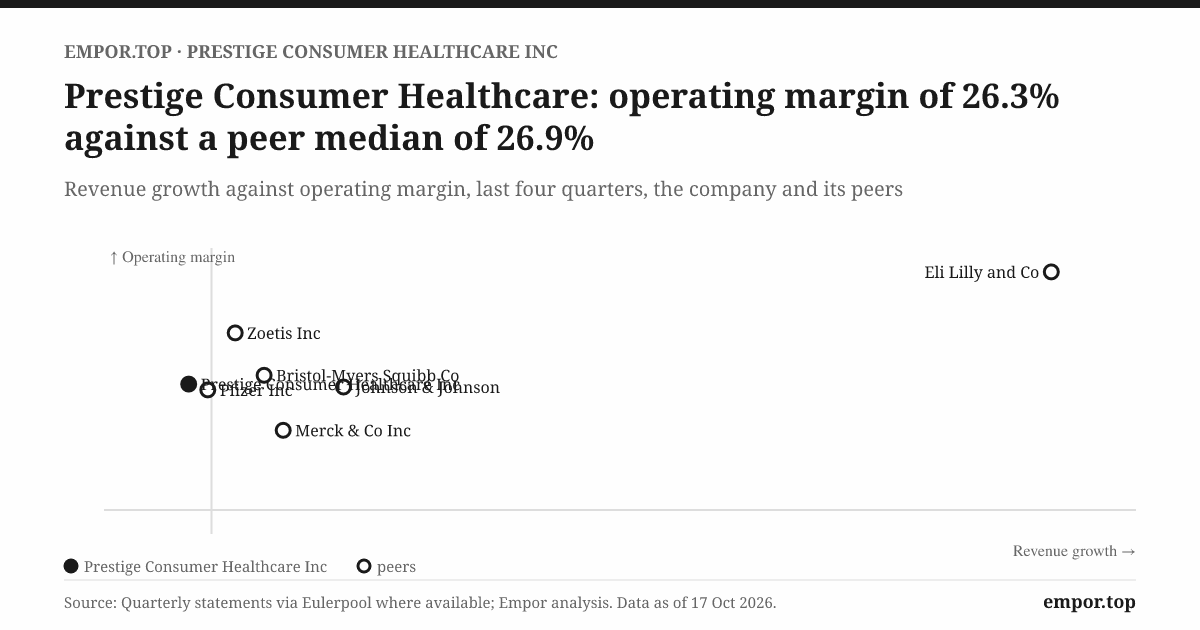
But a category claim is not the same thing as company-wide pricing power. The evidence supports a narrower conclusion: Prestige has strong brands in specific niches, and those brands sustain margins that would be the envy of most packaged-goods companies. The company's operating margin was about 28.4% in fiscal 2026.3 What the evidence does not show is that consumers would follow a Prestige brand anywhere at any price, or that Prestige can push through price increases faster than retailers and store brands push back.
The clearest way to see the limits is a quick walk through the forces that shape the industry. The buyers are the most powerful force by far, and the story will come back to them in a moment. Substitutes are the store brands sitting beside every Prestige product, often made by companies like Perrigo, offering the same active ingredient for less; consumer trust and habit protect the branded box, but only up to a price gap. New entrants can get into many packaged OTC categories cheaply, yet regulatory, quality and distribution requirements raise the bar, especially for sterile products like eye drops. Suppliers matter more than one might think, because where formulations or sterile production rely on scarce qualified capacity, a single contract manufacturer can hold an entire brand hostage. Rivalry among the big branded houses is real but tends to play out in advertising and shelf space rather than price wars.
The supplier point deserves its own moment, because it shapes both the margin and the risk. Historically, Prestige outsourced roughly four-fifths of its product volume to third-party contract manufacturers.10 As of March 2026, after buying the Canadian manufacturer Pillar5, company-owned sites in Virginia, Ontario and Australia produced about 21% of gross revenue, leaving 79% with outside contractors.3 U.S. distribution runs through a single third-party facility in Clayton, Indiana.3
Outsourcing is why Prestige can spend only about 1% of revenue on capital expenditure.3 It does not need to build plants or run production lines for most of what it sells. It pays others to do that and keeps its own money for marketing, which absorbed about $149 million, or roughly 13.7% of revenue, in fiscal 2026.3 The downside is that when a key supplier stumbles, Prestige has very little ability to fix the problem quickly. Clear Eyes, as the story will show, is what that downside looks like.
Now the buyers. Walmart accounted for about 20% of Prestige's fiscal 2026 gross revenue, and Amazon for about 15%.3 Together they represented 18% of the company's receivables at year-end.3 Amazon's share has been climbing fast, from about 11% in fiscal 2024 to 15% two years later.3 Put plainly, more than one dollar in every three Prestige earns passes through two companies, each of which controls its own shelf, its own search rankings, its own promotional calendar and its own payment timetable.
None of this means Prestige's brands lack value. A retailer still wants the brand shoppers ask for by name, and Prestige's margins show that its niche positions are worth something. But the business is not simply a portfolio of trademarks. It is a portfolio of trademarks rented space on someone else's shelf, made in someone else's factory. That is the core tension, and it was never clearer than in the years when the eye drops stopped arriving.
A Supplier Couldn't Keep Clear Eyes on the Shelf
For a stretch of years, shoppers who went looking for Clear Eyes, the redness-relief drops that have been in American medicine cabinets for generations, often found a gap where the bottles should have been. The same was true for TheraTears, Prestige's dry-eye brand.3 The brands were not failing because consumers stopped wanting them. They were failing because the bottles could not be made fast enough.
The causal chain is simple to reconstruct and painful to watch. Sterile ophthalmic production, making eye drops in conditions clean enough to put in a human eye, requires specialized facilities and qualified capacity, and there is not much of it. Prestige relied on an outside manufacturer for these products, and that manufacturer hit capacity limits and production bottlenecks that persisted for years.3 Prestige tried to help the supplier along. It advanced the manufacturer a short-term loan of about $10.3 million.3 The supplier still did not perform, and Prestige ultimately wrote off the entire loan in fiscal 2026.3
That write-off is a small number against a $1 billion revenue base, but it carries a big lesson. A company that thought of itself as a marketer had become, without quite intending to, a lender to its own factory, and then a creditor that did not get paid. The lost Clear Eyes sales, meanwhile, were the larger cost, because every week the shelf was empty was a week in which a shopper could try a rival brand and never come back.
So in August 2025, Prestige made a strategic chess move. It agreed to buy Pillar5 Pharma, the Canadian sterile ophthalmic manufacturer that made Clear Eyes, for CAD 150 million.11 The deal closed in December 2025, at a net cash cost of about $124 million.3 The rationale was not a new growth business. Prestige did not suddenly want to be a contract manufacturer. It wanted control over capacity and quality for products it could not otherwise keep in stock.11
Buying the factory changed the company's shape. Headcount jumped from about 600 people in fiscal 2025 to about 890 by March 2026, with roughly 30% of employees now in Canada, a shift driven mostly by Pillar5.3 A company that had prided itself on being lean and outsourced now ran a sterile plant in Arnprior, Ontario, with all the compliance, staffing and utilization demands that come with it. Pillar5 was even excluded from the fiscal 2026 internal-control assessment, which is normal for a recently acquired business but a reminder that its systems were still new to Prestige.3
The bill for owning the plant
The first full quarter with the plant inside the company showed what control costs. In the quarter ended June 2026, the first of fiscal 2027, Prestige's reported gross margin fell to 51.3% from 56.2% a year earlier, a drop of 490 basis points.[^4] That is a large move for a company whose gross margins had been remarkably steady.
But that headline number mixes three different things, and they need to be separated. Some of it was ordinary purchase accounting: when Prestige bought Breathe Right's inventory, accountants marked it up to fair value, so selling it through the quarter produced an artificially low margin. The reconciliation shows about $2.8 million of that inventory step-up.[^4] A larger piece, about $7.1 million, was remediation, period overhead and idle-capacity costs at the Pillar5 facility, money spent bringing the plant up to standard and carrying it while it ran below full use.[^4] Remove both, and the company's adjusted gross margin was 55.0%.[^4]
That adjusted figure still sits about 120 basis points below the prior year. So the honest reading is not that the decline was all accounting, nor that it was all a crisis. Most of the 490-point drop was transitional, and a smaller, real decline remained underneath it. Operating profit for the quarter fell about 27% from a year earlier, to roughly $53 million, and the operating margin dropped to about 20%.[^4] Even in the bull version of this story, Prestige is paying for its supply fix before it gets the benefit.
Compare the new arrangement with the old one. Under outsourcing, Prestige paid a manufacturer a tolling fee and carried no plant. When the plant failed, Prestige lost sales and, eventually, a loan. Under ownership, Prestige can in theory recapture the manufacturer's margin and guarantee its own supply, but it now carries a fixed-cost facility that must run steadily, pass inspections and be staffed by skilled people. Pillar5 does not change the company's overall model much: most volume still comes from external manufacturers, and the Indiana distribution center remains a single point of logistics.3 It is a targeted fix for one specific vulnerability.
There was also a small but telling personnel moment over the summer. In August 2026, Prestige disclosed that its Senior Vice President of Operations, Jeffrey Zerillo, would retire within days.12 The filing gives no link to Pillar5, and none should be assumed, but it means the operations leadership changed in the middle of the most demanding manufacturing integration in the company's history.
Management's case is that internal control will stabilize Clear Eyes availability, recapture lost market share and lift margins once the plant reaches efficient throughput.13 That is a plausible case, and it is still a case. The proof points are observable: Clear Eyes availability and eye-care category sales, North American gross margin, and whether the remediation line in the reconciliation shrinks quarter by quarter. Until those move, recovery is a promise.
And it was not the only promise Prestige was making in 2026. While the plant was absorbing costs, the company was signing the biggest check in its history.
The Buyback Stopped When the $1.045 Billion Loan Arrived
In March 2026, Prestige announced that it would buy Breathe Right and related OTC brands for $1.045 billion.9 Management framed the deal as a fit with its "disciplined M&A framework,"9 the kind of language every acquirer uses and every investor should test. The deal closed in June.1 In July, Prestige closed a second, smaller purchase: LaCorium Health, an Australian skincare business, for about $150 million.2 Add the Pillar5 plant from the year before, and Prestige had committed well over $1.3 billion across three acquisitions in under a year, against a company whose market value today is about $2.5 billion.
The order matters because the three deals solve different problems. Pillar5 was defensive, a fix for a broken supply chain. Breathe Right was offensive, a large, established category leader that would immediately become the company's biggest brand. LaCorium was a growth option, small but fast-growing, in a market where Prestige already had an international footprint.
What Prestige paid for snoring
Start with the price. At announcement, Prestige said the Breathe Right brands carried about $200 million of revenue and about $95 million of EBITDA.9 Divide the price by that EBITDA and the multiple is about 11.0 times. Prestige also expected roughly $150 million of tax benefits from the deal structure, which lowers the effective price to about $895 million, or about 9.5 times EBITDA.9 That second number is the one management prefers. Both are worth holding, because the tax benefit is real money but arrives over time rather than at closing.
Is 11 times expensive? There is no precise answer, but there is context. A small database of disclosed consumer-health transactions shows a median of about 19 times EBITDA across four deals announced in the preceding five years.14 Against that sample, Breathe Right looks reasonable, even cheap. The caveat is large, though: four deals is a tiny sample, the businesses vary widely in growth and quality, and a brand being sold at a lower multiple may simply be a slower-growing brand. Context, not a fair-value verdict. What can be said is that Prestige did not obviously overpay against comparable deals, and that the purchase is very large relative to Prestige itself.
LaCorium is a different animal. It brought roughly $40 million of revenue, a history of double-digit growth and a skincare platform in Australia.[^18] At about $150 million, the price is meaningful but not transformational. LaCorium is the part of the summer most likely to add organic growth later, and the part least likely to determine the company's fate either way.
Following the money
Now follow the financing, because that is where the real bet lives. On June 12, 2026, Prestige took out a new seven-year term loan of $1.045 billion, priced at the floating SOFR rate plus 2.00%, to pay for Breathe Right.2 It expanded its asset-based revolving facility to $225 million.2 On July 1 it drew a further $95 million under the term facility to help fund LaCorium.2 Two weeks later it issued $400 million of 6.25% senior notes due 2034 and used the money to redeem older 5.125% notes due in 2028.2
The arithmetic is stark. Gross debt rose from $1.0 billion at the end of March 2026 to about $2.05 billion at the end of June and roughly $2.14 billion after the July draw.2 More than half of it now floats with short-term interest rates, and the refinanced fixed notes carry a coupon more than a full point higher than the ones they replaced. The added interest burden runs to more than $65 million a year,2 a cost that comes straight out of the free cash flow Prestige uses to pay down debt.
Prestige expected its bank-defined net leverage to land near 4.0 times on a pro forma basis.9 The credit agencies used their own definitions and saw something closer to five times.15 In May 2026, Moody's lowered Prestige's corporate family rating one notch, to Ba3 from Ba2, citing elevated pro forma leverage; it rated the secured term loan at Ba2 and the unsecured notes at B1.15 S&P affirmed its BB issuer rating with a stable outlook, rated the new secured loan BBB-, and lowered its rating on the unsecured notes to BB-, because those bondholders now stand behind a much larger block of secured bank debt.16
Both agencies also gave Prestige credit for something: its record of paying debt down after earlier acquisitions.15 That record is real. After the Fleet deal, borrowings peaked at about $2.2 billion in fiscal 2017 and fell steadily to about $1.0 billion by fiscal 2026, while debt-to-equity dropped from about 2.7 to about 0.55.3 The company retired hundreds of millions of term loans in fiscal 2024 and 2025 alone.3 The question is whether that playbook works as well when base rates are far above the near-zero levels of the post-Fleet years, and when the business underneath is shrinking organically rather than growing modestly.
The reversal nobody advertised
There is one more thread, and it is the one most likely to irritate a shareholder. In fiscal 2026, Prestige repurchased about $156 million of its own stock, its biggest buyback in years.3 On May 5, 2026, the board authorized another $100 million program.3 Then, with acquisition funding and debt reduction taking priority, repurchases were curtailed.3 Within a matter of months the company went from returning cash to borrowing over a billion dollars. That is not necessarily inconsistent, since Breathe Right may have been the better use of capital, but it does mean the timing of the fiscal 2026 buyback deserves scrutiny, which the story will give it shortly.
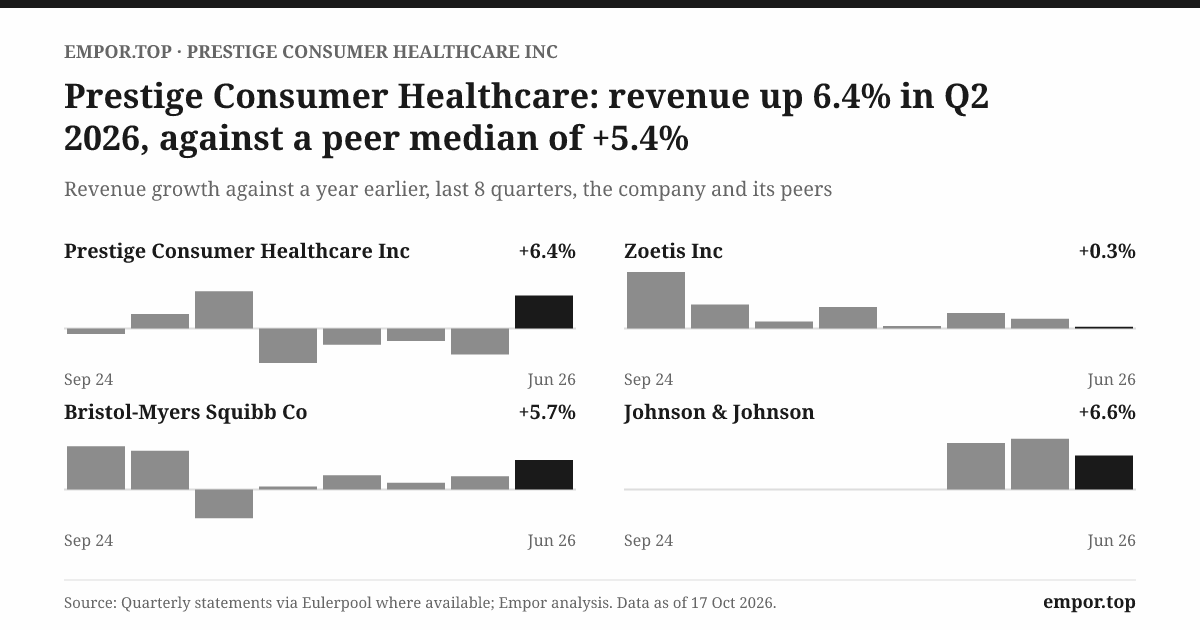
The measurable promise is now on the table. When Prestige reported its first quarter of fiscal 2027, it raised its full-year revenue guidance to between $1.29 billion and $1.315 billion.[^4] The organic growth range stayed at 1% to 3%.[^4] Read those two numbers together and the source of growth is obvious: nearly all of the jump comes from acquired revenue, while the existing business is expected to grow slowly at best. A deal can be accretive to earnings on the day it closes and still destroy value if the debt takes the upside first. Whether it does depends on the thing Prestige has always been good at: turning old brands into cash.
Can Old Brands Finance New Ones?
In fiscal 2026, Prestige reported falling revenue and still generated about $246 million of free cash flow.3 It spent about $156 million of that buying back stock.3 For a company whose sales were shrinking, it was a strange-looking year: a business in apparent retreat behaving like a cash machine. In a sense, that is exactly what Prestige is.
The pattern holds across more than a decade. From fiscal 2015 through fiscal 2026, Prestige produced about $2.6 billion of operating cash flow, roughly 162% of its cumulative net profit of about $1.6 billion.3 Free cash flow, after its tiny capital spending, came to about $2.5 billion.3 In plain English, for every dollar of profit the company reported, about a dollar sixty arrived in the bank.
The gap has explanations, and they matter. Amortization of acquired intangibles, depreciation, stock-based compensation, and above all the impairment charges reduce reported profit without taking cash out of the business that year.3 When Prestige wrote down Fleet, DenTek and the women's health brands, profit fell but cash did not. That is why cash conversion looks so strong. It is also why strong cash conversion should not be confused with a clean record: those impairments reflect cash spent years earlier on acquisitions that turned out to be worth less. The cash conversion explains the accounting gap. It does not erase the economic cost of failed brand forecasts.
Now trace where the cash went. Over those twelve years Prestige paid no dividends at all.3 And cash on the balance sheet rose by only about $36 million from the start of the period to the end.3 Every other dollar of the $2.5 billion was spent: on acquisitions, on paying down the debt that financed earlier acquisitions, and on buying back shares. Prestige has done this without issuing any new equity in the past decade, financing itself entirely from debt and operating cash.3
That is the self-funding cycle at the heart of the company: borrow to buy brands, use the brands' cash to pay off the borrowing, repeat. It works as long as the brands keep producing cash and the purchase prices are sensible. It stops working if the brands decay faster than the debt falls, or if the next purchase is bought at a price the cash cannot support.
The buyback at $67
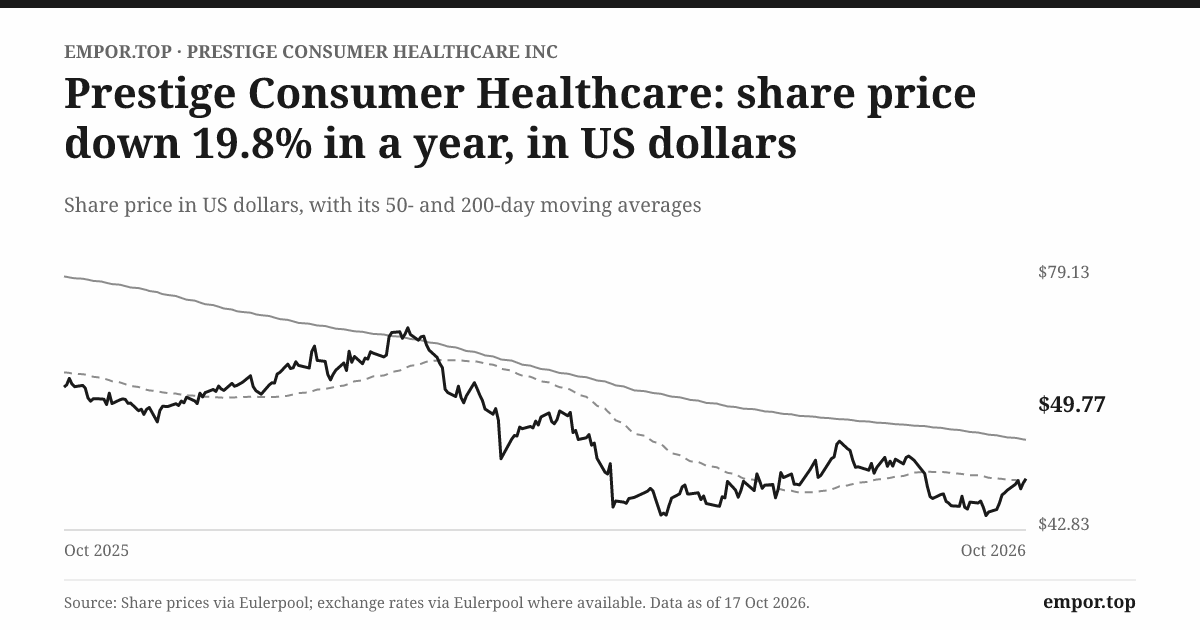
Put the latest buyback under the same scrutiny as the deals. In fiscal 2026, Prestige bought back roughly 2.3 to 2.4 million shares for about $156 million, an average of about $67 a share.3 Today the stock trades at about $50. On paper, that is a loss of roughly a quarter on the money spent, and within months the company was borrowing more than $1 billion. A skeptical investor can fairly ask whether the board would have made the same call had it known Breathe Right was coming, and whether buying stock near the top of its range, ahead of a debt-funded deal, created durable per-share value. Buybacks are judged by price and timing, just like acquisitions, and this one has not aged well so far.
Who is making these decisions? The leadership is unusually stable. Ron Lombardi joined Prestige as chief financial officer in 2010 and became chief executive in June 2015; he is also chair of the board.17 He is a finance executive by background, and the company he runs looks like it: lean, cash-focused, and comfortable with leverage. Christine Sacco has served as CFO since 2016 and added the chief operating officer role in 2024.17 Between them they have run every major decision of the last decade, from the Fleet integration to the impairments to the Breathe Right financing.
Lombardi earned about $6.0 million in fiscal 2026, of which about $4.1 million came in stock awards and about $0.85 million in annual incentive pay.17 Officers and directors as a group own about 1.5% of the shares.17 That is meaningful money but not a founder-sized stake. Shareholders appear broadly comfortable: the advisory say-on-pay vote received about 97% support.17 Seven of eight directors are independent, with a lead independent director, and the company reports no material related-party transactions.17 These facts narrow governance worries. They do not prove the operating plan.
Two calls, one question
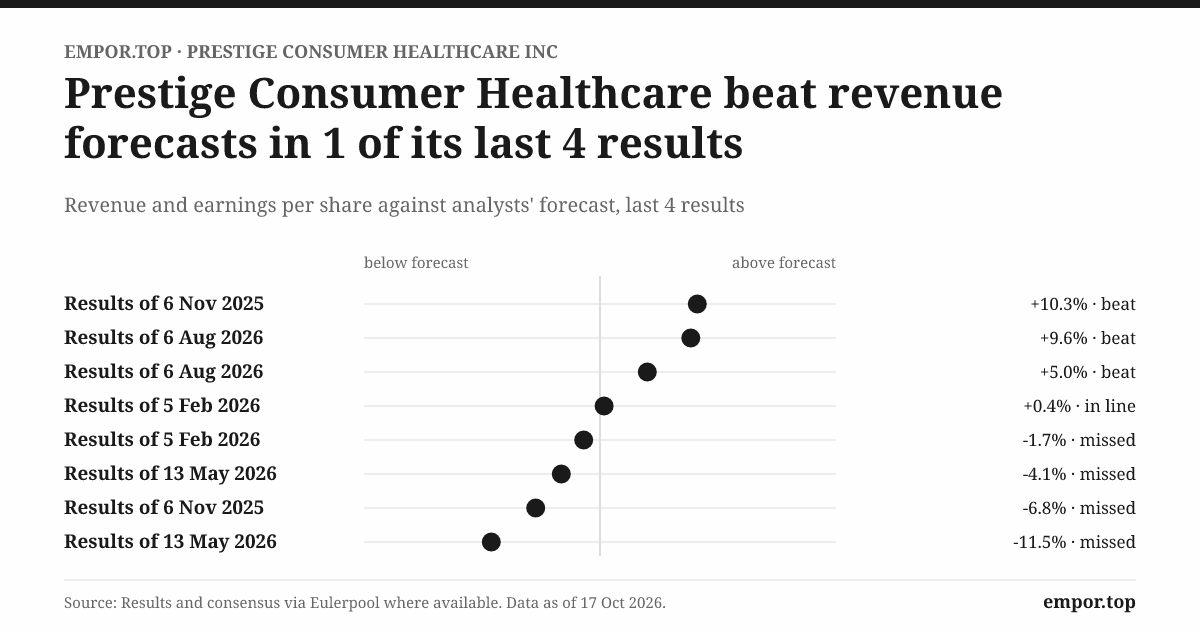
The best window into how management handles pressure is the pair of calls around the turn of the fiscal year. On the fourth-quarter call in May 2026, management discussed weak sales, the Clear Eyes supply problem and the new 1% to 3% organic outlook.18 Three months later, on the first-quarter call in August, sales beat expectations, rising about 6% from a year earlier.13 But management itself said that order timing had added about two points of growth to the quarter and that the second quarter would absorb a reversal.13
That candor is worth crediting. Management did not dress up a timing benefit as a recovery. At the same time, it means the strongest-looking quarter in a year was partly borrowed from the next one, and the real reading on organic momentum is still to come. In analyst questions, the recurring theme was when Clear Eyes supply would normalize and how quickly the plant costs would fade.13 The answers pointed to gradual improvement through the year rather than a precise date.13 Investors should compare those answers with what the next call says. Consistency across calls is the cheapest test of credibility available.
Cash generation is real, then, but it is not the credibility test on its own. Capital allocation is. And part of that allocation is quietly being decided not in the boardroom but in the accounts receivable ledger.
Who Gets Paid While Working Capital Stretches?
A retailer the size of Walmart pays its suppliers on its own schedule. When Prestige ships a pallet of Monistat or Dramamine, it books revenue and waits. Over the past decade, it has been waiting longer.
Debtor days, the average number of days of sales sitting in receivables, rose from about 45 in fiscal 2015 to about 64 in fiscal 2026, the longest in the series.3 At the same time, days payable, the time Prestige takes to pay its own suppliers, fell from about 55 to about 16.3 Put those together with inventory and the cash conversion cycle, the number of days between paying for products and collecting for them, stretched from about 78 days to about 161.3 In simple terms, Prestige now finances more than five months of its own operations before the cash comes home.
The receivables themselves are not the problem. Trade receivables stood at about $209 million at the end of fiscal 2026, with about $18 million of allowances for returns, promotional deductions, cash discounts and credit losses.3 Actual trade-credit charge-offs were negligible, a few hundred thousand dollars a year from fiscal 2024 to 2026.3 The retailers pay. They just pay more slowly, and they deduct along the way.
So who pays late? The company does not identify any customer as delinquent. It shows that debtor days rose overall, and that Walmart and Amazon together represented 18% of receivables at year-end, well below their 35% share of gross revenue.3 That gap suggests the two largest customers are not the ones holding the most unpaid invoices. It would be wrong to turn an aggregate number into a claim about any single retailer.
The collapse in days payable is arguably the more telling move. Some of it likely reflects the shift toward owning manufacturing and the changing terms with suppliers, but the company does not provide a full explanation. What is clear is the result: Prestige now pays its suppliers faster and collects from its customers more slowly than it did a decade ago, and that combination absorbs cash that would otherwise go to debt reduction.
Keep the supplier loan separate from all of this. The $10.3 million write-off was not a retailer failing to pay. It was a credit decision Prestige made to keep a struggling manufacturer running, which went bad when the manufacturer still failed to deliver.3 It belongs to the Clear Eyes story, not the trade-credit story.
A few other exposures belong here, and only briefly. About 16.1% of fiscal 2026 revenue was in foreign currencies, mostly Canadian and Australian dollars; a 10% adverse move was estimated to cut pre-tax income by about $4 million.3 Legal proceedings are described as routine, and uncertain tax liabilities were only about $1.3 million.3 The more serious accounting judgment is the one the auditor flagged: the two critical audit matters in fiscal 2026 were the valuation of the Summer's Eve and Monistat tradenames and the goodwill of the North American Women's Health unit.3 Goodwill and tradenames make up more than 80% of total assets.3 That is the balance sheet of a brand acquirer, and it is where the next impairment, if there is one, would come from.
The forward checks are simple. Watch debtor days, days payable and the cash conversion cycle, alongside the Walmart and Amazon revenue share. If the retailers' share rises above 40% while debtor days keep lengthening, it would point to buyer power growing at Prestige's expense. If those numbers stabilize, the stretched cycle is more likely a one-time effect of the company's changing shape. Either way, the working-capital burden is now part of the cost of carrying a doubled debt load, which brings the story to the central argument.
Analysis & Bear vs. Bull Case
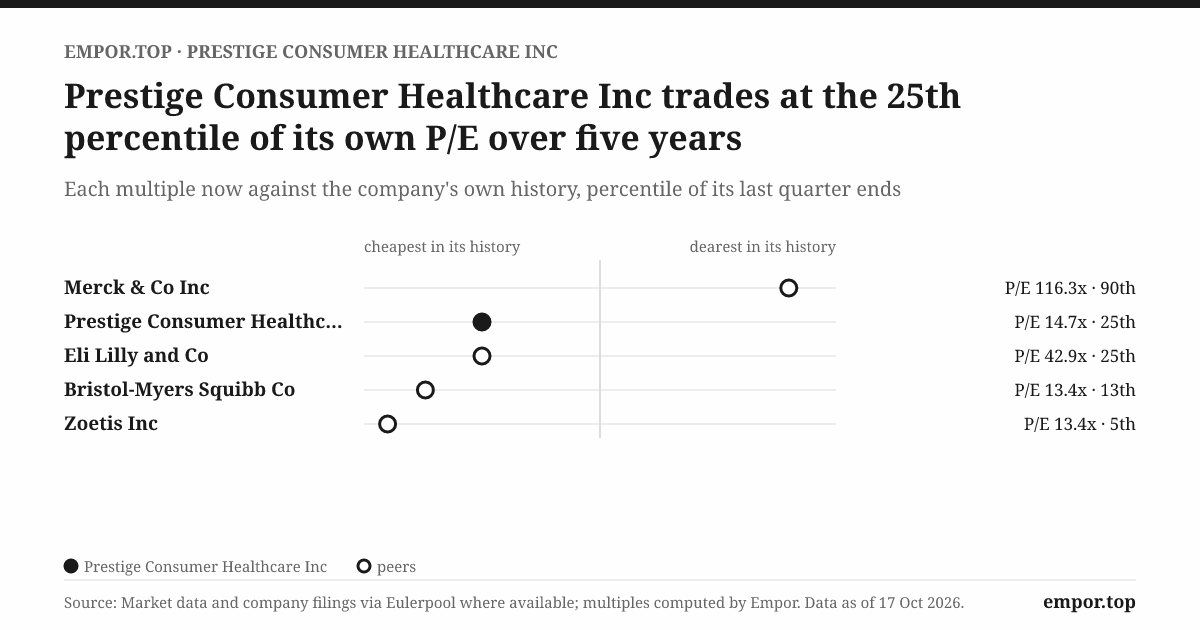
Here is the setup as it stands tonight. Prestige's shares trade about 29% below their 52-week high, at roughly $50. The company forecasts revenue growth of about 10% a year through fiscal 2029 and earnings-per-share growth of 8% or more, after adding nearly 20% in acquired revenue this year.13 Its own organic growth guidance is 1% to 3%.[^4] The stock trades at about 14.7 times trailing earnings, below its own five-year median of about 16.1 times. The market, in other words, is not paying for the ambition. It is pricing something closer to a slow-growing, more indebted version of the old company.
The case for
The bull case begins with durable categories. People keep getting motion sickness, dry eyes, sore throats and digestive trouble, regardless of the economy. Prestige holds leading positions in several of those niches,3 and with Breathe Right it now owns a brand with about 60% of its North American category.9 Its operating margin of about 28% and capital spending of roughly 1% of revenue mean that most of each sales dollar's profit turns into free cash, about $240 to $250 million a year in recent years.3 With Breathe Right and LaCorium inside, the portfolio is larger and more diversified, and the free cash flow base should rise.
Management's targets give the bull case numbers to hold onto: about $270 million of adjusted free cash flow expected in fiscal 2027 and roughly $900 million cumulatively over the three years through fiscal 2029.13 If those arrive, and if most of that cash goes to debt, leverage would fall back toward the company's comfort zone within a few years, exactly as it did after Fleet. The deleveraging record is a genuine strength, not management rhetoric; the balance sheet history shows it.3
The case against
The bear case starts with the same history, read differently. Over the past three years, the legacy business has shrunk.3 The 1% to 3% organic guidance is modest, and the one quarter that beat expectations was flattered by order timing.13 Retailer concentration is rising, and Amazon in particular has gained share of Prestige's sales quickly.3 The Pillar5 plant is adding cost before it adds supply.[^4] And about $2.14 billion of debt, much of it floating, raises interest costs and shrinks the margin for error.2
The historical record tests the strategic claims directly. Prestige's acquisition engine has produced more than $550 million of write-downs on brands it once valued confidently.3 The fiscal 2019 charges on Fleet, DenTek and Efferdent came within about two years of the Fleet purchase.[^7] The fiscal 2023 charges, again concentrated in women's health, came in a year of record revenue.[^8] The history does not reject the claim that Prestige can buy and run brands profitably. It narrows it: Prestige reliably extracts cash from acquired brands, but it has not reliably grown them, and its forecasts at purchase have sometimes been too optimistic. Breathe Right will be judged against that narrower version.
The growth ambition needs the same decomposition. A roughly 10% revenue growth rate through fiscal 2029 sounds like a transformed company. But nearly 20 points of growth arrive in fiscal 2027 from acquisitions alone, so the remaining years can hit that compound rate with low-single-digit organic growth.13 In other words, the headline target does not require the old brands to get much better. Investors should track organic revenue separately from acquired contribution, and compare realized free cash flow with the roughly $900 million three-year promise.
Where the moat really is
Hamilton Helmer's seven powers offer a cleaner way to locate Prestige's advantage, if it has one. Scale economies are absent at the company level; Kenvue and Haleon have far more of them. Network effects and switching costs do not apply to a consumer buying a box of drops. Cornered resource is limited, though Pillar5's sterile capacity is a small one, and process power is not obvious. Counter-positioning is the most interesting candidate: Prestige's willingness to give small brands the attention that giant owners will not is a posture those giants cannot copy without changing how they allocate effort. The strongest power is branding in specific niches, where consumer habit and trust sustain a price premium over store brands.
Those powers hold at the category level, not across the company. And they are bounded by the forces described earlier: two retailers controlling more than a third of revenue, store brands on every shelf, and suppliers who can stop a brand cold. The competitive comparison should be about economics, not size. Kenvue and Haleon have scale and broad portfolios; Perrigo sells a large mix of store-brand products and trades at a much lower valuation.8 Prestige's defense is focused brand ownership and marketing attention. The evidence does not establish a company-wide cost or distribution advantage over those peers. The moat is real but narrow, and it is a set of small moats rather than one wide one.
An activist looking at Prestige would likely push on three points: the timing of the fiscal 2026 buyback just ahead of a debt-funded deal, the use of floating-rate debt for the largest purchase in company history, and the absence of clear targets that tie executive pay to organic growth rather than reported growth. None of these is a scandal. All of them are fair questions.
The numbers that will decide it
Three measurements will resolve most of this story. The first is organic revenue growth excluding acquisitions, which fell 4.3% in fiscal 2026 and is guided to 1% to 3% this year.[^4] The second is North American gross margin, together with Clear Eyes availability; the latest consolidated adjusted gross margin was about 55%, down about 120 basis points.[^4] The third is net debt reduction against cash interest costs, starting from about $2.14 billion of gross debt.2 If organic growth turns positive and stays there, the margin recovers, and debt falls by well over $100 million a year, the bull case is working. If any of them stalls, the bear case gains ground.
The timing of the next proof is specific. Management tied part of the first-quarter growth to order timing and expected a reversal in the second quarter.13 The next call will show whether the explanation holds and whether the recovery timetable for Clear Eyes stays the same. That is what the record so far teaches about this company, and it is worth stating plainly.
Business & Investing Lessons
A shortage of eye drops made Prestige buy a factory. A snoring strip made it double its debt. Those two moments, more than any spreadsheet, hold the lessons of this company.
A familiar brand can outlast its former owner, but not a bad forecast. Prestige's whole history rests on the idea that the brands larger companies neglect still have life in them, and in a cash sense that idea has been right more often than wrong. But the Fleet and women's health write-downs show the other half of the bargain: the price you pay for a brand is a bet on its future, and when that future is drawn too generously, the trademark survives while the shareholder's capital does not. For founders and investors, the lesson is that durability is not the same thing as growth, and an acquisition model priced on growth will eventually be marked to durability.
Low capex is a funding source, not a moat. Prestige spends about a penny of every revenue dollar on equipment, which is why it can convert so much profit into cash. But the Clear Eyes years revealed what outsourcing really means: you save the capital, and you rent the risk. When the supplier's line broke, Prestige had no factory to fall back on, only a loan it would eventually write off. A light balance sheet is an advantage right up to the moment the supply chain you do not own stops working.
Buying the factory buys control and responsibility together. Pillar5 gave Prestige the ability to fix its own eye-drop supply. It also gave it a plant to staff, remediate and fill, with the bill showing up as idle-capacity costs in the very first quarter. Vertical integration is not a cure. It is a trade, exchanging one kind of risk for another, and the proof of whether the trade was worth it shows up on the shelf, not in the announcement.
An accretive deal can still be expensive if debt takes the upside first. Breathe Right was priced at about 11 times EBITDA, reasonable against recent consumer-health deals. It was also financed with $1.045 billion of floating-rate debt that will cost the company tens of millions of dollars a year in added interest. The arithmetic of accretion, earnings per share rising on day one, can coexist with a deal that leaves equity holders with little after the lenders are paid. The right question is not whether the deal adds to earnings. It is who gets paid first, and how long it takes before the shareholder is next in line.
These are lessons from Prestige's own record, not a generic celebration of roll-ups. What makes this company distinctive is that it has run the borrow-buy-repay cycle several times and survived each one. What makes this moment distinctive is that it is running it again with a shrinking core, a costly plant and a much higher cost of money.
Epilogue
Tonight, Prestige is a company in its first full year with Breathe Right and LaCorium inside the portfolio, working through the integration of a sterile eye-drop plant, and carrying about $2.14 billion of debt.2 Its shares are well off their highs. Its management is the same team that has run the company for a decade. And the next chapters are observable, quarter by quarter.
The first is the reversal. Management told investors that the order-timing boost in the first quarter would unwind in the second.13 When that quarter is reported, the question will be whether organic growth stays inside the 1% to 3% range once the timing effect is gone, or whether the underlying portfolio is still slipping. A positive organic number after the reversal would be the first real evidence that the fiscal 2026 decline was a trough rather than a trend.
The second is the eye drops. If Clear Eyes and TheraTears return to the shelf in steady supply, and the Pillar5 remediation costs fade from the gross margin reconciliation, the factory purchase will have done its job. If the plant costs linger and availability stays patchy, Prestige will have taken on a manufacturer's fixed costs without a manufacturer's reliability. The category sales and the North American gross margin will tell that story faster than any press release.
The third is the debt. Management expects about $270 million of adjusted free cash flow this year and roughly $900 million over three years.13 The company's deleveraging after Fleet is the best evidence it can do this, but that playbook ran in a world of near-zero interest rates on a smaller debt base. This time, more than half the debt floats, and every quarter of higher rates eats into the cash available for repayment. Watch net debt fall, or not, against those promises.
And then there are the acquisitions themselves. Breathe Right and LaCorium should be judged on their own revenue, margins and cash contribution as the company discloses them, not on the combined headline growth they produce this year. Their true return will take years to establish, and the company's history suggests that the verdict on an acquisition can arrive long after the celebration has faded. The tension that remains is the one that opened this story: Prestige has bought itself a bigger business. It has not yet shown that it owns a growing one.
Outro
Go back to the shelf one last time. A consumer reaches for a familiar bottle of Clear Eyes, or finds a gap where it should be. Walmart and Amazon, between them, decide whether more than a third of Prestige's products reach that consumer at all.3 And behind the shelf sits the choice Prestige has now made differently than ever before: whether to make the product itself or pay someone else to do it.
That is the whole company in one image. Prestige is a portfolio of familiar remedies that turns brand recognition into cash, about 28 cents of operating profit on every revenue dollar,3 and then uses that cash to buy the next shelf. Whether that makes it a compounding business depends on the brands it buys and the debt and supply problems it takes home with them. If Pillar5 puts Clear Eyes back on the shelf reliably, a strategic bet will have repaired the core. If it does not, the shelf, as always, will be the final judge.
References
-
Breathe Right Acquisition Completion and Pro Forma Information — SEC, 2026-06-12 ↩↩
-
Form 10-Q for Quarter Ended June 30, 2026 — SEC, 2026-08-06 ↩↩↩↩↩↩↩↩↩↩↩↩
-
Form 10-K for FY2026 — SEC, 2026-05-14 ↩↩↩↩↩↩↩↩↩↩↩↩↩↩↩↩↩↩↩↩↩↩↩↩↩↩↩↩↩↩↩↩↩↩↩↩↩↩↩↩↩↩↩↩↩↩↩↩↩↩↩↩↩↩↩↩↩↩↩↩↩↩↩↩↩↩↩↩↩↩
-
Breathe Right Acquisition Announcement and Investor Presentation — SEC, 2026-03-20 ↩↩↩↩↩↩↩
-
Q1 FY2027 Earnings Call Transcript — Benzinga, 2026-08-06 ↩↩↩↩↩↩↩↩↩↩↩↩
-
Consumer Health Acquisition Multiples — Mergers & Tribulations ↩
-
Rating Action on Prestige Brands, Inc. — Moody's Ratings, 2026-05 ↩↩↩
-
Research Update on Prestige Consumer Healthcare Inc. — S&P Global Ratings, 2026-05-14 ↩
-
Q4 FY2026 Earnings Call Transcript — Seeking Alpha, 2026-05-14 ↩
 LinkedIn
 WhatsApp
 Reddit
 Hacker News
 Email
 Kindle
 RSS Feed
 Spotify
 Apple Podcasts
 Amazon Music
 Audible
 YouTube