Bristol Myers Squibb: The Pharmaceutical Giant's Quest for Reinvention
I. Cold Open & Episode Setup
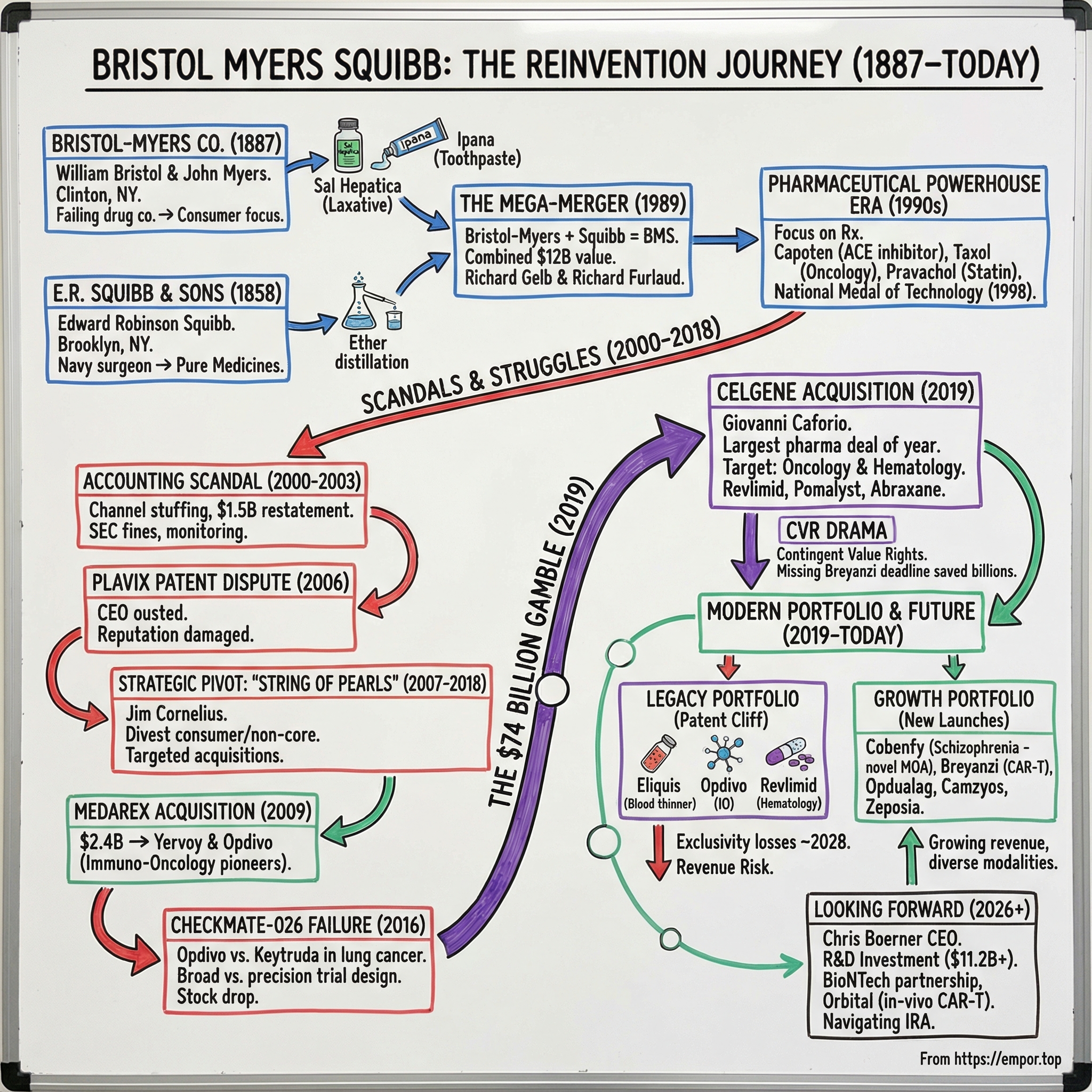
On the morning of January 3, 2019 — the second trading day of the year, when most of Wall Street was still shaking off the holidays — Bristol Myers Squibb announced that it would buy Celgene Corporation for approximately $74 billion in cash and stock. Celgene shareholders were offered $50 in cash plus one BMS share for each Celgene share, a package valued at $102.43 and a premium of roughly 54% to the prior close.1 It was, at the time, the largest acquisition in the history of the pharmaceutical industry. It was also, in a sense, a confession: the company that had invented modern cancer immunotherapy had concluded it could not grow its way out of its own patent cliff, and would have to buy its way out instead.
Seven and a half years later, that bet has produced a verdict, and the verdict is in Bristol Myers Squibb's own annual report. The company is required by the SEC to publish a chart showing what $100 invested in its shares on the last day of 2020 would have been worth five years later, with dividends reinvested, alongside the same $100 invested in the S&P 500 and in a basket of thirteen large pharmaceutical peers. As of December 31, 2025, the BMS line stood at $104.81. The S&P 500 line stood at $196.16. The pharma peer group stood at $198.36.2 Five years of dividends, five years of restructuring, five years of deal-making — and a shareholder of Bristol Myers Squibb ended up roughly where they started while owners of its direct competitors nearly doubled their money. Any honest analysis of this company has to begin there.
And yet the operating business in the summer of 2026 looks nothing like a company in freefall. On July 30, 2026, BMS reported second-quarter revenue of $12.97 billion, up 6%, and raised its full-year revenue guidance from a range of roughly $46.0–47.5 billion to roughly $49.0–50.0 billion, with non-GAAP earnings per share guidance lifted from $6.05–6.35 to $6.75–7.00.3 A three-billion-dollar guidance raise mid-year is not a rounding error. Something in the model changed. Understanding exactly what changed — and how much of it is scientific achievement versus a one-time gift from Washington's drug-pricing rewiring — is the central analytical exercise of this story.
To put the company in context: its 2025 revenue was roughly three-quarters of the $65.0 billion Merck reported for the same year, and about 69% of the BMS total was generated in the United States, with the remaining 31% booked internationally.425 That US weighting matters more than it used to, because it is precisely the American channel where government price-setting now applies. This is not a niche player having a bad decade; it is one of the industry's largest incumbents running an unusually visible experiment in self-replacement, in the one market where its pricing is increasingly set by statute.
The setup. Full-year 2025 revenue was $48.2 billion, essentially flat against $48.3 billion in 2024.4 That flat line hides a violent internal rotation. What BMS calls its Growth Portfolio generated $26.4 billion in 2025, up 17%, while its Legacy Portfolio fell 15% to $21.8 billion.4 Roughly $4 billion of old revenue evaporated and roughly $4 billion of new revenue replaced it. The company is running up a down escalator, and for the last two years it has run just fast enough to stay level.
The central tension. Bristol Myers Squibb sells medicines whose profits are protected by patents, and patents are calendars. Revlimid, the multiple myeloma drug that came with Celgene and was once among the largest-selling medicines in the world, fell 49% in 2025 to $2.95 billion.4 Eliquis, the blood thinner co-developed with Pfizer and the single largest product in the company at $14.4 billion in 2025, became one of the first ten medicines subject to Medicare price-setting under the Inflation Reduction Act, with a government-set price effective January 1, 2026 and settled US generic entry permitted in 2028.42 Opdivo, the PD-1 immunotherapy that made the modern company, generated $10.0 billion in 2025 and carries an estimated minimum US market exclusivity date of 2028.42 Three products, north of $27 billion of revenue, all with visible expiry dates inside a five-year window.
The scale of the hole. It is worth sizing the problem plainly rather than in the abstract. Eliquis, Opdivo, Revlimid and Pomalyst together produced roughly $30 billion of revenue in 2025 — around 62% of the company — and every one of them has either already begun eroding or has a disclosed exclusivity date inside the next few years.42 No amount of cost cutting addresses a hole of that size. Only new revenue does.
The response. Christopher Boerner, a commercial executive by training who became chief executive in late 2023 and now also chairs the board, has run two plays simultaneously. The first is cost: an enterprise-wide "strategic productivity initiative" that began with a $1.5 billion program and roughly 2,200 job cuts announced in April 2024,6 then expanded in 2025 with a further target of approximately $2.0 billion of savings by the end of 2027.2 The second is acquisition: $14.0 billion in cash for Karuna Therapeutics and its schizophrenia drug,[^7] $4.1 billion for the radiopharmaceutical developer RayzeBio,[^8] plus Mirati Therapeutics and a string of smaller deals and licensing arrangements. The strategy is not subtle. Cut the old, buy the new, and hope the arithmetic works.
What this story tests. Four claims sit at the heart of any bull case on Bristol Myers Squibb, and each one has a long, documented record against which it can be checked. That BMS's scale in oncology is a durable moat — testable against what happened when Merck out-executed it in lung cancer. That its capital allocation has become disciplined — testable against the fate of what it has already bought. That Cobenfy, the first genuinely new mechanism in schizophrenia in decades, will replace the lost billions — testable against the company's own patent disclosures and its record of converting scientific firsts into commercial franchises. And that management's guidance can be trusted — testable against the gap between what the incentive plans paid and what shareholders earned.
Three myths worth clearing before the story starts. The consensus narrative around Bristol Myers Squibb has hardened faster than the disclosures, and three claims in wide circulation do not survive contact with the filings.
The first is that the Inflation Reduction Act broke Eliquis in 2026. It did not — at least not yet. Eliquis revenue grew, and management guided it higher, for reasons that have more to do with how manufacturer discounts are now booked than with demand. The second is that the company's "Growth Portfolio" is a portfolio of young medicines. Its largest component is a molecule approved in 2014 whose US exclusivity the company itself estimates ends in 2028.42 The third is that Cobenfy, the schizophrenia drug at the centre of the replacement thesis, enjoys a long protected runway. The annual report puts the relevant US combination patents at 2030, with an extension application pending that would reach 2033.2
None of these corrections make the company uninvestable. They do relocate the debate from where the marketing puts it to where the arithmetic actually lives.
The story runs from a Brooklyn brownstone in 1858 through a fraternity-house friendship in upstate New York, to the merger that created the modern company, to the single most expensive clinical trial design error in the history of oncology, to the largest deal the industry had ever seen, and finally to a portfolio and a balance sheet that must now answer for all of it.
 Subscribe on LinkedIn
II. Dual Origins: Standardized Purity & Horse-and-Buggy Sales (1858–1989)
Edward Robinson Squibb went to sea as a physician with the United States Navy and returned disenchanted. The medicines carried aboard American vessels in the 1840s and 1850s were of poor and unpredictable quality — a commercial free-for-all in which nobody could verify what was in the bottle. His response was not to write a pamphlet, but to solve the chemistry. In 1854, he devised an improved method of distilling ether — the anaesthetic that made surgery survivable — producing it at consistent strength batch after batch. Four years later, he rented a brownstone in Brooklyn and began manufacturing.7
What Squibb actually invented was not a single drug, but the principle that a pharmaceutical company's true product is reliability — that the item being sold is not merely the compound, but the guarantee of its purity. In a market saturated with patent-medicine quackery, a name that functioned as a warranty was the primary asset that mattered, explaining why the Squibb name outlived its founder by more than a century.
Twenty-nine years later and 250 miles north, two Hamilton College graduates — William McLaren Bristol and John Ripley Myers — pooled $5,000 to buy a struggling drug manufacturer in Clinton, New York, backed by what the company's own history describes as a pledge to sell no quack remedies.7 They had little else. For more than a decade, the business barely survived as a going concern, selling to physicians and druggists across upstate New York while the partners searched for a product with wider reach.
Salvation arrived through marketing rather than medicine. In 1895, they introduced Sal Hepatica, an effervescent mineral salt that, when dissolved in water, reproduced the taste and laxative effect of a fashionable Bohemian spa water. Within a decade, it was a bestseller.7 In 1901 came Ipana toothpaste, marketed on the novel premise that a paste could contain a disinfectant to protect gums.7 These were consumer products sold directly to households, advertised at scale, and fundamentally distinct from Edward Squibb's vision of pharmacy.
That distinction shaped a century of capital allocation. Sal Hepatica and Ipana required no patents, clinical trials, or regulatory approvals. Their moat rested on shelf space and advertising recall, building consumer habits through repetition rather than clinical evidence. The economics were seductive: modest gross margins paired with minimal research risk and near-perpetual product lifecycles. Squibb's economics presented the inverse: immense research risk, high margins when successful, and product lifespans dictated by patent expirations.
A business managing both models faces constant temptation to let consumer profits subsidize pharmaceutical development. Bristol-Myers succumbed to that temptation for eight decades, entering the era of billion-dollar drug development with a research organization managed as a division rather than the core enterprise.
That divergence defined the two companies for eighty years. Squibb built its reputation in clinical medicine, opening what its history describes as the world's largest penicillin production facility in New Jersey by 1944 to supply Allied forces.7 Bristol-Myers focused on consumer brands. After World War II, Bristol-Myers expanded by acquiring the hair-color maker Clairol in 1959, Mead Johnson and its Enfamil infant formula in 1967, and later moving into orthopaedic implants.7 By the 1980s, Bristol-Myers functioned less as a pharmaceutical innovator than as a diversified consumer-health conglomerate housing a drug division.
The falsification. Conventional history suggests diversification was Bristol-Myers's structural strength, providing a stable, cash-generative base to fund riskier drug discovery. The company's subsequent actions contradict that narrative. Had consumer diversification been a core advantage, management would have preserved it. Instead, the company dismantled those divisions piece by piece as capital grew scarce. The orthopaedics business, Zimmer, was spun off to shareholders. Clairol was sold to Procter & Gamble for $4.95 billion in cash, a transaction completed in November 2001.8 Mead Johnson was floated in an initial public offering in early 2009 and fully separated that November through a tax-advantaged exchange offer — a move chief executive James Cornelius framed explicitly as completing a "healthcare divestment strategy."9
The mechanics of that dismantling reveal financial engineering instincts that recur later in the company's history. Zimmer was distributed to shareholders, Clairol was sold outright for cash, and Mead Johnson was separated in two stages to establish a market price before using an exchange offer to retire BMS stock while shedding the stake. Executing three distinct structures for three different objectives reflected a management team comfortable using transaction mechanics to reshape the business.
What those divestitures demonstrate is that shampoo and infant formula never truly subsidized pharmaceutical research. Instead, they competed for capital, management focus, and the patience of investors forced to weigh a conglomerate discount against pure-play research companies. As managed-care organizations consolidated purchasing power in the 1980s and 1990s and Phase III trial costs rose into hundreds of millions of dollars, the strategic math shifted: a dollar invested in oncology could yield multiples of a dollar spent on hair dye, but only for companies with sufficient scale and pipeline depth. Bristol-Myers lacked both.
Diversification did not create durable strength; it delayed an inevitable strategic realignment. When that realignment occurred, selling consumer assets generated cash but eliminated operational diversification. Bristol-Myers emerged with revenue concentrated in a narrow set of patented molecules facing firm expiration dates, leaving acquisition as its primary tool to replace maturing drugs. That reliance on external dealmaking, established through decisions in the 1990s and 2000s, remains central to the company's strategy.
The initial step in that transformation was a merger between two institutions with starkly different origins.
III. The 1989 Mega-Merger & The BioPharma Transformation (1989–2008)
Richard Gelb and Richard Furlaud had been friends for a quarter century before they combined their companies. Gelb ran Bristol-Myers, having entered the firm when it acquired his family's business, Clairol. Furlaud led Squibb. For years, the two chief executives had casually discussed a combination. On July 27, 1989, those discussions materialized into a formal agreement: each Squibb share would be exchanged for 2.4 Bristol-Myers shares in a stock-for-stock merger valued at roughly $12 billion at announcement. Gelb became chairman and chief executive, while Furlaud served as president overseeing the prescription drug business, which ranked second globally behind Merck.10
Structurally, the logic was persuasive. Squibb brought a legitimate pharmaceutical research pipeline and international reach; Bristol-Myers contributed commercial scale, consumer marketing expertise, and a formidable balance sheet. Neither entity possessed the scale required to fund the escalating cost of billion-dollar drug development independently. Moreover, corporate cultures proved unusually compatible, avoiding the internal friction that frequently derails pharmaceutical mergers.
The 1990s initially vindicated the deal. Pravachol, a statin, became a major cardiovascular product as cholesterol management expanded into a mass-market category. Glucophage (metformin) established itself as a foundational therapy for type 2 diabetes. Meanwhile, Taxol, derived from the bark of the Pacific yew tree and approved in 1991, established Bristol-Myers Squibb as a dominant player in oncology.7 Taxol established a blueprint for the company's future strategy: mastering complex natural-product chemistry, scaling production, and commercializing a landmark franchise across breast, lung, and ovarian cancers.
Yet that successful decade contained a structural vulnerability. Pravachol and Glucophage relied heavily on commercial execution rather than proprietary, high-barrier science, leaving both vulnerable to generic alternatives and competing therapies. Only the oncology portfolio represented a defensible internal research platform. By the end of the decade, the company's core scientific engine was far narrower than its total revenue suggested.
The channel-stuffing years. By the late 1990s and early 2000s, Bristol Myers Squibb faced mounting pressure to sustain aggressive earnings targets. To meet Wall Street expectations, management resorted to accounting maneuvers. On August 4, 2004, the Securities and Exchange Commission announced an enforcement action, alleging the company had executed a fraudulent scheme by shipping excess product to wholesalers ahead of demand, improperly recognizing $1.5 billion in revenue from its two largest distributors, and drawing down "cookie-jar" reserves to artificially meet earnings targets. Bristol Myers Squibb settled the matter by paying $150 million and accepting an independent monitor to oversee its accounting practices and financial controls.11
Channel stuffing effectively borrows revenue from future quarters to satisfy current expectations until excess inventory in distribution channels collapses the arrangement. The primary damage was institutional: an enterprise founded on manufacturing purity had compromised the integrity of its financial reporting.
Then Plavix. Plavix, an antiplatelet medication co-developed with Sanofi, generated a substantial share of company profits. In 2006, Bristol Myers Squibb and Sanofi attempted to settle patent litigation with Canadian generic manufacturer Apotex to block generic competition. The negotiations collapsed. Apotex terminated the agreement and launched generic clopidogrel at risk in August 2006, flooding the US market before patent litigation concluded. The Federal Trade Commission later assessed a $2.1 million civil penalty—the maximum permitted by law at the time—for failing to disclose terms of the Apotex negotiations to antitrust regulators.12 The commercial fallout was immediate. On September 12, 2006, the board removed Chief Executive Peter Dolan, following concerns raised by the federal monitor regarding management's handling of the patent dispute.13
Within four years, Bristol Myers Squibb had absorbed an accounting fraud settlement, a federal monitorship, a patent litigation failure, and an executive replacement. The institutional prestige signaled by its 1998 National Medal of Technology—awarded for historic achievements in cancer research—reflected past scientific accomplishments rather than its contemporary governance.7
The BioPharma pivot. Chief Executive James Cornelius engineered a strategic turn by abandoning the diversified healthcare model. Management shuttered roughly half the company's manufacturing footprint, divested non-pharmaceutical operations, and concentrated capital exclusively on specialty biopharmaceuticals. To rebuild the pipeline, Cornelius introduced the "String of Pearls" strategy—acquiring targeted, early-stage external innovation rather than pursuing large-scale corporate consolidations.14
The portfolio restructuring unlocked substantial capital. When the separation of Mead Johnson closed in late 2009, the exchange offer was heavily oversubscribed—with shareholders tendering nearly twice the 170 million available shares—valuing the divested stake above $7.3 billion.9 More critically, the pivot reallocated corporate resources: instead of dividing capital among consumer goods, infant formula, and medical devices, the company focused its balance sheet on targeted biopharmaceutical development.
The central question for investors became whether concentrating capital would enhance the quality of scientific investments or merely inflate their financial size. That strategy faced its first test almost immediately, initially producing one of the most successful capital allocation outcomes in the company's history.
IV. The Immuno-Oncology Revolution: Opdivo vs. Keytruda (2009–2018)
On July 22, 2009, Bristol Myers Squibb announced it would acquire Medarex, a New Jersey antibody company, for $16.00 per share in cash — an aggregate valuation of approximately $2.4 billion, or roughly $2.1 billion net of Medarex's cash. Cornelius framed the deal in the language of his corporate strategy, noting that Medarex's discovery platform and pipeline were "what we're looking for in terms of our String of Pearls strategy."14 What BMS actually acquired, though the initial announcement could only gesture at it, were the foundational antibodies that created an entire therapeutic category.
To understand the significance of the deal, it helps to simplify the underlying biology. A tumor consists of the body's own cells that have stopped obeying growth controls. The immune system relies on T-cells to patrol for this abnormal behavior, but T-cells carry built-in molecular safety switches — or brakes — to prevent them from attacking healthy tissue. Tumors evade destruction by engaging those brakes. Two of the primary molecular brakes are proteins known as CTLA-4 and PD-1. Medarex had engineered antibodies targeting both. By blocking the brake, the drug allows the patient's own immune system to attack the tumor. That concept, known as checkpoint inhibition, was widely doubted outside specialized immunology circles before clinical trials proved its efficacy.
Yervoy, the anti-CTLA-4 antibody, gained approval in 2011 for metastatic melanoma, a disease that previously carried a bleak prognosis. Opdivo, the anti-PD-1 antibody, followed in 2014.7 For a brief period, Bristol Myers Squibb held a commanding position in the nascent field of immuno-oncology. Equity analysts re-rated the stock, company scientists drew national media coverage, and Merck — whose competing anti-PD-1 antibody had arrived through its acquisition of Schering-Plough — appeared to be trailing at a distant second.
Then came August 5, 2016. Both companies were racing to advance their respective PD-1 inhibitors into first-line non-small cell lung cancer — the largest commercial market in oncology, where chemotherapy remained the established standard of care. The critical strategic decision facing each management team was how broadly to define the patient selection criteria.
That trial design decision shaped the subsequent decade of competition in oncology. PD-L1 is a surface protein that tumors use to signal T-cells to stand down. Some tumors express high levels of PD-L1, while others express very little. Because a checkpoint inhibitor works by blocking this signal, efficacy is highest in tumors with abundant PD-L1 expression. Merck designed its KEYNOTE-024 trial with a restrictive threshold, enrolling only patients whose tumors were heavily PD-L1 positive — defined as expression on at least 50% of tumor cells. That choice targeted a smaller initial patient population, but it maximized the probability of demonstrating a clear clinical benefit.
Bristol Myers Squibb took a broader gamble. Its CheckMate-026 trial evaluated Opdivo as a monotherapy against chemotherapy in previously untreated advanced lung cancer, setting a primary endpoint of progression-free survival in patients whose tumors expressed PD-L1 on as few as 5% of cells.15 That threshold was ten times broader than Merck's entry requirement. Had the trial succeeded, Bristol Myers Squibb would have captured nearly the entire first-line lung cancer market, relegating Merck to a small niche.
The strategy failed. The trial missed its primary endpoint,15 while Merck's narrower study delivered a decisive victory. Bristol Myers Squibb shares fell roughly 16% in a single trading session, whereas Merck shares rose sharply.16 Chief Executive Giovanni Caforio acknowledged the setback that day, stating that the company was disappointed by the outcome "in this broad patient population."15
What BMS did next. Denied a dominant position in first-line monotherapy, the company pivoted to combination therapies. Management paired Opdivo with Yervoy, reasoning that dual checkpoint inhibition would achieve efficacy where single-agent therapy fell short, and later launched Opdualag, combining nivolumab with an antibody against a third checkpoint, LAG-3. Both approaches yielded regulatory approvals and commercial sales: Yervoy generated $2.9 billion and Opdualag reached $1.19 billion in 2025.4 However, combination regimens typically carry higher toxicity, target narrower eligible patient populations, and face tougher reimbursement discussions than a single, well-tolerated monotherapy. Bristol Myers Squibb spent the subsequent decade managing a structural disadvantage of its own making, with contemporaneous industry analysis attributing the deficit directly to the initial trial design decision rather than any molecular shortcoming.17
The falsification. The prevailing investment thesis of that era held that first-mover status in PD-1 inhibition conferred a durable, defensible moat in immuno-oncology. Subsequent financial results contradict that assumption. In 2025, Merck's Keytruda franchise generated $31.7 billion in sales, up 7%, representing nearly half of Merck's $65.0 billion total revenue.5 By comparison, Opdivo generated $10.0 billion in 2025, growing 8%.4 Despite the molecules being close pharmacological analogues, Keytruda's revenue expanded to more than three times that of Opdivo — a divergence established not by laboratory discovery, but by clinical trial design.
In pharmaceutical commercialization, securing the initial first-line indication carries compounding advantages. Establishing a medicine as the default first-line standard dictates subsequent lines of therapy, shapes hospital treatment protocols, and compels clinical trials for combination therapies to build upon that established baseline. Consequently, Bristol Myers Squibb was not merely competing for individual prescriptions; it was attempting to displace an entrenched clinical workflow.
Two broader conclusions emerge from this episode. First, pioneering a drug mechanism confers limited competitive protection compared to securing the primary clinical indication, where regulatory approvals, treatment guidelines, and prescribing habits solidify. Second, the CheckMate-026 outcome highlighted a recurring institutional challenge at Bristol Myers Squibb: commercial and clinical misjudgment under competitive pressure. Similar missteps appeared in the earlier Plavix litigation settlement and reemerged in the contingent value right structure designed for the Celgene acquisition. For investors evaluating management's capital allocation track record, execution discipline in clinical strategy remains as critical as the underlying science.
Which is precisely what happened next.
V. The M&A Machine: Celgene, MyoKardia, Karuna & RayzeBio (2019–2024)
By late 2018, Bristol Myers Squibb faced a growth problem that internal laboratories could not fix on a useful timeline. Opdivo's expansion had stalled after its defeat in lung cancer, and the next wave of pipeline assets remained years away. Across the negotiating table, Celgene harbored a mirror-image vulnerability: Revlimid, an extraordinarily profitable hematology franchise, was marching toward its own patent cliff, while investors had lost confidence in the company's pipeline after repeated clinical setbacks. Facing converging patent cliffs, the two drugmakers decided that the solution was a combination.
The deal, announced on the first trading Thursday of 2019, created a cash-and-stock package valued at $102.43 per Celgene share.1 Regulatory review soon forced a major divestiture: to satisfy Federal Trade Commission objections in inflammatory disease, Bristol Myers Squibb agreed in August 2019 to sell Celgene's psoriasis drug Otezla to Amgen for $13.4 billion in cash.18 That sale altered the transaction's underlying economics. Otezla was one of the few Celgene assets offering a long, clear growth runway. Disposing of it meant the remaining acquisition leaned even more heavily on mature, expiring hematology products—shifting the deal from a strategic growth acquisition to a cash-flow extraction exercise.
The CVR. To bridge the valuation gap, management attached a contingent value right to each Celgene share. The tradable security promised a $9.00 payout per share if three late-stage therapies—the CAR-T cell therapies liso-cel and ide-cel, alongside the multiple sclerosis treatment ozanimod—secured Food and Drug Administration approvals by specified deadlines. Across all shares, the potential payout totaled roughly $6.4 billion. Liso-cel, later brand-named Breyanzi, missed its regulatory window. While the FDA approved the therapy in February 2021, the decision arrived weeks after the cutoff due to pandemic-related delays in manufacturing facility inspections. The CVR expired worthless. Hedge funds holding the instruments sued, alleging Bristol Myers Squibb had deliberately delayed the submission, but a US federal court dismissed the lawsuit in October 2024.19
While the court ruling cleared the company legally, the commercial implications were less flattering. A contingent value right is a contractual bet that an acquirer can execute regulatory milestones on schedule, and Bristol Myers Squibb failed that test on the asset closest to its core operational capabilities. Cell therapy is not a conventional pill; each dose must be custom-manufactured from a patient's own cells, making production facilities the binding constraint. The manufacturing bottleneck that cost target shareholders $6.4 billion also slowed Breyanzi's commercial expansion for years. Only in 2025 did Breyanzi's sales inflect, rising 82% to $1.36 billion.4 It took five years to escape an operational bottleneck that the transaction's timeline had implicitly ignored.
The spree. With Celgene absorbed, Bristol Myers Squibb continued buying. In 2020, the company acquired MyoKardia for $13.1 billion in cash, adding mavacamten—now marketed as Camzyos—a first-in-class treatment for obstructive hypertrophic cardiomyopathy, a disease that thickens and stiffens heart muscle.[^22] Mirati Therapeutics brought Krazati, a KRAS inhibitor for lung cancer. RayzeBio, acquired in December 2023 for $4.1 billion, brought a platform in targeted alpha therapy that delivers radioisotopes directly into tumor cells.[^8] Four days earlier, management agreed to pay $14.0 billion for Karuna Therapeutics, whose valuation hinged on a single clinical-stage schizophrenia compound.[^7]
The accounting treatment for Karuna revealed the immediate financial cost of that strategy. Because Karuna was essentially a single-asset developer, accounting rules classified the transaction as an asset acquisition rather than a business combination. As a result, the purchase price was expensed instantly as acquired in-process research and development rather than capitalized on the balance sheet. Driven primarily by the Karuna purchase, acquired research charges totaled $13.4 billion in 2024.4 That single write-off caused Bristol Myers Squibb to post a full-year GAAP net loss of $8.9 billion, or $(4.41) per share.4 The company acquired a promising compound and immediately wrote off its entire cost.
The capital allocation audit. What has this acquisition campaign yielded? The results are mixed, with the underlying details telling a clearer story than the aggregate figures.
On the deficit side, the write-downs are documented in the company's financial disclosures. Augtyro, a lung cancer drug acquired through Turning Point Therapeutics in 2022, incurred a $1.4 billion impairment charge in the fourth quarter of 2024 due to lowered cash-flow projections, followed by an additional $564 million partial impairment in 2025—erasing roughly $2 billion in value from a single purchase.202 Abecma, the ide-cel cell therapy that served as one of the three CVR milestones, was fully written down through a $122 million charge in late 2024 as market competition intensified.20 Additionally, two clinical-stage Celgene compounds—an immunology asset and the myeloma drug alnuctamab—were written off in 2024 for $390 million and $590 million, respectively.20
These impairments came alongside substantial purchase amortization. Bristol Myers Squibb recognized $9.0 billion, $8.9 billion, and $3.3 billion of acquired-intangible amortization through its income statement in 2023, 2024, and 2025.204 Over those three years, non-cash amortization charges totaled more than $21 billion, representing the ongoing accounting drag of the Celgene transaction.
On the growth side, several acquired assets delivered clear commercial progress. Camzyos sales climbed 77% to $1.07 billion in 2025 and reached $416 million in the second quarter of 2026 alone, up 59% year-over-year.43 Reblozyl, another Celgene asset, generated $2.33 billion in 2025.4 Meanwhile, Breyanzi established commercial scale, and Cobenfy—the schizophrenia therapy from Karuna—gained regulatory approval and launched.
What sets this acquisition strategy apart from similar debt-funded expansions by peers like AbbVie or Pfizer is not the size of individual transactions, but their rapid cadence. Bristol Myers Squibb bought Celgene, MyoKardia, Turning Point, Mirati, RayzeBio, and Karuna within five years, securing the final two deals within four days of each other in December 2023.[^7][^8] Executing six corporate acquisitions in five years represents a distinct strategy—and an implicit commentary on the productivity of the internal discovery pipeline.
Credit rating agencies responded to the rapid pace of dealmaking. Following the December 2023 announcements, Standard & Poor's lowered the company's long-term credit rating from A+ to A.2 Management subsequently prioritized balance-sheet repair, making $10.9 billion in long-term debt repayments in 2025 against $5.7 billion in new debt issuance, which reduced net debt from $38.5 billion to $34.0 billion by year-end.2 That deleveraging continued into mid-2026, with management retiring another $1.2 billion in debt during the second quarter.21 Furthermore, the company paused share repurchases in both 2024 and 2025 despite roughly $5.0 billion in remaining buyback authorization, confirming that debt reduction took precedence over returning capital to shareholders.2
The calibrated conclusion. Does this track record disprove management's dealmaking capability? Not entirely, but it narrows the claim significantly. The evidence indicates that Bristol Myers Squibb has been an effective acquirer of de-risked, late-stage or approved cardiovascular and hematology therapies with lower clinical risk, such as Camzyos and Reblozyl. Conversely, it has struggled with early-stage oncology platforms, as evidenced by Turning Point and the undeveloped Celgene pipeline. It also underscores a valuation risk: the late-2023 acquisitions occurred near the peak of biotech valuations, relied heavily on debt financing, and cost the company a credit notch. The key metric that will confirm or falsify this strategy is whether RayzeBio's radiopharmaceutical pipeline and Cobenfy's expansion trials generate approvals and commercial revenue before further impairment charges appear against them.
Which brings the story to the portfolio as it actually stands today.
VI. Portfolio Economics & Current Business Breakdown
Analyzing Bristol Myers Squibb requires first navigating a definitional trap in how the company presents its performance.
Management reports revenue in two categories: the Growth Portfolio and the Legacy Portfolio. In 2025, the Growth Portfolio generated $26.4 billion, up 17 percent, while the Legacy Portfolio fell 15 percent to $21.8 billion.4 On the surface, the company appears to be more than halfway transformed. Yet the Growth Portfolio's largest component is Opdivo at $10.0 billion — a molecule first approved in 2014 with an estimated minimum US exclusivity date of 2028, according to the annual report.42 The bucket also includes Orencia at $3.7 billion, a long-standing rheumatoid arthritis biologic, and Yervoy at $2.9 billion, which gained its initial approval in 2011.47 Strip out those three mature therapies and what remains — the genuinely young medicines — totals roughly $9.8 billion.
This classification is not an accounting irregularity; product sales are fully disclosed line by line. But the distinction is critical because "Growth Portfolio Revenue" doubles as an executive compensation metric. It carried a 35 percent weight in the 2025 annual incentive plan and a 40 percent weight in three-year performance share units.22 When executive bonus metrics include products facing exclusivity losses within two years, evaluating individual drug performance becomes far more informative than relying on management's aggregated labels.
Deep dive one: the legacy cliff, and the surprise of 2026. Eliquis, an oral anticoagulant co-promoted with Pfizer under a profit-sharing alliance, is the company's largest product, generating $14.4 billion in 2025.4 It was among the first ten medicines selected for Medicare price negotiation under the Inflation Reduction Act, setting a maximum fair price of $231 for a 30-day supply — roughly 56 percent below list price — effective January 1, 2026.[^26]2
Consensus expectations held that 2026 would mark the downturn for Eliquis. Instead, sales grew 22 percent in the second quarter of 2026 to $4.48 billion, prompting management to raise full-year growth guidance for the drug from 10–15 percent to 20–25 percent.3 That resilience stemmed from financial mechanics rather than surging clinical demand. First, Medicare Part D structural changes altered manufacturer discount obligations: drugs sold at government-mandated prices operate under different rebate rules than those sold into the former coverage-gap program, softening the impact on net realized prices. Second, management noted during the second-quarter earnings call that a list-price reduction implemented at the start of 2026 eliminated accumulated inflation-penalty rebates across certain government channels.21 A third factor, detailed in the annual report rather than quarterly earnings releases, also altered the revenue calculation.
Under a December 2025 agreement with the US government, Bristol Myers Squibb agreed to provide Eliquis without charge to Medicaid effective January 1, 2026 — effectively removing a low-margin channel burdened by heavy statutory rebates from the top-line calculation.2
The analytical distinction is vital: while the near-term cash flow from Eliquis is real, it reflects gross-to-net accounting adjustments and regulatory settlements rather than expanding patient demand. The upside bolsters 2026 results but alters neither the 2028 US patent settlement date permitting generic competition nor the November 2026 expiration of European composition-of-matter protections.2 The guidance increase represents a temporary revenue reprieve rather than a permanent expansion of terminal value.
The broader government agreement contained additional concessions: direct-to-patient access for Sotyktu, Zeposia, Reyataz, Baraclude, and Orencia at discounts of approximately 80 percent off list price for cash-paying patients, alongside commitments toward balanced international launch pricing. In return, the company secured tariff relief through January 2029 and temporary exemptions from future US pricing mandates.2 Bristol Myers Squibb effectively exchanged list-price flexibility for regulatory predictability, resetting its US gross-to-net baseline while the agreement remains in place.
Meanwhile, the remainder of the legacy portfolio shows standard patent-cliff dynamics. Pomalyst, a multiple myeloma therapy, saw sales fall 23 percent in 2025 to $2.73 billion before dropping 71 percent year-over-year in the second quarter of 2026 to $204 million following US generic entry.43 Patent cliffs rarely produce gradual declines; revenue drops abruptly. Regulatory price-setting is also expanding: the government designated Pomalyst for Medicare negotiations effective January 2027 and selected Orencia in January 2026 for pricing mandates starting in 2028.2 Government price adjustments are progressively advancing into products previously classified within the Growth Portfolio.
A key structural feature of Eliquis warrants emphasis: because the drug is commercialized through a partnership with Pfizer, Bristol Myers Squibb reports gross revenue while splitting operating profits. Consequently, Eliquis generates a smaller percentage of operating earnings than its top-line contribution suggests — a critical nuance when calculating the earnings impact of the 2028 patent expiration.
Deep dive two: the Opdivo defense. To mitigate upcoming exclusivity losses, Bristol Myers Squibb is attempting to transition patients from intravenous Opdivo to Opdivo Qvantig, a subcutaneous formulation utilizing Halozyme's ENHANZE delivery technology that received FDA approval in December 2024. The clinical rationale centers on reducing delivery time to three to five minutes, down from a 30-minute infusion.23 By the second quarter of 2026, Qvantig generated $261 million, capturing roughly 15 percent of the franchise and reaching a $1 billion annualized run rate.321 However, financial disclosures clarify that Qvantig's core US exclusivity relies on the primary nivolumab composition-of-matter patent expiring in 2028, with additional patent protection dependent on pending applications specific to the subcutaneous formulation.2 Without granted extension patents, switching patients builds clinical habit and convenience rather than extending intellectual property protection.
Deep dive three: Cobenfy, and its market reality. For seven decades, approved antipsychotics shared a common mechanism: blocking dopamine D2 receptors. While effective, D2 antagonists often cause metabolic changes, weight gain, and movement disorders that limit long-term patient adherence. Cobenfy introduces a distinct mechanism by targeting M1 and M4 muscarinic receptors without blocking dopamine pathways. The FDA approved the therapy on September 26, 2024, marking the first novel pharmacological class for schizophrenia in decades, with a wholesale list price of approximately $1,850 per month before rebates.2425
Early commercial execution has proven modest relative to initial expectations. Cobenfy generated $155 million in 2025 and $63 million in the second quarter of 2026 — representing 81 percent year-over-year growth off a low baseline, trailing consensus forecasts.43 During the second-quarter 2026 earnings call, commercial head Adam Lenkowsky reported 15 percent quarter-over-quarter prescription growth while acknowledging the need to accelerate new patient starts and improve prescription renewals, noting ongoing educational initiatives to help physicians titrate patients quickly to the target 125-milligram dose.21 Ongoing prescriber education on dosage titration nearly two years post-launch indicates real-world adoption hurdles and tolerability considerations.
Furthermore, intellectual property filings reveal a compressed commercial timeline. The company's annual report indicates that US patents covering Cobenfy's combination active ingredients expire in 2030, with a pending patent term restoration application that could extend exclusivity to 2033.2 For an asset acquired for $14.0 billion, disclosed exclusivity spans four to seven years. Relying on Cobenfy to offset revenues lost from Eliquis and Opdivo requires both rapid adoption acceleration and favorable patent extension rulings.
Secondary pipeline commercialization. Evaluating portfolio sustainability requires reviewing secondary product launches. Sotyktu, an oral therapy approved for psoriasis and psoriatic arthritis, generated $291 million in 2025 and $87 million in the second quarter of 2026 — demonstrating growth, but on a sales trajectory well below initial expectations for a first-in-class oral immunology drug.43 Zeposia, a treatment for multiple sclerosis and ulcerative colitis tied to the former Celgene milestone rights, recorded $577 million in 2025 sales.4 Krazati, the KRAS inhibitor acquired via Mirati Therapeutics, delivered $205 million in 2025 revenue — reflecting commercial progress, but a modest return against its $4.8 billion acquisition cost.4 These outcomes illustrate the standard variability of drug launches, demonstrating why revenue replacement models cannot assume newly introduced molecules automatically achieve blockbuster status.
Management alignment and incentives. Chief Executive Christopher Boerner's background in commercial strategy shapes corporate focus, while Chief Financial Officer David Elkins continues to direct balance-sheet deleveraging. Research leadership experienced recent turnover: Samit Hirawat stepped down as chief medical officer and head of development in August 2025 before departing in November, replaced by Cristian Massacesi, who received a make-whole equity grant to offset forfeited compensation from his previous employer.22 Executive transitions within drug development during a pipeline pivot represent a notable governance shift.
Compensation outcomes for 2025 reflect this operational orientation. The corporate performance factor for annual incentives reached 157.66 percent, supported by non-GAAP operating income of $18.48 billion against a $16.85 billion target, and Growth Portfolio revenue of $26.23 billion versus a $24.85 billion baseline. Consequently, Boerner received a $3.75 million cash incentive against a $2.38 million target.22 Over the same period, the stock declined from $63.11 at the March grant date to $53.94 by year-end, leading proxy disclosures to project zero payout on the relative total shareholder return portion of long-term performance share units.22 Shareholders approved the executive compensation plan with 94 percent support in 2025.22 Executive compensation remains tied to internal operational targets even during periods of equity underperformance.
Which raises the underlying question of whether the company's remaining franchises possess a durable competitive moat.
VII. Moat Analysis: Helmer's 7 Powers & Porter's 5 Forces
Consider a revealing thought experiment. Imagine a business that holds a legal monopoly on a drug with 90 percent gross margins, no direct substitute, and patients willing to pay nearly any price for it — and then imagine that monopoly is guaranteed to end on a date printed in a public filing. Is that a moat? It is certainly a lucrative profit stream. But a moat, in the framework popularized by strategist Hamilton Helmer, is a persistent differential that survives competitive attack. Pharmaceutical exclusivity does not survive; it simply expires. The central question for Bristol Myers Squibb is what, if anything, remains standing when those expirations arrive.
Cornered Resource. Bristol Myers Squibb holds genuine cornered resources: the nivolumab and ipilimumab antibody estates, the muscarinic combination patents behind Cobenfy, the CAR-T constructs behind Breyanzi, and the actinium-based radiopharmaceutical chemistry acquired with RayzeBio. Each is proprietary and difficult to replicate. Yet the counter-argument is arithmetic rather than analytical: the patent expiration dates are fully disclosed, and several fall within the next five years.2 Unlike a cornered resource in mining or media — such as an orebody or a film library — a drug patent does not gradually erode at the margins. It expires on a fixed schedule, and the underlying revenue can drop by half in a single year, as Revlimid and Pomalyst have both demonstrated.43 A more accurate characterization is that Bristol Myers Squibb rents a series of temporary cornered resources rather than owning a permanent one.
Scale Economies. This power is more durable, providing genuine support for the investment case. Bristol Myers Squibb spent $9.5 billion on non-GAAP research and development in 2025, even after implementing cost-reduction programs.4 Conducting global Phase III oncology trials, navigating regulatory affairs across dozens of jurisdictions, and operating specialized manufacturing infrastructure for cell therapies and radiopharmaceuticals require massive fixed capital investments with no viable small-scale alternative. Radiopharmaceuticals illustrate this barrier clearly.
The company opened a new production facility in Indianapolis in 2025 to supply the RayzeBio programs, built specifically because radioisotopes decay within days and cannot be manufactured and stored in standard warehouses.2 A biotechnology startup with a promising alpha-emitting molecule but no manufacturing plant lacks a commercial enterprise; it holds an asset that it must eventually sell to an incumbent with infrastructure. That infrastructure represents a defensible operational advantage — explaining why Bristol Myers Squibb frequently buys late-stage assets rather than discovering them internally.
Switching Costs. Switching costs in oncology are asymmetric and often overstated. A cancer patient who is stable on an Opdivo-Yervoy regimen will not be moved by an oncologist to a competitor for a modest price difference, creating real patient-level stickiness. However, switching costs in oncology attach to the patient rather than the prescriber. Every newly diagnosed patient represents an uncommitted competitive event decided by whichever regimen holds superior clinical trial data in that specific indication. This exact dynamic enabled Merck's Keytruda to overtake Opdivo. A moat that must be re-won with every new diagnosis is inherently fragile.
Counter-Positioning, Branding, Network Economies, Process Power. Counter-positioning is absent; Bristol Myers Squibb cannot adopt a business model that generic manufacturers are unwilling to copy, as generic producers exist specifically to replicate expiring small molecules and biologics. Branding carries weight with prescribing physicians but holds negligible influence with institutional payers. Network economies do not apply. Process power represents a notable exception: autologous cell therapy manufacturing is an accumulated operational capability that competitors cannot purchase off the shelf, and Bristol Myers Squibb spent five challenging years developing it. Whether that capability yields an adequate financial return remains unproven — highlighted by Abecma being written down to zero while the company was still building the manufacturing infrastructure intended to make the franchise competitive.20
Porter's Five Forces. The competitive forces governing the industry are unusually lopsided.
Buyer power is extreme, and it is now legislative. The mechanism of buyer power has shifted in kind, not merely in degree. Negotiating discounts with commercial pharmacy benefit managers is fundamentally different from having the largest purchaser in the market establish prices by statute, as Medicare did for Eliquis, Pomalyst, and Orencia.2 A buyer capable of legislating price ceilings acts as a regulator rather than a traditional commercial counterparty. The December 2025 agreement with the US government — providing zero-cost Medicaid supply and deep direct-to-patient cash discounts in exchange for tariff relief and temporary exemption from future pricing mandates — reflects management accepting lower, predictable prices to eliminate severe tail risk.2
Threat of substitutes is high and rising. Antibody-drug conjugates — which attach targeted chemotherapy payloads to tumor-seeking antibodies — are advancing rapidly, as are bispecific antibodies designed to engage T-cells directly at tumor sites. Tellingly, Bristol Myers Squibb has responded primarily by licensing external technology rather than developing it internally: collaborating with BioNTech on the bispecific antibody pumitamig, securing a license from Philochem for a prostate-cancer radiopharmaceutical, partnering with Sichuan Biokin Pharmaceutical's subsidiary SystImmune on the antibody-drug conjugate iza-bren, and entering agreements in May 2026 with Hengrui Pharma covering thirteen early-stage programs.23 The strategic implication is clear: across the therapeutic modalities most likely to displace PD-1 monotherapy, the company is purchasing access rather than leading scientific discovery.
Rivalry is intense and asymmetric. Merck, Roche, AstraZeneca, Johnson & Johnson, Pfizer, and Novartis compete directly with Bristol Myers Squibb in oncology, with several competitors holding stronger commercial franchises. For example, Johnson & Johnson and Legend Biotech's Carvykti — a direct competitor to Abecma in multiple myeloma — generated approximately $657 million in net trade sales in the second quarter of 2026 alone, up 50 percent year-over-year.26 By contrast, Abecma generated $427 million across all of 2025 and was no longer reported as a standalone line item in the second-quarter 2026 financial report, having been reclassified into "Other Growth Products."43 Ceasing separate disclosure for a product previously highlighted as a cornerstone of cell therapy strategy provides a clear signal of commercial trajectory.
Supplier power and new entrants represent secondary concerns by comparison, with one key caveat: the primary suppliers of novel drug candidates to Bristol Myers Squibb are venture-backed biotechnology firms and, increasingly, Chinese pharmaceutical developers, both of which command rising deal valuations as competition for high-quality assets intensifies.
This shift in innovation supply represents a fundamental industry transition. In previous market cycles, Western pharmaceutical incumbents sourced external innovation primarily from American and European biotechnology startups. Today, licensing agreements with firms like Hengrui Pharma and SystImmune reflect a deep, global supply of drug candidates that did not exist a decade ago.23 For an incumbent whose primary core competency lies in clinical development, regulatory approval, and global commercialization rather than early-stage discovery, a broader supply of licensable assets is a clear advantage. However, because these same assets are available to global competitors on similar commercial terms, access alone fails to confer an enduring competitive moat.
The verdict on the moat. Bristol Myers Squibb possesses a genuine operational advantage, but it is not a structural moat in the traditional sense. It is a scale-and-infrastructure capability — the capacity to develop, manufacture, and commercialize complex therapeutic modalities globally — that allows the company to rent a rotating series of temporary monopolies. While renting monopolies can sustain a profitable business, it cannot compound long-term value unless the revenue replacement rate consistently exceeds the patent expiration rate. The key empirical test for investors is clear: can the portion of the Growth Portfolio outside Opdivo, Orencia, and Yervoy compound fast enough to offset legacy portfolio declines without relying on continuous, debt-funded acquisitions?
That question leads directly to what could go wrong.
VIII. Current Risk Radar & Skeptical-Investor Stress Test
Picture the meeting that a skeptical investor would want to hold with management. Not an official earnings call with polite questions and rehearsed responses, but a forty-five-minute session with an analyst holding a short position and no corporate relationship to protect. Here is what they would ask.
"Your biggest guidance raise came from a policy accounting change. What happens in 2027?" The Eliquis top-line benefit described earlier is largely non-recurring. Once the list-price reset and Medicaid delivery arrangement enter the operational baseline, year-over-year growth comparisons normalize. Meanwhile, the underlying franchise still faces European composition-of-matter expiration in November 2026 and settled US generic entry in 2028.2 Management raised full-year 2026 revenue guidance to between $49.0 billion and $50.0 billion;3 the critical question is what the 2028 revenue base looks like once Eliquis, Opdivo, and the remaining Celgene hematology assets reprice. Management has offered no revenue guidance for 2028, yet that figure represents the central metric for long-term valuation.
"Opdivo is roughly a fifth of your revenue and loses exclusivity in two years. Convince me the subcutaneous switch solves it." Commercial conversion is advancing: capturing a 15 percent market share within eighteen months of launch represents rapid adoption for an oncology formulation switch.21 However, company disclosures specify an estimated minimum US market exclusivity date of 2028 for the subcutaneous presentation—matching the intravenous version.2 The bull thesis relies on physician habit, hospital reimbursement dynamics that favor subcutaneous delivery, and ungranted formulation patents. Two of those three factors depend on behavior rather than legal exclusivity, and behavioral moats persist only until payers alter reimbursement terms.
"You wrote off $2 billion on Augtyro and zeroed out Abecma. Why should I fund the next deal?" Chief Executive Christopher Boerner stated during the second-quarter 2026 earnings call that the company felt no compulsion to chase acquisitions, prioritizing compelling science in familiar therapeutic areas.21 Corporate execution shows a nuanced picture: while avoiding ten-billion-dollar-plus takeovers, Bristol Myers Squibb acquired Orbital Therapeutics, established partnerships with BioNTech and Hengrui Pharma, and recorded a $1.4 billion acquired in-process research and development charge in the fourth quarter of 2025 driven primarily by the Orbital transaction.42 Capital deployment continues, shifting from mega-mergers to early-stage technology licensing and targeted acquisitions.
"Your R&D leader left mid-transition and two major readouts slipped. Is the pipeline actually on schedule?" Company disclosures detail three pipeline setbacks. On November 14, 2025, Bristol Myers Squibb and Johnson & Johnson halted the Phase III Librexia ACS trial of milvexian—the Factor XIa anticoagulant intended as an eventual successor to Eliquis—in post-acute coronary syndrome patients.4 The trial readout for milvexian in atrial fibrillation subsequently moved to the first quarter of 2027, which Chief Medical Officer Cristian Massacesi attributed to slower-than-expected event accumulation, characterizing the delay as encouraging: "I see favorably this delay because actually give us more confidence."21 Additionally, on December 3, 2025, the company announced expanded enrollment in the Phase III ADEPT-2 study evaluating Cobenfy in Alzheimer's disease psychosis, delaying results until early 2027.427
While low event rates in cardiovascular trials can reflect positive clinical signals, the combined pattern—a trial termination for a primary candidate, delayed readouts for key line extensions, and senior development leadership turnover—warrants close monitoring on the risk radar.
"Is the dividend safe?" From a liquidity standpoint, the dividend remains covered. Operating cash flow reached $14.2 billion in 2025 against dividend payments of $5.0 billion, supporting a quarterly payout increase to $0.63 per share for 2026—marking the 17th consecutive annual dividend hike and the 94th consecutive year of payouts.24 Net debt has declined,2 and the company maintains an A credit rating following its 2023 downgrade.2 The primary risk to the dividend is strategic rather than immediate liquidity: if the 2028 post-exclusivity revenue base falls short of replacement projections, the board will face competing demands between pipeline funding, debt service, and maintaining a near-century dividend record. Streaks of that length become their own constraint, and constraints can distort capital allocation.
Other things that belong on the radar. Operational risks include manufacturing concentration in autologous cell therapies and short-half-life radiopharmaceuticals, where production bottlenecks pose supply risks absent in small-molecule manufacturing. Legal and regulatory exposure continues, including the ongoing Celgene securities class action and European generic apixaban litigation across multiple jurisdictions.2 While the December 2025 government agreement provides tariff relief through January 2029, annual disclosures note that such regulatory exemptions remain subject to modification or termination.2
A few second-layer items worth noting. Acquired in-process research and development accounting creates significant GAAP-to-non-GAAP divergence. Because single-asset purchases are expensed immediately, 2025 non-GAAP net earnings per share of $6.15 diverged from GAAP earnings of $3.46 by $2.69 per share—a difference reflecting real economic cash outlays excluded from non-GAAP incentive compensation metrics.4 Governance disclosures confirm Deloitte & Touche's continued role as independent auditor, put to shareholder ratification in 2026 alongside a shareholder proposal.22 All eleven board nominees stood for one-year terms at the 2026 annual meeting.22 Compensation benchmarking shifted in 2025, replacing Biogen with Regeneron Pharmaceuticals in the primary peer group.22 Additionally, royalty income from legacy diabetes products expired at the end of 2025, eliminating a small but high-margin line item from non-operating income.3
The stress-test verdict. Bristol Myers Squibb represents a replacement-rate story rather than an immediate balance-sheet crisis. The critical risk is not structural insolvency, but a scenario where new portfolio growth proceeds more slowly than legacy patent decay, forcing pipeline investment and dividend obligations to compete for the same capital.
The company's history offers a clear set of lessons about how it got here.
IX. Playbook: Key Business & Investing Lessons
Every long-lived company accumulates a set of expensive lessons. Bristol Myers Squibb's are unusually well documented because most of them were learned in public and quantified in regulatory filings.
1. Buying cash flow accelerates the problem it was meant to solve. The Celgene acquisition delivered exactly what it promised on the day it was announced: an enormous stream of profits from Revlimid and Pomalyst that funded dividends, research, and subsequent transactions through the early 2020s. It also imported those products' patent expiration dates onto the acquirer's balance sheet. The two medicines that made the deal work eventually fell by 49% and 71% at their steepest,43 while the amortization of intangible assets created by the purchase consumed billions of dollars in reported earnings for years. The generalizable lesson for investors is that in a patent-protected business, acquired mature revenue is not equivalent to organic growth — it is a shorter-duration annuity bought at a premium that obliges the acquirer to run the same replacement race sooner and with more debt.
2. In precision medicine, patient selection is the strategy. The single most expensive decision in the company's modern history was not the purchase price of an asset, but the enrollment threshold chosen for a clinical trial. Enrolling broadly in CheckMate-026 was a bet that a wider net would capture a larger patient population. It caught nothing, while a competitor using a more conservative design took the largest oncology market in the world and built a $31.7 billion franchise on it.5 The transferable lesson for evaluating probabilistic research and development is to ask whether a trial design maximizes the probability of a clean clinical win or maximizes the size of the prize conditional on winning. Companies under commercial pressure systematically drift toward the second approach, a vulnerability visible in trial protocols long before it shows up in final results.
3. Contingent value rights transfer risk to the party least able to price it. The Celgene contingent value right was designed to bridge a valuation disagreement between dealmakers. It succeeded in closing the transaction, but it did so by forcing target shareholders to absorb manufacturing and regulatory-inspection risks that only the acquirer could influence and neither party could fully control. The instrument expired worthless, the acquirer retained roughly $6.4 billion, and the resulting shareholder litigation dragged on for years before its eventual dismissal.19 Deal structure carries long-term consequences: an earn-out tied to a milestone under the acquirer's operational control creates an inherent conflict of interest visible to judges and future target companies alike. The reputational penalty is ultimately paid on the next negotiation through a higher acquisition premium.
4. Regulatory approval is not commercialization. Bristol Myers Squibb has pioneered numerous scientific firsts, including the first dual checkpoint inhibitor combination, one of the first CAR-T cell therapies for multiple myeloma, and the first new pharmacological mechanism for schizophrenia in seven decades. Converting those scientific breakthroughs into durable commercial leadership has proven far less consistent. Abecma moved from a contingent value milestone to a complete write-down within four years.20 Augtyro generated roughly $2 billion in total impairment charges following its acquisition.202 Cobenfy remains a promising drug with a modest commercial launch that management acknowledges requires faster new-patient starts and improved prescription renewals.21 For investors, regulatory clearance marks the beginning of the commercial evaluation rather than its conclusion, requiring a company's historical conversion rate to be weighted more heavily than the novelty of its pipeline chemistry.
5. Cost reduction funds transitions; it does not create growth. Bristol Myers Squibb has executed continuous restructuring since 2024, initiating a $1.5 billion cost-cutting effort before expanding the target in 2025 to achieve an additional $2.0 billion in savings by the end of 2027.62 The initiative shows clear operational progress, with non-GAAP selling and administrative expenses declining 11% in 2025.4 However, the strategic purpose of cost reduction during a patent cliff is to buy time and preserve capital for investment, not to substitute for top-line expansion.
The critical metric to monitor is whether research spending remains protected while administrative overhead contracts. In 2025, non-GAAP research spending fell 3% alongside the 11% drop in administrative costs — a defensible operating balance.4 For 2026, management guided total operating expenses back up to approximately $16.5 billion to support pipeline advancement and commercial launches.3 A cost-reduction effort that permanently starves core research is not a business turnaround; it is liquidation on an installment plan.
6. The ultimate metric is total shareholder return, and it is unforgiving. All of these operational dynamics explain why the five-year shareholder returns published in the annual report remain so stark.2 A company can execute a mega-merger, integrate complex operations, cut overhead, expand a growth portfolio at 17%, and raise its dividend for a seventeenth consecutive year, yet still generate virtually zero return for equity holders over half a decade — because its starting valuation already priced in a rapid, seamless replacement of its expiring franchises.
X. Financial Analysis & Bull vs. Bear Case
Strip Bristol Myers Squibb down to its financial skeleton and it functions as a straightforward engine. In 2025, the company converted top-line revenue into $14.2 billion of operating cash flow, operating with a 72.6% non-GAAP gross margin. It directed $9.5 billion to research and development, distributed $5.0 billion in dividends, and retired a net $5.2 billion of debt.42 Management guidance for 2026 projects revenue of $49.0 billion to $50.0 billion with a gross margin of roughly 69% to 70%.43 That margin compression reflects product mix: high-margin small molecules are being replaced by biologics and cell therapies that cost far more to manufacture. A dollar of Breyanzi revenue is structurally less profitable than a dollar of Revlimid was. The portfolio transformation, even if successful on revenue, will not fully restore the old margin structure.
The bull case. The positive thesis for Bristol Myers Squibb rests on four pillars, each backed by empirical evidence.
First, the replacement engine is functioning at the product level. Second-quarter 2026 sales delivered solid expansion across key launches: Camzyos grew 59%, Reblozyl 29%, Breyanzi 41%, and Opdualag 23%.3 These figures represent genuine commercial adoption in indications with unaddressed clinical need. The company's scale and operational infrastructure are executing as intended—taking complex therapeutic assets and commercializing them globally at speed.
Second, management is repairing the balance sheet ahead of the patent cliff rather than after it. Net debt declined by more than $4 billion within twelve months while the company raised its dividend and paused share repurchases.2 Prioritizing debt reduction before capital returns establishes proper capital sequencing for an incumbent facing major exclusivity losses in 2028.
Third, the pipeline contains unpriced optionality. Two CELMoD protein degraders—small molecules designed to direct cellular machinery to degrade disease-causing proteins—carried FDA target action dates of August 17, 2026 for iberdomide and May 13, 2027 for mezigdomide as disclosed in the second-quarter report; mezigdomide's Phase III trial demonstrated a 52% reduction in the risk of disease progression or death in relapsed myeloma.3 Regulatory outcomes for the iberdomide decision remain unreflected in the company's latest public financial filings. Complementing these candidate therapies are BioNTech's bispecific antibody partnership, which demonstrated clinical activity in lung and triple-negative breast cancers, and the targeted radiopharmaceutical platform supported by dedicated manufacturing infrastructure.32 Commercial success in any single candidate alters the post-2030 financial outlook.
Fourth, industry history demonstrates that major drugmakers can navigate major exclusivity cliffs. AbbVie successfully absorbed the loss of exclusivity on Humira by introducing two internally developed immunology therapies, while Merck is pursuing a subcutaneous transition strategy for Keytruda similar to Bristol Myers Squibb's deployment of Qvantig. Exclusivity expirations represent standard operational cycles for pharmaceutical incumbents rather than existential events.
The bear case. The counter-thesis does not anticipate operational insolvency, but rather structural stagnation.
The upcoming exclusivity timeline is defined by binding legal dates: settled litigation permits US generic entry for Eliquis in 2028, Opdivo's US exclusivity estimate extends to 2028, and mandatory Medicare price adjustments expand to Pomalyst in 2027 and Orencia in 2028.2 Against those expiring assets, the Growth Portfolio—excluding Opdivo, Orencia, and Yervoy—generated roughly $9.8 billion in 2025.4 To maintain its overall revenue base through 2030, that younger asset base must double to offset losses from the primary revenue drivers. Achieving that trajectory requires compounding growth of 20% annually; a 12% rate falls short.
The reliance on Cobenfy highlights the core execution risk. Acquired for $14.0 billion and fully written off as an in-process research expense, the therapy generated $63 million in the second quarter of 2026, faces prescriber titration hurdles, saw its primary market-expansion readout delayed to 2027, and holds disclosed US combination patents through 2030 with an extension application reaching 2033.[^7]32142 The commercial return on Cobenfy depends on rapid market penetration within a compressed patent window.
Furthermore, management's recent execution record warrants analytical scrutiny: a lost primary indication in first-line lung cancer, major impairment charges on acquired oncology assets, the complete write-down of an autologous cell therapy, a terminated Phase III cardiovascular trial, and a five-year total shareholder return trailing peers and the broad market index by approximately ninety percentage points.2 This history emphasizes the necessity of rigorous verification when assessing forward guidance.
Weighing it. Disclosed evidence does not support the assertion that Bristol Myers Squibb possesses a durable competitive moat capable of insulating it from patent cliffs. It supports a narrower conclusion: the company possesses specialized manufacturing, regulatory, and commercial capabilities that reliably convert external innovation into commercial revenue, generating 15% to 17% growth in the newer portfolio.43 Whether this compounding rate offsets legacy declines remains an empirical question that will resolve over the next thirty-six months. Management frames this outlook as an ambition rather than a formal commitment, with Chief Executive Christopher Boerner targeting "industry-leading, sustainable growth into the 2030s,"3 representing a strategic objective rather than specific financial guidance.
Additionally, public markets have had seven years to evaluate the Celgene transaction and subsequent acquisitions, with the five-year return metrics in the annual report reflecting that collective assessment.2 Current equity valuations already incorporate substantial skepticism regarding the pipeline replacement thesis. Consequently, outperformance in the newer growth portfolio offers potential upside, whereas the bear thesis requires operational performance to deteriorate below established trends.
The key performance indicators. Three specific metrics will determine the trajectory.
The compounding rate of the newer growth portfolio, excluding Opdivo, Orencia, and Yervoy. This tracks the core replacement engine isolated from mature assets approaching exclusivity expiration, indicating whether non-legacy products can sustain corporate revenue without requiring additional debt-funded acquisitions.
Cobenfy new patient starts and prescription renewal rates. Management identified patient initiation and persistence as primary operational bottlenecks.21 New patient starts and refill retention clarify whether the therapy is establishing a durable commercial franchise or encountering real-world adoption barriers.
Opdivo Qvantig's adoption rate as a percentage of total franchise revenue. This provides a direct measure of formulation switching ahead of the 2028 patent expiration. Conversion percentages offer a clear, quarterly benchmark of commercial defense independent of patent litigation outcomes.
XI. Epilogue & Recent Developments
In the summer of 2026, Bristol Myers Squibb is a company doing several sensible things at once. It has raised its outlook twice, deleveraged its balance sheet, kept its dividend streak intact into a tenth decade, and watched four of its newer medicines grow at rates that would flatter any biotech. Its chief executive told investors in February that the company had "real momentum" in its growth portfolio and a "strengthened balance sheet," and in July that it was "building from a position of strength."43 Both statements are defensible readings of the reported numbers.
They are also, on the evidence assembled here, incomplete readings. The largest single driver of the 2026 upgrade was Eliquis — a product entering government price-setting, whose revenue rose because of how discounts are now booked and because the company gave the drug away free to Medicaid under a December 2025 agreement with Washington that also bought it tariff relief and exemption from future pricing mandates.221 That is skilled policy navigation. It is not the growth portfolio arriving early.
Testing narrative consistency across the two most recent reporting cycles is instructive. In February the emphasis was on discipline: momentum, a strengthened balance sheet, a data-rich year ahead.4 By July the emphasis had shifted to strength and expansion — a raised outlook, higher operating expense guidance to fund launches, new artificial-intelligence partnerships, and a licensing deal covering thirteen programmes.3 The pivot from consolidation language to expansion language inside six months, on the back of a revenue upgrade driven substantially by pricing mechanics, is exactly the sequence that warrants attention. It is not evidence of anything improper. It is a reminder that management tone tracks the most recent quarter more closely than it tracks the 2028 calendar.
What the company has genuinely built over the past three years is optionality, purchased at high prices, in three modalities: neuroscience via Cobenfy, targeted radiotherapy via RayzeBio and the Philochem license, and next-generation cell therapy via Breyanzi and the in vivo CAR-T programme from Orbital Therapeutics.2 It has also leaned heavily on partnership as a substitute for internal discovery, most conspicuously through the BioNTech bispecific collaboration and the thirteen-programme arrangement with Hengrui Pharma.23 In May 2026 it signed an enterprise agreement with Anthropic to deploy Claude across research, development, manufacturing and commercial functions, and in July expanded a collaboration with NVIDIA around large-scale model training on its own data.3 Whether artificial intelligence improves pharmaceutical R&D productivity is genuinely unresolved; what is observable is that BMS is now spending against that possibility, and that the industry's historical rate of converting new discovery tooling into approved medicines has been slow.
What would success actually look like? By 2030, a version of Bristol Myers Squibb that had worked would show three things: a newer-medicines portfolio comfortably north of $20 billion and still compounding; Cobenfy established across schizophrenia and at least one additional indication with its patent term restored to 2033; and at least one radiopharmaceutical or CELMoD product approved and scaling. A version that had not worked would show a company at roughly $40 billion of revenue, still investment grade, still paying its dividend, and having spent another $20 billion of acquired-IPRD charges trying to find the thing that finally sticks.
In the nearer term, the calendar itself will settle several of the open questions. The milvexian atrial fibrillation readout, the Cobenfy Alzheimer's psychosis data, and the mezigdomide regulatory decision all land within roughly eighteen months of this writing, and each one attaches to a different leg of the replacement thesis — cardiovascular succession, neuroscience expansion, and hematology renewal respectively. Rarely does a company of this size have three such cleanly separable tests arrive so close together. An investor does not need to forecast them; they need only be clear in advance about what each outcome would mean for the arithmetic laid out here.
The unusual quality of this company is that it has been in both positions before, repeatedly. It survived the collapse of its consumer conglomerate model, an accounting fraud settlement and a monitorship, the loss of Plavix to an at-risk generic launch, and the loss of the largest market in oncology to a competitor working from the same mechanism. Each time, it reconstituted itself by buying what it could not build. Whether that constitutes resilience or a structural dependency is, in the end, the same question phrased two ways — and the answer arrives on a schedule that is already printed in the exclusivity table of the annual report.
References
-
Bristol-Myers Squibb to Acquire Celgene in $74 Billion Mega-Deal — Reuters, 2019-01-03 ↩↩
-
Bristol-Myers Squibb Company Annual Report on Form 10-K for the fiscal year ended December 31, 2025 — SEC EDGAR, 2026-02-11 ↩↩↩↩↩↩↩↩↩↩↩↩↩↩↩↩↩↩↩↩↩↩↩↩↩↩↩↩↩↩↩↩↩↩↩↩↩↩↩↩↩↩↩↩↩↩↩
-
Bristol Myers Squibb Reports Second Quarter Financial Results for 2026 and Raises Full-Year Outlook (Form 8-K, Exhibit 99.1) — SEC EDGAR, 2026-07-30 ↩↩↩↩↩↩↩↩↩↩↩↩↩↩↩↩↩↩↩↩↩↩↩↩↩↩
-
Bristol Myers Squibb Reports Fourth Quarter and Full-Year Financial Results for 2025 (Form 8-K, Exhibit 99.1) — SEC EDGAR, 2026-02-05 ↩↩↩↩↩↩↩↩↩↩↩↩↩↩↩↩↩↩↩↩↩↩↩↩↩↩↩↩↩↩↩↩↩↩↩↩↩↩↩↩↩↩↩
-
Merck & Co., Inc. Announces Fourth-Quarter and Full-Year 2025 Financial Results (Form 8-K, Exhibit 99.1) — SEC EDGAR, 2026-02-03 ↩↩↩
-
Bristol Myers Squibb to Slash $1.5B in Costs and Cut 2,200 Jobs — FiercePharma, 2024-04-25 ↩↩
-
Bristol-Myers Squibb Completes Sale of Clairol to Procter & Gamble — chemeurope.com, 2001 ↩
-
Bristol-Myers Squibb Announces Split-Off of Mead Johnson (Exhibit (a)(4)(i)) — SEC EDGAR, 2009-11-15 ↩↩
-
Bristol-Myers and Squibb announce merger pact — UPI Archives, 1989-07-27 ↩
-
Bristol-Myers Squibb Company Agrees to Pay $150 Million to Settle Fraud Charges — U.S. Securities and Exchange Commission, 2004-08-04 ↩
-
Bristol-Myers Squibb to Pay $2.1 Million Penalty for Failure to Disclose Agreement Involving Substantial Payments to Delay Entry of a Generic Version of the Drug Plavix — Federal Trade Commission, 2009-03 ↩
-
Bristol-Myers Squibb to Acquire Medarex (Form 8-K, Exhibit 99.4) — SEC EDGAR, 2009-07-22 ↩↩
-
Bristol-Myers Squibb Announces Top-Line Results from CheckMate-026, a Phase 3 Study of Opdivo (nivolumab) in Treatment-Naive Patients with Advanced Non-Small Cell Lung Cancer — BMS Newsroom, 2016-08-05 ↩↩↩
-
How BMS' Opdivo Stumbled in Lung Cancer Trial, Opening Door for Merck's Keytruda — FiercePharma, 2016-08-08 ↩
-
How biomarkers cost Bristol-Myers the lung cancer market — BioPharma Dive ↩
-
Amgen to Buy Celgene Psoriasis Drug Otezla for $13.4 Billion — Reuters, 2019-08-26 ↩
-
Bristol Myers Squibb Wins Dismissal of $6.4 Billion Celgene CVR Lawsuit — Reuters, 2024-10-18 ↩↩
-
Bristol-Myers Squibb Company Annual Report on Form 10-K for the fiscal year ended December 31, 2024 — SEC EDGAR, 2025-02-11 ↩↩↩↩↩↩↩
-
Earnings call transcript: Bristol Myers beats Q2 2026 estimates as growth portfolio shines — Investing.com, 2026-07-30 ↩↩↩↩↩↩↩↩↩↩↩
-
Bristol Myers Squibb 2026 Proxy Statement (Form DEF 14A) — SEC EDGAR, 2026-03-25 ↩↩↩↩↩↩↩↩
-
Halozyme Announces FDA Approval of Bristol Myers Squibb's Opdivo Qvantig with ENHANZE for Subcutaneous Use — PR Newswire, 2024-12-27 ↩
-
FDA approves Bristol Myers Squibb's schizophrenia drug, the first new type of treatment in decades — CNBC, 2024-09-26 ↩
-
FDA Approves Drug with New Mechanism of Action for Treatment of Schizophrenia — U.S. Food and Drug Administration, 2024-09-26 ↩
-
Legend Biotech Corporation Report of Foreign Private Issuer (Form 6-K), second quarter 2026 results — SEC EDGAR, 2026-08-11 ↩
-
Bristol-Myers Squibb (BMY) Q2 2026 Earnings Call Transcript — The Motley Fool, 2026-08-03 ↩
 LinkedIn
 WhatsApp
 Reddit
 Hacker News
 Email
Email Kindle
 RSS Feed
 Spotify
 Apple Podcasts
 Amazon Music
 Audible
 YouTube