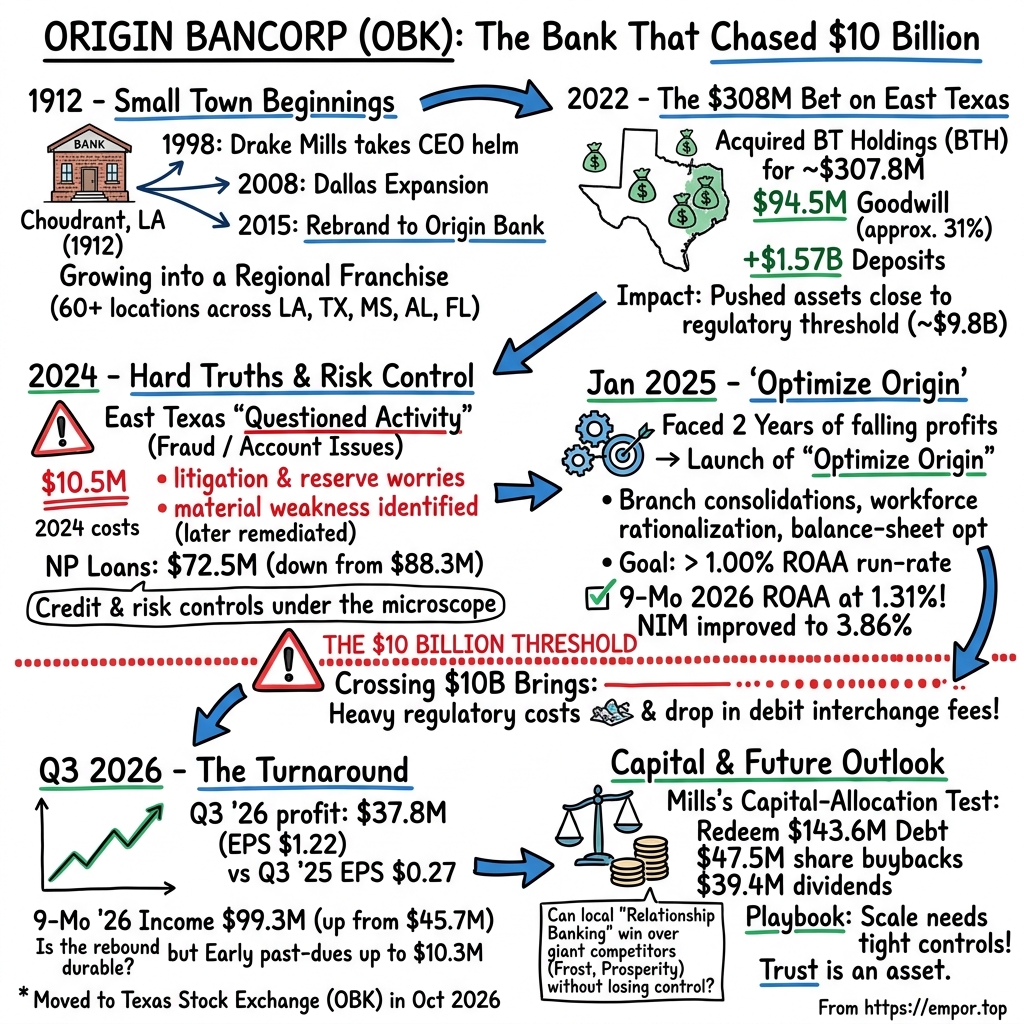
Origin Bancorp: The Bank That Chased $10 Billion
I. The Quarter the Story Turned
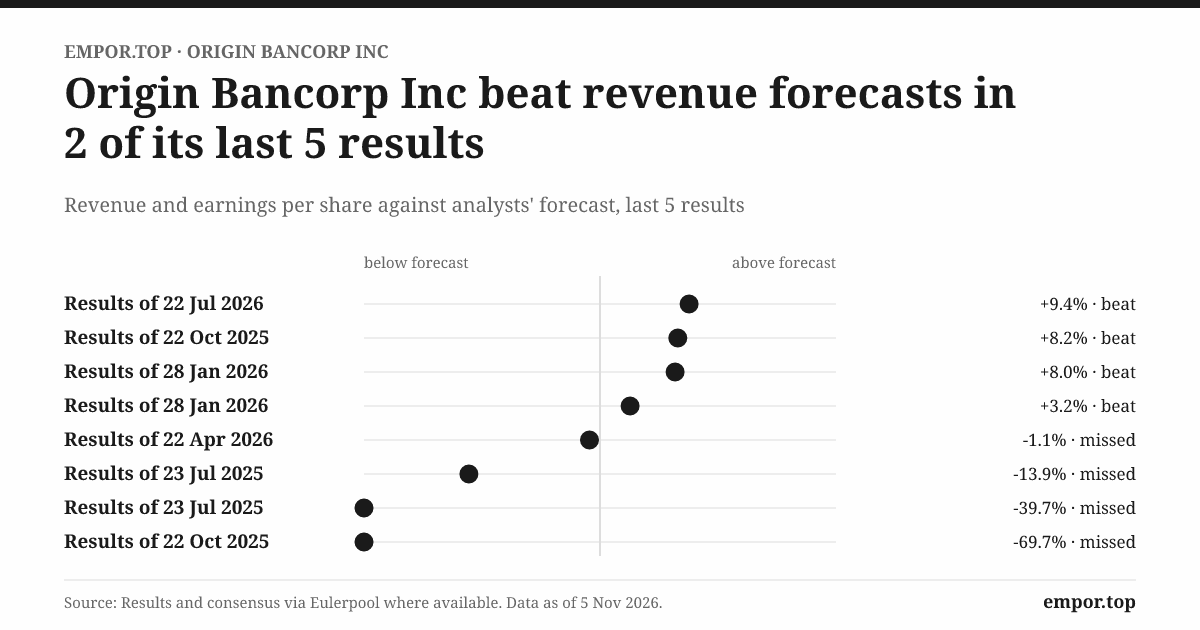
In the last week of October 2026, Drake Mills had the kind of number a bank chief executive waits years to say out loud. Origin Bancorp had earned $37.8 million in the third quarter, or $1.22 a share.[^1] A year earlier, the same three months had produced $0.27 a share, a result so thin that it barely covered the dividend.[^1] For a regional lender based in Ruston, Louisiana, a fourfold jump in quarterly earnings is not a rounding error. It is the sort of swing that makes analysts reopen their models and makes long-suffering shareholders wonder whether the hard part is finally over.
Read the same release a little more slowly, though, and the picture splits in two. On one side of the screen sat the rebound: nine months of 2026 profit totalling $99.3 million, more than double the $45.7 million earned in the first nine months of 2025.[^1] On the other side sat two small, stubborn numbers that do not usually make headlines. Loans that were 30 to 89 days past due, the early-warning tier where borrowers have missed a payment or two but have not yet been classified as problems, rose to $10.3 million from $5.2 million at the end of June.[^1] And the bank's securities portfolio, the pile of bonds a lender holds alongside its loans, was carrying a larger unrealized loss, with accumulated other comprehensive loss of $96.4 million after tax at the end of September.1 Neither figure is alarming against a bank of this size. The past-due loans were about 0.13% of the loan book.[^1] But the direction of both was the wrong way in a quarter that was otherwise a victory lap.
That split-screen is the right way into the Origin story, because the company spent the previous three years teaching investors that its headline numbers and its underlying health could diverge. Profit fell from $83.8 million in 2023 to $75.2 million in 2025, a stretch in which the bank discovered that a former banker in East Texas had mishandled customer accounts and loans, disclosed a material weakness in internal controls, booked a $46.3 million credit-loss provision in 2025, and launched a turnaround program with its own name and its own target.2[^4] The 2026 earnings jump arrives against that soft comparison. A quarter that looks spectacular next to a bruised year can still be ordinary next to a healthy one.
So the question hanging over the October release is not whether Origin made more money. It plainly did. The question is whether the improvement is durable or mostly the echo of a costly 2025 rolling out of the comparison. Four smaller questions sit inside it, and they run through every chapter of this story. Can the rebound last once provisions return to a normal level? Is asset quality genuinely getting better, or have the problem loans simply moved from one bucket to another? Can Origin cross the $10 billion asset line, where federal rules start to cost a bank real money, without giving back the returns it fought to recover? And is management, led by a chief executive who has been at the top of the company since the late 1990s, allocating capital in a way that builds value for each share rather than simply making the bank bigger?
Before going further, it helps to be precise about what an investor actually owns. The listed company is Origin Bancorp, Inc., a financial holding company. Nearly all of its economics come from its wholly owned subsidiary, Origin Bank, which takes deposits and makes loans across Texas, Louisiana, Mississippi, Alabama and the Florida Panhandle.2 A smaller subsidiary, Forth Insurance, sells insurance as an agency and earns commissions rather than underwriting risk itself.2 When this story speaks of loans, deposits and capital ratios, it is talking about the bank. When it speaks of earnings per share and buybacks, it is talking about the holding company that sits on top. The two are closely tied, but the distinction matters when regulators measure capital, because the bank and the holding company each carry their own ratios.
There is one more piece of context from the fall of 2026. In September, Origin announced it would move its stock listing from the New York Stock Exchange to the new Texas Stock Exchange, keeping the ticker OBK, and its third-quarter report already listed the shares on the Texas venue.[^5]1 It was the company's third home in eight years: Origin went public on Nasdaq in 2018 and moved to the NYSE in 2023.3 A listing venue says something about a company's identity and its ambitions to be seen as a Texas bank, and it may shave some listing costs. It says nothing about loan quality, deposit costs or returns on equity. The exchange is the stage. The performance still has to happen on it.
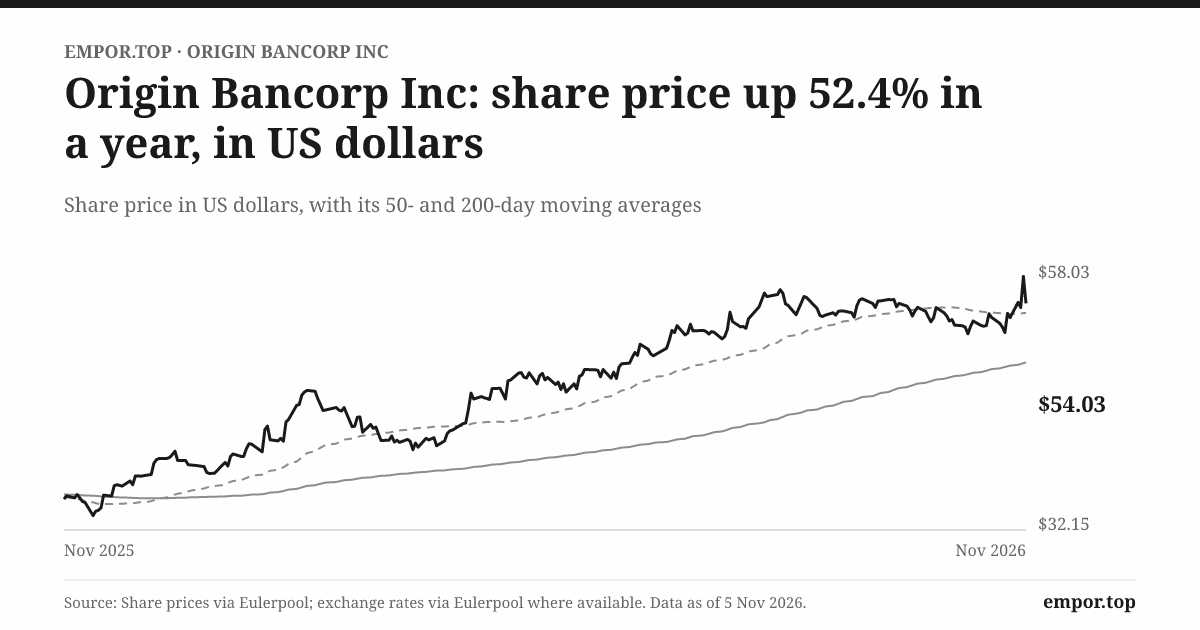
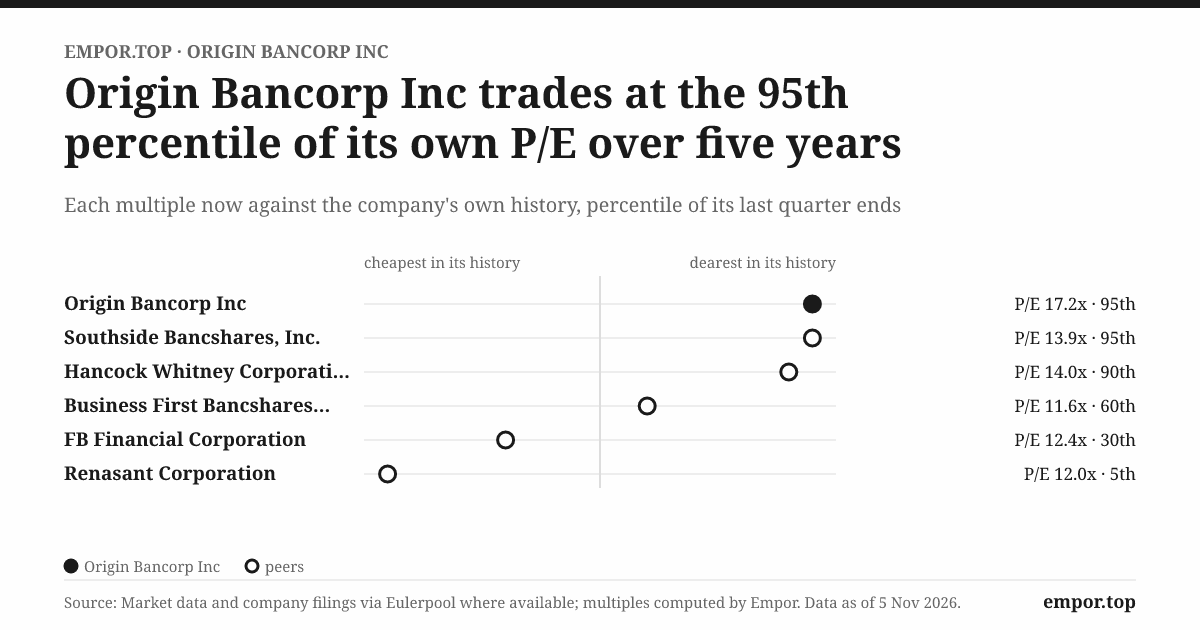
At about $54 a share in early November, the market valued Origin at roughly $1.7 billion, or about 17 times trailing earnings, well above the 13 times the stock fetched on average over the previous five years. Investors, in other words, had already started to pay for the recovery. Whether they paid too early depends on a story that starts more than a century ago, in a farming town most of them could not find on a map.
 Subscribe on LinkedIn
II. A Century-Old Bank Leaves Home
Choudrant, Louisiana, sits in Lincoln Parish along the old rail line between Monroe and Ruston, a place of pine woods, cotton and sweet-potato fields. In 1912, the Bank of Choudrant opened its doors there with $10,000 of capital.3 By the company's own telling, the deed for its land carried the signature of Theodore Roosevelt.3 Whether or not that detail is the most important thing about the founding, it captures the self-image the bank has carried ever since: a small-town institution with deep roots, a long memory and an unusually close relationship with the people who walk through its door.
For most of the twentieth century, that was all it was. The bank that would become Origin grew the way rural Southern banks grew, slowly and locally, by being the lender of record for farmers, merchants and families in a handful of parishes. The real change began in the late 1980s. In 1987, the organization acquired the Bank of Bernice in Union Parish and renamed it Community Trust Bank; in 1991, it formed a holding company, Community Trust Financial Corporation.3 Through the 1990s and early 2000s, it pushed into Ouachita Parish around Monroe and bought First United Bank in Farmerville.3 These were sensible, contiguous moves. A north Louisiana bank was becoming a bigger north Louisiana bank.
Then, in 2008, it did something rural Louisiana banks rarely do. The same year it crossed $1 billion in assets, Community Trust opened its first location in Dallas.3 The timing looks bold in hindsight, because the global financial crisis was tearing through the banking industry, and because a Louisiana lender walking into one of the most competitive banking markets in the United States was a little like a regional diner opening across the street from a food hall. The logic, however, was simple. North Louisiana is a slow-growing economy. Dallas–Fort Worth was one of the fastest-growing metropolitan areas in the country, full of mid-sized businesses whose owners often felt overlooked by the giant national banks. If the bank's edge really was relationships, the best place to sell relationships was where the customers were multiplying.
The next seven years were a march outward. In 2009, it bought First Louisiana Bank in Shreveport–Bossier City and opened in Fort Worth and Plano.3 In 2010, it acquired the parent of Madison County Bank and entered Mississippi.3 In 2013, it reached Houston.3 And in 2015, Community Trust Bank changed its name to Origin Bank.3 The rebrand mattered more than a new logo usually does. "Community Trust" sounded like a hometown bank; "Origin" sounded like a regional franchise that wanted to be taken seriously in Dallas boardrooms. In 2018, Origin Bancorp completed its initial public offering, selling company and existing-holder shares at $34 each.43 By then, the bank that had opened with $10,000 in Choudrant was a multi-billion-dollar lender with a Texas strategy and a Louisiana accent.
The person who steered most of that journey is still running the company. Drake Mills, a Louisiana Tech finance graduate, started at the bank as a check file clerk and worked his way through nearly every seat in the building: night computer operator, branch manager, consumer loan officer, commercial lender and chief financial officer.5 He has served as president of the company since 1998, later added the chief executive title, and has chaired the board since 2012.5 He was 65 at the time of the 2026 proxy.5 Day-to-day leadership of the bank itself sits with Lance Hall, a 25-year veteran of the organization who became Origin Bank's president and chief executive in January 2020.56
It is tempting to treat a career like Mills's as proof of something, and in one sense it is. Few chief executives in American banking can say they once filed the checks. That kind of history usually produces leaders who know how every department actually works, who are trusted by long-tenured employees, and who can carry a strategy across decades rather than quarters. The Dallas push, the Houston entry and the move toward a regional brand all happened under the same leadership, which gave the strategy a consistency that many acquisitive banks lack.
But tenure is context, not evidence of skill. The same continuity that kept the strategy steady also means that the problems of the past three years, from the control failures in East Texas to the profit slide that prompted a formal turnaround program, happened on the same watch. A fair reading of Mills's record has to weigh both against how management explained what went wrong in 2024, what it promised in 2025 and what it actually delivered in 2026. Long tenure earns a leader the benefit of the doubt about intentions. It does not earn a pass on outcomes.
The succession bench matters here too, because a 65-year-old chief executive who has run the company for more than a quarter-century raises an obvious question about what comes next. Lance Hall, the bank's chief executive, came up through the organization the long way as well. He served as Origin's Louisiana state president from 2013 to 2018, held chief strategy and chief operating officer roles, and spent four earlier years at Regions Bank, one of the South's large regional lenders.5 He became president of Origin Bank in July 2018 and its chief executive in January 2020.5 The arrangement gives Origin a two-tier leadership structure common in community banking: the holding-company chief sets strategy and capital priorities, while the bank chief runs lending, deposits and operations. It also means the bench is visible to investors, even if the board has not publicly tied it to any succession timetable.
By 2024, Origin had added South Alabama and the Florida Panhandle to its map and operated more than 60 locations across five states.32 The question that expansion raises is the one that runs underneath this entire story. Did growth build a stronger relationship franchise, one where customers stay because they value the bank, or did it simply build a larger balance sheet with more risk to manage? The clearest test came in 2022, when Origin made the largest bet in its history and paid for it with its own stock.
III. The $308 Million Bet on East Texas
Quitman, Texas, is a county seat of a few thousand people about 80 miles east of Dallas, the kind of place where a local bank can still be the most important business in town. It was the home of BTH Bank, the subsidiary of BT Holdings, and in August 2022 it became part of Origin.73 Origin paid with shares rather than cash, issuing stock worth about $307.8 million to BTH's owners.7 In return, it took on a 13-location network that stretched across East Texas and into the Dallas–Fort Worth area, along with roughly $1.57 billion of deposits.7 When the deal closed, the combined company had about $9.8 billion in assets.7
That last number tells you a lot about what Origin was really buying. A bank with $9.8 billion in assets sits just below the most consequential line in American community banking. Once a bank crosses $10 billion, the rules change. Its debit-card interchange fees, the small cut a bank receives every time a customer swipes, become capped by the Federal Reserve's Durbin rules. It comes under direct supervision by the Consumer Financial Protection Bureau. Its compliance, risk management and stress-testing expectations rise. Many banks spend years hovering just below the threshold, reluctant to cross it until they are big enough to absorb those costs. BTH put Origin within touching distance of the line, which meant that every strategic decision after August 2022 would be made with the threshold in view.
The strategic appeal of the deal was easy to see. East Texas was a natural bridge between Origin's Louisiana roots and its big-city Texas ambitions, a stretch of small cities and rural counties where a relationship bank could gather low-cost deposits and lend to local businesses. BTH also brought presence in Dallas–Fort Worth, deepening Origin's position in the market it had entered in 2008. For a bank whose pitch was local knowledge, buying a lender that already knew the towns between Shreveport and Dallas made more sense than trying to build branches from scratch.
The premium is where the story becomes more interesting. Origin recorded $94.5 million of goodwill on the transaction, which means that about 31% of what it paid was for something beyond the fair value of BTH's identifiable assets and liabilities.7 Goodwill is the accountant's word for the hope inside an acquisition: the expectation that customer relationships, a trained workforce and a market position will earn more than the balance sheet alone would suggest. Paying for goodwill is not a mistake in itself. Every bank deal involves it. But it creates a clear test. If the relationships stay and grow, the premium was worth paying. If they leak away, the goodwill sits on the balance sheet as a reminder of what was supposed to happen.
The early evidence was mixed. By the end of 2022, the deposits that had come from BTH stood at $1.45 billion, down from the roughly $1.57 billion acquired at closing.72 That decline happened during the year the Federal Reserve raised rates at the fastest pace in four decades, when depositors everywhere were moving money into higher-yielding accounts and money-market funds. Origin's legacy deposits, excluding the acquired balances, also fell during 2022, by $361.5 million, or about 5.5%.2 In that context, BTH's outflow does not look like a unique failure of the acquired franchise. It looks like the whole industry's 2022 problem landing on a freshly bought bank. Still, the fact remains that within months of paying a premium for deposits, Origin owned fewer of them.
Was the price cheap or expensive? That depends on how it compares with what other buyers paid for similar banks, usually measured as a multiple of tangible book value, and Origin's merger disclosures do not make a clean comparison easy. What can be said is narrower. Origin paid in stock, not cash, so BTH's former owners became Origin shareholders and took part of the risk with them. The goodwill share was meaningful but not extreme for a bank deal of that era. And the transaction's real payoff, more deposits, better markets and a path to scale, would have to be proven over years rather than at closing. Declaring the deal a triumph or a blunder on the evidence available would be overreaching. The more honest verdict is that the purchase bought something useful and that the receipts are still being counted.
Then came the complication nobody priced in. The deal deepened Origin's exposure to East Texas just before the bank discovered a serious problem in that same market. In 2024, Origin found what it would call "questioned activity" by a former banker there.2 The company has not suggested that every East Texas credit problem came from one person, and this story does not either. But the coincidence of geography is hard to ignore. Origin had just paid a premium to become a bigger player in a region, and within two years it was conducting forensic work on loans made there.
Step back, and the BTH deal asks a question that matters for any acquisitive bank. What does a premium really buy: deposits and distribution, or loan growth that demands a tougher credit-control system than the buyer had built? Deposits are only worth what they cost to keep. Loans are only worth what they collect. And branches are only worth the judgment of the people who work in them. In East Texas, that last point was about to become painfully concrete.
IV. The Banker Who Made Growth Harder to Trust
Every bank runs on the same quiet assumption: that the person across the desk is doing what the records say. A loan officer opens accounts, moves money and approves credit on behalf of the institution, and the institution checks that work through systems designed to catch mistakes before they become losses. In 2024, Origin learned that, for one former banker in East Texas, those systems had not been enough. The banker was terminated, the affected loans were placed on nonaccrual, meaning the bank stopped counting their interest as income, and Origin began the slow work of forensic review, customer litigation and reserve adjustments.2
The bill arrived in stages. In 2024, costs associated with the questioned activity came to $10.5 million.[^11]2 That is not a sum that threatens a bank with more than $1 billion of equity. But money was never the only cost. A relationship bank sells judgment: the idea that its local people know their customers well enough to lend wisely and serve them honestly. When one of those people mishandles customer accounts, the damage reaches past the loan file. It raises a question every investor and regulator asks next. If this happened here, what else did the controls miss?
Origin's answer came in two parts, and it is worth separating them, because they are often blurred together. The first was the former banker's activity itself, a credit and conduct problem. The second was a broader internal-control weakness that the company disclosed in February 2025: its controls over employees initiating manual transfers between deposit accounts were not designed or operating effectively, a gap that had persisted through the third quarter of 2024.[^4] A material weakness is the most serious category of control deficiency a public company can report. It means there was a reasonable possibility that a material misstatement in the financial statements would not be prevented or caught in time. In plain terms, the bank had to admit that one of the plumbing systems it used to move customer money did not have adequate locks.
The company then fixed the plumbing. By the end of 2025, its auditor reported that internal control over financial reporting was effective, and the financial statements received an unqualified opinion.2 That remediation counts for something. Material weaknesses at banks do not always get closed within a year, and Origin's clean year-end opinion means the specific deficiency around manual transfers was no longer an open wound. Still, a clean opinion in 2025 does not erase the earlier failure. It narrows it. The record now shows a bank that had a real control gap, disclosed it, and closed it, which is better than the alternative and worse than never having it at all.
How management explained the problem over time is part of the evidence. In early 2025, the company said it could not estimate additional potential losses from the activity.[^4] A year later, the 2025 annual report offered a more detailed picture: Origin had recognized $2.6 million of insurance recoveries during 2025, but had also booked a $1.3 million net increase in its loan-loss provision tied primarily to litigation taking longer than expected.2 Management said it still could not estimate any additional loss, considered more loss reasonably possible, and did not expect the ultimate outcome to be material to the company's financial position.2 That is a careful, lawyerly position, and it is consistent across filings. It is also not a resolution. Two years after discovery, the litigation was still moving, and the final cost was still unknown.
The more important question for investors is whether the bank's broader credit file is healing. Here the evidence improves, with caveats. Nonperforming loans, the loans that are no longer paying as agreed, stood at $72.5 million at the end of September 2026, down from $88.3 million a year earlier.[^1] The allowance for credit losses, the reserve a bank sets aside against expected future losses, was $98.4 million, or 1.22% of loans.[^1] Third-quarter net charge-offs, the loans actually written off after recoveries, were $2.7 million, a modest number for a loan book of about $8.1 billion.[^1] Read together, those figures describe a bank whose problem loans are shrinking and whose reserve covers its nonperformers with room to spare.
And yet the early-delinquency figure that opened this story did not move in the same direction. Loans 30 to 89 days past due roughly doubled in the third quarter.[^1] Most loans that fall a month or two behind are cured. Some are not, and the ones that are not become tomorrow's nonperformers. One quarter of rising early delinquencies is a reason to watch, not a reason to panic. But it is the reason that falling nonperforming loans alone cannot settle the asset-quality question.
There is a deeper reason for caution, and it is built into how bank accounting works. Under the current expected credit loss standard, a bank's reserve is not just a tally of bad loans. It is a forecast of losses over the life of every loan, built from economic scenarios, historical loss rates and management judgment. Origin's auditor flagged the allowance as a critical audit matter, the auditor's way of saying that this number involves especially subjective judgment and required especially careful testing.2 That is common at banks, not a red flag on its own. It does mean that a reserve of 1.22% of loans is an estimate, not a fact, and that it can move if the economy, the real estate market or the litigation turns.
The verdict on this chapter is clear enough to state plainly. The East Texas episode is not shown to threaten Origin's solvency; the dollar costs were small relative to its capital, and the specific control weakness was closed. But it was material to confidence. It showed that a relationship bank's greatest asset, the judgment of its local bankers, can also be its sharpest vulnerability when controls lag growth. By the start of 2025, Origin's leadership faced a credibility problem as well as a profitability one. Its response was to put a name on the fix, and a number on the goal.
V. Optimize Origin Meets the $10 Billion Line
In January 2025, Origin did something banks under pressure often avoid. It set a public target and attached a date to it. Reported profit had slipped for two years, from $83.8 million in 2023 to $76.5 million in 2024, and dipped again to $75.2 million in 2025.52 So when management presented its fourth-quarter 2024 results, it unveiled a program called Optimize Origin and committed to reaching a return on average assets run rate of 1% or better by the fourth quarter of 2025.[^11][^12]
Return on average assets, or ROAA, is the cleanest single gauge of a bank's earning power. It asks a simple question: for every $100 of assets on the balance sheet, how much profit does the bank produce in a year? For community and regional banks, about $1 has long been the rough line between solid and mediocre. In 2025, Origin's reported ROAA was 0.77%, meaning it was earning 77 cents on every $100 of assets, roughly a quarter less than the benchmark it had promised.5 The 1% target was therefore not a vanity goal. It was a promise to close a visible gap within a year.
The program had several parts, and none of them was glamorous. Origin consolidated branches, rationalized its workforce, repositioned part of its securities portfolio by selling low-yielding bonds and reinvesting at higher rates, and reworked the balance sheet to lean away from expensive funding.[^11]2 It paired that with a push on productivity and employee engagement, the softer side of a cost program meant to keep the people who generate revenue while trimming the processes that do not.2 Management projected that these actions would produce about $37.2 million of annual pre-tax improvement by the end of 2025.[^11] For a company that had earned about $95 million before tax in 2025, that projected improvement was large, roughly two-fifths of the year's pre-tax profit.2
Did it work? On the headline target, yes. Origin reached the better-than-1% ROAA run rate in the fourth quarter of 2025, when it earned about $29 million in three months on a balance sheet of roughly $9.7 billion.[^1]2 And 2026 went further. Over the first nine months, ROAA was 1.31%, against 0.63% in the same period of 2025, and the third quarter alone reached 1.47%.[^1] KBRA, the rating agency, said in February 2026 that the large one-time costs of the program in 2024 and 2025 were largely behind the company and that the initiative was gaining traction.8
The more useful question is why the numbers improved, because the answer tells you how durable the improvement might be. Two engines did most of the work. The first was net interest income, the difference between what the bank earns on loans and securities and what it pays on deposits and borrowings. It rose to $274.6 million over the first nine months of 2026 from $244.3 million a year earlier, an increase of about 12%.[^1] The net interest margin, which measures that spread as a percentage of earning assets, improved to 3.86% from 3.57%.[^1] Think of the margin as the markup in a grocery store: a bank that raises its markup by almost three-tenths of a point across $9 billion of earning assets has found tens of millions of dollars a year without growing at all. Some of that gain came from the securities repositioning and from paying off higher-cost funding. Some came from the interest-rate environment. Only the first part is clearly within management's control.
The second engine was credit costs, and here the comparison flatters 2026. The 2025 results absorbed a $46.3 million provision for credit losses, almost three times the $16.8 million booked in 2023.2 When a year that heavy rolls out of the comparison, profit rises almost automatically. The third quarter of 2026 also included a net benefit of about $2.1 million from items management classed as notable, the bank-industry term for one-off gains and charges.[^1] Strip out the easy comparison and the one-offs, and the improvement is still real, because the higher margin is real. But it is smaller than the doubling of nine-month profit implies.
The verdict deserves credit with a caveat. Origin hit the near-term target it set for itself, and it did so through identifiable actions rather than accounting reclassifications. That matters for credibility: in January 2025 the company named a goal, and by year-end it had met it. Management's longer-term ambition, which it has described as top-quartile performance among peers, is a different and much harder claim, and nothing in the record yet proves it.[^12] Hitting 1% from a starting point well below it is a turnaround. Staying near the top of the peer group through a credit cycle is a franchise.
That longer test now has a deadline, and it is the $10 billion line. At the end of September 2026, Origin's total assets were about $10.1 billion.1 Crossing that threshold brings the debit interchange, consumer-protection and compliance costs that came with the BTH deal. Origin also flags overdraft income as exposed, since banks of its new size face sharper regulatory scrutiny over those fees.2 The precise annual hit to revenue depends on the timing of when the caps take effect and on how many debit transactions its customers run, and the company has not published a single all-in figure. The direction is clear: interchange revenue will shrink, while some of the savings from Optimize Origin will go to compliance staff and systems.
The cap stings because Origin's processing costs do not fall with the regulated fee, making the first year above the line unusually revealing.
KBRA framed this as a manageable transition. It noted that Origin was expected to cross the threshold organically during 2026 and pointed to treasury-management fees and equity-method income from Origin's investment in Argent Financial, a trust and wealth firm, as potential offsets to lost interchange.8 Origin raised its stake in Argent above 20% in July 2025 and carried it at $51.8 million at year-end, earning $3.2 million from it that year.2 That is a sensible hedge, but it is a modest one, and it depends on a business Origin does not control.
The proof will come in two numbers that will not be known until next year: the full-year 2026 expense run rate, once the threshold costs start to land, and 2027 ROAA. If returns hold above 1% after a full year above $10 billion, Optimize Origin will have done more than repair a bad year. If they slip back toward 2025 levels, it will have been a cost cut that bought a few good quarters. Either way, the bank's returns ultimately depend on something no cost program can manufacture: customers who choose Origin when they have plenty of other options.
VI. The Relationship-Banking Promise
Picture the customer Origin is built for. She runs a mid-sized distribution company in Fort Worth, or a medical practice in Shreveport, or a contracting firm along the Gulf Coast. She needs a line of credit that flexes with the seasons, a treasury system that moves payroll and collects receivables, perhaps a loan for a new building. She could get all of that from JPMorgan Chase or Wells Fargo, which have better apps and bigger marketing budgets. She could get it from Frost or Texas Capital, which are Texas-born and many times Origin's size. Origin's pitch is that she should choose a banker who knows her market, picks up the phone, and can make a decision without sending her file to a committee in another state.
That pitch is the heart of what Origin calls relationship banking, and it is worth understanding the economics underneath it. Its core business is earning a spread between funding costs and what it earns on loans and securities. Fees from service charges, card transactions, mortgage activity and Forth Insurance's commissions add a smaller stream. KBRA estimates that noninterest income has historically run just below 20% of total revenue.8 In the first nine months of 2026, Origin earned $50.3 million of noninterest income against $274.6 million of net interest income, so fees were only about 15% of the total.[^1] Forth is a useful diversifier, and its insurance commissions do not depend on interest rates, but it is a small part of the picture. This is a lending business with an agency attached, not the other way around.
The loan book shows where the bank has chosen to compete. At the end of 2025, about 74% of loans held for investment sat in commercial and industrial loans, mortgage warehouse lines, commercial real estate, and construction and land development.2 Commercial real estate alone was about a third of the book.2 Mortgage warehouse lending deserves a brief explanation, because it is less familiar. It is short-term financing for independent mortgage companies, which use a bank's credit line to fund home loans for the few weeks before they sell them to investors. It can be profitable and relatively low-loss, but it rises and falls with the housing market. Taken together, the mix describes a bank deeply tied to local business activity and real estate in its five states. When those economies do well, so does Origin. When commercial property values fall, the bank feels it.
At the end of September 2026, Origin held about $8.1 billion of loans held for investment and about $8.7 billion of deposits.[^1]1 Roughly a quarter of those deposits paid no interest at all, which is the cheapest funding a bank can have and usually a sign of operating business accounts rather than rate-shopping savers.1 That is an encouraging marker for a relationship bank. Less encouraging is that about $4.03 billion of deposits, nearly half of the total, were uninsured, meaning balances above the federal deposit insurance limit.1 Large uninsured balances are typical of business-heavy banks. They are also exactly the kind of money that moved fastest during the spring 2023 bank runs, when depositors at Silicon Valley Bank discovered how quickly uninsured funds can leave. Origin's relationships are supposed to make that money sticky. The bank does not publish data showing how sticky it is.
That is the core difficulty with judging Origin's moat. A competitive advantage in banking usually shows up in a few measurable ways: customers staying longer, deposits costing less than rivals pay, loans priced above market without losing volume, or a lower cost to serve each account. Origin does not publish customer retention rates, win rates against competitors, or a series showing its deposit costs against peers. It reports no single customer large enough to matter on its own, which reduces one kind of risk, but the more important concentration is by asset class and geography, and there it is meaningful.2 So the relationship advantage is plausible and consistent with the deposit mix, but it is largely asserted rather than demonstrated.
The people are the product, and there are fewer of them than there used to be. Origin reported 988 full-time-equivalent employees at the end of 2025, after a year of workforce rationalization and branch consolidation under Optimize Origin.2 For a relationship bank, headcount is not just a cost line. Each banker carries a book of customers, and each departure risks taking some of those customers along. Cutting staff while promising more personal service is a delicate balance, and the bank has not disclosed how many client relationships moved with departing bankers or how its loan and deposit balances per banker changed. What can be said is that the cost savings were real enough to lift returns, and that the revenue line did not collapse in the process, which suggests the cuts fell more on process than on producers. Whether that remains true will show up slowly, in loan growth and deposit retention over the next several years.
The competitive map makes the stakes clear. Texas is home to some of the most capable regional banks in the country. Frost, Prosperity and Texas Capital each run balance sheets several times larger than Origin's, with deeper technology budgets and long-standing commercial relationships in the same Dallas and Houston markets. National banks bring cheaper funding and better digital products. Fintech lenders and payment firms nibble at the edges, offering small businesses faster credit decisions and slicker cash-management tools. Origin's own filings identify technology investment and the pace of product delivery as competitive risks.2
Run the industry through Michael Porter's lens once, and the shape of the fight becomes clear. Customers have real bargaining power, because a business owner can compare deposit rates and loan terms across several banks in an afternoon. Substitutes are everywhere, from money-market funds that compete for deposits to private-credit funds that compete for loans. Rivalry is intense in Texas, where large, well-run banks compete for the same commercial clients. Suppliers, in banking terms, are depositors and wholesale funders, and they gained power whenever rates rose. Barriers to entry are high for a new bank charter, which helps incumbents, but they do little to slow down the existing giants. In that environment, the only durable defenses for a bank of Origin's size are local knowledge, fast decisions and service that customers value enough to accept slightly less favorable pricing. Those defenses are real, but the public record does not quantify them.
So why might Origin win? Because in markets where the largest banks treat mid-sized businesses as a product segment, a bank that treats them as neighbors can earn loyalty, cheaper deposits and better credit information. And why might it not? Because loyalty is expensive to keep when rivals offer higher deposit rates; because larger banks can outspend it on technology; and because its heavy commercial real estate and construction exposure ties its performance to local property cycles it cannot control. The East Texas episode added a final caution. The same local autonomy that makes a relationship banker valuable also makes that banker harder to supervise. A relationship model wins only when the trust it builds with customers is matched by the controls the bank builds around its own people.
That brings the story back to the person at the top. A franchise with a plausible but unproven moat depends heavily on how management deploys the capital it earns. In 2026, Mills had more of it to deploy than he had had in years.
VII. Mills's Capital-Allocation Test
There is a moment in every turnaround when the cash starts to come back and management has to decide what to do with it. For Origin, that moment arrived in 2026. Earnings were recovering, capital ratios were strong, and the board faced the classic menu: raise the dividend, buy back stock, pay down debt, or keep the money to fund growth and the cost of a bigger, more regulated bank. Origin, in effect, did a little of everything at once.
Start with the dividend. Origin declared 15 cents a share in the first quarter of 2026, then lifted the quarterly payment to 25 cents in the second quarter and kept it there in the third.1 That is a two-thirds increase in the regular payout, the clearest signal a bank board can send that it believes the earnings recovery is sustainable. Dividends are hard to cut without damaging credibility, so a board that raises one this sharply is betting that 2026 is not a one-year spike.
Then the buybacks. Since the start of 2025, Origin repurchased about 1.1 million shares for $47.5 million, at an average price of about $43.[^1] With the stock near $54 in early November, those purchases look well timed, made roughly a fifth below the current price. Buying back stock is the most direct way to increase each remaining shareholder's claim on future earnings, but only if the price paid is below what the shares are worth and the capital is not needed elsewhere. On price, the record so far is favorable. On need, the answer depends on what the bank will cost to run above $10 billion.
The third use of capital was debt reduction. Since the start of 2025, Origin redeemed $143.6 million of subordinated debt, the long-term, lower-priority borrowings that banks use to bolster their capital base.[^1]1 By the end of September 2026, only about $16.6 million of net subordinated debt remained, along with $15.4 million of other borrowings.1 Paying off sub debt eliminates interest expense, which helps earnings, but it also gives up a layer of capital that cushions depositors and senior creditors in a downturn. Origin could afford it: its common equity tier 1 ratio, the core measure of loss-absorbing capital, was 13.74% at the holding company and 13.06% at the bank at the end of September, comfortably above regulatory minimums.1 It also had about $2.39 billion of unused borrowing capacity at the Federal Home Loan Bank and $1.25 billion at the Federal Reserve's discount window at the end of 2025.2 A bank with that much capital and liquidity is not under pressure. The question is whether it is using its strength well.
Add the three uses together and the scale of the commitment becomes clear. Between the start of 2025 and the end of September 2026, Origin spent about $47.5 million on buybacks, $143.6 million retiring subordinated debt and $39.4 million on dividends declared, roughly $230 million in all.[^1]1 Over the same seven quarters, it earned about $174 million, adding the $75.2 million of 2025 to the $99.3 million of the first nine months of 2026.2[^1] In other words, the bank distributed or retired more capital than it generated. The difference came from the excess capital it had accumulated before the turnaround, and from shrinking the debt layer rather than the equity layer. That is not reckless; a bank with a 13% core capital ratio can afford to give some back. But it does mean the cushion that carried Origin through 2024 and 2025 is thinner than it was, just as the bank enters the most expensive regulatory tier it has ever faced.
That question turns on the person making the decisions. Mills's compensation tells part of the story. His total pay was $2.64 million in 2025, up from $2.54 million in 2024 and $1.72 million in 2023.5 Over the same period, reported net income fell.5 His base salary stayed flat at $835,800, so the increase came mainly through stock awards and annual incentive pay, including $733,063 of non-equity incentive in 2025.5
The design of the bonus plan explains how pay could rise as profit fell. Three-quarters of the short-term incentive depended on financial metrics: a normalized pre-tax, pre-provision return on assets weighted at 30%, normalized net income at 25%, and two credit measures, nonperforming assets and net charge-offs, at 10% each.5 The remaining quarter depended on individual scorecards; Mills's included advancing the bank's $10 billion planning.5 The word that matters is "normalized." By adjusting for one-time items and stripping out provisions in the main return measure, the plan rewarded management for underlying operating performance rather than the headline result. The financial portion paid out at 96.2% of target for 2025, the year profit hit its low.5
There is a defensible argument for that design. A bank in the middle of a restructuring takes deliberate charges that hurt reported earnings in the short term, and paying executives less for doing the right thing would discourage the cleanup. But there is an equally fair skeptic's response. Provisions are not an accident in banking; they are the cost of lending decisions. A plan that rewards pre-provision returns in a year when credit costs nearly tripled pays management for the part of the business that went right while softening the consequence of the part that went wrong. A skeptical shareholder would ask the compensation committee to explain why a year with a material weakness, a lawsuit-driven provision and the lowest profit in recent years still produced near-target incentive pay. The newer long-term performance shares, tied equally to return on assets and return on equity over a period ending in 2027, align better with shareholder outcomes, because they will reflect whether post-threshold returns hold.5
Ownership adds another layer. Mills owned 229,539 shares in early 2026, less than 1% of the company.5 At $54 a share, that stake is worth about $12 million, a substantial personal investment but not the kind of ownership that makes a chief executive think like a controlling owner. No shareholder controls Origin. Its largest holders were BlackRock at about 8% and Vanguard at about 6%, both index-heavy managers whose stakes largely mirror benchmark weights.5 That makes the board, and shareholder votes, the main checks on management.
Shareholders have been supportive. At the 2025 annual meeting, 96.6% of votes cast approved the say-on-pay proposal.5 At the 2026 meeting in April, holders of 84.96% of eligible shares were represented, and the full vote tally was filed with regulators.[^14]5 High support is evidence that investors were comfortable with the pay structure, but it is not a verdict on whether the structure is optimal. Index funds tend to vote with management unless something is plainly wrong.
The related-party disclosures are worth noting in proportion. Mills owns a third of MNG Properties, which leased office space to Forth Insurance; Forth paid it $165,000 in rent and tax payments in 2025.25 His son, Tyler Mills, worked at Origin Bank and earned more than $120,000 in 2025.5 Loans to executives, directors and their affiliates fell to $9.2 million at year-end 2025 from $52.9 million a year earlier and were made on terms comparable to those offered to unrelated borrowers.2 These are disclosed, small and ordinary relationships for a community bank whose leaders are local businesspeople. They do not suggest material extraction of value. They are simply the sort of details a careful board keeps visible.
The real scorecard for Mills's capital allocation is not any single decision. It is the combined result over several years: diluted earnings per share and tangible book value per share after every dividend, buyback, debt redemption and the full cost of crossing $10 billion. Earnings per share fell from $4.60 in 2021 to $2.42 in 2025 before recovering to about $4.15 over the twelve months to September 2026.2[^1] On that measure, shareholders have spent five years mostly getting back to where they started. That leaves the question open: will the next dollar of capital go to buybacks at a price now near the stock's 52-week high, or to building the bank management says it wants to become? That choice, more than any single quarter, will determine whether today's valuation makes sense.
VIII. Analysis & Bear vs. Bull Case
Imagine two investors looking at the same screen in early November 2026. Origin's stock sits at about $54, within 5% of its 52-week high and roughly 60% above its low of the past year. The market values the company at about 17 times its trailing earnings and about 1.3 times book value. One investor sees a bank that has fixed its problems and deserves a better multiple. The other sees a bank priced as if the best quarter of its recent history is the new normal. Both are reading the same filings. The difference is in what they expect the next two years to look like.
Begin with the price itself. Over the previous five years, Origin's stock traded at a median of about 13 times earnings. Today's 17 times is a premium of roughly 30% to its own history. But that history includes years when earnings were depressed by provisions and restructuring charges, and the trailing earnings behind today's multiple include the soft fourth quarter of 2025 alongside the strong quarters of 2026. If the third quarter's run rate held for a full year, earnings per share would be closer to $4.90, and the multiple would look more like 11 times. That arithmetic is the bull case in miniature: the market is not paying a premium for today's earning power, only for last year's. The bear's reply is that a single quarter, flattered by low provisions and a notable-item benefit, is precisely the wrong base for annualizing.
Price-to-book tells the same story from another angle. A bank that earns exactly its cost of equity, the return shareholders demand for owning a risky lender, should trade at roughly its book value. Paying 1.3 times book implies the market expects Origin to earn meaningfully more than that hurdle for a long time. Over the twelve months to September 2026, return on equity was about 10%, a level that would not usually justify much of a premium. Annualize the third quarter alone, though, and Origin is earning something closer to 12% on its roughly $1.2 billion of equity, which begins to explain the price. The market, in short, is valuing the bank on its latest quarter rather than its latest year. That is a reasonable bet if the quarter is representative and an expensive one if it is not.
The bull case is specific and grounded in evidence. Optimize Origin delivered what it promised on schedule, with ROAA above 1% from late 2025 and near 1.5% in the latest quarter.[^1] The net interest margin rose by almost three-tenths of a point, driven partly by deliberate balance-sheet decisions rather than luck.[^1] Nonperforming loans fell meaningfully over the year.[^1] Capital ratios are strong enough to absorb a credit shock and still fund growth.1 KBRA affirmed its investment-grade ratings with a stable outlook in February 2026 and called the 2025 provision spike "largely idiosyncratic," meaning tied to specific situations rather than a broad deterioration.8 If that diagnosis holds, the 2025 earnings slump was a one-time cleanup and 2026 represents a cleaner baseline.
The bear case is equally specific. 2025 was the weakest profit year in recent history, and only a year later the market is pricing the stock at a premium to its own past.2 Commercial real estate is about a third of the loan book, and construction lending adds to that exposure.2 Early-stage delinquencies nearly doubled in the latest quarter.[^1] The costs of crossing $10 billion will start landing just as the earnings recovery is supposed to prove durable. Nearly half of deposits are uninsured, which makes funding costs sensitive to any loss of confidence.1 And the litigation tied to the East Texas activity is still unresolved.2 KBRA's own assessment cited execution risk and moderate credit headwinds alongside its stable outlook.8 None of these factors is decisive alone. Together, they describe a bank whose margin for error is thinner than its share price implies.
The moat question is where the two cases diverge most sharply. Hamilton Helmer's 7 Powers framework, which asks what structural advantages let a business earn returns above its cost of capital, gives a useful test. Origin has no network effects; one customer's deposit does not make the bank more valuable to another. It has no meaningful scale economies against Frost or Texas Capital; if anything, it is on the wrong side of that comparison. It has no counter-positioning, since its model is the same one many community banks have pursued for decades. Switching costs exist in banking, because moving treasury services and loan relationships is a hassle, but Origin does not disclose retention data that would show they are unusually high for its customers. It has no cornered resource or brand power of the kind that commands premium pricing. The most plausible power is process power, the embedded habits and local knowledge that let its bankers underwrite and serve customers better than a distant competitor. That is a real advantage in principle, but the East Texas episode is the strongest disconfirming evidence against it: the same autonomy that gives local bankers an edge also produced Origin's most expensive control failure. The history does not reject the relationship claim. It narrows it to a smaller, conditional version: Origin's local model works when its controls keep pace, and the evidence for a durable edge remains limited.
There is also a funding and securities dimension that investors should keep in view. At the end of September 2026, accumulated other comprehensive loss, mostly the unrealized loss on bonds held in the available-for-sale portfolio, was $96.4 million after tax.1 That does not reduce regulatory capital for a bank of Origin's size under current rules, but it does reduce tangible book value, which is what many investors use to value banks. The securities portfolio's weighted average duration had lengthened to about 4.65 years, meaning its value would fall further if long-term rates rose.1 In plain terms, the bank has locked in more of its bond income for longer, which helps if rates fall and hurts if they rise. It is a modest exposure next to Origin's capital base, but it is a reminder that the 2023 bank failures started with exactly this kind of rate-driven loss on securities combined with uninsured deposits.
So what should an investor actually watch? Three indicators carry most of the signal. The first is the net interest margin, last reported at 3.86% for the first nine months of 2026 and rising.[^1] If it holds as the rate environment shifts and as Origin competes harder for deposits, the core earnings engine is sound. The second is credit migration, the movement of loans from current to past due to nonperforming to charged off. Nonperforming loans were falling while early delinquencies were rising, and the next two quarters will show which trend wins.[^1] The third is expense growth relative to assets after the bank crosses $10 billion. If costs rise faster than the balance sheet, the threshold is eating the Optimize Origin savings; if they rise slower, management has absorbed the burden.
An activist looking at Origin would not find much to attack on the balance sheet. Capital is strong, leverage is low, and the related-party relationships are small. The harder questions would be about accountability and capital priorities. Why did incentive pay rise while reported profit fell? Why buy back stock aggressively near multi-year highs if the costs of the threshold are still uncertain? What is the measurable return on the BTH acquisition after four years? And what specific evidence, beyond management's description, shows that the relationship model produces better retention or pricing than rivals? Those are questions a well-run bank should be able to answer with data. So far, Origin has answered them mainly with results, which have improved, rather than with disclosures, which remain thin.
The verdict is balanced, but not bland. The bull case has real support in better margins, lower provisions and a target that was met on time. The bear case is that normalized credit costs, regulatory expense and competition could pull returns back toward their recent average, leaving a stock that has re-rated faster than the business has proven itself. The premium the market pays coincides with a rebound from an unusually bad 2025. Whether it survives depends on lessons Origin has had to learn the hard way.
IX. Playbook: Business & Investing Lessons
Every bank story eventually becomes a story about trust: the trust of depositors who leave their money, of regulators who supervise it, of investors who pay a multiple for its earnings. Origin's past four years compress that theme into a single, unusually clear arc. A bank bought scale in a market it wanted to own, found that a banker in that market had betrayed the controls meant to protect customers, rebuilt its returns under a public deadline, and now has to prove that the rebuild can survive the costs of being larger. The lessons from that arc belong to Origin, but they travel well.
The first lesson begins in Quitman, with the BTH deal, whose early deposit outflow put the value of the acquired relationships to an early test.72 The point is not that the deal failed. It is that its value could only ever be measured after closing, in the deposits that stayed and the loans that performed. A deal is only as good as the deposits and relationships that stay after the press release. For founders and acquirers, that means pricing a purchase on what the target's customers will do, not on what its balance sheet says on the day the papers are signed.
The second lesson comes from East Texas, where the questioned activity damaged credibility as well as causing financial costs.[^11] In most industries, a single employee's misconduct is a personnel problem. In a relationship bank, it goes to the heart of the product, because what the bank sells is the judgment of its people. In a relationship bank, trust is an asset on the balance sheet, even when accounting cannot measure it. The wider lesson is that a business built on local autonomy has to spend proportionally more on oversight, not less, because the edge and the risk grow from the same root.
The third lesson is about targets. Origin met the 1% ROAA deadline it set for the fourth quarter of 2025.[^11][^1] That act alone changed the conversation, because a public number forces internal decisions that vague ambitions never do: which branches close, which bonds get sold, which roles disappear. But a target matters most when it changes how the bank operates, and then survives the next cost cycle. The first half of that sentence is now proven. The second half begins the day the threshold costs arrive.
The fourth lesson belongs to the capital decisions of 2026. Origin returned capital in several ways, and its capital ratios showed the bank could afford to do so.1[^1] But capital spent is capital that cannot be used to fund growth, absorb a credit shock or pay for the compliance build-out above $10 billion. Buybacks create value only when the bank can still fund the franchise it wants to become. For investors, the lesson is to judge every buyback against the opportunities it displaces, not just against the share price.
Taken together, the four lessons point to the same principle. Scale, controls and returns are not separate projects to be managed by separate departments on separate timelines. Origin chased scale first, discovered the control gap second and repaired returns third. Its next chapter will test whether it can keep all three moving together.
X. Epilogue
Tonight, Origin Bancorp stands in a place it has spent four years trying to reach. Its assets are above $10 billion.1 Its stock trades under the ticker OBK on a new exchange in the state it chose as its growth engine.[^5]1 Its quarterly return on assets is at a level management once described only as a goal.[^1] Its dividend is two-thirds higher than at the start of the year, and its subordinated debt is nearly gone.1 By most of the measures a bank chief executive likes to cite, Drake Mills has turned the ship.
What remains is the part that no press release can settle. The first decisive moment will come with the 2026 year-end results in January. They will show full-year provisions and charge-offs, which will reveal whether the third-quarter rise in early delinquencies was a blip or the first sign of a new credit cycle. If those past-due loans cure, the asset-quality story will look clean. If they roll into nonperforming status, the reserve and the ROAA both come under pressure, and the market's premium becomes harder to defend.
The second moment will unfold through 2027, as the costs of being a $10 billion bank show up in the expense line. Lost interchange income, heavier compliance and higher risk-management spending are not hypothetical; they are the known price of the threshold. The question is whether the savings from Optimize Origin and new revenue from treasury services and Argent are enough to absorb them. A full year of results above the line, with ROAA still comfortably above 1%, would answer the question this story began with. A slide back toward the 2025 level would suggest that the 2026 recovery was a well-timed lull between two sets of costs.
The third test is less visible but just as important: the funding base. Origin competes for deposits against banks several times its size, and nearly half of its deposits are uninsured.1 If its noninterest-bearing share holds near a quarter of deposits while rivals compete aggressively on rates, the relationship franchise is doing what management says it does. If those balances migrate to higher-cost accounts or leave altogether, the margin gains of 2026 will erode from the funding side, no matter how disciplined the expenses.
There is also the matter of management's voice. In 2025, Origin explained its problems with specificity: it named the control weakness, quantified the costs, set a target and met it.[^4][^11] That openness is a credibility asset. The next test is whether management uses the same precision if something goes wrong above $10 billion, whether a miss is met with a plan or with a narrative. Investors would also benefit from data the company does not yet publish, such as customer retention, deposit costs against peers and the return on the BTH franchise, because without it the moat question stays open by default.
The story ends, for now, with a tension rather than a conclusion. The recovery is real in reported results. Its durability rests on clean credit migration, disciplined costs and capital returns that do not erode the bank's capacity to grow. Only post-threshold results can settle the return question, and no published retention data can yet settle the moat question. Origin has proven it can fix a bad year. It has not yet proven it can be a better bank.
XI. Outro
Back in Choudrant, the old bank began as a small-town institution, with, by its own lore, a deed signed by a president.3 Its customers were farmers and storekeepers whose names every teller knew. More than a century later, its descendant is a $10 billion regional lender facing the costs and scrutiny of its expanded reach.31 The distance between those two pictures is the whole story of American community banking: the long march from knowing your customers by name to managing them by portfolio.
Origin's bet is that it never has to choose between the two, that a bank can grow to regional scale and still keep the small-town judgment that made it worth trusting in the first place. The last four years showed both sides of that bet: the relationships that justify a premium and the single banker who made growth harder to trust. Size has answered the question of whether Origin could become big. The question that began this story is still waiting for its answer: can Origin keep the relationship advantage as it takes on the costs and scrutiny of being larger?
References
-
Origin Bancorp Form 10-Q for the quarter ended September 30, 2026 — U.S. Securities and Exchange Commission, 2026-11-06 ↩↩↩↩↩↩↩↩↩↩↩↩↩↩↩↩↩↩↩↩↩
-
2025 Annual Report — Origin Bancorp, 2026-02-25 ↩↩↩↩↩↩↩↩↩↩↩↩↩↩↩↩↩↩↩↩↩↩↩↩↩↩↩↩↩↩↩↩↩↩↩
-
Final IPO Prospectus (Form 424B4) — U.S. Securities and Exchange Commission, 2018 ↩
-
2026 Proxy Statement — U.S. Securities and Exchange Commission, 2026-03-13 ↩↩↩↩↩↩↩↩↩↩↩↩↩↩↩↩↩↩↩↩↩
-
Origin Bancorp Form 10-Q for the quarter ended September 30, 2022 (BT Holdings acquisition) — U.S. Securities and Exchange Commission, 2022 ↩↩↩↩↩↩↩
-
KBRA Affirms Ratings for Origin Bancorp, Inc. — KBRA, 2026-02-12 ↩↩↩↩↩
 LinkedIn
 WhatsApp
 Reddit
 Hacker News
 Email
 Kindle
 RSS Feed
 Spotify
 Apple Podcasts
 Amazon Music
 Audible
 YouTube